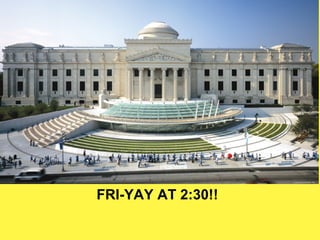
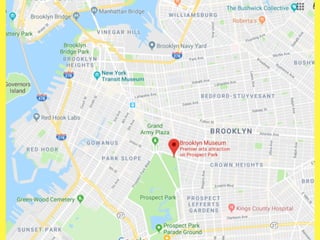
FRI-YAY AT 2:30!!
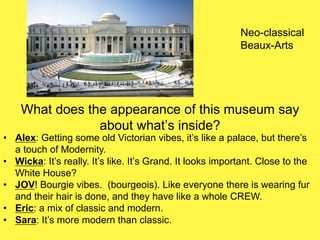
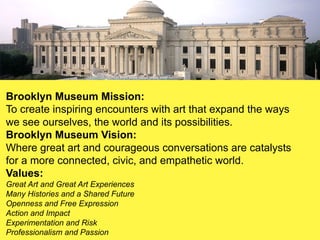
What does the appearance of this museum say
about what’s inside?
• Alex: Getting some old Victorian vibes, it’s like a palace, but there’s
a touch of Modernity.
• Wicka: It’s really. It’s like. It’s Grand. It looks important. Close to the
White House?
• JOV! Bourgie vibes. (bourgeois). Like everyone there is wearing fur
and their hair is done, and they have like a whole CREW.
• Eric: a mix of classic and modern.
• Sara: It’s more modern than classic.
Neo-classical
Beaux-Arts
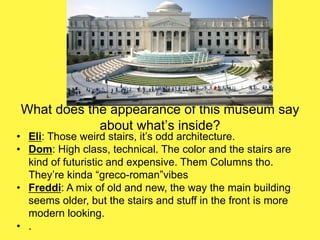
What does the appearance of this museum say
about what’s inside?
• Eli: Those weird stairs, it’s odd architecture.
• Dom: High class, technical. The color and the stairs are
kind of futuristic and expensive. Them Columns tho.
They’re kinda “greco-roman”vibes
• Freddi: A mix of old and new, the way the main building
seems older, but the stairs and stuff in the front is more
modern looking.
• .
Brooklyn Museum Mission:
To create inspiring encounters with art that expand the ways
we see ourselves, the world and its possibilities.
Brooklyn Museum Vision:
Where great art and courageous conversations are catalysts
for a more connected, civic, and empathetic world.
Values:
Great Art and Great Art Experiences
Many Histories and a Shared Future
Openness and Free Expression
Action and Impact
Experimentation and Risk
Professionalism and Passion
May 4, 2019 : Celebrate SPRING!
Music: Descarrilao
5–6 pm
Enjoy a fusion of Afro-Caribbean, merengue, pop, and
cumbia sound from bilingual salsa dura rock band
Descarrilao.
Teen Pop-Up Gallery Talks
6:30–7:30 pm
Teen Apprentices host ten-minute talks about works on
view in One: Egúngún.
Music: Arooj Aftab
7–8 pm
Pakistan-born, Brooklyn-based composer and performer
Arooj Aftab shares her ambient experimental music that
explores themes of female empowerment.
YO/OY
Deborah Kass
2015
APPEARANCES CAN
BE DECEIVING
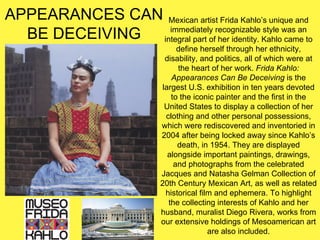
Mexican artist Frida Kahlo’s unique and
immediately recognizable style was an
integral part of her identity. Kahlo came to
define herself through her ethnicity,
disability, and politics, all of which were at
the heart of her work. Frida Kahlo:
Appearances Can Be Deceiving is the
largest U.S. exhibition in ten years devoted
to the iconic painter and the first in the
United States to display a collection of her
clothing and other personal possessions,
which were rediscovered and inventoried in
2004 after being locked away since Kahlo’s
death, in 1954. They are displayed
alongside important paintings, drawings,
and photographs from the celebrated
Jacques and Natasha Gelman Collection of
20th Century Mexican Art, as well as related
historical film and ephemera. To highlight
the collecting interests of Kahlo and her
husband, muralist Diego Rivera, works from
our extensive holdings of Mesoamerican art
are also included.
APPEARANCES CAN
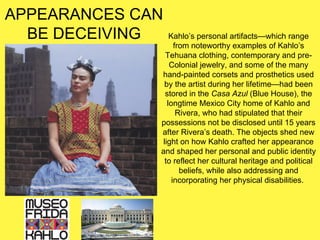
BE DECEIVING Kahlo’s personal artifacts—which range
from noteworthy examples of Kahlo’s
Tehuana clothing, contemporary and pre-
Colonial jewelry, and some of the many
hand-painted corsets and prosthetics used
by the artist during her lifetime—had been
stored in the Casa Azul (Blue House), the
longtime Mexico City home of Kahlo and
Rivera, who had stipulated that their
possessions not be disclosed until 15 years
after Rivera’s death. The objects shed new
light on how Kahlo crafted her appearance
and shaped her personal and public identity
to reflect her cultural heritage and political
beliefs, while also addressing and
incorporating her physical disabilities.
How do you deal with
trauma in your life?
If something traumatic were to happen to
you, how would you handle it?
– Would you confront the issue?
– Would you hide it away?
– Would you trust in someone?
– Would you take some kind of action?
How do you deal with
trauma in your life?
If something
traumatic were to happen
to you, how would you
handle it?
– Would you confront the
issue?
– Would you hide it away?
– Would you trust in
someone?
– Would you take some
kind of action?
• Find distractions, movies, tv, books?
• Everyone deals in different ways…some
try to FACE IT and overcome it...some
bottle it up and hope it goes away, but it
ends up building up and turning into
something worse.
• If you’re dealing with something and not
facing it, it can cause you harm one day.
• We can stress over it, or try to deal with it
quickly, and attack the problem.
• Less people actually face their trauma, it
takes a lot of strength to do that.
• People try to detach themselves from the
reality of it all. They may do things that
push them away from their current state
of mind. Media, Drugs,
How do you deal with
trauma in your life?
If something
traumatic were to happen
to you, how would you
handle it?
– Would you confront the
issue?
– Would you hide it away?
– Would you trust in
someone?
– Would you take some
kind of action?
• Bottle ‘em up. Hide them away so you
don’t have to deal with them.
• Some people may decide to NOT
speak about their trauma, but they
could turn it into a positive in some
way. It adds to your “character”, it
doesn’t completely alter who you are.
• You’re not defined by your trauma,
but how you DEAL with it.
• Counseling - talk it out, get it out.
• Avoid the drama if it’s a family or
friend thing. It can cause problems.
Stay out of that drama-mix. There’s
no winners in it.
• Turn that trauma into something
productive – art or
writing…SOMETHING! Get it out.
Frida Kahlo
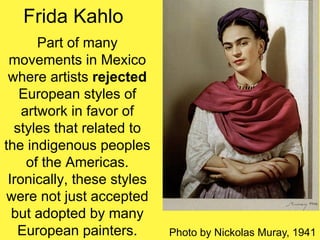
Part of many
movements in Mexico
where artists rejected
European styles of
artwork in favor of
styles that related to
the indigenous peoples
of the Americas.
Ironically, these styles
were not just accepted
but adopted by many
European painters. Photo by Nickolas Muray, 1941
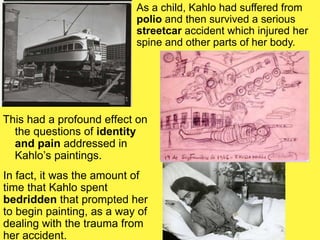
This had a profound effect on
the questions of identity
and pain addressed in
Kahlo’s paintings.
In fact, it was the amount of
time that Kahlo spent
bedridden that prompted her
to begin painting, as a way of
dealing with the trauma from
her accident.
As a child, Kahlo had suffered from
polio and then survived a serious
streetcar accident which injured her
spine and other parts of her body.
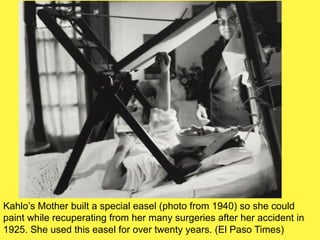
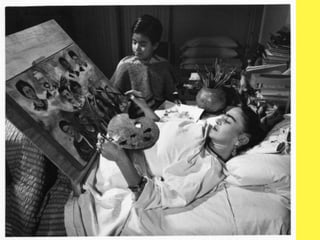
Kahlo’s Mother built a special easel (photo from 1940) so she could
paint while recuperating from her many surgeries after her accident in
1925. She used this easel for over twenty years. (El Paso Times)
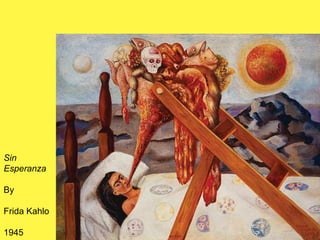
Sin
Esperanza
By
Frida Kahlo
1945
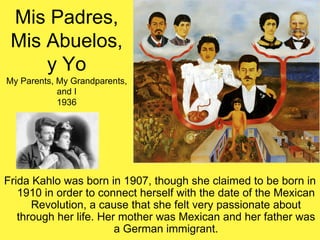
Mis Padres,
Mis Abuelos,
y Yo
My Parents, My Grandparents,
and I
1936
Frida Kahlo was born in 1907, though she claimed to be born in
1910 in order to connect herself with the date of the Mexican
Revolution, a cause that she felt very passionate about
through her life. Her mother was Mexican and her father was
a German immigrant.
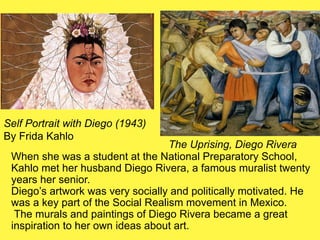
When she was a student at the National Preparatory School,
Kahlo met her husband Diego Rivera, a famous muralist twenty
years her senior.
Diego’s artwork was very socially and politically motivated. He
was a key part of the Social Realism movement in Mexico.
The murals and paintings of Diego Rivera became a great
inspiration to her own ideas about art.
The Uprising, Diego Rivera
Self Portrait with Diego (1943)
By Frida Kahlo
Diego and
frida
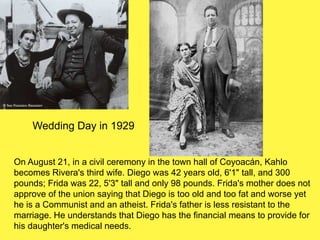
Wedding Day in 1929
On August 21, in a civil ceremony in the town hall of Coyoacán, Kahlo
becomes Rivera's third wife. Diego was 42 years old, 6'1" tall, and 300
pounds; Frida was 22, 5'3" tall and only 98 pounds. Frida's mother does not
approve of the union saying that Diego is too old and too fat and worse yet
he is a Communist and an atheist. Frida's father is less resistant to the
marriage. He understands that Diego has the financial means to provide for
his daughter's medical needs.
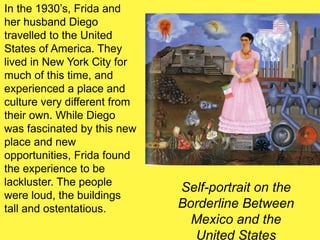
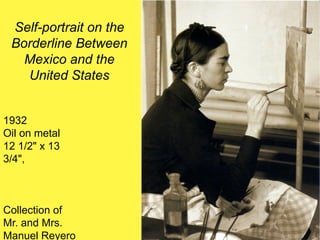
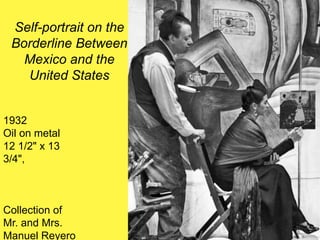
Self-portrait on the
Borderline Between
Mexico and the
United States
In the 1930’s, Frida and
her husband Diego
travelled to the United
States of America. They
lived in New York City for
much of this time, and
experienced a place and
culture very different from
their own. While Diego
was fascinated by this new
place and new
opportunities, Frida found
the experience to be
lackluster. The people
were loud, the buildings
tall and ostentatious.
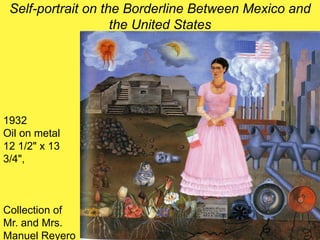
Self-portrait on the Borderline Between Mexico and
the United States
1932
Oil on metal
12 1/2" x 13
3/4",
Collection of
Mr. and Mrs.
Manuel Reyero
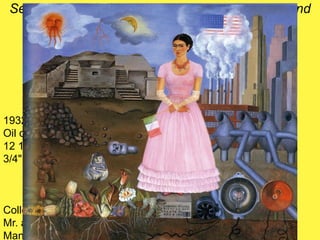
Self-portrait on the Borderline Between Mexico and
the United States
1932
Oil on metal
12 1/2" x 13
3/4",
Collection of
Mr. and Mrs.
Manuel Reyero
Self-portrait on the
Borderline Between
Mexico and the
United States
1932
Oil on metal
12 1/2" x 13
3/4",
Collection of
Mr. and Mrs.
Manuel Reyero
Self-portrait on the
Borderline Between
Mexico and the
United States
1932
Oil on metal
12 1/2" x 13
3/4",
Collection of
Mr. and Mrs.
Manuel Reyero
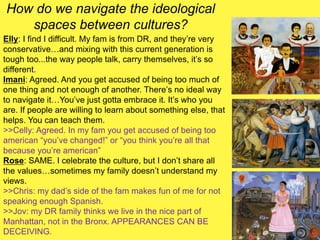
How do we navigate the ideological
spaces between cultures?
Elly: I find I difficult. My fam is from DR, and they’re very
conservative…and mixing with this current generation is
tough too...the way people talk, carry themselves, it’s so
different.
Imani: Agreed. And you get accused of being too much of
one thing and not enough of another. There’s no ideal way
to navigate it…You’ve just gotta embrace it. It’s who you
are. If people are willing to learn about something else, that
helps. You can teach them.
>>Celly: Agreed. In my fam you get accused of being too
american “you’ve changed!” or “you think you’re all that
because you’re american”
Rose: SAME. I celebrate the culture, but I don’t share all
the values…sometimes my family doesn’t understand my
views.
>>Chris: my dad’s side of the fam makes fun of me for not
speaking enough Spanish.
>>Jov: my DR family thinks we live in the nice part of
Manhattan, not in the Bronx. APPEARANCES CAN BE
DECEIVING.
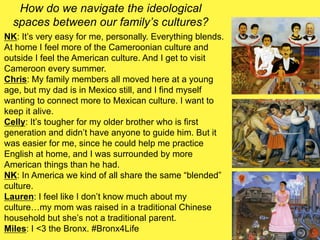
How do we navigate the ideological
spaces between our family’s cultures?
NK: It’s very easy for me, personally. Everything blends.
At home I feel more of the Cameroonian culture and
outside I feel the American culture. And I get to visit
Cameroon every summer.
Chris: My family members all moved here at a young
age, but my dad is in Mexico still, and I find myself
wanting to connect more to Mexican culture. I want to
keep it alive.
Celly: It’s tougher for my older brother who is first
generation and didn’t have anyone to guide him. But it
was easier for me, since he could help me practice
English at home, and I was surrounded by more
American things than he had.
NK: In America we kind of all share the same “blended”
culture.
Lauren: I feel like I don’t know much about my
culture…my mom was raised in a traditional Chinese
household but she’s not a traditional parent.
Miles: I <3 the Bronx. #Bronx4Life
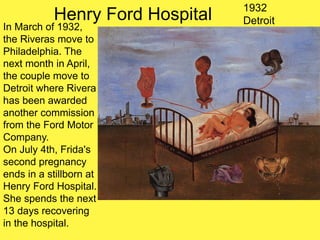
Henry Ford Hospital 1932
Detroit
In March of 1932,
the Riveras move to
Philadelphia. The
next month in April,
the couple move to
Detroit where Rivera
has been awarded
another commission
from the Ford Motor
Company.
On July 4th, Frida's
second pregnancy
ends in a stillborn at
Henry Ford Hospital.
She spends the next
13 days recovering
in the hospital.
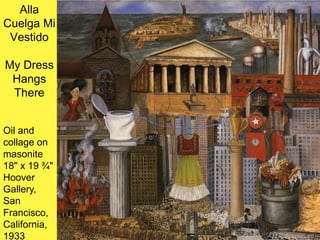
Alla
Cuelga Mi
Vestido
My Dress
Hangs
There
Oil and
collage on
masonite
18" x 19 ¾"
Hoover
Gallery,
San
Francisco,
California,
1933
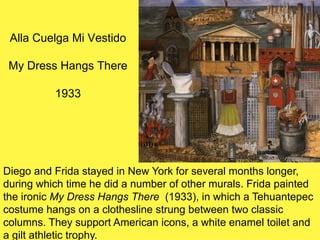
Alla Cuelga Mi Vestido
My Dress Hangs There
1933
Diego and Frida stayed in New York for several months longer,
during which time he did a number of other murals. Frida painted
the ironic My Dress Hangs There (1933), in which a Tehuantepec
costume hangs on a clothesline strung between two classic
columns. They support American icons, a white enamel toilet and
a gilt athletic trophy.
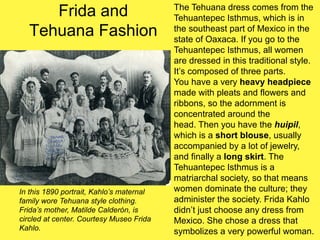
Frida and
Tehuana Fashion
In this 1890 portrait, Kahlo’s maternal
family wore Tehuana style clothing.
Frida’s mother, Matilde Calderón, is
circled at center. Courtesy Museo Frida
Kahlo.
The Tehuana dress comes from the
Tehuantepec Isthmus, which is in
the southeast part of Mexico in the
state of Oaxaca. If you go to the
Tehuantepec Isthmus, all women
are dressed in this traditional style.
It’s composed of three parts.
You have a very heavy headpiece
made with pleats and flowers and
ribbons, so the adornment is
concentrated around the
head. Then you have the huipil,
which is a short blouse, usually
accompanied by a lot of jewelry,
and finally a long skirt. The
Tehuantepec Isthmus is a
matriarchal society, so that means
women dominate the culture; they
administer the society. Frida Kahlo
didn’t just choose any dress from
Mexico. She chose a dress that
symbolizes a very powerful woman.
The Isthmus of Tehuantepec (Spanish pronunciation:
[tewanteˈpek]) is an isthmus in Mexico. It represents the shortest
distance between the Gulf of Mexico and the Pacific Ocean. Prior
to the opening of the Panama Canal, it was a major shipping route
known simply as the Tehuantepec Route.
Cotton blouse
embroidered with
glass beads,
from San Gabriel
Chilac, Puebla
state.
Tehuana ensemble
from the Isthmus of
Tehuantepec: cotton
huipil with machine-
embroidered chain
stitch; printed cotton
skirt with embroidery
and holán (ruffle).
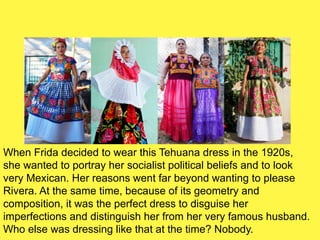
When Frida decided to wear this Tehuana dress in the 1920s,
she wanted to portray her socialist political beliefs and to look
very Mexican. Her reasons went far beyond wanting to please
Rivera. At the same time, because of its geometry and
composition, it was the perfect dress to disguise her
imperfections and distinguish her from her very famous husband.
Who else was dressing like that at the time? Nobody.
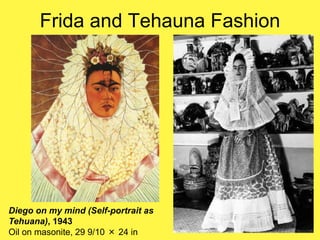
Frida and Tehauna Fashion
Diego on my mind (Self-portrait as
Tehuana), 1943
Oil on masonite, 29 9/10 × 24 in
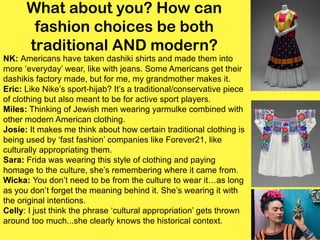
What about you? How can
fashion choices be both
traditional AND modern?
NK: Americans have taken dashiki shirts and made them into
more ‘everyday’ wear, like with jeans. Some Americans get their
dashikis factory made, but for me, my grandmother makes it.
Eric: Like Nike’s sport-hijab? It’s a traditional/conservative piece
of clothing but also meant to be for active sport players.
Miles: Thinking of Jewish men wearing yarmulke combined with
other modern American clothing.
Josie: It makes me think about how certain traditional clothing is
being used by ‘fast fashion’ companies like Forever21, like
culturally appropriating them.
Sara: Frida was wearing this style of clothing and paying
homage to the culture, she’s remembering where it came from.
Wicka: You don’t need to be from the culture to wear it…as long
as you don’t forget the meaning behind it. She’s wearing it with
the original intentions.
Celly: I just think the phrase ‘cultural appropriation’ gets thrown
around too much...she clearly knows the historical context.
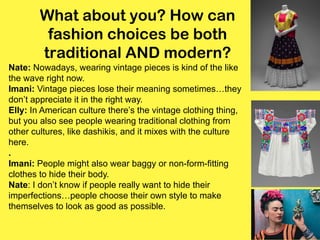
What about you? How can
fashion choices be both
traditional AND modern?
Nate: Nowadays, wearing vintage pieces is kind of the like
the wave right now.
Imani: Vintage pieces lose their meaning sometimes…they
don’t appreciate it in the right way.
Elly: In American culture there’s the vintage clothing thing,
but you also see people wearing traditional clothing from
other cultures, like dashikis, and it mixes with the culture
here.
.
Imani: People might also wear baggy or non-form-fitting
clothes to hide their body.
Nate: I don’t know if people really want to hide their
imperfections…people choose their own style to make
themselves to look as good as possible.
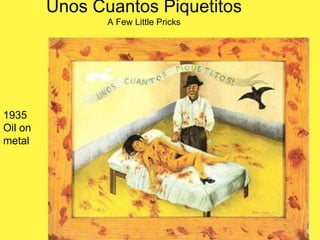
Unos Cuantos Piquetitos
A Few Little Pricks
1935
Oil on
metal
Unos
Cuantos
Piquetitos
A Few Little Pricks
1935
Oil on metal
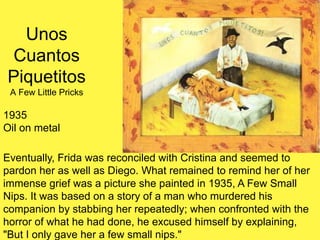
Eventually, Frida was reconciled with Cristina and seemed to
pardon her as well as Diego. What remained to remind her of her
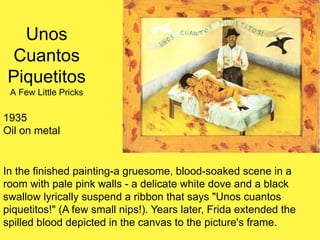
immense grief was a picture she painted in 1935, A Few Small
Nips. It was based on a story of a man who murdered his
companion by stabbing her repeatedly; when confronted with the
horror of what he had done, he excused himself by explaining,
"But I only gave her a few small nips."
Unos
Cuantos
Piquetitos
A Few Little Pricks
1935
Oil on metal
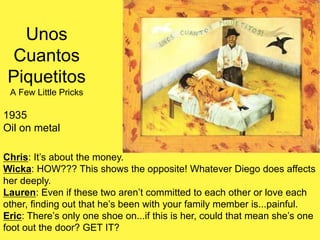
Chris: It’s about the money.
Wicka: HOW??? This shows the opposite! Whatever Diego does affects
her deeply.
Lauren: Even if these two aren’t committed to each other or love each
other, finding out that he’s been with your family member is...painful.
Eric: There’s only one shoe on...if this is her, could that mean she’s one
foot out the door? GET IT?
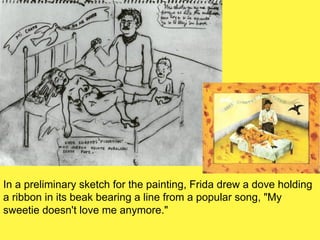
SKETCH of
Unos Cuantos
PiquetitosSketch and Final Painting
In a preliminary sketch for the painting, Frida drew a dove holding
a ribbon in its beak bearing a line from a popular song, "My
sweetie doesn't love me anymore."
Unos
Cuantos
Piquetitos
A Few Little Pricks
1935
Oil on metal
In the finished painting-a gruesome, blood-soaked scene in a
room with pale pink walls - a delicate white dove and a black
swallow lyrically suspend a ribbon that says "Unos cuantos
piquetitos!" (A few small nips!). Years later, Frida extended the
spilled blood depicted in the canvas to the picture's frame.
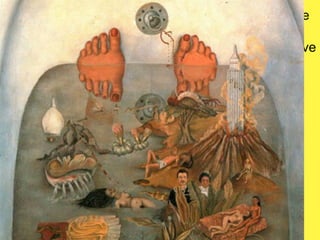
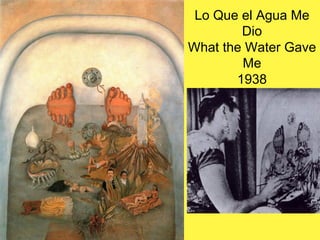
Lo Que el Agua Me
Dio
What the Water Gave
Me
1938
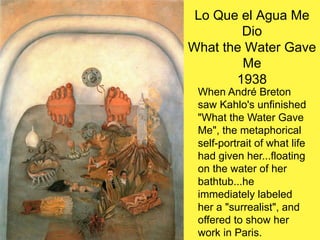
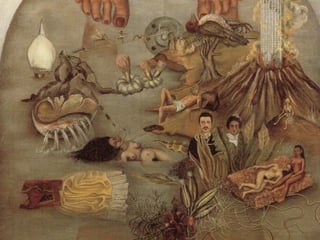
When André Breton
saw Kahlo's unfinished
"What the Water Gave
Me", the metaphorical
self-portrait of what life
had given her...floating
on the water of her
bathtub...he
immediately labeled
her a "surrealist", and
offered to show her
work in Paris.
Lo Que el Agua Me Dio
What the Water Gave Me
1938
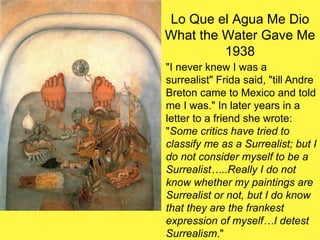
"I never knew I was a
surrealist" Frida said, "till Andre
Breton came to Mexico and told
me I was." In later years in a
letter to a friend she wrote:
"Some critics have tried to
classify me as a Surrealist; but I
do not consider myself to be a
Surrealist…..Really I do not
know whether my paintings are
Surrealist or not, but I do know
that they are the frankest
expression of myself…I detest
Surrealism."
Lo Que el Agua Me
Dio
What the Water Gave
Me
1938
details
Lo Que el Agua Me
Dio
What the Water Gave
Me
1938
details
“Feet, what do I need
you for when I have
wings to fly.”
Frida Kahlo
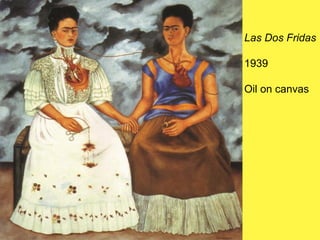
Las Dos Fridas
1939
Oil on canvas
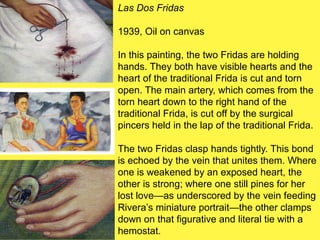
Las Dos Fridas
1939, Oil on canvas
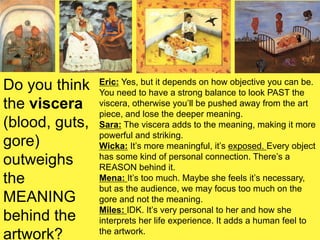
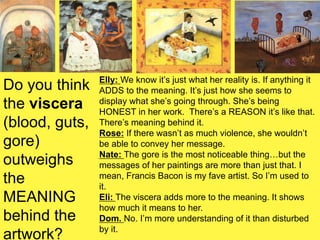
In this painting, the two Fridas are holding
hands. They both have visible hearts and the
heart of the traditional Frida is cut and torn
open. The main artery, which comes from the
torn heart down to the right hand of the
traditional Frida, is cut off by the surgical
pincers held in the lap of the traditional Frida.
The two Fridas clasp hands tightly. This bond
is echoed by the vein that unites them. Where
one is weakened by an exposed heart, the
other is strong; where one still pines for her
lost love—as underscored by the vein feeding
Rivera’s miniature portrait—the other clamps
down on that figurative and literal tie with a
hemostat.
Do you think
the viscera
(blood, guts,
gore)
outweighs
the
MEANING
behind the
artwork?
Eric: Yes, but it depends on how objective you can be.
You need to have a strong balance to look PAST the
viscera, otherwise you’ll be pushed away from the art
piece, and lose the deeper meaning.
Sara: The viscera adds to the meaning, making it more
powerful and striking.
Wicka: It’s more meaningful, it’s exposed. Every object
has some kind of personal connection. There’s a
REASON behind it.
Mena: It’s too much. Maybe she feels it’s necessary,
but as the audience, we may focus too much on the
gore and not the meaning.
Miles: IDK. It’s very personal to her and how she
interprets her life experience. It adds a human feel to
the artwork.
Do you think
the viscera
(blood, guts,
gore)
outweighs
the
MEANING
behind the
artwork?
Elly: We know it’s just what her reality is. If anything it
ADDS to the meaning. It’s just how she seems to
display what she’s going through. She’s being
HONEST in her work. There’s a REASON it’s like that.
There’s meaning behind it.
Rose: If there wasn’t as much violence, she wouldn’t
be able to convey her message.
Nate: The gore is the most noticeable thing…but the
messages of her paintings are more than just that. I
mean, Francis Bacon is my fave artist. So I’m used to
it.
Eli: The viscera adds more to the meaning. It shows
how much it means to her.
Dom. No. I’m more understanding of it than disturbed
by it.
Frida Kahlo
Self Portrait with
Cropped Hair
1940
Oil on canvas
"Look, if I loved you it was
because of your hair. Now that
you are without hair, I don't love
you anymore."
Frida Kahlo
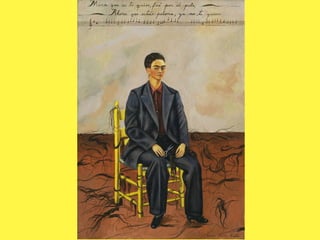
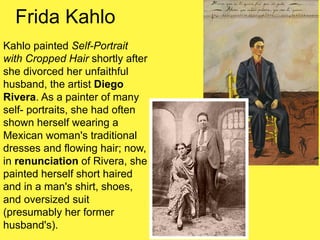
Kahlo painted Self-Portrait
with Cropped Hair shortly after
she divorced her unfaithful
husband, the artist Diego
Rivera. As a painter of many
self- portraits, she had often
shown herself wearing a
Mexican woman's traditional
dresses and flowing hair; now,
in renunciation of Rivera, she
painted herself short haired
and in a man's shirt, shoes,
and oversized suit
(presumably her former
husband's).
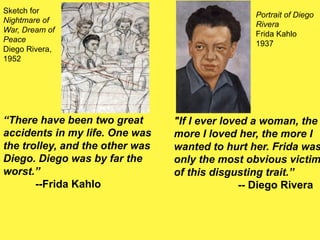
"If I ever loved a woman, the
more I loved her, the more I
wanted to hurt her. Frida was
only the most obvious victim
of this disgusting trait.”
-- Diego Rivera
Portrait of Diego
Rivera
Frida Kahlo
1937
“There have been two great
accidents in my life. One was
the trolley, and the other was
Diego. Diego was by far the
worst.”
--Frida Kahlo
Sketch for
Nightmare of
War, Dream of
Peace
Diego Rivera,
1952
"If I ever loved a woman, the
more I loved her, the more I
wanted to hurt her. Frida was
only the most obvious victim
of this disgusting trait.”
-- Diego Rivera
Portrait of Diego
Rivera
Frida Kahlo
1937
“There have been two great
accidents in my life. One was
the trolley, and the other was
Diego. Diego was by far the
worst.”
--Frida Kahlo
Sketch for
Nightmare of
War, Dream of
Peace
Diego Rivera,
1952
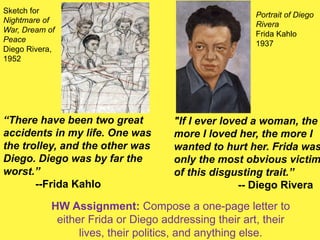
HW Assignment: Compose a one-page letter to
either Frida or Diego addressing their art, their
lives, their politics, and anything else.
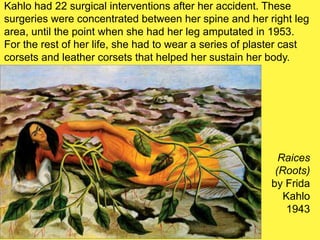
Raices
(Roots)
by Frida
Kahlo
1943
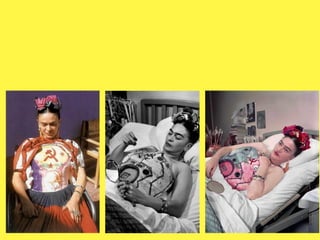
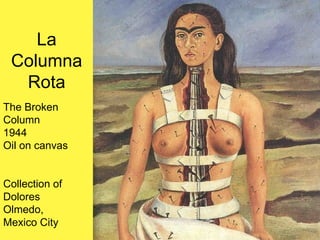
Kahlo had 22 surgical interventions after her accident. These
surgeries were concentrated between her spine and her right leg
area, until the point when she had her leg amputated in 1953.
For the rest of her life, she had to wear a series of plaster cast
corsets and leather corsets that helped her sustain her body.
La
Columna
Rota
The Broken
Column
1944
Oil on canvas
Collection of
Dolores
Olmedo,
Mexico City
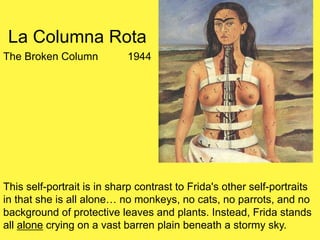
La Columna Rota
The Broken Column 1944
This self-portrait is in sharp contrast to Frida's other self-portraits
in that she is all alone… no monkeys, no cats, no parrots, and no
background of protective leaves and plants. Instead, Frida stands
all alone crying on a vast barren plain beneath a stormy sky.
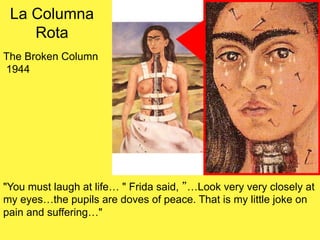
La Columna
Rota
The Broken Column
1944
"You must laugh at life… " Frida said, ”…Look very very closely at
my eyes…the pupils are doves of peace. That is my little joke on
pain and suffering…"
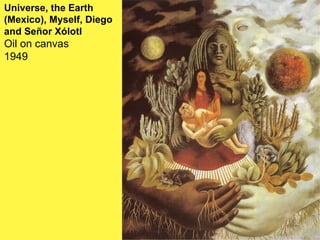
Universe, the Earth
(Mexico), Myself, Diego
and Señor Xólotl
Oil on canvas
1949
Universe, the Earth
(Mexico), Myself, Diego
and Señor Xólotl
Oil on canvas
1949
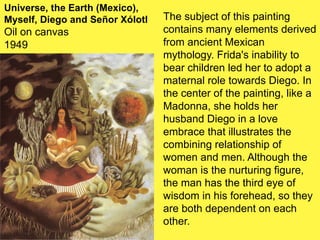
The subject of this painting
contains many elements derived
from ancient Mexican
mythology. Frida's inability to
bear children led her to adopt a
maternal role towards Diego. In
the center of the painting, like a
Madonna, she holds her
husband Diego in a love
embrace that illustrates the
combining relationship of
women and men. Although the
woman is the nurturing figure,
the man has the third eye of
wisdom in his forehead, so they
are both dependent on each
other.
Universe, the Earth (Mexico),
Myself, Diego and Señor Xólotl
Oil on canvas
1949
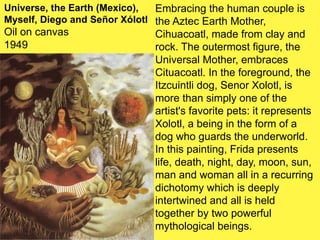
Embracing the human couple is
the Aztec Earth Mother,
Cihuacoatl, made from clay and
rock. The outermost figure, the
Universal Mother, embraces
Cituacoatl. In the foreground, the
Itzcuintli dog, Senor Xolotl, is
more than simply one of the
artist's favorite pets: it represents
Xolotl, a being in the form of a
dog who guards the underworld.
In this painting, Frida presents
life, death, night, day, moon, sun,
man and woman all in a recurring
dichotomy which is deeply
intertwined and all is held
together by two powerful
mythological beings.
Universe, the Earth (Mexico),
Myself, Diego and Señor Xólotl
Oil on canvas
1949
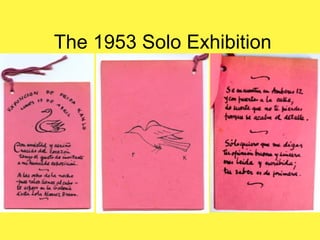
The 1953 Solo
Exhibition
Realizing that Frida was near
death, Frida’s friend Lola Alvarez
Bravo wanted to honor her during
her lifetime with her first solo
exhibition in Mexico. Frida was
delighted and started designing
and creating the invitations herself.
Her health actually seemed to
improve as she began planning
and thinking about the event.
Frida's doctor told her she was not
well enough to attend the opening
and she was not to leave her bed.
The day before the exhibition
opening, Frida's health took a turn
for the worse but Frida was
determined to attend the opening.
The 1953 Solo Exhibition
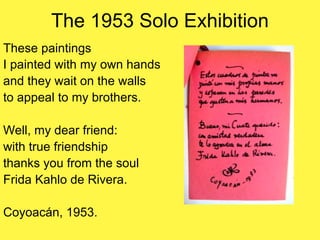
These paintings
I painted with my own hands
and they wait on the walls
to appeal to my brothers.
Well, my dear friend:
with true friendship
thanks you from the soul
Frida Kahlo de Rivera.
Coyoacán, 1953.
The 1953 Solo
Exhibition
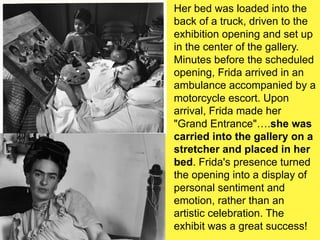
Her bed was loaded into the
back of a truck, driven to the
exhibition opening and set up
in the center of the gallery.
Minutes before the scheduled
opening, Frida arrived in an
ambulance accompanied by a
motorcycle escort. Upon
arrival, Frida made her
"Grand Entrance"….she was
carried into the gallery on a
stretcher and placed in her
bed. Frida's presence turned
the opening into a display of
personal sentiment and
emotion, rather than an
artistic celebration. The
exhibit was a great success!
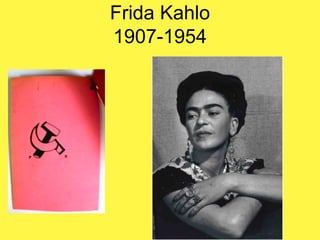
Frida Kahlo
1907-1954
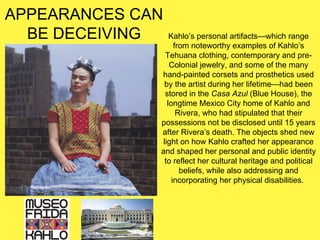
APPEARANCES CAN
BE DECEIVING Kahlo’s personal artifacts—which range
from noteworthy examples of Kahlo’s
Tehuana clothing, contemporary and pre-
Colonial jewelry, and some of the many
hand-painted corsets and prosthetics used
by the artist during her lifetime—had been
stored in the Casa Azul (Blue House), the
longtime Mexico City home of Kahlo and
Rivera, who had stipulated that their
possessions not be disclosed until 15 years
after Rivera’s death. The objects shed new
light on how Kahlo crafted her appearance
and shaped her personal and public identity
to reflect her cultural heritage and political
beliefs, while also addressing and
incorporating her physical disabilities.
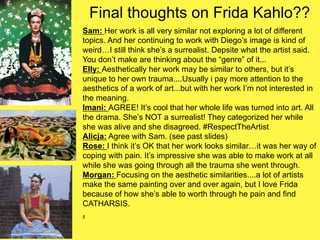
Final thoughts on Frida Kahlo??
Sam: Her work is all very similar not exploring a lot of different
topics. And her continuing to work with Diego’s image is kind of
weird…I still think she’s a surrealist. Depsite what the artist said.
You don’t make are thinking about the “genre” of it...
Elly: Aesthetically her work may be similar to others, but it’s
unique to her own trauma....Usually i pay more attention to the
aesthetics of a work of art...but with her work I’m not interested in
the meaning.
Imani: AGREE! It’s cool that her whole life was turned into art. All
the drama. She’s NOT a surrealist! They categorized her while
she was alive and she disagreed. #RespectTheArtist
Alicja: Agree with Sam. (see past slides)
Rose: I think it’s OK that her work looks similar…it was her way of
coping with pain. It’s impressive she was able to make work at all
while she was going through all the trauma she went through.
Morgan: Focusing on the aesthetic similarities....a lot of artists
make the same painting over and over again, but I love Frida
because of how she’s able to worth through he pain and find
CATHARSIS.
.
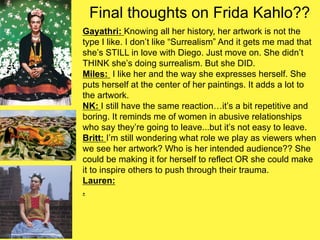
Final thoughts on Frida Kahlo??
Gayathri: Knowing all her history, her artwork is not the
type I like. I don’t like “Surrealism” And it gets me mad that
she’s STILL in love with Diego. Just move on. She didn’t
THINK she’s doing surrealism. But she DID.
Miles: I like her and the way she expresses herself. She
puts herself at the center of her paintings. It adds a lot to
the artwork.
NK: I still have the same reaction…it’s a bit repetitive and
boring. It reminds me of women in abusive relationships
who say they’re going to leave...but it’s not easy to leave.
Britt: I’m still wondering what role we play as viewers when
we see her artwork? Who is her intended audience?? She
could be making it for herself to reflect OR she could make
it to inspire others to push through their trauma.
Lauren:
.
How we deal with Truama
(redux)
https://www.youtube.com/watch?v=4IpTxQ_DWy0

Frida Kahlo

  • 1.
  • 3.
    What does theappearance of this museum say about what’s inside? • Alex: Getting some old Victorian vibes, it’s like a palace, but there’s a touch of Modernity. • Wicka: It’s really. It’s like. It’s Grand. It looks important. Close to the White House? • JOV! Bourgie vibes. (bourgeois). Like everyone there is wearing fur and their hair is done, and they have like a whole CREW. • Eric: a mix of classic and modern. • Sara: It’s more modern than classic. Neo-classical Beaux-Arts
  • 4.
    What does theappearance of this museum say about what’s inside? • Eli: Those weird stairs, it’s odd architecture. • Dom: High class, technical. The color and the stairs are kind of futuristic and expensive. Them Columns tho. They’re kinda “greco-roman”vibes • Freddi: A mix of old and new, the way the main building seems older, but the stairs and stuff in the front is more modern looking. • .
  • 5.
    Brooklyn Museum Mission: Tocreate inspiring encounters with art that expand the ways we see ourselves, the world and its possibilities. Brooklyn Museum Vision: Where great art and courageous conversations are catalysts for a more connected, civic, and empathetic world. Values: Great Art and Great Art Experiences Many Histories and a Shared Future Openness and Free Expression Action and Impact Experimentation and Risk Professionalism and Passion
  • 6.
    May 4, 2019: Celebrate SPRING! Music: Descarrilao 5–6 pm Enjoy a fusion of Afro-Caribbean, merengue, pop, and cumbia sound from bilingual salsa dura rock band Descarrilao. Teen Pop-Up Gallery Talks 6:30–7:30 pm Teen Apprentices host ten-minute talks about works on view in One: Egúngún. Music: Arooj Aftab 7–8 pm Pakistan-born, Brooklyn-based composer and performer Arooj Aftab shares her ambient experimental music that explores themes of female empowerment. YO/OY Deborah Kass 2015
  • 7.
    APPEARANCES CAN BE DECEIVING Mexicanartist Frida Kahlo’s unique and immediately recognizable style was an integral part of her identity. Kahlo came to define herself through her ethnicity, disability, and politics, all of which were at the heart of her work. Frida Kahlo: Appearances Can Be Deceiving is the largest U.S. exhibition in ten years devoted to the iconic painter and the first in the United States to display a collection of her clothing and other personal possessions, which were rediscovered and inventoried in 2004 after being locked away since Kahlo’s death, in 1954. They are displayed alongside important paintings, drawings, and photographs from the celebrated Jacques and Natasha Gelman Collection of 20th Century Mexican Art, as well as related historical film and ephemera. To highlight the collecting interests of Kahlo and her husband, muralist Diego Rivera, works from our extensive holdings of Mesoamerican art are also included.
  • 8.
    APPEARANCES CAN BE DECEIVINGKahlo’s personal artifacts—which range from noteworthy examples of Kahlo’s Tehuana clothing, contemporary and pre- Colonial jewelry, and some of the many hand-painted corsets and prosthetics used by the artist during her lifetime—had been stored in the Casa Azul (Blue House), the longtime Mexico City home of Kahlo and Rivera, who had stipulated that their possessions not be disclosed until 15 years after Rivera’s death. The objects shed new light on how Kahlo crafted her appearance and shaped her personal and public identity to reflect her cultural heritage and political beliefs, while also addressing and incorporating her physical disabilities.
  • 9.
    How do youdeal with trauma in your life? If something traumatic were to happen to you, how would you handle it? – Would you confront the issue? – Would you hide it away? – Would you trust in someone? – Would you take some kind of action?
  • 10.
    How do youdeal with trauma in your life? If something traumatic were to happen to you, how would you handle it? – Would you confront the issue? – Would you hide it away? – Would you trust in someone? – Would you take some kind of action? • Find distractions, movies, tv, books? • Everyone deals in different ways…some try to FACE IT and overcome it...some bottle it up and hope it goes away, but it ends up building up and turning into something worse. • If you’re dealing with something and not facing it, it can cause you harm one day. • We can stress over it, or try to deal with it quickly, and attack the problem. • Less people actually face their trauma, it takes a lot of strength to do that. • People try to detach themselves from the reality of it all. They may do things that push them away from their current state of mind. Media, Drugs,
  • 11.
    How do youdeal with trauma in your life? If something traumatic were to happen to you, how would you handle it? – Would you confront the issue? – Would you hide it away? – Would you trust in someone? – Would you take some kind of action? • Bottle ‘em up. Hide them away so you don’t have to deal with them. • Some people may decide to NOT speak about their trauma, but they could turn it into a positive in some way. It adds to your “character”, it doesn’t completely alter who you are. • You’re not defined by your trauma, but how you DEAL with it. • Counseling - talk it out, get it out. • Avoid the drama if it’s a family or friend thing. It can cause problems. Stay out of that drama-mix. There’s no winners in it. • Turn that trauma into something productive – art or writing…SOMETHING! Get it out.
  • 12.
    Frida Kahlo Part ofmany movements in Mexico where artists rejected European styles of artwork in favor of styles that related to the indigenous peoples of the Americas. Ironically, these styles were not just accepted but adopted by many European painters. Photo by Nickolas Muray, 1941
  • 13.
    This had aprofound effect on the questions of identity and pain addressed in Kahlo’s paintings. In fact, it was the amount of time that Kahlo spent bedridden that prompted her to begin painting, as a way of dealing with the trauma from her accident. As a child, Kahlo had suffered from polio and then survived a serious streetcar accident which injured her spine and other parts of her body.
  • 14.
    Kahlo’s Mother builta special easel (photo from 1940) so she could paint while recuperating from her many surgeries after her accident in 1925. She used this easel for over twenty years. (El Paso Times)
  • 15.
  • 17.
    Mis Padres, Mis Abuelos, yYo My Parents, My Grandparents, and I 1936 Frida Kahlo was born in 1907, though she claimed to be born in 1910 in order to connect herself with the date of the Mexican Revolution, a cause that she felt very passionate about through her life. Her mother was Mexican and her father was a German immigrant.
  • 19.
    When she wasa student at the National Preparatory School, Kahlo met her husband Diego Rivera, a famous muralist twenty years her senior. Diego’s artwork was very socially and politically motivated. He was a key part of the Social Realism movement in Mexico. The murals and paintings of Diego Rivera became a great inspiration to her own ideas about art. The Uprising, Diego Rivera Self Portrait with Diego (1943) By Frida Kahlo
  • 21.
    Diego and frida Wedding Dayin 1929 On August 21, in a civil ceremony in the town hall of Coyoacán, Kahlo becomes Rivera's third wife. Diego was 42 years old, 6'1" tall, and 300 pounds; Frida was 22, 5'3" tall and only 98 pounds. Frida's mother does not approve of the union saying that Diego is too old and too fat and worse yet he is a Communist and an atheist. Frida's father is less resistant to the marriage. He understands that Diego has the financial means to provide for his daughter's medical needs.
  • 22.
    Self-portrait on the BorderlineBetween Mexico and the United States In the 1930’s, Frida and her husband Diego travelled to the United States of America. They lived in New York City for much of this time, and experienced a place and culture very different from their own. While Diego was fascinated by this new place and new opportunities, Frida found the experience to be lackluster. The people were loud, the buildings tall and ostentatious.
  • 23.
    Self-portrait on theBorderline Between Mexico and the United States 1932 Oil on metal 12 1/2" x 13 3/4", Collection of Mr. and Mrs. Manuel Reyero
  • 24.
    Self-portrait on theBorderline Between Mexico and the United States 1932 Oil on metal 12 1/2" x 13 3/4", Collection of Mr. and Mrs. Manuel Reyero
  • 25.
    Self-portrait on the BorderlineBetween Mexico and the United States 1932 Oil on metal 12 1/2" x 13 3/4", Collection of Mr. and Mrs. Manuel Reyero
  • 26.
    Self-portrait on the BorderlineBetween Mexico and the United States 1932 Oil on metal 12 1/2" x 13 3/4", Collection of Mr. and Mrs. Manuel Reyero
  • 27.
    How do wenavigate the ideological spaces between cultures? Elly: I find I difficult. My fam is from DR, and they’re very conservative…and mixing with this current generation is tough too...the way people talk, carry themselves, it’s so different. Imani: Agreed. And you get accused of being too much of one thing and not enough of another. There’s no ideal way to navigate it…You’ve just gotta embrace it. It’s who you are. If people are willing to learn about something else, that helps. You can teach them. >>Celly: Agreed. In my fam you get accused of being too american “you’ve changed!” or “you think you’re all that because you’re american” Rose: SAME. I celebrate the culture, but I don’t share all the values…sometimes my family doesn’t understand my views. >>Chris: my dad’s side of the fam makes fun of me for not speaking enough Spanish. >>Jov: my DR family thinks we live in the nice part of Manhattan, not in the Bronx. APPEARANCES CAN BE DECEIVING.
  • 28.
    How do wenavigate the ideological spaces between our family’s cultures? NK: It’s very easy for me, personally. Everything blends. At home I feel more of the Cameroonian culture and outside I feel the American culture. And I get to visit Cameroon every summer. Chris: My family members all moved here at a young age, but my dad is in Mexico still, and I find myself wanting to connect more to Mexican culture. I want to keep it alive. Celly: It’s tougher for my older brother who is first generation and didn’t have anyone to guide him. But it was easier for me, since he could help me practice English at home, and I was surrounded by more American things than he had. NK: In America we kind of all share the same “blended” culture. Lauren: I feel like I don’t know much about my culture…my mom was raised in a traditional Chinese household but she’s not a traditional parent. Miles: I <3 the Bronx. #Bronx4Life
  • 30.
    Henry Ford Hospital1932 Detroit In March of 1932, the Riveras move to Philadelphia. The next month in April, the couple move to Detroit where Rivera has been awarded another commission from the Ford Motor Company. On July 4th, Frida's second pregnancy ends in a stillborn at Henry Ford Hospital. She spends the next 13 days recovering in the hospital.
  • 31.
    Alla Cuelga Mi Vestido My Dress Hangs There Oiland collage on masonite 18" x 19 ¾" Hoover Gallery, San Francisco, California, 1933
  • 32.
    Alla Cuelga MiVestido My Dress Hangs There 1933 Diego and Frida stayed in New York for several months longer, during which time he did a number of other murals. Frida painted the ironic My Dress Hangs There (1933), in which a Tehuantepec costume hangs on a clothesline strung between two classic columns. They support American icons, a white enamel toilet and a gilt athletic trophy.
  • 33.
    Frida and Tehuana Fashion Inthis 1890 portrait, Kahlo’s maternal family wore Tehuana style clothing. Frida’s mother, Matilde Calderón, is circled at center. Courtesy Museo Frida Kahlo. The Tehuana dress comes from the Tehuantepec Isthmus, which is in the southeast part of Mexico in the state of Oaxaca. If you go to the Tehuantepec Isthmus, all women are dressed in this traditional style. It’s composed of three parts. You have a very heavy headpiece made with pleats and flowers and ribbons, so the adornment is concentrated around the head. Then you have the huipil, which is a short blouse, usually accompanied by a lot of jewelry, and finally a long skirt. The Tehuantepec Isthmus is a matriarchal society, so that means women dominate the culture; they administer the society. Frida Kahlo didn’t just choose any dress from Mexico. She chose a dress that symbolizes a very powerful woman.
  • 34.
    The Isthmus ofTehuantepec (Spanish pronunciation: [tewanteˈpek]) is an isthmus in Mexico. It represents the shortest distance between the Gulf of Mexico and the Pacific Ocean. Prior to the opening of the Panama Canal, it was a major shipping route known simply as the Tehuantepec Route. Cotton blouse embroidered with glass beads, from San Gabriel Chilac, Puebla state. Tehuana ensemble from the Isthmus of Tehuantepec: cotton huipil with machine- embroidered chain stitch; printed cotton skirt with embroidery and holán (ruffle).
  • 35.
    When Frida decidedto wear this Tehuana dress in the 1920s, she wanted to portray her socialist political beliefs and to look very Mexican. Her reasons went far beyond wanting to please Rivera. At the same time, because of its geometry and composition, it was the perfect dress to disguise her imperfections and distinguish her from her very famous husband. Who else was dressing like that at the time? Nobody.
  • 36.
    Frida and TehaunaFashion Diego on my mind (Self-portrait as Tehuana), 1943 Oil on masonite, 29 9/10 × 24 in
  • 37.
    What about you?How can fashion choices be both traditional AND modern? NK: Americans have taken dashiki shirts and made them into more ‘everyday’ wear, like with jeans. Some Americans get their dashikis factory made, but for me, my grandmother makes it. Eric: Like Nike’s sport-hijab? It’s a traditional/conservative piece of clothing but also meant to be for active sport players. Miles: Thinking of Jewish men wearing yarmulke combined with other modern American clothing. Josie: It makes me think about how certain traditional clothing is being used by ‘fast fashion’ companies like Forever21, like culturally appropriating them. Sara: Frida was wearing this style of clothing and paying homage to the culture, she’s remembering where it came from. Wicka: You don’t need to be from the culture to wear it…as long as you don’t forget the meaning behind it. She’s wearing it with the original intentions. Celly: I just think the phrase ‘cultural appropriation’ gets thrown around too much...she clearly knows the historical context.
  • 38.
    What about you?How can fashion choices be both traditional AND modern? Nate: Nowadays, wearing vintage pieces is kind of the like the wave right now. Imani: Vintage pieces lose their meaning sometimes…they don’t appreciate it in the right way. Elly: In American culture there’s the vintage clothing thing, but you also see people wearing traditional clothing from other cultures, like dashikis, and it mixes with the culture here. . Imani: People might also wear baggy or non-form-fitting clothes to hide their body. Nate: I don’t know if people really want to hide their imperfections…people choose their own style to make themselves to look as good as possible.
  • 39.
    Unos Cuantos Piquetitos AFew Little Pricks 1935 Oil on metal
  • 40.
    Unos Cuantos Piquetitos A Few LittlePricks 1935 Oil on metal Eventually, Frida was reconciled with Cristina and seemed to pardon her as well as Diego. What remained to remind her of her immense grief was a picture she painted in 1935, A Few Small Nips. It was based on a story of a man who murdered his companion by stabbing her repeatedly; when confronted with the horror of what he had done, he excused himself by explaining, "But I only gave her a few small nips."
  • 41.
    Unos Cuantos Piquetitos A Few LittlePricks 1935 Oil on metal Chris: It’s about the money. Wicka: HOW??? This shows the opposite! Whatever Diego does affects her deeply. Lauren: Even if these two aren’t committed to each other or love each other, finding out that he’s been with your family member is...painful. Eric: There’s only one shoe on...if this is her, could that mean she’s one foot out the door? GET IT?
  • 42.
    SKETCH of Unos Cuantos PiquetitosSketchand Final Painting In a preliminary sketch for the painting, Frida drew a dove holding a ribbon in its beak bearing a line from a popular song, "My sweetie doesn't love me anymore."
  • 43.
    Unos Cuantos Piquetitos A Few LittlePricks 1935 Oil on metal In the finished painting-a gruesome, blood-soaked scene in a room with pale pink walls - a delicate white dove and a black swallow lyrically suspend a ribbon that says "Unos cuantos piquetitos!" (A few small nips!). Years later, Frida extended the spilled blood depicted in the canvas to the picture's frame.
  • 44.
    Lo Que elAgua Me Dio What the Water Gave Me 1938 When André Breton saw Kahlo's unfinished "What the Water Gave Me", the metaphorical self-portrait of what life had given her...floating on the water of her bathtub...he immediately labeled her a "surrealist", and offered to show her work in Paris.
  • 46.
    Lo Que elAgua Me Dio What the Water Gave Me 1938 "I never knew I was a surrealist" Frida said, "till Andre Breton came to Mexico and told me I was." In later years in a letter to a friend she wrote: "Some critics have tried to classify me as a Surrealist; but I do not consider myself to be a Surrealist…..Really I do not know whether my paintings are Surrealist or not, but I do know that they are the frankest expression of myself…I detest Surrealism."
  • 47.
    Lo Que elAgua Me Dio What the Water Gave Me 1938 details
  • 48.
    Lo Que elAgua Me Dio What the Water Gave Me 1938 details
  • 49.
    “Feet, what doI need you for when I have wings to fly.” Frida Kahlo
  • 50.
  • 51.
    Las Dos Fridas 1939,Oil on canvas In this painting, the two Fridas are holding hands. They both have visible hearts and the heart of the traditional Frida is cut and torn open. The main artery, which comes from the torn heart down to the right hand of the traditional Frida, is cut off by the surgical pincers held in the lap of the traditional Frida. The two Fridas clasp hands tightly. This bond is echoed by the vein that unites them. Where one is weakened by an exposed heart, the other is strong; where one still pines for her lost love—as underscored by the vein feeding Rivera’s miniature portrait—the other clamps down on that figurative and literal tie with a hemostat.
  • 53.
    Do you think theviscera (blood, guts, gore) outweighs the MEANING behind the artwork? Eric: Yes, but it depends on how objective you can be. You need to have a strong balance to look PAST the viscera, otherwise you’ll be pushed away from the art piece, and lose the deeper meaning. Sara: The viscera adds to the meaning, making it more powerful and striking. Wicka: It’s more meaningful, it’s exposed. Every object has some kind of personal connection. There’s a REASON behind it. Mena: It’s too much. Maybe she feels it’s necessary, but as the audience, we may focus too much on the gore and not the meaning. Miles: IDK. It’s very personal to her and how she interprets her life experience. It adds a human feel to the artwork.
  • 54.
    Do you think theviscera (blood, guts, gore) outweighs the MEANING behind the artwork? Elly: We know it’s just what her reality is. If anything it ADDS to the meaning. It’s just how she seems to display what she’s going through. She’s being HONEST in her work. There’s a REASON it’s like that. There’s meaning behind it. Rose: If there wasn’t as much violence, she wouldn’t be able to convey her message. Nate: The gore is the most noticeable thing…but the messages of her paintings are more than just that. I mean, Francis Bacon is my fave artist. So I’m used to it. Eli: The viscera adds more to the meaning. It shows how much it means to her. Dom. No. I’m more understanding of it than disturbed by it.
  • 56.
    Frida Kahlo Self Portraitwith Cropped Hair 1940 Oil on canvas "Look, if I loved you it was because of your hair. Now that you are without hair, I don't love you anymore."
  • 57.
    Frida Kahlo Kahlo paintedSelf-Portrait with Cropped Hair shortly after she divorced her unfaithful husband, the artist Diego Rivera. As a painter of many self- portraits, she had often shown herself wearing a Mexican woman's traditional dresses and flowing hair; now, in renunciation of Rivera, she painted herself short haired and in a man's shirt, shoes, and oversized suit (presumably her former husband's).
  • 58.
    "If I everloved a woman, the more I loved her, the more I wanted to hurt her. Frida was only the most obvious victim of this disgusting trait.” -- Diego Rivera Portrait of Diego Rivera Frida Kahlo 1937 “There have been two great accidents in my life. One was the trolley, and the other was Diego. Diego was by far the worst.” --Frida Kahlo Sketch for Nightmare of War, Dream of Peace Diego Rivera, 1952
  • 59.
    "If I everloved a woman, the more I loved her, the more I wanted to hurt her. Frida was only the most obvious victim of this disgusting trait.” -- Diego Rivera Portrait of Diego Rivera Frida Kahlo 1937 “There have been two great accidents in my life. One was the trolley, and the other was Diego. Diego was by far the worst.” --Frida Kahlo Sketch for Nightmare of War, Dream of Peace Diego Rivera, 1952 HW Assignment: Compose a one-page letter to either Frida or Diego addressing their art, their lives, their politics, and anything else.
  • 60.
    Raices (Roots) by Frida Kahlo 1943 Kahlo had22 surgical interventions after her accident. These surgeries were concentrated between her spine and her right leg area, until the point when she had her leg amputated in 1953. For the rest of her life, she had to wear a series of plaster cast corsets and leather corsets that helped her sustain her body.
  • 61.
    La Columna Rota The Broken Column 1944 Oil oncanvas Collection of Dolores Olmedo, Mexico City
  • 62.
    La Columna Rota TheBroken Column 1944 This self-portrait is in sharp contrast to Frida's other self-portraits in that she is all alone… no monkeys, no cats, no parrots, and no background of protective leaves and plants. Instead, Frida stands all alone crying on a vast barren plain beneath a stormy sky.
  • 63.
    La Columna Rota The BrokenColumn 1944 "You must laugh at life… " Frida said, ”…Look very very closely at my eyes…the pupils are doves of peace. That is my little joke on pain and suffering…"
  • 64.
    Universe, the Earth (Mexico),Myself, Diego and Señor Xólotl Oil on canvas 1949
  • 65.
    Universe, the Earth (Mexico),Myself, Diego and Señor Xólotl Oil on canvas 1949
  • 66.
    The subject ofthis painting contains many elements derived from ancient Mexican mythology. Frida's inability to bear children led her to adopt a maternal role towards Diego. In the center of the painting, like a Madonna, she holds her husband Diego in a love embrace that illustrates the combining relationship of women and men. Although the woman is the nurturing figure, the man has the third eye of wisdom in his forehead, so they are both dependent on each other. Universe, the Earth (Mexico), Myself, Diego and Señor Xólotl Oil on canvas 1949
  • 67.
    Embracing the humancouple is the Aztec Earth Mother, Cihuacoatl, made from clay and rock. The outermost figure, the Universal Mother, embraces Cituacoatl. In the foreground, the Itzcuintli dog, Senor Xolotl, is more than simply one of the artist's favorite pets: it represents Xolotl, a being in the form of a dog who guards the underworld. In this painting, Frida presents life, death, night, day, moon, sun, man and woman all in a recurring dichotomy which is deeply intertwined and all is held together by two powerful mythological beings. Universe, the Earth (Mexico), Myself, Diego and Señor Xólotl Oil on canvas 1949
  • 68.
    The 1953 Solo Exhibition Realizingthat Frida was near death, Frida’s friend Lola Alvarez Bravo wanted to honor her during her lifetime with her first solo exhibition in Mexico. Frida was delighted and started designing and creating the invitations herself. Her health actually seemed to improve as she began planning and thinking about the event. Frida's doctor told her she was not well enough to attend the opening and she was not to leave her bed. The day before the exhibition opening, Frida's health took a turn for the worse but Frida was determined to attend the opening.
  • 69.
    The 1953 SoloExhibition
  • 70.
    The 1953 SoloExhibition These paintings I painted with my own hands and they wait on the walls to appeal to my brothers. Well, my dear friend: with true friendship thanks you from the soul Frida Kahlo de Rivera. Coyoacán, 1953.
  • 71.
    The 1953 Solo Exhibition Herbed was loaded into the back of a truck, driven to the exhibition opening and set up in the center of the gallery. Minutes before the scheduled opening, Frida arrived in an ambulance accompanied by a motorcycle escort. Upon arrival, Frida made her "Grand Entrance"….she was carried into the gallery on a stretcher and placed in her bed. Frida's presence turned the opening into a display of personal sentiment and emotion, rather than an artistic celebration. The exhibit was a great success!
  • 72.
  • 73.
    APPEARANCES CAN BE DECEIVINGKahlo’s personal artifacts—which range from noteworthy examples of Kahlo’s Tehuana clothing, contemporary and pre- Colonial jewelry, and some of the many hand-painted corsets and prosthetics used by the artist during her lifetime—had been stored in the Casa Azul (Blue House), the longtime Mexico City home of Kahlo and Rivera, who had stipulated that their possessions not be disclosed until 15 years after Rivera’s death. The objects shed new light on how Kahlo crafted her appearance and shaped her personal and public identity to reflect her cultural heritage and political beliefs, while also addressing and incorporating her physical disabilities.
  • 74.
    Final thoughts onFrida Kahlo?? Sam: Her work is all very similar not exploring a lot of different topics. And her continuing to work with Diego’s image is kind of weird…I still think she’s a surrealist. Depsite what the artist said. You don’t make are thinking about the “genre” of it... Elly: Aesthetically her work may be similar to others, but it’s unique to her own trauma....Usually i pay more attention to the aesthetics of a work of art...but with her work I’m not interested in the meaning. Imani: AGREE! It’s cool that her whole life was turned into art. All the drama. She’s NOT a surrealist! They categorized her while she was alive and she disagreed. #RespectTheArtist Alicja: Agree with Sam. (see past slides) Rose: I think it’s OK that her work looks similar…it was her way of coping with pain. It’s impressive she was able to make work at all while she was going through all the trauma she went through. Morgan: Focusing on the aesthetic similarities....a lot of artists make the same painting over and over again, but I love Frida because of how she’s able to worth through he pain and find CATHARSIS. .
  • 75.
    Final thoughts onFrida Kahlo?? Gayathri: Knowing all her history, her artwork is not the type I like. I don’t like “Surrealism” And it gets me mad that she’s STILL in love with Diego. Just move on. She didn’t THINK she’s doing surrealism. But she DID. Miles: I like her and the way she expresses herself. She puts herself at the center of her paintings. It adds a lot to the artwork. NK: I still have the same reaction…it’s a bit repetitive and boring. It reminds me of women in abusive relationships who say they’re going to leave...but it’s not easy to leave. Britt: I’m still wondering what role we play as viewers when we see her artwork? Who is her intended audience?? She could be making it for herself to reflect OR she could make it to inspire others to push through their trauma. Lauren: .
  • 76.
    How we dealwith Truama (redux) https://www.youtube.com/watch?v=4IpTxQ_DWy0