MOLECULAR
TECHNIQUES IN FOOD
MICROBIOLOGY
Presented by :
Najiya K V
MSc Biotechnology
APPLICATIONS OF MOLECULAR
METHOD
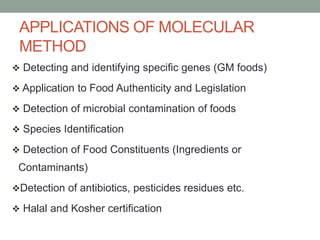
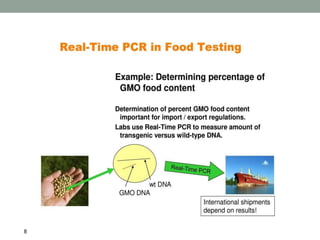
 Detecting and identifying specific genes (GM foods)
 Application to Food Authenticity and Legislation
 Detection of microbial contamination of foods
 Species Identification
 Detection of Food Constituents (Ingredients or
Contaminants)
Detection of antibiotics, pesticides residues etc.
 Halal and Kosher certification
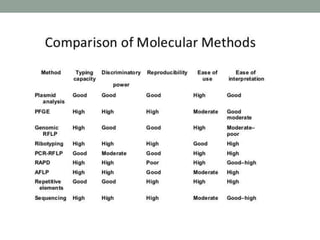
COMMON MOLECULAR METHODS
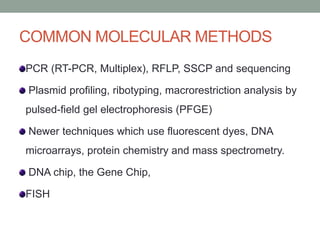
PCR (RT-PCR, Multiplex), RFLP, SSCP and sequencing
Plasmid profiling, ribotyping, macrorestriction analysis by
pulsed-field gel electrophoresis (PFGE)
Newer techniques which use fluorescent dyes, DNA
microarrays, protein chemistry and mass spectrometry.
DNA chip, the Gene Chip,
FISH
COMMON MOLECULAR METHODS
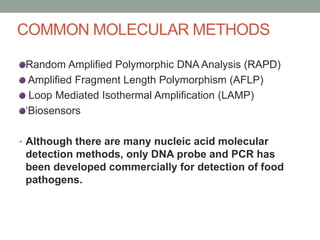
Random Amplified Polymorphic DNA Analysis (RAPD)
Amplified Fragment Length Polymorphism (AFLP)
Loop Mediated Isothermal Amplification (LAMP)
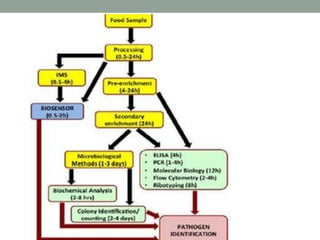
‘Biosensors
• Although there are many nucleic acid molecular
detection methods, only DNA probe and PCR has
been developed commercially for detection of food
pathogens.
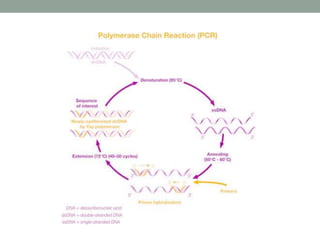
PCR STEPS
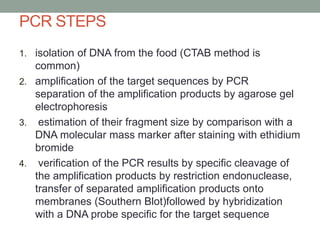
1. isolation of DNA from the food (CTAB method is
common)
2. amplification of the target sequences by PCR
separation of the amplification products by agarose gel
electrophoresis
3. estimation of their fragment size by comparison with a
DNA molecular mass marker after staining with ethidium
bromide
4. verification of the PCR results by specific cleavage of
the amplification products by restriction endonuclease,
transfer of separated amplification products onto
membranes (Southern Blot)followed by hybridization
with a DNA probe specific for the target sequence
REAL TIME PCR
• Real Time PCR is a technique in which fluoroprobes bind
to specific target regions of amplicons to produce
fluorescence during PCR.
• The fluorescence, measured in Real Time, is detected in
a PCR cycler with an inbuilt filter flurometer.
MULTIPLEX PCR
• Several primers pairs with similar annealing requirements
can be added to a PCR mixture to simultaneously detect
several target sequences.
• Saves time and minimize the expense on detection of
food borne pathogens
• Primers should have same melting temperature
• Must not interact with each other.
• The amplified fragments of same length cannot be
detected
MULTIPLEX PCR
Standard PCR- unable to differentiate viable and non-
viable microorganisms.
 Ethidium monoazide can be used to separate dead and
viable bacteria
 Real-time PCR using RNA as template is more authentic
since the RNA is present only in viable microbes.
 RNA is first reverse transcribed to cDNA and then used
for amplification
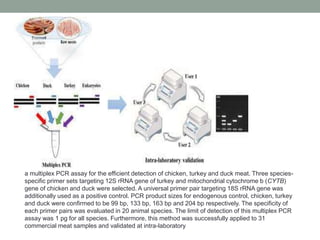
a multiplex PCR assay for the efficient detection of chicken, turkey and duck meat. Three species-
specific primer sets targeting 12S rRNA gene of turkey and mitochondrial cytochrome b (CYTB)
gene of chicken and duck were selected. A universal primer pair targeting 18S rRNA gene was
additionally used as a positive control. PCR product sizes for endogenous control, chicken, turkey
and duck were confirmed to be 99 bp, 133 bp, 163 bp and 204 bp respectively. The specificity of
each primer pairs was evaluated in 20 animal species. The limit of detection of this multiplex PCR
assay was 1 pg for all species. Furthermore, this method was successfully applied to 31
commercial meat samples and validated at intra-laboratory
POLYMERASE CHAIN REACTION –
RESTRICTION FRAGMENT LENGTH
POLYMORPHISM (PCR-RFLP)
• The method includes amplification of a known DNA
sequence using two specific primers, subsequent
digestion of an amplicon with restriction endonucleases
and separation and comparison of DNA restriction
fragments.
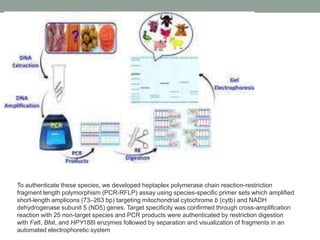
To authenticate these species, we developed heptaplex polymerase chain reaction-restriction
fragment length polymorphism (PCR-RFLP) assay using species-specific primer sets which amplified
short-length amplicons (73–263 bp) targeting mitochondrial cytochrome b (cytb) and NADH
dehydrogenase subunit 5 (ND5) genes. Target specificity was confirmed through cross-amplification
reaction with 25 non-target species and PCR products were authenticated by restriction digestion
with FatI, BfaI, and HPY188I enzymes followed by separation and visualization of fragments in an
automated electrophoretic system
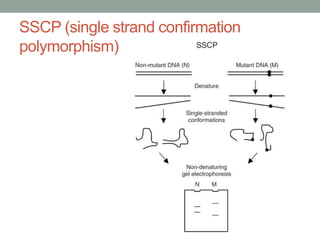
SSCP (single strand confirmation
polymorphism)
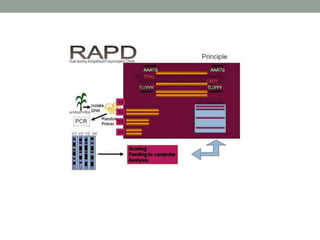
RAPD-PCR
Random amplified polymorphic DNA PCR uses a random
primer (10-mer) to generate a DNA profile.
 The primer anneals to several places on the DNA
template and generate a DNA profile which is used for
microbe identification.
RAPD has many advantages:
Pure DNA is not needed
Less labour intensive than RFLP.
There is no need for prior DNA sequence data.
RAPD has been used to fingerprint the outbreak of
Listeria monocytogenes from milk.
PLASMID PROFILING
• Plasmid profile analysis involves extraction of plasmid
DNA and separation by electrophoresis. The plasmids are
visualized under UV light and sized in relation to plasmids
of known molecular mass carried in a reference strain of
E. coli.
• Plasmid analysis of over 120 strains of Cl. perfringens,
isolated during food-poisoning incidents was carried out
by Jones et al., 1989.
• A high proportion (71%) of fresh and well- characterized
food-poisoning strains possessed plasmids of 6.2 kb in
size (compared with 19% of non-food-poisoning strains).
• Plasmids are extrachromosomal, circular DNA molecules that
are located in the bacterial cytoplasm, that contain at least one
origin of replication
• Isolation of plasmid DNA released under alkaline and high
temperature conditions that denature the chromosomal DNA
• Phenol: chloroform mixture to precipitate the plasmid DNA.
• Separated by gel electrophoresis, stained with a dye and
viewed.
• Typically, supercoiled molecular size standards from E. coli
R861 (NCTC 50192) and V517 (NCTC 50193), to determine the
sizes of the isolated plasmids
• The number and size of plasmid bands are analyzed to define
the plasmid profile for a particular isolate
RIBOTYPING
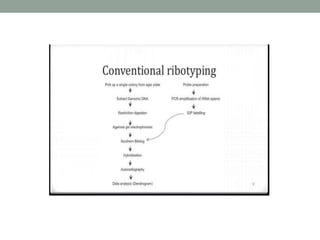
• Ribotyping is a method that can identify and classify
bacteria based upon differences in rRNA. It generates a
highly reproducible and precise fingerprint that can be
used to classify bacteria from the genus through and
beyond the species level.
• Databases for Listeria (80 pattern types), Salmonella (97
pattern types), Escherichia (65 pattern types) and
Staphylococcus(252 pattern types) have been established
MACRORESTRICTION
• The macrorestriction analysis of bacterial genomes is a
method that is generally applicable to the typing of
bacteria.
• The chromosome is cleaved with a restriction
endonuclease that cuts infrequently and subsequently
separated by pulsed-field gel electrophoresis.
• The fragment pattern defines the genotype of the strain.
• The relatedness of strains is evaluated from the similarity
of the fragment patterns.
• Macrorestriction analysis is a sensitive and specific
method to trace the origin and spread of infections and to
analyse the clonal structure of bacterial populations.
Pulse Field Gel Electrophoresis
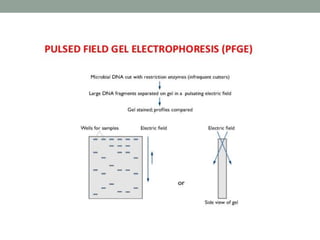
• Pulsed-field gel electrophoresis is based on the digestion of bacterial
DNA with restriction endonucleases that recognize few sites along the
chromosome, generating large DNA fragments (30-800 Kb) that cannot be
effectively separated by conventional electrophoresis.
• The basis for PFGE separation is the size-dependent time-associated
reorientation of DNA migration achieved by periodic switching of the
electric field in different directions.
• The DNA fragments will form a distinctive pattern of bands in the gel,
which can be analyzed visually and electronically.
• Bacterial isolates with identical or very similar band patterns are more
likely to be related genetically than bacterial isolates with more divergent
band patterns.
DNA MICROARRAY
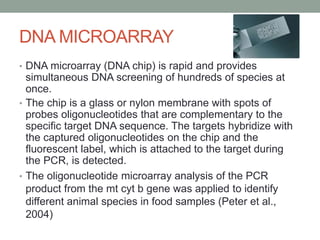
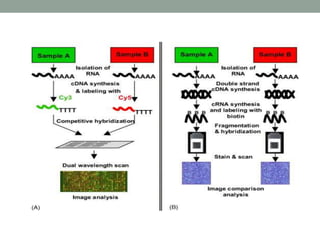
• DNA microarray (DNA chip) is rapid and provides
simultaneous DNA screening of hundreds of species at
once.
• The chip is a glass or nylon membrane with spots of
probes oligonucleotides that are complementary to the
specific target DNA sequence. The targets hybridize with
the captured oligonucleotides on the chip and the
fluorescent label, which is attached to the target during
the PCR, is detected.
• The oligonucleotide microarray analysis of the PCR
product from the mt cyt b gene was applied to identify
different animal species in food samples (Peter et al.,
2004)
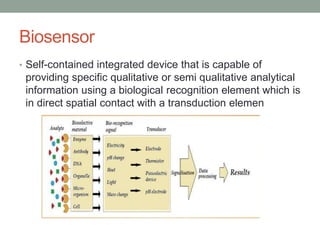
Biosensor
• Self-contained integrated device that is capable of
providing specific qualitative or semi qualitative analytical
information using a biological recognition element which is
in direct spatial contact with a transduction elemen
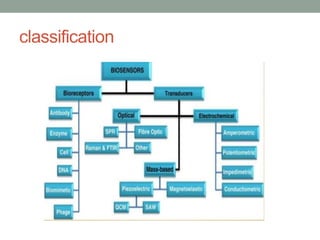
classification
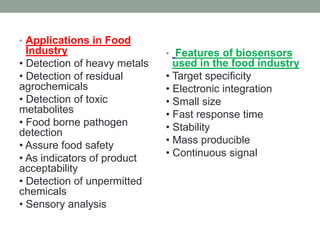
• Applications in Food
Industry
• Detection of heavy metals
• Detection of residual
agrochemicals
• Detection of toxic
metabolites
• Food borne pathogen
detection
• Assure food safety
• As indicators of product
acceptability
• Detection of unpermitted
chemicals
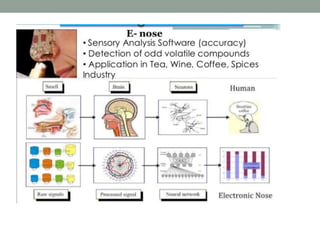
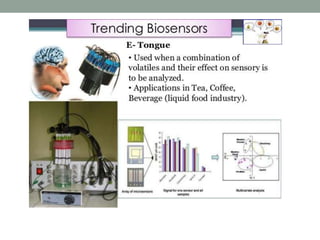
• Sensory analysis
• Features of biosensors
used in the food industry
• Target specificity
• Electronic integration
• Small size
• Fast response time
• Stability
• Mass producible
• Continuous signal
IMPEDANCE-BASED BIOCHIP SENSOR
• Based on the changes in conductance in a medium due
to microbial breakdown of inert substances into
electrically charged ionic compounds.
• Allows the detection of only the viable cells
PIEZOELECTRIC BIOSENSOR
• Very attractive and offers real time output, simplicity of
use and cost effectiveness
• Based on coating the surface of piezoelectric sensor with
a selective binding substance e.g. antibodies, placing it in
a solution containing bacteria, the bacteria/antigen will
bind to the antibodies and the mass of the crystal
increase while the resonance frequency will decrease
AFLP ( Amplified Fragment Length
Polymorphism)
• AFLP is a technique based on the principle of selectively
amplifying the subset of restriction fragments from a
complex mixture of DNA fragments obtained after the
digestion of genomic DNA with restriction endonucleases.
• Steps :1. Digestion 2. Adaptor ligation 3. Amplification 4.
Electrophoresis
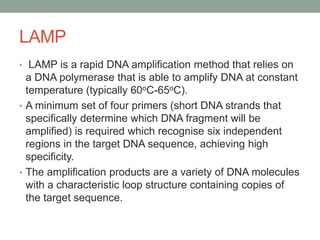
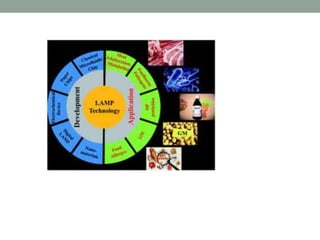
LAMP
• LAMP is a rapid DNA amplification method that relies on
a DNA polymerase that is able to amplify DNA at constant
temperature (typically 60oC-65oC).
• A minimum set of four primers (short DNA strands that
specifically determine which DNA fragment will be
amplified) is required which recognise six independent
regions in the target DNA sequence, achieving high
specificity.
• The amplification products are a variety of DNA molecules
with a characteristic loop structure containing copies of
the target sequence.
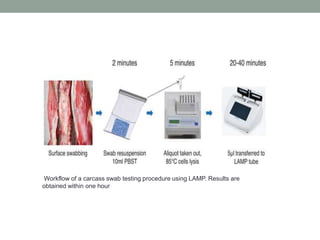
Workflow of a carcass swab testing procedure using LAMP. Results are
obtained within one hour
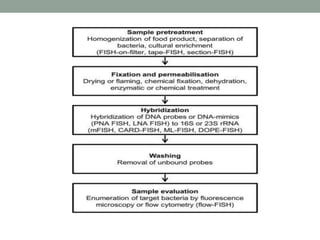
FLUORESCENT IN SITU
HYBRIDIZATION (FISH)
• A molecular technique often used to identify and
enumerate specific microbial groups.
• The FISH technique is dependent upon hybridizing a
probe with a fluorescent tag, complementary in sequence,
to a short section of DNA on a target gene.
• The tag and probe are applied to a sample of interest
under conditions that allow for the probe to attach itself to
the complementary sequence in the specimen
• After sample treatment, excess fluorophore is washed
away and the sample can be visualized under a
fluorescent microscope.
REFERANCE
• Murugaboopathi G., Parthasarathy V., Chellaram C., Anand T.P., and
Vinurajkumar s. (2013) Applications of Biosensors in Food Biosciences
Biotechnology Research Asia. 10(2), 707-711 Industry
• Mandal, P.K., A.K. Biswas, K. Choi and U.K. Pal, 2011. Methods of Rapid
Detection of Foodborne Pathogens: An Overview. Am. J. Food Tech. 6(2): 87-
102
• Sharma H., Agarwal M., Goswami M., Sharma A., Roy S.K., Rai S., and
Murugan M.S.(2013) Biosensors: tool for food borne pathogen detection.
Veterinary World. 6(12), 968-973. 18
• http://www.worldfoodscience.org/cms/
• Naravaneni R, Jamil K. J Med Microbiol. 2005 Jan;54(Pt 1):51-4
• www.researchgate.net
• https://www.newfoodmagazine.com/article/74029/loop-mediated-isothermal-
nucleic-acid-amplification-lamp-for-food-microbiology-testing/
• foodsafety.merieuxnutrisciences.com
• https://pubmed.ncbi.nlm.nih.gov/7698814/

Molecular techniques in food microbiology

  • 1.
    MOLECULAR TECHNIQUES IN FOOD MICROBIOLOGY Presentedby : Najiya K V MSc Biotechnology
  • 2.
    APPLICATIONS OF MOLECULAR METHOD Detecting and identifying specific genes (GM foods)  Application to Food Authenticity and Legislation  Detection of microbial contamination of foods  Species Identification  Detection of Food Constituents (Ingredients or Contaminants) Detection of antibiotics, pesticides residues etc.  Halal and Kosher certification
  • 3.
    COMMON MOLECULAR METHODS PCR(RT-PCR, Multiplex), RFLP, SSCP and sequencing Plasmid profiling, ribotyping, macrorestriction analysis by pulsed-field gel electrophoresis (PFGE) Newer techniques which use fluorescent dyes, DNA microarrays, protein chemistry and mass spectrometry. DNA chip, the Gene Chip, FISH
  • 4.
    COMMON MOLECULAR METHODS RandomAmplified Polymorphic DNA Analysis (RAPD) Amplified Fragment Length Polymorphism (AFLP) Loop Mediated Isothermal Amplification (LAMP) ‘Biosensors • Although there are many nucleic acid molecular detection methods, only DNA probe and PCR has been developed commercially for detection of food pathogens.
  • 5.
    PCR STEPS 1. isolationof DNA from the food (CTAB method is common) 2. amplification of the target sequences by PCR separation of the amplification products by agarose gel electrophoresis 3. estimation of their fragment size by comparison with a DNA molecular mass marker after staining with ethidium bromide 4. verification of the PCR results by specific cleavage of the amplification products by restriction endonuclease, transfer of separated amplification products onto membranes (Southern Blot)followed by hybridization with a DNA probe specific for the target sequence
  • 7.
    REAL TIME PCR •Real Time PCR is a technique in which fluoroprobes bind to specific target regions of amplicons to produce fluorescence during PCR. • The fluorescence, measured in Real Time, is detected in a PCR cycler with an inbuilt filter flurometer.
  • 9.
    MULTIPLEX PCR • Severalprimers pairs with similar annealing requirements can be added to a PCR mixture to simultaneously detect several target sequences. • Saves time and minimize the expense on detection of food borne pathogens • Primers should have same melting temperature • Must not interact with each other. • The amplified fragments of same length cannot be detected
  • 10.
    MULTIPLEX PCR Standard PCR-unable to differentiate viable and non- viable microorganisms.  Ethidium monoazide can be used to separate dead and viable bacteria  Real-time PCR using RNA as template is more authentic since the RNA is present only in viable microbes.  RNA is first reverse transcribed to cDNA and then used for amplification
  • 11.
    a multiplex PCRassay for the efficient detection of chicken, turkey and duck meat. Three species- specific primer sets targeting 12S rRNA gene of turkey and mitochondrial cytochrome b (CYTB) gene of chicken and duck were selected. A universal primer pair targeting 18S rRNA gene was additionally used as a positive control. PCR product sizes for endogenous control, chicken, turkey and duck were confirmed to be 99 bp, 133 bp, 163 bp and 204 bp respectively. The specificity of each primer pairs was evaluated in 20 animal species. The limit of detection of this multiplex PCR assay was 1 pg for all species. Furthermore, this method was successfully applied to 31 commercial meat samples and validated at intra-laboratory
  • 12.
    POLYMERASE CHAIN REACTION– RESTRICTION FRAGMENT LENGTH POLYMORPHISM (PCR-RFLP) • The method includes amplification of a known DNA sequence using two specific primers, subsequent digestion of an amplicon with restriction endonucleases and separation and comparison of DNA restriction fragments.
  • 13.
    To authenticate thesespecies, we developed heptaplex polymerase chain reaction-restriction fragment length polymorphism (PCR-RFLP) assay using species-specific primer sets which amplified short-length amplicons (73–263 bp) targeting mitochondrial cytochrome b (cytb) and NADH dehydrogenase subunit 5 (ND5) genes. Target specificity was confirmed through cross-amplification reaction with 25 non-target species and PCR products were authenticated by restriction digestion with FatI, BfaI, and HPY188I enzymes followed by separation and visualization of fragments in an automated electrophoretic system
  • 14.
    SSCP (single strandconfirmation polymorphism)
  • 15.
    RAPD-PCR Random amplified polymorphicDNA PCR uses a random primer (10-mer) to generate a DNA profile.  The primer anneals to several places on the DNA template and generate a DNA profile which is used for microbe identification. RAPD has many advantages: Pure DNA is not needed Less labour intensive than RFLP. There is no need for prior DNA sequence data. RAPD has been used to fingerprint the outbreak of Listeria monocytogenes from milk.
  • 17.
    PLASMID PROFILING • Plasmidprofile analysis involves extraction of plasmid DNA and separation by electrophoresis. The plasmids are visualized under UV light and sized in relation to plasmids of known molecular mass carried in a reference strain of E. coli. • Plasmid analysis of over 120 strains of Cl. perfringens, isolated during food-poisoning incidents was carried out by Jones et al., 1989. • A high proportion (71%) of fresh and well- characterized food-poisoning strains possessed plasmids of 6.2 kb in size (compared with 19% of non-food-poisoning strains).
  • 18.
    • Plasmids areextrachromosomal, circular DNA molecules that are located in the bacterial cytoplasm, that contain at least one origin of replication • Isolation of plasmid DNA released under alkaline and high temperature conditions that denature the chromosomal DNA • Phenol: chloroform mixture to precipitate the plasmid DNA. • Separated by gel electrophoresis, stained with a dye and viewed. • Typically, supercoiled molecular size standards from E. coli R861 (NCTC 50192) and V517 (NCTC 50193), to determine the sizes of the isolated plasmids • The number and size of plasmid bands are analyzed to define the plasmid profile for a particular isolate
  • 19.
    RIBOTYPING • Ribotyping isa method that can identify and classify bacteria based upon differences in rRNA. It generates a highly reproducible and precise fingerprint that can be used to classify bacteria from the genus through and beyond the species level. • Databases for Listeria (80 pattern types), Salmonella (97 pattern types), Escherichia (65 pattern types) and Staphylococcus(252 pattern types) have been established
  • 21.
    MACRORESTRICTION • The macrorestrictionanalysis of bacterial genomes is a method that is generally applicable to the typing of bacteria. • The chromosome is cleaved with a restriction endonuclease that cuts infrequently and subsequently separated by pulsed-field gel electrophoresis. • The fragment pattern defines the genotype of the strain. • The relatedness of strains is evaluated from the similarity of the fragment patterns. • Macrorestriction analysis is a sensitive and specific method to trace the origin and spread of infections and to analyse the clonal structure of bacterial populations.
  • 22.
    Pulse Field GelElectrophoresis • Pulsed-field gel electrophoresis is based on the digestion of bacterial DNA with restriction endonucleases that recognize few sites along the chromosome, generating large DNA fragments (30-800 Kb) that cannot be effectively separated by conventional electrophoresis. • The basis for PFGE separation is the size-dependent time-associated reorientation of DNA migration achieved by periodic switching of the electric field in different directions. • The DNA fragments will form a distinctive pattern of bands in the gel, which can be analyzed visually and electronically. • Bacterial isolates with identical or very similar band patterns are more likely to be related genetically than bacterial isolates with more divergent band patterns.
  • 24.
    DNA MICROARRAY • DNAmicroarray (DNA chip) is rapid and provides simultaneous DNA screening of hundreds of species at once. • The chip is a glass or nylon membrane with spots of probes oligonucleotides that are complementary to the specific target DNA sequence. The targets hybridize with the captured oligonucleotides on the chip and the fluorescent label, which is attached to the target during the PCR, is detected. • The oligonucleotide microarray analysis of the PCR product from the mt cyt b gene was applied to identify different animal species in food samples (Peter et al., 2004)
  • 26.
    Biosensor • Self-contained integrateddevice that is capable of providing specific qualitative or semi qualitative analytical information using a biological recognition element which is in direct spatial contact with a transduction elemen
  • 27.
  • 28.
    • Applications inFood Industry • Detection of heavy metals • Detection of residual agrochemicals • Detection of toxic metabolites • Food borne pathogen detection • Assure food safety • As indicators of product acceptability • Detection of unpermitted chemicals • Sensory analysis • Features of biosensors used in the food industry • Target specificity • Electronic integration • Small size • Fast response time • Stability • Mass producible • Continuous signal
  • 30.
    IMPEDANCE-BASED BIOCHIP SENSOR •Based on the changes in conductance in a medium due to microbial breakdown of inert substances into electrically charged ionic compounds. • Allows the detection of only the viable cells PIEZOELECTRIC BIOSENSOR • Very attractive and offers real time output, simplicity of use and cost effectiveness • Based on coating the surface of piezoelectric sensor with a selective binding substance e.g. antibodies, placing it in a solution containing bacteria, the bacteria/antigen will bind to the antibodies and the mass of the crystal increase while the resonance frequency will decrease
  • 33.
    AFLP ( AmplifiedFragment Length Polymorphism) • AFLP is a technique based on the principle of selectively amplifying the subset of restriction fragments from a complex mixture of DNA fragments obtained after the digestion of genomic DNA with restriction endonucleases. • Steps :1. Digestion 2. Adaptor ligation 3. Amplification 4. Electrophoresis
  • 34.
    LAMP • LAMP isa rapid DNA amplification method that relies on a DNA polymerase that is able to amplify DNA at constant temperature (typically 60oC-65oC). • A minimum set of four primers (short DNA strands that specifically determine which DNA fragment will be amplified) is required which recognise six independent regions in the target DNA sequence, achieving high specificity. • The amplification products are a variety of DNA molecules with a characteristic loop structure containing copies of the target sequence.
  • 35.
    Workflow of acarcass swab testing procedure using LAMP. Results are obtained within one hour
  • 37.
    FLUORESCENT IN SITU HYBRIDIZATION(FISH) • A molecular technique often used to identify and enumerate specific microbial groups. • The FISH technique is dependent upon hybridizing a probe with a fluorescent tag, complementary in sequence, to a short section of DNA on a target gene. • The tag and probe are applied to a sample of interest under conditions that allow for the probe to attach itself to the complementary sequence in the specimen • After sample treatment, excess fluorophore is washed away and the sample can be visualized under a fluorescent microscope.
  • 40.
    REFERANCE • Murugaboopathi G.,Parthasarathy V., Chellaram C., Anand T.P., and Vinurajkumar s. (2013) Applications of Biosensors in Food Biosciences Biotechnology Research Asia. 10(2), 707-711 Industry • Mandal, P.K., A.K. Biswas, K. Choi and U.K. Pal, 2011. Methods of Rapid Detection of Foodborne Pathogens: An Overview. Am. J. Food Tech. 6(2): 87- 102 • Sharma H., Agarwal M., Goswami M., Sharma A., Roy S.K., Rai S., and Murugan M.S.(2013) Biosensors: tool for food borne pathogen detection. Veterinary World. 6(12), 968-973. 18 • http://www.worldfoodscience.org/cms/ • Naravaneni R, Jamil K. J Med Microbiol. 2005 Jan;54(Pt 1):51-4 • www.researchgate.net • https://www.newfoodmagazine.com/article/74029/loop-mediated-isothermal- nucleic-acid-amplification-lamp-for-food-microbiology-testing/ • foodsafety.merieuxnutrisciences.com • https://pubmed.ncbi.nlm.nih.gov/7698814/