report
August 2012
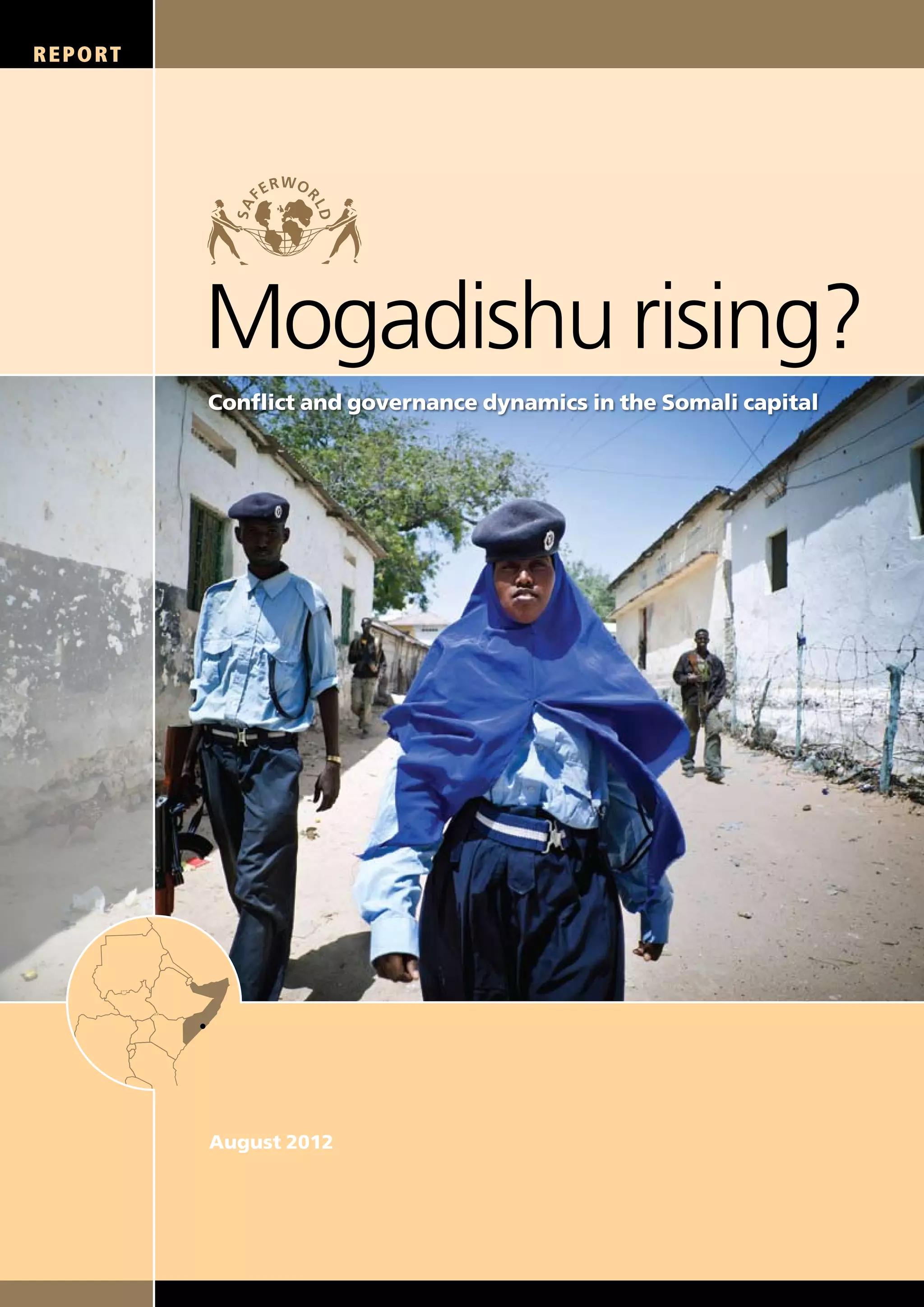
Mogadishu rising?
Conflict and governance dynamics in the Somali capital
august 2012
Mogadishu rising?
Conflict and governance dynamics in the Somali capital
Acronyms and Abbreviations
AMISOM	 African Union Mission in Somalia
ASWJ	 Ahlu-Sunna Wal-Jama’a
AU	 African Union
CIS	 Council of Islamic Scholars
CSO	 Civil society organisation
DC	 District Commissioner
EU	 European Union
IDP	 internally displaced person
IGAD	 Intergovernmental Authority on Development
MP	 Member of Parliament
NGO	 non-governmental organisation
NSA	 National Security Agency
PDP	 Peace and Development Party
SOSCENSA	 Somali South-Central Non-State Actors
SEMG	 Somalia and Eritrea Monitoring Group
TFG	 Transitional Federal Government
UK	 United Kingdom
UN	 United Nations
UNHCR	 UN Refugee Agency
UNPOS	 UN Political Office for Somalia
US	 United States
© Saferworld, August 2012. All rights reserved. No part of this publication may be
reproduced, stored in a retrieval system or transmitted in any form or by any means
electronic, mechanical, photocopying, recording or otherwise, without full
attribution. Saferworld welcomes and encourages the utilisation and dissemination
of the material included in this publication.
Contents
	 1. 	Introduction	 1
	 2. 	Key findings	 2
	 3. 	Overview of the context	 3
	 4. 	Key domestic actors	 5
	 5. 	Security dynamics	 9
		 5.1 	Tenuous improvement	 9
		 5.2 	Criminal activity	 10
		 5.3 	Policing and private security	 13
	 6. 	Human needs: migration, food and resources	 15
		 6.1 	Population movements	 15
		 6.2 	Food availability	 16
		 6.3 	Land	 17
	 7. 	Regional and international stakeholders in Somalia	 18
		 7.1 	AMISOM’s progress	 18
		 7.2 	Non-mandated external security actors	 19
		 7.3 	Other external security funding and support	 20
	 8. 	Conclusion: Issues to consider	 22
		 Methodology	 24
		 Bibliography	 25
Tables and figures
Table 1. 	 Distribution of major assets by district in Mogadishu 	 4
Figure 1. 	Al-Shabaab structure, July 2012 	 6
Figure 2. 	Perceptions of security in Mogadishu 	 9
Figure 3. 	Perceptions of risk in Mogadishu, July 2012 	 10
Table 2. 	 Attacks on UN, international NGO and local NGO aid workers, 	 10
	 January–July 2012
Figure 4. 	Torture and illegal arrest per household in past 90 days 	 11
Table 3. 	 Non-lethal violent incidents per household in past 90 days 	 12
Figure 5. 	Security incidents in Mogadishu, January–June 2012 	 12
Figure 6. 	Mogadishu: Levels of fear of armed entities 	 13
	 Map of Somalia 			 14
Figure 7. 	Movement of internally displaced persons in Mogadishu 	 15
Figure 8. 	Prices of food per kilo in Mogadishu, April–June 2012	 17
Table 4. 	 Actors’ attitudes towards key issues	 21
1	
	 1	 Section 7 focuses more on Somalia as a whole, as geopolitical developments are not relevant to just Mogadishu.
	 1
Introduction
this report was prepared by saferworld as part of the design phase of a
Conflict and Governance Mapping (CGM) project. The project aims to produce a
credible research model to map conflict and governance dynamics in Somalia with a
view to producing regular data and analysis and tracking trends over time. This pilot
report focuses on Mogadishu1 and uses original data collected between April and July
2012 in interviews, focus group discussions and Mogadishu-wide household survey
and mapping exercises (see Methodology section for more detail). While this report
provides a time-bound snapshot of current conflict and governance issues in a limited
geographical area (Mogadishu), the project ultimately seeks to assist actors promoting
peace and development in Somalia, including the new Somali authorities, by collecting
firsthand data sourced at the local level and integrating it with data from secondary
sources to provide timely analysis that is grounded in local realities.
After flagging key findings in Section 2, Section 3 offers an overview of the context
followed by an updated analysis of domestic actors and their relationships in Section 4.
Section 5 covers security dynamics in Mogadishu, including recent improvements in
security, criminal activity and ongoing challenges in the areas of policing and
privatisation of security. Section 6 on human needs describes migrations trends, food
availability and the potential for land-related conflict. Section 7 then examines the
influence of key external actors, both regional and international, and highlights the
concerns felt by Somalis over their influence on the country. The conclusion flags key
issues to consider based on the main findings of the report.
2  	
	 2
Key findings
	 n	 There is a widespread perception in Mogadishu that security has improved
considerably in the past year, with a decline in terrorism and insurgency-related
violence in particular. This is largely due to the Transitional Federal Government
(TFG) consolidating power after al-Shabaab fighters largely withdrew from the city
in August 2011.
	 n	 Nevertheless, security remains inadequate and uneven with significant areas of
Mogadishu – particularly the city’s northern districts – almost entirely unpoliced.
In the absence of state-provided security, residents and officials have formed an array
of neighbourhood vigilante groups and private militias to protect themselves and their
assets.
	 n	 A significant number – reportedly up to 50 percent – of police and military personnel
work for private individuals, adding to the large number of freelance armed actors
in the city and seriously undermining the security services’ ability to perform their
duties. Criminal violence and violent deaths remain common, as do reported
incidences of illegal arrests and physical torture.
	 n	 Residents are anxious that warlords and influential businessmen not included in the
new political order could stage an armed revolt. Already there is evidence that some
warlords and business people are arming themselves.
	 n	 Land is the most contested resource in Mogadishu and land claims by returnees from
the diaspora and internally displaced persons (IDPs) are inflaming an already tense
situation. Social unrest and wider instability could be the outcome of conflict over this
key resource.
	 n	 President Sheikh Sharif Sheikh Ahmed’s clan dominates the city politically, creating
grievances among rival clans which could also trigger unrest.
	 n	 External actors have given disproportionate weight to the transition roadmap and its
six Somali signatories. As the roadmap has not been widely supported, this has
contributed to the perception that external actors rather than Somalis have driven the
recent political transition.
	 n	 Somalis have welcomed the injection of significant infrastructure funding by Turkey,
but quiet criticism is growing that it has overestimated the institutional importance of
the president and may have inadvertently concentrated its commercial dealings on a
narrow section of his close allies and kinsmen.
3	
	 2	 The end of transition roadmap was signed on 6 September 2011 by the TFG President, the Prime Minister, the Speaker of
Parliament, the President of Puntland, the President of Galmudug and the leader of the Ahlu-Sunna Wal-Jama’a (ASWJ). The
roadmap’s original wide scope was subsequently narrowed to focus on two key goals: finalising a provisional constitution
and creating a National Constituent Assembly that would endorse the provisional constitution and appoint a new
parliament. Mosley J, ‘End of the Roadmap: Somalia after the London and Istanbul Conferences’, Africa Programme Paper,
June 2012, p 3.
	 3 	 2012 was marked by a flurry of diplomatic activity on Somalia at meetings including the London Conference on Somalia in
February 2012 and the Istanbul II Conference in May 2012. This focus on Somalia is in part related to international interest in
piracy and terrorism.
	 4 	 A December 2011–January 2012 poll conducted by Opinion Research Business (ORB) found that a limited number of people
in Mogadishu were familiar with the road map: 28 percent knew it very well; 13 percent knew it a fair amount; 23 percent
knew just a little; 25 percent had heard of it but knew nothing about it; and 9 percent had never heard of it. ORB
International, Mogadishu opinion polling, December 2011–January 2012: Poll findings, 2012.
	 5	 See UN Monitoring Group on Somalia Report, June 2012, pp 11–19, for background on corruption. Nevertheless the TFG
has legitimacy: an ORB Mogadishu opinion poll from December 2011–January 2012 found that 97 percent of respondents
agreed that the TFG was the legitimate government of Somalia. Op cit ORB.
	 6 	 Interview with Abdirashid Hashi, Somalia analyst, August 2012.
	 7 	 See methodology section for explanation on the population figure used by Saferworld.
	 3
Overview of the context
somalia’s eight-year transition period officially ended on 20 August 2012,
bringing to a close the TFG and its fractious parliament.2 A new, leaner parliament
with 275 members (MPs), down from 550, is now tasked with finalising the country’s
provisional constitution over its four-year term. The parliament is also electing a new
president who will then appoint a prime minister responsible for forming a cabinet.
Though the roadmap to transition process has been welcomed outside Somalia it was
largely forced through by external actors.3 This carries the risk of isolating dissenting
Somali voices, including those who may try to disrupt the new political order.4 Indeed,
Somalia is still no nearer to statehood than it was in 2004 when the transition began, in
part because of the TFG’s weak governance and widespread corruption.5 The challenge
of providing security and any semblance of good governance in government-held
areas therefore remains immense.
The transition process is hugely important, not least because it will set the stage for
future international engagement with Somalia. If managed well and peacefully, it could
help to cement recent security gains. This could result in increased engagement by
donors, with more funds available to stabilise the country and provide tangible peace
dividends for the Somali people. If, on the other hand, the transition gives birth to
institutions and leaders that are perceived to lack legitimacy, a deterioration in security
and international engagement could ensue.6 This could, in turn, lead to a decrease in
international aid.
There has been tentative progress on security in recent months, particularly in
Mogadishu, the largest and most populous city in Somalia with more than one million
people living in and around the capital.7 The city remains sharply divided between
north and south with the government and most international organisations based in
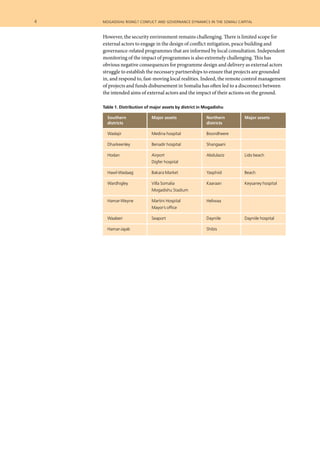
the southern districts. These are more economically and socially vibrant (see Table 1)
than those in the north which were controlled by al-Shabaab fighters until the end
of 2011.
4  	 mogadishu rising? conflict and governance dynamics in the somali capital
However, the security environment remains challenging. There is limited scope for
external actors to engage in the design of conflict mitigation, peace building and
governance-related programmes that are informed by local consultation. Independent
monitoring of the impact of programmes is also extremely challenging. This has
obvious negative consequences for programme design and delivery as external actors
struggle to establish the necessary partnerships to ensure that projects are grounded
in, and respond to, fast-moving local realities. Indeed, the remote control management
of projects and funds disbursement in Somalia has often led to a disconnect between
the intended aims of external actors and the impact of their actions on the ground.
Table 1. Distribution of major assets by district in Mogadishu
Wadajir	 Medina hospital	 Boondheere
Dharkeenley	 Benadir hospital	 Shangaani
Hodan	 Airport	 Abdulaziz	 Lido beach
	 Digfer hospital
Hawl-Wadaag 	 Bakara Market	 Yaqshiid	 Beach
Wardhigley	 Villa Somalia	 Kaaraan	 Keysaney hospital
	 Mogadishu Stadium
Hamar-Weyne	 Martini Hospital	 Heliwaa
	 Mayor’s office
Waaberi	 Seaport	 Dayniile	 Dayniile hospital
Hamar-Jajab		 Shibis
Southern	 Major assets	 Northern	 Major assets
districts		 districts
5	
	 8 	 Op cit UN Monitoring Group Report, p 14.
	 9 	 Interview with clan elder, Mogadishu, June 2012.
	 10 	 Voice Of America Somali Service interview with Sheikh Bashir Salad, head of CIS, 5 October, 2011.
	 11 	 Op cit UN Monitoring Group Report, p 15.
	 12 	 Adde D, ‘Puntland ready to fight al-Shabaab affiliated groups, officials say’, Sabahi Online, 14 March 2012.
	 13 	 The Galgala militia is a group of fighters with long ties to violent Islamist groups in Somalia, dating back to the now defunct
al-Ittihad al-Islami in the early 1990s.
	 14 	 Pelton R, ‘Atom Militia declare allegiance to Shabaab’, Somaliareport.com, 25 February 2012.
	 4
Key domestic actors
an increase in african union mission in somalia (AMISOM) troop
levels to more than 17,000 as of July 2012,8 along with better co-ordination between
AMISOM and TFG officials, has contributed to the decline of the militant movement
al-Shabaab in the Somali capital.
The bulk of al-Shabaab was driven out in August 2011, including from the Bakara
Market, but a small number of fighters remained in north Mogadishu until December
2011. In May and June 2012, al-Shabaab lost three other main towns-Elasha Biyaha and
Afgoye in the Lower Shabelle region and Bal’ad in Middle Shabelle. Forced out of the
outer rings of Mogadishu and bases that it had controlled for three to four years, this
represented a major blow to its ability to strike at the heart of the capital.
These defeats came at a difficult time for the militants who had been struggling to find
safe havens inside Mogadishu due to popular disapproval of their tactics. More than
half the residents (53 percent) polled by Saferworld in July 2012 said that al-Shabaab
had a negative impact on the lives of residents with just 6.4 percent reporting a positive
impact. Community elders attribute the recent decline in popularity to, among other
things, the attack in October 2011 that killed 70 people – mainly students and their
parents.9 A day after al-Shabaab claimed responsibility, the Council of Islamic Scholars
(CIS) criticised the militants and their declaration of jihad against unarmed civilians.10
The CIS said the attack was the strongest evidence that al-Shabaab was “being manipu-
lated by a foreign entity to decimate the Somali people” and branded al-Shabaab “the
enemy of the Somali people”.
Al-Shabaab responded by moving much of its manpower and equipment to Puntland
in northeast Somalia. The United Nations (UN) Somalia and Eritrea Monitoring
Group (SEMG) found that there has been “a steady influx of al-Shabaab fighters from
southern Somalia into Puntland”11 since February 2012. This relocation was driven by
several factors including the deteriorating security in Puntland where al-Shabaab
affiliated militants have carried out a number of targeted assassinations against
politicians, district commissioners and judges.12
Also drawing al-Shabaab to Puntland has been the Galgala militia13 which declared
allegiance to al-Shabaab in February14 – profoundly boosting its presence there.
The Galgala are based in the vast, inaccessible Golis mountains in the Sanaag region
6  	 mogadishu rising? conflict and governance dynamics in the somali capital
	 15 	 Op cit UN Monitoring Group Report, p 148.
	 16 	 Ibid, p 147.
	 17 	 Crawford, J,’Obama Bans Charcoal from Somalia’, CNN.com, 20 July 2012.
	 18 	 For background see Aynte, A, ‘An anatomy of al Shabaab,’ June 2010.
	 19 	 Scahill J, ‘The CIA’s secret sites in Somalia’, The Nation Magazine, (1–8 August 2011), pp 1–6.
in northeast Somalia. Dubbed by some as ‘Somalia’s Tora Bora’, referring to the remote
cave complex in Afghanistan where Al Qaeda leader Osama bin Laden was thought to
have hidden out, the area offers rugged terrain and an excellent hideout for al-Shabaab
fighters.
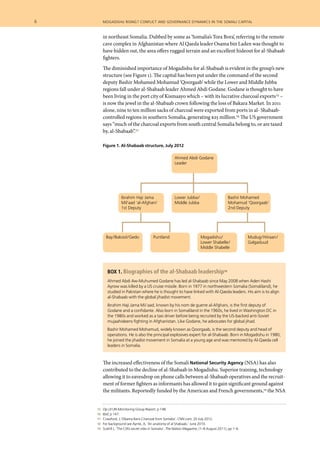
The diminished importance of Mogadishu for al-Shabaab is evident in the group’s new
structure (see Figure 1). The capital has been put under the command of the second
deputy Bashir Mohamed Mohamud ‘Qoorgaab’ while the Lower and Middle Jubba
regions fall under al-Shabaab leader Ahmed Abdi Godane. Godane is thought to have
been living in the port city of Kismaayo which – with its lucrative charcoal exports15 –
is now the jewel in the al-Shabaab crown following the loss of Bakara Market. In 2011
alone, nine to ten million sacks of charcoal were exported from ports in al- Shabaab-
controlled regions in southern Somalia, generating $25 million.16 The US government
says “much of the charcoal exports from south central Somalia belong to, or are taxed
by, al-Shabaab”.17
Figure 1. Al-Shabaab structure, July 2012
0 20 40 60 80 100%
TFG police
TFG allied militia
AMISOM
Al-Shabaab
ASWJ
Non TFG allied
clan miliitas
US drones
13.4 33.6 50.1 2.9
17.6 41.8 35 5.6
17.9 35 42.1 5
26 29.4 30.1 14.5
7.1 32.5 52 8.4
21.8 36 35 7.2
17.2 34.2 41.2 7.4
Afraid but does not affect daily activities
Very afraid so avoiding affects daily activities
Not afraid
Refused to answer
Bay/Bakool/Gedo Puntland Mogadishu/
Lower Shabelle/
Middle Shabelle
Mudug/Hiiraan/
Galgaduud
Ibrahim Haji Jama
Mil’aad ‘al-Afghani’
1st Deputy
Lower Jubba/
Middle Jubba
Bashir Mohamed
Mohamud ‘Qoorgaab’
2nd Deputy
Ahmed Abdi Godane
Leader
Figure 2
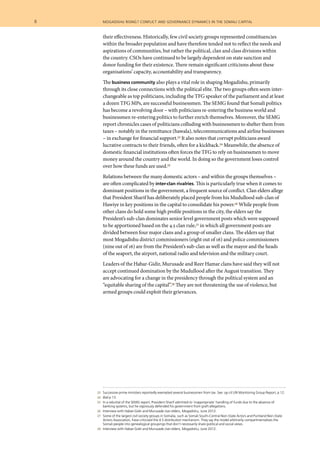
Box 1. Biographies of the al-Shabaab leadership18
Ahmed Abdi Aw-Muhumed Godane has led al-Shabaab since May 2008 when Aden Hashi
Ayrow was killed by a US cruise missile. Born in 1977 in northwestern Somalia (Somaliland), he
studied in Pakistan where he is thought to have linked with Al-Qaeda leaders. His aim is to align
al-Shabaab with the global jihadist movement.
Ibrahim Haji Jama Mii’aad, known by his nom de guerre al-Afghani, is the first deputy of
Godane and a confidante. Also born in Somaliland in the 1960s, he lived in Washington DC in
the 1980s and worked as a taxi driver before being recruited by the US-backed anti-Soviet
mujaahideens fighting in Afghanistan. Like Godane, he advocates for global jihad.
Bashir Mohamed Mohamud, widely known as Qoorgaab, is the second deputy and head of
operations. He is also the principal explosives expert for al-Shabaab. Born in Mogadishu in 1980,
he joined the jihadist movement in Somalia at a young age and was mentored by Al-Qaeda cell
leaders in Somalia.
The increased effectiveness of the Somali National Security Agency (NSA) has also
contributed to the decline of al-Shabaab in Mogadishu. Superior training, technology
allowing it to eavesdrop on phone calls between al-Shabaab operatives and the recruit-
ment of former fighters as informants has allowed it to gain significant ground against
the militants. Reportedly funded by the American and French governments,19 the NSA
saferworld	 7	
	 20 	 ‘Man with explosive jacket apprehended by NSA’, Radio Mogadishu, 7 April, 2012.
	 21 	 ASWJ is a Sufi militia allied with the TFG.
	 22 	 This was a criteria agreed by signatories of the roadmap.
managed to pre-empt terrorist attacks in April and May 2012 including two militants
who were planning to carry out suicide bombings on TFG targets such as the head-
quarters of the military.20
Despite the improving security, criminal activity is still a significant problem in the
capital, discussed in greater detail in section five. The city’s police force is not up to the
task of protecting citizens, so communities have taken matters into their own hands
and organised neighbourhood vigilante groups. Armed with weapons including
AK47s, the vigilantes can be seen at night behind barricades and fortified positions
on the winding, narrow dirt roads leading into densely populated residential areas.
In return, they are fed and paid by wealthy members of the community.
These vigilantes are joined on Mogadishu’s streets by a variety of other militias, most
of which operate independently and are primarily loyal to their clans and clan leaders.
These groups are better defined by what they are against – al-Shabaab – than what
they stand for, as they work autonomously and lack a single command and control
structure. The most important is Ahlu-Sunna Wal-Jama (ASWJ),21 which is closely
associated with Ethiopia and has heavily armed fighters in Mogadishu. It is led by
Abdulkadir Moallin Nur. Other significant militias in the city include those operated
by the district commissioners (DCs), including from Wadajir and Hawl-Wadaag
districts.
Added into the mix are some of Mogadishu’s former warlords and businessmen who
are arming themselves before the end of the transition. The motive is invariably
similar: uncertainty regarding the post-transition outcome and fear of being left out
of positions of influence and power. This is a real possibility as new MPs are not
permitted to have criminal backgrounds,22 which could affect former warlords vying
for political positions, although they have never been convicted in a court of law.
Other domestic actors pursue a peaceful approach towards their goals. They include
the CIS which comprises hundreds of scholars representing a plethora of Islamist
organisations and wields a towering moral authority over the city. Its objective is to
safeguard the religious values of the Somali people and it can mobilise tens of thousands
of followers. Recently, it has called for the government to consult with religious scholars
on the provisional constitution, which it deems non-compliant with Islamic law. Many
of the political elite, including the president, have had ties with the CIS through their
associations with Islamist organisations.
Political parties are increasingly influencing developments on issues like the provisional
constitution, the role of external actors and federalism. While many of the parties are
diaspora-based, most – including Hassan Sheikh’s Peace and Development Party
(PDP), the Somali Democratic Union (Hiil Qaran) and the Daljir Forum – have
opened offices in Mogadishu and are fielding candidates for the parliament and the
presidency. Although the top presidential contenders for the new government – the
TFG president, prime minister and the speaker of parliament – are not running on a
political party platform, a number of prominent candidates, including former prime
minister Mohamed Abdullahi ‘Farmaajo’, have formed non-clan based parties with
nationalist platforms.
Mogadishu’s vibrant civil society organisations (CSOs) have begun to exercise more
influence through better co-ordinated and inclusive engagement with policy- and
decision-makers. The failure of successive peace agreements to end conflict or to
establish an effective administration, particularly in South-Central, has resulted in the
heavy engagement of civil society in social service delivery and other vital public
services in Mogadishu. However, the recent history of conflict and the discouragement
by successive Somali governments of independent associative activity has also limited
8  	 mogadishu rising? conflict and governance dynamics in the somali capital
	 23 	 Successive prime ministers reportedly exempted several businessmen from tax. See: op cit UN Monitoring Group Report, p 12.
	 24 	 Ibid p 13.
	 25 	 In a rebuttal of the SEMG report, President Sharif admitted to ‘inappropriate’ handling of funds due to the absence of
banking systems, but he vigorously defended his government from graft allegations.
	 26 	 Interview with Habar-Gidir and Murusade clan elders, Mogadishu, June 2012.
	 27 	 Some of the largest civil society groups in Somalia, such as Somali South-Central Non-State Actors and Puntland Non-State
Actors Association, have criticized the 4.5 distribution mechanism. They say the model arbitrarily compartmentalises the
Somali people into genealogical groupings that don’t necessarily share political and social views.
	 28 	 Interview with Habar-Gidir and Murusade clan elders, Mogadishu, June 2012.
their effectiveness. Historically, few civil society groups represented constituencies
within the broader population and have therefore tended not to reflect the needs and
aspirations of communities, but rather the political, clan and class divisions within
the country. CSOs have continued to be largely dependent on state sanction and
donor funding for their existence. There remain significant criticisms about these
organisations’ capacity, accountability and transparency.
The business community also plays a vital role in shaping Mogadishu, primarily
through its close connections with the political elite. The two groups often seem inter-
changeable as top politicians, including the TFG speaker of the parliament and at least
a dozen TFG MPs, are successful businessmen. The SEMG found that Somali politics
has become a revolving door – with politicians re-entering the business world and
businessmen re-entering politics to further enrich themselves. Moreover, the SEMG
report chronicles cases of politicians colluding with businessmen to shelter them from
taxes – notably in the remittance (hawala), telecommunications and airline businesses
– in exchange for financial support.23 It also notes that corrupt politicians award
lucrative contracts to their friends, often for a kickback.24 Meanwhile, the absence of
domestic financial institutions often forces the TFG to rely on businessmen to move
money around the country and the world. In doing so the government loses control
over how these funds are used.25
Relations between the many domestic actors – and within the groups themselves –
are often complicated by inter-clan rivalries. This is particularly true when it comes to
dominant positions in the government, a frequent source of conflict. Clan elders allege
that President Sharif has deliberately placed people from his Mudullood sub-clan of
Hawiye in key positions in the capital to consolidate his power.26 While people from
other clans do hold some high profile positions in the city, the elders say the
President’s sub-clan dominates senior level government posts which were supposed
to be apportioned based on the 4.5 clan rule,27 in which all government posts are
divided between four major clans and a group of smaller clans. The elders say that
most Mogadishu district commissioners (eight out of 16) and police commissioners
(nine out of 16) are from the President’s sub-clan as well as the mayor and the heads
of the seaport, the airport, national radio and television and the military court.
Leaders of the Habar-Gidir, Murusade and Reer Hamar clans have said they will not
accept continued domination by the Mudullood after the August transition. They
are advocating for a change in the presidency through the political system and an
“equitable sharing of the capital”.28 They are not threatening the use of violence, but
armed groups could exploit their grievances.
9	
	 29 	 Interview with senior TFG police official in Mogadishu and focus groups in Mogadishu, June 2012.
	 5
Security dynamics
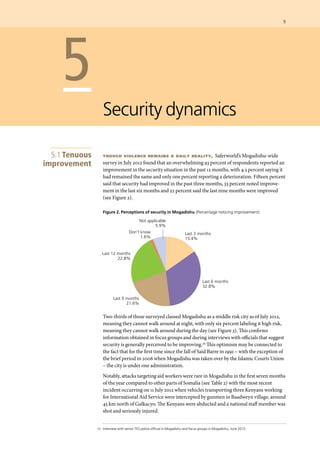
though violence remains a daily reality, Saferworld’s Mogadishu-wide
survey in July 2012 found that an overwhelming 93 percent of respondents reported an
improvement in the security situation in the past 12 months, with 4.5 percent saying it
had remained the same and only one percent reporting a deterioration. Fifteen percent
said that security had improved in the past three months, 33 percent noted improve-
ment in the last six months and 22 percent said the last nine months were improved
(see Figure 2).
Figure 2. Perceptions of security in Mogadishu (Percentage noticing improvement)
5.1 Tenuous
improvement
Last 3 months
15.4%
Last 6 months
32.8%
Last 9 months
21.6%
Last 12 months
22.8%
Don’t know
1.6%
Not applicable
5.9%Table 2
0 10 20 30 40 50 60 70%
High risk
(I cannot walk around the city during the day)
Middle risk
(I cannot walk around the city at night)
Low risk
(I can freely walk and go about my business
Don’t know
5.6
66
27.2
1.1
Figure 1
15000
20000
25000
19000
1800018000
Arriving in Mogadishu
Within Mogadishu
Leaving Mogadishu
Figure 3
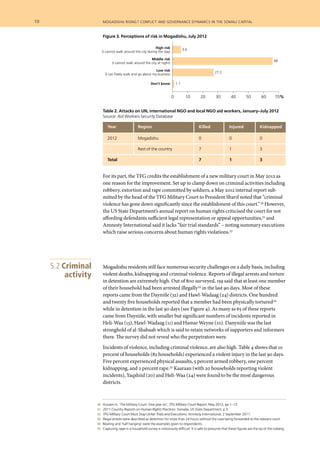
Two-thirds of those surveyed classed Mogadishu as a middle risk city as of July 2012,
meaning they cannot walk around at night, with only six percent labeling it high risk,
meaning they cannot walk around during the day (see Figure 3). This confirms
information obtained in focus groups and during interviews with officials that suggest
security is generally perceived to be improving.29 This optimism may be connected to
the fact that for the first time since the fall of Said Barre in 1991 – with the exception of
the brief period in 2006 when Mogadishu was taken over by the Islamic Courts Union
– the city is under one administration.
Notably, attacks targeting aid workers were rare in Mogadishu in the first seven months
of the year compared to other parts of Somalia (see Table 2) with the most recent
incident occurring on 11 July 2012 when vehicles transporting three Kenyans working
for International Aid Service were intercepted by gunmen in Baadweyn village, around
45 km north of Galkacyo. The Kenyans were abducted and a national staff member was
shot and seriously injured.
Table 2. Attacks on UN, international NGO and local NGO aid workers, January–July 2012
Source: Aid Workers Security Database
10  	 mogadishu rising? conflict and governance dynamics in the somali capital
	 30 	 Hussein H, ‘The Military Court: One year on’, TFG Military Court Report, May 2012, pp 1–12.
	 31 	 2011 Country Reports on Human Rights Practices: Somalia, US State Department, p 3.
	 32 	 TFG Military Court Must Stop Unfair Trials and Executions, Amnesty International, 2 September 2011.
	 33 	 Illegal arrests were described as detention for more than 24 hours without the case being forwarded to the relevant court.
	 34 	 Beating and ‘half hanging’ were the examples given to respondents.
	 35 	 Capturing rape in a household survey is notoriously difficult. It is safe to presume that these figures are the tip of the iceberg.
Figure 3. Perceptions of risk in Mogadishu, July 2012
Last 6 months
32.8%
Last 9 months
21.6%
0 10 20 30 40 50 60 70%
High risk
(I cannot walk around the city during the day)
Middle risk
(I cannot walk around the city at night)
Low risk
(I can freely walk and go about my business
Don’t know
5.6
66
27.2
1.1
Figure 1
10
5000
10000
15000
20000
25000
400
300
5300
600
5400
19000
1700
2500
18000
1400
3800
18000
March April May June
Arriving in Mogadishu
Within Mogadishu
Leaving Mogadishu
Figure 3
0 5000 10000 15000 20000 25000
Imported red rice
Wheat flour
Wheat grain
Red sorghum
White maize
Cowpeas
17,396
16,717
13,375
12,917
12,767
12,375
8,653
8,575
9,300
5,833
5,383
6,154
7,700
8,520
8,300
20,642
22,367
19,900
Figure 3
April
May
June
2012	 Mogadishu	 0	 0	 0
	 Rest of the country	 7	 1	 3
Total		 7	 1	 3
Year	 Region	 Killed	 Injured	 Kidnapped
For its part, the TFG credits the establishment of a new military court in May 2012 as
one reason for the improvement. Set up to clamp down on criminal activities including
robbery, extortion and rape committed by soldiers, a May 2012 internal report sub-
mitted by the head of the TFG Military Court to President Sharif noted that “criminal
violence has gone down significantly since the establishment of this court.”30 However,
the US State Department’s annual report on human rights criticised the court for not
affording defendants sufficient legal representation or appeal opportunities,31 and
Amnesty International said it lacks “fair trial standards” – noting summary executions
which raise serious concerns about human rights violations.32
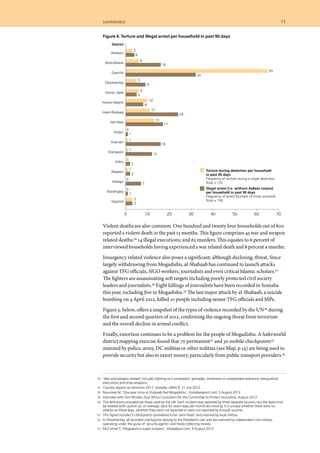
Mogadishu residents still face numerous security challenges on a daily basis, including
violent deaths, kidnapping and criminal violence. Reports of illegal arrests and torture
in detention are extremely high. Out of 800 surveyed, 159 said that at least one member
of their household had been arrested illegally33 in the last 90 days. Most of these
reports came from the Dayniile (32) and Hawl-Wadaag (24) districts. One hundred
and twenty five households reported that a member had been physically tortured34
while in detention in the last 90 days (see Figure 4). As many as 65 of these reports
came from Dayniile, with smaller but significant numbers of incidents reported in
Heli-Waa (13), Hawl-Wadaag (11) and Hamar Weyne (10). Danyniile was the last
stronghold of al-Shabaab which is said to retain networks of supporters and informers
there. The survey did not reveal who the perpetrators were.
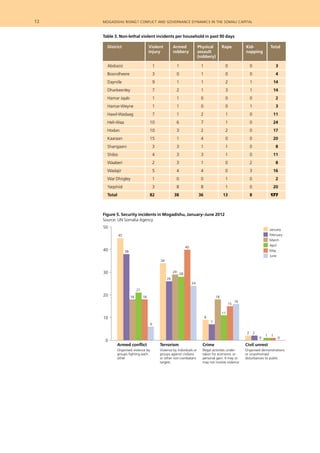
Incidents of violence, including criminal violence, are also high. Table 4 shows that 10
percent of households (82 households) experienced a violent injury in the last 90 days.
Five percent experienced physical assaults, 5 percent armed robbery, one percent
kidnapping, and 2 percent rape.35 Kaaraan (with 20 households reporting violent
incidents), Yaqshiid (20) and Heli-Waa (24) were found to be the most dangerous
districts.
5.2 Criminal
activity
saferworld	 11	
	 36 	 ‘War and weapon related’ includes fighting as a combatant, grenades, landmines or unexploded ordnance, extrajudicial
executions and stray weapons.
	 37 	 Country reports on terrorism 2011, Somalia, UNHCR, 31 July 2012.
	 38 	 Nuxurkey M, ‘One year since al-Shabaab fled Mogadishu’, Somaliareport.com, 5 August 2012.
	 39 	 Interview with Tom Rhodes, East Africa Consultant for the Committee to Protect Journalists, August 2012.
	 40 	 The definitions provided are those used by the UN. Each incident was reported by three separate sources, but the data must
be treated with caution as, on average, data for seven days per month are missing. It is unclear whether there were no
attacks on these days, whether they were not reported or were not reported by enough sources.
	 41 	 This figure includes 5 checkpoints considered to be ‘semi-fixed’ and manned by local militias.
	 42 	 In Dharkeenley, all recorded checkpoints belong to the President’s clan and are manned by independent clan militias,
operating under the guise of ‘security agents’ and freely collecting money.
	 43 	 McConnel T, ‘Mogadishu’s super troopers’, Globalpost.com, 9 August 2012.
Figure 4. Torture and illegal arrest per household in past 90 days
Abdiaziz
Boondheere
Dayniile
Dharkeenley
Hamar Jajab
Hamar-Weyne
Hawl-Wadaag
Heli-Waa
Hodan
Kaaraan
Shangaani
Shibis
Waaberi
Wadajir
Wardhigley
Yaqshiid
0 10 20 30 40 50 60 70
3
4
6
16
65
32
5
9
6
5
10
8
11
24
13
17
0
1
1
16
1
12
0
2
1
2
0
7
0
1
3
3
Torture during detention per household
in past 90 days
Frequency of torture during a single detention
Total = 125
Illegal arrest (i.e. without habeas corpus)
per household in past 90 days
Frequency of arrest (Number of times arrested)
Total = 159
District
Violent deaths are also common. One hundred and twenty four households out of 800
reported a violent death in the past 12 months. This figure comprises 45 war and weapon
related deaths;36 14 illegal executions; and 65 murders. This equates to 6 percent of
interviewed households having experienced a war related death and 8 percent a murder.
Insurgency related violence also poses a significant, although declining, threat. Since
largely withdrawing from Mogadishu, al-Shabaab has continued to launch attacks
against TFG officials, NGO workers, journalists and even critical Islamic scholars.37
The fighters are assassinating soft targets including poorly protected civil society
leaders and journalists.38 Eight killings of journalists have been recorded in Somalia
this year, including five in Mogadishu.39 The last major attack by al-Shabaab, a suicide
bombing on 4 April 2012, killed 10 people including senior TFG officials and MPs.
Figure 5, below, offers a snapshot of the types of violence recorded by the UN40 during
the first and second quarters of 2012, confirming the ongoing threat from terrorism
and the overall decline in armed conflict.
Finally, extortion continues to be a problem for the people of Mogadishu. A Saferworld
district mapping exercise found that 70 permanent41 and 30 mobile checkpoints42
manned by police, army, DC militias or other militias (see Map, p 14) are being used to
provide security but also to extort money, particularly from public transport providers.43
Table 3. Non-lethal violent incidents per household in past 90 days
12  	 mogadishu rising? conflict and governance dynamics in the somali capital
Abdiaziz	 1	 1	 1	 0	 0	 3
Boondheere	 3	 0	 1	 0	 0	 4
Dayniile	 9	 1	 1	 2	 1	 14
Dharkeenley	 7	 2	 1	 3	 1	 14
Hamar Jajab	 1	 1	 0	 0	 0	 2
Hamar-Weyne	 1	 1	 0	 0	 1	 3
Hawl-Wadaag	 7	 1	 2	 1	 0	 11
Heli-Waa	 10	 6	 7	 1	 0	 24
Hodan	 10	 3	 2	 2	 0	 17
Kaaraan	 15	 1	 4	 0	 0	 20
Shangaani	 3	 3	 1	 1	 0	 8
Shibis	 4	 3	 3	 1	 0	 11
Waaberi	 2	 3	 1	 0	 2	 8
Wadajir	 5	 4	 4	 0	 3	 16
War Dhiigley	 1	 0	 0	 1	 0	 2
Yaqshiid	 3	 8	 8	 1	 0	 20
Total	 82	 38	 36	 13	 8	 177
District 	 Violent 	 Armed	 Physical	 Rape	 Kid-	 Total
	 injury	 robbery	 assault 		 napping
			 (robbery)	
0
10
20
30
40
50
45
38
18
21
18
6
34
26
29
28
40
24
9
7
18
11
15
16
2 2
0
1 1
0
Armed conflict Terrorism Crime Civil unrest
Organised violence by Violence by individuals or Illegal activities under- Organised demonstrations
groups fighting each groups against civilians taken for economic or or unauthorised
other or other non-combatant personal gain. It may or disturbances to public
targets may not involve violence
January
February
March
April
May
June
Figure 4
TFG army
TFG police
TFG allied militia
AMISOM
Al-Shabaab
ASWJ
Non TFG allied
16 32.4 49 2.6
13.4 33.6 50.1 2.9
17.6 41.8 35 5.6
17.9 35 42.1 5
26 29.4 30.1 14.5
7.1 32.5 52 8.4
21.8 36 35 7.2
Table 7
Figure 5. Security incidents in Mogadishu, January–June 2012
Source: UN Somalia Agency
saferworld	 13	
	 44 	 The police are paid by the United Nations Development Programme and tend to be better trained and older than the military.
According to the Interior Ministry, the average age of a police officer is 32, while the average of a soldier is 10 years younger.
Interview with TFG deputy Interior Minister, Mogadishu, June 2012.
	 45 	 This is in stark contrast to a poll conducted in Mogadishu in December 2011–January 2012 which found that 92 percent of
respondents perceived AMISOM as a ‘friendly’ force (up from 75 percent in November 2010 and 72 percent in January
2010). See: op cit ORB.
	 46 	 Chonghaile C, ‘Somali tale of two cities as Mogadishu’s vulnerable miss out on progress’, The Guardian, 18 June 2012.
	 47 	 Interview with senior NSA official, Mogadishu, June 2012.
	 48 	 Comprising the TFG President, Prime Minister and Speaker, in addition to the heads of police, military, NSA, the Mogadishu
mayor, and the Minister of Justice.
	 49 	 This came after former Prime Minister Mohamed Farmaajo hired dozens of police and military to provide protection during
his presidential campaign.
	 50 	 Interview with B Warsame, TFG soldier working for a hotel, Mogadishu, June 2012.
Actual numbers are higher as some checkpoints are only set up at night and were not
included in the survey for security reasons.
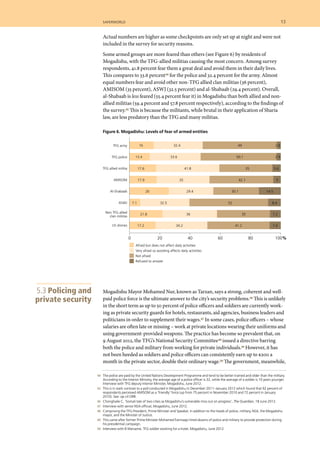
Some armed groups are more feared than others (see Figure 6) by residents of
Mogadishu, with the TFG-allied militias causing the most concern. Among survey
respondents, 41.8 percent fear them a great deal and avoid them in their daily lives.
This compares to 33.6 percent44 for the police and 32.4 percent for the army. Almost
equal numbers fear and avoid other non-TFG allied clan militias (36 percent),
AMISOM (35 percent), ASWJ (32.5 percent) and al-Shabaab (29.4 percent). Overall,
al-Shabaab is less feared (55.4 percent fear it) in Mogadishu than both allied and non-
allied militias (59.4 percent and 57.8 percent respectively), according to the findings of
the survey.45 This is because the militants, while brutal in their application of Sharia
law, are less predatory than the TFG and many militias.
Figure 6. Mogadishu: Levels of fear of armed entities
0
10
20
30
40 38
18
21
18
6
34
26
29
28
40
24
9
7
18
11
15
16
2 2
0
1 1
0
Armed conflict Terrorism Crime Civil unrest
Organised violence by Violence by individuals or Illegal activities under- Organised demonstrations
groups fighting each groups against civilians taken for economic or or unauthorised
other or other non-combatant personal gain. It may or disturbances to public
targets may not involve violence
March
April
May
June
0 20 40 60 80 100%
TFG army
TFG police
TFG allied militia
AMISOM
Al-Shabaab
ASWJ
Non TFG allied
clan miliitas
US drones
16 32.4 49 2.6
13.4 33.6 50.1 2.9
17.6 41.8 35 5.6
17.9 35 42.1 5
26 29.4 30.1 14.5
7.1 32.5 52 8.4
21.8 36 35 7.2
17.2 34.2 41.2 7.4
Afraid but does not affect daily activities
Very afraid so avoiding affects daily activities
Not afraid
Refused to answer
Table 7
Bay/Bakool/Gedo Puntland Mogadishu/
Lower Shabelle/
Middle Shabelle
Mudug/Hiiraan/
Galgaduud
Ibrahim Haji Jama
Mil’aad ‘al-Afghani’
1st Deputy
Lower Jubba/
Middle Jubba
Bashir Mohamed
Mohamud ‘Qoorgaab’
2nd Deputy
Ahmed Abdi Godane
Leader
Figure 2
Mogadishu Mayor Mohamed Nur, known as Tarzan, says a strong, coherent and well-
paid police force is the ultimate answer to the city’s security problems.46 This is unlikely
in the short term as up to 50 percent of police officers and soldiers are currently work-
ing as private security guards for hotels, restaurants, aid agencies, business leaders and
politicians in order to supplement their wages.47 In some cases, police officers – whose
salaries are often late or missing – work at private locations wearing their uniforms and
using government-provided weapons. The practice has become so prevalent that, on
9 August 2012, the TFG’s National Security Committee48 issued a directive barring
both the police and military from working for private individuals.49 However, it has
not been heeded as soldiers and police officers can consistently earn up to $200 a
month in the private sector, double their ordinary wage.50 The government, meanwhile,
5.3 Policing and
private security
14  	 mogadishu rising? conflict and governance dynamics in the somali capital
	 51 	 Interview with senior NSA official, Mogadishu, June 2012.
	 52 	 Also noted in: Menkhaus K, Conflict analysis: Somalia, UNPOS, February 2011, updated December 2011, p 13.
	 53 	 Mapping exercise undertaken by Saferworld, July 2012.
has been willing to look the other way as the soldiers and police officers are protecting
installations and individuals that should fall under its remit.51
There are concerns that by protecting individuals or businesses owned by members of
their sub-clan, the security services are increasingly carrying out sectarian duties at the
expense of national responsibilities. This increases the possibility of uniformed officers
being used against each other. Moreover, it erodes the credibility and legitimacy of the
police and military, as they are perceived as disparate militias and not a national security
service. A further point is that high wages for private security provision constitute
a vested interest in prolonged insecurity for those working in the security sector.52
Given these limitations, and despite having functioning police stations in all of the
16 districts of the city,53 the TFG focuses its policing efforts on southern districts where
almost all government and non-governmental institutions, as well as the offices of
international organisations are located. This leaves the northern districts poorly
protected during the day and virtually defenseless at night. The north also lacks the
protection of neighbourhood vigilante groups. Table 3 confirms that most incidents of
non-lethal violence over the last 90 days were reported by residents of three northern
districts: Kaaraan, Yaqshiid, and Heli-Waa. However, there were also significant
numbers of incidents reported by residents of southern districts. The most violent
deaths were reported by residents of Hawl-Wadaag (a southern district) followed by
Kaaraan and Dayniile (northern districts). The most violent deaths were reported by
residents of Hawl-Wadaag (a southern district) and Karaan followed by Dayniile (both
northern districts).
Bondhere
Sources: UN Somalia Agency, UN OCHA Somalia and Saferworld
Turkish R.C. Jazeera
Badbaado
Al Cadala
Majo
Yusuf
Alkon
Darwish
Hawl-Wadaag
Oto Oto
Xero RuushkaXero Ruushka
Horseed
Taleex
Tarbunka
Siliga
Sona K
77 Camp
Sigaale West Sigaale
East
Deynille
Waberi
Wadajir
Dharkeenley
Huriwa
Karan
ShibisBondhere
Abdiaziz
Shangaani
HamarweynHamar
Jabab
Hawl-Wadaag
Wardhigley
Yaqshid
Hodan
I N D I A N
O C E A N
Mogadishu
S O M A L I A
International
airport
International
airport
New sea portNew sea port
Old sea portOld sea port
Bakara
Market
Bakara
Market
Presidential
Palace
Presidential
Palace
Shangaani
Hamarweynr
New sea portNew sea port
Residual risk level
by district
Very high
High
District
boundary
IDP camp
Fixed/semi fixed
check point
Mobile check
point
Sources: UN Somalia Agency, UN OCHA So
S O M A
3km
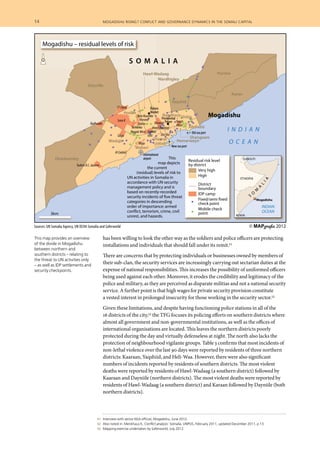
Mogadishu – residual levels of risk
This
map depicts
the current
(residual) levels of risk to
UN activities in Somalia in
accordance with UN security
management policy and is
based on recently-recorded
security incidents of five threat
categories in descending
order of importance: armed
conflict, terrorism, crime, civil
unrest, and hazards.
A NO C E A
vel
y
mi fixed
nt
eck
DJIBOUTI
KENYA
Mogadishu
ETHIOPIA
DJIBOUTI
KENYA
INDIAN
OCEAN
S
O
M
A
L
IA
© MAPgrafix 2012
This map provides an overview
of the divide in Mogadishu
between northern and
southern districts – relating to
the threat to UN activities only
– as well as IDP settlements and
security checkpoints.
6
Human needs:
migration, food and
resources
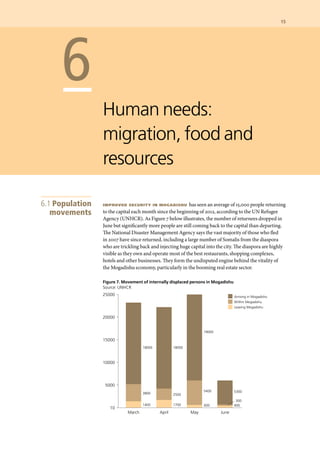
improved security in mogadishu has seen an average of 15,000 people returning
to the capital each month since the beginning of 2012, according to the UN Refugee
Agency (UNHCR). As Figure 7 below illustrates, the number of returnees dropped in
June but significantly more people are still coming back to the capital than departing.
The National Disaster Management Agency says the vast majority of those who fled
in 2007 have since returned, including a large number of Somalis from the diaspora
who are trickling back and injecting huge capital into the city. The diaspora are highly
visible as they own and operate most of the best restaurants, shopping complexes,
hotels and other businesses. They form the undisputed engine behind the vitality of
the Mogadishu economy, particularly in the booming real estate sector.
Figure 7. Movement of internally displaced persons in Mogadishu
Source: UNHCR
6.1 Population
movements
Last 3 months
15.4%
Last 6 months
32.8%
Last 9 months
21.6%
Last 12 months
22.8%
Don’t know
1.6%
Not applicable
5.9%Table 2
0 10 20 30 40 50 60 70%
High risk
(I cannot walk around the city during the day)
Middle risk
(I cannot walk around the city at night)
Low risk
(I can freely walk and go about my business
Don’t know
5.6
66
27.2
1.1
Figure 1
10
5000
10000
15000
20000
25000
400
300
5300
600
5400
19000
1700
2500
18000
1400
3800
18000
March April May June
Arriving in Mogadishu
Within Mogadishu
Leaving Mogadishu
Figure 3
Imported red rice
17,396
16,717
13,375
12,917
Figure 3
April
May
June
	 	 15
54 	 Interview with official from Concern Ireland, Mogadishu, June 2012.
	 55 	 Interview with a senior aide to the mayor, Mogadishu, June 2012.
	 56 	 Interview with Ali Mohamed, Ministry of Finance, Mogadishu, June 2012.
	 57 	 FSNAU, WFP and Fewsnet, Mogadishu Food Security and Nutrition Situation Trends, July 2011–April 2012, 19 July 2012, p 3.
	 58 	 The proportion of people with acceptable levels of food consumption increased from only 40 percent in August 2011, to 65
percent in December 2011, and 84 percent at the present time. Ibid p 3.
	 59 	 Op cit FSNAU, WFP and Fewsnet, p 4.
	 60 	 Global Acute Malnutrition (GAM) is calculated with the Z-score defined as a weight-for-height index of less than 2 standard
deviations from the mean weight of a reference population of children of the same height and/or having oedema. Severe
Acute Malnutrition (SAM) is calculated with the Z-score defined as a weight-for-height index less than 3 standard deviations
from the mean weight of a reference population of children of the same height and/or having oedema. See: CEDAT –
Complex Emergency Database, Glossary, (available online).
	 61 	 Op cit FSNAU, WFP and Fewsnet, p 4.
	 62 	 Interview with Russell Geekie, spokesperson for the Office for the Coordination of Humanitarian Affairs Somalia.
	 63 	 Interview with Somalia analyst, Nairobi, August 2012.
	 64 	 Interview with Somalia analyst, Nairobi, August 2012.
	 65 	 Houreld K, ‘AP Exclusive: How Somalia’s Famine Aid Went Astray’, Associated Press, 17 Mar 2012.
Poorer families who are moving into IDP camps or unoccupied public buildings are
more vulnerable and over-looked, according to aid agencies.54 These families have
faced serious challenges since the TFG launched a campaign in January 2012 to evict
squatters from public buildings – forcibly removing thousands with little or no notice,
creating a huge shelter problem in the city. There were at least two incidents during
the second quarter of 2012 in which neighbours attacked families returning from
Elasha Biyaha who were seeking shelter in an abandoned public building. In May, for
example, a young boy was seriously wounded as he defended his ailing mother from
the rocks of neighbours who were trying to prevent families from forming an IDP
settlement in their neighbourhood.55
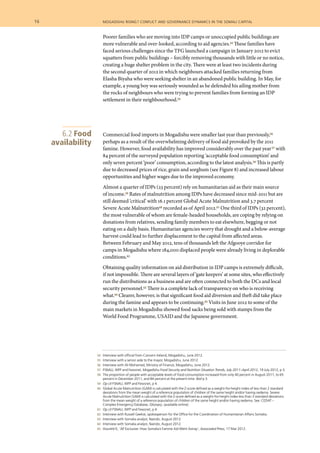
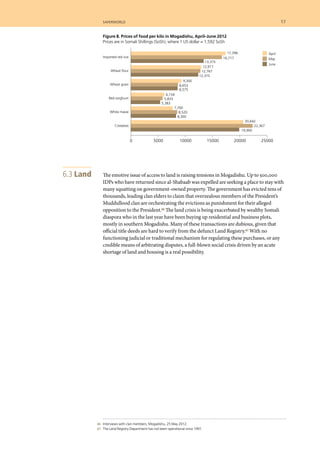
Commercial food imports in Mogadishu were smaller last year than previously,56
perhaps as a result of the overwhelming delivery of food aid provoked by the 2011
famine. However, food availability has improved considerably over the past year57 with
84 percent of the surveyed population reporting ‘acceptable food consumption’ and
only seven percent ‘poor’ consumption, according to the latest analysis.58 This is partly
due to decreased prices of rice, grain and sorghum (see Figure 8) and increased labour
opportunities and higher wages due to the improved economy.
Almost a quarter of IDPs (23 percent) rely on humanitarian aid as their main source
of income.59 Rates of malnutrition among IDPs have decreased since mid-2011 but are
still deemed ‘critical’ with 16.1 percent Global Acute Malnutrition and 3.7 percent
Severe Acute Malnutrition60 recorded as of April 2012.61 One third of IDPs (32 percent),
the most vulnerable of whom are female-headed households, are coping by relying on
donations from relatives, sending family members to eat elsewhere, begging or not
eating on a daily basis. Humanitarian agencies worry that drought and a below-average
harvest could lead to further displacement to the capital from affected areas.
Between February and May 2012, tens of thousands left the Afgooye corridor for
camps in Mogadishu where 184,000 displaced people were already living in deplorable
conditions.62
Obtaining quality information on aid distribution in IDP camps is extremely difficult,
if not impossible. There are several layers of ‘gate keepers’ at some sites, who effectively
run the distributions as a business and are often connected to both the DCs and local
security personnel.63 There is a complete lack of transparency on who is receiving
what.64 Clearer, however, is that significant food aid diversion and theft did take place
during the famine and appears to be continuing.65 Visits in June 2012 to some of the
main markets in Mogadishu showed food sacks being sold with stamps from the
World Food Programme, USAID and the Japanese government.
6.2 Food
availability
16  	 mogadishu rising? conflict and governance dynamics in the somali capital
66 	 Interviews with clan members, Mogadishu, 25 May 2012.
	 67 	 The Land Registry Department has not been operational since 1991.
The emotive issue of access to land is raising tensions in Mogadishu. Up to 500,000
IDPs who have returned since al-Shabaab was expelled are seeking a place to stay with
many squatting on government-owned property. The government has evicted tens of
thousands, leading clan elders to claim that overzealous members of the President’s
Muddullood clan are orchestrating the evictions as punishment for their alleged
opposition to the President.66 The land crisis is being exacerbated by wealthy Somali
diaspora who in the last year have been buying up residential and business plots,
mostly in southern Mogadishu. Many of these transactions are dubious, given that
official title deeds are hard to verify from the defunct Land Registry.67 With no
functioning judicial or traditional mechanism for regulating these purchases, or any
credible means of arbitrating disputes, a full-blown social crisis driven by an acute
shortage of land and housing is a real possibility.
10
5000
400
300
5300
600
5400
1700
2500
1400
3800
March April May June
0 5000 10000 15000 20000 25000
Imported red rice
Wheat flour
Wheat grain
Red sorghum
White maize
Cowpeas
17,396
16,717
13,375
12,917
12,767
12,375
8,653
8,575
9,300
5,833
5,383
6,154
7,700
8,520
8,300
20,642
22,367
19,900
Figure 3
April
May
June
Figure 8. Prices of food per kilo in Mogadishu, April–June 2012
Prices are in Somali Shillings (SoSh), where 1 US dollar = 1,592 SoSh
6.3 Land
	 saferworld	 17
68 	 Op cit UN Monitoring Group Report, p 22.
	 69 	 Telephone interview with senior AMISOM official, August 2012.
	 7
Regional and
international
stakeholders in Somalia
the key external actors in somalia are the un, which co-ordinates
the international community’s efforts through the transition roadmap and the Inter-
Governmental Authority for Development (IGAD), whose member states Uganda,
Kenya and Djibouti have troops in Somalia operating under the AMISOM banner.
Ethiopia, another IGAD member state, also has troops in Somalia, but prefers to
operate outside of the AMISOM framework. The UN and IGAD co-ordinate their
approaches, with the former leading the political track via its Political Office for
Somalia (UNPOS) and the latter providing the troops to stabilise Somalia.
Turkey, the United States and the United Kingdom remain significant external actors
in Somalia and the presence of foreign Al Qaeda-affiliated fighters has also been
reported.
Backed by the UN, the US government and the EU,68 AMISOM’s role is to support
the TFG and create conditions for the long-term stabilisation and reconstruction of
Somalia. Military successes have been significant with AMISOM largely uprooting
al-Shabaab from Mogadishu by the end of 2011. It displaced al-Shabaab from Daynille,
on the outskirts of Mogadishu, at the end of March 2012 and from Afgooye, 30 km
northwest of Mogadishu, in May 2012. In June, AMISOM and TFG forces claimed
control of Bala’ad, 30 km north of Mogadishu, and the Esaley airstrip and Elma’an port
37 km northeast of the city. These victories were helped by an increase in troop
numbers which are expected to rise to 17,731 by the end of 2012.
AMISOM soldiers are also being used to train, mentor, monitor and advise the Somali
Police Force; provide security in Mogadishu to the traditional elders and committee
tasked with facilitating the end of the transition period;69 and protect both the TFG
and the growing number of external actors who visit Mogadishu on political or
7.1 AMISOM’s
progress
18  
70 	 All parties to Somalia’s conflict – namely AMISOM, the TFG forces, al-Shabaab and Kenyan and Ugandan forces – have been
accused of violating international humanitarian law, mainly through the use of indiscriminate attacks targeting civilians.
According to Human Rights Watch between August 2010 and August 2011 there were 4,000 combat-related civilian
casualties in Somalia, including 1,000 deaths. See: op cit HRW, for background.
	 71 	 Interview with Somali peace activist, Mogadishu, August 2012.
	 72 	 See: op cit UN Monitoring Group Report, p 28.
	 73 	 Interview with Somali peace activist, Mogadishu, August 2012.
	 74 	 Davison W, ‘Ethiopia agrees to back Somalia military operations, says IGAD’, Bloomberg News, 1 December 2011.
	 75 	 Voice of America, ‘US Offers Bounty for Somali Militias’, VOA News, 7 June 2012.
	 76 	 Zenko M, & Welch E, ‘Where the drones are: Mapping the launch pads for Obama’s secret wars’, Foreign Policy, 29 May 2012.
	 77 	 Information from UK government official, August 2012.
development missions. Part of the external support for AMISOM includes ‘mentors’ –
nationalities unknown – which are provided through Bancroft, a private security firm.
New deployments include Kenyan operations in Middle and Lower Jubba (4,600),
Burundian and Ugandan deployments in the Bay and Bakool regions (2,500) and the
Djiboutian deployment to Beled Weyn (850), in the Hiiraan region. The Kenyans,
allied with the Ras Kamboni militia, successfully engaged with al-Shabaab forces at
Hosingo in January 2012 and captured Afmadow in May 2012. AMISOM members
Uganda and Burundi have stayed out of the political sphere but helped create a secure
environment in the capital and the surrounding regions.
AMISOM representatives insist that recent successes against al-Shabaab have been
achieved with minimal impact on civilians.70 They say that AMISOM forces have
avoided entering towns or large population centres and that al-Shabaab is avoiding
confrontation with the superior force. This is confirmed by other sources.71 However,
the 2012 SEMG report found that “Kenyan and Ethiopian military have shown little
transparency with respect to operational procedures and battlefield damage assess-
ments, making it difficult to ascertain whether they have adopted measures to avoid,
mitigate and compensate harm to civilians.”72 Abuses of civilians – namely looting and
rapes – occurred after the taking of Afgooye by TFG soldiers in front of AMISOM
commanders in June 2012.73
Ethiopia is the most significant external security actor operating outside the frame-
work of AMISOM. IGAD has sanctioned their intervention (at the political level) but
Ethiopian forces also operate as part of a broad anti-Shabaab alliance without any
specific mandate.74
There have been no reports of Ethiopian troops in or near Mogadishu, and most of
the reported activity has been in the west and central areas of south central Somalia.
Ethiopian forces, alongside local ASWJ militias, took Beled Weyn on 31 December 2011.
They took Baidoa, the capital of Bay region, in February in conjunction with TFG-
allied local militias. Establishing new administrations in these locations has been
complicated and has sometimes resulted in conflict as it is taking place amid fear of
al-Shabaab reprisals.
The United States (US) is another key external actor and has largely focused on attacks
against high value targets. That includes the killings of al-Qaeda operative Salah Nabhan
and the former al-Shabaab leader, Aden Hashi Ayrow. In June, the State Department’s
Rewards for Justice programme announced a bounty on the heads of seven al Shabaab
leaders totaling $33 million.75 Surveillance activity using drones, reportedly from
airbases in southern Ethiopia and Djibouti, also continues.76
The United Kingdom (UK), meanwhile, has confirmed that it has sent a small
advisory team that is mentoring AMISOM in areas such as stabilisation, strategic
communications and medical advice. The UK has also said it will open an embassy in
Mogadishu when the security situation allows. On 2 February 2012, Matt Baugh was
appointed as the UK Ambassador to Somalia, the first such appointment in 21 years.77
7.2 Non-
mandated
external
security actors
	 saferworld	 19
78	 Hussein A, ‘Foreign Al-Shabaab fighters spotted in Lower Shabelle’, Sabahi Online, 19 June 2012.
	 79 	 International Contact Group on Somalia, Final Communique of the International Contact Group on Somalia meeting in
Rome, Garowe Online, July 2012.
	 80 	 Although authorised by the UN, AMISOM is an AU operation. Since the AU does not have funds to pay for the mission, an
AMISOM Trust Fund was established in 2007 to support it. The contributions to the Trust Fund are voluntary, unlike UN
assessed contributions which are mandatory.
	 81 	 For background information see Delany M, ‘Once mighty, Somalia’s army struggles to rebuild itself’, The Daily Star,
10 August 2012.
	 82 	 Op cit McConnel.
	 83 	 For background information see Aynte, A, Turkey’s increasing role in Somalia: An emerging donor, Al Jazeera Centre for
Studies, March 2012, pp 1–5.
	 84 	 ‘Turkey trains Somali police’, Keydmedia.com, 30 June 2012.
Elsewhere, there have been consistent reports of the presence of foreign fighters
associated with Al Qaeda supporting al-Shabaab on the ground in Somalia. Estimates
of their numbers vary between 200 and 500. Press reports in June suggested that
foreign jihadists were still present in the al-Shabaab-held towns of Marka and Barawe
in the Lower Shabelle region but that many were fleeing to Yemen.78
External actors are largely funding the rising cost of the AMISOM mission whose
budget will double to $450–$500 million79 by the time the force is up to full strength,
which is expected to be around the end of 2012. Funding arrangements are complex
and include a Trust Fund,80 payment of salaries by the European Union (EU) (from
its African Peace Facility) and a growing proportion of funding from UN-assessed
contributions. External actors are also providing funds for the training and develop-
ment of the TFG soldiers who will eventually take over from AMISOM. Up to 600
TFG troops recently completed their military training in Uganda – the fifth graduation
of its kind, bringing the number of troops trained under the joint EU/US/Uganda
programme to 2,400. The target by the end of 2012 is 3,200.81
Elsewhere in South-Central Somalia, Ethiopia provides military training in the
Hiiraan region to ASWJ and TFG forces, while Kenya supports its allies in the Ras
Kamboni militia.
Separately, a long-standing United Nations Development Programme initiative has
produced 5,300 trained police officers for south central Somalia who are mainly
deployed in Mogadishu. The EU and Japan provide funding for their salaries – $100
for a constable and $150–$200 per month for senior officers.82
External actors, particularly Turkey, have become the main drivers of the political
process and in focus groups and interviews Somali people welcomed the Turkish
preference for direct contact with local people and the prominent involvement of its
private sector. Up to 500 Turkish aid workers, teachers and engineers are currently
in Mogadishu83 and the country recently announced a $100 million infrastructure
project to rebuild the city. It has also given scholarships to more than a thousand
Somali students; held the Istanbul II conference on Somalia in May 2012; sent 80 police
cadets for officer training in Turkey;84 and in March 2012 the Turkish national carrier
was the first international airline to start flying into Mogadishu since 1991.
However, quiet criticism is also growing that Turkey has overestimated the institutional
importance of Sheikh Sharif and the Presidency and may have inadvertently concen-
trated its commercial dealings on a narrow section of his close allies and kinsmen.
Turkey decided to invite 135 elders who had been tasked with selecting the new 275
members of parliament to the Istanbul II conference on 30 May. The decision itself was
unexpected and caught everyone by surprise. Turkey’s motive may have been simple –
to lend gravitas to the Istanbul conference and increase Somali-ownership. However,
some within the TFG and outside have cast the move in a negative light, suggesting it
was proof of Ankara’s meddling and part of a plot to scuttle the process and sponsor a
parallel peace initiative.
7.3 Other
external
funding and
support
20  	 mogadishu rising? conflict and governance dynamics in the somali capital
Despite driving – and in many cases shaping – the political process, external actors
are meeting stiff resistance from some local actors on key issues facing the country.
For example, external support for the provisional constitution, the presence of foreign
troops and federalism is not shared by local actors including the CIS, civil society and
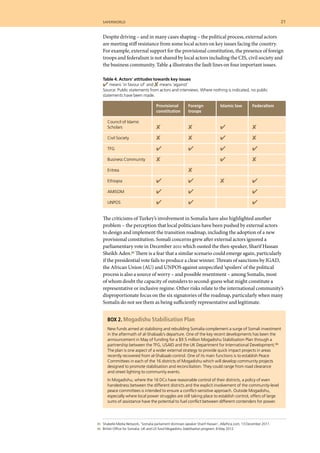
the business community. Table 4 illustrates the fault lines on four important issues.
Table 4. Actors’ attitudes towards key issues
✔means ‘in favour of’ and ✘means ‘against’
Source: Public statements from actors and interviews. Where nothing is indicated, no public
statements have been made.
	 Provisional 	 Foreign	 Islamic law	 Federalism
	 constitution	 troops
Council of Islamic
Scholars	 ✘	 ✘	 ✔	 ✘
Civil Society	 ✘	 ✘	 ✔	 ✘
TFG	 ✔	 ✔	 ✔	 ✔
Business Community	 ✘		 ✔	 ✘
Eritrea		 ✘
Ethiopia	 ✔	 ✔	 ✘	 ✔
AMISOM	 ✔	 ✔		 ✔
UNPOS	 ✔	 ✔		 ✔
	 saferworld	 21	
The criticisms of Turkey’s involvement in Somalia have also highlighted another
problem – the perception that local politicians have been pushed by external actors
to design and implement the transition roadmap, including the adoption of a new
provisional constitution. Somali concerns grew after external actors ignored a
parliamentary vote in December 2011 which ousted the then speaker, Sharif Hassan
Sheikh Aden.85 There is a fear that a similar scenario could emerge again, particularly
if the presidential vote fails to produce a clear winner. Threats of sanctions by IGAD,
the African Union (AU) and UNPOS against unspecified ‘spoilers’ of the political
process is also a source of worry – and possible resentment – among Somalis, most
of whom doubt the capacity of outsiders to second-guess what might constitute a
representative or inclusive regime. Other risks relate to the international community’s
disproportionate focus on the six signatories of the roadmap, particularly when many
Somalis do not see them as being sufficiently representative and legitimate.
Box 2. Mogadishu Stabilisation Plan
New funds aimed at stabilising and rebuilding Somalia complement a surge of Somali investment
in the aftermath of al-Shabaab’s departure. One of the key recent developments has been the
announcement in May of funding for a $9.5 million Mogadishu Stabilisation Plan through a
partnership between the TFG, USAID and the UK Department for International Development.86
The plan is one aspect of a wider external strategy to provide quick impact projects in areas
recently recovered from al-Shabaab control. One of its main functions is to establish Peace
Committees in each of the 16 districts of Mogadishu which will develop community projects
designed to promote stabilisation and reconciliation. They could range from road clearance
and street lighting to community events.
In Mogadishu, where the 16 DCs have reasonable control of their districts, a policy of even
handedness between the different districts and the explicit involvement of the community-level
peace committees is intended to ensure a conflict-sensitive approach. Outside Mogadishu,
especially where local power struggles are still taking place to establish control, offers of large
sums of assistance have the potential to fuel conflict between different contenders for power.
	 85 	 Shabelle Media Network, ‘Somalia parliament dismisses speaker Sharif Hassan’, Allafrica.com, 13 December 2011.
	 86 	 British Office for Somalia, UK and US fund Mogadishu Stabilisation program, 8 May 2012.
87 	 A concentration on citizens’ security is in line with the recommendations made by the World Bank in its latest World
Development Report and with international commitments made under the New Deal during the Fourth High-Level Forum on
Aid Effectiveness in Busan, Korea, in November 2011. See: World Bank, The World Development Report 2011: Conflict,
Security, and Development, Washington DC.
	 8
Conclusion:
Issues to consider
mogadishu is at a crossroads. The expulsion of al-Shabaab from the city, the
consolidation of TFG control, the widespread perception of improved security, mass
returns, the revival of the economy and improved food security have all led to a sense
of optimism among residents. It is essential that this turning point be seized by Somalis
and international actors alike to consolidate and build on fragile gains.
There are many risks associated with the political transition, most notably the potential
rekindling of violence by warlords and businessmen who feel excluded by the latest
political settlement. Inadequate policing – particularly in the recently liberated northern
districts – the privatisation of a significant part of the national security forces, the
pervasiveness of neighborhood vigilantes and militias and the mix of corruption,
clan-based nepotism and the absence of the rule of law mean that conflict could easily
re-erupt to reverse the many gains the city has made in the past year. This must be
avoided at all costs.
Recent developments present both opportunities and dilemmas. External actors
approaching Somalia will need to balance commitments to supporting peace dividends
and security for Somali citizens with efforts to avoid reinforcing the unsavoury aspects
of the fragile security apparatus and increase transparency in aid delivery. In addition
to addressing immediate humanitarian needs, special priority should be given to
improving the provision of security and protection to local populations from high
levels of violence and crime. This will require a concerted investment in professionalised
community policing capacity, particularly in Mogadishu’s northern districts.
Experiences from other conflict-affected and fragile states, including in East Africa,
give ample evidence that a failure to invest in citizens’ security significantly under-
mines state legitimacy and efforts to support long-term peace and security.87 Special
consideration will be needed as to how and whether to integrate neighbourhood
vigilante groups, which are currently fulfilling a kind of community policing function.
Also, the current free-for-all approach to the privatisation of security in the city which
is taking place in a regulatory vacuum poses an immense risk to human security and
must be properly regulated.
22  
saferworld	 23	
As the new government takes shape, consideration needs to be paid to how it will
differentiate itself from the TFG. Key to this will be the ways in which the new govern-
ment demonstrates a commitment to providing security and services not only to the
country’s elite, but also to ordinary and particularly vulnerable residents. Also, the new
government should place a concerted focus on facilitating and encouraging genuinely
broad-based, inclusive and non-violent political debate and reconciliation, both at
the national and the local level. The failure of the TFG to advance good governance
practices, including the focus on reconciliation, left it lacking legitimacy for its entire
tenure.
Finally, the nascent government needs to prioritise the establishment of the rule of law
in the city and enforce it equally among all groups. A zero-tolerance policy on torture
and illegal arrests would be a good starting point, as would the regulation of the land
sector and the provision of credible land dispute resolution mechanisms. Clamping
down on rampant corruption among political and economic elites is also essential.
88 	 More than 30 people including diplomats, traditional elders, Islamic scholars, civil society leaders, business people and
residents of Mogadishu participated in the focus groups.
	 89 	 The standard margin of error of 2.5 percent would have necessitated a sample size of 1,536, which was beyond the scope of
the design phase of the Conflict and Governance Mapping (CGM) project for which this paper was produced.
	 90 	 Vaidyanathan, K E, ‘Population Statistics of Somalia,’ United Nations Development Programme Somalia, 1997.
	 91 	 If the day’s date is the 27th, using a skip pattern and left thumb rule, two is added to seven to make nine and every ninth
household on the left is surveyed.
	 92 	 The Kish Grid is a widely-used technique in surveying whereby interviewers who have been issued with a sample of
household addresses can sample individuals by following simple yet rigorous rules for selecting one person to interview from
among household residents. The system is devised so that all individuals in a household have an equal chance of selection.
See www.encyclopedia.com/doc/1O88-Kishgrid.html.
Methodology
This report draws on more than 70 interviews and three participatory focus groups88
conducted by four researchers in Mogadishu and Nairobi from May–July 2012.
Additional material was added in August 2012. Interviewees included security officials,
government officials, community elders, civil society representatives and western
diplomats. A variety of methodologies were employed, including archival desk
research, field-based research, key informant interviews, empirical analyses of raw
secondary data, a household survey, estimation techniques based on survey data and a
district-level mapping exercise on security, access to resources and political dynamics
in Mogadishu. The researchers also drew on media reports, data from the UN and
NGOs and existing literature. All websites cited in the report were accessed from May
to August 2012.
The researchers were recruited based on their expertise, extensive contacts, and
established track record of undertaking research in Somalia as well as their ability to
manoeuvre in Mogadishu. Each was assigned a specific subject to research and a
central analyst was charged with consolidating findings. All of the researchers under-
took field research, three of them in Mogadishu.
A district-level mapping exercise was undertaken by Hanvard Africa from 11–18 July
2012 in Mogadishu to map public services (e.g. police stations), facilities (e.g. health
providers) and security checkpoints. It was conducted by a team of 16 data collectors
and two data supervisors employed to cross-check the information over three days.
A household survey was also undertaken by Data and Research Solutions Ltd (DARS)
on 23–24 July 2012. Twelve teams – each consisting of four interviewers and one super-
visor – a total of 60 field operation members – were divided into teams comprising
two males and two females.
A sample size of 800 was selected based on the limited budget and timeframe for the
survey. The margin of error was 3.5 percent89 with a 95 percent confidence level,
necessitating a sample size of 783 households for an overall estimated population of
1,175,700.90 Taking into account a likely non-response rate of four percent, based on
previous surveys in Somalia, the total sample size was increased to 800. Sampling was
undertaken in three stages with all 16 Mogadishu districts serving as the primary
sampling unit; sub-districts (Xaafadaha in Somali) selected randomly using stratified
cluster sampling as the secondary units; and wards (Laamaha in Somali) as the tertiary
sampling units, also selected randomly. A total of 50 households were targeted in each
district. The Date Code method was used to select the first household in each sampling
unit and subsequent households were selected by using a skip pattern and the left thumb
rule.91 Household respondents were selected using the Kish Grid methodology.92
The source of all information presented is Saferworld unless otherwise stated.
24  
25	
Bibliography
Adde D, ‘Puntland ready to fight al-Shabaab affiliated militias, officials say’, Sabahi Online,
14 March 2012, http://sabahionline.com/en_GB/articles/hoa/articles/features/2012/03/14/
feature-01.
Amnesty International, Somalia: Transitional Federal Government Must Stop Unfair trials and
executions, 2 September 2011, www.amnesty.org/en/for-media/press-releases/somalia-
transitional-federal-government-military-court-must-stop-unfair-tri.
Aynte A, Turkey’s increasing role in Somalia: An emerging donor, (Al Jazeera Centre for Studies,
March 2012), http://studies.aljazeera.net/ResourceGallery/media/Documents/2012/3/22/20
1232213350836734Turkeys%20Increasing%20Role%20in%20Somalia.pdf.
Aynte A, The anatomy of al Shabaab, (Unpublished: Doha, 2010). http://www.scribd.com/
doc/34053611/The-Anatomy-of-Al-Shabaab-by-Abdi-Aynte
British Office for Somalia, UK and US fund Mogadishu Stabilisation program, 8 May 2012,
http://ukinsomalia.fco.gov.uk/en/about-us/working-with-somalia/uk-us-fund-mogadishu-
stabilisation-plan
Central Intelligence Agency, The World Factbook: Somalia, 20 June 2012, www.cia.gov/library/
publications/the-world-factbook/geos/so.html.
Chonghaile C, ‘Somali tale of two cities as Mogadishu’s vulnerable miss out on progress’,
The Guardian, 18 June 2012, www.guardian.co.uk/global-development/2012/jun/18/somali-
mogadishu-vulnerable-progress.
CEDAT – Complex Emergency Database, Glossary, www.cedat.be/glossary.
Crawford J ‘Obama bans charcoal from Somalia’, CNN.com, 20 July 2012, http://security.blogs.
cnn.com/2012/07/20/obama-moves-on-charcoal-ban-from-somalia/.
Davison W, ‘Ethiopia agrees to back Somalia Military operations, says IGAD’, Bloomberg News,
1 December 2011, www.businessweek.com/news/2011-12-01/ethiopia-agrees-to-back-
somalia-military-operations-igad-says.html.
Delany M, ‘Once mighty, Somalia’s army struggles to rebuild itself’, The Daily Star, 10 August
2012, www.dailystar.com.lb/News/Middle-East/2012/Aug-10/184071-once-mighty-
somalias-army-struggles-to-rebuild-itself.ashx#axzz23V5sG3pb.
European Commission, Study for integrated development programme for agricultural and water
development of the Lower Shebelle, Middle Shebelle, Lower Juba and Hiran regions of Somalia,
(Cardno Agro Systems Ltd, 2009).
Final Communique of the International Contact Group meeting in Rome, Garowe Online,
July 2012, www.garoweonline.com/artman2/publish/Press_Releases_32/Somalia_Final_
Communiqu_of_the_International_Contact_Group_on_Somalia_Meeting_in_Rome.
shtml
Food Security and Nutrition Analysis Unit, Gu and post Deyr analysis, (FSNAU, 2011).
FSNAU, WFP & Fewsnet, Mogadishu food security and nutrition situation trends, July 2011–
April 2012, (19 July 2012), www.fsnau.org/downloads/Mogadishu-Special-Report.pdf.
Ghani A & Lockhart C, Fixing failed states: A framework for rebuilding a fractured world,
(Oxford University Press, 2008).
Houreld K, ‘AP exclusive: How Somalia’s famine aid went astray’, Associated Press, 17 Mar 2012,
www.huffingtonpost.com/2012/03/17/somali-famine-aid_n_1355348.html.
Human Rights Watch, World Report: Somalia 2012, January 2012, www.hrw.org/sites/default/
files/related_material/somalia_2012.pdf.
Human Rights Watch, You don’t know who to blame, (New York, HRW), 15 August 2012,
www.hrw.org/sites/default/files/reports/somalia0811webwcover.pdf.
Hussein A, ‘Foreign Al-Shabaab fighters spotted in Lower Shabelle’, Sabahi Online, 19 June 2012,
www.sabahionline.com/en_GB/articles/hoa/articles/features/2012/06/19/feature-01.
Hussein H, ‘The Military Court: One year on’, TFG Military Report, May 2012.
International Crisis Group, ‘Somalia’s divided Islamists’, Africa Briefing, 18 May 2010,
www.crisisgroup.org/en/regions/africa/horn-of africa/somalia/B074-somalias-divided-
islamists.aspx.
International Crisis Group, ‘Countering terrorism in a failed state’, Africa report, 23 May 2002,
www.crisisgroup.org/en/regions/africa/horn-of-africa/somalia/045-somalia-countering-
terrorism-in-a-failed-state.aspx.
Karugaba M, ‘AU wants 600 Ugandan soldiers to leave Somalia’, New Vision Daily, 10 August
2012, www.newvision.co.ug/news/633965-AU-wants-600-Ugandan-soldiers-to-leave-
Somalia.html.
Keydmedia, ‘Turkey trains Somali police’, Keydmedia.com, 30 June 2012, www.keydmedia.net/
en/news/article/turkey_trains_somali_police_recruits/.
Kilcullen D, The accidental guerilla: Fighting small wars in the midst of a big one, (Oxford
University Press, 2009).
Lewis M, A modern history of the Somali: Nation and state in the Horn of Africa, (University
Press, 1998).
Little P D & Currey J, Somalia: Economy without a state, (International African Institute, 2003).
M H D, ‘The importance of Kismayo’, Somaliareport.com, 11 June 2012, www.somaliareport.com/
index.php/post/3427.
McConnel T, ‘Mogadishu’s super troopers’, Globalpost.com, 9 August 2012, www.globalpost.
com/dispatch/news/regions/africa/120807/mogadishu-somalia-police-corruption-al-
shabaab.
Menkhaus K, Somalia: State collapse and the threat of terrorism, (International Institute for
Strategic Studies, 2004).
Ministry of Foreign Affairs, Federal Democratic Republic of Ethiopia, UK military advisers in
Somalia to help AMISOM, 27 July 2012, www.mfa.gov.et/news/more.php?newsid=970.
Mohamed M, ‘Somali leaders agree on protocols to end transition period’, Sabahi Online, 25 June
2012, http://sabahionline.com/en_GB/articles/hoa/articles/features/2012/06/25/feature-01.
Mosley J, ‘End of the roadmap: Somalia after the London and Istanbul Conferences’, Africa
Programme Paper, June 2012, www.chathamhouse.org/sites/default/files/public/Research/
Africa/0612pp_mosley.pdf.
Nuxurkey M, ‘One year since Al-Shabaab fled Mogadishu’, SomaliaReport.com, 5 August 2012,
www.somaliareport.com/index.php/post/3572.
Opinion Poll Business (ORB), Mogadishu Opinion Polling December 2011–January 2012:
Poll findings, 2012.
Pelton R, ‘Atom militia declares allegiance to Shabaab’, SomaliaReport.com, 25 February 2012,
www.somaliareport.com/index.php/post/2915.
Q A A, ‘What is Alpha Group?’, SomaliaReport.com, 14 June 2012, www.somaliareport.com/
index.php/post/3436.
Radio Mogadishu, Man with explosive jacket apprehended by NSA, 7 April 2012,
http://radiomuqdisho.net/taliska-ciidammada-xoogga-dalka-oo-maxkamadda-
ciidammada-ku-wareejiyey-nin-lagu-qabtay-jaakad-qarax-ahdhageysosawirro/.
Scahill J, ‘The CIA’s secret sites in Somalia’, The Nation, 1–8 August 2011, www.thenation.com/
article/161936/cias-secret-sites-somalia
Shabelle Media Network, ‘Somalia: Parliament dismisses Speaker of Parliament Sharif Hassan’,
Allafrica.com, 13 December 2011, http://allafrica.com/stories/201112131698.html.
SomaliaReport, ‘New structure of al-Shabaab’, SomaliaReport.com, 23 July 2012,
www.somaliareport.com/index.php/post/3528.
Somalia South-Central Non-State Actors (SOSCENSA), Consultation on the Draft Constitution:
Draft report, (Unpublished: Mogadishu, 2011).
UK Foreign & Commonwealth Office, London Conference on Somalia: Communique,
23 February 2012, www.fco.gov.uk/en/news/latest-news/?view=PressS&id=727627582.
UNHCR, Country reports on terrorism 2011, Somalia, 13 July 2012, www.unhcr.org/refworld/
docid/501fbca1b.html.
UN Monitoring Group on Somalia, Somali Report, June 2012, www.somaliareport.com/
downloads/UN_REPORT_2012.pdf.
UN Security Council, Security Council Resolution 91 (2010), 10 March 2010, S/91/ (2010),
www.un.org/ga/search/view_doc.asp?symbol=S/2010/91.
UN Security Council, Security Council Resolution 2036 (2012), 22 February 2012, S/2036/ (2012),
www.un.org/News/Press/docs/2012/sc10550.doc.htm.
UN Department of Safety and Security, Mogadishu risk residual map, June 2012.
US Department of State, Country Reports on terrorism 2011, Somalia, July 2012,
www.unhcr.org/refworld/docid/501fbca1b.html.
26  	 mogadishu rising? conflict and governance dynamics in the somali capital
saferworld	 27	
US Department of State, 2011 Country Reports on Human Rights Practices – Somalia, May 2012,
www.state.gov/documents/organization/186453.pdf.
Vaidyanathan K E, ‘Population Statistics of Somalia’, United Nations Development Programme
Somalia, 1997, www.somali-jna.org/downloads/ACFA9.pdf
Voice of America, ‘Al Shabaab Vows to Use Guerilla Tactics in Somalia’, VOA News, 12 August
2011, http://blogs.voanews.com/breaking-news/2011/08/12/al-shabab-vows-to-use-guerilla-
tactics-in-somalia/.
Voice of America, ‘US offers bounty for Somali militias’, VOA News, 7 June 2012,
www.voanews.com/content/somalia-us-al-shabab/1204450.html.
World Bank, The World Development Report 2011: Conflict, security and development,
http://web.worldbank.org/WBSITE/EXTERNAL/EXTDEC/EXTRESEARCH/EXTWDRS/
0,,contentMDK:23252415~pagePK:478093~piPK:477627~theSitePK:477624,00.html.
Zenko M & Welch E, ‘Where the drones are: Mapping the launch pads for Obama’s secret wars’,
Foreign Policy, 29 May 2012, www.foreignpolicy.com/articles/2012/05/29/where_the_
drones_are?page=0,10.
Saferworld works to prevent and reduce violent conflict and promote
co-operative approaches to security. We work with governments,
international organisations and civil society to encourage and support
effective policies and practices through advocacy, research and policy
development and through supporting the actions of others.
cover photo: Policewoman Khadija Haji Diriye investigates local complaints with
a colleague in Mogadishu. © sven torfinn
		 uk office
		 The Grayston Centre
		 28 Charles Square	
		 London N1 6HT	
		 UK	
	Phone: 	+44 (0)20 7324 4646	
	 Fax: 	+44 (0)20 7324 4647	
	 Email: 	general@saferworld.org.uk
	 Web: 	www.saferworld.org.uk
		 Registered charity no. 1043843
		 A company limited by guarantee
		 no. 3015948
		 ISBN 978–1–904833–93–2
	 	 kenya office
		 PO Box 21484-00505
		 Adams Arcade
		 Nairobi
		 Kenya
	Phone:	 +254 (0)20 273 3250/
		 +254 (0)20 273 6480  
	 Fax: 	+254 (0)20 273 6283 

MogadishuRising_ConflictandGovernance_SAFERWORLD

  • 1.
    report August 2012 Mogadishu rising? Conflictand governance dynamics in the Somali capital
  • 2.
    august 2012 Mogadishu rising? Conflictand governance dynamics in the Somali capital
  • 3.
    Acronyms and Abbreviations AMISOM African Union Mission in Somalia ASWJ Ahlu-Sunna Wal-Jama’a AU African Union CIS Council of Islamic Scholars CSO Civil society organisation DC District Commissioner EU European Union IDP internally displaced person IGAD Intergovernmental Authority on Development MP Member of Parliament NGO non-governmental organisation NSA National Security Agency PDP Peace and Development Party SOSCENSA Somali South-Central Non-State Actors SEMG Somalia and Eritrea Monitoring Group TFG Transitional Federal Government UK United Kingdom UN United Nations UNHCR UN Refugee Agency UNPOS UN Political Office for Somalia US United States © Saferworld, August 2012. All rights reserved. No part of this publication may be reproduced, stored in a retrieval system or transmitted in any form or by any means electronic, mechanical, photocopying, recording or otherwise, without full attribution. Saferworld welcomes and encourages the utilisation and dissemination of the material included in this publication.
  • 4.
    Contents 1. Introduction 1 2. Key findings 2 3. Overview of the context 3 4. Key domestic actors 5 5. Security dynamics 9 5.1 Tenuous improvement 9 5.2 Criminal activity 10 5.3 Policing and private security 13 6. Human needs: migration, food and resources 15 6.1 Population movements 15 6.2 Food availability 16 6.3 Land 17 7. Regional and international stakeholders in Somalia 18 7.1 AMISOM’s progress 18 7.2 Non-mandated external security actors 19 7.3 Other external security funding and support 20 8. Conclusion: Issues to consider 22 Methodology 24 Bibliography 25
  • 5.
    Tables and figures Table1. Distribution of major assets by district in Mogadishu 4 Figure 1. Al-Shabaab structure, July 2012 6 Figure 2. Perceptions of security in Mogadishu 9 Figure 3. Perceptions of risk in Mogadishu, July 2012 10 Table 2. Attacks on UN, international NGO and local NGO aid workers, 10 January–July 2012 Figure 4. Torture and illegal arrest per household in past 90 days 11 Table 3. Non-lethal violent incidents per household in past 90 days 12 Figure 5. Security incidents in Mogadishu, January–June 2012 12 Figure 6. Mogadishu: Levels of fear of armed entities 13 Map of Somalia 14 Figure 7. Movement of internally displaced persons in Mogadishu 15 Figure 8. Prices of food per kilo in Mogadishu, April–June 2012 17 Table 4. Actors’ attitudes towards key issues 21
  • 6.
    1 1 Section7 focuses more on Somalia as a whole, as geopolitical developments are not relevant to just Mogadishu. 1 Introduction this report was prepared by saferworld as part of the design phase of a Conflict and Governance Mapping (CGM) project. The project aims to produce a credible research model to map conflict and governance dynamics in Somalia with a view to producing regular data and analysis and tracking trends over time. This pilot report focuses on Mogadishu1 and uses original data collected between April and July 2012 in interviews, focus group discussions and Mogadishu-wide household survey and mapping exercises (see Methodology section for more detail). While this report provides a time-bound snapshot of current conflict and governance issues in a limited geographical area (Mogadishu), the project ultimately seeks to assist actors promoting peace and development in Somalia, including the new Somali authorities, by collecting firsthand data sourced at the local level and integrating it with data from secondary sources to provide timely analysis that is grounded in local realities. After flagging key findings in Section 2, Section 3 offers an overview of the context followed by an updated analysis of domestic actors and their relationships in Section 4. Section 5 covers security dynamics in Mogadishu, including recent improvements in security, criminal activity and ongoing challenges in the areas of policing and privatisation of security. Section 6 on human needs describes migrations trends, food availability and the potential for land-related conflict. Section 7 then examines the influence of key external actors, both regional and international, and highlights the concerns felt by Somalis over their influence on the country. The conclusion flags key issues to consider based on the main findings of the report.
  • 7.
    2   2 Key findings n There is a widespread perception in Mogadishu that security has improved considerably in the past year, with a decline in terrorism and insurgency-related violence in particular. This is largely due to the Transitional Federal Government (TFG) consolidating power after al-Shabaab fighters largely withdrew from the city in August 2011. n Nevertheless, security remains inadequate and uneven with significant areas of Mogadishu – particularly the city’s northern districts – almost entirely unpoliced. In the absence of state-provided security, residents and officials have formed an array of neighbourhood vigilante groups and private militias to protect themselves and their assets. n A significant number – reportedly up to 50 percent – of police and military personnel work for private individuals, adding to the large number of freelance armed actors in the city and seriously undermining the security services’ ability to perform their duties. Criminal violence and violent deaths remain common, as do reported incidences of illegal arrests and physical torture. n Residents are anxious that warlords and influential businessmen not included in the new political order could stage an armed revolt. Already there is evidence that some warlords and business people are arming themselves. n Land is the most contested resource in Mogadishu and land claims by returnees from the diaspora and internally displaced persons (IDPs) are inflaming an already tense situation. Social unrest and wider instability could be the outcome of conflict over this key resource. n President Sheikh Sharif Sheikh Ahmed’s clan dominates the city politically, creating grievances among rival clans which could also trigger unrest. n External actors have given disproportionate weight to the transition roadmap and its six Somali signatories. As the roadmap has not been widely supported, this has contributed to the perception that external actors rather than Somalis have driven the recent political transition. n Somalis have welcomed the injection of significant infrastructure funding by Turkey, but quiet criticism is growing that it has overestimated the institutional importance of the president and may have inadvertently concentrated its commercial dealings on a narrow section of his close allies and kinsmen.
  • 8.
    3 2 Theend of transition roadmap was signed on 6 September 2011 by the TFG President, the Prime Minister, the Speaker of Parliament, the President of Puntland, the President of Galmudug and the leader of the Ahlu-Sunna Wal-Jama’a (ASWJ). The roadmap’s original wide scope was subsequently narrowed to focus on two key goals: finalising a provisional constitution and creating a National Constituent Assembly that would endorse the provisional constitution and appoint a new parliament. Mosley J, ‘End of the Roadmap: Somalia after the London and Istanbul Conferences’, Africa Programme Paper, June 2012, p 3. 3 2012 was marked by a flurry of diplomatic activity on Somalia at meetings including the London Conference on Somalia in February 2012 and the Istanbul II Conference in May 2012. This focus on Somalia is in part related to international interest in piracy and terrorism. 4 A December 2011–January 2012 poll conducted by Opinion Research Business (ORB) found that a limited number of people in Mogadishu were familiar with the road map: 28 percent knew it very well; 13 percent knew it a fair amount; 23 percent knew just a little; 25 percent had heard of it but knew nothing about it; and 9 percent had never heard of it. ORB International, Mogadishu opinion polling, December 2011–January 2012: Poll findings, 2012. 5 See UN Monitoring Group on Somalia Report, June 2012, pp 11–19, for background on corruption. Nevertheless the TFG has legitimacy: an ORB Mogadishu opinion poll from December 2011–January 2012 found that 97 percent of respondents agreed that the TFG was the legitimate government of Somalia. Op cit ORB. 6 Interview with Abdirashid Hashi, Somalia analyst, August 2012. 7 See methodology section for explanation on the population figure used by Saferworld. 3 Overview of the context somalia’s eight-year transition period officially ended on 20 August 2012, bringing to a close the TFG and its fractious parliament.2 A new, leaner parliament with 275 members (MPs), down from 550, is now tasked with finalising the country’s provisional constitution over its four-year term. The parliament is also electing a new president who will then appoint a prime minister responsible for forming a cabinet. Though the roadmap to transition process has been welcomed outside Somalia it was largely forced through by external actors.3 This carries the risk of isolating dissenting Somali voices, including those who may try to disrupt the new political order.4 Indeed, Somalia is still no nearer to statehood than it was in 2004 when the transition began, in part because of the TFG’s weak governance and widespread corruption.5 The challenge of providing security and any semblance of good governance in government-held areas therefore remains immense. The transition process is hugely important, not least because it will set the stage for future international engagement with Somalia. If managed well and peacefully, it could help to cement recent security gains. This could result in increased engagement by donors, with more funds available to stabilise the country and provide tangible peace dividends for the Somali people. If, on the other hand, the transition gives birth to institutions and leaders that are perceived to lack legitimacy, a deterioration in security and international engagement could ensue.6 This could, in turn, lead to a decrease in international aid. There has been tentative progress on security in recent months, particularly in Mogadishu, the largest and most populous city in Somalia with more than one million people living in and around the capital.7 The city remains sharply divided between north and south with the government and most international organisations based in the southern districts. These are more economically and socially vibrant (see Table 1) than those in the north which were controlled by al-Shabaab fighters until the end of 2011.
  • 9.
    4   mogadishu rising?conflict and governance dynamics in the somali capital However, the security environment remains challenging. There is limited scope for external actors to engage in the design of conflict mitigation, peace building and governance-related programmes that are informed by local consultation. Independent monitoring of the impact of programmes is also extremely challenging. This has obvious negative consequences for programme design and delivery as external actors struggle to establish the necessary partnerships to ensure that projects are grounded in, and respond to, fast-moving local realities. Indeed, the remote control management of projects and funds disbursement in Somalia has often led to a disconnect between the intended aims of external actors and the impact of their actions on the ground. Table 1. Distribution of major assets by district in Mogadishu Wadajir Medina hospital Boondheere Dharkeenley Benadir hospital Shangaani Hodan Airport Abdulaziz Lido beach Digfer hospital Hawl-Wadaag Bakara Market Yaqshiid Beach Wardhigley Villa Somalia Kaaraan Keysaney hospital Mogadishu Stadium Hamar-Weyne Martini Hospital Heliwaa Mayor’s office Waaberi Seaport Dayniile Dayniile hospital Hamar-Jajab Shibis Southern Major assets Northern Major assets districts districts
  • 10.
    5 8 Op cit UN Monitoring Group Report, p 14. 9 Interview with clan elder, Mogadishu, June 2012. 10 Voice Of America Somali Service interview with Sheikh Bashir Salad, head of CIS, 5 October, 2011. 11 Op cit UN Monitoring Group Report, p 15. 12 Adde D, ‘Puntland ready to fight al-Shabaab affiliated groups, officials say’, Sabahi Online, 14 March 2012. 13 The Galgala militia is a group of fighters with long ties to violent Islamist groups in Somalia, dating back to the now defunct al-Ittihad al-Islami in the early 1990s. 14 Pelton R, ‘Atom Militia declare allegiance to Shabaab’, Somaliareport.com, 25 February 2012. 4 Key domestic actors an increase in african union mission in somalia (AMISOM) troop levels to more than 17,000 as of July 2012,8 along with better co-ordination between AMISOM and TFG officials, has contributed to the decline of the militant movement al-Shabaab in the Somali capital. The bulk of al-Shabaab was driven out in August 2011, including from the Bakara Market, but a small number of fighters remained in north Mogadishu until December 2011. In May and June 2012, al-Shabaab lost three other main towns-Elasha Biyaha and Afgoye in the Lower Shabelle region and Bal’ad in Middle Shabelle. Forced out of the outer rings of Mogadishu and bases that it had controlled for three to four years, this represented a major blow to its ability to strike at the heart of the capital. These defeats came at a difficult time for the militants who had been struggling to find safe havens inside Mogadishu due to popular disapproval of their tactics. More than half the residents (53 percent) polled by Saferworld in July 2012 said that al-Shabaab had a negative impact on the lives of residents with just 6.4 percent reporting a positive impact. Community elders attribute the recent decline in popularity to, among other things, the attack in October 2011 that killed 70 people – mainly students and their parents.9 A day after al-Shabaab claimed responsibility, the Council of Islamic Scholars (CIS) criticised the militants and their declaration of jihad against unarmed civilians.10 The CIS said the attack was the strongest evidence that al-Shabaab was “being manipu- lated by a foreign entity to decimate the Somali people” and branded al-Shabaab “the enemy of the Somali people”. Al-Shabaab responded by moving much of its manpower and equipment to Puntland in northeast Somalia. The United Nations (UN) Somalia and Eritrea Monitoring Group (SEMG) found that there has been “a steady influx of al-Shabaab fighters from southern Somalia into Puntland”11 since February 2012. This relocation was driven by several factors including the deteriorating security in Puntland where al-Shabaab affiliated militants have carried out a number of targeted assassinations against politicians, district commissioners and judges.12 Also drawing al-Shabaab to Puntland has been the Galgala militia13 which declared allegiance to al-Shabaab in February14 – profoundly boosting its presence there. The Galgala are based in the vast, inaccessible Golis mountains in the Sanaag region
  • 11.
    6   mogadishu rising?conflict and governance dynamics in the somali capital 15 Op cit UN Monitoring Group Report, p 148. 16 Ibid, p 147. 17 Crawford, J,’Obama Bans Charcoal from Somalia’, CNN.com, 20 July 2012. 18 For background see Aynte, A, ‘An anatomy of al Shabaab,’ June 2010. 19 Scahill J, ‘The CIA’s secret sites in Somalia’, The Nation Magazine, (1–8 August 2011), pp 1–6. in northeast Somalia. Dubbed by some as ‘Somalia’s Tora Bora’, referring to the remote cave complex in Afghanistan where Al Qaeda leader Osama bin Laden was thought to have hidden out, the area offers rugged terrain and an excellent hideout for al-Shabaab fighters. The diminished importance of Mogadishu for al-Shabaab is evident in the group’s new structure (see Figure 1). The capital has been put under the command of the second deputy Bashir Mohamed Mohamud ‘Qoorgaab’ while the Lower and Middle Jubba regions fall under al-Shabaab leader Ahmed Abdi Godane. Godane is thought to have been living in the port city of Kismaayo which – with its lucrative charcoal exports15 – is now the jewel in the al-Shabaab crown following the loss of Bakara Market. In 2011 alone, nine to ten million sacks of charcoal were exported from ports in al- Shabaab- controlled regions in southern Somalia, generating $25 million.16 The US government says “much of the charcoal exports from south central Somalia belong to, or are taxed by, al-Shabaab”.17 Figure 1. Al-Shabaab structure, July 2012 0 20 40 60 80 100% TFG police TFG allied militia AMISOM Al-Shabaab ASWJ Non TFG allied clan miliitas US drones 13.4 33.6 50.1 2.9 17.6 41.8 35 5.6 17.9 35 42.1 5 26 29.4 30.1 14.5 7.1 32.5 52 8.4 21.8 36 35 7.2 17.2 34.2 41.2 7.4 Afraid but does not affect daily activities Very afraid so avoiding affects daily activities Not afraid Refused to answer Bay/Bakool/Gedo Puntland Mogadishu/ Lower Shabelle/ Middle Shabelle Mudug/Hiiraan/ Galgaduud Ibrahim Haji Jama Mil’aad ‘al-Afghani’ 1st Deputy Lower Jubba/ Middle Jubba Bashir Mohamed Mohamud ‘Qoorgaab’ 2nd Deputy Ahmed Abdi Godane Leader Figure 2 Box 1. Biographies of the al-Shabaab leadership18 Ahmed Abdi Aw-Muhumed Godane has led al-Shabaab since May 2008 when Aden Hashi Ayrow was killed by a US cruise missile. Born in 1977 in northwestern Somalia (Somaliland), he studied in Pakistan where he is thought to have linked with Al-Qaeda leaders. His aim is to align al-Shabaab with the global jihadist movement. Ibrahim Haji Jama Mii’aad, known by his nom de guerre al-Afghani, is the first deputy of Godane and a confidante. Also born in Somaliland in the 1960s, he lived in Washington DC in the 1980s and worked as a taxi driver before being recruited by the US-backed anti-Soviet mujaahideens fighting in Afghanistan. Like Godane, he advocates for global jihad. Bashir Mohamed Mohamud, widely known as Qoorgaab, is the second deputy and head of operations. He is also the principal explosives expert for al-Shabaab. Born in Mogadishu in 1980, he joined the jihadist movement in Somalia at a young age and was mentored by Al-Qaeda cell leaders in Somalia. The increased effectiveness of the Somali National Security Agency (NSA) has also contributed to the decline of al-Shabaab in Mogadishu. Superior training, technology allowing it to eavesdrop on phone calls between al-Shabaab operatives and the recruit- ment of former fighters as informants has allowed it to gain significant ground against the militants. Reportedly funded by the American and French governments,19 the NSA
  • 12.
    saferworld 7 20 ‘Man with explosive jacket apprehended by NSA’, Radio Mogadishu, 7 April, 2012. 21 ASWJ is a Sufi militia allied with the TFG. 22 This was a criteria agreed by signatories of the roadmap. managed to pre-empt terrorist attacks in April and May 2012 including two militants who were planning to carry out suicide bombings on TFG targets such as the head- quarters of the military.20 Despite the improving security, criminal activity is still a significant problem in the capital, discussed in greater detail in section five. The city’s police force is not up to the task of protecting citizens, so communities have taken matters into their own hands and organised neighbourhood vigilante groups. Armed with weapons including AK47s, the vigilantes can be seen at night behind barricades and fortified positions on the winding, narrow dirt roads leading into densely populated residential areas. In return, they are fed and paid by wealthy members of the community. These vigilantes are joined on Mogadishu’s streets by a variety of other militias, most of which operate independently and are primarily loyal to their clans and clan leaders. These groups are better defined by what they are against – al-Shabaab – than what they stand for, as they work autonomously and lack a single command and control structure. The most important is Ahlu-Sunna Wal-Jama (ASWJ),21 which is closely associated with Ethiopia and has heavily armed fighters in Mogadishu. It is led by Abdulkadir Moallin Nur. Other significant militias in the city include those operated by the district commissioners (DCs), including from Wadajir and Hawl-Wadaag districts. Added into the mix are some of Mogadishu’s former warlords and businessmen who are arming themselves before the end of the transition. The motive is invariably similar: uncertainty regarding the post-transition outcome and fear of being left out of positions of influence and power. This is a real possibility as new MPs are not permitted to have criminal backgrounds,22 which could affect former warlords vying for political positions, although they have never been convicted in a court of law. Other domestic actors pursue a peaceful approach towards their goals. They include the CIS which comprises hundreds of scholars representing a plethora of Islamist organisations and wields a towering moral authority over the city. Its objective is to safeguard the religious values of the Somali people and it can mobilise tens of thousands of followers. Recently, it has called for the government to consult with religious scholars on the provisional constitution, which it deems non-compliant with Islamic law. Many of the political elite, including the president, have had ties with the CIS through their associations with Islamist organisations. Political parties are increasingly influencing developments on issues like the provisional constitution, the role of external actors and federalism. While many of the parties are diaspora-based, most – including Hassan Sheikh’s Peace and Development Party (PDP), the Somali Democratic Union (Hiil Qaran) and the Daljir Forum – have opened offices in Mogadishu and are fielding candidates for the parliament and the presidency. Although the top presidential contenders for the new government – the TFG president, prime minister and the speaker of parliament – are not running on a political party platform, a number of prominent candidates, including former prime minister Mohamed Abdullahi ‘Farmaajo’, have formed non-clan based parties with nationalist platforms. Mogadishu’s vibrant civil society organisations (CSOs) have begun to exercise more influence through better co-ordinated and inclusive engagement with policy- and decision-makers. The failure of successive peace agreements to end conflict or to establish an effective administration, particularly in South-Central, has resulted in the heavy engagement of civil society in social service delivery and other vital public services in Mogadishu. However, the recent history of conflict and the discouragement by successive Somali governments of independent associative activity has also limited
  • 13.
    8   mogadishu rising?conflict and governance dynamics in the somali capital 23 Successive prime ministers reportedly exempted several businessmen from tax. See: op cit UN Monitoring Group Report, p 12. 24 Ibid p 13. 25 In a rebuttal of the SEMG report, President Sharif admitted to ‘inappropriate’ handling of funds due to the absence of banking systems, but he vigorously defended his government from graft allegations. 26 Interview with Habar-Gidir and Murusade clan elders, Mogadishu, June 2012. 27 Some of the largest civil society groups in Somalia, such as Somali South-Central Non-State Actors and Puntland Non-State Actors Association, have criticized the 4.5 distribution mechanism. They say the model arbitrarily compartmentalises the Somali people into genealogical groupings that don’t necessarily share political and social views. 28 Interview with Habar-Gidir and Murusade clan elders, Mogadishu, June 2012. their effectiveness. Historically, few civil society groups represented constituencies within the broader population and have therefore tended not to reflect the needs and aspirations of communities, but rather the political, clan and class divisions within the country. CSOs have continued to be largely dependent on state sanction and donor funding for their existence. There remain significant criticisms about these organisations’ capacity, accountability and transparency. The business community also plays a vital role in shaping Mogadishu, primarily through its close connections with the political elite. The two groups often seem inter- changeable as top politicians, including the TFG speaker of the parliament and at least a dozen TFG MPs, are successful businessmen. The SEMG found that Somali politics has become a revolving door – with politicians re-entering the business world and businessmen re-entering politics to further enrich themselves. Moreover, the SEMG report chronicles cases of politicians colluding with businessmen to shelter them from taxes – notably in the remittance (hawala), telecommunications and airline businesses – in exchange for financial support.23 It also notes that corrupt politicians award lucrative contracts to their friends, often for a kickback.24 Meanwhile, the absence of domestic financial institutions often forces the TFG to rely on businessmen to move money around the country and the world. In doing so the government loses control over how these funds are used.25 Relations between the many domestic actors – and within the groups themselves – are often complicated by inter-clan rivalries. This is particularly true when it comes to dominant positions in the government, a frequent source of conflict. Clan elders allege that President Sharif has deliberately placed people from his Mudullood sub-clan of Hawiye in key positions in the capital to consolidate his power.26 While people from other clans do hold some high profile positions in the city, the elders say the President’s sub-clan dominates senior level government posts which were supposed to be apportioned based on the 4.5 clan rule,27 in which all government posts are divided between four major clans and a group of smaller clans. The elders say that most Mogadishu district commissioners (eight out of 16) and police commissioners (nine out of 16) are from the President’s sub-clan as well as the mayor and the heads of the seaport, the airport, national radio and television and the military court. Leaders of the Habar-Gidir, Murusade and Reer Hamar clans have said they will not accept continued domination by the Mudullood after the August transition. They are advocating for a change in the presidency through the political system and an “equitable sharing of the capital”.28 They are not threatening the use of violence, but armed groups could exploit their grievances.
  • 14.
    9 29 Interview with senior TFG police official in Mogadishu and focus groups in Mogadishu, June 2012. 5 Security dynamics though violence remains a daily reality, Saferworld’s Mogadishu-wide survey in July 2012 found that an overwhelming 93 percent of respondents reported an improvement in the security situation in the past 12 months, with 4.5 percent saying it had remained the same and only one percent reporting a deterioration. Fifteen percent said that security had improved in the past three months, 33 percent noted improve- ment in the last six months and 22 percent said the last nine months were improved (see Figure 2). Figure 2. Perceptions of security in Mogadishu (Percentage noticing improvement) 5.1 Tenuous improvement Last 3 months 15.4% Last 6 months 32.8% Last 9 months 21.6% Last 12 months 22.8% Don’t know 1.6% Not applicable 5.9%Table 2 0 10 20 30 40 50 60 70% High risk (I cannot walk around the city during the day) Middle risk (I cannot walk around the city at night) Low risk (I can freely walk and go about my business Don’t know 5.6 66 27.2 1.1 Figure 1 15000 20000 25000 19000 1800018000 Arriving in Mogadishu Within Mogadishu Leaving Mogadishu Figure 3 Two-thirds of those surveyed classed Mogadishu as a middle risk city as of July 2012, meaning they cannot walk around at night, with only six percent labeling it high risk, meaning they cannot walk around during the day (see Figure 3). This confirms information obtained in focus groups and during interviews with officials that suggest security is generally perceived to be improving.29 This optimism may be connected to the fact that for the first time since the fall of Said Barre in 1991 – with the exception of the brief period in 2006 when Mogadishu was taken over by the Islamic Courts Union – the city is under one administration. Notably, attacks targeting aid workers were rare in Mogadishu in the first seven months of the year compared to other parts of Somalia (see Table 2) with the most recent incident occurring on 11 July 2012 when vehicles transporting three Kenyans working for International Aid Service were intercepted by gunmen in Baadweyn village, around 45 km north of Galkacyo. The Kenyans were abducted and a national staff member was shot and seriously injured.
  • 15.
    Table 2. Attackson UN, international NGO and local NGO aid workers, January–July 2012 Source: Aid Workers Security Database 10   mogadishu rising? conflict and governance dynamics in the somali capital 30 Hussein H, ‘The Military Court: One year on’, TFG Military Court Report, May 2012, pp 1–12. 31 2011 Country Reports on Human Rights Practices: Somalia, US State Department, p 3. 32 TFG Military Court Must Stop Unfair Trials and Executions, Amnesty International, 2 September 2011. 33 Illegal arrests were described as detention for more than 24 hours without the case being forwarded to the relevant court. 34 Beating and ‘half hanging’ were the examples given to respondents. 35 Capturing rape in a household survey is notoriously difficult. It is safe to presume that these figures are the tip of the iceberg. Figure 3. Perceptions of risk in Mogadishu, July 2012 Last 6 months 32.8% Last 9 months 21.6% 0 10 20 30 40 50 60 70% High risk (I cannot walk around the city during the day) Middle risk (I cannot walk around the city at night) Low risk (I can freely walk and go about my business Don’t know 5.6 66 27.2 1.1 Figure 1 10 5000 10000 15000 20000 25000 400 300 5300 600 5400 19000 1700 2500 18000 1400 3800 18000 March April May June Arriving in Mogadishu Within Mogadishu Leaving Mogadishu Figure 3 0 5000 10000 15000 20000 25000 Imported red rice Wheat flour Wheat grain Red sorghum White maize Cowpeas 17,396 16,717 13,375 12,917 12,767 12,375 8,653 8,575 9,300 5,833 5,383 6,154 7,700 8,520 8,300 20,642 22,367 19,900 Figure 3 April May June 2012 Mogadishu 0 0 0 Rest of the country 7 1 3 Total 7 1 3 Year Region Killed Injured Kidnapped For its part, the TFG credits the establishment of a new military court in May 2012 as one reason for the improvement. Set up to clamp down on criminal activities including robbery, extortion and rape committed by soldiers, a May 2012 internal report sub- mitted by the head of the TFG Military Court to President Sharif noted that “criminal violence has gone down significantly since the establishment of this court.”30 However, the US State Department’s annual report on human rights criticised the court for not affording defendants sufficient legal representation or appeal opportunities,31 and Amnesty International said it lacks “fair trial standards” – noting summary executions which raise serious concerns about human rights violations.32 Mogadishu residents still face numerous security challenges on a daily basis, including violent deaths, kidnapping and criminal violence. Reports of illegal arrests and torture in detention are extremely high. Out of 800 surveyed, 159 said that at least one member of their household had been arrested illegally33 in the last 90 days. Most of these reports came from the Dayniile (32) and Hawl-Wadaag (24) districts. One hundred and twenty five households reported that a member had been physically tortured34 while in detention in the last 90 days (see Figure 4). As many as 65 of these reports came from Dayniile, with smaller but significant numbers of incidents reported in Heli-Waa (13), Hawl-Wadaag (11) and Hamar Weyne (10). Danyniile was the last stronghold of al-Shabaab which is said to retain networks of supporters and informers there. The survey did not reveal who the perpetrators were. Incidents of violence, including criminal violence, are also high. Table 4 shows that 10 percent of households (82 households) experienced a violent injury in the last 90 days. Five percent experienced physical assaults, 5 percent armed robbery, one percent kidnapping, and 2 percent rape.35 Kaaraan (with 20 households reporting violent incidents), Yaqshiid (20) and Heli-Waa (24) were found to be the most dangerous districts. 5.2 Criminal activity
  • 16.
    saferworld 11 36 ‘War and weapon related’ includes fighting as a combatant, grenades, landmines or unexploded ordnance, extrajudicial executions and stray weapons. 37 Country reports on terrorism 2011, Somalia, UNHCR, 31 July 2012. 38 Nuxurkey M, ‘One year since al-Shabaab fled Mogadishu’, Somaliareport.com, 5 August 2012. 39 Interview with Tom Rhodes, East Africa Consultant for the Committee to Protect Journalists, August 2012. 40 The definitions provided are those used by the UN. Each incident was reported by three separate sources, but the data must be treated with caution as, on average, data for seven days per month are missing. It is unclear whether there were no attacks on these days, whether they were not reported or were not reported by enough sources. 41 This figure includes 5 checkpoints considered to be ‘semi-fixed’ and manned by local militias. 42 In Dharkeenley, all recorded checkpoints belong to the President’s clan and are manned by independent clan militias, operating under the guise of ‘security agents’ and freely collecting money. 43 McConnel T, ‘Mogadishu’s super troopers’, Globalpost.com, 9 August 2012. Figure 4. Torture and illegal arrest per household in past 90 days Abdiaziz Boondheere Dayniile Dharkeenley Hamar Jajab Hamar-Weyne Hawl-Wadaag Heli-Waa Hodan Kaaraan Shangaani Shibis Waaberi Wadajir Wardhigley Yaqshiid 0 10 20 30 40 50 60 70 3 4 6 16 65 32 5 9 6 5 10 8 11 24 13 17 0 1 1 16 1 12 0 2 1 2 0 7 0 1 3 3 Torture during detention per household in past 90 days Frequency of torture during a single detention Total = 125 Illegal arrest (i.e. without habeas corpus) per household in past 90 days Frequency of arrest (Number of times arrested) Total = 159 District Violent deaths are also common. One hundred and twenty four households out of 800 reported a violent death in the past 12 months. This figure comprises 45 war and weapon related deaths;36 14 illegal executions; and 65 murders. This equates to 6 percent of interviewed households having experienced a war related death and 8 percent a murder. Insurgency related violence also poses a significant, although declining, threat. Since largely withdrawing from Mogadishu, al-Shabaab has continued to launch attacks against TFG officials, NGO workers, journalists and even critical Islamic scholars.37 The fighters are assassinating soft targets including poorly protected civil society leaders and journalists.38 Eight killings of journalists have been recorded in Somalia this year, including five in Mogadishu.39 The last major attack by al-Shabaab, a suicide bombing on 4 April 2012, killed 10 people including senior TFG officials and MPs. Figure 5, below, offers a snapshot of the types of violence recorded by the UN40 during the first and second quarters of 2012, confirming the ongoing threat from terrorism and the overall decline in armed conflict. Finally, extortion continues to be a problem for the people of Mogadishu. A Saferworld district mapping exercise found that 70 permanent41 and 30 mobile checkpoints42 manned by police, army, DC militias or other militias (see Map, p 14) are being used to provide security but also to extort money, particularly from public transport providers.43
  • 17.
    Table 3. Non-lethalviolent incidents per household in past 90 days 12   mogadishu rising? conflict and governance dynamics in the somali capital Abdiaziz 1 1 1 0 0 3 Boondheere 3 0 1 0 0 4 Dayniile 9 1 1 2 1 14 Dharkeenley 7 2 1 3 1 14 Hamar Jajab 1 1 0 0 0 2 Hamar-Weyne 1 1 0 0 1 3 Hawl-Wadaag 7 1 2 1 0 11 Heli-Waa 10 6 7 1 0 24 Hodan 10 3 2 2 0 17 Kaaraan 15 1 4 0 0 20 Shangaani 3 3 1 1 0 8 Shibis 4 3 3 1 0 11 Waaberi 2 3 1 0 2 8 Wadajir 5 4 4 0 3 16 War Dhiigley 1 0 0 1 0 2 Yaqshiid 3 8 8 1 0 20 Total 82 38 36 13 8 177 District Violent Armed Physical Rape Kid- Total injury robbery assault napping (robbery) 0 10 20 30 40 50 45 38 18 21 18 6 34 26 29 28 40 24 9 7 18 11 15 16 2 2 0 1 1 0 Armed conflict Terrorism Crime Civil unrest Organised violence by Violence by individuals or Illegal activities under- Organised demonstrations groups fighting each groups against civilians taken for economic or or unauthorised other or other non-combatant personal gain. It may or disturbances to public targets may not involve violence January February March April May June Figure 4 TFG army TFG police TFG allied militia AMISOM Al-Shabaab ASWJ Non TFG allied 16 32.4 49 2.6 13.4 33.6 50.1 2.9 17.6 41.8 35 5.6 17.9 35 42.1 5 26 29.4 30.1 14.5 7.1 32.5 52 8.4 21.8 36 35 7.2 Table 7 Figure 5. Security incidents in Mogadishu, January–June 2012 Source: UN Somalia Agency
  • 18.
    saferworld 13 44 The police are paid by the United Nations Development Programme and tend to be better trained and older than the military. According to the Interior Ministry, the average age of a police officer is 32, while the average of a soldier is 10 years younger. Interview with TFG deputy Interior Minister, Mogadishu, June 2012. 45 This is in stark contrast to a poll conducted in Mogadishu in December 2011–January 2012 which found that 92 percent of respondents perceived AMISOM as a ‘friendly’ force (up from 75 percent in November 2010 and 72 percent in January 2010). See: op cit ORB. 46 Chonghaile C, ‘Somali tale of two cities as Mogadishu’s vulnerable miss out on progress’, The Guardian, 18 June 2012. 47 Interview with senior NSA official, Mogadishu, June 2012. 48 Comprising the TFG President, Prime Minister and Speaker, in addition to the heads of police, military, NSA, the Mogadishu mayor, and the Minister of Justice. 49 This came after former Prime Minister Mohamed Farmaajo hired dozens of police and military to provide protection during his presidential campaign. 50 Interview with B Warsame, TFG soldier working for a hotel, Mogadishu, June 2012. Actual numbers are higher as some checkpoints are only set up at night and were not included in the survey for security reasons. Some armed groups are more feared than others (see Figure 6) by residents of Mogadishu, with the TFG-allied militias causing the most concern. Among survey respondents, 41.8 percent fear them a great deal and avoid them in their daily lives. This compares to 33.6 percent44 for the police and 32.4 percent for the army. Almost equal numbers fear and avoid other non-TFG allied clan militias (36 percent), AMISOM (35 percent), ASWJ (32.5 percent) and al-Shabaab (29.4 percent). Overall, al-Shabaab is less feared (55.4 percent fear it) in Mogadishu than both allied and non- allied militias (59.4 percent and 57.8 percent respectively), according to the findings of the survey.45 This is because the militants, while brutal in their application of Sharia law, are less predatory than the TFG and many militias. Figure 6. Mogadishu: Levels of fear of armed entities 0 10 20 30 40 38 18 21 18 6 34 26 29 28 40 24 9 7 18 11 15 16 2 2 0 1 1 0 Armed conflict Terrorism Crime Civil unrest Organised violence by Violence by individuals or Illegal activities under- Organised demonstrations groups fighting each groups against civilians taken for economic or or unauthorised other or other non-combatant personal gain. It may or disturbances to public targets may not involve violence March April May June 0 20 40 60 80 100% TFG army TFG police TFG allied militia AMISOM Al-Shabaab ASWJ Non TFG allied clan miliitas US drones 16 32.4 49 2.6 13.4 33.6 50.1 2.9 17.6 41.8 35 5.6 17.9 35 42.1 5 26 29.4 30.1 14.5 7.1 32.5 52 8.4 21.8 36 35 7.2 17.2 34.2 41.2 7.4 Afraid but does not affect daily activities Very afraid so avoiding affects daily activities Not afraid Refused to answer Table 7 Bay/Bakool/Gedo Puntland Mogadishu/ Lower Shabelle/ Middle Shabelle Mudug/Hiiraan/ Galgaduud Ibrahim Haji Jama Mil’aad ‘al-Afghani’ 1st Deputy Lower Jubba/ Middle Jubba Bashir Mohamed Mohamud ‘Qoorgaab’ 2nd Deputy Ahmed Abdi Godane Leader Figure 2 Mogadishu Mayor Mohamed Nur, known as Tarzan, says a strong, coherent and well- paid police force is the ultimate answer to the city’s security problems.46 This is unlikely in the short term as up to 50 percent of police officers and soldiers are currently work- ing as private security guards for hotels, restaurants, aid agencies, business leaders and politicians in order to supplement their wages.47 In some cases, police officers – whose salaries are often late or missing – work at private locations wearing their uniforms and using government-provided weapons. The practice has become so prevalent that, on 9 August 2012, the TFG’s National Security Committee48 issued a directive barring both the police and military from working for private individuals.49 However, it has not been heeded as soldiers and police officers can consistently earn up to $200 a month in the private sector, double their ordinary wage.50 The government, meanwhile, 5.3 Policing and private security
  • 19.
    14   mogadishu rising?conflict and governance dynamics in the somali capital 51 Interview with senior NSA official, Mogadishu, June 2012. 52 Also noted in: Menkhaus K, Conflict analysis: Somalia, UNPOS, February 2011, updated December 2011, p 13. 53 Mapping exercise undertaken by Saferworld, July 2012. has been willing to look the other way as the soldiers and police officers are protecting installations and individuals that should fall under its remit.51 There are concerns that by protecting individuals or businesses owned by members of their sub-clan, the security services are increasingly carrying out sectarian duties at the expense of national responsibilities. This increases the possibility of uniformed officers being used against each other. Moreover, it erodes the credibility and legitimacy of the police and military, as they are perceived as disparate militias and not a national security service. A further point is that high wages for private security provision constitute a vested interest in prolonged insecurity for those working in the security sector.52 Given these limitations, and despite having functioning police stations in all of the 16 districts of the city,53 the TFG focuses its policing efforts on southern districts where almost all government and non-governmental institutions, as well as the offices of international organisations are located. This leaves the northern districts poorly protected during the day and virtually defenseless at night. The north also lacks the protection of neighbourhood vigilante groups. Table 3 confirms that most incidents of non-lethal violence over the last 90 days were reported by residents of three northern districts: Kaaraan, Yaqshiid, and Heli-Waa. However, there were also significant numbers of incidents reported by residents of southern districts. The most violent deaths were reported by residents of Hawl-Wadaag (a southern district) followed by Kaaraan and Dayniile (northern districts). The most violent deaths were reported by residents of Hawl-Wadaag (a southern district) and Karaan followed by Dayniile (both northern districts). Bondhere Sources: UN Somalia Agency, UN OCHA Somalia and Saferworld Turkish R.C. Jazeera Badbaado Al Cadala Majo Yusuf Alkon Darwish Hawl-Wadaag Oto Oto Xero RuushkaXero Ruushka Horseed Taleex Tarbunka Siliga Sona K 77 Camp Sigaale West Sigaale East Deynille Waberi Wadajir Dharkeenley Huriwa Karan ShibisBondhere Abdiaziz Shangaani HamarweynHamar Jabab Hawl-Wadaag Wardhigley Yaqshid Hodan I N D I A N O C E A N Mogadishu S O M A L I A International airport International airport New sea portNew sea port Old sea portOld sea port Bakara Market Bakara Market Presidential Palace Presidential Palace Shangaani Hamarweynr New sea portNew sea port Residual risk level by district Very high High District boundary IDP camp Fixed/semi fixed check point Mobile check point Sources: UN Somalia Agency, UN OCHA So S O M A 3km Mogadishu – residual levels of risk This map depicts the current (residual) levels of risk to UN activities in Somalia in accordance with UN security management policy and is based on recently-recorded security incidents of five threat categories in descending order of importance: armed conflict, terrorism, crime, civil unrest, and hazards. A NO C E A vel y mi fixed nt eck DJIBOUTI KENYA Mogadishu ETHIOPIA DJIBOUTI KENYA INDIAN OCEAN S O M A L IA © MAPgrafix 2012 This map provides an overview of the divide in Mogadishu between northern and southern districts – relating to the threat to UN activities only – as well as IDP settlements and security checkpoints.
  • 20.
    6 Human needs: migration, foodand resources improved security in mogadishu has seen an average of 15,000 people returning to the capital each month since the beginning of 2012, according to the UN Refugee Agency (UNHCR). As Figure 7 below illustrates, the number of returnees dropped in June but significantly more people are still coming back to the capital than departing. The National Disaster Management Agency says the vast majority of those who fled in 2007 have since returned, including a large number of Somalis from the diaspora who are trickling back and injecting huge capital into the city. The diaspora are highly visible as they own and operate most of the best restaurants, shopping complexes, hotels and other businesses. They form the undisputed engine behind the vitality of the Mogadishu economy, particularly in the booming real estate sector. Figure 7. Movement of internally displaced persons in Mogadishu Source: UNHCR 6.1 Population movements Last 3 months 15.4% Last 6 months 32.8% Last 9 months 21.6% Last 12 months 22.8% Don’t know 1.6% Not applicable 5.9%Table 2 0 10 20 30 40 50 60 70% High risk (I cannot walk around the city during the day) Middle risk (I cannot walk around the city at night) Low risk (I can freely walk and go about my business Don’t know 5.6 66 27.2 1.1 Figure 1 10 5000 10000 15000 20000 25000 400 300 5300 600 5400 19000 1700 2500 18000 1400 3800 18000 March April May June Arriving in Mogadishu Within Mogadishu Leaving Mogadishu Figure 3 Imported red rice 17,396 16,717 13,375 12,917 Figure 3 April May June 15
  • 21.
    54 Interviewwith official from Concern Ireland, Mogadishu, June 2012. 55 Interview with a senior aide to the mayor, Mogadishu, June 2012. 56 Interview with Ali Mohamed, Ministry of Finance, Mogadishu, June 2012. 57 FSNAU, WFP and Fewsnet, Mogadishu Food Security and Nutrition Situation Trends, July 2011–April 2012, 19 July 2012, p 3. 58 The proportion of people with acceptable levels of food consumption increased from only 40 percent in August 2011, to 65 percent in December 2011, and 84 percent at the present time. Ibid p 3. 59 Op cit FSNAU, WFP and Fewsnet, p 4. 60 Global Acute Malnutrition (GAM) is calculated with the Z-score defined as a weight-for-height index of less than 2 standard deviations from the mean weight of a reference population of children of the same height and/or having oedema. Severe Acute Malnutrition (SAM) is calculated with the Z-score defined as a weight-for-height index less than 3 standard deviations from the mean weight of a reference population of children of the same height and/or having oedema. See: CEDAT – Complex Emergency Database, Glossary, (available online). 61 Op cit FSNAU, WFP and Fewsnet, p 4. 62 Interview with Russell Geekie, spokesperson for the Office for the Coordination of Humanitarian Affairs Somalia. 63 Interview with Somalia analyst, Nairobi, August 2012. 64 Interview with Somalia analyst, Nairobi, August 2012. 65 Houreld K, ‘AP Exclusive: How Somalia’s Famine Aid Went Astray’, Associated Press, 17 Mar 2012. Poorer families who are moving into IDP camps or unoccupied public buildings are more vulnerable and over-looked, according to aid agencies.54 These families have faced serious challenges since the TFG launched a campaign in January 2012 to evict squatters from public buildings – forcibly removing thousands with little or no notice, creating a huge shelter problem in the city. There were at least two incidents during the second quarter of 2012 in which neighbours attacked families returning from Elasha Biyaha who were seeking shelter in an abandoned public building. In May, for example, a young boy was seriously wounded as he defended his ailing mother from the rocks of neighbours who were trying to prevent families from forming an IDP settlement in their neighbourhood.55 Commercial food imports in Mogadishu were smaller last year than previously,56 perhaps as a result of the overwhelming delivery of food aid provoked by the 2011 famine. However, food availability has improved considerably over the past year57 with 84 percent of the surveyed population reporting ‘acceptable food consumption’ and only seven percent ‘poor’ consumption, according to the latest analysis.58 This is partly due to decreased prices of rice, grain and sorghum (see Figure 8) and increased labour opportunities and higher wages due to the improved economy. Almost a quarter of IDPs (23 percent) rely on humanitarian aid as their main source of income.59 Rates of malnutrition among IDPs have decreased since mid-2011 but are still deemed ‘critical’ with 16.1 percent Global Acute Malnutrition and 3.7 percent Severe Acute Malnutrition60 recorded as of April 2012.61 One third of IDPs (32 percent), the most vulnerable of whom are female-headed households, are coping by relying on donations from relatives, sending family members to eat elsewhere, begging or not eating on a daily basis. Humanitarian agencies worry that drought and a below-average harvest could lead to further displacement to the capital from affected areas. Between February and May 2012, tens of thousands left the Afgooye corridor for camps in Mogadishu where 184,000 displaced people were already living in deplorable conditions.62 Obtaining quality information on aid distribution in IDP camps is extremely difficult, if not impossible. There are several layers of ‘gate keepers’ at some sites, who effectively run the distributions as a business and are often connected to both the DCs and local security personnel.63 There is a complete lack of transparency on who is receiving what.64 Clearer, however, is that significant food aid diversion and theft did take place during the famine and appears to be continuing.65 Visits in June 2012 to some of the main markets in Mogadishu showed food sacks being sold with stamps from the World Food Programme, USAID and the Japanese government. 6.2 Food availability 16   mogadishu rising? conflict and governance dynamics in the somali capital
  • 22.
    66 Interviewswith clan members, Mogadishu, 25 May 2012. 67 The Land Registry Department has not been operational since 1991. The emotive issue of access to land is raising tensions in Mogadishu. Up to 500,000 IDPs who have returned since al-Shabaab was expelled are seeking a place to stay with many squatting on government-owned property. The government has evicted tens of thousands, leading clan elders to claim that overzealous members of the President’s Muddullood clan are orchestrating the evictions as punishment for their alleged opposition to the President.66 The land crisis is being exacerbated by wealthy Somali diaspora who in the last year have been buying up residential and business plots, mostly in southern Mogadishu. Many of these transactions are dubious, given that official title deeds are hard to verify from the defunct Land Registry.67 With no functioning judicial or traditional mechanism for regulating these purchases, or any credible means of arbitrating disputes, a full-blown social crisis driven by an acute shortage of land and housing is a real possibility. 10 5000 400 300 5300 600 5400 1700 2500 1400 3800 March April May June 0 5000 10000 15000 20000 25000 Imported red rice Wheat flour Wheat grain Red sorghum White maize Cowpeas 17,396 16,717 13,375 12,917 12,767 12,375 8,653 8,575 9,300 5,833 5,383 6,154 7,700 8,520 8,300 20,642 22,367 19,900 Figure 3 April May June Figure 8. Prices of food per kilo in Mogadishu, April–June 2012 Prices are in Somali Shillings (SoSh), where 1 US dollar = 1,592 SoSh 6.3 Land saferworld 17
  • 23.
    68 Opcit UN Monitoring Group Report, p 22. 69 Telephone interview with senior AMISOM official, August 2012. 7 Regional and international stakeholders in Somalia the key external actors in somalia are the un, which co-ordinates the international community’s efforts through the transition roadmap and the Inter- Governmental Authority for Development (IGAD), whose member states Uganda, Kenya and Djibouti have troops in Somalia operating under the AMISOM banner. Ethiopia, another IGAD member state, also has troops in Somalia, but prefers to operate outside of the AMISOM framework. The UN and IGAD co-ordinate their approaches, with the former leading the political track via its Political Office for Somalia (UNPOS) and the latter providing the troops to stabilise Somalia. Turkey, the United States and the United Kingdom remain significant external actors in Somalia and the presence of foreign Al Qaeda-affiliated fighters has also been reported. Backed by the UN, the US government and the EU,68 AMISOM’s role is to support the TFG and create conditions for the long-term stabilisation and reconstruction of Somalia. Military successes have been significant with AMISOM largely uprooting al-Shabaab from Mogadishu by the end of 2011. It displaced al-Shabaab from Daynille, on the outskirts of Mogadishu, at the end of March 2012 and from Afgooye, 30 km northwest of Mogadishu, in May 2012. In June, AMISOM and TFG forces claimed control of Bala’ad, 30 km north of Mogadishu, and the Esaley airstrip and Elma’an port 37 km northeast of the city. These victories were helped by an increase in troop numbers which are expected to rise to 17,731 by the end of 2012. AMISOM soldiers are also being used to train, mentor, monitor and advise the Somali Police Force; provide security in Mogadishu to the traditional elders and committee tasked with facilitating the end of the transition period;69 and protect both the TFG and the growing number of external actors who visit Mogadishu on political or 7.1 AMISOM’s progress 18  
  • 24.
    70 Allparties to Somalia’s conflict – namely AMISOM, the TFG forces, al-Shabaab and Kenyan and Ugandan forces – have been accused of violating international humanitarian law, mainly through the use of indiscriminate attacks targeting civilians. According to Human Rights Watch between August 2010 and August 2011 there were 4,000 combat-related civilian casualties in Somalia, including 1,000 deaths. See: op cit HRW, for background. 71 Interview with Somali peace activist, Mogadishu, August 2012. 72 See: op cit UN Monitoring Group Report, p 28. 73 Interview with Somali peace activist, Mogadishu, August 2012. 74 Davison W, ‘Ethiopia agrees to back Somalia military operations, says IGAD’, Bloomberg News, 1 December 2011. 75 Voice of America, ‘US Offers Bounty for Somali Militias’, VOA News, 7 June 2012. 76 Zenko M, & Welch E, ‘Where the drones are: Mapping the launch pads for Obama’s secret wars’, Foreign Policy, 29 May 2012. 77 Information from UK government official, August 2012. development missions. Part of the external support for AMISOM includes ‘mentors’ – nationalities unknown – which are provided through Bancroft, a private security firm. New deployments include Kenyan operations in Middle and Lower Jubba (4,600), Burundian and Ugandan deployments in the Bay and Bakool regions (2,500) and the Djiboutian deployment to Beled Weyn (850), in the Hiiraan region. The Kenyans, allied with the Ras Kamboni militia, successfully engaged with al-Shabaab forces at Hosingo in January 2012 and captured Afmadow in May 2012. AMISOM members Uganda and Burundi have stayed out of the political sphere but helped create a secure environment in the capital and the surrounding regions. AMISOM representatives insist that recent successes against al-Shabaab have been achieved with minimal impact on civilians.70 They say that AMISOM forces have avoided entering towns or large population centres and that al-Shabaab is avoiding confrontation with the superior force. This is confirmed by other sources.71 However, the 2012 SEMG report found that “Kenyan and Ethiopian military have shown little transparency with respect to operational procedures and battlefield damage assess- ments, making it difficult to ascertain whether they have adopted measures to avoid, mitigate and compensate harm to civilians.”72 Abuses of civilians – namely looting and rapes – occurred after the taking of Afgooye by TFG soldiers in front of AMISOM commanders in June 2012.73 Ethiopia is the most significant external security actor operating outside the frame- work of AMISOM. IGAD has sanctioned their intervention (at the political level) but Ethiopian forces also operate as part of a broad anti-Shabaab alliance without any specific mandate.74 There have been no reports of Ethiopian troops in or near Mogadishu, and most of the reported activity has been in the west and central areas of south central Somalia. Ethiopian forces, alongside local ASWJ militias, took Beled Weyn on 31 December 2011. They took Baidoa, the capital of Bay region, in February in conjunction with TFG- allied local militias. Establishing new administrations in these locations has been complicated and has sometimes resulted in conflict as it is taking place amid fear of al-Shabaab reprisals. The United States (US) is another key external actor and has largely focused on attacks against high value targets. That includes the killings of al-Qaeda operative Salah Nabhan and the former al-Shabaab leader, Aden Hashi Ayrow. In June, the State Department’s Rewards for Justice programme announced a bounty on the heads of seven al Shabaab leaders totaling $33 million.75 Surveillance activity using drones, reportedly from airbases in southern Ethiopia and Djibouti, also continues.76 The United Kingdom (UK), meanwhile, has confirmed that it has sent a small advisory team that is mentoring AMISOM in areas such as stabilisation, strategic communications and medical advice. The UK has also said it will open an embassy in Mogadishu when the security situation allows. On 2 February 2012, Matt Baugh was appointed as the UK Ambassador to Somalia, the first such appointment in 21 years.77 7.2 Non- mandated external security actors saferworld 19
  • 25.
    78 Hussein A,‘Foreign Al-Shabaab fighters spotted in Lower Shabelle’, Sabahi Online, 19 June 2012. 79 International Contact Group on Somalia, Final Communique of the International Contact Group on Somalia meeting in Rome, Garowe Online, July 2012. 80 Although authorised by the UN, AMISOM is an AU operation. Since the AU does not have funds to pay for the mission, an AMISOM Trust Fund was established in 2007 to support it. The contributions to the Trust Fund are voluntary, unlike UN assessed contributions which are mandatory. 81 For background information see Delany M, ‘Once mighty, Somalia’s army struggles to rebuild itself’, The Daily Star, 10 August 2012. 82 Op cit McConnel. 83 For background information see Aynte, A, Turkey’s increasing role in Somalia: An emerging donor, Al Jazeera Centre for Studies, March 2012, pp 1–5. 84 ‘Turkey trains Somali police’, Keydmedia.com, 30 June 2012. Elsewhere, there have been consistent reports of the presence of foreign fighters associated with Al Qaeda supporting al-Shabaab on the ground in Somalia. Estimates of their numbers vary between 200 and 500. Press reports in June suggested that foreign jihadists were still present in the al-Shabaab-held towns of Marka and Barawe in the Lower Shabelle region but that many were fleeing to Yemen.78 External actors are largely funding the rising cost of the AMISOM mission whose budget will double to $450–$500 million79 by the time the force is up to full strength, which is expected to be around the end of 2012. Funding arrangements are complex and include a Trust Fund,80 payment of salaries by the European Union (EU) (from its African Peace Facility) and a growing proportion of funding from UN-assessed contributions. External actors are also providing funds for the training and develop- ment of the TFG soldiers who will eventually take over from AMISOM. Up to 600 TFG troops recently completed their military training in Uganda – the fifth graduation of its kind, bringing the number of troops trained under the joint EU/US/Uganda programme to 2,400. The target by the end of 2012 is 3,200.81 Elsewhere in South-Central Somalia, Ethiopia provides military training in the Hiiraan region to ASWJ and TFG forces, while Kenya supports its allies in the Ras Kamboni militia. Separately, a long-standing United Nations Development Programme initiative has produced 5,300 trained police officers for south central Somalia who are mainly deployed in Mogadishu. The EU and Japan provide funding for their salaries – $100 for a constable and $150–$200 per month for senior officers.82 External actors, particularly Turkey, have become the main drivers of the political process and in focus groups and interviews Somali people welcomed the Turkish preference for direct contact with local people and the prominent involvement of its private sector. Up to 500 Turkish aid workers, teachers and engineers are currently in Mogadishu83 and the country recently announced a $100 million infrastructure project to rebuild the city. It has also given scholarships to more than a thousand Somali students; held the Istanbul II conference on Somalia in May 2012; sent 80 police cadets for officer training in Turkey;84 and in March 2012 the Turkish national carrier was the first international airline to start flying into Mogadishu since 1991. However, quiet criticism is also growing that Turkey has overestimated the institutional importance of Sheikh Sharif and the Presidency and may have inadvertently concen- trated its commercial dealings on a narrow section of his close allies and kinsmen. Turkey decided to invite 135 elders who had been tasked with selecting the new 275 members of parliament to the Istanbul II conference on 30 May. The decision itself was unexpected and caught everyone by surprise. Turkey’s motive may have been simple – to lend gravitas to the Istanbul conference and increase Somali-ownership. However, some within the TFG and outside have cast the move in a negative light, suggesting it was proof of Ankara’s meddling and part of a plot to scuttle the process and sponsor a parallel peace initiative. 7.3 Other external funding and support 20   mogadishu rising? conflict and governance dynamics in the somali capital
  • 26.
    Despite driving –and in many cases shaping – the political process, external actors are meeting stiff resistance from some local actors on key issues facing the country. For example, external support for the provisional constitution, the presence of foreign troops and federalism is not shared by local actors including the CIS, civil society and the business community. Table 4 illustrates the fault lines on four important issues. Table 4. Actors’ attitudes towards key issues ✔means ‘in favour of’ and ✘means ‘against’ Source: Public statements from actors and interviews. Where nothing is indicated, no public statements have been made. Provisional Foreign Islamic law Federalism constitution troops Council of Islamic Scholars ✘ ✘ ✔ ✘ Civil Society ✘ ✘ ✔ ✘ TFG ✔ ✔ ✔ ✔ Business Community ✘ ✔ ✘ Eritrea ✘ Ethiopia ✔ ✔ ✘ ✔ AMISOM ✔ ✔ ✔ UNPOS ✔ ✔ ✔ saferworld 21 The criticisms of Turkey’s involvement in Somalia have also highlighted another problem – the perception that local politicians have been pushed by external actors to design and implement the transition roadmap, including the adoption of a new provisional constitution. Somali concerns grew after external actors ignored a parliamentary vote in December 2011 which ousted the then speaker, Sharif Hassan Sheikh Aden.85 There is a fear that a similar scenario could emerge again, particularly if the presidential vote fails to produce a clear winner. Threats of sanctions by IGAD, the African Union (AU) and UNPOS against unspecified ‘spoilers’ of the political process is also a source of worry – and possible resentment – among Somalis, most of whom doubt the capacity of outsiders to second-guess what might constitute a representative or inclusive regime. Other risks relate to the international community’s disproportionate focus on the six signatories of the roadmap, particularly when many Somalis do not see them as being sufficiently representative and legitimate. Box 2. Mogadishu Stabilisation Plan New funds aimed at stabilising and rebuilding Somalia complement a surge of Somali investment in the aftermath of al-Shabaab’s departure. One of the key recent developments has been the announcement in May of funding for a $9.5 million Mogadishu Stabilisation Plan through a partnership between the TFG, USAID and the UK Department for International Development.86 The plan is one aspect of a wider external strategy to provide quick impact projects in areas recently recovered from al-Shabaab control. One of its main functions is to establish Peace Committees in each of the 16 districts of Mogadishu which will develop community projects designed to promote stabilisation and reconciliation. They could range from road clearance and street lighting to community events. In Mogadishu, where the 16 DCs have reasonable control of their districts, a policy of even handedness between the different districts and the explicit involvement of the community-level peace committees is intended to ensure a conflict-sensitive approach. Outside Mogadishu, especially where local power struggles are still taking place to establish control, offers of large sums of assistance have the potential to fuel conflict between different contenders for power. 85 Shabelle Media Network, ‘Somalia parliament dismisses speaker Sharif Hassan’, Allafrica.com, 13 December 2011. 86 British Office for Somalia, UK and US fund Mogadishu Stabilisation program, 8 May 2012.
  • 27.
    87 Aconcentration on citizens’ security is in line with the recommendations made by the World Bank in its latest World Development Report and with international commitments made under the New Deal during the Fourth High-Level Forum on Aid Effectiveness in Busan, Korea, in November 2011. See: World Bank, The World Development Report 2011: Conflict, Security, and Development, Washington DC. 8 Conclusion: Issues to consider mogadishu is at a crossroads. The expulsion of al-Shabaab from the city, the consolidation of TFG control, the widespread perception of improved security, mass returns, the revival of the economy and improved food security have all led to a sense of optimism among residents. It is essential that this turning point be seized by Somalis and international actors alike to consolidate and build on fragile gains. There are many risks associated with the political transition, most notably the potential rekindling of violence by warlords and businessmen who feel excluded by the latest political settlement. Inadequate policing – particularly in the recently liberated northern districts – the privatisation of a significant part of the national security forces, the pervasiveness of neighborhood vigilantes and militias and the mix of corruption, clan-based nepotism and the absence of the rule of law mean that conflict could easily re-erupt to reverse the many gains the city has made in the past year. This must be avoided at all costs. Recent developments present both opportunities and dilemmas. External actors approaching Somalia will need to balance commitments to supporting peace dividends and security for Somali citizens with efforts to avoid reinforcing the unsavoury aspects of the fragile security apparatus and increase transparency in aid delivery. In addition to addressing immediate humanitarian needs, special priority should be given to improving the provision of security and protection to local populations from high levels of violence and crime. This will require a concerted investment in professionalised community policing capacity, particularly in Mogadishu’s northern districts. Experiences from other conflict-affected and fragile states, including in East Africa, give ample evidence that a failure to invest in citizens’ security significantly under- mines state legitimacy and efforts to support long-term peace and security.87 Special consideration will be needed as to how and whether to integrate neighbourhood vigilante groups, which are currently fulfilling a kind of community policing function. Also, the current free-for-all approach to the privatisation of security in the city which is taking place in a regulatory vacuum poses an immense risk to human security and must be properly regulated. 22  
  • 28.
    saferworld 23 As thenew government takes shape, consideration needs to be paid to how it will differentiate itself from the TFG. Key to this will be the ways in which the new govern- ment demonstrates a commitment to providing security and services not only to the country’s elite, but also to ordinary and particularly vulnerable residents. Also, the new government should place a concerted focus on facilitating and encouraging genuinely broad-based, inclusive and non-violent political debate and reconciliation, both at the national and the local level. The failure of the TFG to advance good governance practices, including the focus on reconciliation, left it lacking legitimacy for its entire tenure. Finally, the nascent government needs to prioritise the establishment of the rule of law in the city and enforce it equally among all groups. A zero-tolerance policy on torture and illegal arrests would be a good starting point, as would the regulation of the land sector and the provision of credible land dispute resolution mechanisms. Clamping down on rampant corruption among political and economic elites is also essential.
  • 29.
    88 Morethan 30 people including diplomats, traditional elders, Islamic scholars, civil society leaders, business people and residents of Mogadishu participated in the focus groups. 89 The standard margin of error of 2.5 percent would have necessitated a sample size of 1,536, which was beyond the scope of the design phase of the Conflict and Governance Mapping (CGM) project for which this paper was produced. 90 Vaidyanathan, K E, ‘Population Statistics of Somalia,’ United Nations Development Programme Somalia, 1997. 91 If the day’s date is the 27th, using a skip pattern and left thumb rule, two is added to seven to make nine and every ninth household on the left is surveyed. 92 The Kish Grid is a widely-used technique in surveying whereby interviewers who have been issued with a sample of household addresses can sample individuals by following simple yet rigorous rules for selecting one person to interview from among household residents. The system is devised so that all individuals in a household have an equal chance of selection. See www.encyclopedia.com/doc/1O88-Kishgrid.html. Methodology This report draws on more than 70 interviews and three participatory focus groups88 conducted by four researchers in Mogadishu and Nairobi from May–July 2012. Additional material was added in August 2012. Interviewees included security officials, government officials, community elders, civil society representatives and western diplomats. A variety of methodologies were employed, including archival desk research, field-based research, key informant interviews, empirical analyses of raw secondary data, a household survey, estimation techniques based on survey data and a district-level mapping exercise on security, access to resources and political dynamics in Mogadishu. The researchers also drew on media reports, data from the UN and NGOs and existing literature. All websites cited in the report were accessed from May to August 2012. The researchers were recruited based on their expertise, extensive contacts, and established track record of undertaking research in Somalia as well as their ability to manoeuvre in Mogadishu. Each was assigned a specific subject to research and a central analyst was charged with consolidating findings. All of the researchers under- took field research, three of them in Mogadishu. A district-level mapping exercise was undertaken by Hanvard Africa from 11–18 July 2012 in Mogadishu to map public services (e.g. police stations), facilities (e.g. health providers) and security checkpoints. It was conducted by a team of 16 data collectors and two data supervisors employed to cross-check the information over three days. A household survey was also undertaken by Data and Research Solutions Ltd (DARS) on 23–24 July 2012. Twelve teams – each consisting of four interviewers and one super- visor – a total of 60 field operation members – were divided into teams comprising two males and two females. A sample size of 800 was selected based on the limited budget and timeframe for the survey. The margin of error was 3.5 percent89 with a 95 percent confidence level, necessitating a sample size of 783 households for an overall estimated population of 1,175,700.90 Taking into account a likely non-response rate of four percent, based on previous surveys in Somalia, the total sample size was increased to 800. Sampling was undertaken in three stages with all 16 Mogadishu districts serving as the primary sampling unit; sub-districts (Xaafadaha in Somali) selected randomly using stratified cluster sampling as the secondary units; and wards (Laamaha in Somali) as the tertiary sampling units, also selected randomly. A total of 50 households were targeted in each district. The Date Code method was used to select the first household in each sampling unit and subsequent households were selected by using a skip pattern and the left thumb rule.91 Household respondents were selected using the Kish Grid methodology.92 The source of all information presented is Saferworld unless otherwise stated. 24  
  • 30.
    25 Bibliography Adde D, ‘Puntlandready to fight al-Shabaab affiliated militias, officials say’, Sabahi Online, 14 March 2012, http://sabahionline.com/en_GB/articles/hoa/articles/features/2012/03/14/ feature-01. Amnesty International, Somalia: Transitional Federal Government Must Stop Unfair trials and executions, 2 September 2011, www.amnesty.org/en/for-media/press-releases/somalia- transitional-federal-government-military-court-must-stop-unfair-tri. Aynte A, Turkey’s increasing role in Somalia: An emerging donor, (Al Jazeera Centre for Studies, March 2012), http://studies.aljazeera.net/ResourceGallery/media/Documents/2012/3/22/20 1232213350836734Turkeys%20Increasing%20Role%20in%20Somalia.pdf. Aynte A, The anatomy of al Shabaab, (Unpublished: Doha, 2010). http://www.scribd.com/ doc/34053611/The-Anatomy-of-Al-Shabaab-by-Abdi-Aynte British Office for Somalia, UK and US fund Mogadishu Stabilisation program, 8 May 2012, http://ukinsomalia.fco.gov.uk/en/about-us/working-with-somalia/uk-us-fund-mogadishu- stabilisation-plan Central Intelligence Agency, The World Factbook: Somalia, 20 June 2012, www.cia.gov/library/ publications/the-world-factbook/geos/so.html. Chonghaile C, ‘Somali tale of two cities as Mogadishu’s vulnerable miss out on progress’, The Guardian, 18 June 2012, www.guardian.co.uk/global-development/2012/jun/18/somali- mogadishu-vulnerable-progress. CEDAT – Complex Emergency Database, Glossary, www.cedat.be/glossary. Crawford J ‘Obama bans charcoal from Somalia’, CNN.com, 20 July 2012, http://security.blogs. cnn.com/2012/07/20/obama-moves-on-charcoal-ban-from-somalia/. Davison W, ‘Ethiopia agrees to back Somalia Military operations, says IGAD’, Bloomberg News, 1 December 2011, www.businessweek.com/news/2011-12-01/ethiopia-agrees-to-back- somalia-military-operations-igad-says.html. Delany M, ‘Once mighty, Somalia’s army struggles to rebuild itself’, The Daily Star, 10 August 2012, www.dailystar.com.lb/News/Middle-East/2012/Aug-10/184071-once-mighty- somalias-army-struggles-to-rebuild-itself.ashx#axzz23V5sG3pb. European Commission, Study for integrated development programme for agricultural and water development of the Lower Shebelle, Middle Shebelle, Lower Juba and Hiran regions of Somalia, (Cardno Agro Systems Ltd, 2009). Final Communique of the International Contact Group meeting in Rome, Garowe Online, July 2012, www.garoweonline.com/artman2/publish/Press_Releases_32/Somalia_Final_ Communiqu_of_the_International_Contact_Group_on_Somalia_Meeting_in_Rome. shtml Food Security and Nutrition Analysis Unit, Gu and post Deyr analysis, (FSNAU, 2011). FSNAU, WFP & Fewsnet, Mogadishu food security and nutrition situation trends, July 2011– April 2012, (19 July 2012), www.fsnau.org/downloads/Mogadishu-Special-Report.pdf. Ghani A & Lockhart C, Fixing failed states: A framework for rebuilding a fractured world, (Oxford University Press, 2008). Houreld K, ‘AP exclusive: How Somalia’s famine aid went astray’, Associated Press, 17 Mar 2012, www.huffingtonpost.com/2012/03/17/somali-famine-aid_n_1355348.html. Human Rights Watch, World Report: Somalia 2012, January 2012, www.hrw.org/sites/default/ files/related_material/somalia_2012.pdf. Human Rights Watch, You don’t know who to blame, (New York, HRW), 15 August 2012, www.hrw.org/sites/default/files/reports/somalia0811webwcover.pdf. Hussein A, ‘Foreign Al-Shabaab fighters spotted in Lower Shabelle’, Sabahi Online, 19 June 2012, www.sabahionline.com/en_GB/articles/hoa/articles/features/2012/06/19/feature-01. Hussein H, ‘The Military Court: One year on’, TFG Military Report, May 2012. International Crisis Group, ‘Somalia’s divided Islamists’, Africa Briefing, 18 May 2010, www.crisisgroup.org/en/regions/africa/horn-of africa/somalia/B074-somalias-divided- islamists.aspx. International Crisis Group, ‘Countering terrorism in a failed state’, Africa report, 23 May 2002, www.crisisgroup.org/en/regions/africa/horn-of-africa/somalia/045-somalia-countering- terrorism-in-a-failed-state.aspx.
  • 31.
    Karugaba M, ‘AUwants 600 Ugandan soldiers to leave Somalia’, New Vision Daily, 10 August 2012, www.newvision.co.ug/news/633965-AU-wants-600-Ugandan-soldiers-to-leave- Somalia.html. Keydmedia, ‘Turkey trains Somali police’, Keydmedia.com, 30 June 2012, www.keydmedia.net/ en/news/article/turkey_trains_somali_police_recruits/. Kilcullen D, The accidental guerilla: Fighting small wars in the midst of a big one, (Oxford University Press, 2009). Lewis M, A modern history of the Somali: Nation and state in the Horn of Africa, (University Press, 1998). Little P D & Currey J, Somalia: Economy without a state, (International African Institute, 2003). M H D, ‘The importance of Kismayo’, Somaliareport.com, 11 June 2012, www.somaliareport.com/ index.php/post/3427. McConnel T, ‘Mogadishu’s super troopers’, Globalpost.com, 9 August 2012, www.globalpost. com/dispatch/news/regions/africa/120807/mogadishu-somalia-police-corruption-al- shabaab. Menkhaus K, Somalia: State collapse and the threat of terrorism, (International Institute for Strategic Studies, 2004). Ministry of Foreign Affairs, Federal Democratic Republic of Ethiopia, UK military advisers in Somalia to help AMISOM, 27 July 2012, www.mfa.gov.et/news/more.php?newsid=970. Mohamed M, ‘Somali leaders agree on protocols to end transition period’, Sabahi Online, 25 June 2012, http://sabahionline.com/en_GB/articles/hoa/articles/features/2012/06/25/feature-01. Mosley J, ‘End of the roadmap: Somalia after the London and Istanbul Conferences’, Africa Programme Paper, June 2012, www.chathamhouse.org/sites/default/files/public/Research/ Africa/0612pp_mosley.pdf. Nuxurkey M, ‘One year since Al-Shabaab fled Mogadishu’, SomaliaReport.com, 5 August 2012, www.somaliareport.com/index.php/post/3572. Opinion Poll Business (ORB), Mogadishu Opinion Polling December 2011–January 2012: Poll findings, 2012. Pelton R, ‘Atom militia declares allegiance to Shabaab’, SomaliaReport.com, 25 February 2012, www.somaliareport.com/index.php/post/2915. Q A A, ‘What is Alpha Group?’, SomaliaReport.com, 14 June 2012, www.somaliareport.com/ index.php/post/3436. Radio Mogadishu, Man with explosive jacket apprehended by NSA, 7 April 2012, http://radiomuqdisho.net/taliska-ciidammada-xoogga-dalka-oo-maxkamadda- ciidammada-ku-wareejiyey-nin-lagu-qabtay-jaakad-qarax-ahdhageysosawirro/. Scahill J, ‘The CIA’s secret sites in Somalia’, The Nation, 1–8 August 2011, www.thenation.com/ article/161936/cias-secret-sites-somalia Shabelle Media Network, ‘Somalia: Parliament dismisses Speaker of Parliament Sharif Hassan’, Allafrica.com, 13 December 2011, http://allafrica.com/stories/201112131698.html. SomaliaReport, ‘New structure of al-Shabaab’, SomaliaReport.com, 23 July 2012, www.somaliareport.com/index.php/post/3528. Somalia South-Central Non-State Actors (SOSCENSA), Consultation on the Draft Constitution: Draft report, (Unpublished: Mogadishu, 2011). UK Foreign & Commonwealth Office, London Conference on Somalia: Communique, 23 February 2012, www.fco.gov.uk/en/news/latest-news/?view=PressS&id=727627582. UNHCR, Country reports on terrorism 2011, Somalia, 13 July 2012, www.unhcr.org/refworld/ docid/501fbca1b.html. UN Monitoring Group on Somalia, Somali Report, June 2012, www.somaliareport.com/ downloads/UN_REPORT_2012.pdf. UN Security Council, Security Council Resolution 91 (2010), 10 March 2010, S/91/ (2010), www.un.org/ga/search/view_doc.asp?symbol=S/2010/91. UN Security Council, Security Council Resolution 2036 (2012), 22 February 2012, S/2036/ (2012), www.un.org/News/Press/docs/2012/sc10550.doc.htm. UN Department of Safety and Security, Mogadishu risk residual map, June 2012. US Department of State, Country Reports on terrorism 2011, Somalia, July 2012, www.unhcr.org/refworld/docid/501fbca1b.html. 26   mogadishu rising? conflict and governance dynamics in the somali capital
  • 32.
    saferworld 27 US Departmentof State, 2011 Country Reports on Human Rights Practices – Somalia, May 2012, www.state.gov/documents/organization/186453.pdf. Vaidyanathan K E, ‘Population Statistics of Somalia’, United Nations Development Programme Somalia, 1997, www.somali-jna.org/downloads/ACFA9.pdf Voice of America, ‘Al Shabaab Vows to Use Guerilla Tactics in Somalia’, VOA News, 12 August 2011, http://blogs.voanews.com/breaking-news/2011/08/12/al-shabab-vows-to-use-guerilla- tactics-in-somalia/. Voice of America, ‘US offers bounty for Somali militias’, VOA News, 7 June 2012, www.voanews.com/content/somalia-us-al-shabab/1204450.html. World Bank, The World Development Report 2011: Conflict, security and development, http://web.worldbank.org/WBSITE/EXTERNAL/EXTDEC/EXTRESEARCH/EXTWDRS/ 0,,contentMDK:23252415~pagePK:478093~piPK:477627~theSitePK:477624,00.html. Zenko M & Welch E, ‘Where the drones are: Mapping the launch pads for Obama’s secret wars’, Foreign Policy, 29 May 2012, www.foreignpolicy.com/articles/2012/05/29/where_the_ drones_are?page=0,10.
  • 33.
    Saferworld works toprevent and reduce violent conflict and promote co-operative approaches to security. We work with governments, international organisations and civil society to encourage and support effective policies and practices through advocacy, research and policy development and through supporting the actions of others. cover photo: Policewoman Khadija Haji Diriye investigates local complaints with a colleague in Mogadishu. © sven torfinn uk office The Grayston Centre 28 Charles Square London N1 6HT UK Phone: +44 (0)20 7324 4646 Fax: +44 (0)20 7324 4647 Email: general@saferworld.org.uk Web: www.saferworld.org.uk Registered charity no. 1043843 A company limited by guarantee no. 3015948 ISBN 978–1–904833–93–2 kenya office PO Box 21484-00505 Adams Arcade Nairobi Kenya Phone: +254 (0)20 273 3250/ +254 (0)20 273 6480   Fax: +254 (0)20 273 6283