Estonian Ministry of Finance 2010. Summer Forecast A ugust  25 th   2010
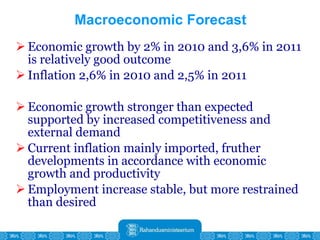
Macroeconomic Forecast Economic growth by 2% in 2010 and 3,6% in 2011 is relatively good outcome Inflation 2,6% in 2010 and 2,5% in 2011 Economic growth stronger than expected supported by increased competitiveness and external demand Current inflation mainly imported, fruther developments in accordance with economic growth and productivity Employment increase stable, but more restrained than desired
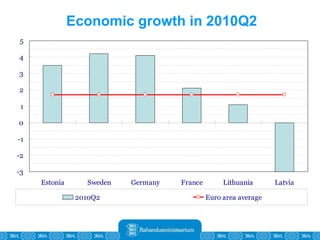
Economic growth in 2010Q2
1. Macroeconomic Forecast Andrus Säälik Head of Macroeconomic Policy Department
Fundamentals of Forecast Recovery from the crisis in 2010. faster than expected (export, industry) Domestic demand starts to pick up in 2nd half of 2010 supported by investments Consumption courage is increasing In 2010. inflation higher than expected (commodities, bad weather conditions), further developments in accordance with economic growth Uncertainty in respect to 2011. outlook has increased
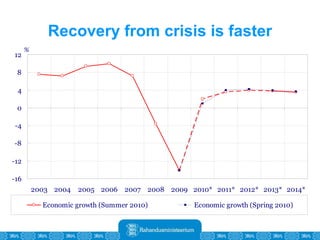
Recovery from crisis is faster
1.1. External environment and trade
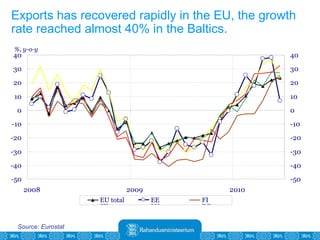
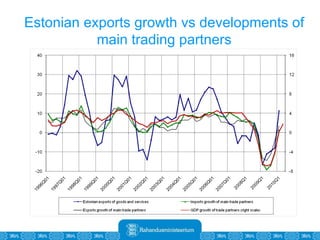
Source: Eurostat Exports has recovered rapidly in the EU, the growth rate reached almost 40% in the Baltics.
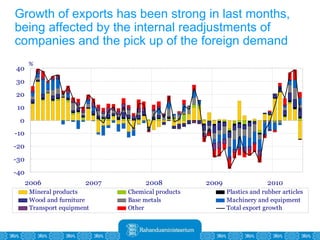
Growth of exports has been strong in last months, being affected  by  the internal readjustments of companies and the   pick up of the foreign demand
1.2. Domestic demand
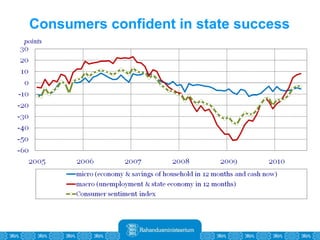
Consumers confident in state success
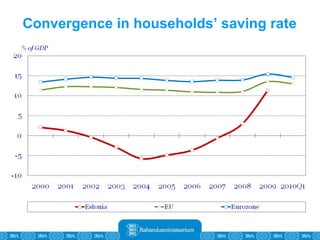
Convergence in households’ saving rate
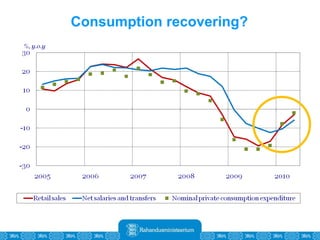
Consumption recovering?
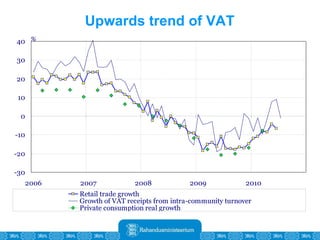
Upwards trend of VAT
1.3. Labour market and prices
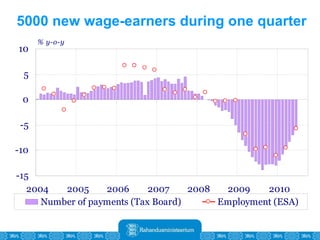
5000 new wage-earners during one quarter
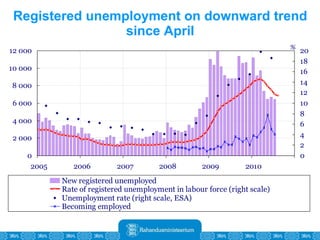
Registered unemployment on downward trend since April
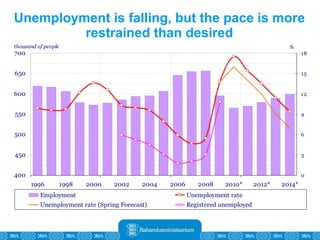
Unemployment is falling, but the pace is more restrained than desired
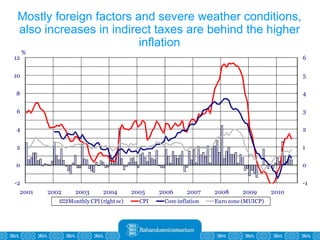
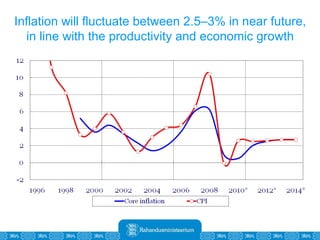
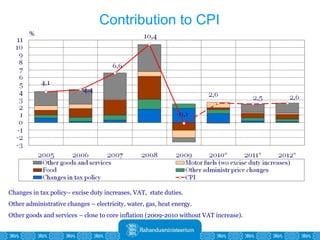
Mostly foreign factors and severe weather conditions, also increases in indirect taxes are behind the higher inflation
Inflation will fluctuate between 2.5–3% in near future, in line with the productivity and economic growth
1.4. Risks
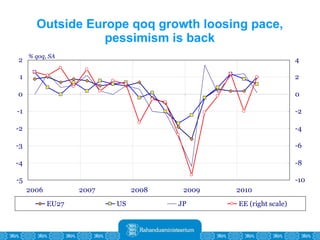
Outside Europe qoq growth loosing pace, pessimism is back
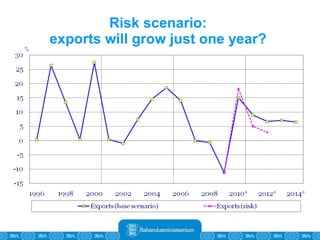
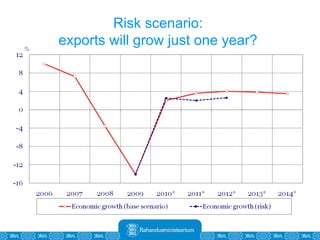
Risk scenario:  exports will grow just one year?
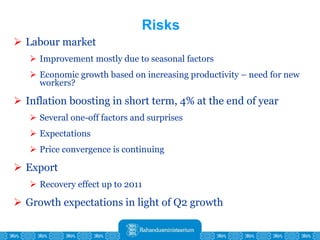
Risks Labour market Improvement mostly due to seasonal factors Economic growth based on increasing productivity – need for new workers? Inflation boosting in short term, 4% at the end of year Several one-off factors and surprises Expectations Price convergence is continuing Export Recovery effect up to 2011 Growth expectations in light of Q2 growth
Public Finance Sven Kirsipuu Adviser  Public Finance and Strategies Department
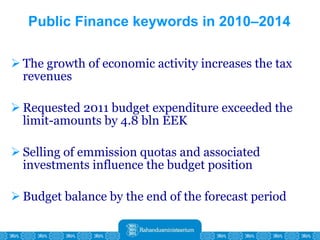
Public Finance keywords in 2010–2014 The growth of economic activity increases the tax revenues Requested 2011 budget expenditure exceeded the limit-amounts by 4.8 bln EEK Selling of emmission quotas and associated investments influence the budget position Budget balance by the end of the forecast period
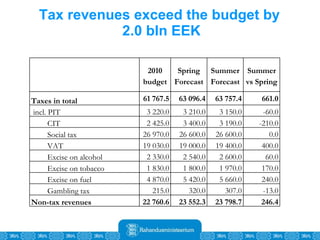
Tax revenues exceed the budget by  2.0 bln EEK   2010 budget Spring Forecast Summer Forecast Summer vs Spring Taxes in total 61 767.5 63 096.4 63 757.4 661.0 incl. PIT 3 220.0 3 210.0 3 150.0 -60.0 CIT 2 425.0 3 400.0 3 190.0 -210.0 Social tax 26 970.0 26 600.0 26 600.0 0.0 VAT 19 030.0 19 000.0 19 400.0 400.0 Excise on alcohol 2 330.0 2 540.0 2 600.0 60.0 Excise on tobacco 1 830.0 1 800.0 1 970.0 170.0 Excise on fuel 4 870.0 5 420.0 5 660.0 240.0 Gambling tax 215.0 320.0 307.0 -13.0 Non-tax revenues  22 760.6 23 552.3 23 798.7 246.4
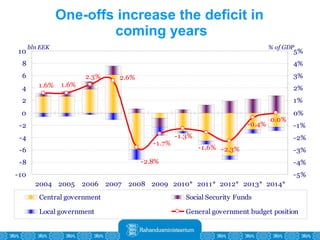
One-offs increase the deficit in  coming years
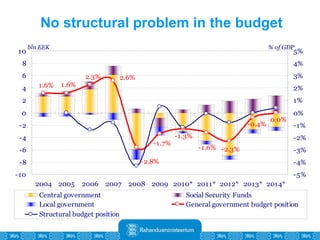
No structural problem in the budget
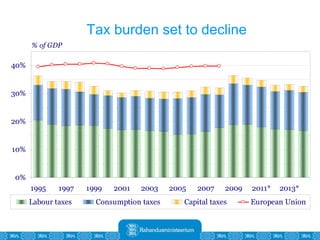
Tax burden set to decline
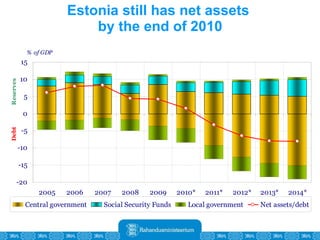
Estonia still has net assets  by the end of 2010
Thank you!
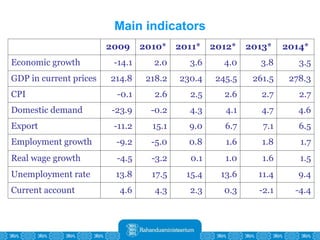
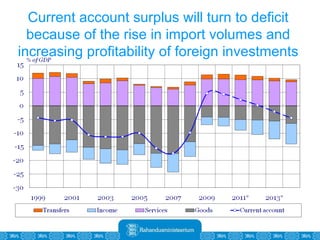
Main indicators 2009 2010* 2011* 2012* 2013* 2014* Economic growth -14.1 2.0 3.6 4.0 3.8 3.5 GDP in current prices 214.8 218.2 230.4 245.5 261.5 278.3 CPI -0.1 2.6 2.5 2.6 2.7 2.7 Domestic demand -23.9 -0.2 4.3 4.1 4.7 4.6 Export -11.2 15.1 9.0 6.7 7.1 6.5 Employment growth -9.2 -5.0 0.8 1.6 1.8 1.7 Real wage growth -4.5 -3.2 0.1 1.0 1.6 1.5 Unemployment rate 13.8 17.5 15.4 13.6 11.4 9.4 Current account 4.6 4.3 2.3 0.3 -2.1 -4.4
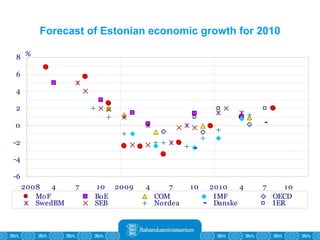
Forecast of Estonian economic growth for 2010
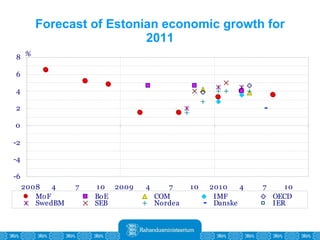
Forecast of Estonian economic growth for 2011
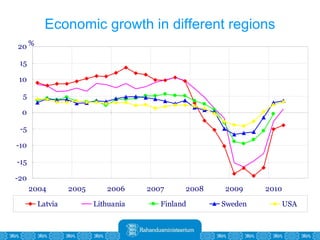
Economic growth in different regions
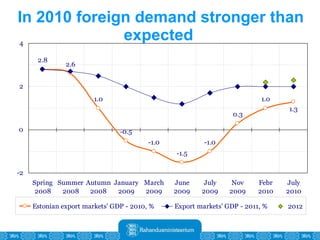
In 2010 foreign demand stronger than expected
Estonian exports  growth  vs developments of main trading partners
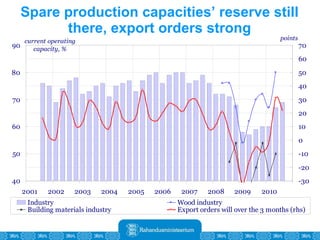
Spare production capacities’ reserve still there, export orders strong
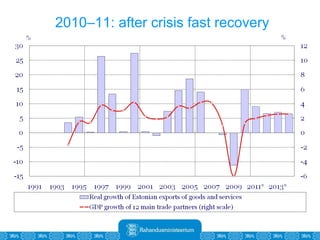
2010–11: after crisis fast recovery
Current account surplus will turn to deficit because of the rise in import volumes and increasing profitability of foreign investments
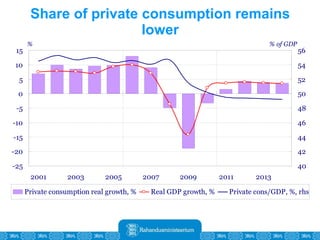
Share of private consumption remains lower
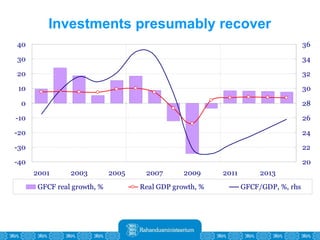
Investments presumably recover
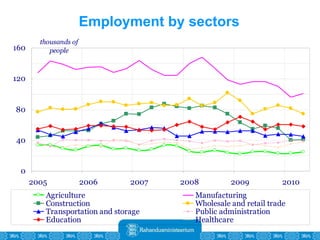
Employment by sectors
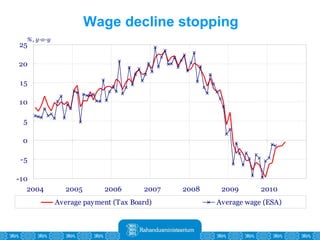
Wage decline stopping
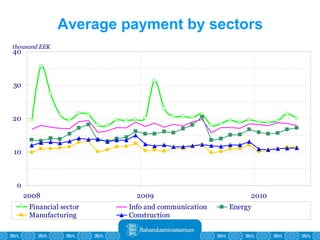
Average payment by sectors
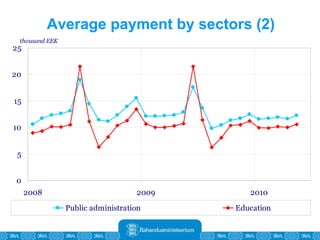
Average payment by sectors   (2)
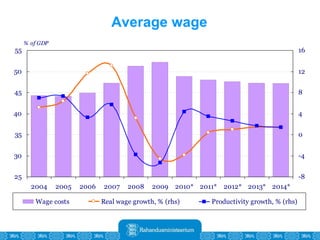
Average wage
Changes in tax policy– excise duty increases, VAT,  state duties. Other administrative changes – electricity, water, gas, heat energy. Other goods and services – close to core inflation (2009-2010 without VAT increase). Contribution to CPI

Mof Summer 2010 Macroeconomic Forecast