MEMORY SYSTEM
Module 4
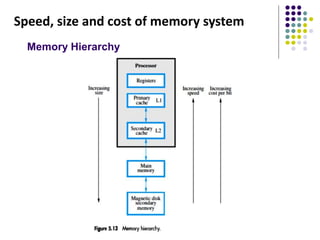
Memory Hierarchy
Speed, size and cost of memory system
Cache Memories
Cache Memories
 Processor is much faster than the main memory.
 As a result, the processor has to spend much of its
time waiting while instructions and data are being
fetched from the main memory.
 Major obstacle towards achieving good performance.
 Speed of the main memory cannot be increased
beyond a certain point.
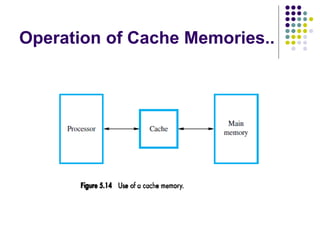
 Cache memory is an architectural arrangement
which makes the main memory appear faster to the
processor than it really is.
 Cache memory is based on the property of
computer programs known as “locality of reference”.
Locality of Reference
 Analysis of programs shows that most of their
execution time is spent on routines in which
many instructions are executed repeatedly.
 These instructions may constitute a simple loop,
nested loops, or a few procedures that
repeatedly call each other.
 Many instructions in localized areas of the
program are executed repeatedly during some
time period, and the remainder of the program is
accessed relatively infrequently.
 This is called “locality of reference”.
Locality of Reference..
 Temporal locality of reference
 Recently executed instruction is likely to be
executed again very soon.
 Spatial locality of reference
 Instructions with addresses close to a recently
executed instruction are likely to be executed
soon.
Operation of Cache Memories
 If the active segments of a program can be placed in a
fast cache memory, then the total execution time can be
reduced significantly.
 The memory control circuitry is designed to take
advantage of the property of locality of reference.
 The temporal aspect of the locality of reference suggests that whenever
an information item (instruction or data) is first needed, this item should
be brought into the cache where it will hopefully remain until it is needed
again.
 The spatial aspect suggests that instead of fetching just one item from
the main memory to the cache, it is useful to fetch several items that
reside at adjacent addresses as well.
 The term block refers to a set of contiguous address
locations of some size.
 The term Cache line refers to a cache block.
Operation of Cache Memories..
 Processor issues a Read request, a block of words is
transferred from the main memory to the cache, one
word at a time.
 Subsequent references to the data in this block of words
are found in the cache.
 At any given time, only some blocks in the main memory
are held in the cache.
 Which blocks in the main memory are in the cache is determined
by a “mapping function”.
 When the cache is full, and a block of words needs to be
transferred from the main memory, some block of words
in the cache must be replaced.
 This is determined by a “replacement algorithm”.
Cache Hit
 Processor simply issues Read and Write
requests using addresses that refer to
locations in the memory.
 The cache control circuitry determines whether the
requested word currently exists in the cache.
 If it does, the Read or Write operation is performed on the
appropriate cache location.
 In this case, a read hit or write hit is said to have occurred.
 In a Read operation, the main memory is not involved.
 Data is obtained from the cache.
Read
Request
Cache
Read
Request
Cache
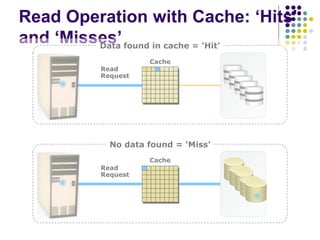
Data found in cache = ‘Hit’
No data found = ‘Miss’
Read Operation with Cache: ‘Hits’
and ‘Misses’
Cache Hit..
 For a Write operation, the system can proceed in
two ways.
 Write-through protocol
 The cache location and the main memory location are
updated simultaneously.
 Write-back or copy-back protocol
 Only the cache location is updated and it is marked as
updated with an associated flag bit, often called the
dirty or modified bit.
 The main memory location of the word is updated
later, when the block containing this marked word is to
be removed from the cache to make room for a new
block.
Cache Miss
 When the addressed word in a Read operation is
not in the cache, a read miss occurs.
 The block of words that contains the requested word
is copied from the main memory into the cache.
 After the entire block is loaded into the cache, the
particular word requested is forwarded to the
processor.
 Alternatively, this word may be sent to the processor
as soon as it is read from the main memory.
 This approach is called load-through, or early restart,
 Reduces the processor's waiting period, but at the expense
of more complex circuitry.
Cache Miss..
 During a Write operation, if the addressed word is
not in the cache, a write miss occurs.

MODULE-4 - Memory-System used in Computer organization

  • 1.
  • 2.
    Memory Hierarchy Speed, sizeand cost of memory system
  • 3.
  • 4.
    Cache Memories  Processoris much faster than the main memory.  As a result, the processor has to spend much of its time waiting while instructions and data are being fetched from the main memory.  Major obstacle towards achieving good performance.  Speed of the main memory cannot be increased beyond a certain point.  Cache memory is an architectural arrangement which makes the main memory appear faster to the processor than it really is.  Cache memory is based on the property of computer programs known as “locality of reference”.
  • 5.
    Locality of Reference Analysis of programs shows that most of their execution time is spent on routines in which many instructions are executed repeatedly.  These instructions may constitute a simple loop, nested loops, or a few procedures that repeatedly call each other.  Many instructions in localized areas of the program are executed repeatedly during some time period, and the remainder of the program is accessed relatively infrequently.  This is called “locality of reference”.
  • 6.
    Locality of Reference.. Temporal locality of reference  Recently executed instruction is likely to be executed again very soon.  Spatial locality of reference  Instructions with addresses close to a recently executed instruction are likely to be executed soon.
  • 7.
    Operation of CacheMemories  If the active segments of a program can be placed in a fast cache memory, then the total execution time can be reduced significantly.  The memory control circuitry is designed to take advantage of the property of locality of reference.  The temporal aspect of the locality of reference suggests that whenever an information item (instruction or data) is first needed, this item should be brought into the cache where it will hopefully remain until it is needed again.  The spatial aspect suggests that instead of fetching just one item from the main memory to the cache, it is useful to fetch several items that reside at adjacent addresses as well.  The term block refers to a set of contiguous address locations of some size.  The term Cache line refers to a cache block.
  • 8.
  • 9.
    Operation of CacheMemories..  Processor issues a Read request, a block of words is transferred from the main memory to the cache, one word at a time.  Subsequent references to the data in this block of words are found in the cache.  At any given time, only some blocks in the main memory are held in the cache.  Which blocks in the main memory are in the cache is determined by a “mapping function”.  When the cache is full, and a block of words needs to be transferred from the main memory, some block of words in the cache must be replaced.  This is determined by a “replacement algorithm”.
  • 10.
    Cache Hit  Processorsimply issues Read and Write requests using addresses that refer to locations in the memory.  The cache control circuitry determines whether the requested word currently exists in the cache.  If it does, the Read or Write operation is performed on the appropriate cache location.  In this case, a read hit or write hit is said to have occurred.  In a Read operation, the main memory is not involved.  Data is obtained from the cache.
  • 11.
    Read Request Cache Read Request Cache Data found incache = ‘Hit’ No data found = ‘Miss’ Read Operation with Cache: ‘Hits’ and ‘Misses’
  • 12.
    Cache Hit..  Fora Write operation, the system can proceed in two ways.  Write-through protocol  The cache location and the main memory location are updated simultaneously.  Write-back or copy-back protocol  Only the cache location is updated and it is marked as updated with an associated flag bit, often called the dirty or modified bit.  The main memory location of the word is updated later, when the block containing this marked word is to be removed from the cache to make room for a new block.
  • 13.
    Cache Miss  Whenthe addressed word in a Read operation is not in the cache, a read miss occurs.  The block of words that contains the requested word is copied from the main memory into the cache.  After the entire block is loaded into the cache, the particular word requested is forwarded to the processor.  Alternatively, this word may be sent to the processor as soon as it is read from the main memory.  This approach is called load-through, or early restart,  Reduces the processor's waiting period, but at the expense of more complex circuitry.
  • 14.
    Cache Miss..  Duringa Write operation, if the addressed word is not in the cache, a write miss occurs.

Editor's Notes

  • #12 Intelligent Storage System