MODULE 2 :
Objectives and
Phases of
Operational Audits
PRE02
OBJECTIVES OF OPERATIONAL AUDIT
Analyze administrative, managerial and
operational aspects on which the appropriate
modifications will be made in order to
improve business operations.
Identify ehich areas should reduce costs and
support the processes with the greatest
needs.
PHASES OF THE OPERATIONAL
AUDIT
Phase 1
: Planning
Steps:
1.Define audits to be performed
2.Perform risk assessment and prioritize
3.Designate resources and timeline
4.Prepare, prepare, prepare
5.Create audit plan
6.Review audit plan and set-up
planning meetings
7 STEPS TO EFFECTIVE PLANNING AND CONTROL
PHASES OF THE OPERATIONAL
AUDIT
Phase 2: Fieldwork
The phase when most of the testing is
performed.
It includes:
Interviewing
Documenting
Applying testing methodologies
Managing fieldwork
Providing status updates
PHASES OF THE OPERATIONAL
AUDIT
Phase 2: Fieldwork
It consists primarily of two things:
Determining if the process or program
under review is designed effectively so
that the related goals and objectives are
likely to be achieved.
Verify that the controls in place are
performing as designed by management.
PHASES OF THE OPERATIONAL
AUDIT
Types of Audit Evidence
Testimonial - It consists of verbal or written
statements or assertions given by someone
as proof regarding the matter being
discussed.
Observation - Auditors typically observe
conditions and dynamics related to the
subject of the review.
PHASES OF THE OPERATIONAL
AUDIT
Types of Audit Evidence
Document inspection - It is one of the most
common procedures performed by auditors
who examine documents to verify the date
and amount of transactions, agreements
made between various parties, evidence of
authorizations and record of decisions made,
among others.
PHASES OF THE OPERATIONAL
AUDIT
Types of Audit Evidence
Recalculation - It consists of checking the
accuracy of documents or records through
mathematical recalculation.
Reperformance - Sometimes, auditors
reperform the work of others to verify the
accuracy and completeness of the work
done, and to confirm that the amount is
correct.
PHASES OF THE OPERATIONAL
AUDIT
Types of Audit Evidence
Professional skepticism - It is verifying the
integrity of the information gathered and
make sure their conclusions are sound.
Workpapers - It is a collection of evidentiary
material showing the planning done, the
fieldwork activities performed, and the
support for all information mentioned in the
audit report or other communication of
results.
PHASES OF THE OPERATIONAL
AUDIT
Types of Audit Evidence
Flowcharts - It is a diagram of the sequence
of movements or actions of people or things
involved in a process or activity.
Internal control questionnaire - It helps
evaluate internal controls in specific areas by
asking key questions.
PHASES OF THE OPERATIONAL
AUDIT
Attributes of a Persuasive Audit Evidence
Relevance - Evidence must be relevant to the
related audit objectives and scope.
Objective - Evidence is objective when to or
more auditors, working independently, are
very likely to arrive at the same result. Also
when the parties involved are not influenced
by personal feelings or opinions in
considering and representing facts.
PHASES OF THE OPERATIONAL
AUDIT
Attributes of a Persuasive Audit Evidence
Documentation - Documented evidence is
more persuasive than undocumented
evidence.
Externality - Evidence obtained from a third-
party is generally more persuasive than
evidence from within the organization being
audited.
Sample size - Larger samples are generally
more persuasive than smaller samples.
PHASES OF THE OPERATIONAL
AUDIT
Attributes of a Persuasive Audit Evidence
Sampling method - Statistical samples are
usually more persuasive than non-statistical
samples because they reduce the likelihood
of sampling bias.
Corroboration - Corroborated evidence is
more persuasive than uncorroborated
evidence.
PHASES OF THE OPERATIONAL
AUDIT
Attributes of a Persuasive Audit Evidence
Timeliness - Recent items are typically more
persuasive than older items or those
produced after a delay.
Authoritativeness - Authoritative evidence is
more persuasive than non-authoritative
evidence. For example, a machine operator is
usually more authoritative with regard to how
well a particular machine works than the
engineer who built the machine.
more
Directness - Direct evidence is
persuasive than indirect evidence. For
example, an original document is more
persuasive than a copy.
Adequacy of controls - Evidence from a well-
controlled and reliable system is more
persuasive than evidence from a poorly
controlled or questionable system.
PHASES OF THE OPERATIONAL
AUDIT
Attributes of a Persuasive Audit Evidence
PHASES OF THE OPERATIONAL
AUDIT
Conditions of Workpapers
Workpapers should be neat, easy to review,
and their appearance should be uniform.
Most internal audit departments develop
templates to standardize their appearance
and key contents.
PHASES OF THE OPERATIONAL
AUDIT
Conditions of Workpapers
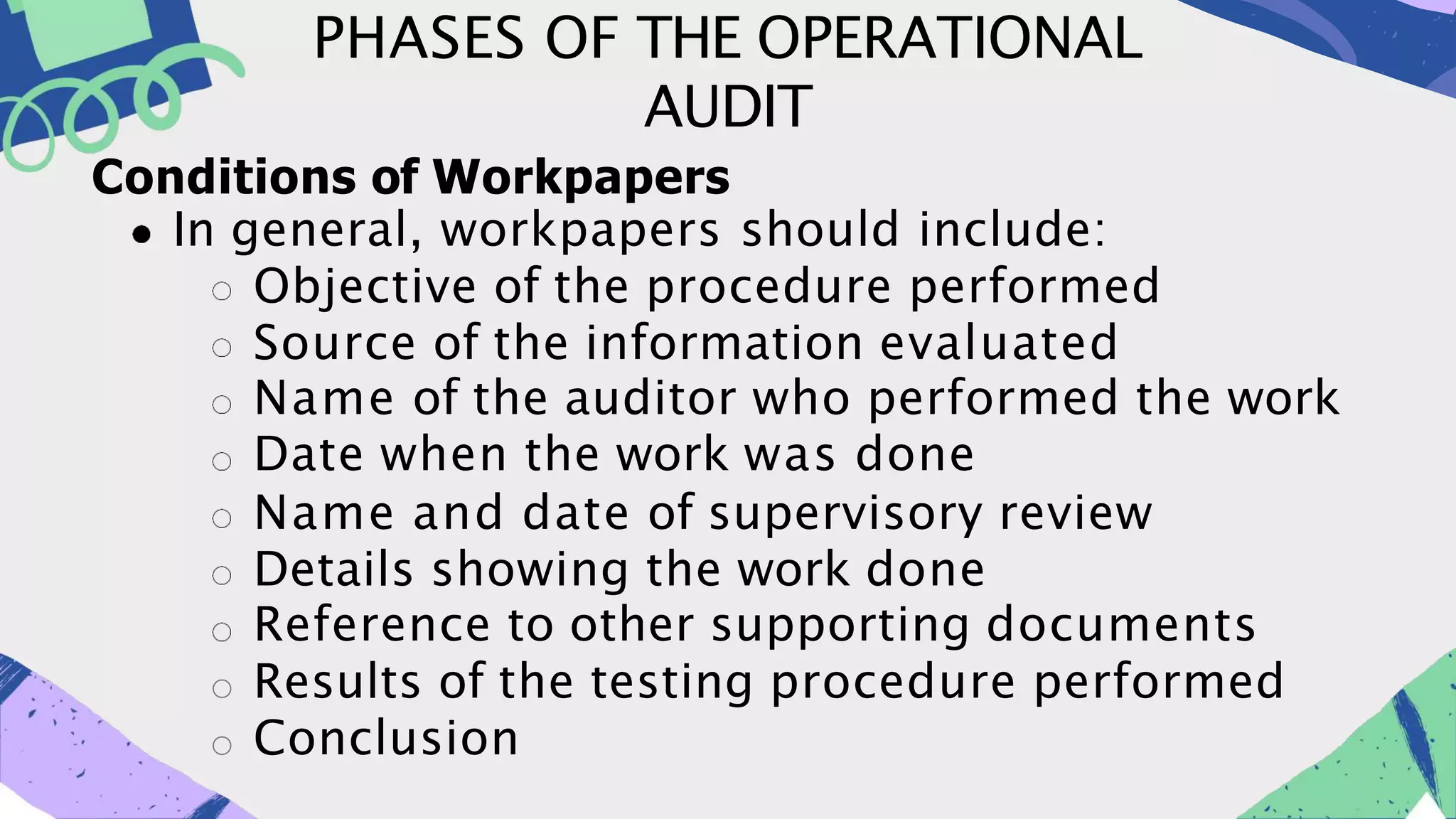
In general, workpapers should include:
Objective of the procedure performed
Source of the information evaluated
Name of the auditor who performed the work
Date when the work was done
Name and date of supervisory review
Details showing the work done
Reference to other supporting documents
Results of the testing procedure performed
Conclusion
PHASES OF THE OPERATIONAL
AUDIT
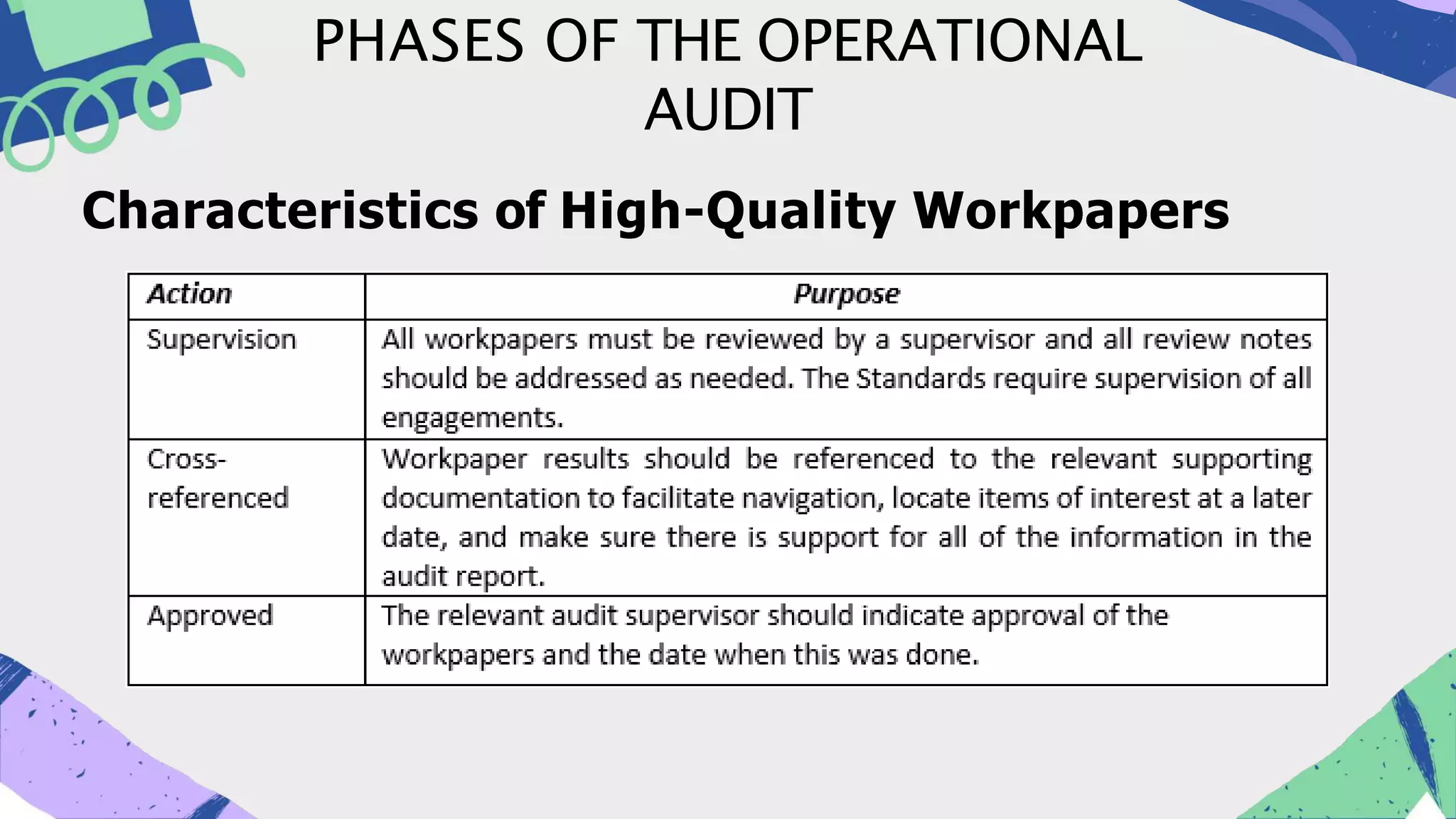
Characteristics of High-Quality Workpapers
PHASES OF THE OPERATIONAL
AUDIT
have become electronic
Workpapers
documents that
templates in a
are prepared using
document management
application.
The electronic audit working papers
application has improved the audit process
by reducing the amount of paper per audit,
increasing collaboration, and increasing
transparency.
Electronic Workpapers
PHASES OF THE OPERATIONAL
AUDIT
Typical Features of Electronic Workpaper Systems
Access controls
Budget management
Data analytics
Integration with popular productivity tools
Document preparation and management
Findings documentation and tracking
Support multiple users
Report writing
Review notes
Risk and control assessment
Risk matrix
Task assignment
Time tracking
Version control
Online/offline functionality
PHASES OF THE
OPERATIONAL
AUDIT
General Guidelines for Working Papers
Working papers should contain sufficient
information to allow an experienced auditor
having no previous connection with the audit
to ascertain from them the evidence that
supports the auditors' significant conclusions
and judgements.
PHASES OF THE
OPERATIONAL
AUDIT
findings,
observations and best practices noted during
the review and developing recommendations
for corrective action.
Phase 3: Reporting
It is the communication of results.
It consists of communicating
PHASES OF THE
OPERATIONAL
AUDIT
Attributes of Effective Audit Findings
PHASES OF THE
OPERATIONAL
AUDIT
Phase 4: Follow-up
Follow-up is a process by which internal
auditors evaluate the adequacy,
effectiveness and timeliness of actions taken
by management on reported observations
and recommendations.
This process also includes determining
whether senior management and/or the
board have assumed the risk of not taking
corrective action on reported observations.
PHASES OF THE
OPERATIONAL
AUDIT
Phase 4: Follow-up
A follow-up review means that the auditor is
checking to make sure the corrective action
was performed, so it consists of checking
what management did to address the issue
reported.
PHASES OF THE
OPERATIONAL
AUDIT
Reference:
https://www.youtube.com/watch?
v=7aUabD77FvI
END of
Module 2

Chapter_2___Objectives_and_Phases_of_Operational_Audits.pdf.pptx

  • 1.
    MODULE 2 : Objectivesand Phases of Operational Audits PRE02
  • 2.
    OBJECTIVES OF OPERATIONALAUDIT Analyze administrative, managerial and operational aspects on which the appropriate modifications will be made in order to improve business operations. Identify ehich areas should reduce costs and support the processes with the greatest needs.
  • 3.
    PHASES OF THEOPERATIONAL AUDIT Phase 1 : Planning Steps: 1.Define audits to be performed 2.Perform risk assessment and prioritize 3.Designate resources and timeline 4.Prepare, prepare, prepare 5.Create audit plan 6.Review audit plan and set-up planning meetings
  • 4.
    7 STEPS TOEFFECTIVE PLANNING AND CONTROL
  • 5.
    PHASES OF THEOPERATIONAL AUDIT Phase 2: Fieldwork The phase when most of the testing is performed. It includes: Interviewing Documenting Applying testing methodologies Managing fieldwork Providing status updates
  • 6.
    PHASES OF THEOPERATIONAL AUDIT Phase 2: Fieldwork It consists primarily of two things: Determining if the process or program under review is designed effectively so that the related goals and objectives are likely to be achieved. Verify that the controls in place are performing as designed by management.
  • 7.
    PHASES OF THEOPERATIONAL AUDIT Types of Audit Evidence Testimonial - It consists of verbal or written statements or assertions given by someone as proof regarding the matter being discussed. Observation - Auditors typically observe conditions and dynamics related to the subject of the review.
  • 8.
    PHASES OF THEOPERATIONAL AUDIT Types of Audit Evidence Document inspection - It is one of the most common procedures performed by auditors who examine documents to verify the date and amount of transactions, agreements made between various parties, evidence of authorizations and record of decisions made, among others.
  • 9.
    PHASES OF THEOPERATIONAL AUDIT Types of Audit Evidence Recalculation - It consists of checking the accuracy of documents or records through mathematical recalculation. Reperformance - Sometimes, auditors reperform the work of others to verify the accuracy and completeness of the work done, and to confirm that the amount is correct.
  • 10.
    PHASES OF THEOPERATIONAL AUDIT Types of Audit Evidence Professional skepticism - It is verifying the integrity of the information gathered and make sure their conclusions are sound. Workpapers - It is a collection of evidentiary material showing the planning done, the fieldwork activities performed, and the support for all information mentioned in the audit report or other communication of results.
  • 11.
    PHASES OF THEOPERATIONAL AUDIT Types of Audit Evidence Flowcharts - It is a diagram of the sequence of movements or actions of people or things involved in a process or activity. Internal control questionnaire - It helps evaluate internal controls in specific areas by asking key questions.
  • 12.
    PHASES OF THEOPERATIONAL AUDIT Attributes of a Persuasive Audit Evidence Relevance - Evidence must be relevant to the related audit objectives and scope. Objective - Evidence is objective when to or more auditors, working independently, are very likely to arrive at the same result. Also when the parties involved are not influenced by personal feelings or opinions in considering and representing facts.
  • 13.
    PHASES OF THEOPERATIONAL AUDIT Attributes of a Persuasive Audit Evidence Documentation - Documented evidence is more persuasive than undocumented evidence. Externality - Evidence obtained from a third- party is generally more persuasive than evidence from within the organization being audited. Sample size - Larger samples are generally more persuasive than smaller samples.
  • 14.
    PHASES OF THEOPERATIONAL AUDIT Attributes of a Persuasive Audit Evidence Sampling method - Statistical samples are usually more persuasive than non-statistical samples because they reduce the likelihood of sampling bias. Corroboration - Corroborated evidence is more persuasive than uncorroborated evidence.
  • 15.
    PHASES OF THEOPERATIONAL AUDIT Attributes of a Persuasive Audit Evidence Timeliness - Recent items are typically more persuasive than older items or those produced after a delay. Authoritativeness - Authoritative evidence is more persuasive than non-authoritative evidence. For example, a machine operator is usually more authoritative with regard to how well a particular machine works than the engineer who built the machine.
  • 16.
    more Directness - Directevidence is persuasive than indirect evidence. For example, an original document is more persuasive than a copy. Adequacy of controls - Evidence from a well- controlled and reliable system is more persuasive than evidence from a poorly controlled or questionable system. PHASES OF THE OPERATIONAL AUDIT Attributes of a Persuasive Audit Evidence
  • 17.
    PHASES OF THEOPERATIONAL AUDIT Conditions of Workpapers Workpapers should be neat, easy to review, and their appearance should be uniform. Most internal audit departments develop templates to standardize their appearance and key contents.
  • 18.
    PHASES OF THEOPERATIONAL AUDIT Conditions of Workpapers In general, workpapers should include: Objective of the procedure performed Source of the information evaluated Name of the auditor who performed the work Date when the work was done Name and date of supervisory review Details showing the work done Reference to other supporting documents Results of the testing procedure performed Conclusion
  • 19.
    PHASES OF THEOPERATIONAL AUDIT Characteristics of High-Quality Workpapers
  • 20.
    PHASES OF THEOPERATIONAL AUDIT have become electronic Workpapers documents that templates in a are prepared using document management application. The electronic audit working papers application has improved the audit process by reducing the amount of paper per audit, increasing collaboration, and increasing transparency. Electronic Workpapers
  • 21.
    PHASES OF THEOPERATIONAL AUDIT Typical Features of Electronic Workpaper Systems Access controls Budget management Data analytics Integration with popular productivity tools Document preparation and management Findings documentation and tracking Support multiple users Report writing Review notes Risk and control assessment Risk matrix Task assignment Time tracking Version control Online/offline functionality
  • 22.
    PHASES OF THE OPERATIONAL AUDIT GeneralGuidelines for Working Papers Working papers should contain sufficient information to allow an experienced auditor having no previous connection with the audit to ascertain from them the evidence that supports the auditors' significant conclusions and judgements.
  • 23.
    PHASES OF THE OPERATIONAL AUDIT findings, observationsand best practices noted during the review and developing recommendations for corrective action. Phase 3: Reporting It is the communication of results. It consists of communicating
  • 24.
    PHASES OF THE OPERATIONAL AUDIT Attributesof Effective Audit Findings
  • 25.
    PHASES OF THE OPERATIONAL AUDIT Phase4: Follow-up Follow-up is a process by which internal auditors evaluate the adequacy, effectiveness and timeliness of actions taken by management on reported observations and recommendations. This process also includes determining whether senior management and/or the board have assumed the risk of not taking corrective action on reported observations.
  • 26.
    PHASES OF THE OPERATIONAL AUDIT Phase4: Follow-up A follow-up review means that the auditor is checking to make sure the corrective action was performed, so it consists of checking what management did to address the issue reported.
  • 27.
  • 28.