Slideshare uses cookies to improve functionality and performance, and to provide you with
relevant advertising. If you continue browsing the site, you agree to the use of cookies on this
website. See our User Agreement and Privacy Policy.
Slideshare uses cookies to improve functionality and performance, and to provide you with
relevant advertising. If you continue browsing the site, you agree to the use of cookies on this
website. See our Privacy Policy and User Agreement for details.
SlideShare Explore Search You
●
● Upload
● Login
● Signup
●
●
Submit Search
● Home
● Explore
Successfully reported this slideshow.
We use your LinkedIn profile and activity data to personalize ads and to show you more relevant
ads. You can change your ad preferences anytime.
HUMAN SETTLEMENTS
Upcoming SlideShare
Loading in …5
×
1
1 of 133
Like this presentation? Why not share!
● Share
● Email
●
●
● Islamabad by Hamzah Meraj, Fac... 6819 views
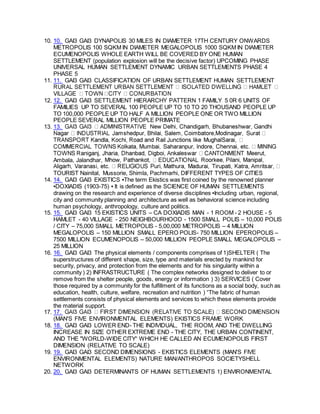
● Evolution of settlements by yusra_gul 66376 views
● Kath-khuni architecture of Himachal... by Mansi Shah 73684 views
● Auroville - City Planning by ams_5686 21768 views
● EKISTICS by Healthene Joy Alesna 23994 views
● City forms by Vijay Meena 59817 views
Share SlideShare
● Facebook
● Twitter
● LinkedIn
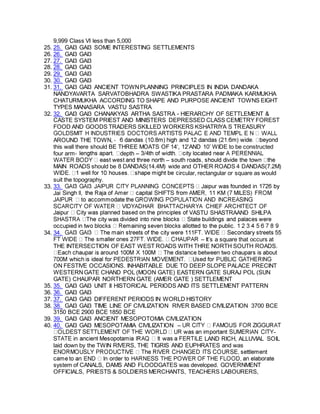
Embed
Size (px)
Start on
Show related SlideShares at end
WordPress Shortcode
Link
HUMAN SETTLEMENTS
47,684 views
● Share
● Like
● ...
○
Gai3 Segar
, TEACHER
Follow
Published on Aug 12, 2017
Origin of human settlements,determinants,evolution through the course of history,changing
scenario in the context of globalization
...
Published in: Education
● 51 Comments
● 266 Likes
● Statistics
● Notes
● Full Name
Comment goes here.12 hours ago Delete Reply Block
Are you sure you want to Yes No
Your message goes here
Post
● Login to see the comments
● lubnahameed1
2 days ago
● Chris_paul
1 week ago
● vrushalipanchal1
1 week ago
● HimanshiChachondia1
2 weeks ago
● NimjeRatna
3 weeks ago
Show More
No Downloads
Views
Total views
47,684
On SlideShare
0
From Embeds
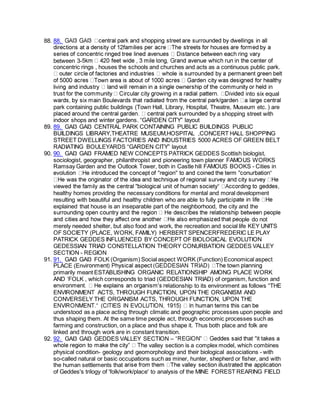
0
Number of Embeds
15
Actions
Shares
0
Downloads
0
Comments
51
Likes
266
No notes for slide
HUMAN SETTLEMENTS
1. 1. GAI3 GAI3 EVOLUTION OF HUMAN SETTLEMENT
2. 2. GAI3 GAI3 SYLLABUS
3. 3. GAI3 GAI3 CLASS I INTRODUCTION TO HUMAN SETTLEMENT
SETTLEMENTHUMAN EVOLUTIO N
4. 4. GAI3 GAI3 HUMAN EVOLUTION
5. 5. GAI3 GAI3 SAFETY & SECURITY TO PROTECT THEMSELVES FROM
PREDATORS & ENEMIES TO PROTECT THEMSELVES FROM ADVERSE WEATHER
CONDITIONS LIKE EXTREME TEMPERATURE ,STORMY WINDS AND RAIN TO
SAFEGUARD THEIR FOOD SUPPLIES & DOMESTIC ANIMALS WHY HUMAN NEEDS
A SHELTER? VJ
6. 6. people and acquiring of some
opening up and settling of a previously uninhabited area by the people. SETTLEMENT
7. 7. GAI3 GAI3MAMMOTH BONE HUT - MOLDAVA PALEOLITHIC PEOPLE LIVE IN
CAVES PALEOLITHIC AGE NOMADS AND HUNTERS SHELTER - CAVE,TREES
MESOLITHIC AGE NOMADS AND HUNTERS SHELTER – TEMPORARY Huts were
built using mammoth bone followed by houses of wood, straw & rock.
8. 8. GAI3 GAI3 NEOLITHIC AGE FARMERS AND HERDERS SHELTER – PERMANENT
- Neolithic houses were rectangular and made using tree trunks. -The roof was usually
made from timber beams with a reed thatch covering. - The houses usually had a hearth
which was used for cooking: unlike the earlier Mesolithic people, Neolithic people cooked
food indoors
9. 9. GAI3 GAI3 PRIMITIVE NON ORGANIZED HUMAN SETTLEMENT PRIMITIVE MAN
(tree tops, branches , tree holes & caves) PALEOLITHIC - OLD STONE AGE NOMAD
TEMPORARY SHELTER (ISOLATED DWELLING-HAMLET) ( Huts were built using
mammoth bone ,wood , straw & rock) MESOLITHIC - MIDDLE STONE AGE FARMERS
& HERDERS PERMANENT SHELTER (FORMATION OF VILLAGE) (The roof was
usually made from timber beams with a reed thatch covering) NEOLITHIC - NEW STONE
AGE CONFLICT BETWEENMAN - WINNER BECAME THE KING NON
AGRICULTURAL FORTIFIED SETTLEMENTS WERE BUILT WITH MOATS ALL
AROUND (FORMATION OF TOWN) (people started migrating to this town centre for
better wages & employment) BRONZE AGE DUE TO EXCESSIVE MIGRATION
DEVELOPMENT CAME OUT OF FORTS TO ACCOMDATE MORE PEOPLE GIVING
RISE TO A BIGGER SETTLEMENTS (FORMATION OF LARGER TOWNS & CITIES)
IRON AGE PRIMITIVE ORGANIZED HUMAN SETTLEMENT STATIC URBAN
SETTLEMENTS OR CITIES PHASE 1 PHASE2 PHASE 3 DIFFERENT PHASES OF
HUMAN SETTLEMENT
10. 10. GAI3 GAI3 DYNAPOLIS 30 MILES IN DIAMETER 17TH CENTURY ONWARDS
METROPOLIS 100 SQKM IN DIAMETER MEGALOPOLIS 1000 SQKM IN DIAMETER
ECUMENOPOLIS WHOLE EARTH WILL BE COVERED BY ONE HUMAN
SETTLEMENT (population explosion will be the decisive factor) UPCOMING PHASE
UNIVERSAL HUMAN SETTLEMENT DYNAMIC URBAN SETTLEMENTS PHASE 4
PHASE 5
11. 11. GAI3 GAI3 CLASSIFICATION OF URBAN SETTLEMENT HUMAN SETTLEMENT
12. 12. GAI3 GAI3 SETTLEMENT HIERARCHY PATTERN 1 FAMILY 5 0R 6 UNITS OF
FAMILIES UP TO SEVERAL 100 PEOPLE UP TO 10 TO 20 THOUSAND PEOPLE UP
TO 100,000 PEOPLE UP TO HALF A MILLION PEOPLE ONE OR TWO MILLION
PEOPLE SEVERAL MILLION PEOPLE PRIMATE
13. 13.
Ambala, Jalandhar,
TOURIST Nainital, Mussorie, Shimla, Pachmarhi, DIFFERENT TYPES OF CITIES
14. 14. GAI3 GAI3 EKISTICS ▪The term Ekistics was first coined by the renowned planner
▪DOXIADIS (1903-75) ▪ It is defined as the SCIENCE OF HUMAN SETTLEMENTS
drawing on the research and experience of diverse disciplines ▪Including urban, regional,
city and community planning and architecture as well as behavioral science including
human psychology, anthropology, culture and politics.
15. 15. GAI3 GAI3 15 EKISTICS UNITS – CA DOXIADIS MAN - 1 ROOM - 2 HOUSE - 5
HAMLET - 40 VILLAGE - 250 NEIGHBOURHOOD - 1500 SMALL POLIS – 10,000 POLIS
/ CITY – 75,000 SMALL METROPOLIS - 5,00,000 METROPOLIS – 4 MILLION
MEGALOPOLIS – 150 MILLION SMALL EPERO POLIS- 750 MILLION EPEROPOLIS –
7500 MILLION ECUMENOPOLIS – 50,000 MILLION PEOPLE SMALL MEGALOPOLIS –
25 MILLION
16. 16. GAI3 GAI3 The physical elements / components comprises of 1)SHELTER ( The
superstructures of different shape, size, type and materials erected by mankind for
security, privacy, and protection from the elements and for his singularity within a
community ) 2) INFRASTRUCTURE ( The complex networks designed to deliver to or
remove from the shelter people, goods, energy or information ) 3) SERVICES ( Cover
those required by a community for the fulfillment of its functions as a social body, such as
education, health, culture, welfare, recreation and nutrition ) “The fabric of human
settlements consists of physical elements and services to which these elements provide
the material support.
17. 17.
(MAN'S FIVE ENVIRONMENTAL ELEMENTS) EKISTICS FRAME WORK
18. 18. GAI3 GAI3 LOWER END- THE INDIVIDUAL, THE ROOM, AND THE DWELLING
INCREASE IN SIZE OTHER EXTREME END - THE CITY, THE URBAN CONTINENT,
AND THE "WORLD-WIDE CITY“ WHICH HE CALLED AN ECUMENOPOLIS FIRST
DIMENSION (RELATIVE TO SCALE)
19. 19. GAI3 GAI3 SECOND DIMENSIONS - EKISTICS ELEMENTS (MAN'S FIVE
ENVIRONMENTAL ELEMENTS) NATURE MAN/ANTHROPOS SOCIETYSHELL
NETWORK
20. 20. GAI3 GAI3 DETERMINANTS OF HUMAN SETTLEMENTS 1) ENVIRONMENTAL
DRINKING, COOKING, WASHING, IRRIGATION AND TRANSPORTATION PURPOSES
the SHAPE AND ELEVATION OF THE LAND. It
to settle IN FLAT, OPEN AREAS SUCH AS PLAINS AND VALLEYS FOR CULTIVATION
ENDLY to human settlement.
Steep mountains were hard to cross. Their jagged peaks, cold temperatures, and rocky
were hot and dry. They contained very little water for farming. VEGETATI
many kinds of vegetation, such as TREES, BUSHES, FLOWERS, GRASS, AND REEDS.
21. 21.
LAND OWNING CASTE resides at the CENTRE of the village and the OTHER SERVICE
AND FRAGMENTATION of a settlement into several units 3) HISTORICAL OR
conquered or attacked frequentl
UNICATE with
communication network
22. 22. GAI3 GAI3 CLASSIFICATION OF RURAL SETTLEMENT 1 ) ON THE BASIS OF
OCCUPATION
-SHAPED
-
23. 23. GAI3 GAI3 KURINCHI NEITHAL PALAI MULLAI MARUTHAM SANGAM
LITERATURE – FIVE LANDSCAPES
24. 24.
THAN ONE LAKH POPULATION) 2 ) ON THE BASIS OF
Kolkata, Mumbai, Sahar
RELIGIOUS Puri, Mathura, Madurai, Tirupati, Katra, Amritsar, CLASSIFICATION OF
URBAN SETTLEMENT Class Population Class I (city) 1,00,000 and above Class II (town)
50,000 – 99,999 Class III 20,000 – 49,999 Class IV 10,000 – 19,999 Class V 5,000 –
9,999 Class VI less than 5,000
25. 25. GAI3 GAI3 SOME INTERESTING SETTLEMENTS
26. 26. GAI3 GAI3
27. 27. GAI3 GAI3
28. 28. GAI3 GAI3
29. 29. GAI3 GAI3
30. 30. GAI3 GAI3
31. 31. GAI3 GAI3 ANCIENT TOWNPLANNING PRINCIPLES IN INDIA DANDAKA
NANDYAVARTA SARVATOBHADRA SWASTIKA PRASTARA PADMAKA KARMUKHA
CHATURMUKHA ACCORDING TO SHAPE AND PURPOSE ANCIENT TOWNS EIGHT
TYPES MANASARA VASTU SASTRA
32. 32. GAI3 GAI3 CHANAKYAS ARTHA SASTRA - HIERARCHY OF SETTLEMENT &
CASTE SYSTEM PRIEST AND MINISTERS DEPRESSED CLASS CEMETRY FOREST
FOOD AND GOODS TRADERS SKILLED WORKERS KSHATRIYA S TREASURY
AROUND THE TOWN, ‐
this wall there should BE THREE MOATS OF 14‘, 12’AND 10’ WIDE to be constructed
four arm‐ depth –
–
MAIN ROADS should be 8 DANDAS(14.4M) wide and OTHER ROADS 4 DANDAS(7.2M)
ircular, rectangular or square as would
suit the topography.
33. 33.
Ja
ASTU SHASTRAAND SHILPA
34. 34.
– It’s a square that occurs at
THE INTERSECTION OF EAST WEST ROADS WITH THRE NORTH SOUTH ROADS.
ON FESTIVE OCCASIONS. INHABITABLE DUE TO DEEP SLOPE PALACE PRECINT
WESTERNGATE CHAND POL (MOON GATE) EASTERN GATE SURAJ POL (SUN
GATE) CHAUPAR NORTHERN GATE (AMER GATE ) SETTLEMENT
35. 35. GAI3 GAI3 UNIT II HISTORICAL PERIODS AND ITS SETTLEMENT PATTERN
36. 36. GAI3 GAI3
37. 37. GAI3 GAI3 DIFFERENT PERIODS IN WORLD HISTORY
38. 38. GAI3 GAI3 TIME LINE OF CIVILIZATION RIVER BASED CIVILIZATION 3700 BCE
3150 BCE 2900 BCE 1850 BCE
39. 39. GAI3 GAI3 ANCIENT MESOPOTOMIA CIVILIZATION
40. 40. GAI3 GAI3 MESOPOTAMIA CIVILIZATION –
-
E LAND RICH, ALLUVIAL SOIL
laid down by the TWIN RIVERS, THE TIGRIS AND EUPHRATES and was
system of CANALS, DAMS AND FLOODGATES was developed. GOVERNMENT
OFFICIALS, PRIESTS & SOLDIERS MERCHANTS, TEACHERS LABOURERS,
FARMERS & CRAFT-MAKERS SLAVES (CAPTURED FROM BATTLE) SUPREME
POWER TOP LEVEL PEOPLE MIDDLE LEVEL PEOPLE BOTTOMLEVEL PEOPLE
SOCIAL STRUCTURE
41. 41.
TEMPLES on PLATFORMS OR, IN THE CASE OF ZIGGURATS, on a stepped series of
platf -BRICK with an outer skin of fired bricks,
set in BITUMEN MORTAR, to protect it AGAINST FLOOD DAMAGE
42. 42.
M
CUTTERS made gems, and THE FULLER stomped on woven wools to make them soft.
The METAL WORKERS made weapons. RESIDENTIAL AREA FORTIFICATIO N GATE
COURT OF NANNA ZIGGURA T GIPARU SACRED PRECINT CITY WALL
RESIDENTIAL AREA EUPHRATES RIVER CANA L WEST HARBOU R NORTH
HARBOUR E.DUBLALMAH PLACE OF JUDGEMENT UR SETTLEMENT LAYOUT
43. 43. GAI3 GAI3 VARIOUS ACTIVITIES INSIDE RESIDENTIAL AREA OF UR
SETTLEMENT SHRINE SCHOOL HOUSE SHOPS THE KHAN COOK HOUSE
44. 44. GAI3 GAI3 BAKER SQUARE ENTRANCE PASSAGE COURTYARD WITH TWO
FURNACE LARGE COURTYARD FURNACE SHOPS & BUSINESS RELATIVELY LONG
AND NARROW SHOPS WORKSHOPS AND STORE ROOMLOW WINDOWS ACTS
LIKE A COUNTER THE KAHN 3 SEPARATE ENTRANCE 19 GROUND FLOOR ROOMS
MAY BE HOTEL THREE STOREY HIGH THE COOK HOUSE HOUSE CONVERTED
INTO FAST FOOD RESTAURANT BREAD OVEN INDOOR SEATING IN OLD
DOMESTIC CHAPEL FOOD PREPARATION CAN BE VIEWED BY PASSERS
THROUGH LOW WINDOW PLANNING CONCEPTS IN UR CITY
45. 45. G
FAMILY BURIAL-
very tightly, with EXTERIOR WALLS of one household immediately ABUTTING THE
CLOSE-SET HOUSES protects the EXTERIOR WALLS IN HEATING especially during
residential areas of the city included HOMES WITH BAKED MUD BRICK FOUNDATIONS
an OPEN CENTRAL COURTYARD with two or more main living rooms in which the
families resided.
of large structures such as city walls, also provided an effective PROTECTIONAGAINST
DAMP PRIVATE HOUSES PLANNING CONCEPTS IN UR CITY
46. 46. GAI3 GAI3 REMAINS OF UR CITY ,IRAQ 2017
47. 47. GAI3 GAI3 ANCIENT INDUS VALLEY CIVILIZATION
48. 48. GAI3 GAI3
49. 49. -
techni
knowledge with meas
50. 50. GAI3 GAI3 MASS MEASUREMENT SYSTEM
51. 51. igher
city(Acropolis)was safeguarded by walls which look like a fort usually occupied by rulers
er a
attac
has well connected sink and it is further linked with underground sink
52. 52. GAI3 GAI3 INDUS VALLEY CIVILIZATION- CITADEL OF MOHENJODARO
53. 53. GAI3 GAI3 INDUS VALLEY CIVILIZATION-
– mound of mud bricks of 12m height
encloses great bath, granary residential area for 5000 citizens and two large assembly
massive
ultural civilization
54. 54. GAI3 GAI3 DHOLAVIRA SETTLEMENT BAILLE Y CASTLE NORTH GATE LOWER
TOWNMIDDLE TOWNRESERVOI R CEREMONIAL GROUND
55. 55. GAI3 GAI3 ANCIENT GREEK CIVILIZATION
56. 56. GAI3 GAI3
57. 57. GAI3 GAI3
58. 58.
s rocky and barren and
communication and trade with other places. PLANNING CONCEPTS OF GREEK
T
the Hellenistic period, had a GRID-
ACROPOLIS
four as follows: •1100 B. C. –750 B. C Greek Dark Ages •750 B. C. –490 B. C. Archaic
Period •5000 B. C. –323 B. C. Classical Period •323 B. C. –147 B. C. Hellenistic Period
59. 59. GAI3 GAI3 SETTLEMENT PATTERN - ATHENS CITY- HELLINIC PERIOD
60. 60.
Doric orders and Ionic orders ACROPOLIS ATHENS
61. 61. GAI3 GAI3 ACROPOLIS ATHENS
62. 62. GAI3 GAI3 ACROPOLIS - ATHENS
63. 63. GAI3 GAI3 AGORA -
place for c
64. 64. GAI3 GAI3 TOWN -
stic towns were
65. 65. GAI3 GAI3 SETTLEMENT PATTERN - MESSENE CITY -
an was pre-determined, strictly
geometric in nature, and based on the virtues of the democratic constitution.
ent Messene is not random
y's walls (the Klepsydra spring), feeding
the
66. 66. GAI3 GAI3
67. 67. GAI3 GAI3 ANCIENT ROME CIVILZATION
68. 68. GAI3 GAI3
69. 69. GAI3 GAI3
70. 70.
CONQU
-BUILT SEWERS BENEATH THEM
OGONAL STRUCTURES
FORUM WITH CITY SERVICES, surrounded by a COMPACT, RECTILINEAR GRID OF
TRANSPORT,
WIDTH AND LENGTH, EXCEPT FOR TWO, which were slightly wider than the others.
PLANNING PRINCIPLES OF ROME CIVILIZATION
71. 71.
east–west, the other, north–south, and intersected in the middle to form the centre of the
-
marked BY FOUR ROADS WAS CALLED AN INSULA the Roman equivalent of a modern
An AQUEDUCT was BUILT OUTSIDE THE CITY WALLS.
72. 72. GAI3 GAI3 ROME CIVILZATION - TIMGAD TIMGAD ALGERIA ROMAN MILITARY
-
rectangular limestone slabs
73. 73. GAI3 GAI3 MEDIEVAL
74. 74.
-
and long-
centers -distance trading led to the
development of a new class of people — the merchant class MEDIEVAL TOWN -
urban morphology: castle, wa
spur in the bend of the Neckar River, affording a clear view of the river and forested
valley. THE FORTRESS Usually cities were clustered around a fortified place Reflected in
place names — German -burg, French -Bourg, English -burgh all meaning a fortified
castle The terms burgher and bourgeoisie, originally referred to a citizen of the medieval
city
75. 75. GAI3 GAI3 THE CHARTER Governmental decree from a regional power granting
political autonomy to the town Freed the population from feudal restrictions Made the city
responsible for its own defense and government Allowed cities to coin their own money
These freedoms contributed to development of urban social, economic, and intellectual
life. THE MARKETPLACE Symbolized role of economic activities in the city City
depended on the countryside for food and produce was traded in the market Center for
long-distance trade linking city to city THE WALL Symbol of the sharp distinction between
country and city Within the wall most inhabitants were free; outside most were serfs
People inside were able to move about with little restriction Goods entering the gates
were inspected and taxed Nonresidents were issued permits for entry, but often required
to leave by sundown when the gates were shut Suburbs called faubourgs sprang up, and
in time demanded to be included into the city If the suburbs were allowed to be part of the
city, the wall was extended to include them At one end stood the fairly tall town hail
Meeting space for city’s political leaders Market hail for storage and display of finer goods.
76. 76. GAI3 GAI3 PROBLEMS CREATED FOR CONTEMPORARY URBAN LIFE BY
MEDIEVAL CITY MORPHOLOGY AND LANDSCAPE Streets were narrow, wandering
lanes, rarely more than 15 feet wide Today, in 141 German cities, 77 percent of streets
are too narrow for two-
Form and function of the city changed significantly during the Renaissance (1500 —
1600) and baroque (1600- gave up their
logy acted to
remold and constrain the physical form of the city BAROQUE PLANNING: PARIS,
Cobblestone streets carefully paved to prevent loose ammunition for rioting Parisians
reets were straightened and widened, and cul-de-sacs broken down to give army
-
and north sections are still crowded today
77. 77. GAI3 GAI3 UNIT II INDUSTRIALAGE
78. 78. GAI3 GAI3
79. 79. GAI3 GAI3
80. 80. GAI3 GAI3
81. 81. nal
unemployment
82. 82.
ntion of steam engines and power looms
enjoyed all benefits MIDDLE CLASS WORKING CLASS SOCIAL STRUCTURE UPPER
CLASS Land lords, merchants, Industrialist Bosiness men Professionals, lawyers,
doctors, Workers
83. 83.
difficulty during indus
amount of Carbon di oxide
Use of pesticides and hazardous chemicals At the end of 19th century governments
ritish law empowered state and local authorities to
ed in North America by using zoning Regulations –
congested, people moved to suburbs for better opportunities & clean
84. 84. GAI3 GAI3 GARNIER’S INDUSTRIAL CITY
85. 85. 69- 1948) was the son of Pierre Garnier the architect of
and that industry had to
showed great sensibility to the symbolic meaning of buildings and the quality of urban
whereas the modernists advocated strict hierarchical road networks and separation of
dispos
quarters show an innovative new type of building block with free standing houses and
nclosed
indicating that he cared everyday living conditions.
86. 86. GAI3 GAI3 UNIT IV
87. 87. GAI3 GAI3 EBENEZER HOWARD sociologist, English founder of the garden city
movement FAMOUS BOOKS To-Morrow: A Peaceful Path to Real Reform, Garden cities
-
TOWN(high population density & traffic congestion – disadvantage) - COUNTRY (fresh
air, close to nature & low land value) - TOWN& COUNTRY (attractive feature of both
both town (such as opportunity, amusement and good wages) and country (such as
industrial evils in Britain and gave the c
were created to avoid the downfalls of industrial cities of the time such as urban poverty,
overcrowding, low wages, dirty alleys with no drainage, poorly ventilated houses, toxic
substances, dust, carbon gases
First proposed garden cities were Letchworth and Welwyn in 1903 and 1920 respectively.
88. 88.
between 3-
concentric rings , houses the schools and churches and acts as a continuous public park.
nto six equal
park containing public buildings (Town Hall, Library, Hospital, Theatre, Museum etc. ) are
y a shopping street with
indoor shops and winter gardens. “GARDEN CITY” layout
89. 89. GAI3 GAI3 CENTRAL PARK CONTAINING PUBLIC BUILDINGS PUBLIC
BUILDINGS LIBRARY,THEATRE MUSEUM,HOSPITAL ,CONCERT HALL SHOPPING
STREET DWELLINGS FACTORIES AND INDUSTRIES 5000 ACRES OF GREEN BELT
RADIATING BOULEYARDS “GARDEN CITY” layout
90. 90. GAI3 GAI3 FRAMED NEW CONCEPTS PATRICK GEDDES Scottish biologist,
sociologist, geographer, philanthropist and pioneering town planner FAMOUS WORKS
Ramsay Garden and the Outlook Tower, both in Castle hill FAMOUS BOOKS - Cities in
healthy homes providing the necessary conditions for mental and moral development
resulting with beautiful and healthy children who are able to fully partici
explained that house is an inseparable part of the neighborhood, the city and the
ople do not
merely needed shelter, but also food and work, the recreation and social life KEY UNITS
OF SOCIETY (PLACE, WORK, FAMILY) HERBERT SPENCERFREDERIC LE PLAY
PATRICK GEDDES INFLUENCED BY CONCEPT OF BIOLOGICAL EVOLUTION
GEDESSIAN TRIAD CONSTELLATION THEORY CONURBATION GEDDES VALLEY
SECTION - REGION
91. 91. GAI3 GAI3 FOLK (Organism) Social aspect WORK (Function) Economical aspect
PLACE (Envi
primarily meant ESTABLISHING ORGANIC RELATIONSHIP AMONG PLACE WORK
AND ‘FOLK , which corresponds to triad (GEDDESIAN TRIAD) of organism, function and
ationship to its environment as follows “THE
ENVIRONMENT ACTS, THROUGH FUNCTION, UPON THE ORGANISM AND
CONVERSELY THE ORGANISM ACTS, THROUGH FUNCTION, UPON THE
understood as a place acting through climatic and geographic processes upon people and
thus shaping them. At the same time people act, through economic processes such as
farming and construction, on a place and thus shape it. Thus both place and folk are
linked and through work are in constant transition.
92. 92. GAI3 GAI3 GEDDES VALLEY SECTION –
e valley section is a complex model, which combines
physical condition- geology and geomorphology and their biological associations - with
so-called natural or basic occupations such as miner, hunter, shepherd or fisher, and with
the human settlements that
of Geddes's trilogy of 'folk/work/place' to analysis of the MINE FOREST REARING FIELD
FARM & FIELD WATER BODIES MINING CUTTING AND HUNTING GOAT AND COW
REARING FARMING & GARDENING FISHING MINER WOOD LOGER & HUNTING
SHEPARD FARMER & GARDENER FISHERMAN PLACE WORK FOLK
93. 93. are not
prominent cities in Maharashtra are connected forming ‘CONSTELLATION’ shape.
tern is
not possible in Today’s times. STARS CONSTELLATION - A group of stars linked
together to form a recognizable pattern MUMBAI- Economic and Capital city NASIK-
Religious city AURANGABAD- Administrative city NAGPUR- Political city PUNE-
Educational imp - Economic and Capital city NASIK- Religious city
AURANGABAD- Administrative city NAGPUR- Political city PUNE-Educational
the cities ranges mostly in 100km-300km making
transportation, connectivity, inter-
gained prime importance and formed in early 60’s, contributing 15% to country’s industrial
output and 13.3% GDP.
94. 94.
ion inflow to
large cities, followed by overcrowding and slum formation resulting in the merging of
other urban areas that, through population growth and physical expansion, have merged
America, a metropolitan area can be defined by the Census Bureau or it may consist of a
central city and its suburbs, while a conurbation consists of adjacent metropolitan areas
that are connected with one another by urbanization. LONDON
95. 95. GAI3 GAI3 THE OUTLOOK TOWER INTERPRETER’S HOUSE (INDEX MUSEUM -
-
his holism, visual thinking, and commitment to UNDERSTANDING THE CITY IN THE
WHOLE, to see its many sides in their proper relations, but we must have a PRACTICAL
first contribution of this TOWER TOWARDS UNDERSTANDING LIFE IS PURELY
VISUAL, one can also grasp what a natural region actually is and how a GREAT CITY IS
Outlook Tower OFFERS SPECTACULAR VIEWS across the Firth of Forth and the
REGIONALANALYSIS, index-museum and the ‘WORLD’S FIRST SOCIOLOGICAL
LABORATORY’
96. 96. GAI3 GAI3 LEWIS MUMFORD American historian, sociologist, philosopher of
technology, and literary critic. FAMOUS WORKS The City in History Technics and
rescue and extend the qualities of urban life that will preserve and stimulate the human
rganic
attributes of personality. That they show character, moods, visible gestures of welcoming
or rejecting is something that men have know almost since they began to live in cities.”
out; Lewis Mumford was one of those critics most responsible for preventing him from
lacing
-lane
highway through Washington Square and Mumford opposed him. Koch said Mumford was
example of the purposeless giantism and technological exhibitionism that are now
funnel more motor traffic into the city, through new bridges and tunnels, than its streets
and its parking spaces can handle..”
97. 97.
became, as it were, more active and human, reproducing the organic properties of eye
and ear, the human beings who employed the machine as a mode of escape have tended
to become more passive and mechanical. Unsure of their own voices, unable to hold a
tune, they carry a phonograph or a radio set with them even on a picnic: afraid to be alone
with their own thoughts, afraid to confront the blankness and inertia of their own minds,
they turn on the radio and eat and talk and sleep to the accompaniment of a continuous
constitutes a valid human life, and how much of life will be left is we go on ever more
rapidly in the present direction. What has to be challenged is an economy that is based
not on organics needs, historic experience, human aptitudes, ecological complexity and
variety, but upon a system of empty abstractions: money, power, speed, quantity,
d
humans from other animals. He claimed the evolution of language was far more important
question. Why had technological progress brought with it such catastrophic ruin? He was
a witness to the worst 20 years of humankind, Hitler and Hiroshima, and he wanted an
explanation of what went wrong. Was the modern association of power and productivity
Polytechnic – different modes of technology providing a complex framework to solve
– technology only for its own sake, which oppresses
humanity as it moves along its own trajectory. An example of monotechnic is the modern
American transportation network. Reliance on cars which become an obstacle to walking,
using humans as its components.
98. 98.
insidious impact on personal privacy and autonomy. To him the computer is merely
another overrated tool, vastly inferior to the human brain; in the wrong hands, however,
is not the increase in power but the increase of self-understanding, self-control, self
direction and self-transcendence. For in a mature society, man himself, and not his
MUMFORD :I would die happy if I knew that on my tombstone could be written these
words, “This man was an absolute fool. None of the disastrous things that he reluctantly
predicted ever came to pass!”
99. 99. GAI3 GAI3 INDIA DURING BRITISH RULE INDIA AFTER INDEPENDANCE EAST
PUNJAB WAS LEFT WITHOUT CAPITAL
100. 100. GAI3 GAI3 CURRENT 1966 PUNJAB WAS DIVIDED INTO HARYANA
CHANDIAGRH
101. 101. GAI3 GAI3 UNION TERRITORIES OF INDIA
102. 102. GAI3 GAI3 CHANDIGARH – THE ONLY BUILT CITY OF CORBUSIER
103. 103.
subcontinent, Lahore, the capital of undivided Punjab fell within Pakistan, leaving East
wherein vertical and high rise buildings were ruled out, keeping in view the socio
economic-conditions and living habits of the people. MASTER PLAN WAS TO BE
REALIZED IN -I low density sector - 9000 acres (Sector 1 to 30)
-II high density Sectors - 6000 acres ( Sectors 31 to 47) for
It is a self-sufficient unit having shops, school, health centres, places of recreations and
designed roads & streets with hierarchy
104. 104. GAI3 GAI3 LE CORBUSIER CONCEIVED THE MASTER PLAN OF
CHANDIGARH AS ANALOGOUS TO HUMAN BODYCITIES ALSO FOLLOWS
BIOLOGICAL PHENOMENA – CITIES ALSO HAVE BRAIN, HEART, LUNGS, LIMBS
CAPITAL COMP
LUNGS (THE LEISURE VALLEY, INNUMERABLE OPENSPACE, GREEN SPACES
HE
WORKING (Capitol Complex, city centre, Educational Zone (Punjab Engineering College,
Sector Greens
roads known as 7 Vs & V8)
105. 105. GAI3 GAI3 HEAD CAPITAL COMPLEX, SECTOR 1 HEART CITY CENTRE,
SECTOR 17 VISCERA INDUSTRIAL AREA CIRCULATORY SYSTEM THE NETWORK
OF ROADS, THE 7VS’ LUNGS THE LEISURE VALLEY, OPEN SPACE, GREEN
SPACES CONCEPT OF CHANDIGARH CITY
106. 106. GAI3 GAI3 SECRETARIAT HIGHCOURT ASSEMBLY HALL OPEN HAND
MONUMENT
107. 107. GAI3 GAI3 7 V’S ROAD AND ITS HIERARCHY THE 7VS ESTABLISHES A
E TRACKS (V8) V1 CONNECTS CHANDIGARH TO OTHER
CITIES V2 ARE THE MAJOR AVENUES OF THE CITY E.G MADHYA MARG ETC V3
ARE THE CORRIDORS STREETS FOR VEHICULAR TRAFFIC ONLY V4…..V7 ARE
THE ROADS WITHIN THE SECTORS
108. 108. GAI3 GAI3 Till 1960 Rio de Janerio Brazil capital Brasilia Brazil new capital city
design competition for the new capital was won by Lúcio Costa, whose entry incorporated
society –
created an ultra-
investment and the grandeur of the civic buildings but it lacks a sense of place and vitality
that
109. 109.
modernist dream come true, a
ential areas grew through land speculation and
110. 110. GAI3 GAI3 BRASILIA , BRAZIL – LAND USE ZONING
111. 111. GAI3 GAI3 SOUTHERN WING OF THE CITY — SATELLITE VIEW SOUTHERN
WING OF THE CITY - PERSPECTIVE VIEW BRASILIA , BRAZIL – SETTLEMENT VIEW
112. 112. GAI3 GAI3 HIGH-INCOME LAGO SUL NEIGHBORHOOD IN CENTRAL
BRASILIA. LOW-INCOME SOL NASCENTE NEIGHBORHOOD IN CEILÂNDIA, 26
KILOMETERS WEST OF THE CAPITAL. BRASILIA , BRAZIL – SETTLEMENT
PATTERN
113. 113. GAI3 GAI3 LINCOLNPARK D.CUNITED U.SSTATECAPITAL NATIONAL MALL
WARMEMORIAL LINCOLNMEMORIAL WASHINGTON MONUMENT
the layout of the s
envisioning the grand capital with wide avenues, public squares and inspiring buildings
wide straight strip of grass and trees that stretc for two miles from capital hill to the
Potomac river. NATIONAL MALL
114. 114. GAI3 GAI3 WASHINGTON D.C CITY LAYOUT- CONCEPT
115. 115.
area of land measuring 100 square miles where the Eastern Branch (today's Anacostia
comers. It's
both rectilinear and radial, diagonal boulevard pattern NATIONAL MALL & MAIN
MONUMENTS
116. 116.
was the chief architect of new
117. 117.
parts, so revised with round
resembles giving the plans of Rome, Paris and Washington to study and apply to Delhi.
NEWYORK CITY LAYOUT WASHINGTON DC LAYOUT PARIS LAYOUT INTIAL
DESIGN LAYOUT NEW DELHI CITY LAYOUT
118. 118. GAI3 GAI3 CITY LAYOUT PROPOSED EXISTING
119. 119. GAI3 GAI3 CONNAUGHT PLACE RASTRAPATHI BHAVAN INDIA GATE RAJ
PATH NEW DELHI LAND MARK
120. 120.
reflects Lutyens’ “transcendent fervour for geometric symmetry,” which is expressed
through amazin
the heart of the city was the impressive Rashtrapati Bhawan, located on the top of Raisina
Hill. The Rajpath connects India Gate to Rashtrapati Bhawan, while Janpath, which
crosses it
Building, which houses various ministries of the Government of India including Prime
Minister's Office are beside the Rashtrapati Bhawan and were designed by Herbert
Baker. GOVERNMENT COMPLEX BUNGALOW ZONE COMMERCIAL DISTRICT
121. 121. GAI3 GAI3 UNIT V SUSTAINABLE CITY
122. 122. GAI3 GAI3 A sustainable city, or eco-city (also "ecocity") is acity designed with
consideration of environmental impact, inhabited by people dedicated towards
minimization of required inputs of energy, water and food, and waste output of heat, air
pollution - CO2, methane, and water pollution. SUSTAINABLE CITY, "There is a sense of
great opportunity and hope that a new world can be built, in which economic
development, social development and environmental protection as interdependent and
mutually reinforcing components of sustainable development can be realized through
solidarity and cooperation within and between countries and through effective
partnerships at all levels." CHARACTERISTICS OF LESS & MORE SUSTAINABLE
SUSTAINABLE CITY,
123. 123.
in the city are a
are safe, accessible and enjoyable Wherever possible, renewable resources are used
instead of non-
such as crime and
investment is made to the CBD COPENHAGEN DENMARK THE SUSTAINABLE CITY
-friendly
ners excel in combining sustainable solutions with growth
ambitious green profile of the city has a clear goal: The City of Copenhagen aims to
become the world's first CO2 neutral capital by 2025.
124. 124.
been Danish tradition but Copenhagen has gone one step further and made cycling
nline journey planner across
in which one can drink high
municipalities waste water treatment plants to remove nutrient salts, minimize discharge
rbor is open to public bath due to
modernization of sewer system
125. 125.
electr
follow most carbon efficient and flexible ways to produce and supply energy, by
integrating renewable energy such as bio mass, surplus wing energy and geo thermal
construction waste has been recycled & 75% of household garbage used for city’s district
residual was
cooling from seawater abstraction along with surplus heat generated by district heating
emission is reduced in district cooling system 8) CARBON NEUTRAL – COPENHAGEN
buses-
ilt green economy- adopt to changing climate change 6) DISTRICT
HEATING SYSTEM Waste heat, usually sent into the sea as a byproduct from the
incineration plants and Combined Heat and Power plants (CHPs), is pumped through a
1,300 km network of pipes straight into homes. The system maintains water temperature
providing homes with cheap heat from a waste product.
126. 126. GAI3 GAI3 UNIT III HUMAN SETTLEMENTS AND THEIR CHARACTERISTICS
127. 127. GAI3 GAI3 CITY VILLAGE OBSERVE THE TWO IMAGES EXPLAIN THE
CHARACTERISTICS FEATURE OF THE TWO IMAGE RURALAREA 1.Harmony
2.Homogenous setting 3.Low density URBAN AREA 1.Diversity & Hierarchy
2.Heterogenous setting 3.High density
128. 128. G
have the homogenous spatial structure, while city appears as a COMPLICATED
SPATIALARRANGEMENT WITH MACHINE
POWER – time till
“CHANGE” IMPORTANCE OF SHELTER AND ITS FORM AND SCALE IN THE CITY
129. 129.
parts ,but it happens through REORGANIZATION AS IT REACHES LIMITS OR
of HIGHLY
BEYOND OPTIMUM SIZE ,it will result in MENTAL DISEASE condition, chaos and
NATURE BUT ALSO PROVIDES GOOD HEALTHY GROWTH. CITY IS A LIVING
COMMERCIAL,CULTURAL & FUNCTIONAL ENTITY
130. 130. GAI3 GAI3 LANDMARK OF CITY PARIS EIFFEL TOWER USA STATUE OF
city as a mark .a badge ,a brand sending ripple
fulfill the basic need like food, travel, stay and safe we need to be well informed about the
at first natural features and then modified
place like this a safe place to stay but also embodied important associations like
131. 131.
tradit - height,
(static), orientation when moving (dynamic), expressing values (communication),
understanding meanings (relationship with culture) and defining place (design)
132. 132.
to CHANGE THE PEOPLE BEHAVIOR which always trying to adapt And synchronize
SPACE is regarded as a PLACE FOR ENTIRE COSMIC ENVIRONMENT .
COSMOS meanwhile CITY IS CONSIDERED AS MACRO COSM
achieved by SEVERE ARRANGEMENTS in SPACE ORDERS AND ORIENTATION
by GIVING HONOR TO THE
COSMIC, so that HARMONYAND BALANCE BETWEENENTIRE COSMIC FORCES can
n axis of the SUN ORBIT IS THE EASIEST COSMIC FORCE we can feel in
COSMIC
133. 133. GAI3 GAI3 AXIS AND ORIENTATION IN CAPITALCITY NEW DELHI
Recommended
●
Explore professional development books with Scribd
Scribd - Free 30 day trial
●
Islamabad
Hamzah Meraj, Faculty of Architecture, Jamia Millia Islamia, New delhi
●
Evolution of settlements
yusra_gul
●
Kath-khuni architecture of Himachal Pradesh, India
Mansi Shah
●
Auroville - City Planning
ams_5686
●
EKISTICS
Healthene Joy Alesna
●
City forms
Vijay Meena
●
ARCHITECTURE PROFESSIONAL PRACTICE
Gai3 Segar
●
What to Upload to SlideShare
SlideShare
●
Customer Code: Creating a Company Customers Love
HubSpot
●
Be A Great Product Leader (Amplify, Oct 2019)
Adam Nash
● English
● Español
● Português
● Français
● Deutsch
● About
● Dev & API
● Blog
● Terms
● Privacy
● Copyright
● Support
●
×
Share Clipboard
×
● Facebook
● Twitter
● LinkedIn
Link
Public clipboards featuring this slide
×
No public clipboards found for this slide
Select another clipboard
×
Looks like you’ve clipped this slide to already.
Create a clipboard
You just clipped your first slide!
Clipping is a handy way to collect important slides you want to go back to later. Now customize
the name of a clipboard to store your clips.
Name*
Description
Visibility
Others can see my Clipboard
Cancel Save

Module 3. evolution of human settlements

  • 1.
    Slideshare uses cookiesto improve functionality and performance, and to provide you with relevant advertising. If you continue browsing the site, you agree to the use of cookies on this website. See our User Agreement and Privacy Policy. Slideshare uses cookies to improve functionality and performance, and to provide you with relevant advertising. If you continue browsing the site, you agree to the use of cookies on this website. See our Privacy Policy and User Agreement for details. SlideShare Explore Search You ● ● Upload ● Login ● Signup ● ● Submit Search ● Home ● Explore Successfully reported this slideshow. We use your LinkedIn profile and activity data to personalize ads and to show you more relevant ads. You can change your ad preferences anytime. HUMAN SETTLEMENTS
  • 2.
    Upcoming SlideShare Loading in…5 × 1 1 of 133 Like this presentation? Why not share! ● Share ● Email ● ● ● Islamabad by Hamzah Meraj, Fac... 6819 views ● Evolution of settlements by yusra_gul 66376 views
  • 3.
    ● Kath-khuni architectureof Himachal... by Mansi Shah 73684 views ● Auroville - City Planning by ams_5686 21768 views ● EKISTICS by Healthene Joy Alesna 23994 views ● City forms by Vijay Meena 59817 views Share SlideShare ● Facebook ● Twitter ● LinkedIn Embed Size (px) Start on Show related SlideShares at end WordPress Shortcode Link HUMAN SETTLEMENTS 47,684 views ● Share ● Like ● ... ○ Gai3 Segar , TEACHER Follow Published on Aug 12, 2017 Origin of human settlements,determinants,evolution through the course of history,changing scenario in the context of globalization
  • 4.
    ... Published in: Education ●51 Comments ● 266 Likes ● Statistics ● Notes ● Full Name Comment goes here.12 hours ago Delete Reply Block Are you sure you want to Yes No Your message goes here Post ● Login to see the comments ● lubnahameed1 2 days ago ● Chris_paul 1 week ago ● vrushalipanchal1 1 week ago ● HimanshiChachondia1 2 weeks ago ● NimjeRatna 3 weeks ago Show More No Downloads Views Total views 47,684 On SlideShare 0 From Embeds 0 Number of Embeds 15 Actions Shares
  • 5.
    0 Downloads 0 Comments 51 Likes 266 No notes forslide HUMAN SETTLEMENTS 1. 1. GAI3 GAI3 EVOLUTION OF HUMAN SETTLEMENT 2. 2. GAI3 GAI3 SYLLABUS 3. 3. GAI3 GAI3 CLASS I INTRODUCTION TO HUMAN SETTLEMENT SETTLEMENTHUMAN EVOLUTIO N 4. 4. GAI3 GAI3 HUMAN EVOLUTION 5. 5. GAI3 GAI3 SAFETY & SECURITY TO PROTECT THEMSELVES FROM PREDATORS & ENEMIES TO PROTECT THEMSELVES FROM ADVERSE WEATHER CONDITIONS LIKE EXTREME TEMPERATURE ,STORMY WINDS AND RAIN TO SAFEGUARD THEIR FOOD SUPPLIES & DOMESTIC ANIMALS WHY HUMAN NEEDS A SHELTER? VJ 6. 6. people and acquiring of some opening up and settling of a previously uninhabited area by the people. SETTLEMENT 7. 7. GAI3 GAI3MAMMOTH BONE HUT - MOLDAVA PALEOLITHIC PEOPLE LIVE IN CAVES PALEOLITHIC AGE NOMADS AND HUNTERS SHELTER - CAVE,TREES MESOLITHIC AGE NOMADS AND HUNTERS SHELTER – TEMPORARY Huts were built using mammoth bone followed by houses of wood, straw & rock. 8. 8. GAI3 GAI3 NEOLITHIC AGE FARMERS AND HERDERS SHELTER – PERMANENT - Neolithic houses were rectangular and made using tree trunks. -The roof was usually made from timber beams with a reed thatch covering. - The houses usually had a hearth which was used for cooking: unlike the earlier Mesolithic people, Neolithic people cooked food indoors 9. 9. GAI3 GAI3 PRIMITIVE NON ORGANIZED HUMAN SETTLEMENT PRIMITIVE MAN (tree tops, branches , tree holes & caves) PALEOLITHIC - OLD STONE AGE NOMAD TEMPORARY SHELTER (ISOLATED DWELLING-HAMLET) ( Huts were built using mammoth bone ,wood , straw & rock) MESOLITHIC - MIDDLE STONE AGE FARMERS & HERDERS PERMANENT SHELTER (FORMATION OF VILLAGE) (The roof was usually made from timber beams with a reed thatch covering) NEOLITHIC - NEW STONE AGE CONFLICT BETWEENMAN - WINNER BECAME THE KING NON AGRICULTURAL FORTIFIED SETTLEMENTS WERE BUILT WITH MOATS ALL AROUND (FORMATION OF TOWN) (people started migrating to this town centre for better wages & employment) BRONZE AGE DUE TO EXCESSIVE MIGRATION DEVELOPMENT CAME OUT OF FORTS TO ACCOMDATE MORE PEOPLE GIVING RISE TO A BIGGER SETTLEMENTS (FORMATION OF LARGER TOWNS & CITIES) IRON AGE PRIMITIVE ORGANIZED HUMAN SETTLEMENT STATIC URBAN SETTLEMENTS OR CITIES PHASE 1 PHASE2 PHASE 3 DIFFERENT PHASES OF HUMAN SETTLEMENT
  • 6.
    10. 10. GAI3GAI3 DYNAPOLIS 30 MILES IN DIAMETER 17TH CENTURY ONWARDS METROPOLIS 100 SQKM IN DIAMETER MEGALOPOLIS 1000 SQKM IN DIAMETER ECUMENOPOLIS WHOLE EARTH WILL BE COVERED BY ONE HUMAN SETTLEMENT (population explosion will be the decisive factor) UPCOMING PHASE UNIVERSAL HUMAN SETTLEMENT DYNAMIC URBAN SETTLEMENTS PHASE 4 PHASE 5 11. 11. GAI3 GAI3 CLASSIFICATION OF URBAN SETTLEMENT HUMAN SETTLEMENT 12. 12. GAI3 GAI3 SETTLEMENT HIERARCHY PATTERN 1 FAMILY 5 0R 6 UNITS OF FAMILIES UP TO SEVERAL 100 PEOPLE UP TO 10 TO 20 THOUSAND PEOPLE UP TO 100,000 PEOPLE UP TO HALF A MILLION PEOPLE ONE OR TWO MILLION PEOPLE SEVERAL MILLION PEOPLE PRIMATE 13. 13. Ambala, Jalandhar, TOURIST Nainital, Mussorie, Shimla, Pachmarhi, DIFFERENT TYPES OF CITIES 14. 14. GAI3 GAI3 EKISTICS ▪The term Ekistics was first coined by the renowned planner ▪DOXIADIS (1903-75) ▪ It is defined as the SCIENCE OF HUMAN SETTLEMENTS drawing on the research and experience of diverse disciplines ▪Including urban, regional, city and community planning and architecture as well as behavioral science including human psychology, anthropology, culture and politics. 15. 15. GAI3 GAI3 15 EKISTICS UNITS – CA DOXIADIS MAN - 1 ROOM - 2 HOUSE - 5 HAMLET - 40 VILLAGE - 250 NEIGHBOURHOOD - 1500 SMALL POLIS – 10,000 POLIS / CITY – 75,000 SMALL METROPOLIS - 5,00,000 METROPOLIS – 4 MILLION MEGALOPOLIS – 150 MILLION SMALL EPERO POLIS- 750 MILLION EPEROPOLIS – 7500 MILLION ECUMENOPOLIS – 50,000 MILLION PEOPLE SMALL MEGALOPOLIS – 25 MILLION 16. 16. GAI3 GAI3 The physical elements / components comprises of 1)SHELTER ( The superstructures of different shape, size, type and materials erected by mankind for security, privacy, and protection from the elements and for his singularity within a community ) 2) INFRASTRUCTURE ( The complex networks designed to deliver to or remove from the shelter people, goods, energy or information ) 3) SERVICES ( Cover those required by a community for the fulfillment of its functions as a social body, such as education, health, culture, welfare, recreation and nutrition ) “The fabric of human settlements consists of physical elements and services to which these elements provide the material support. 17. 17. (MAN'S FIVE ENVIRONMENTAL ELEMENTS) EKISTICS FRAME WORK 18. 18. GAI3 GAI3 LOWER END- THE INDIVIDUAL, THE ROOM, AND THE DWELLING INCREASE IN SIZE OTHER EXTREME END - THE CITY, THE URBAN CONTINENT, AND THE "WORLD-WIDE CITY“ WHICH HE CALLED AN ECUMENOPOLIS FIRST DIMENSION (RELATIVE TO SCALE) 19. 19. GAI3 GAI3 SECOND DIMENSIONS - EKISTICS ELEMENTS (MAN'S FIVE ENVIRONMENTAL ELEMENTS) NATURE MAN/ANTHROPOS SOCIETYSHELL NETWORK 20. 20. GAI3 GAI3 DETERMINANTS OF HUMAN SETTLEMENTS 1) ENVIRONMENTAL
  • 7.
    DRINKING, COOKING, WASHING,IRRIGATION AND TRANSPORTATION PURPOSES the SHAPE AND ELEVATION OF THE LAND. It to settle IN FLAT, OPEN AREAS SUCH AS PLAINS AND VALLEYS FOR CULTIVATION ENDLY to human settlement. Steep mountains were hard to cross. Their jagged peaks, cold temperatures, and rocky were hot and dry. They contained very little water for farming. VEGETATI many kinds of vegetation, such as TREES, BUSHES, FLOWERS, GRASS, AND REEDS. 21. 21. LAND OWNING CASTE resides at the CENTRE of the village and the OTHER SERVICE AND FRAGMENTATION of a settlement into several units 3) HISTORICAL OR conquered or attacked frequentl UNICATE with communication network 22. 22. GAI3 GAI3 CLASSIFICATION OF RURAL SETTLEMENT 1 ) ON THE BASIS OF OCCUPATION -SHAPED - 23. 23. GAI3 GAI3 KURINCHI NEITHAL PALAI MULLAI MARUTHAM SANGAM LITERATURE – FIVE LANDSCAPES 24. 24. THAN ONE LAKH POPULATION) 2 ) ON THE BASIS OF Kolkata, Mumbai, Sahar RELIGIOUS Puri, Mathura, Madurai, Tirupati, Katra, Amritsar, CLASSIFICATION OF URBAN SETTLEMENT Class Population Class I (city) 1,00,000 and above Class II (town) 50,000 – 99,999 Class III 20,000 – 49,999 Class IV 10,000 – 19,999 Class V 5,000 –
  • 8.
    9,999 Class VIless than 5,000 25. 25. GAI3 GAI3 SOME INTERESTING SETTLEMENTS 26. 26. GAI3 GAI3 27. 27. GAI3 GAI3 28. 28. GAI3 GAI3 29. 29. GAI3 GAI3 30. 30. GAI3 GAI3 31. 31. GAI3 GAI3 ANCIENT TOWNPLANNING PRINCIPLES IN INDIA DANDAKA NANDYAVARTA SARVATOBHADRA SWASTIKA PRASTARA PADMAKA KARMUKHA CHATURMUKHA ACCORDING TO SHAPE AND PURPOSE ANCIENT TOWNS EIGHT TYPES MANASARA VASTU SASTRA 32. 32. GAI3 GAI3 CHANAKYAS ARTHA SASTRA - HIERARCHY OF SETTLEMENT & CASTE SYSTEM PRIEST AND MINISTERS DEPRESSED CLASS CEMETRY FOREST FOOD AND GOODS TRADERS SKILLED WORKERS KSHATRIYA S TREASURY AROUND THE TOWN, ‐ this wall there should BE THREE MOATS OF 14‘, 12’AND 10’ WIDE to be constructed four arm‐ depth – – MAIN ROADS should be 8 DANDAS(14.4M) wide and OTHER ROADS 4 DANDAS(7.2M) ircular, rectangular or square as would suit the topography. 33. 33. Ja ASTU SHASTRAAND SHILPA 34. 34. – It’s a square that occurs at THE INTERSECTION OF EAST WEST ROADS WITH THRE NORTH SOUTH ROADS. ON FESTIVE OCCASIONS. INHABITABLE DUE TO DEEP SLOPE PALACE PRECINT WESTERNGATE CHAND POL (MOON GATE) EASTERN GATE SURAJ POL (SUN GATE) CHAUPAR NORTHERN GATE (AMER GATE ) SETTLEMENT 35. 35. GAI3 GAI3 UNIT II HISTORICAL PERIODS AND ITS SETTLEMENT PATTERN 36. 36. GAI3 GAI3 37. 37. GAI3 GAI3 DIFFERENT PERIODS IN WORLD HISTORY 38. 38. GAI3 GAI3 TIME LINE OF CIVILIZATION RIVER BASED CIVILIZATION 3700 BCE 3150 BCE 2900 BCE 1850 BCE 39. 39. GAI3 GAI3 ANCIENT MESOPOTOMIA CIVILIZATION 40. 40. GAI3 GAI3 MESOPOTAMIA CIVILIZATION – - E LAND RICH, ALLUVIAL SOIL laid down by the TWIN RIVERS, THE TIGRIS AND EUPHRATES and was system of CANALS, DAMS AND FLOODGATES was developed. GOVERNMENT OFFICIALS, PRIESTS & SOLDIERS MERCHANTS, TEACHERS LABOURERS,
  • 9.
    FARMERS & CRAFT-MAKERSSLAVES (CAPTURED FROM BATTLE) SUPREME POWER TOP LEVEL PEOPLE MIDDLE LEVEL PEOPLE BOTTOMLEVEL PEOPLE SOCIAL STRUCTURE 41. 41. TEMPLES on PLATFORMS OR, IN THE CASE OF ZIGGURATS, on a stepped series of platf -BRICK with an outer skin of fired bricks, set in BITUMEN MORTAR, to protect it AGAINST FLOOD DAMAGE 42. 42. M CUTTERS made gems, and THE FULLER stomped on woven wools to make them soft. The METAL WORKERS made weapons. RESIDENTIAL AREA FORTIFICATIO N GATE COURT OF NANNA ZIGGURA T GIPARU SACRED PRECINT CITY WALL RESIDENTIAL AREA EUPHRATES RIVER CANA L WEST HARBOU R NORTH HARBOUR E.DUBLALMAH PLACE OF JUDGEMENT UR SETTLEMENT LAYOUT 43. 43. GAI3 GAI3 VARIOUS ACTIVITIES INSIDE RESIDENTIAL AREA OF UR SETTLEMENT SHRINE SCHOOL HOUSE SHOPS THE KHAN COOK HOUSE 44. 44. GAI3 GAI3 BAKER SQUARE ENTRANCE PASSAGE COURTYARD WITH TWO FURNACE LARGE COURTYARD FURNACE SHOPS & BUSINESS RELATIVELY LONG AND NARROW SHOPS WORKSHOPS AND STORE ROOMLOW WINDOWS ACTS LIKE A COUNTER THE KAHN 3 SEPARATE ENTRANCE 19 GROUND FLOOR ROOMS MAY BE HOTEL THREE STOREY HIGH THE COOK HOUSE HOUSE CONVERTED INTO FAST FOOD RESTAURANT BREAD OVEN INDOOR SEATING IN OLD DOMESTIC CHAPEL FOOD PREPARATION CAN BE VIEWED BY PASSERS THROUGH LOW WINDOW PLANNING CONCEPTS IN UR CITY 45. 45. G FAMILY BURIAL- very tightly, with EXTERIOR WALLS of one household immediately ABUTTING THE CLOSE-SET HOUSES protects the EXTERIOR WALLS IN HEATING especially during residential areas of the city included HOMES WITH BAKED MUD BRICK FOUNDATIONS an OPEN CENTRAL COURTYARD with two or more main living rooms in which the families resided. of large structures such as city walls, also provided an effective PROTECTIONAGAINST DAMP PRIVATE HOUSES PLANNING CONCEPTS IN UR CITY 46. 46. GAI3 GAI3 REMAINS OF UR CITY ,IRAQ 2017 47. 47. GAI3 GAI3 ANCIENT INDUS VALLEY CIVILIZATION 48. 48. GAI3 GAI3 49. 49. - techni knowledge with meas
  • 10.
    50. 50. GAI3GAI3 MASS MEASUREMENT SYSTEM 51. 51. igher city(Acropolis)was safeguarded by walls which look like a fort usually occupied by rulers er a attac has well connected sink and it is further linked with underground sink 52. 52. GAI3 GAI3 INDUS VALLEY CIVILIZATION- CITADEL OF MOHENJODARO 53. 53. GAI3 GAI3 INDUS VALLEY CIVILIZATION- – mound of mud bricks of 12m height encloses great bath, granary residential area for 5000 citizens and two large assembly massive ultural civilization 54. 54. GAI3 GAI3 DHOLAVIRA SETTLEMENT BAILLE Y CASTLE NORTH GATE LOWER TOWNMIDDLE TOWNRESERVOI R CEREMONIAL GROUND 55. 55. GAI3 GAI3 ANCIENT GREEK CIVILIZATION 56. 56. GAI3 GAI3 57. 57. GAI3 GAI3 58. 58. s rocky and barren and communication and trade with other places. PLANNING CONCEPTS OF GREEK T the Hellenistic period, had a GRID- ACROPOLIS four as follows: •1100 B. C. –750 B. C Greek Dark Ages •750 B. C. –490 B. C. Archaic Period •5000 B. C. –323 B. C. Classical Period •323 B. C. –147 B. C. Hellenistic Period 59. 59. GAI3 GAI3 SETTLEMENT PATTERN - ATHENS CITY- HELLINIC PERIOD 60. 60. Doric orders and Ionic orders ACROPOLIS ATHENS 61. 61. GAI3 GAI3 ACROPOLIS ATHENS 62. 62. GAI3 GAI3 ACROPOLIS - ATHENS 63. 63. GAI3 GAI3 AGORA - place for c 64. 64. GAI3 GAI3 TOWN -
  • 11.
    stic towns were 65.65. GAI3 GAI3 SETTLEMENT PATTERN - MESSENE CITY - an was pre-determined, strictly geometric in nature, and based on the virtues of the democratic constitution. ent Messene is not random y's walls (the Klepsydra spring), feeding the 66. 66. GAI3 GAI3 67. 67. GAI3 GAI3 ANCIENT ROME CIVILZATION 68. 68. GAI3 GAI3 69. 69. GAI3 GAI3 70. 70. CONQU -BUILT SEWERS BENEATH THEM OGONAL STRUCTURES FORUM WITH CITY SERVICES, surrounded by a COMPACT, RECTILINEAR GRID OF TRANSPORT, WIDTH AND LENGTH, EXCEPT FOR TWO, which were slightly wider than the others. PLANNING PRINCIPLES OF ROME CIVILIZATION 71. 71. east–west, the other, north–south, and intersected in the middle to form the centre of the - marked BY FOUR ROADS WAS CALLED AN INSULA the Roman equivalent of a modern An AQUEDUCT was BUILT OUTSIDE THE CITY WALLS. 72. 72. GAI3 GAI3 ROME CIVILZATION - TIMGAD TIMGAD ALGERIA ROMAN MILITARY - rectangular limestone slabs 73. 73. GAI3 GAI3 MEDIEVAL 74. 74. - and long- centers -distance trading led to the development of a new class of people — the merchant class MEDIEVAL TOWN -
  • 12.
    urban morphology: castle,wa spur in the bend of the Neckar River, affording a clear view of the river and forested valley. THE FORTRESS Usually cities were clustered around a fortified place Reflected in place names — German -burg, French -Bourg, English -burgh all meaning a fortified castle The terms burgher and bourgeoisie, originally referred to a citizen of the medieval city 75. 75. GAI3 GAI3 THE CHARTER Governmental decree from a regional power granting political autonomy to the town Freed the population from feudal restrictions Made the city responsible for its own defense and government Allowed cities to coin their own money These freedoms contributed to development of urban social, economic, and intellectual life. THE MARKETPLACE Symbolized role of economic activities in the city City depended on the countryside for food and produce was traded in the market Center for long-distance trade linking city to city THE WALL Symbol of the sharp distinction between country and city Within the wall most inhabitants were free; outside most were serfs People inside were able to move about with little restriction Goods entering the gates were inspected and taxed Nonresidents were issued permits for entry, but often required to leave by sundown when the gates were shut Suburbs called faubourgs sprang up, and in time demanded to be included into the city If the suburbs were allowed to be part of the city, the wall was extended to include them At one end stood the fairly tall town hail Meeting space for city’s political leaders Market hail for storage and display of finer goods. 76. 76. GAI3 GAI3 PROBLEMS CREATED FOR CONTEMPORARY URBAN LIFE BY MEDIEVAL CITY MORPHOLOGY AND LANDSCAPE Streets were narrow, wandering lanes, rarely more than 15 feet wide Today, in 141 German cities, 77 percent of streets are too narrow for two- Form and function of the city changed significantly during the Renaissance (1500 — 1600) and baroque (1600- gave up their logy acted to remold and constrain the physical form of the city BAROQUE PLANNING: PARIS, Cobblestone streets carefully paved to prevent loose ammunition for rioting Parisians reets were straightened and widened, and cul-de-sacs broken down to give army - and north sections are still crowded today 77. 77. GAI3 GAI3 UNIT II INDUSTRIALAGE 78. 78. GAI3 GAI3 79. 79. GAI3 GAI3 80. 80. GAI3 GAI3 81. 81. nal unemployment 82. 82. ntion of steam engines and power looms
  • 13.
    enjoyed all benefitsMIDDLE CLASS WORKING CLASS SOCIAL STRUCTURE UPPER CLASS Land lords, merchants, Industrialist Bosiness men Professionals, lawyers, doctors, Workers 83. 83. difficulty during indus amount of Carbon di oxide Use of pesticides and hazardous chemicals At the end of 19th century governments ritish law empowered state and local authorities to ed in North America by using zoning Regulations – congested, people moved to suburbs for better opportunities & clean 84. 84. GAI3 GAI3 GARNIER’S INDUSTRIAL CITY 85. 85. 69- 1948) was the son of Pierre Garnier the architect of and that industry had to showed great sensibility to the symbolic meaning of buildings and the quality of urban whereas the modernists advocated strict hierarchical road networks and separation of dispos quarters show an innovative new type of building block with free standing houses and nclosed indicating that he cared everyday living conditions. 86. 86. GAI3 GAI3 UNIT IV 87. 87. GAI3 GAI3 EBENEZER HOWARD sociologist, English founder of the garden city movement FAMOUS BOOKS To-Morrow: A Peaceful Path to Real Reform, Garden cities - TOWN(high population density & traffic congestion – disadvantage) - COUNTRY (fresh air, close to nature & low land value) - TOWN& COUNTRY (attractive feature of both both town (such as opportunity, amusement and good wages) and country (such as industrial evils in Britain and gave the c were created to avoid the downfalls of industrial cities of the time such as urban poverty, overcrowding, low wages, dirty alleys with no drainage, poorly ventilated houses, toxic substances, dust, carbon gases First proposed garden cities were Letchworth and Welwyn in 1903 and 1920 respectively.
  • 14.
    88. 88. between 3- concentricrings , houses the schools and churches and acts as a continuous public park. nto six equal park containing public buildings (Town Hall, Library, Hospital, Theatre, Museum etc. ) are y a shopping street with indoor shops and winter gardens. “GARDEN CITY” layout 89. 89. GAI3 GAI3 CENTRAL PARK CONTAINING PUBLIC BUILDINGS PUBLIC BUILDINGS LIBRARY,THEATRE MUSEUM,HOSPITAL ,CONCERT HALL SHOPPING STREET DWELLINGS FACTORIES AND INDUSTRIES 5000 ACRES OF GREEN BELT RADIATING BOULEYARDS “GARDEN CITY” layout 90. 90. GAI3 GAI3 FRAMED NEW CONCEPTS PATRICK GEDDES Scottish biologist, sociologist, geographer, philanthropist and pioneering town planner FAMOUS WORKS Ramsay Garden and the Outlook Tower, both in Castle hill FAMOUS BOOKS - Cities in healthy homes providing the necessary conditions for mental and moral development resulting with beautiful and healthy children who are able to fully partici explained that house is an inseparable part of the neighborhood, the city and the ople do not merely needed shelter, but also food and work, the recreation and social life KEY UNITS OF SOCIETY (PLACE, WORK, FAMILY) HERBERT SPENCERFREDERIC LE PLAY PATRICK GEDDES INFLUENCED BY CONCEPT OF BIOLOGICAL EVOLUTION GEDESSIAN TRIAD CONSTELLATION THEORY CONURBATION GEDDES VALLEY SECTION - REGION 91. 91. GAI3 GAI3 FOLK (Organism) Social aspect WORK (Function) Economical aspect PLACE (Envi primarily meant ESTABLISHING ORGANIC RELATIONSHIP AMONG PLACE WORK AND ‘FOLK , which corresponds to triad (GEDDESIAN TRIAD) of organism, function and ationship to its environment as follows “THE ENVIRONMENT ACTS, THROUGH FUNCTION, UPON THE ORGANISM AND CONVERSELY THE ORGANISM ACTS, THROUGH FUNCTION, UPON THE understood as a place acting through climatic and geographic processes upon people and thus shaping them. At the same time people act, through economic processes such as farming and construction, on a place and thus shape it. Thus both place and folk are linked and through work are in constant transition. 92. 92. GAI3 GAI3 GEDDES VALLEY SECTION – e valley section is a complex model, which combines physical condition- geology and geomorphology and their biological associations - with so-called natural or basic occupations such as miner, hunter, shepherd or fisher, and with the human settlements that of Geddes's trilogy of 'folk/work/place' to analysis of the MINE FOREST REARING FIELD
  • 15.
    FARM & FIELDWATER BODIES MINING CUTTING AND HUNTING GOAT AND COW REARING FARMING & GARDENING FISHING MINER WOOD LOGER & HUNTING SHEPARD FARMER & GARDENER FISHERMAN PLACE WORK FOLK 93. 93. are not prominent cities in Maharashtra are connected forming ‘CONSTELLATION’ shape. tern is not possible in Today’s times. STARS CONSTELLATION - A group of stars linked together to form a recognizable pattern MUMBAI- Economic and Capital city NASIK- Religious city AURANGABAD- Administrative city NAGPUR- Political city PUNE- Educational imp - Economic and Capital city NASIK- Religious city AURANGABAD- Administrative city NAGPUR- Political city PUNE-Educational the cities ranges mostly in 100km-300km making transportation, connectivity, inter- gained prime importance and formed in early 60’s, contributing 15% to country’s industrial output and 13.3% GDP. 94. 94. ion inflow to large cities, followed by overcrowding and slum formation resulting in the merging of other urban areas that, through population growth and physical expansion, have merged America, a metropolitan area can be defined by the Census Bureau or it may consist of a central city and its suburbs, while a conurbation consists of adjacent metropolitan areas that are connected with one another by urbanization. LONDON 95. 95. GAI3 GAI3 THE OUTLOOK TOWER INTERPRETER’S HOUSE (INDEX MUSEUM - - his holism, visual thinking, and commitment to UNDERSTANDING THE CITY IN THE WHOLE, to see its many sides in their proper relations, but we must have a PRACTICAL first contribution of this TOWER TOWARDS UNDERSTANDING LIFE IS PURELY VISUAL, one can also grasp what a natural region actually is and how a GREAT CITY IS Outlook Tower OFFERS SPECTACULAR VIEWS across the Firth of Forth and the REGIONALANALYSIS, index-museum and the ‘WORLD’S FIRST SOCIOLOGICAL LABORATORY’ 96. 96. GAI3 GAI3 LEWIS MUMFORD American historian, sociologist, philosopher of technology, and literary critic. FAMOUS WORKS The City in History Technics and rescue and extend the qualities of urban life that will preserve and stimulate the human rganic attributes of personality. That they show character, moods, visible gestures of welcoming or rejecting is something that men have know almost since they began to live in cities.” out; Lewis Mumford was one of those critics most responsible for preventing him from
  • 16.
    lacing -lane highway through WashingtonSquare and Mumford opposed him. Koch said Mumford was example of the purposeless giantism and technological exhibitionism that are now funnel more motor traffic into the city, through new bridges and tunnels, than its streets and its parking spaces can handle..” 97. 97. became, as it were, more active and human, reproducing the organic properties of eye and ear, the human beings who employed the machine as a mode of escape have tended to become more passive and mechanical. Unsure of their own voices, unable to hold a tune, they carry a phonograph or a radio set with them even on a picnic: afraid to be alone with their own thoughts, afraid to confront the blankness and inertia of their own minds, they turn on the radio and eat and talk and sleep to the accompaniment of a continuous constitutes a valid human life, and how much of life will be left is we go on ever more rapidly in the present direction. What has to be challenged is an economy that is based not on organics needs, historic experience, human aptitudes, ecological complexity and variety, but upon a system of empty abstractions: money, power, speed, quantity, d humans from other animals. He claimed the evolution of language was far more important question. Why had technological progress brought with it such catastrophic ruin? He was a witness to the worst 20 years of humankind, Hitler and Hiroshima, and he wanted an explanation of what went wrong. Was the modern association of power and productivity Polytechnic – different modes of technology providing a complex framework to solve – technology only for its own sake, which oppresses humanity as it moves along its own trajectory. An example of monotechnic is the modern American transportation network. Reliance on cars which become an obstacle to walking, using humans as its components. 98. 98. insidious impact on personal privacy and autonomy. To him the computer is merely another overrated tool, vastly inferior to the human brain; in the wrong hands, however, is not the increase in power but the increase of self-understanding, self-control, self direction and self-transcendence. For in a mature society, man himself, and not his MUMFORD :I would die happy if I knew that on my tombstone could be written these words, “This man was an absolute fool. None of the disastrous things that he reluctantly predicted ever came to pass!” 99. 99. GAI3 GAI3 INDIA DURING BRITISH RULE INDIA AFTER INDEPENDANCE EAST PUNJAB WAS LEFT WITHOUT CAPITAL 100. 100. GAI3 GAI3 CURRENT 1966 PUNJAB WAS DIVIDED INTO HARYANA CHANDIAGRH 101. 101. GAI3 GAI3 UNION TERRITORIES OF INDIA 102. 102. GAI3 GAI3 CHANDIGARH – THE ONLY BUILT CITY OF CORBUSIER 103. 103. subcontinent, Lahore, the capital of undivided Punjab fell within Pakistan, leaving East
  • 17.
    wherein vertical andhigh rise buildings were ruled out, keeping in view the socio economic-conditions and living habits of the people. MASTER PLAN WAS TO BE REALIZED IN -I low density sector - 9000 acres (Sector 1 to 30) -II high density Sectors - 6000 acres ( Sectors 31 to 47) for It is a self-sufficient unit having shops, school, health centres, places of recreations and designed roads & streets with hierarchy 104. 104. GAI3 GAI3 LE CORBUSIER CONCEIVED THE MASTER PLAN OF CHANDIGARH AS ANALOGOUS TO HUMAN BODYCITIES ALSO FOLLOWS BIOLOGICAL PHENOMENA – CITIES ALSO HAVE BRAIN, HEART, LUNGS, LIMBS CAPITAL COMP LUNGS (THE LEISURE VALLEY, INNUMERABLE OPENSPACE, GREEN SPACES HE WORKING (Capitol Complex, city centre, Educational Zone (Punjab Engineering College, Sector Greens roads known as 7 Vs & V8) 105. 105. GAI3 GAI3 HEAD CAPITAL COMPLEX, SECTOR 1 HEART CITY CENTRE, SECTOR 17 VISCERA INDUSTRIAL AREA CIRCULATORY SYSTEM THE NETWORK OF ROADS, THE 7VS’ LUNGS THE LEISURE VALLEY, OPEN SPACE, GREEN SPACES CONCEPT OF CHANDIGARH CITY 106. 106. GAI3 GAI3 SECRETARIAT HIGHCOURT ASSEMBLY HALL OPEN HAND MONUMENT 107. 107. GAI3 GAI3 7 V’S ROAD AND ITS HIERARCHY THE 7VS ESTABLISHES A E TRACKS (V8) V1 CONNECTS CHANDIGARH TO OTHER CITIES V2 ARE THE MAJOR AVENUES OF THE CITY E.G MADHYA MARG ETC V3 ARE THE CORRIDORS STREETS FOR VEHICULAR TRAFFIC ONLY V4…..V7 ARE THE ROADS WITHIN THE SECTORS 108. 108. GAI3 GAI3 Till 1960 Rio de Janerio Brazil capital Brasilia Brazil new capital city design competition for the new capital was won by Lúcio Costa, whose entry incorporated society – created an ultra- investment and the grandeur of the civic buildings but it lacks a sense of place and vitality that 109. 109. modernist dream come true, a
  • 18.
    ential areas grewthrough land speculation and 110. 110. GAI3 GAI3 BRASILIA , BRAZIL – LAND USE ZONING 111. 111. GAI3 GAI3 SOUTHERN WING OF THE CITY — SATELLITE VIEW SOUTHERN WING OF THE CITY - PERSPECTIVE VIEW BRASILIA , BRAZIL – SETTLEMENT VIEW 112. 112. GAI3 GAI3 HIGH-INCOME LAGO SUL NEIGHBORHOOD IN CENTRAL BRASILIA. LOW-INCOME SOL NASCENTE NEIGHBORHOOD IN CEILÂNDIA, 26 KILOMETERS WEST OF THE CAPITAL. BRASILIA , BRAZIL – SETTLEMENT PATTERN 113. 113. GAI3 GAI3 LINCOLNPARK D.CUNITED U.SSTATECAPITAL NATIONAL MALL WARMEMORIAL LINCOLNMEMORIAL WASHINGTON MONUMENT the layout of the s envisioning the grand capital with wide avenues, public squares and inspiring buildings wide straight strip of grass and trees that stretc for two miles from capital hill to the Potomac river. NATIONAL MALL 114. 114. GAI3 GAI3 WASHINGTON D.C CITY LAYOUT- CONCEPT 115. 115. area of land measuring 100 square miles where the Eastern Branch (today's Anacostia comers. It's both rectilinear and radial, diagonal boulevard pattern NATIONAL MALL & MAIN MONUMENTS 116. 116. was the chief architect of new 117. 117. parts, so revised with round resembles giving the plans of Rome, Paris and Washington to study and apply to Delhi. NEWYORK CITY LAYOUT WASHINGTON DC LAYOUT PARIS LAYOUT INTIAL DESIGN LAYOUT NEW DELHI CITY LAYOUT 118. 118. GAI3 GAI3 CITY LAYOUT PROPOSED EXISTING 119. 119. GAI3 GAI3 CONNAUGHT PLACE RASTRAPATHI BHAVAN INDIA GATE RAJ PATH NEW DELHI LAND MARK 120. 120. reflects Lutyens’ “transcendent fervour for geometric symmetry,” which is expressed through amazin the heart of the city was the impressive Rashtrapati Bhawan, located on the top of Raisina Hill. The Rajpath connects India Gate to Rashtrapati Bhawan, while Janpath, which
  • 19.
    crosses it Building, whichhouses various ministries of the Government of India including Prime Minister's Office are beside the Rashtrapati Bhawan and were designed by Herbert Baker. GOVERNMENT COMPLEX BUNGALOW ZONE COMMERCIAL DISTRICT 121. 121. GAI3 GAI3 UNIT V SUSTAINABLE CITY 122. 122. GAI3 GAI3 A sustainable city, or eco-city (also "ecocity") is acity designed with consideration of environmental impact, inhabited by people dedicated towards minimization of required inputs of energy, water and food, and waste output of heat, air pollution - CO2, methane, and water pollution. SUSTAINABLE CITY, "There is a sense of great opportunity and hope that a new world can be built, in which economic development, social development and environmental protection as interdependent and mutually reinforcing components of sustainable development can be realized through solidarity and cooperation within and between countries and through effective partnerships at all levels." CHARACTERISTICS OF LESS & MORE SUSTAINABLE SUSTAINABLE CITY, 123. 123. in the city are a are safe, accessible and enjoyable Wherever possible, renewable resources are used instead of non- such as crime and investment is made to the CBD COPENHAGEN DENMARK THE SUSTAINABLE CITY -friendly ners excel in combining sustainable solutions with growth ambitious green profile of the city has a clear goal: The City of Copenhagen aims to become the world's first CO2 neutral capital by 2025. 124. 124. been Danish tradition but Copenhagen has gone one step further and made cycling nline journey planner across in which one can drink high municipalities waste water treatment plants to remove nutrient salts, minimize discharge rbor is open to public bath due to modernization of sewer system 125. 125. electr follow most carbon efficient and flexible ways to produce and supply energy, by integrating renewable energy such as bio mass, surplus wing energy and geo thermal construction waste has been recycled & 75% of household garbage used for city’s district
  • 20.
    residual was cooling fromseawater abstraction along with surplus heat generated by district heating emission is reduced in district cooling system 8) CARBON NEUTRAL – COPENHAGEN buses- ilt green economy- adopt to changing climate change 6) DISTRICT HEATING SYSTEM Waste heat, usually sent into the sea as a byproduct from the incineration plants and Combined Heat and Power plants (CHPs), is pumped through a 1,300 km network of pipes straight into homes. The system maintains water temperature providing homes with cheap heat from a waste product. 126. 126. GAI3 GAI3 UNIT III HUMAN SETTLEMENTS AND THEIR CHARACTERISTICS 127. 127. GAI3 GAI3 CITY VILLAGE OBSERVE THE TWO IMAGES EXPLAIN THE CHARACTERISTICS FEATURE OF THE TWO IMAGE RURALAREA 1.Harmony 2.Homogenous setting 3.Low density URBAN AREA 1.Diversity & Hierarchy 2.Heterogenous setting 3.High density 128. 128. G have the homogenous spatial structure, while city appears as a COMPLICATED SPATIALARRANGEMENT WITH MACHINE POWER – time till “CHANGE” IMPORTANCE OF SHELTER AND ITS FORM AND SCALE IN THE CITY 129. 129. parts ,but it happens through REORGANIZATION AS IT REACHES LIMITS OR of HIGHLY BEYOND OPTIMUM SIZE ,it will result in MENTAL DISEASE condition, chaos and NATURE BUT ALSO PROVIDES GOOD HEALTHY GROWTH. CITY IS A LIVING COMMERCIAL,CULTURAL & FUNCTIONAL ENTITY 130. 130. GAI3 GAI3 LANDMARK OF CITY PARIS EIFFEL TOWER USA STATUE OF city as a mark .a badge ,a brand sending ripple fulfill the basic need like food, travel, stay and safe we need to be well informed about the at first natural features and then modified place like this a safe place to stay but also embodied important associations like 131. 131.
  • 21.
    tradit - height, (static),orientation when moving (dynamic), expressing values (communication), understanding meanings (relationship with culture) and defining place (design) 132. 132. to CHANGE THE PEOPLE BEHAVIOR which always trying to adapt And synchronize SPACE is regarded as a PLACE FOR ENTIRE COSMIC ENVIRONMENT . COSMOS meanwhile CITY IS CONSIDERED AS MACRO COSM achieved by SEVERE ARRANGEMENTS in SPACE ORDERS AND ORIENTATION by GIVING HONOR TO THE COSMIC, so that HARMONYAND BALANCE BETWEENENTIRE COSMIC FORCES can n axis of the SUN ORBIT IS THE EASIEST COSMIC FORCE we can feel in COSMIC 133. 133. GAI3 GAI3 AXIS AND ORIENTATION IN CAPITALCITY NEW DELHI Recommended ● Explore professional development books with Scribd Scribd - Free 30 day trial ● Islamabad Hamzah Meraj, Faculty of Architecture, Jamia Millia Islamia, New delhi ● Evolution of settlements yusra_gul ● Kath-khuni architecture of Himachal Pradesh, India Mansi Shah ● Auroville - City Planning ams_5686 ● EKISTICS Healthene Joy Alesna ● City forms Vijay Meena ● ARCHITECTURE PROFESSIONAL PRACTICE
  • 22.
    Gai3 Segar ● What toUpload to SlideShare SlideShare ● Customer Code: Creating a Company Customers Love HubSpot ● Be A Great Product Leader (Amplify, Oct 2019) Adam Nash ● English ● Español ● Português ● Français ● Deutsch ● About ● Dev & API ● Blog ● Terms ● Privacy ● Copyright ● Support ● × Share Clipboard × ● Facebook ● Twitter ● LinkedIn Link Public clipboards featuring this slide
  • 23.
    × No public clipboardsfound for this slide Select another clipboard × Looks like you’ve clipped this slide to already. Create a clipboard You just clipped your first slide! Clipping is a handy way to collect important slides you want to go back to later. Now customize the name of a clipboard to store your clips. Name* Description Visibility Others can see my Clipboard Cancel Save