Water security in periurban
       South Asia
 Adapting to climate change and
          urbanization

        Inception Workshop
          August 16, 2010
            Kathmandu
What is periurban
• peripheral areas around cities
• urban fringe, urban outgrowth, urban
  agglomeration
• as urbanization advances, periurban becomes
  more visible
  – The categorization of rural and urban becomes less
    relevant
• bear the brunt of urban expansion
  – Supply land and water to the cities
  – Receive urban wastes
Features of periurban
• Changing and mixed land use
  – Driven by real estate boom
  – Multiple claimants over land
• Social transition and heterogeneity
• Periurban livelihoods across rural and
  urban resources and assets
• Environmental and natural resource
  management issues
• Institutional lacunae
Implications for water use and
               access
• Land acquisition changes water access
• Land use change alters demand for water
• Water sources filled up and acquired for
  urban purposes
• Polluting industries relocated to
  peripheries
• CPRs diverted for urban purposes: poor
  and landless suffer
Implications for water use
• Rural-urban water flows
  – Absence of a property rights structure
• Urban-rural water flows
  – Sewage irrigation cheap but adverse health
    implications
• Urban elite can afford costly water extraction
  technologies
  – Farm-houses
• Conflicts escalating over scarce water in the
  absence of institutions across rural and urban
  jurisdictions
Water (in) security aggravated by
          climate change
• Periurban residents lose water on account
  of urbanization and climate change
  – Fluctuations in water availability
  – Extreme events: drought/floods, glacial
    outbursts
• Differ in their capacity to adapt to these
  changes
• Vulnerability varies across class, caste
  and gender
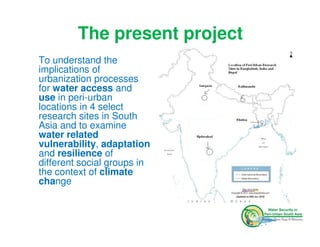
The present project
To understand the
implications of
urbanization processes
for water access and
use in peri-urban
locations in 4 select
research sites in South
Asia and to examine
water related
vulnerability, adaptation
and resilience of
different social groups in
the context of climate
change
Objectives
• Examine
  – changing water availability/ insecurity as a
    result of the interaction of urbanization and
    climate change for periurban residents
  – the adaptation of periurban residents to these
    changes and assess their cost-effectiveness
  – Institutional lacunae in addressing these
    concerns
  – Mobilize and bring together a wide range of
    stakeholders as a basis to intervene
Approach and methodology
• A diversity of approaches rooted both in
  the interpretive and positivist sciences
• Qualitative, participatory methodologies to
  involve residents as a basis for designing
  interventions for them
• Quantitative techniques and cost-benefit
  analyses for relevant interventions
• Stakeholder meetings to catalyse change
Water (in)Security in Khulna,
              Bangladesh
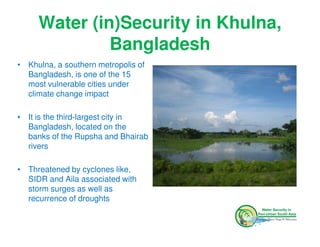
• Khulna, a southern metropolis of
  Bangladesh, is one of the 15
  most vulnerable cities under
  climate change impact

• It is the third-largest city in
  Bangladesh, located on the
  banks of the Rupsha and Bhairab
  rivers

• Threatened by cyclones like,
  SIDR and Aila associated with
  storm surges as well as
  recurrence of droughts
Water (in)Security in Khulna,
               Bangladesh
• Sea level rise, reduced upstream
  flow and prolonged dry weather
  are expected to drive up salinity -
  crisis for freshwater
• urban wastewater is getting
  diverted to peri-urban areas and
  surrounding rivers
• River floods increase salinity in
  drinking water sources
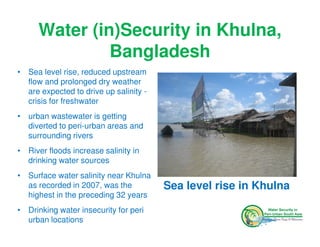
• Surface water salinity near Khulna
  as recorded in 2007, was the          Sea level rise in Khulna
  highest in the preceding 32 years
• Drinking water insecurity for peri
  urban locations
Water (in)Security in
                Hyderabad, India
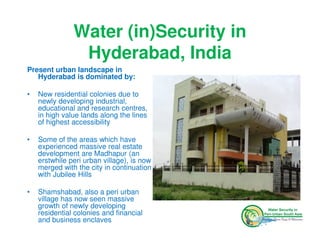
Present urban landscape in
   Hyderabad is dominated by:

•   New residential colonies due to
    newly developing industrial,
    educational and research centres,
    in high value lands along the lines
    of highest accessibility

•   Some of the areas which have
    experienced massive real estate
    development are Madhapur (an
    erstwhile peri urban village), is now
    merged with the city in continuation
    with Jubilee Hills

•   Shamshabad, also a peri urban
    village has now seen massive
    growth of newly developing
    residential colonies and financial
    and business enclaves
Water (in)Security in
           Hyderabad, India
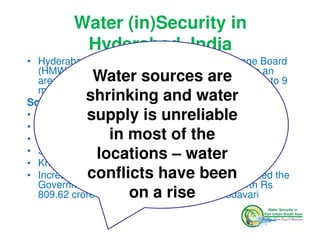
• Hyderabad Metropolitan Water Supply Sewerage Board
  (HMWSSB) constituted in 1989 to supply water to an
             Water sources are
  area of 172.6 sq. km for Hyderabad- supplies water to 9
  municipalities adjoining Hyderabad.
            shrinking and water
Sources of Water
            supply is unreliable
• Osman Sagar on Musi river
• Himayat Sagar on Esi river
               in most of the
• Manjira Barrage on Manjira river
• Singur Dam on Manjira river
             locations – water
• Krishna Drinking Water Scheme Phase I & II
            conflicts have been
• Increasing demand in Greater Hyderabad compelled the
  Government in 2009 to undertake a project worth Rs
                  on a rise
  809.62 crore for drawing water from the Godavari
Water (in)Security in Hyderabad,
             India
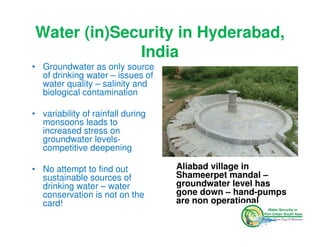
• Groundwater as only source
  of drinking water – issues of
  water quality – salinity and
  biological contamination

• variability of rainfall during
  monsoons leads to
  increased stress on
  groundwater levels-
  competitive deepening

• No attempt to find out           Aliabad village in
  sustainable sources of           Shameerpet mandal –
  drinking water – water           groundwater level has
  conservation is not on the       gone down – hand-pumps
  card!                            are non operational
Water (in)Security in Gurgaon,
               India
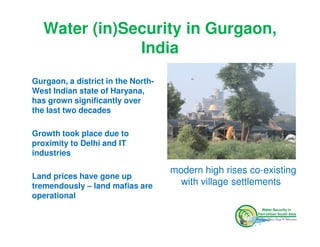
Gurgaon, a district in the North-
West Indian state of Haryana,
has grown significantly over
the last two decades

Growth took place due to
proximity to Delhi and IT
industries

                                    modern high rises co-existing
Land prices have gone up
tremendously – land mafias are        with village settlements
operational
Water (in)Security in
                Gurgaon, India
• Water table has been declining
  at a rate of about two meters (six
  feet) every year since 2006

• Poor aquifer to recharge due to
  erractic rainfall pattern coupled
  with the concrete structures

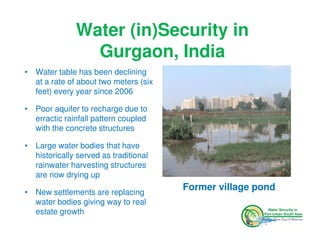
• Large water bodies that have
  historically served as traditional
  rainwater harvesting structures
  are now drying up

• New settlements are replacing
                                       Former village pond
  water bodies giving way to real
  estate growth
Water (in) security in peri-
         urban Kathmandu
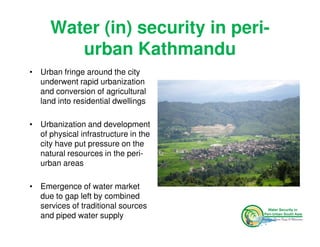
• Urban fringe around the city
  underwent rapid urbanization
  and conversion of agricultural
  land into residential dwellings

• Urbanization and development
  of physical infrastructure in the
  city have put pressure on the
  natural resources in the peri-
  urban areas

• Emergence of water market
  due to gap left by combined
  services of traditional sources
  and piped water supply
Water (in) security in peri-
            urban Kathmandu
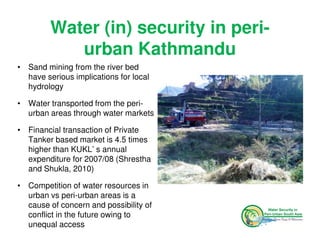
• Sand mining from the river bed
  have serious implications for local
  hydrology

• Water transported from the peri-
  urban areas through water markets

• Financial transaction of Private
  Tanker based market is 4.5 times
  higher than KUKL’ s annual
  expenditure for 2007/08 (Shrestha
  and Shukla, 2010)

• Competition of water resources in
  urban vs peri-urban areas is a
  cause of concern and possibility of
  conflict in the future owing to
  unequal access
Water (in)security in peri-urban
           South Asia
• Different levels of development and mis-management of
  water throws environmental stress for peri-urban
  residence

• Traditional water harvesting sources are engulfed by the
  ways cities are expanding or extracting resources of their
  neighborhoods

• Unsustainable development brings in water insecurity
  which is further aggravated by climate change

• All four locations have unique socio-economic and
  political context of development but are bound by the
  issue of water security issues for poor women and men
Thank you for your attention

Peri urban Project Introduction_Anjal Prakash and Vishal Narain

  • 1.
    Water security inperiurban South Asia Adapting to climate change and urbanization Inception Workshop August 16, 2010 Kathmandu
  • 2.
    What is periurban •peripheral areas around cities • urban fringe, urban outgrowth, urban agglomeration • as urbanization advances, periurban becomes more visible – The categorization of rural and urban becomes less relevant • bear the brunt of urban expansion – Supply land and water to the cities – Receive urban wastes
  • 3.
    Features of periurban •Changing and mixed land use – Driven by real estate boom – Multiple claimants over land • Social transition and heterogeneity • Periurban livelihoods across rural and urban resources and assets • Environmental and natural resource management issues • Institutional lacunae
  • 4.
    Implications for wateruse and access • Land acquisition changes water access • Land use change alters demand for water • Water sources filled up and acquired for urban purposes • Polluting industries relocated to peripheries • CPRs diverted for urban purposes: poor and landless suffer
  • 5.
    Implications for wateruse • Rural-urban water flows – Absence of a property rights structure • Urban-rural water flows – Sewage irrigation cheap but adverse health implications • Urban elite can afford costly water extraction technologies – Farm-houses • Conflicts escalating over scarce water in the absence of institutions across rural and urban jurisdictions
  • 6.
    Water (in) securityaggravated by climate change • Periurban residents lose water on account of urbanization and climate change – Fluctuations in water availability – Extreme events: drought/floods, glacial outbursts • Differ in their capacity to adapt to these changes • Vulnerability varies across class, caste and gender
  • 7.
    The present project Tounderstand the implications of urbanization processes for water access and use in peri-urban locations in 4 select research sites in South Asia and to examine water related vulnerability, adaptation and resilience of different social groups in the context of climate change
  • 8.
    Objectives • Examine – changing water availability/ insecurity as a result of the interaction of urbanization and climate change for periurban residents – the adaptation of periurban residents to these changes and assess their cost-effectiveness – Institutional lacunae in addressing these concerns – Mobilize and bring together a wide range of stakeholders as a basis to intervene
  • 9.
    Approach and methodology •A diversity of approaches rooted both in the interpretive and positivist sciences • Qualitative, participatory methodologies to involve residents as a basis for designing interventions for them • Quantitative techniques and cost-benefit analyses for relevant interventions • Stakeholder meetings to catalyse change
  • 10.
    Water (in)Security inKhulna, Bangladesh • Khulna, a southern metropolis of Bangladesh, is one of the 15 most vulnerable cities under climate change impact • It is the third-largest city in Bangladesh, located on the banks of the Rupsha and Bhairab rivers • Threatened by cyclones like, SIDR and Aila associated with storm surges as well as recurrence of droughts
  • 11.
    Water (in)Security inKhulna, Bangladesh • Sea level rise, reduced upstream flow and prolonged dry weather are expected to drive up salinity - crisis for freshwater • urban wastewater is getting diverted to peri-urban areas and surrounding rivers • River floods increase salinity in drinking water sources • Surface water salinity near Khulna as recorded in 2007, was the Sea level rise in Khulna highest in the preceding 32 years • Drinking water insecurity for peri urban locations
  • 12.
    Water (in)Security in Hyderabad, India Present urban landscape in Hyderabad is dominated by: • New residential colonies due to newly developing industrial, educational and research centres, in high value lands along the lines of highest accessibility • Some of the areas which have experienced massive real estate development are Madhapur (an erstwhile peri urban village), is now merged with the city in continuation with Jubilee Hills • Shamshabad, also a peri urban village has now seen massive growth of newly developing residential colonies and financial and business enclaves
  • 13.
    Water (in)Security in Hyderabad, India • Hyderabad Metropolitan Water Supply Sewerage Board (HMWSSB) constituted in 1989 to supply water to an Water sources are area of 172.6 sq. km for Hyderabad- supplies water to 9 municipalities adjoining Hyderabad. shrinking and water Sources of Water supply is unreliable • Osman Sagar on Musi river • Himayat Sagar on Esi river in most of the • Manjira Barrage on Manjira river • Singur Dam on Manjira river locations – water • Krishna Drinking Water Scheme Phase I & II conflicts have been • Increasing demand in Greater Hyderabad compelled the Government in 2009 to undertake a project worth Rs on a rise 809.62 crore for drawing water from the Godavari
  • 14.
    Water (in)Security inHyderabad, India • Groundwater as only source of drinking water – issues of water quality – salinity and biological contamination • variability of rainfall during monsoons leads to increased stress on groundwater levels- competitive deepening • No attempt to find out Aliabad village in sustainable sources of Shameerpet mandal – drinking water – water groundwater level has conservation is not on the gone down – hand-pumps card! are non operational
  • 15.
    Water (in)Security inGurgaon, India Gurgaon, a district in the North- West Indian state of Haryana, has grown significantly over the last two decades Growth took place due to proximity to Delhi and IT industries modern high rises co-existing Land prices have gone up tremendously – land mafias are with village settlements operational
  • 16.
    Water (in)Security in Gurgaon, India • Water table has been declining at a rate of about two meters (six feet) every year since 2006 • Poor aquifer to recharge due to erractic rainfall pattern coupled with the concrete structures • Large water bodies that have historically served as traditional rainwater harvesting structures are now drying up • New settlements are replacing Former village pond water bodies giving way to real estate growth
  • 17.
    Water (in) securityin peri- urban Kathmandu • Urban fringe around the city underwent rapid urbanization and conversion of agricultural land into residential dwellings • Urbanization and development of physical infrastructure in the city have put pressure on the natural resources in the peri- urban areas • Emergence of water market due to gap left by combined services of traditional sources and piped water supply
  • 18.
    Water (in) securityin peri- urban Kathmandu • Sand mining from the river bed have serious implications for local hydrology • Water transported from the peri- urban areas through water markets • Financial transaction of Private Tanker based market is 4.5 times higher than KUKL’ s annual expenditure for 2007/08 (Shrestha and Shukla, 2010) • Competition of water resources in urban vs peri-urban areas is a cause of concern and possibility of conflict in the future owing to unequal access
  • 19.
    Water (in)security inperi-urban South Asia • Different levels of development and mis-management of water throws environmental stress for peri-urban residence • Traditional water harvesting sources are engulfed by the ways cities are expanding or extracting resources of their neighborhoods • Unsustainable development brings in water insecurity which is further aggravated by climate change • All four locations have unique socio-economic and political context of development but are bound by the issue of water security issues for poor women and men
  • 20.
    Thank you foryour attention