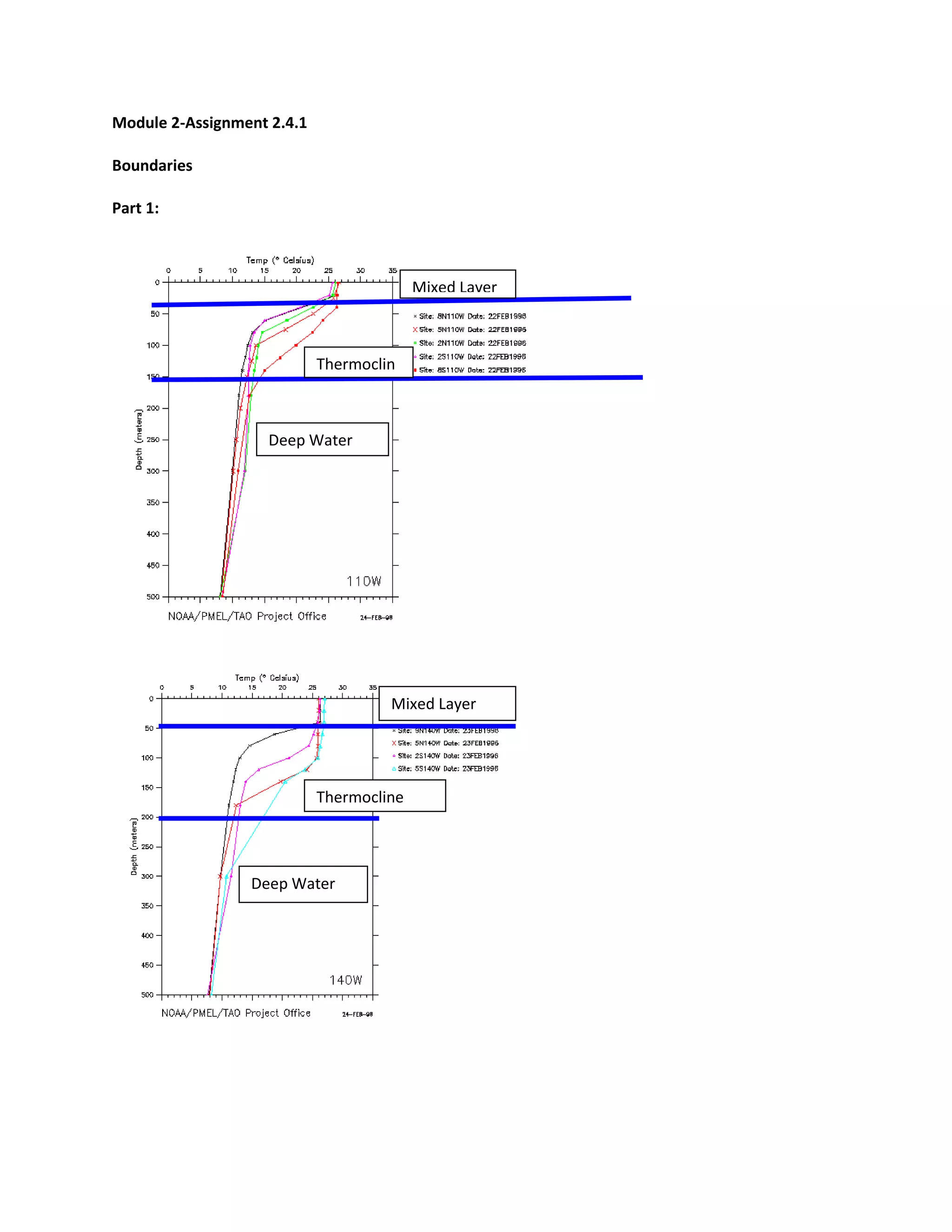
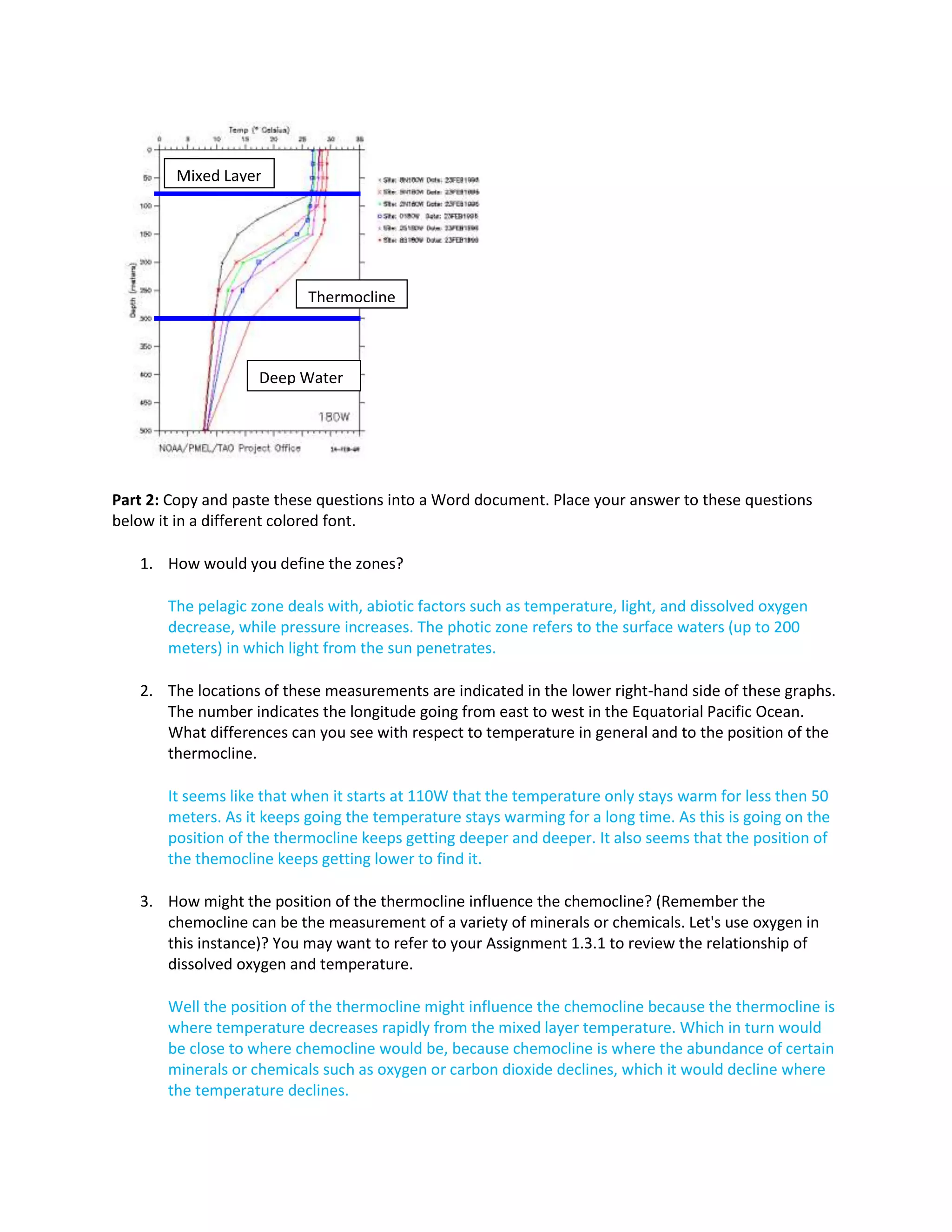
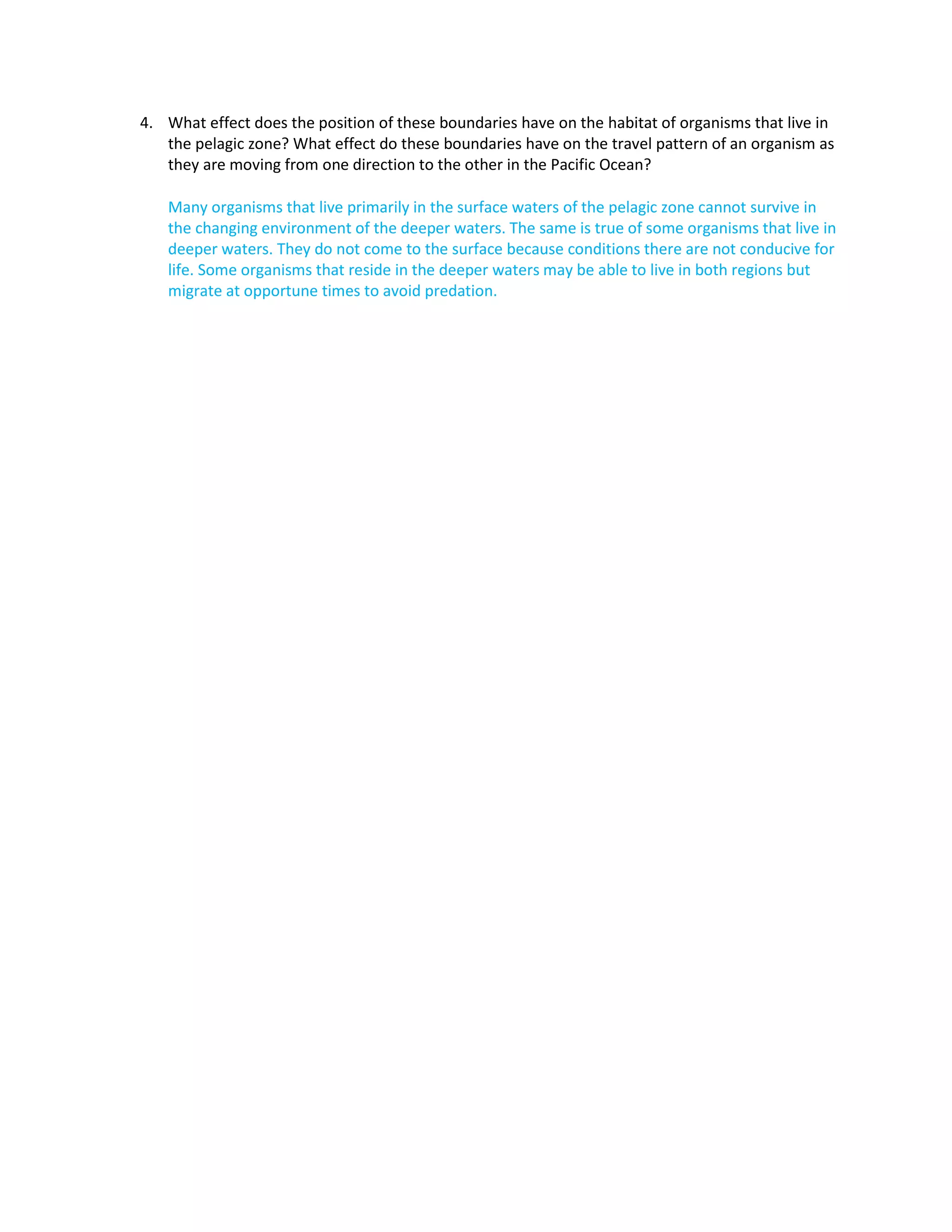
Module 2-Assignment 2.4.1<br />Boundaries <br />Part 1:<br />Deep WaterMixed LayerThermocline <br />Deep WaterThermoclineMixed Layer<br />ThermoclineDeep WaterMixed Layer<br />Part 2: Copy and paste these questions into a Word document. Place your answer to these questions below it in a different colored font.<br />How would you define the zones?<br />The pelagic zone deals with, abiotic factors such as temperature, light, and dissolved oxygen decrease, while pressure increases. The photic zone refers to the surface waters (up to 200 meters) in which light from the sun penetrates. <br />The locations of these measurements are indicated in the lower right-hand side of these graphs. The number indicates the longitude going from east to west in the Equatorial Pacific Ocean. What differences can you see with respect to temperature in general and to the position of the thermocline. <br />It seems like that when it starts at 110W that the temperature only stays warm for less then 50 meters. As it keeps going the temperature stays warming for a long time. As this is going on the position of the thermocline keeps getting deeper and deeper. It also seems that the position of the themocline keeps getting lower to find it. <br />How might the position of the thermocline influence the chemocline? (Remember the chemocline can be the measurement of a variety of minerals or chemicals. Let's use oxygen in this instance)? You may want to refer to your Assignment 1.3.1 to review the relationship of dissolved oxygen and temperature.<br />Well the position of the thermocline might influence the chemocline because the thermocline is where temperature decreases rapidly from the mixed layer temperature. Which in turn would be close to where chemocline would be, because chemocline is where the abundance of certain minerals or chemicals such as oxygen or carbon dioxide declines, which it would decline where the temperature declines. <br />What effect does the position of these boundaries have on the habitat of organisms that live in the pelagic zone? What effect do these boundaries have on the travel pattern of an organism as they are moving from one direction to the other in the Pacific Ocean?<br />Many organisms that live primarily in the surface waters of the pelagic zone cannot survive in the changing environment of the deeper waters. The same is true of some organisms that live in deeper waters. They do not come to the surface because conditions there are not conducive for life. Some organisms that reside in the deeper waters may be able to live in both regions but migrate at opportune times to avoid predation.<br />
Module 2 assignment 2.4.1

Module 2 assignment 2.4.1

  • 1.
    Module 2-Assignment 2.4.1<br/>Boundaries <br />Part 1:<br />Deep WaterMixed LayerThermocline <br />Deep WaterThermoclineMixed Layer<br />ThermoclineDeep WaterMixed Layer<br />Part 2: Copy and paste these questions into a Word document. Place your answer to these questions below it in a different colored font.<br />How would you define the zones?<br />The pelagic zone deals with, abiotic factors such as temperature, light, and dissolved oxygen decrease, while pressure increases. The photic zone refers to the surface waters (up to 200 meters) in which light from the sun penetrates. <br />The locations of these measurements are indicated in the lower right-hand side of these graphs. The number indicates the longitude going from east to west in the Equatorial Pacific Ocean. What differences can you see with respect to temperature in general and to the position of the thermocline. <br />It seems like that when it starts at 110W that the temperature only stays warm for less then 50 meters. As it keeps going the temperature stays warming for a long time. As this is going on the position of the thermocline keeps getting deeper and deeper. It also seems that the position of the themocline keeps getting lower to find it. <br />How might the position of the thermocline influence the chemocline? (Remember the chemocline can be the measurement of a variety of minerals or chemicals. Let's use oxygen in this instance)? You may want to refer to your Assignment 1.3.1 to review the relationship of dissolved oxygen and temperature.<br />Well the position of the thermocline might influence the chemocline because the thermocline is where temperature decreases rapidly from the mixed layer temperature. Which in turn would be close to where chemocline would be, because chemocline is where the abundance of certain minerals or chemicals such as oxygen or carbon dioxide declines, which it would decline where the temperature declines. <br />What effect does the position of these boundaries have on the habitat of organisms that live in the pelagic zone? What effect do these boundaries have on the travel pattern of an organism as they are moving from one direction to the other in the Pacific Ocean?<br />Many organisms that live primarily in the surface waters of the pelagic zone cannot survive in the changing environment of the deeper waters. The same is true of some organisms that live in deeper waters. They do not come to the surface because conditions there are not conducive for life. Some organisms that reside in the deeper waters may be able to live in both regions but migrate at opportune times to avoid predation.<br />