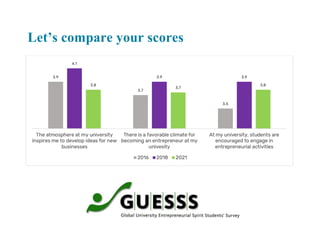
Some preliminary questionsfor you
Indicate your level of agreement on the two questions (on a 7-
points Likert scale, 1=not at all; 7=very much):
• The atmosphere at my university inspires me to develop ideas
for new businesses.
• At my university, students are encouraged to engage in
entrepreneurial activities.
Open discussion
• Whatshould UniTS (or your university) do for:
– Promoting/Diffusing a more favourable atmosphere for
entrepreneurship?
– Encouraging (more) students to engage (more) in
entrepreneurial activities?
What Is Entrepreneurship?
•Academic Definition (Stevenson and Jarillo)
– Entrepreneurship is the process by which individuals
pursue opportunities without regard to resources they
currently control.
• Alternative Definition (non academic)
– Entrepreneurship is the art of turning an idea into a
business.
• Explanation of What Entrepreneurs Do
– Entrepreneurs assemble and then integrate all the
resources needed – the money, the people, the business
model, the strategy – to transform an invention or an idea
into a viable business.
8.
Corporate Entrepreneurship (1of 2)
• Corporate Entrepreneurship
‒ Is the conceptualization of “entrepreneurship” at the
firm level.
‒ It is about encouraging through concrete initatives
employees to act «entrepreneurally»
‒ All firms fall along a conceptual continuum that ranges
from highly conservative to highly entrepreneurial.
‒ The position of a firm on this continuum is referred to
as its entrepreneurial intensity.
9.
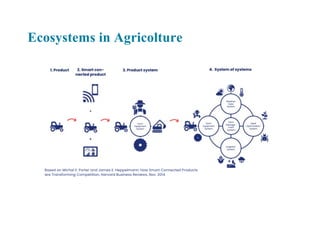
Ecosystems in Agricolture
1.Think about ARENAs, not INDUSTRIES. Innovate
in the same way
30
Based on Michal E. Porter and James E. Heppelmann: How Smart Connected Products
are Transforming Competition, Harvard Business Reviews, Nov. 2014
Corporate Entrepreneurship (2of 2)
Entrepreneurial Firms
• Proactive
• Innovative
• Risk taking
Conservative Firms
• Take a more “wait and see”
posture
• Less innovative
• Risk averse
12.
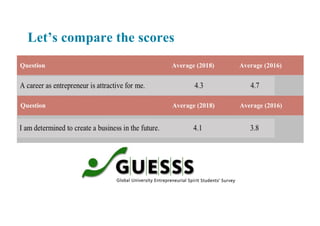
Some questions foryou
Indicate your level of agreement on the two questions below
on a 7-points Likert scale (1=not at all; 7=very much).
• A career as entrepreneur is attractive for me.
• I am determined to create a business in the future.
For the onesthat would like to become an
entrepreneur…
• Why would you like to do so?
15.
Why Become anEntrepreneur?
• The three primary reasons that people become
entrepreneurs and start their own firms.
– Desire to be their own boss: positive attitudes (long-
time ambition) or contextual negative perceptions
(frustration in the workplace) both account
– Desire to pursue their own ideas (especially when
not recognized in the workplace -> NEST and APPLE)
– Financial rewards: secondary and overestimated
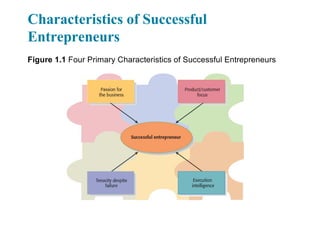
Characteristics of Successful
Entrepreneurs
•Passion for the Business
– Passion could come from a hobby or a cultural interest of the
founder
– But it can stem from the entrepreneur’s belief that the business
will positively influence people’s lives (especially for social
businesses)
Five primary Reasons why Passion is important
1. The ability to learn and iterate
2. A willingness to work hard for an extended period of time
3. Ability to overcome setbacks and “no’s”
4. The ability to listen to feedback on the limitations of your organization
and yourself
5. Perseverance and persistence when the going gets tough
18.
Characteristics of Successful
Entrepreneurs
•Product/Customer Focus
– Products and customers: two most important elements in
any business
– Product/customer focus is not just “product” focus!
It’s the ability to walk in the shoes of customers
– This is one of the main difficulty for wannabe entrepreneurs
– Spot product opportunities and see them through to
competition
19.
Characteristics of Successful
Entrepreneurs
•Tenacity Despite Failure
– Failure rates are naturally high in new ventures
– Successful entrepreneurs are able (and resilient
enough) to persevere through setbacks and failures
– Tenacity to overcome personal and professional
obstacles
20.
Characteristics of Successful
Entrepreneurs
•Execution Intelligence
– The ability to fashion a solid business idea into a
viable business model is a key characteristic of
successful entrepreneurs (commercial attitude helps
here)
– A related ability is to modify the business model
according to the changes occurring in the environment
– “Ideas are easy. It’s execution that’s hard” (Jeff Bezos,
founder of Amazon).
21.
Start-Up Incubators andAccelerators
• A smart way of gaining access to mentors, partners,
investors, and other critical Start-Up resources
– Incubators: organizations that provides start-ups with
shared operating space and services
– Accelerators: for-profit organizations that offer a small
amount of seed founding in exchange for small equity
positions in the companies that participate in their
programs.
– The greatest advantage: the mentorship opportunities
they provide.
22.
Common Myths AboutEntrepreneurs (1 of 7)
• Myth 1: Entrepreneurs Are Born, Not Made
– This myth is based on the mistaken belief that some
people are genetically predisposed to be
entrepreneurs.
– Psychological and sociological studies do not support
this myth.
– Whether someone does or doesn’t become an
entrepreneur is a function of the environment, life
experiences, and personal choices.
23.
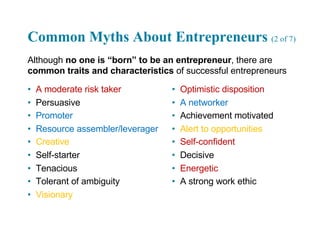
Common Myths AboutEntrepreneurs (2 of 7)
Although no one is “born” to be an entrepreneur, there are
common traits and characteristics of successful entrepreneurs
• A moderate risk taker
• Persuasive
• Promoter
• Resource assembler/leverager
• Creative
• Self-starter
• Tenacious
• Tolerant of ambiguity
• Visionary
• Optimistic disposition
• A networker
• Achievement motivated
• Alert to opportunities
• Self-confident
• Decisive
• Energetic
• A strong work ethic
24.
Common Myths AboutEntrepreneurs (3 of 7)
• Myth 2: Entrepreneurs Are Gamblers
– Scientific evidence does not support such myth.
– On the contrary, most entrepreneurs are just “moderate”
risk takers.
– The idea that entrepreneurs are gamblers originates from
two sources:
▪ Entrepreneurs typically have jobs that are less
structured, and so they face a more uncertain set of
possibilities than people in traditional jobs.
▪ Many entrepreneurs have a strong need to achieve and
set challenging goals, a behavior that is often equated
with risk taking.
25.
Common Myths AboutEntrepreneurs (4 of 7)
• Myth 3: Entrepreneurs Are Motivated Primarily by Money
– While it is naïve to think that entrepreneurs don’t seek
financial rewards, money is rarely the reason
entrepreneurs start new firms.
– In fact, some entrepreneurs warn that the pursuit of money
can be distracting.
26.
Common Myths AboutEntrepreneurs (5 of 7)
• Myth 4: Entrepreneurs Should Be Young and Energetic
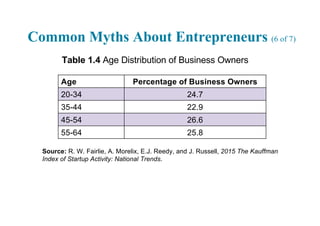
– Entrepreneurial activity is fairly evenly spread out over
age ranges.
– While it is important to be energetic, investors often cite
the strength of the entrepreneur as their most important
criterion in making investment decisions.
▪ What makes an entrepreneur “strong” in the eyes of
an investor is industry experience, maturity and
realism, reputation, and, of course, a track record of
success.
▪ These criteria favor older rather than younger
entrepreneurs.
27.
Common Myths AboutEntrepreneurs (6 of 7)
Table 1.4 Age Distribution of Business Owners
Age Percentage of Business Owners
20-34 24.7
35-44 22.9
45-54 26.6
55-64 25.8
Source: R. W. Fairlie, A. Morelix, E.J. Reedy, and J. Russell, 2015 The Kauffman
Index of Startup Activity: National Trends.
28.
Common Myths AboutEntrepreneurs (7 of 7)
• Myth 5: Entrepreneurs Love the Spotlight
– The vast majority of entrepreneurs do not attract
public attention.
– As evidence of this, consider the following question:
“How many entrepreneurs could you name?”
▪ Most of us could come up with Jeff Bezos of
Amazon.com, Mark Zuckerberg of Facebook, Larry
Page and Sergey Brin of Google or Elon Musk of
Tesla.
▪ But few could name the founders of many other
businesses including Netflix and YouTube even
though we frequently use those firms’ services.
29.
Microfoundations of Entrepreneurship
•The aim of microfoundations
– The principal aim of the research on microfoundations
is understand how individual-level factors impact
organizations.
– To anchor higher-level concepts like strategies,
capabilities, routines on lower levels (Felin et al.,
2015).
– When analysed under the lights of the
microfoundation theory, the success of initiatives
carried out by the organisations (or start-up) are traced
back to the individual’s (and entrepreneur) attitudes,
mindsets and values that trigger and shape his/her
behavior at the workplace.
30.
Microfoundations of Entrepreneurship
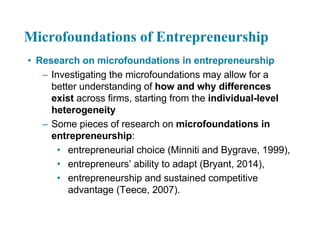
•Research on microfoundations in entrepreneurship
– Investigating the microfoundations may allow for a
better understanding of how and why differences
exist across firms, starting from the individual-level
heterogeneity
– Some pieces of research on microfoundations in
entrepreneurship:
• entrepreneurial choice (Minniti and Bygrave, 1999),
• entrepreneurs’ ability to adapt (Bryant, 2014),
• entrepreneurship and sustained competitive
advantage (Teece, 2007).
31.
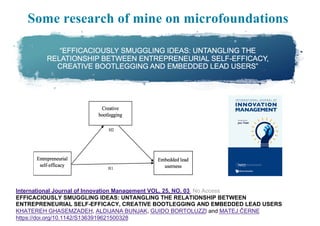
Some research ofmine on microfoundations
International Journal of Innovation Management VOL. 25, NO. 03 No Access
EFFICACIOUSLY SMUGGLING IDEAS: UNTANGLING THE RELATIONSHIP BETWEEN
ENTREPRENEURIAL SELF-EFFICACY, CREATIVE BOOTLEGGING AND EMBEDDED LEAD USERS
KHATEREH GHASEMZADEH, ALDIJANA BUNJAK, GUIDO BORTOLUZZI and MATEJ ČERNE
https://doi.org/10.1142/S1363919621500328
32.
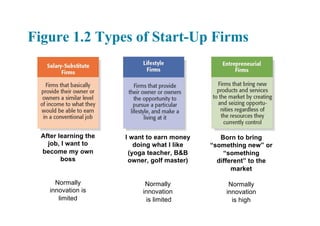
Figure 1.2 Typesof Start-Up Firms
After learning the
job, I want to
become my own
boss
Normally
innovation is
limited
I want to earn money
doing what I like
(yoga teacher, B&B
owner, golf master)
Normally
innovation
is limited
Born to bring
“something new” or
“something
different” to the
market
Normally
innovation
is high
33.
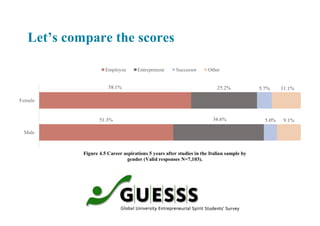
A question foryou: How do you see yourself
after 5 years to graduation?
• An entrepreneur/consultant (working by your own)
• A manager/employee (in a multinational firm)
• A manager/employee (in a small to medium firm)
• A successor in the business run by my family
• Other
Changing Demographics
of Entrepreneurs(1 of 4)
• Women Entrepreneurs
– While men are more likely to start businesses than
women, the number of women-owned businesses is
increasing.
– Over the past nine years, the number of women-owned
businesses has grown at a rate five times faster than
the national average in the U.S.
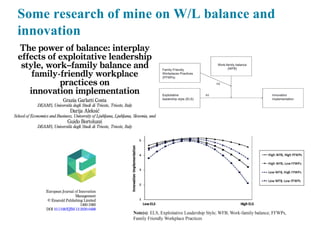
– Work-life balance? After COVID19 no more a big
challenge!
Changing Demographics
of Entrepreneurs(2 of 4)
• Minority Entrepreneurs
– There has been a substantial increase in minority
entrepreneurs in the United States and worldwide.
– According to recent estimates, there has been a 38
percent increase since 2007 in the US.
– An important factor facilitating the growth of minority
entrepreneurs is the number of organizations that
promote and provide assistance.
38.
Changing Demographics
of Entrepreneurs(3 of 4)
• Senior Entrepreneurs
– The numbers of seniors starting businesses is
substantial and growing.
– Many people in the 60 and older age range have
substantial business experience, financial
resources, and excellent vigor and health.
This makes them excellent candidates to start
businesses in many industries.
39.
Changing Demographics
of Entrepreneurs(4 of 4)
• Millennial Entrepreneurs
– A desire to pursue an entrepreneurial career is high
among millennials.
– Despite this desire, in 2013 only 3.6 percent of all
businesses in the United States were owned by
someone under the age of 30.
– The biggest obstacles preventing millennials from
starting businesses are:
– lack of finances,
– lack of desire,
– fear of failure,
– lack of knowledge of the business start-up
process.
40.
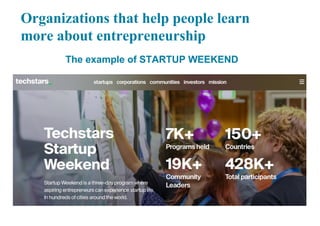
Organizations that helppeople learn
more about entrepreneurship
The example of STARTUP WEEKEND
41.
The positive effectsof entrepreneurship and
entrepreneurial firms
• Creative destruction
– The theory of Economic Development (Schumpeter, 1934)
– Entrepreneurship’s importance to an economy and the
society
– Creative Destruction: Entrepreneurs develop new
products and technologies that over time make current
products and technologies obsolete.
– This process is initiated most effectively by start-up
ventures that improve on what is currently available
– “Innovators” or “agents of change”
42.
Economic Impact ofEntrepreneurial Firms
• Innovation
– Small innovative firms are more productive than larger
innovative firms in terms of patents per employee.
• Job Creation
– Small businesses create a substantial number of net
new jobs in the World.
– (but big companies are the ones that matter the most in
terms of total employment…)
43.
Entrepreneurial Firms’ Impacton Society
and Larger Firms
• Impact on Society
– The innovations of entrepreneurial firms have a
dramatic impact on society, such as new products and
services that make lives easier, enhance productivity
at work, improve health, and entertain.
• Impact on Larger Firms
– Many entrepreneurial firms have built their entire
business models around producing products and
services that help larger firms become more efficient
and effective.
– Entrepreneurial firms are sometimes founded to
respond to larger firms’ needs.
44.
Group work: thestart-upper identikit
• Starting from this first block of slides identify a set of questions to be made to our
guests start-uppers (in group) in order to understand their fit with the “Four Primary
Characteristics of Successful Entrepreneurs” model
• After selecting the best questions, (all together) we will prepare a draft of the survey
and use it to interview the startuppers during the course