The Essential
Elements of
PYPGroup 4
Bisma, Jabin, Ashfaq, Ayesha, Nighat
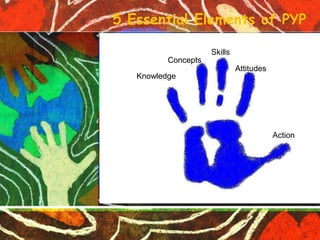
Knowledge
Skills
Action
Attitudes
Concepts
5 Essential Elements of PYP
Knowledge
What do we want students to know about?
• Students explore knowledge which is of genuine
importance in understanding the human condition and
has significance for all students of all cultures.
• Engaging and challenging, and the potential to actively
involve students in their own learning.
• All-inclusive understanding of ideas, not restricted to
traditional subject areas.
• Acquiring a set of skills in context and exploring
content which transcends the boundaries of the
traditional subjects.
• The driving question should be “What is really worth
knowing that allows students’ understanding of the
transdisciplinary themes to develop and evolve?”
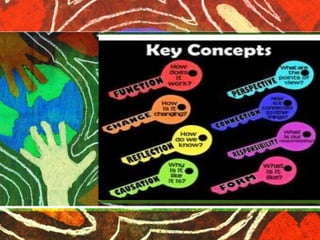
Concepts
What do we want students to understand?
•Concept-driven curriculum is a means of supporting the
inquiry that promotes meaning and understanding.
•Concepts force thinking to a higher level as students
consider "transferable ideas from questions".
• The concepts form a research tool that is manageable,
open-ended and more readily accessible to students.
•Concepts provide a structure for the exploration of
significant and authentic content underpinning student
inquiries throughout the planned and unplanned
curriculum.
• Concepts also act as the foundation on which students
build up their knowledge and get skills that then result in
the development of attitudes and actions.
Attitudes
What do we want students to feel, value and
demonstrate?
•Vital focus in the development of positive attitudes
towards people, the environment and learning.
•Attitudes are meant to be an explicit part of daily
learning.
•Teachers need to be a role model both within and outside
the class to encourage students to reflect and develop
their own set of values.
•Focus on developing the following attitudes:
Appreciation Commitment
Confidence Cooperation
Creativity Curiosity
Empathy Enthusiasm
Independence Integrity
Respect Tolerance
Skills
What do we want students to be able to do?
•Acquiring and applying a range of skills is very important
in constructing meaning of
knowledge, concepts, attitudes and actions.
•Skills is a goal of students learning.
• PYP suggest best skills for students.
• In PYP program Students are able to reflect Thinking
skills, Social skills, Communication skill. Self management
skills and Research skills.
•These skills are helpful for students to achieve PYP
learning goals and are also helpful for teachers to assess
the learning of students.
•Acquiring these skills help the learners to become life long
learners.
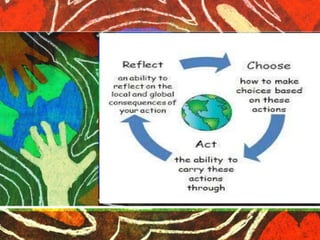
Action
What do we want students to act?
•' Action is what is being practically done to make life
better and connect ones understanding with the rest of the
world after acquiring knowledge, concepts and skills due
to a positive attitude towards learning.
• Learners should be given the opportunity to choose, act
and reflect .This way they will be able to analyze their own
actions and make a difference in themselves as well as the
people around them.
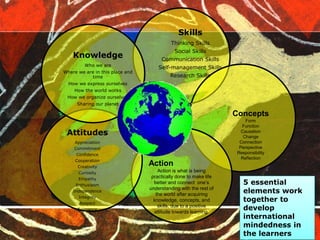
Skills
Thinking Skills
Social Skills
Communication Skills
Self-management Skills
Research Skills
Attitudes
Appreciation
Commitment
Confidence
Cooperation
Creativity
Curiosity
Empathy
Enthusiasm
Independence
Integrity
Respect
Tolerance
Knowledge
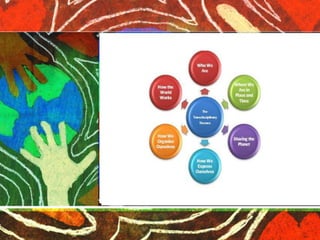
Who we are
Where we are in this place and
time
How we express ourselves
How the world works
How we organize ourselves
Sharing our planet
Concepts
Form
Function
Causation
Change
Connection
Perspective
Responsibility
Reflection
Action
Action is what is being
practically done to make life
better and connect one’s
understanding with the rest of
the world after acquiring
knowledge, concepts, and
skills, due to a positive
attitude towards learning.
5 essential
elements work
together to
develop
international
mindedness in
the learners

Module 2 Activity 2 Part 2

  • 1.
    The Essential Elements of PYPGroup4 Bisma, Jabin, Ashfaq, Ayesha, Nighat
  • 2.
  • 3.
    Knowledge What do wewant students to know about? • Students explore knowledge which is of genuine importance in understanding the human condition and has significance for all students of all cultures. • Engaging and challenging, and the potential to actively involve students in their own learning. • All-inclusive understanding of ideas, not restricted to traditional subject areas. • Acquiring a set of skills in context and exploring content which transcends the boundaries of the traditional subjects. • The driving question should be “What is really worth knowing that allows students’ understanding of the transdisciplinary themes to develop and evolve?”
  • 5.
    Concepts What do wewant students to understand? •Concept-driven curriculum is a means of supporting the inquiry that promotes meaning and understanding. •Concepts force thinking to a higher level as students consider "transferable ideas from questions". • The concepts form a research tool that is manageable, open-ended and more readily accessible to students. •Concepts provide a structure for the exploration of significant and authentic content underpinning student inquiries throughout the planned and unplanned curriculum. • Concepts also act as the foundation on which students build up their knowledge and get skills that then result in the development of attitudes and actions.
  • 7.
    Attitudes What do wewant students to feel, value and demonstrate? •Vital focus in the development of positive attitudes towards people, the environment and learning. •Attitudes are meant to be an explicit part of daily learning. •Teachers need to be a role model both within and outside the class to encourage students to reflect and develop their own set of values. •Focus on developing the following attitudes: Appreciation Commitment Confidence Cooperation Creativity Curiosity Empathy Enthusiasm Independence Integrity Respect Tolerance
  • 8.
    Skills What do wewant students to be able to do? •Acquiring and applying a range of skills is very important in constructing meaning of knowledge, concepts, attitudes and actions. •Skills is a goal of students learning. • PYP suggest best skills for students. • In PYP program Students are able to reflect Thinking skills, Social skills, Communication skill. Self management skills and Research skills. •These skills are helpful for students to achieve PYP learning goals and are also helpful for teachers to assess the learning of students. •Acquiring these skills help the learners to become life long learners.
  • 9.
    Action What do wewant students to act? •' Action is what is being practically done to make life better and connect ones understanding with the rest of the world after acquiring knowledge, concepts and skills due to a positive attitude towards learning. • Learners should be given the opportunity to choose, act and reflect .This way they will be able to analyze their own actions and make a difference in themselves as well as the people around them.
  • 11.
    Skills Thinking Skills Social Skills CommunicationSkills Self-management Skills Research Skills Attitudes Appreciation Commitment Confidence Cooperation Creativity Curiosity Empathy Enthusiasm Independence Integrity Respect Tolerance Knowledge Who we are Where we are in this place and time How we express ourselves How the world works How we organize ourselves Sharing our planet Concepts Form Function Causation Change Connection Perspective Responsibility Reflection Action Action is what is being practically done to make life better and connect one’s understanding with the rest of the world after acquiring knowledge, concepts, and skills, due to a positive attitude towards learning. 5 essential elements work together to develop international mindedness in the learners