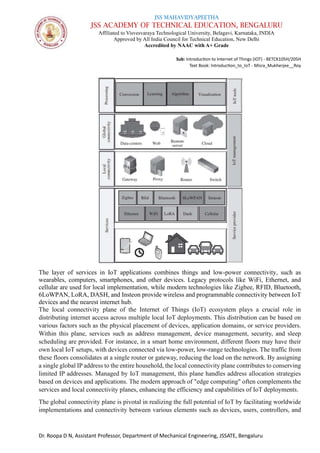
JSS MAHAVIDYAPEETHA
JSS ACADEMY OF TECHNICAL EDUCATION, BENGALURU
Affiliated to Visvesvaraya Technological University, Belagavi, Karnataka, INDIA
Approved by All India Council for Technical Education, New Delhi
Accredited by NAAC with A+ Grade
Sub: Introduction to Internet of Things (IOT) - BETCK105H/205H
Text Book: Introduction_to_IoT - Misra_Mukherjee__Roy
Dr. Roopa D N, Assistant Professor, Department of Mechanical Engineering, JSSATE, Bengaluru
Module 1
Basics of Networking: Introduction, Network Types, Layered network models Emergence of IoT:
Introduction, Evolution of IoT, Enabling IoT and the Complex Interdependence of Technologies, IoT
Networking Components
Textbook 1: Chapter 1- 1.1 to 1.3 Chapter 4 – 4.1 to 4.4
Most Important Questions for the module:
(i) Differentiate between point-to-point and point-to-multipoint connection types.
(ii) Discuss the pros and cons of the following network topologies: (a) Star (b) Ring (c) Bus
(d) Mesh
(iii) How are PANs different from LANs?
(iv) How are MANs different from WANs?
(v) What is the ISO-OSI model?
(vi) Discuss the highlights of the seven layers of the OSI stack. (vii) What is the Internet
protocol suite?
(vii) How is the Internet protocol suite different from the ISO-OSI model?
(viii) Evolution of IoT and explain each technological development.
(ix) Differentiate between IoT and M2M, IoT and CPS, IoT and WoT.
(x) Explain various technological interdependencies of IoT with other domains and networking
paradigms.
(xi) Explain various IoT enabling technologies
(xii) Explain IoT networking components.
Basics of networking
Introduction
• Everything we do, from farming to military missions, depends a lot on information.
• The quality of information depends on the variety and strength of the data behind it.
• How quickly and effectively we share data with our team determines our advantage over others.
• In today's global operations, fast and relevant information is crucial for staying ahead.
• Data and networking are super important because they let us get information instantly from
anywhere in the world.
What is networking?
• Networking links computers and communication devices through a network like the Internet
or Intranet.
• Each device has a unique identifier, like IP addresses and MAC addresses.
JSS MAHAVIDYAPEETHA
JSS ACADEMY OF TECHNICAL EDUCATION, BENGALURU
Affiliated to Visvesvaraya Technological University, Belagavi, Karnataka, INDIA
Approved by All India Council for Technical Education, New Delhi
Accredited by NAAC with A+ Grade
Sub: Introduction to Internet of Things (IOT) - BETCK105H/205H
Text Book: Introduction_to_IoT - Misra_Mukherjee__Roy
Dr. Roopa D N, Assistant Professor, Department of Mechanical Engineering, JSSATE, Bengaluru
• Hosts can be connected by a single path or multiple paths for data exchange.
• Data transferred between hosts can be text, images, or videos.
• Information is usually in binary bit streams, which are sequences of 0s and 1s.
Think???
The data generated from a camera sensor tells us more about the scene compared to the data generated
from a proximity sensor (which detects only the presence of the object in its sensing range)!!!!
The simultaneous data generated from multiple cameras focusing on the same spot from various angles
tell us even more about the object (or scene) than a single camera focussed at that scene!!!!
Network Types
• Computer networks are categorized based on:
❖ Type of connection
❖ Physical topology
❖ Reach of the network
• These classifications help determine the needs of a network setup.
• They also guide in choosing the right type of network for a specific setup.
Network types based on type of connection (Connection types)
Computer networks can be classified into two types based on how hosts communicate:
i) Point-to-point and
ii) Point-to-multipoint.
i) Point-to-point: Direct connections between two hosts.
❖ Examples include remote controls for appliances like air conditioners or TVs.
❖ These connections have the entire channel dedicated to them.
❖ These networks commonly used over duplex links and suitable for synchronous and
asynchronous systems.
❖ Found in specialized applications such as optical networks.
JSS MAHAVIDYAPEETHA
JSS ACADEMY OF TECHNICAL EDUCATION, BENGALURU
Affiliated to Visvesvaraya Technological University, Belagavi, Karnataka, INDIA
Approved by All India Council for Technical Education, New Delhi
Accredited by NAAC with A+ Grade
Sub: Introduction to Internet of Things (IOT) - BETCK105H/205H
Text Book: Introduction_to_IoT - Misra_Mukherjee__Roy
Dr. Roopa D N, Assistant Professor, Department of Mechanical Engineering, JSSATE, Bengaluru
ii) Point-to-Multipoint Connection:
❖ Multiple hosts share the same link.
❖ It is Similar to one-to-many connections, where one sender communicates with many receivers.
❖ Its commonly employed in wireless networks (like Wi-Fi) and IP telephony for efficient
communication with multiple devices.
❖ The channel is shared between hosts spatially or temporally.
o Spatial sharing: Frequency Division Multiple Access (FDMA).
o Temporal sharing: Time Division Multiple Access (TDMA).
❖ Various schemes and protocols ensure smooth channel sharing in point-to-multipoint networks.
❖ Its popular because, widely used in modern networks, particularly for connecting numerous
devices, like in smart cities and IoT applications.
Network types based on physical topology
In the context of computer networks and telecommunications, topology refers to the physical
arrangement or layout of interconnected devices and communication paths. It encompasses how
devices are connected to each other and the overall structure of the network.
Computer networks can have the following four broad topologies—Star, Mesh, Bus, and Ring.
JSS MAHAVIDYAPEETHA
JSS ACADEMY OF TECHNICAL EDUCATION, BENGALURU
Affiliated to Visvesvaraya Technological University, Belagavi, Karnataka, INDIA
Approved by All India Council for Technical Education, New Delhi
Accredited by NAAC with A+ Grade
Sub: Introduction to Internet of Things (IOT) - BETCK105H/205H
Text Book: Introduction_to_IoT - Misra_Mukherjee__Roy
Dr. Roopa D N, Assistant Professor, Department of Mechanical Engineering, JSSATE, Bengaluru
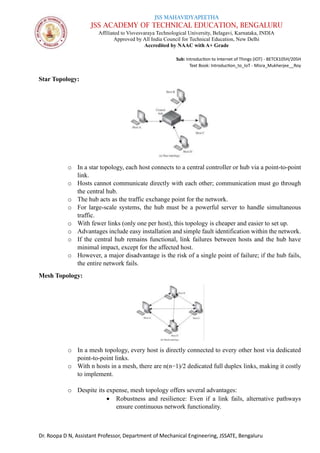
Star Topology:
o In a star topology, each host connects to a central controller or hub via a point-to-point
link.
o Hosts cannot communicate directly with each other; communication must go through
the central hub.
o The hub acts as the traffic exchange point for the network.
o For large-scale systems, the hub must be a powerful server to handle simultaneous
traffic.
o With fewer links (only one per host), this topology is cheaper and easier to set up.
o Advantages include easy installation and simple fault identification within the network.
o If the central hub remains functional, link failures between hosts and the hub have
minimal impact, except for the affected host.
o However, a major disadvantage is the risk of a single point of failure; if the hub fails,
the entire network fails.
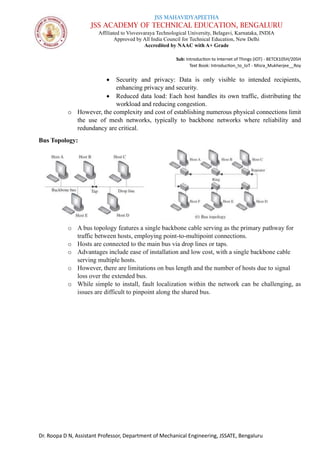
Mesh Topology:
o In a mesh topology, every host is directly connected to every other host via dedicated
point-to-point links.
o With n hosts in a mesh, there are n(n−1)/2 dedicated full duplex links, making it costly
to implement.
o Despite its expense, mesh topology offers several advantages:
• Robustness and resilience: Even if a link fails, alternative pathways
ensure continuous network functionality.
JSS MAHAVIDYAPEETHA
JSS ACADEMY OF TECHNICAL EDUCATION, BENGALURU
Affiliated to Visvesvaraya Technological University, Belagavi, Karnataka, INDIA
Approved by All India Council for Technical Education, New Delhi
Accredited by NAAC with A+ Grade
Sub: Introduction to Internet of Things (IOT) - BETCK105H/205H
Text Book: Introduction_to_IoT - Misra_Mukherjee__Roy
Dr. Roopa D N, Assistant Professor, Department of Mechanical Engineering, JSSATE, Bengaluru
• Security and privacy: Data is only visible to intended recipients,
enhancing privacy and security.
• Reduced data load: Each host handles its own traffic, distributing the
workload and reducing congestion.
o However, the complexity and cost of establishing numerous physical connections limit
the use of mesh networks, typically to backbone networks where reliability and
redundancy are critical.
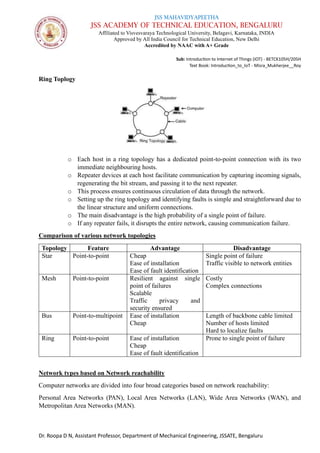
Bus Topology:
o A bus topology features a single backbone cable serving as the primary pathway for
traffic between hosts, employing point-to-multipoint connections.
o Hosts are connected to the main bus via drop lines or taps.
o Advantages include ease of installation and low cost, with a single backbone cable
serving multiple hosts.
o However, there are limitations on bus length and the number of hosts due to signal
loss over the extended bus.
o While simple to install, fault localization within the network can be challenging, as
issues are difficult to pinpoint along the shared bus.
JSS MAHAVIDYAPEETHA
JSS ACADEMY OF TECHNICAL EDUCATION, BENGALURU
Affiliated to Visvesvaraya Technological University, Belagavi, Karnataka, INDIA
Approved by All India Council for Technical Education, New Delhi
Accredited by NAAC with A+ Grade
Sub: Introduction to Internet of Things (IOT) - BETCK105H/205H
Text Book: Introduction_to_IoT - Misra_Mukherjee__Roy
Dr. Roopa D N, Assistant Professor, Department of Mechanical Engineering, JSSATE, Bengaluru
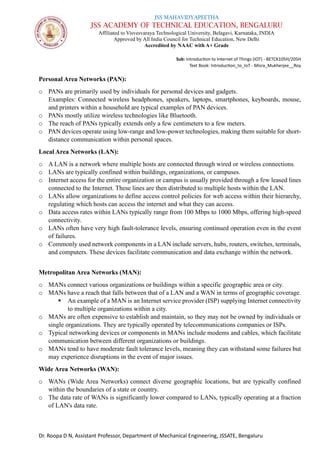
Ring Toplogy
o Each host in a ring topology has a dedicated point-to-point connection with its two
immediate neighbouring hosts.
o Repeater devices at each host facilitate communication by capturing incoming signals,
regenerating the bit stream, and passing it to the next repeater.
o This process ensures continuous circulation of data through the network.
o Setting up the ring topology and identifying faults is simple and straightforward due to
the linear structure and uniform connections.
o The main disadvantage is the high probability of a single point of failure.
o If any repeater fails, it disrupts the entire network, causing communication failure.
Comparison of various network topologies
Topology Feature Advantage Disadvantage
Star Point-to-point Cheap
Ease of installation
Ease of fault identification
Single point of failure
Traffic visible to network entities
Mesh Point-to-point Resilient against single
point of failures
Scalable
Traffic privacy and
security ensured
Costly
Complex connections
Bus Point-to-multipoint Ease of installation
Cheap
Length of backbone cable limited
Number of hosts limited
Hard to localize faults
Ring Point-to-point Ease of installation
Cheap
Ease of fault identification
Prone to single point of failure
Network types based on Network reachability
Computer networks are divided into four broad categories based on network reachability:
Personal Area Networks (PAN), Local Area Networks (LAN), Wide Area Networks (WAN), and
Metropolitan Area Networks (MAN).
JSS MAHAVIDYAPEETHA
JSS ACADEMY OF TECHNICAL EDUCATION, BENGALURU
Affiliated to Visvesvaraya Technological University, Belagavi, Karnataka, INDIA
Approved by All India Council for Technical Education, New Delhi
Accredited by NAAC with A+ Grade
Sub: Introduction to Internet of Things (IOT) - BETCK105H/205H
Text Book: Introduction_to_IoT - Misra_Mukherjee__Roy
Dr. Roopa D N, Assistant Professor, Department of Mechanical Engineering, JSSATE, Bengaluru
Personal Area Networks (PAN):
o PANs are primarily used by individuals for personal devices and gadgets.
Examples: Connected wireless headphones, speakers, laptops, smartphones, keyboards, mouse,
and printers within a household are typical examples of PAN devices.
o PANs mostly utilize wireless technologies like Bluetooth.
o The reach of PANs typically extends only a few centimeters to a few meters.
o PAN devices operate using low-range and low-power technologies, making them suitable for short-
distance communication within personal spaces.
Local Area Networks (LAN):
o A LAN is a network where multiple hosts are connected through wired or wireless connections.
o LANs are typically confined within buildings, organizations, or campuses.
o Internet access for the entire organization or campus is usually provided through a few leased lines
connected to the Internet. These lines are then distributed to multiple hosts within the LAN.
o LANs allow organizations to define access control policies for web access within their hierarchy,
regulating which hosts can access the internet and what they can access.
o Data access rates within LANs typically range from 100 Mbps to 1000 Mbps, offering high-speed
connectivity.
o LANs often have very high fault-tolerance levels, ensuring continued operation even in the event
of failures.
o Commonly used network components in a LAN include servers, hubs, routers, switches, terminals,
and computers. These devices facilitate communication and data exchange within the network.
Metropolitan Area Networks (MAN):
o MANs connect various organizations or buildings within a specific geographic area or city.
o MANs have a reach that falls between that of a LAN and a WAN in terms of geographic coverage.
▪ An example of a MAN is an Internet service provider (ISP) supplying Internet connectivity
to multiple organizations within a city.
o MANs are often expensive to establish and maintain, so they may not be owned by individuals or
single organizations. They are typically operated by telecommunications companies or ISPs.
o Typical networking devices or components in MANs include modems and cables, which facilitate
communication between different organizations or buildings.
o MANs tend to have moderate fault tolerance levels, meaning they can withstand some failures but
may experience disruptions in the event of major issues.
Wide Area Networks (WAN):
o WANs (Wide Area Networks) connect diverse geographic locations, but are typically confined
within the boundaries of a state or country.
o The data rate of WANs is significantly lower compared to LANs, typically operating at a fraction
of LAN's data rate.
JSS MAHAVIDYAPEETHA
JSS ACADEMY OF TECHNICAL EDUCATION, BENGALURU
Affiliated to Visvesvaraya Technological University, Belagavi, Karnataka, INDIA
Approved by All India Council for Technical Education, New Delhi
Accredited by NAAC with A+ Grade
Sub: Introduction to Internet of Things (IOT) - BETCK105H/205H
Text Book: Introduction_to_IoT - Misra_Mukherjee__Roy
Dr. Roopa D N, Assistant Professor, Department of Mechanical Engineering, JSSATE, Bengaluru
o WANs connecting two LANs or MANs may utilize public switched telephone networks (PSTNs)
or satellite-based links for communication.
o Due to the long transmission ranges, WANs are prone to more errors and noise during transmission
compared to LANs or MANs.
o WANs are very costly to establish and maintain due to their extensive coverage area and
infrastructure requirements.
o Generally, WANs have lower fault tolerance levels compared to LANs or MANs, meaning they are
more susceptible to disruptions in case of failures or issues.
Layered Network Models
The intercommunication between hosts in any computer network, be it a large-scale or a small-scale
one, is built upon the premise of various task-specific layers.
Two of the most commonly accepted and used traditional layered network models are the
1. Open Systems Interconnection (OSI) developed by the International Organization of
Standardization (ISO-OSI) reference model.
2. The Internet protocol suite.
OSI Model
The OSI model is framework that divides network communication into seven layers, each with its own
job. These layers help organize how devices talk to each other, making it easier to understand and
troubleshoot network issues.
The OSI is a reference model and is maintained by the ISO under the identity of ISO/IEC 7498-1.
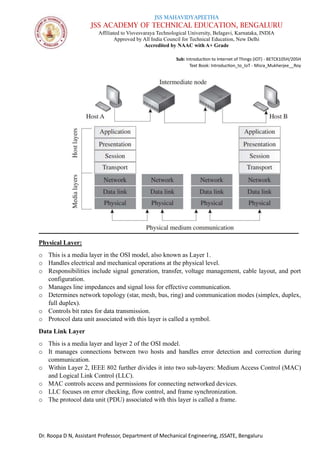
These seven layers, from bottom-up, are as follows: 1) Physical layer, 2) Data link layer, 3) Network
layer, 4) Transport layer, 5) Session layer, 6) Presentation layer, and 7) Application layer.
A networked communication between two hosts following the OSI model is shown below:
For information
ARPANET, BITNET, Cellular network, CYCLADES, FidoNet, Telex, World Wide Web
These communication systems (methods, protocols, and technologies used to transmit, receive, and process data.):
ARPANET: The first wide-area packet-switching network, developed by the U.S. Department of Defense, and a precursor
to the modern internet.
BITNET: A network that connected academic institutions primarily for email and file transfer services.
CELLULAR NETWORK: A wireless network infrastructure enabling mobile communication devices to connect and
communicate with each other.
CYCLADES: A French research network that was one of the pioneering efforts in packet-switched networking.
FIDONET: A worldwide bulletin board system network allowing users to exchange messages and files through dial-up
connections.
TELEX: A worldwide network of teleprinters enabling text-based communication between users via wired connections.
WORLD WIDE WEB: An information system accessible via the internet, consisting of interlinked hypertext documents
accessed through web browsers. It revolutionized the way information is accessed and shared online.
JSS MAHAVIDYAPEETHA
JSS ACADEMY OF TECHNICAL EDUCATION, BENGALURU
Affiliated to Visvesvaraya Technological University, Belagavi, Karnataka, INDIA
Approved by All India Council for Technical Education, New Delhi
Accredited by NAAC with A+ Grade
Sub: Introduction to Internet of Things (IOT) - BETCK105H/205H
Text Book: Introduction_to_IoT - Misra_Mukherjee__Roy
Dr. Roopa D N, Assistant Professor, Department of Mechanical Engineering, JSSATE, Bengaluru
Physical Layer:
o This is a media layer in the OSI model, also known as Layer 1.
o Handles electrical and mechanical operations at the physical level.
o Responsibilities include signal generation, transfer, voltage management, cable layout, and port
configuration.
o Manages line impedances and signal loss for effective communication.
o Determines network topology (star, mesh, bus, ring) and communication modes (simplex, duplex,
full duplex).
o Controls bit rates for data transmission.
o Protocol data unit associated with this layer is called a symbol.
Data Link Layer
o This is a media layer and layer 2 of the OSI model.
o It manages connections between two hosts and handles error detection and correction during
communication.
o Within Layer 2, IEEE 802 further divides it into two sub-layers: Medium Access Control (MAC)
and Logical Link Control (LLC).
o MAC controls access and permissions for connecting networked devices.
o LLC focuses on error checking, flow control, and frame synchronization.
o The protocol data unit (PDU) associated with this layer is called a frame.
JSS MAHAVIDYAPEETHA
JSS ACADEMY OF TECHNICAL EDUCATION, BENGALURU
Affiliated to Visvesvaraya Technological University, Belagavi, Karnataka, INDIA
Approved by All India Council for Technical Education, New Delhi
Accredited by NAAC with A+ Grade
Sub: Introduction to Internet of Things (IOT) - BETCK105H/205H
Text Book: Introduction_to_IoT - Misra_Mukherjee__Roy
Dr. Roopa D N, Assistant Professor, Department of Mechanical Engineering, JSSATE, Bengaluru
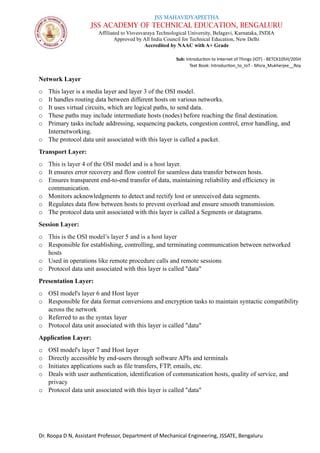
Network Layer
o This layer is a media layer and layer 3 of the OSI model.
o It handles routing data between different hosts on various networks.
o It uses virtual circuits, which are logical paths, to send data.
o These paths may include intermediate hosts (nodes) before reaching the final destination.
o Primary tasks include addressing, sequencing packets, congestion control, error handling, and
Internetworking.
o The protocol data unit associated with this layer is called a packet.
Transport Layer:
o This is layer 4 of the OSI model and is a host layer.
o It ensures error recovery and flow control for seamless data transfer between hosts.
o Ensures transparent end-to-end transfer of data, maintaining reliability and efficiency in
communication.
o Monitors acknowledgments to detect and rectify lost or unreceived data segments.
o Regulates data flow between hosts to prevent overload and ensure smooth transmission.
o The protocol data unit associated with this layer is called a Segments or datagrams.
Session Layer:
o This is the OSI model’s layer 5 and is a host layer
o Responsible for establishing, controlling, and terminating communication between networked
hosts
o Used in operations like remote procedure calls and remote sessions
o Protocol data unit associated with this layer is called "data"
Presentation Layer:
o OSI model's layer 6 and Host layer
o Responsible for data format conversions and encryption tasks to maintain syntactic compatibility
across the network
o Referred to as the syntax layer
o Protocol data unit associated with this layer is called "data"
Application Layer:
o OSI model's layer 7 and Host layer
o Directly accessible by end-users through software APIs and terminals
o Initiates applications such as file transfers, FTP, emails, etc.
o Deals with user authentication, identification of communication hosts, quality of service, and
privacy
o Protocol data unit associated with this layer is called "data"
JSS MAHAVIDYAPEETHA
JSS ACADEMY OF TECHNICAL EDUCATION, BENGALURU
Affiliated to Visvesvaraya Technological University, Belagavi, Karnataka, INDIA
Approved by All India Council for Technical Education, New Delhi
Accredited by NAAC with A+ Grade
Sub: Introduction to Internet of Things (IOT) - BETCK105H/205H
Text Book: Introduction_to_IoT - Misra_Mukherjee__Roy
Dr. Roopa D N, Assistant Professor, Department of Mechanical Engineering, JSSATE, Bengaluru
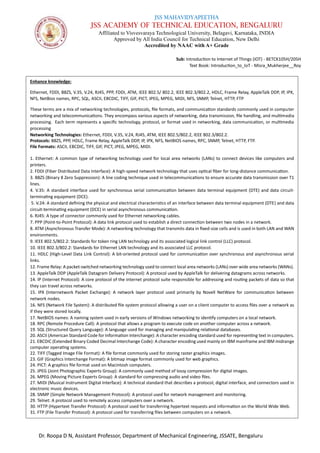
Enhance knowledge:
Ethernet, FDDI, B8ZS, V.35, V.24, RJ45, PPP, FDDI, ATM, IEEE 802.5/ 802.2, IEEE 802.3/802.2, HDLC, Frame Relay, AppleTalk DDP, IP, IPX,
NFS, NetBios names, RPC, SQL, ASCII, EBCDIC, TIFF, GIF, PICT, JPEG, MPEG, MIDI, NFS, SNMP, Telnet, HTTP, FTP
These terms are a mix of networking technologies, protocols, file formats, and communication standards commonly used in computer
networking and telecommunications. They encompass various aspects of networking, data transmission, file handling, and multimedia
processing. Each term represents a specific technology, protocol, or format used in networking, data communication, or multimedia
processing
Networking Technologies: Ethernet, FDDI, V.35, V.24, RJ45, ATM, IEEE 802.5/802.2, IEEE 802.3/802.2.
Protocols: B8ZS, PPP, HDLC, Frame Relay, AppleTalk DDP, IP, IPX, NFS, NetBIOS names, RPC, SNMP, Telnet, HTTP, FTP.
File Formats: ASCII, EBCDIC, TIFF, GIF, PICT, JPEG, MPEG, MIDI.
1. Ethernet: A common type of networking technology used for local area networks (LANs) to connect devices like computers and
printers.
2. FDDI (Fiber Distributed Data Interface): A high-speed network technology that uses optical fiber for long-distance communication.
3. B8ZS (Binary 8 Zero Suppression): A line coding technique used in telecommunications to ensure accurate data transmission over T1
lines.
4. V.35: A standard interface used for synchronous serial communication between data terminal equipment (DTE) and data circuit-
terminating equipment (DCE).
5. V.24: A standard defining the physical and electrical characteristics of an interface between data terminal equipment (DTE) and data
circuit-terminating equipment (DCE) in serial asynchronous communication.
6. RJ45: A type of connector commonly used for Ethernet networking cables.
7. PPP (Point-to-Point Protocol): A data link protocol used to establish a direct connection between two nodes in a network.
8. ATM (Asynchronous Transfer Mode): A networking technology that transmits data in fixed-size cells and is used in both LAN and WAN
environments.
9. IEEE 802.5/802.2: Standards for token ring LAN technology and its associated logical link control (LLC) protocol.
10. IEEE 802.3/802.2: Standards for Ethernet LAN technology and its associated LLC protocol.
11. HDLC (High-Level Data Link Control): A bit-oriented protocol used for communication over synchronous and asynchronous serial
links.
12. Frame Relay: A packet-switched networking technology used to connect local area networks (LANs) over wide area networks (WANs).
13. AppleTalk DDP (AppleTalk Datagram Delivery Protocol): A protocol used by AppleTalk for delivering datagrams across networks.
14. IP (Internet Protocol): A core protocol of the internet protocol suite responsible for addressing and routing packets of data so that
they can travel across networks.
15. IPX (Internetwork Packet Exchange): A network layer protocol used primarily by Novell NetWare for communication between
network nodes.
16. NFS (Network File System): A distributed file system protocol allowing a user on a client computer to access files over a network as
if they were stored locally.
17. NetBIOS names: A naming system used in early versions of Windows networking to identify computers on a local network.
18. RPC (Remote Procedure Call): A protocol that allows a program to execute code on another computer across a network.
19. SQL (Structured Query Language): A language used for managing and manipulating relational databases.
20. ASCII (American Standard Code for Information Interchange): A character encoding standard used for representing text in computers.
21. EBCDIC (Extended Binary Coded Decimal Interchange Code): A character encoding used mainly on IBM mainframe and IBM midrange
computer operating systems.
22. TIFF (Tagged Image File Format): A file format commonly used for storing raster graphics images.
23. GIF (Graphics Interchange Format): A bitmap image format commonly used for web graphics.
24. PICT: A graphics file format used on Macintosh computers.
25. JPEG (Joint Photographic Experts Group): A commonly used method of lossy compression for digital images.
26. MPEG (Moving Picture Experts Group): A standard for compressing audio and video files.
27. MIDI (Musical Instrument Digital Interface): A technical standard that describes a protocol, digital interface, and connectors used in
electronic music devices.
28. SNMP (Simple Network Management Protocol): A protocol used for network management and monitoring.
29. Telnet: A protocol used to remotely access computers over a network.
30. HTTP (Hypertext Transfer Protocol): A protocol used for transferring hypertext requests and information on the World Wide Web.
31. FTP (File Transfer Protocol): A protocol used for transferring files between computers on a network.
JSS MAHAVIDYAPEETHA
JSS ACADEMY OF TECHNICAL EDUCATION, BENGALURU
Affiliated to Visvesvaraya Technological University, Belagavi, Karnataka, INDIA
Approved by All India Council for Technical Education, New Delhi
Accredited by NAAC with A+ Grade
Sub: Introduction to Internet of Things (IOT) - BETCK105H/205H
Text Book: Introduction_to_IoT - Misra_Mukherjee__Roy
Dr. Roopa D N, Assistant Professor, Department of Mechanical Engineering, JSSATE, Bengaluru
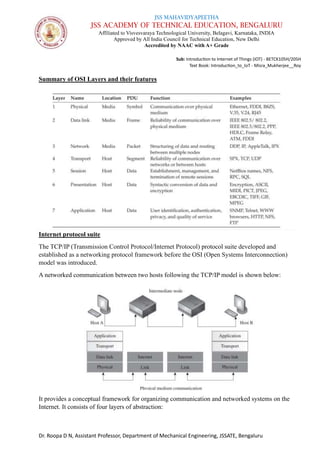
Summary of OSI Layers and their features
Internet protocol suite
The TCP/IP (Transmission Control Protocol/Internet Protocol) protocol suite developed and
established as a networking protocol framework before the OSI (Open Systems Interconnection)
model was introduced.
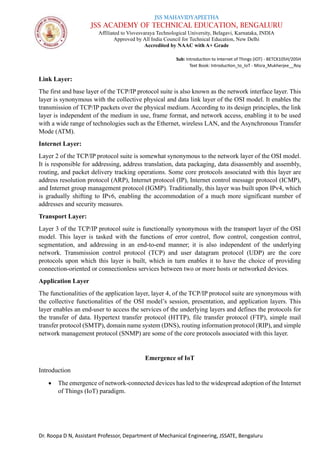
A networked communication between two hosts following the TCP/IP model is shown below:
It provides a conceptual framework for organizing communication and networked systems on the
Internet. It consists of four layers of abstraction:
JSS MAHAVIDYAPEETHA
JSS ACADEMY OF TECHNICAL EDUCATION, BENGALURU
Affiliated to Visvesvaraya Technological University, Belagavi, Karnataka, INDIA
Approved by All India Council for Technical Education, New Delhi
Accredited by NAAC with A+ Grade
Sub: Introduction to Internet of Things (IOT) - BETCK105H/205H
Text Book: Introduction_to_IoT - Misra_Mukherjee__Roy
Dr. Roopa D N, Assistant Professor, Department of Mechanical Engineering, JSSATE, Bengaluru
Link Layer:
The first and base layer of the TCP/IP protocol suite is also known as the network interface layer. This
layer is synonymous with the collective physical and data link layer of the OSI model. It enables the
transmission of TCP/IP packets over the physical medium. According to its design principles, the link
layer is independent of the medium in use, frame format, and network access, enabling it to be used
with a wide range of technologies such as the Ethernet, wireless LAN, and the Asynchronous Transfer
Mode (ATM).
Internet Layer:
Layer 2 of the TCP/IP protocol suite is somewhat synonymous to the network layer of the OSI model.
It is responsible for addressing, address translation, data packaging, data disassembly and assembly,
routing, and packet delivery tracking operations. Some core protocols associated with this layer are
address resolution protocol (ARP), Internet protocol (IP), Internet control message protocol (ICMP),
and Internet group management protocol (IGMP). Traditionally, this layer was built upon IPv4, which
is gradually shifting to IPv6, enabling the accommodation of a much more significant number of
addresses and security measures.
Transport Layer:
Layer 3 of the TCP/IP protocol suite is functionally synonymous with the transport layer of the OSI
model. This layer is tasked with the functions of error control, flow control, congestion control,
segmentation, and addressing in an end-to-end manner; it is also independent of the underlying
network. Transmission control protocol (TCP) and user datagram protocol (UDP) are the core
protocols upon which this layer is built, which in turn enables it to have the choice of providing
connection-oriented or connectionless services between two or more hosts or networked devices.
Application Layer
The functionalities of the application layer, layer 4, of the TCP/IP protocol suite are synonymous with
the collective functionalities of the OSI model’s session, presentation, and application layers. This
layer enables an end-user to access the services of the underlying layers and defines the protocols for
the transfer of data. Hypertext transfer protocol (HTTP), file transfer protocol (FTP), simple mail
transfer protocol (SMTP), domain name system (DNS), routing information protocol (RIP), and simple
network management protocol (SNMP) are some of the core protocols associated with this layer.
Emergence of IoT
Introduction
• The emergence of network-connected devices has led to the widespread adoption of the Internet
of Things (IoT) paradigm.
JSS MAHAVIDYAPEETHA
JSS ACADEMY OF TECHNICAL EDUCATION, BENGALURU
Affiliated to Visvesvaraya Technological University, Belagavi, Karnataka, INDIA
Approved by All India Council for Technical Education, New Delhi
Accredited by NAAC with A+ Grade
Sub: Introduction to Internet of Things (IOT) - BETCK105H/205H
Text Book: Introduction_to_IoT - Misra_Mukherjee__Roy
Dr. Roopa D N, Assistant Professor, Department of Mechanical Engineering, JSSATE, Bengaluru
• The modern internet carries massively diverse traffic, including images, videos, music, speech,
text, numbers, binary codes, machine status, banking messages, sensor data, healthcare
information, vehicle data, home automation data, military communications, and more.
• This traffic encompasses a vast variety of data types generated by a multitude of connected
devices.
• Devices may be directly connected to the internet or linked through gateway devices, enabling
global connectivity and data exchange.
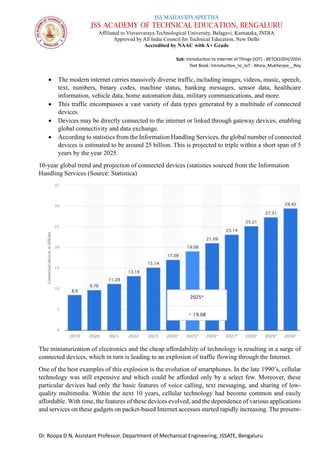
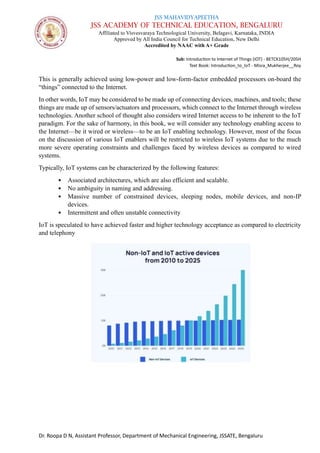
• According to statistics from the Information Handling Services, the global number of connected
devices is estimated to be around 25 billion. This is projected to triple within a short span of 5
years by the year 2025.
10-year global trend and projection of connected devices (statistics sourced from the Information
Handling Services (Source: Statistica)
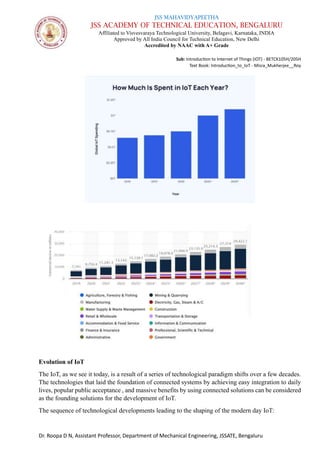
The miniaturization of electronics and the cheap affordability of technology is resulting in a surge of
connected devices, which in turn is leading to an explosion of traffic flowing through the Internet.
One of the best examples of this explosion is the evolution of smartphones. In the late 1990’s, cellular
technology was still expensive and which could be afforded only by a select few. Moreover, these
particular devices had only the basic features of voice calling, text messaging, and sharing of low-
quality multimedia. Within the next 10 years, cellular technology had become common and easily
affordable. With time, the features of these devices evolved, and the dependence of various applications
and services on these gadgets on packet-based Internet accesses started rapidly increasing. The present-
JSS MAHAVIDYAPEETHA
JSS ACADEMY OF TECHNICAL EDUCATION, BENGALURU
Affiliated to Visvesvaraya Technological University, Belagavi, Karnataka, INDIA
Approved by All India Council for Technical Education, New Delhi
Accredited by NAAC with A+ Grade
Sub: Introduction to Internet of Things (IOT) - BETCK105H/205H
Text Book: Introduction_to_IoT - Misra_Mukherjee__Roy
Dr. Roopa D N, Assistant Professor, Department of Mechanical Engineering, JSSATE, Bengaluru
day mobile phones (commonly referred to as smartphones) are more or less Internet-based. The range
of applications on these gadgets such as messaging, video calling, e-mails, games, music streaming,
video streaming, and others are solely dependent on network provider allocated Internet access or
WiFi. Most of the present-day consumers of smartphone technology tend to carry more than one of
these units. In line with this trend, other connected devices have rapidly increased in numbers resulting
in the number of devices exceeding the number of humans on Earth by multiple times. Now imagine
that as all technologies and domains are moving toward smart management of systems, the number of
sensor/actuator-based systems is rapidly increasing. With time, the need for location-independent
access to monitored and controlled systems keep on rising. This rise in number leads to a further rise
in the number of Internet-connected devices.
The original Internet intended for sending simple messages is now connected with all sorts of “Things”.
These things can be legacy devices, modern-day computers, sensors, actuators, household appliances,
toys, clothes, shoes, vehicles, cameras, and anything which may benefit a product by increasing its
scientific value, accuracy, or even its cosmetic value.
Internet of Things
“The Internet of Things (IoT) is the network of physical objects that contain embedded technology to
communicate and sense or interact with their internal states or the external environment.”
IoT is an anytime, anywhere, and anything network of Internet-connected physical devices or systems
capable of sensing an environment and affecting the sensed environment intelligently.
Internet of Things
“In the 2000s, we are heading into a new era of ubiquity, where the ‘users’ of the Internet will be counted
in billions and where humans may become the minority as generators and receivers of traffic. Instead,
most of the traffic will flow between devices and all kinds of “Things”, thereby creating a much wider and
more complex Internet of Things.”
—ITU Internet Report 2005
JSS MAHAVIDYAPEETHA
JSS ACADEMY OF TECHNICAL EDUCATION, BENGALURU
Affiliated to Visvesvaraya Technological University, Belagavi, Karnataka, INDIA
Approved by All India Council for Technical Education, New Delhi
Accredited by NAAC with A+ Grade
Sub: Introduction to Internet of Things (IOT) - BETCK105H/205H
Text Book: Introduction_to_IoT - Misra_Mukherjee__Roy
Dr. Roopa D N, Assistant Professor, Department of Mechanical Engineering, JSSATE, Bengaluru
This is generally achieved using low-power and low-form-factor embedded processors on-board the
“things” connected to the Internet.
In other words, IoT may be considered to be made up of connecting devices, machines, and tools; these
things are made up of sensors/actuators and processors, which connect to the Internet through wireless
technologies. Another school of thought also considers wired Internet access to be inherent to the IoT
paradigm. For the sake of harmony, in this book, we will consider any technology enabling access to
the Internet—be it wired or wireless—to be an IoT enabling technology. However, most of the focus
on the discussion of various IoT enablers will be restricted to wireless IoT systems due to the much
more severe operating constraints and challenges faced by wireless devices as compared to wired
systems.
Typically, IoT systems can be characterized by the following features:
• Associated architectures, which are also efficient and scalable.
• No ambiguity in naming and addressing.
• Massive number of constrained devices, sleeping nodes, mobile devices, and non-IP
devices.
• Intermittent and often unstable connectivity
IoT is speculated to have achieved faster and higher technology acceptance as compared to electricity
and telephony
JSS MAHAVIDYAPEETHA
JSS ACADEMY OF TECHNICAL EDUCATION, BENGALURU
Affiliated to Visvesvaraya Technological University, Belagavi, Karnataka, INDIA
Approved by All India Council for Technical Education, New Delhi
Accredited by NAAC with A+ Grade
Sub: Introduction to Internet of Things (IOT) - BETCK105H/205H
Text Book: Introduction_to_IoT - Misra_Mukherjee__Roy
Dr. Roopa D N, Assistant Professor, Department of Mechanical Engineering, JSSATE, Bengaluru
Evolution of IoT
The IoT, as we see it today, is a result of a series of technological paradigm shifts over a few decades.
The technologies that laid the foundation of connected systems by achieving easy integration to daily
lives, popular public acceptance , and massive benefits by using connected solutions can be considered
as the founding solutions for the development of IoT.
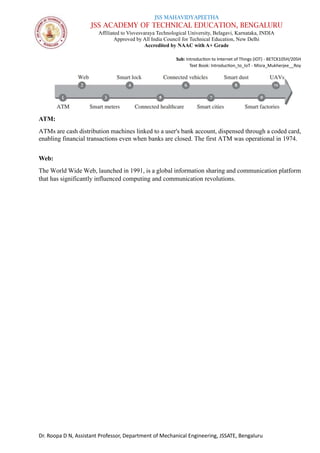
The sequence of technological developments leading to the shaping of the modern day IoT:
JSS MAHAVIDYAPEETHA
JSS ACADEMY OF TECHNICAL EDUCATION, BENGALURU
Affiliated to Visvesvaraya Technological University, Belagavi, Karnataka, INDIA
Approved by All India Council for Technical Education, New Delhi
Accredited by NAAC with A+ Grade
Sub: Introduction to Internet of Things (IOT) - BETCK105H/205H
Text Book: Introduction_to_IoT - Misra_Mukherjee__Roy
Dr. Roopa D N, Assistant Professor, Department of Mechanical Engineering, JSSATE, Bengaluru
ATM:
ATMs are cash distribution machines linked to a user's bank account, dispensed through a coded card,
enabling financial transactions even when banks are closed. The first ATM was operational in 1974.
Web:
The World Wide Web, launched in 1991, is a global information sharing and communication platform
that has significantly influenced computing and communication revolutions.
JSS MAHAVIDYAPEETHA
JSS ACADEMY OF TECHNICAL EDUCATION, BENGALURU
Affiliated to Visvesvaraya Technological University, Belagavi, Karnataka, INDIA
Approved by All India Council for Technical Education, New Delhi
Accredited by NAAC with A+ Grade
Sub: Introduction to Internet of Things (IOT) - BETCK105H/205H
Text Book: Introduction_to_IoT - Misra_Mukherjee__Roy
Dr. Roopa D N, Assistant Professor, Department of Mechanical Engineering, JSSATE, Bengaluru
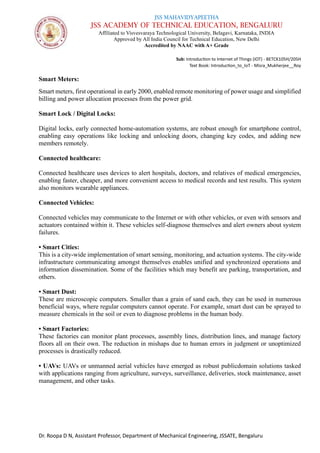
Smart Meters:
Smart meters, first operational in early 2000, enabled remote monitoring of power usage and simplified
billing and power allocation processes from the power grid.
Smart Lock / Digital Locks:
Digital locks, early connected home-automation systems, are robust enough for smartphone control,
enabling easy operations like locking and unlocking doors, changing key codes, and adding new
members remotely.
Connected healthcare:
Connected healthcare uses devices to alert hospitals, doctors, and relatives of medical emergencies,
enabling faster, cheaper, and more convenient access to medical records and test results. This system
also monitors wearable appliances.
Connected Vehicles:
Connected vehicles may communicate to the Internet or with other vehicles, or even with sensors and
actuators contained within it. These vehicles self-diagnose themselves and alert owners about system
failures.
• Smart Cities:
This is a city-wide implementation of smart sensing, monitoring, and actuation systems. The city-wide
infrastructure communicating amongst themselves enables unified and synchronized operations and
information dissemination. Some of the facilities which may benefit are parking, transportation, and
others.
• Smart Dust:
These are microscopic computers. Smaller than a grain of sand each, they can be used in numerous
beneficial ways, where regular computers cannot operate. For example, smart dust can be sprayed to
measure chemicals in the soil or even to diagnose problems in the human body.
• Smart Factories:
These factories can monitor plant processes, assembly lines, distribution lines, and manage factory
floors all on their own. The reduction in mishaps due to human errors in judgment or unoptimized
processes is drastically reduced.
• UAVs: UAVs or unmanned aerial vehicles have emerged as robust publicdomain solutions tasked
with applications ranging from agriculture, surveys, surveillance, deliveries, stock maintenance, asset
management, and other tasks.
JSS MAHAVIDYAPEETHA
JSS ACADEMY OF TECHNICAL EDUCATION, BENGALURU
Affiliated to Visvesvaraya Technological University, Belagavi, Karnataka, INDIA
Approved by All India Council for Technical Education, New Delhi
Accredited by NAAC with A+ Grade
Sub: Introduction to Internet of Things (IOT) - BETCK105H/205H
Text Book: Introduction_to_IoT - Misra_Mukherjee__Roy
Dr. Roopa D N, Assistant Professor, Department of Mechanical Engineering, JSSATE, Bengaluru
The present-day Internet of Things (IoT) is a versatile and robust technology that spans various
domains and applications. It serves as a cross-domain enabler, supporting legacy and modern
technologies simultaneously.
IoT is utilized in a wide range of areas, including smart parking, smartphone detection, traffic
management, smart lighting, waste management, structural health monitoring, urban noise mapping,
flood detection, water management, stock calculation, environmental monitoring, access control,
disaster prevention, supply chain management, smart product management, and more.
In summary, the present-day IoT ecosystem offers extensive domain coverage, versatile functionality,
and diverse applications, making it a foundational technology for addressing various challenges and
enhancing efficiency across multiple sectors.
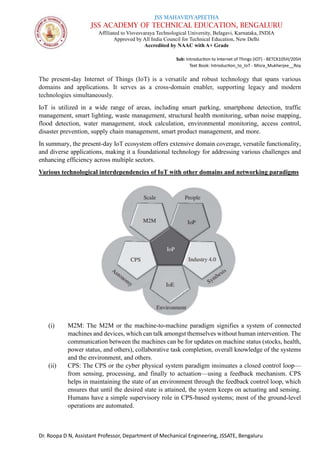
Various technological interdependencies of IoT with other domains and networking paradigms
(i) M2M: The M2M or the machine-to-machine paradigm signifies a system of connected
machines and devices, which can talk amongst themselves without human intervention. The
communication between the machines can be for updates on machine status (stocks, health,
power status, and others), collaborative task completion, overall knowledge of the systems
and the environment, and others.
(ii) CPS: The CPS or the cyber physical system paradigm insinuates a closed control loop—
from sensing, processing, and finally to actuation—using a feedback mechanism. CPS
helps in maintaining the state of an environment through the feedback control loop, which
ensures that until the desired state is attained, the system keeps on actuating and sensing.
Humans have a simple supervisory role in CPS-based systems; most of the ground-level
operations are automated.
JSS MAHAVIDYAPEETHA
JSS ACADEMY OF TECHNICAL EDUCATION, BENGALURU
Affiliated to Visvesvaraya Technological University, Belagavi, Karnataka, INDIA
Approved by All India Council for Technical Education, New Delhi
Accredited by NAAC with A+ Grade
Sub: Introduction to Internet of Things (IOT) - BETCK105H/205H
Text Book: Introduction_to_IoT - Misra_Mukherjee__Roy
Dr. Roopa D N, Assistant Professor, Department of Mechanical Engineering, JSSATE, Bengaluru
(iii) IoE: The IoE paradigm is mainly concerned with minimizing and even reversing the ill-
effects of the permeation of Internet-based technologies on the environment. The major
focus areas of this paradigm include smart and sustainable farming, sustainable and energy-
efficient habitats, enhancing the energy efficiency of systems and processes, and others. In
brief, we can safely assume that any aspect of IoT that concerns and affects the
environment, falls under the purview of IoE.
(iv) Industry 4.0: Industry 4.0 is commonly referred to as the fourth industrial revolution
pertaining to digitization in the manufacturing industry. The previous revolutions
chronologically dealt with mechanization, mass production, and the industrial revolution,
respectively. This paradigm strongly puts forward the concept of smart factories, where
machines talk to one another without much human involvement based on a framework of
CPS and IoT. The digitization and connectedness in Industry 4.0 translate to better resource
and workforce management, optimization of production time and resources, and better
upkeep and lifetimes of industrial systems.
(v) IoP: IoP is a new technological movement on the Internet which aims to decentralize online
social interactions, payments, transactions, and other tasks while maintaining
confidentiality and privacy of its user’s data. A famous site for IoP states that as the
introduction of the Bitcoin has severely limited the power of banks and governments, the
acceptance of IoP will limit the power of corporations, governments, and their spy agencies
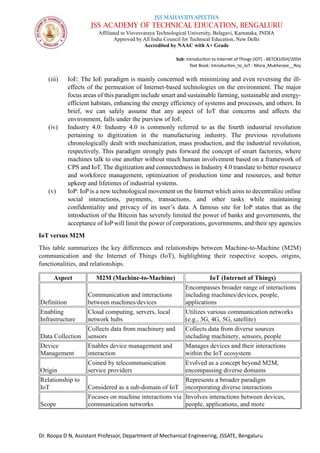
IoT versus M2M
This table summarizes the key differences and relationships between Machine-to-Machine (M2M)
communication and the Internet of Things (IoT), highlighting their respective scopes, origins,
functionalities, and relationships.
Aspect M2M (Machine-to-Machine) IoT (Internet of Things)
Definition
Communication and interactions
between machines/devices
Encompasses broader range of interactions
including machines/devices, people,
applications
Enabling
Infrastructure
Cloud computing, servers, local
network hubs
Utilizes various communication networks
(e.g., 3G, 4G, 5G, satellite)
Data Collection
Collects data from machinery and
sensors
Collects data from diverse sources
including machinery, sensors, people
Device
Management
Enables device management and
interaction
Manages devices and their interactions
within the IoT ecosystem
Origin
Coined by telecommunication
service providers
Evolved as a concept beyond M2M,
encompassing diverse domains
Relationship to
IoT Considered as a sub-domain of IoT
Represents a broader paradigm
incorporating diverse interactions
Scope
Focuses on machine interactions via
communication networks
Involves interactions between devices,
people, applications, and more
JSS MAHAVIDYAPEETHA
JSS ACADEMY OF TECHNICAL EDUCATION, BENGALURU
Affiliated to Visvesvaraya Technological University, Belagavi, Karnataka, INDIA
Approved by All India Council for Technical Education, New Delhi
Accredited by NAAC with A+ Grade
Sub: Introduction to Internet of Things (IOT) - BETCK105H/205H
Text Book: Introduction_to_IoT - Misra_Mukherjee__Roy
Dr. Roopa D N, Assistant Professor, Department of Mechanical Engineering, JSSATE, Bengaluru
Aspect M2M (Machine-to-Machine) IoT (Internet of Things)
Standards
Occupies a core place in the IoT
landscape
Standards evolve to accommodate the
broader scope of IoT
Internet
Connectivity
Central to IoT but not limited to
telecom networks
Utilizes various communication
technologies for connectivity
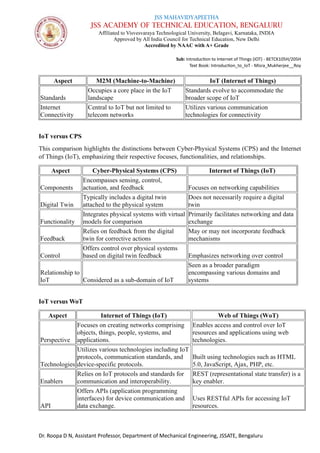
IoT versus CPS
This comparison highlights the distinctions between Cyber-Physical Systems (CPS) and the Internet
of Things (IoT), emphasizing their respective focuses, functionalities, and relationships.
Aspect Cyber-Physical Systems (CPS) Internet of Things (IoT)
Components
Encompasses sensing, control,
actuation, and feedback Focuses on networking capabilities
Digital Twin
Typically includes a digital twin
attached to the physical system
Does not necessarily require a digital
twin
Functionality
Integrates physical systems with virtual
models for comparison
Primarily facilitates networking and data
exchange
Feedback
Relies on feedback from the digital
twin for corrective actions
May or may not incorporate feedback
mechanisms
Control
Offers control over physical systems
based on digital twin feedback Emphasizes networking over control
Relationship to
IoT Considered as a sub-domain of IoT
Seen as a broader paradigm
encompassing various domains and
systems
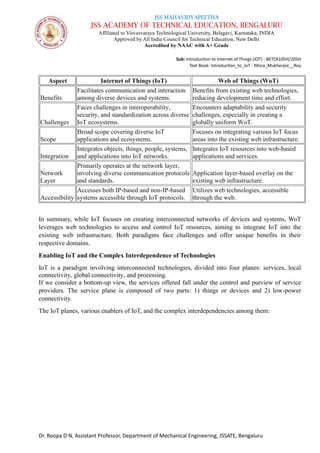
IoT versus WoT
Aspect Internet of Things (IoT) Web of Things (WoT)
Perspective
Focuses on creating networks comprising
objects, things, people, systems, and
applications.
Enables access and control over IoT
resources and applications using web
technologies.
Technologies
Utilizes various technologies including IoT
protocols, communication standards, and
device-specific protocols.
Built using technologies such as HTML
5.0, JavaScript, Ajax, PHP, etc.
Enablers
Relies on IoT protocols and standards for
communication and interoperability.
REST (representational state transfer) is a
key enabler.
API
Offers APIs (application programming
interfaces) for device communication and
data exchange.
Uses RESTful APIs for accessing IoT
resources.
JSS MAHAVIDYAPEETHA
JSS ACADEMY OF TECHNICAL EDUCATION, BENGALURU
Affiliated to Visvesvaraya Technological University, Belagavi, Karnataka, INDIA
Approved by All India Council for Technical Education, New Delhi
Accredited by NAAC with A+ Grade
Sub: Introduction to Internet of Things (IOT) - BETCK105H/205H
Text Book: Introduction_to_IoT - Misra_Mukherjee__Roy
Dr. Roopa D N, Assistant Professor, Department of Mechanical Engineering, JSSATE, Bengaluru
Aspect Internet of Things (IoT) Web of Things (WoT)
Benefits
Facilitates communication and interaction
among diverse devices and systems.
Benefits from existing web technologies,
reducing development time and effort.
Challenges
Faces challenges in interoperability,
security, and standardization across diverse
IoT ecosystems.
Encounters adaptability and security
challenges, especially in creating a
globally uniform WoT.
Scope
Broad scope covering diverse IoT
applications and ecosystems.
Focuses on integrating various IoT focus
areas into the existing web infrastructure.
Integration
Integrates objects, things, people, systems,
and applications into IoT networks.
Integrates IoT resources into web-based
applications and services.
Network
Layer
Primarily operates at the network layer,
involving diverse communication protocols
and standards.
Application layer-based overlay on the
existing web infrastructure.
Accessibility
Accesses both IP-based and non-IP-based
systems accessible through IoT protocols.
Utilizes web technologies, accessible
through the web.
In summary, while IoT focuses on creating interconnected networks of devices and systems, WoT
leverages web technologies to access and control IoT resources, aiming to integrate IoT into the
existing web infrastructure. Both paradigms face challenges and offer unique benefits in their
respective domains.
Enabling IoT and the Complex Interdependence of Technologies
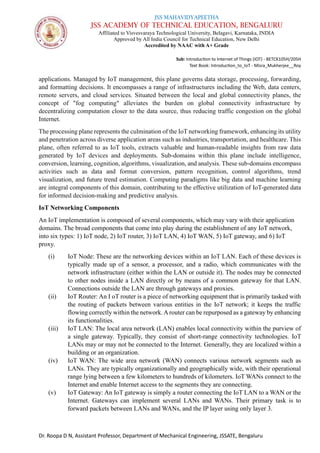
IoT is a paradigm involving interconnected technologies, divided into four planes: services, local
connectivity, global connectivity, and processing.
If we consider a bottom-up view, the services offered fall under the control and purview of service
providers. The service plane is composed of two parts: 1) things or devices and 2) low-power
connectivity.
The IoT planes, various enablers of IoT, and the complex interdependencies among them:
JSS MAHAVIDYAPEETHA
JSS ACADEMY OF TECHNICAL EDUCATION, BENGALURU
Affiliated to Visvesvaraya Technological University, Belagavi, Karnataka, INDIA
Approved by All India Council for Technical Education, New Delhi
Accredited by NAAC with A+ Grade
Sub: Introduction to Internet of Things (IOT) - BETCK105H/205H
Text Book: Introduction_to_IoT - Misra_Mukherjee__Roy
Dr. Roopa D N, Assistant Professor, Department of Mechanical Engineering, JSSATE, Bengaluru
The layer of services in IoT applications combines things and low-power connectivity, such as
wearables, computers, smartphones, and other devices. Legacy protocols like WiFi, Ethernet, and
cellular are used for local implementation, while modern technologies like Zigbee, RFID, Bluetooth,
6LoWPAN, LoRA, DASH, and Insteon provide wireless and programmable connectivity between IoT
devices and the nearest internet hub.
The local connectivity plane of the Internet of Things (IoT) ecosystem plays a crucial role in
distributing internet access across multiple local IoT deployments. This distribution can be based on
various factors such as the physical placement of devices, application domains, or service providers.
Within this plane, services such as address management, device management, security, and sleep
scheduling are provided. For instance, in a smart home environment, different floors may have their
own local IoT setups, with devices connected via low-power, low-range technologies. The traffic from
these floors consolidates at a single router or gateway, reducing the load on the network. By assigning
a single global IP address to the entire household, the local connectivity plane contributes to conserving
limited IP addresses. Managed by IoT management, this plane handles address allocation strategies
based on devices and applications. The modern approach of "edge computing" often complements the
services and local connectivity planes, enhancing the efficiency and capabilities of IoT deployments.
The global connectivity plane is pivotal in realizing the full potential of IoT by facilitating worldwide
implementations and connectivity between various elements such as devices, users, controllers, and
JSS MAHAVIDYAPEETHA
JSS ACADEMY OF TECHNICAL EDUCATION, BENGALURU
Affiliated to Visvesvaraya Technological University, Belagavi, Karnataka, INDIA
Approved by All India Council for Technical Education, New Delhi
Accredited by NAAC with A+ Grade
Sub: Introduction to Internet of Things (IOT) - BETCK105H/205H
Text Book: Introduction_to_IoT - Misra_Mukherjee__Roy
Dr. Roopa D N, Assistant Professor, Department of Mechanical Engineering, JSSATE, Bengaluru
applications. Managed by IoT management, this plane governs data storage, processing, forwarding,
and formatting decisions. It encompasses a range of infrastructures including the Web, data centers,
remote servers, and cloud services. Situated between the local and global connectivity planes, the
concept of "fog computing" alleviates the burden on global connectivity infrastructure by
decentralizing computation closer to the data source, thus reducing traffic congestion on the global
Internet.
The processing plane represents the culmination of the IoT networking framework, enhancing its utility
and penetration across diverse application areas such as industries, transportation, and healthcare. This
plane, often referred to as IoT tools, extracts valuable and human-readable insights from raw data
generated by IoT devices and deployments. Sub-domains within this plane include intelligence,
conversion, learning, cognition, algorithms, visualization, and analysis. These sub-domains encompass
activities such as data and format conversion, pattern recognition, control algorithms, trend
visualization, and future trend estimation. Computing paradigms like big data and machine learning
are integral components of this domain, contributing to the effective utilization of IoT-generated data
for informed decision-making and predictive analysis.
IoT Networking Components
An IoT implementation is composed of several components, which may vary with their application
domains. The broad components that come into play during the establishment of any IoT network,
into six types: 1) IoT node, 2) IoT router, 3) IoT LAN, 4) IoT WAN, 5) IoT gateway, and 6) IoT
proxy.
(i) IoT Node: These are the networking devices within an IoT LAN. Each of these devices is
typically made up of a sensor, a processor, and a radio, which communicates with the
network infrastructure (either within the LAN or outside it). The nodes may be connected
to other nodes inside a LAN directly or by means of a common gateway for that LAN.
Connections outside the LAN are through gateways and proxies.
(ii) IoT Router: An I oT router is a piece of networking equipment that is primarily tasked with
the routing of packets between various entities in the IoT network; it keeps the traffic
flowing correctly within the network.Arouter can be repurposed as a gateway by enhancing
its functionalities.
(iii) IoT LAN: The local area network (LAN) enables local connectivity within the purview of
a single gateway. Typically, they consist of short-range connectivity technologies. IoT
LANs may or may not be connected to the Internet. Generally, they are localized within a
building or an organization.
(iv) IoT WAN: The wide area network (WAN) connects various network segments such as
LANs. They are typically organizationally and geographically wide, with their operational
range lying between a few kilometers to hundreds of kilometers. IoT WANs connect to the
Internet and enable Internet access to the segments they are connecting.
(v) IoT Gateway: An IoT gateway is simply a router connecting the IoT LAN to a WAN or the
Internet. Gateways can implement several LANs and WANs. Their primary task is to
forward packets between LANs and WANs, and the IP layer using only layer 3.
JSS MAHAVIDYAPEETHA
JSS ACADEMY OF TECHNICAL EDUCATION, BENGALURU
Affiliated to Visvesvaraya Technological University, Belagavi, Karnataka, INDIA
Approved by All India Council for Technical Education, New Delhi
Accredited by NAAC with A+ Grade
Sub: Introduction to Internet of Things (IOT) - BETCK105H/205H
Text Book: Introduction_to_IoT - Misra_Mukherjee__Roy
Dr. Roopa D N, Assistant Professor, Department of Mechanical Engineering, JSSATE, Bengaluru
(vi) IoT Proxy: Proxies actively lie on the application layer and performs application layer
functions between IoT nodes and other entities. Typically, application layer proxies are a
means of providing security to the network entities under it ; it helps to extend the
addressing range of its network.
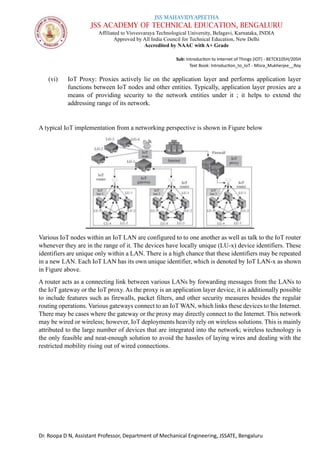
A typical IoT implementation from a networking perspective is shown in Figure below
Various IoT nodes within an IoT LAN are configured to to one another as well as talk to the IoT router
whenever they are in the range of it. The devices have locally unique (LU-x) device identifiers. These
identifiers are unique only within a LAN. There is a high chance that these identifiers may be repeated
in a new LAN. Each IoT LAN has its own unique identifier, which is denoted by IoT LAN-x as shown
in Figure above.
A router acts as a connecting link between various LANs by forwarding messages from the LANs to
the IoT gateway or the IoT proxy. As the proxy is an application layer device, it is additionally possible
to include features such as firewalls, packet filters, and other security measures besides the regular
routing operations. Various gateways connect to an IoT WAN, which links these devices to the Internet.
There may be cases where the gateway or the proxy may directly connect to the Internet. This network
may be wired or wireless; however, IoT deployments heavily rely on wireless solutions. This is mainly
attributed to the large number of devices that are integrated into the network; wireless technology is
the only feasible and neat-enough solution to avoid the hassles of laying wires and dealing with the
restricted mobility rising out of wired connections.

Module 1_BETCK105H_Introduction to IoT.pdf

  • 1.
    JSS MAHAVIDYAPEETHA JSS ACADEMYOF TECHNICAL EDUCATION, BENGALURU Affiliated to Visvesvaraya Technological University, Belagavi, Karnataka, INDIA Approved by All India Council for Technical Education, New Delhi Accredited by NAAC with A+ Grade Sub: Introduction to Internet of Things (IOT) - BETCK105H/205H Text Book: Introduction_to_IoT - Misra_Mukherjee__Roy Dr. Roopa D N, Assistant Professor, Department of Mechanical Engineering, JSSATE, Bengaluru Module 1 Basics of Networking: Introduction, Network Types, Layered network models Emergence of IoT: Introduction, Evolution of IoT, Enabling IoT and the Complex Interdependence of Technologies, IoT Networking Components Textbook 1: Chapter 1- 1.1 to 1.3 Chapter 4 – 4.1 to 4.4 Most Important Questions for the module: (i) Differentiate between point-to-point and point-to-multipoint connection types. (ii) Discuss the pros and cons of the following network topologies: (a) Star (b) Ring (c) Bus (d) Mesh (iii) How are PANs different from LANs? (iv) How are MANs different from WANs? (v) What is the ISO-OSI model? (vi) Discuss the highlights of the seven layers of the OSI stack. (vii) What is the Internet protocol suite? (vii) How is the Internet protocol suite different from the ISO-OSI model? (viii) Evolution of IoT and explain each technological development. (ix) Differentiate between IoT and M2M, IoT and CPS, IoT and WoT. (x) Explain various technological interdependencies of IoT with other domains and networking paradigms. (xi) Explain various IoT enabling technologies (xii) Explain IoT networking components. Basics of networking Introduction • Everything we do, from farming to military missions, depends a lot on information. • The quality of information depends on the variety and strength of the data behind it. • How quickly and effectively we share data with our team determines our advantage over others. • In today's global operations, fast and relevant information is crucial for staying ahead. • Data and networking are super important because they let us get information instantly from anywhere in the world. What is networking? • Networking links computers and communication devices through a network like the Internet or Intranet. • Each device has a unique identifier, like IP addresses and MAC addresses.
  • 2.
    JSS MAHAVIDYAPEETHA JSS ACADEMYOF TECHNICAL EDUCATION, BENGALURU Affiliated to Visvesvaraya Technological University, Belagavi, Karnataka, INDIA Approved by All India Council for Technical Education, New Delhi Accredited by NAAC with A+ Grade Sub: Introduction to Internet of Things (IOT) - BETCK105H/205H Text Book: Introduction_to_IoT - Misra_Mukherjee__Roy Dr. Roopa D N, Assistant Professor, Department of Mechanical Engineering, JSSATE, Bengaluru • Hosts can be connected by a single path or multiple paths for data exchange. • Data transferred between hosts can be text, images, or videos. • Information is usually in binary bit streams, which are sequences of 0s and 1s. Think??? The data generated from a camera sensor tells us more about the scene compared to the data generated from a proximity sensor (which detects only the presence of the object in its sensing range)!!!! The simultaneous data generated from multiple cameras focusing on the same spot from various angles tell us even more about the object (or scene) than a single camera focussed at that scene!!!! Network Types • Computer networks are categorized based on: ❖ Type of connection ❖ Physical topology ❖ Reach of the network • These classifications help determine the needs of a network setup. • They also guide in choosing the right type of network for a specific setup. Network types based on type of connection (Connection types) Computer networks can be classified into two types based on how hosts communicate: i) Point-to-point and ii) Point-to-multipoint. i) Point-to-point: Direct connections between two hosts. ❖ Examples include remote controls for appliances like air conditioners or TVs. ❖ These connections have the entire channel dedicated to them. ❖ These networks commonly used over duplex links and suitable for synchronous and asynchronous systems. ❖ Found in specialized applications such as optical networks.
  • 3.
    JSS MAHAVIDYAPEETHA JSS ACADEMYOF TECHNICAL EDUCATION, BENGALURU Affiliated to Visvesvaraya Technological University, Belagavi, Karnataka, INDIA Approved by All India Council for Technical Education, New Delhi Accredited by NAAC with A+ Grade Sub: Introduction to Internet of Things (IOT) - BETCK105H/205H Text Book: Introduction_to_IoT - Misra_Mukherjee__Roy Dr. Roopa D N, Assistant Professor, Department of Mechanical Engineering, JSSATE, Bengaluru ii) Point-to-Multipoint Connection: ❖ Multiple hosts share the same link. ❖ It is Similar to one-to-many connections, where one sender communicates with many receivers. ❖ Its commonly employed in wireless networks (like Wi-Fi) and IP telephony for efficient communication with multiple devices. ❖ The channel is shared between hosts spatially or temporally. o Spatial sharing: Frequency Division Multiple Access (FDMA). o Temporal sharing: Time Division Multiple Access (TDMA). ❖ Various schemes and protocols ensure smooth channel sharing in point-to-multipoint networks. ❖ Its popular because, widely used in modern networks, particularly for connecting numerous devices, like in smart cities and IoT applications. Network types based on physical topology In the context of computer networks and telecommunications, topology refers to the physical arrangement or layout of interconnected devices and communication paths. It encompasses how devices are connected to each other and the overall structure of the network. Computer networks can have the following four broad topologies—Star, Mesh, Bus, and Ring.
  • 4.
    JSS MAHAVIDYAPEETHA JSS ACADEMYOF TECHNICAL EDUCATION, BENGALURU Affiliated to Visvesvaraya Technological University, Belagavi, Karnataka, INDIA Approved by All India Council for Technical Education, New Delhi Accredited by NAAC with A+ Grade Sub: Introduction to Internet of Things (IOT) - BETCK105H/205H Text Book: Introduction_to_IoT - Misra_Mukherjee__Roy Dr. Roopa D N, Assistant Professor, Department of Mechanical Engineering, JSSATE, Bengaluru Star Topology: o In a star topology, each host connects to a central controller or hub via a point-to-point link. o Hosts cannot communicate directly with each other; communication must go through the central hub. o The hub acts as the traffic exchange point for the network. o For large-scale systems, the hub must be a powerful server to handle simultaneous traffic. o With fewer links (only one per host), this topology is cheaper and easier to set up. o Advantages include easy installation and simple fault identification within the network. o If the central hub remains functional, link failures between hosts and the hub have minimal impact, except for the affected host. o However, a major disadvantage is the risk of a single point of failure; if the hub fails, the entire network fails. Mesh Topology: o In a mesh topology, every host is directly connected to every other host via dedicated point-to-point links. o With n hosts in a mesh, there are n(n−1)/2 dedicated full duplex links, making it costly to implement. o Despite its expense, mesh topology offers several advantages: • Robustness and resilience: Even if a link fails, alternative pathways ensure continuous network functionality.
  • 5.
    JSS MAHAVIDYAPEETHA JSS ACADEMYOF TECHNICAL EDUCATION, BENGALURU Affiliated to Visvesvaraya Technological University, Belagavi, Karnataka, INDIA Approved by All India Council for Technical Education, New Delhi Accredited by NAAC with A+ Grade Sub: Introduction to Internet of Things (IOT) - BETCK105H/205H Text Book: Introduction_to_IoT - Misra_Mukherjee__Roy Dr. Roopa D N, Assistant Professor, Department of Mechanical Engineering, JSSATE, Bengaluru • Security and privacy: Data is only visible to intended recipients, enhancing privacy and security. • Reduced data load: Each host handles its own traffic, distributing the workload and reducing congestion. o However, the complexity and cost of establishing numerous physical connections limit the use of mesh networks, typically to backbone networks where reliability and redundancy are critical. Bus Topology: o A bus topology features a single backbone cable serving as the primary pathway for traffic between hosts, employing point-to-multipoint connections. o Hosts are connected to the main bus via drop lines or taps. o Advantages include ease of installation and low cost, with a single backbone cable serving multiple hosts. o However, there are limitations on bus length and the number of hosts due to signal loss over the extended bus. o While simple to install, fault localization within the network can be challenging, as issues are difficult to pinpoint along the shared bus.
  • 6.
    JSS MAHAVIDYAPEETHA JSS ACADEMYOF TECHNICAL EDUCATION, BENGALURU Affiliated to Visvesvaraya Technological University, Belagavi, Karnataka, INDIA Approved by All India Council for Technical Education, New Delhi Accredited by NAAC with A+ Grade Sub: Introduction to Internet of Things (IOT) - BETCK105H/205H Text Book: Introduction_to_IoT - Misra_Mukherjee__Roy Dr. Roopa D N, Assistant Professor, Department of Mechanical Engineering, JSSATE, Bengaluru Ring Toplogy o Each host in a ring topology has a dedicated point-to-point connection with its two immediate neighbouring hosts. o Repeater devices at each host facilitate communication by capturing incoming signals, regenerating the bit stream, and passing it to the next repeater. o This process ensures continuous circulation of data through the network. o Setting up the ring topology and identifying faults is simple and straightforward due to the linear structure and uniform connections. o The main disadvantage is the high probability of a single point of failure. o If any repeater fails, it disrupts the entire network, causing communication failure. Comparison of various network topologies Topology Feature Advantage Disadvantage Star Point-to-point Cheap Ease of installation Ease of fault identification Single point of failure Traffic visible to network entities Mesh Point-to-point Resilient against single point of failures Scalable Traffic privacy and security ensured Costly Complex connections Bus Point-to-multipoint Ease of installation Cheap Length of backbone cable limited Number of hosts limited Hard to localize faults Ring Point-to-point Ease of installation Cheap Ease of fault identification Prone to single point of failure Network types based on Network reachability Computer networks are divided into four broad categories based on network reachability: Personal Area Networks (PAN), Local Area Networks (LAN), Wide Area Networks (WAN), and Metropolitan Area Networks (MAN).
  • 7.
    JSS MAHAVIDYAPEETHA JSS ACADEMYOF TECHNICAL EDUCATION, BENGALURU Affiliated to Visvesvaraya Technological University, Belagavi, Karnataka, INDIA Approved by All India Council for Technical Education, New Delhi Accredited by NAAC with A+ Grade Sub: Introduction to Internet of Things (IOT) - BETCK105H/205H Text Book: Introduction_to_IoT - Misra_Mukherjee__Roy Dr. Roopa D N, Assistant Professor, Department of Mechanical Engineering, JSSATE, Bengaluru Personal Area Networks (PAN): o PANs are primarily used by individuals for personal devices and gadgets. Examples: Connected wireless headphones, speakers, laptops, smartphones, keyboards, mouse, and printers within a household are typical examples of PAN devices. o PANs mostly utilize wireless technologies like Bluetooth. o The reach of PANs typically extends only a few centimeters to a few meters. o PAN devices operate using low-range and low-power technologies, making them suitable for short- distance communication within personal spaces. Local Area Networks (LAN): o A LAN is a network where multiple hosts are connected through wired or wireless connections. o LANs are typically confined within buildings, organizations, or campuses. o Internet access for the entire organization or campus is usually provided through a few leased lines connected to the Internet. These lines are then distributed to multiple hosts within the LAN. o LANs allow organizations to define access control policies for web access within their hierarchy, regulating which hosts can access the internet and what they can access. o Data access rates within LANs typically range from 100 Mbps to 1000 Mbps, offering high-speed connectivity. o LANs often have very high fault-tolerance levels, ensuring continued operation even in the event of failures. o Commonly used network components in a LAN include servers, hubs, routers, switches, terminals, and computers. These devices facilitate communication and data exchange within the network. Metropolitan Area Networks (MAN): o MANs connect various organizations or buildings within a specific geographic area or city. o MANs have a reach that falls between that of a LAN and a WAN in terms of geographic coverage. ▪ An example of a MAN is an Internet service provider (ISP) supplying Internet connectivity to multiple organizations within a city. o MANs are often expensive to establish and maintain, so they may not be owned by individuals or single organizations. They are typically operated by telecommunications companies or ISPs. o Typical networking devices or components in MANs include modems and cables, which facilitate communication between different organizations or buildings. o MANs tend to have moderate fault tolerance levels, meaning they can withstand some failures but may experience disruptions in the event of major issues. Wide Area Networks (WAN): o WANs (Wide Area Networks) connect diverse geographic locations, but are typically confined within the boundaries of a state or country. o The data rate of WANs is significantly lower compared to LANs, typically operating at a fraction of LAN's data rate.
  • 8.
    JSS MAHAVIDYAPEETHA JSS ACADEMYOF TECHNICAL EDUCATION, BENGALURU Affiliated to Visvesvaraya Technological University, Belagavi, Karnataka, INDIA Approved by All India Council for Technical Education, New Delhi Accredited by NAAC with A+ Grade Sub: Introduction to Internet of Things (IOT) - BETCK105H/205H Text Book: Introduction_to_IoT - Misra_Mukherjee__Roy Dr. Roopa D N, Assistant Professor, Department of Mechanical Engineering, JSSATE, Bengaluru o WANs connecting two LANs or MANs may utilize public switched telephone networks (PSTNs) or satellite-based links for communication. o Due to the long transmission ranges, WANs are prone to more errors and noise during transmission compared to LANs or MANs. o WANs are very costly to establish and maintain due to their extensive coverage area and infrastructure requirements. o Generally, WANs have lower fault tolerance levels compared to LANs or MANs, meaning they are more susceptible to disruptions in case of failures or issues. Layered Network Models The intercommunication between hosts in any computer network, be it a large-scale or a small-scale one, is built upon the premise of various task-specific layers. Two of the most commonly accepted and used traditional layered network models are the 1. Open Systems Interconnection (OSI) developed by the International Organization of Standardization (ISO-OSI) reference model. 2. The Internet protocol suite. OSI Model The OSI model is framework that divides network communication into seven layers, each with its own job. These layers help organize how devices talk to each other, making it easier to understand and troubleshoot network issues. The OSI is a reference model and is maintained by the ISO under the identity of ISO/IEC 7498-1. These seven layers, from bottom-up, are as follows: 1) Physical layer, 2) Data link layer, 3) Network layer, 4) Transport layer, 5) Session layer, 6) Presentation layer, and 7) Application layer. A networked communication between two hosts following the OSI model is shown below: For information ARPANET, BITNET, Cellular network, CYCLADES, FidoNet, Telex, World Wide Web These communication systems (methods, protocols, and technologies used to transmit, receive, and process data.): ARPANET: The first wide-area packet-switching network, developed by the U.S. Department of Defense, and a precursor to the modern internet. BITNET: A network that connected academic institutions primarily for email and file transfer services. CELLULAR NETWORK: A wireless network infrastructure enabling mobile communication devices to connect and communicate with each other. CYCLADES: A French research network that was one of the pioneering efforts in packet-switched networking. FIDONET: A worldwide bulletin board system network allowing users to exchange messages and files through dial-up connections. TELEX: A worldwide network of teleprinters enabling text-based communication between users via wired connections. WORLD WIDE WEB: An information system accessible via the internet, consisting of interlinked hypertext documents accessed through web browsers. It revolutionized the way information is accessed and shared online.
  • 9.
    JSS MAHAVIDYAPEETHA JSS ACADEMYOF TECHNICAL EDUCATION, BENGALURU Affiliated to Visvesvaraya Technological University, Belagavi, Karnataka, INDIA Approved by All India Council for Technical Education, New Delhi Accredited by NAAC with A+ Grade Sub: Introduction to Internet of Things (IOT) - BETCK105H/205H Text Book: Introduction_to_IoT - Misra_Mukherjee__Roy Dr. Roopa D N, Assistant Professor, Department of Mechanical Engineering, JSSATE, Bengaluru Physical Layer: o This is a media layer in the OSI model, also known as Layer 1. o Handles electrical and mechanical operations at the physical level. o Responsibilities include signal generation, transfer, voltage management, cable layout, and port configuration. o Manages line impedances and signal loss for effective communication. o Determines network topology (star, mesh, bus, ring) and communication modes (simplex, duplex, full duplex). o Controls bit rates for data transmission. o Protocol data unit associated with this layer is called a symbol. Data Link Layer o This is a media layer and layer 2 of the OSI model. o It manages connections between two hosts and handles error detection and correction during communication. o Within Layer 2, IEEE 802 further divides it into two sub-layers: Medium Access Control (MAC) and Logical Link Control (LLC). o MAC controls access and permissions for connecting networked devices. o LLC focuses on error checking, flow control, and frame synchronization. o The protocol data unit (PDU) associated with this layer is called a frame.
  • 10.
    JSS MAHAVIDYAPEETHA JSS ACADEMYOF TECHNICAL EDUCATION, BENGALURU Affiliated to Visvesvaraya Technological University, Belagavi, Karnataka, INDIA Approved by All India Council for Technical Education, New Delhi Accredited by NAAC with A+ Grade Sub: Introduction to Internet of Things (IOT) - BETCK105H/205H Text Book: Introduction_to_IoT - Misra_Mukherjee__Roy Dr. Roopa D N, Assistant Professor, Department of Mechanical Engineering, JSSATE, Bengaluru Network Layer o This layer is a media layer and layer 3 of the OSI model. o It handles routing data between different hosts on various networks. o It uses virtual circuits, which are logical paths, to send data. o These paths may include intermediate hosts (nodes) before reaching the final destination. o Primary tasks include addressing, sequencing packets, congestion control, error handling, and Internetworking. o The protocol data unit associated with this layer is called a packet. Transport Layer: o This is layer 4 of the OSI model and is a host layer. o It ensures error recovery and flow control for seamless data transfer between hosts. o Ensures transparent end-to-end transfer of data, maintaining reliability and efficiency in communication. o Monitors acknowledgments to detect and rectify lost or unreceived data segments. o Regulates data flow between hosts to prevent overload and ensure smooth transmission. o The protocol data unit associated with this layer is called a Segments or datagrams. Session Layer: o This is the OSI model’s layer 5 and is a host layer o Responsible for establishing, controlling, and terminating communication between networked hosts o Used in operations like remote procedure calls and remote sessions o Protocol data unit associated with this layer is called "data" Presentation Layer: o OSI model's layer 6 and Host layer o Responsible for data format conversions and encryption tasks to maintain syntactic compatibility across the network o Referred to as the syntax layer o Protocol data unit associated with this layer is called "data" Application Layer: o OSI model's layer 7 and Host layer o Directly accessible by end-users through software APIs and terminals o Initiates applications such as file transfers, FTP, emails, etc. o Deals with user authentication, identification of communication hosts, quality of service, and privacy o Protocol data unit associated with this layer is called "data"
  • 11.
    JSS MAHAVIDYAPEETHA JSS ACADEMYOF TECHNICAL EDUCATION, BENGALURU Affiliated to Visvesvaraya Technological University, Belagavi, Karnataka, INDIA Approved by All India Council for Technical Education, New Delhi Accredited by NAAC with A+ Grade Sub: Introduction to Internet of Things (IOT) - BETCK105H/205H Text Book: Introduction_to_IoT - Misra_Mukherjee__Roy Dr. Roopa D N, Assistant Professor, Department of Mechanical Engineering, JSSATE, Bengaluru Enhance knowledge: Ethernet, FDDI, B8ZS, V.35, V.24, RJ45, PPP, FDDI, ATM, IEEE 802.5/ 802.2, IEEE 802.3/802.2, HDLC, Frame Relay, AppleTalk DDP, IP, IPX, NFS, NetBios names, RPC, SQL, ASCII, EBCDIC, TIFF, GIF, PICT, JPEG, MPEG, MIDI, NFS, SNMP, Telnet, HTTP, FTP These terms are a mix of networking technologies, protocols, file formats, and communication standards commonly used in computer networking and telecommunications. They encompass various aspects of networking, data transmission, file handling, and multimedia processing. Each term represents a specific technology, protocol, or format used in networking, data communication, or multimedia processing Networking Technologies: Ethernet, FDDI, V.35, V.24, RJ45, ATM, IEEE 802.5/802.2, IEEE 802.3/802.2. Protocols: B8ZS, PPP, HDLC, Frame Relay, AppleTalk DDP, IP, IPX, NFS, NetBIOS names, RPC, SNMP, Telnet, HTTP, FTP. File Formats: ASCII, EBCDIC, TIFF, GIF, PICT, JPEG, MPEG, MIDI. 1. Ethernet: A common type of networking technology used for local area networks (LANs) to connect devices like computers and printers. 2. FDDI (Fiber Distributed Data Interface): A high-speed network technology that uses optical fiber for long-distance communication. 3. B8ZS (Binary 8 Zero Suppression): A line coding technique used in telecommunications to ensure accurate data transmission over T1 lines. 4. V.35: A standard interface used for synchronous serial communication between data terminal equipment (DTE) and data circuit- terminating equipment (DCE). 5. V.24: A standard defining the physical and electrical characteristics of an interface between data terminal equipment (DTE) and data circuit-terminating equipment (DCE) in serial asynchronous communication. 6. RJ45: A type of connector commonly used for Ethernet networking cables. 7. PPP (Point-to-Point Protocol): A data link protocol used to establish a direct connection between two nodes in a network. 8. ATM (Asynchronous Transfer Mode): A networking technology that transmits data in fixed-size cells and is used in both LAN and WAN environments. 9. IEEE 802.5/802.2: Standards for token ring LAN technology and its associated logical link control (LLC) protocol. 10. IEEE 802.3/802.2: Standards for Ethernet LAN technology and its associated LLC protocol. 11. HDLC (High-Level Data Link Control): A bit-oriented protocol used for communication over synchronous and asynchronous serial links. 12. Frame Relay: A packet-switched networking technology used to connect local area networks (LANs) over wide area networks (WANs). 13. AppleTalk DDP (AppleTalk Datagram Delivery Protocol): A protocol used by AppleTalk for delivering datagrams across networks. 14. IP (Internet Protocol): A core protocol of the internet protocol suite responsible for addressing and routing packets of data so that they can travel across networks. 15. IPX (Internetwork Packet Exchange): A network layer protocol used primarily by Novell NetWare for communication between network nodes. 16. NFS (Network File System): A distributed file system protocol allowing a user on a client computer to access files over a network as if they were stored locally. 17. NetBIOS names: A naming system used in early versions of Windows networking to identify computers on a local network. 18. RPC (Remote Procedure Call): A protocol that allows a program to execute code on another computer across a network. 19. SQL (Structured Query Language): A language used for managing and manipulating relational databases. 20. ASCII (American Standard Code for Information Interchange): A character encoding standard used for representing text in computers. 21. EBCDIC (Extended Binary Coded Decimal Interchange Code): A character encoding used mainly on IBM mainframe and IBM midrange computer operating systems. 22. TIFF (Tagged Image File Format): A file format commonly used for storing raster graphics images. 23. GIF (Graphics Interchange Format): A bitmap image format commonly used for web graphics. 24. PICT: A graphics file format used on Macintosh computers. 25. JPEG (Joint Photographic Experts Group): A commonly used method of lossy compression for digital images. 26. MPEG (Moving Picture Experts Group): A standard for compressing audio and video files. 27. MIDI (Musical Instrument Digital Interface): A technical standard that describes a protocol, digital interface, and connectors used in electronic music devices. 28. SNMP (Simple Network Management Protocol): A protocol used for network management and monitoring. 29. Telnet: A protocol used to remotely access computers over a network. 30. HTTP (Hypertext Transfer Protocol): A protocol used for transferring hypertext requests and information on the World Wide Web. 31. FTP (File Transfer Protocol): A protocol used for transferring files between computers on a network.
  • 12.
    JSS MAHAVIDYAPEETHA JSS ACADEMYOF TECHNICAL EDUCATION, BENGALURU Affiliated to Visvesvaraya Technological University, Belagavi, Karnataka, INDIA Approved by All India Council for Technical Education, New Delhi Accredited by NAAC with A+ Grade Sub: Introduction to Internet of Things (IOT) - BETCK105H/205H Text Book: Introduction_to_IoT - Misra_Mukherjee__Roy Dr. Roopa D N, Assistant Professor, Department of Mechanical Engineering, JSSATE, Bengaluru Summary of OSI Layers and their features Internet protocol suite The TCP/IP (Transmission Control Protocol/Internet Protocol) protocol suite developed and established as a networking protocol framework before the OSI (Open Systems Interconnection) model was introduced. A networked communication between two hosts following the TCP/IP model is shown below: It provides a conceptual framework for organizing communication and networked systems on the Internet. It consists of four layers of abstraction:
  • 13.
    JSS MAHAVIDYAPEETHA JSS ACADEMYOF TECHNICAL EDUCATION, BENGALURU Affiliated to Visvesvaraya Technological University, Belagavi, Karnataka, INDIA Approved by All India Council for Technical Education, New Delhi Accredited by NAAC with A+ Grade Sub: Introduction to Internet of Things (IOT) - BETCK105H/205H Text Book: Introduction_to_IoT - Misra_Mukherjee__Roy Dr. Roopa D N, Assistant Professor, Department of Mechanical Engineering, JSSATE, Bengaluru Link Layer: The first and base layer of the TCP/IP protocol suite is also known as the network interface layer. This layer is synonymous with the collective physical and data link layer of the OSI model. It enables the transmission of TCP/IP packets over the physical medium. According to its design principles, the link layer is independent of the medium in use, frame format, and network access, enabling it to be used with a wide range of technologies such as the Ethernet, wireless LAN, and the Asynchronous Transfer Mode (ATM). Internet Layer: Layer 2 of the TCP/IP protocol suite is somewhat synonymous to the network layer of the OSI model. It is responsible for addressing, address translation, data packaging, data disassembly and assembly, routing, and packet delivery tracking operations. Some core protocols associated with this layer are address resolution protocol (ARP), Internet protocol (IP), Internet control message protocol (ICMP), and Internet group management protocol (IGMP). Traditionally, this layer was built upon IPv4, which is gradually shifting to IPv6, enabling the accommodation of a much more significant number of addresses and security measures. Transport Layer: Layer 3 of the TCP/IP protocol suite is functionally synonymous with the transport layer of the OSI model. This layer is tasked with the functions of error control, flow control, congestion control, segmentation, and addressing in an end-to-end manner; it is also independent of the underlying network. Transmission control protocol (TCP) and user datagram protocol (UDP) are the core protocols upon which this layer is built, which in turn enables it to have the choice of providing connection-oriented or connectionless services between two or more hosts or networked devices. Application Layer The functionalities of the application layer, layer 4, of the TCP/IP protocol suite are synonymous with the collective functionalities of the OSI model’s session, presentation, and application layers. This layer enables an end-user to access the services of the underlying layers and defines the protocols for the transfer of data. Hypertext transfer protocol (HTTP), file transfer protocol (FTP), simple mail transfer protocol (SMTP), domain name system (DNS), routing information protocol (RIP), and simple network management protocol (SNMP) are some of the core protocols associated with this layer. Emergence of IoT Introduction • The emergence of network-connected devices has led to the widespread adoption of the Internet of Things (IoT) paradigm.
  • 14.
    JSS MAHAVIDYAPEETHA JSS ACADEMYOF TECHNICAL EDUCATION, BENGALURU Affiliated to Visvesvaraya Technological University, Belagavi, Karnataka, INDIA Approved by All India Council for Technical Education, New Delhi Accredited by NAAC with A+ Grade Sub: Introduction to Internet of Things (IOT) - BETCK105H/205H Text Book: Introduction_to_IoT - Misra_Mukherjee__Roy Dr. Roopa D N, Assistant Professor, Department of Mechanical Engineering, JSSATE, Bengaluru • The modern internet carries massively diverse traffic, including images, videos, music, speech, text, numbers, binary codes, machine status, banking messages, sensor data, healthcare information, vehicle data, home automation data, military communications, and more. • This traffic encompasses a vast variety of data types generated by a multitude of connected devices. • Devices may be directly connected to the internet or linked through gateway devices, enabling global connectivity and data exchange. • According to statistics from the Information Handling Services, the global number of connected devices is estimated to be around 25 billion. This is projected to triple within a short span of 5 years by the year 2025. 10-year global trend and projection of connected devices (statistics sourced from the Information Handling Services (Source: Statistica) The miniaturization of electronics and the cheap affordability of technology is resulting in a surge of connected devices, which in turn is leading to an explosion of traffic flowing through the Internet. One of the best examples of this explosion is the evolution of smartphones. In the late 1990’s, cellular technology was still expensive and which could be afforded only by a select few. Moreover, these particular devices had only the basic features of voice calling, text messaging, and sharing of low- quality multimedia. Within the next 10 years, cellular technology had become common and easily affordable. With time, the features of these devices evolved, and the dependence of various applications and services on these gadgets on packet-based Internet accesses started rapidly increasing. The present-
  • 15.
    JSS MAHAVIDYAPEETHA JSS ACADEMYOF TECHNICAL EDUCATION, BENGALURU Affiliated to Visvesvaraya Technological University, Belagavi, Karnataka, INDIA Approved by All India Council for Technical Education, New Delhi Accredited by NAAC with A+ Grade Sub: Introduction to Internet of Things (IOT) - BETCK105H/205H Text Book: Introduction_to_IoT - Misra_Mukherjee__Roy Dr. Roopa D N, Assistant Professor, Department of Mechanical Engineering, JSSATE, Bengaluru day mobile phones (commonly referred to as smartphones) are more or less Internet-based. The range of applications on these gadgets such as messaging, video calling, e-mails, games, music streaming, video streaming, and others are solely dependent on network provider allocated Internet access or WiFi. Most of the present-day consumers of smartphone technology tend to carry more than one of these units. In line with this trend, other connected devices have rapidly increased in numbers resulting in the number of devices exceeding the number of humans on Earth by multiple times. Now imagine that as all technologies and domains are moving toward smart management of systems, the number of sensor/actuator-based systems is rapidly increasing. With time, the need for location-independent access to monitored and controlled systems keep on rising. This rise in number leads to a further rise in the number of Internet-connected devices. The original Internet intended for sending simple messages is now connected with all sorts of “Things”. These things can be legacy devices, modern-day computers, sensors, actuators, household appliances, toys, clothes, shoes, vehicles, cameras, and anything which may benefit a product by increasing its scientific value, accuracy, or even its cosmetic value. Internet of Things “The Internet of Things (IoT) is the network of physical objects that contain embedded technology to communicate and sense or interact with their internal states or the external environment.” IoT is an anytime, anywhere, and anything network of Internet-connected physical devices or systems capable of sensing an environment and affecting the sensed environment intelligently. Internet of Things “In the 2000s, we are heading into a new era of ubiquity, where the ‘users’ of the Internet will be counted in billions and where humans may become the minority as generators and receivers of traffic. Instead, most of the traffic will flow between devices and all kinds of “Things”, thereby creating a much wider and more complex Internet of Things.” —ITU Internet Report 2005
  • 16.
    JSS MAHAVIDYAPEETHA JSS ACADEMYOF TECHNICAL EDUCATION, BENGALURU Affiliated to Visvesvaraya Technological University, Belagavi, Karnataka, INDIA Approved by All India Council for Technical Education, New Delhi Accredited by NAAC with A+ Grade Sub: Introduction to Internet of Things (IOT) - BETCK105H/205H Text Book: Introduction_to_IoT - Misra_Mukherjee__Roy Dr. Roopa D N, Assistant Professor, Department of Mechanical Engineering, JSSATE, Bengaluru This is generally achieved using low-power and low-form-factor embedded processors on-board the “things” connected to the Internet. In other words, IoT may be considered to be made up of connecting devices, machines, and tools; these things are made up of sensors/actuators and processors, which connect to the Internet through wireless technologies. Another school of thought also considers wired Internet access to be inherent to the IoT paradigm. For the sake of harmony, in this book, we will consider any technology enabling access to the Internet—be it wired or wireless—to be an IoT enabling technology. However, most of the focus on the discussion of various IoT enablers will be restricted to wireless IoT systems due to the much more severe operating constraints and challenges faced by wireless devices as compared to wired systems. Typically, IoT systems can be characterized by the following features: • Associated architectures, which are also efficient and scalable. • No ambiguity in naming and addressing. • Massive number of constrained devices, sleeping nodes, mobile devices, and non-IP devices. • Intermittent and often unstable connectivity IoT is speculated to have achieved faster and higher technology acceptance as compared to electricity and telephony
  • 17.
    JSS MAHAVIDYAPEETHA JSS ACADEMYOF TECHNICAL EDUCATION, BENGALURU Affiliated to Visvesvaraya Technological University, Belagavi, Karnataka, INDIA Approved by All India Council for Technical Education, New Delhi Accredited by NAAC with A+ Grade Sub: Introduction to Internet of Things (IOT) - BETCK105H/205H Text Book: Introduction_to_IoT - Misra_Mukherjee__Roy Dr. Roopa D N, Assistant Professor, Department of Mechanical Engineering, JSSATE, Bengaluru Evolution of IoT The IoT, as we see it today, is a result of a series of technological paradigm shifts over a few decades. The technologies that laid the foundation of connected systems by achieving easy integration to daily lives, popular public acceptance , and massive benefits by using connected solutions can be considered as the founding solutions for the development of IoT. The sequence of technological developments leading to the shaping of the modern day IoT:
  • 18.
    JSS MAHAVIDYAPEETHA JSS ACADEMYOF TECHNICAL EDUCATION, BENGALURU Affiliated to Visvesvaraya Technological University, Belagavi, Karnataka, INDIA Approved by All India Council for Technical Education, New Delhi Accredited by NAAC with A+ Grade Sub: Introduction to Internet of Things (IOT) - BETCK105H/205H Text Book: Introduction_to_IoT - Misra_Mukherjee__Roy Dr. Roopa D N, Assistant Professor, Department of Mechanical Engineering, JSSATE, Bengaluru ATM: ATMs are cash distribution machines linked to a user's bank account, dispensed through a coded card, enabling financial transactions even when banks are closed. The first ATM was operational in 1974. Web: The World Wide Web, launched in 1991, is a global information sharing and communication platform that has significantly influenced computing and communication revolutions.
  • 19.
    JSS MAHAVIDYAPEETHA JSS ACADEMYOF TECHNICAL EDUCATION, BENGALURU Affiliated to Visvesvaraya Technological University, Belagavi, Karnataka, INDIA Approved by All India Council for Technical Education, New Delhi Accredited by NAAC with A+ Grade Sub: Introduction to Internet of Things (IOT) - BETCK105H/205H Text Book: Introduction_to_IoT - Misra_Mukherjee__Roy Dr. Roopa D N, Assistant Professor, Department of Mechanical Engineering, JSSATE, Bengaluru Smart Meters: Smart meters, first operational in early 2000, enabled remote monitoring of power usage and simplified billing and power allocation processes from the power grid. Smart Lock / Digital Locks: Digital locks, early connected home-automation systems, are robust enough for smartphone control, enabling easy operations like locking and unlocking doors, changing key codes, and adding new members remotely. Connected healthcare: Connected healthcare uses devices to alert hospitals, doctors, and relatives of medical emergencies, enabling faster, cheaper, and more convenient access to medical records and test results. This system also monitors wearable appliances. Connected Vehicles: Connected vehicles may communicate to the Internet or with other vehicles, or even with sensors and actuators contained within it. These vehicles self-diagnose themselves and alert owners about system failures. • Smart Cities: This is a city-wide implementation of smart sensing, monitoring, and actuation systems. The city-wide infrastructure communicating amongst themselves enables unified and synchronized operations and information dissemination. Some of the facilities which may benefit are parking, transportation, and others. • Smart Dust: These are microscopic computers. Smaller than a grain of sand each, they can be used in numerous beneficial ways, where regular computers cannot operate. For example, smart dust can be sprayed to measure chemicals in the soil or even to diagnose problems in the human body. • Smart Factories: These factories can monitor plant processes, assembly lines, distribution lines, and manage factory floors all on their own. The reduction in mishaps due to human errors in judgment or unoptimized processes is drastically reduced. • UAVs: UAVs or unmanned aerial vehicles have emerged as robust publicdomain solutions tasked with applications ranging from agriculture, surveys, surveillance, deliveries, stock maintenance, asset management, and other tasks.
  • 20.
    JSS MAHAVIDYAPEETHA JSS ACADEMYOF TECHNICAL EDUCATION, BENGALURU Affiliated to Visvesvaraya Technological University, Belagavi, Karnataka, INDIA Approved by All India Council for Technical Education, New Delhi Accredited by NAAC with A+ Grade Sub: Introduction to Internet of Things (IOT) - BETCK105H/205H Text Book: Introduction_to_IoT - Misra_Mukherjee__Roy Dr. Roopa D N, Assistant Professor, Department of Mechanical Engineering, JSSATE, Bengaluru The present-day Internet of Things (IoT) is a versatile and robust technology that spans various domains and applications. It serves as a cross-domain enabler, supporting legacy and modern technologies simultaneously. IoT is utilized in a wide range of areas, including smart parking, smartphone detection, traffic management, smart lighting, waste management, structural health monitoring, urban noise mapping, flood detection, water management, stock calculation, environmental monitoring, access control, disaster prevention, supply chain management, smart product management, and more. In summary, the present-day IoT ecosystem offers extensive domain coverage, versatile functionality, and diverse applications, making it a foundational technology for addressing various challenges and enhancing efficiency across multiple sectors. Various technological interdependencies of IoT with other domains and networking paradigms (i) M2M: The M2M or the machine-to-machine paradigm signifies a system of connected machines and devices, which can talk amongst themselves without human intervention. The communication between the machines can be for updates on machine status (stocks, health, power status, and others), collaborative task completion, overall knowledge of the systems and the environment, and others. (ii) CPS: The CPS or the cyber physical system paradigm insinuates a closed control loop— from sensing, processing, and finally to actuation—using a feedback mechanism. CPS helps in maintaining the state of an environment through the feedback control loop, which ensures that until the desired state is attained, the system keeps on actuating and sensing. Humans have a simple supervisory role in CPS-based systems; most of the ground-level operations are automated.
  • 21.
    JSS MAHAVIDYAPEETHA JSS ACADEMYOF TECHNICAL EDUCATION, BENGALURU Affiliated to Visvesvaraya Technological University, Belagavi, Karnataka, INDIA Approved by All India Council for Technical Education, New Delhi Accredited by NAAC with A+ Grade Sub: Introduction to Internet of Things (IOT) - BETCK105H/205H Text Book: Introduction_to_IoT - Misra_Mukherjee__Roy Dr. Roopa D N, Assistant Professor, Department of Mechanical Engineering, JSSATE, Bengaluru (iii) IoE: The IoE paradigm is mainly concerned with minimizing and even reversing the ill- effects of the permeation of Internet-based technologies on the environment. The major focus areas of this paradigm include smart and sustainable farming, sustainable and energy- efficient habitats, enhancing the energy efficiency of systems and processes, and others. In brief, we can safely assume that any aspect of IoT that concerns and affects the environment, falls under the purview of IoE. (iv) Industry 4.0: Industry 4.0 is commonly referred to as the fourth industrial revolution pertaining to digitization in the manufacturing industry. The previous revolutions chronologically dealt with mechanization, mass production, and the industrial revolution, respectively. This paradigm strongly puts forward the concept of smart factories, where machines talk to one another without much human involvement based on a framework of CPS and IoT. The digitization and connectedness in Industry 4.0 translate to better resource and workforce management, optimization of production time and resources, and better upkeep and lifetimes of industrial systems. (v) IoP: IoP is a new technological movement on the Internet which aims to decentralize online social interactions, payments, transactions, and other tasks while maintaining confidentiality and privacy of its user’s data. A famous site for IoP states that as the introduction of the Bitcoin has severely limited the power of banks and governments, the acceptance of IoP will limit the power of corporations, governments, and their spy agencies IoT versus M2M This table summarizes the key differences and relationships between Machine-to-Machine (M2M) communication and the Internet of Things (IoT), highlighting their respective scopes, origins, functionalities, and relationships. Aspect M2M (Machine-to-Machine) IoT (Internet of Things) Definition Communication and interactions between machines/devices Encompasses broader range of interactions including machines/devices, people, applications Enabling Infrastructure Cloud computing, servers, local network hubs Utilizes various communication networks (e.g., 3G, 4G, 5G, satellite) Data Collection Collects data from machinery and sensors Collects data from diverse sources including machinery, sensors, people Device Management Enables device management and interaction Manages devices and their interactions within the IoT ecosystem Origin Coined by telecommunication service providers Evolved as a concept beyond M2M, encompassing diverse domains Relationship to IoT Considered as a sub-domain of IoT Represents a broader paradigm incorporating diverse interactions Scope Focuses on machine interactions via communication networks Involves interactions between devices, people, applications, and more
  • 22.
    JSS MAHAVIDYAPEETHA JSS ACADEMYOF TECHNICAL EDUCATION, BENGALURU Affiliated to Visvesvaraya Technological University, Belagavi, Karnataka, INDIA Approved by All India Council for Technical Education, New Delhi Accredited by NAAC with A+ Grade Sub: Introduction to Internet of Things (IOT) - BETCK105H/205H Text Book: Introduction_to_IoT - Misra_Mukherjee__Roy Dr. Roopa D N, Assistant Professor, Department of Mechanical Engineering, JSSATE, Bengaluru Aspect M2M (Machine-to-Machine) IoT (Internet of Things) Standards Occupies a core place in the IoT landscape Standards evolve to accommodate the broader scope of IoT Internet Connectivity Central to IoT but not limited to telecom networks Utilizes various communication technologies for connectivity IoT versus CPS This comparison highlights the distinctions between Cyber-Physical Systems (CPS) and the Internet of Things (IoT), emphasizing their respective focuses, functionalities, and relationships. Aspect Cyber-Physical Systems (CPS) Internet of Things (IoT) Components Encompasses sensing, control, actuation, and feedback Focuses on networking capabilities Digital Twin Typically includes a digital twin attached to the physical system Does not necessarily require a digital twin Functionality Integrates physical systems with virtual models for comparison Primarily facilitates networking and data exchange Feedback Relies on feedback from the digital twin for corrective actions May or may not incorporate feedback mechanisms Control Offers control over physical systems based on digital twin feedback Emphasizes networking over control Relationship to IoT Considered as a sub-domain of IoT Seen as a broader paradigm encompassing various domains and systems IoT versus WoT Aspect Internet of Things (IoT) Web of Things (WoT) Perspective Focuses on creating networks comprising objects, things, people, systems, and applications. Enables access and control over IoT resources and applications using web technologies. Technologies Utilizes various technologies including IoT protocols, communication standards, and device-specific protocols. Built using technologies such as HTML 5.0, JavaScript, Ajax, PHP, etc. Enablers Relies on IoT protocols and standards for communication and interoperability. REST (representational state transfer) is a key enabler. API Offers APIs (application programming interfaces) for device communication and data exchange. Uses RESTful APIs for accessing IoT resources.
  • 23.
    JSS MAHAVIDYAPEETHA JSS ACADEMYOF TECHNICAL EDUCATION, BENGALURU Affiliated to Visvesvaraya Technological University, Belagavi, Karnataka, INDIA Approved by All India Council for Technical Education, New Delhi Accredited by NAAC with A+ Grade Sub: Introduction to Internet of Things (IOT) - BETCK105H/205H Text Book: Introduction_to_IoT - Misra_Mukherjee__Roy Dr. Roopa D N, Assistant Professor, Department of Mechanical Engineering, JSSATE, Bengaluru Aspect Internet of Things (IoT) Web of Things (WoT) Benefits Facilitates communication and interaction among diverse devices and systems. Benefits from existing web technologies, reducing development time and effort. Challenges Faces challenges in interoperability, security, and standardization across diverse IoT ecosystems. Encounters adaptability and security challenges, especially in creating a globally uniform WoT. Scope Broad scope covering diverse IoT applications and ecosystems. Focuses on integrating various IoT focus areas into the existing web infrastructure. Integration Integrates objects, things, people, systems, and applications into IoT networks. Integrates IoT resources into web-based applications and services. Network Layer Primarily operates at the network layer, involving diverse communication protocols and standards. Application layer-based overlay on the existing web infrastructure. Accessibility Accesses both IP-based and non-IP-based systems accessible through IoT protocols. Utilizes web technologies, accessible through the web. In summary, while IoT focuses on creating interconnected networks of devices and systems, WoT leverages web technologies to access and control IoT resources, aiming to integrate IoT into the existing web infrastructure. Both paradigms face challenges and offer unique benefits in their respective domains. Enabling IoT and the Complex Interdependence of Technologies IoT is a paradigm involving interconnected technologies, divided into four planes: services, local connectivity, global connectivity, and processing. If we consider a bottom-up view, the services offered fall under the control and purview of service providers. The service plane is composed of two parts: 1) things or devices and 2) low-power connectivity. The IoT planes, various enablers of IoT, and the complex interdependencies among them:
  • 24.
    JSS MAHAVIDYAPEETHA JSS ACADEMYOF TECHNICAL EDUCATION, BENGALURU Affiliated to Visvesvaraya Technological University, Belagavi, Karnataka, INDIA Approved by All India Council for Technical Education, New Delhi Accredited by NAAC with A+ Grade Sub: Introduction to Internet of Things (IOT) - BETCK105H/205H Text Book: Introduction_to_IoT - Misra_Mukherjee__Roy Dr. Roopa D N, Assistant Professor, Department of Mechanical Engineering, JSSATE, Bengaluru The layer of services in IoT applications combines things and low-power connectivity, such as wearables, computers, smartphones, and other devices. Legacy protocols like WiFi, Ethernet, and cellular are used for local implementation, while modern technologies like Zigbee, RFID, Bluetooth, 6LoWPAN, LoRA, DASH, and Insteon provide wireless and programmable connectivity between IoT devices and the nearest internet hub. The local connectivity plane of the Internet of Things (IoT) ecosystem plays a crucial role in distributing internet access across multiple local IoT deployments. This distribution can be based on various factors such as the physical placement of devices, application domains, or service providers. Within this plane, services such as address management, device management, security, and sleep scheduling are provided. For instance, in a smart home environment, different floors may have their own local IoT setups, with devices connected via low-power, low-range technologies. The traffic from these floors consolidates at a single router or gateway, reducing the load on the network. By assigning a single global IP address to the entire household, the local connectivity plane contributes to conserving limited IP addresses. Managed by IoT management, this plane handles address allocation strategies based on devices and applications. The modern approach of "edge computing" often complements the services and local connectivity planes, enhancing the efficiency and capabilities of IoT deployments. The global connectivity plane is pivotal in realizing the full potential of IoT by facilitating worldwide implementations and connectivity between various elements such as devices, users, controllers, and
  • 25.
    JSS MAHAVIDYAPEETHA JSS ACADEMYOF TECHNICAL EDUCATION, BENGALURU Affiliated to Visvesvaraya Technological University, Belagavi, Karnataka, INDIA Approved by All India Council for Technical Education, New Delhi Accredited by NAAC with A+ Grade Sub: Introduction to Internet of Things (IOT) - BETCK105H/205H Text Book: Introduction_to_IoT - Misra_Mukherjee__Roy Dr. Roopa D N, Assistant Professor, Department of Mechanical Engineering, JSSATE, Bengaluru applications. Managed by IoT management, this plane governs data storage, processing, forwarding, and formatting decisions. It encompasses a range of infrastructures including the Web, data centers, remote servers, and cloud services. Situated between the local and global connectivity planes, the concept of "fog computing" alleviates the burden on global connectivity infrastructure by decentralizing computation closer to the data source, thus reducing traffic congestion on the global Internet. The processing plane represents the culmination of the IoT networking framework, enhancing its utility and penetration across diverse application areas such as industries, transportation, and healthcare. This plane, often referred to as IoT tools, extracts valuable and human-readable insights from raw data generated by IoT devices and deployments. Sub-domains within this plane include intelligence, conversion, learning, cognition, algorithms, visualization, and analysis. These sub-domains encompass activities such as data and format conversion, pattern recognition, control algorithms, trend visualization, and future trend estimation. Computing paradigms like big data and machine learning are integral components of this domain, contributing to the effective utilization of IoT-generated data for informed decision-making and predictive analysis. IoT Networking Components An IoT implementation is composed of several components, which may vary with their application domains. The broad components that come into play during the establishment of any IoT network, into six types: 1) IoT node, 2) IoT router, 3) IoT LAN, 4) IoT WAN, 5) IoT gateway, and 6) IoT proxy. (i) IoT Node: These are the networking devices within an IoT LAN. Each of these devices is typically made up of a sensor, a processor, and a radio, which communicates with the network infrastructure (either within the LAN or outside it). The nodes may be connected to other nodes inside a LAN directly or by means of a common gateway for that LAN. Connections outside the LAN are through gateways and proxies. (ii) IoT Router: An I oT router is a piece of networking equipment that is primarily tasked with the routing of packets between various entities in the IoT network; it keeps the traffic flowing correctly within the network.Arouter can be repurposed as a gateway by enhancing its functionalities. (iii) IoT LAN: The local area network (LAN) enables local connectivity within the purview of a single gateway. Typically, they consist of short-range connectivity technologies. IoT LANs may or may not be connected to the Internet. Generally, they are localized within a building or an organization. (iv) IoT WAN: The wide area network (WAN) connects various network segments such as LANs. They are typically organizationally and geographically wide, with their operational range lying between a few kilometers to hundreds of kilometers. IoT WANs connect to the Internet and enable Internet access to the segments they are connecting. (v) IoT Gateway: An IoT gateway is simply a router connecting the IoT LAN to a WAN or the Internet. Gateways can implement several LANs and WANs. Their primary task is to forward packets between LANs and WANs, and the IP layer using only layer 3.
  • 26.
    JSS MAHAVIDYAPEETHA JSS ACADEMYOF TECHNICAL EDUCATION, BENGALURU Affiliated to Visvesvaraya Technological University, Belagavi, Karnataka, INDIA Approved by All India Council for Technical Education, New Delhi Accredited by NAAC with A+ Grade Sub: Introduction to Internet of Things (IOT) - BETCK105H/205H Text Book: Introduction_to_IoT - Misra_Mukherjee__Roy Dr. Roopa D N, Assistant Professor, Department of Mechanical Engineering, JSSATE, Bengaluru (vi) IoT Proxy: Proxies actively lie on the application layer and performs application layer functions between IoT nodes and other entities. Typically, application layer proxies are a means of providing security to the network entities under it ; it helps to extend the addressing range of its network. A typical IoT implementation from a networking perspective is shown in Figure below Various IoT nodes within an IoT LAN are configured to to one another as well as talk to the IoT router whenever they are in the range of it. The devices have locally unique (LU-x) device identifiers. These identifiers are unique only within a LAN. There is a high chance that these identifiers may be repeated in a new LAN. Each IoT LAN has its own unique identifier, which is denoted by IoT LAN-x as shown in Figure above. A router acts as a connecting link between various LANs by forwarding messages from the LANs to the IoT gateway or the IoT proxy. As the proxy is an application layer device, it is additionally possible to include features such as firewalls, packet filters, and other security measures besides the regular routing operations. Various gateways connect to an IoT WAN, which links these devices to the Internet. There may be cases where the gateway or the proxy may directly connect to the Internet. This network may be wired or wireless; however, IoT deployments heavily rely on wireless solutions. This is mainly attributed to the large number of devices that are integrated into the network; wireless technology is the only feasible and neat-enough solution to avoid the hassles of laying wires and dealing with the restricted mobility rising out of wired connections.