1
Year & Sem – IV year & VII Sem
Subject – Internet of Things &7CS4-01
Unit – I
JAIPUR ENGINEERING COLLEGE AND RESEARCH CENTRE
1
UNIT-I
Introduction to IoT
Internet of Things CSE/ VIISem
 Vision of Computer Science Department
To become renowned Centre of Excellence in Computer Science and Engineering and
make competent engineers and professionals with high ethical values prepared for
lifelong learning.

Mission of Computer Science Department
M1 - To impart outcome based education for emerging technologies in the field of
computer science and engineering.
M2 - To provide opportunities for interaction between academia and industry.
M3 - To provide platform for lifelo learning by accepting the change in technologiesM4
- To develop aptitude of fulfilling social responsibilities.

COURSE OUTCOMES (CO)
CO1: Understand the revolution of internet in field of cloud, wireless network,
embedded system and mobile devices.
CO2: Apply IOT design concepts in various dimensions implementing software
and hardware.
CO3: Analyze various M2M and IOT architectures.
CO4: Design and develop various applications in IOT.
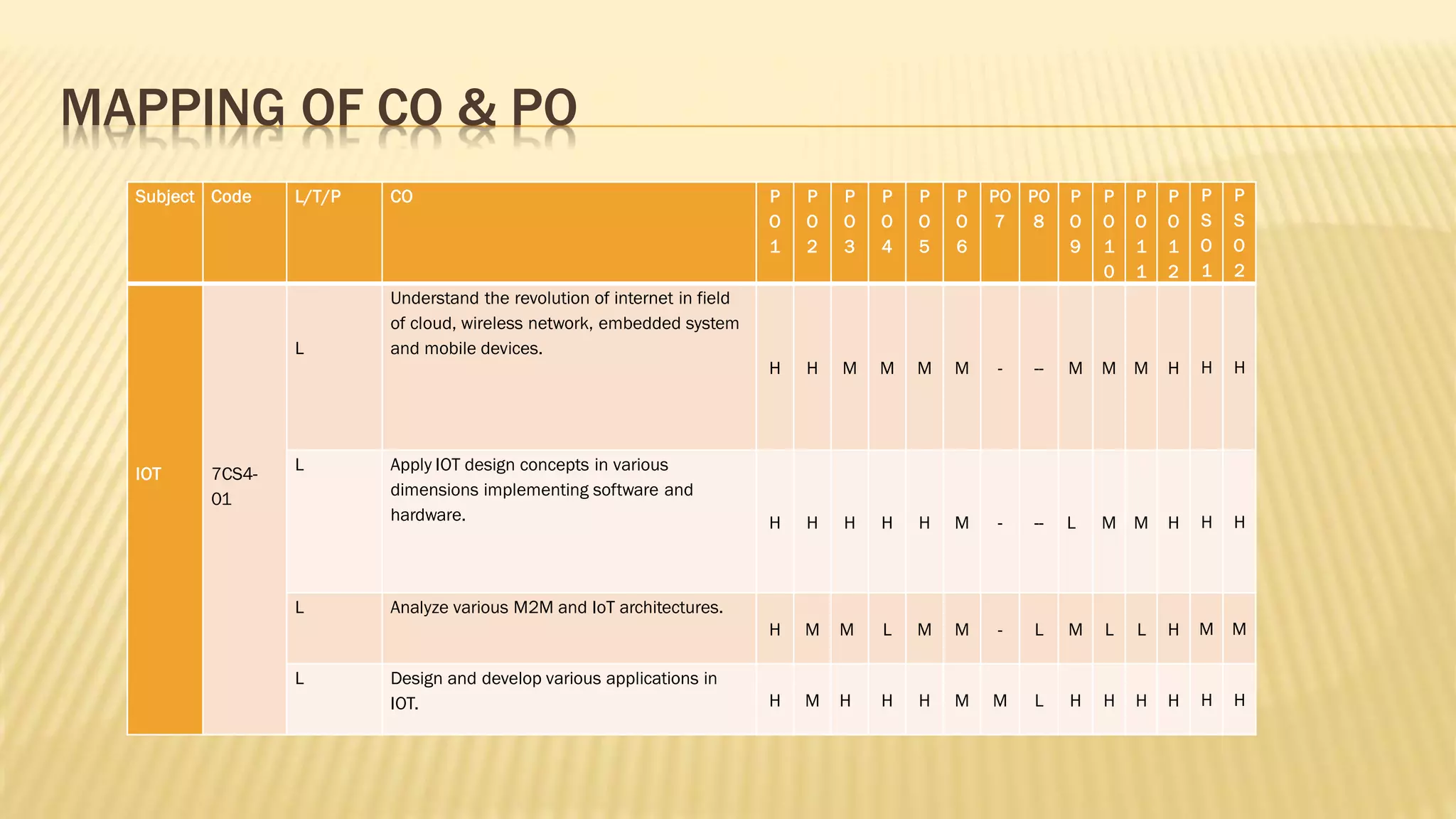
MAPPING OF CO & PO
Subject Code L/T/P CO P
O
1
P
O
2
P
O
3
P
O
4
P
O
5
P
O
6
PO
7
PO
8
P
O
9
P
O
1
0
P
O
1
1
P
O
1
2
P
S
O
1
P
S
O
2
IOT 7CS4-
01
L
Understand the revolution of internet in field
of cloud, wireless network, embedded system
and mobile devices.
H H M M M M - -- M M M H H H
L Apply IOT design concepts in various
dimensions implementing software and
hardware. H H H H H M - -- L M M H H H
L Analyze various M2M and IoT architectures.
H M M L M M - L M L L H M M
L Design and develop various applications in
IOT. H M H H H M M L H H H H H H
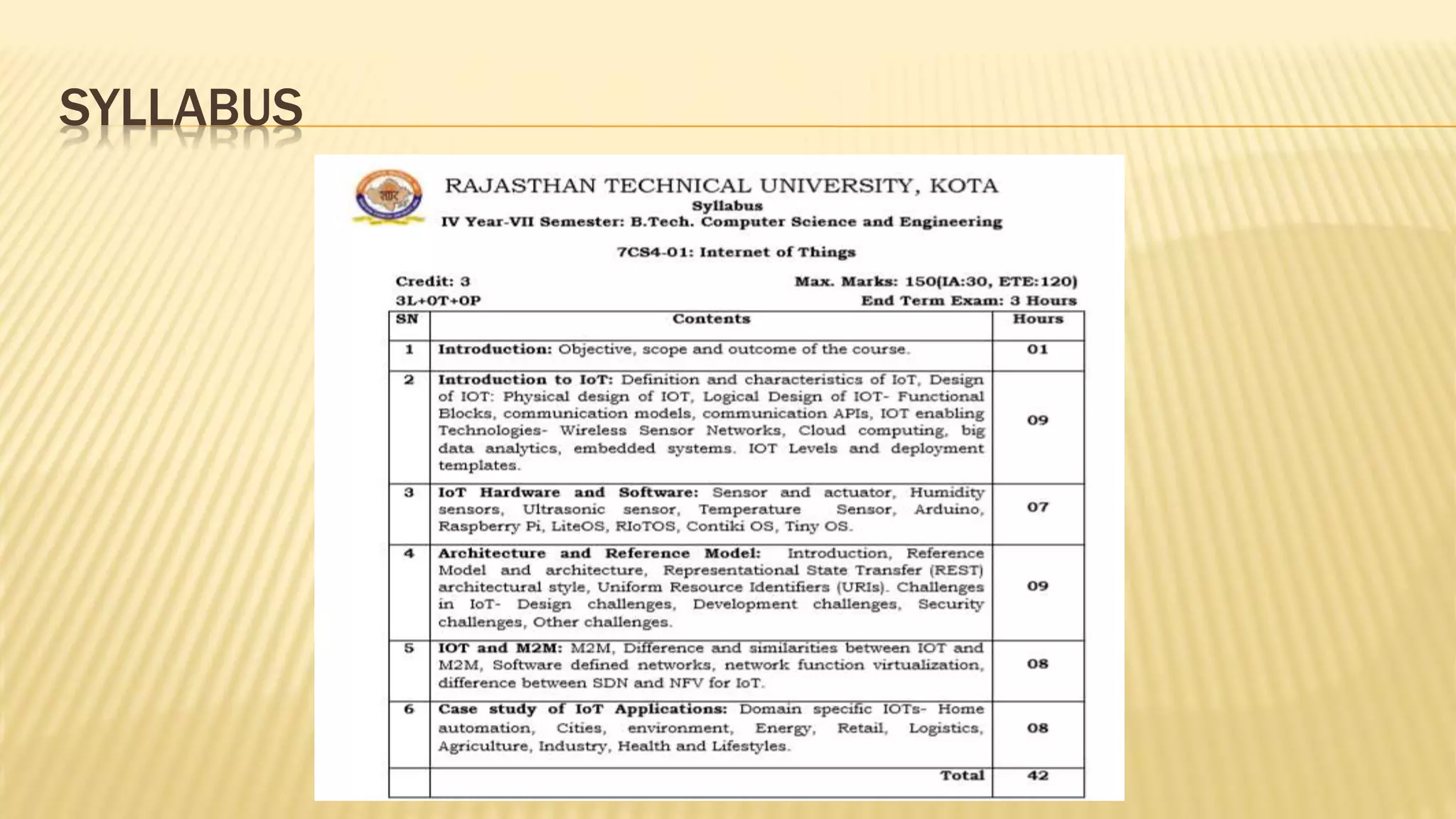
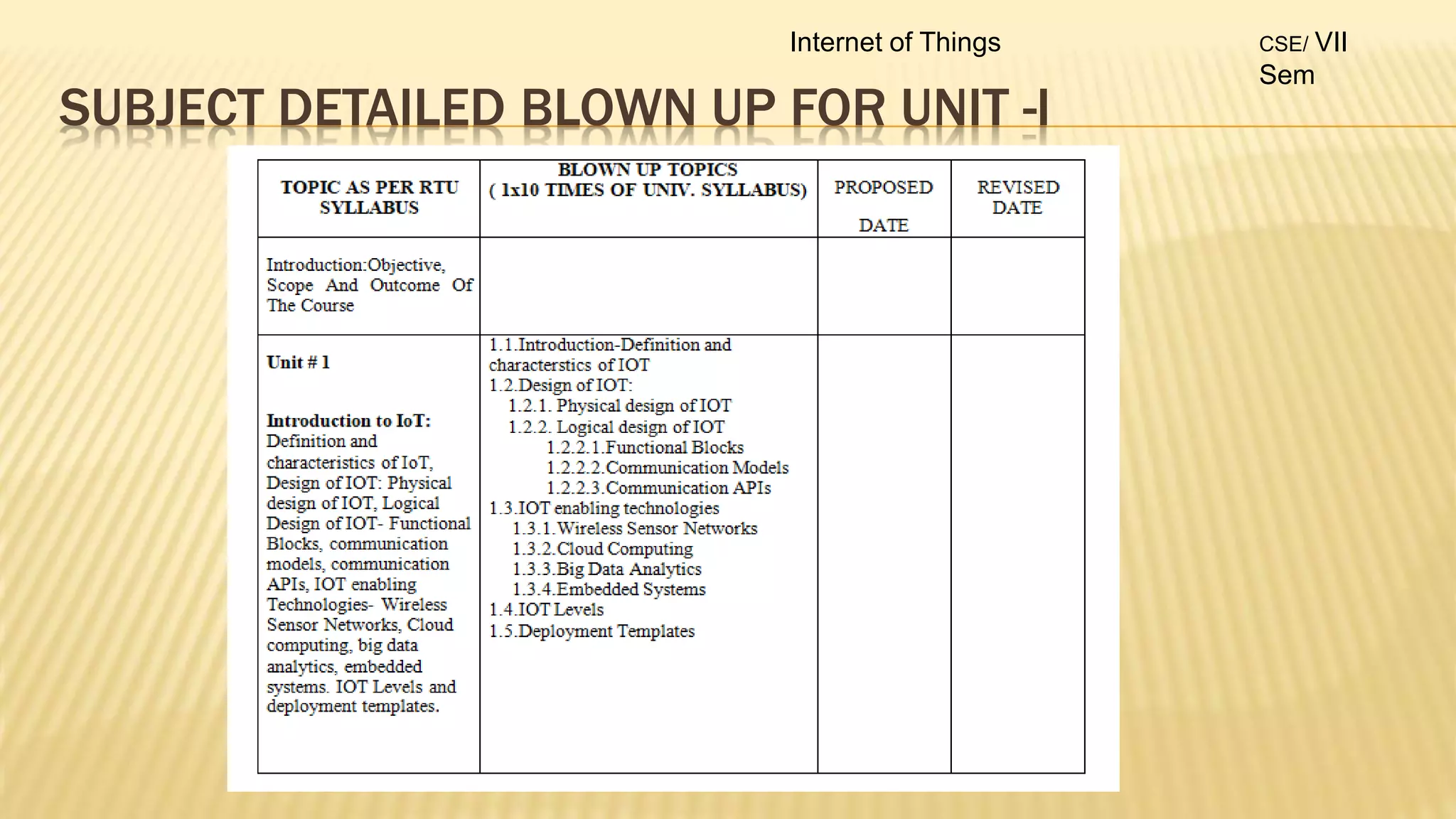
SYLLABUS
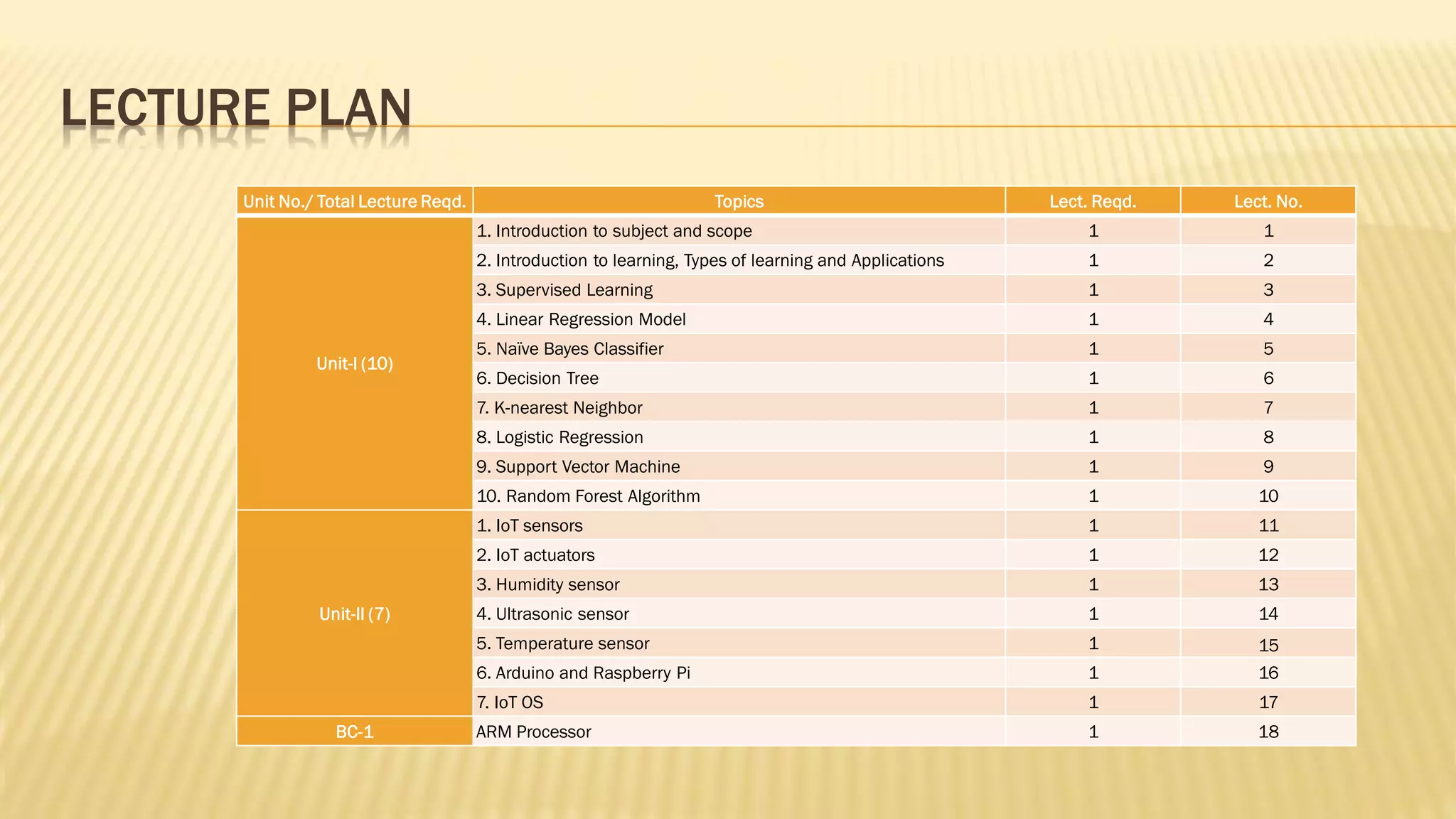
LECTURE PLAN
Unit No./ Total Lecture Reqd. Topics Lect. Reqd. Lect. No.
Unit-I (10)
1. Introduction to subject and scope 1 1
2. Introduction to learning, Types of learning and Applications 1 2
3. Supervised Learning 1 3
4. Linear Regression Model 1 4
5. Naïve Bayes Classifier 1 5
6. Decision Tree 1 6
7. K-nearest Neighbor 1 7
8. Logistic Regression 1 8
9. Support Vector Machine 1 9
10. Random Forest Algorithm 1 10
Unit-II (7)
1. IoT sensors 1 11
2. IoT actuators 1 12
3. Humidity sensor 1 13
4. Ultrasonic sensor 1 14
5. Temperature sensor 1 15
6. Arduino and Raspberry Pi 1 16
7. IoT OS 1 17
BC-1 ARM Processor 1 18
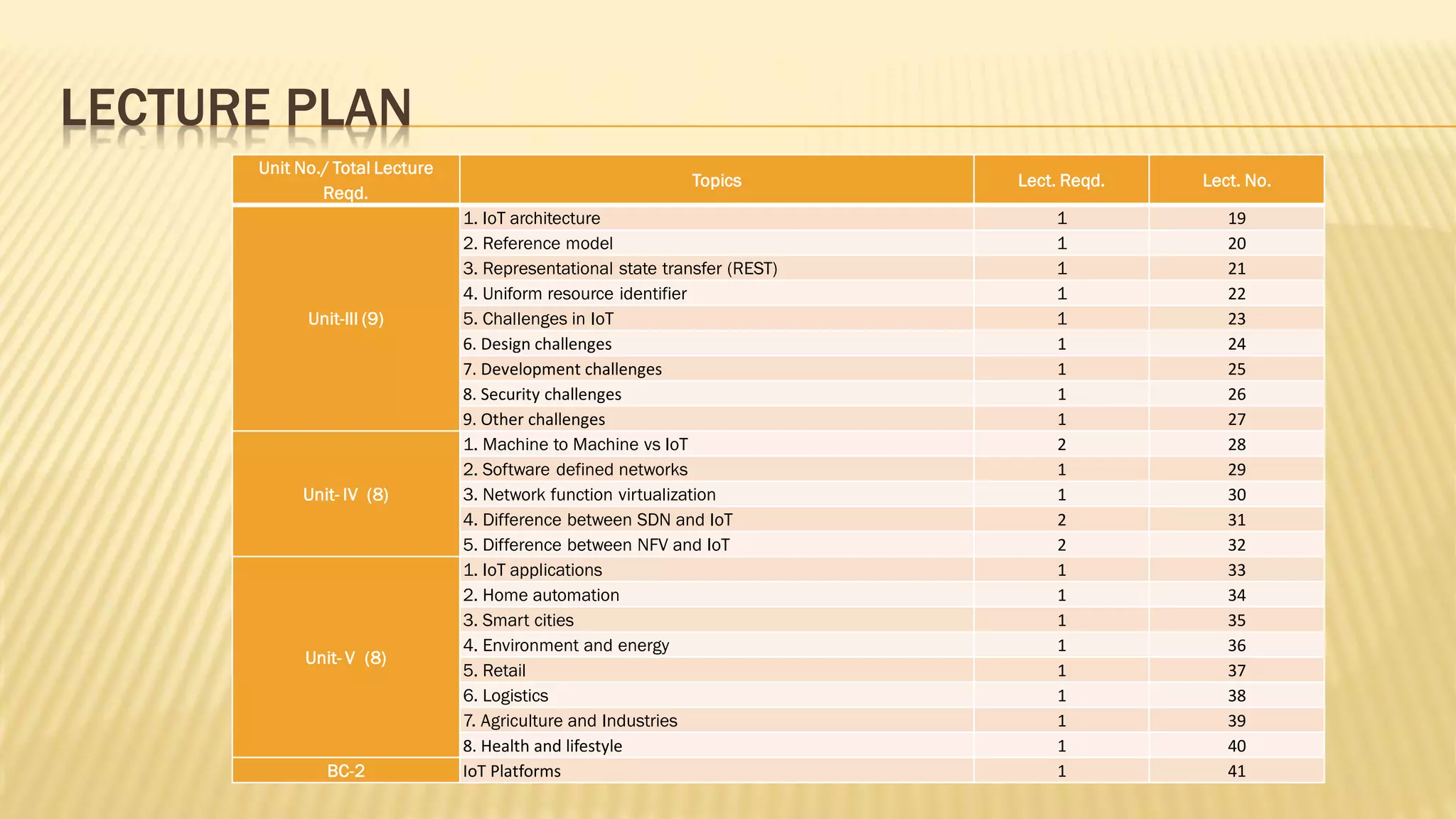
LECTURE PLAN
Unit No./ Total Lecture
Reqd.
Topics Lect. Reqd. Lect. No.
Unit-III (9)
1. IoT architecture 1 19
2. Reference model 1 20
3. Representational state transfer (REST) 1 21
4. Uniform resource identifier 1 22
5. Challenges in IoT 1 23
6. Design challenges 1 24
7. Development challenges 1 25
8. Security challenges 1 26
9. Other challenges 1 27
Unit- IV (8)
1. Machine to Machine vs IoT 2 28
2. Software defined networks 1 29
3. Network function virtualization 1 30
4. Difference between SDN and IoT 2 31
5. Difference between NFV and IoT 2 32
Unit- V (8)
1. IoT applications 1 33
2. Home automation 1 34
3. Smart cities 1 35
4. Environment and energy 1 36
5. Retail 1 37
6. Logistics 1 38
7. Agriculture and Industries 1 39
8. Health and lifestyle 1 40
BC-2 IoT Platforms 1 41
RECOMMENDED BOOKS
• T1 :- “Vijay Madisetti and Arshdeep Bahga, “Internet of Things (A Hands-on-
Approach), 1st Edition, VPT, 2014”.
• T2 :- “Jan Holler , Vlasios Tsiatsis, Catherine Mulligan, Stefan Avesand, Stamatis
Karnouskos, David Boyle, “From Machine-to-Machine to the Internet of Things:
Introduction to a New Age of Intelligence”,1st Edition, Academic Press, 2014”.
• T3 :- “Getting Started with Raspberry Pi, Matt Richardson & Shawn Wallace,
O’Reilly (SPD), 2014, ISBN: 9789350239759”.
• T4:- “Michael Margolis, “Arduino Cookbook”, 2nd edition, O’Reilly, 2012”.
Internet of Things CSE/ VII
Sem
SUBJECT DETAILED BLOWN UP FOR UNIT -I
Internet of Things CSE/ VII
Sem
BEFORE UNIT I WE FIRST DISCUSSED
• IoT and its definition
• History
• How IOT works
• Lifecycle
• Characteristics of IoT
• What internet of things do?
• How many IOT devices are today?
• Applications
• Real life applications
• Future with IOT
Internet of Things CSE/ VII
Sem
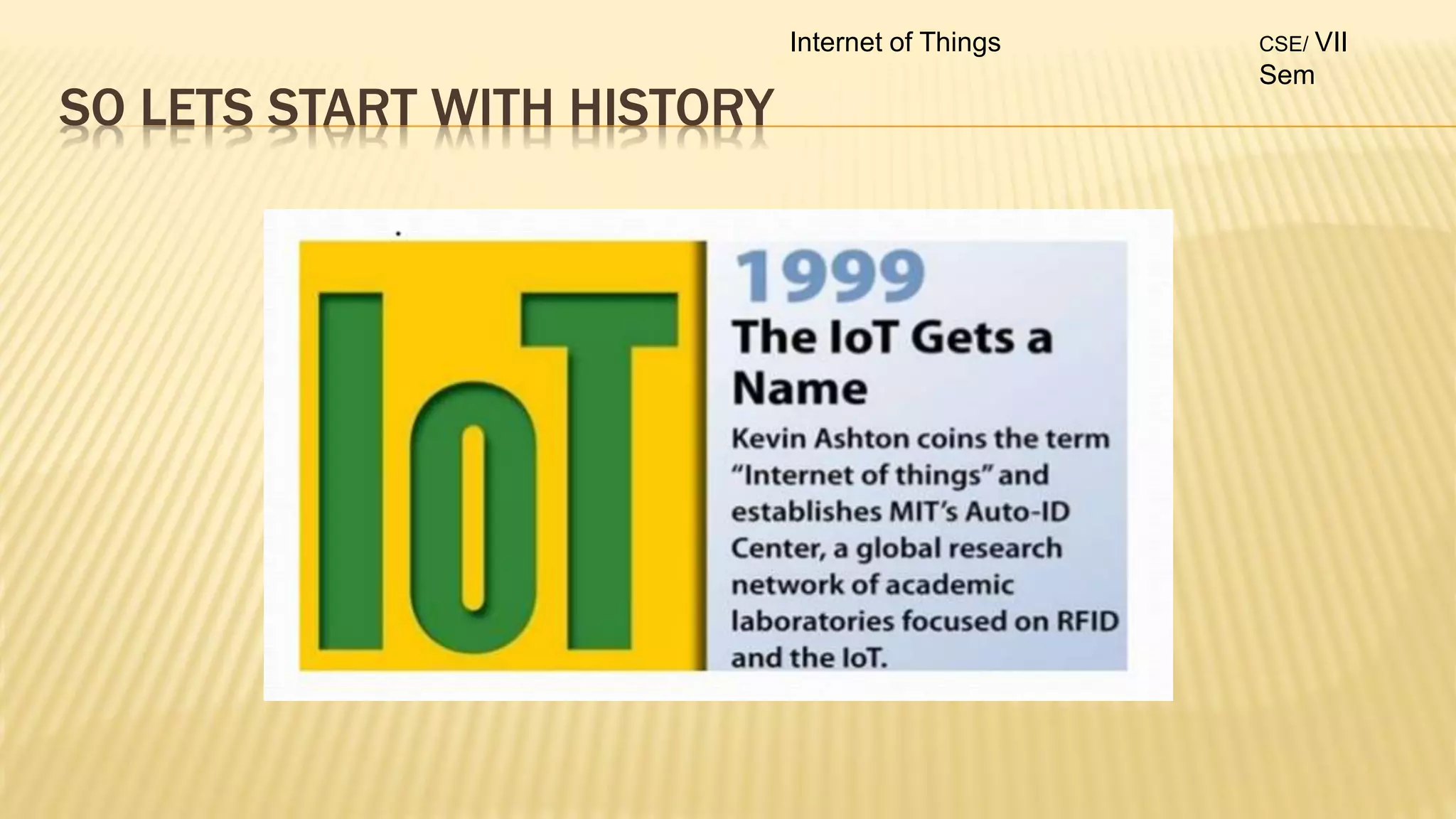
SO LETS START WITH HISTORY
Internet of Things CSE/ VII
Sem
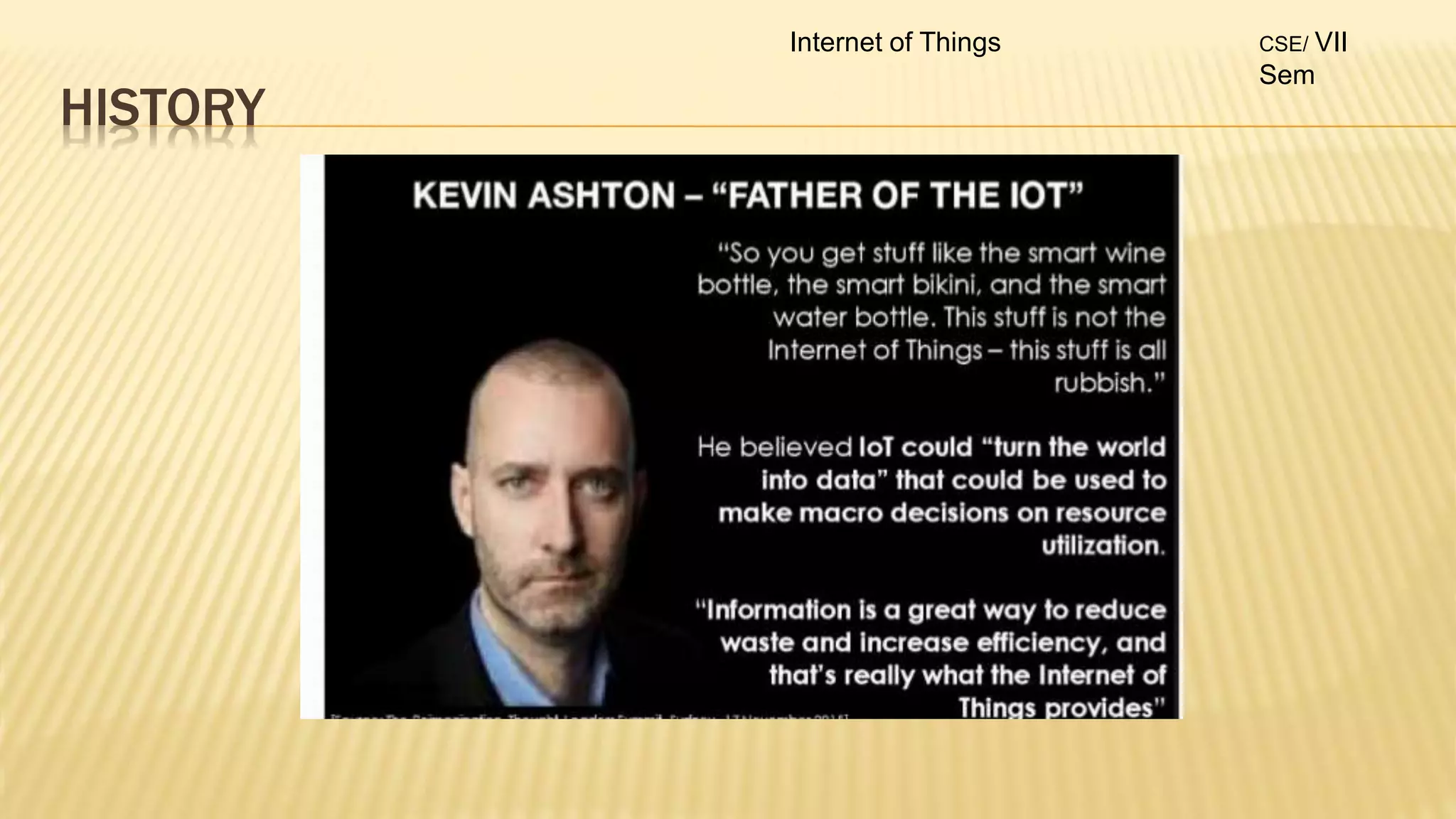
HISTORY
Internet of Things CSE/ VII
Sem
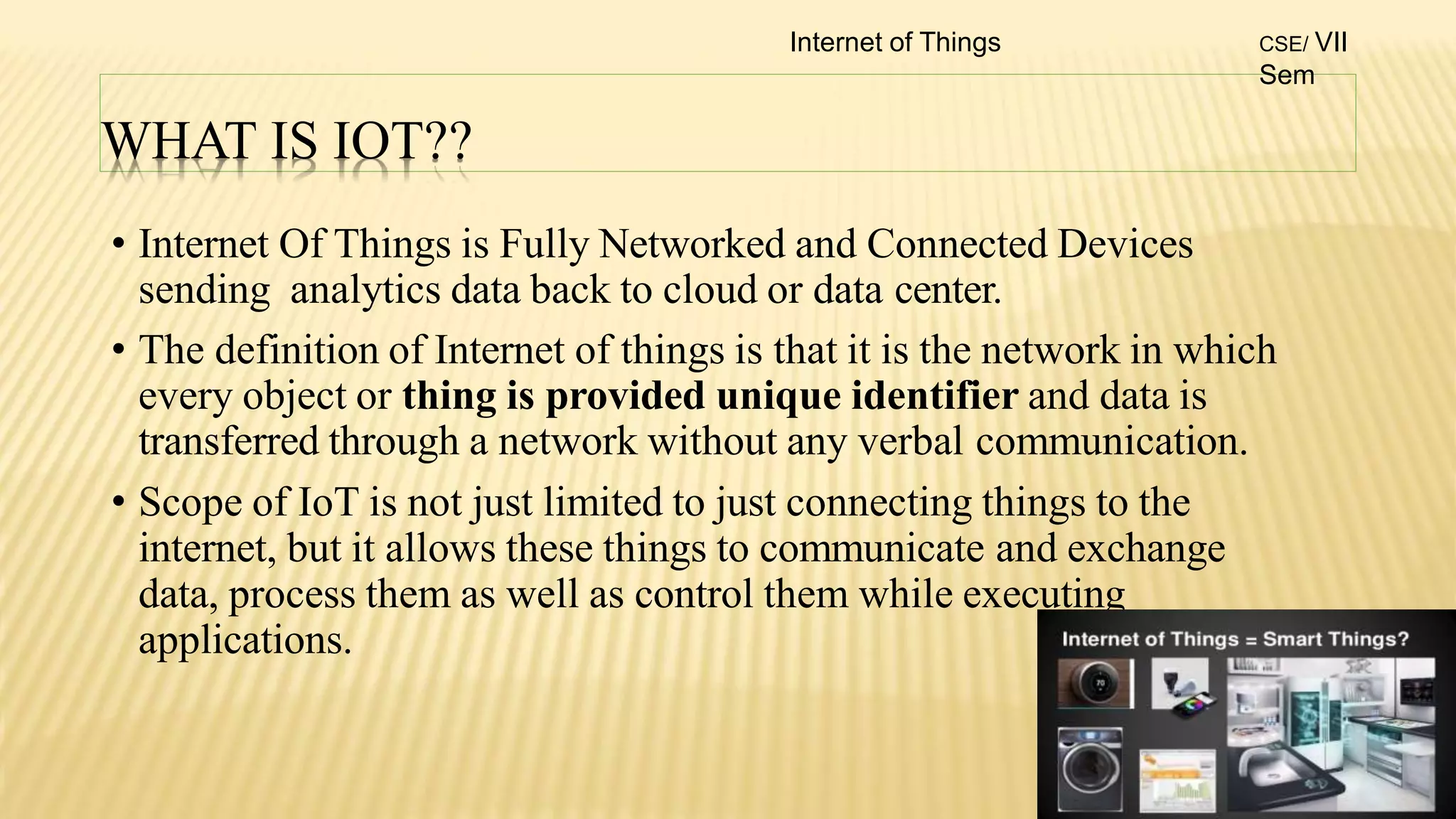
WHAT IS IOT??
• Internet Of Things is Fully Networked and Connected Devices
sending analytics data back to cloud or data center.
• The definition of Internet of things is that it is the network in which
every object or thing is provided unique identifier and data is
transferred through a network without any verbal communication.
• Scope of IoT is not just limited to just connecting things to the
internet, but it allows these things to communicate and exchange
data, process them as well as control them while executing
applications.
Internet of Things CSE/ VII
Sem
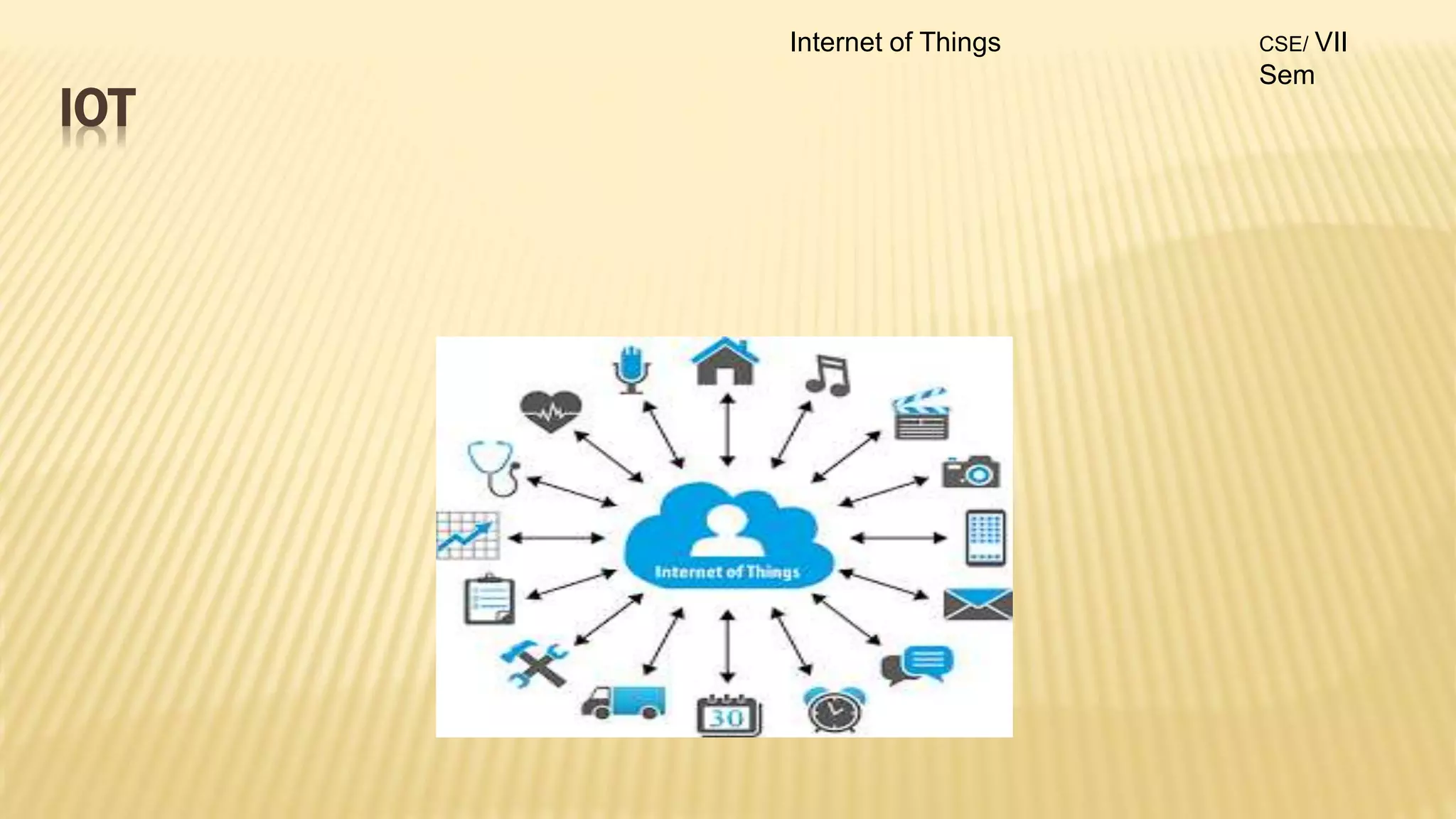
IOT
Internet of Things CSE/ VII
Sem
FORMAL DEFINITION OF IOT
• The Internet of Things (IoT) is the network of physical objects or
"things" embedded with electronics, software, sensors, and network
connectivity, which enables these objects to collect and exchange data.
Internet of Things CSE/ VII
Sem
HOW IOT WORKS??
• Internet of Things (IoT), also sometimes referred to as the Internet of
Everything (IoE), consists of all the web-enabled devices that collect, send and
act on data they acquire from their surrounding environments using embedded
sensors, processors and communication hardware.
• These devices, often called "connected" or "smart" devices, can sometimes talk
to other related devices, a process called machine-to-machine (M2M)
communication, and act on the information they get from one another.
• Humans can interact with the gadgets to set them up, give them instructions or
access the data, but the devices do most of the work on their own without
human intervention.
Internet of Things CSE/ VII
Sem
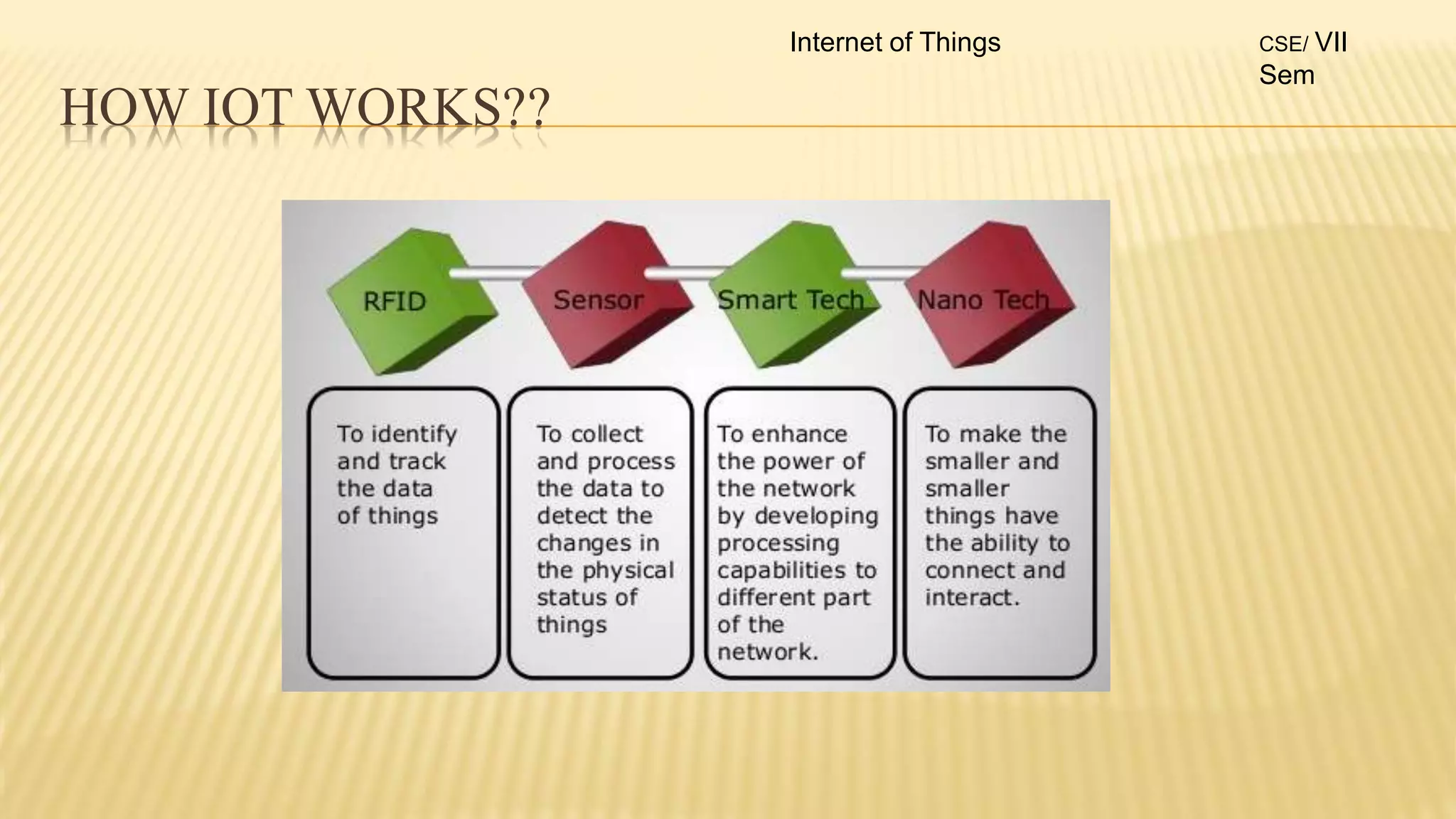
HOW IOT WORKS??
Internet of Things CSE/ VII
Sem
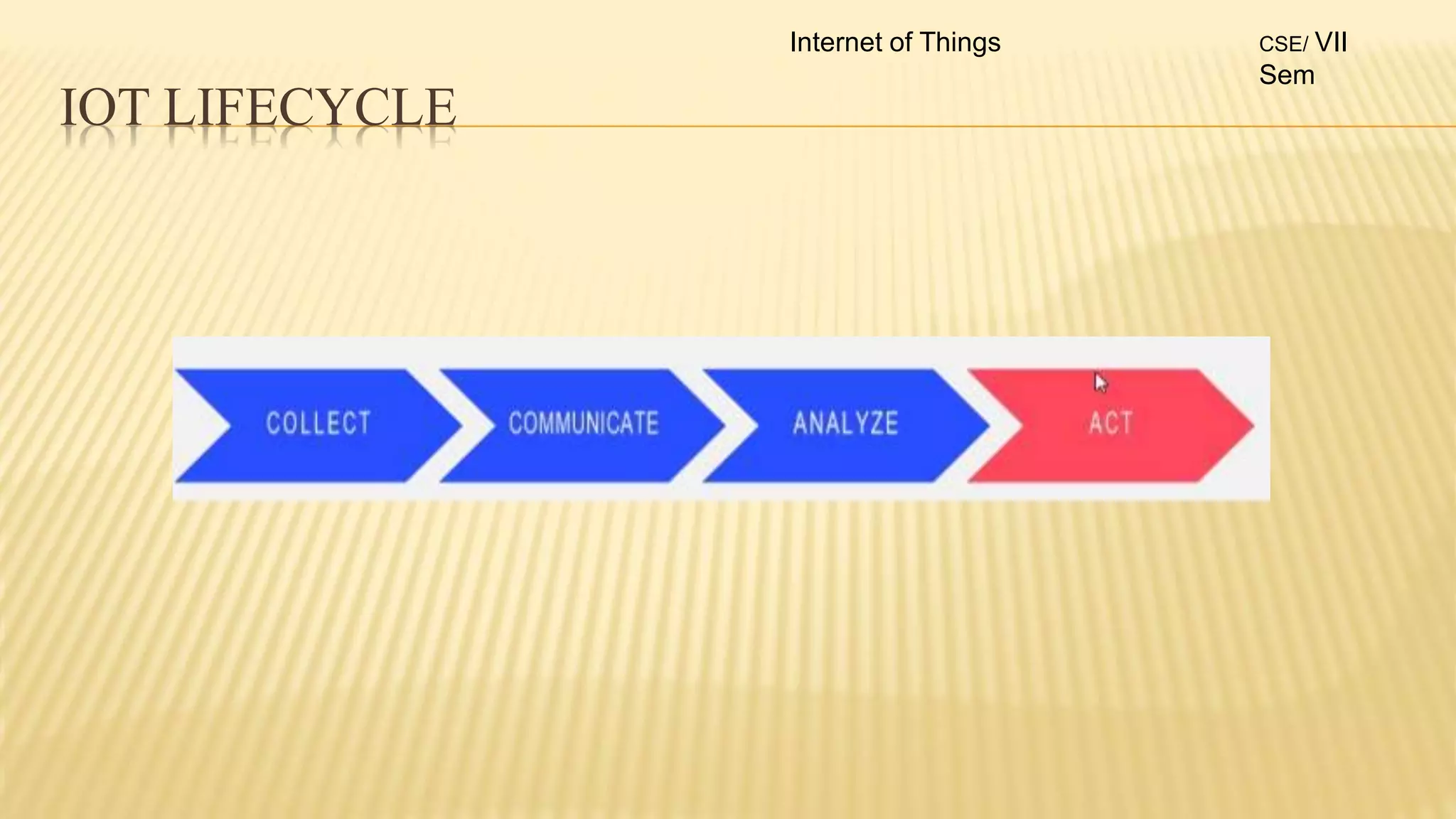
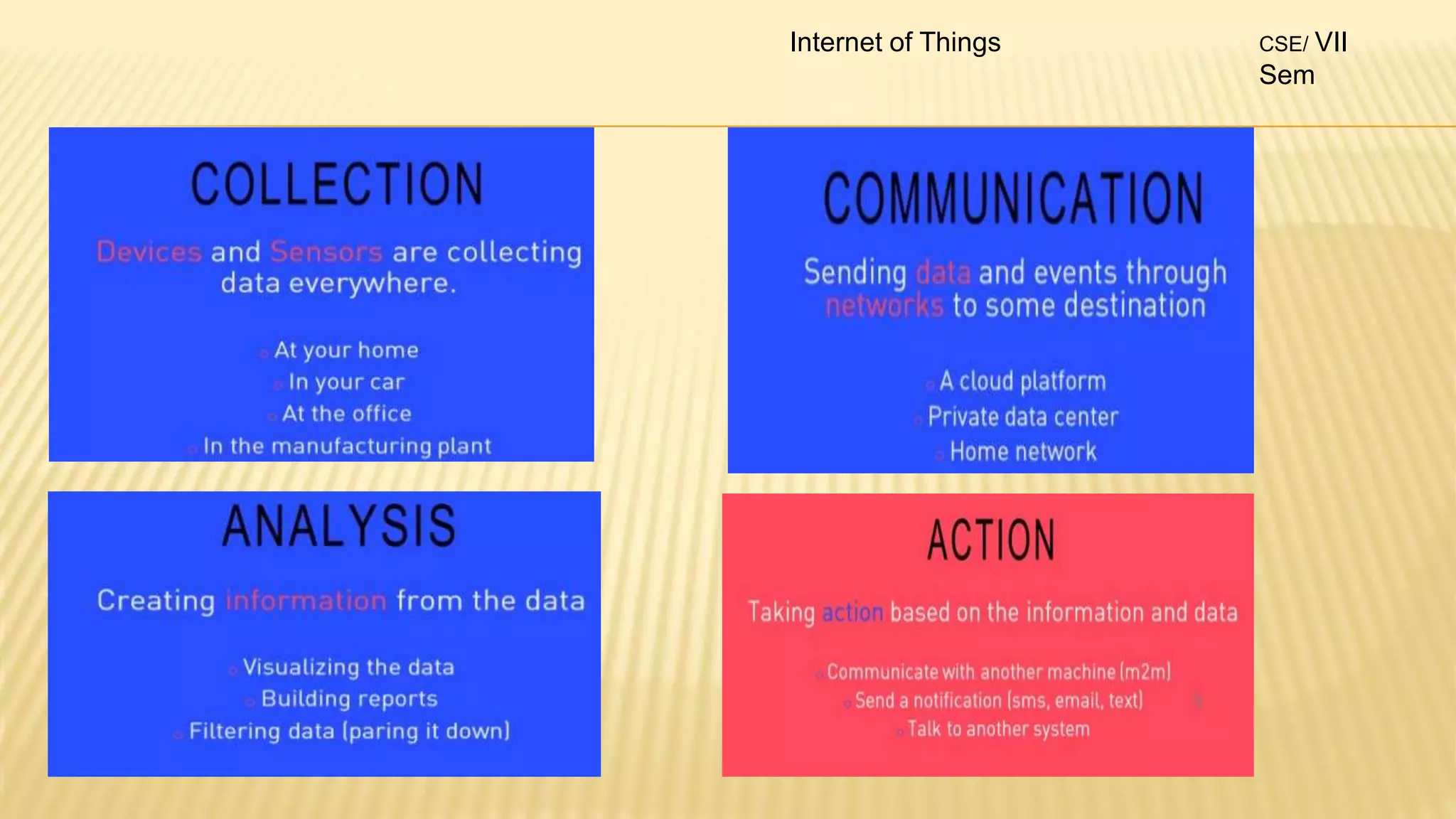
IOT LIFECYCLE
Internet of Things CSE/ VII
Sem
Internet of Things CSE/ VII
Sem
CHARACTERISTICS OF IOT
• Dynamic Global network & Self-Adapting : Adapt the changes
w.r.t changing contexts
• Self Configuring : Eg. Fetching latest s/w updates without manual
intervention.
• Interoperable Communication Protocols : Communicate
through various protocols
• Unique Identity : Such as Unique IP Address or a URI
• Integrated into Information Network : This allows to
communicate and exchange data with other devices to perform
certain analysis.
Internet of Things CSE/ VII
Sem
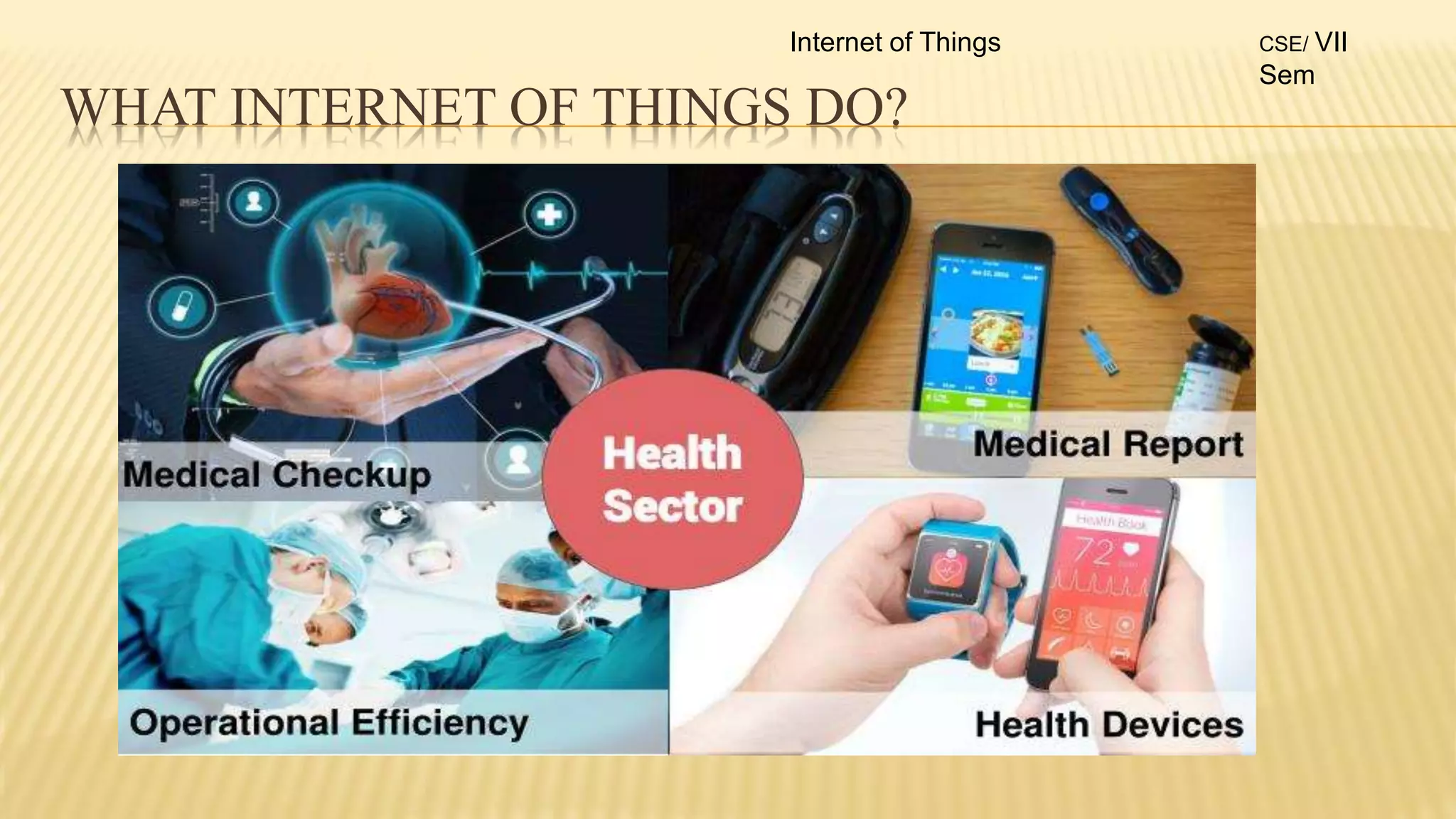
WHAT INTERNET OF THINGS DO?
Internet of Things CSE/ VII
Sem
Internet of Things CSE/ VII
Sem
HOW MANY IOT DEVICES ARE THERE TODAY?
• In the year 2017 there were 8.4 billion IoT connected devices in the
whole worldwide.
• While in the year 2018 it increased to 9.2 Billion.
• It is expected that in the year 2020 the IoT connected devices in
the worldwide would be 20.8 Billion.
Internet of Things CSE/ VII
Sem
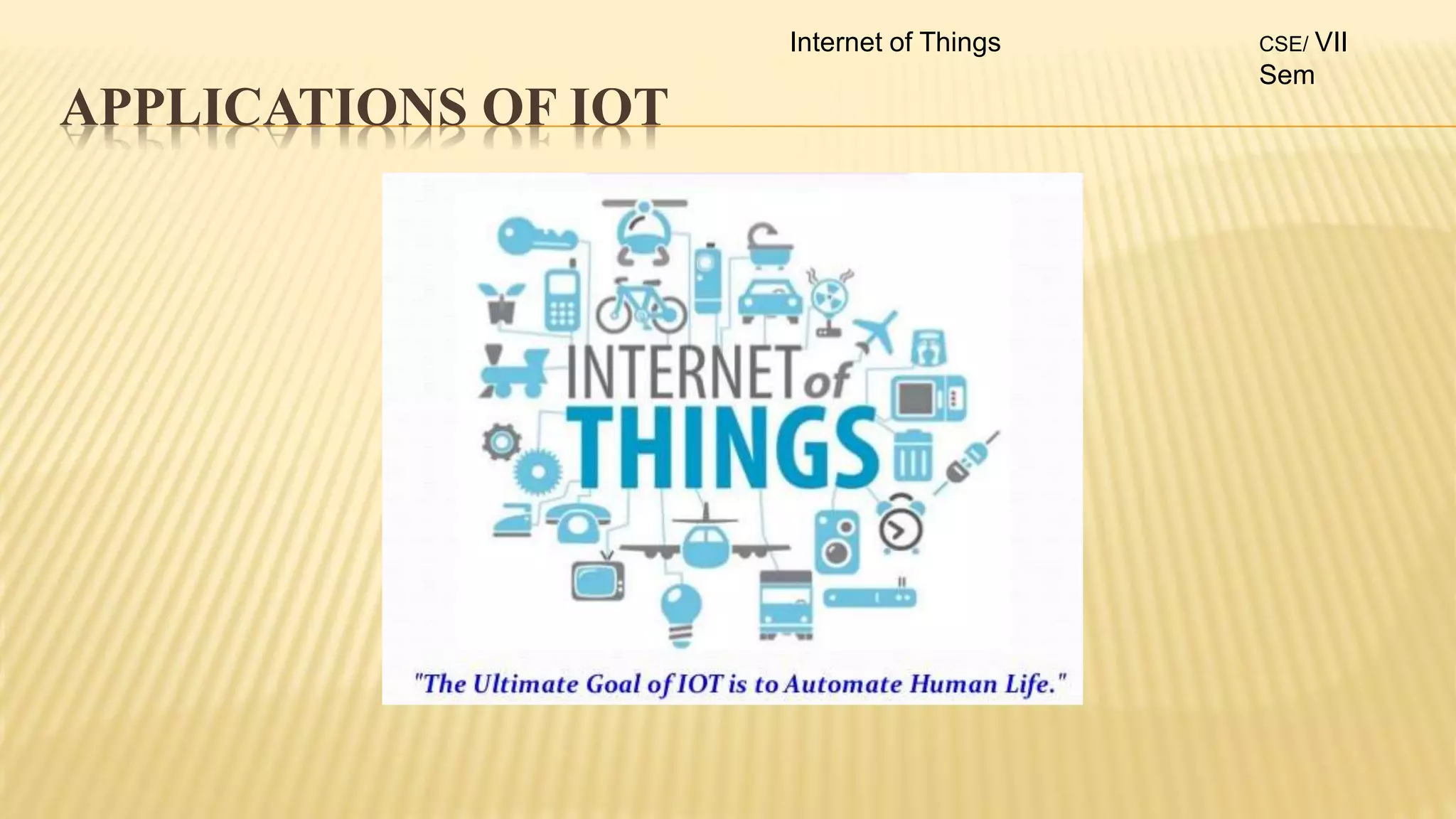
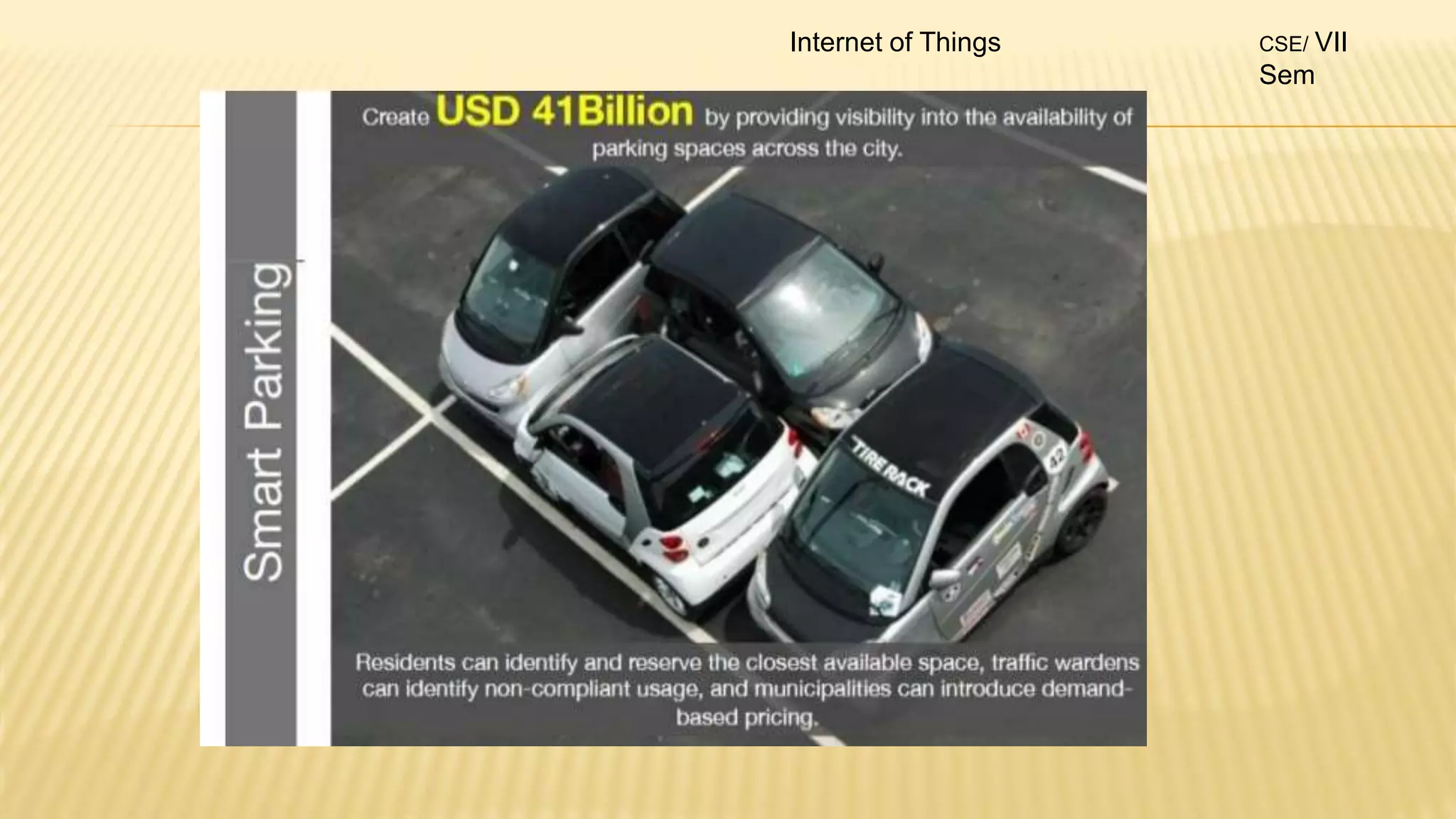
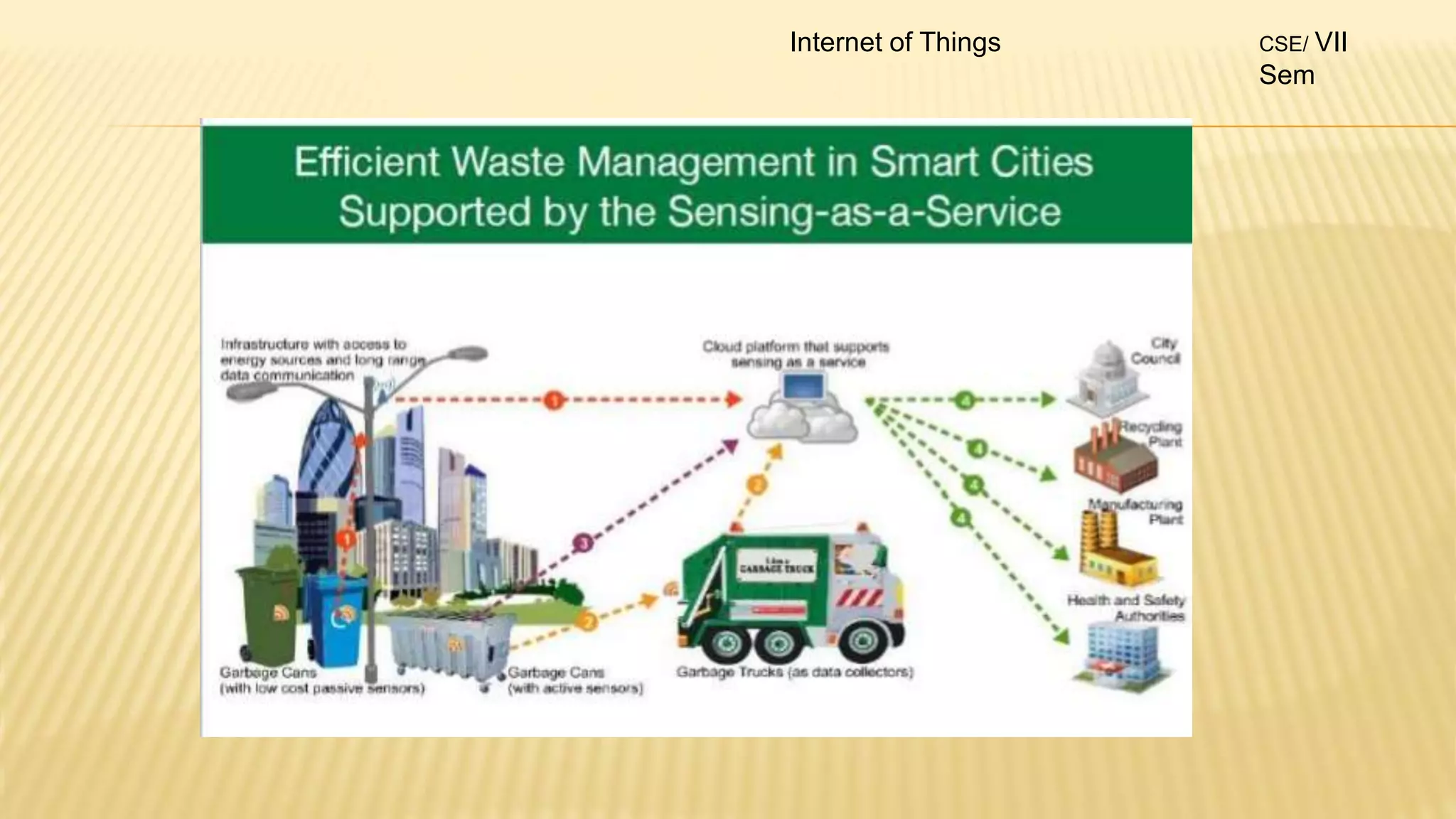
APPLICATIONS OF IOT
Internet of Things CSE/ VII
Sem
Internet of Things CSE/ VII
Sem
Internet of Things CSE/ VII
Sem
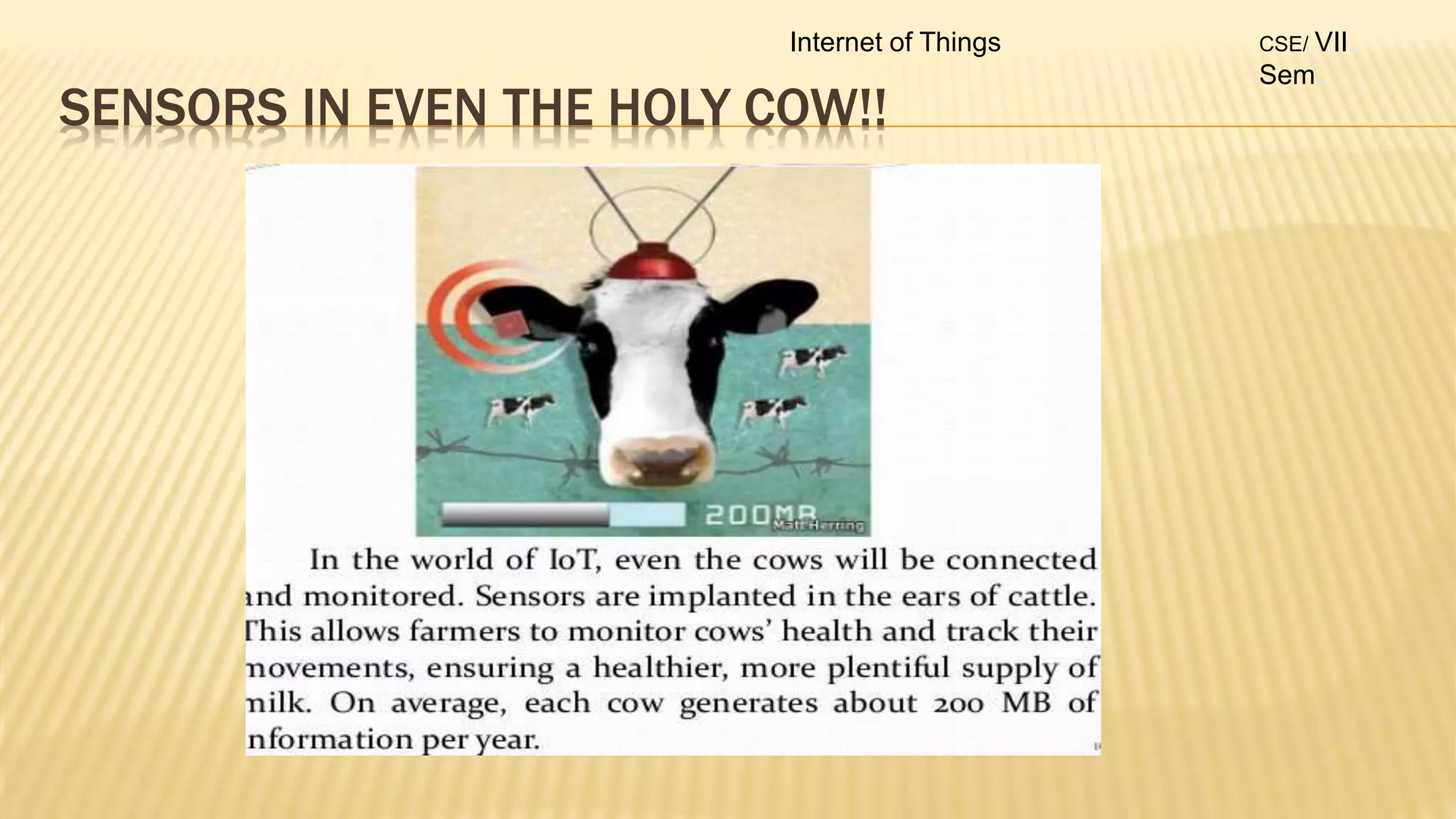
SENSORS IN EVEN THE HOLY COW!!
Internet of Things CSE/ VII
Sem
Internet of Things CSE/ VII
Sem
THINGS IN IOT
• Refers to IoT devices which have unique identities that can perform
sensing, actuating and monitoring capabilities.
• IoT devices can exchange data with other connected devices or collect
data from other devices and process the data either locally or send the
data to centralized servers or cloud – based application back-ends for
processing the data.
Internet of Things CSE/ VII
Sem
GENERIC BLOCK DIAGRAM OF AN IOT
DEVICE
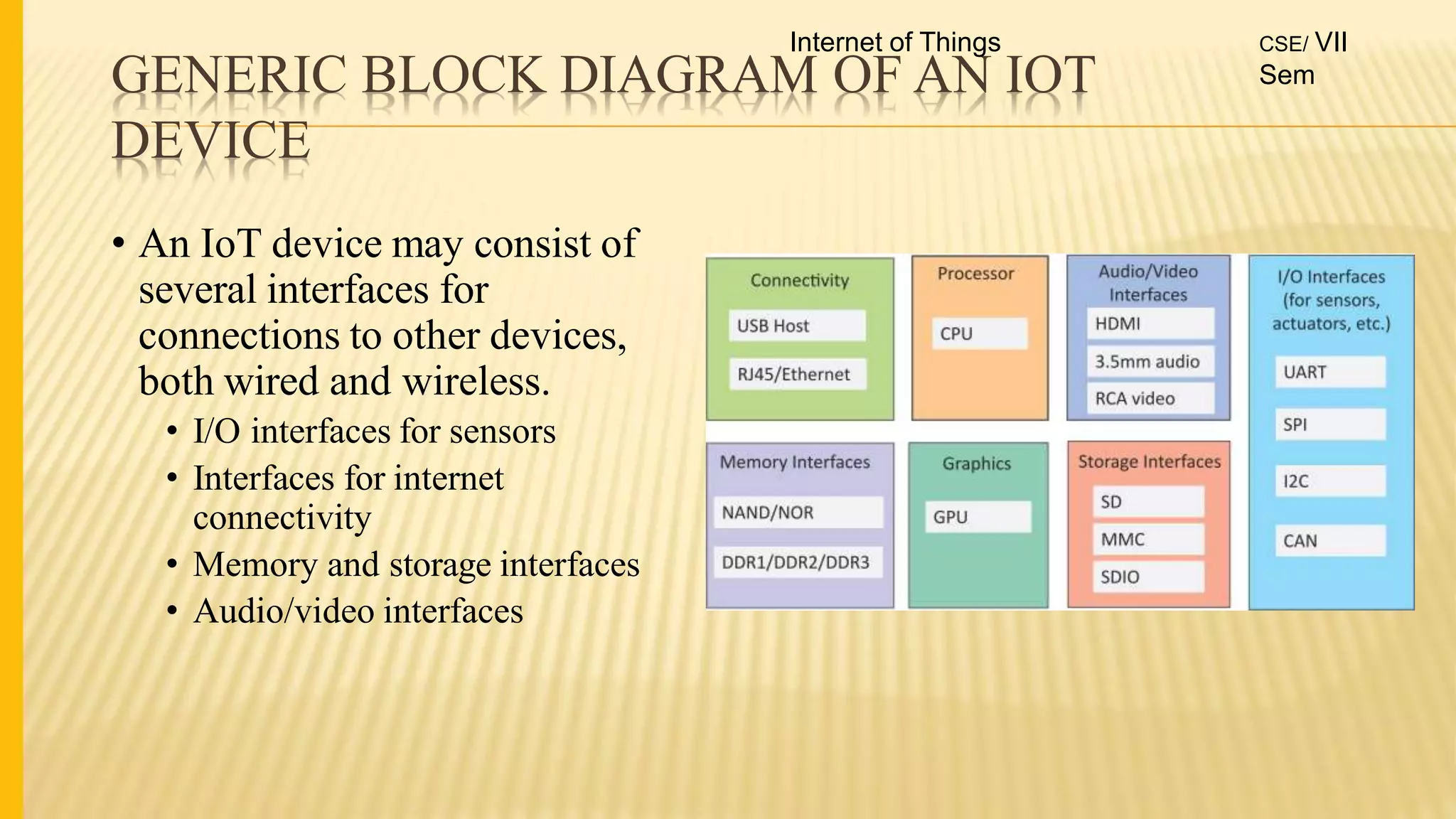
• An IoT device may consist of
several interfaces for
connections to other devices,
both wired and wireless.
• I/O interfaces for sensors
• Interfaces for internet
connectivity
• Memory and storage interfaces
• Audio/video interfaces
Internet of Things CSE/ VII
Sem
FUTURE WITH IOT
• Internet of Things Wearable devices is the future. You can control your car with a smart watch like
automatically parking it and for closing or to open the doors.
• Your wearable device may also detect the dangers around you. We already have devices that track our
activity and exercise habits.
• In the near future, we may also be able to easily track our calorie intake and eating habits automatically. So
everything is going to be easy except that making everything easy is tough.
• Here are some examples of IoT wearable devices that are already available in the market.
1. Sync Smart band Activity Tracker
2. Fitbit Surge Smart Watch
3. Hicon Wearable Smart Bracelet
4. Beddit Sleep tracker
Internet of Things CSE/ VII
Sem
PHYSICAL DESIGN OF IOT
• IOT
Protocols
• Things in
IOT
Internet of Things CSE/ VII
Sem
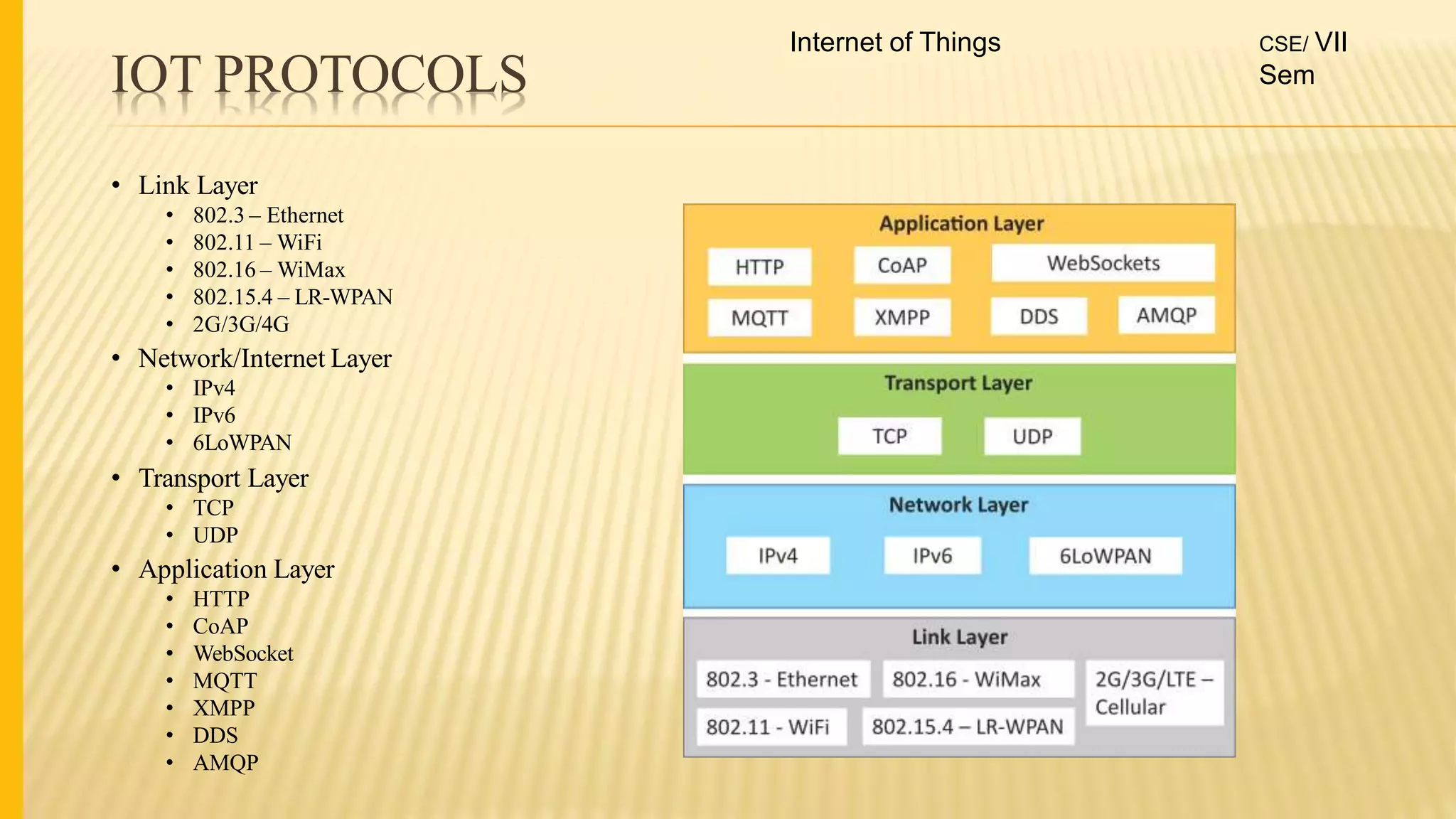
IOT PROTOCOLS
• Link Layer
• 802.3 – Ethernet
• 802.11 – WiFi
• 802.16 – WiMax
• 802.15.4 – LR-WPAN
• 2G/3G/4G
• Network/Internet Layer
• IPv4
• IPv6
• 6LoWPAN
• Transport Layer
• TCP
• UDP
• Application Layer
• HTTP
• CoAP
• WebSocket
• MQTT
• XMPP
• DDS
• AMQP
Internet of Things CSE/ VII
Sem
IOT PROTOCOLS…LINK LAYER…ETHERNET
Sr.No Standard Shared medium
1 802.3 Coaxial Cable…10BASE5
2 802.3.i Copper Twisted pair …..10BASE-T
3 802.3.j Fiber Optic……10BASE-F
4 802.3.ae Fiber…..10Gbits/s
Data Rates are provided from 10Gbit/s to 40Gb/s and higher
Internet of Things CSE/ VII
Sem
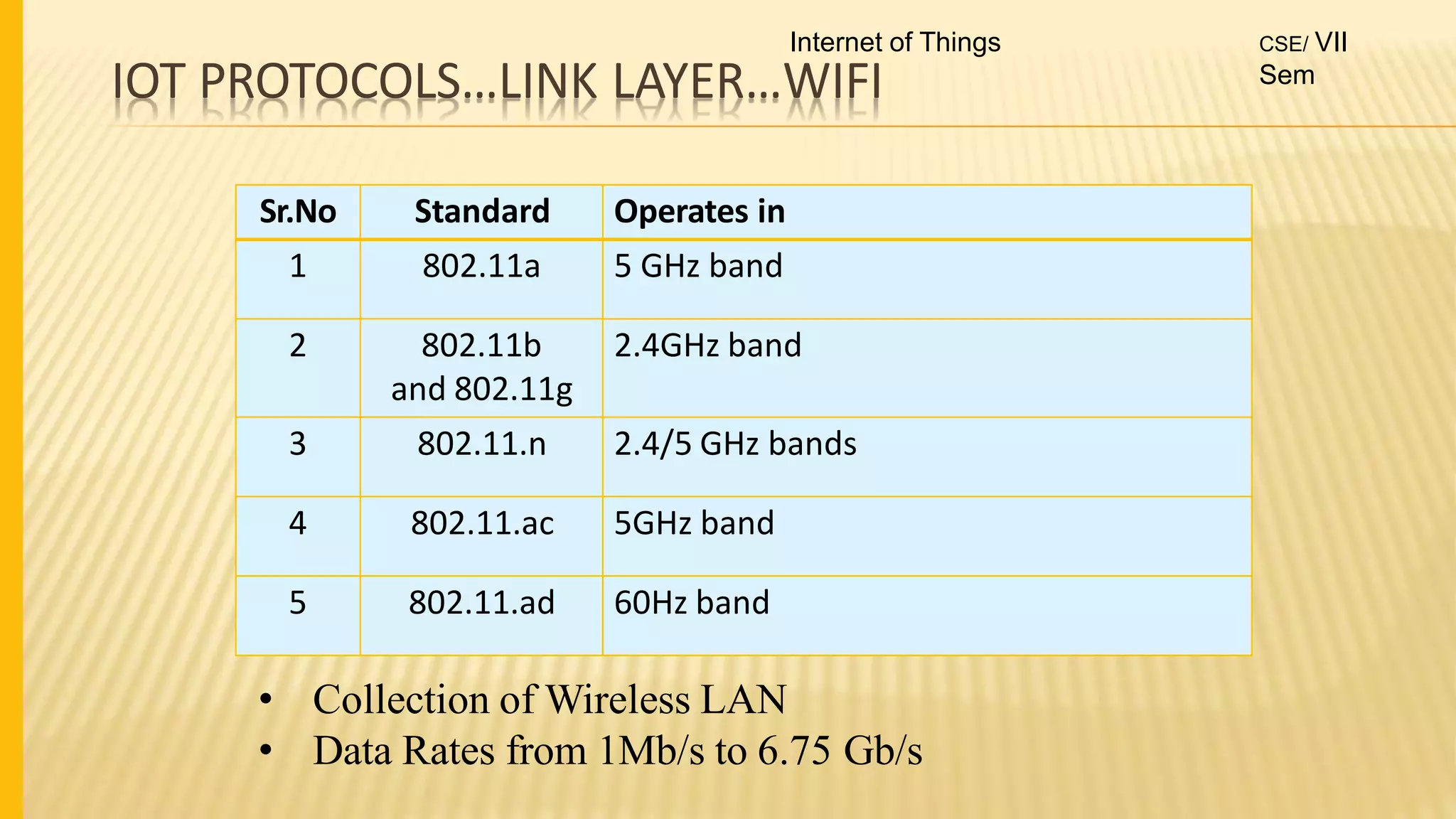
IOT PROTOCOLS…LINK LAYER…WIFI
Sr.No Standard Operates in
1 802.11a 5 GHz band
2 802.11b
and 802.11g
2.4GHz band
3 802.11.n 2.4/5 GHz bands
4 802.11.ac 5GHz band
5 802.11.ad 60Hz band
• Collection of Wireless LAN
• Data Rates from 1Mb/s to 6.75 Gb/s
Internet of Things CSE/ VII
Sem
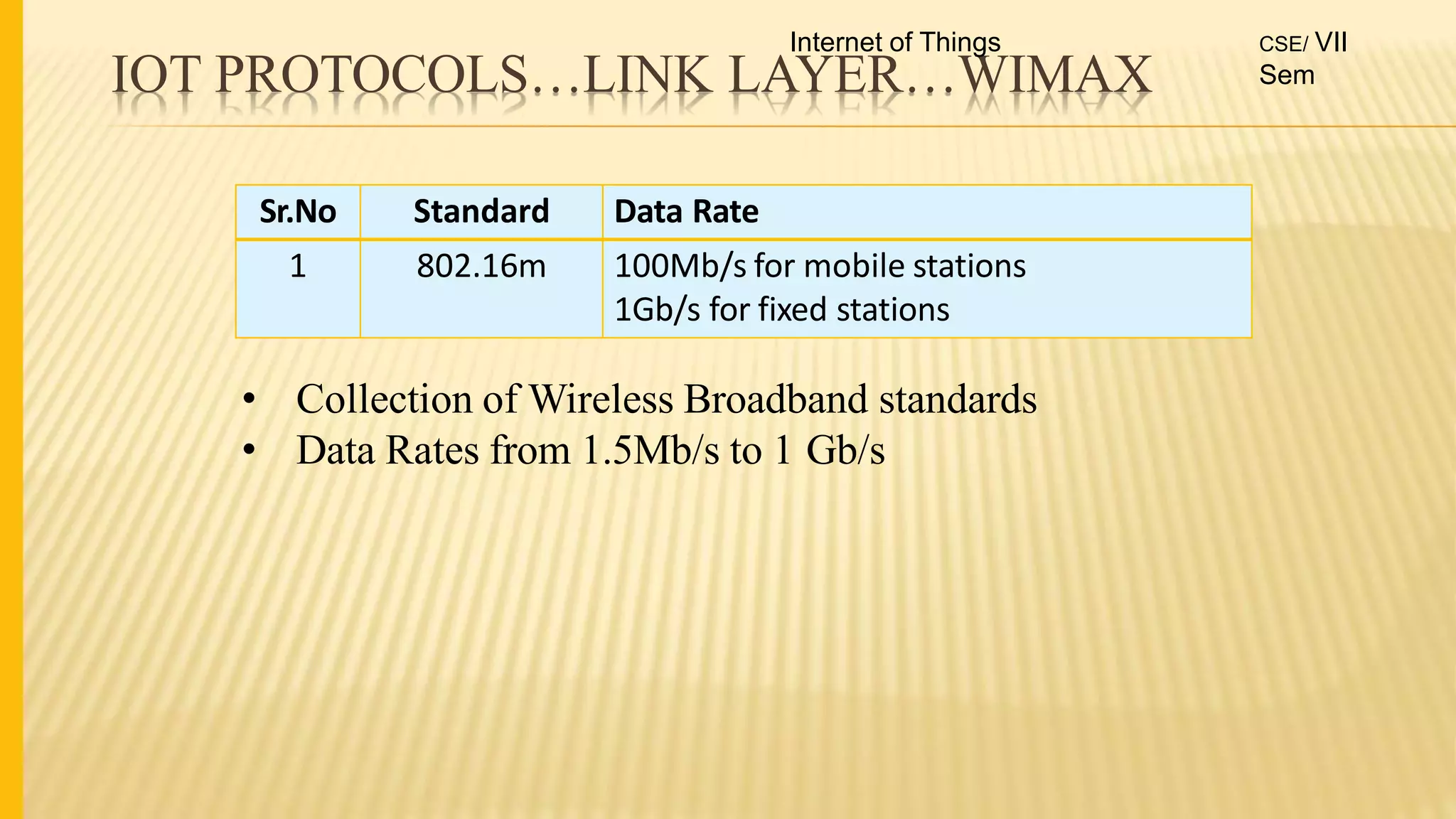
IOT PROTOCOLS…LINK LAYER…WIMAX
Sr.No Standard Data Rate
1 802.16m 100Mb/s for mobile stations
1Gb/s for fixed stations
• Collection of Wireless Broadband standards
• Data Rates from 1.5Mb/s to 1 Gb/s
Internet of Things CSE/ VII
Sem
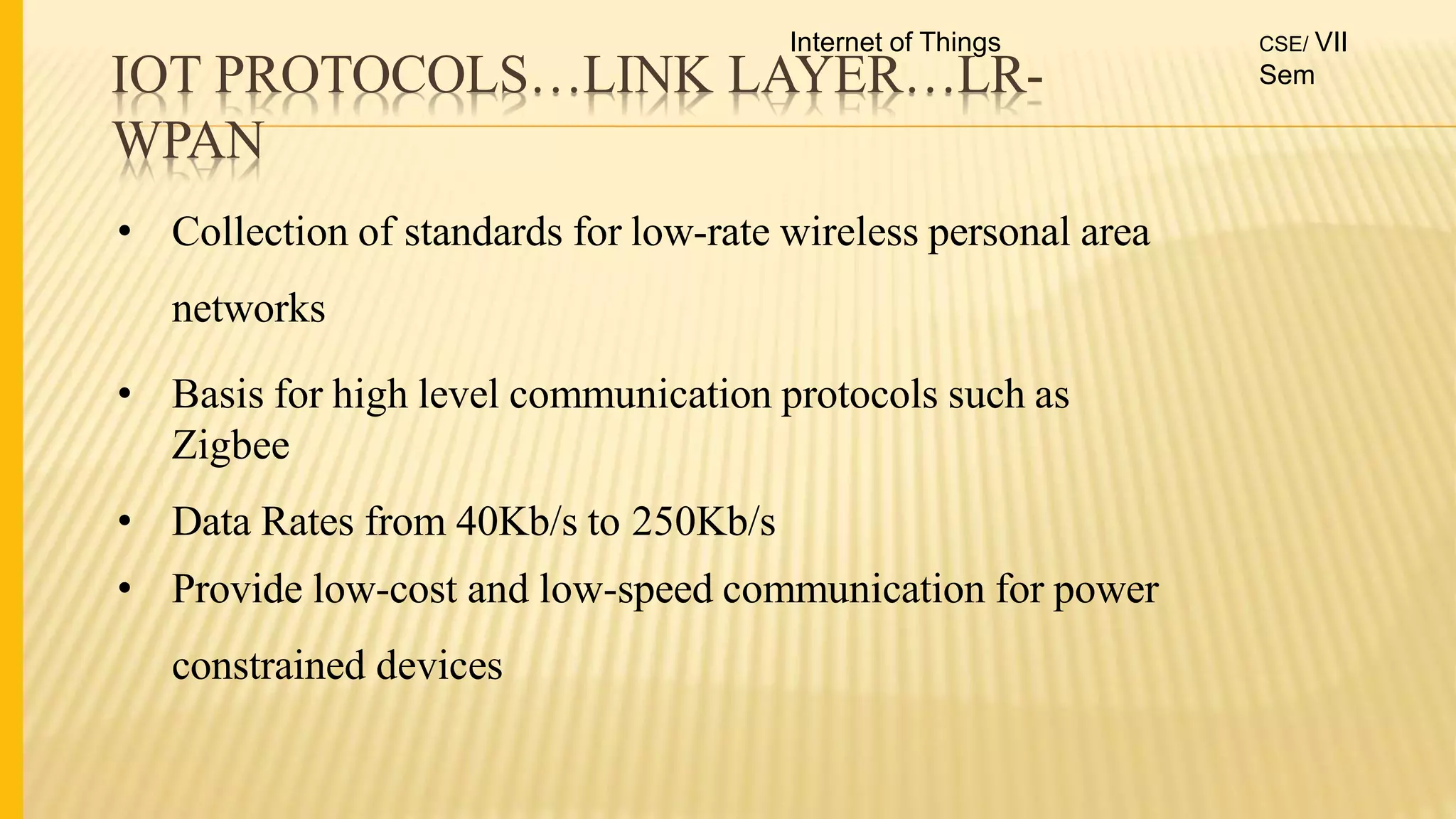
IOT PROTOCOLS…LINK LAYER…LR-
WPAN
• Collection of standards for low-rate wireless personal area
networks
• Basis for high level communication protocols such as
Zigbee
• Data Rates from 40Kb/s to 250Kb/s
• Provide low-cost and low-speed communication for power
constrained devices
Internet of Things CSE/ VII
Sem
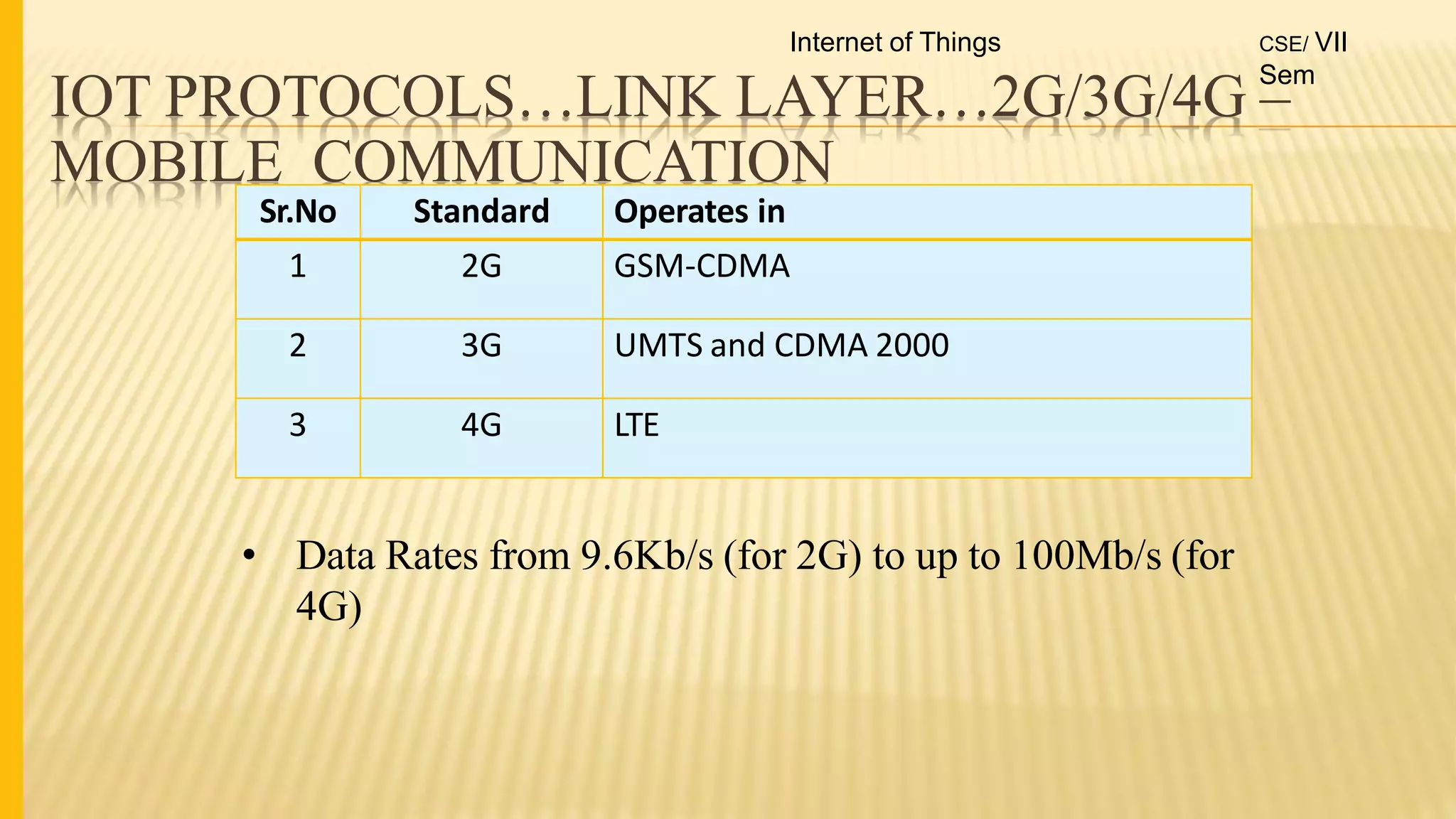
IOT PROTOCOLS…LINK LAYER…2G/3G/4G –
MOBILE COMMUNICATION
Sr.No Standard Operates in
1 2G GSM-CDMA
2 3G UMTS and CDMA 2000
3 4G LTE
• Data Rates from 9.6Kb/s (for 2G) to up to 100Mb/s (for
4G)
Internet of Things CSE/ VII
Sem
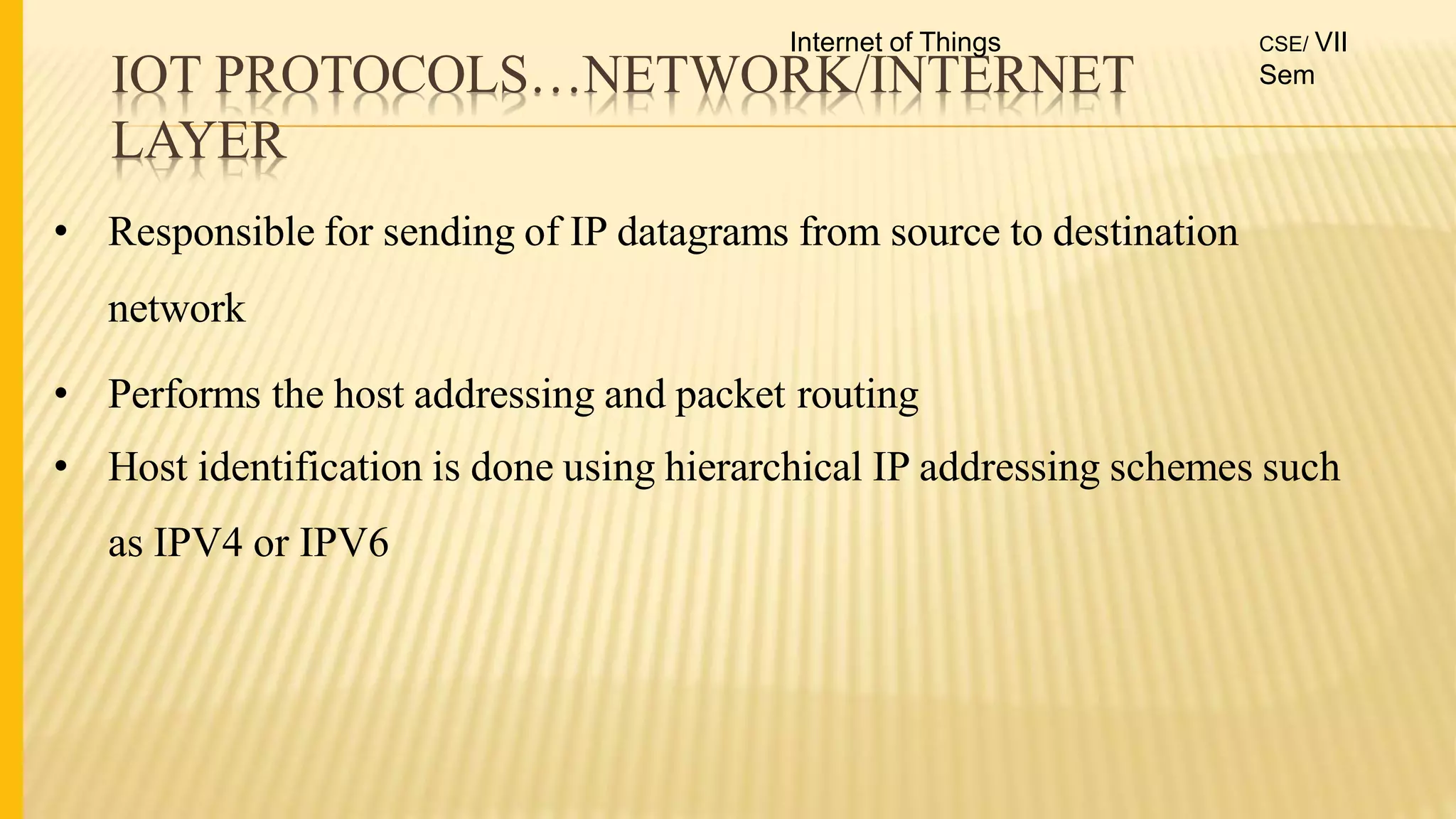
IOT PROTOCOLS…NETWORK/INTERNET
LAYER
• Responsible for sending of IP datagrams from source to destination
network
• Performs the host addressing and packet routing
• Host identification is done using hierarchical IP addressing schemes such
as IPV4 or IPV6
Internet of Things CSE/ VII
Sem
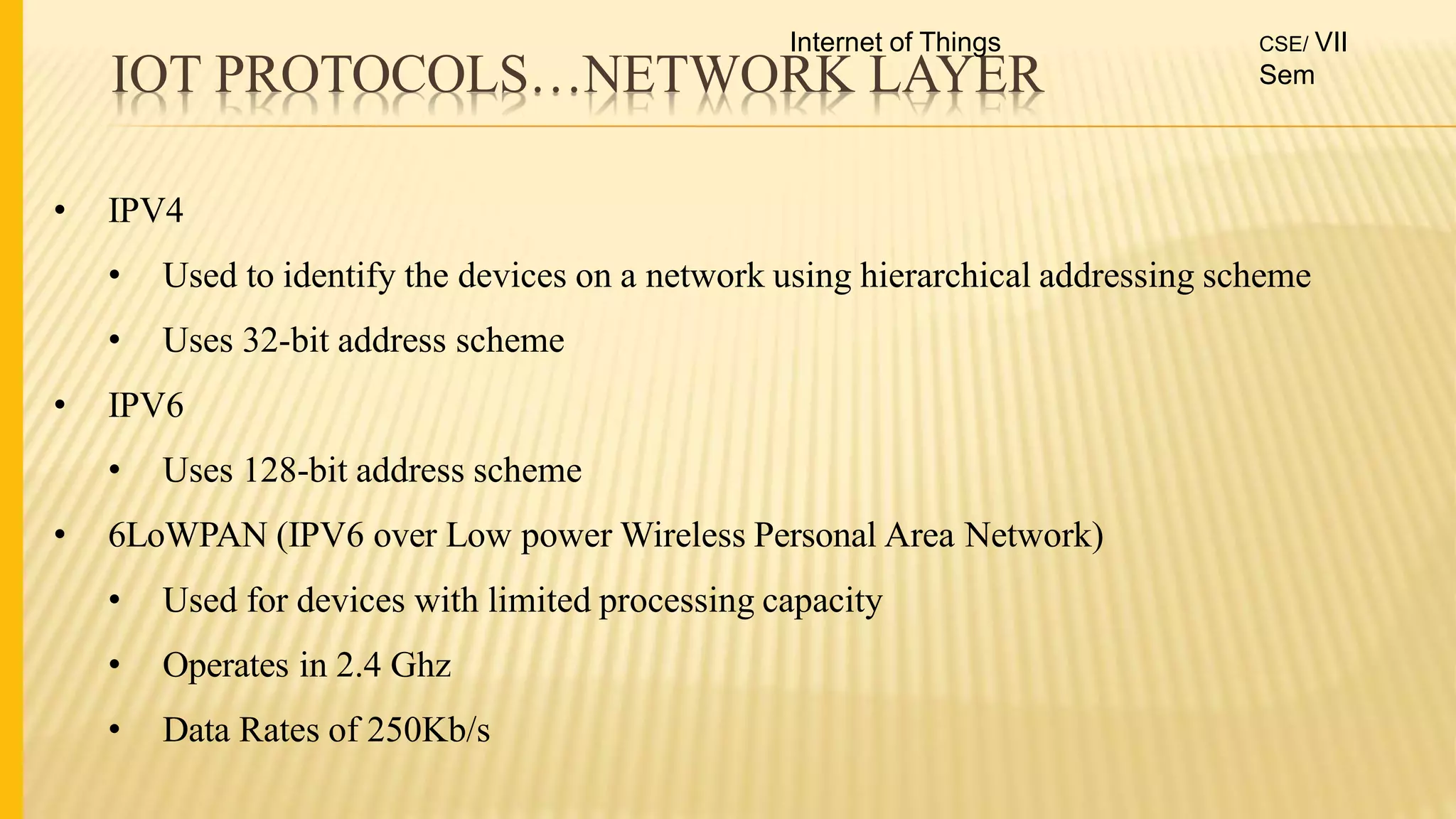
IOT PROTOCOLS…NETWORK LAYER
• IPV4
• Used to identify the devices on a network using hierarchical addressing scheme
• Uses 32-bit address scheme
• IPV6
• Uses 128-bit address scheme
• 6LoWPAN (IPV6 over Low power Wireless Personal Area Network)
• Used for devices with limited processing capacity
• Operates in 2.4 Ghz
• Data Rates of 250Kb/s
Internet of Things CSE/ VII
Sem
IOT PROTOCOLS…TRANSPORT
LAYER
• Provide end-to-end message transfer capability independent of
the underlying network
• It provides functions such as error control, segmentation, flow-
control and congestion control
Internet of Things CSE/ VII
Sem
IOT
PROTOCOLS…TCP
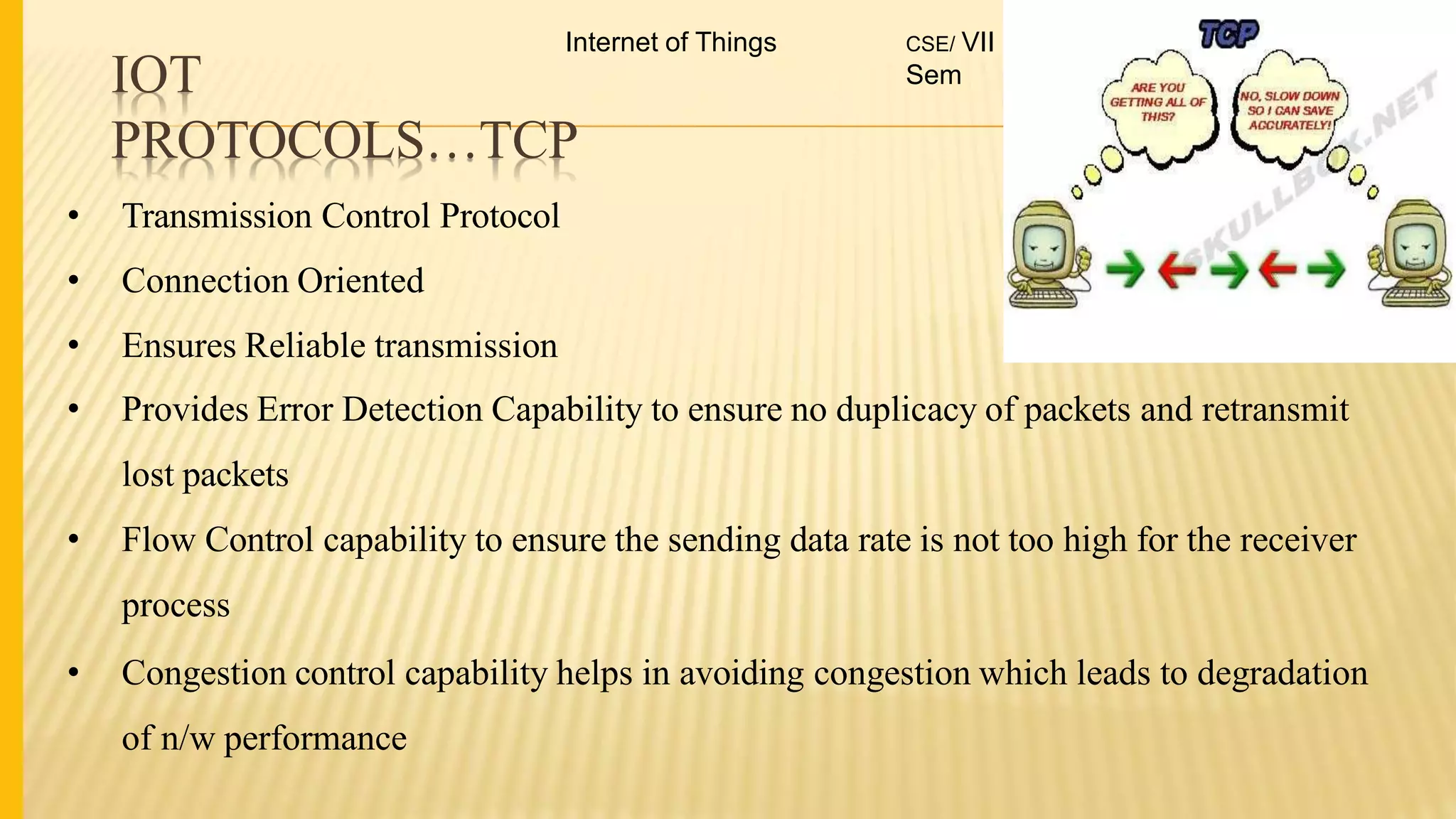
• Transmission Control Protocol
• Connection Oriented
• Ensures Reliable transmission
• Provides Error Detection Capability to ensure no duplicacy of packets and retransmit
lost packets
• Flow Control capability to ensure the sending data rate is not too high for the receiver
process
• Congestion control capability helps in avoiding congestion which leads to degradation
of n/w performance
Internet of Things CSE/ VII
Sem
IOT
PROTOCOLS…UDP
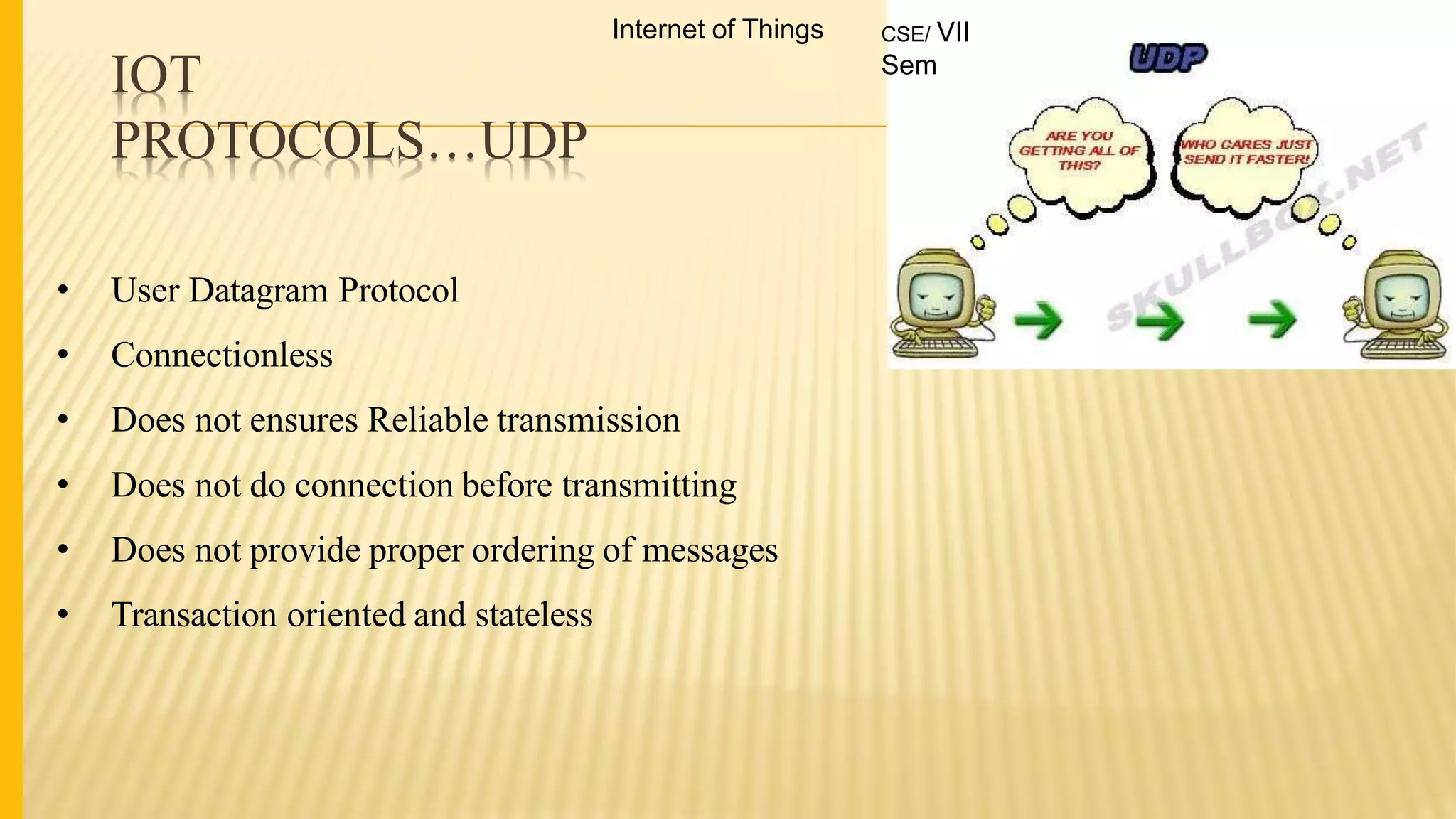
• User Datagram Protocol
• Connectionless
• Does not ensures Reliable transmission
• Does not do connection before transmitting
• Does not provide proper ordering of messages
• Transaction oriented and stateless
Internet of Things CSE/ VII
Sem
IOT PROTOCOLS…APPLICATION
LAYER…HYPER TRANSFER PROTOCOL
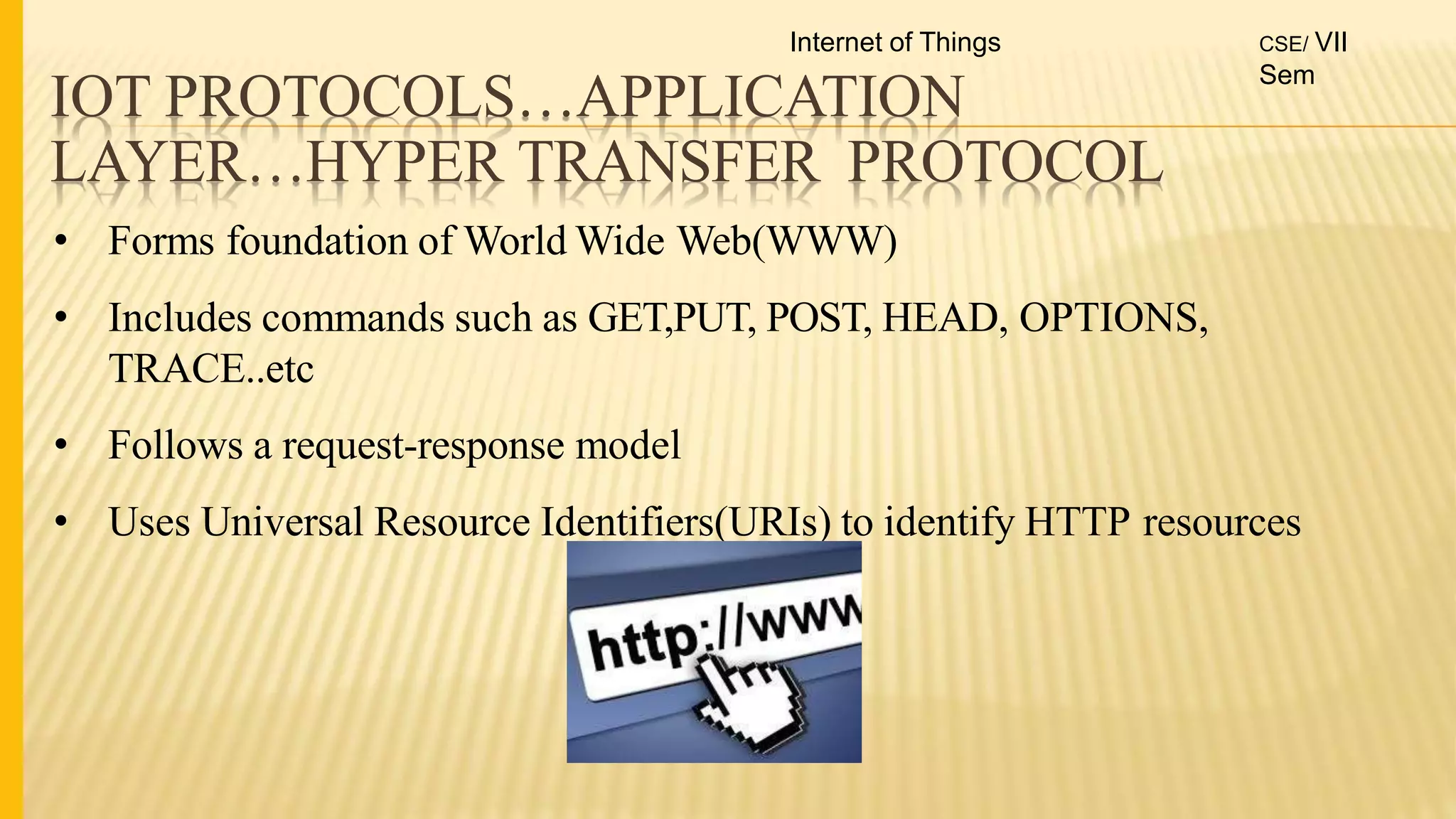
• Forms foundation of World Wide Web(WWW)
• Includes commands such as GET,PUT, POST, HEAD, OPTIONS,
TRACE..etc
• Follows a request-response model
• Uses Universal Resource Identifiers(URIs) to identify HTTP resources
Internet of Things CSE/ VII
Sem
IOT PROTOCOLS…APPLICATION
LAYER…COAP
• Constrained Application Protocol
• Used for Machine to machine (M2M) applications meant for constrained
devices and n/w’s
• Web transfer protocol for IoT and uses request-response
model
• Uses client –server architecture
• Supports methods such as GET,POST, PUT and DELETE
Internet of Things CSE/ VII
Sem
IOT PROTOCOLS…APPLICATION
LAYER…WEBSOCKET
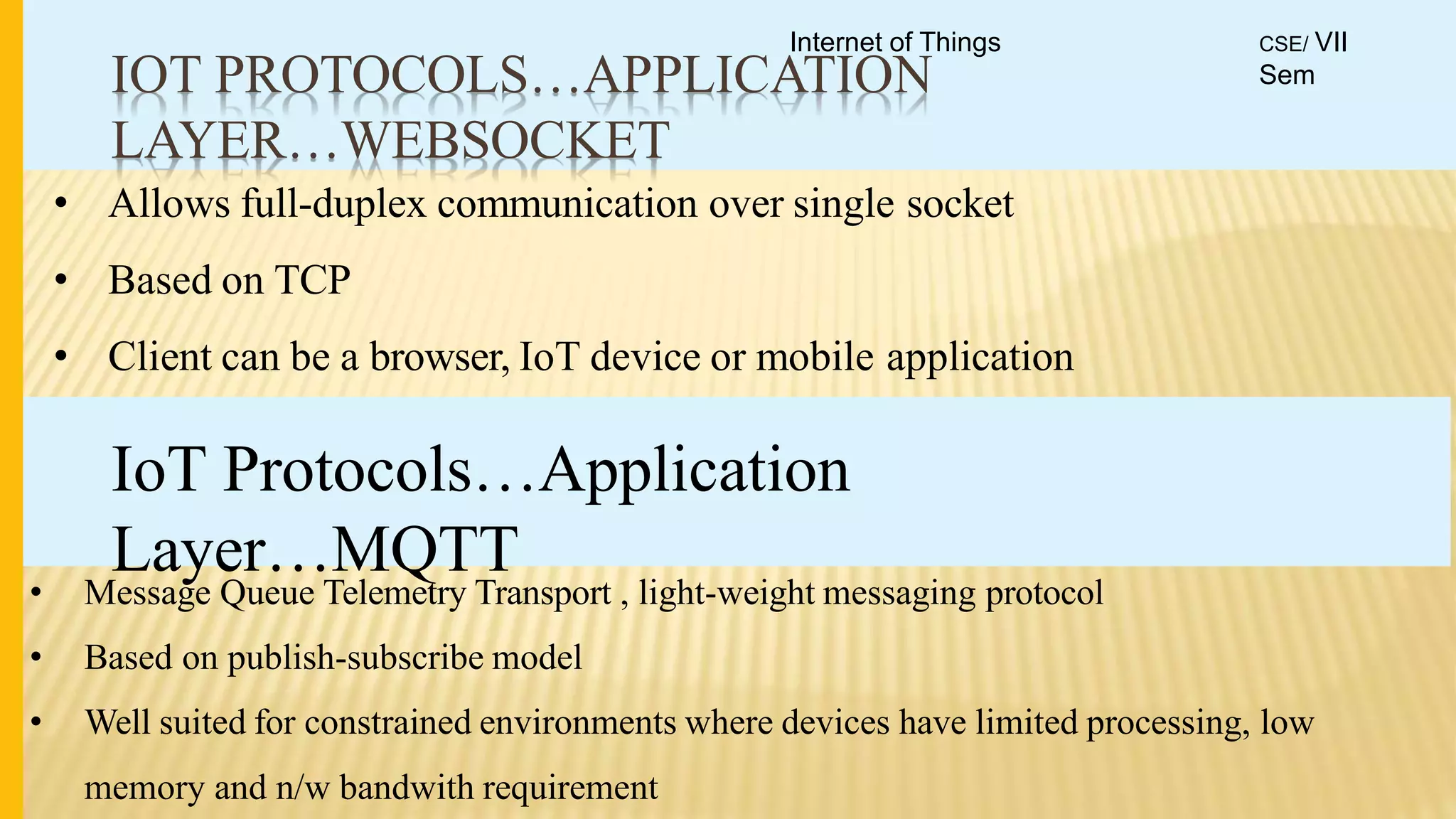
• Allows full-duplex communication over single socket
• Based on TCP
• Client can be a browser, IoT device or mobile application
IoT Protocols…Application
Layer…MQTT
• Message Queue Telemetry Transport , light-weight messaging protocol
• Based on publish-subscribe model
• Well suited for constrained environments where devices have limited processing, low
memory and n/w bandwith requirement
Internet of Things CSE/ VII
Sem
IOT PROTOCOLS…APPLICATION LAYER…XMPP
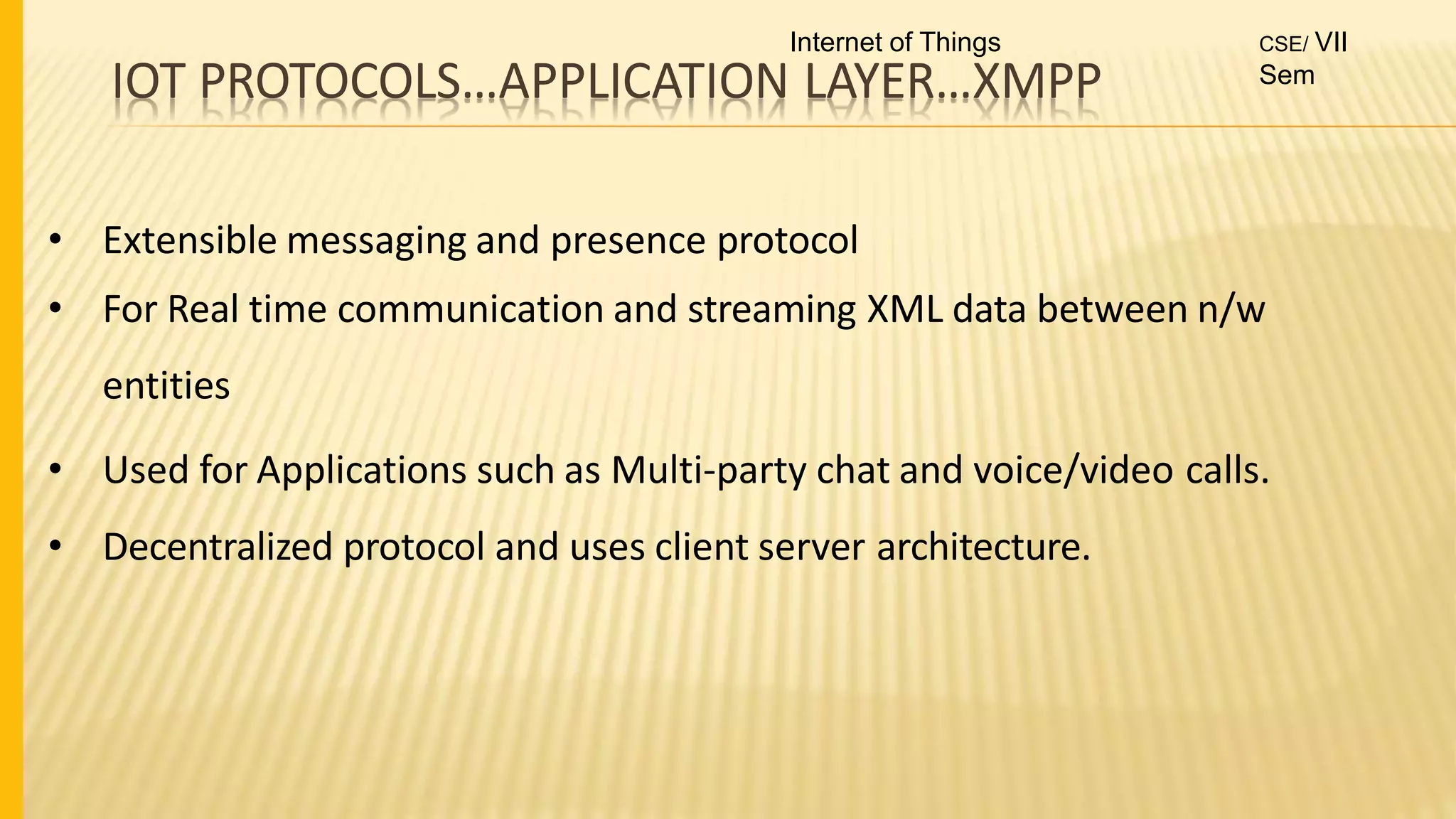
• Extensible messaging and presence protocol
• For Real time communication and streaming XML data between n/w
entities
• Used for Applications such as Multi-party chat and voice/video calls.
• Decentralized protocol and uses client server architecture.
Internet of Things CSE/ VII
Sem
IOT PROTOCOLS…APPLICATION LAYER…DDS
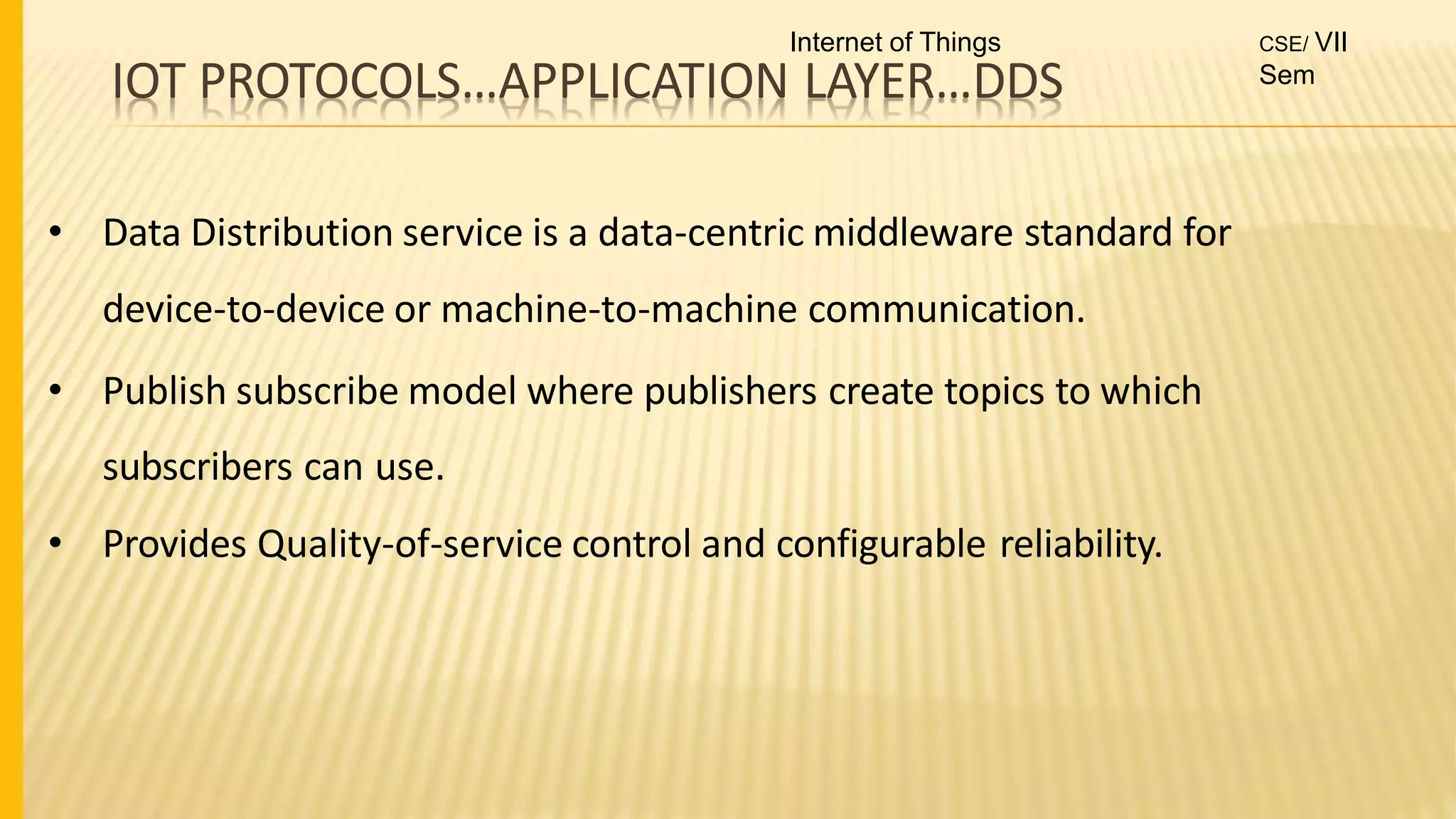
• Data Distribution service is a data-centric middleware standard for
device-to-device or machine-to-machine communication.
• Publish subscribe model where publishers create topics to which
subscribers can use.
• Provides Quality-of-service control and configurable reliability.
Internet of Things CSE/ VII
Sem
IOT PROTOCOLS…APPLICATION LAYER…AMQP
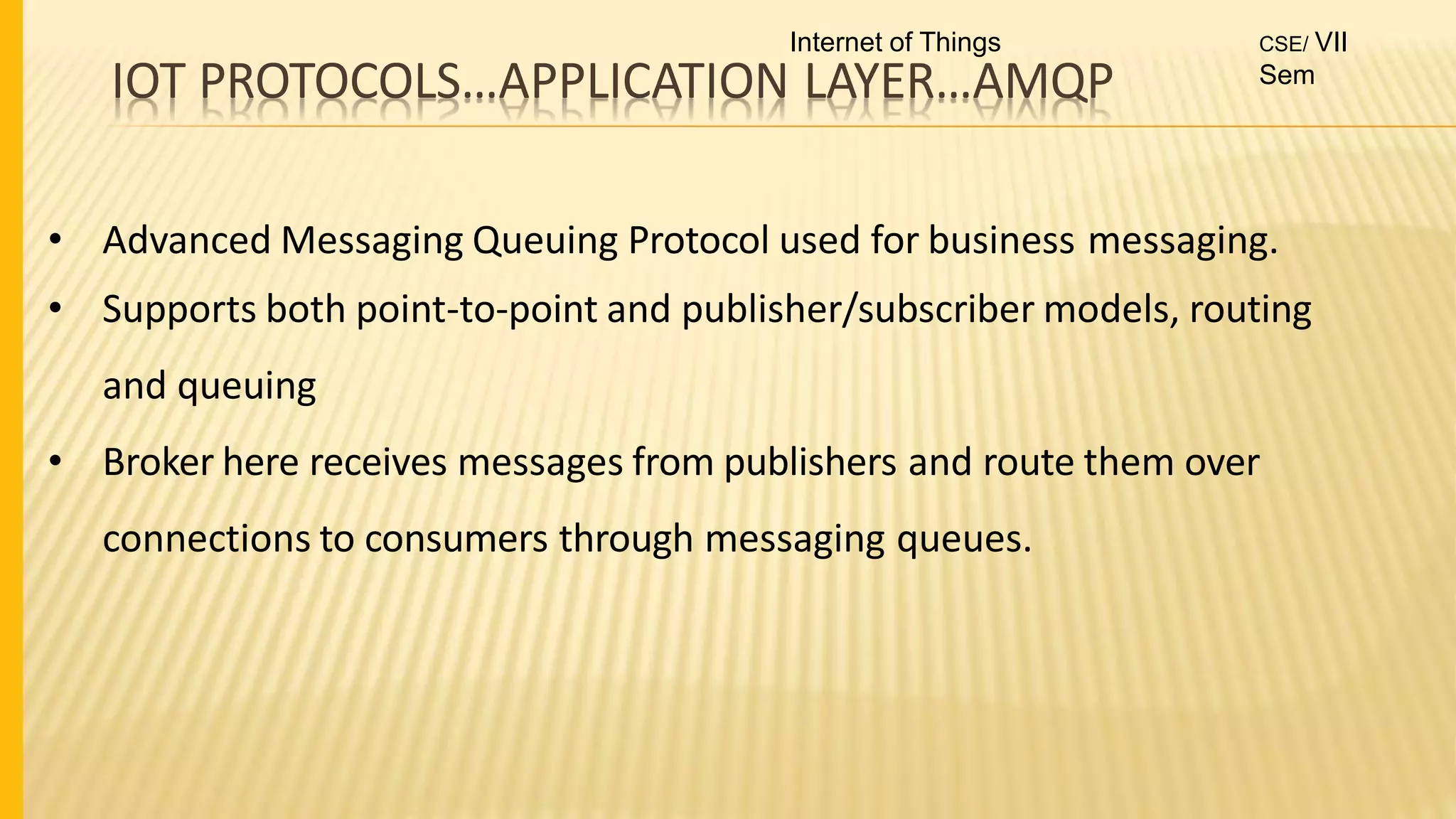
• Advanced Messaging Queuing Protocol used for business messaging.
• Supports both point-to-point and publisher/subscriber models, routing
and queuing
• Broker here receives messages from publishers and route them over
connections to consumers through messaging queues.
Internet of Things CSE/ VII
Sem
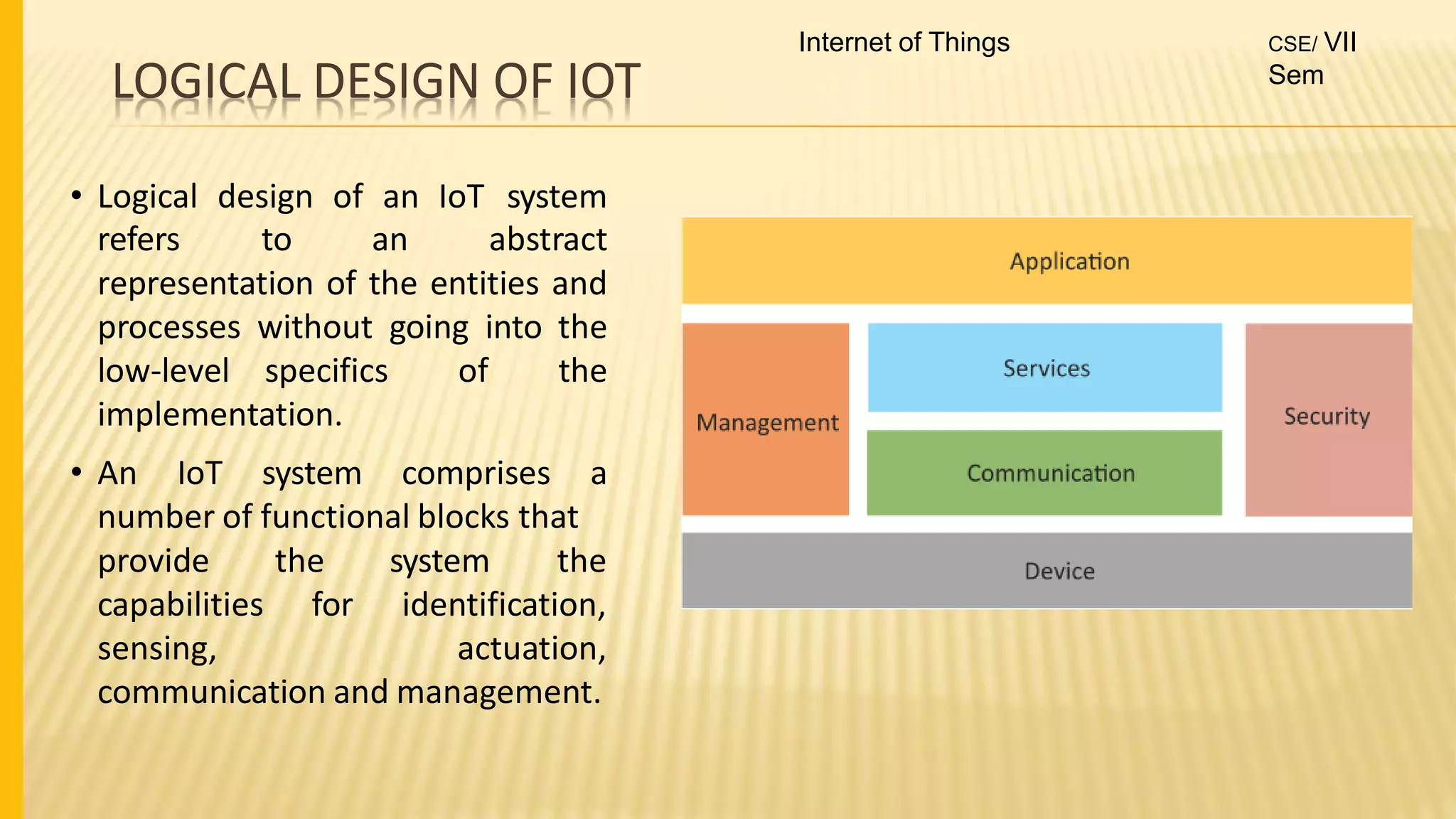
LOGICAL DESIGN OF IOT
• Logical design of an IoT system
refers to an abstract
representation of the entities and
processes without going into the
low-level specifics of the
implementation.
• An IoT system comprises a
number of functional blocks that
the system the
for
provide
capabilities
sensing,
identification,
actuation,
communication and management.
Internet of Things CSE/ VII
Sem
LOGICAL DESIGN OF IOT
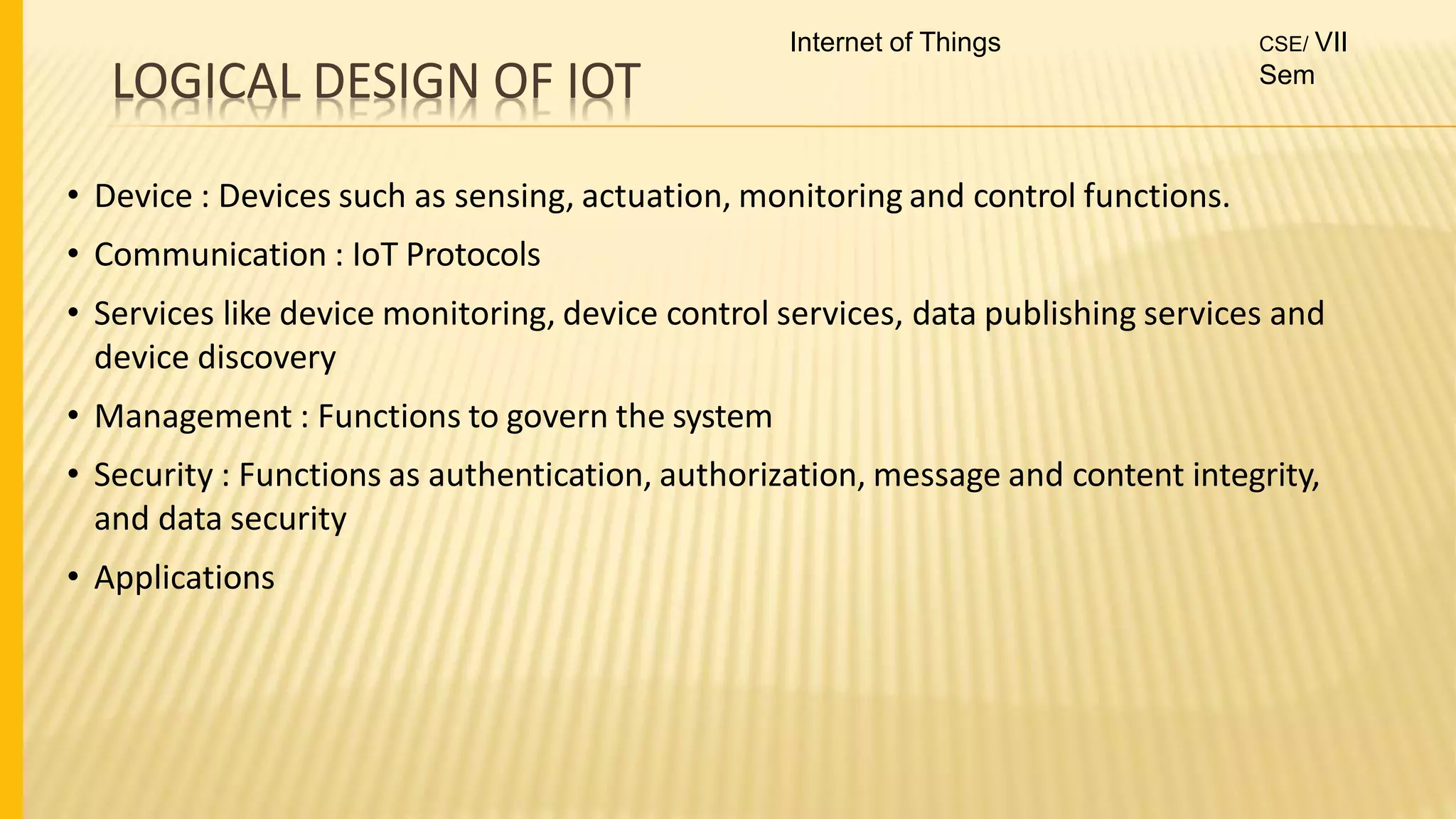
• Device : Devices such as sensing, actuation, monitoring and control functions.
• Communication : IoT Protocols
• Services like device monitoring, device control services, data publishing services and
device discovery
• Management : Functions to govern the system
• Security : Functions as authentication, authorization, message and content integrity,
and data security
• Applications
Internet of Things CSE/ VII
Sem
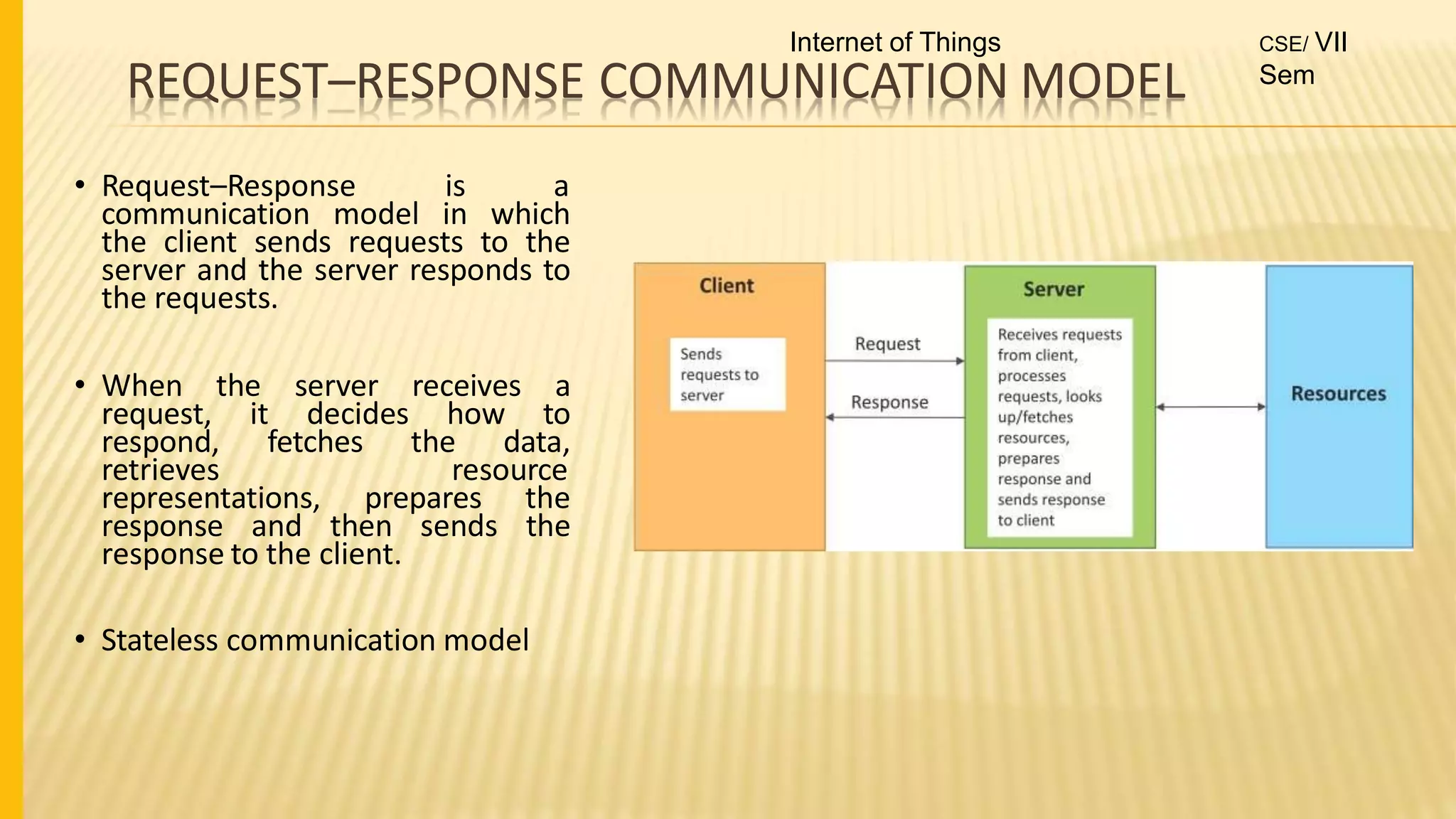
REQUEST–RESPONSE COMMUNICATION MODEL
• Request–Response is a
communication model in which
the client sends requests to the
server and the server responds to
the requests.
• When the server receives a
request, it decides how to
respond, fetches the data,
retrieves resource
representations, prepares the
response and then sends the
response to the client.
• Stateless communication model
Internet of Things CSE/ VII
Sem
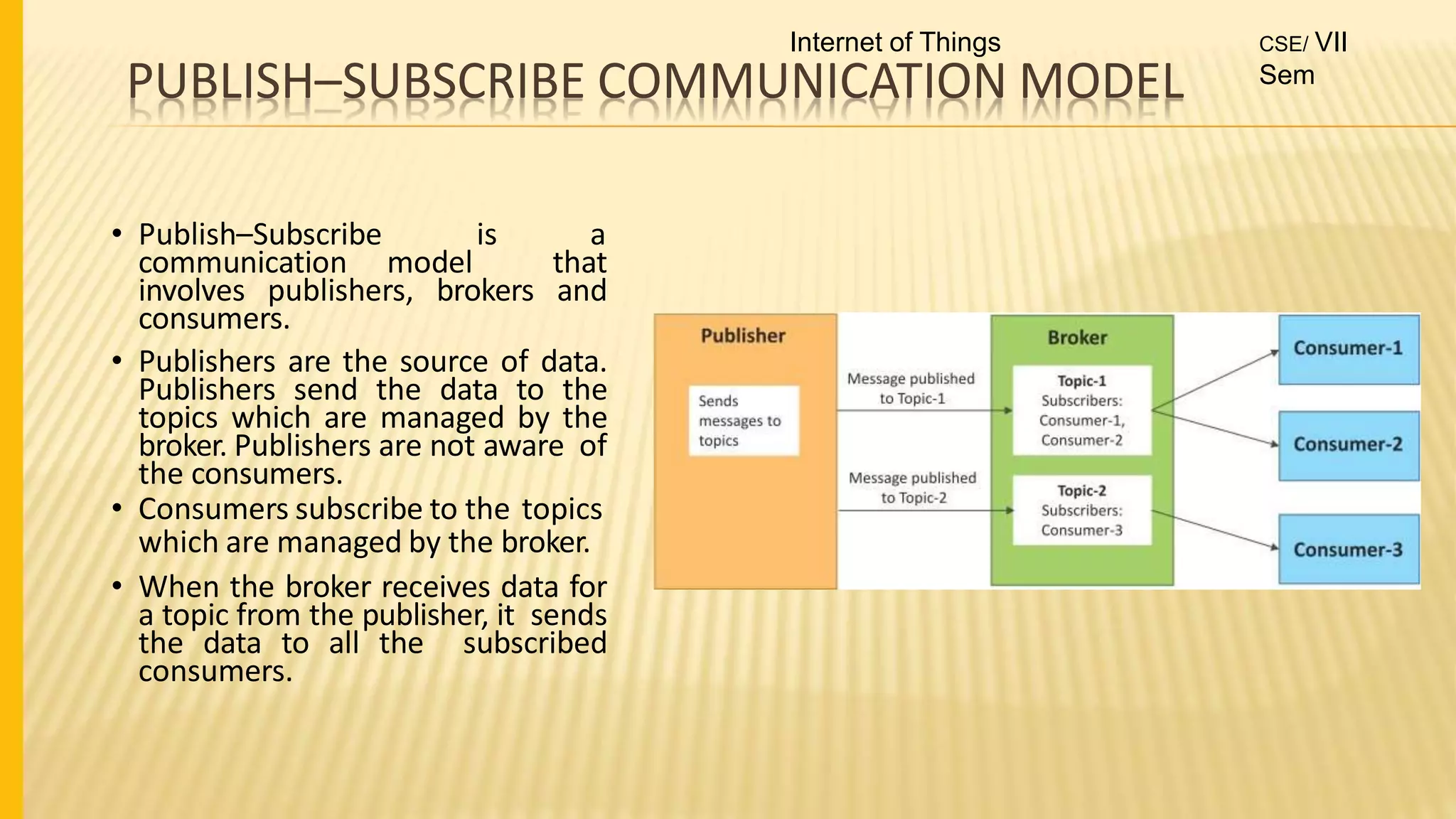
PUBLISH–SUBSCRIBE COMMUNICATION MODEL
• Publish–Subscribe is a
communication model that
involves publishers, brokers and
consumers.
• Publishers are the source of data.
Publishers send the data to the
topics which are managed by the
broker. Publishers are not aware of
the consumers.
• Consumers subscribe to the topics
which are managed by the broker.
• When the broker receives data for
a topic from the publisher, it sends
the data to all the subscribed
consumers.
Internet of Things CSE/ VII
Sem
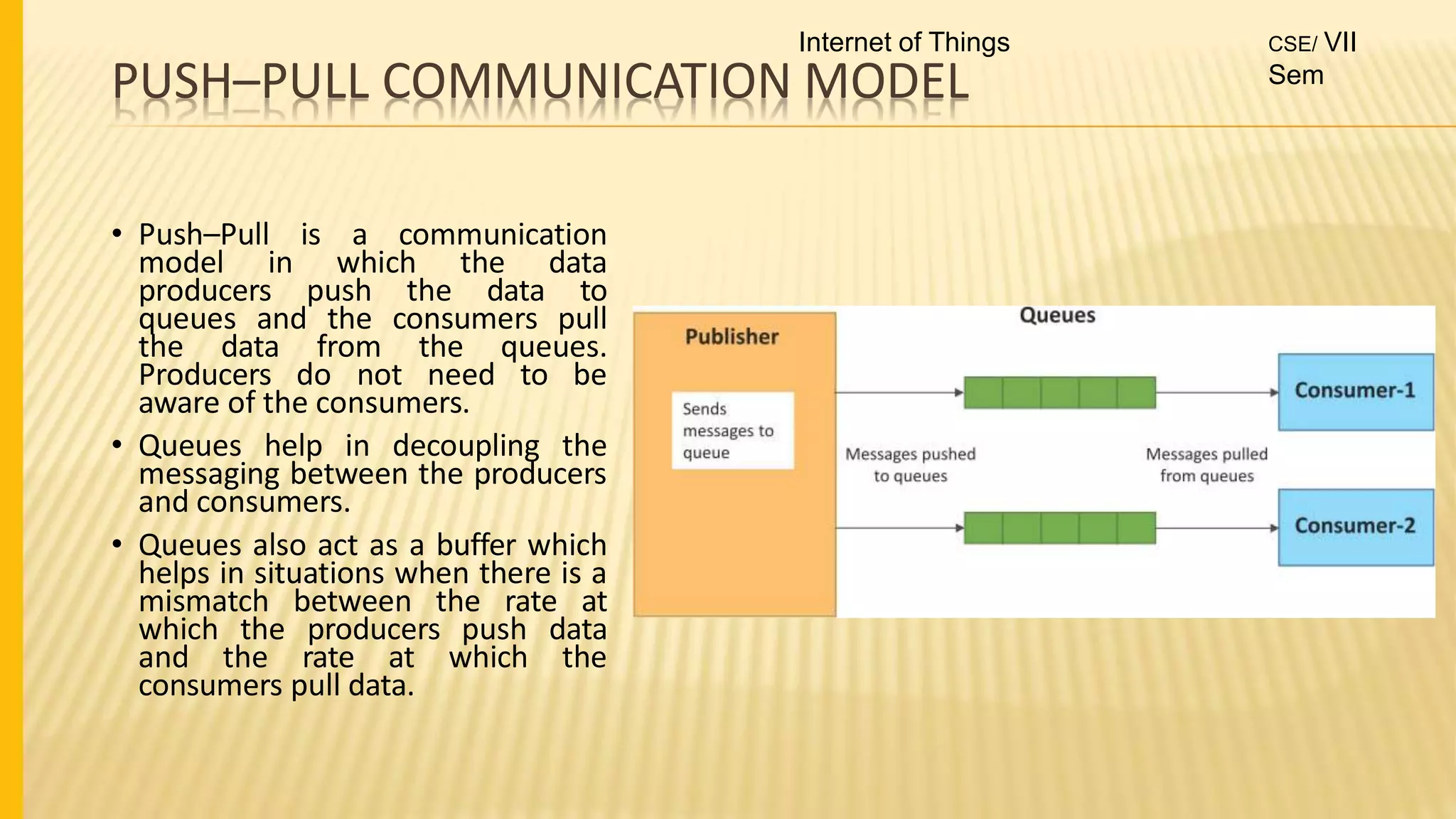
PUSH–PULL COMMUNICATION MODEL
• Push–Pull is a communication
model in which the data
producers push the data to
queues and the consumers pull
the data from the queues.
Producers do not need to be
aware of the consumers.
• Queues help in decoupling the
messaging between the producers
and consumers.
• Queues also act as a buffer which
helps in situations when there is a
mismatch between the rate at
which the producers push data
and the rate at which the
consumers pull data.
Internet of Things CSE/ VII
Sem
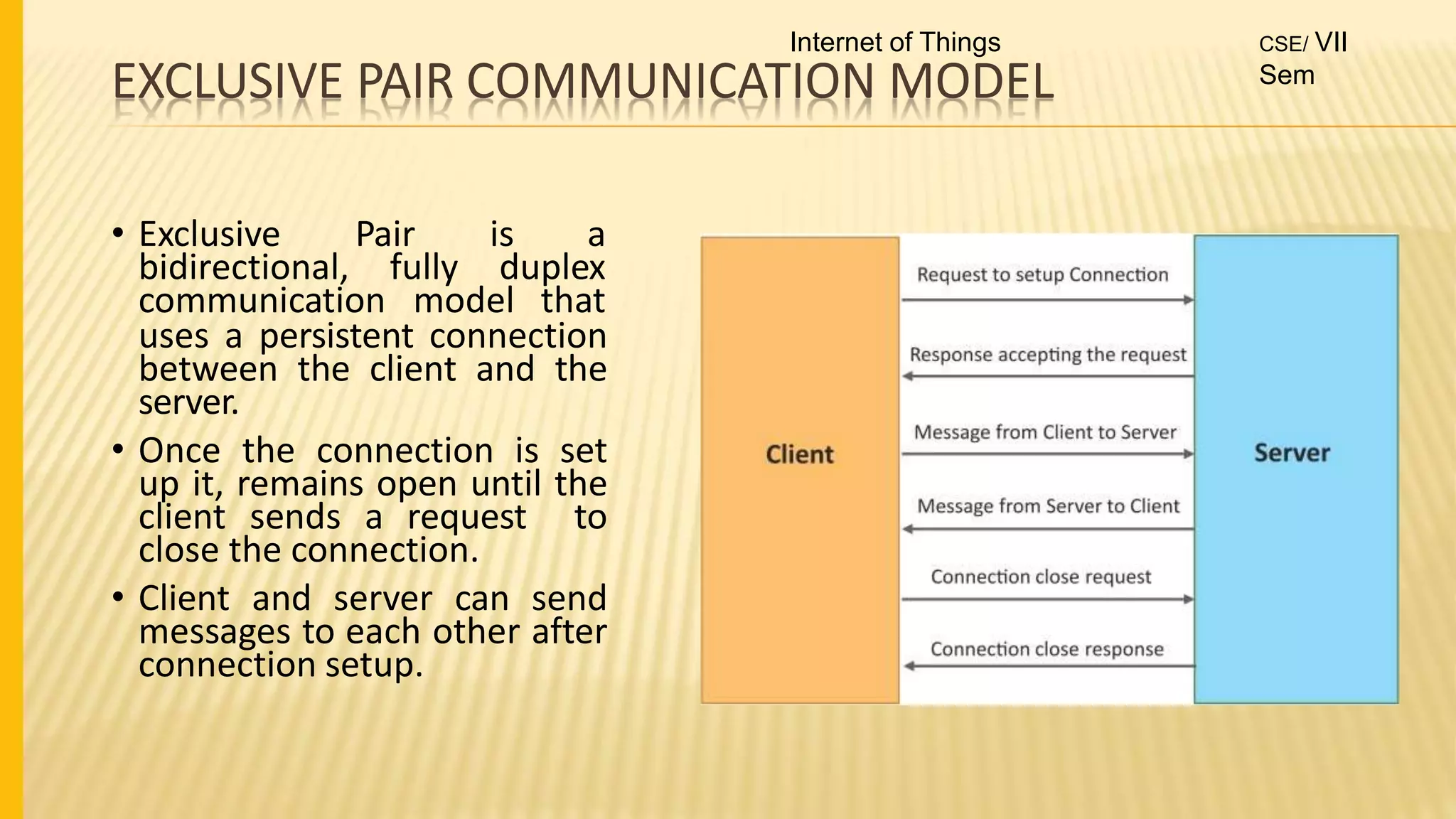
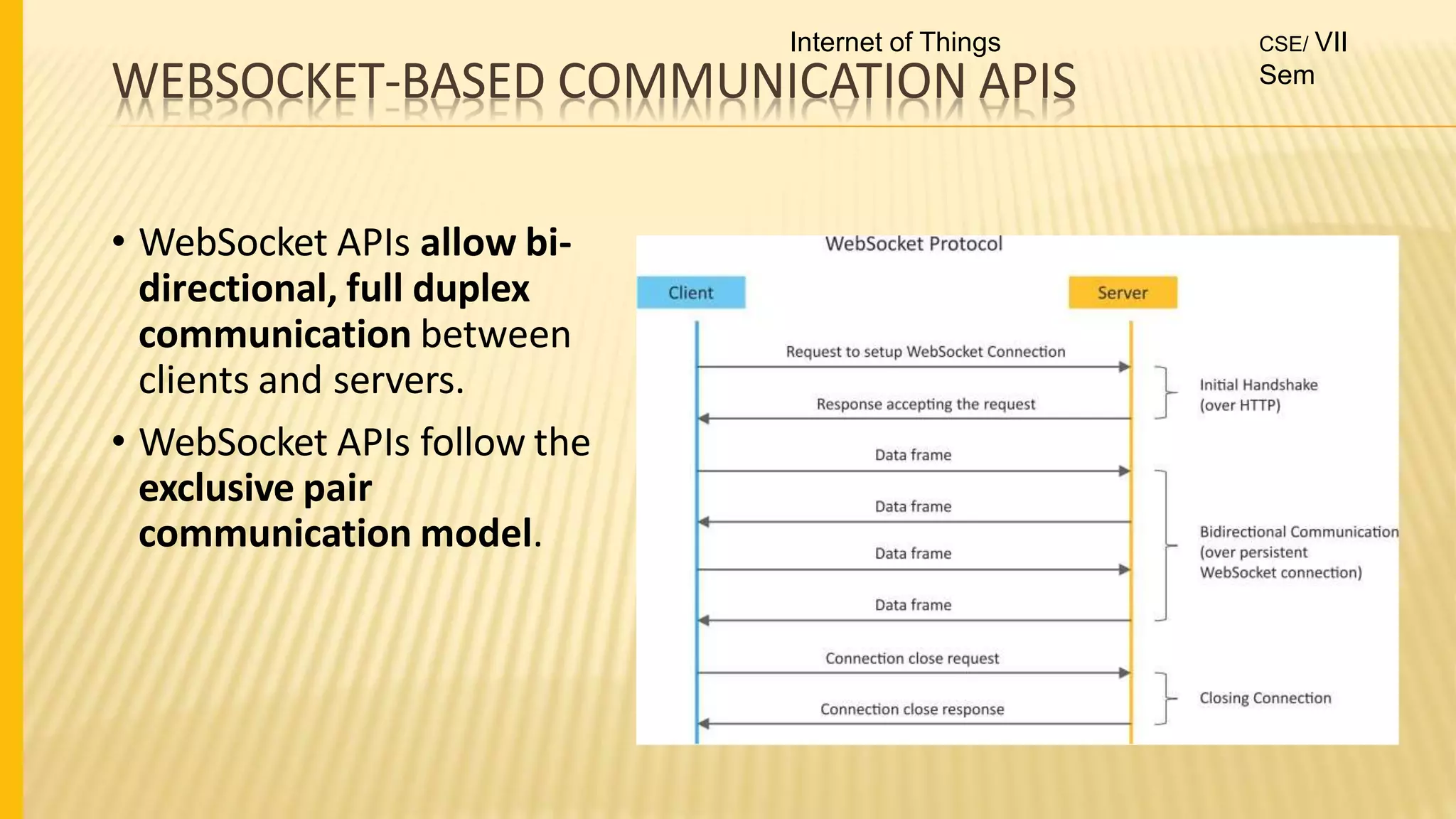
EXCLUSIVE PAIR COMMUNICATION MODEL
• Exclusive Pair is a
bidirectional, fully duplex
communication model that
uses a persistent connection
between the client and the
server.
• Once the connection is set
up it, remains open until the
client sends a request to
close the connection.
• Client and server can send
messages to each other after
connection setup.
Internet of Things CSE/ VII
Sem
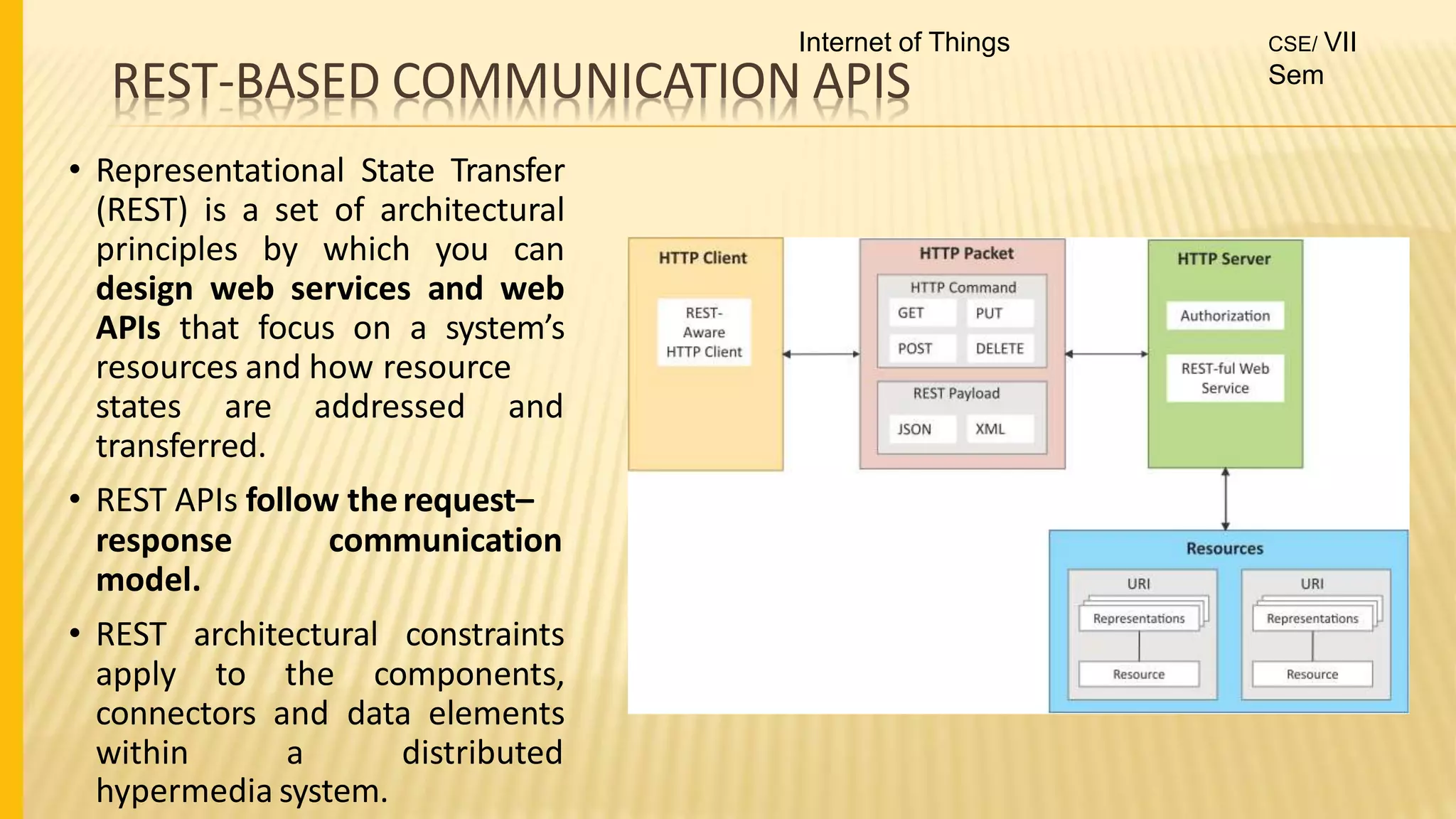
REST-BASED COMMUNICATION APIS
• Representational State Transfer
(REST) is a set of architectural
principles by which you can
design web services and web
APIs that focus on a system’s
resources and how resource
states are addressed and
transferred.
• REST APIs follow therequest–
response communication
model.
• REST architectural constraints
apply to the components,
connectors and data elements
within a distributed
hypermedia system.
Internet of Things CSE/ VII
Sem
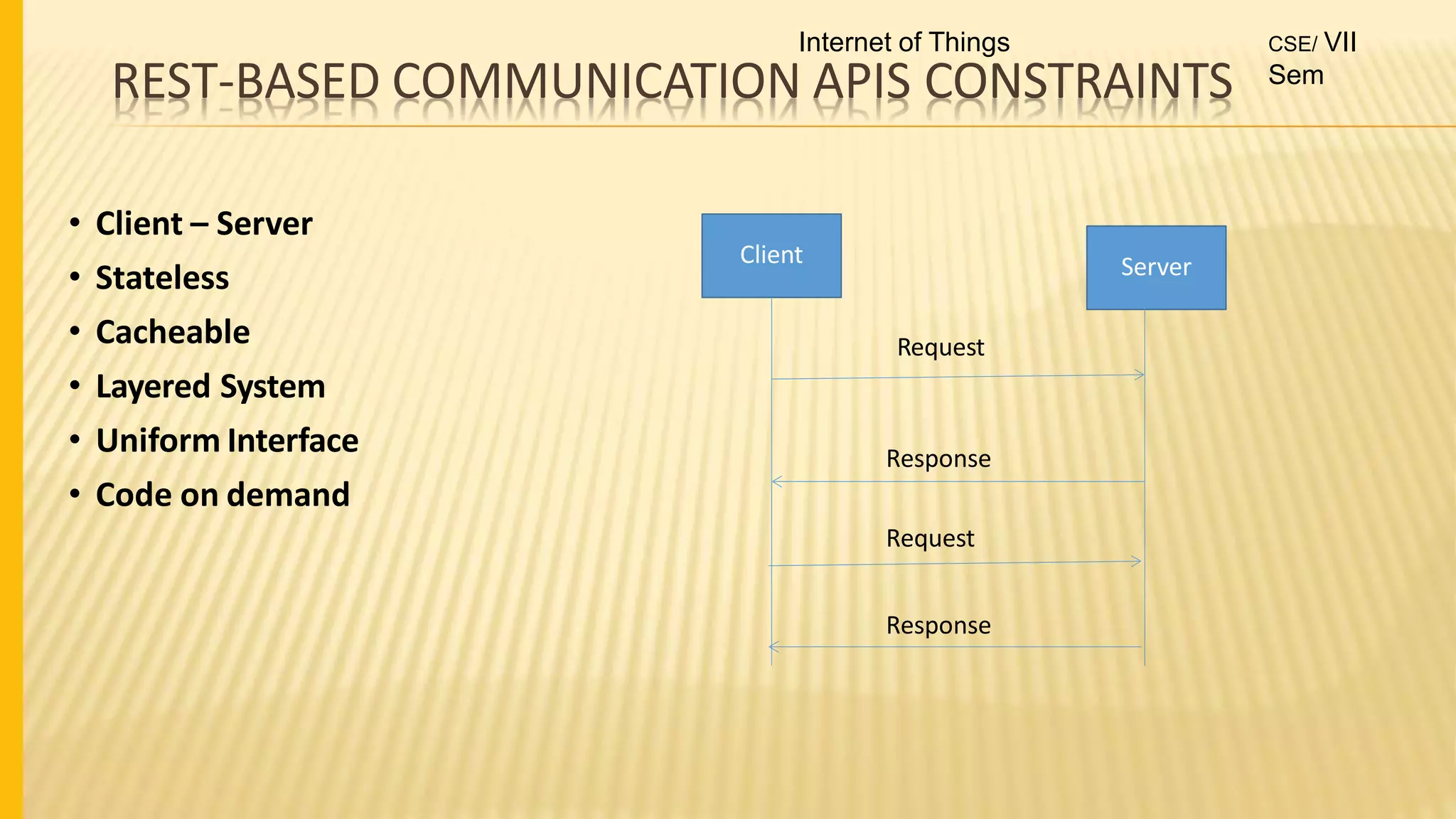
REST-BASED COMMUNICATION APIS CONSTRAINTS
• Client – Server
• Stateless
• Cacheable
• Layered System
• Uniform Interface
• Code on demand
Client Server
Request
Response
Request
Response
Internet of Things CSE/ VII
Sem
WEBSOCKET-BASED COMMUNICATION APIS
• WebSocket APIs allow bi-
directional, full duplex
communication between
clients and servers.
• WebSocket APIs follow the
exclusive pair
communication model.
Internet of Things CSE/ VII
Sem
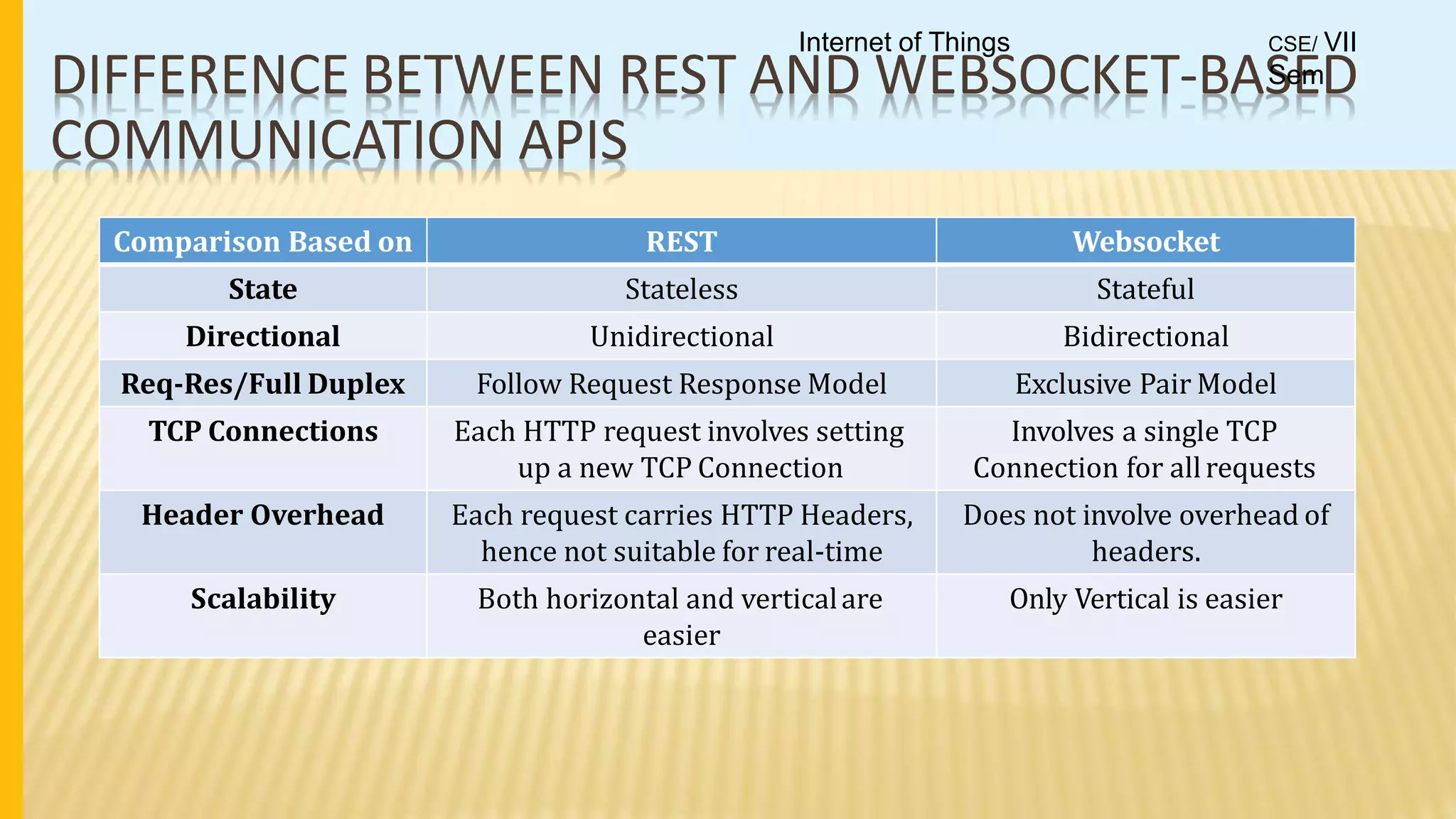
Comparison Based on REST Websocket
State Stateless Stateful
Directional Unidirectional Bidirectional
Req-Res/Full Duplex Follow Request Response Model Exclusive Pair Model
TCP Connections Each HTTP request involves setting
up a new TCP Connection
Involves a single TCP
Connection for allrequests
Header Overhead Each request carries HTTP Headers,
hence not suitable for real-time
Does not involve overhead of
headers.
Scalability Both horizontal and verticalare
easier
Only Vertical is easier
DIFFERENCE BETWEEN REST AND WEBSOCKET-BASED
COMMUNICATION APIS
Internet of Things CSE/ VII
Sem
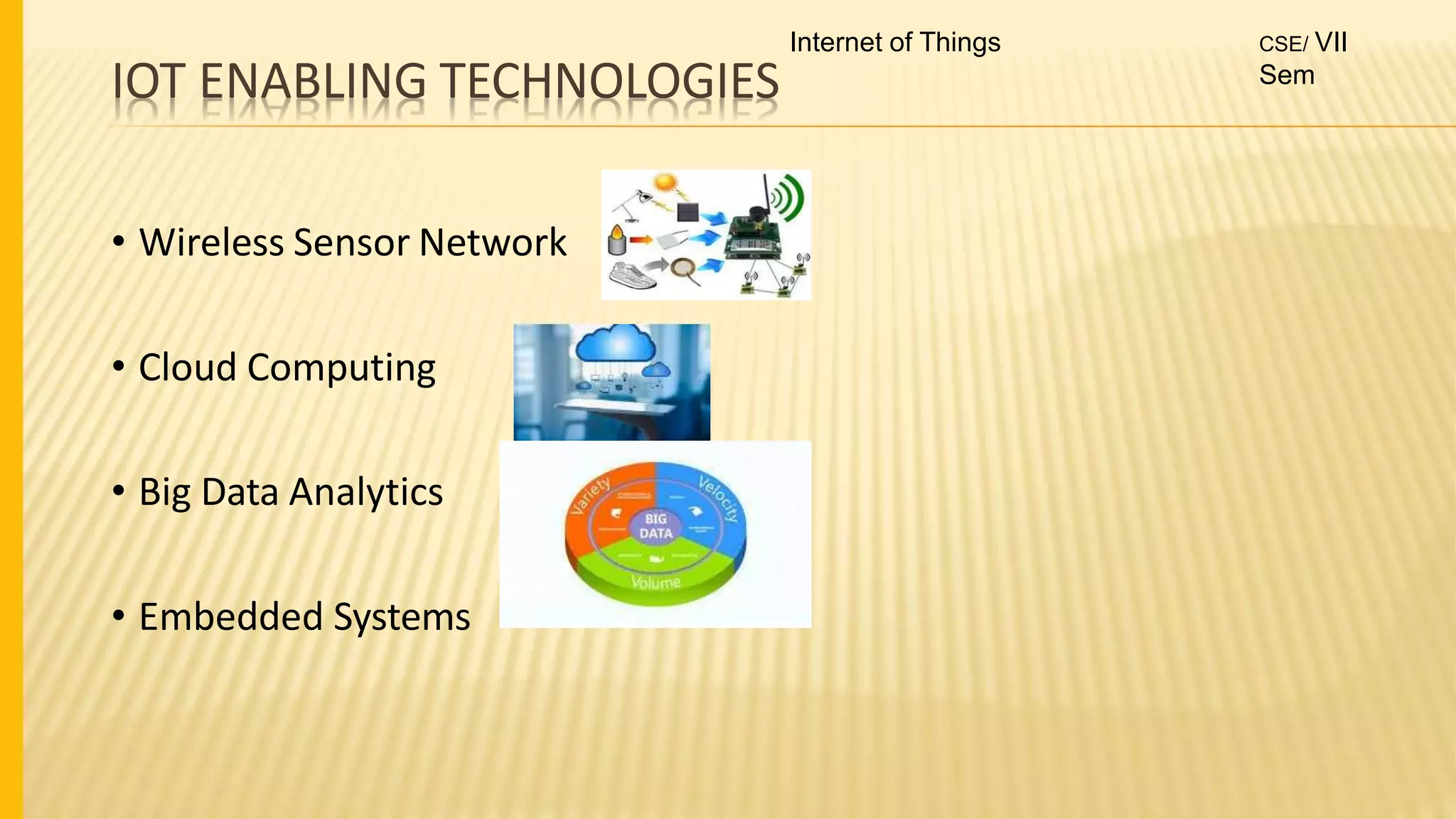
IOT ENABLING TECHNOLOGIES
• Wireless Sensor Network
• Cloud Computing
• Big Data Analytics
• Embedded Systems
Internet of Things CSE/ VII
Sem
WSN
• Distributed Devices with sensors used to monitor the environmental
and physical conditions
• Consists of several end-nodes acting as routers or coordinators too
• Coordinators collects data from all nodes / acts as gateway that
connects WSN to internet
• Routers route the data packets from end nodes to coordinators.
Internet of Things CSE/ VII
Sem
EXAMPLE OF WSNS IN IOT & PROTOCOLS USED
Example
• Weather monitoring system
• Indoor Air quality monitoring system
• Soil moisture monitoring system
• Survelliance systems
• Health monitoring systems
Protocols
• Zigbee
Internet of Things CSE/ VII
Sem
CLOUD COMPUTING
• Deliver applications and services over internet
• Provides computing, networking and storage resources on demand
• Cloud computing performs services such as Iaas, Paas and Saas
• Iaas : Rent Infrastructure
• Paas : supply an on-demand environment for developing, testing,
delivering and managing software applications.
• Saas : method for delivering software applications over the Internet,
on demand and typically on a subscription basis.
Internet of Things CSE/ VII
Sem
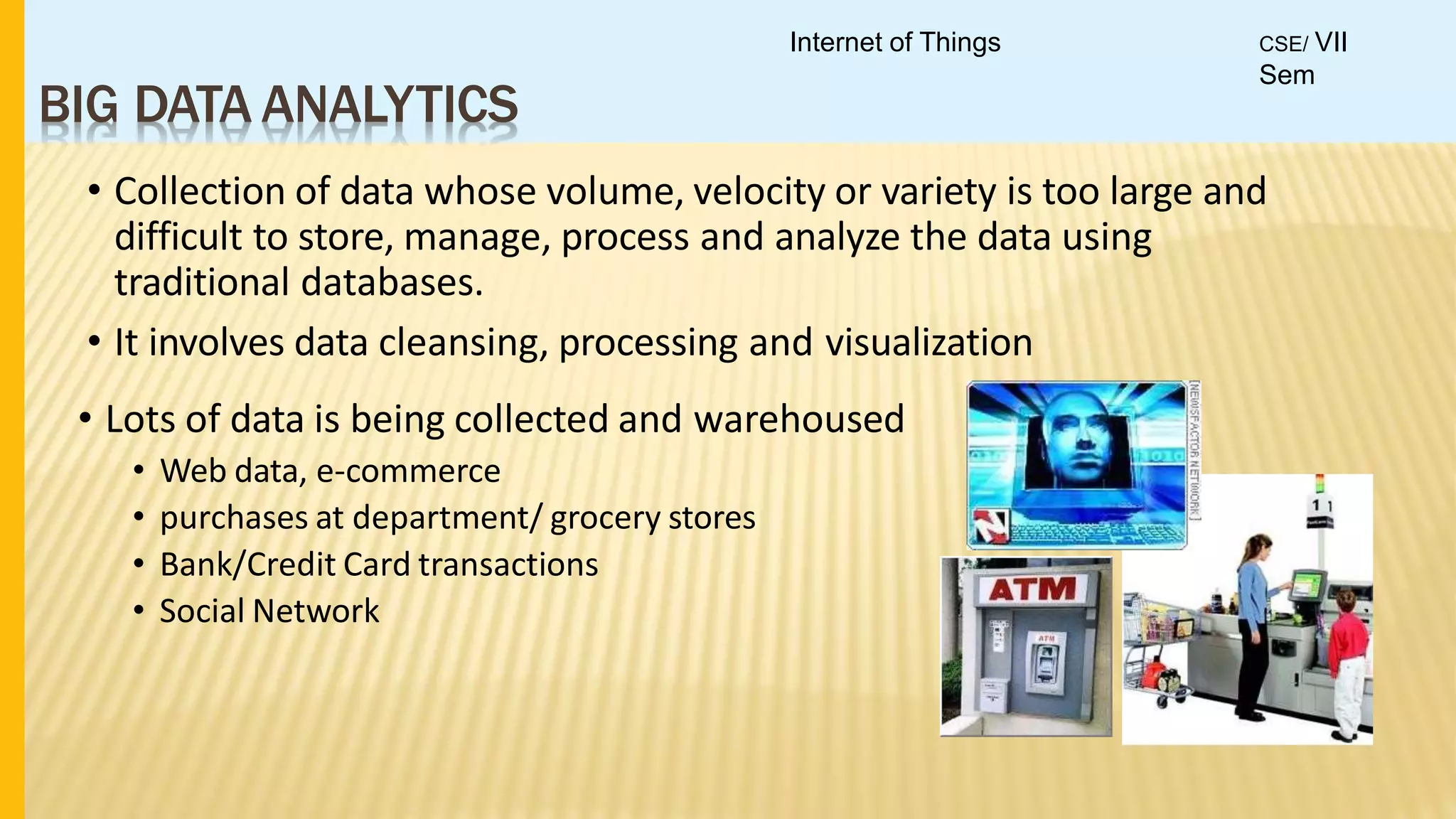
BIG DATA ANALYTICS
• Collection of data whose volume, velocity or variety is too large and
difficult to store, manage, process and analyze the data using
traditional databases.
• It involves data cleansing, processing and visualization
• Lots of data is being collected and warehoused
• Web data, e-commerce
• purchases at department/ grocery stores
• Bank/Credit Card transactions
• Social Network
Internet of Things CSE/ VII
Sem
BIG DATA ANALYTICS
Variety Includes different types of data
• Structured
• Unstructured
• SemiStructured
• All of above
Internet of Things CSE/ VII
Sem
BIG DATA ANALYTICS
Velocity Refers to speed at which data is processed
• Batch
• Real-time
• STreams
Internet of Things CSE/ VII
Sem
BIG DATA ANALYTICS
Volume refers to the amount of data
• Terabyte
• Records
• Transactions
• Files
• Tables
Internet of Things CSE/ VII
Sem
IOT LEVELS AND DEPLOYMENT TEMPLATES
An IoT system comprises the following components:
• Device: An IoT device allows identification, remote sensing, actuating and
remote monitoring capabilities.
• Resource: Resources are software components on the IoT device for
accessing, processing and storing sensor information, or for controlling
actuators connected to the device. Resources also include the software
components that enable network access for the device.
• Controller Service: Controller service is a native service that runs on the
device and interacts with the web services. Controller service sends data
from the device to the web service and receives commands from the
application (via web services) for controlling the device.
Internet of Things CSE/ VII
Sem
IOT LEVELS AND DEPLOYMENT TEMPLATES
• Database: Database can be either local or in the cloud and stores the data
generated by the IoT device.
• Web Service: Web services serve as a link between the IoT device,
application, database and analysis components. Web service can be
implemented using HTTP and REST principles (REST service) or using the
WebSocket protocol (WebSocket service).
• Analysis Component: This is responsible for analyzing the IoT data and
generating results in a form that is easy for the user to understand.
• Application: IoT applications provide an interface that the users can use to
control and monitor various aspects of the IoT system. Applications also
allow users to view the system status and the processed data.
Internet of Things CSE/ VII
Sem
IOT LEVEL-1
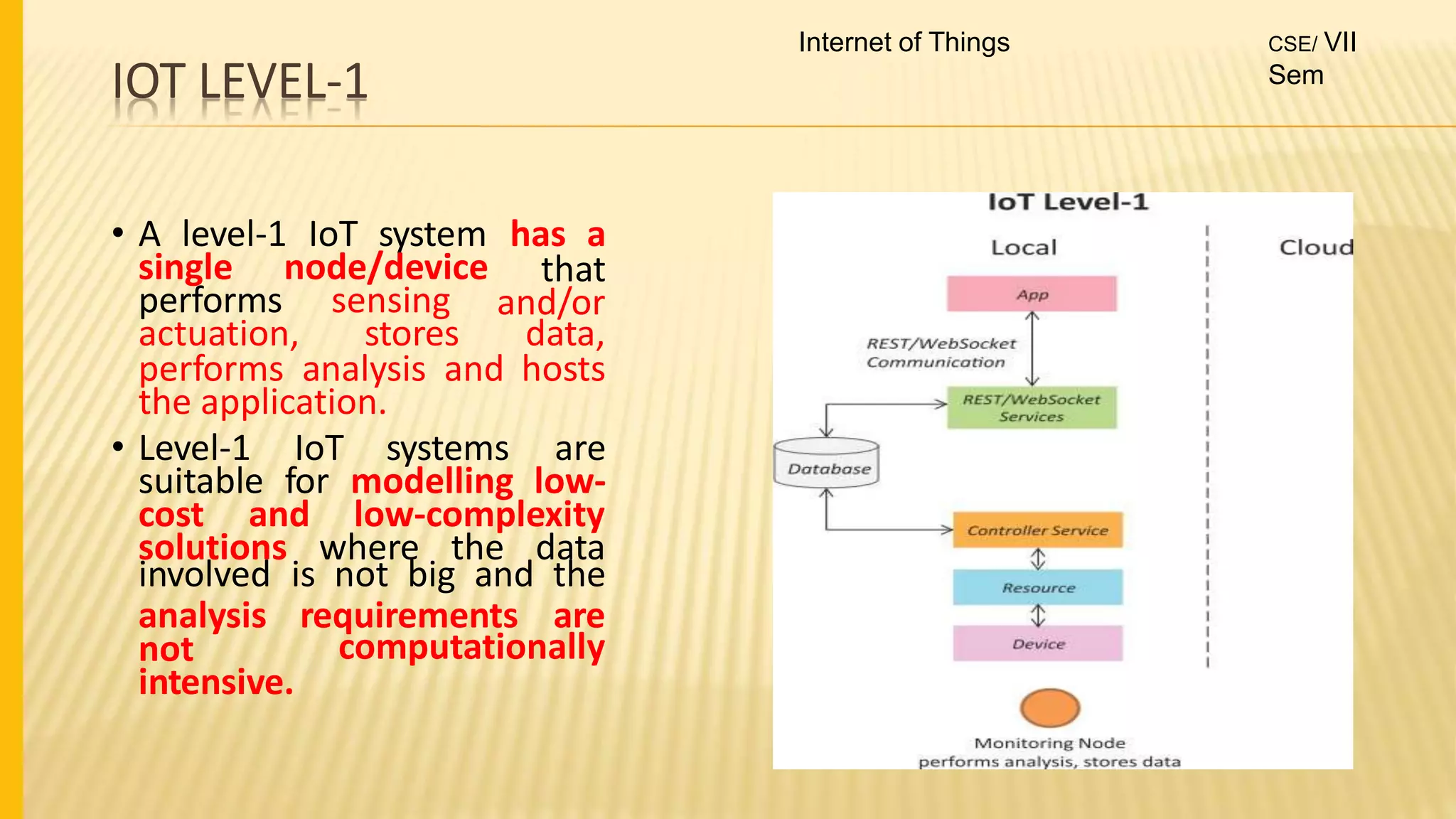
• A level-1 IoT system has a
single node/device
performs sensing
that
and/or
actuation, stores data,
performs analysis and hosts
the application.
• Level-1 IoT systems are
suitable for modelling low-
cost and low-complexity
solutions where the data
involved is not big and the
analysis requirements are
computationally
not
intensive.
Internet of Things CSE/ VII
Sem
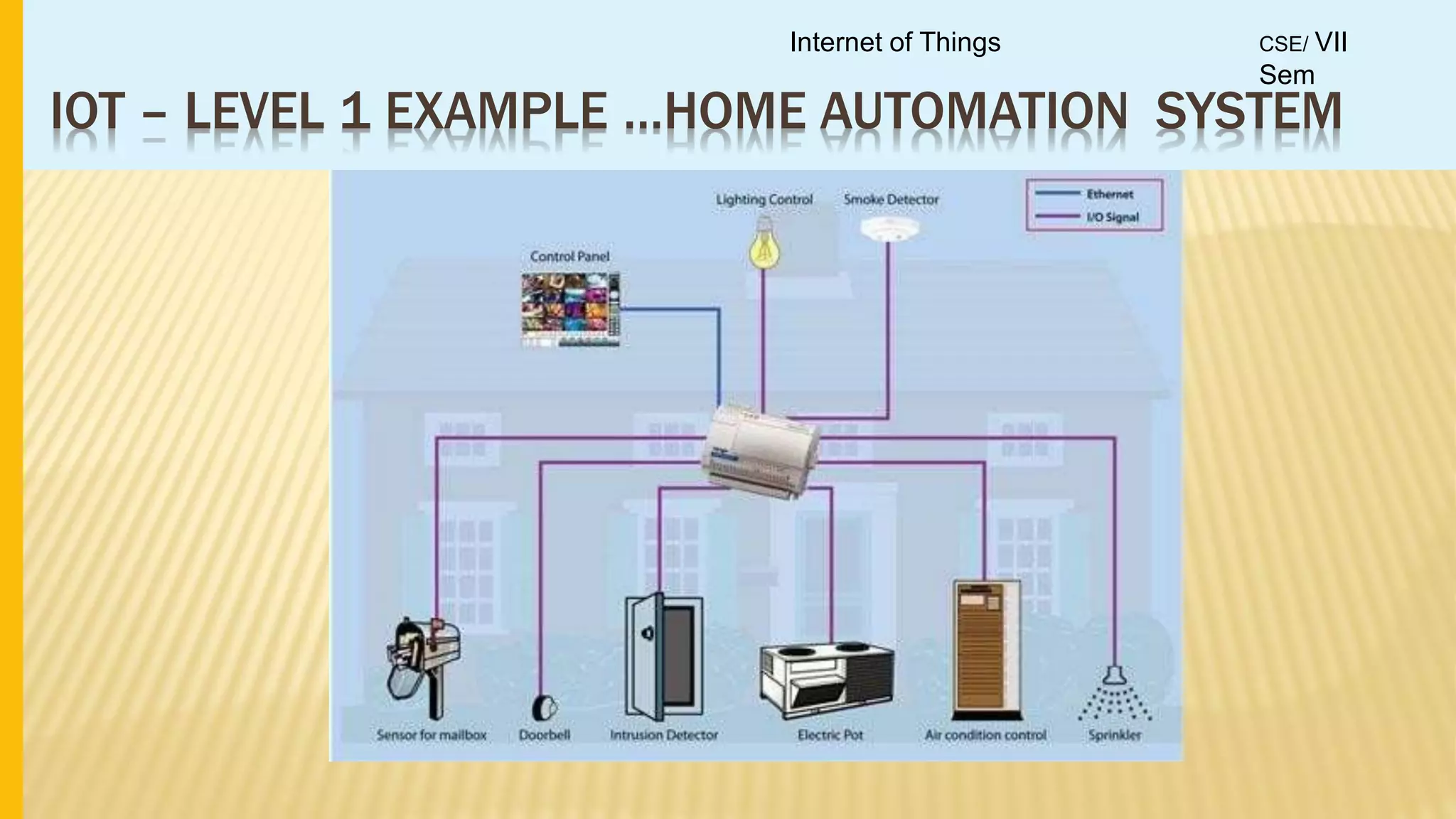
IOT – LEVEL 1 EXAMPLE …HOME AUTOMATION SYSTEM
Internet of Things CSE/ VII
Sem
IOT LEVEL-2
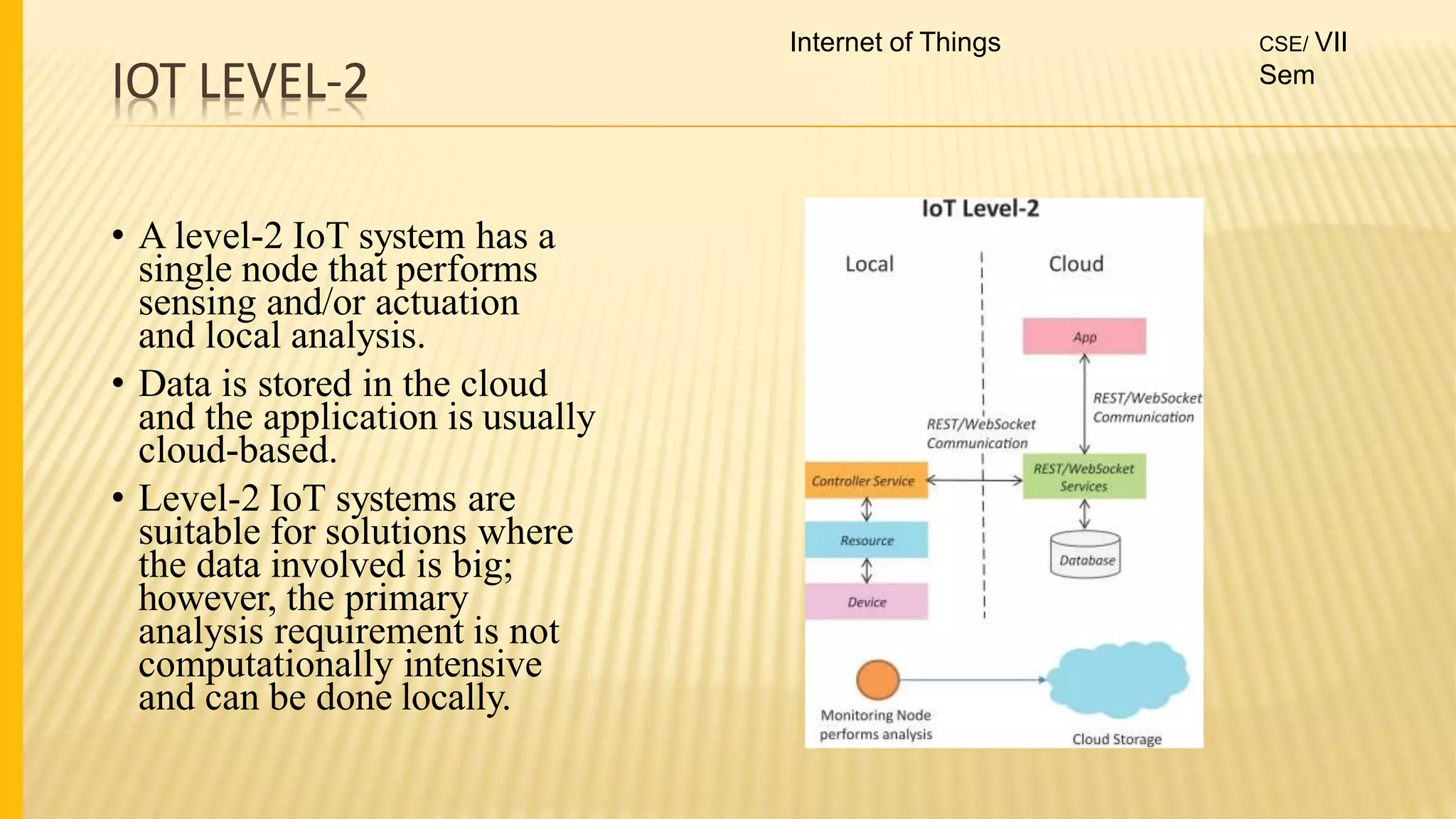
• A level-2 IoT system has a
single node that performs
sensing and/or actuation
and local analysis.
• Data is stored in the cloud
and the application is usually
cloud-based.
• Level-2 IoT systems are
suitable for solutions where
the data involved is big;
however, the primary
analysis requirement is not
computationally intensive
and can be done locally.
Internet of Things CSE/ VII
Sem
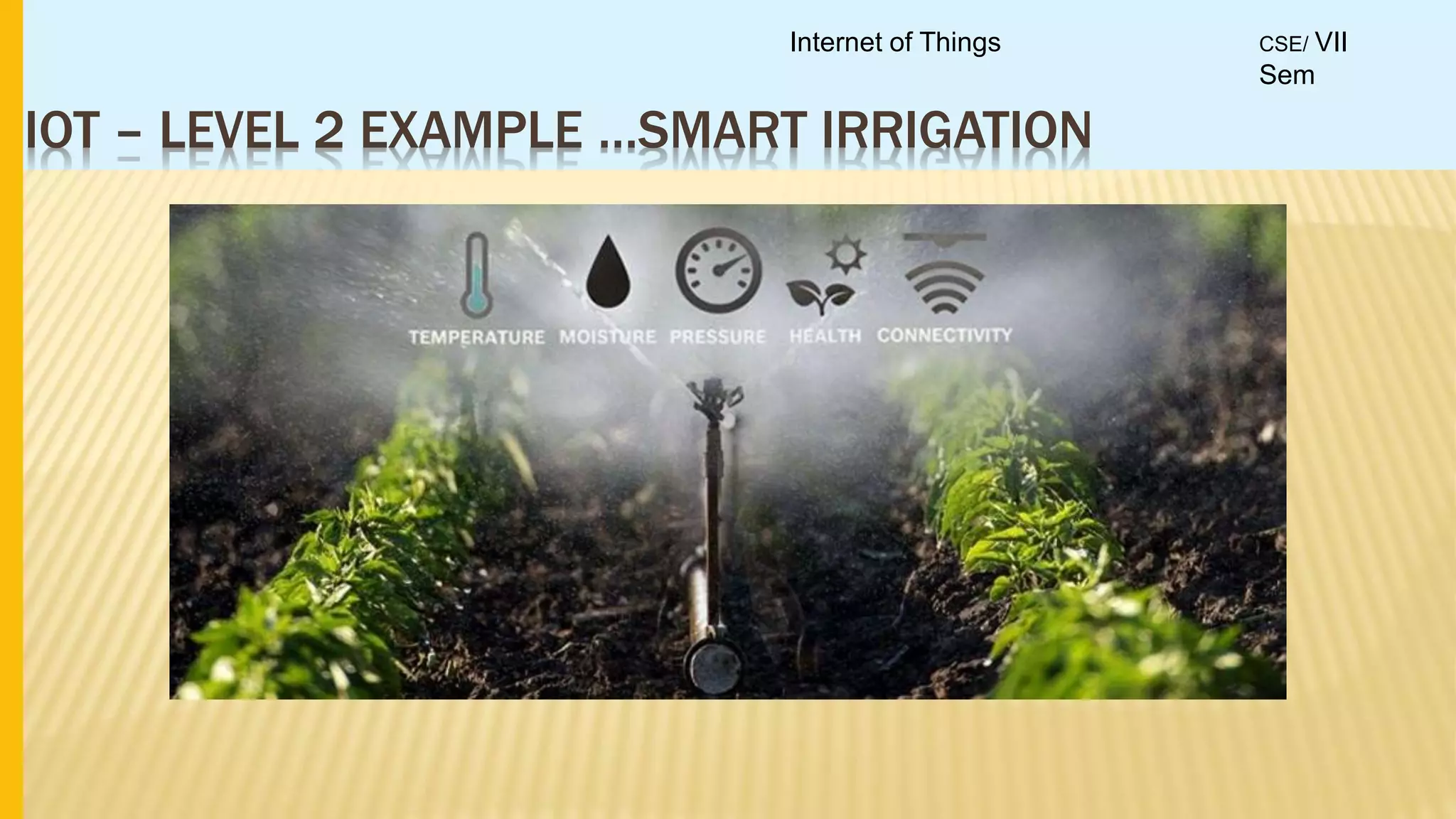
IOT – LEVEL 2 EXAMPLE …SMART IRRIGATION
Internet of Things CSE/ VII
Sem
IOT LEVEL-3
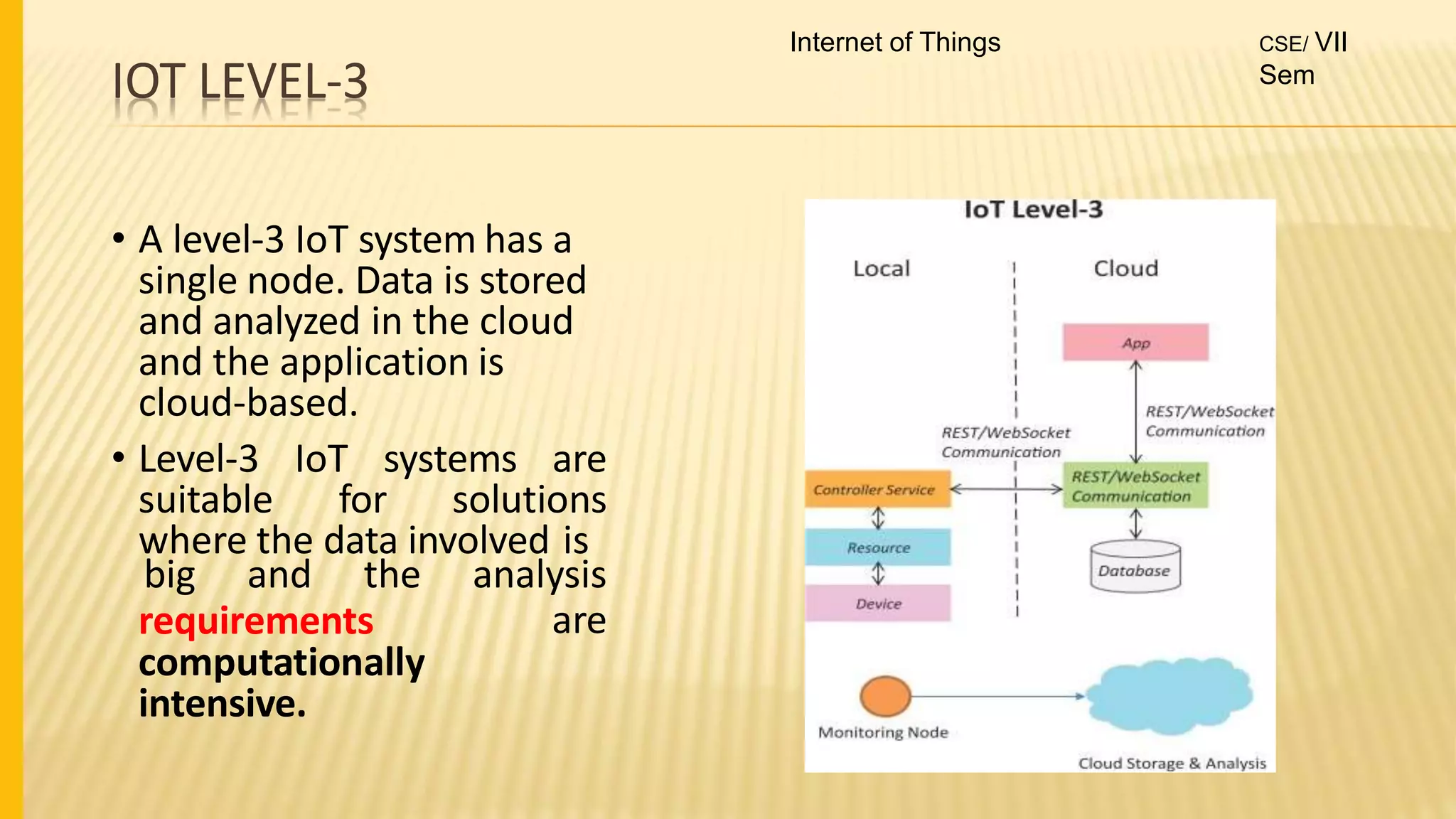
• A level-3 IoT system has a
single node. Data is stored
and analyzed in the cloud
and the application is
cloud-based.
• Level-3 IoT systems are
suitable for solutions
where the data involved is
requirements
big and the analysis
are
computationally
intensive.
Internet of Things CSE/ VII
Sem
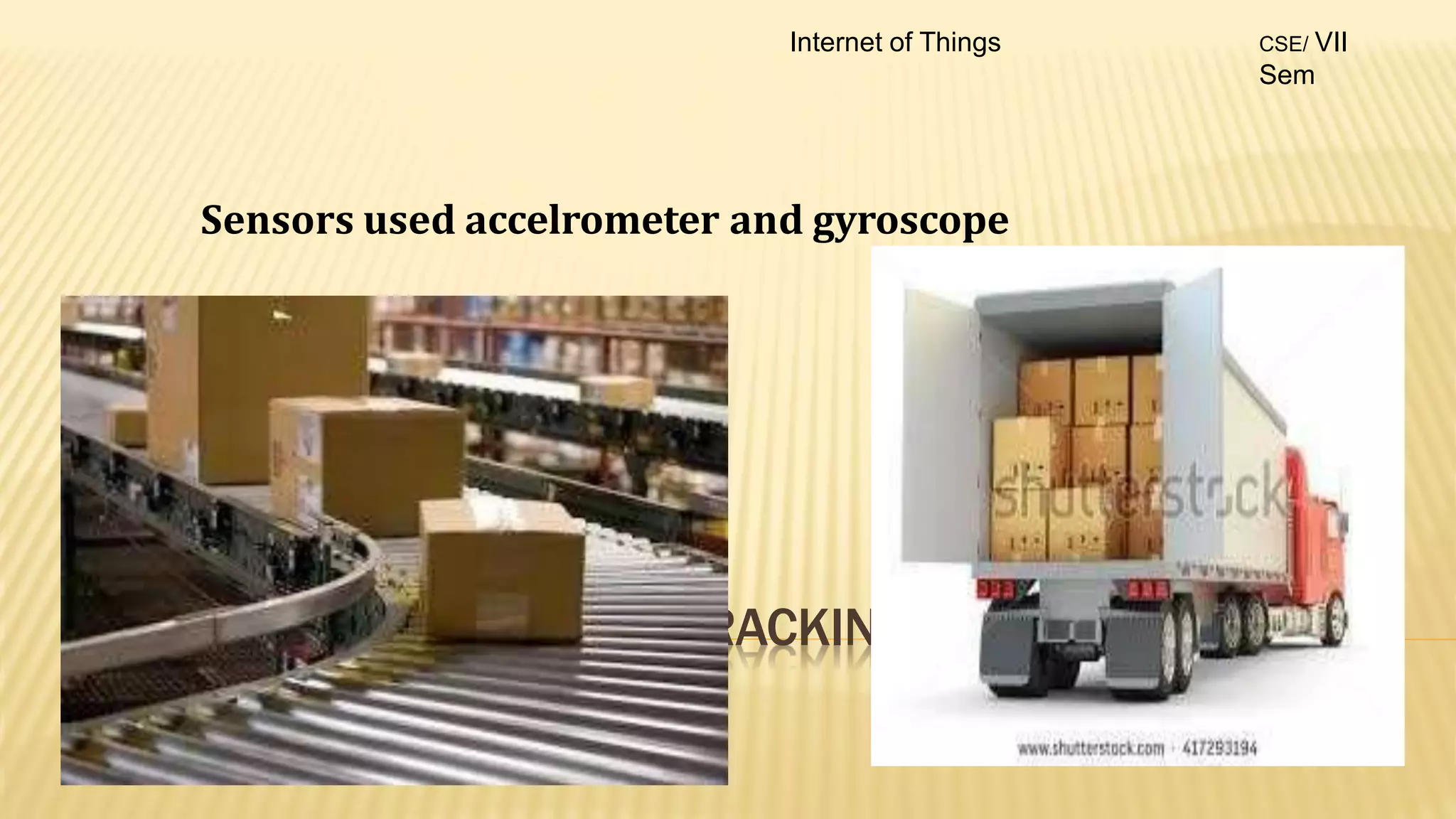
IOT – LEVEL 3 EXAMPLE …TRACKING PACKAGE
HANDLING
Sensors used accelrometer and gyroscope
Internet of Things CSE/ VII
Sem
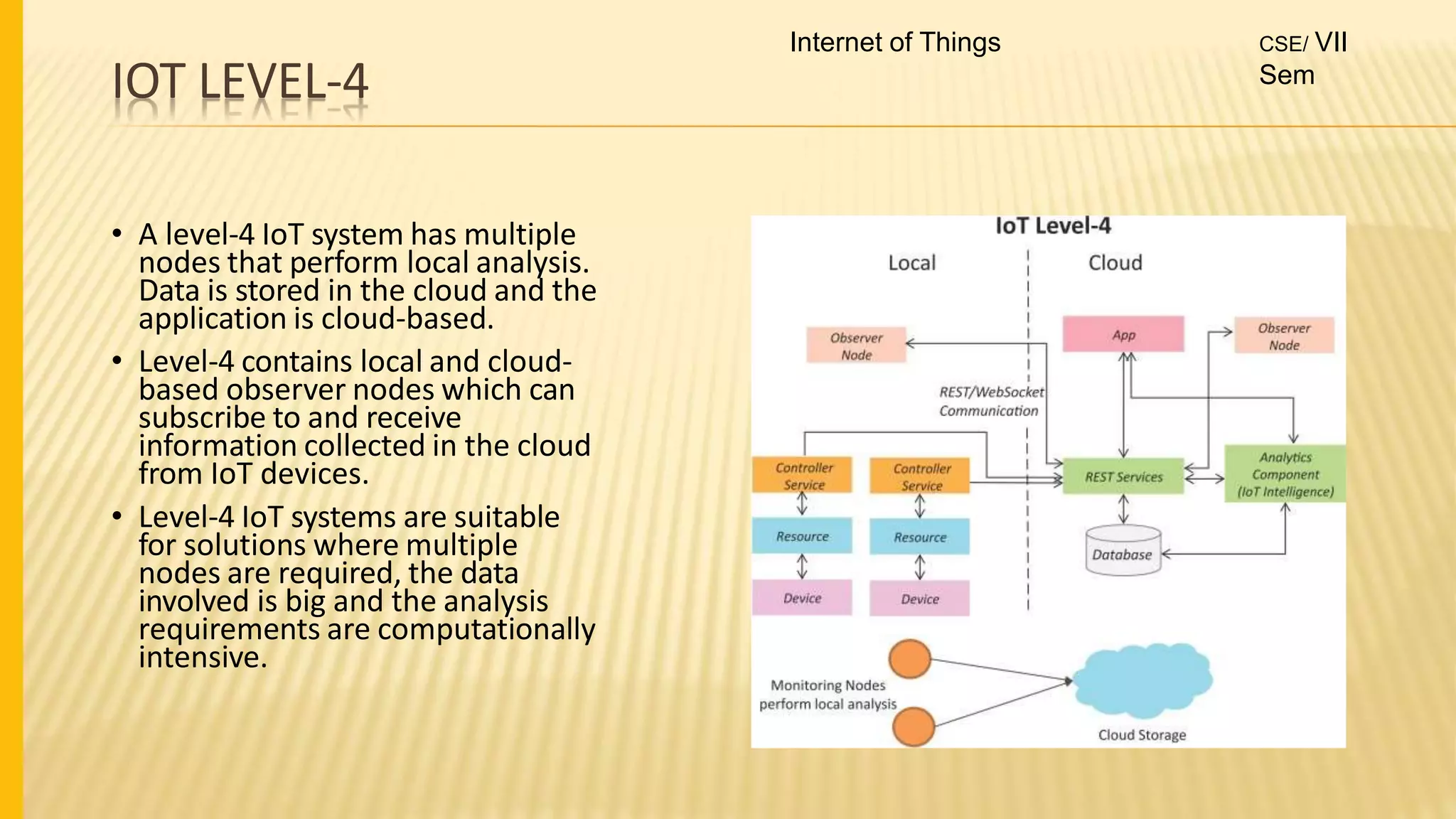
IOT LEVEL-4
• A level-4 IoT system has multiple
nodes that perform local analysis.
Data is stored in the cloud and the
application is cloud-based.
• Level-4 contains local and cloud-
based observer nodes which can
subscribe to and receive
information collected in the cloud
from IoT devices.
• Level-4 IoT systems are suitable
for solutions where multiple
nodes are required, the data
involved is big and the analysis
requirements are computationally
intensive.
Internet of Things CSE/ VII
Sem
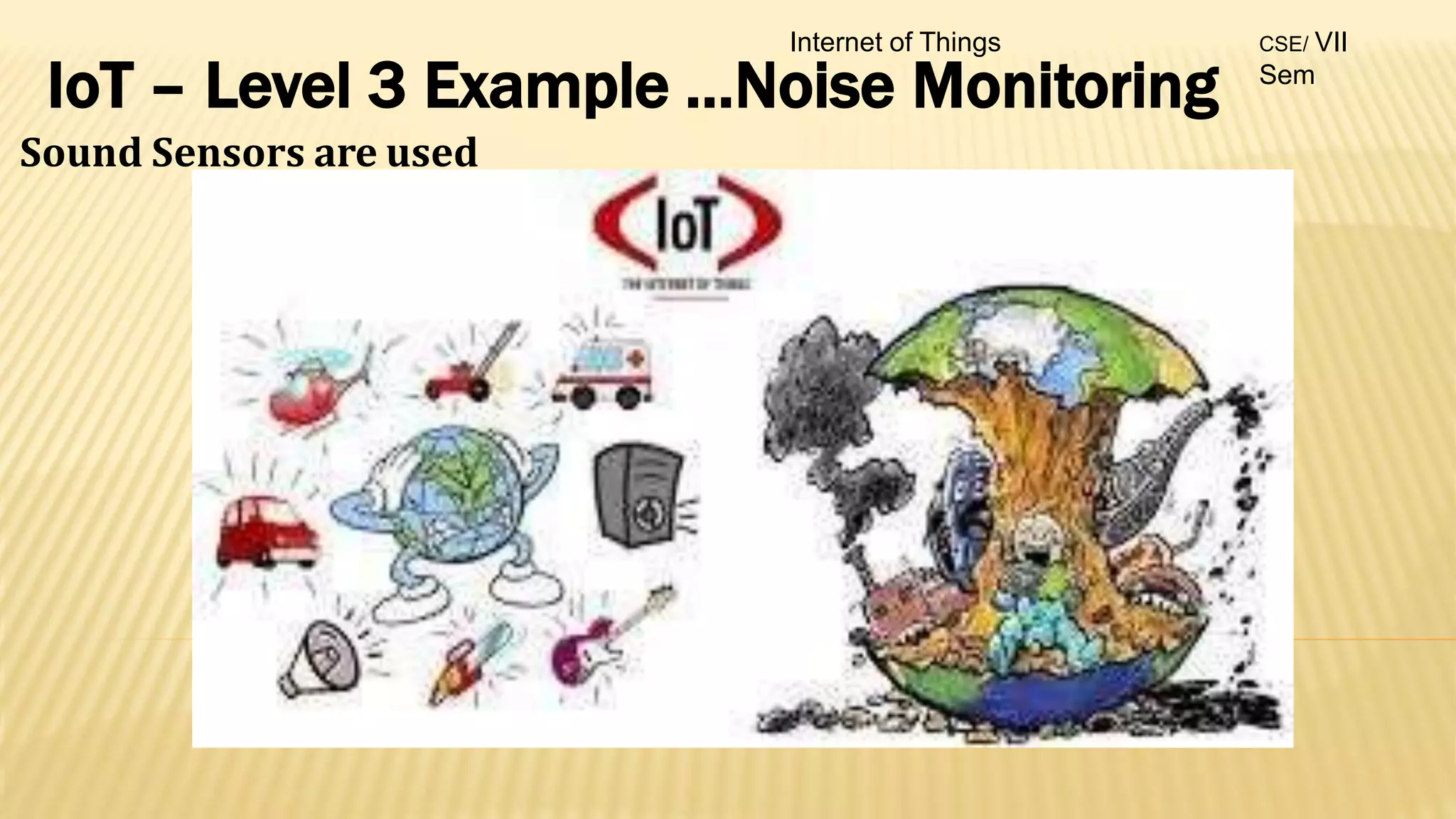
IoT – Level 3 Example …Noise Monitoring
Sound Sensors are used
Internet of Things CSE/ VII
Sem
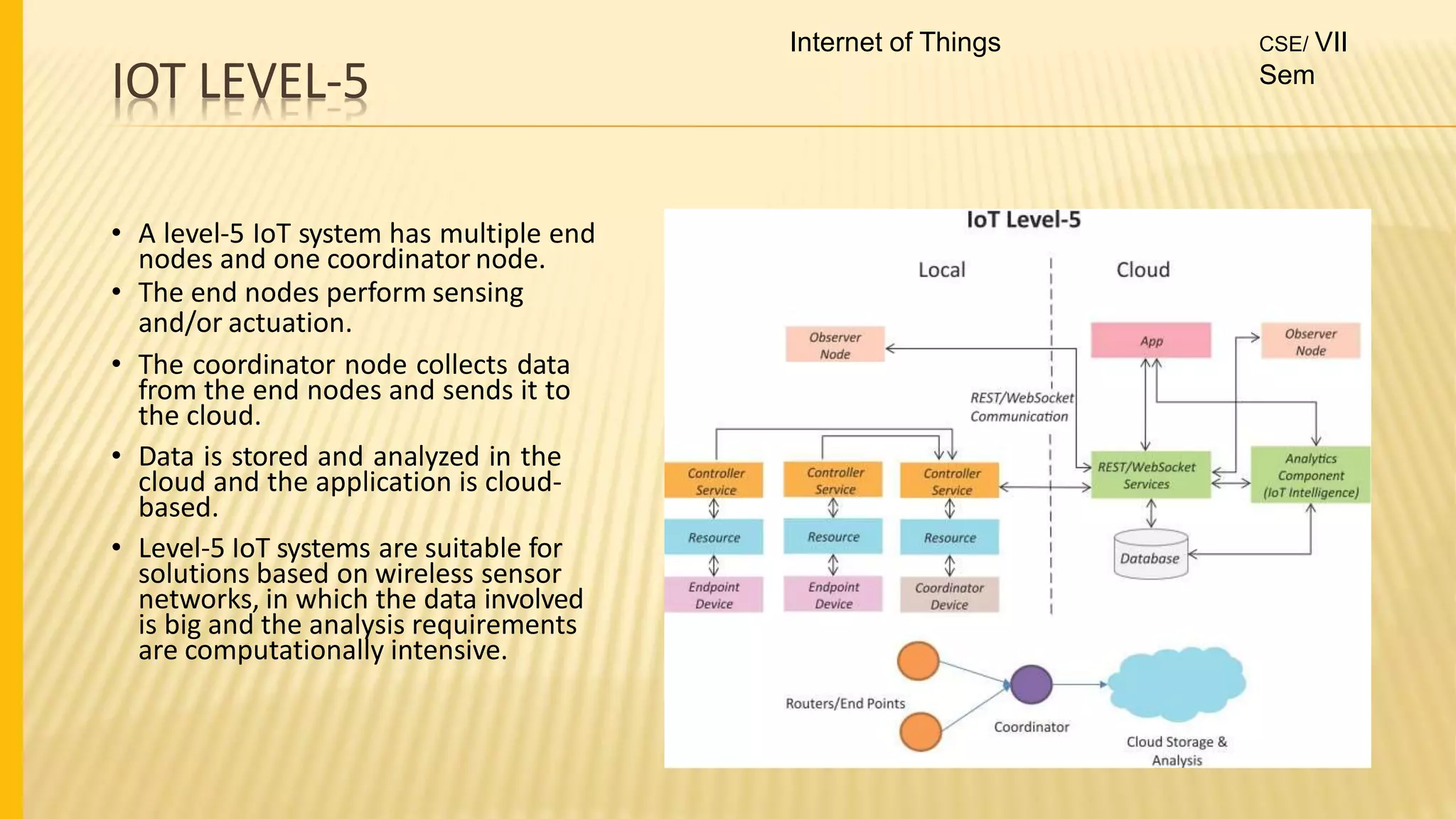
IOT LEVEL-5
• A level-5 IoT system has multiple end
nodes and one coordinator node.
• The end nodes perform sensing
and/or actuation.
• The coordinator node collects data
from the end nodes and sends it to
the cloud.
• Data is stored and analyzed in the
cloud and the application is cloud-
based.
• Level-5 IoT systems are suitable for
solutions based on wireless sensor
networks, in which the data involved
is big and the analysis requirements
are computationally intensive.
Internet of Things CSE/ VII
Sem
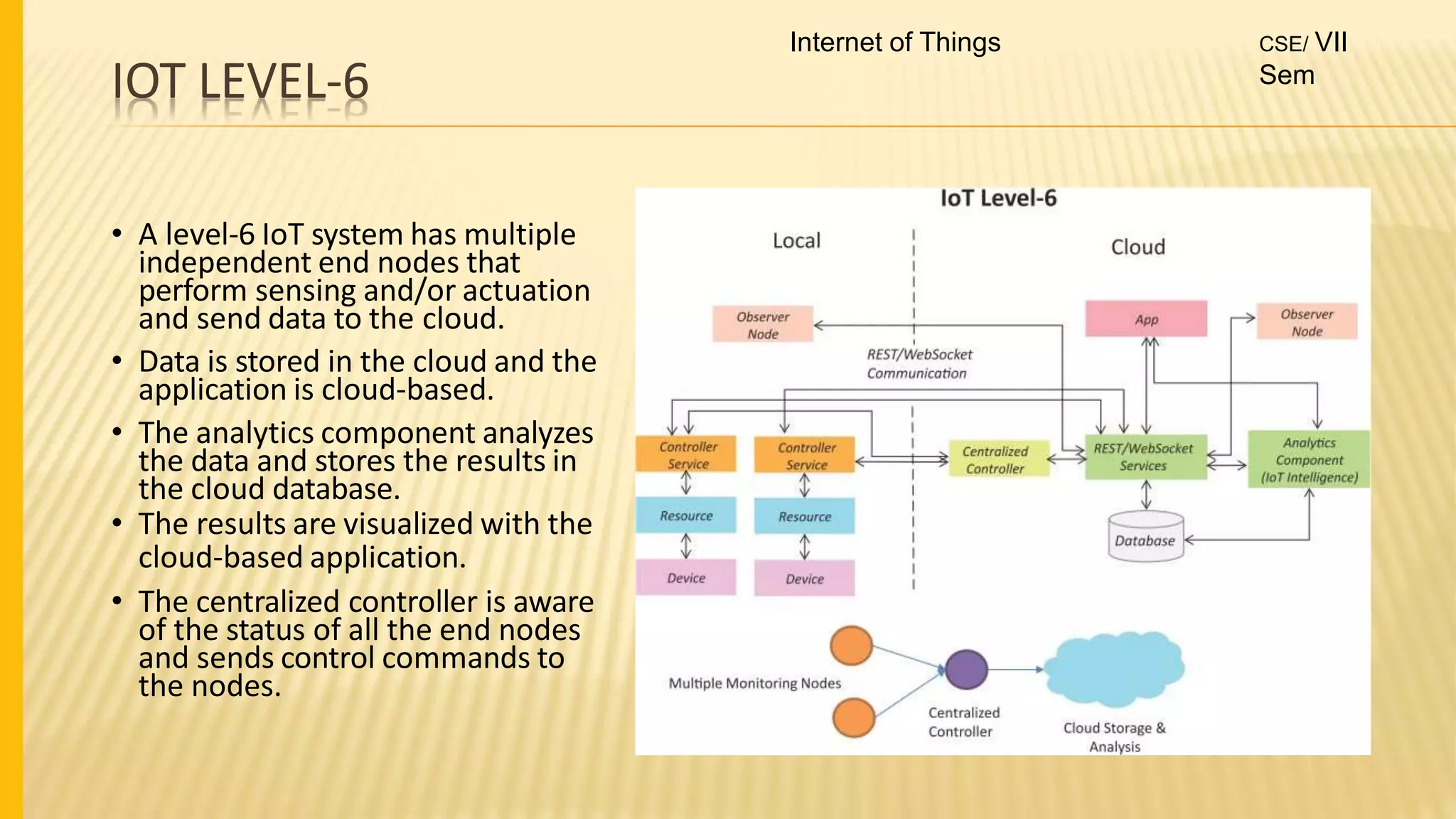
IOT LEVEL-6
• A level-6 IoT system has multiple
independent end nodes that
perform sensing and/or actuation
and send data to the cloud.
• Data is stored in the cloud and the
application is cloud-based.
• The analytics component analyzes
the data and stores the results in
the cloud database.
• The results are visualized with the
cloud-based application.
• The centralized controller is aware
of the status of all the end nodes
and sends control commands to
the nodes.
Internet of Things CSE/ VII
Sem
THANKS....

IOT Unit 1.pdf

  • 1.
    1 Year & Sem– IV year & VII Sem Subject – Internet of Things &7CS4-01 Unit – I JAIPUR ENGINEERING COLLEGE AND RESEARCH CENTRE 1
  • 2.
  • 3.
     Vision ofComputer Science Department To become renowned Centre of Excellence in Computer Science and Engineering and make competent engineers and professionals with high ethical values prepared for lifelong learning.  Mission of Computer Science Department M1 - To impart outcome based education for emerging technologies in the field of computer science and engineering. M2 - To provide opportunities for interaction between academia and industry. M3 - To provide platform for lifelo learning by accepting the change in technologiesM4 - To develop aptitude of fulfilling social responsibilities. 
  • 4.
    COURSE OUTCOMES (CO) CO1:Understand the revolution of internet in field of cloud, wireless network, embedded system and mobile devices. CO2: Apply IOT design concepts in various dimensions implementing software and hardware. CO3: Analyze various M2M and IOT architectures. CO4: Design and develop various applications in IOT.
  • 5.
    MAPPING OF CO& PO Subject Code L/T/P CO P O 1 P O 2 P O 3 P O 4 P O 5 P O 6 PO 7 PO 8 P O 9 P O 1 0 P O 1 1 P O 1 2 P S O 1 P S O 2 IOT 7CS4- 01 L Understand the revolution of internet in field of cloud, wireless network, embedded system and mobile devices. H H M M M M - -- M M M H H H L Apply IOT design concepts in various dimensions implementing software and hardware. H H H H H M - -- L M M H H H L Analyze various M2M and IoT architectures. H M M L M M - L M L L H M M L Design and develop various applications in IOT. H M H H H M M L H H H H H H
  • 6.
  • 7.
    LECTURE PLAN Unit No./Total Lecture Reqd. Topics Lect. Reqd. Lect. No. Unit-I (10) 1. Introduction to subject and scope 1 1 2. Introduction to learning, Types of learning and Applications 1 2 3. Supervised Learning 1 3 4. Linear Regression Model 1 4 5. Naïve Bayes Classifier 1 5 6. Decision Tree 1 6 7. K-nearest Neighbor 1 7 8. Logistic Regression 1 8 9. Support Vector Machine 1 9 10. Random Forest Algorithm 1 10 Unit-II (7) 1. IoT sensors 1 11 2. IoT actuators 1 12 3. Humidity sensor 1 13 4. Ultrasonic sensor 1 14 5. Temperature sensor 1 15 6. Arduino and Raspberry Pi 1 16 7. IoT OS 1 17 BC-1 ARM Processor 1 18
  • 8.
    LECTURE PLAN Unit No./Total Lecture Reqd. Topics Lect. Reqd. Lect. No. Unit-III (9) 1. IoT architecture 1 19 2. Reference model 1 20 3. Representational state transfer (REST) 1 21 4. Uniform resource identifier 1 22 5. Challenges in IoT 1 23 6. Design challenges 1 24 7. Development challenges 1 25 8. Security challenges 1 26 9. Other challenges 1 27 Unit- IV (8) 1. Machine to Machine vs IoT 2 28 2. Software defined networks 1 29 3. Network function virtualization 1 30 4. Difference between SDN and IoT 2 31 5. Difference between NFV and IoT 2 32 Unit- V (8) 1. IoT applications 1 33 2. Home automation 1 34 3. Smart cities 1 35 4. Environment and energy 1 36 5. Retail 1 37 6. Logistics 1 38 7. Agriculture and Industries 1 39 8. Health and lifestyle 1 40 BC-2 IoT Platforms 1 41
  • 9.
    RECOMMENDED BOOKS • T1:- “Vijay Madisetti and Arshdeep Bahga, “Internet of Things (A Hands-on- Approach), 1st Edition, VPT, 2014”. • T2 :- “Jan Holler , Vlasios Tsiatsis, Catherine Mulligan, Stefan Avesand, Stamatis Karnouskos, David Boyle, “From Machine-to-Machine to the Internet of Things: Introduction to a New Age of Intelligence”,1st Edition, Academic Press, 2014”. • T3 :- “Getting Started with Raspberry Pi, Matt Richardson & Shawn Wallace, O’Reilly (SPD), 2014, ISBN: 9789350239759”. • T4:- “Michael Margolis, “Arduino Cookbook”, 2nd edition, O’Reilly, 2012”. Internet of Things CSE/ VII Sem
  • 10.
    SUBJECT DETAILED BLOWNUP FOR UNIT -I Internet of Things CSE/ VII Sem
  • 11.
    BEFORE UNIT IWE FIRST DISCUSSED • IoT and its definition • History • How IOT works • Lifecycle • Characteristics of IoT • What internet of things do? • How many IOT devices are today? • Applications • Real life applications • Future with IOT Internet of Things CSE/ VII Sem
  • 12.
    SO LETS STARTWITH HISTORY Internet of Things CSE/ VII Sem
  • 13.
  • 14.
    WHAT IS IOT?? •Internet Of Things is Fully Networked and Connected Devices sending analytics data back to cloud or data center. • The definition of Internet of things is that it is the network in which every object or thing is provided unique identifier and data is transferred through a network without any verbal communication. • Scope of IoT is not just limited to just connecting things to the internet, but it allows these things to communicate and exchange data, process them as well as control them while executing applications. Internet of Things CSE/ VII Sem
  • 15.
  • 16.
    FORMAL DEFINITION OFIOT • The Internet of Things (IoT) is the network of physical objects or "things" embedded with electronics, software, sensors, and network connectivity, which enables these objects to collect and exchange data. Internet of Things CSE/ VII Sem
  • 17.
    HOW IOT WORKS?? •Internet of Things (IoT), also sometimes referred to as the Internet of Everything (IoE), consists of all the web-enabled devices that collect, send and act on data they acquire from their surrounding environments using embedded sensors, processors and communication hardware. • These devices, often called "connected" or "smart" devices, can sometimes talk to other related devices, a process called machine-to-machine (M2M) communication, and act on the information they get from one another. • Humans can interact with the gadgets to set them up, give them instructions or access the data, but the devices do most of the work on their own without human intervention. Internet of Things CSE/ VII Sem
  • 18.
    HOW IOT WORKS?? Internetof Things CSE/ VII Sem
  • 19.
    IOT LIFECYCLE Internet ofThings CSE/ VII Sem
  • 20.
    Internet of ThingsCSE/ VII Sem
  • 21.
    CHARACTERISTICS OF IOT •Dynamic Global network & Self-Adapting : Adapt the changes w.r.t changing contexts • Self Configuring : Eg. Fetching latest s/w updates without manual intervention. • Interoperable Communication Protocols : Communicate through various protocols • Unique Identity : Such as Unique IP Address or a URI • Integrated into Information Network : This allows to communicate and exchange data with other devices to perform certain analysis. Internet of Things CSE/ VII Sem
  • 22.
    WHAT INTERNET OFTHINGS DO? Internet of Things CSE/ VII Sem
  • 23.
    Internet of ThingsCSE/ VII Sem
  • 24.
    HOW MANY IOTDEVICES ARE THERE TODAY? • In the year 2017 there were 8.4 billion IoT connected devices in the whole worldwide. • While in the year 2018 it increased to 9.2 Billion. • It is expected that in the year 2020 the IoT connected devices in the worldwide would be 20.8 Billion. Internet of Things CSE/ VII Sem
  • 25.
    APPLICATIONS OF IOT Internetof Things CSE/ VII Sem
  • 26.
    Internet of ThingsCSE/ VII Sem
  • 27.
    Internet of ThingsCSE/ VII Sem
  • 28.
    SENSORS IN EVENTHE HOLY COW!! Internet of Things CSE/ VII Sem
  • 29.
    Internet of ThingsCSE/ VII Sem
  • 30.
    THINGS IN IOT •Refers to IoT devices which have unique identities that can perform sensing, actuating and monitoring capabilities. • IoT devices can exchange data with other connected devices or collect data from other devices and process the data either locally or send the data to centralized servers or cloud – based application back-ends for processing the data. Internet of Things CSE/ VII Sem
  • 31.
    GENERIC BLOCK DIAGRAMOF AN IOT DEVICE • An IoT device may consist of several interfaces for connections to other devices, both wired and wireless. • I/O interfaces for sensors • Interfaces for internet connectivity • Memory and storage interfaces • Audio/video interfaces Internet of Things CSE/ VII Sem
  • 32.
    FUTURE WITH IOT •Internet of Things Wearable devices is the future. You can control your car with a smart watch like automatically parking it and for closing or to open the doors. • Your wearable device may also detect the dangers around you. We already have devices that track our activity and exercise habits. • In the near future, we may also be able to easily track our calorie intake and eating habits automatically. So everything is going to be easy except that making everything easy is tough. • Here are some examples of IoT wearable devices that are already available in the market. 1. Sync Smart band Activity Tracker 2. Fitbit Surge Smart Watch 3. Hicon Wearable Smart Bracelet 4. Beddit Sleep tracker Internet of Things CSE/ VII Sem
  • 33.
    PHYSICAL DESIGN OFIOT • IOT Protocols • Things in IOT Internet of Things CSE/ VII Sem
  • 34.
    IOT PROTOCOLS • LinkLayer • 802.3 – Ethernet • 802.11 – WiFi • 802.16 – WiMax • 802.15.4 – LR-WPAN • 2G/3G/4G • Network/Internet Layer • IPv4 • IPv6 • 6LoWPAN • Transport Layer • TCP • UDP • Application Layer • HTTP • CoAP • WebSocket • MQTT • XMPP • DDS • AMQP Internet of Things CSE/ VII Sem
  • 35.
    IOT PROTOCOLS…LINK LAYER…ETHERNET Sr.NoStandard Shared medium 1 802.3 Coaxial Cable…10BASE5 2 802.3.i Copper Twisted pair …..10BASE-T 3 802.3.j Fiber Optic……10BASE-F 4 802.3.ae Fiber…..10Gbits/s Data Rates are provided from 10Gbit/s to 40Gb/s and higher Internet of Things CSE/ VII Sem
  • 36.
    IOT PROTOCOLS…LINK LAYER…WIFI Sr.NoStandard Operates in 1 802.11a 5 GHz band 2 802.11b and 802.11g 2.4GHz band 3 802.11.n 2.4/5 GHz bands 4 802.11.ac 5GHz band 5 802.11.ad 60Hz band • Collection of Wireless LAN • Data Rates from 1Mb/s to 6.75 Gb/s Internet of Things CSE/ VII Sem
  • 37.
    IOT PROTOCOLS…LINK LAYER…WIMAX Sr.NoStandard Data Rate 1 802.16m 100Mb/s for mobile stations 1Gb/s for fixed stations • Collection of Wireless Broadband standards • Data Rates from 1.5Mb/s to 1 Gb/s Internet of Things CSE/ VII Sem
  • 38.
    IOT PROTOCOLS…LINK LAYER…LR- WPAN •Collection of standards for low-rate wireless personal area networks • Basis for high level communication protocols such as Zigbee • Data Rates from 40Kb/s to 250Kb/s • Provide low-cost and low-speed communication for power constrained devices Internet of Things CSE/ VII Sem
  • 39.
    IOT PROTOCOLS…LINK LAYER…2G/3G/4G– MOBILE COMMUNICATION Sr.No Standard Operates in 1 2G GSM-CDMA 2 3G UMTS and CDMA 2000 3 4G LTE • Data Rates from 9.6Kb/s (for 2G) to up to 100Mb/s (for 4G) Internet of Things CSE/ VII Sem
  • 40.
    IOT PROTOCOLS…NETWORK/INTERNET LAYER • Responsiblefor sending of IP datagrams from source to destination network • Performs the host addressing and packet routing • Host identification is done using hierarchical IP addressing schemes such as IPV4 or IPV6 Internet of Things CSE/ VII Sem
  • 41.
    IOT PROTOCOLS…NETWORK LAYER •IPV4 • Used to identify the devices on a network using hierarchical addressing scheme • Uses 32-bit address scheme • IPV6 • Uses 128-bit address scheme • 6LoWPAN (IPV6 over Low power Wireless Personal Area Network) • Used for devices with limited processing capacity • Operates in 2.4 Ghz • Data Rates of 250Kb/s Internet of Things CSE/ VII Sem
  • 42.
    IOT PROTOCOLS…TRANSPORT LAYER • Provideend-to-end message transfer capability independent of the underlying network • It provides functions such as error control, segmentation, flow- control and congestion control Internet of Things CSE/ VII Sem
  • 43.
    IOT PROTOCOLS…TCP • Transmission ControlProtocol • Connection Oriented • Ensures Reliable transmission • Provides Error Detection Capability to ensure no duplicacy of packets and retransmit lost packets • Flow Control capability to ensure the sending data rate is not too high for the receiver process • Congestion control capability helps in avoiding congestion which leads to degradation of n/w performance Internet of Things CSE/ VII Sem
  • 44.
    IOT PROTOCOLS…UDP • User DatagramProtocol • Connectionless • Does not ensures Reliable transmission • Does not do connection before transmitting • Does not provide proper ordering of messages • Transaction oriented and stateless Internet of Things CSE/ VII Sem
  • 45.
    IOT PROTOCOLS…APPLICATION LAYER…HYPER TRANSFERPROTOCOL • Forms foundation of World Wide Web(WWW) • Includes commands such as GET,PUT, POST, HEAD, OPTIONS, TRACE..etc • Follows a request-response model • Uses Universal Resource Identifiers(URIs) to identify HTTP resources Internet of Things CSE/ VII Sem
  • 46.
    IOT PROTOCOLS…APPLICATION LAYER…COAP • ConstrainedApplication Protocol • Used for Machine to machine (M2M) applications meant for constrained devices and n/w’s • Web transfer protocol for IoT and uses request-response model • Uses client –server architecture • Supports methods such as GET,POST, PUT and DELETE Internet of Things CSE/ VII Sem
  • 47.
    IOT PROTOCOLS…APPLICATION LAYER…WEBSOCKET • Allowsfull-duplex communication over single socket • Based on TCP • Client can be a browser, IoT device or mobile application IoT Protocols…Application Layer…MQTT • Message Queue Telemetry Transport , light-weight messaging protocol • Based on publish-subscribe model • Well suited for constrained environments where devices have limited processing, low memory and n/w bandwith requirement Internet of Things CSE/ VII Sem
  • 48.
    IOT PROTOCOLS…APPLICATION LAYER…XMPP •Extensible messaging and presence protocol • For Real time communication and streaming XML data between n/w entities • Used for Applications such as Multi-party chat and voice/video calls. • Decentralized protocol and uses client server architecture. Internet of Things CSE/ VII Sem
  • 49.
    IOT PROTOCOLS…APPLICATION LAYER…DDS •Data Distribution service is a data-centric middleware standard for device-to-device or machine-to-machine communication. • Publish subscribe model where publishers create topics to which subscribers can use. • Provides Quality-of-service control and configurable reliability. Internet of Things CSE/ VII Sem
  • 50.
    IOT PROTOCOLS…APPLICATION LAYER…AMQP •Advanced Messaging Queuing Protocol used for business messaging. • Supports both point-to-point and publisher/subscriber models, routing and queuing • Broker here receives messages from publishers and route them over connections to consumers through messaging queues. Internet of Things CSE/ VII Sem
  • 51.
    LOGICAL DESIGN OFIOT • Logical design of an IoT system refers to an abstract representation of the entities and processes without going into the low-level specifics of the implementation. • An IoT system comprises a number of functional blocks that the system the for provide capabilities sensing, identification, actuation, communication and management. Internet of Things CSE/ VII Sem
  • 52.
    LOGICAL DESIGN OFIOT • Device : Devices such as sensing, actuation, monitoring and control functions. • Communication : IoT Protocols • Services like device monitoring, device control services, data publishing services and device discovery • Management : Functions to govern the system • Security : Functions as authentication, authorization, message and content integrity, and data security • Applications Internet of Things CSE/ VII Sem
  • 53.
    REQUEST–RESPONSE COMMUNICATION MODEL •Request–Response is a communication model in which the client sends requests to the server and the server responds to the requests. • When the server receives a request, it decides how to respond, fetches the data, retrieves resource representations, prepares the response and then sends the response to the client. • Stateless communication model Internet of Things CSE/ VII Sem
  • 54.
    PUBLISH–SUBSCRIBE COMMUNICATION MODEL •Publish–Subscribe is a communication model that involves publishers, brokers and consumers. • Publishers are the source of data. Publishers send the data to the topics which are managed by the broker. Publishers are not aware of the consumers. • Consumers subscribe to the topics which are managed by the broker. • When the broker receives data for a topic from the publisher, it sends the data to all the subscribed consumers. Internet of Things CSE/ VII Sem
  • 55.
    PUSH–PULL COMMUNICATION MODEL •Push–Pull is a communication model in which the data producers push the data to queues and the consumers pull the data from the queues. Producers do not need to be aware of the consumers. • Queues help in decoupling the messaging between the producers and consumers. • Queues also act as a buffer which helps in situations when there is a mismatch between the rate at which the producers push data and the rate at which the consumers pull data. Internet of Things CSE/ VII Sem
  • 56.
    EXCLUSIVE PAIR COMMUNICATIONMODEL • Exclusive Pair is a bidirectional, fully duplex communication model that uses a persistent connection between the client and the server. • Once the connection is set up it, remains open until the client sends a request to close the connection. • Client and server can send messages to each other after connection setup. Internet of Things CSE/ VII Sem
  • 57.
    REST-BASED COMMUNICATION APIS •Representational State Transfer (REST) is a set of architectural principles by which you can design web services and web APIs that focus on a system’s resources and how resource states are addressed and transferred. • REST APIs follow therequest– response communication model. • REST architectural constraints apply to the components, connectors and data elements within a distributed hypermedia system. Internet of Things CSE/ VII Sem
  • 58.
    REST-BASED COMMUNICATION APISCONSTRAINTS • Client – Server • Stateless • Cacheable • Layered System • Uniform Interface • Code on demand Client Server Request Response Request Response Internet of Things CSE/ VII Sem
  • 59.
    WEBSOCKET-BASED COMMUNICATION APIS •WebSocket APIs allow bi- directional, full duplex communication between clients and servers. • WebSocket APIs follow the exclusive pair communication model. Internet of Things CSE/ VII Sem
  • 60.
    Comparison Based onREST Websocket State Stateless Stateful Directional Unidirectional Bidirectional Req-Res/Full Duplex Follow Request Response Model Exclusive Pair Model TCP Connections Each HTTP request involves setting up a new TCP Connection Involves a single TCP Connection for allrequests Header Overhead Each request carries HTTP Headers, hence not suitable for real-time Does not involve overhead of headers. Scalability Both horizontal and verticalare easier Only Vertical is easier DIFFERENCE BETWEEN REST AND WEBSOCKET-BASED COMMUNICATION APIS Internet of Things CSE/ VII Sem
  • 61.
    IOT ENABLING TECHNOLOGIES •Wireless Sensor Network • Cloud Computing • Big Data Analytics • Embedded Systems Internet of Things CSE/ VII Sem
  • 62.
    WSN • Distributed Deviceswith sensors used to monitor the environmental and physical conditions • Consists of several end-nodes acting as routers or coordinators too • Coordinators collects data from all nodes / acts as gateway that connects WSN to internet • Routers route the data packets from end nodes to coordinators. Internet of Things CSE/ VII Sem
  • 63.
    EXAMPLE OF WSNSIN IOT & PROTOCOLS USED Example • Weather monitoring system • Indoor Air quality monitoring system • Soil moisture monitoring system • Survelliance systems • Health monitoring systems Protocols • Zigbee Internet of Things CSE/ VII Sem
  • 64.
    CLOUD COMPUTING • Deliverapplications and services over internet • Provides computing, networking and storage resources on demand • Cloud computing performs services such as Iaas, Paas and Saas • Iaas : Rent Infrastructure • Paas : supply an on-demand environment for developing, testing, delivering and managing software applications. • Saas : method for delivering software applications over the Internet, on demand and typically on a subscription basis. Internet of Things CSE/ VII Sem
  • 65.
    BIG DATA ANALYTICS •Collection of data whose volume, velocity or variety is too large and difficult to store, manage, process and analyze the data using traditional databases. • It involves data cleansing, processing and visualization • Lots of data is being collected and warehoused • Web data, e-commerce • purchases at department/ grocery stores • Bank/Credit Card transactions • Social Network Internet of Things CSE/ VII Sem
  • 66.
    BIG DATA ANALYTICS VarietyIncludes different types of data • Structured • Unstructured • SemiStructured • All of above Internet of Things CSE/ VII Sem
  • 67.
    BIG DATA ANALYTICS VelocityRefers to speed at which data is processed • Batch • Real-time • STreams Internet of Things CSE/ VII Sem
  • 68.
    BIG DATA ANALYTICS Volumerefers to the amount of data • Terabyte • Records • Transactions • Files • Tables Internet of Things CSE/ VII Sem
  • 69.
    IOT LEVELS ANDDEPLOYMENT TEMPLATES An IoT system comprises the following components: • Device: An IoT device allows identification, remote sensing, actuating and remote monitoring capabilities. • Resource: Resources are software components on the IoT device for accessing, processing and storing sensor information, or for controlling actuators connected to the device. Resources also include the software components that enable network access for the device. • Controller Service: Controller service is a native service that runs on the device and interacts with the web services. Controller service sends data from the device to the web service and receives commands from the application (via web services) for controlling the device. Internet of Things CSE/ VII Sem
  • 70.
    IOT LEVELS ANDDEPLOYMENT TEMPLATES • Database: Database can be either local or in the cloud and stores the data generated by the IoT device. • Web Service: Web services serve as a link between the IoT device, application, database and analysis components. Web service can be implemented using HTTP and REST principles (REST service) or using the WebSocket protocol (WebSocket service). • Analysis Component: This is responsible for analyzing the IoT data and generating results in a form that is easy for the user to understand. • Application: IoT applications provide an interface that the users can use to control and monitor various aspects of the IoT system. Applications also allow users to view the system status and the processed data. Internet of Things CSE/ VII Sem
  • 71.
    IOT LEVEL-1 • Alevel-1 IoT system has a single node/device performs sensing that and/or actuation, stores data, performs analysis and hosts the application. • Level-1 IoT systems are suitable for modelling low- cost and low-complexity solutions where the data involved is not big and the analysis requirements are computationally not intensive. Internet of Things CSE/ VII Sem
  • 72.
    IOT – LEVEL1 EXAMPLE …HOME AUTOMATION SYSTEM Internet of Things CSE/ VII Sem
  • 73.
    IOT LEVEL-2 • Alevel-2 IoT system has a single node that performs sensing and/or actuation and local analysis. • Data is stored in the cloud and the application is usually cloud-based. • Level-2 IoT systems are suitable for solutions where the data involved is big; however, the primary analysis requirement is not computationally intensive and can be done locally. Internet of Things CSE/ VII Sem
  • 74.
    IOT – LEVEL2 EXAMPLE …SMART IRRIGATION Internet of Things CSE/ VII Sem
  • 75.
    IOT LEVEL-3 • Alevel-3 IoT system has a single node. Data is stored and analyzed in the cloud and the application is cloud-based. • Level-3 IoT systems are suitable for solutions where the data involved is requirements big and the analysis are computationally intensive. Internet of Things CSE/ VII Sem
  • 76.
    IOT – LEVEL3 EXAMPLE …TRACKING PACKAGE HANDLING Sensors used accelrometer and gyroscope Internet of Things CSE/ VII Sem
  • 77.
    IOT LEVEL-4 • Alevel-4 IoT system has multiple nodes that perform local analysis. Data is stored in the cloud and the application is cloud-based. • Level-4 contains local and cloud- based observer nodes which can subscribe to and receive information collected in the cloud from IoT devices. • Level-4 IoT systems are suitable for solutions where multiple nodes are required, the data involved is big and the analysis requirements are computationally intensive. Internet of Things CSE/ VII Sem
  • 78.
    IoT – Level3 Example …Noise Monitoring Sound Sensors are used Internet of Things CSE/ VII Sem
  • 79.
    IOT LEVEL-5 • Alevel-5 IoT system has multiple end nodes and one coordinator node. • The end nodes perform sensing and/or actuation. • The coordinator node collects data from the end nodes and sends it to the cloud. • Data is stored and analyzed in the cloud and the application is cloud- based. • Level-5 IoT systems are suitable for solutions based on wireless sensor networks, in which the data involved is big and the analysis requirements are computationally intensive. Internet of Things CSE/ VII Sem
  • 80.
    IOT LEVEL-6 • Alevel-6 IoT system has multiple independent end nodes that perform sensing and/or actuation and send data to the cloud. • Data is stored in the cloud and the application is cloud-based. • The analytics component analyzes the data and stores the results in the cloud database. • The results are visualized with the cloud-based application. • The centralized controller is aware of the status of all the end nodes and sends control commands to the nodes. Internet of Things CSE/ VII Sem
  • 81.