JSS Academy of Technical Education (JSSATE), Bengaluru
CLASS OF I SEMESTER
Sub: Innovation and Design Thinking (BIDTK158/258 )
Course Faculty: Dr. D N Roopa (DNR), Assistant Professor, MED, JSSATE
Module 2 - Tools for Design Thinking
• Real-Time design interaction capture and analysis
• Enabling efficient collaboration in digital space
• Empathy for design – Collaboration in distributed Design
Module 2 - Design thinking tools
1. Visualization
2. Empathy Map
3. Journey Mapping
4. Mind Maps
5. Rapid Concept Development
6. Assumption testing
7. Prototyping
8. Story Telling
9. Co creation
10. Learning Launches
• What is the main goal of empathy for design?
a) To create a product or service that meets the need of the target
audience.
b) To create a product or service that is aesthetically pleasing
c) To make a product or service that is easy to use
d) To create product or service that is unique
• What is an example of a method for conducting user research?
a) Surveys
b) A/B testing
c) Usability testing
d) Design sprints
• What empathy is:
a) To experience a persons situation so you can tell others what it was
like
b) To understand a person’s situation and to pity them
c) To have a deeper appreciation and understanding of peoples
needs
d) To listen to their problems and then give them advice
• Empathy allows designers to do all of the following except.
a) Focus on the practicalities of designing
b) Understand the way users do things
c) Figure out how users do things
d) Investigate users emotional needs
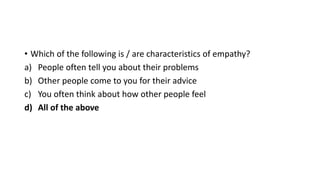
• Which of the following is / are characteristics of empathy?
a) People often tell you about their problems
b) Other people come to you for their advice
c) You often think about how other people feel
d) All of the above
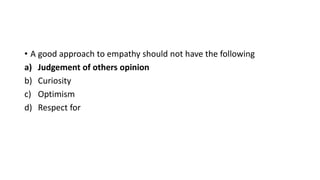
• A good approach to empathy should not have the following
a) Judgement of others opinion
b) Curiosity
c) Optimism
d) Respect for
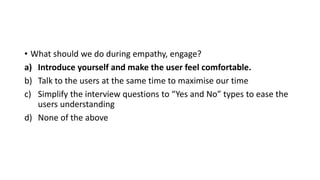
• What should we do during empathy, engage?
a) Introduce yourself and make the user feel comfortable.
b) Talk to the users at the same time to maximise our time
c) Simplify the interview questions to “Yes and No” types to ease the
users understanding
d) None of the above
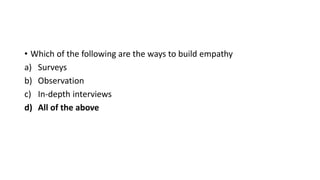
• Which of the following are the ways to build empathy
a) Surveys
b) Observation
c) In-depth interviews
d) All of the above
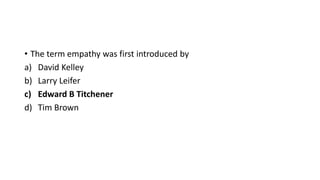
• The term empathy was first introduced by
a) David Kelley
b) Larry Leifer
c) Edward B Titchener
d) Tim Brown
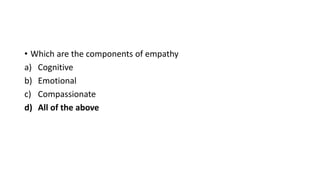
• Which are the components of empathy
a) Cognitive
b) Emotional
c) Compassionate
d) All of the above
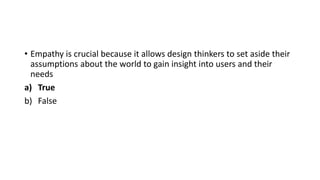
• Empathy is crucial because it allows design thinkers to set aside their
assumptions about the world to gain insight into users and their
needs
a) True
b) False
• Surya is creating a new product for Architectural college students. He
takes a design thinking approach. His first step is addressing who he is
creating the product for? And conducts research on understanding
the market. What is this step in the design thinking process?
• Which is NOT a good interview strategy for the Empathy step?
a) Encourage the person to talk about experiences
b) Encourage short answers that get right to the point
c) Ask follow up questions to get more information
d) Try to uncover needs people may or may not be aware of
• Which of the following is right?
a) Design sensibilities are a combination of design features, qualities
and aesthetics
b) Empathy is to see no evil, hear no evil and speak no evil
c) Design sensibilities are complex feelings such as amenity,
pleasantness, comfort, pleasure
d) Empathy is seeing with your own eyes, hearing with your own ear
and feeling the pain with your own heart
e) a & d
• You would interview people to gain an understanding of how they feel
during the -------------- stage of design thinking
a) Test
b) Define
c) Ideate
d) Empathize
• During which stage would you gather information about peoples
needs and motivations?
Ans: Empathise
• During which stage would you consult experts to learn more about
the areas of concern and to gain an understanding of other people’s
experiences?
a) Prototype
b) Define
c) Ideate
d) Empathize
• ----------------- is used with the objective of identifying needs that
customers are often unable to articulate
a. Mind mapping
b. Experience mapping
c. Story telling
d. Rapid concept development
What tool is often used to brainstorm and organize ideas?
a) Mind maps
b) Gantt Chart
c) Flow chart
d) PERT diagram
What tool is used to help visualize and understand user needs and pain
points
a) Personas
b) User stories
c) Use cases
d) Job stories
What tool is used to create interactive prototypes of a design?
a) Wireframes
b) Mockups
c) Clickable prototypes
d) Storyboards
• What tools is used to prioritize design elements and features
a) Affinity diagrams
b) Kano analysis
c) Value proposition canvas
d) Cost benefit analysis
What tool is used to create a visual representation of a process or
workflows?
a) Flow charts
b) PERT diagram
c) Gantt Charts
d) Mind maps
What tool is used to understand and map out the customer journey?
a) Customer Journey Map
b) Empathy Map
c) User Flow
d) User Research
What tool is used to create a visual representation of a product’s value
proposition?
a) Value proposition canvas
b) Affinity diagrams
c) Kano analysis
d) Cost benefit analysis
What tool is used to understand and organize user feedback and
research?
a) Affinity diagrams
b) Kano analysis
c) User research
d) Empathy Map
• What tool is used to create a visual representation of a projects tasks
and timelines?
a) Gantt chart
b) PERT diagrams
c) Mind Maps
d) Flowcharts
What tool is used to create a visual representation of a product’s
features and benefits?
a) Feature benefit matrix
b) Affinity diagrams
c) Kano analysis
d) Cost benefit analysis
• What tool is used to track user interactions on a website or app and
create visual representation of the data, such as a heatmaps and
click-maps?
a) Session replay software
b) Eye tracking technology
c) Heatmap and click tracking software
d) User testing platforms
What tool allows designers to conduct user testing and collect real time
feedback on a design?
a) Session replay software
b) Eye tracking technology
c) Heatmap and click tracking software
d) User testing platforms
What software records user interactions on a website or app, allowing
designers to watch and analyze users behaviour in real time?
a) Session replay software
b) Eye tracking technology
c) Heatmap and click tracking software
d) User testing platforms
What technology uses a device to track the movement of a users eyes
as they interact with a design?
a) Session replay software
b) Eye tracking technology
c) Heatmap and click tracking software
d) User testing platforms
What is the process of collecting and analyzing data on how users
interact with a design in real time called?
a) Real time design interaction capture
b) Real time design analysis
c) Real time design interaction analysis
d) Real time design capture and analysis
What tools and technologies can be used for real time design
interaction capture and analysis?
a) Heatmap and click tracking software, user testing platforms, session
replay software and eye tracking technology
b) Gantt charts, PERT diagrams and Mind Maps
c) Affinity diagrams, kano analysis and value proposition canvas
d) Cost benefit analysis, customer journey map and empathy map
What is the main goal of using Real time design interaction capture and
analysis?
a) To create a visual representation of a project tasks and timelines
b) To inform and improve the design process
c) To prioritize design elements and features
d) To understand and map out the customers journey.
What is the main difference between remote testing and in person
testing?
a) Remote testing is conducted over the phone and in person testing is
conducted in person
b) Remote testing is conducted online and in person testing is
conducted in person
c) Remote testing is conducted through email and in person testing is
conducted in person
d) Remote testing is conducted online and in person testing is
conducted over the phone
What is the main goal of enabling efficient collaboration in digital
space?
a) To create a digital environment where team members can easily
share ideas, provide feedback and work together on projects in real
time.
b) To develop a project management software for team members
c) To train team members on how to use design collaboration
software
d) To implement video conferencing tools for remote team members.
Which of the following is an example of a project management
software?
a) InVision
b) Trello
c) Google meet
d) Adobe XD
Which of the following is an example of design collaboration software?
a) InVision
b) Trello
c) Google meet
d) Adobe XD
What is one way to encourage open communication among team
members?
a) By fostering an open and inclusive environment where team
members feel comfortable sharing their thoughts.
b) By implementing strict protocols for communication, file sharing
and project management
c) By setting up regular team building activities
d) By limiting the number of team members on a project
How can clear protocols help team members collaborate efficiently?
a) By fostering an open and inclusive environment where team
members feel comfortable sharing their thoughts.
b) By limiting the number of team members on a project
c) By setting up regular team building activities
d) By establishing clear guidelines for communication, file sharing and
project management, team members can understand to work
together effectively and efficiently.
What are some benefits of enabling efficient collaboration in digital
space?
a) Better project management, design collaboration and video
conferencing
b) Improved productivity, better communication and faster project
completion.
c) Better communication, faster project completion and improved
productivity
d) Improved productivity, faster project completion and better design
collaboration.
What is the purpose of video conferencing tools?
a) To enable team members to communicate and collaborate in real
time even if they are working remotely.
b) To organize tasks set deadlines and assign team members to specific
tasks
c) To enable team members to share and work together on design
projects in real time
d) To provide a platform for team building activities
• What is the purpose of user testing?
a) To gather feedback and identify areas for improvements in a
product or service
b) To create a user-centered design
c) To create empathy map
d) To conduct user research
• What is an example of a user-centered design approach?
a) Involving users in the design process through co-creation
workshops or design sprints.
b) Creating empathy map
c) Conducting user research
d) User testing
• What is an example of a tool to understand users needs, wants, pain
points and goals?
a) User testing
b) User centered deign
c) Surveys
d) Empathy maps
• What is the benefit of using file sharing tools in distributed teams?
a) Team members can share and collaborate on files including design
documents and project assets.
b) To organize tasks and set deadlines
c) To enable team members to communicate and collaborate in real
time, even if they are working remotely.
d) To provide a platform for team building activities

Module 2_DNR_MCQ.pptx

  • 1.
    JSS Academy ofTechnical Education (JSSATE), Bengaluru CLASS OF I SEMESTER Sub: Innovation and Design Thinking (BIDTK158/258 ) Course Faculty: Dr. D N Roopa (DNR), Assistant Professor, MED, JSSATE
  • 2.
    Module 2 -Tools for Design Thinking • Real-Time design interaction capture and analysis • Enabling efficient collaboration in digital space • Empathy for design – Collaboration in distributed Design
  • 3.
    Module 2 -Design thinking tools 1. Visualization 2. Empathy Map 3. Journey Mapping 4. Mind Maps 5. Rapid Concept Development 6. Assumption testing 7. Prototyping 8. Story Telling 9. Co creation 10. Learning Launches
  • 4.
    • What isthe main goal of empathy for design? a) To create a product or service that meets the need of the target audience. b) To create a product or service that is aesthetically pleasing c) To make a product or service that is easy to use d) To create product or service that is unique
  • 5.
    • What isan example of a method for conducting user research? a) Surveys b) A/B testing c) Usability testing d) Design sprints
  • 6.
    • What empathyis: a) To experience a persons situation so you can tell others what it was like b) To understand a person’s situation and to pity them c) To have a deeper appreciation and understanding of peoples needs d) To listen to their problems and then give them advice
  • 7.
    • Empathy allowsdesigners to do all of the following except. a) Focus on the practicalities of designing b) Understand the way users do things c) Figure out how users do things d) Investigate users emotional needs
  • 8.
    • Which ofthe following is / are characteristics of empathy? a) People often tell you about their problems b) Other people come to you for their advice c) You often think about how other people feel d) All of the above
  • 9.
    • A goodapproach to empathy should not have the following a) Judgement of others opinion b) Curiosity c) Optimism d) Respect for
  • 10.
    • What shouldwe do during empathy, engage? a) Introduce yourself and make the user feel comfortable. b) Talk to the users at the same time to maximise our time c) Simplify the interview questions to “Yes and No” types to ease the users understanding d) None of the above
  • 11.
    • Which ofthe following are the ways to build empathy a) Surveys b) Observation c) In-depth interviews d) All of the above
  • 12.
    • The termempathy was first introduced by a) David Kelley b) Larry Leifer c) Edward B Titchener d) Tim Brown
  • 13.
    • Which arethe components of empathy a) Cognitive b) Emotional c) Compassionate d) All of the above
  • 14.
    • Empathy iscrucial because it allows design thinkers to set aside their assumptions about the world to gain insight into users and their needs a) True b) False
  • 15.
    • Surya iscreating a new product for Architectural college students. He takes a design thinking approach. His first step is addressing who he is creating the product for? And conducts research on understanding the market. What is this step in the design thinking process?
  • 16.
    • Which isNOT a good interview strategy for the Empathy step? a) Encourage the person to talk about experiences b) Encourage short answers that get right to the point c) Ask follow up questions to get more information d) Try to uncover needs people may or may not be aware of
  • 17.
    • Which ofthe following is right? a) Design sensibilities are a combination of design features, qualities and aesthetics b) Empathy is to see no evil, hear no evil and speak no evil c) Design sensibilities are complex feelings such as amenity, pleasantness, comfort, pleasure d) Empathy is seeing with your own eyes, hearing with your own ear and feeling the pain with your own heart e) a & d
  • 18.
    • You wouldinterview people to gain an understanding of how they feel during the -------------- stage of design thinking a) Test b) Define c) Ideate d) Empathize
  • 19.
    • During whichstage would you gather information about peoples needs and motivations? Ans: Empathise
  • 20.
    • During whichstage would you consult experts to learn more about the areas of concern and to gain an understanding of other people’s experiences? a) Prototype b) Define c) Ideate d) Empathize
  • 21.
    • ----------------- isused with the objective of identifying needs that customers are often unable to articulate a. Mind mapping b. Experience mapping c. Story telling d. Rapid concept development
  • 22.
    What tool isoften used to brainstorm and organize ideas? a) Mind maps b) Gantt Chart c) Flow chart d) PERT diagram
  • 23.
    What tool isused to help visualize and understand user needs and pain points a) Personas b) User stories c) Use cases d) Job stories
  • 24.
    What tool isused to create interactive prototypes of a design? a) Wireframes b) Mockups c) Clickable prototypes d) Storyboards
  • 25.
    • What toolsis used to prioritize design elements and features a) Affinity diagrams b) Kano analysis c) Value proposition canvas d) Cost benefit analysis
  • 26.
    What tool isused to create a visual representation of a process or workflows? a) Flow charts b) PERT diagram c) Gantt Charts d) Mind maps
  • 27.
    What tool isused to understand and map out the customer journey? a) Customer Journey Map b) Empathy Map c) User Flow d) User Research
  • 28.
    What tool isused to create a visual representation of a product’s value proposition? a) Value proposition canvas b) Affinity diagrams c) Kano analysis d) Cost benefit analysis
  • 29.
    What tool isused to understand and organize user feedback and research? a) Affinity diagrams b) Kano analysis c) User research d) Empathy Map
  • 30.
    • What toolis used to create a visual representation of a projects tasks and timelines? a) Gantt chart b) PERT diagrams c) Mind Maps d) Flowcharts
  • 31.
    What tool isused to create a visual representation of a product’s features and benefits? a) Feature benefit matrix b) Affinity diagrams c) Kano analysis d) Cost benefit analysis
  • 32.
    • What toolis used to track user interactions on a website or app and create visual representation of the data, such as a heatmaps and click-maps? a) Session replay software b) Eye tracking technology c) Heatmap and click tracking software d) User testing platforms
  • 33.
    What tool allowsdesigners to conduct user testing and collect real time feedback on a design? a) Session replay software b) Eye tracking technology c) Heatmap and click tracking software d) User testing platforms
  • 34.
    What software recordsuser interactions on a website or app, allowing designers to watch and analyze users behaviour in real time? a) Session replay software b) Eye tracking technology c) Heatmap and click tracking software d) User testing platforms
  • 35.
    What technology usesa device to track the movement of a users eyes as they interact with a design? a) Session replay software b) Eye tracking technology c) Heatmap and click tracking software d) User testing platforms
  • 36.
    What is theprocess of collecting and analyzing data on how users interact with a design in real time called? a) Real time design interaction capture b) Real time design analysis c) Real time design interaction analysis d) Real time design capture and analysis
  • 37.
    What tools andtechnologies can be used for real time design interaction capture and analysis? a) Heatmap and click tracking software, user testing platforms, session replay software and eye tracking technology b) Gantt charts, PERT diagrams and Mind Maps c) Affinity diagrams, kano analysis and value proposition canvas d) Cost benefit analysis, customer journey map and empathy map
  • 38.
    What is themain goal of using Real time design interaction capture and analysis? a) To create a visual representation of a project tasks and timelines b) To inform and improve the design process c) To prioritize design elements and features d) To understand and map out the customers journey.
  • 39.
    What is themain difference between remote testing and in person testing? a) Remote testing is conducted over the phone and in person testing is conducted in person b) Remote testing is conducted online and in person testing is conducted in person c) Remote testing is conducted through email and in person testing is conducted in person d) Remote testing is conducted online and in person testing is conducted over the phone
  • 40.
    What is themain goal of enabling efficient collaboration in digital space? a) To create a digital environment where team members can easily share ideas, provide feedback and work together on projects in real time. b) To develop a project management software for team members c) To train team members on how to use design collaboration software d) To implement video conferencing tools for remote team members.
  • 41.
    Which of thefollowing is an example of a project management software? a) InVision b) Trello c) Google meet d) Adobe XD
  • 42.
    Which of thefollowing is an example of design collaboration software? a) InVision b) Trello c) Google meet d) Adobe XD
  • 43.
    What is oneway to encourage open communication among team members? a) By fostering an open and inclusive environment where team members feel comfortable sharing their thoughts. b) By implementing strict protocols for communication, file sharing and project management c) By setting up regular team building activities d) By limiting the number of team members on a project
  • 44.
    How can clearprotocols help team members collaborate efficiently? a) By fostering an open and inclusive environment where team members feel comfortable sharing their thoughts. b) By limiting the number of team members on a project c) By setting up regular team building activities d) By establishing clear guidelines for communication, file sharing and project management, team members can understand to work together effectively and efficiently.
  • 45.
    What are somebenefits of enabling efficient collaboration in digital space? a) Better project management, design collaboration and video conferencing b) Improved productivity, better communication and faster project completion. c) Better communication, faster project completion and improved productivity d) Improved productivity, faster project completion and better design collaboration.
  • 46.
    What is thepurpose of video conferencing tools? a) To enable team members to communicate and collaborate in real time even if they are working remotely. b) To organize tasks set deadlines and assign team members to specific tasks c) To enable team members to share and work together on design projects in real time d) To provide a platform for team building activities
  • 47.
    • What isthe purpose of user testing? a) To gather feedback and identify areas for improvements in a product or service b) To create a user-centered design c) To create empathy map d) To conduct user research
  • 48.
    • What isan example of a user-centered design approach? a) Involving users in the design process through co-creation workshops or design sprints. b) Creating empathy map c) Conducting user research d) User testing
  • 49.
    • What isan example of a tool to understand users needs, wants, pain points and goals? a) User testing b) User centered deign c) Surveys d) Empathy maps
  • 50.
    • What isthe benefit of using file sharing tools in distributed teams? a) Team members can share and collaborate on files including design documents and project assets. b) To organize tasks and set deadlines c) To enable team members to communicate and collaborate in real time, even if they are working remotely. d) To provide a platform for team building activities

Editor's Notes