Dr. Robert Taylor
IPAC
Introduction to the
course
LEADING CHANGE EFFECTIVELY IN
GOVERNMENT
2
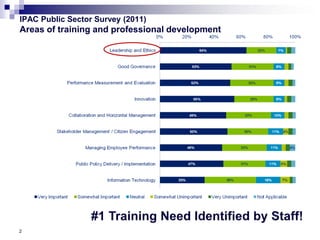
IPAC Public Sector Survey (2011)
Areas of training and professional development
Introductions
Introduce Yourself, Where you are from, Your role and
what you hope to achieve from this course
Introduction to the Course
Who are we – IPAC in brief
A pracademic approach
The course goals and objectives
Course overview
Presenters
© IPAC 2015 4
5
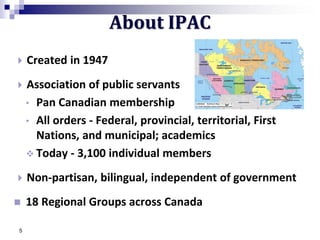
 Created in 1947
 Association of public servants
• Pan Canadian membership
• All orders - Federal, provincial, territorial, First
Nations, and municipal; academics
 Today - 3,100 individual members
 Non-partisan, bilingual, independent of government
 18 Regional Groups across Canada
About IPAC
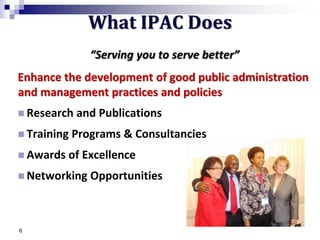
“Serving you to serve better”
Enhance the development of good public administration
and management practices and policies
 Research and Publications
 Training Programs & Consultancies
 Awards of Excellence
 Networking Opportunities
6
What IPAC Does
Knowledge Broker
 IPAC’s strength is its
capacity to create and
broker the diffusion of
knowledge about public
administration and
governance.
Network
IPAC can connect the
right experts with its
partners.
 Flexible
 Efficient
 Cost-effective
A Pracademic Approach
 At IPAC we believe that complex issues in
government are best tackled using a blend of
academic and practitioner knowledge.
 We organize our teaching along lines of rigorous and
cutting edge academic knowledge, blended with and
enhanced by long-standing expertise of practitioners
in the field.
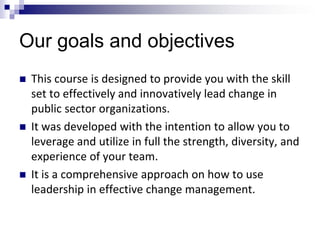
Our goals and objectives
 This course is designed to provide you with the skill
set to effectively and innovatively lead change in
public sector organizations.
 It was developed with the intention to allow you to
leverage and utilize in full the strength, diversity, and
experience of your team.
 It is a comprehensive approach on how to use
leadership in effective change management.
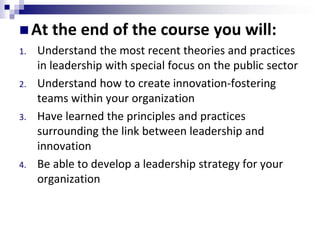
 At the end of the course you will:
1. Understand the most recent theories and practices
in leadership with special focus on the public sector
2. Understand how to create innovation-fostering
teams within your organization
3. Have learned the principles and practices
surrounding the link between leadership and
innovation
4. Be able to develop a leadership strategy for your
organization
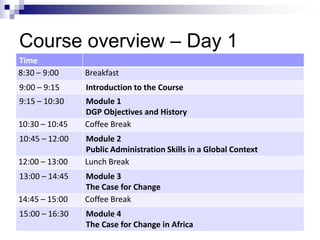
Course overview – Day 1
Time
8:30 – 9:00 Breakfast
9:00 – 9:15 Introduction to the Course
9:15 – 10:30 Module 1
DGP Objectives and History
10:30 – 10:45 Coffee Break
10:45 – 12:00 Module 2
Public Administration Skills in a Global Context
12:00 – 13:00 Lunch Break
13:00 – 14:45 Module 3
The Case for Change
14:45 – 15:00 Coffee Break
15:00 – 16:30 Module 4
The Case for Change in Africa
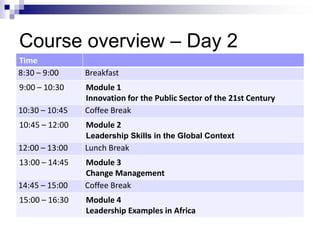
Course overview – Day 2
Time
8:30 – 9:00 Breakfast
9:00 – 10:30 Module 1
Innovation for the Public Sector of the 21st Century
10:30 – 10:45 Coffee Break
10:45 – 12:00 Module 2
Leadership Skills in the Global Context
12:00 – 13:00 Lunch Break
13:00 – 14:45 Module 3
Change Management
14:45 – 15:00 Coffee Break
15:00 – 16:30 Module 4
Leadership Examples in Africa
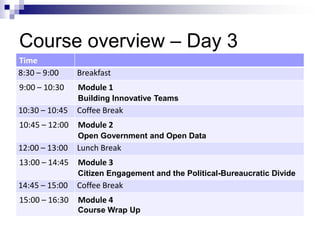
Course overview – Day 3
Time
8:30 – 9:00 Breakfast
9:00 – 10:30 Module 1
Building Innovative Teams
10:30 – 10:45 Coffee Break
10:45 – 12:00 Module 2
Open Government and Open Data
12:00 – 13:00 Lunch Break
13:00 – 14:45 Module 3
Citizen Engagement and the Political-Bureaucratic Divide
14:45 – 15:00 Coffee Break
15:00 – 16:30 Module 4
Course Wrap Up
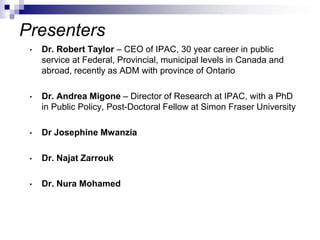
Presenters
• Dr. Robert Taylor – CEO of IPAC, 30 year career in public
service at Federal, Provincial, municipal levels in Canada and
abroad, recently as ADM with province of Ontario
• Dr. Andrea Migone – Director of Research at IPAC, with a PhD
in Public Policy, Post-Doctoral Fellow at Simon Fraser University
• Dr Josephine Mwanzia
• Dr. Najat Zarrouk
• Dr. Nura Mohamed

Module 00 Course Introduction

  • 1.
    Dr. Robert Taylor IPAC Introductionto the course LEADING CHANGE EFFECTIVELY IN GOVERNMENT
  • 2.
    2 IPAC Public SectorSurvey (2011) Areas of training and professional development
  • 3.
    Introductions Introduce Yourself, Whereyou are from, Your role and what you hope to achieve from this course
  • 4.
    Introduction to theCourse Who are we – IPAC in brief A pracademic approach The course goals and objectives Course overview Presenters © IPAC 2015 4
  • 5.
    5  Created in1947  Association of public servants • Pan Canadian membership • All orders - Federal, provincial, territorial, First Nations, and municipal; academics  Today - 3,100 individual members  Non-partisan, bilingual, independent of government  18 Regional Groups across Canada About IPAC
  • 6.
    “Serving you toserve better” Enhance the development of good public administration and management practices and policies  Research and Publications  Training Programs & Consultancies  Awards of Excellence  Networking Opportunities 6 What IPAC Does
  • 7.
    Knowledge Broker  IPAC’sstrength is its capacity to create and broker the diffusion of knowledge about public administration and governance. Network IPAC can connect the right experts with its partners.  Flexible  Efficient  Cost-effective
  • 9.
    A Pracademic Approach At IPAC we believe that complex issues in government are best tackled using a blend of academic and practitioner knowledge.  We organize our teaching along lines of rigorous and cutting edge academic knowledge, blended with and enhanced by long-standing expertise of practitioners in the field.
  • 10.
    Our goals andobjectives  This course is designed to provide you with the skill set to effectively and innovatively lead change in public sector organizations.  It was developed with the intention to allow you to leverage and utilize in full the strength, diversity, and experience of your team.  It is a comprehensive approach on how to use leadership in effective change management.
  • 11.
     At theend of the course you will: 1. Understand the most recent theories and practices in leadership with special focus on the public sector 2. Understand how to create innovation-fostering teams within your organization 3. Have learned the principles and practices surrounding the link between leadership and innovation 4. Be able to develop a leadership strategy for your organization
  • 12.
    Course overview –Day 1 Time 8:30 – 9:00 Breakfast 9:00 – 9:15 Introduction to the Course 9:15 – 10:30 Module 1 DGP Objectives and History 10:30 – 10:45 Coffee Break 10:45 – 12:00 Module 2 Public Administration Skills in a Global Context 12:00 – 13:00 Lunch Break 13:00 – 14:45 Module 3 The Case for Change 14:45 – 15:00 Coffee Break 15:00 – 16:30 Module 4 The Case for Change in Africa
  • 13.
    Course overview –Day 2 Time 8:30 – 9:00 Breakfast 9:00 – 10:30 Module 1 Innovation for the Public Sector of the 21st Century 10:30 – 10:45 Coffee Break 10:45 – 12:00 Module 2 Leadership Skills in the Global Context 12:00 – 13:00 Lunch Break 13:00 – 14:45 Module 3 Change Management 14:45 – 15:00 Coffee Break 15:00 – 16:30 Module 4 Leadership Examples in Africa
  • 14.
    Course overview –Day 3 Time 8:30 – 9:00 Breakfast 9:00 – 10:30 Module 1 Building Innovative Teams 10:30 – 10:45 Coffee Break 10:45 – 12:00 Module 2 Open Government and Open Data 12:00 – 13:00 Lunch Break 13:00 – 14:45 Module 3 Citizen Engagement and the Political-Bureaucratic Divide 14:45 – 15:00 Coffee Break 15:00 – 16:30 Module 4 Course Wrap Up
  • 15.
    Presenters • Dr. RobertTaylor – CEO of IPAC, 30 year career in public service at Federal, Provincial, municipal levels in Canada and abroad, recently as ADM with province of Ontario • Dr. Andrea Migone – Director of Research at IPAC, with a PhD in Public Policy, Post-Doctoral Fellow at Simon Fraser University • Dr Josephine Mwanzia • Dr. Najat Zarrouk • Dr. Nura Mohamed