Sociology of Poverty
MOD 10: Hope for the Future
Macro Perspective
Poverty and Power
Royce, 2015
Poverty & Power – Conclusion
 Royce (2015) argues that “we need to shift the focus from the characteristics
of the poor to the dynamics of the larger political economy, from the
deficiencies of individuals to the failings of social institutions” (p. 247)
 “Where there is power there is conflict, and where there is conflict there are
winners and losers. Power is also unequally distributed” (p. 248)
 Poverty and related inequalities “are by-products of a growing imbalance of
power between the haves and the have-nots. This “power shift,” underway
since the 1970s, helps to explain why there is so much poverty in a country
with so much wealth (as cited in Royce, 2015, p. 248)
Policy Reform Goals to Address Poverty
 Income Support Policies
 Would reduce poverty by increasing income levels
 Public Goals Policies
 Focused on improved quality of life and vital services (child care, health care, etc.)
 Equal Opportunity Policies
 Measures to prevent extra affliction on racial and ethnic minorities, single mothers,
and children
 Empowerment Policies
 Focused on empowering the poor with a stronger economic and political voice
Toward a Solution – People Power
 “We have the know-how, but we lack the political will and the political means
necessary to put that knowledge into effect” (p. 253)
 Ordinary Americans have significant “potential power” as “organized people
power” and through social movements can leverage their “disruptive power” and
form “alternative power networks” (as cited in Royce, 2015, p. 254). Examples
include:
 Civil rights movement
 Community and labor movements
 Women’s groups
 Environmental justice activism
 Occupy Wall Street movement
 “New unionism” (e.g., Justice for Janitors)
Micro Perspective
Evicted
Desmond, 2016
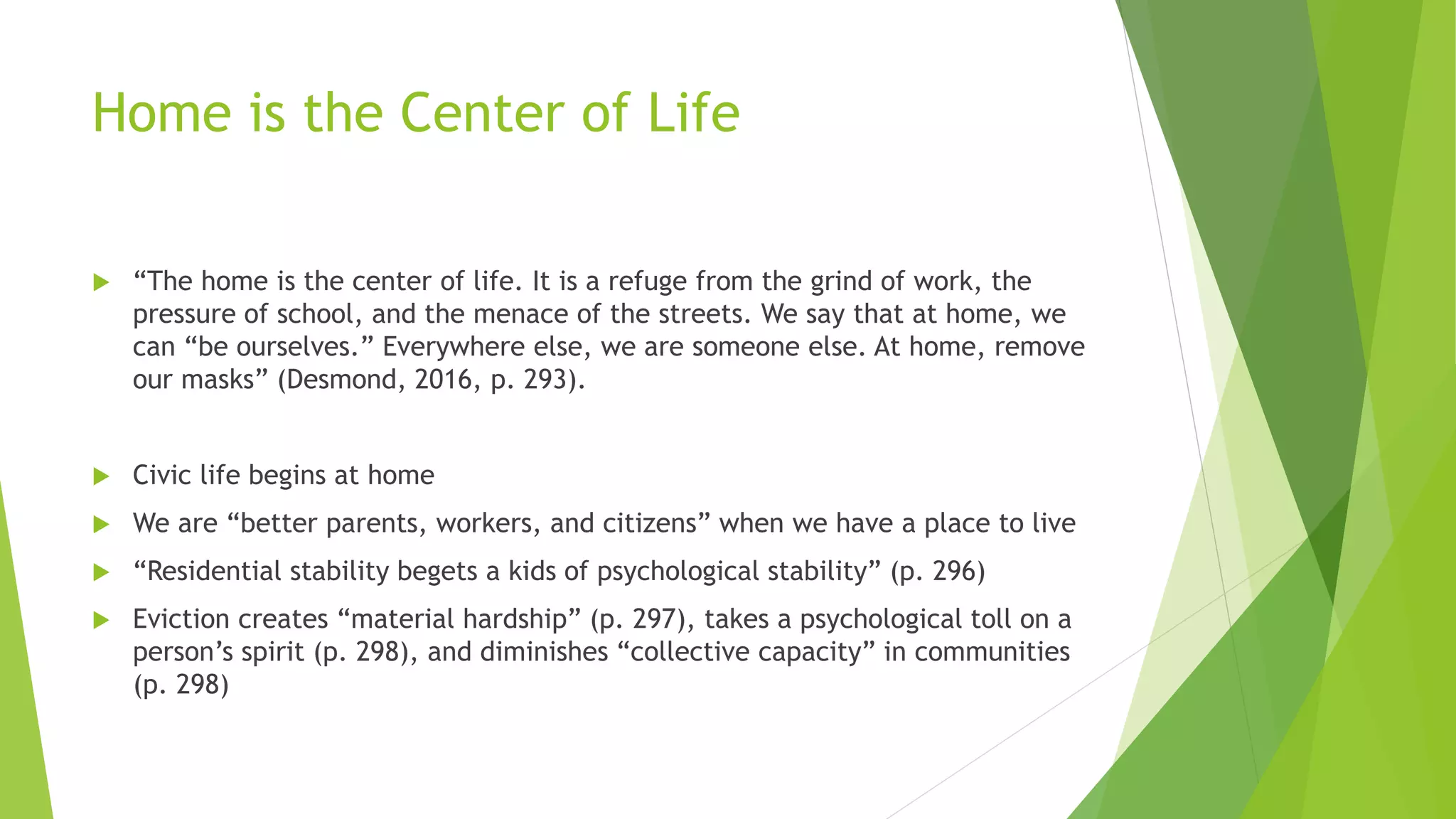
Home is the Center of Life
 “The home is the center of life. It is a refuge from the grind of work, the
pressure of school, and the menace of the streets. We say that at home, we
can “be ourselves.” Everywhere else, we are someone else. At home, remove
our masks” (Desmond, 2016, p. 293).
 Civic life begins at home
 We are “better parents, workers, and citizens” when we have a place to live
 “Residential stability begets a kids of psychological stability” (p. 296)
 Eviction creates “material hardship” (p. 297), takes a psychological toll on a
person’s spirit (p. 298), and diminishes “collective capacity” in communities
(p. 298)
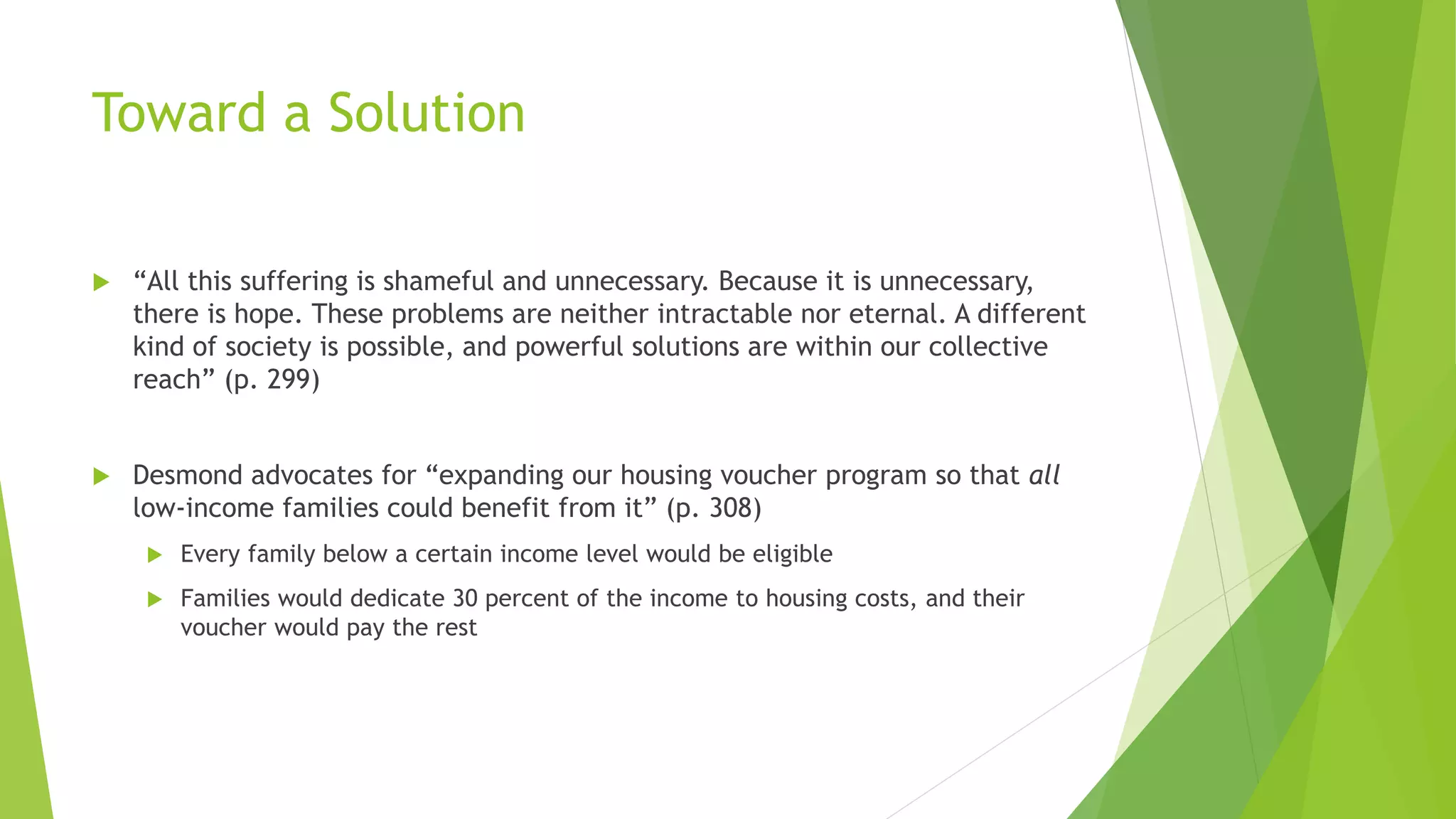
Toward a Solution
 “All this suffering is shameful and unnecessary. Because it is unnecessary,
there is hope. These problems are neither intractable nor eternal. A different
kind of society is possible, and powerful solutions are within our collective
reach” (p. 299)
 Desmond advocates for “expanding our housing voucher program so that all
low-income families could benefit from it” (p. 308)
 Every family below a certain income level would be eligible
 Families would dedicate 30 percent of the income to housing costs, and their
voucher would pay the rest
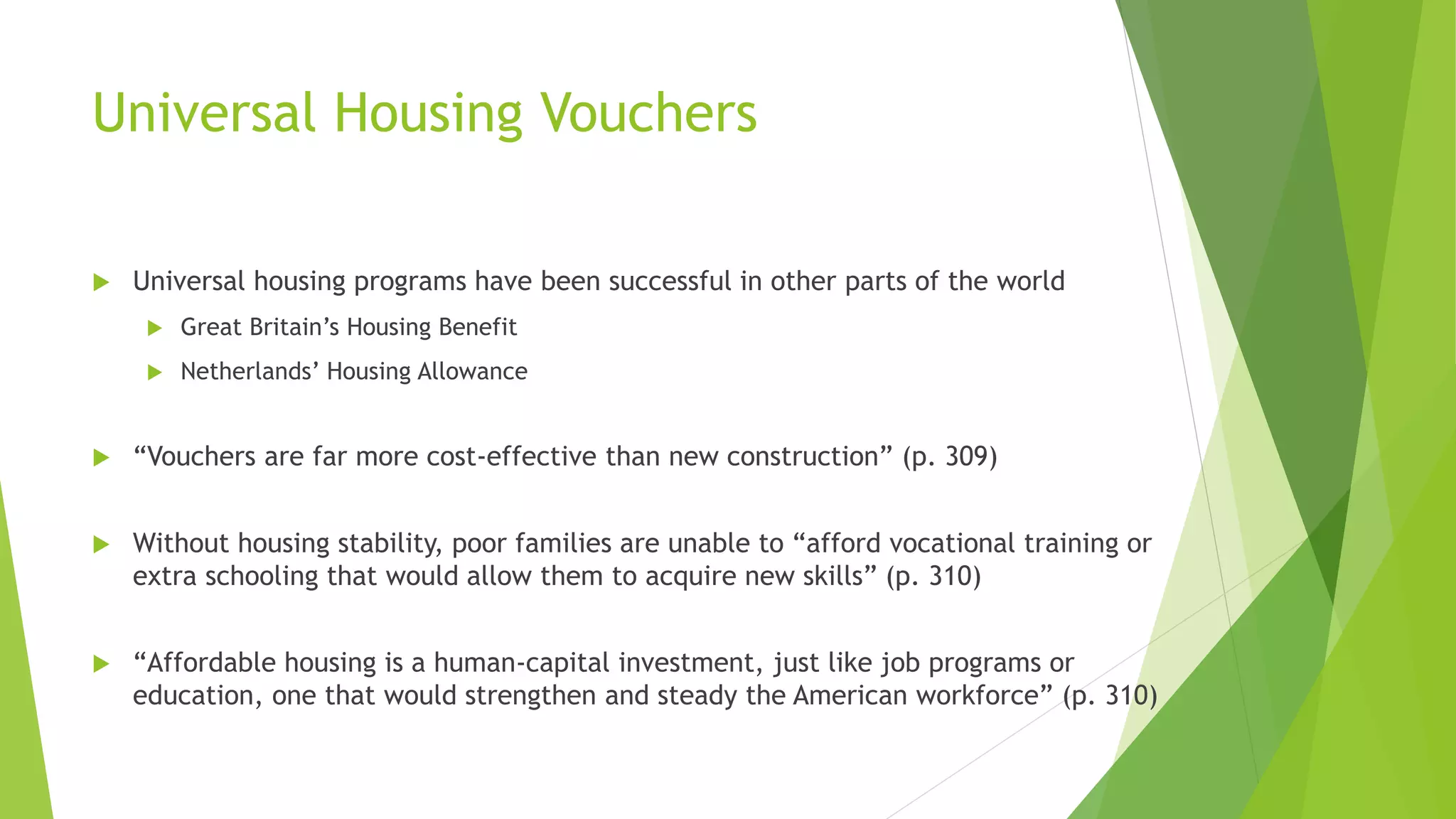
Universal Housing Vouchers
 Universal housing programs have been successful in other parts of the world
 Great Britain’s Housing Benefit
 Netherlands’ Housing Allowance
 “Vouchers are far more cost-effective than new construction” (p. 309)
 Without housing stability, poor families are unable to “afford vocational training or
extra schooling that would allow them to acquire new skills” (p. 310)
 “Affordable housing is a human-capital investment, just like job programs or
education, one that would strengthen and steady the American workforce” (p. 310)

Module 10 ppt (hope for future)

  • 1.
    Sociology of Poverty MOD10: Hope for the Future
  • 2.
  • 3.
    Poverty & Power– Conclusion  Royce (2015) argues that “we need to shift the focus from the characteristics of the poor to the dynamics of the larger political economy, from the deficiencies of individuals to the failings of social institutions” (p. 247)  “Where there is power there is conflict, and where there is conflict there are winners and losers. Power is also unequally distributed” (p. 248)  Poverty and related inequalities “are by-products of a growing imbalance of power between the haves and the have-nots. This “power shift,” underway since the 1970s, helps to explain why there is so much poverty in a country with so much wealth (as cited in Royce, 2015, p. 248)
  • 4.
    Policy Reform Goalsto Address Poverty  Income Support Policies  Would reduce poverty by increasing income levels  Public Goals Policies  Focused on improved quality of life and vital services (child care, health care, etc.)  Equal Opportunity Policies  Measures to prevent extra affliction on racial and ethnic minorities, single mothers, and children  Empowerment Policies  Focused on empowering the poor with a stronger economic and political voice
  • 5.
    Toward a Solution– People Power  “We have the know-how, but we lack the political will and the political means necessary to put that knowledge into effect” (p. 253)  Ordinary Americans have significant “potential power” as “organized people power” and through social movements can leverage their “disruptive power” and form “alternative power networks” (as cited in Royce, 2015, p. 254). Examples include:  Civil rights movement  Community and labor movements  Women’s groups  Environmental justice activism  Occupy Wall Street movement  “New unionism” (e.g., Justice for Janitors)
  • 6.
  • 7.
    Home is theCenter of Life  “The home is the center of life. It is a refuge from the grind of work, the pressure of school, and the menace of the streets. We say that at home, we can “be ourselves.” Everywhere else, we are someone else. At home, remove our masks” (Desmond, 2016, p. 293).  Civic life begins at home  We are “better parents, workers, and citizens” when we have a place to live  “Residential stability begets a kids of psychological stability” (p. 296)  Eviction creates “material hardship” (p. 297), takes a psychological toll on a person’s spirit (p. 298), and diminishes “collective capacity” in communities (p. 298)
  • 8.
    Toward a Solution “All this suffering is shameful and unnecessary. Because it is unnecessary, there is hope. These problems are neither intractable nor eternal. A different kind of society is possible, and powerful solutions are within our collective reach” (p. 299)  Desmond advocates for “expanding our housing voucher program so that all low-income families could benefit from it” (p. 308)  Every family below a certain income level would be eligible  Families would dedicate 30 percent of the income to housing costs, and their voucher would pay the rest
  • 9.
    Universal Housing Vouchers Universal housing programs have been successful in other parts of the world  Great Britain’s Housing Benefit  Netherlands’ Housing Allowance  “Vouchers are far more cost-effective than new construction” (p. 309)  Without housing stability, poor families are unable to “afford vocational training or extra schooling that would allow them to acquire new skills” (p. 310)  “Affordable housing is a human-capital investment, just like job programs or education, one that would strengthen and steady the American workforce” (p. 310)