Human Resource Management
&
Line Managers
Line Managers and HRM
HRM is an aspect of all management jobs because it is
an essential organizational process. Line managers,
those who directly supervise employees engaged in the
operations of the firm, are closely involved in HRM and
almost always accountable for the performance of their
team.
(Boxall & Purcell, 2008)
What is Line Manager?
The line manager is a person or employee of an organization who directly
directs the other employees and is in charge of all the individuals working
in a department.
The line manager reports to the person in a position ranking higher to
him. Line manager is very much proficient functionally.
A line manager is an employee who directly manages other employees of
the organization and is accountable for the administrative management
work and its functional management which directly contributes to the
output of the production plant.
If we consider a corporate hierarchy, a line manager holds the authority in
a vertical chain of command or over a particular product line.
Who are Line managers and why are they important?
Managers of people – the non specialist HR manager
Key link in causal chain between people management &
performance
New significance in HRM model as it is becoming more popular
to “return HR to the line”
“It could be said that HR may propose but line managers dispose –
line managers can bring HR policies to life but they can also put
them to death”
HRM for Line Manager
SURVIVING IN BUSINESS
“Corporate must change their Old Ways of doing business
to survive in this
new
environment. Because
of
and extremely
challenging their
critical place in
the
organization, much of the burden of change will fall on the
shoulders of the Line Managers.”
{MANAGEMENT GURU}
CHALLENGES FOR LINE MANAGERS
• Rapidly Changing Business Environment
• Pressure to “do more” with Fewer Resources
• Downsizing of the Staff
• Greater Workforce Diversity
• Increasing Gap in Skill Availability and Job
Requirements
MAIN OBJECTIVES
1.Identify the Critical HR Role Played by Line
Managers
2.Competencies Required for Role Play
3.Relationship with HR (Personal) Team
4.Tools / Information to strengthen Line Managers
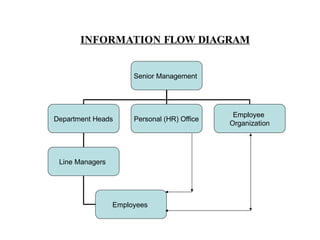
Senior Management
Department Heads Personal (HR) Office
Employee
Organization
Line Managers
Employees
INFORMATION FLOW DIAGRAM
Line managers play a critical role in
delivering HRM
• Line managers and employees have substantial discretion as to
how to do their jobs
• It is more likely that they will use their discretion positively if
they feel that they are being fairly treated and this arguably
originates with the relationship between line managers and
employees.
• Adopting positive HR polices is not enough, the way in which
they are implemented by line managers is critical to the way in
which employees respond.
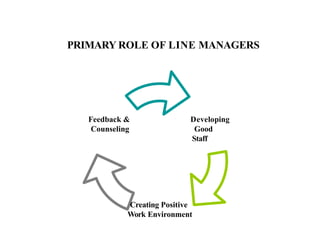
Developing
Good
Staff
Creating Positive
Work Environment
Feedback &
Counseling
PRIMARY ROLE OF LINE MANAGERS
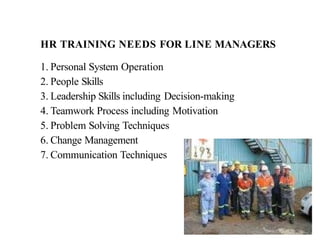
HR TRAINING NEEDS FOR LINE MANAGERS
1. Personal System Operation
2. People Skills
3. Leadership Skills including Decision-making
4. Teamwork Process including Motivation
5. Problem Solving Techniques
6. Change Management
7. Communication Techniques
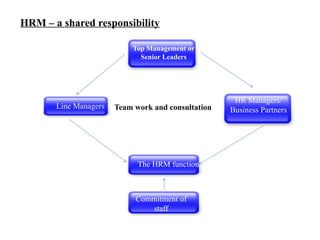
HRM – a shared responsibility
Top Management or
Senior Leaders
Line Managers
HR Managers/
Business Partners
The HRM function
Commitment of
staff
Team work and consultation
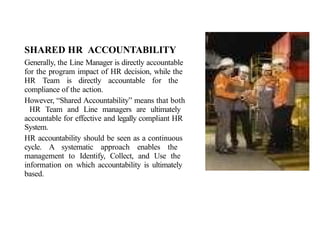
SHARED HR ACCOUNTABILITY
Generally, the Line Manager is directly accountable
for the program impact of HR decision, while the
HR Team is directly accountable for the
compliance of the action.
However, “Shared Accountability” means that both
HR Team and Line managers are ultimately
accountable for effective and legally compliant HR
System.
HR accountability should be seen as a continuous
cycle. A systematic approach enables the
management to Identify, Collect, and Use the
information on which accountability is ultimately
based.
Line managers views and responsibilities
Operational Aspects
Recruitment and selection
Training
Discipline
Absence monitoring
Leadership Roles
Encouraging employee
involvement
Reducing resistance to change
Emotional engagement and
relationships
The HR Competencies
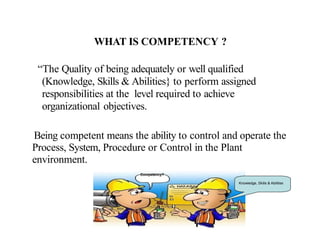
WHAT IS COMPETENCY ?
“The Quality of being adequately or well qualified
(Knowledge, Skills & Abilities} to perform assigned
responsibilities at the level required to achieve
organizational objectives.
Being competent means the ability to control and operate the
Process, System, Procedure or Control in the Plant
environment.
Competency?
Knowledge, Skills & Abilities
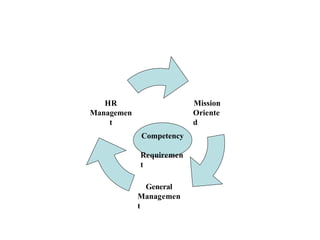
Mission
Oriente
d
General
Managemen
t
HR
Managemen
t
Competency
Requiremen
t
37
COMPETENCIES AS LINK BETWEEN STRATEGY
AND HUMAN RESOURCE PROGRAMMES
Business
Strategy
Organisationa
l
Capabilities
Capability
Components
Competencies
Human Resource
Consequences
•Strategy
•Mission
•Values
• Objectives
•Characteristic
s of the
organi- zation
which are
crucial
for success-
fully imple-
menting the
organization’
s strategy
•Measures
and
actions
needed to
build each
Capability
•The
competencie
s (skills and
behaviour)
needed to
bring about
the required
capability
components
•Human
Resource
activities for
developing
and
reinforcing
the required
competencies
38
FROM STRATEGY TO INDIVIDUAL COMPETENCIES
Business
Strategy
Organisational
Capabilities
Capability
Components
Employee
Competencies
Strategic Intent
•To become the
Leading
telecom
provider
in Egypt
•Obtain and
maintain No. 1
position in
telecom l
services provision
•Accelerate
network
expansion
•Strong focus on
Added value of
Customers
•Sophisticated
information
system.
•Knowledge of the
Market and
Competitors
• Understanding
of
The customer.
•Customer focused
attitude.
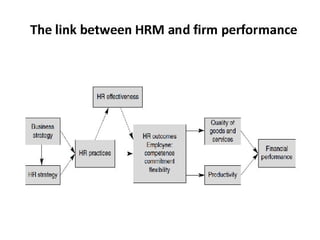
Human Resource Management &
Firm Performance
Human Resource Management at work
• What Is Human Resource Management (HRM)?
– The process of acquiring, training, appraising, and compensating
employees, and of attending to their labor relations, health and
safety, and fairness concerns.
• Organization
– People with formally assigned roles who work together to
achieve the organization’s goals.
• Manager
– The person responsible for accomplishing the organization’s
goals, and who does so by managing the efforts of the
organization’s people.
The HR practices that influence firm performance
Attract, develop and retain high-quality people
Talent management
Job and work design
Learning and development
Manage knowledge and intellectual capital
Increase engagement, commitment and motivation
Psychological contract
High-performance management
Reward management
Employee relations
Working environment– core values, leadership,
work–life balance, managing diversity, secure
Employment.

HRM com.pptx very important subject to study

  • 1.
  • 2.
    Line Managers andHRM HRM is an aspect of all management jobs because it is an essential organizational process. Line managers, those who directly supervise employees engaged in the operations of the firm, are closely involved in HRM and almost always accountable for the performance of their team. (Boxall & Purcell, 2008)
  • 3.
    What is LineManager? The line manager is a person or employee of an organization who directly directs the other employees and is in charge of all the individuals working in a department. The line manager reports to the person in a position ranking higher to him. Line manager is very much proficient functionally. A line manager is an employee who directly manages other employees of the organization and is accountable for the administrative management work and its functional management which directly contributes to the output of the production plant. If we consider a corporate hierarchy, a line manager holds the authority in a vertical chain of command or over a particular product line.
  • 4.
    Who are Linemanagers and why are they important? Managers of people – the non specialist HR manager Key link in causal chain between people management & performance New significance in HRM model as it is becoming more popular to “return HR to the line” “It could be said that HR may propose but line managers dispose – line managers can bring HR policies to life but they can also put them to death”
  • 5.
    HRM for LineManager SURVIVING IN BUSINESS “Corporate must change their Old Ways of doing business to survive in this new environment. Because of and extremely challenging their critical place in the organization, much of the burden of change will fall on the shoulders of the Line Managers.” {MANAGEMENT GURU}
  • 6.
    CHALLENGES FOR LINEMANAGERS • Rapidly Changing Business Environment • Pressure to “do more” with Fewer Resources • Downsizing of the Staff • Greater Workforce Diversity • Increasing Gap in Skill Availability and Job Requirements
  • 7.
    MAIN OBJECTIVES 1.Identify theCritical HR Role Played by Line Managers 2.Competencies Required for Role Play 3.Relationship with HR (Personal) Team 4.Tools / Information to strengthen Line Managers
  • 8.
    Senior Management Department HeadsPersonal (HR) Office Employee Organization Line Managers Employees INFORMATION FLOW DIAGRAM
  • 9.
    Line managers playa critical role in delivering HRM • Line managers and employees have substantial discretion as to how to do their jobs • It is more likely that they will use their discretion positively if they feel that they are being fairly treated and this arguably originates with the relationship between line managers and employees. • Adopting positive HR polices is not enough, the way in which they are implemented by line managers is critical to the way in which employees respond.
  • 10.
  • 11.
    HR TRAINING NEEDSFOR LINE MANAGERS 1. Personal System Operation 2. People Skills 3. Leadership Skills including Decision-making 4. Teamwork Process including Motivation 5. Problem Solving Techniques 6. Change Management 7. Communication Techniques
  • 12.
    HRM – ashared responsibility Top Management or Senior Leaders Line Managers HR Managers/ Business Partners The HRM function Commitment of staff Team work and consultation
  • 13.
    SHARED HR ACCOUNTABILITY Generally,the Line Manager is directly accountable for the program impact of HR decision, while the HR Team is directly accountable for the compliance of the action. However, “Shared Accountability” means that both HR Team and Line managers are ultimately accountable for effective and legally compliant HR System. HR accountability should be seen as a continuous cycle. A systematic approach enables the management to Identify, Collect, and Use the information on which accountability is ultimately based.
  • 14.
    Line managers viewsand responsibilities Operational Aspects Recruitment and selection Training Discipline Absence monitoring Leadership Roles Encouraging employee involvement Reducing resistance to change Emotional engagement and relationships
  • 15.
  • 16.
    WHAT IS COMPETENCY? “The Quality of being adequately or well qualified (Knowledge, Skills & Abilities} to perform assigned responsibilities at the level required to achieve organizational objectives. Being competent means the ability to control and operate the Process, System, Procedure or Control in the Plant environment. Competency? Knowledge, Skills & Abilities
  • 17.
  • 18.
    37 COMPETENCIES AS LINKBETWEEN STRATEGY AND HUMAN RESOURCE PROGRAMMES Business Strategy Organisationa l Capabilities Capability Components Competencies Human Resource Consequences •Strategy •Mission •Values • Objectives •Characteristic s of the organi- zation which are crucial for success- fully imple- menting the organization’ s strategy •Measures and actions needed to build each Capability •The competencie s (skills and behaviour) needed to bring about the required capability components •Human Resource activities for developing and reinforcing the required competencies
  • 19.
    38 FROM STRATEGY TOINDIVIDUAL COMPETENCIES Business Strategy Organisational Capabilities Capability Components Employee Competencies Strategic Intent •To become the Leading telecom provider in Egypt •Obtain and maintain No. 1 position in telecom l services provision •Accelerate network expansion •Strong focus on Added value of Customers •Sophisticated information system. •Knowledge of the Market and Competitors • Understanding of The customer. •Customer focused attitude.
  • 20.
    Human Resource Management& Firm Performance
  • 21.
    Human Resource Managementat work • What Is Human Resource Management (HRM)? – The process of acquiring, training, appraising, and compensating employees, and of attending to their labor relations, health and safety, and fairness concerns. • Organization – People with formally assigned roles who work together to achieve the organization’s goals. • Manager – The person responsible for accomplishing the organization’s goals, and who does so by managing the efforts of the organization’s people.
  • 23.
    The HR practicesthat influence firm performance Attract, develop and retain high-quality people Talent management Job and work design Learning and development Manage knowledge and intellectual capital Increase engagement, commitment and motivation Psychological contract High-performance management Reward management Employee relations Working environment– core values, leadership, work–life balance, managing diversity, secure Employment.