Modernising Change for
Speed and Scale with
Confluent and Kong
Welcome
Modernising Change for Speed and
Scale with Confluent and Kong
In this session, we will explore modern
applications and platforms espouse the
benefits of simplification, scale, and improved
cost efficiencies, but often organisations face
the challenge in managing significant
increases in change volume and the
associated cost of this change.
We will explore how modern applications and
platforms are deployed, consumed, and
managed, and learn how platforms like
Confluent and Kong, when used together, are
enablers of change, empowering
organisations to deliver new products and
services at speed.
Goran Stankovski is the
Founder & CEO of LimePoint,
and an industry thought leader
specialising in Automation,
DevOps, Enterprise and
Technical Architecture, and
Technology Enablement.
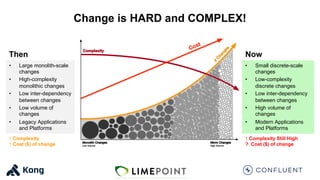
Change is HARD and COMPLEX!
Then
• Large monolith-scale
changes
• High-complexity
monolithic changes
• Low inter-dependency
between changes
• Low volume of
changes
• Legacy Applications
and Platforms
↑ Complexity
↑ Cost ($) of change
Now
• Small discrete-scale
changes
• Low-complexity
discrete changes
• Low inter-dependency
between changes
• High volume of
changes
• Modern Applications
and Platforms
↑ Complexity Still High
? Cost ($) of change
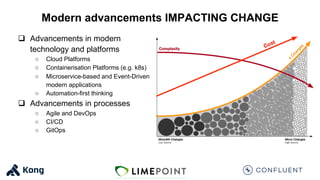
Modern advancements IMPACTING CHANGE
q Advancements in modern
technology and platforms
○ Cloud Platforms
○ Containerisation Platforms (e.g. k8s)
○ Microservice-based and Event-Driven
modern applications
○ Automation-first thinking
q Advancements in processes
○ Agile and DevOps
○ CI/CD
○ GitOps
WHAT are organisations doing?
q Reduce application and platform complexity
q Establish Agile Teams and Processes
q Implement CI/CD pipelines and automation
q Adopt GitOps methodologies
… all with the objective to simplify change!
Common Problems and Use Cases
q Common Use Cases
○ “I am deploying [ Salesforce (insert other relevant application) ], and I need to
ensure that my existing applications and platforms can work together”
○ “I want to engage with my customers and interact with them in real-time”
○ “I want to know how my customers are buying on my website”
○ “I want to know whether I need to be aware of any any suspicious activities”
○ “I need to meet my regulatory and compliance requirements”
○ “I need to know the availability of stock and inventory in real-time so that I can
ensure I have stock when a customer needs it”
So WHY is change still HARD?
q Changes are often NOT entirely discrete and still highly
interdependent
q Containerisation is NOT the solution for everything
q Automation is a keystone requirement, but not everything is automated
q Change process still rely on older monolithic technologies
q Compromise on the above items often leads to higher average cost per
change and higher overall cost of change!
WHAT do organisations NEED to deliver change?
✓ Effortless access to quality Data and Information
§ Data from existing applications and systems
• High-level of data quality
• Real-time data, as and when it changes
• Historical data
✓ Easily interact with, manipulate, and shape Data to
meet my needs
✓ Secure and Control those actors who interact with my
data and information
Events ... What is the big deal?
Events and Event-Driven Architecture
q An architectural pattern that decouples systems that run in
response to events
○ Events are created when data changes
○ Events are ordered (Event Log)
○ Events have Producers and Consumers (loosely coupled)
○ Events can be resolved to determine state of data at any point in
time (Materialised View)
q Event-Driven Architecture supports the move from Monolith
to Distributed Systems
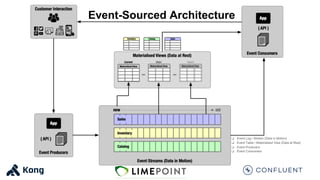
Event-Sourced Architecture
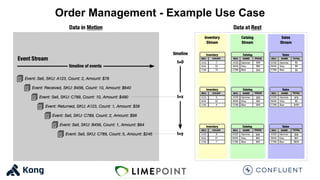
❏ Event Log / Stream (Data in Motion)
❏ Event Table / Materialised View (Data at Rest)
❏ Event Producers
❏ Event Consumers
Benefits of Event-Sourced Architectures
q Ready access to data and information
○ Events (as and when they occur) (Data in Motion)
○ Resolved to any point in time (Data at Rest)
○ Broad use-case applicability
§ Compliance requirements (e.g. security and threat events)
§ Customer Buying requirements (e.g. clickstream events, orders, etc.)
§ System synchronisation and Integration
§ Master data management to support legacy applications
q Delivered Benefits of Event-Sourced Architectures
✓ Increased Data Quality
✓ Increased Responsiveness to Change
✓ Scalability and Flow Control
✓ Autonomy (Decoupling)
Order Management - Example Use Case
Microservices … why should I care?
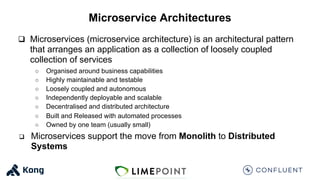
Microservice Architectures
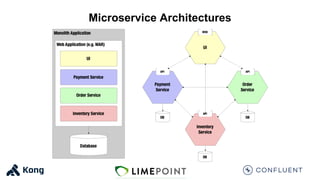
q Microservices (microservice architecture) is an architectural pattern
that arranges an application as a collection of loosely coupled
collection of services
○ Organised around business capabilities
○ Highly maintainable and testable
○ Loosely coupled and autonomous
○ Independently deployable and scalable
○ Decentralised and distributed architecture
○ Built and Released with automated processes
○ Owned by one team (usually small)
q Microservices support the move from Monolith to Distributed
Systems
Microservice Architectures
Benefits of Microservice Architectures
q Delivered Benefits of Microservice Architectures
○ The microservice architecture enables the rapid, frequent and reliable
delivery of large, complex applications with the following benefits
ü Pluggability (Loose Coupling)
ü Improved Scalability
ü Agnostic (Language and Technology)
ü Isolation (Fault Tolerant)
ü Improved Security and Compliance
ü Improved Agility
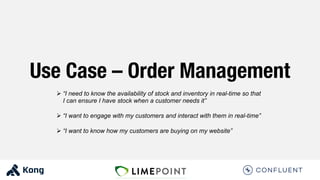
Use Case – Order Management
Ø “I need to know the availability of stock and inventory in real-time so that
I can ensure I have stock when a customer needs it”
Ø “I want to engage with my customers and interact with them in real-time”
Ø “I want to know how my customers are buying on my website”
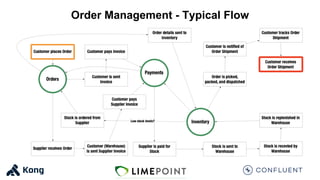
Order Management - Typical Flow
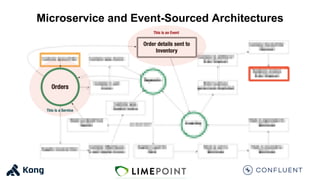
Microservice and Event-Sourced Architectures
Lets mesh things up!
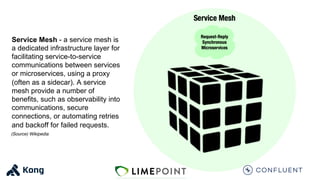
Service Mesh - a service mesh is
a dedicated infrastructure layer for
facilitating service-to-service
communications between services
or microservices, using a proxy
(often as a sidecar). A service
mesh provide a number of
benefits, such as observability into
communications, secure
connections, or automating retries
and backoff for failed requests.
(Source) Wikipedia
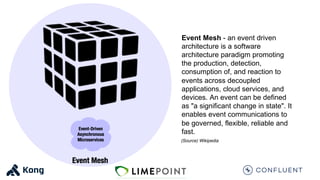
Event Mesh - an event driven
architecture is a software
architecture paradigm promoting
the production, detection,
consumption of, and reaction to
events across decoupled
applications, cloud services, and
devices. An event can be defined
as "a significant change in state". It
enables event communications to
be governed, flexible, reliable and
fast.
(Source) Wikipedia
Service and Event Meshes
q The move to Distributed Systems necessitates an uplift in platform capabilities required to
support communications, connectivity, governance, and observability of distributed system
components
q Distributed systems (Events and Microservices) require the need to
o Discover and communicate reliably with others
o Monitor and observe interactions between system components
o Tolerate faults and be highly available
o Govern and Secure interactions between system components, producers, or consumers
o Permit only authorised actors to perform functions
o Manage the Lifecycle of distributed components from cradle to grave
o Provide common access protocols for interacting with distributed system components
q Service and Event Meshes are responsible for providing these platform capabilities
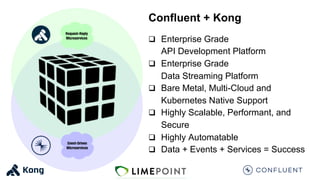
Confluent + Kong
q Enterprise Grade
API Development Platform
q Enterprise Grade
Data Streaming Platform
q Bare Metal, Multi-Cloud and
Kubernetes Native Support
q Highly Scalable, Performant, and
Secure
q Highly Automatable
q Data + Events + Services = Success
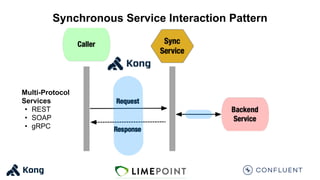
Synchronous Service Interaction Pattern
Multi-Protocol
Services
• REST
• SOAP
• gRPC
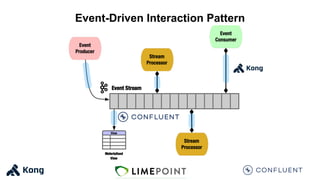
Event-Driven Interaction Pattern
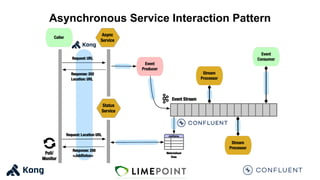
Asynchronous Service Interaction Pattern
Confluent + Kong > [ Confluent | Kong ]
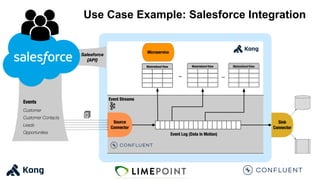
Use Case Example: Salesforce Integration
“I am deploying [ Salesforce (insert other relevant application) ], and I
need to ensure that my existing applications and platforms can work
together”
Use Case Example: Salesforce Integration
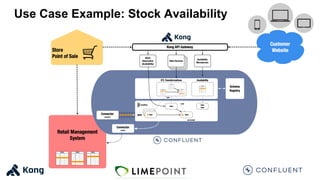
Use Case Example: Retail Stock Availability
“I need to know the availability of stock and inventory in real-time so that I
can ensure I have stock when a customer needs it”
Use Case Example: Stock Availability
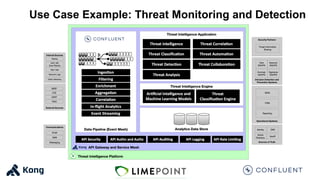
Use Case Example: Threat Monitoring and Detection
“I want to know whether I need to be aware of any any suspicious
activities”
Use Case Example: Threat Monitoring and Detection
What is your
Use Case ?
Contact Us
Goran Stankovski
M: +61 400 88 55 66
E: gstankovski@limepoint.com

Modernising Change - Lime Point - Confluent - Kong

  • 1.
    Modernising Change for Speedand Scale with Confluent and Kong
  • 2.
    Welcome Modernising Change forSpeed and Scale with Confluent and Kong In this session, we will explore modern applications and platforms espouse the benefits of simplification, scale, and improved cost efficiencies, but often organisations face the challenge in managing significant increases in change volume and the associated cost of this change. We will explore how modern applications and platforms are deployed, consumed, and managed, and learn how platforms like Confluent and Kong, when used together, are enablers of change, empowering organisations to deliver new products and services at speed. Goran Stankovski is the Founder & CEO of LimePoint, and an industry thought leader specialising in Automation, DevOps, Enterprise and Technical Architecture, and Technology Enablement.
  • 3.
    Change is HARDand COMPLEX!
  • 4.
    Change is HARDand COMPLEX! Then • Large monolith-scale changes • High-complexity monolithic changes • Low inter-dependency between changes • Low volume of changes • Legacy Applications and Platforms ↑ Complexity ↑ Cost ($) of change Now • Small discrete-scale changes • Low-complexity discrete changes • Low inter-dependency between changes • High volume of changes • Modern Applications and Platforms ↑ Complexity Still High ? Cost ($) of change
  • 5.
    Modern advancements IMPACTINGCHANGE q Advancements in modern technology and platforms ○ Cloud Platforms ○ Containerisation Platforms (e.g. k8s) ○ Microservice-based and Event-Driven modern applications ○ Automation-first thinking q Advancements in processes ○ Agile and DevOps ○ CI/CD ○ GitOps
  • 6.
    WHAT are organisationsdoing? q Reduce application and platform complexity q Establish Agile Teams and Processes q Implement CI/CD pipelines and automation q Adopt GitOps methodologies … all with the objective to simplify change!
  • 7.
    Common Problems andUse Cases q Common Use Cases ○ “I am deploying [ Salesforce (insert other relevant application) ], and I need to ensure that my existing applications and platforms can work together” ○ “I want to engage with my customers and interact with them in real-time” ○ “I want to know how my customers are buying on my website” ○ “I want to know whether I need to be aware of any any suspicious activities” ○ “I need to meet my regulatory and compliance requirements” ○ “I need to know the availability of stock and inventory in real-time so that I can ensure I have stock when a customer needs it”
  • 8.
    So WHY ischange still HARD? q Changes are often NOT entirely discrete and still highly interdependent q Containerisation is NOT the solution for everything q Automation is a keystone requirement, but not everything is automated q Change process still rely on older monolithic technologies q Compromise on the above items often leads to higher average cost per change and higher overall cost of change!
  • 9.
    WHAT do organisationsNEED to deliver change? ✓ Effortless access to quality Data and Information § Data from existing applications and systems • High-level of data quality • Real-time data, as and when it changes • Historical data ✓ Easily interact with, manipulate, and shape Data to meet my needs ✓ Secure and Control those actors who interact with my data and information
  • 10.
    Events ... Whatis the big deal?
  • 11.
    Events and Event-DrivenArchitecture q An architectural pattern that decouples systems that run in response to events ○ Events are created when data changes ○ Events are ordered (Event Log) ○ Events have Producers and Consumers (loosely coupled) ○ Events can be resolved to determine state of data at any point in time (Materialised View) q Event-Driven Architecture supports the move from Monolith to Distributed Systems
  • 12.
    Event-Sourced Architecture ❏ EventLog / Stream (Data in Motion) ❏ Event Table / Materialised View (Data at Rest) ❏ Event Producers ❏ Event Consumers
  • 13.
    Benefits of Event-SourcedArchitectures q Ready access to data and information ○ Events (as and when they occur) (Data in Motion) ○ Resolved to any point in time (Data at Rest) ○ Broad use-case applicability § Compliance requirements (e.g. security and threat events) § Customer Buying requirements (e.g. clickstream events, orders, etc.) § System synchronisation and Integration § Master data management to support legacy applications q Delivered Benefits of Event-Sourced Architectures ✓ Increased Data Quality ✓ Increased Responsiveness to Change ✓ Scalability and Flow Control ✓ Autonomy (Decoupling)
  • 14.
    Order Management -Example Use Case
  • 15.
    Microservices … whyshould I care?
  • 16.
    Microservice Architectures q Microservices(microservice architecture) is an architectural pattern that arranges an application as a collection of loosely coupled collection of services ○ Organised around business capabilities ○ Highly maintainable and testable ○ Loosely coupled and autonomous ○ Independently deployable and scalable ○ Decentralised and distributed architecture ○ Built and Released with automated processes ○ Owned by one team (usually small) q Microservices support the move from Monolith to Distributed Systems
  • 17.
  • 18.
    Benefits of MicroserviceArchitectures q Delivered Benefits of Microservice Architectures ○ The microservice architecture enables the rapid, frequent and reliable delivery of large, complex applications with the following benefits ü Pluggability (Loose Coupling) ü Improved Scalability ü Agnostic (Language and Technology) ü Isolation (Fault Tolerant) ü Improved Security and Compliance ü Improved Agility
  • 19.
    Use Case –Order Management Ø “I need to know the availability of stock and inventory in real-time so that I can ensure I have stock when a customer needs it” Ø “I want to engage with my customers and interact with them in real-time” Ø “I want to know how my customers are buying on my website”
  • 20.
    Order Management -Typical Flow
  • 21.
  • 22.
  • 23.
    Service Mesh -a service mesh is a dedicated infrastructure layer for facilitating service-to-service communications between services or microservices, using a proxy (often as a sidecar). A service mesh provide a number of benefits, such as observability into communications, secure connections, or automating retries and backoff for failed requests. (Source) Wikipedia
  • 24.
    Event Mesh -an event driven architecture is a software architecture paradigm promoting the production, detection, consumption of, and reaction to events across decoupled applications, cloud services, and devices. An event can be defined as "a significant change in state". It enables event communications to be governed, flexible, reliable and fast. (Source) Wikipedia
  • 25.
    Service and EventMeshes q The move to Distributed Systems necessitates an uplift in platform capabilities required to support communications, connectivity, governance, and observability of distributed system components q Distributed systems (Events and Microservices) require the need to o Discover and communicate reliably with others o Monitor and observe interactions between system components o Tolerate faults and be highly available o Govern and Secure interactions between system components, producers, or consumers o Permit only authorised actors to perform functions o Manage the Lifecycle of distributed components from cradle to grave o Provide common access protocols for interacting with distributed system components q Service and Event Meshes are responsible for providing these platform capabilities
  • 28.
    Confluent + Kong qEnterprise Grade API Development Platform q Enterprise Grade Data Streaming Platform q Bare Metal, Multi-Cloud and Kubernetes Native Support q Highly Scalable, Performant, and Secure q Highly Automatable q Data + Events + Services = Success
  • 29.
    Synchronous Service InteractionPattern Multi-Protocol Services • REST • SOAP • gRPC
  • 30.
  • 31.
  • 32.
    Confluent + Kong> [ Confluent | Kong ]
  • 33.
    Use Case Example:Salesforce Integration “I am deploying [ Salesforce (insert other relevant application) ], and I need to ensure that my existing applications and platforms can work together”
  • 34.
    Use Case Example:Salesforce Integration
  • 35.
    Use Case Example:Retail Stock Availability “I need to know the availability of stock and inventory in real-time so that I can ensure I have stock when a customer needs it”
  • 36.
    Use Case Example:Stock Availability
  • 37.
    Use Case Example:Threat Monitoring and Detection “I want to know whether I need to be aware of any any suspicious activities”
  • 38.
    Use Case Example:Threat Monitoring and Detection
  • 39.
    What is your UseCase ? Contact Us Goran Stankovski M: +61 400 88 55 66 E: gstankovski@limepoint.com