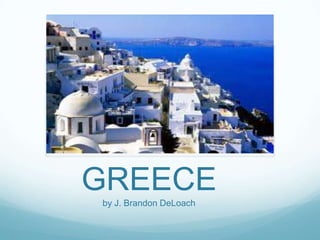
GREECE
by J. Brandon DeLoach
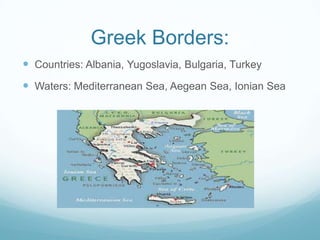
Greek Borders:
 Countries: Albania, Yugoslavia, Bulgaria, Turkey
 Waters: Mediterranean Sea, Aegean Sea, Ionian Sea
Physical Characteristics:
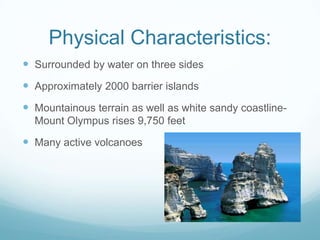
 Surrounded by water on three sides
 Approximately 2000 barrier islands
 Mountainous terrain as well as white sandy coastline-
  Mount Olympus rises 9,750 feet

 Many active volcanoes
Government
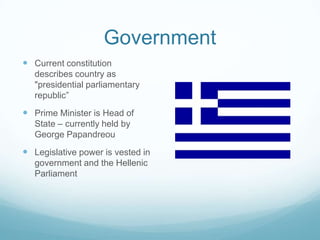
 Current constitution
   describes country as
   "presidential parliamentary
   republic”
 Prime Minister is Head of
   State – currently held by
   George Papandreou
 Legislative power is vested in
   government and the Hellenic
   Parliament
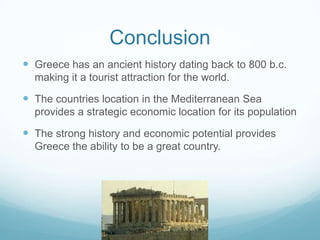
Ancient Culture/History
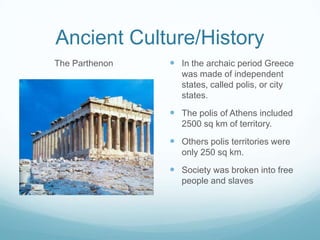
The Parthenon    In the archaic period Greece
                   was made of independent
                   states, called polis, or city
                   states.
                 The polis of Athens included
                   2500 sq km of territory.

                 Others polis territories were
                   only 250 sq km.
                 Society was broken into free
                   people and slaves
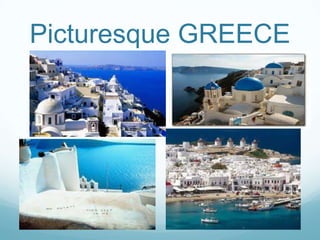
Picturesque GREECE
Modern Culture/Industry
 Greece has a diverse culture influenced by both
  eastern and western cultures of the world

 Athens, the capital city, inhabits 1/3 of the countries
  population totaling 10.5 million people

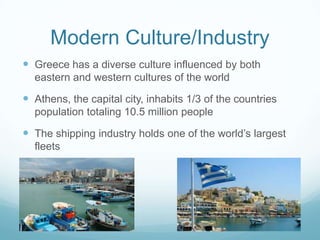
 The shipping industry holds one of the world’s largest
  fleets
Facts about the Greek people
 Religion is primarily Greek Orthodox at 98% of
  population, Muslims 1.3%, other .07%

 Life expectancy Male 75.66yrs/Female 81.81yrs
 Labor force 1.4 million
 Main line telephones approx. 5million/Cell phones 8
  million.
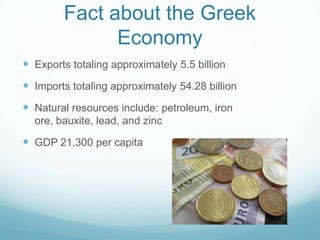
Fact about the Greek
              Economy
 Exports totaling approximately 5.5 billion
 Imports totaling approximately 54.28 billion
 Natural resources include: petroleum, iron
  ore, bauxite, lead, and zinc

 GDP 21,300 per capita
Conclusion
 Greece has an ancient history dating back to 800 b.c.
  making it a tourist attraction for the world.

 The countries location in the Mediterranean Sea
  provides a strategic economic location for its population

 The strong history and economic potential provides
  Greece the ability to be a great country.

Greece by j b d

  • 1.
  • 2.
    Greek Borders:  Countries:Albania, Yugoslavia, Bulgaria, Turkey  Waters: Mediterranean Sea, Aegean Sea, Ionian Sea
  • 3.
    Physical Characteristics:  Surroundedby water on three sides  Approximately 2000 barrier islands  Mountainous terrain as well as white sandy coastline- Mount Olympus rises 9,750 feet  Many active volcanoes
  • 4.
    Government  Current constitution describes country as "presidential parliamentary republic”  Prime Minister is Head of State – currently held by George Papandreou  Legislative power is vested in government and the Hellenic Parliament
  • 5.
    Ancient Culture/History The Parthenon  In the archaic period Greece was made of independent states, called polis, or city states.  The polis of Athens included 2500 sq km of territory.  Others polis territories were only 250 sq km.  Society was broken into free people and slaves
  • 6.
  • 7.
    Modern Culture/Industry  Greecehas a diverse culture influenced by both eastern and western cultures of the world  Athens, the capital city, inhabits 1/3 of the countries population totaling 10.5 million people  The shipping industry holds one of the world’s largest fleets
  • 8.
    Facts about theGreek people  Religion is primarily Greek Orthodox at 98% of population, Muslims 1.3%, other .07%  Life expectancy Male 75.66yrs/Female 81.81yrs  Labor force 1.4 million  Main line telephones approx. 5million/Cell phones 8 million.
  • 9.
    Fact about theGreek Economy  Exports totaling approximately 5.5 billion  Imports totaling approximately 54.28 billion  Natural resources include: petroleum, iron ore, bauxite, lead, and zinc  GDP 21,300 per capita
  • 10.
    Conclusion  Greece hasan ancient history dating back to 800 b.c. making it a tourist attraction for the world.  The countries location in the Mediterranean Sea provides a strategic economic location for its population  The strong history and economic potential provides Greece the ability to be a great country.