AUSTRIA
Mokhigul Sadullaeva
European Culture and Civilization
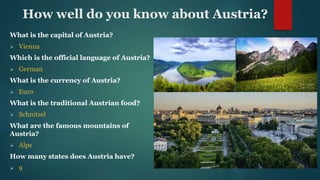
How well do you know about Austria?
What is the capital of Austria?
 Vienna
Which is the official language of Austria?
 German
What is the currency of Austria?
 Euro
What is the traditional Austrian food?
 Schnitzel
What are the famous mountains of
Austria?
 Alps
How many states does Austria have?
 9
INTERESTING FACTS
 Adolf Hitler was born in Braunau am Inn, Austria in 1889.
He relocated to Germany in 1913
 Ferdinand Porsche, who is the founder of the German sports
car company ‘Porsche’, was from Austria
 Arnold Schwarzenegger, former Hollywood actor, grew up in
Austria
 Austrians are very proud of being the home of Mozart!
 Psychiatrist Sigmund Freud, father of psychoanalysis, was
from Vienna. You can visit his former home and office there.
 The waltz (a ballroom and folk dance) first appeared in
Austria, suburbs of Vienna, in the 17th century
 The energy drink “Red Bull” was created in Austria. It is now
the single highest-selling energy drink on the planet.
GEOGRAPHY
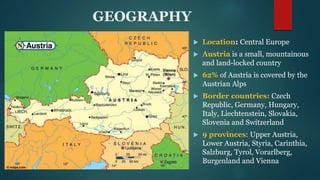
 Location: Central Europe
 Austria is a small, mountainous
and land-locked country
 62% of Austria is covered by the
Austrian Alps
 Border countries: Czech
Republic, Germany, Hungary,
Italy, Liechtenstein, Slovakia,
Slovenia and Switzerland
 9 provinces: Upper Austria,
Lower Austria, Styria, Carinthia,
Salzburg, Tyrol, Vorarlberg,
Burgenland and Vienna
BACKGROUND
 Population: over 8,7 million
 Area: 83,879 km2 (about twice size of
Switzerland)
 GDP: $461.432 billion (2018)
 Capital and the largest city: Vienna
(1/4 of the population)
 Official and national language:
(Austrian) German
 Currency: Euro (since 2002)
 Austria is regularly named as one of
the countries with the highest
standard of living in the world.
HISTORY
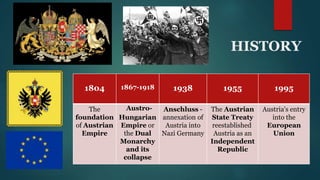
1804 1867-1918 1938 1955 1995
The
foundation
of Austrian
Empire
Austro-
Hungarian
Empire or
the Dual
Monarchy
and its
collapse
Anschluss -
annexation of
Austria into
Nazi Germany
The Austrian
State Treaty
reestablished
Austria as an
Independent
Republic
Austria's entry
into the
European
Union
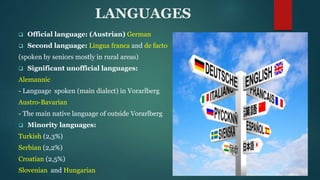
LANGUAGES
 Official language: (Austrian) German
 Second language: Lingua franca and de facto
(spoken by seniors mostly in rural areas)
 Significant unofficial languages:
Alemannic
- Language spoken (main dialect) in Vorarlberg
Austro-Bavarian
- The main native language of outside Vorarlberg
 Minority languages:
Turkish (2,3%)
Serbian (2,2%)
Croatian (2,5%)
Slovenian and Hungarian
ECONOMY
 Austria is one of the 14 richest countries in
the world in terms of GDP per capita
($51,320 in 2018)
 Tourism accounts for around 10 % of GDP
 The Service sector forms about 2/3 of the
GDP ( 62,79% in 2017)
 Trade and Industry make up 1/3 of the GDP
(25,27% in 2017)
 Agriculture contributes about 2 %.
 Trade with other EU countries accounts for
almost 66% of Austrian imports and exports.
 Unemployment rate: 4.8% (Eurostat 2018)
RELIGION
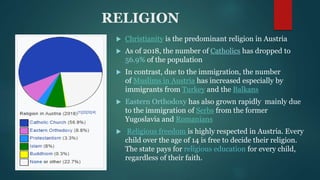
 Christianity is the predominant religion in Austria
 As of 2018, the number of Catholics has dropped to
56.9% of the population
 In contrast, due to the immigration, the number
of Muslims in Austria has increased especially by
immigrants from Turkey and the Balkans
 Eastern Orthodoxy has also grown rapidly mainly due
to the immigration of Serbs from the former
Yugoslavia and Romanians
 Religious freedom is highly respected in Austria. Every
child over the age of 14 is free to decide their religion.
The state pays for religious education for every child,
regardless of their faith.
POLITICS
 State type: Federal parliamentary republic
 Head of State: (President) Alexander Van
der Bellen since 26 January 2017
 Head of Government: (Chancellor)
Sebastian Kurz
 Political parties:
 Austrian People's Party (ÖVP)
 Social Democratic Party of Austria (SPÖ)
 Freedom Party of Austria (FPÖ)
 The New Austria and Liberal Forum
(NEOS)
 Peter Pilz List (PILZ)
 The Greens – The Green Alternative
(GRÜNE)
ETHNIC MINORITIES
 Turks (about 3%)
- the largest ethnic minority
- including Turkish Kurds
- Federal Germans (2,7%)
 Indigenous ethnic groups :
- Serbs ( 2,2%)
- (Carinthian) Slovenes (o,5%)
- Slovaks (0,4%)
- Czechs (0,4%)
- (Burgerland) Croats ( about 0,3%)
- Hungarians (0,2%)
- Romani people (0,1%)
CULTURE
 For men, the most traditional piece of clothing
is lederhosen (leather trousers)
 For women, a dirndl is the most popular clothing
 Traditional Austrian dress is not commonly worn
except on special occasions
 In Vienna and other large cities:
- wearing anything that is too revealing or makes
you stand out is frowned upon
- the dress is fairly formal and shorts are quite
uncommon
 Before entering churches, government buildings
or business meetings, be sure to dress in a more
conservative and formal manner.
Customs and Traditions
The International Institute for Market and Social
Analysis (IMAS) results of a survey show that many
Austrians see traditions as very important and
9 out of 10 Austrians think that protecting Austrian
traditions and keeping them alive is vital.
Easter Egg battle
Autumn Cow train
Stealing the BrideScary mask processions
Music in Austria
 Austria, especially Vienna is the current home
and historic birthplace of Classical music.
 Wolfgang Amadeus Mozart, Franz Joseph Haydn,
Johann Strauss, Franz Schubert, and Anton
Bruckner found their origins and inspirations
there.
 The Musikverein in Vienna is considered to be
one of the three finest concert halls in the world
 The Vienna State Opera is one of the most
important opera companies in the world
 The Vienna Boys' Choir is one of the best known
boys' choirs in the world.
 Yodeling is a type of throat singing that was
developed in the Austrian Alps
Stereotypes that every Austrian hates
 Lederhosen and dirndl
 The Sound of Music
 Great lovers of Classical music
 Mistaken for being German
 Austria's northern neighbors think:
Austrians are basically Bavarians but
“unfriendly”
 Europeans would depict Austrians as:
fair-haired, serious, standoffish, hardworking
and lacking in any sense of humor
 Many Germans think:
the country's craggy landscape reflects the
personalities of its inhabitants - cold, severe,
rigid people
Sign at Salzburg Airport.
Presentation

Presentation

  • 1.
  • 2.
    How well doyou know about Austria? What is the capital of Austria?  Vienna Which is the official language of Austria?  German What is the currency of Austria?  Euro What is the traditional Austrian food?  Schnitzel What are the famous mountains of Austria?  Alps How many states does Austria have?  9
  • 3.
    INTERESTING FACTS  AdolfHitler was born in Braunau am Inn, Austria in 1889. He relocated to Germany in 1913  Ferdinand Porsche, who is the founder of the German sports car company ‘Porsche’, was from Austria  Arnold Schwarzenegger, former Hollywood actor, grew up in Austria  Austrians are very proud of being the home of Mozart!  Psychiatrist Sigmund Freud, father of psychoanalysis, was from Vienna. You can visit his former home and office there.  The waltz (a ballroom and folk dance) first appeared in Austria, suburbs of Vienna, in the 17th century  The energy drink “Red Bull” was created in Austria. It is now the single highest-selling energy drink on the planet.
  • 4.
    GEOGRAPHY  Location: CentralEurope  Austria is a small, mountainous and land-locked country  62% of Austria is covered by the Austrian Alps  Border countries: Czech Republic, Germany, Hungary, Italy, Liechtenstein, Slovakia, Slovenia and Switzerland  9 provinces: Upper Austria, Lower Austria, Styria, Carinthia, Salzburg, Tyrol, Vorarlberg, Burgenland and Vienna
  • 5.
    BACKGROUND  Population: over8,7 million  Area: 83,879 km2 (about twice size of Switzerland)  GDP: $461.432 billion (2018)  Capital and the largest city: Vienna (1/4 of the population)  Official and national language: (Austrian) German  Currency: Euro (since 2002)  Austria is regularly named as one of the countries with the highest standard of living in the world.
  • 6.
    HISTORY 1804 1867-1918 19381955 1995 The foundation of Austrian Empire Austro- Hungarian Empire or the Dual Monarchy and its collapse Anschluss - annexation of Austria into Nazi Germany The Austrian State Treaty reestablished Austria as an Independent Republic Austria's entry into the European Union
  • 7.
    LANGUAGES  Official language:(Austrian) German  Second language: Lingua franca and de facto (spoken by seniors mostly in rural areas)  Significant unofficial languages: Alemannic - Language spoken (main dialect) in Vorarlberg Austro-Bavarian - The main native language of outside Vorarlberg  Minority languages: Turkish (2,3%) Serbian (2,2%) Croatian (2,5%) Slovenian and Hungarian
  • 8.
    ECONOMY  Austria isone of the 14 richest countries in the world in terms of GDP per capita ($51,320 in 2018)  Tourism accounts for around 10 % of GDP  The Service sector forms about 2/3 of the GDP ( 62,79% in 2017)  Trade and Industry make up 1/3 of the GDP (25,27% in 2017)  Agriculture contributes about 2 %.  Trade with other EU countries accounts for almost 66% of Austrian imports and exports.  Unemployment rate: 4.8% (Eurostat 2018)
  • 9.
    RELIGION  Christianity isthe predominant religion in Austria  As of 2018, the number of Catholics has dropped to 56.9% of the population  In contrast, due to the immigration, the number of Muslims in Austria has increased especially by immigrants from Turkey and the Balkans  Eastern Orthodoxy has also grown rapidly mainly due to the immigration of Serbs from the former Yugoslavia and Romanians  Religious freedom is highly respected in Austria. Every child over the age of 14 is free to decide their religion. The state pays for religious education for every child, regardless of their faith.
  • 10.
    POLITICS  State type:Federal parliamentary republic  Head of State: (President) Alexander Van der Bellen since 26 January 2017  Head of Government: (Chancellor) Sebastian Kurz  Political parties:  Austrian People's Party (ÖVP)  Social Democratic Party of Austria (SPÖ)  Freedom Party of Austria (FPÖ)  The New Austria and Liberal Forum (NEOS)  Peter Pilz List (PILZ)  The Greens – The Green Alternative (GRÜNE)
  • 11.
    ETHNIC MINORITIES  Turks(about 3%) - the largest ethnic minority - including Turkish Kurds - Federal Germans (2,7%)  Indigenous ethnic groups : - Serbs ( 2,2%) - (Carinthian) Slovenes (o,5%) - Slovaks (0,4%) - Czechs (0,4%) - (Burgerland) Croats ( about 0,3%) - Hungarians (0,2%) - Romani people (0,1%)
  • 12.
    CULTURE  For men,the most traditional piece of clothing is lederhosen (leather trousers)  For women, a dirndl is the most popular clothing  Traditional Austrian dress is not commonly worn except on special occasions  In Vienna and other large cities: - wearing anything that is too revealing or makes you stand out is frowned upon - the dress is fairly formal and shorts are quite uncommon  Before entering churches, government buildings or business meetings, be sure to dress in a more conservative and formal manner.
  • 13.
    Customs and Traditions TheInternational Institute for Market and Social Analysis (IMAS) results of a survey show that many Austrians see traditions as very important and 9 out of 10 Austrians think that protecting Austrian traditions and keeping them alive is vital. Easter Egg battle Autumn Cow train Stealing the BrideScary mask processions
  • 14.
    Music in Austria Austria, especially Vienna is the current home and historic birthplace of Classical music.  Wolfgang Amadeus Mozart, Franz Joseph Haydn, Johann Strauss, Franz Schubert, and Anton Bruckner found their origins and inspirations there.  The Musikverein in Vienna is considered to be one of the three finest concert halls in the world  The Vienna State Opera is one of the most important opera companies in the world  The Vienna Boys' Choir is one of the best known boys' choirs in the world.  Yodeling is a type of throat singing that was developed in the Austrian Alps
  • 15.
    Stereotypes that everyAustrian hates  Lederhosen and dirndl  The Sound of Music  Great lovers of Classical music  Mistaken for being German  Austria's northern neighbors think: Austrians are basically Bavarians but “unfriendly”  Europeans would depict Austrians as: fair-haired, serious, standoffish, hardworking and lacking in any sense of humor  Many Germans think: the country's craggy landscape reflects the personalities of its inhabitants - cold, severe, rigid people Sign at Salzburg Airport.