What is Genocide?
"Actscommitted with intent to destroy, in whole or in part, a
national, ethnical, racial, or religious group."
genocide can occur during wars, often as a method of targeting and eliminating specific
groups
The importance of understanding its roots, history, and impact on
human civilization
3.
Causes of Genocidein War:
Ethnic or Religious Hatred: Long-standing tensions between
groups escalate during war.
Political Power Struggles: Leaders eliminate rivals or threats
to their authority.
Propaganda and Dehumanization: Targeted groups are
dehumanized through propaganda.
Colonial or Historical Conflicts: Divisions from colonialism or
past injustices resurface.
Economic Inequality: Competition for resources leads to
violence against certain groups.
Failure of International Intervention: Lack of timely response
emboldens perpetrators.
War as a Catalyst: Chaos during war weakens governance
and enables genocidal acts.
4.
Classification
Dividing people into"us" and "them" based on ethnicity, religion, or nationality.
Symbolization: Assigning symbols or labels to distinguish groups (e.g., clothing,
badges).
Discrimination: Denying rights and excluding a group through laws or policies.
Dehumanization: Treating a group as less than human, often using hate speech
or propaganda.
Organization: Planning and preparing for genocide, including arming militias.
Polarization: Spreading extremist propaganda to divide groups and silence
moderates.
Preparation: Identifying victims, creating lists, and organizing resources for
killings.
Persecution: Targeting victims through imprisonment, forced relocation, or
property confiscation.
Extermination: Carrying out mass killings, seen by perpetrators as "cleansing."
Denial: Destroying evidence, denying the genocide, or blaming the victims.
5.
Genocide in theContext of War
The relationship between war and genocide: War often
creates conditions for extreme violence, displacement, and
targeting of minority groups.
Genocides historically have been justified under political,
racial, or religious ideologies.
Mention early examples (e.g., the Armenian Genocide, the
Holocaust).
6.
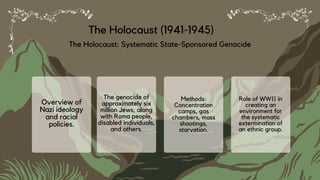
The Holocaust (1941-1945)
Overviewof
Nazi ideology
and racial
policies.
The genocide of
approximately six
million Jews, along
with Roma people,
disabled individuals,
and others.
Methods:
Concentration
camps, gas
chambers, mass
shootings,
starvation.
Role of WWII in
creating an
environment for
the systematic
extermination of
an ethnic group.
The Holocaust: Systematic State-Sponsored Genocide
7.
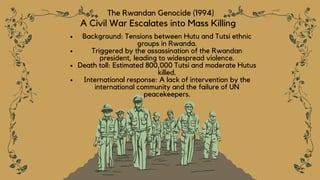
The Rwandan Genocide(1994)
A Civil War Escalates into Mass Killing
Background: Tensions between Hutu and Tutsi ethnic
groups in Rwanda.
Triggered by the assassination of the Rwandan
president, leading to widespread violence.
Death toll: Estimated 800,000 Tutsi and moderate Hutus
killed.
International response: A lack of intervention by the
international community and the failure of UN
peacekeepers.
8.
The Bosnian Genocide(1992-1995)
Genocide in the Bosnian War
Breakdown of Yugoslavia leading to ethnic conflict.
Ethnic cleansing by Bosnian Serb forces against Bosnian Muslims
(Bosniaks) and Croats.
Notable events: The Siege of Sarajevo, the Srebrenica massacre
(8,000 men and boys murdered).
International recognition: The International Criminal Tribunal for
the former Yugoslavia (ICTY) convicted perpetrators of genocide.
9.
The Role ofPropaganda and Dehumanization
Fueling Hatred and Violence
The use of media, speech, and propaganda to
dehumanize target groups.
Examples: Nazi anti-Semitic propaganda, Hutu
Power propaganda during the Rwandan
Genocide, and Serbian nationalist rhetoric
during the Bosnian War.
The role of leaders in inciting violence through
hateful language and ideas.
10.
The International Response
GlobalEfforts to Address Genocide
Post-WWII international laws: The Genocide
Convention (1948), the International Criminal Court
(ICC), and the establishment of international
tribunals.
Failures of intervention: Lack of action or delayed
response in cases like Rwanda and Bosnia.
Examples of successful interventions: The end of
apartheid in South Africa, peacekeeping efforts in
East Timor.
11.
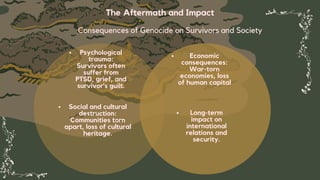
The Aftermath andImpact
Consequences of Genocide on Survivors and Society
Psychological
trauma:
Survivors often
suffer from
PTSD, grief, and
survivor's guilt.
Long-term
impact on
international
relations and
security.
Social and cultural
destruction:
Communities torn
apart, loss of cultural
heritage.
Economic
consequences:
War-torn
economies, loss
of human capital
12.
Preventing Future Genocides
HowCan Genocides Be Prevented?
Early warning systems, diplomacy, and peacebuilding efforts are essential for
preventing genocide by identifying and addressing rising tensions before they
escalate into violence. Strengthening international laws, such as the Genocide
Convention, helps hold perpetrators accountable and reinforces global norms
against atrocities. Promoting human rights and protecting minority groups fosters
inclusive societies, while education encourages tolerance, understanding, and the
prevention of hate speech. Together, these efforts form a comprehensive approach
to preventing genocide and promoting peace.
13.
Conclusion
While much progresshas been made,
genocide remains a threat in many
regions of the world.
The international community must
remain vigilant and committed to
preventing atrocities.
A call to action: "Never Again" –
remembering the past to ensure a
better future.