+
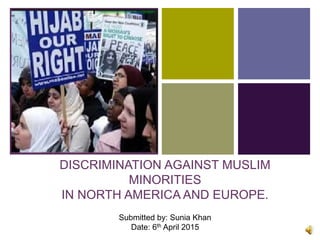
DISCRIMINATION AGAINST MUSLIM
MINORITIES
IN NORTH AMERICA AND EUROPE.
Submitted by: Sunia Khan
Date: 6th April 2015
+
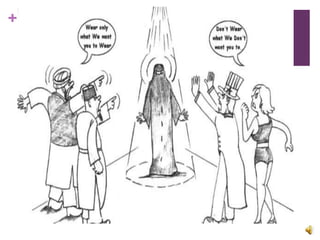
Burqas and Bans: Freedom or
Oppression?
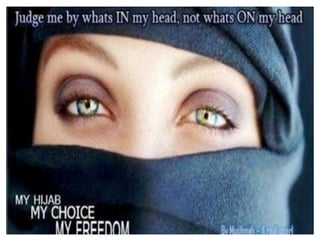
 Farzana Hassan, a past president of the Canadian Muslim
Congress presented her case at a multiculturalism lecture held in
the University of British Columbia. She argues that facial vialing
also known as ‘niqab’ or ‘burqa’ worn by some women in the
Muslim community should be banned. I strongly disagree with a lot
of her statements.
 “wearing a burqa is a safety and security concern for Canada”
(Hassan, 2011).
 “wearing a burqa is crossing the reasonable limit” (Hassan, 2011).
 “veiling was not said to be done by the prophet Muhammad
(P.B.U.H)” (Hassan, 2011) and also that “there is no religious
reason for wearing a burqua” (Hassan, 2011).
(Assignment by Professor Mansour)
+
+
Indian Horse by Richard
Wagamese
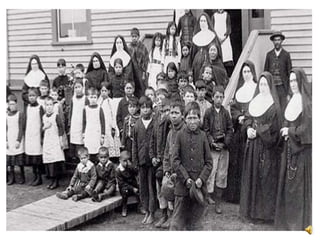
 Wagamese’s novel Indian Horse expresses how Aboriginal
people in Canada experience racism in interpersonal, structural
and sometimes violent ways. Wagamese exposes the horrors
of residential schools which have scared aboriginal community
for life. (Carin, 2013)
 Racism is an experience acutely felt by many Aboriginal people
in Canada. For example, according to a 2005 report of the First
Nations Regional Longitudinal Health Survey (RHS), 38% of
participating First Nations adults experienced at least one
instance of racism in the past 12 months; 63% of them felt that
it had at least some effect on their self-esteem (First Nations
Centre, 2005).’ (Reading, Leeuw, & Loopie, n.d)
+
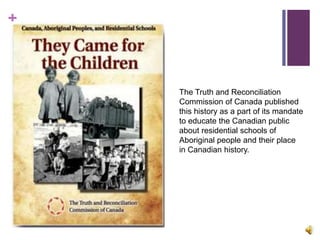
The Truth and Reconciliation
Commission of Canada published
this history as a part of its mandate
to educate the Canadian public
about residential schools of
Aboriginal people and their place
in Canadian history.
+
+
MUSLIM POPULATION TODAY
 According to Canada's 2011 National Household Survey, there
were about 3.2% of the Muslim population in Canada, making
them the second largest religion after Christianity and the fastest
growing religion in Canada.
 Islam is the largest or the second largest religion in 17 of 38
European (overall) countries. Around 60% of the Muslims living in
Europe are under 30 Years of age.
 Today, the total Muslim population in Western Europe is estimated
to be between 12-14 million. There are 3 million Muslims in
Germany and 1.5 million in Britain; Italy, Belgium and the
Netherlands have about a half million each.
+
+
DISCRIMINATION AGAINST THE
MUSLIM MINORITY
 In parts of western Europe complaints are wife of Muslim women are
being denied jobs because of their headscarves, Muslims served last in
stores, denied memberships of local clubs, and unfortunately jeered at in
the street, "to go back to Turkey”
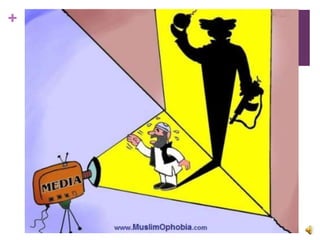
 Canadian Muslims and Arabs are feeling the effects of discrimination in
their daily lives. For example, they report: Harassment and name calling,
Distorted representation in media, Discrimination in employment and
housing, Vandalism against mosques, Being labeled as supporting
terrorism.
 Many Muslim Canadians are committed to working for a Canada that is
free of discrimination and where every human being is valued and
respected.
 Since many Muslims themselves look at the world through the paradigm
of their religion, they often consider these elements Islamophobic.
+
+
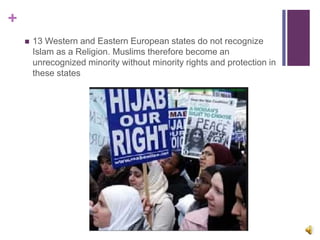
 13 Western and Eastern European states do not recognize
Islam as a Religion. Muslims therefore become an
unrecognized minority without minority rights and protection in
these states
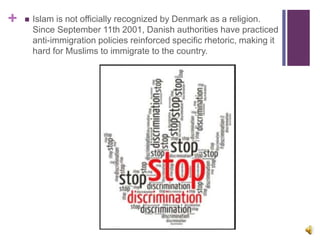
+  Islam is not officially recognized by Denmark as a religion.
Since September 11th 2001, Danish authorities have practiced
anti-immigration policies reinforced specific rhetoric, making it
hard for Muslims to immigrate to the country.
+
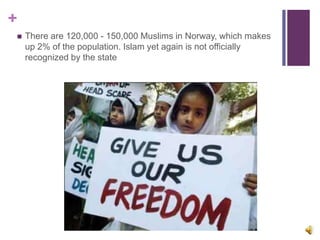
 There are 120,000 - 150,000 Muslims in Norway, which makes
up 2% of the population. Islam yet again is not officially
recognized by the state
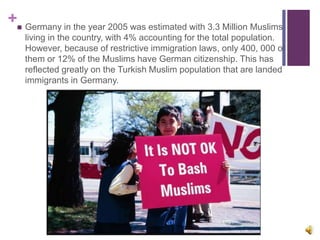
+ Germany in the year 2005 was estimated with 3.3 Million Muslims
living in the country, with 4% accounting for the total population.
However, because of restrictive immigration laws, only 400, 000 of
them or 12% of the Muslims have German citizenship. This has
reflected greatly on the Turkish Muslim population that are landed
immigrants in Germany.
+
+
+
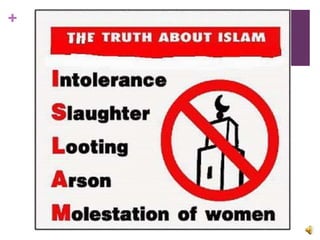
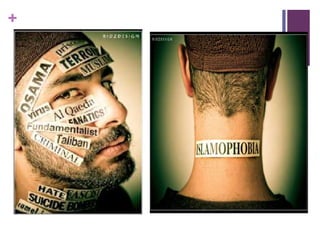
ISLAMOPHOBIA
 Definition: Dislike of or prejudice against Islam or Muslims,
especially as a political force.
(oxford dictionaries)
+
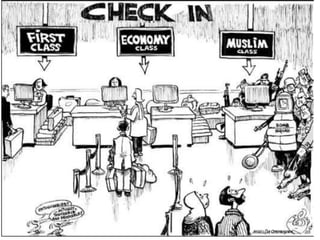
WHAT MAKES A NATION OR
PEOPLE ISLAMPHOBIC?
It is seen as a political Ideology, used for political or
military advantage.
Hostility towards Islam is used to justify
discriminatory practices towards Muslims and
exclusion of Muslims from mainstream society.
Anti-Muslim hostility is seen as natural and normal
+
+
WHAT MAKES A NATION OR
PEOPLE ISLAMPHOBIC?
Islam is seen as a monolithic block, static and
unresponsive to change.
It is seen as separate and "other." It does not have
values in common with other cultures, is not
affected by them and does not influence them.
It is seen as inferior to the West. It is seen as
barbaric, irrational, primitive, and sexist.
It is seen as violent, aggressive, threatening,
supportive of Terrorism, and engaged in a Clash of
civilization.
+ CASE STUDY: MUSLIM
MINORITIES IN FRANCE
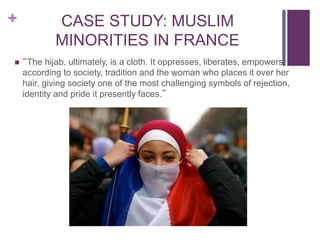
 “The hijab, ultimately, is a cloth. It oppresses, liberates, empowers,
according to society, tradition and the woman who places it over her
hair, giving society one of the most challenging symbols of rejection,
identity and pride it presently faces.”
+
DEMOGRAPHICS
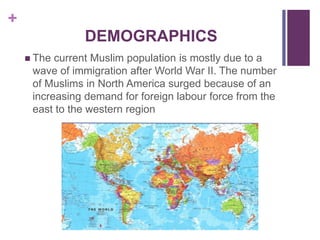
 The current Muslim population is mostly due to a
wave of immigration after World War II. The number
of Muslims in North America surged because of an
increasing demand for foreign labour force from the
east to the western region
+ DISCRIMINATION OF MUSLIMS IN
CANADA
 With the population of Muslims increasing, there has
been growing criticism regarding the treatment of
Muslims in Canadian society.
 Community surveys, focus groups and polls indicate
that many Muslims feel there is discrimination
against them in Canada after 9/11 (Helly, 2004;
CAIR-CAN, 2002; Adams, 2007).
 Within the larger population, a recent poll by Ipsos
Reid found that 60% of people surveyed felt there
was increased discrimination against Muslims, in
comparison to ten years ago (Chung, 2011).
+ GTA woman has Niqab pulled off
in assault
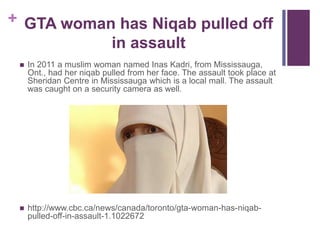
 In 2011 a muslim woman named Inas Kadri, from Mississauga,
Ont., had her niqab pulled from her face. The assault took place at
Sheridan Centre in Mississauga which is a local mall. The assault
was caught on a security camera as well.
 http://www.cbc.ca/news/canada/toronto/gta-woman-has-niqab-
pulled-off-in-assault-1.1022672
+
DISCRIMINATION OF MUSLIMS IN
FRANCE
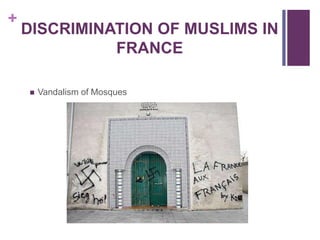
 Vandalism of Mosques
+
THE BAN OF THE HIJAB
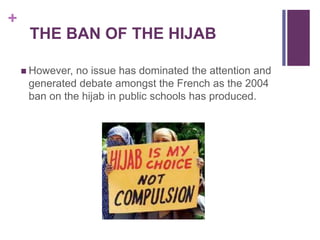
 However, no issue has dominated the attention and
generated debate amongst the French as the 2004
ban on the hijab in public schools has produced.
+
CHAIN OF EVENTS: THE BAN OF
THE HIJAB
 The current debate over the veil can said to have
begun in October 1989, when three junior high
school girls refused to remove their hijabs in class,
and were expelled for doing so.
 The second debate over the veil took place in
September 1994, when then education minister
François Bayrou issued a order concerning the
display of religious insignia in schools.
+
PASSING OF THE LEGISLATION
 The bill to outlaw conspicuous religious dress and
insignia in French schools officially became law on
March 15, 2004 with an overwhelming majority vote
of 276 to 20, and became applicable from the start of
the new school year in September.
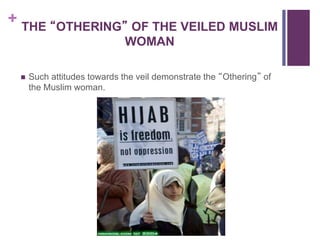
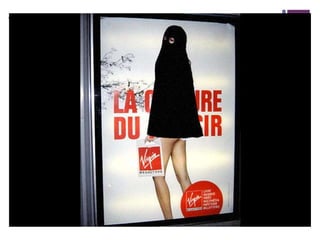
+ THE “OTHERING” OF THE VEILED MUSLIM
WOMAN
 Such attitudes towards the veil demonstrate the “Othering” of
the Muslim woman.
+
+ THE HIJAB AS A RELIGIOUS OBSERVANCE
RATHER THAN A POLITICAL SYMBOL
 There are, no doubt, a number of reasons why
Muslim women choose to wear the hijab.
 Some often cited reasons are: personal religious
conviction, freedom of religion, acceptance as a
good Muslim female, compliance with family values,
neutralization of sexuality and protection from
harassment from males, and individual choice and
religious/cultural identity.
+
FREEDOM OF RELIGION AND THE
BAN OF THE HIJAB
 Article 18 of the Universal Declaration of Human Rights
(UDHR):
 Everyone has the right to freedom of thought, conscience and
religion; this right includes freedom to change his religion or
belief, and freedom, either alone or in community with others
and in public or private, to manifest his religion or belief in
teaching, practice, worship and observance.
+
FREEDOM OF EDUCATION AND THE
BAN OF THE HIJAB
 It does not matter who or which state is abusing the
basic human right; ultimately it is the Muslim woman
who suffers either way.
 Once again her body has become the site on which
various political battles are carried on and biased
agreements negotiated.
+
+
 The Canadian Charter of Rights and Freedoms
guarantees protection from discrimination: “Every
individual is equal before and under the law and has
the right to the equal protection and equal benefit of
the law without discrimination and, in particular,
without discrimination based on race, national or
ethnic origin, colour, religion, sex, age or mental or
physical disability.” (Section 15(1))
Recognition of International and
regional Human Rights
+
International and regional human rights instruments
recognize at least four rights directly related to religion and
belief:
 a) the right to freedom of thought, conscience, and
religion;
 b)the right to equal protection of the law, including
the prohibition of discrimination on the basis of
religion;
 c) the right of persons belonging to religious
minorities to profess and practice their religion;
 d) the right to protection from incitement to
discrimination, hostility, or violence.
+
Work Cited
 http://ccrweb.ca/files/discrimination_against_arabs_and_musli
ms_in_canada.pdf
 http://www.cbc.ca/news/canada/toronto/gta-woman-has-niqab-
pulled-off-in-assault-1.1022672
 http://www.ohrc.on.ca/en/creed-freedom-religion-and-human-
rights-special-issue-diversity-magazine-volume-93-summer-
2012/discrimination-experienced-muslims-ontario
 http://www.libertymagazine.org/discussion/are-burqa-bans-
oppressive-to-religious-freedom-or-a-defense-of-the-rights-a

Discrimination Against Muslim Minorities In North America And Europe.

  • 1.
    + DISCRIMINATION AGAINST MUSLIM MINORITIES INNORTH AMERICA AND EUROPE. Submitted by: Sunia Khan Date: 6th April 2015
  • 2.
    + Burqas and Bans:Freedom or Oppression?  Farzana Hassan, a past president of the Canadian Muslim Congress presented her case at a multiculturalism lecture held in the University of British Columbia. She argues that facial vialing also known as ‘niqab’ or ‘burqa’ worn by some women in the Muslim community should be banned. I strongly disagree with a lot of her statements.  “wearing a burqa is a safety and security concern for Canada” (Hassan, 2011).  “wearing a burqa is crossing the reasonable limit” (Hassan, 2011).  “veiling was not said to be done by the prophet Muhammad (P.B.U.H)” (Hassan, 2011) and also that “there is no religious reason for wearing a burqua” (Hassan, 2011). (Assignment by Professor Mansour)
  • 3.
  • 4.
    + Indian Horse byRichard Wagamese  Wagamese’s novel Indian Horse expresses how Aboriginal people in Canada experience racism in interpersonal, structural and sometimes violent ways. Wagamese exposes the horrors of residential schools which have scared aboriginal community for life. (Carin, 2013)  Racism is an experience acutely felt by many Aboriginal people in Canada. For example, according to a 2005 report of the First Nations Regional Longitudinal Health Survey (RHS), 38% of participating First Nations adults experienced at least one instance of racism in the past 12 months; 63% of them felt that it had at least some effect on their self-esteem (First Nations Centre, 2005).’ (Reading, Leeuw, & Loopie, n.d)
  • 5.
    + The Truth andReconciliation Commission of Canada published this history as a part of its mandate to educate the Canadian public about residential schools of Aboriginal people and their place in Canadian history.
  • 6.
  • 7.
    + MUSLIM POPULATION TODAY According to Canada's 2011 National Household Survey, there were about 3.2% of the Muslim population in Canada, making them the second largest religion after Christianity and the fastest growing religion in Canada.  Islam is the largest or the second largest religion in 17 of 38 European (overall) countries. Around 60% of the Muslims living in Europe are under 30 Years of age.  Today, the total Muslim population in Western Europe is estimated to be between 12-14 million. There are 3 million Muslims in Germany and 1.5 million in Britain; Italy, Belgium and the Netherlands have about a half million each.
  • 8.
  • 9.
    + DISCRIMINATION AGAINST THE MUSLIMMINORITY  In parts of western Europe complaints are wife of Muslim women are being denied jobs because of their headscarves, Muslims served last in stores, denied memberships of local clubs, and unfortunately jeered at in the street, "to go back to Turkey”  Canadian Muslims and Arabs are feeling the effects of discrimination in their daily lives. For example, they report: Harassment and name calling, Distorted representation in media, Discrimination in employment and housing, Vandalism against mosques, Being labeled as supporting terrorism.  Many Muslim Canadians are committed to working for a Canada that is free of discrimination and where every human being is valued and respected.  Since many Muslims themselves look at the world through the paradigm of their religion, they often consider these elements Islamophobic.
  • 10.
  • 11.
    +  13 Westernand Eastern European states do not recognize Islam as a Religion. Muslims therefore become an unrecognized minority without minority rights and protection in these states
  • 12.
    +  Islamis not officially recognized by Denmark as a religion. Since September 11th 2001, Danish authorities have practiced anti-immigration policies reinforced specific rhetoric, making it hard for Muslims to immigrate to the country.
  • 13.
    +  There are120,000 - 150,000 Muslims in Norway, which makes up 2% of the population. Islam yet again is not officially recognized by the state
  • 14.
    + Germany inthe year 2005 was estimated with 3.3 Million Muslims living in the country, with 4% accounting for the total population. However, because of restrictive immigration laws, only 400, 000 of them or 12% of the Muslims have German citizenship. This has reflected greatly on the Turkish Muslim population that are landed immigrants in Germany.
  • 15.
  • 16.
  • 17.
    + ISLAMOPHOBIA  Definition: Dislikeof or prejudice against Islam or Muslims, especially as a political force. (oxford dictionaries)
  • 18.
    + WHAT MAKES ANATION OR PEOPLE ISLAMPHOBIC? It is seen as a political Ideology, used for political or military advantage. Hostility towards Islam is used to justify discriminatory practices towards Muslims and exclusion of Muslims from mainstream society. Anti-Muslim hostility is seen as natural and normal
  • 19.
  • 20.
    + WHAT MAKES ANATION OR PEOPLE ISLAMPHOBIC? Islam is seen as a monolithic block, static and unresponsive to change. It is seen as separate and "other." It does not have values in common with other cultures, is not affected by them and does not influence them. It is seen as inferior to the West. It is seen as barbaric, irrational, primitive, and sexist. It is seen as violent, aggressive, threatening, supportive of Terrorism, and engaged in a Clash of civilization.
  • 21.
    + CASE STUDY:MUSLIM MINORITIES IN FRANCE  “The hijab, ultimately, is a cloth. It oppresses, liberates, empowers, according to society, tradition and the woman who places it over her hair, giving society one of the most challenging symbols of rejection, identity and pride it presently faces.”
  • 22.
    + DEMOGRAPHICS  The currentMuslim population is mostly due to a wave of immigration after World War II. The number of Muslims in North America surged because of an increasing demand for foreign labour force from the east to the western region
  • 23.
    + DISCRIMINATION OFMUSLIMS IN CANADA  With the population of Muslims increasing, there has been growing criticism regarding the treatment of Muslims in Canadian society.  Community surveys, focus groups and polls indicate that many Muslims feel there is discrimination against them in Canada after 9/11 (Helly, 2004; CAIR-CAN, 2002; Adams, 2007).  Within the larger population, a recent poll by Ipsos Reid found that 60% of people surveyed felt there was increased discrimination against Muslims, in comparison to ten years ago (Chung, 2011).
  • 24.
    + GTA womanhas Niqab pulled off in assault  In 2011 a muslim woman named Inas Kadri, from Mississauga, Ont., had her niqab pulled from her face. The assault took place at Sheridan Centre in Mississauga which is a local mall. The assault was caught on a security camera as well.  http://www.cbc.ca/news/canada/toronto/gta-woman-has-niqab- pulled-off-in-assault-1.1022672
  • 25.
    + DISCRIMINATION OF MUSLIMSIN FRANCE  Vandalism of Mosques
  • 26.
    + THE BAN OFTHE HIJAB  However, no issue has dominated the attention and generated debate amongst the French as the 2004 ban on the hijab in public schools has produced.
  • 27.
    + CHAIN OF EVENTS:THE BAN OF THE HIJAB  The current debate over the veil can said to have begun in October 1989, when three junior high school girls refused to remove their hijabs in class, and were expelled for doing so.  The second debate over the veil took place in September 1994, when then education minister François Bayrou issued a order concerning the display of religious insignia in schools.
  • 28.
    + PASSING OF THELEGISLATION  The bill to outlaw conspicuous religious dress and insignia in French schools officially became law on March 15, 2004 with an overwhelming majority vote of 276 to 20, and became applicable from the start of the new school year in September.
  • 29.
    + THE “OTHERING”OF THE VEILED MUSLIM WOMAN  Such attitudes towards the veil demonstrate the “Othering” of the Muslim woman.
  • 30.
  • 31.
    + THE HIJABAS A RELIGIOUS OBSERVANCE RATHER THAN A POLITICAL SYMBOL  There are, no doubt, a number of reasons why Muslim women choose to wear the hijab.  Some often cited reasons are: personal religious conviction, freedom of religion, acceptance as a good Muslim female, compliance with family values, neutralization of sexuality and protection from harassment from males, and individual choice and religious/cultural identity.
  • 32.
    + FREEDOM OF RELIGIONAND THE BAN OF THE HIJAB  Article 18 of the Universal Declaration of Human Rights (UDHR):  Everyone has the right to freedom of thought, conscience and religion; this right includes freedom to change his religion or belief, and freedom, either alone or in community with others and in public or private, to manifest his religion or belief in teaching, practice, worship and observance.
  • 33.
    + FREEDOM OF EDUCATIONAND THE BAN OF THE HIJAB  It does not matter who or which state is abusing the basic human right; ultimately it is the Muslim woman who suffers either way.  Once again her body has become the site on which various political battles are carried on and biased agreements negotiated.
  • 34.
  • 35.
    +  The CanadianCharter of Rights and Freedoms guarantees protection from discrimination: “Every individual is equal before and under the law and has the right to the equal protection and equal benefit of the law without discrimination and, in particular, without discrimination based on race, national or ethnic origin, colour, religion, sex, age or mental or physical disability.” (Section 15(1)) Recognition of International and regional Human Rights
  • 36.
    + International and regionalhuman rights instruments recognize at least four rights directly related to religion and belief:  a) the right to freedom of thought, conscience, and religion;  b)the right to equal protection of the law, including the prohibition of discrimination on the basis of religion;  c) the right of persons belonging to religious minorities to profess and practice their religion;  d) the right to protection from incitement to discrimination, hostility, or violence.
  • 37.
    + Work Cited  http://ccrweb.ca/files/discrimination_against_arabs_and_musli ms_in_canada.pdf http://www.cbc.ca/news/canada/toronto/gta-woman-has-niqab- pulled-off-in-assault-1.1022672  http://www.ohrc.on.ca/en/creed-freedom-religion-and-human- rights-special-issue-diversity-magazine-volume-93-summer- 2012/discrimination-experienced-muslims-ontario  http://www.libertymagazine.org/discussion/are-burqa-bans- oppressive-to-religious-freedom-or-a-defense-of-the-rights-a