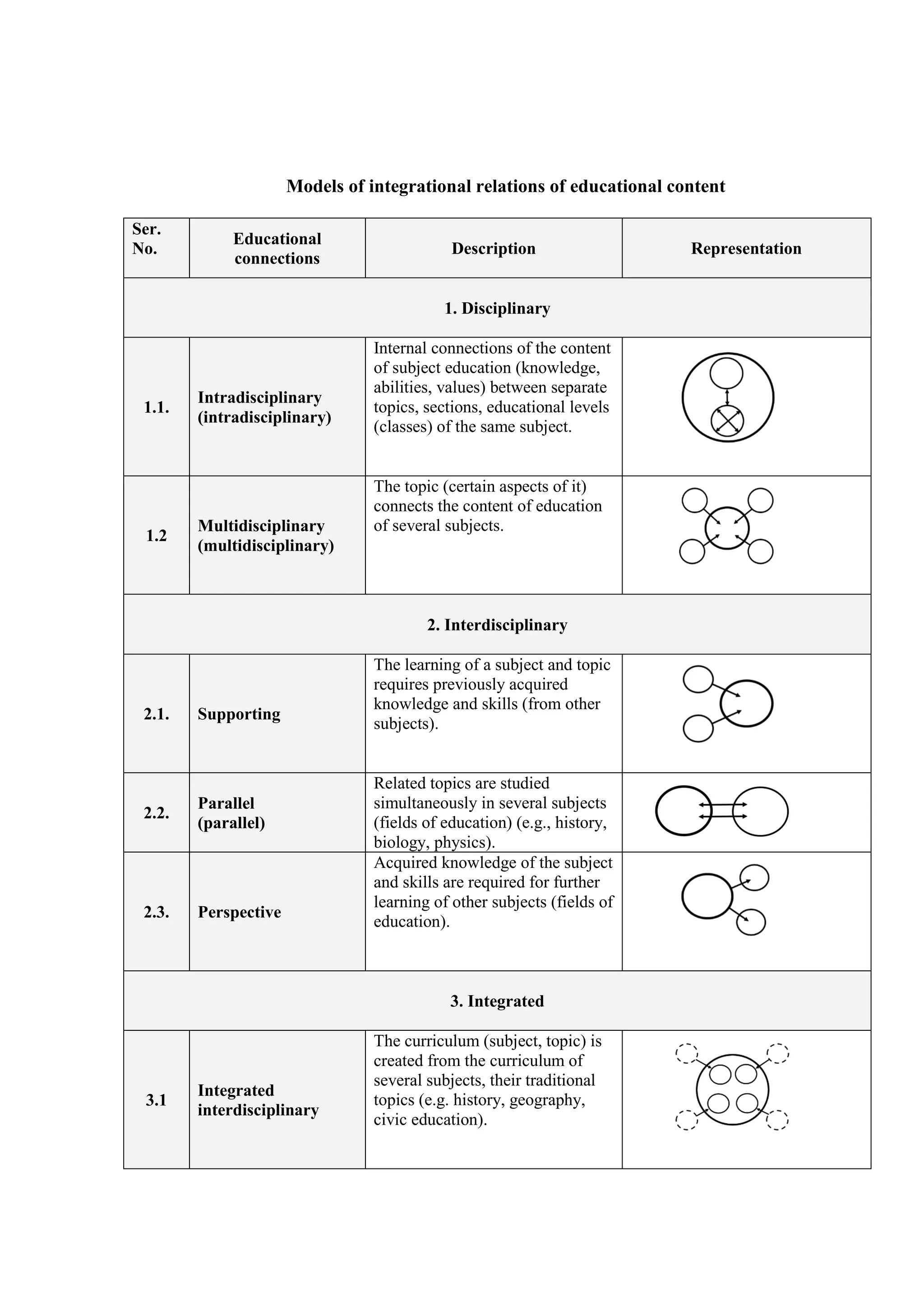
Models of integrational relations of educational content
Ser.
No.
Educational
connections
Description Representation
1. Disciplinary
1.1.
Intradisciplinary
(intradisciplinary)
Internal connections of the content
of subject education (knowledge,
abilities, values) between separate
topics, sections, educational levels
(classes) of the same subject.
1.2
Multidisciplinary
(multidisciplinary)
The topic (certain aspects of it)
connects the content of education
of several subjects.
2. Interdisciplinary
2.1. Supporting
The learning of a subject and topic
requires previously acquired
knowledge and skills (from other
subjects).
2.2.
Parallel
(parallel)
Related topics are studied
simultaneously in several subjects
(fields of education) (e.g., history,
biology, physics).
2.3. Perspective
Acquired knowledge of the subject
and skills are required for further
learning of other subjects (fields of
education).
3. Integrated
3.1
Integrated
interdisciplinary
The curriculum (subject, topic) is
created from the curriculum of
several subjects, their traditional
topics (e.g. history, geography,
civic education).
3.2
Integrated
disciplinary
(Integrated subject)
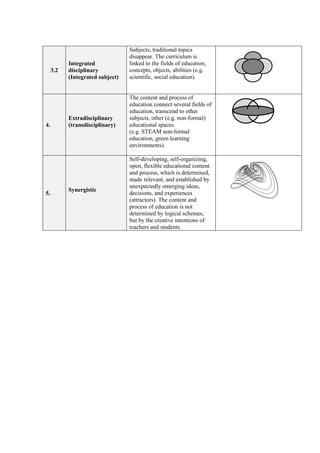
Subjects, traditional topics
disappear. The curriculum is
linked to the fields of education,
concepts, objects, abilities (e.g.
scientific, social education).
4.
Extradisciplinary
(transdisciplinary)
The content and process of
education connect several fields of
education, transcend to other
subjects, other (e.g. non-formal)
educational spaces.
(e.g. STEAM non-formal
education, green learning
environments).
5.
Synergistic
Self-developing, self-organizing,
open, flexible educational content
and process, which is determined,
made relevant, and established by
unexpectedly emerging ideas,
decisions, and experiences
(attractors). The content and
process of education is not
determined by logical schemes,
but by the creative intentions of
teachers and students.

Models of integration

  • 1.
    Models of integrationalrelations of educational content Ser. No. Educational connections Description Representation 1. Disciplinary 1.1. Intradisciplinary (intradisciplinary) Internal connections of the content of subject education (knowledge, abilities, values) between separate topics, sections, educational levels (classes) of the same subject. 1.2 Multidisciplinary (multidisciplinary) The topic (certain aspects of it) connects the content of education of several subjects. 2. Interdisciplinary 2.1. Supporting The learning of a subject and topic requires previously acquired knowledge and skills (from other subjects). 2.2. Parallel (parallel) Related topics are studied simultaneously in several subjects (fields of education) (e.g., history, biology, physics). 2.3. Perspective Acquired knowledge of the subject and skills are required for further learning of other subjects (fields of education). 3. Integrated 3.1 Integrated interdisciplinary The curriculum (subject, topic) is created from the curriculum of several subjects, their traditional topics (e.g. history, geography, civic education).
  • 2.
    3.2 Integrated disciplinary (Integrated subject) Subjects, traditionaltopics disappear. The curriculum is linked to the fields of education, concepts, objects, abilities (e.g. scientific, social education). 4. Extradisciplinary (transdisciplinary) The content and process of education connect several fields of education, transcend to other subjects, other (e.g. non-formal) educational spaces. (e.g. STEAM non-formal education, green learning environments). 5. Synergistic Self-developing, self-organizing, open, flexible educational content and process, which is determined, made relevant, and established by unexpectedly emerging ideas, decisions, and experiences (attractors). The content and process of education is not determined by logical schemes, but by the creative intentions of teachers and students.