MODELS OF CURRICULUM
INTEGRATION
Introduction……
• “Models of Curriculum Integration”
means different methods or
approaches used to combine subjects
and learning experiences into a
connected and meaningful curriculum
….
• They promote holistic education…
Models
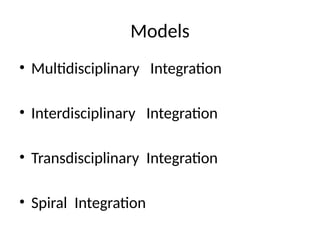
• Multidisciplinary Integration
• Interdisciplinary Integration
• Transdisciplinary Integration
• Spiral Integration
Multidisciplinary Integration
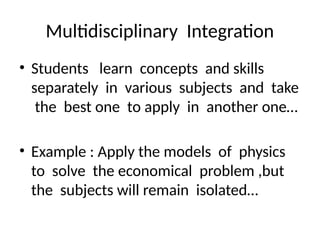
• Students learn concepts and skills
separately in various subjects and take
the best one to apply in another one…
• Example : Apply the models of physics
to solve the economical problem ,but
the subjects will remain isolated…
Interdisciplinary Integration
• In this , students integrating the
knowledge from different subjects to
produce one single product or reach one
goal..
• Example : For the construction of
drone , it requires the knowledge of
mechanical and software engineering…
Transdisciplinary Integration
• It brings the multidisciplinary knowledge
together to solve the bigger problems
in the society
• Example : students uses the drone as a
real life tool to connect learning with
society by applying knowledge from
many fields…
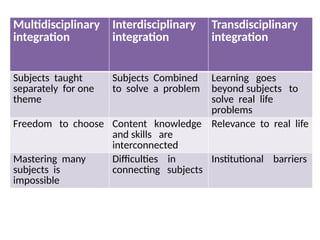
Multidisciplinary
integration
Interdisciplinary
integration
Transdisciplinary
integration
Subjects taught
separately for one
theme
Subjects Combined
to solve a problem
Learning goes
beyond subjects to
solve real life
problems
Freedom to choose Content knowledge
and skills are
interconnected
Relevance to real life
Mastering many
subjects is
impossible
Difficulties in
connecting subjects
Institutional barriers
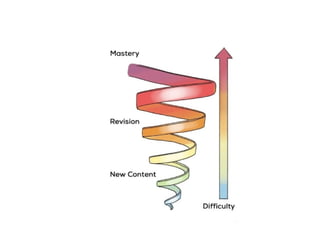
Spiral Curriculum…
• It is an educational approach where
students revisit topics multiple times
throughout their education
• Pros { cognitive development –gradual}
• Cons { vast and time consuming }
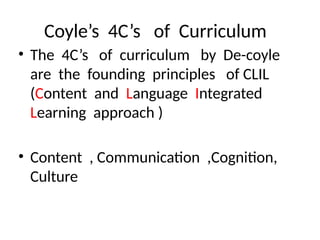
Coyle’s 4C’s of Curriculum
• The 4C’s of curriculum by De-coyle
are the founding principles of CLIL
(Content and Language Integrated
Learning approach )
• Content , Communication ,Cognition,
Culture
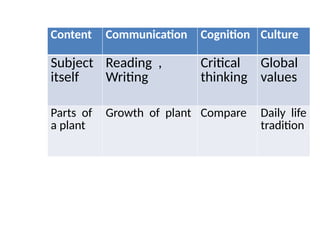
Content Communication Cognition Culture
Subject
itself
Reading ,
Writing
Critical
thinking
Global
values
Parts of
a plant
Growth of plant Compare Daily life
tradition
MODELS   OF    CURRICULUM  INTEGRATION.pptx

MODELS OF CURRICULUM INTEGRATION.pptx

  • 1.
  • 2.
    Introduction…… • “Models ofCurriculum Integration” means different methods or approaches used to combine subjects and learning experiences into a connected and meaningful curriculum …. • They promote holistic education…
  • 3.
    Models • Multidisciplinary Integration •Interdisciplinary Integration • Transdisciplinary Integration • Spiral Integration
  • 4.
    Multidisciplinary Integration • Studentslearn concepts and skills separately in various subjects and take the best one to apply in another one… • Example : Apply the models of physics to solve the economical problem ,but the subjects will remain isolated…
  • 5.
    Interdisciplinary Integration • Inthis , students integrating the knowledge from different subjects to produce one single product or reach one goal.. • Example : For the construction of drone , it requires the knowledge of mechanical and software engineering…
  • 6.
    Transdisciplinary Integration • Itbrings the multidisciplinary knowledge together to solve the bigger problems in the society • Example : students uses the drone as a real life tool to connect learning with society by applying knowledge from many fields…
  • 7.
    Multidisciplinary integration Interdisciplinary integration Transdisciplinary integration Subjects taught separately forone theme Subjects Combined to solve a problem Learning goes beyond subjects to solve real life problems Freedom to choose Content knowledge and skills are interconnected Relevance to real life Mastering many subjects is impossible Difficulties in connecting subjects Institutional barriers
  • 8.
    Spiral Curriculum… • Itis an educational approach where students revisit topics multiple times throughout their education • Pros { cognitive development –gradual} • Cons { vast and time consuming }
  • 10.
    Coyle’s 4C’s ofCurriculum • The 4C’s of curriculum by De-coyle are the founding principles of CLIL (Content and Language Integrated Learning approach ) • Content , Communication ,Cognition, Culture
  • 11.
    Content Communication CognitionCulture Subject itself Reading , Writing Critical thinking Global values Parts of a plant Growth of plant Compare Daily life tradition