Modeling Resilience in GEM
Kate Stillwell, GEM Foundation
acknowledgements to Christopher Burton, GEM Foundation
EERI National Meeting, Seattle
February 2013
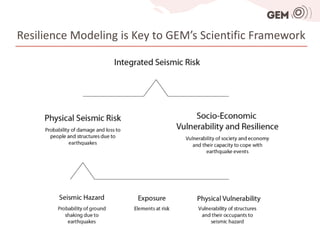
Resilience Modeling is Key to GEM’s Scientific Framework
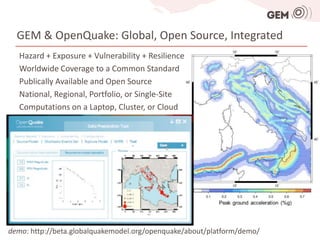
GEM & OpenQuake: Global, Open Source, Integrated
   Hazard + Exposure + Vulnerability + Resilience
   Worldwide Coverage to a Common Standard
   Publically Available and Open Source
   National, Regional, Portfolio, or Single-Site
   Computations on a Laptop, Cluster, or Cloud


demo: http://beta.globalquakemodel.org/openquake/about/platform/demo/
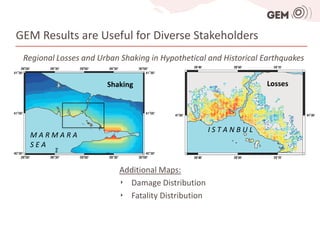
GEM Results are Useful for Diverse Stakeholders
 Regional Losses and Urban Shaking in Hypothetical and Historical Earthquakes

                       Shaking                                    Losses


                                                     ISTANBUL
  MARMARA
  SEA


                           Additional Maps:
                           ‣ Damage Distribution
                           ‣ Fatality Distribution
Working Together to Assess [Seismic] Risk

                                                        Capabilities & Results
Global Components                   GEM Secretariat            PSHA
                                                               Loss Exceedence Curves
                                                               Event Losses
        Collaborating                                          Damage Maps
        Scientists                                             Fatality Estimates
                                                               Retrofit Cost-Benefit
Historical Catalog                  OpenQuake                  Hazard Curves & Spectra
Instrumental Catalog
Fault Database
Strain Rates
Attenuation Relations
Taxonomy
Vulnerability                                         Regional Workshops
Global Exposure
Consequences Database
Inventory Data Capture Tools
Social Vulnerability & Resilience
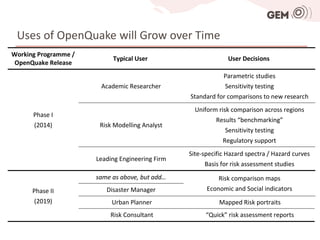
Uses of OpenQuake will Grow over Time
Working Programme /
                           Typical User                        User Decisions
 OpenQuake Release
                                                            Parametric studies
                       Academic Researcher                   Sensitivity testing
                                                 Standard for comparisons to new research
                                                   Uniform risk comparison across regions
      Phase I
                                                          Results “benchmarking”
      (2014)           Risk Modelling Analyst
                                                              Sensitivity testing
                                                             Regulatory support
                                                 Site-specific Hazard spectra / Hazard curves
                      Leading Engineering Firm
                                                       Basis for risk assessment studies
                      same as above, but add…              Risk comparison maps
      Phase II           Disaster Manager              Economic and Social indicators
       (2019)              Urban Planner                   Mapped Risk portraits
                          Risk Consultant              “Quick” risk assessment reports
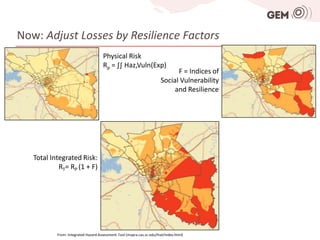
Now: Adjust Losses by Resilience Factors
                                     Physical Risk
                                     Rp = ∫∫ Haz,Vuln(Exp)
                                                                             F = Indices of
                                                                       Social Vulnerability
                                                                            and Resilience


   Total Integrated Risk:
            RT= RP (1 + F)


           From: Integrated Hazard Assessment Tool (mapra.cas.sc.edu/ihat/index.html)
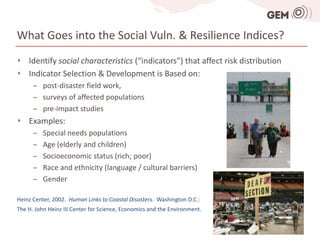
What Goes into the Social Vuln. & Resilience Indices?
‣ Identify social characteristics (“indicators”) that affect risk distribution
‣ Indicator Selection & Development is Based on:
      ‒ post-disaster field work,
      ‒ surveys of affected populations
      ‒ pre-impact studies
‣ Examples:
      ‒   Special needs populations
      ‒   Age (elderly and children)
      ‒   Socioeconomic status (rich; poor)
      ‒   Race and ethnicity (language / cultural barriers)
      ‒   Gender

Heinz Center, 2002. Human Links to Coastal Disasters. Washington D.C.:
The H. John Heinz III Center for Science, Economics and the Environment.
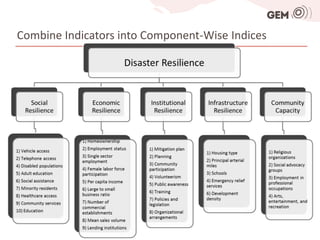
Combine Indicators into Component-Wise Indices
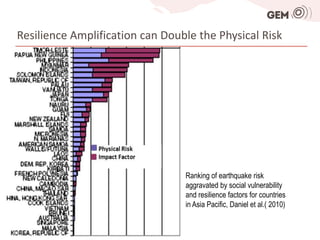
Resilience Amplification can Double the Physical Risk


                                 Ranking of earthquake risk
                                 aggravated by social vulnerability
                                 and resilience factors for countries
                                 in Asia Pacific, Daniel et al.( 2010)
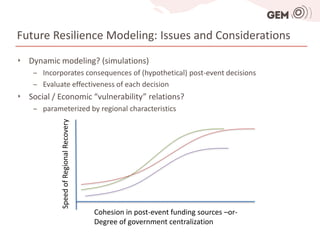
Future Resilience Modeling: Issues and Considerations
‣ Dynamic modeling? (simulations)
    ‒ Incorporates consequences of (hypothetical) post-event decisions
    ‒ Evaluate effectiveness of each decision
‣ Social / Economic “vulnerability” relations?
    ‒ parameterized by regional characteristics
            Speed of Regional Recovery


                                         Cohesion in post-event funding sources –or-
                                         Degree of government centralization
Modeling Resilience in GEM - Kate Stillwell

Modeling Resilience in GEM - Kate Stillwell

  • 1.
    Modeling Resilience inGEM Kate Stillwell, GEM Foundation acknowledgements to Christopher Burton, GEM Foundation EERI National Meeting, Seattle February 2013
  • 2.
    Resilience Modeling isKey to GEM’s Scientific Framework
  • 3.
    GEM & OpenQuake:Global, Open Source, Integrated Hazard + Exposure + Vulnerability + Resilience Worldwide Coverage to a Common Standard Publically Available and Open Source National, Regional, Portfolio, or Single-Site Computations on a Laptop, Cluster, or Cloud demo: http://beta.globalquakemodel.org/openquake/about/platform/demo/
  • 4.
    GEM Results areUseful for Diverse Stakeholders Regional Losses and Urban Shaking in Hypothetical and Historical Earthquakes Shaking Losses ISTANBUL MARMARA SEA Additional Maps: ‣ Damage Distribution ‣ Fatality Distribution
  • 5.
    Working Together toAssess [Seismic] Risk Capabilities & Results Global Components GEM Secretariat PSHA Loss Exceedence Curves Event Losses Collaborating Damage Maps Scientists Fatality Estimates Retrofit Cost-Benefit Historical Catalog OpenQuake Hazard Curves & Spectra Instrumental Catalog Fault Database Strain Rates Attenuation Relations Taxonomy Vulnerability Regional Workshops Global Exposure Consequences Database Inventory Data Capture Tools Social Vulnerability & Resilience
  • 6.
    Uses of OpenQuakewill Grow over Time Working Programme / Typical User User Decisions OpenQuake Release Parametric studies Academic Researcher Sensitivity testing Standard for comparisons to new research Uniform risk comparison across regions Phase I Results “benchmarking” (2014) Risk Modelling Analyst Sensitivity testing Regulatory support Site-specific Hazard spectra / Hazard curves Leading Engineering Firm Basis for risk assessment studies same as above, but add… Risk comparison maps Phase II Disaster Manager Economic and Social indicators (2019) Urban Planner Mapped Risk portraits Risk Consultant “Quick” risk assessment reports
  • 7.
    Now: Adjust Lossesby Resilience Factors Physical Risk Rp = ∫∫ Haz,Vuln(Exp) F = Indices of Social Vulnerability and Resilience Total Integrated Risk: RT= RP (1 + F) From: Integrated Hazard Assessment Tool (mapra.cas.sc.edu/ihat/index.html)
  • 8.
    What Goes intothe Social Vuln. & Resilience Indices? ‣ Identify social characteristics (“indicators”) that affect risk distribution ‣ Indicator Selection & Development is Based on: ‒ post-disaster field work, ‒ surveys of affected populations ‒ pre-impact studies ‣ Examples: ‒ Special needs populations ‒ Age (elderly and children) ‒ Socioeconomic status (rich; poor) ‒ Race and ethnicity (language / cultural barriers) ‒ Gender Heinz Center, 2002. Human Links to Coastal Disasters. Washington D.C.: The H. John Heinz III Center for Science, Economics and the Environment.
  • 9.
    Combine Indicators intoComponent-Wise Indices
  • 10.
    Resilience Amplification canDouble the Physical Risk Ranking of earthquake risk aggravated by social vulnerability and resilience factors for countries in Asia Pacific, Daniel et al.( 2010)
  • 11.
    Future Resilience Modeling:Issues and Considerations ‣ Dynamic modeling? (simulations) ‒ Incorporates consequences of (hypothetical) post-event decisions ‒ Evaluate effectiveness of each decision ‣ Social / Economic “vulnerability” relations? ‒ parameterized by regional characteristics Speed of Regional Recovery Cohesion in post-event funding sources –or- Degree of government centralization

Editor's Notes

  • #6 Abrief word on process: How does GEM get there? As mentioned in the first slide, GEM’s core elements are is data, software, and community.We start with the global components, which are the datasets and models used as the default science in the GEM model. These are developed through projects conducted by consortia of scientists from leading institutions worldwide, and the deliverables represent scientific consensus. Examples of deliverables from the Global Components will be shown in the next few slides but as an example - one of these projects is a unified and consistent earthquake catalog, and another is a set of vulnerability relations - hundreds, both empirical and analytical, applicable around the world, together detailed standards to construct customized analytical vulnerability relations.The staff at the GEM Secretariat and Model Facility develop the GEM OpenQuake software – the engine, the interface, and the testing that goes along with it. The Model Facility also takes care of the challenge to integrate each dataset with the others and into the OpenQuake platform. And they implement the OpenQuake capabilities we saw in the previous slides – making sure the results that GEM produces are consistent with the needs of users and beneficiaries.Guiding these efforts are the Scientific Board, which provides input and scientific credibility particularly to the Global Components but also to OpenQuake development. The Governing Board provides formal governance of GEM organization and allocation of resources. The people who make GEM a reality day-to-day are Secretary General Rui Pinho and the executive team consisting of Helen Crowley, risk, Marco Pagani, hazard, Paul Henshaw, OpenQuake, and Christopher Burton, social vulnerability, along with Nicole Keller, international relations and communications.GEM is already being disseminated and contributing to scientific capacity-building and technology transfer worldwide, in the context of regional workshops. Groups of scientists convene to learn GEM, adapt it to their region and their level of knowledge, develop hazard or risk maps and metrics, and contribute back their own knowledge and data. Here are photos from a Southeast Asia working group in Sept 2011 and a workshop in Cape Town, South Africa from June 2012.