© 2011 ANSYS, Inc. August 27, 20141 Release 14.0
14. 0 Release
ANSYS Mechanical
Experimental Elastomers
Modeling Plastics in ANSYS
© 2011 ANSYS, Inc. August 27, 20142 Release 14.0
Introduction
The large strain nonlinear stress-strain behavior of thermoplastic exhibits
the following:
• Strong hysteresis
• Rate dependence
• Softening after yielding
• Brittle failure at low temperatures and ductile behavior at higher
temperature
Thermoplastics usually show different material behavior under different
loading and environmental conditions. Thus usually one single material
model could not be used to predict plastic nature. Following slides will
discuss the thermoplastic behavior under different conditions and ANSYS
material models which could be used to model such behavior.
© 2011 ANSYS, Inc. August 27, 20143
Uniaxial behavior of thermoplastics
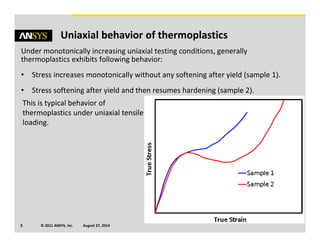
Under monotonically increasing uniaxial testing conditions, generally
thermoplastics exhibits following behavior:
• Stress increases monotonically without any softening after yield (sample 1).
• Stress softening after yield and then resumes hardening (sample 2).
This is typical behavior of
thermoplastics under uniaxial tensile
loading.
© 2011 ANSYS, Inc. August 27, 20144
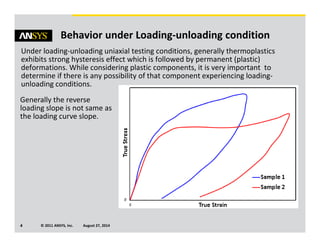
Behavior under Loading-unloading condition
Under loading-unloading uniaxial testing conditions, generally thermoplastics
exhibits strong hysteresis effect which is followed by permanent (plastic)
deformations. While considering plastic components, it is very important to
determine if there is any possibility of that component experiencing loading-
unloading conditions.
Generally the reverse
loading slope is not same as
the loading curve slope.
© 2011 ANSYS, Inc. August 27, 20145
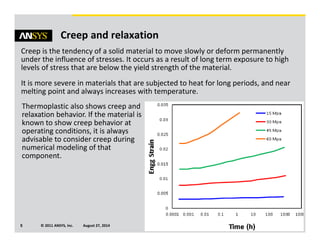
Creep and relaxation
Creep is the tendency of a solid material to move slowly or deform permanently
under the influence of stresses. It occurs as a result of long term exposure to high
levels of stress that are below the yield strength of the material.
It is more severe in materials that are subjected to heat for long periods, and near
melting point and always increases with temperature.
Thermoplastic also shows creep and
relaxation behavior. If the material is
known to show creep behavior at
operating conditions, it is always
advisable to consider creep during
numerical modeling of that
component.
© 2011 ANSYS, Inc. August 27, 20146
Available ANSYS Material Models
ANSYS offers range of material models which could be used to model different
thermoplastic behavior under different conditions. Choice of material model
dependents on:
1) Experimental data available
2) Operating conditions
Different models which could be used are:
• Small deformation plasticity (Elasto-plastic)
• Pressure dependent plasticity models (Drucker Prager/ Extendend Drucker
Prager)
• Large deformation elasticity models (Hyperelastic)
• Bergstrom Boyce Model
• Rate dependent plasticity models (Viscoplastic)
• Viscoelastic
• Creep
© 2011 ANSYS, Inc. August 27, 20147
Choosing right model
© 2011 ANSYS, Inc. August 27, 20148
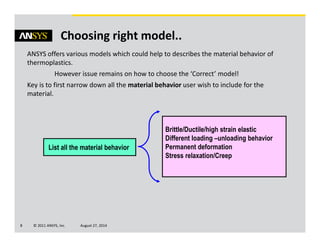
Choosing right model..
ANSYS offers various models which could help to describes the material behavior of
thermoplastics.
However issue remains on how to choose the ‘Correct’ model!
Key is to first narrow down all the material behavior user wish to include for the
material.
List all the material behavior
Brittle/Ductile/high strain elastic
Different loading –unloading behavior
Permanent deformation
Stress relaxation/Creep
© 2011 ANSYS, Inc. August 27, 20149
Choosing right model..
ANSYS offers various models which could help to describes the material behavior of
thermoplastics.
However issue remains on how to choose the ‘Correct’ model!
Second step is to list all the loading conditions for which the structural component needs
to be designed.
Cyclic/non-cyclic loading
Loading rate
Temperature loading
List all the loading condition
© 2011 ANSYS, Inc. August 27, 201410
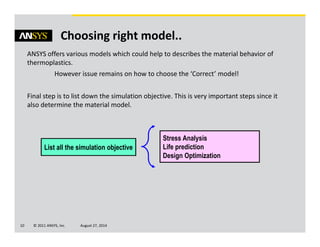
Choosing right model..
ANSYS offers various models which could help to describes the material behavior of
thermoplastics.
However issue remains on how to choose the ‘Correct’ model!
Final step is to list down the simulation objective. This is very important steps since it
also determine the material model.
Stress Analysis
Life prediction
Design Optimization
List all the simulation objective
© 2011 ANSYS, Inc. August 27, 201411
Choosing right model..
As mentioned earlier there is no single ‘Material Model’ which could model all the
behavior described in the last slides. Thus it is advisable to gather all experimental
data and list all the operating conditions and choose material model. Let consider
few scenarios:
.
© 2011 ANSYS, Inc. August 27, 201412
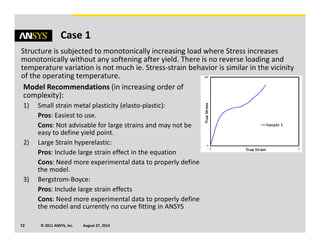
Case 1
Structure is subjected to monotonically increasing load where Stress increases
monotonically without any softening after yield. There is no reverse loading and
temperature variation is not much ie. Stress-strain behavior is similar in the vicinity
of the operating temperature.
Model Recommendations (in increasing order of
complexity):
1) Small strain metal plasticity (elasto-plastic):
Pros: Easiest to use.
Cons: Not advisable for large strains and may not be
easy to define yield point.
2) Large Strain hyperelastic:
Pros: Include large strain effect in the equation
Cons: Need more experimental data to properly define
the model.
3) Bergstrom-Boyce:
Pros: Include large strain effects
Cons: Need more experimental data to properly define
the model and currently no curve fitting in ANSYS
© 2011 ANSYS, Inc. August 27, 201413
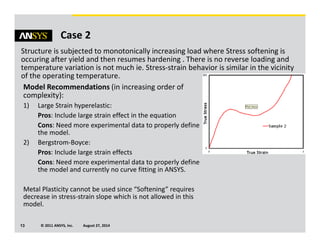
Case 2
Structure is subjected to monotonically increasing load where Stress softening is
occuring after yield and then resumes hardening . There is no reverse loading and
temperature variation is not much ie. Stress-strain behavior is similar in the vicinity
of the operating temperature.
Model Recommendations (in increasing order of
complexity):
1) Large Strain hyperelastic:
Pros: Include large strain effect in the equation
Cons: Need more experimental data to properly define
the model.
2) Bergstrom-Boyce:
Pros: Include large strain effects
Cons: Need more experimental data to properly define
the model and currently no curve fitting in ANSYS.
Metal Plasticity cannot be used since “Softening” requires
decrease in stress-strain slope which is not allowed in this
model.
© 2011 ANSYS, Inc. August 27, 201414
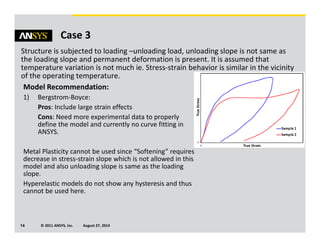
Case 3
Structure is subjected to loading –unloading load, unloading slope is not same as
the loading slope and permanent deformation is present. It is assumed that
temperature variation is not much ie. Stress-strain behavior is similar in the vicinity
of the operating temperature.
Model Recommendation:
1) Bergstrom-Boyce:
Pros: Include large strain effects
Cons: Need more experimental data to properly
define the model and currently no curve fitting in
ANSYS.
Metal Plasticity cannot be used since “Softening” requires
decrease in stress-strain slope which is not allowed in this
model and also unloading slope is same as the loading
slope.
Hyperelastic models do not show any hysteresis and thus
cannot be used here.

Modeling plastics in ANSYS

  • 1.
    © 2011 ANSYS,Inc. August 27, 20141 Release 14.0 14. 0 Release ANSYS Mechanical Experimental Elastomers Modeling Plastics in ANSYS
  • 2.
    © 2011 ANSYS,Inc. August 27, 20142 Release 14.0 Introduction The large strain nonlinear stress-strain behavior of thermoplastic exhibits the following: • Strong hysteresis • Rate dependence • Softening after yielding • Brittle failure at low temperatures and ductile behavior at higher temperature Thermoplastics usually show different material behavior under different loading and environmental conditions. Thus usually one single material model could not be used to predict plastic nature. Following slides will discuss the thermoplastic behavior under different conditions and ANSYS material models which could be used to model such behavior.
  • 3.
    © 2011 ANSYS,Inc. August 27, 20143 Uniaxial behavior of thermoplastics Under monotonically increasing uniaxial testing conditions, generally thermoplastics exhibits following behavior: • Stress increases monotonically without any softening after yield (sample 1). • Stress softening after yield and then resumes hardening (sample 2). This is typical behavior of thermoplastics under uniaxial tensile loading.
  • 4.
    © 2011 ANSYS,Inc. August 27, 20144 Behavior under Loading-unloading condition Under loading-unloading uniaxial testing conditions, generally thermoplastics exhibits strong hysteresis effect which is followed by permanent (plastic) deformations. While considering plastic components, it is very important to determine if there is any possibility of that component experiencing loading- unloading conditions. Generally the reverse loading slope is not same as the loading curve slope.
  • 5.
    © 2011 ANSYS,Inc. August 27, 20145 Creep and relaxation Creep is the tendency of a solid material to move slowly or deform permanently under the influence of stresses. It occurs as a result of long term exposure to high levels of stress that are below the yield strength of the material. It is more severe in materials that are subjected to heat for long periods, and near melting point and always increases with temperature. Thermoplastic also shows creep and relaxation behavior. If the material is known to show creep behavior at operating conditions, it is always advisable to consider creep during numerical modeling of that component.
  • 6.
    © 2011 ANSYS,Inc. August 27, 20146 Available ANSYS Material Models ANSYS offers range of material models which could be used to model different thermoplastic behavior under different conditions. Choice of material model dependents on: 1) Experimental data available 2) Operating conditions Different models which could be used are: • Small deformation plasticity (Elasto-plastic) • Pressure dependent plasticity models (Drucker Prager/ Extendend Drucker Prager) • Large deformation elasticity models (Hyperelastic) • Bergstrom Boyce Model • Rate dependent plasticity models (Viscoplastic) • Viscoelastic • Creep
  • 7.
    © 2011 ANSYS,Inc. August 27, 20147 Choosing right model
  • 8.
    © 2011 ANSYS,Inc. August 27, 20148 Choosing right model.. ANSYS offers various models which could help to describes the material behavior of thermoplastics. However issue remains on how to choose the ‘Correct’ model! Key is to first narrow down all the material behavior user wish to include for the material. List all the material behavior Brittle/Ductile/high strain elastic Different loading –unloading behavior Permanent deformation Stress relaxation/Creep
  • 9.
    © 2011 ANSYS,Inc. August 27, 20149 Choosing right model.. ANSYS offers various models which could help to describes the material behavior of thermoplastics. However issue remains on how to choose the ‘Correct’ model! Second step is to list all the loading conditions for which the structural component needs to be designed. Cyclic/non-cyclic loading Loading rate Temperature loading List all the loading condition
  • 10.
    © 2011 ANSYS,Inc. August 27, 201410 Choosing right model.. ANSYS offers various models which could help to describes the material behavior of thermoplastics. However issue remains on how to choose the ‘Correct’ model! Final step is to list down the simulation objective. This is very important steps since it also determine the material model. Stress Analysis Life prediction Design Optimization List all the simulation objective
  • 11.
    © 2011 ANSYS,Inc. August 27, 201411 Choosing right model.. As mentioned earlier there is no single ‘Material Model’ which could model all the behavior described in the last slides. Thus it is advisable to gather all experimental data and list all the operating conditions and choose material model. Let consider few scenarios: .
  • 12.
    © 2011 ANSYS,Inc. August 27, 201412 Case 1 Structure is subjected to monotonically increasing load where Stress increases monotonically without any softening after yield. There is no reverse loading and temperature variation is not much ie. Stress-strain behavior is similar in the vicinity of the operating temperature. Model Recommendations (in increasing order of complexity): 1) Small strain metal plasticity (elasto-plastic): Pros: Easiest to use. Cons: Not advisable for large strains and may not be easy to define yield point. 2) Large Strain hyperelastic: Pros: Include large strain effect in the equation Cons: Need more experimental data to properly define the model. 3) Bergstrom-Boyce: Pros: Include large strain effects Cons: Need more experimental data to properly define the model and currently no curve fitting in ANSYS
  • 13.
    © 2011 ANSYS,Inc. August 27, 201413 Case 2 Structure is subjected to monotonically increasing load where Stress softening is occuring after yield and then resumes hardening . There is no reverse loading and temperature variation is not much ie. Stress-strain behavior is similar in the vicinity of the operating temperature. Model Recommendations (in increasing order of complexity): 1) Large Strain hyperelastic: Pros: Include large strain effect in the equation Cons: Need more experimental data to properly define the model. 2) Bergstrom-Boyce: Pros: Include large strain effects Cons: Need more experimental data to properly define the model and currently no curve fitting in ANSYS. Metal Plasticity cannot be used since “Softening” requires decrease in stress-strain slope which is not allowed in this model.
  • 14.
    © 2011 ANSYS,Inc. August 27, 201414 Case 3 Structure is subjected to loading –unloading load, unloading slope is not same as the loading slope and permanent deformation is present. It is assumed that temperature variation is not much ie. Stress-strain behavior is similar in the vicinity of the operating temperature. Model Recommendation: 1) Bergstrom-Boyce: Pros: Include large strain effects Cons: Need more experimental data to properly define the model and currently no curve fitting in ANSYS. Metal Plasticity cannot be used since “Softening” requires decrease in stress-strain slope which is not allowed in this model and also unloading slope is same as the loading slope. Hyperelastic models do not show any hysteresis and thus cannot be used here.