PROSEDUR/MODEL DALAM PENELITIAN
PENGEMBANGAN
DEFINE—DESIGN-DEVELOP-DISSEMINATE
(4D)
BYTHIAGARAJAN ET AL., 1974
ANTUNI WIYARSI
FMIPA UNY
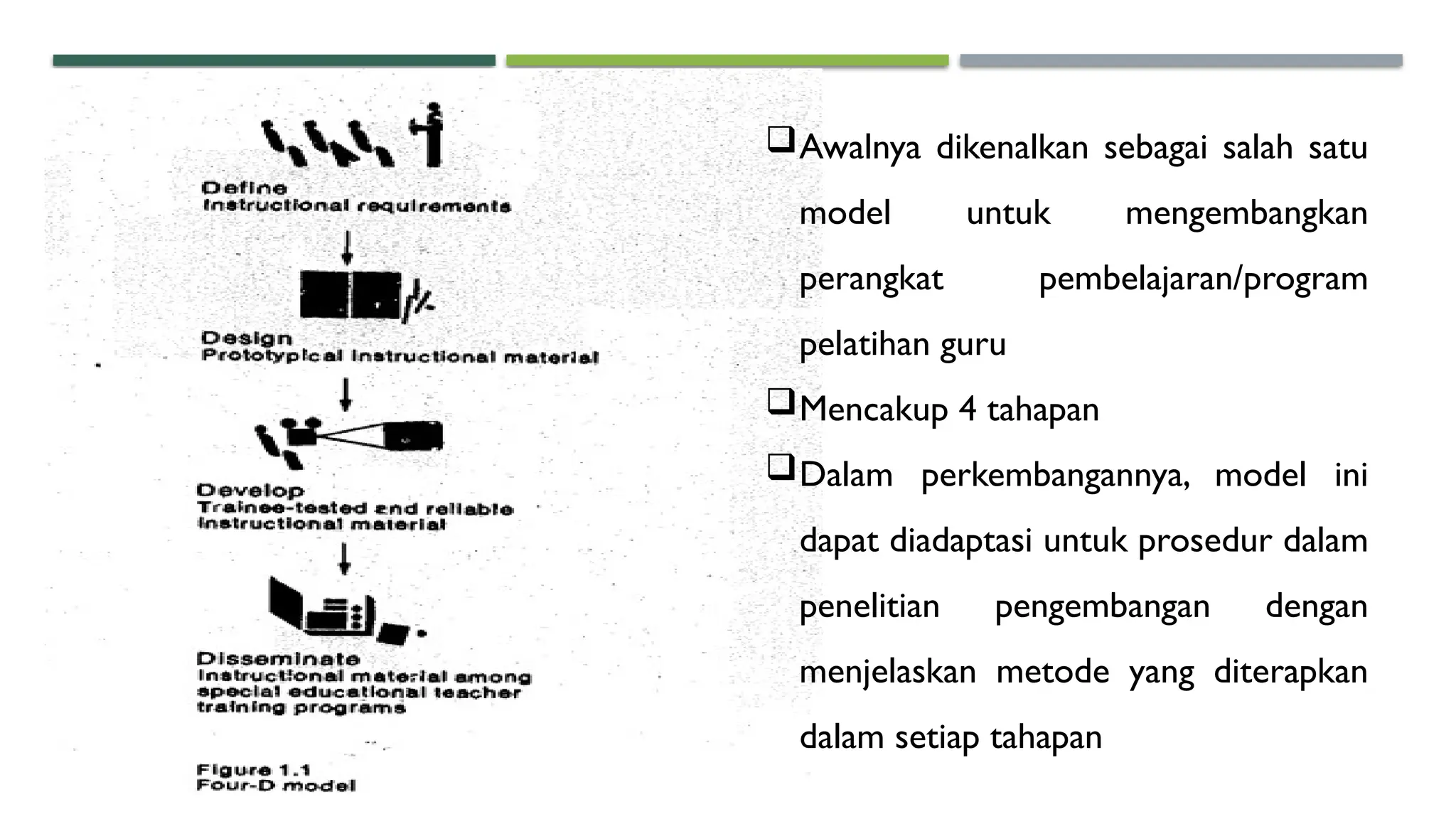
Awalnya dikenalkan sebagai salah satu
model untuk mengembangkan
perangkat pembelajaran/program
pelatihan guru
Mencakup 4 tahapan
Dalam perkembangannya, model ini
dapat diadaptasi untuk prosedur dalam
penelitian pengembangan dengan
menjelaskan metode yang diterapkan
dalam setiap tahapan
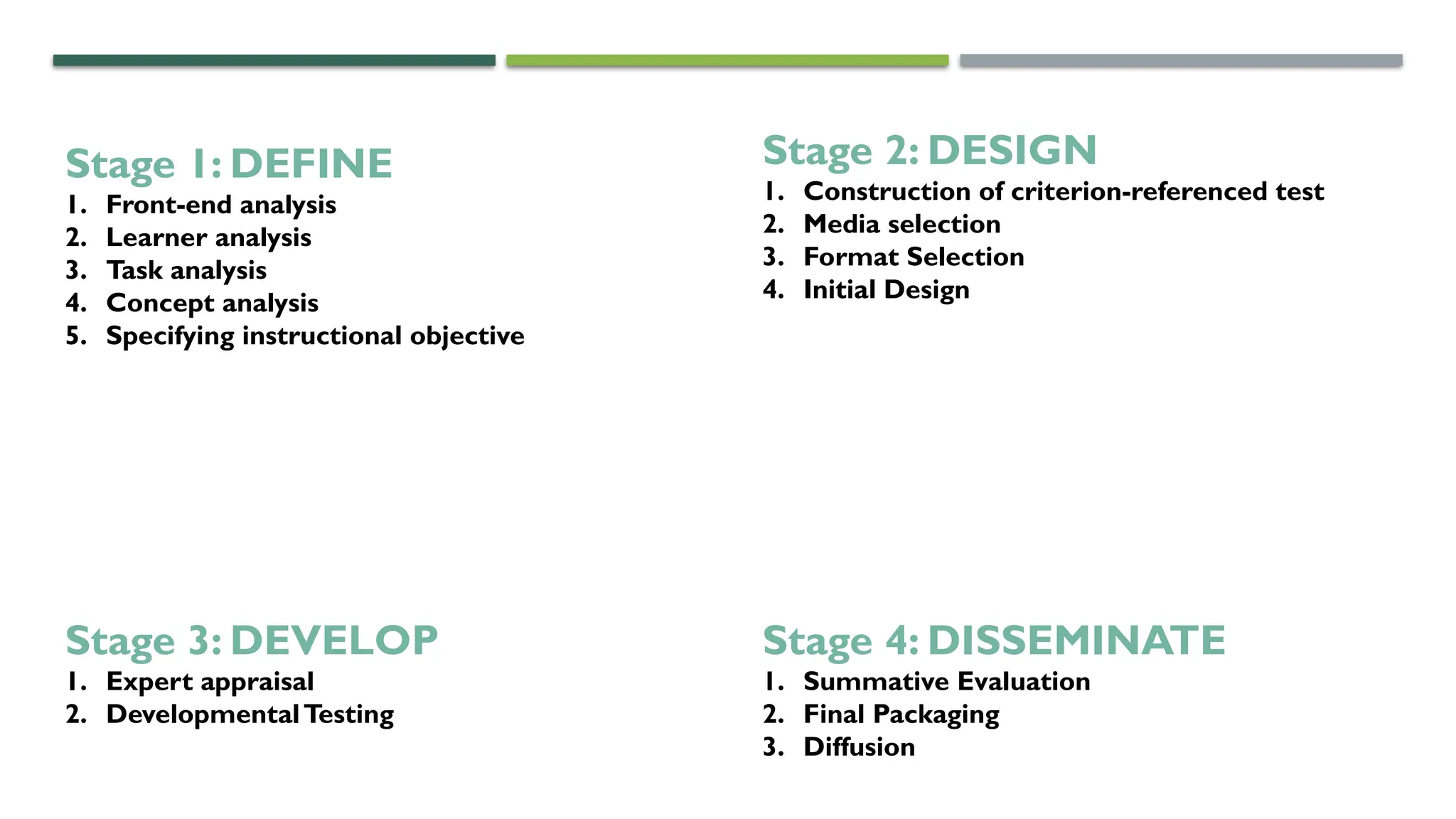
Stage 1: DEFINE
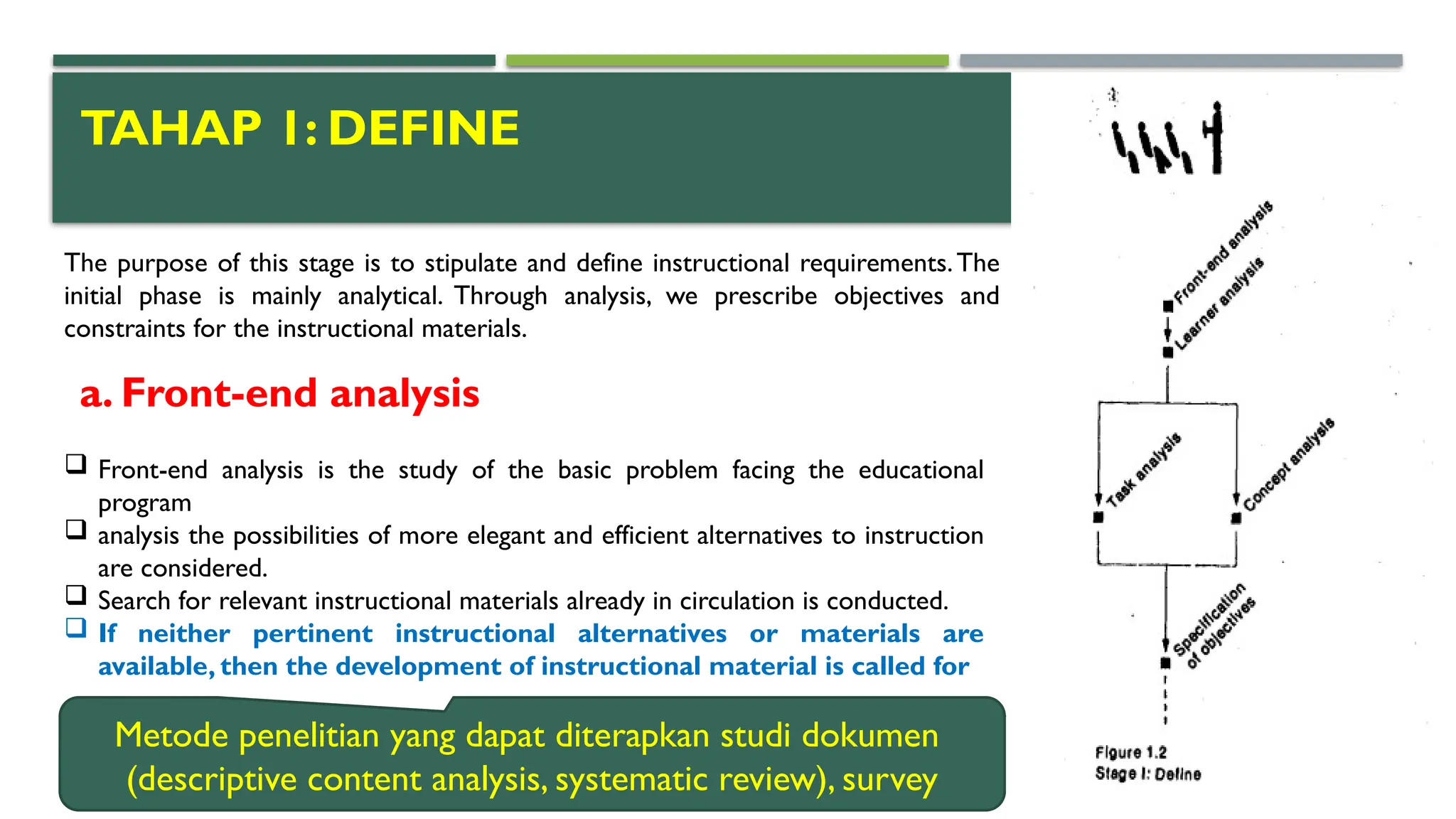
1. Front-end analysis
2. Learner analysis
3. Task analysis
4. Concept analysis
5. Specifying instructional objective
Stage 2: DESIGN
1. Construction of criterion-referenced test
2. Media selection
3. Format Selection
4. Initial Design
Stage 3: DEVELOP
1. Expert appraisal
2. DevelopmentalTesting
Stage 4: DISSEMINATE
1. Summative Evaluation
2. Final Packaging
3. Diffusion
TAHAP 1: DEFINE
The purpose of this stage is to stipulate and define instructional requirements.The
initial phase is mainly analytical. Through analysis, we prescribe objectives and
constraints for the instructional materials.
 Front-end analysis is the study of the basic problem facing the educational
program
 analysis the possibilities of more elegant and efficient alternatives to instruction
are considered.
 Search for relevant instructional materials already in circulation is conducted.
 If neither pertinent instructional alternatives or materials are
available, then the development of instructional material is called for
a. Front-end analysis
Metode penelitian yang dapat diterapkan studi dokumen
(descriptive content analysis, systematic review), survey
 Learner analysis is the study of the students target.
 Student characteristics relevant to the design and development of instruction are identified.
 The characteristics are entering competencies and background experiences; general attitude toward the
instructional topic; and media, format, and language preferences
b. Learner Analysis
Metode penelitian yang dapat diterapkan studi dokumen
descriptive content analysis
c.Task Analysis
 Task analysis is the identifying of the main skill to be acquired by students and analyzing it into a set of necessary
and sufficient sub-skills.
 This analysis ensures comprehensive coverage of the task in the instructional material
Sebagai contoh, ketika mengembangkan LKPD berbasis inkuiri, maka peneliti harus mengidentifikasi
keterampilan apa yang diharapkan dengan penggunaan LKPD tersebut  misal untuk mengembangkan
keterampilan berpikir kritis, maka harus diidentifikasi sub (aspek) keterampilannya  dasar
pengembangan instrumen untuk uji efektivitas  selanjutnya identifikasi rancangan awal aktivitas pada
bagian LKPD mana setiap sub/aspek keterampilan itu dikembangkan.
d. Concept Analysis
 Concept analysts is the identifying of the major concepts to be taught, arranging them in hierarchies, and
breaking down individual concepts into critical and irrelevant attributes.
 This analysis helps to identify a rational set of examples and non-examples to be portrayed in protocol
development.
Menganalisis materi kimia untuk
pengembangan LKPD berbasis inkuiri,
dari KD diturunkan ruang lingkupnya,
break down submateri, lalu ditelaah
jadi berapa seri LKPD dst
e. Specifying instructional objectives
 Specifying instructional objectives is the converting of the results of task and concept analyses into
behaviorally stated objectives.
 This set of objectives provides the basis for test construction and instructional design
 Later. it is integrated into the instructional materials for use by teacher and students
Menentukan IPK dan tujuan pembelajaran berdasarkan hasil tahap c (keterampilan
berpikir kritis) dan d (KD). Ini digunakan sebagai dasar penyusunan RPP dan LKPD
Metode penelitian yang dapat
diterapkan studi dokumen descriptive
content analysis
TAHAP II: DESIGN
The purpose of this stage is to design prototype instructional material
 Constituting criterion-referenced tests is the step bridging Stage 1, Define, and the Design
process.
 Criterion-referenced tests convert behavioral objectives into an outline for the instructional
material.
a. Criterion-referenced tests
b. Media Selection
 Media selection is the selection of appropriate media for the presentation of the, instructional
content.
 This process involves matching the task and concept analyses, target-students characteristics,
production resources, and dissemination plans with various attributes of different media.
Contoh. Menyusun tes keterampilan berpikir kritis
Contoh. Menentukan jenis LKS
 Initial design is the presenting of the essential instruction through appropriate media and in a suitable
sequence.
 It also Involves structuring various learning activities such as reading a text, interviewing special education
personnel, and practicing different instructional skills by teaching peers/peer review
 Format selection is closely related to media selection.
 The selection of the most appropriate format depends upon a number of factor,' which are discussed.
c. Format Selection Selection
d. Initial Design
Contoh. Menentukan format LKS yang menunjukkan tahapan inkuiri dan
memfasilitasi keterampilan berpikir kritis
Contoh. Menentukan layout awal, point2 penting isi dari LKS
TAHAP III: DEVELOP
a. Expert appraisal
 Expert appraisal is one stage of formative evaluation. It is the process of obtaining editorial
feed back front various professionals for the improvement of the instructional materials.
 Based upon this feedback the material is modified to improve its appropriateness,
effectiveness, usability, and technical quality.
 Furthermore, from a dissemination point of view, expert opinion is most important since,
for better or worse, the decision to adopt the material is frequently based upon it.
 Use a wide variety of specialists
from scholarly and technical areas.A
professional jury should include
special educators, subject-matter
experts, language editors, and media
production experts
 Restrict each expert to his own field
 Present only relevant parts of the
instructional material for evaluation
by each expert
 Specify the purpose of the review by
each expert by defining the context
in which the material is to be used
and by providing him with a
checklist or questionnaires (open-
ended or closed)
Guidelines for conducting expert appraisals
 Developmental testing involves the trying out of instructional materials on members of the target-
students group. The purpose of the testing is to collect feedback to make the materials
instructionally and motivationally more effective.
 Data from student testing remain the most valid predictors of potential problem & challenges
 Three phases of developmental testing
b. DevelopmentalTesting
Contoh penelitian pengembangan bahan ajar untuk pelatihan guru, maka subjek untuk
uji efektivitas adalah guru sebagai sasaran
Metode:
explorative
survey
Metode:
instrumental case
study
Metode: pre-
eksperimen
TAHAP IV: DISSEMINATE
 The purpose of the summative evaluation differs from that of the formative evaluation in that its goal is
to describe the effects of the instructional material rather than to improve its effectiveness.
 In summative evaluation, a representative group of target trainees works through the material under
specified condition Data are collected on the characteristics of the trainees; the changes in their skills,
knowledge, and attitudes; the context In which the material is used and the time requirements.
 There are three phases of validation testing/summative evaluation
 In addition, summative evaluation also involves professional jurying, that is, a panel of experts critically
appraising the material and providing opinions on its content, strategies, and production)
a. Summative Evaluation
Three phases of validation testing (Uji Efektivitas)
1. Internal validation.This phase identifies the extent to which the
instructional material electively teaches what it is supposed to teach. It tests
the trainee by criterion-referenced test immediately after instruction to check
the attainment of the instructional objectives
2. Transfer validation. Transfer validation measures the extent to which a
teacher's real-world performance is affected by the skill or knowledge he has
acquired from the instructional material. Self-reports from trainees as part of
their regular record-keeping responsibilities, and observation coding systems
used by supervising teachers or peers, enable the collection of valid data
unobtrusively.
3. Payoff validation. The ultimate criterion for effective teacher
training is facilitation of exceptional children's learning.
Selection of evaluation design
Pre-post one group design
Pre-post control group design
Posttest only control group design
Outcome measurement
Time series design
Single subject design
Input & Output measurement
4. Techniques for collecting expert opinions on the appropriateness and technical quality of instructional
materials use same procedure with teaching appraisal and may be use quantitative measurement by
professional jurying of the total package
 konsep penilaian kualitas produk oleh professional/ahli, selain validator
Process measurement
Professional Jurying
Diffusion is the process through which a new idea or product becomes
accepted and assimilated, that is, "adopted," by an individual, a group, or a
system
Practical packaging considerations that apply to small-stale-developer produced
packages as well as to commercially produced materials.
b. Final Packaging
c. Diffusion

MOdel penelitian pengembangan desain 4D.pptx

  • 1.
  • 2.
    Awalnya dikenalkan sebagaisalah satu model untuk mengembangkan perangkat pembelajaran/program pelatihan guru Mencakup 4 tahapan Dalam perkembangannya, model ini dapat diadaptasi untuk prosedur dalam penelitian pengembangan dengan menjelaskan metode yang diterapkan dalam setiap tahapan
  • 3.
    Stage 1: DEFINE 1.Front-end analysis 2. Learner analysis 3. Task analysis 4. Concept analysis 5. Specifying instructional objective Stage 2: DESIGN 1. Construction of criterion-referenced test 2. Media selection 3. Format Selection 4. Initial Design Stage 3: DEVELOP 1. Expert appraisal 2. DevelopmentalTesting Stage 4: DISSEMINATE 1. Summative Evaluation 2. Final Packaging 3. Diffusion
  • 4.
    TAHAP 1: DEFINE Thepurpose of this stage is to stipulate and define instructional requirements.The initial phase is mainly analytical. Through analysis, we prescribe objectives and constraints for the instructional materials.  Front-end analysis is the study of the basic problem facing the educational program  analysis the possibilities of more elegant and efficient alternatives to instruction are considered.  Search for relevant instructional materials already in circulation is conducted.  If neither pertinent instructional alternatives or materials are available, then the development of instructional material is called for a. Front-end analysis Metode penelitian yang dapat diterapkan studi dokumen (descriptive content analysis, systematic review), survey
  • 5.
     Learner analysisis the study of the students target.  Student characteristics relevant to the design and development of instruction are identified.  The characteristics are entering competencies and background experiences; general attitude toward the instructional topic; and media, format, and language preferences b. Learner Analysis Metode penelitian yang dapat diterapkan studi dokumen descriptive content analysis c.Task Analysis  Task analysis is the identifying of the main skill to be acquired by students and analyzing it into a set of necessary and sufficient sub-skills.  This analysis ensures comprehensive coverage of the task in the instructional material Sebagai contoh, ketika mengembangkan LKPD berbasis inkuiri, maka peneliti harus mengidentifikasi keterampilan apa yang diharapkan dengan penggunaan LKPD tersebut  misal untuk mengembangkan keterampilan berpikir kritis, maka harus diidentifikasi sub (aspek) keterampilannya  dasar pengembangan instrumen untuk uji efektivitas  selanjutnya identifikasi rancangan awal aktivitas pada bagian LKPD mana setiap sub/aspek keterampilan itu dikembangkan.
  • 6.
    d. Concept Analysis Concept analysts is the identifying of the major concepts to be taught, arranging them in hierarchies, and breaking down individual concepts into critical and irrelevant attributes.  This analysis helps to identify a rational set of examples and non-examples to be portrayed in protocol development. Menganalisis materi kimia untuk pengembangan LKPD berbasis inkuiri, dari KD diturunkan ruang lingkupnya, break down submateri, lalu ditelaah jadi berapa seri LKPD dst e. Specifying instructional objectives  Specifying instructional objectives is the converting of the results of task and concept analyses into behaviorally stated objectives.  This set of objectives provides the basis for test construction and instructional design  Later. it is integrated into the instructional materials for use by teacher and students Menentukan IPK dan tujuan pembelajaran berdasarkan hasil tahap c (keterampilan berpikir kritis) dan d (KD). Ini digunakan sebagai dasar penyusunan RPP dan LKPD Metode penelitian yang dapat diterapkan studi dokumen descriptive content analysis
  • 7.
    TAHAP II: DESIGN Thepurpose of this stage is to design prototype instructional material  Constituting criterion-referenced tests is the step bridging Stage 1, Define, and the Design process.  Criterion-referenced tests convert behavioral objectives into an outline for the instructional material. a. Criterion-referenced tests b. Media Selection  Media selection is the selection of appropriate media for the presentation of the, instructional content.  This process involves matching the task and concept analyses, target-students characteristics, production resources, and dissemination plans with various attributes of different media. Contoh. Menyusun tes keterampilan berpikir kritis Contoh. Menentukan jenis LKS
  • 8.
     Initial designis the presenting of the essential instruction through appropriate media and in a suitable sequence.  It also Involves structuring various learning activities such as reading a text, interviewing special education personnel, and practicing different instructional skills by teaching peers/peer review  Format selection is closely related to media selection.  The selection of the most appropriate format depends upon a number of factor,' which are discussed. c. Format Selection Selection d. Initial Design Contoh. Menentukan format LKS yang menunjukkan tahapan inkuiri dan memfasilitasi keterampilan berpikir kritis Contoh. Menentukan layout awal, point2 penting isi dari LKS
  • 9.
    TAHAP III: DEVELOP a.Expert appraisal  Expert appraisal is one stage of formative evaluation. It is the process of obtaining editorial feed back front various professionals for the improvement of the instructional materials.  Based upon this feedback the material is modified to improve its appropriateness, effectiveness, usability, and technical quality.  Furthermore, from a dissemination point of view, expert opinion is most important since, for better or worse, the decision to adopt the material is frequently based upon it.
  • 10.
     Use awide variety of specialists from scholarly and technical areas.A professional jury should include special educators, subject-matter experts, language editors, and media production experts  Restrict each expert to his own field  Present only relevant parts of the instructional material for evaluation by each expert  Specify the purpose of the review by each expert by defining the context in which the material is to be used and by providing him with a checklist or questionnaires (open- ended or closed) Guidelines for conducting expert appraisals
  • 11.
     Developmental testinginvolves the trying out of instructional materials on members of the target- students group. The purpose of the testing is to collect feedback to make the materials instructionally and motivationally more effective.  Data from student testing remain the most valid predictors of potential problem & challenges  Three phases of developmental testing b. DevelopmentalTesting
  • 12.
    Contoh penelitian pengembanganbahan ajar untuk pelatihan guru, maka subjek untuk uji efektivitas adalah guru sebagai sasaran Metode: explorative survey Metode: instrumental case study Metode: pre- eksperimen
  • 13.
    TAHAP IV: DISSEMINATE The purpose of the summative evaluation differs from that of the formative evaluation in that its goal is to describe the effects of the instructional material rather than to improve its effectiveness.  In summative evaluation, a representative group of target trainees works through the material under specified condition Data are collected on the characteristics of the trainees; the changes in their skills, knowledge, and attitudes; the context In which the material is used and the time requirements.  There are three phases of validation testing/summative evaluation  In addition, summative evaluation also involves professional jurying, that is, a panel of experts critically appraising the material and providing opinions on its content, strategies, and production) a. Summative Evaluation
  • 14.
    Three phases ofvalidation testing (Uji Efektivitas) 1. Internal validation.This phase identifies the extent to which the instructional material electively teaches what it is supposed to teach. It tests the trainee by criterion-referenced test immediately after instruction to check the attainment of the instructional objectives 2. Transfer validation. Transfer validation measures the extent to which a teacher's real-world performance is affected by the skill or knowledge he has acquired from the instructional material. Self-reports from trainees as part of their regular record-keeping responsibilities, and observation coding systems used by supervising teachers or peers, enable the collection of valid data unobtrusively. 3. Payoff validation. The ultimate criterion for effective teacher training is facilitation of exceptional children's learning. Selection of evaluation design Pre-post one group design Pre-post control group design Posttest only control group design Outcome measurement Time series design Single subject design Input & Output measurement 4. Techniques for collecting expert opinions on the appropriateness and technical quality of instructional materials use same procedure with teaching appraisal and may be use quantitative measurement by professional jurying of the total package  konsep penilaian kualitas produk oleh professional/ahli, selain validator Process measurement Professional Jurying
  • 15.
    Diffusion is theprocess through which a new idea or product becomes accepted and assimilated, that is, "adopted," by an individual, a group, or a system Practical packaging considerations that apply to small-stale-developer produced packages as well as to commercially produced materials. b. Final Packaging c. Diffusion