MODEL OF CONSUMER BEHAVIOUR
ABHINAV CHANDRA
cabhinav602@gmail.com
9044582389
PRESENTATION OVERVIEW
The presentation describe various model of consumer behavior i.e the motivation factor
which influence the customer to buy a product.
various models of consumer behavior are explained:
Introduction
Economic model
Model of family decision making
Input output decision model
Psycological model
Howarth Sheth Model
INTRODUCTION
Consumer behaviour is the study of individuals, groups, or organizations
and all the activities associated with the purchase, use and disposal of
goods and services, including the consumer's emotional, mental and
behavioral responses that precede or follow these activities.
We have already seen that there are many factors which influence the
decision-making of consumers. There are various consumers models
which help in the understanding of consumer behaviour.
ECONOMIC MODEL
Model is Based on 3
imp factors-
Substitution effect
Price effect
Income effect
In this model, consumers follow the principle of
maximum utility based on the law of diminishing
marginal utility. The consumer wants to spend the
minimum amount for maximising his
gains.
This model, according to behavioral scientists, is not
complete as it assumes the homogeneity
of the market, similarity of buyer behaviour and
concentrates only on the product or
price. It ignores all the other aspects such as perception,
motivation, learning, attitudes, personality and socio-cultural
factors.
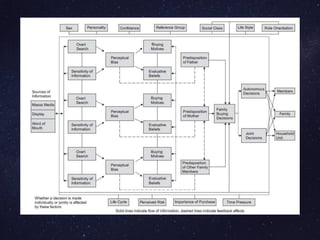
MODEL OF FAMILY DECISION-MAKING
In a family decision-making model, it is important to understand how the family
members
interact with each other in the context of their consumer decision-making. There are
different
consumption roles played by various members of the family.
(i) Influencers
(ii) (ii) Gate keepers
(iii) Deciders
(iv) Buyers
(v) Preparers
(vi) User
model over view are as followes :
WORKS CITED
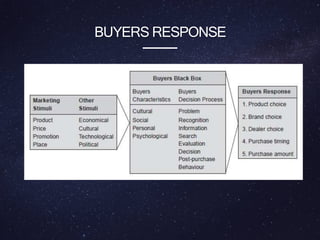
INPUT, PROCESS AND OUTPUT MODEL
 This is a simple model of consumer behaviour, in which the input for
the customer is the firm’s marketing effort (the product, price,
promotion and place) and the social environment. The social
environment consists of the family, reference groups, culture, social
class, etc. which influences the decision-making process. Both these
factors together constitute the input in the mind of the consumer
 Need recognition
 Product awareness
 Evaluation
 Intention
 Post-purchase behaviour
BUYERS RESPONSE
PSYCHOLOGICAL MODEL
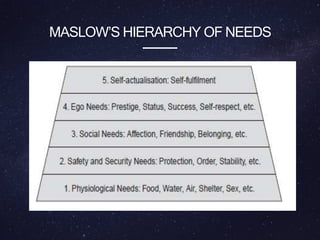
 Psychologists have been investigating the causes which lead to
purchases and decision making. This has been answered by A.H.
Maslow in his hierarchy of needs. The behaviour of an individual at a
particular time is determined by his strongest need at that time. This
also shows that needs have a priority. First they satisfy the basic needs
and then go on for secondary needs. The purchasing process and
behaviour is governed by motivational forces. Motivation stimulates
people into action. Motivation starts with the need. It is a driving force
and also a mental phenomenon. Need arises when one is deprived of
something. A tension is created in the mind of the individual which
leads him to a goal directed behaviour which satisfies the need. Once
a need is satisfied, a new need arises and the process is continuous.
MASLOW’S HIERARCHY OF NEEDS
HOWARTH -SHETH MODEL
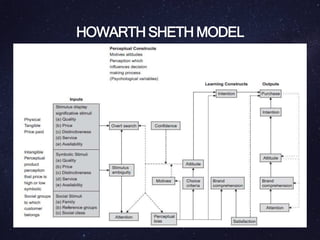
 concepts of learning, perception and attitudes influence consumer
behaviour. This model of decision-making is applicable to individuals.
It has four sets of variables which are:
 (i) Input
 (ii) Perceptual and learning constructs
 (iii) Outputs
 (iv) Exogenous or external variables.
HOWARTH SHETH MODEL
 All the models discussed in this ppt give us an idea of the buying
behavior in diverse situations. An understanding of these models gives
the marketer clues to formulate his strategies according to the target
audience, e.g., an individual, a family or an industry, etc
Model of consumer behaviour

Model of consumer behaviour

  • 1.
    MODEL OF CONSUMERBEHAVIOUR ABHINAV CHANDRA cabhinav602@gmail.com 9044582389
  • 2.
    PRESENTATION OVERVIEW The presentationdescribe various model of consumer behavior i.e the motivation factor which influence the customer to buy a product. various models of consumer behavior are explained: Introduction Economic model Model of family decision making Input output decision model Psycological model Howarth Sheth Model
  • 3.
    INTRODUCTION Consumer behaviour isthe study of individuals, groups, or organizations and all the activities associated with the purchase, use and disposal of goods and services, including the consumer's emotional, mental and behavioral responses that precede or follow these activities. We have already seen that there are many factors which influence the decision-making of consumers. There are various consumers models which help in the understanding of consumer behaviour.
  • 4.
    ECONOMIC MODEL Model isBased on 3 imp factors- Substitution effect Price effect Income effect In this model, consumers follow the principle of maximum utility based on the law of diminishing marginal utility. The consumer wants to spend the minimum amount for maximising his gains. This model, according to behavioral scientists, is not complete as it assumes the homogeneity of the market, similarity of buyer behaviour and concentrates only on the product or price. It ignores all the other aspects such as perception, motivation, learning, attitudes, personality and socio-cultural factors.
  • 5.
    MODEL OF FAMILYDECISION-MAKING In a family decision-making model, it is important to understand how the family members interact with each other in the context of their consumer decision-making. There are different consumption roles played by various members of the family. (i) Influencers (ii) (ii) Gate keepers (iii) Deciders (iv) Buyers (v) Preparers (vi) User model over view are as followes :
  • 6.
  • 7.
    INPUT, PROCESS ANDOUTPUT MODEL  This is a simple model of consumer behaviour, in which the input for the customer is the firm’s marketing effort (the product, price, promotion and place) and the social environment. The social environment consists of the family, reference groups, culture, social class, etc. which influences the decision-making process. Both these factors together constitute the input in the mind of the consumer  Need recognition  Product awareness  Evaluation  Intention  Post-purchase behaviour
  • 8.
  • 9.
    PSYCHOLOGICAL MODEL  Psychologistshave been investigating the causes which lead to purchases and decision making. This has been answered by A.H. Maslow in his hierarchy of needs. The behaviour of an individual at a particular time is determined by his strongest need at that time. This also shows that needs have a priority. First they satisfy the basic needs and then go on for secondary needs. The purchasing process and behaviour is governed by motivational forces. Motivation stimulates people into action. Motivation starts with the need. It is a driving force and also a mental phenomenon. Need arises when one is deprived of something. A tension is created in the mind of the individual which leads him to a goal directed behaviour which satisfies the need. Once a need is satisfied, a new need arises and the process is continuous.
  • 10.
  • 11.
    HOWARTH -SHETH MODEL concepts of learning, perception and attitudes influence consumer behaviour. This model of decision-making is applicable to individuals. It has four sets of variables which are:  (i) Input  (ii) Perceptual and learning constructs  (iii) Outputs  (iv) Exogenous or external variables.
  • 12.
  • 13.
     All themodels discussed in this ppt give us an idea of the buying behavior in diverse situations. An understanding of these models gives the marketer clues to formulate his strategies according to the target audience, e.g., an individual, a family or an industry, etc