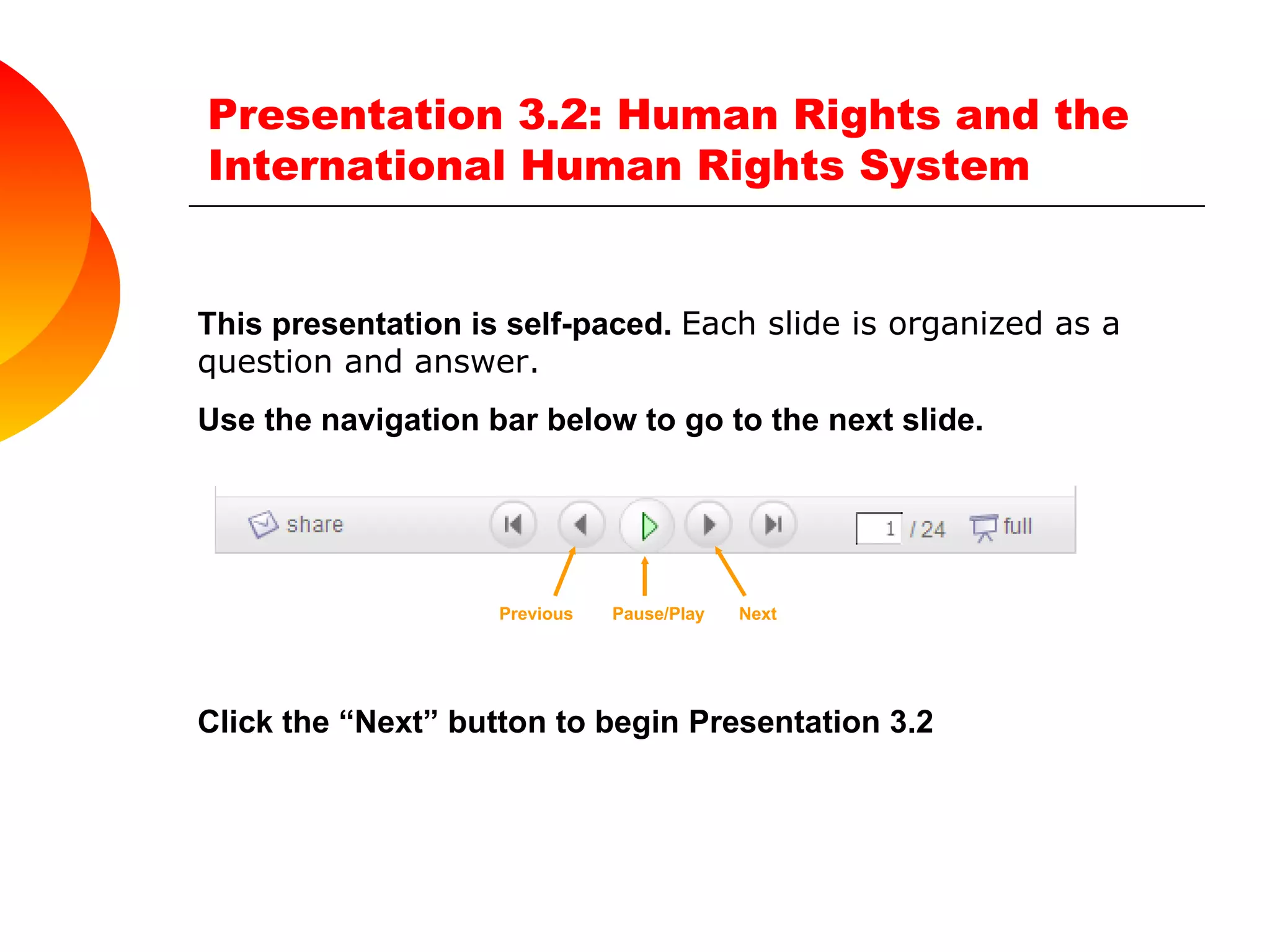
Presentation 3.2: Human Rights and the International Human Rights System  This presentation is self-paced.  Each slide is organized as a question and answer.  Use the navigation bar below to go to the next slide. Previous  Pause/Play  Next    Click the “Next” button to begin Presentation 3.2
What are human rights? Human rights are the rights that someone has simply because he or she is a human being Human rights are based on the principles of: Human dignity Equality and non-discrimination Responsibility Universality Inalienability Indivisibility Interdependency
Human rights are guaranteed under law The laws formally protect the rights of individuals and groups against actions by governments which interfere with the enjoyment of human rights They are expressed in declarations, treaties (conventions, covenants, etc.) and other sources of law These laws place an obligation on the State (a country) to engage in specific activities to guarantee these rights What is international human rights law?
What prompted the development of international human rights law? World War II:  An estimated 50 to 70 million people died, including six million people in  a genocide, and dozens of millions of people around the world were homeless, hungry, angry, and in shock In response to the devastation of World War II, governments committed themselves to establishing the United Nations to preserve peace through international cooperation and collective security The United Nations has four purposes: maintain international peace and security develop friendly relations among nations cooperate in solving international problems and in promoting respect for human rights be a centre for harmonizing the actions of nations.
Which declaration is considered as the foundation of international human rights standards? The Universal Declaration of Human Rights (UDHR) The UDHR was adopted by the members of the United Nations on December 10, 1948 The UDHR was drafted under the leadership of Eleanor Roosevelt, chairperson of the United Nations Committee for Human Rights, and other prominent figures, such as Canadian legal scholar, John Humphrey The UDHR is based on constitutions from 55 different States
What is a declaration? Declarations are general norms of international law; they set forth general principles and standards of human rights that most States would agree upon  Declarations have no binding legal effect on States, but represent a broad consensus on the part of the international community
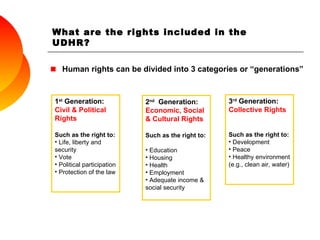
What are the rights included in the UDHR? Human rights can be divided into 3 categories or “generations” 1 st  Generation: Civil & Political Rights Such as the right to:  Life, liberty and security  Vote Political participation Protection of the law 2 nd   Generation: Economic, Social & Cultural Rights Such as the right to:  Education Housing Health Employment Adequate income & social security 3 rd  Generation: Collective Rights   Such as the right to:  Development Peace Healthy environment (e.g., clean air, water)
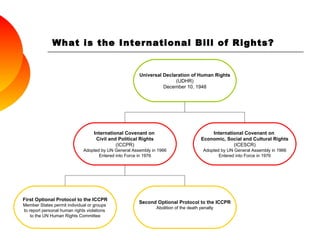
What is the International Bill of Rights? Universal Declaration of Human Rights (UDHR) December 10, 1948 International Covenant on  Civil and Political Rights (ICCPR) Adopted by UN General Assembly in 1966 Entered into Force in 1976 International Covenant on  Economic, Social and Cultural Rights (ICESCR) Adopted by UN General Assembly in 1966 Entered into Force in 1976 First Optional Protocol to the ICCPR Member States permit individual or groups  to report personal human rights violations  to the UN Human Rights Committee Second Optional Protocol to the ICCPR Abolition of the death penalty
What is the International Bill of Rights? In order to enforce the principles and standards of the UDHR, the UN Commission on Human Rights drafted two  treaties : ICCPR:  The Covenant on Civil and Political Rights (and its Optional Protocols)  ICESCR:  The Covenant on Economic, Social and Cultural Rights These treaties define specific rights and are legally binding documents Together with the UDHR, are now known as the  International Bill of Human Rights
What are treaties? A treaty is an agreement by a State to be bound by particular rules. There are different types of international treaties: Covenants Charters Protocols Conventions  Accords Agreements For more information go to:  untreaty.un.org
How many human rights instruments are there? There are over 100 human rights treaties, declarations, guidelines, etc…which fall under various categories such as: Cultural enjoyment Disability rights Housing Employment Marriage, family, youth War crimes and crimes against humanity  Religious protection Refugee protection These instruments have been developed and adopted to affirm the rights and protect especially vulnerable populations
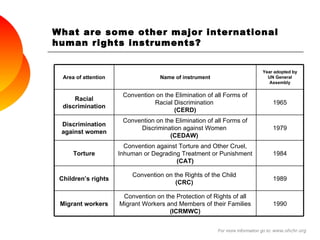
What are some other major international human rights instruments? For more information go to:  www.ohchr.org 1990 Convention on the Protection of Rights of all Migrant Workers and Members of their Families  (ICRMWC) Migrant workers 1989 Convention on the Rights of the Child  (CRC)  Children’s rights 1984 Convention against Torture and Other Cruel, Inhuman or Degrading Treatment or Punishment  (CAT) Torture 1979 Convention on the Elimination of all Forms of Discrimination against Women  (CEDAW)  Discrimination against women 1965 Convention on the Elimination of all Forms of Racial Discrimination  (CERD) Racial discrimination Year adopted by UN General Assembly Name of instrument Area of attention
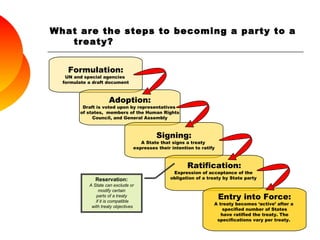
What are the steps to becoming a party to a treaty?  Formulation: UN and special agencies  formulate a draft document Adoption: Draft is voted upon by representatives  of states,  members of the Human Rights Council, and General Assembly Signing: A State that signs a treaty  expresses their intention to ratify Ratification: Expression of acceptance of the  obligation of a treaty by State party  Entry into Force: A treaty becomes ‘active’ after a  specified number of States have ratified the treaty. The  specifications vary per treaty.  Reservation: A State can exclude or modify certain parts of a treaty if it is compatible with treaty objectives
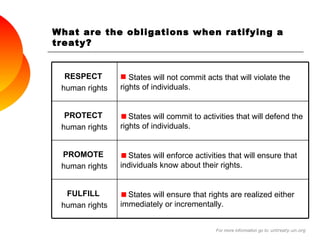
What are the obligations when ratifying a treaty? For more information go to:  untreaty.un.org States will ensure that rights are realized either immediately or incrementally. FULFILL   human rights States will enforce activities that will ensure that individuals know about their rights. PROMOTE   human rights States will commit to activities that will defend the rights of individuals. PROTECT   human rights States will not commit acts that will violate the rights of individuals. RESPECT   human rights
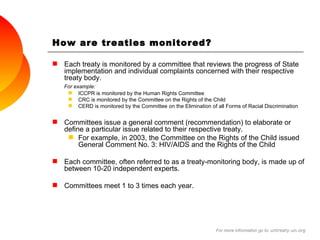
How are treaties monitored?  Each treaty is monitored by a committee that reviews the progress of State implementation and individual complaints concerned with their respective treaty body.  For example: ICCPR is monitored by the Human Rights Committee CRC is monitored by the Committee on the Rights of the Child CERD is monitored by the Committee on the Elimination of all Forms of Racial Discrimination Committees issue a general comment (recommendation) to elaborate or define a particular issue related to their respective treaty. For example, in 2003, the Committee on the Rights of the Child issued General Comment No. 3: HIV/AIDS and the Rights of the Child Each committee, often referred to as a treaty-monitoring body, is made up of between 10-20 independent experts. Committees meet 1 to 3 times each year. For more information go to:  untreaty.un.org
How are the treaties enforced? State reporting States must submit periodic reports to the monitoring committees about the progress made and problems encountered in the implementation of the rights. Shadow reports Independent reports are submitted by non-governmental organizations to treaty monitoring committees. They supplement, or “shadow” State reports. Individual complaints Some treaties ( ICCPR, CRC, CAT, CEDAW)  have an individual complaint mechanism. This means that if an individual exhausts local remedies in the State concerned, he or she can file an individual complaint with the applicable committee. State-to-state complaints Some treaties allow States to lodge a complaint against another State.
What are the main human rights bodies? There are three main human rights bodies: Human Rights Council Office of the High Commissioner for Human Rights Special Rapporteurs For more information go to:  www.un.org/rights
What is the UN Human Rights Council? The Human Rights Council is a subsidiary organ of the General Assembly. It was adopted by UN member States in March 2006  to strengthen the protection and promotion of human rights around the world. There are 47 elected Member States that each carry three-year terms. They are distributed among the regional groups. They meet at least 3 times a year.  Objectives of the Human Rights Council: To review the human rights record of all States through the Universal Periodic Review To respond promptly to human rights emergencies To develop international human rights law To improve and rationalize mandates of the former Commission on Human Rights For more information go to:  www.un.org/rights
What is the Office of the High Commissioner for Human Rights (OHCHR)? The OHCHR is a UN agency that works to promote and protect human rights  The High Commissioner for Human Rights is a United Nations official, under the direction and authority of the Secretary-General Objectives of the OHCHR: Oversees and highlights human rights issues to the General Assembly Promotes universal enjoyment of human rights  Coordinates United Nations human rights work Promotes international cooperation in the area of human rights Promotes ratification and implementation of standards Responds to serious human rights violations Provides education and technical assistance  For more information go to:  www.un.org/rights
What are Special Rapporteurs? Individual experts who monitor  the implementation of human rights  They are independent of government and are not financially compensated  There are currently 36 Special Rapporteurs associated with geographic or thematic mandates  Example regions / countries: Burundi, Cambodia, Haiti  Example themes:  Indigenous peoples, education, extreme poverty, bioethics Objectives of Special Rapporteurs: Monitor human rights by  conducting studies Investigate human rights situations by visiting countries or through research Prepare reports and recommendations to governments and the United Nations For more information go to:  www.un.org/rights
What are other human rights bodies? Economic and Social Council Coordinates the economic and social work of the United Nations Consults with non-government organizations International Court of Justice Judicial organ of the United Nations Only States may be held before the court Composed of 15 independent judges elected by the UN Security Council International Criminal Tribunals International criminal tribunals were created ‘ad hoc’ in response to specific situations under the authority of the UN Security Council to prosecute individuals responsible for serious violations on international humanitarian law. ICTY : International Criminal Tribunal for Former Yugoslavia  ICTR:  International Criminal Tribunal for Rwanda International Criminal Court Permanent court that prosecutes individuals for serious crimes of international concern: acts of genocide, crimes against humanity, war crimes and crimes of aggression. Proceedings may be initiated by a State, the UN Security Council, or the Prosecutor The court entered into force July 1, 2002 and can only prosecute crimes committed on or after that date  For more information go to:  www.un.org/rights
What are some trends in the international human rights system? Human rights is an evolving field that is influenced by both state and non-state actors, such as individuals, community groups, and non-government organizations. More human rights instruments have been adopted:  Convention for the Rights of People with Disabilities (2006) Declaration of the Rights of Indigenous Peoples (2007) More themes are being addressed: Lesbians, gay, transgender, bisexual rights  Environmental rights Increasing willingness from States to develop regional human rights bodies: European Court of Human Rights, 1950 Inter-American Commission of Human Rights, 1959 African Commission on Human and Peoples’ Rights, 1987 For more information go to:  www.un.org/rights
Where can you find more information? United Nations human rights website http:// www.un.org/rights Office of the High Commissioner for Human Rights http://www.ohcr.org United Nations Treaty Collection http://untreaty.un.org
End

Mod 3 International

  • 1.
    Presentation 3.2: HumanRights and the International Human Rights System This presentation is self-paced. Each slide is organized as a question and answer. Use the navigation bar below to go to the next slide. Previous Pause/Play Next Click the “Next” button to begin Presentation 3.2
  • 2.
    What are humanrights? Human rights are the rights that someone has simply because he or she is a human being Human rights are based on the principles of: Human dignity Equality and non-discrimination Responsibility Universality Inalienability Indivisibility Interdependency
  • 3.
    Human rights areguaranteed under law The laws formally protect the rights of individuals and groups against actions by governments which interfere with the enjoyment of human rights They are expressed in declarations, treaties (conventions, covenants, etc.) and other sources of law These laws place an obligation on the State (a country) to engage in specific activities to guarantee these rights What is international human rights law?
  • 4.
    What prompted thedevelopment of international human rights law? World War II: An estimated 50 to 70 million people died, including six million people in a genocide, and dozens of millions of people around the world were homeless, hungry, angry, and in shock In response to the devastation of World War II, governments committed themselves to establishing the United Nations to preserve peace through international cooperation and collective security The United Nations has four purposes: maintain international peace and security develop friendly relations among nations cooperate in solving international problems and in promoting respect for human rights be a centre for harmonizing the actions of nations.
  • 5.
    Which declaration isconsidered as the foundation of international human rights standards? The Universal Declaration of Human Rights (UDHR) The UDHR was adopted by the members of the United Nations on December 10, 1948 The UDHR was drafted under the leadership of Eleanor Roosevelt, chairperson of the United Nations Committee for Human Rights, and other prominent figures, such as Canadian legal scholar, John Humphrey The UDHR is based on constitutions from 55 different States
  • 6.
    What is adeclaration? Declarations are general norms of international law; they set forth general principles and standards of human rights that most States would agree upon Declarations have no binding legal effect on States, but represent a broad consensus on the part of the international community
  • 7.
    What are therights included in the UDHR? Human rights can be divided into 3 categories or “generations” 1 st Generation: Civil & Political Rights Such as the right to: Life, liberty and security Vote Political participation Protection of the law 2 nd Generation: Economic, Social & Cultural Rights Such as the right to: Education Housing Health Employment Adequate income & social security 3 rd Generation: Collective Rights Such as the right to: Development Peace Healthy environment (e.g., clean air, water)
  • 8.
    What is theInternational Bill of Rights? Universal Declaration of Human Rights (UDHR) December 10, 1948 International Covenant on Civil and Political Rights (ICCPR) Adopted by UN General Assembly in 1966 Entered into Force in 1976 International Covenant on Economic, Social and Cultural Rights (ICESCR) Adopted by UN General Assembly in 1966 Entered into Force in 1976 First Optional Protocol to the ICCPR Member States permit individual or groups to report personal human rights violations to the UN Human Rights Committee Second Optional Protocol to the ICCPR Abolition of the death penalty
  • 9.
    What is theInternational Bill of Rights? In order to enforce the principles and standards of the UDHR, the UN Commission on Human Rights drafted two treaties : ICCPR: The Covenant on Civil and Political Rights (and its Optional Protocols) ICESCR: The Covenant on Economic, Social and Cultural Rights These treaties define specific rights and are legally binding documents Together with the UDHR, are now known as the International Bill of Human Rights
  • 10.
    What are treaties?A treaty is an agreement by a State to be bound by particular rules. There are different types of international treaties: Covenants Charters Protocols Conventions Accords Agreements For more information go to: untreaty.un.org
  • 11.
    How many humanrights instruments are there? There are over 100 human rights treaties, declarations, guidelines, etc…which fall under various categories such as: Cultural enjoyment Disability rights Housing Employment Marriage, family, youth War crimes and crimes against humanity Religious protection Refugee protection These instruments have been developed and adopted to affirm the rights and protect especially vulnerable populations
  • 12.
    What are someother major international human rights instruments? For more information go to: www.ohchr.org 1990 Convention on the Protection of Rights of all Migrant Workers and Members of their Families (ICRMWC) Migrant workers 1989 Convention on the Rights of the Child (CRC) Children’s rights 1984 Convention against Torture and Other Cruel, Inhuman or Degrading Treatment or Punishment (CAT) Torture 1979 Convention on the Elimination of all Forms of Discrimination against Women (CEDAW) Discrimination against women 1965 Convention on the Elimination of all Forms of Racial Discrimination (CERD) Racial discrimination Year adopted by UN General Assembly Name of instrument Area of attention
  • 13.
    What are thesteps to becoming a party to a treaty? Formulation: UN and special agencies formulate a draft document Adoption: Draft is voted upon by representatives of states, members of the Human Rights Council, and General Assembly Signing: A State that signs a treaty expresses their intention to ratify Ratification: Expression of acceptance of the obligation of a treaty by State party Entry into Force: A treaty becomes ‘active’ after a specified number of States have ratified the treaty. The specifications vary per treaty. Reservation: A State can exclude or modify certain parts of a treaty if it is compatible with treaty objectives
  • 14.
    What are theobligations when ratifying a treaty? For more information go to: untreaty.un.org States will ensure that rights are realized either immediately or incrementally. FULFILL human rights States will enforce activities that will ensure that individuals know about their rights. PROMOTE human rights States will commit to activities that will defend the rights of individuals. PROTECT human rights States will not commit acts that will violate the rights of individuals. RESPECT human rights
  • 15.
    How are treatiesmonitored? Each treaty is monitored by a committee that reviews the progress of State implementation and individual complaints concerned with their respective treaty body. For example: ICCPR is monitored by the Human Rights Committee CRC is monitored by the Committee on the Rights of the Child CERD is monitored by the Committee on the Elimination of all Forms of Racial Discrimination Committees issue a general comment (recommendation) to elaborate or define a particular issue related to their respective treaty. For example, in 2003, the Committee on the Rights of the Child issued General Comment No. 3: HIV/AIDS and the Rights of the Child Each committee, often referred to as a treaty-monitoring body, is made up of between 10-20 independent experts. Committees meet 1 to 3 times each year. For more information go to: untreaty.un.org
  • 16.
    How are thetreaties enforced? State reporting States must submit periodic reports to the monitoring committees about the progress made and problems encountered in the implementation of the rights. Shadow reports Independent reports are submitted by non-governmental organizations to treaty monitoring committees. They supplement, or “shadow” State reports. Individual complaints Some treaties ( ICCPR, CRC, CAT, CEDAW) have an individual complaint mechanism. This means that if an individual exhausts local remedies in the State concerned, he or she can file an individual complaint with the applicable committee. State-to-state complaints Some treaties allow States to lodge a complaint against another State.
  • 17.
    What are themain human rights bodies? There are three main human rights bodies: Human Rights Council Office of the High Commissioner for Human Rights Special Rapporteurs For more information go to: www.un.org/rights
  • 18.
    What is theUN Human Rights Council? The Human Rights Council is a subsidiary organ of the General Assembly. It was adopted by UN member States in March 2006 to strengthen the protection and promotion of human rights around the world. There are 47 elected Member States that each carry three-year terms. They are distributed among the regional groups. They meet at least 3 times a year. Objectives of the Human Rights Council: To review the human rights record of all States through the Universal Periodic Review To respond promptly to human rights emergencies To develop international human rights law To improve and rationalize mandates of the former Commission on Human Rights For more information go to: www.un.org/rights
  • 19.
    What is theOffice of the High Commissioner for Human Rights (OHCHR)? The OHCHR is a UN agency that works to promote and protect human rights The High Commissioner for Human Rights is a United Nations official, under the direction and authority of the Secretary-General Objectives of the OHCHR: Oversees and highlights human rights issues to the General Assembly Promotes universal enjoyment of human rights Coordinates United Nations human rights work Promotes international cooperation in the area of human rights Promotes ratification and implementation of standards Responds to serious human rights violations Provides education and technical assistance For more information go to: www.un.org/rights
  • 20.
    What are SpecialRapporteurs? Individual experts who monitor the implementation of human rights They are independent of government and are not financially compensated There are currently 36 Special Rapporteurs associated with geographic or thematic mandates Example regions / countries: Burundi, Cambodia, Haiti Example themes: Indigenous peoples, education, extreme poverty, bioethics Objectives of Special Rapporteurs: Monitor human rights by conducting studies Investigate human rights situations by visiting countries or through research Prepare reports and recommendations to governments and the United Nations For more information go to: www.un.org/rights
  • 21.
    What are otherhuman rights bodies? Economic and Social Council Coordinates the economic and social work of the United Nations Consults with non-government organizations International Court of Justice Judicial organ of the United Nations Only States may be held before the court Composed of 15 independent judges elected by the UN Security Council International Criminal Tribunals International criminal tribunals were created ‘ad hoc’ in response to specific situations under the authority of the UN Security Council to prosecute individuals responsible for serious violations on international humanitarian law. ICTY : International Criminal Tribunal for Former Yugoslavia ICTR: International Criminal Tribunal for Rwanda International Criminal Court Permanent court that prosecutes individuals for serious crimes of international concern: acts of genocide, crimes against humanity, war crimes and crimes of aggression. Proceedings may be initiated by a State, the UN Security Council, or the Prosecutor The court entered into force July 1, 2002 and can only prosecute crimes committed on or after that date For more information go to: www.un.org/rights
  • 22.
    What are sometrends in the international human rights system? Human rights is an evolving field that is influenced by both state and non-state actors, such as individuals, community groups, and non-government organizations. More human rights instruments have been adopted: Convention for the Rights of People with Disabilities (2006) Declaration of the Rights of Indigenous Peoples (2007) More themes are being addressed: Lesbians, gay, transgender, bisexual rights Environmental rights Increasing willingness from States to develop regional human rights bodies: European Court of Human Rights, 1950 Inter-American Commission of Human Rights, 1959 African Commission on Human and Peoples’ Rights, 1987 For more information go to: www.un.org/rights
  • 23.
    Where can youfind more information? United Nations human rights website http:// www.un.org/rights Office of the High Commissioner for Human Rights http://www.ohcr.org United Nations Treaty Collection http://untreaty.un.org
  • 24.