What is a Project ?
A project is defined as a sequence of tasks that must be completed to attain a certain outcome. According to
the Project Management Institute (PMI), the term Project refers to ” to any temporary endeavor with a definite
beginning and end”. Depending on its complexity, it can be managed by a single person or hundreds.
A project is a set of interdependent tasks that have a common goal. Projects have the following characteristics:
1.A clear start and end date – There are projects that last several years but a project cannot go
on forever. It needs to have a clear beginning, a definite end, and an overview of what happens
in between.
2.A project creates something new – Every project is unique, producing something that did not
previously exist. A project is a one-time, once-off activity, never to be repeated exactly the same
way again.
3.A project has boundaries – A project operates within certain constraints of time, money,
quality, and functionality. We’ll see more about this in later sections.
4.A project is not business as usual – Projects are often confused with processes. A Process is a
series of routine, predefined steps to perform a particular function, say, expense
reimbursement approvals. It’s not a one-off activity. It determines how a specific function is
performed every single time.
The diverse nature of projects
Projects come in a wide range of shapes and sizes.
A project can:
•Be big: Like the construction of the Hoover Dam, take years to complete, and
have a humongous budget.
•Be small: Like your weekend project of installing a pathway in your lawn
•Involve many people: Like planning a wedding
•Just yourself: rearranging the photos in your wedding album
Types of projects
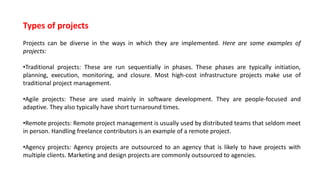
Projects can be diverse in the ways in which they are implemented. Here are some examples of
projects:
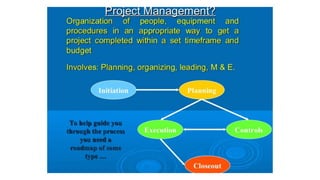
•Traditional projects: These are run sequentially in phases. These phases are typically initiation,
planning, execution, monitoring, and closure. Most high-cost infrastructure projects make use of
traditional project management.
•Agile projects: These are used mainly in software development. They are people-focused and
adaptive. They also typically have short turnaround times.
•Remote projects: Remote project management is usually used by distributed teams that seldom meet
in person. Handling freelance contributors is an example of a remote project.
•Agency projects: Agency projects are outsourced to an agency that is likely to have projects with
multiple clients. Marketing and design projects are commonly outsourced to agencies.
The boundaries of a project
Every project operates within certain boundaries called
constraints:
• Project scope
• Project schedule
• People
• Resources
All of these project constraints depend on what the project aims to achieve and when. The outcome of a
project results in deliverables. Anything that’s produced during the project’s development such
as documents, plans, and project reports is considered a deliverable. A deliverable may also be the result
of the project itself.
Having a final deliverable, as well as a finite timespan, distinguishes project management from business-
as-usual operations. Since projects are unlike routine operations, most people involved are those who
usually don’t work together. Sometimes, the professionals involved will come from different organizations
and geographies. If the desired outcome is achieved on time and within budget, a project is considered to
be a success.
Objectives of a Project
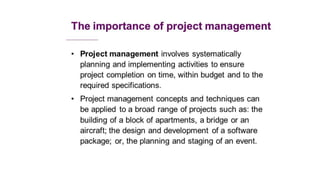
What is Project Management ?
Project Management Techniques
When it comes to project management tools and techniques, you don’t have just one technique or foolproof
tool that you can use in every project of every organization. Your decision about which one to choose should
arise from the project specifics that the brief contained, the complexity level that the project boasts, the
nature and qualification of the team involved in the development, and countless other factors.
Most of the project management tools and techniques can be used in various fields, but there are techniques
that are natively designed for specific activities and these activities or projects really can’t function properly if
they don’t have the foundation of those tools.
1. Classic technique
2. Waterfall technique
3. Agile Project Management
4. Rational Unified Process (RUP)
5. Program Evaluation and Review Technique (PERT)
6. Critical Path Technique
7. Critical Chain Technique
8. Extreme Project Management (XPM)
Project Management Tools
While the techniques are important, you also need specific tools that you can use to properly implement
during the development page and achieve your desired results. Here is a list of tools that you can use during
project management.
1. Organizing Workflow & Planning
2. Communication
3. Scheduling and Time Management
Project Management is an amazing field of work as it has a number of different project management tools and
techniques which let you effectively analyze and control your project as you want while keeping a keen eye on
multiple dependencies and key factors to get the desired results that will benefit your business and impact
your business metrics.
Project management tools and techniques define the workflow and how the project will take shape but it’s
always up to the tools to execute those techniques and help you get those sweet results.
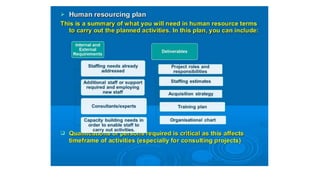
In a project, a project team or team is defined as "an interdependent collection of individuals who work
together towards a common goal and who share responsibility for specific outcomes of their
organizations. The project team is the group of people responsible for executing the tasks and
producing deliverables outlined in the project plan and schedule, as directed by the project manager, at
whatever level of effort or participation defined for them.
The project team includes the project manager and the group of individuals who work together on a
project to achieve its objectives. It consists of the project manager, project management staff, and other
members who are maybe not directly involved with management but carry out the work related to the
project
Teamwork in project management leads to increased efficiency and productivity. Everyone's putting their
strengths forward, holding themselves accountable, and they're not afraid to ask for help since they
respect one another.
Project Team
Project management
Project management
Project management
Project management
Project management
Project management
Project management
Project management
Project management
Project management
Project management
Project management
Project management
Project management
Project management

Project management

  • 2.
    What is aProject ? A project is defined as a sequence of tasks that must be completed to attain a certain outcome. According to the Project Management Institute (PMI), the term Project refers to ” to any temporary endeavor with a definite beginning and end”. Depending on its complexity, it can be managed by a single person or hundreds. A project is a set of interdependent tasks that have a common goal. Projects have the following characteristics:
  • 3.
    1.A clear startand end date – There are projects that last several years but a project cannot go on forever. It needs to have a clear beginning, a definite end, and an overview of what happens in between. 2.A project creates something new – Every project is unique, producing something that did not previously exist. A project is a one-time, once-off activity, never to be repeated exactly the same way again. 3.A project has boundaries – A project operates within certain constraints of time, money, quality, and functionality. We’ll see more about this in later sections. 4.A project is not business as usual – Projects are often confused with processes. A Process is a series of routine, predefined steps to perform a particular function, say, expense reimbursement approvals. It’s not a one-off activity. It determines how a specific function is performed every single time.
  • 4.
    The diverse natureof projects Projects come in a wide range of shapes and sizes. A project can: •Be big: Like the construction of the Hoover Dam, take years to complete, and have a humongous budget. •Be small: Like your weekend project of installing a pathway in your lawn •Involve many people: Like planning a wedding •Just yourself: rearranging the photos in your wedding album
  • 5.
    Types of projects Projectscan be diverse in the ways in which they are implemented. Here are some examples of projects: •Traditional projects: These are run sequentially in phases. These phases are typically initiation, planning, execution, monitoring, and closure. Most high-cost infrastructure projects make use of traditional project management. •Agile projects: These are used mainly in software development. They are people-focused and adaptive. They also typically have short turnaround times. •Remote projects: Remote project management is usually used by distributed teams that seldom meet in person. Handling freelance contributors is an example of a remote project. •Agency projects: Agency projects are outsourced to an agency that is likely to have projects with multiple clients. Marketing and design projects are commonly outsourced to agencies.
  • 8.
    The boundaries ofa project Every project operates within certain boundaries called constraints: • Project scope • Project schedule • People • Resources All of these project constraints depend on what the project aims to achieve and when. The outcome of a project results in deliverables. Anything that’s produced during the project’s development such as documents, plans, and project reports is considered a deliverable. A deliverable may also be the result of the project itself. Having a final deliverable, as well as a finite timespan, distinguishes project management from business- as-usual operations. Since projects are unlike routine operations, most people involved are those who usually don’t work together. Sometimes, the professionals involved will come from different organizations and geographies. If the desired outcome is achieved on time and within budget, a project is considered to be a success.
  • 9.
  • 10.
    What is ProjectManagement ?
  • 37.
    Project Management Techniques Whenit comes to project management tools and techniques, you don’t have just one technique or foolproof tool that you can use in every project of every organization. Your decision about which one to choose should arise from the project specifics that the brief contained, the complexity level that the project boasts, the nature and qualification of the team involved in the development, and countless other factors. Most of the project management tools and techniques can be used in various fields, but there are techniques that are natively designed for specific activities and these activities or projects really can’t function properly if they don’t have the foundation of those tools. 1. Classic technique 2. Waterfall technique 3. Agile Project Management 4. Rational Unified Process (RUP) 5. Program Evaluation and Review Technique (PERT) 6. Critical Path Technique 7. Critical Chain Technique 8. Extreme Project Management (XPM)
  • 38.
    Project Management Tools Whilethe techniques are important, you also need specific tools that you can use to properly implement during the development page and achieve your desired results. Here is a list of tools that you can use during project management. 1. Organizing Workflow & Planning 2. Communication 3. Scheduling and Time Management Project Management is an amazing field of work as it has a number of different project management tools and techniques which let you effectively analyze and control your project as you want while keeping a keen eye on multiple dependencies and key factors to get the desired results that will benefit your business and impact your business metrics. Project management tools and techniques define the workflow and how the project will take shape but it’s always up to the tools to execute those techniques and help you get those sweet results.
  • 39.
    In a project,a project team or team is defined as "an interdependent collection of individuals who work together towards a common goal and who share responsibility for specific outcomes of their organizations. The project team is the group of people responsible for executing the tasks and producing deliverables outlined in the project plan and schedule, as directed by the project manager, at whatever level of effort or participation defined for them. The project team includes the project manager and the group of individuals who work together on a project to achieve its objectives. It consists of the project manager, project management staff, and other members who are maybe not directly involved with management but carry out the work related to the project Teamwork in project management leads to increased efficiency and productivity. Everyone's putting their strengths forward, holding themselves accountable, and they're not afraid to ask for help since they respect one another. Project Team