Introduction Mobi.Ubiq is a pioneer in object-based services through mobile Internet. Mobi.Ubiq believes that with RFID, mobile internet and the ability to combine object-based and location-based services will create new possibilities that will revolutionize mobile computing and push consumer technology.
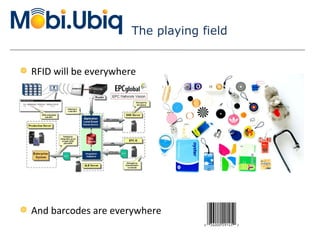
The playing field RFID will be everywhere And barcodes are everywhere Internet of Things
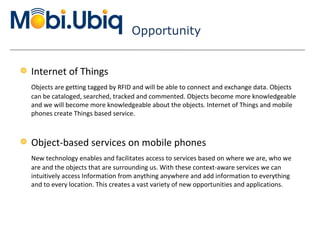
Opportunity Internet of Things Objects are getting tagged by RFID and will be able to connect and exchange data. Objects can be cataloged, searched, tracked and commented. Objects become more knowledgeable and we will become more knowledgeable about the objects. Internet of Things and mobile phones create Things based service. Object-based services on mobile phones New technology enables and facilitates access to services based on where we are, who we are and the objects that are surrounding us. With these context-aware services we can intuitively access Information from anything anywhere and add information to everything and to every location. This creates a vast variety of new opportunities and applications.
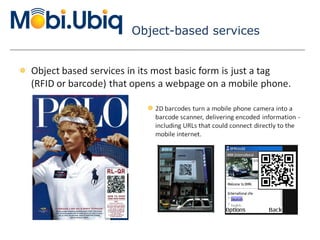
Object-based services
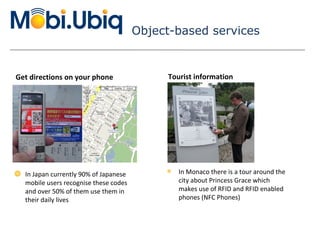
Object-based services In Japan currently 90% of Japanese mobile users recognise these codes and over 50% of them use them in their daily lives Get directions on your phone   Tourist information In Monaco there is a tour around the city about Princess Grace which makes use of RFID and RFID enabled phones (NFC Phones)
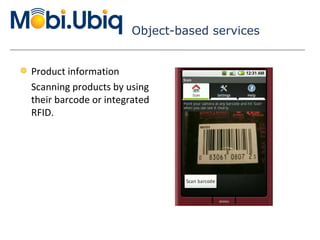
Object-based services Product information Scanning products by using their barcode or integrated RFID.
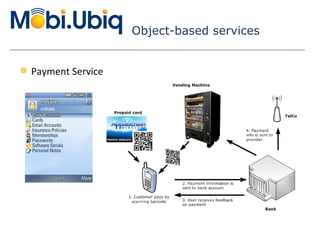
Object-based services Payment Service
The approach Dynamically add services to objects Service discovery based on object, location and personal profile Mash-up services and execute those services in the cloud. But…… These services are all 1 on 1 closed services.  A ny surviving technology of relevance will in the end be an open technology (e.g.: Internet, e-mail).  That’s why Mobi.Ubiq is, together with partners,  developing a framework and open standards to:
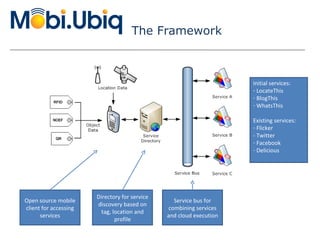
The Framework Open source mobile client for accessing services Directory for service discovery based on tag, location and profile Service bus for combining services and cloud execution Initial services:  LocateThis BlogThis WhatsThis Existing services:  Flicker - Twitter  Facebook Delicious
A New Playing Field Creating a new type of client application for accessing object-based and location-based information and services: A new Mosaic for the real world instead of the virtual world. Finding services and information based on locations and objects surrounding us: A new Google for the real world instead of the virtual world. Developing new services by integrating, extending and customizing other services: An application platform for mobile services where the applications execute in the cloud. The framework provided by Mobi.Ubiq is unique in 3 distinctive ways :
Business model Mobi.Ubiq operates under an Open Source business model and we publish the client software, libraries and protocol under a GPL license. We are convinced that only an open source model will provide the dissemination of the framework and open standard needed to create a critical mass. The Open Source business model is based on value added services, which are needed to apply the technology in business-to-business and business-to-consumer areas. Short term revenu model Custom solutions and services Partners requesting adaptations and extensions Long term revenu model Sponsored services in the service directory Support and training to the developers network

MobiUbiq Vision

  • 1.
    Introduction Mobi.Ubiq isa pioneer in object-based services through mobile Internet. Mobi.Ubiq believes that with RFID, mobile internet and the ability to combine object-based and location-based services will create new possibilities that will revolutionize mobile computing and push consumer technology.
  • 2.
    The playing fieldRFID will be everywhere And barcodes are everywhere Internet of Things
  • 3.
    Opportunity Internet ofThings Objects are getting tagged by RFID and will be able to connect and exchange data. Objects can be cataloged, searched, tracked and commented. Objects become more knowledgeable and we will become more knowledgeable about the objects. Internet of Things and mobile phones create Things based service. Object-based services on mobile phones New technology enables and facilitates access to services based on where we are, who we are and the objects that are surrounding us. With these context-aware services we can intuitively access Information from anything anywhere and add information to everything and to every location. This creates a vast variety of new opportunities and applications.
  • 4.
  • 5.
    Object-based services InJapan currently 90% of Japanese mobile users recognise these codes and over 50% of them use them in their daily lives Get directions on your phone Tourist information In Monaco there is a tour around the city about Princess Grace which makes use of RFID and RFID enabled phones (NFC Phones)
  • 6.
    Object-based services Productinformation Scanning products by using their barcode or integrated RFID.
  • 7.
  • 8.
    The approach Dynamicallyadd services to objects Service discovery based on object, location and personal profile Mash-up services and execute those services in the cloud. But…… These services are all 1 on 1 closed services. A ny surviving technology of relevance will in the end be an open technology (e.g.: Internet, e-mail). That’s why Mobi.Ubiq is, together with partners, developing a framework and open standards to:
  • 9.
    The Framework Opensource mobile client for accessing services Directory for service discovery based on tag, location and profile Service bus for combining services and cloud execution Initial services: LocateThis BlogThis WhatsThis Existing services: Flicker - Twitter Facebook Delicious
  • 10.
    A New PlayingField Creating a new type of client application for accessing object-based and location-based information and services: A new Mosaic for the real world instead of the virtual world. Finding services and information based on locations and objects surrounding us: A new Google for the real world instead of the virtual world. Developing new services by integrating, extending and customizing other services: An application platform for mobile services where the applications execute in the cloud. The framework provided by Mobi.Ubiq is unique in 3 distinctive ways :
  • 11.
    Business model Mobi.Ubiqoperates under an Open Source business model and we publish the client software, libraries and protocol under a GPL license. We are convinced that only an open source model will provide the dissemination of the framework and open standard needed to create a critical mass. The Open Source business model is based on value added services, which are needed to apply the technology in business-to-business and business-to-consumer areas. Short term revenu model Custom solutions and services Partners requesting adaptations and extensions Long term revenu model Sponsored services in the service directory Support and training to the developers network