The Breakdown 1,900 Vehicle Crashes 1,600 Homicides 300 Suicide Rest from drowning, falls , burns, and various other injuries (NIAA, 2006).
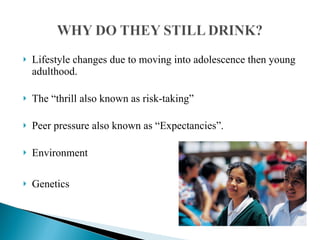
Lifestyle changes due to moving into adolescence then young adulthood. The “thrill also known as risk-taking” Peer pressure also known as “Expectancies”.  Environment Genetics
Effects on the brain Liver Growth and Endocrine
NIAA, (2004) – Surveyed 772 College Undergraduates 50%  - Blacked out  due to alcohol 40% - Reported blacking out within the last year 9.4% - Reported that due to alcohol they participated in dangerous acts such as: vandalism, fighting, unsafe sex, and driving.
Mental Confusion Coma Vomiting  Seizure Slow/irregular breathing Hypothermia (low body temperature, bluish skin) Person can not be aroused (Volkmann, 2006)
Punishable by law monetary and/or jail time Parents being held liable for their child’s actions Having to live with what has happened a lifetime experience.
Peer Education Talk to the youth at a young age Schools , Churches, Youth organizations “ Alcohol Awareness Week” not only in high school but colleges Educate parent and guardians
Still today alcohol consumption still prevalent among high school and college students. Parents, teachers, and counselors trying to make known the dangers and consequences. Parents struggling with how to deal with the drinking even with all the literature available to them. Denial is the biggest issue not only with the young adults but also the parents.
Alcoholics Anonymous, (2001).  This is the Fourth Edition of the Big Book, the Basic Text for Alcoholics Anonymous.  Alcoholics Anonymous World Services, Inc. New York City, New York.  Jalowiec, M., (2010).  Cheshire Cares: Alcohol Awareness.  Unconsidered Consequences of Home Alcohol Consumption by Minors.  Retrieved March 12, 2011 from chelshirecares.org: http://www.chelshirecares.org/unconsideredconsequencesofhomealcoholconsumptionbyminors .  Merino, N., (2008).  Underage Drinking.  GreenHaven Press, Farmington Hills, MI.  National Institute On Alcohol Abuse And Alcoholism, (2004).  Alcohol Alert.  Damaging Effects On The Brain.  Num. 63, October 2004. Retrieved March 12, 2011 from nih.gov: http://pubs.niaaa.nih.gov/publications/aa63/aa63.htm .
National Institute On Alcohol Abuse And Alcoholism, (2006).  Alcohol Alert.  Underage Drinking. Num. 67, January 2006. Retrieved march 12, 2011 from nih.gov: http://www.pubs.niaaa.nih.gov/publications/aa67/aa67.htm . ProCon.org, (2011).  42 States That Allow Underage (under21) Alcohol Consumption.   Drinking Age.   Retrieved March 12, 2011 from procon.org: http://www.drinkingage.procon.org/view.rescource.php?rescourceID=002591 . Steinberg, N., (2008).  Drunkard.  A Hard-Drinking Life.  Dutton, Penguin Group. New York, New York. Teen Drug Abuse, (2005).  The Health Effects Of Teen Alcohol Use.  Retrieved March 18, 2011 from Teendrugabuse.us:  http://www.teendrugabuse.us/teensandalcohol.html . Volkmann, C. &Volkmann, T., (2006).  From Binge To Blackout.  A Mother And Son Struggle With Teen Drinking.  New American Library. New York, New York. Wechsler, H., Ph. D., Wuethrich, B., (2002).  Dying To Drink.  Confronting Binge Drinking On College  Campuses.  Rodale, St. Martins Press, New York, New York.

Au Psy492 M7 A2 Bagwell P Pp

  • 1.
  • 2.
    The Breakdown 1,900Vehicle Crashes 1,600 Homicides 300 Suicide Rest from drowning, falls , burns, and various other injuries (NIAA, 2006).
  • 3.
    Lifestyle changes dueto moving into adolescence then young adulthood. The “thrill also known as risk-taking” Peer pressure also known as “Expectancies”. Environment Genetics
  • 4.
    Effects on thebrain Liver Growth and Endocrine
  • 5.
    NIAA, (2004) –Surveyed 772 College Undergraduates 50% - Blacked out due to alcohol 40% - Reported blacking out within the last year 9.4% - Reported that due to alcohol they participated in dangerous acts such as: vandalism, fighting, unsafe sex, and driving.
  • 6.
    Mental Confusion ComaVomiting Seizure Slow/irregular breathing Hypothermia (low body temperature, bluish skin) Person can not be aroused (Volkmann, 2006)
  • 7.
    Punishable by lawmonetary and/or jail time Parents being held liable for their child’s actions Having to live with what has happened a lifetime experience.
  • 8.
    Peer Education Talkto the youth at a young age Schools , Churches, Youth organizations “ Alcohol Awareness Week” not only in high school but colleges Educate parent and guardians
  • 9.
    Still today alcoholconsumption still prevalent among high school and college students. Parents, teachers, and counselors trying to make known the dangers and consequences. Parents struggling with how to deal with the drinking even with all the literature available to them. Denial is the biggest issue not only with the young adults but also the parents.
  • 10.
    Alcoholics Anonymous, (2001). This is the Fourth Edition of the Big Book, the Basic Text for Alcoholics Anonymous. Alcoholics Anonymous World Services, Inc. New York City, New York. Jalowiec, M., (2010). Cheshire Cares: Alcohol Awareness. Unconsidered Consequences of Home Alcohol Consumption by Minors. Retrieved March 12, 2011 from chelshirecares.org: http://www.chelshirecares.org/unconsideredconsequencesofhomealcoholconsumptionbyminors . Merino, N., (2008). Underage Drinking. GreenHaven Press, Farmington Hills, MI. National Institute On Alcohol Abuse And Alcoholism, (2004). Alcohol Alert. Damaging Effects On The Brain. Num. 63, October 2004. Retrieved March 12, 2011 from nih.gov: http://pubs.niaaa.nih.gov/publications/aa63/aa63.htm .
  • 11.
    National Institute OnAlcohol Abuse And Alcoholism, (2006). Alcohol Alert. Underage Drinking. Num. 67, January 2006. Retrieved march 12, 2011 from nih.gov: http://www.pubs.niaaa.nih.gov/publications/aa67/aa67.htm . ProCon.org, (2011). 42 States That Allow Underage (under21) Alcohol Consumption. Drinking Age. Retrieved March 12, 2011 from procon.org: http://www.drinkingage.procon.org/view.rescource.php?rescourceID=002591 . Steinberg, N., (2008). Drunkard. A Hard-Drinking Life. Dutton, Penguin Group. New York, New York. Teen Drug Abuse, (2005). The Health Effects Of Teen Alcohol Use. Retrieved March 18, 2011 from Teendrugabuse.us: http://www.teendrugabuse.us/teensandalcohol.html . Volkmann, C. &Volkmann, T., (2006). From Binge To Blackout. A Mother And Son Struggle With Teen Drinking. New American Library. New York, New York. Wechsler, H., Ph. D., Wuethrich, B., (2002). Dying To Drink. Confronting Binge Drinking On College Campuses. Rodale, St. Martins Press, New York, New York.

Editor's Notes

  • #2 Hello, in this power point presentation the title seems to say it all. The “Effects of Alcohol Consumption By Minors”, there are pros and cons that will be discussed and various sources from Alcoholics Anonymous to the National Institute On Alcohol Abuse And Alcoholism. Even Teen Drug Abuse will be further looked at along with the ProCon.org. It is important to try and further understand that if someone is 18 and old enough to vote and go to war, but not go out and drink, why. The main question for this presentation is ,”What are the effects of alcohol consumption by minors?” By asking this important question it will cover the whole picture, from not only the health issues but some of the legal issues along with the pros and cons.
  • #3 It is important when addressing these statistics ,to understand that these young people are under the age of 21. Knowing these statistics the questions remains , “Why do youth still drink?”
  • #4 Merino addresses these issues in his book, “Underage Drinking”, by saying that some youth have real issues when they go through puberty not only physically, but also emotionally. This can further lead them to bend to the peer pressures and the environment around them. They will further engage them into maybe trying something they normally would not have done or even thought of doing before. This is the “thrill or risk-taking” process. The next issue is genetics which can be directly linked to one’s ability to the tolerance of alcohol (Merino, 2008).
  • #5 The severe health issues that underage drinking can cause all depends on the age one starts to drink along with the length of time. It has been shown according to Merino (2008) that the younger the individual starts drinking heavily the higher risk they are taking later on in their lives (Merino, 2008). Some of the effects that alcohol has on the body are the brain, liver, and growth and endocrine areas (Merino, 2008). For instance the effect it has on the brain is quite evident as soon as a person starts drinking, slurred speech, difficulty walking, blurred vision, and difficulty walking. Some of the impairments start to diminish as soon as sobriety is obtained. As far as effecting the liver and growth and endocrine systems this is effected longer term and with age (Merino, 2008). According to the NIAA, (2004) scientist are still studying the effects alcohol consumption has not only on the brain but also to other organs of the body.
  • #6 Black outs from binge drinking is a serious issue that is seen in high school and colleges throughout our country. The statistics show that individuals who binge drinks in high school will be 3 times more likely to binge drink in college (Volkmann, 2006). Blackouts occur at quit a high alcohol level or after a rapid consumption of alcohol (Volkmann, 2006). It is important to understand that a person often experiences blacking out just prior to passing out.
  • #7 Alcohol poisoning is a serious issue that should not be taken lightly. Binge drinking and blackouts can often lead to alcohol poisoning which can be deadly. If alcohol poising is a possibility it is important to call 911 immediately (Volkmann, 2006).
  • #8 It is important to understand that even as an adult parent that should one decide to allow a minor to drink in their own home it is still punishable by law (Jalowiec, 2010). The ramifications can even go further by the parent being held liable for their child’s actions should they be in a car accident and harm not only themselves but possible someone else (Jalowiec, 2010).
  • #9 This is were communication is key. Peer education will help send the message that is needed to get the message out about the dangers of alcohol among our youth today (Alcoholics Anonymous, 2001). There has been an “alcohol awareness week” set up at various college to help inform underage drinkers of all the dangers (Welchsler, 2002).
  • #10 The answer seems quite simple, “education”, not only the children but the parents and guardians. However, the positive point is that since the drinking age has changed to 21 years of age, underage drinking has slowed some (Merino, 2008). Knowing this maybe overtime and some more research alcohol consumption among our youth will decline even further.