®
We deliver opportunities.™
Mobile Payment
Adoption
WHITE PAPER
To attract and retain customers, banks need to fully embrace mobile
payments into their business. In the most recent payment study from the US
Federal Reserve, each year nearly half of the 3.4 billion checks deposited
and over 132 million bill-payments involving US banks are completed
through a mobile device. For some, mobile payment systems are becoming
a ubiquitous part of everyday life and the preferred method of buying and
selling.
A wide variety of mobile payment systems (or “mobile wallets”) are available
with numerous features and options to satisfy the different lifestyles and
habits of today’s consumer. Most consumers adopt a mobile wallet because
it is easy to operate, has the best security, and operates on their favorite
smart phone. But how does a bank know which system is best for their
customers and more importantly which system will attract new ones?
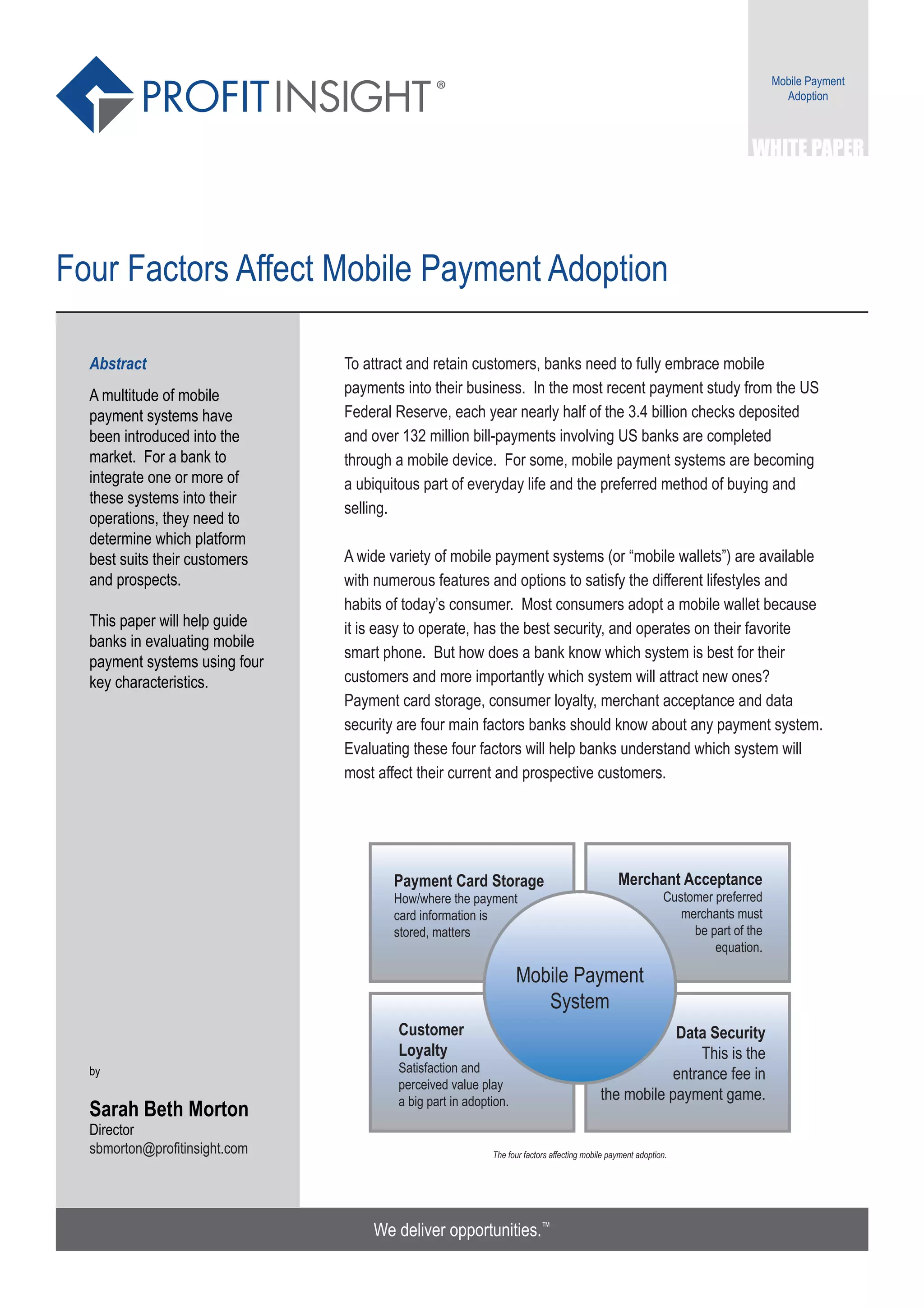
Payment card storage, consumer loyalty, merchant acceptance and data
security are four main factors banks should know about any payment system.
Evaluating these four factors will help banks understand which system will
most affect their current and prospective customers.
Four Factors Affect Mobile Payment Adoption
Abstract
A multitude of mobile
payment systems have
been introduced into the
market. For a bank to
integrate one or more of
these systems into their
operations, they need to
determine which platform
best suits their customers
and prospects.
This paper will help guide
banks in evaluating mobile
payment systems using four
key characteristics.
by
Sarah Beth Morton
Director
sbmorton@profitinsight.com
Payment Card Storage
How/where the payment
card information is
stored, matters
Merchant Acceptance
Customer preferred
merchants must
be part of the
equation.
Data Security
This is the
entrance fee in
the mobile payment game.
Customer
Loyalty
Satisfaction and
perceived value play
a big part in adoption.
Mobile Payment
System
The four factors affecting mobile payment adoption.
2
®
WHITE PAPER - MOBILE PAYMENT ADOPTION
Factor 1: Payment Card Storage
For a mobile payment system to live up to its name, it must
truly be mobile. Though it may seem obvious, a mobile
payment system that operates properly in all areas of the world
will attract considerably more customers. The main issue lies in
the way payment systems store consumer debit or credit card
information.
Two of the most popular systems, Apple Pay™ and Samsung
Pay™, store payment card information on the mobile device
(smart phone or tablet). Just like having a wallet or purse, a
consumer with a smart device has access to their payment
cards. But just like a real plastic card, if the device is lost or
stolen, the risk increases for fraud purchases and identity
theft. And, when consumers want to change or upgrade their
devices, the card information must be transferred and formatted
for the new mobile phone or tablet.
Google Wallet solves some of this mobility issue by storing
payment card information in “the cloud” (a server accessed
through the Internet). Through a standard Internet connection,
mobile device users access their payment cards through one
or multiple devices. When consistent and dependable Internet
access is not available, this system will not operate properly.
In foreign countries or rural areas where on-line connections
can be difficult, a consumer may be left at the check-out aisle
without a mobile payment option.
Factor 2: Loyalty
Though customers may be indifferent to how their credit
or debit cards are stored, they can quickly become loyal to
one payment platform over another for a variety of reasons.
Banks can determine customer loyalty to a particular platform
by looking at two main factors: customer satisfaction and
perceived value.
Customer Satisfaction
In any business, customer satisfaction is the ultimate test of
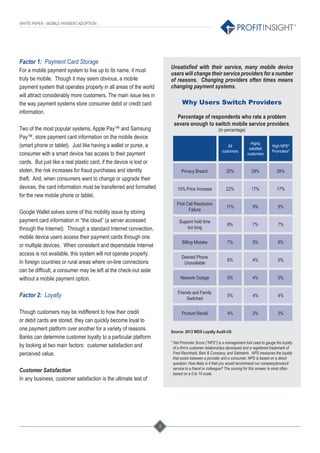
Unsatisfied with their service, many mobile device
users will change their service providers for a number
of reasons. Changing providers often times means
changing payment systems.
Why Users Switch Providers
Percentage of respondents who rate a problem
severe enough to switch mobile service providers.
(In percentage)
All
customers
Highly
satisfied
customers
High NPS®
Promoters*
Privacy Breach 32% 29% 28%
10% Price Increase 22% 17% 17%
First Call Resolution
Failure
11% 9% 8%
Support hold time
too long
8% 7% 7%
Billing Mistake 7% 5% 6%
Desired Phone
Unavailable
6% 4% 5%
Network Outage 5% 4% 5%
Friends and Family
Switched
5% 4% 4%
Product Recall 4% 2% 3%
Source: 2013 WDS Loyalty Audit-US
* Net Promoter Score (“NPS”) is a management tool used to gauge the loyalty
of a firm’s customer relationships developed and a registered trademark of
Fred Reichheld, Bain & Company, and Satmetrix. NPS measures the loyalty
that exists between a provider and a consumer. NPS is based on a direct
question: How likely is it that you would recommend our company/product/
service to a friend or colleague? The scoring for this answer is most often
based on a 0 to 10 scale.
3
®
WHITE PAPER - MOBILE PAYMENT ADOPTION
a product or service. Customer satisfaction is created over
time by repeated value associations with every aspect of a
product or service. With a mobile payment system customer
satisfaction not only depends on the value associations
delivered by the payment system, it also depends on the
service provider and the smart device delivering the payment
system. Negative experiences with these entities can directly
affect a customer’s acceptance of the payment platform
associated with the mobile device or service provider. Even if
the experiences have nothing to do with the mobile payment
system, its association with a “bad” device or service can taint
it forever.
Perceived value
Perceived value is the other factor building customer loyalty.
Though difficult to quantify, perceived value can change
from individual to individual for no apparent reason other
than personal feelings, thoughts and opinions. To capture,
measure and analyze the perceived value of a product or
service, government and private agencies use Internet surveys,
personal interviews and focus groups. Participants in these
research tools come from a variety of socially economic groups
and are asked probing questions to uncover their feelings about
a product or service.
Perceived value is a combination of social, functional,
emotional and monetary reward received from a product or
service.
Social Value - Social value places importance on how
the consumer is accepted by others in their “clan”,
“tribe” or community. Each of us know people with
loyalties to Apple, Android, or Windows based devices.
Using a particular device may bring elevated status
to the consumer and with that comes an acceptance
of a particular payment method. Many times a proud
consumer will boldly initiate or demonstrate a payment
system to others in an attempt to take a leadership
role in even a temporary community (i.e. the check-out
counter at a local coffee shop).
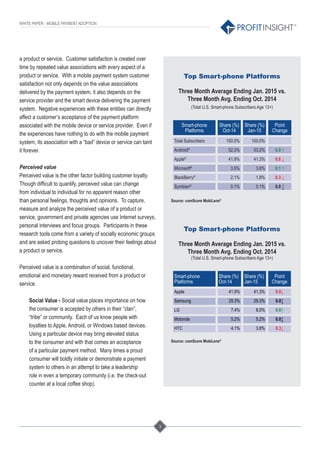
Top Smart-phone Platforms
Three Month Average Ending Jan. 2015 vs.
Three Month Avg. Ending Oct. 2014
(Total U.S. Smart-phone Subscribers Age 13+)
Smart-phone
Platforms
Share (%)
Oct-14
Share (%)
Jan-15
Point
Change
Total Subscribers 100.0% 100.0%
Android®
52.3% 53.2% 0.9 ↑
Apple®
41.9% 41.3% 0.6 ↓
Microsoft®
3.5% 3.6% 0.1 ↑
BlackBerry®
2.1% 1.8% 0.3 ↓
Symbian®
0.1% 0.1% 0.0 ↨
Source: comScore MobiLens®
Top Smart-phone Platforms
Three Month Average Ending Jan. 2015 vs.
Three Month Avg. Ending Oct. 2014
(Total U.S. Smart-phone Subscribers Age 13+)
Smart-phone
Platforms
Share (%)
Oct-14
Share (%)
Jan-15
Point
Change
Apple 41.9% 41.3% 0.6↓
Samsung 29.3% 29.3% 0.0↨
LG 7.4% 8.0% 0.6↑
Motorola 5.2% 5.2% 0.0↨
HTC 4.1% 3.8% 0.3↓
Source: comScore MobiLens®
4
®
WHITE PAPER - MOBILE PAYMENT ADOPTION
Functional Value - Though very different from social
value, functional values can be very personal too.
Users may like the graphic-user-interface (“GUI”) of
one payment system over another, while others who
look for speed and efficiency may favor something
different. Beyond the ease of use, each consumer
has different expectations from a payment platform
and measures how effective that platform is in meeting
those expectations. Some users may want product
comparison features or access to specials and
coupons while other users may want a “click-and-go”
function to speed checkout. The combination of ease
and effectiveness gives consumers a functional value.
Emotional Value - The emotional value of a product
or service is generated by many factors. Two of the
most important are trust and dependability. Again,
linked together with the smart device and service
provider, a mobile payment user must be certain their
information is secure, safe and available when and
where they need it. If strong enough, the emotional
value produced by a product or service may eclipse
other shortcomings.
Monetary Value - A payment systems’ monetary value
goes beyond price. Monetary value compares the
costs of using a payment system versus the reward
received by the users. Since most payment systems
come without charge, the costs in this equation relate
to how much time is required to learn and use the
payment system along with the cost of the device and
service supporting the system. The monetary value is
derived by comparing these costs to faster checkouts,
increased purchasing power and additional loyalty
awards.
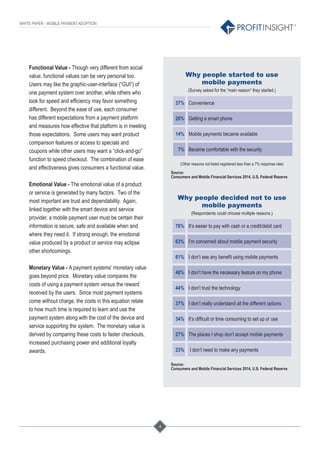
Why people started to use
mobile payments
(Survey asked for the “main reason” they started.)
37% Convenience
26% Getting a smart phone
14% Mobile payments became available
7% Became comfortable with the security
(Other reasons not listed registered less than a 7% response rate)
Source:
Consumers and Mobile Financial Services 2014, U.S. Federal Reserve
Why people decided not to use
mobile payments
(Respondents could choose multiple reasons.)
76% It’s easier to pay with cash or a credit/debit card
63% I’m concerned about mobile payment security
61% I don’t see any benefit using mobile payments
46% I don’t have the necessary feature on my phone
44% I don’t trust the technology
37% I don’t really understand all the different options
34% It’s difficult or time consuming to set up or use
27% The places I shop don’t accept mobile payments
23% I don’t need to make any payments
Source:
Consumers and Mobile Financial Services 2014, U.S. Federal Reserve
5
®
WHITE PAPER - MOBILE PAYMENT ADOPTION
Factor 3: Merchant Acceptance
Regardless of the social, functional, emotional and monetary
value placed on a payment platform, adoption is mostly affected
by merchant acceptance. If a consumer cannot use the
payment system in their favorite store or restaurant, chances
are it will not be embraced.
Apple Pay and Google Wallet depend on a communication
system called Near Field Communication (“NFC”). At checkout,
this wireless system transfers card information to a merchant
by moving a smart device close to a terminal resembling a
traditional credit card reader. With a few taps on the phone, the
payment is made and the merchant completes the purchase.
NFC communications are meant to speed the checkout process
while maintaining a secure line of communication between the
consumer and merchant.
But payment terminals with the ability to accept NFC payments
are not as ubiquitous as a standard credit card reader.
Penetration of this technology is not expected to reach high
levels any time soon. So for payment systems depending
solely on NFC connections, it may be sometime before they are
widely accepted.
Samsung Pay, however, has the ability to communicate with
both NFC readers and traditional magnetic stripe “swipe”
machines. Using a special hardware attachment (a key chain
fob for Android phones) or phone case, Samsung Pay transmits
payment information from the smart phone to the retailers
magnetic swipe terminals. By holding the phone close to the
terminal, the smart phone transmits a magnetic signal that
the terminal interprets as a physical swipe. Merchants may
accept payments without making any changes to their existing
equipment. According to the company, Samsung Pay is
accepted at over 90% of all US merchants.
Factor 4: Security
Despite all the aspects affecting mobile payment adoption
one factor trumps all others. The platform must be secure.
This is the ante for every company who chooses to play in
the payment space. Each of the big three payment systems
Apple Pay, Samsung Pay and Google Wallet use a technology
called tokenization. Tokenization refers to a method of securely
transferring debit or credit card information between a customer
and merchant. Instead of sharing specific card information,
tokenization provides a one-time usage code to the merchant.
This code is unscrambled by the bank to authorize and process
the transaction. It is the most secure technology used in
electronic payments today.
Beyond tokenization, payment systems vary on their security
efforts. Google uses a Personal Identification Number (“PIN”)
verification system to authenticate a user. This PIN is different
from the one used to unlock the phone. So, when making a
payment with Google Wallet, the user must use two PIN’s – one
to unlock the phone and other to unlock the wallet. A PIN can
be forgotten, lost or stolen so this security method has some
drawbacks.
Apple Pay and Samsung Pay use fingerprint authorization.
The user places their finger directly onto the face of the smart
device and compares that scan with the one stored in the
phone. It offers a more convenient and more secure method
than a PIN system as fingerprints are known to be very unique
amongst individuals. However, some older smart phones do
not have the ability to accept fingerprint scans.
Payment technology will continue to evolve. New players will
jump into the payments space and current players may exit.
But banks can quickly evaluate any payment platform using
four basic criteria – payment card storage, loyalty, merchant
acceptance and security. Without knowing how each of these
factors will affect their current and future customers, banks may
be taking risks when deciding which platform to integrate into
their operations.
6
®
WHITE PAPER - MOBILE PAYMENT ADOPTION
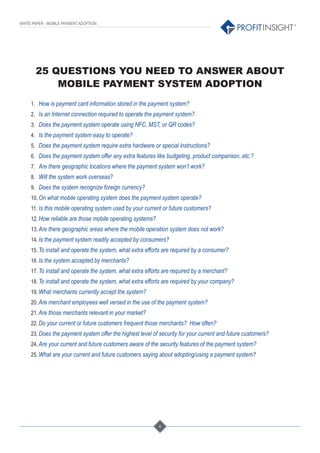
25 QUESTIONS YOU NEED TO ANSWER ABOUT
MOBILE PAYMENT SYSTEM ADOPTION
1. How is payment card information stored in the payment system?
2. Is an Internet connection required to operate the payment system?
3. Does the payment system operate using NFC, MST, or QR codes?
4. Is the payment system easy to operate?
5. Does the payment system require extra hardware or special instructions?
6. Does the payment system offer any extra features like budgeting, product comparison, etc.?
7. Are there geographic locations where the payment system won’t work?
8. Will the system work overseas?
9. Does the system recognize foreign currency?
10. On what mobile operating system does the payment system operate?
11. Is this mobile operating system used by your current or future customers?
12. How reliable are those mobile operating systems?
13. Are there geographic areas where the mobile operation system does not work?
14. Is the payment system readily accepted by consumers?
15. To install and operate the system, what extra efforts are required by a consumer?
16. Is the system accepted by merchants?
17. To install and operate the system, what extra efforts are required by a merchant?
18. To install and operate the system, what extra efforts are required by your company?
19. What merchants currently accept the system?
20. Are merchant employees well versed in the use of the payment system?
21. Are those merchants relevant in your market?
22. Do your current or future customers frequent those merchants? How often?
23. Does the payment system offer the highest level of security for your current and future customers?
24. Are your current and future customers aware of the security features of the payment system?
25. What are your current and future customers saying about adopting/using a payment system?
®
We deliver opportunities.™
249 Williamson Road • Suite 200 • Mooresville • North Carolina • USA • 28117
866.261.6226 • +1.704.896.5230 • www.profitinsight.com
© 2015 by PROFIT INSIGHT®
All rights reserved.Mobile_Wallet_Acceptance 05/29/15
PROFIT INSIGHT®
provides tactical
solutions to the global banking and
payments industry. Our specialists solve
problems for executives frustrated by
declining revenues and rising costs.
Through client collaboration, PROFIT
INSIGHT®
creates revenue enhancement,
revenue assurance and cost reduction
strategies to deliver substantial financial
rewards.
Our customized solutions are yours
We develop a broad array of solutions to address your
specific needs and customize them to your specific business
climate. We work with you to implement these ideas and
instill them as best practices into your organization’s culture.
Our customized solutions are highly transparent
We are sensitive to your current customers and prospects.
Our revenue enhancement, revenue assurance and cost
saving programs help you better understand not only your
operations, but your market and customer base.
Our engagements are quick, quiet & efficient
Our engagement teams are small and operate quickly
without disrupting your daily operations. They require little
of your internal resources and work as part of your team in a
collaborative approach.
YEARS • CONTINENTS • $BILLION
For over forty years, our customers
on six continents, have realized over
forty billion dollars of incremental
financial opportunity!
BANKS • CREDIT UNIONS • OTHER FINANCIAL INSTITUTIONS
BANKING • EXPERIENCE • PAYMENTS
PROFIT INSIGHT®
is the
CLEARCLEARCHOICE to help you achieve your financial goals.
Providing Cumulative financial benefits with solutions that
are Locally compliant focusing on
revenue Enhancement,
revenue Assurance and
cost Reduction

Mobile_Wallet_Acceptance

  • 1.
    ® We deliver opportunities.™ MobilePayment Adoption WHITE PAPER To attract and retain customers, banks need to fully embrace mobile payments into their business. In the most recent payment study from the US Federal Reserve, each year nearly half of the 3.4 billion checks deposited and over 132 million bill-payments involving US banks are completed through a mobile device. For some, mobile payment systems are becoming a ubiquitous part of everyday life and the preferred method of buying and selling. A wide variety of mobile payment systems (or “mobile wallets”) are available with numerous features and options to satisfy the different lifestyles and habits of today’s consumer. Most consumers adopt a mobile wallet because it is easy to operate, has the best security, and operates on their favorite smart phone. But how does a bank know which system is best for their customers and more importantly which system will attract new ones? Payment card storage, consumer loyalty, merchant acceptance and data security are four main factors banks should know about any payment system. Evaluating these four factors will help banks understand which system will most affect their current and prospective customers. Four Factors Affect Mobile Payment Adoption Abstract A multitude of mobile payment systems have been introduced into the market. For a bank to integrate one or more of these systems into their operations, they need to determine which platform best suits their customers and prospects. This paper will help guide banks in evaluating mobile payment systems using four key characteristics. by Sarah Beth Morton Director sbmorton@profitinsight.com Payment Card Storage How/where the payment card information is stored, matters Merchant Acceptance Customer preferred merchants must be part of the equation. Data Security This is the entrance fee in the mobile payment game. Customer Loyalty Satisfaction and perceived value play a big part in adoption. Mobile Payment System The four factors affecting mobile payment adoption.
  • 2.
    2 ® WHITE PAPER -MOBILE PAYMENT ADOPTION Factor 1: Payment Card Storage For a mobile payment system to live up to its name, it must truly be mobile. Though it may seem obvious, a mobile payment system that operates properly in all areas of the world will attract considerably more customers. The main issue lies in the way payment systems store consumer debit or credit card information. Two of the most popular systems, Apple Pay™ and Samsung Pay™, store payment card information on the mobile device (smart phone or tablet). Just like having a wallet or purse, a consumer with a smart device has access to their payment cards. But just like a real plastic card, if the device is lost or stolen, the risk increases for fraud purchases and identity theft. And, when consumers want to change or upgrade their devices, the card information must be transferred and formatted for the new mobile phone or tablet. Google Wallet solves some of this mobility issue by storing payment card information in “the cloud” (a server accessed through the Internet). Through a standard Internet connection, mobile device users access their payment cards through one or multiple devices. When consistent and dependable Internet access is not available, this system will not operate properly. In foreign countries or rural areas where on-line connections can be difficult, a consumer may be left at the check-out aisle without a mobile payment option. Factor 2: Loyalty Though customers may be indifferent to how their credit or debit cards are stored, they can quickly become loyal to one payment platform over another for a variety of reasons. Banks can determine customer loyalty to a particular platform by looking at two main factors: customer satisfaction and perceived value. Customer Satisfaction In any business, customer satisfaction is the ultimate test of Unsatisfied with their service, many mobile device users will change their service providers for a number of reasons. Changing providers often times means changing payment systems. Why Users Switch Providers Percentage of respondents who rate a problem severe enough to switch mobile service providers. (In percentage) All customers Highly satisfied customers High NPS® Promoters* Privacy Breach 32% 29% 28% 10% Price Increase 22% 17% 17% First Call Resolution Failure 11% 9% 8% Support hold time too long 8% 7% 7% Billing Mistake 7% 5% 6% Desired Phone Unavailable 6% 4% 5% Network Outage 5% 4% 5% Friends and Family Switched 5% 4% 4% Product Recall 4% 2% 3% Source: 2013 WDS Loyalty Audit-US * Net Promoter Score (“NPS”) is a management tool used to gauge the loyalty of a firm’s customer relationships developed and a registered trademark of Fred Reichheld, Bain & Company, and Satmetrix. NPS measures the loyalty that exists between a provider and a consumer. NPS is based on a direct question: How likely is it that you would recommend our company/product/ service to a friend or colleague? The scoring for this answer is most often based on a 0 to 10 scale.
  • 3.
    3 ® WHITE PAPER -MOBILE PAYMENT ADOPTION a product or service. Customer satisfaction is created over time by repeated value associations with every aspect of a product or service. With a mobile payment system customer satisfaction not only depends on the value associations delivered by the payment system, it also depends on the service provider and the smart device delivering the payment system. Negative experiences with these entities can directly affect a customer’s acceptance of the payment platform associated with the mobile device or service provider. Even if the experiences have nothing to do with the mobile payment system, its association with a “bad” device or service can taint it forever. Perceived value Perceived value is the other factor building customer loyalty. Though difficult to quantify, perceived value can change from individual to individual for no apparent reason other than personal feelings, thoughts and opinions. To capture, measure and analyze the perceived value of a product or service, government and private agencies use Internet surveys, personal interviews and focus groups. Participants in these research tools come from a variety of socially economic groups and are asked probing questions to uncover their feelings about a product or service. Perceived value is a combination of social, functional, emotional and monetary reward received from a product or service. Social Value - Social value places importance on how the consumer is accepted by others in their “clan”, “tribe” or community. Each of us know people with loyalties to Apple, Android, or Windows based devices. Using a particular device may bring elevated status to the consumer and with that comes an acceptance of a particular payment method. Many times a proud consumer will boldly initiate or demonstrate a payment system to others in an attempt to take a leadership role in even a temporary community (i.e. the check-out counter at a local coffee shop). Top Smart-phone Platforms Three Month Average Ending Jan. 2015 vs. Three Month Avg. Ending Oct. 2014 (Total U.S. Smart-phone Subscribers Age 13+) Smart-phone Platforms Share (%) Oct-14 Share (%) Jan-15 Point Change Total Subscribers 100.0% 100.0% Android® 52.3% 53.2% 0.9 ↑ Apple® 41.9% 41.3% 0.6 ↓ Microsoft® 3.5% 3.6% 0.1 ↑ BlackBerry® 2.1% 1.8% 0.3 ↓ Symbian® 0.1% 0.1% 0.0 ↨ Source: comScore MobiLens® Top Smart-phone Platforms Three Month Average Ending Jan. 2015 vs. Three Month Avg. Ending Oct. 2014 (Total U.S. Smart-phone Subscribers Age 13+) Smart-phone Platforms Share (%) Oct-14 Share (%) Jan-15 Point Change Apple 41.9% 41.3% 0.6↓ Samsung 29.3% 29.3% 0.0↨ LG 7.4% 8.0% 0.6↑ Motorola 5.2% 5.2% 0.0↨ HTC 4.1% 3.8% 0.3↓ Source: comScore MobiLens®
  • 4.
    4 ® WHITE PAPER -MOBILE PAYMENT ADOPTION Functional Value - Though very different from social value, functional values can be very personal too. Users may like the graphic-user-interface (“GUI”) of one payment system over another, while others who look for speed and efficiency may favor something different. Beyond the ease of use, each consumer has different expectations from a payment platform and measures how effective that platform is in meeting those expectations. Some users may want product comparison features or access to specials and coupons while other users may want a “click-and-go” function to speed checkout. The combination of ease and effectiveness gives consumers a functional value. Emotional Value - The emotional value of a product or service is generated by many factors. Two of the most important are trust and dependability. Again, linked together with the smart device and service provider, a mobile payment user must be certain their information is secure, safe and available when and where they need it. If strong enough, the emotional value produced by a product or service may eclipse other shortcomings. Monetary Value - A payment systems’ monetary value goes beyond price. Monetary value compares the costs of using a payment system versus the reward received by the users. Since most payment systems come without charge, the costs in this equation relate to how much time is required to learn and use the payment system along with the cost of the device and service supporting the system. The monetary value is derived by comparing these costs to faster checkouts, increased purchasing power and additional loyalty awards. Why people started to use mobile payments (Survey asked for the “main reason” they started.) 37% Convenience 26% Getting a smart phone 14% Mobile payments became available 7% Became comfortable with the security (Other reasons not listed registered less than a 7% response rate) Source: Consumers and Mobile Financial Services 2014, U.S. Federal Reserve Why people decided not to use mobile payments (Respondents could choose multiple reasons.) 76% It’s easier to pay with cash or a credit/debit card 63% I’m concerned about mobile payment security 61% I don’t see any benefit using mobile payments 46% I don’t have the necessary feature on my phone 44% I don’t trust the technology 37% I don’t really understand all the different options 34% It’s difficult or time consuming to set up or use 27% The places I shop don’t accept mobile payments 23% I don’t need to make any payments Source: Consumers and Mobile Financial Services 2014, U.S. Federal Reserve
  • 5.
    5 ® WHITE PAPER -MOBILE PAYMENT ADOPTION Factor 3: Merchant Acceptance Regardless of the social, functional, emotional and monetary value placed on a payment platform, adoption is mostly affected by merchant acceptance. If a consumer cannot use the payment system in their favorite store or restaurant, chances are it will not be embraced. Apple Pay and Google Wallet depend on a communication system called Near Field Communication (“NFC”). At checkout, this wireless system transfers card information to a merchant by moving a smart device close to a terminal resembling a traditional credit card reader. With a few taps on the phone, the payment is made and the merchant completes the purchase. NFC communications are meant to speed the checkout process while maintaining a secure line of communication between the consumer and merchant. But payment terminals with the ability to accept NFC payments are not as ubiquitous as a standard credit card reader. Penetration of this technology is not expected to reach high levels any time soon. So for payment systems depending solely on NFC connections, it may be sometime before they are widely accepted. Samsung Pay, however, has the ability to communicate with both NFC readers and traditional magnetic stripe “swipe” machines. Using a special hardware attachment (a key chain fob for Android phones) or phone case, Samsung Pay transmits payment information from the smart phone to the retailers magnetic swipe terminals. By holding the phone close to the terminal, the smart phone transmits a magnetic signal that the terminal interprets as a physical swipe. Merchants may accept payments without making any changes to their existing equipment. According to the company, Samsung Pay is accepted at over 90% of all US merchants. Factor 4: Security Despite all the aspects affecting mobile payment adoption one factor trumps all others. The platform must be secure. This is the ante for every company who chooses to play in the payment space. Each of the big three payment systems Apple Pay, Samsung Pay and Google Wallet use a technology called tokenization. Tokenization refers to a method of securely transferring debit or credit card information between a customer and merchant. Instead of sharing specific card information, tokenization provides a one-time usage code to the merchant. This code is unscrambled by the bank to authorize and process the transaction. It is the most secure technology used in electronic payments today. Beyond tokenization, payment systems vary on their security efforts. Google uses a Personal Identification Number (“PIN”) verification system to authenticate a user. This PIN is different from the one used to unlock the phone. So, when making a payment with Google Wallet, the user must use two PIN’s – one to unlock the phone and other to unlock the wallet. A PIN can be forgotten, lost or stolen so this security method has some drawbacks. Apple Pay and Samsung Pay use fingerprint authorization. The user places their finger directly onto the face of the smart device and compares that scan with the one stored in the phone. It offers a more convenient and more secure method than a PIN system as fingerprints are known to be very unique amongst individuals. However, some older smart phones do not have the ability to accept fingerprint scans. Payment technology will continue to evolve. New players will jump into the payments space and current players may exit. But banks can quickly evaluate any payment platform using four basic criteria – payment card storage, loyalty, merchant acceptance and security. Without knowing how each of these factors will affect their current and future customers, banks may be taking risks when deciding which platform to integrate into their operations.
  • 6.
    6 ® WHITE PAPER -MOBILE PAYMENT ADOPTION 25 QUESTIONS YOU NEED TO ANSWER ABOUT MOBILE PAYMENT SYSTEM ADOPTION 1. How is payment card information stored in the payment system? 2. Is an Internet connection required to operate the payment system? 3. Does the payment system operate using NFC, MST, or QR codes? 4. Is the payment system easy to operate? 5. Does the payment system require extra hardware or special instructions? 6. Does the payment system offer any extra features like budgeting, product comparison, etc.? 7. Are there geographic locations where the payment system won’t work? 8. Will the system work overseas? 9. Does the system recognize foreign currency? 10. On what mobile operating system does the payment system operate? 11. Is this mobile operating system used by your current or future customers? 12. How reliable are those mobile operating systems? 13. Are there geographic areas where the mobile operation system does not work? 14. Is the payment system readily accepted by consumers? 15. To install and operate the system, what extra efforts are required by a consumer? 16. Is the system accepted by merchants? 17. To install and operate the system, what extra efforts are required by a merchant? 18. To install and operate the system, what extra efforts are required by your company? 19. What merchants currently accept the system? 20. Are merchant employees well versed in the use of the payment system? 21. Are those merchants relevant in your market? 22. Do your current or future customers frequent those merchants? How often? 23. Does the payment system offer the highest level of security for your current and future customers? 24. Are your current and future customers aware of the security features of the payment system? 25. What are your current and future customers saying about adopting/using a payment system?
  • 7.
    ® We deliver opportunities.™ 249Williamson Road • Suite 200 • Mooresville • North Carolina • USA • 28117 866.261.6226 • +1.704.896.5230 • www.profitinsight.com © 2015 by PROFIT INSIGHT® All rights reserved.Mobile_Wallet_Acceptance 05/29/15 PROFIT INSIGHT® provides tactical solutions to the global banking and payments industry. Our specialists solve problems for executives frustrated by declining revenues and rising costs. Through client collaboration, PROFIT INSIGHT® creates revenue enhancement, revenue assurance and cost reduction strategies to deliver substantial financial rewards. Our customized solutions are yours We develop a broad array of solutions to address your specific needs and customize them to your specific business climate. We work with you to implement these ideas and instill them as best practices into your organization’s culture. Our customized solutions are highly transparent We are sensitive to your current customers and prospects. Our revenue enhancement, revenue assurance and cost saving programs help you better understand not only your operations, but your market and customer base. Our engagements are quick, quiet & efficient Our engagement teams are small and operate quickly without disrupting your daily operations. They require little of your internal resources and work as part of your team in a collaborative approach. YEARS • CONTINENTS • $BILLION For over forty years, our customers on six continents, have realized over forty billion dollars of incremental financial opportunity! BANKS • CREDIT UNIONS • OTHER FINANCIAL INSTITUTIONS BANKING • EXPERIENCE • PAYMENTS PROFIT INSIGHT® is the CLEARCLEARCHOICE to help you achieve your financial goals. Providing Cumulative financial benefits with solutions that are Locally compliant focusing on revenue Enhancement, revenue Assurance and cost Reduction