ELECTRICAL CIRCUITS
LECTURE 9
AC SERIES-PARALLEL CIRCUITS
OHM’S LAW FOR AC CIRCUITS
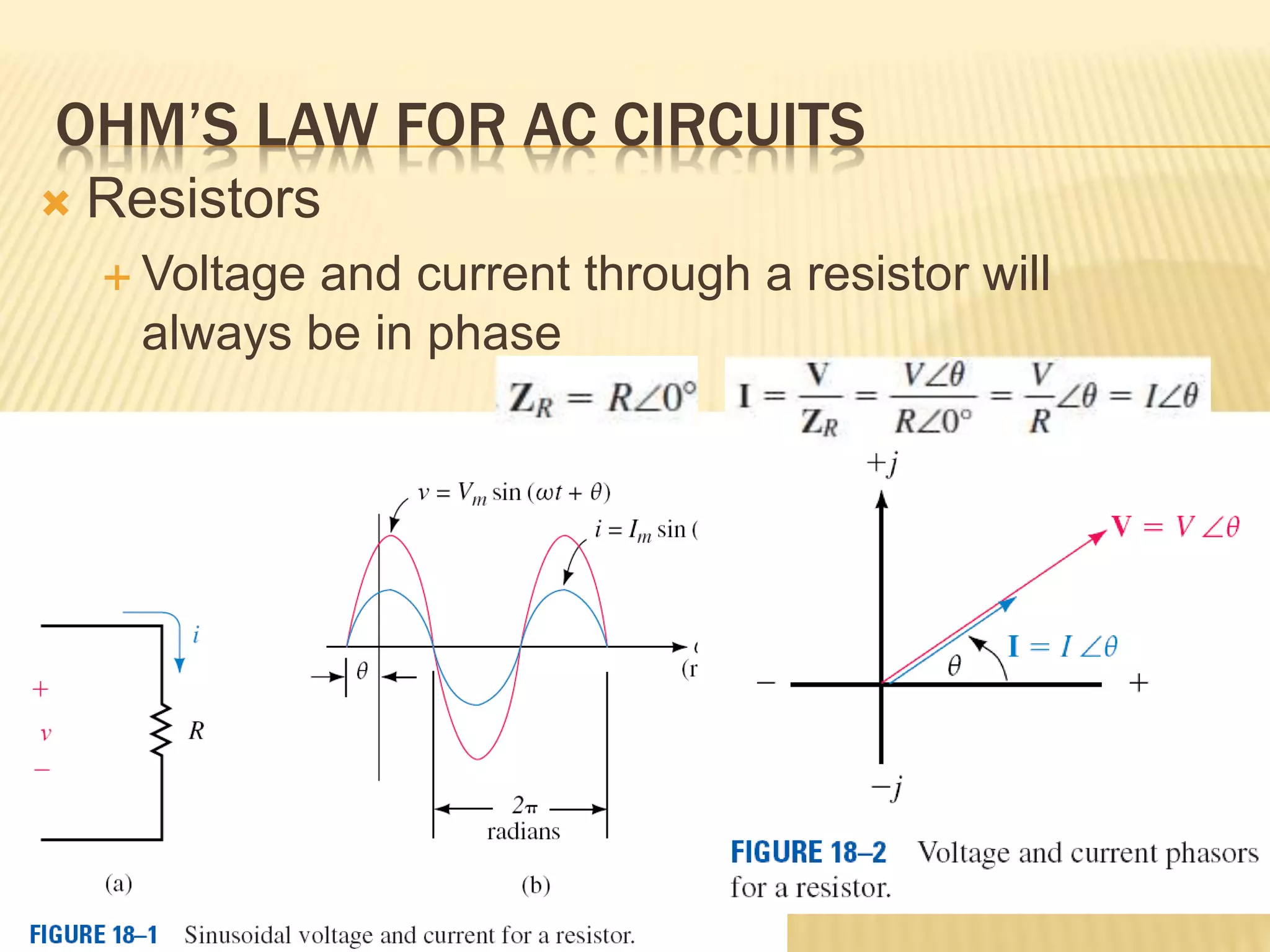
 Resistors
 Voltage and current through a resistor will
always be in phase
OHM’S LAW FOR AC CIRCUITS
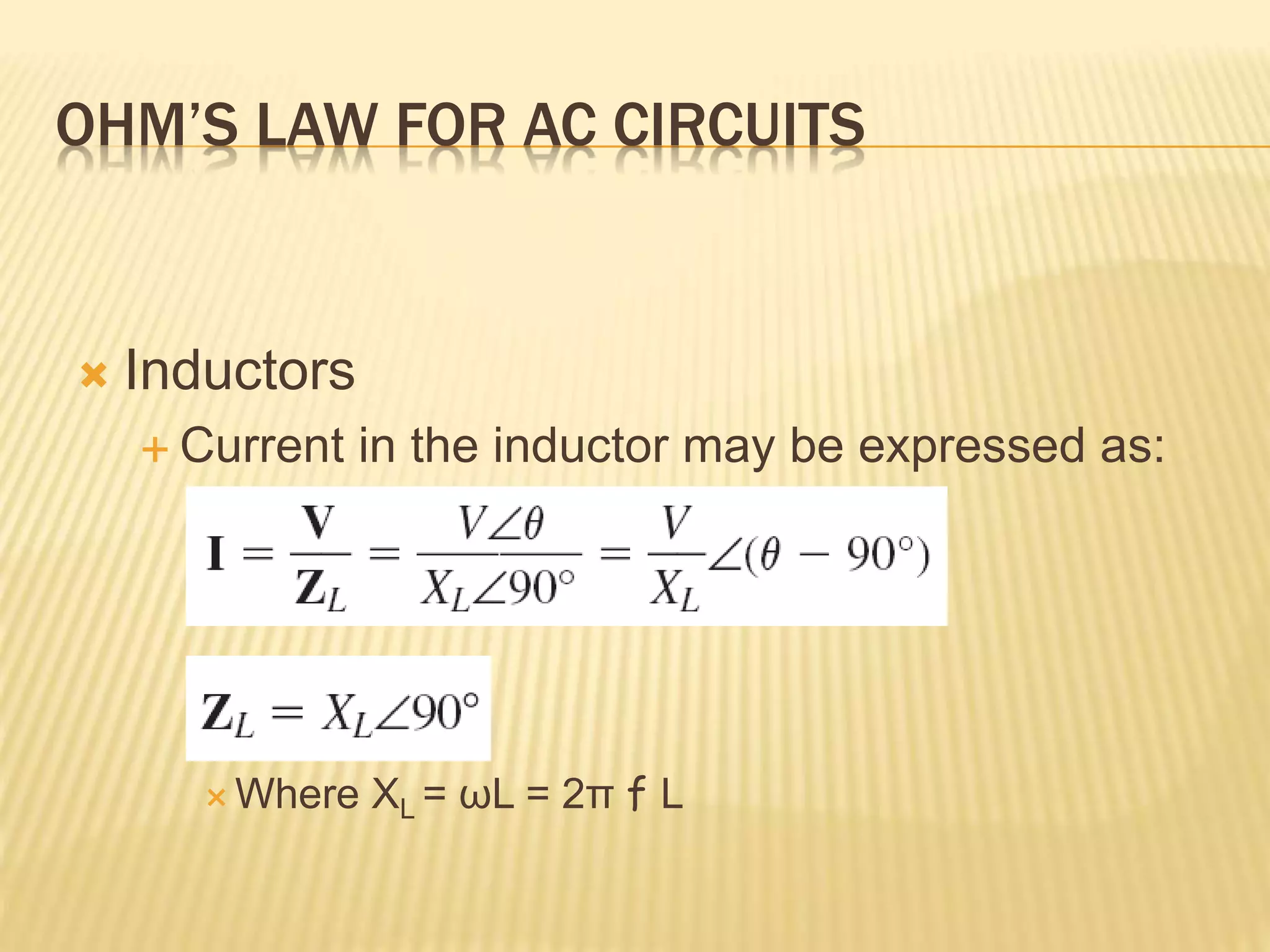
 Inductors
 Current in the inductor may be expressed as:
 Where XL = ωL = 2π f L
OHM’S LAW FOR AC CIRCUITS
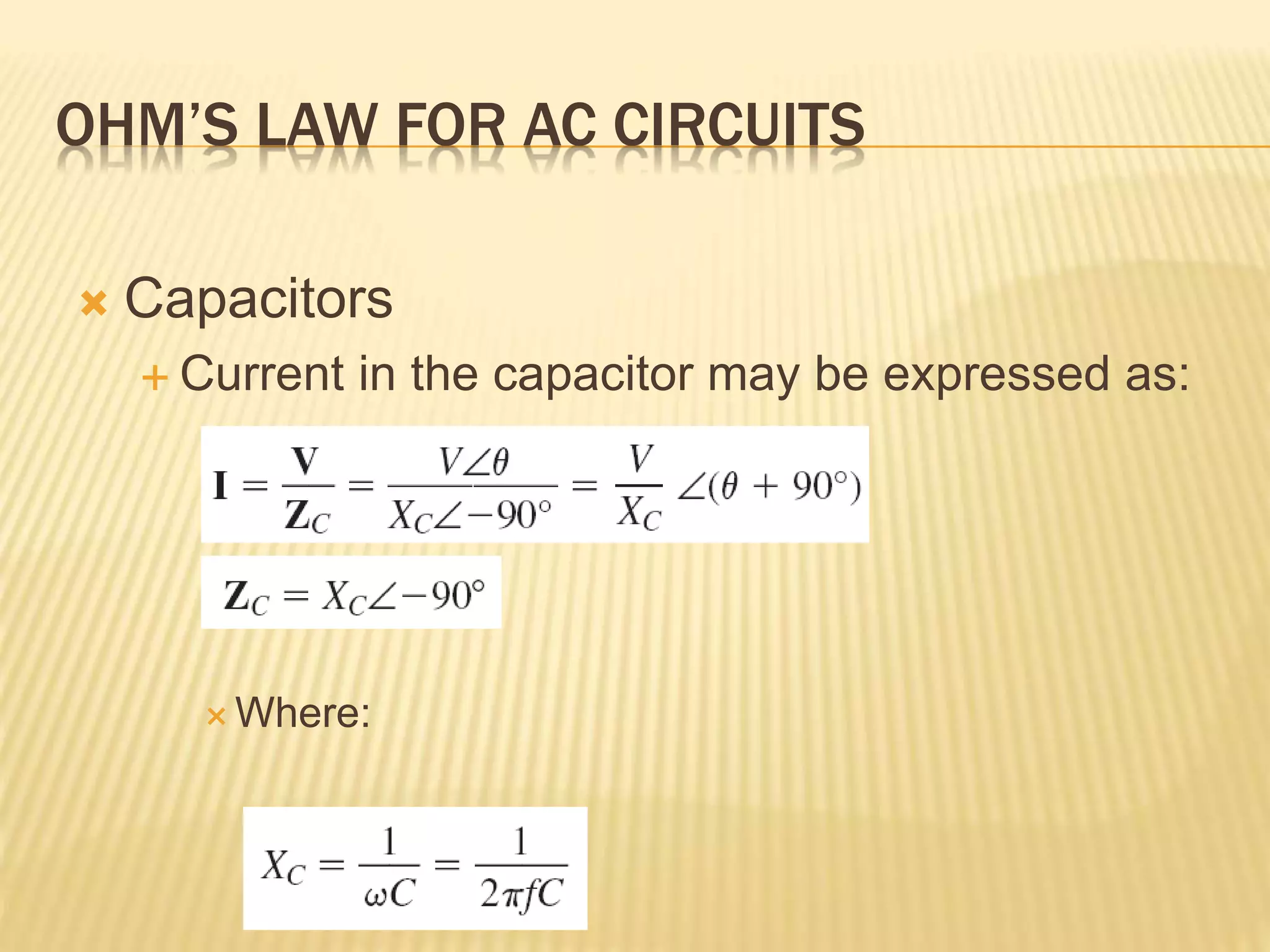
 Capacitors
 Current in the capacitor may be expressed as:
 Where:
AC SERIES CIRCUITS
 Current everywhere in a series circuit is the
same
 Impedance
 Term used to collectively determine how
resistance, capacitance, and inductance impede
current in a circuit
AC SERIES CIRCUITS
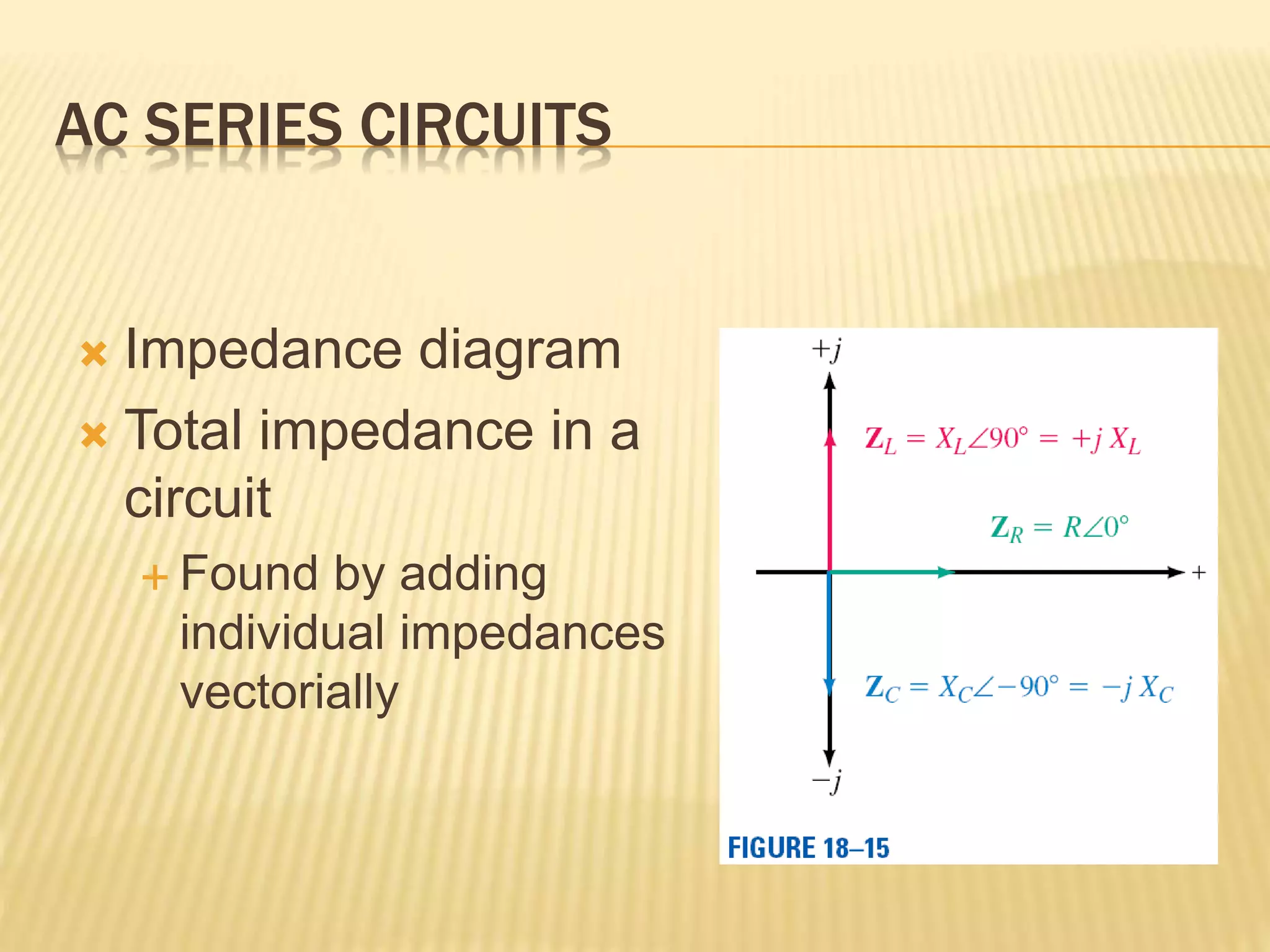
 Impedance diagram
 Total impedance in a
circuit
 Found by adding
individual impedances
vectorially
AC SERIES CIRCUITS
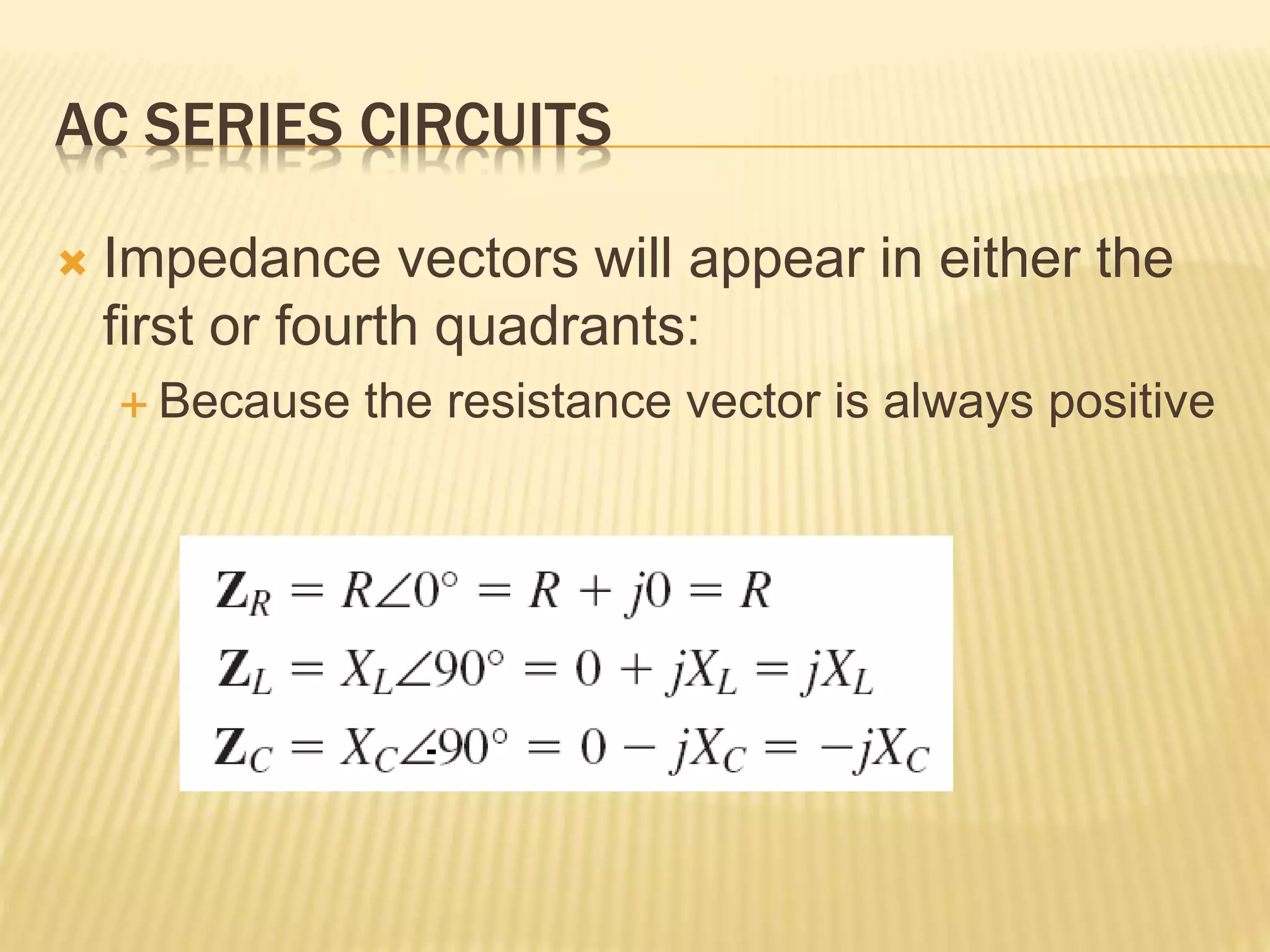
 Impedance vectors will appear in either the
first or fourth quadrants:
 Because the resistance vector is always positive
-
AC SERIES CIRCUITS
 If impedance vector appears in fourth
quadrant:
 Circuit is capacitive
 If impedance vector appears in first quadrant:
 Impedance is inductive
 Resistive circuit
 Total impedance has only a real component
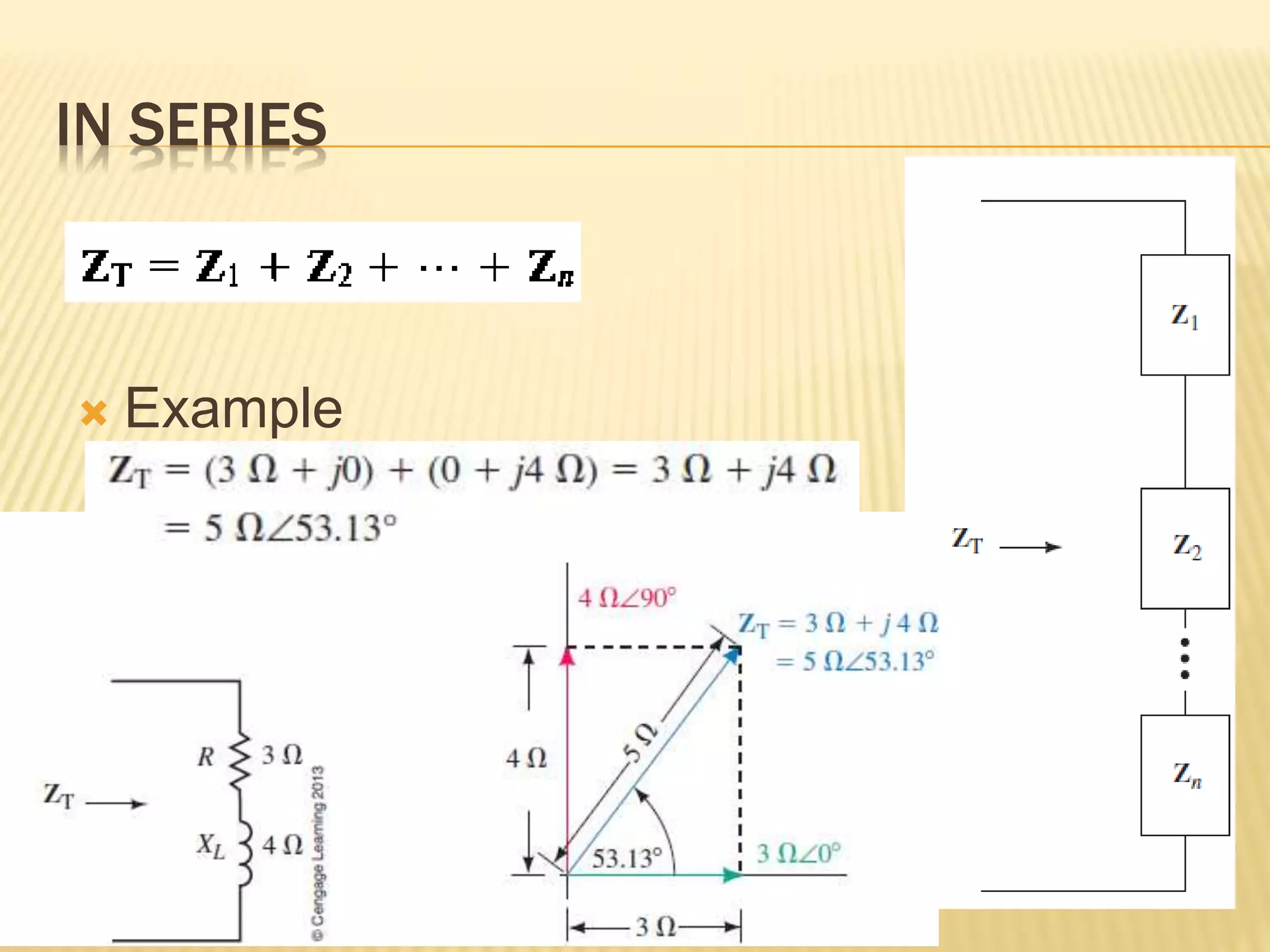
IN SERIES
 Example
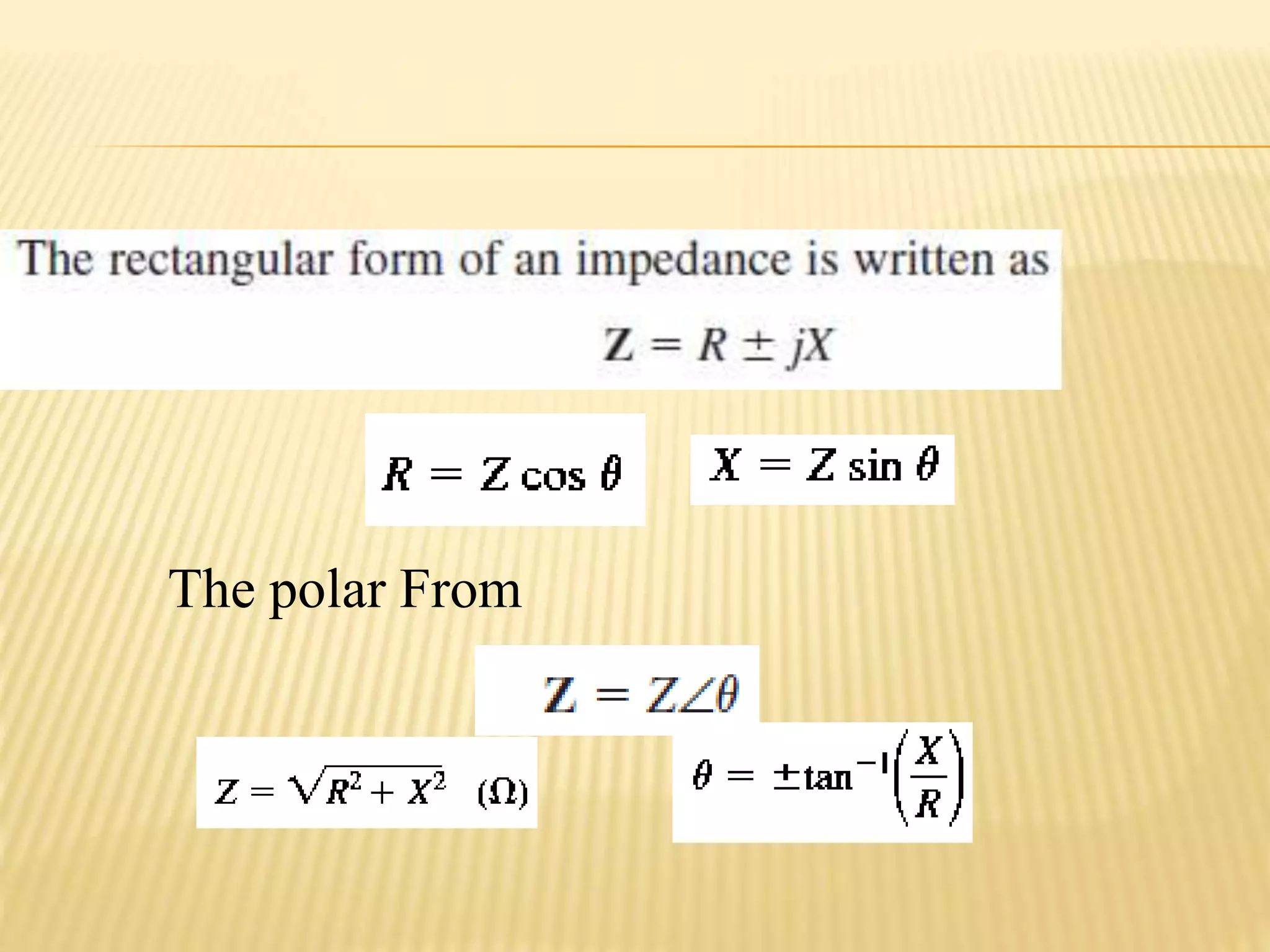
The polar From
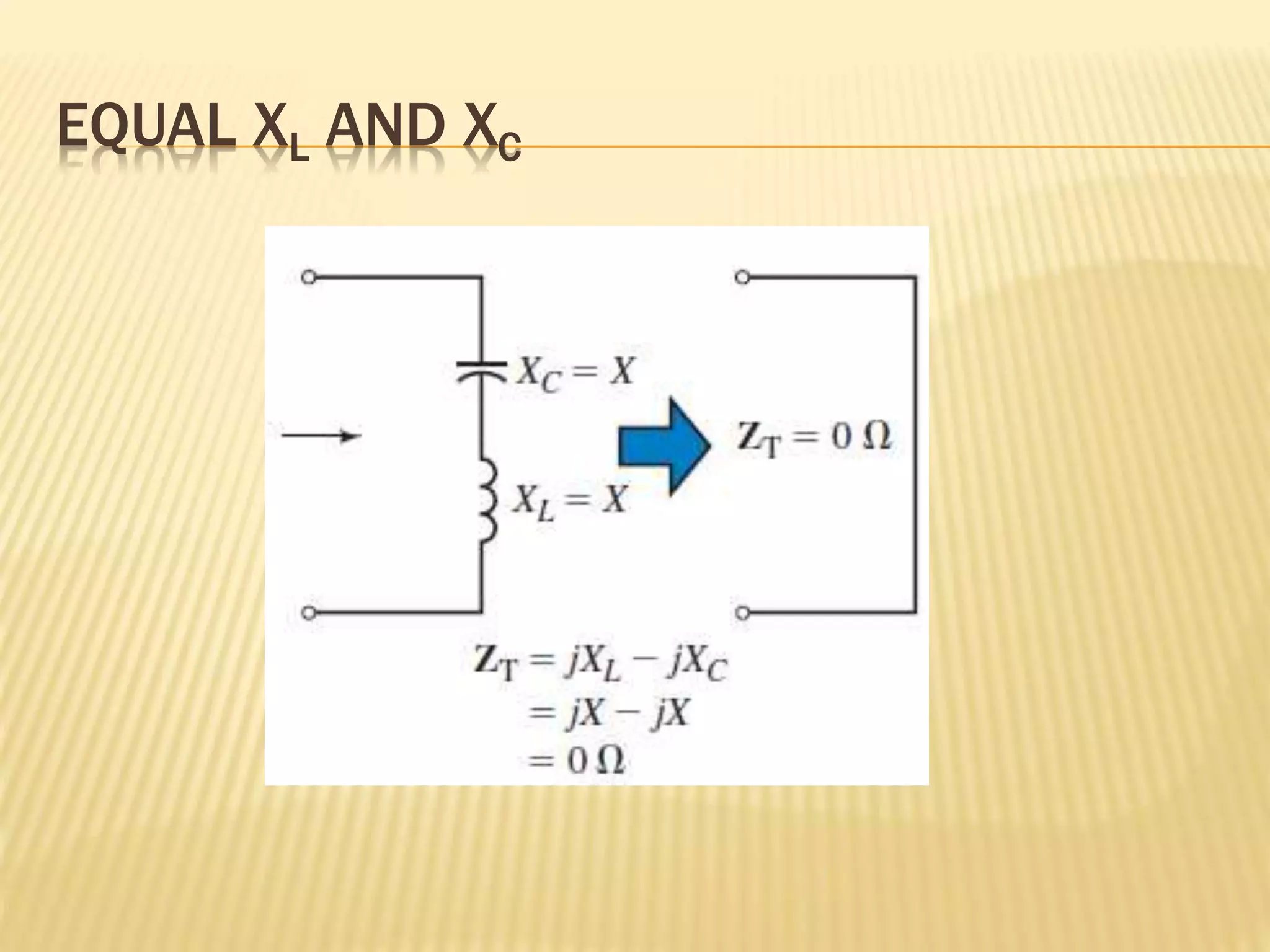
EQUAL XL AND XC
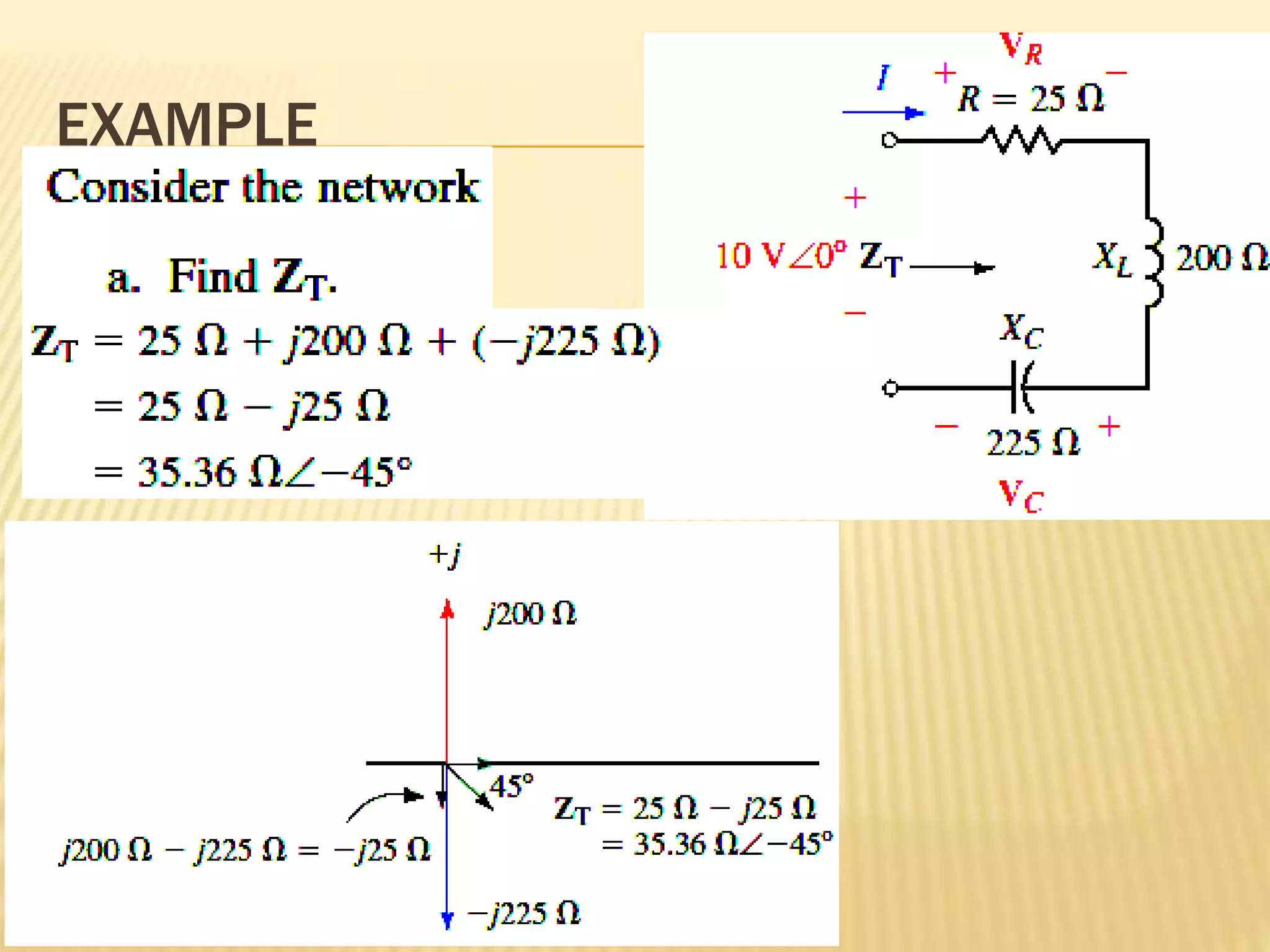
EXAMPLE
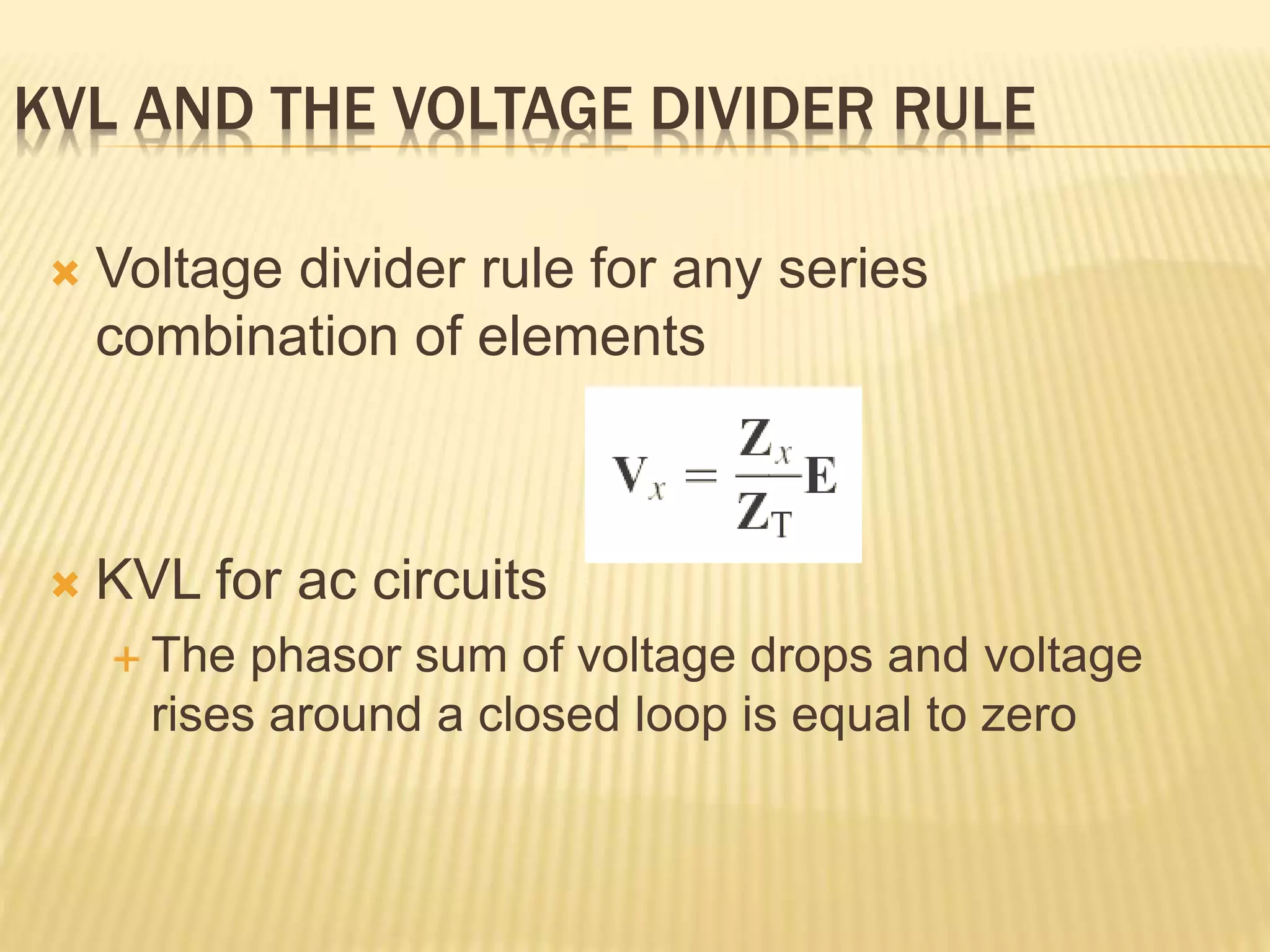
KVL AND THE VOLTAGE DIVIDER RULE
 Voltage divider rule for any series
combination of elements
 KVL for ac circuits
 The phasor sum of voltage drops and voltage
rises around a closed loop is equal to zero
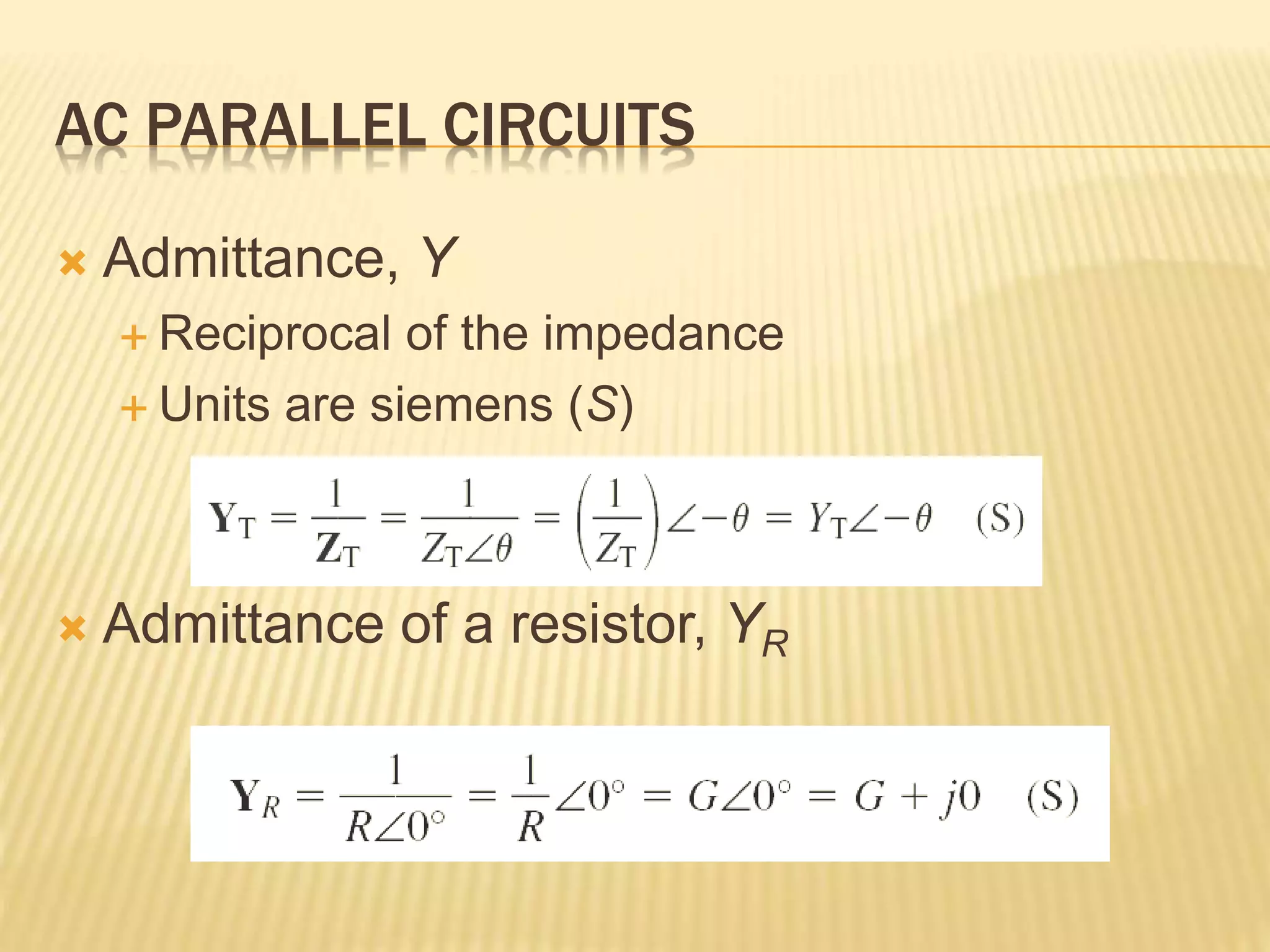
AC PARALLEL CIRCUITS
 Admittance, Y
 Reciprocal of the impedance
 Units are siemens (S)
 Admittance of a resistor, YR
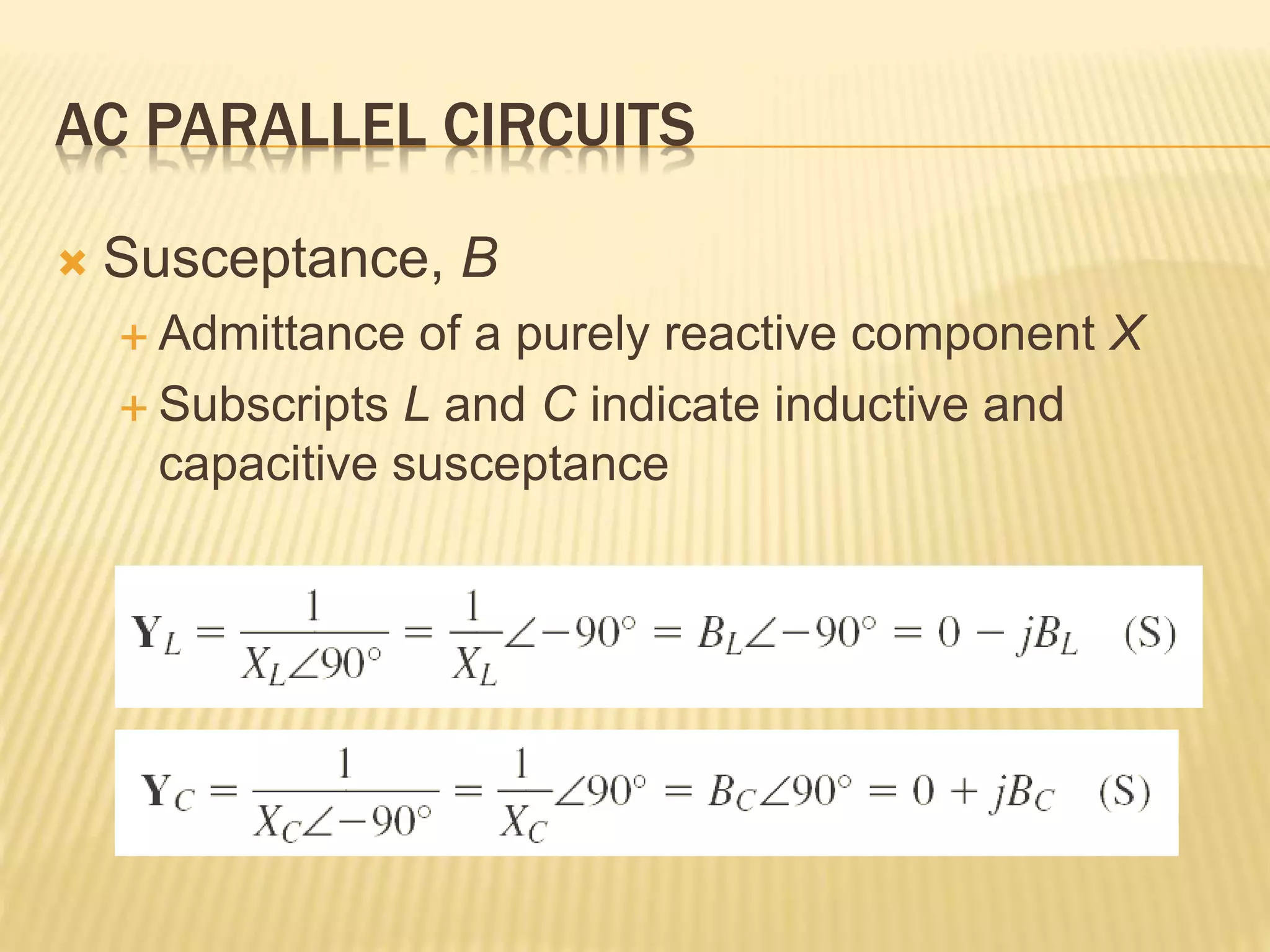
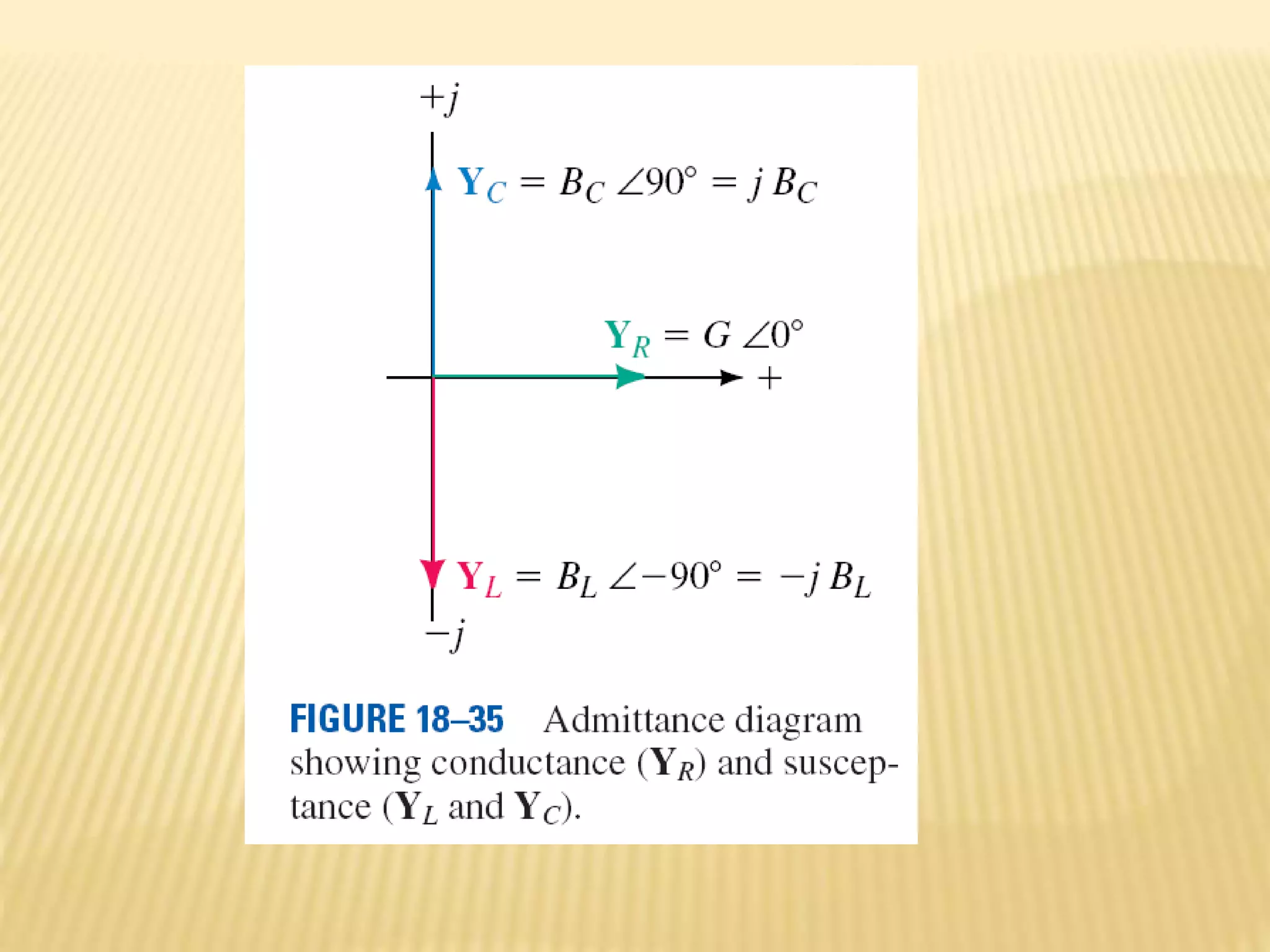
AC PARALLEL CIRCUITS
 Susceptance, B
 Admittance of a purely reactive component X
 Subscripts L and C indicate inductive and
capacitive susceptance
AC PARALLEL CIRCUITS
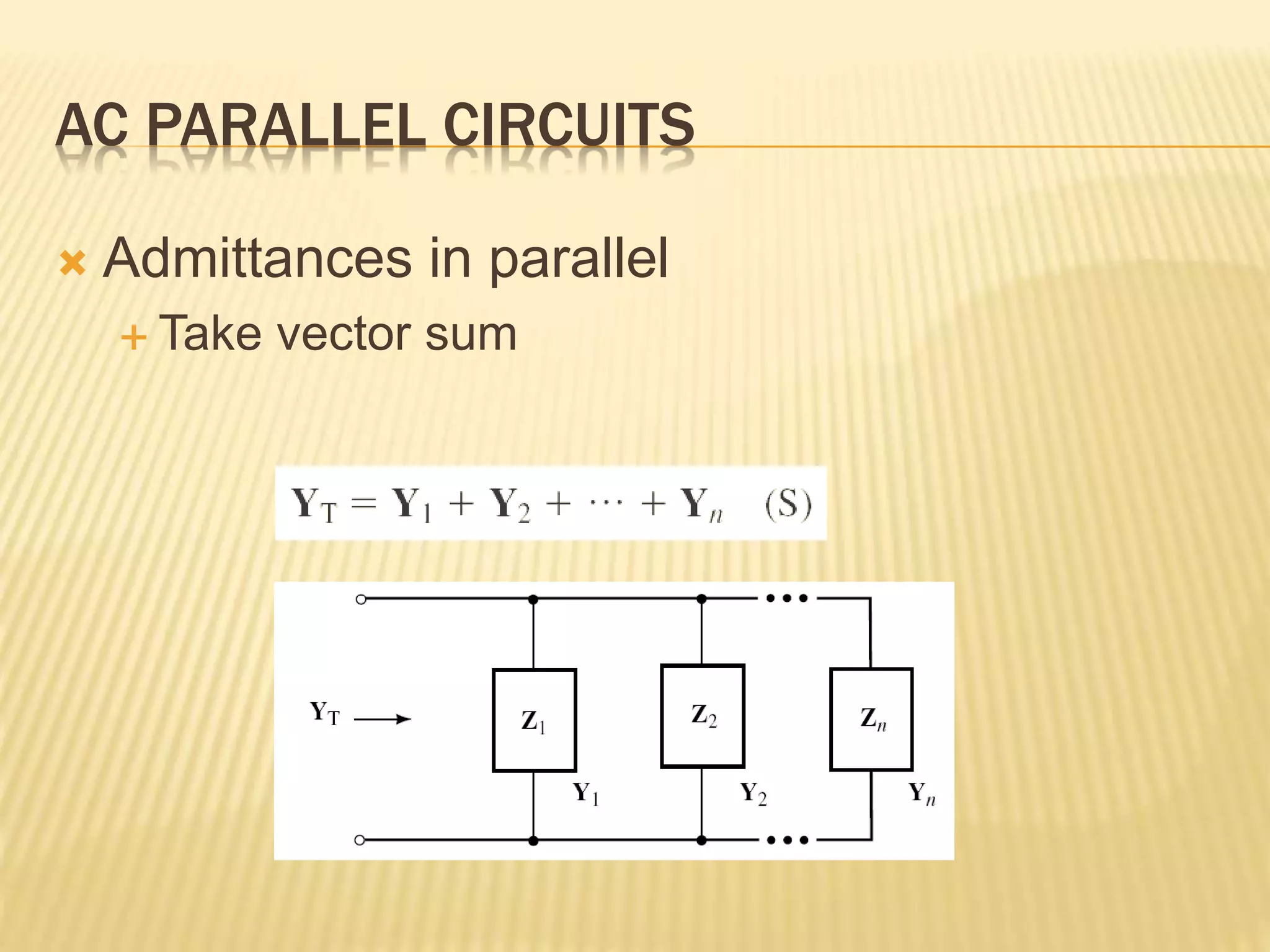
 Admittances in parallel
 Take vector sum
AC PARALLEL CIRCUITS
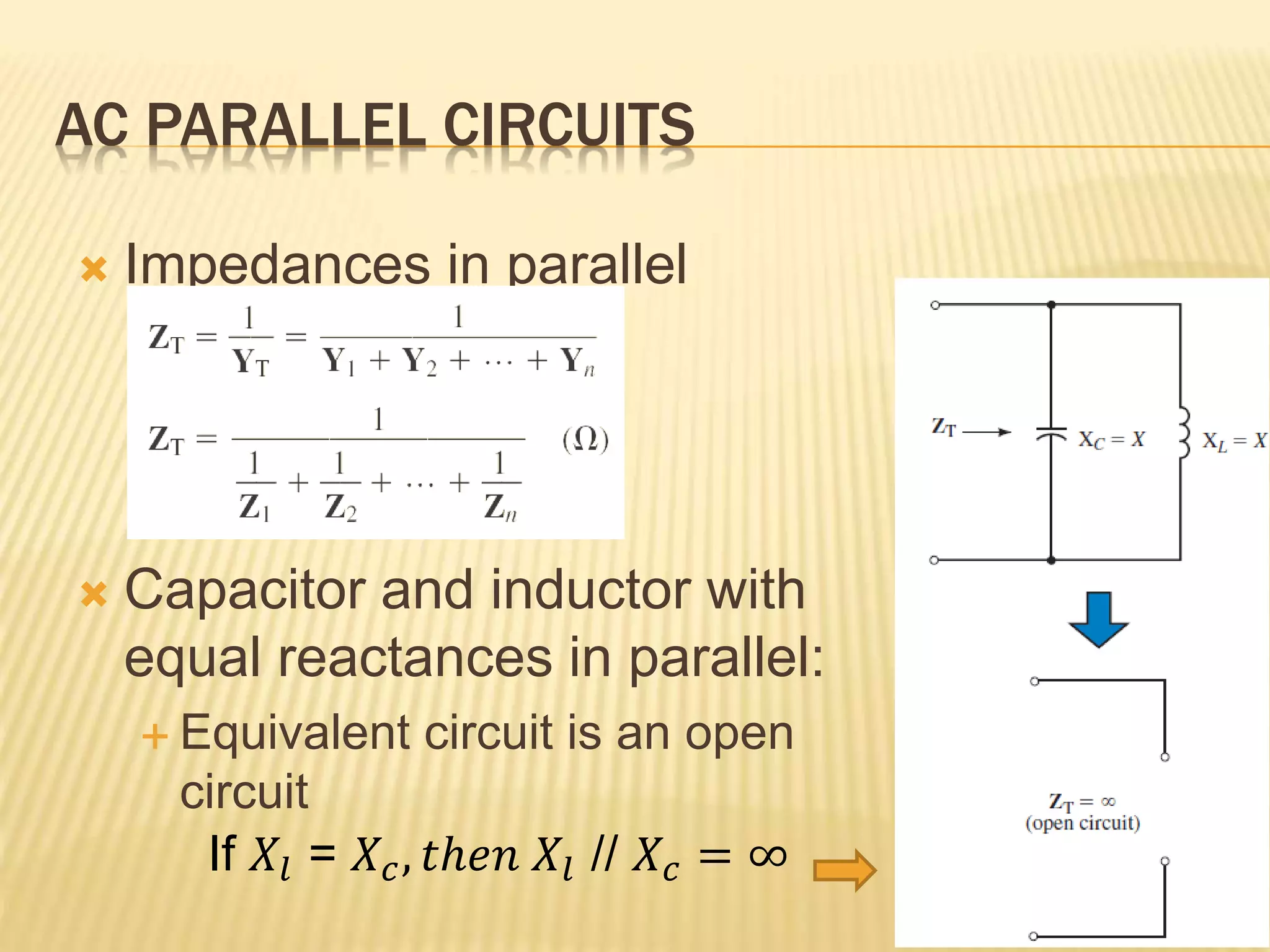
 Impedances in parallel
 Capacitor and inductor with
equal reactances in parallel:
 Equivalent circuit is an open
circuit
If 𝑋𝑙 = 𝑋𝑐, 𝑡ℎ𝑒𝑛 𝑋𝑙 // 𝑋𝑐 = ∞
AC PARALLEL CIRCUITS
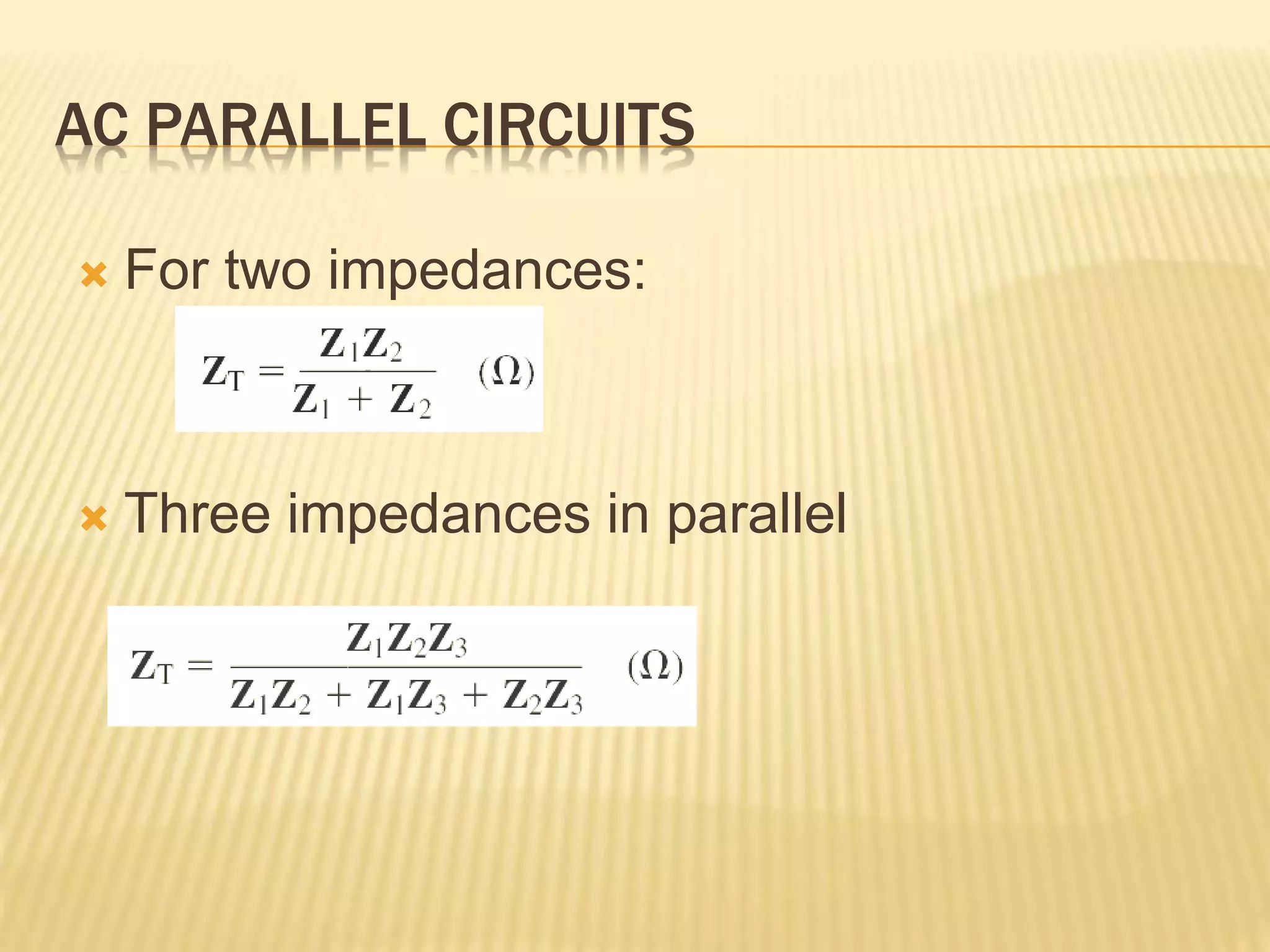
 For two impedances:
 Three impedances in parallel
KCL AND THE CURRENT DIVIDER RULE
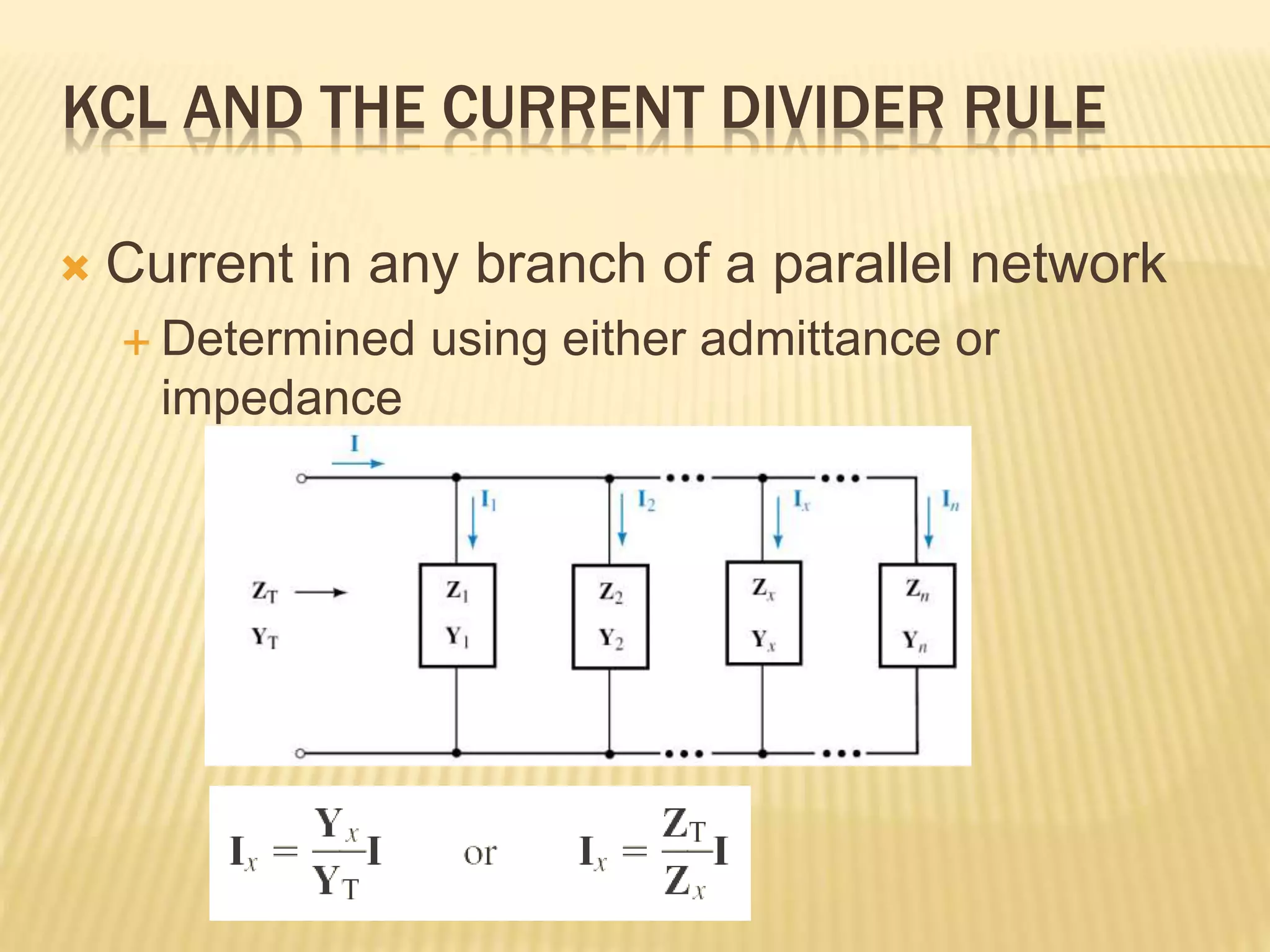
 Current in any branch of a parallel network
 Determined using either admittance or
impedance
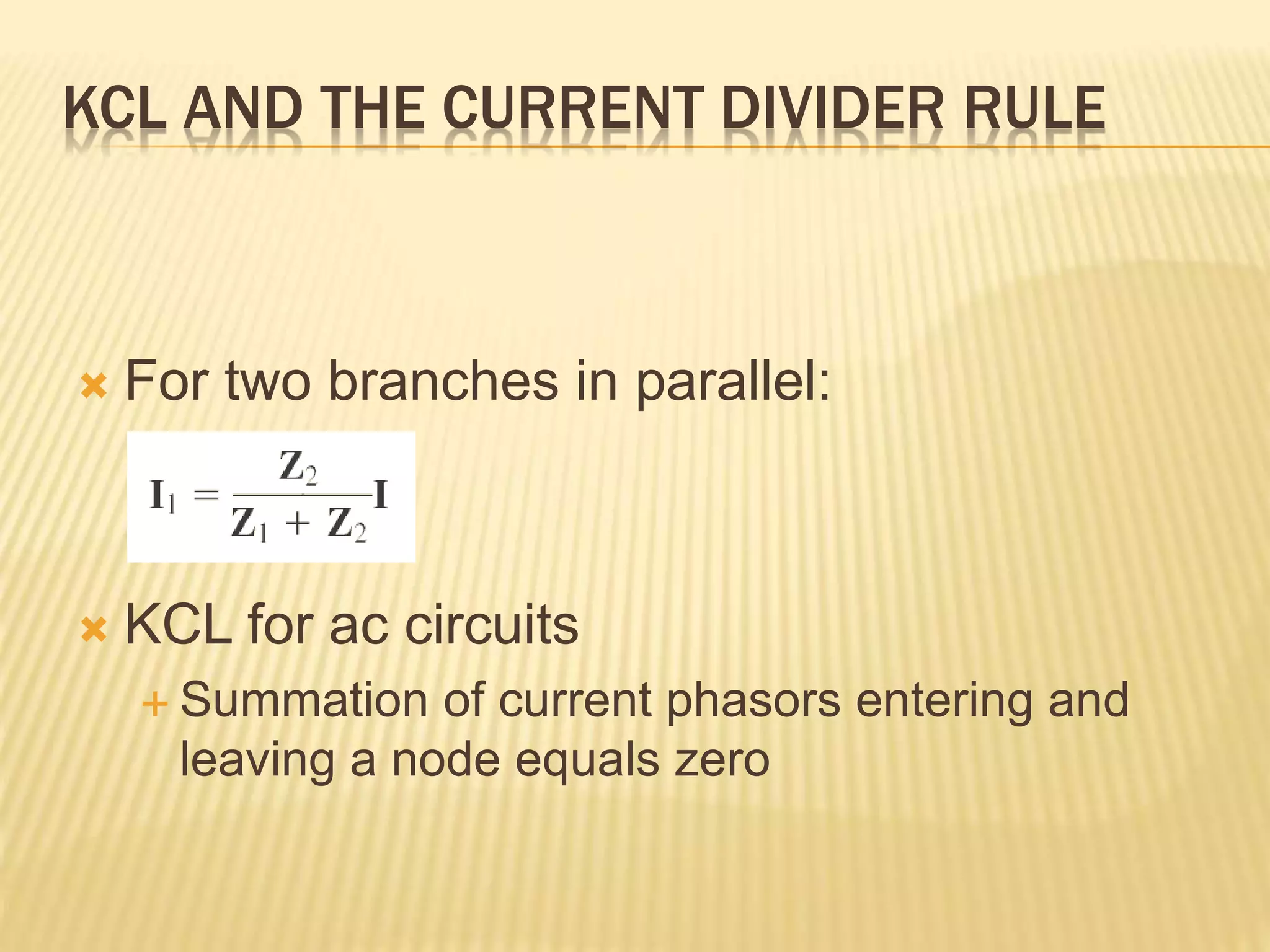
 For two branches in parallel:
 KCL for ac circuits
 Summation of current phasors entering and
leaving a node equals zero
KCL AND THE CURRENT DIVIDER RULE
SERIES-PARALLEL CIRCUITS
 Simplify analysis
 Start with easily recognized combinations
 Redraw circuit if necessary
 Fundamental laws of circuit analysis apply in
all cases
TUTORIAL
AC SERIES-PARALLEL CIRCUITS
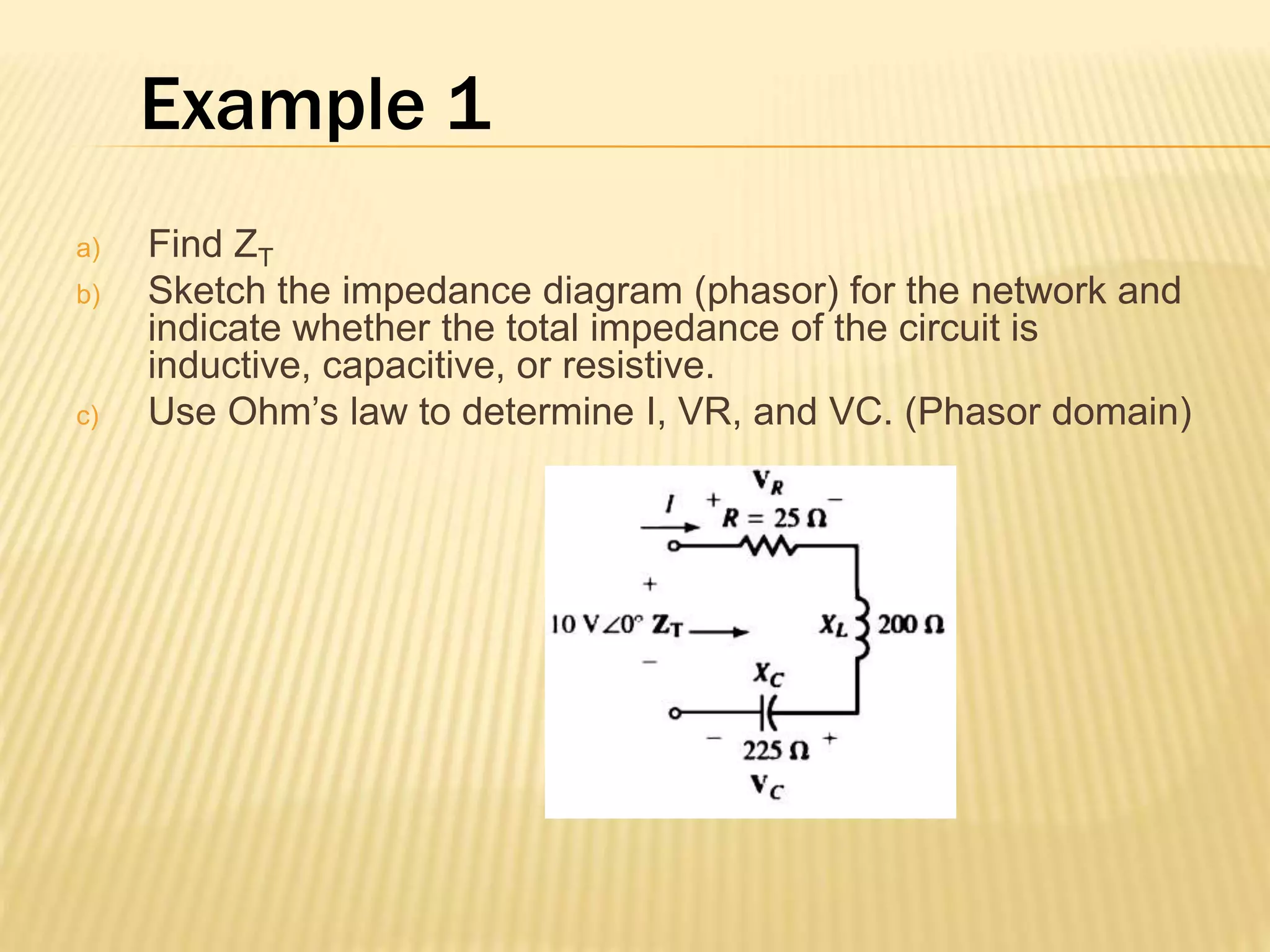
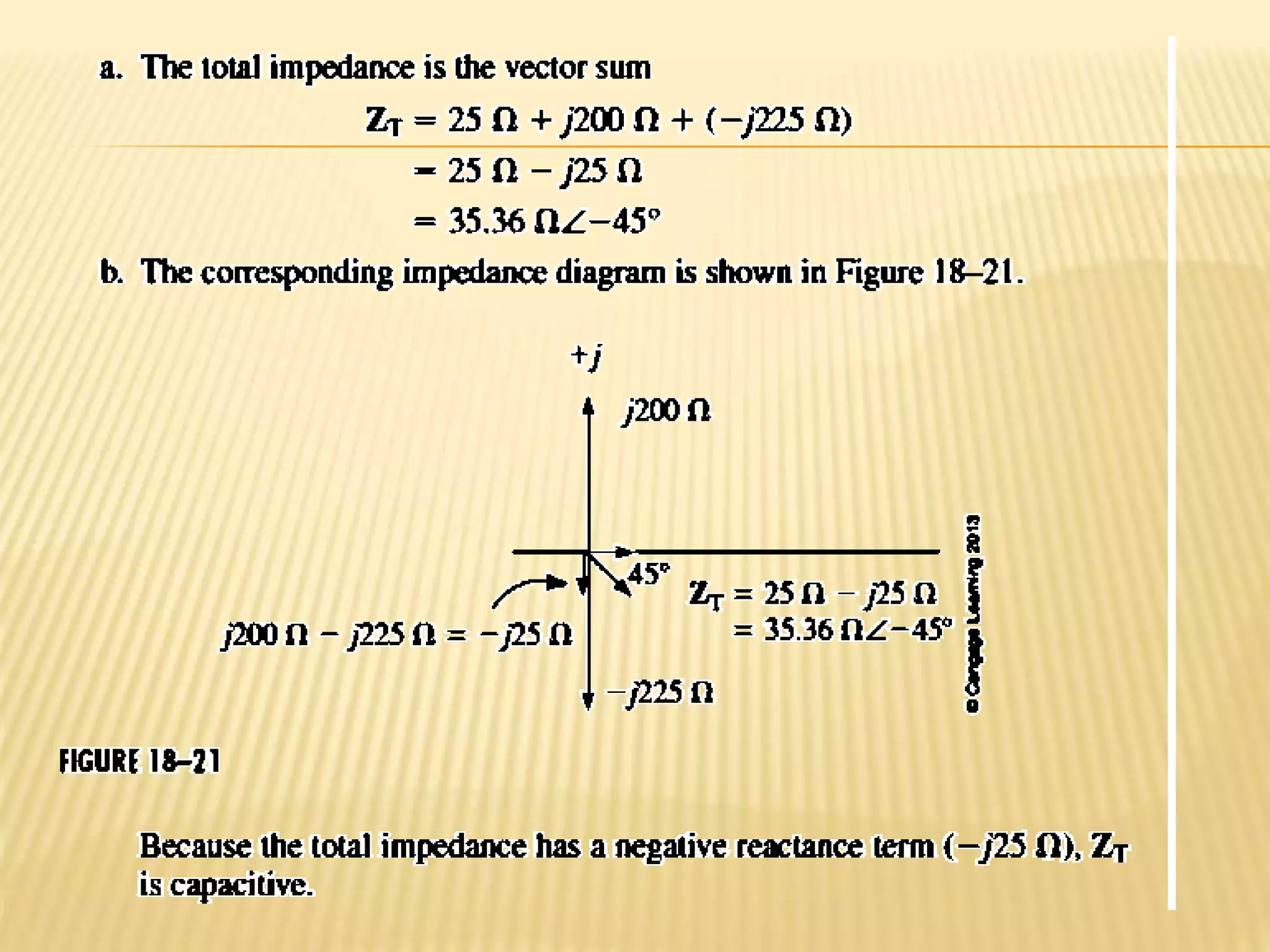
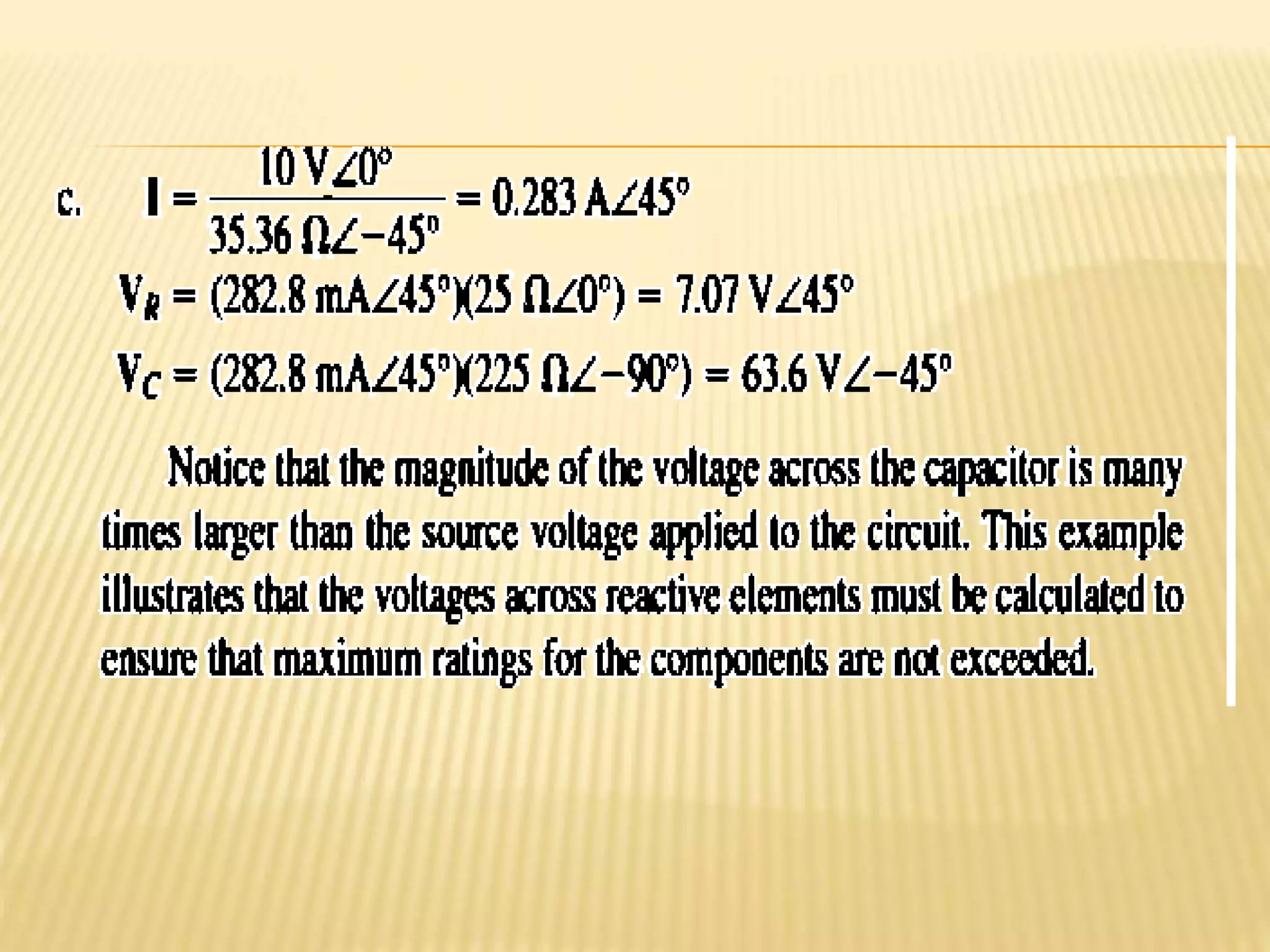
Example 1
a) Find ZT
b) Sketch the impedance diagram (phasor) for the network and
indicate whether the total impedance of the circuit is
inductive, capacitive, or resistive.
c) Use Ohm’s law to determine I, VR, and VC. (Phasor domain)
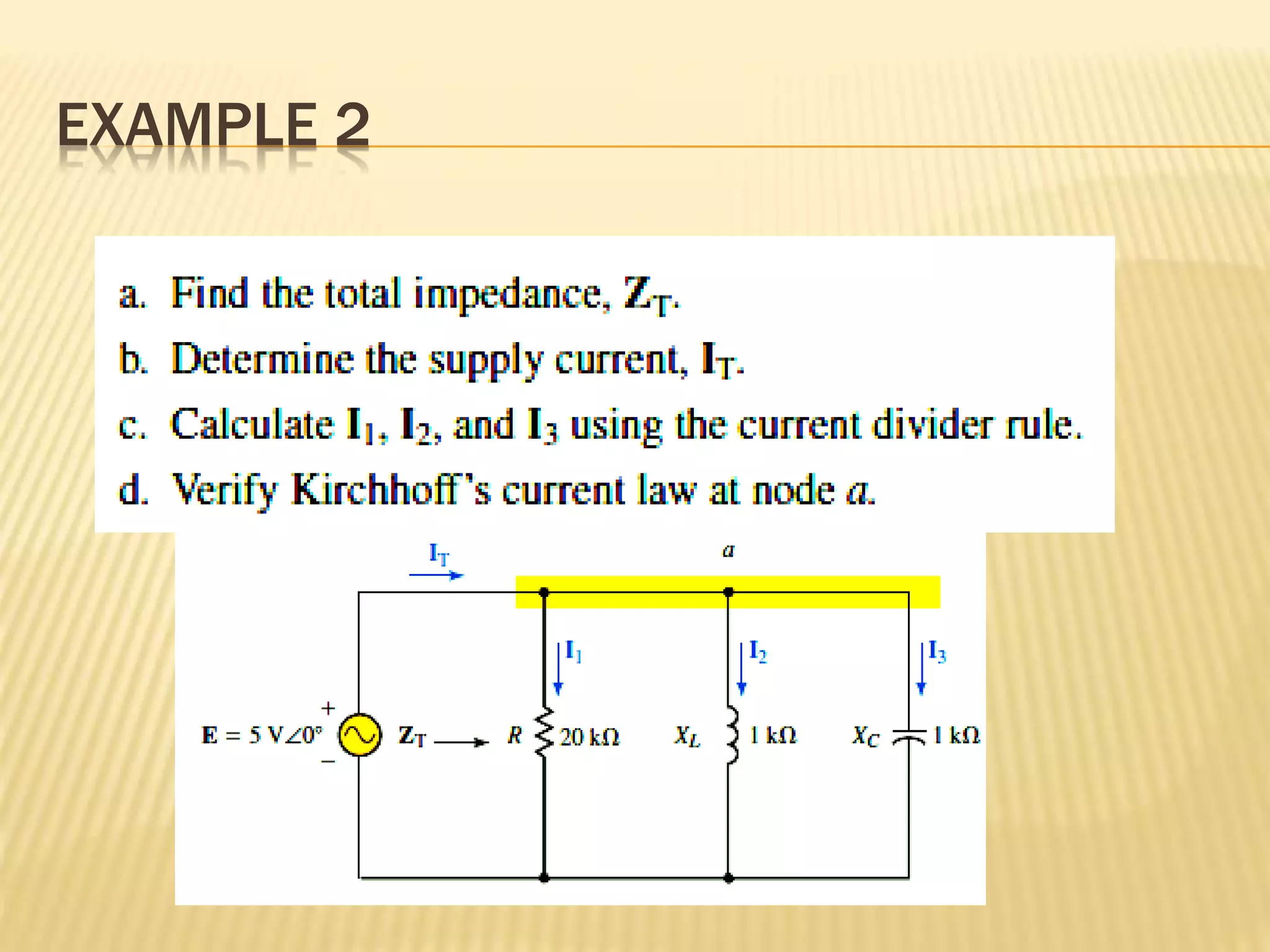
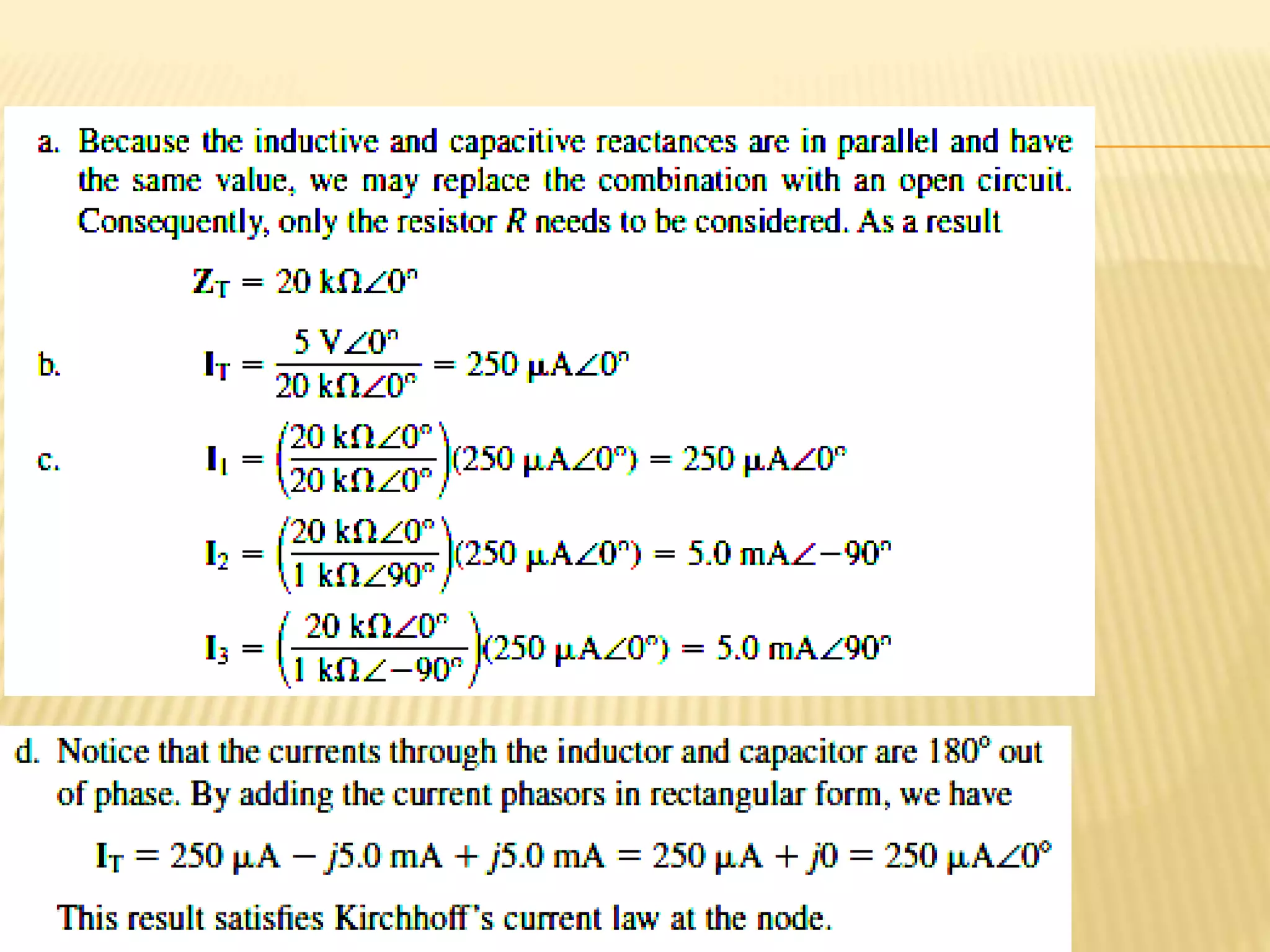
EXAMPLE 2
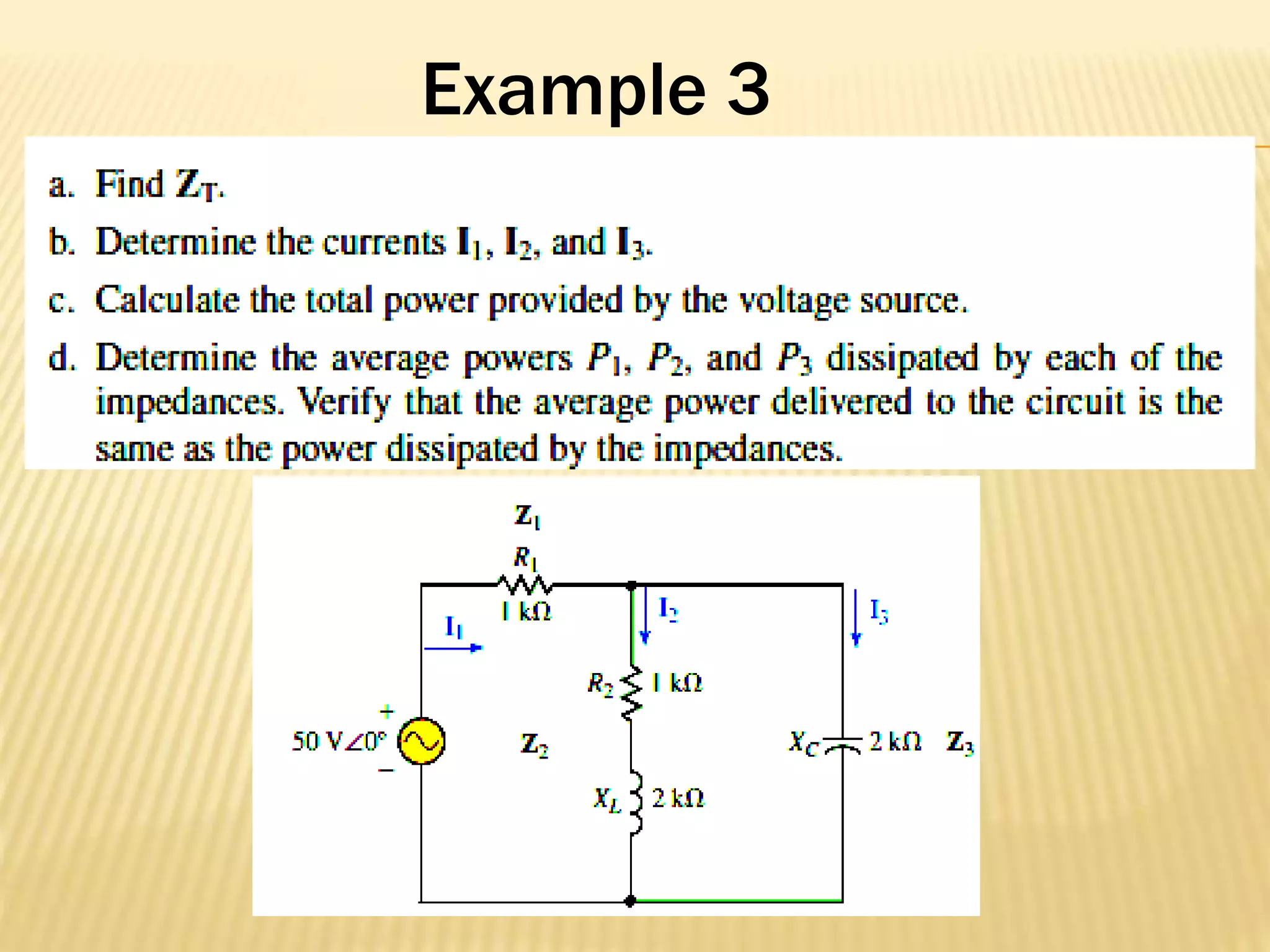
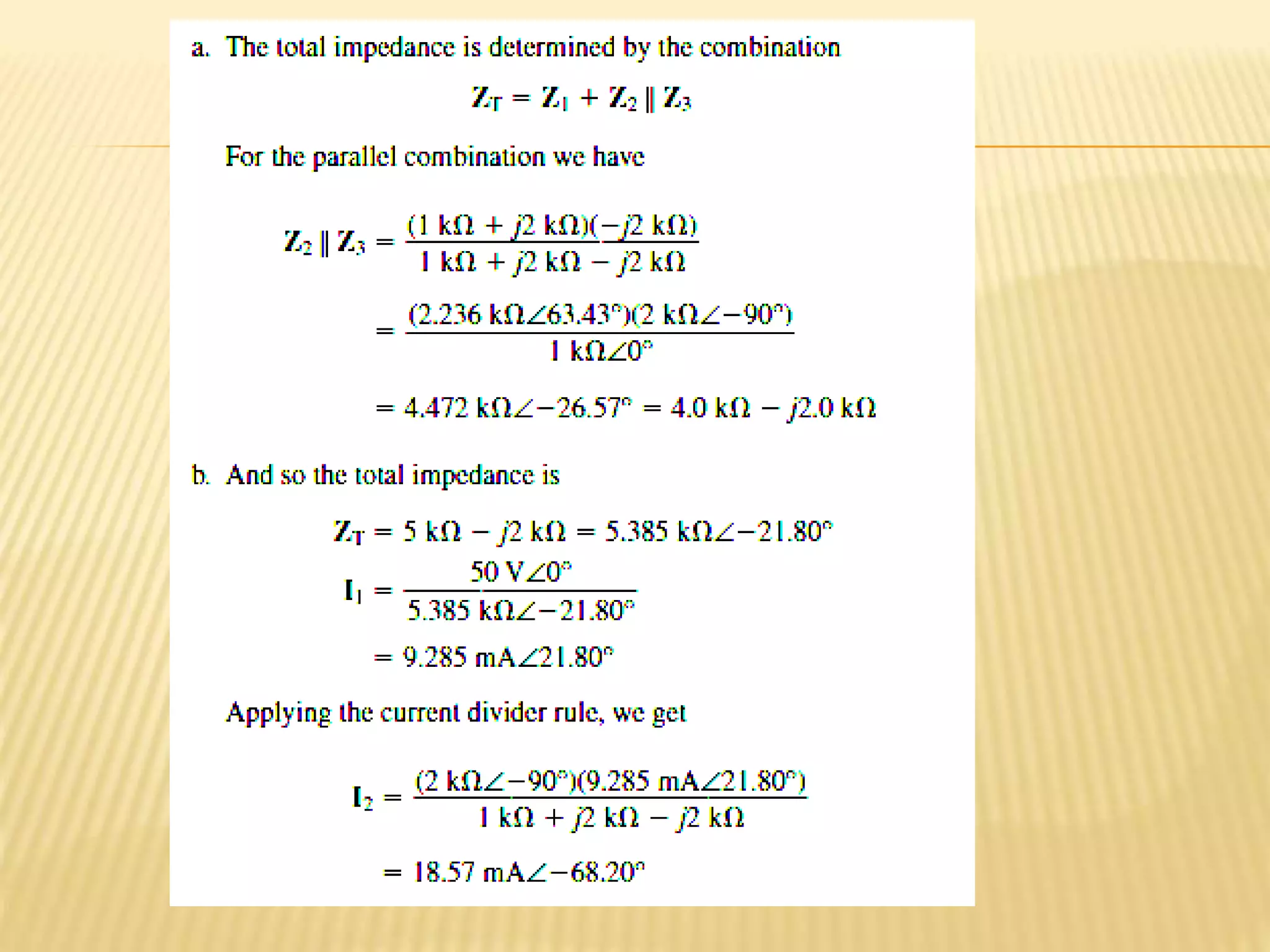
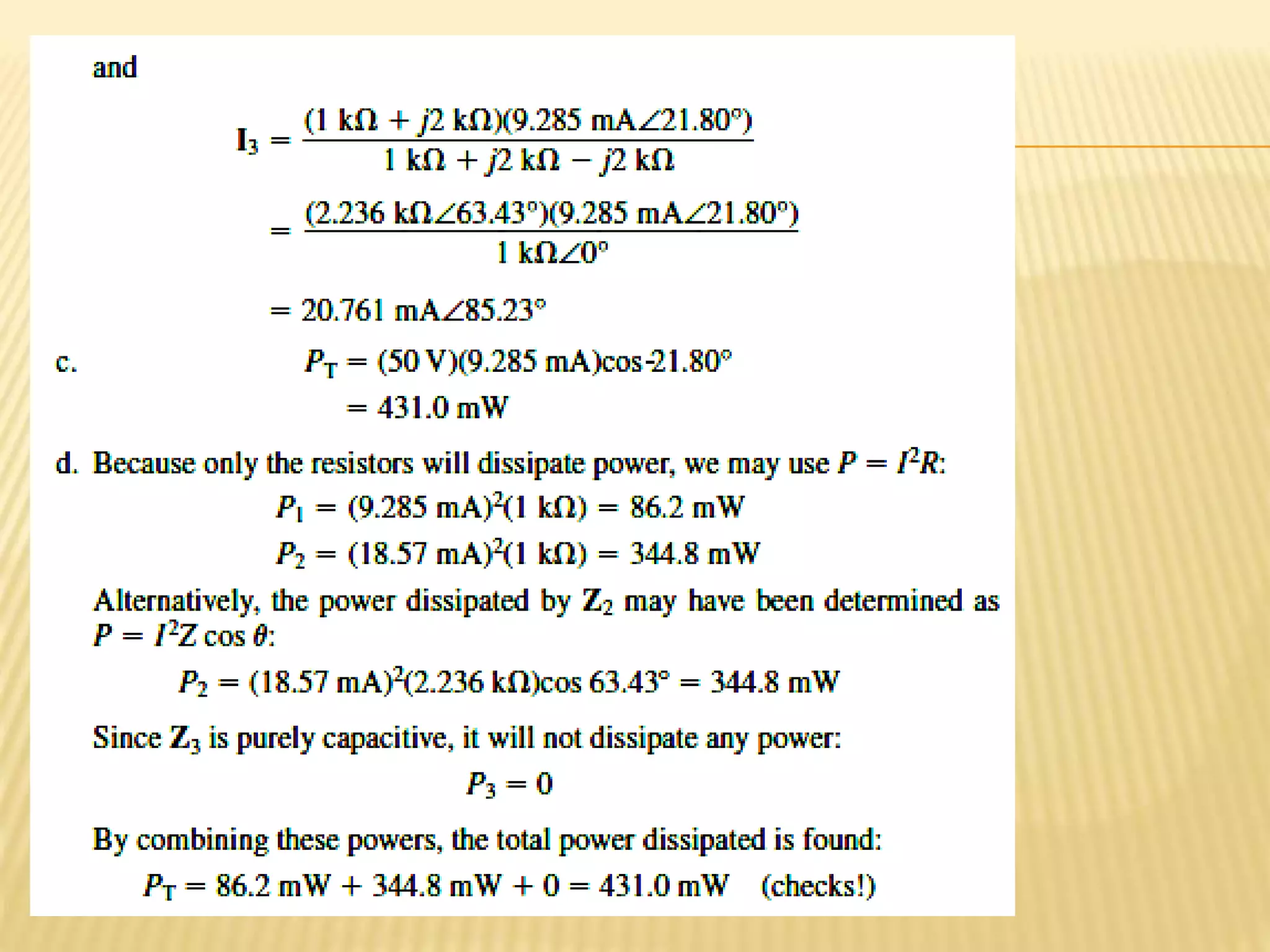
Example 3
-
EXAMPLE 4
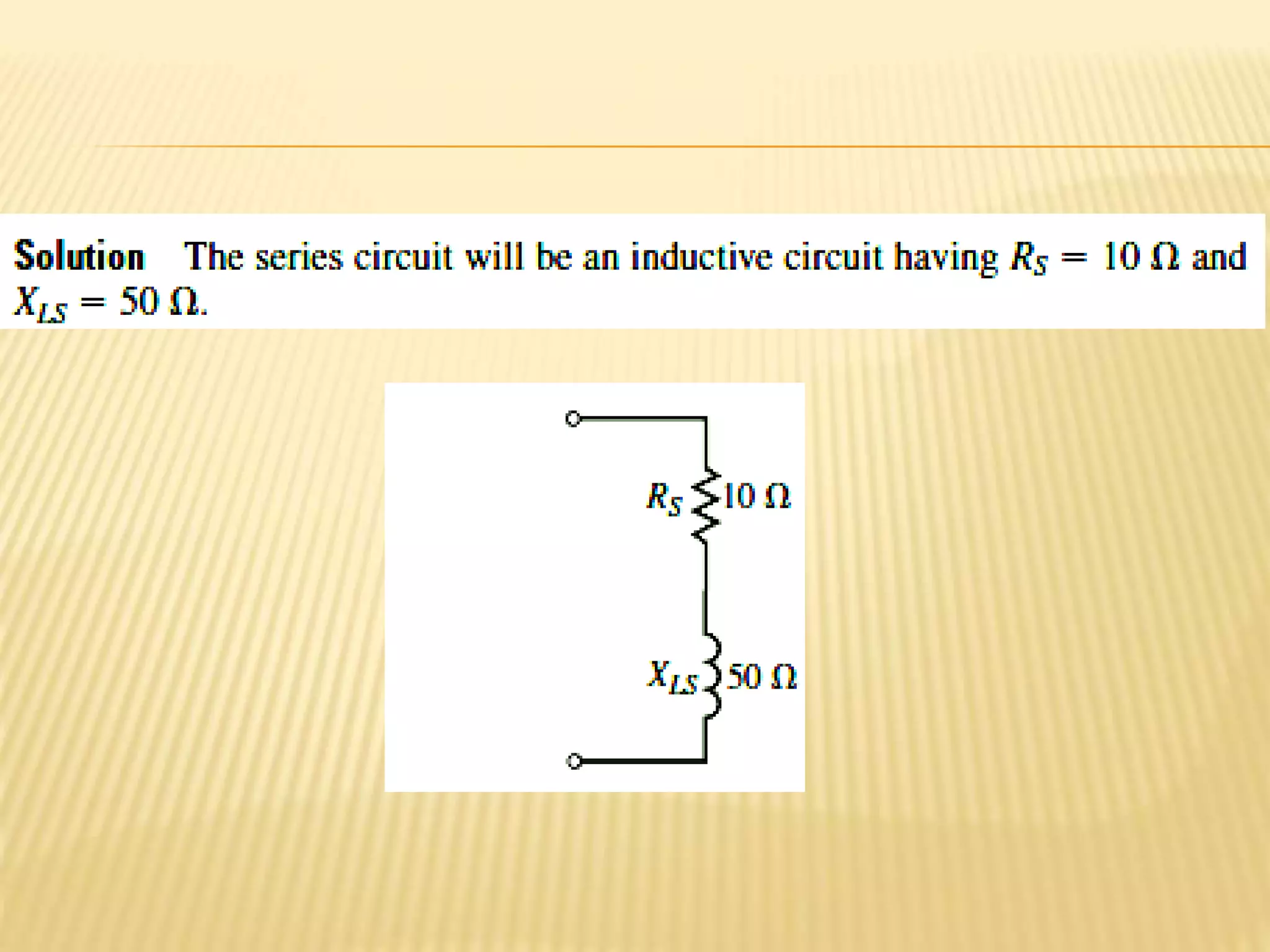
A circuit has a total impedance ZT
=10Ω+j50Ω sketch the equivalent series
circuit
EXAMPLE 5
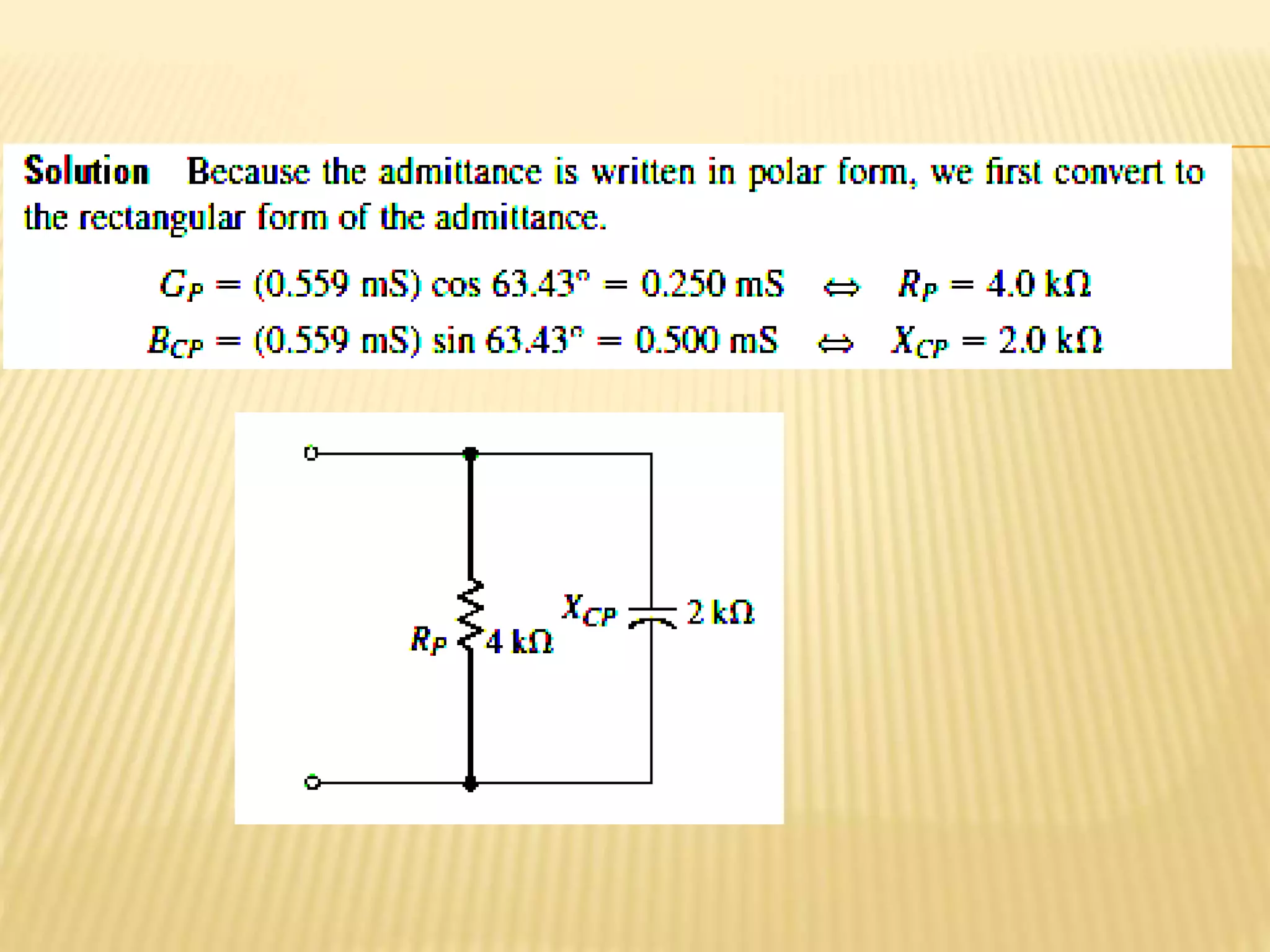
 A circuit has a total impedance YT
=0.559mS∟63.43o sketch the equivalent parallel
circuit
Mobile.pptx

Mobile.pptx

  • 1.
  • 2.
  • 3.
    OHM’S LAW FORAC CIRCUITS  Resistors  Voltage and current through a resistor will always be in phase
  • 4.
    OHM’S LAW FORAC CIRCUITS  Inductors  Current in the inductor may be expressed as:  Where XL = ωL = 2π f L
  • 5.
    OHM’S LAW FORAC CIRCUITS  Capacitors  Current in the capacitor may be expressed as:  Where:
  • 6.
    AC SERIES CIRCUITS Current everywhere in a series circuit is the same  Impedance  Term used to collectively determine how resistance, capacitance, and inductance impede current in a circuit
  • 7.
    AC SERIES CIRCUITS Impedance diagram  Total impedance in a circuit  Found by adding individual impedances vectorially
  • 8.
    AC SERIES CIRCUITS Impedance vectors will appear in either the first or fourth quadrants:  Because the resistance vector is always positive -
  • 9.
    AC SERIES CIRCUITS If impedance vector appears in fourth quadrant:  Circuit is capacitive  If impedance vector appears in first quadrant:  Impedance is inductive  Resistive circuit  Total impedance has only a real component
  • 10.
  • 11.
  • 12.
  • 13.
  • 14.
    KVL AND THEVOLTAGE DIVIDER RULE  Voltage divider rule for any series combination of elements  KVL for ac circuits  The phasor sum of voltage drops and voltage rises around a closed loop is equal to zero
  • 15.
    AC PARALLEL CIRCUITS Admittance, Y  Reciprocal of the impedance  Units are siemens (S)  Admittance of a resistor, YR
  • 16.
    AC PARALLEL CIRCUITS Susceptance, B  Admittance of a purely reactive component X  Subscripts L and C indicate inductive and capacitive susceptance
  • 18.
    AC PARALLEL CIRCUITS Admittances in parallel  Take vector sum
  • 19.
    AC PARALLEL CIRCUITS Impedances in parallel  Capacitor and inductor with equal reactances in parallel:  Equivalent circuit is an open circuit If 𝑋𝑙 = 𝑋𝑐, 𝑡ℎ𝑒𝑛 𝑋𝑙 // 𝑋𝑐 = ∞
  • 20.
    AC PARALLEL CIRCUITS For two impedances:  Three impedances in parallel
  • 21.
    KCL AND THECURRENT DIVIDER RULE  Current in any branch of a parallel network  Determined using either admittance or impedance
  • 22.
     For twobranches in parallel:  KCL for ac circuits  Summation of current phasors entering and leaving a node equals zero KCL AND THE CURRENT DIVIDER RULE
  • 23.
    SERIES-PARALLEL CIRCUITS  Simplifyanalysis  Start with easily recognized combinations  Redraw circuit if necessary  Fundamental laws of circuit analysis apply in all cases
  • 24.
  • 25.
    Example 1 a) FindZT b) Sketch the impedance diagram (phasor) for the network and indicate whether the total impedance of the circuit is inductive, capacitive, or resistive. c) Use Ohm’s law to determine I, VR, and VC. (Phasor domain)
  • 28.
  • 30.
  • 32.
  • 33.
    EXAMPLE 4 A circuithas a total impedance ZT =10Ω+j50Ω sketch the equivalent series circuit
  • 35.
    EXAMPLE 5  Acircuit has a total impedance YT =0.559mS∟63.43o sketch the equivalent parallel circuit