Michael Riggs
Knowledge and Information Management Officer
Food and Agriculture Organization of the United Nations (FAO)
michael.riggs@fao.org @mongkolroek
A global Community of Practice.
People networking, and exchanging information,
ideas and resources on the use of information
and communication technologies (ICT) for
sustainable agriculture and food security.
About e-Agriculture
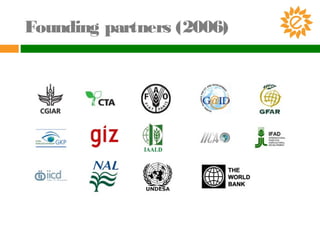
Founding partners (2006)
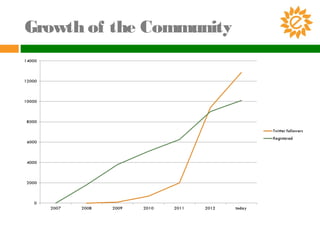
Growth of the Community
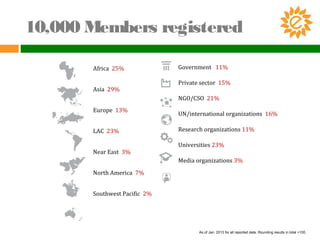
10,000 Members registered
Government 11%
Private sector 15%
NGO/CSO 21%
UN/international organizations 16%
Research organizations 11%
Universities 23%
Media organizations 3%
Africa 25%
Asia 29%
Europe 13%
LAC 23%
Near East 3%
North America 7%
Southwest Pacific 2%
As of Jan. 2013 for all reported data. Rounding results in total >100.
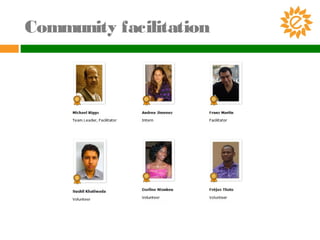
Community facilitation
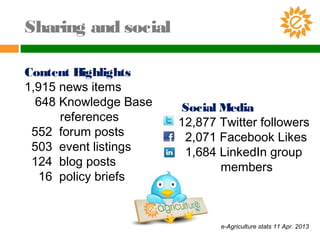
Social Media
12,877 Twitter followers
2,071 Facebook Likes
1,684 LinkedIn group
members
Content Highlights
1,915 news items
648 Knowledge Base
references
552 forum posts
503 event listings
124 blog posts
16 policy briefs
e-Agriculture stats 11 Apr. 2013
Sharing and social
http://www.e-agriculture.org/agricultural-value-chains-and-ict
Key Topic: Value Chains
Mobile Technologies
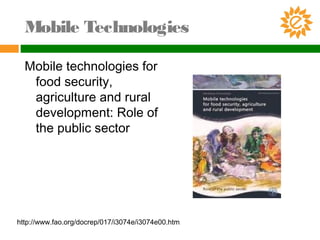
Mobile technologies for
food security,
agriculture and rural
development: Role of
the public sector
http://www.fao.org/docrep/017/i3074e/i3074e00.htm
Discussing these Issues
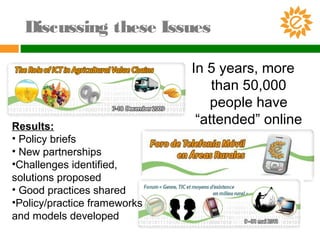
In 5 years, more
than 50,000
people have
“attended” online
discussions.
Results:
• Policy briefs
• New partnerships
•Challenges identified,
solutions proposed
• Good practices shared
•Policy/practice frameworks
and models developed
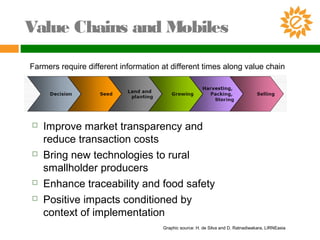
Value Chains and Mobiles
 Improve market transparency and
reduce transaction costs
 Bring new technologies to rural
smallholder producers
 Enhance traceability and food safety
 Positive impacts conditioned by
context of implementation
Graphic source: H. de Silva and D. Ratnadiwakara, LIRNEasia
Farmers require different information at different times along value chain
Why Focus on Mobiles
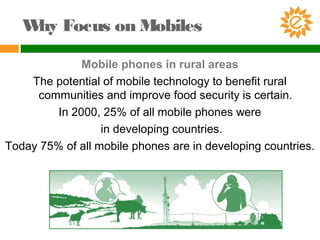
Mobile phones in rural areas
The potential of mobile technology to benefit rural
communities and improve food security is certain.
In 2000, 25% of all mobile phones were
in developing countries.
Today 75% of all mobile phones are in developing countries.
Mobile Information Services
MOBILE INFORMATION SERVICES: The Benefits of Forming Strong
Partnerships to Create Sustainable and Scalable Information Advisory
Services
Online Disucssion Forum 21 November - 2 December 2011
www.e-agriculture.org/forums/forum-archive
 The e-Agriculture Community and the mFarmer Initiative forum discuss
types of partnerships that are conducive to creating sustainable and
scalable mobile information and advisory services for farmers.
 mFarmer: partnership between GSMA, USAID and the Bill and Melinda
Gates Foundation set up to support mobile operators and agricultural
partners in launching mobile information services that benefit farmers and
are commercially viable.
mAgri = mobile agricultural information service
 What value does mobile network operator
(MNO) and agricultural partner bring to mAgri?
 Understand strengths and leverage
 Roles clearly defined
 2 models for mAgri, but which is better?
 MNO integrates mAgri in their own service
portfolio
 MNO only provides infrastructure and revenue
sharing as a business contract
Mobile Information Services
 MNO
 Provide telecom network (including reach into
underserved regions/areas)
 Marketing and communication along with other
services available through network
 Bundle with complimentary services, e.g. mobile
money
 Generating, collecting and sharing revenue with
agricultural partner
 Opportunity for USSD (Unstructured
Supplementary Service Data) in addition to SMS
Mobile Information Services
 Agricultural partner
 Ability to identify target farmers and their information
needs
 Reputation that farmers value, adding to value of
information service
 Understanding format(s) best suited for collection and
delivery of information (voice/IVR, text, etc.)
 Collect, analyse, refine and make available relevant
agricultural information
 Market information services in the field
 Convince MNO that mAgri can be real business
Mobile Information Services
 Need for a third party in mAgri
 Formatting of content
 Quality assurance of content
 Provide a technology platform to create a format
the MNO can use from the agricultural partner’s
content
 Partnerships with more than one MNO?
 Difficult until value of mAgri better understood
 May provide best value to consumer (i.e. farmers)
 Requires skill in agricultural partner to support
MNOs’ need for differentiation
Mobile Information Services
 Challenges in the partnership relationship
 Size of MNO vs. agricultural partner
 unbalanced bargaining power/relationship
 MNO may be unwilling to work directly with
agricultural partner
 MNO needs large scale quickly
 Agricultural partner focus on “needs assessment”
vs. MNO focus on “demand analysis”
Mobile Information Services
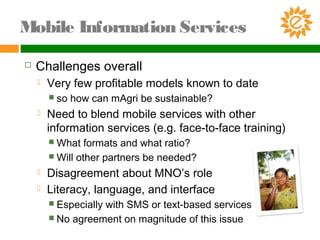
 Challenges overall
 Very few profitable models known to date
 so how can mAgri be sustainable?
 Need to blend mobile services with other
information services (e.g. face-to-face training)
 What formats and what ratio?
 Will other partners be needed?
 Disagreement about MNO’s role
 Literacy, language, and interface
 Especially with SMS or text-based services
 No agreement on magnitude of this issue
Mobile Information Services
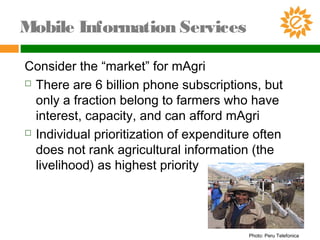
Consider the “market” for mAgri
 There are 6 billion phone subscriptions, but
only a fraction belong to farmers who have
interest, capacity, and can afford mAgri
 Individual prioritization of expenditure often
does not rank agricultural information (the
livelihood) as highest priority
Mobile Information Services
Photo: Peru Telefonica
Direct to farmer vs. intermediary services
 Ideal mAgri service is direct to farmer, but
requires all have mobiles AND capacity to act
on available information
 Role of intermediaries (e.g. Grameen
Foundation’s CKW) exists
 Intermediaries (e.g. cooperatives) or subsidies
(e.g. government support) can also make
information services available to poorest,
though probably not on an individual basis
Mobile Information Services
 Barrier to reaching scale is conflict of:
 Farmers’ cost sensitivity
 MNO’s need for volume
 Cost of providing quality, localized information
 IKSL has achieved scale
 Partnership of Bharti Airtel and IFFCO
 IFFCO widely known and trusted by farmers
 IFFCO very large with significant farm-level
linkages
 Can two partners like this be found elsewhere?
Mobile Information Services
Opportunities and future trends:
 SMS fades as data costs fall (allowing voice
and rich data to expand)
 A question of “when?”, not “if”
 Roles of information producers and owners
clarified (hopefully)
 May separate MNO from VAS provider (as history
shows in developed countries)
 Research into low cost and low energy
solutions for both handsets and networks
Mobile Information Services
Opportunities and future trends (cont.):
 Awareness and capacity development at
individual level are critical
 Mobilization of local content based on farmers’
innovation and knowledge
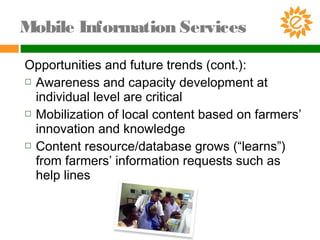
 Content resource/database grows (“learns”)
from farmers’ information requests such as
help lines
Mobile Information Services
www.e-agriculture.org

Mobile phones and agricultural value chains

  • 1.
    Michael Riggs Knowledge andInformation Management Officer Food and Agriculture Organization of the United Nations (FAO) michael.riggs@fao.org @mongkolroek
  • 2.
    A global Communityof Practice. People networking, and exchanging information, ideas and resources on the use of information and communication technologies (ICT) for sustainable agriculture and food security. About e-Agriculture
  • 3.
  • 4.
    Growth of theCommunity
  • 5.
    10,000 Members registered Government11% Private sector 15% NGO/CSO 21% UN/international organizations 16% Research organizations 11% Universities 23% Media organizations 3% Africa 25% Asia 29% Europe 13% LAC 23% Near East 3% North America 7% Southwest Pacific 2% As of Jan. 2013 for all reported data. Rounding results in total >100.
  • 6.
  • 7.
    Social Media 12,877 Twitterfollowers 2,071 Facebook Likes 1,684 LinkedIn group members Content Highlights 1,915 news items 648 Knowledge Base references 552 forum posts 503 event listings 124 blog posts 16 policy briefs e-Agriculture stats 11 Apr. 2013 Sharing and social
  • 8.
  • 12.
    Mobile Technologies Mobile technologiesfor food security, agriculture and rural development: Role of the public sector http://www.fao.org/docrep/017/i3074e/i3074e00.htm
  • 13.
    Discussing these Issues In5 years, more than 50,000 people have “attended” online discussions. Results: • Policy briefs • New partnerships •Challenges identified, solutions proposed • Good practices shared •Policy/practice frameworks and models developed
  • 14.
    Value Chains andMobiles  Improve market transparency and reduce transaction costs  Bring new technologies to rural smallholder producers  Enhance traceability and food safety  Positive impacts conditioned by context of implementation Graphic source: H. de Silva and D. Ratnadiwakara, LIRNEasia Farmers require different information at different times along value chain
  • 15.
    Why Focus onMobiles Mobile phones in rural areas The potential of mobile technology to benefit rural communities and improve food security is certain. In 2000, 25% of all mobile phones were in developing countries. Today 75% of all mobile phones are in developing countries.
  • 16.
    Mobile Information Services MOBILEINFORMATION SERVICES: The Benefits of Forming Strong Partnerships to Create Sustainable and Scalable Information Advisory Services Online Disucssion Forum 21 November - 2 December 2011 www.e-agriculture.org/forums/forum-archive  The e-Agriculture Community and the mFarmer Initiative forum discuss types of partnerships that are conducive to creating sustainable and scalable mobile information and advisory services for farmers.  mFarmer: partnership between GSMA, USAID and the Bill and Melinda Gates Foundation set up to support mobile operators and agricultural partners in launching mobile information services that benefit farmers and are commercially viable.
  • 17.
    mAgri = mobileagricultural information service  What value does mobile network operator (MNO) and agricultural partner bring to mAgri?  Understand strengths and leverage  Roles clearly defined  2 models for mAgri, but which is better?  MNO integrates mAgri in their own service portfolio  MNO only provides infrastructure and revenue sharing as a business contract Mobile Information Services
  • 18.
     MNO  Providetelecom network (including reach into underserved regions/areas)  Marketing and communication along with other services available through network  Bundle with complimentary services, e.g. mobile money  Generating, collecting and sharing revenue with agricultural partner  Opportunity for USSD (Unstructured Supplementary Service Data) in addition to SMS Mobile Information Services
  • 19.
     Agricultural partner Ability to identify target farmers and their information needs  Reputation that farmers value, adding to value of information service  Understanding format(s) best suited for collection and delivery of information (voice/IVR, text, etc.)  Collect, analyse, refine and make available relevant agricultural information  Market information services in the field  Convince MNO that mAgri can be real business Mobile Information Services
  • 20.
     Need fora third party in mAgri  Formatting of content  Quality assurance of content  Provide a technology platform to create a format the MNO can use from the agricultural partner’s content  Partnerships with more than one MNO?  Difficult until value of mAgri better understood  May provide best value to consumer (i.e. farmers)  Requires skill in agricultural partner to support MNOs’ need for differentiation Mobile Information Services
  • 21.
     Challenges inthe partnership relationship  Size of MNO vs. agricultural partner  unbalanced bargaining power/relationship  MNO may be unwilling to work directly with agricultural partner  MNO needs large scale quickly  Agricultural partner focus on “needs assessment” vs. MNO focus on “demand analysis” Mobile Information Services
  • 22.
     Challenges overall Very few profitable models known to date  so how can mAgri be sustainable?  Need to blend mobile services with other information services (e.g. face-to-face training)  What formats and what ratio?  Will other partners be needed?  Disagreement about MNO’s role  Literacy, language, and interface  Especially with SMS or text-based services  No agreement on magnitude of this issue Mobile Information Services
  • 23.
    Consider the “market”for mAgri  There are 6 billion phone subscriptions, but only a fraction belong to farmers who have interest, capacity, and can afford mAgri  Individual prioritization of expenditure often does not rank agricultural information (the livelihood) as highest priority Mobile Information Services Photo: Peru Telefonica
  • 24.
    Direct to farmervs. intermediary services  Ideal mAgri service is direct to farmer, but requires all have mobiles AND capacity to act on available information  Role of intermediaries (e.g. Grameen Foundation’s CKW) exists  Intermediaries (e.g. cooperatives) or subsidies (e.g. government support) can also make information services available to poorest, though probably not on an individual basis Mobile Information Services
  • 25.
     Barrier toreaching scale is conflict of:  Farmers’ cost sensitivity  MNO’s need for volume  Cost of providing quality, localized information  IKSL has achieved scale  Partnership of Bharti Airtel and IFFCO  IFFCO widely known and trusted by farmers  IFFCO very large with significant farm-level linkages  Can two partners like this be found elsewhere? Mobile Information Services
  • 26.
    Opportunities and futuretrends:  SMS fades as data costs fall (allowing voice and rich data to expand)  A question of “when?”, not “if”  Roles of information producers and owners clarified (hopefully)  May separate MNO from VAS provider (as history shows in developed countries)  Research into low cost and low energy solutions for both handsets and networks Mobile Information Services
  • 27.
    Opportunities and futuretrends (cont.):  Awareness and capacity development at individual level are critical  Mobilization of local content based on farmers’ innovation and knowledge  Content resource/database grows (“learns”) from farmers’ information requests such as help lines Mobile Information Services
  • 28.

Editor's Notes

  • #2 Thank you. Very happy to participate. Introduce myself and how to contact me.
  • #4 All these organizations came together to found the e-Agriculture Community, with FAO holding the “secretariat” like function. Most are still active today, with each engaging the Community in a way that has evolved based on the needs and programme of the different organizations.
  • #5 The growth of e-Agriculture Community members REGISTERED on the platform www.e-agriculture.org since September 2007, and of Twitter followers since mid-2008 when the @e_agriculture account was created.
  • #6 About 80% of the registered members are in developing countries. The members cover a broad range of professions, in both the public and private sectors.
  • #7 Day to day facilitation of the Community is led by a FAO staff member and an intern (introduce Andrea), with support from the Community’s “virtual volunteers”. Sushil in Nepal, Darline in Senegal, Frejus in Cameroon.
  • #8 All members can contribute content. Interest of USAID/FHI360, Mercy Corps., Grameen Foundation, etc. due to focused traffic (about 10,000 visits/month, about 25,000-35,000 page views/month) and neutral domain. Twitter began mid-2008, Facebook page and LinkedIn group began mid-2010. About half of website traffic referred from social media (the other half being direct visits or search engines).
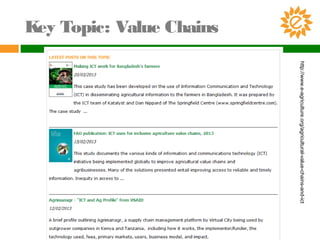
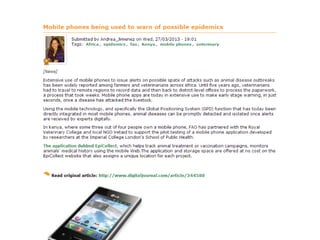
  • #10 A publication about how mobiles are used to track livestock diseases in Kenya. Monitoring and controlling pests and diseases are key to a productive value chain.
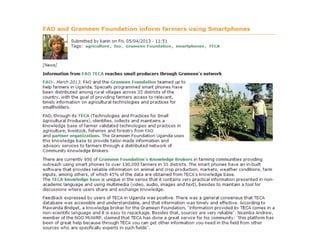
  • #11 Mobile phones are used by the Grameen Foundation’s Community Knowledge Worker (CKW) programme in Uganda to provide farmers access to relevant, timely information on agricultural technologies and practices for smallholders. Content is sourced from several places, including FAO’s TECA knowledge base.
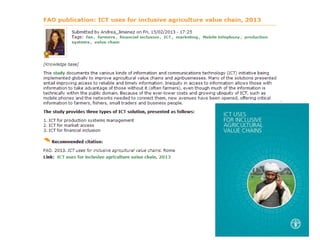
  • #12 “ ICT uses for inclusive agricultural value chains” – a freely available FAO publication.
  • #14 We consider Key Topics in depth from time to time using online discussions. Mobile phones have featured in all of the recent discussions.
  • #16 A critical issue is mobile technology. The rise of the mobile phone and it’s POTENTIAL in the developing world cannot be overlooked. It is of particular interest to us at FAO, because while mobile cellular signals and mobile phones are not everywhere, they are expanding much faster than “wired Internet” access and computers in rural areas.
  • #17 While great in potential, there are still many challenges and issues to surmount. The information here is based on an e-Agriculture discussion that was held at the end of 2011 with support from mFarmer.
  • #18 “ Agricultural partner” is an inclusive term for the partner other than the MNO. It could be from public or private sector, a long standing institution like a nat’l agri research center or a new business venture, etc. The question over what role MNOs should take in the mAgri business model was greatly contested in the discussion. There seems to be a tendency for the former model, with examples to support this. However, many believed that this was either not sustainable, or not in the interest of development (reaching the poorest), or both. Further there is a claim that the experience of MNOs in developed countries with open markets has shown that only the latter model succeeds in the long-term.
  • #19 These are some of the unique value the MNO can bring to a mAgri partnership. It seems USSD is only available with direct participation of the MNO in the mAgri service. SMS services can be provided where the MNO only provides network connectivity.
  • #20 These are some of the unique value the agricultural partner can bring to a mAgri partnership.
  • #21 In some cases the discussion participants felt a 3 rd party was essential for mAgri. Some reasons are listed here. There was a lot of discussion about the value of the agri partner associating with more than one MNO. The proponents of this were those who believe the MNO did not have farmer’s best interests at the forefront. Some even from the MNO perspective felt that multiple MNO partners could be feasible once the value of mAgri was better understood by MNO, and as long as agricultural partners could support the MNOs in differentiating their services. It also requires the agri partner to have the ability to provide information in customizable ways.
  • #22 “ Needs Assessment” is inclusive and development focused, whereas “Demand Analysis” supports finding a business model. These 2 are not necessarily incompatible, but will lead the partners in different directions with regards to the community that is being serviced.
  • #23 Because of so little obvious success, there is a lot of concern that we do not have the correct models. Thus Gates Foundation and USAID have joined with GSMA to explore this further through mFarmer programme. Many practitioners felt to be successful mAgri will need to blend mobile with radio, F2F training, etc. in order to meet communication requirements of rural communities. This complicates the idea of a 2 institution partnership and business models. Disagreement about MNO’s role: Should it be anything more than network service provider, should MNO get into agri VAS? (refer back to slide 12) It was interesting to note that not all agree on the limitations caused by literacy and language. Some cite cases where illiterate populations benefit from SMS-based services directly (learning to understand symbols/codes) or indirectly (with assistance from intermediaries).
  • #24 These are critical issues of the customer market. The prevalence of mobile phones in the developing world is a very positive trend. However, with extremely limited financial resources, many individuals will spend on mobile services that have immediate payback/impact versus mobile agricultural VAS that may not show an impact until a production cycle is completed.
  • #25 This issue was surprisingly contentious in the discussion, so it is worth highlighting. Everyone seemed to agree that “some day” all mAgri would be in the model of a service direct to an individual. The disagreement was over whether or not intermediary services (such as CKW or through farmer cooperatives, etc.) would bridge the gap on a large scale. Some were concerned that intermediary services would in fact hinder/slow the development of direct services. Subsidies were highly opposed by anyone concerned about a sustainable business model, however, some development practitioners felt it the only way “poorest of poor” would ever be served, thereby preventing the rural digital divide from getting wider.
  • #26 In a simplified sense, the barriers to scale come from the conflict that arises from three competing factors. IKSL (IFFCO Kisan Sanchar Limited ) has reached scale, but is it a model others can follow? Bharti Airtel is the MNO and Indian Farmers Fertiliser Cooperative Limited (IFFCO) the agricultural partner. Many think that finding an equal to IFFCO in any other country is near impossible (there could be exceptions like China, Brazil, but no specific possibilities were mentioned).
  • #29 The outputs of the e-Agriculture forum on partnerships for mobile information services were moved forward in a F2F meeting held in April in Bangkok this year. Brining together representatives of Ministries of Agriculture, MNOs, NGOs and private sector. A report will be coming out shortly for anyone interested.