Content Management Process for
    m-Agriculture Platforms

                  Pier Paolo Ficarelli
     - Knowledge Management & ICT for Agriculture -


  Working Group Meeting
                                                      Cape Town, 29th May, 2012
What some say about m-Agriculture
•   What is the use of delivering market information to a farmer with a
    phone, if there is no road to market the produce (IFAD, report 2003)

•   m-Agriculture is about tools, not about access and dissemination of
    agricultural information (FAO, Rome 2010)

•   We have farmer field schools for extension. Mobiles add no value to it.
    (CGIAR Researcher, Delhi, 2011)

•   Use of mobiles in rural areas is the last tactic for squeezing money at
    the bottom of the pyramid (GIZ staff, Delhi 2010)

•   Agro-Advisory on mobile: too much rubbish around (Mark Khan,
    Omnivore Venture Capital, 2012)

•   Adoption of a new agricultural practice requires a change of behaviour,
    not an SMS (a colleague of mine, last week)
                                                                              2
Farmers’ Information Needs

Information to make a decision
Which crop should I grow this year?
Where could I sell ? At what price?
Where can I buy this product?


Answers to a question
How much drench should I give to my sheep?
How much pesticide should I use for my crop?
How much concentrate should I use for a cow that produces 5 liters of milk/day


Solutions to a problem
Something is killing my crop!
The milk of two of my dairy cows comes out yellow/red!
What should I do?


                                                                                 3
Information System Impact Chain


     Source: Glendenning & Ficarelli, 2011

The Info system comprises the processes, people and technology featuring in
the design of a given ICT platform
The impact chain describes the contextual factors determining the impact of the
conveyance of a piece of information to users (design-reality check!)
Relevance is defined as the combination of the functional linkages for users to
make use of the content delivered by the platform
Feedback is the key feature to enable users to influence the Info system        4
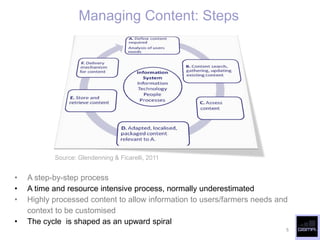
Managing Content: Steps


           Source: Glendenning & Ficarelli, 2011


•   A step-by-step process
•   A time and resource intensive process, normally underestimated
•   Highly processed content to allow information to users/farmers needs and
    context to be customised
•   The cycle is shaped as an upward spiral
                                                                           5
Managing Content: Challenges

Information Needs Analysis
Mainly Expert-to-Farmer Possible at scale? Farmer-to-Expert? Sample surveys useful?
Format
Limitations of SMS & Voice messages for agro-advisory: Videos? Audio+ Icons?
Sourcing
Content is dispersed and scattered: Agri-Google? Standards for congruity & authenticity ?
Access
Identified trend is towards close access of digital repositories: Regulations?
Localisation
Mainly based on outsiders’ knowledge and area criteria: Farmer knowledge?
Quality
It is delegated to experts and relies on implicit knowledge: External validation?
Feedback
Client satisfaction mainly anecdotal/based on sample surveys: Sufficient?
“Infomediaries”
Info-need articulation and advice translation require human facilitation: Viable?


                                                                                    6
Managing Content: Trade-offs
                               Usability
Timeliness for                                    Partnerships for
seasonal relevance                                content relevance
Alliances for                                     Info-mediation
content identification                            for local facilitation
Multi-channels                                    Linkages for
for offering choice                               input provision

                                  Content
                                  Impact


      Reach                                        Quality

                           Technology for real-
                           time feedback
                           Total Quality Mgt.
                           for trustworthiness
                           Revenues for
                           economic viability                      7
Managing Content: Quality Assurance


A      Local stakeholder/expert consultations, user feedback, focussed
       discussion with farmer organisations
B-C    Verifiable sources, validated by authority, updated, generic/localised
D      Re-purposed for users, Type/format congruence, Verified translation
E      Indexing metadata, Interoperability, SOPs
F      Cost- effective, timeliness, scalability
Next                  Joint learning for continuous improvement
           Co-evolving content & applications in the social space of users      8
What Others may say about m-Agriculture


 The problem with the world is not that people know too little,
        but that they know many things that ain't so

                                                       Mark Twain
What do we know that is so in m-Agriculture?
   The Question
   What are the factors determining successful content
   management and delivery in m-Agri?

   The learning route
   1.   Sharing issues/obstacles/failures/successes
   2.   Turning issues/obstacles into Success Factors (SF)
   3.   Discussing the ingredients for each SF
   4.   Proposing promising recipes to be tried out in each SF

   The journey duration
   One hour and a bit

   The destination
   Let’s see how far we can travel!

M agri pp.ficarelli vs.2.2

  • 1.
    Content Management Processfor m-Agriculture Platforms Pier Paolo Ficarelli - Knowledge Management & ICT for Agriculture - Working Group Meeting Cape Town, 29th May, 2012
  • 2.
    What some sayabout m-Agriculture • What is the use of delivering market information to a farmer with a phone, if there is no road to market the produce (IFAD, report 2003) • m-Agriculture is about tools, not about access and dissemination of agricultural information (FAO, Rome 2010) • We have farmer field schools for extension. Mobiles add no value to it. (CGIAR Researcher, Delhi, 2011) • Use of mobiles in rural areas is the last tactic for squeezing money at the bottom of the pyramid (GIZ staff, Delhi 2010) • Agro-Advisory on mobile: too much rubbish around (Mark Khan, Omnivore Venture Capital, 2012) • Adoption of a new agricultural practice requires a change of behaviour, not an SMS (a colleague of mine, last week) 2
  • 3.
    Farmers’ Information Needs Informationto make a decision Which crop should I grow this year? Where could I sell ? At what price? Where can I buy this product? Answers to a question How much drench should I give to my sheep? How much pesticide should I use for my crop? How much concentrate should I use for a cow that produces 5 liters of milk/day Solutions to a problem Something is killing my crop! The milk of two of my dairy cows comes out yellow/red! What should I do? 3
  • 4.
    Information System ImpactChain Source: Glendenning & Ficarelli, 2011 The Info system comprises the processes, people and technology featuring in the design of a given ICT platform The impact chain describes the contextual factors determining the impact of the conveyance of a piece of information to users (design-reality check!) Relevance is defined as the combination of the functional linkages for users to make use of the content delivered by the platform Feedback is the key feature to enable users to influence the Info system 4
  • 5.
    Managing Content: Steps Source: Glendenning & Ficarelli, 2011 • A step-by-step process • A time and resource intensive process, normally underestimated • Highly processed content to allow information to users/farmers needs and context to be customised • The cycle is shaped as an upward spiral 5
  • 6.
    Managing Content: Challenges InformationNeeds Analysis Mainly Expert-to-Farmer Possible at scale? Farmer-to-Expert? Sample surveys useful? Format Limitations of SMS & Voice messages for agro-advisory: Videos? Audio+ Icons? Sourcing Content is dispersed and scattered: Agri-Google? Standards for congruity & authenticity ? Access Identified trend is towards close access of digital repositories: Regulations? Localisation Mainly based on outsiders’ knowledge and area criteria: Farmer knowledge? Quality It is delegated to experts and relies on implicit knowledge: External validation? Feedback Client satisfaction mainly anecdotal/based on sample surveys: Sufficient? “Infomediaries” Info-need articulation and advice translation require human facilitation: Viable? 6
  • 7.
    Managing Content: Trade-offs Usability Timeliness for Partnerships for seasonal relevance content relevance Alliances for Info-mediation content identification for local facilitation Multi-channels Linkages for for offering choice input provision Content Impact Reach Quality Technology for real- time feedback Total Quality Mgt. for trustworthiness Revenues for economic viability 7
  • 8.
    Managing Content: QualityAssurance A Local stakeholder/expert consultations, user feedback, focussed discussion with farmer organisations B-C Verifiable sources, validated by authority, updated, generic/localised D Re-purposed for users, Type/format congruence, Verified translation E Indexing metadata, Interoperability, SOPs F Cost- effective, timeliness, scalability Next Joint learning for continuous improvement Co-evolving content & applications in the social space of users 8
  • 9.
    What Others maysay about m-Agriculture The problem with the world is not that people know too little, but that they know many things that ain't so Mark Twain
  • 10.
    What do weknow that is so in m-Agriculture? The Question What are the factors determining successful content management and delivery in m-Agri? The learning route 1. Sharing issues/obstacles/failures/successes 2. Turning issues/obstacles into Success Factors (SF) 3. Discussing the ingredients for each SF 4. Proposing promising recipes to be tried out in each SF The journey duration One hour and a bit The destination Let’s see how far we can travel!