Presented by:
Raziel B. Lucagbo, ACT-1
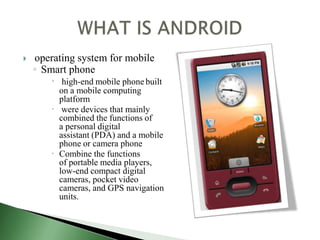
   operating system for mobile
    ◦ Smart phone
         high-end mobile phone built
          on a mobile computing
          platform
         were devices that mainly
          combined the functions of
          a personal digital
          assistant (PDA) and a mobile
          phone or camera phone
         Combine the functions
          of portable media players,
          low-end compact digital
          cameras, pocket video
          cameras, and GPS navigation
          units.
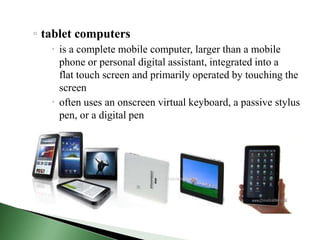
◦ tablet computers
    is a complete mobile computer, larger than a mobile
     phone or personal digital assistant, integrated into a
     flat touch screen and primarily operated by touching the
     screen
    often uses an onscreen virtual keyboard, a passive stylus
     pen, or a digital pen
   Android is a software stack for mobile devices that includes an
    operating system, middleware and key applications
    provides the tools and APIs necessary to begin developing
    applications on the Android platform using the Java
    programming language.
   consists of a kernel based on the Linux kernel,
    with middleware, libraries and APIs written in C
    and application software running on an application
    framework which includes Java-compatible libraries based
    on Apache Harmony
   Provides basic operating system services, message
    passing, and inter-process communication on the
    device.
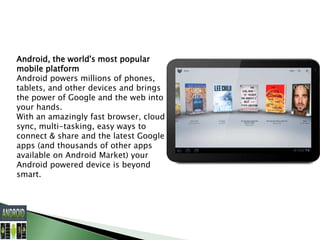
Android, the world's most popular
mobile platform
Android powers millions of phones,
tablets, and other devices and brings
the power of Google and the web into
your hands.
With an amazingly fast browser, cloud
sync, multi-tasking, easy ways to
connect & share and the latest Google
apps (and thousands of other apps
available on Android Market) your
Android powered device is beyond
smart.
   Android is a mobile operating system which is
    becoming a major competitor to iPhone OS in
    terms of openness.I am beginning the android
    series which will be helpful for developers who
    wish to develop android apps.
   Android was initially developed by Android Inc.
    Later acquired by Google to form open Headset
    alliance [ a group of 65 hardware, software, and
    telecom companies ].Applications for android
    devices are written in Java language.
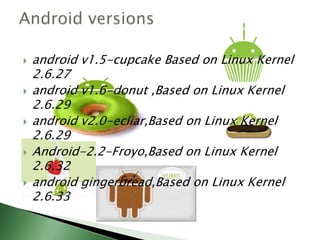
   android v1.5-cupcake Based on Linux Kernel
    2.6.27
   android v1.6-donut ,Based on Linux Kernel
    2.6.29
   android v2.0-ecliar,Based on Linux Kernel
    2.6.29
   Android-2.2-Froyo,Based on Linux Kernel
    2.6.32
   android gingerbread,Based on Linux Kernel
    2.6.33
v 3.0 Honeycomb
Designed especially for Tablet PC’s
 Android 3.0[Honeycomb] is dedicated for tablet PCs hence the design change primarily focuses in tablet optimization with updated UI.
 Honeycomb is the next version of the Android platform, designed from the ground up for devices with larger screen sizes, particularly tablets


  Icecream Sandwich
  The next version composing of both
  gingerbread and honeycomb into unified
  OS
   The following are lists of devices that have been released
    with Google's Android operating system installed. Multiple
    names for the same device are entered in the same row
    where applicable.
   Smartphones
    ◦ Acer Inc.
      HTC corp
    ◦ LG corp
    ◦ Motorola
    ◦ Samsung
    ◦ Sony Ericsson
    ◦ Other manufacturers
       Alcatel
         Cherry mobile

   Android OS is completely open
    source .Developers can use the core OS
    functions to develop applications Unlike
    Iphone OS which is a closed system.
   Android supported by
    various hardware manufacturers (OHA) hence
    there is no mobilecareer dependency
    uses the Dalvik virtual machine with just-in-time
    compilation to run Dalvik dex-code (Dalvik Executable),
    which is usually translated from Java bytecode
   It has a large community of developers writing applications
    ("apps") that extend the functionality of the devices
   Android, Inc. was founded in Palo Alto, California, United
    States in October, 2003
          Andy Rubin (co-founder of Danger)
          Rich Miner(co-founder of Wildfire Communications, Inc.)
         Nick Sears (once VP at T-Mobile)
         Chris White (headed design and interface development
          at WebTV)
   Application framework enabling reuse and replacement of
    components
   Dalvik virtual machine optimized for mobile devices
   Integrated browser based on the open source Web Kit engine
   Optimized graphics powered by a custom 2D graphics
    library; 3D graphics based on the OpenGL ES 1.0
    specification (hardware acceleration optional)
   SQ Lite for structured data storage
   Media support for common audio, video, and still image
    formats (MPEG4, H.264, MP3, AAC, AMR, JPG, PNG, GIF)
   GSM Telephony (hardware dependent)
   Bluetooth, EDGE, 3G, and WiFi (hardware dependent)
   Camera, GPS, compass, and
    accelerometer (hardware dependent)
   Rich development environment including a
    device emulator, tools for debugging,
    memory and performance profiling, and a
    plugin for the Eclipse IDE
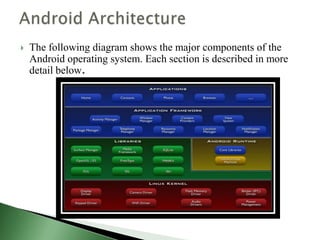
   The following diagram shows the major components of the
    Android operating system. Each section is described in more
    detail below.
   Android includes a set of C/C++ libraries used by various
    components of the Android system. These capabilities are
    exposed to developers through the Android application
    framework.
       System C library - a BSD-derived implementation of the
        standard C system library (libc), tuned for embedded Linux-
        based devices
       Media Libraries - based on PacketVideo's OpenCORE; the
        libraries support playback and recording of many popular audio
        and video formats, as well as static image files, including
        MPEG4, H.264, MP3, AAC, AMR, JPG, and PNG
       Surface Manager - manages access to the display subsystem
        and seamlessly composites 2D and 3D graphic layers from
        multiple applications
◦ LibWebCore - a modern web browser
  engine which powers both the Android
  browser and an embeddable web view
◦ SGL - the underlying 2D graphics engine
◦ 3D libraries - an implementation based on
  OpenGL ES 1.0 APIs; the libraries use
  either hardware 3D acceleration (where
  available) or the included, highly optimized
  3D software rasterizer
◦ FreeType - bitmap and vector font
  rendering
◦ SQLite - a powerful and lightweight
  relational database engine available to all
  applications

Android

  • 1.
  • 2.
    operating system for mobile ◦ Smart phone  high-end mobile phone built on a mobile computing platform  were devices that mainly combined the functions of a personal digital assistant (PDA) and a mobile phone or camera phone  Combine the functions of portable media players, low-end compact digital cameras, pocket video cameras, and GPS navigation units.
  • 3.
    ◦ tablet computers  is a complete mobile computer, larger than a mobile phone or personal digital assistant, integrated into a flat touch screen and primarily operated by touching the screen  often uses an onscreen virtual keyboard, a passive stylus pen, or a digital pen
  • 4.
    Android is a software stack for mobile devices that includes an operating system, middleware and key applications  provides the tools and APIs necessary to begin developing applications on the Android platform using the Java programming language.  consists of a kernel based on the Linux kernel, with middleware, libraries and APIs written in C and application software running on an application framework which includes Java-compatible libraries based on Apache Harmony  Provides basic operating system services, message passing, and inter-process communication on the device.
  • 5.
    Android, the world'smost popular mobile platform Android powers millions of phones, tablets, and other devices and brings the power of Google and the web into your hands. With an amazingly fast browser, cloud sync, multi-tasking, easy ways to connect & share and the latest Google apps (and thousands of other apps available on Android Market) your Android powered device is beyond smart.
  • 6.
    Android is a mobile operating system which is becoming a major competitor to iPhone OS in terms of openness.I am beginning the android series which will be helpful for developers who wish to develop android apps.  Android was initially developed by Android Inc. Later acquired by Google to form open Headset alliance [ a group of 65 hardware, software, and telecom companies ].Applications for android devices are written in Java language.
  • 7.
    android v1.5-cupcake Based on Linux Kernel 2.6.27  android v1.6-donut ,Based on Linux Kernel 2.6.29  android v2.0-ecliar,Based on Linux Kernel 2.6.29  Android-2.2-Froyo,Based on Linux Kernel 2.6.32  android gingerbread,Based on Linux Kernel 2.6.33
  • 8.
    v 3.0 Honeycomb Designedespecially for Tablet PC’s Android 3.0[Honeycomb] is dedicated for tablet PCs hence the design change primarily focuses in tablet optimization with updated UI. Honeycomb is the next version of the Android platform, designed from the ground up for devices with larger screen sizes, particularly tablets Icecream Sandwich The next version composing of both gingerbread and honeycomb into unified OS
  • 9.
    The following are lists of devices that have been released with Google's Android operating system installed. Multiple names for the same device are entered in the same row where applicable.  Smartphones ◦ Acer Inc. HTC corp ◦ LG corp ◦ Motorola ◦ Samsung ◦ Sony Ericsson ◦ Other manufacturers  Alcatel  Cherry mobile 
  • 10.
    Android OS is completely open source .Developers can use the core OS functions to develop applications Unlike Iphone OS which is a closed system.  Android supported by various hardware manufacturers (OHA) hence there is no mobilecareer dependency
  • 11.
    uses the Dalvik virtual machine with just-in-time compilation to run Dalvik dex-code (Dalvik Executable), which is usually translated from Java bytecode  It has a large community of developers writing applications ("apps") that extend the functionality of the devices  Android, Inc. was founded in Palo Alto, California, United States in October, 2003  Andy Rubin (co-founder of Danger)  Rich Miner(co-founder of Wildfire Communications, Inc.)  Nick Sears (once VP at T-Mobile)  Chris White (headed design and interface development at WebTV)
  • 12.
    Application framework enabling reuse and replacement of components  Dalvik virtual machine optimized for mobile devices  Integrated browser based on the open source Web Kit engine  Optimized graphics powered by a custom 2D graphics library; 3D graphics based on the OpenGL ES 1.0 specification (hardware acceleration optional)  SQ Lite for structured data storage  Media support for common audio, video, and still image formats (MPEG4, H.264, MP3, AAC, AMR, JPG, PNG, GIF)  GSM Telephony (hardware dependent)  Bluetooth, EDGE, 3G, and WiFi (hardware dependent)
  • 13.
    Camera, GPS, compass, and accelerometer (hardware dependent)  Rich development environment including a device emulator, tools for debugging, memory and performance profiling, and a plugin for the Eclipse IDE
  • 14.
    The following diagram shows the major components of the Android operating system. Each section is described in more detail below.
  • 15.
    Android includes a set of C/C++ libraries used by various components of the Android system. These capabilities are exposed to developers through the Android application framework.  System C library - a BSD-derived implementation of the standard C system library (libc), tuned for embedded Linux- based devices  Media Libraries - based on PacketVideo's OpenCORE; the libraries support playback and recording of many popular audio and video formats, as well as static image files, including MPEG4, H.264, MP3, AAC, AMR, JPG, and PNG  Surface Manager - manages access to the display subsystem and seamlessly composites 2D and 3D graphic layers from multiple applications
  • 16.
    ◦ LibWebCore -a modern web browser engine which powers both the Android browser and an embeddable web view ◦ SGL - the underlying 2D graphics engine ◦ 3D libraries - an implementation based on OpenGL ES 1.0 APIs; the libraries use either hardware 3D acceleration (where available) or the included, highly optimized 3D software rasterizer ◦ FreeType - bitmap and vector font rendering ◦ SQLite - a powerful and lightweight relational database engine available to all applications