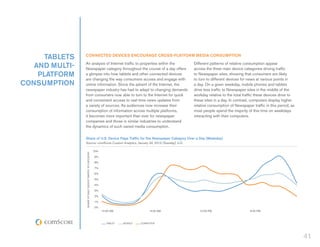
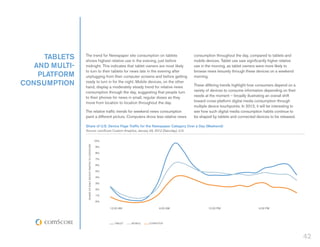
Key Insights from 2011 and What They Mean for the Coming Year


                                                                February 2012
Introduction
                             201 was a pivotal year for the mobile industry, marked by the
                                 1
                             dramatic rise of smartphones in the mainstream, the burgeoning of
                             tablets and other web-enabled connected devices, and a cultural
                             shift toward cross-platform digital media consumption. With mobile
                             becoming an increasing part of comprehensive digital marketing
                             strategies, it becomes more important than ever to understand how
                             the current trends are shaping the mobile environment, with an eye to
                             what lies ahead for 2012.

                             This report examines the mobile and connected device landscape
                             across the mobile markets measured by comScore – primarily
                             the United States, United Kingdom, France, Germany, Italy, Spain,
                             Japan, and Canada – through an exploration of dominant themes
                             in smartphone adoption growth, mobile media use in areas such as
FOR FURTHER INFORMATION,     social networking and retail, platform ecosystem dynamics, and shifts
         PLEASE CONTACT:
                             in multi-device digital media consumption.
         Sarah Radwanick
            comScore, Inc.
         +1 206 268 6310
     press@comscore.com

          Carmela Aquino
           comScore, Inc.
        +1 703 438 2024
     press@comscore.com
                             Stay Connected


                                              Follow @comscore


                                                                                                     2
Contents
                               Data Note

    This report is based on a combination
                                                 4   Executive Summary
       of sources in the comScore mobile
    suite of products, including behavioral
                                                 6   Mobile and Connected Device Landscape
  data from comScore Device Essentials,
 comScore Mobile Metrix 2.0 and GSMA            10   Mobile Handsets
                                                16
        Mobile Media Metrics (MMM). The
   majority of this report utilizes data from        Smartphone Adoption
     comScore MobiLens, which is based
   on a nationally-representative survey of
 mobile subscribers age 13+ in the U.S.,
                                                25   Mobile Media Consumption
UK, France, Germany, Italy, Spain, Japan,
        and Canada. All monthly data from
                                                36   Tablets and Multi-Platform Consumption
  comScore MobiLens are averaged over
   three months on a rolling basis, except      43   Conclusion
                                                48
  for Canada which is currently measured
on a monthly basis, and unless otherwise             Methodology and Definitions
     mentioned. Smartphones are defined
  throughout the report as mobile phones
that use the Google Android, Apple iOS,
      RIM Blackberry, Microsoft, and other
similar platforms. For more information on
          comScore products, please visit
www.comscore.com/Products_Services.
Executive Summary
Smartphones Gain Traction Among ‘Early                            Surge in Mobile App Usage Shapes a Dual Mobile
Majority’ Driving Mobile Media Consumption                        Browsing Experience, Fueling Category Growth
Smartphones gained rapid adoption among mainstream                Along with the growth in smartphone adoption, investment
consumer segments across markets. Nearly 42 percent of all        in mobile applications by publishers has fueled increasing
U.S. mobile subscribers now use smartphones, along with           app usage among total mobile users. In 2011, both the U.S.
44 percent of mobile users across the EU5 (comprised of           and EU5 saw strong growth in the usage of apps, reaching
France, Germany, Italy, Spain, and the UK). Mobile media          parity with the mobile browser audience by year’s end. Health
usage – defined as browsing the mobile web, accessing             ranked as the fastest-growing mobile media category in the
applications, or downloading content – saw a surge in activity    U.S. in 2011, followed by Retail and other commerce-related
and surpassed 50 percent penetration in many markets,             categories such as Electronic Payments and Auction Sites.
supported by the proliferation of high-speed networks and
increased public WiFi availability.                               ‘Smart Shoppers’ Disrupt Traditional Retail as
                                                                  Smartphones Enter Brick-and-Mortar Stores
Smartphone Platform Wars Intensify As                             More than half of the U.S. smartphone population used
Android and Apple Take the Lead in Most                           their phone to perform retail research while inside a store
Markets                                                           in 2011, illustrating the emergence of savvy smartphone
The Google Android and Apple iOS smartphone platforms             shoppers who bring online shopping behaviors in-store. At
emerged as the leaders of the U.S. smartphone market in           the end of 2011, nearly 1 in 5 smartphone users scanned
2011, with Android capturing just shy of half the smartphone      product barcodes and nearly 1 in 8 compared prices on their
market and iOS accounting for nearly 30 percent of the            phone while in a store. Male and female smartphone users
market, ousting other platforms in the process. Android’s         exhibited mobile retail behaviors to differing degrees, as
rapid rise is notable given its relatively recent emergence       females were more likely to use their devices to share their
on the scene. In the EU5, Android saw similarly significant       shopping experience socially while males were more likely
gains, unseating market leader Symbian in 3 out of the 5          to do product research. As mobile retail usage grows not
European markets measured. But the platform race is far           just in the U.S. but also across other markets, retailers face
from over as other players fight to reclaim market share.         the challenge of understanding how audiences interact with
Under new leadership, RIM held on to the leading position in      their mobile devices while shopping to take advantage of any
Canada’s smartphone market, albeit followed closely by iOS.       opportunities to increase customer conversion.
Microsoft took steps to rebuild its platform share with a Nokia
partnership in the works and the launch of its Metro user
interface across multiple devices.


                                                                                                                                   4
executive   Mobile Devices Fuel Social Networking On-The-
            Go, Driving Real-Time Online Interaction
                                                                             Mobile Connectivity and Connected Devices
                                                                             Encourage Cross-Platform Digital Media
 summary    With the means to connect on-the-go, mobile users have not       Consumption among ‘Digital Omnivores’
            only adopted real-time social networking on their devices at a   Tablets quickly rose in popularity in 2011, taking less than
            growing rate but they are doing so with increasing frequency.    two years to reach nearly 40 million tablets in use among the
            64.2 million U.S. smartphone users and 48.4 million EU5          U.S. mobile population, significantly outpacing smartphones
            smartphone users accessed social networking sites or blogs       which took 7 years to reach similar levels of adoption. By the
            on their mobile devices at least once in December 2011,          end of 2011, nearly 15 percent of U.S. mobile users also
            with more than half of these mobile social networking users      had tablets – a trend seen across other markets as well.
            accessing social media almost every day. While mobile social     Combining portability with powerful computing functionality in
            networking users showed the highest propensity to read           a sleek, user-friendly package, tablets have emerged as the
            posts from people they knew personally, more than half of        fourth screen, heralding a shift to an increasingly multi-device
            those in the U.S. and nearly half in the EU5 also reported       lifestyle that is becoming the norm for many consumers we
            reading posts from brands, organizations, and events.            call “digital omnivores” who engage seamlessly with multiple
            With people increasingly using social networking sites not       online touchpoints throughout a day. Even when accessing
            just to interact with their friends but also with brands and     the same content, each device has very different peak usage
            organizations, this platform will only grow in importance for    times throughout a typical day, highlighting their varying use
            those advertisers seeking to engage their social networking      cases and value propositions to the digitally-connected
            audiences through mobile with location-based services.           consumer.
Mobile and Connected Device Landscape
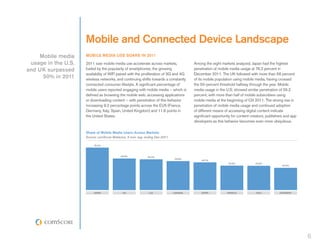
    Mobile media     Mobile Media Use Soars in 2011
 usage in the U.S.   2011 saw mobile media use accelerate across markets,              Among the eight markets analyzed, Japan had the highest
and UK surpassed     fueled by the popularity of smartphones, the growing              penetration of mobile media usage at 76.2 percent in
                     availability of WiFi paired with the proliferation of 3G and 4G   December 2011. The UK followed with more than 56 percent
     50% in 2011     wireless networks, and continuing shifts towards a constantly     of its mobile population using mobile media, having crossed
                     connected consumer lifestyle. A significant percentage of         the 50-percent threshold halfway through the year. Mobile
                     mobile users reported engaging with mobile media – which is       media usage in the U.S. showed similar penetration of 55.2
                     defined as browsing the mobile web, accessing applications        percent, with more than half of mobile subscribers using
                     or downloading content – with penetration of this behavior        mobile media at the beginning of Q3 2011. The strong rise in
                     increasing 9.2 percentage points across the EU5 (France,          penetration of mobile media usage and continued adoption
                     Germany, Italy, Spain, United Kingdom) and 11.6 points in         of different means of accessing digital content indicate
                     the United States.                                                significant opportunity for content creators, publishers and app
                                                                                       developers as this behavior becomes even more ubiquitous.

                     Share of Mobile Media Users Across Markets
                     Source: comScore MobiLens, 3 mon. avg. ending Dec-2011

                          76.2%


                                           56.6%             55.2%
                                                                              49.9%
                                                                                           49.7%
                                                                                                            43.9%            43.6%
                                                                                                                                              40.0%


                          JAPAN              UK               U.S.            CANADA       SPAIN           FRANCE            ITALY          GERMANY


                                                                                                                                                          6
mobile and   Rise of Smartphones Drives Surge in Mobile Media Consumption

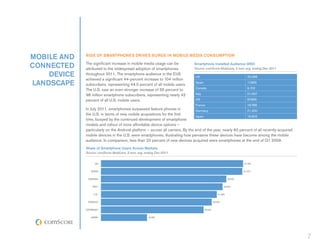
connected    The significant increase in mobile media usage can be
             attributed to the widespread adoption of smartphones
                                                                               Smartphone Installed Audience (000)
                                                                               Source: comScore MobiLens, 3 mon. avg. ending Dec-2011

    device   throughout 2011. The smartphone audience in the EU5
                                                                               UK                                   25,386
             achieved a significant 44-percent increase to 104 million
landscape    subscribers, representing 44.0 percent of all mobile users.
                                                                               Spain                                17,855
                                                                               Canada                               9,103
             The U.S. saw an even stronger increase of 55 percent to
             98 million smartphone subscribers, representing nearly 42         Italy                                21,067

             percent of all U.S. mobile users.                                 US                                   97,865
                                                                               France                               18,788
             In July 2011, smartphones surpassed feature phones in              Germany                        21,300
             the U.S. in terms of new mobile acquisitions for the first
                                                                                Japan                          16,902
             time, buoyed by the continued development of smartphone
             models and rollout of more affordable device options –
             particularly on the Android platform – across all carriers. By the end of the year, nearly 60 percent of all recently acquired
             mobile devices in the U.S. were smartphones, illustrating how pervasive these devices have become among the mobile
             audience. In comparison, less than 20 percent of new devices acquired were smartphones at the end of Q1 2009.
             Share of Smartphone Users Across Markets
             Source: comScore MobiLens, 3 mon. avg. ending Dec-2011


                   UK                                                                                             51.3%


                SPAIN                                                                                             51.0%


              CANADA                                                                                      45.3%


                 ITALY                                                                                 43.9%


                  U.S.                                                                            41.8%


              FRANCE                                                                           40.0%


             GERMANY                                                                   37.0%


                JAPAN                                16.6%


                                                                                                                                              7
mobile and           Mobile and Connected Devices Generate Increasing Share of Internet Traffic

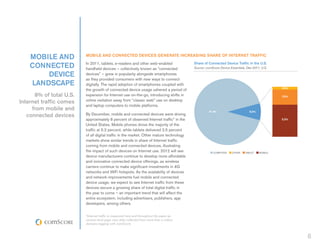
    connected            In 2011, tablets, e-readers and other web-enabled
                         handheld devices – collectively known as “connected
                                                                                          Share of Connected Device Traffic in the U.S.
                                                                                          Source: comScore Device Essentials, Dec-2011, U.S.

        device           devices” – grew in popularity alongside smartphones
                         as they provided consumers with new ways to connect
    landscape            digitally. The rapid adoption of smartphones coupled with
                                                                                                                                                0.5%
                         the growth of connected device usage ushered a period of
      8% of total U.S.   expansion for Internet use on-the-go, introducing shifts in                                                            2.5%

Internet traffic comes   online visitation away from “classic web” use on desktop
                         and laptop computers to mobile platforms.
     from mobile and                                                                                91.8%                       8.2%
   connected devices     By December, mobile and connected devices were driving
                         approximately 8 percent of observed Internet traffic* in the                                                           5.2%

                         United States. Mobile phones drove the majority of the
                         traffic at 5.2 percent, while tablets delivered 2.5 percent
                         of all digital traffic in the market. Other mature technology
                         markets show similar trends in share of Internet traffic
                         coming from mobile and connected devices, illustrating
                         the impact of such devices on Internet use. 2012 will see                     Computer     OTHER    TABLET    MOBILE
                         device manufacturers continue to develop more affordable
                         and innovative connected device offerings, as wireless
                         carriers continue to make significant investments in 4G
                         networks and WiFi hotspots. As the availability of devices
                         and network improvements fuel mobile and connected
                         device usage, we expect to see Internet traffic from these
                         devices secure a growing share of total digital traffic in
                         the year to come – an important trend that will affect the
                         entire ecosystem, including advertisers, publishers, app
                         developers, among others.


                         *Internet traffic is measured here and throughout the paper as
                         census-level page view data collected from more than a million
                         domains tagging with comScore.


                                                                                                                                                       8
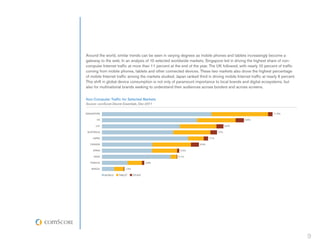
Around the world, similar trends can be seen in varying degrees as mobile phones and tablets increasingly become a
gateway to the web. In an analysis of 10 selected worldwide markets, Singapore led in driving the highest share of non-
computer Internet traffic at more than 11 percent at the end of the year. The UK followed, with nearly 10 percent of traffic
coming from mobile phones, tablets and other connected devices. These two markets also drove the highest percentage
of mobile Internet traffic among the markets studied. Japan ranked third in driving mobile Internet traffic at nearly 6 percent.
This shift in global device consumption is not only of paramount importance to local brands and digital ecosystems, but
also for multinational brands seeking to understand their audiences across borders and across screens.


Non-Computer Traffic for Selected Markets
Source: comScore Device Essentials, Dec-2011

SINGAPORE                                                                                                         11.5%

       UK                                                                                        9.5%

      U.S.                                                                                8.2%

 AUSTRALIA                                                                         7.7%

    JAPAN                                                                   7.1%

  CANADA                                                             6.5%

     SPAIN                                               5.2%

     INDIA                                              5.1%

   FRANCE                                2.8%

   BRAZIL                 1.5%

             MOBILE   TABLET     OTHER


                                                                                                                                   9
Mobile Handsets
  Apple iPhone 4     Smartphones Shape the Global Device Landscape
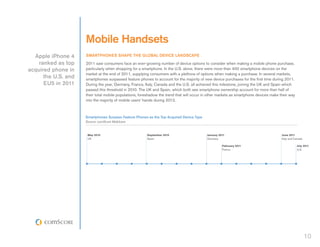
    ranked as top    2011 saw consumers face an ever-growing number of device options to consider when making a mobile phone purchase,
acquired phone in    particularly when shopping for a smartphone. In the U.S. alone, there were more than 400 smartphone devices on the
                     market at the end of 2011, supplying consumers with a plethora of options when making a purchase. In several markets,
      the U.S. and   smartphones surpassed feature phones to account for the majority of new device purchases for the first time during 2011.
      EU5 in 2011    During the year, Germany, France, Italy, Canada and the U.S. all achieved this milestone, joining the UK and Spain which
                     passed this threshold in 2010. The UK and Spain, which both see smartphone ownership account for more than half of
                     their total mobile populations, foreshadow the trend that will occur in other markets as smartphone devices make their way
                     into the majority of mobile users’ hands during 2012.


                     Smartphones Surpass Feature Phones as the Top Acquired Device Type
                     Source: comScore MobiLens


                      May 2010                          September 2010                     January 2011                                June 2011
                      UK                                Spain                              Germany                                     Italy and Canada

                                                                                                     February 2011                                July 2011
                                                                                                     France                                       U.S.


                                                                                                                                                          10
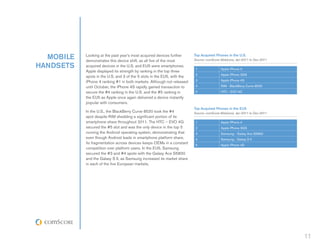
mobile   Looking at the past year’s most acquired devices further
           demonstrates this device shift, as all five of the most
                                                                         Top Acquired Phones in the U.S.
                                                                         Source: comScore MobiLens, Jan-2011 to Dec-2011

handsets   acquired devices in the U.S. and EU5 were smartphones.
                                                                          1               Apple iPhone 4
           Apple displayed its strength by ranking in the top three
                                                                          2               Apple iPhone 3GS
           spots in the U.S. and 3 of the 5 slots in the EU5, with the
           iPhone 4 ranking #1 in both markets. Although not released     3               Apple iPhone 4S

           until October, the iPhone 4S rapidly gained transaction to     4               RIM - BlackBerry Curve 8530
           secure the #4 ranking in the U.S. and the #5 ranking in        5               HTC - EVO 4G
           the EU5 as Apple once again delivered a device instantly
           popular with consumers.
                                                                         Top Acquired Phones in the EU5
           In the U.S., the BlackBerry Curve 8530 took the #4            Source: comScore MobiLens, Jan-2011 to Dec-2011
           spot despite RIM shedding a significant portion of its
           smartphone share throughout 2011. The HTC – EVO 4G             1               Apple iPhone 4
           secured the #5 slot and was the only device in the top 5       2               Apple iPhone 3GS
           running the Android operating system, demonstrating that       3               Samsung - Galaxy Ace S5830
           even though Android leads in smartphone platform share,        4               Samsung - Galaxy S II
           its fragmentation across devices keeps OEMs in a constant      5               Apple iPhone 4S
           competition over platform users. In the EU5, Samsung
           secured the #3 and #4 spots with the Galaxy Ace S5830
           and the Galaxy S II, as Samsung increased its market share
           in each of the five European markets.


                                                                                                                           11
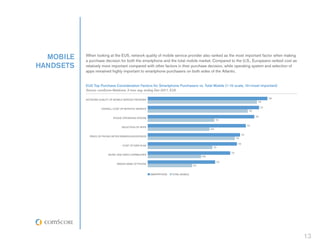
mobile   U.S. and EU Smartphone Buyers Rate OS Brand as Very Important in Their Purchase Decision

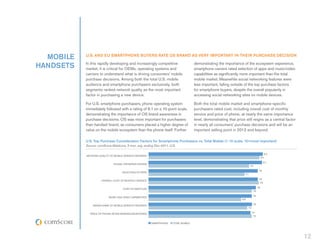
handsets   In this rapidly developing and increasingly competitive
           market, it is critical for OEMs, operating systems and
                                                                                     demonstrating the importance of the ecosystem experience,
                                                                                     smartphone owners rated selection of apps and music/video
           carriers to understand what is driving consumers’ mobile                  capabilities as significantly more important than the total
           purchase decisions. Among both the total U.S. mobile                      mobile market. Meanwhile social networking features were
           audience and smartphone purchasers exclusively, both                      less important, falling outside of the top purchase factors
           segments ranked network quality as the most important                     for smartphone buyers, despite the overall popularity in
           factor in purchasing a new device.                                        accessing social networking sites on mobile devices.

           For U.S. smartphone purchasers, phone operating system                    Both the total mobile market and smartphone-specific
           immediately followed with a rating of 8.1 on a 10-point scale,            purchasers rated cost, including overall cost of monthly
           demonstrating the importance of OS brand awareness in                     service and price of phone, at nearly the same importance
           purchase decisions. OS was more important for purchasers                  level, demonstrating that price still reigns as a central factor
           than handset brand, as consumers placed a higher degree of                in nearly all consumers’ purchase decisions and will be an
           value on the mobile ecosystem than the phone itself. Further              important selling point in 2012 and beyond.

           U.S. Top Purchase Consideration Factors for Smartphone Purchasers vs. Total Mobile (1-10 scale, 10=most important)
           Source: comScore MobiLens, 3 mon. avg. ending Dec-2011, U.S.

                                                                                                                                                     8.2
           NETWORK QUALITY OF MOBILE SERVICE PROVIDER
                                                                                                                                               8.0

                                                                                                                                                 8.1
                             PHONE OPERATING SYSTEM
                                                                                                                               7.3

                                                                                                                                          7.9
                                    SELECTION OF APPS
                                                                                                                         7.1

                                                                                                                                          7.8
                     OVERALL COST OF MONTHLY SERVICE
                                                                                                                                           7.9

                                                                                                                                         7.8
                                    COST OF DATA PLAN
                                                                                                                                  7.6

                                                                                                                                  7.6
                          MUSIC AND VIDEO CAPABILITIES
                                                                                                                   6.8

                                                                                                                                  7.5
               BRAND NAME OF MOBILE SERVICE PROVIDER
                                                                                                                           7.2

             PRICE OF PHONE (after rebates/incentives)                                                                           7.4
                                                                                                                                   7.5

                                                         SMARTPHONE   TOTAL MOBILE


                                                                                                                                                           12
mobile   When looking at the EU5, network quality of mobile service provider also ranked as the most important factor when making
           a purchase decision for both the smartphone and the total mobile market. Compared to the U.S., Europeans ranked cost as
handsets   relatively more important compared with other factors in their purchase decision, while operating system and selection of
           apps remained highly important to smartphone purchasers on both sides of the Atlantic.


           EU5 Top Purchase Consideration Factors for Smartphone Purchasers vs. Total Mobile (1-10 scale, 10=most important)
           Source: comScore MobiLens, 3 mon. avg. ending Dec-2011, EU5

                                                                                                                                                    7.8
           NETWORK QUALITY OF MOBILE SERVICE PROVIDER
                                                                                                                                          7.6

                                                                                                                                              7.7
                     OVERALL COST OF MONTHLY SERVICE
                                                                                                                                  7.5

                                                                                                                                        7.6
                             PHONE OPERATING SYSTEM
                                                                                                       7.0

                                                                                                                                 7.5
                                    SELECTION OF APPS
                                                                                                 6.9

                                                                                                                           7.4
             PRICE OF PHONE (after rebates/incentives)
                                                                                                                   7.3

                                                                                                                     7.3
                                    COST OF DATA PLAN
                                                                                                   7.0

                                                                                                             7.2
                          MUSIC AND VIDEO CAPABILITIES
                                                                                           6.8

                                                                                                       7.0
                                BRAND NAME OF PHONE
                                                                                     6.7


                                                         SMARTPHONE   TOTAL MOBILE


                                                                                                                                                          13
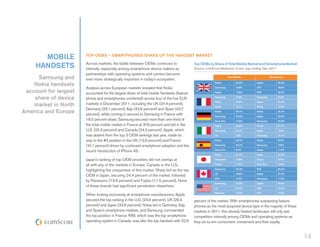
mobile          Top OEMs – Smartphones Shake Up the Handset Market

     handsets          Across markets, the battle between OEMs continues to
                       intensify, especially among smartphone device makers as
                                                                                           Top OEMs by Share of Total Mobile Market and Smartphone Market
                                                                                           Source: comScore MobiLens, 3 mon. avg. ending Dec-2011
                       partnerships with operating systems and carriers become
      Samsung and      ever-more strategically important in today’s ecosystem.
                                                                                                                     Total Mobile                Smartphone


    Nokia handsets                                                                                      Nokia               24.4%   Apple              26.4%

                       Analysis across European markets revealed that Nokia                             Samsung             19.9%   HTC                18.5%
 account for largest   accounted for the largest share of total mobile handsets (feature                Apple               13.6%   RIM                18.3%

    share of device    phone and smartphones combined) across four of the five EU5                      Samsung             37.9%   Samsung            27.3%
                                                                                                        Nokia               18.5%   Apple              25.2%
    market in North    markets in December 2011, including the UK (24.4 percent),
                                                                                                        Apple               10.1%   Nokia              15.8%
                       Germany (29.1 percent), Italy (43.8 percent) and Spain (40.7
America and Europe     percent), while coming in second to Samsung in France with
                                                                                                        Nokia               29.1%   Nokia              25.1%
                                                                                                        Samsung             24.3%   Apple              22.2%
                       18.5 percent share. Samsung secured more than one-third of                       Sony Eric.          13.5%   Samsung            20.3%
                       the total mobile market in France at 37.9 percent and led in the                 Nokia               43.8%   Nokia              51.7%
                       U.S. (25.3 percent) and Canada (24.3 percent). Apple, which                      Samsung             24.2%   Apple              15.8%

                       was absent from the top 3 OEM rankings last year, made its                       LG                  7.2%    Samsung            14.1%

                       way to the #3 position in the UK (13.6 percent) and France                       Nokia               40.7%   Nokia              37.2%

                       (10.1 percent) driven by continued smartphone adoption and the                   Samsung             20.4%   Samsung            17.9%

                       recent introduction of iPhone 4S.                                                Sony Eric.          8.4%    Apple              11.5%
                                                                                                        Sharp               24.4%   Apple              33.6%

                       Japan’s ranking of top OEM providers did not overlap at                          Panasonic           13.6%   Sharp              27.7%

                       all with any of the markets in Europe, Canada or the U.S.,                       Fujitsu             11.5%   Sony Eric.         12.8%

                       highlighting the uniqueness of this market. Sharp led as the top                 Samsung             24.3%   RIM                32.6%
                                                                                                        LG                  18.8%   Apple              31.2%
                       OEM in Japan, securing 24.4 percent of the market, followed
                                                                                                        RIM                 14.8%   Samsung            11.0%
                       by Panasonic (13.6 percent) and Fujitsu (11.5 percent). None
                                                                                                        Samsung             25.3%   Apple              29.6%
                       of these brands had significant penetration elsewhere.                           LG                  20.0%   RIM                16.0%
                                                                                                        Motorola            13.3%   HTC                14.6%
                       When looking exclusively at smartphone manufacturers, Apple
                       secured the top ranking in the U.S. (29.6 percent), UK (26.4        percent of the market. With smartphones surpassing feature
                       percent) and Japan (33.6 percent), Nokia led in Germany, Italy      phones as the most acquired device type in the majority of these
                       and Spain’s smartphone markets, and Samsung commanded               markets in 2011, this already heated landscape will only see
                       the top position in France. RIM, which was the top smartphone       competition intensify among OEMs and operating systems as
                       operating system in Canada, was also the top handset with 32.6      they vie to win consumers’ investment and their loyalty.


                                                                                                                                                               14
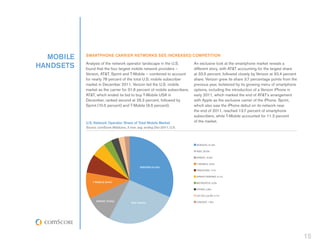
mobile   Smartphone Carrier Networks See Increased Competition

handsets   Analysis of the network operator landscape in the U.S.
           found that the four largest mobile network providers –
                                                                           An exclusive look at the smartphone market reveals a
                                                                           different story, with AT&T accounting for the largest share
           Verizon, AT&T, Sprint and T-Mobile – combined to account        at 33.5 percent, followed closely by Verizon at 30.4 percent
           for nearly 78 percent of the total U.S. mobile subscriber       share. Verizon grew its share 3.7 percentage points from the
           market in December 2011. Verizon led the U.S. mobile            previous year, bolstered by its growing menu of smartphone
           market as the carrier for 31.6 percent of mobile subscribers.   options, including the introduction of a Verizon iPhone in
           AT&T, which ended its bid to buy T-Mobile USA in                early 2011, which marked the end of AT&T’s arrangement
           December, ranked second at 26.3 percent, followed by            with Apple as the exclusive carrier of the iPhone. Sprint,
           Sprint (10.5 percent) and T-Mobile (9.5 percent).               which also saw the iPhone debut on its network near
                                                                           the end of 2011, reached 13.7 percent of smartphone
                                                                           subscribers, while T-Mobile accounted for 11.3 percent
           U.S. Network Operator Share of Total Mobile Market              of the market.
           Source: comScore MobiLens, 3 mon. avg. ending Dec-2011, U.S.


                                                                            verizon, 31.6%

                                                                            at&T, 26.3%

                                                                            sprint, 10.5%

                                                                            t-mobile, 9.5%
                                                Verizon (31.6%)
                                                                            tracfone, 7.1%

                                                                            sprint prepaid, 5.1%

               T-Mobile (9.5%)                                              metropcs, 3.2%

                                                                            other, 2.8%

                                                                            us cellular, 2.1%

                  Sprint (10.5%)                                            cricket, 1.9%
                                         AT&T (26.3%)


                                                                                                                                          15
Smartphone Adoption
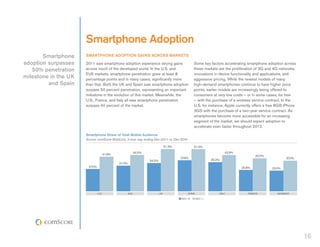
       Smartphone     Smartphone Adoption Gains Across Markets
adoption surpasses    2011 saw smartphone adoption experience strong gains                        Some key factors accelerating smartphone adoption across
   50% penetration    across much of the developed world. In the U.S. and                         these markets are the proliferation of 3G and 4G networks,
                      EU5 markets, smartphone penetration grew at least 8                         innovations in device functionality and applications, and
milestone in the UK   percentage points and in many cases, significantly more                     aggressive pricing. While the newest models of many
         and Spain    than that. Both the UK and Spain saw smartphone adoption                    high-demand smartphones continue to have higher price
                      surpass 50 percent penetration, representing an important                   points, earlier models are increasingly being offered to
                      milestone in the evolution of this market. Meanwhile, the                   consumers at very low costs – or in some cases, for free
                      U.S., France, and Italy all saw smartphone penetration                      – with the purchase of a wireless service contract. In the
                      surpass 40 percent of the market.                                           U.S. for instance, Apple currently offers a free 8GB iPhone
                                                                                                  3GS with the purchase of a two-year service contract. As
                                                                                                  smartphones become more accessible for an increasing
                                                                                                  segment of the market, we should expect adoption to
                                                                                                  accelerate even faster throughout 2012.

                      Smartphone Share of Total Mobile Audience
                      Source: comScore MobiLens, 3 mon. avg. ending Dec-2011 vs. Dec-2010

                                                                                 51.3%            51.0%
                                                            44.0%                                                     43.9%
                                      41.8%                                                                                           40.0%
                                                                                         37.6%                                                         37.0%
                                                                    34.2%                                     35.2%
                                              31.0%
                       27.0%                                                                                                  25.8%            25.0%


                               u.s.                   eu5                   Uk               SPAIN                italy          FRANCE           GERMANY

                                                                                         dec-10      dec-11


                                                                                                                                                                16
smartphone    Smartphones Most Popular Among 25-34 Year Olds

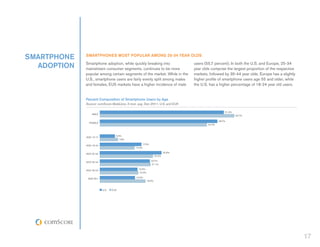
   adoption   Smartphone adoption, while quickly breaking into
              mainstream consumer segments, continues to be more
                                                                                 users (55.7 percent). In both the U.S. and Europe, 25-34
                                                                                 year olds comprise the largest proportion of the respective
              popular among certain segments of the market. While in the         markets, followed by 35-44 year olds. Europe has a slightly
              U.S., smartphone users are fairly evenly split among males         higher profile of smartphone users age 55 and older, while
              and females, EU5 markets have a higher incidence of male           the U.S. has a higher percentage of 18-24 year old users.


              Percent Composition of Smartphone Users by Age
              Source: comScore MobiLens, 3 mon. avg. Dec-2011, U.S. and EU5

                                                                                                     51.3%
                  male
                                                                                                             55.7%

                                                                                                 48.7%
                female
                                                                                         44.3%


                                   6.3%
              age 13-17
                                      7.6%
                                                   17.2%
              age 18-24
                                              14.4%

                                                                         25.6%
              age 25-34
                                                                 22.0%

                                                            20.7%
              age 35-44
                                                             21.1%
                                                15.6%
              age 45-54
                                                 16.0%

               age 55+                         14.6%
                                                         18.9%


                          U.S.   EU5


                                                                                                                                               17
smartphone    Fastest-Growing Segments of Smartphone Adopters Suggest Affordability Driving Growth

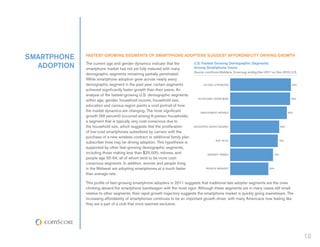
   adoption   The current age and gender dynamics indicate that the
              smartphone market has not yet fully matured with many
                                                                              U.S. Fastest Growing Demographic Segments
                                                                              Among Smartphone Users
                                                                              Source: comScore Mobilens, 3 mon avg. ending Dec-2011 vs. Dec-2010, U.S.
              demographic segments remaining partially penetrated.
              While smartphone adoption grew across nearly every
              demographic segment in the past year, certain segments                HH size: 6 persons                                              99%

              achieved significantly faster growth than their peers. An
              analysis of the fastest-growing U.S. demographic segments
                                                                                hh income: under $25K                                               98%
              within age, gender, household income, household size,
              education and census region paints a vivid portrait of how
              the market dynamics are changing. The most significant              employment: retired                                             92%
              growth (99 percent) occurred among 6-person households,
              a segment that is typically very cost-conscious due to
              the household size, which suggests that the proliferation       education: assoc degree                                       80%

              of low-cost smartphones subsidized by carriers with the
              purchase of a new wireless contract or additional family plan
                                                                                             age: 55-64                                  79%
              subscriber lines may be driving adoption. This hypothesis is
              supported by other fast-growing demographic segments,
              including those making less than $25,000, retirees, and                  gender: female                                 70%
              people age 55-64, all of whom tend to be more cost-
              conscious segments. In addition, women and people living
              in the Midwest are adopting smartphones at a much faster                region: midwest                             62%

              than average rate.

              This profile of fast-growing smartphone adopters in 2011 suggests that traditional late adopter segments are the ones
              climbing aboard the smartphone bandwagon with the most vigor. Although these segments are in many cases still small
              relative to other segments, their rapid growth trajectory suggests the smartphone market is quickly going mainstream. The
              increasing affordability of smartphones continues to be an important growth driver, with many Americans now feeling like
              they are a part of a club that once seemed exclusive.


                                                                                                                                                          18
smartphone           Android Captures Nearly Half of U.S. Smartphone Market

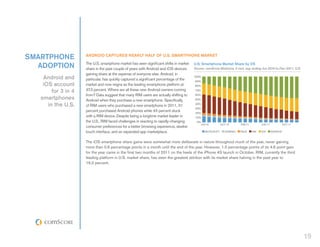
   adoption          The U.S. smartphone market has seen significant shifts in market
                     share in the past couple of years with Android and iOS devices
                                                                                        U.S. Smartphone Market Share by OS
                                                                                        Source: comScore MobiLens, 3 mon. avg. ending Jun-2010 to Dec-2011, U.S.
                     gaining share at the expense of everyone else. Android, in
    Android and      particular, has quickly captured a significant percentage of the
                                                                                        100%
                                                                                        90%
    iOS account      market and now reigns as the leading smartphone platform at        80%

        for 3 in 4   47.3 percent. Where are all these new Android owners coming        70%
                     from? Data suggest that many RIM users are actually shifting to    60%
   smartphones       Android when they purchase a new smartphone. Specifically,         50%

      in the U.S.    of RIM users who purchased a new smartphone in 2011, 31            40%
                                                                                        30%
                     percent purchased Android phones while 43 percent stuck            20%
                     with a RIM device. Despite being a longtime market leader in        10%
                     the U.S., RIM faced challenges in reacting to rapidly-changing      0%
                                                                                            Jun-10         oct-10       feb-11         jun-11             oct-11
                     consumer preferences for a better browsing experience, sleeker
                     touch interface, and an expanded app marketplace.                         microsoft      symbian   palm     rim   ios      android


                     The iOS smartphone share gains were somewhat more deliberate in nature throughout much of the year, never gaining
                     more than 0.6 percentage points in a month until the end of the year. However, 1.5 percentage points of its 4.6 point gain
                     for the year came in the final two months of 2011 on the heels of the iPhone 4S launch in October. RIM, currently the third
                     leading platform in U.S. market share, has seen the greatest attrition with its market share halving in the past year to
                     16.0 percent.


                                                                                                                                                                   19
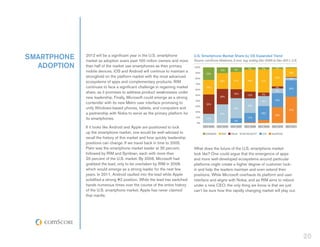
smartphone    2012 will be a significant year in the U.S. smartphone
              market as adoption soars past 100 million owners and more
                                                                              U.S. Smartphone Market Share by OS Expanded Trend
                                                                              Source: comScore MobiLens, 3 mon. avg. ending Dec-2005 to Dec-2011, U.S.
   adoption   than half of the market use smartphones as their primary        100%
                                                                                                           8%
                                                                                                                    4%       4%         3%
              mobile devices. iOS and Android will continue to maintain a      90%
                                                                                                10%
                                                                                                                                                   16%
                                                                                       23%
              stronghold on the platform market with the most advanced         80%                                                      32%
                                                                                                                                                   5%
              ecosystems of apps and complementary products. RIM               70%
                                                                                                28%        31%      40%      41%

              continues to face a significant challenge in regaining market            26%                                              4%         30%
                                                                               60%
                                                                                                                                        8%
              share, as it promises to address product weaknesses under                                    16%               6%
                                                                               50%                                  12%
              new leadership. Finally, Microsoft could emerge as a strong                       28%
                                                                               40%                                           18%        25%
              contender with its new Metro user interface promising to                 35%
                                                                               30%                                  26%
              unify Windows-based phones, tablets, and computers and                                       36%
                                                                                                                                                   47%
                                                                               20%
              a partnership with Nokia to serve as the primary platform for                     34%                          25%
                                                                                                                                        29%
              its smartphones.                                                 10%     17%
                                                                                                           9%
                                                                                                                    17%

                                                                                0%
              If it looks like Android and Apple are positioned to lock              Dec-2005 Dec-2006
                                                                                     Dec-2005 Dec-2006   Dec-2007 Dec-2008 Dec-2009
                                                                                                         Dec-2007 Dec-2008 Dec-2009   Dec-2010
                                                                                                                                      Dec-2010   Dec-2011
                                                                                                                                                 Dec-2011

              up the smartphone market, one would be well-advised to                  symbian    RIM     palm    microsoft    ios     android
              recall the history of this market and how quickly leadership
              positions can change. If we travel back in time to 2005,
              Palm was the smartphone market leader at 35 percent,            What does the future of the U.S. smartphone market
              followed by RIM and Symbian, each with more than                look like? One could argue that the emergence of apps
              20 percent of the U.S. market. By 2006, Microsoft had           and more well-developed ecosystems around particular
              grabbed the lead, only to be overtaken by RIM in 2008,          platforms might create a higher degree of customer lock-
              which would emerge as a strong leader for the next few          in and help the leaders maintain and even extend their
              years. In 2011, Android vaulted into the lead while Apple       positions. While Microsoft overhauls its platform and user
              solidified a strong #2 position. While the lead has switched    interface and aligns with Nokia, and as RIM aims to reboot
              hands numerous times over the course of the entire history      under a new CEO, the only thing we know is that we just
              of the U.S. smartphone market, Apple has never claimed          can’t be sure how this rapidly changing market will play out.
              that mantle.


                                                                                                                                                            20
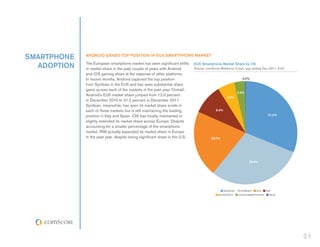
smartphone    Android Grabs Top Position in EU5 Smartphone Market

   adoption   The European smartphone market has seen significant shifts
              in market share in the past couple of years with Android
                                                                               EU5 Smartphone Market Share by OS
                                                                               Source: comScore MobiLens, 3 mon. avg. ending Dec-2011, EU5
              and iOS gaining share at the expense of other platforms.
              In recent months, Android captured the top position                                               0.2%
              from Symbian in the EU5 and has seen substantial share
              gains across each of the markets in the past year. Overall,
                                                                                                              3.4%
              Android’s EU5 market share jumped from 12.0 percent
                                                                                                      5.2%
              in December 2010 to 31.2 percent in December 2011.
              Symbian, meanwhile, has seen its market share erode in
              each of these markets but is still maintaining the leading                     9.4%
              position in Italy and Spain. iOS has mostly maintained or                                                           31.2%
              slightly extended its market share across Europe. Despite
              accounting for a smaller percentage of the smartphone
              market, RIM actually expanded its market share in Europe
              in the past year, despite losing significant share in the U.S.              20.7%


                                                                                                                     29.9%


                                                                                                    android    symbian   iOS     rim
                                                                                               microsoft      other smartphone     palm


                                                                                                                                             21
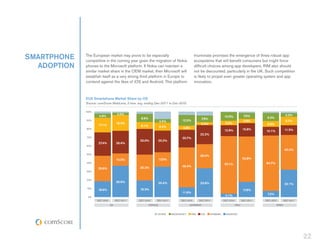
smartphone    The European market may prove to be especially
              competitive in the coming year given the migration of Nokia
                                                                                           triumvirate promises the emergence of three robust app
                                                                                           ecosystems that will benefit consumers but might force
   adoption   phones to the Microsoft platform. If Nokia can maintain a                    difficult choices among app developers. RIM also should
              similar market share in the OEM market, then Microsoft will                  not be discounted, particularly in the UK. Such competition
              establish itself as a very strong third platform in Europe to                is likely to propel even greater operating system and app
              contend against the likes of iOS and Android. This platform                  innovation.


              EU5 Smartphone Market Share by OS
              Source: comScore MobiLens, 3 mon. avg. ending Dec-2011 to Dec-2010

              100%
                                      2.5%                                                                                                                     4.3%
                      4.9%                                                                                      10.0%               7.0%
                                                  9.6%                                         7.9%                                            9.3%
              90%
                                                                  4.4%          12.5%                                               4.9%                       9.7%
                                     18.3%                                                     3.3%              5.2%                          6.8%
                      17.1%                       8.1%            9.2%           4.8%
              80%
                                                                                                                12.9%              15.8%                      11.5%
                                                                                                                                              10.1%
                                                                                              22.2%
              70%                                                               20.7%
                                                 30.0%        25.2%
                      27.4%          26.4%
              60%
                                                                                                                                                              40.4%
              50%
                                                                                              28.4%
                                     14.5%                        17.0%                                                            52.8%
              40%
                                                                                                                67.1%                         64.7%
                                                 30.2%                          46.4%
                      29.6%
              30%


              20%
                                     36.6%                    35.4%                           33.6%                                                           32.1%
              10%                                19.3%
                      18.6%                                                                                                         17.9%
                                                                                11.6%
                                                                                                                 4.1%                          7.2%
               0%
                     Dec-2010        Dec-2011    Dec-2010     Dec-2011          Dec-2010      Dec-2011          Dec-2010           Dec-2011   Dec-2010        Dec-2011
                                UK                       france                       germany                              italy                      spain


                                                              other       microsoft     RIM    ios    symbian    android


                                                                                                                                                                         22
smartphone    Smartphone Markets in Japan and Canada Have Different Complexion

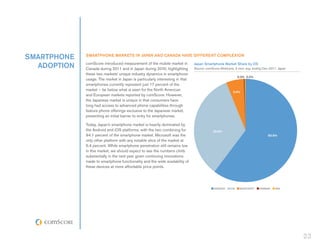
   adoption   comScore introduced measurement of the mobile market in
              Canada during 2011 and in Japan during 2010, highlighting
                                                                               Japan Smartphone Market Share by OS
                                                                               Source: comScore MobiLens, 3 mon. avg. ending Dec-2011, Japan
              these two markets’ unique industry dynamics in smartphone
                                                                                                             0.3% 0.2%
              usage. The market in Japan is particularly interesting in that
              smartphones currently represent just 17 percent of the
              market – far below what is seen for the North American
                                                                                                         5.4%
              and European markets reported by comScore. However,
              the Japanese market is unique in that consumers have
              long had access to advanced phone capabilities through
              feature phone offerings exclusive to the Japanese market,
              presenting an initial barrier to entry for smartphones.

              Today, Japan’s smartphone market is heavily dominated by
              the Android and iOS platforms, with the two combining for                    33.6%
              94.1 percent of the smartphone market. Microsoft was the                                                          60.5%
              only other platform with any notable slice of the market at
              5.4 percent. While smartphone penetration still remains low
              in this market, we should expect to see the numbers climb
              substantially in the next year given continuing innovations
              made to smartphone functionality and the wide availability of
              these devices at more affordable price points.


                                                                                            android    ios    microsoft   symbian    RIM


                                                                                                                                               23
smartphone             Meanwhile, Canada also shows a very different complexion
                          than most other markets due to the strength of the RIM/
                                                                                           Canada Smartphone Market Share by OS
                                                                                           Source: comScore MobiLens, Dec-2011, Canada
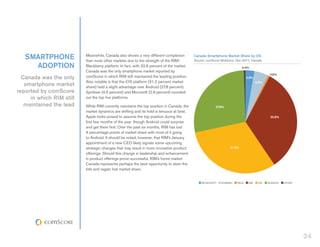
      adoption            Blackberry platform. In fact, with 32.6 percent of the market,                                 0.4%
                          Canada was the only smartphone market reported by
                                                                                                                                            0.6%
  Canada was the only     comScore in which RIM still maintained the leading position.                                       2.9%
                          Also notable is that the iOS platform (31.2 percent market                                                4.5%
   smartphone market      share) held a slight advantage over Android (27.8 percent).
reported by comScore      Symbian (4.5 percent) and Microsoft (2.9 percent) rounded
     in which RIM still   out the top five platforms.
   maintained the lead    While RIM currently maintains the top position in Canada, the                 27.8%
                          market dynamics are shifting and its hold is tenuous at best.
                          Apple looks poised to assume the top position during the                                                          32.6%
                          first few months of the year, though Android could surprise
                          and get there first. Over the past six months, RIM has lost
                          6 percentage points of market share with most of it going
                          to Android. It should be noted, however, that RIM’s January
                          appointment of a new CEO likely signals some upcoming
                          strategic changes that may result in more innovative product                           31.2%
                          offerings. Should this change in leadership and enhancement
                          in product offerings prove successful, RIM’s home market
                          Canada represents perhaps the best opportunity to stem the
                          tide and regain lost market share.


                                                                                               microsoft    symbian   palm    rim    ios   android   other


                                                                                                                                                             24
Mobile Media Consumption
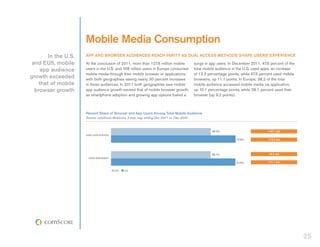
        In the U.S.   App and Browser Audiences Reach Parity as Dual Access Methods Shape Users’ Experience
 and EU5, mobile      At the conclusion of 2011, more than 127.6 million mobile             surge in app users. In December 2011, 47.6 percent of the
     app audience     users in the U.S. and 108 million users in Europe consumed            total mobile audience in the U.S. used apps, an increase
                      mobile media through their mobile browser or applications,            of 13.3 percentage points, while 47.5 percent used mobile
growth exceeded       with both geographies seeing nearly 30 percent increases              browsers, up 11.1 points. In Europe, 38.2 of the total
    that of mobile    in these audiences. In 2011 both geographies saw mobile               mobile audience accessed mobile media via application,
  browser growth      app audience growth exceed that of mobile browser growth,             up 10.1 percentage points, while 38.1 percent used their
                      as smartphone adoption and growing app options fueled a               browser (up 9.2 points).


                      Percent Share of Browser and App Users Among Total Mobile Audience
                      Source: comScore MobiLens, 3 mon. avg. ending Dec-2011 vs. Dec-2010


                                                                                                      38.2%                          +10.1 pts
                      used application
                                                                                                                    47.6%            +13.3 pts


                                                                                                      38.1%                           +9.2 pts
                       used browser
                                                                                                                    47.5%            +11.1 pts

                                         EU5   U.S.


                                                                                                                                                        25
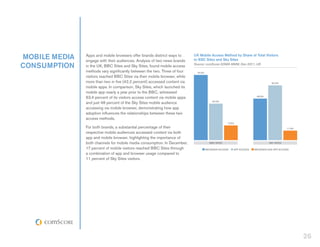
mobile media   Apps and mobile browsers offer brands distinct ways to
               engage with their audiences. Analysis of two news brands
                                                                             UK Mobile Access Method by Share of Total Visitors
                                                                             to BBC Sites and Sky Sites
consumption    in the UK, BBC Sites and Sky Sites, found mobile access       Source: comScore GSMA MMM, Dec-2011, UK

               methods vary significantly between the two. Three of four       75.5%
               visitors reached BBC Sites via their mobile browser, while
               more than two in five (42.2 percent) accessed content via                                                         63.4%
               mobile apps. In comparison, Sky Sites, which launched its
               mobile app nearly a year prior to the BBC, witnessed
               63.4 percent of its visitors access content via mobile apps                                             48.0%

                                                                                           42.2%
               and just 48 percent of the Sky Sites mobile audience
               accessing via mobile browser, demonstrating how app
               adoption influences the relationships between these two
               access methods.
                                                                                                     17.0%
               For both brands, a substantial percentage of their                                                                          11.0%
               respective mobile audiences accessed content via both
               app and mobile browser, highlighting the importance of
               both channels for mobile media consumption. In December,                  BBC Sites                             sky Sites

               17 percent of mobile visitors reached BBC Sites through                 browser access    app access   browser and app access
               a combination of app and browser usage compared to
               11 percent of Sky Sites visitors.


                                                                                                                                                   26
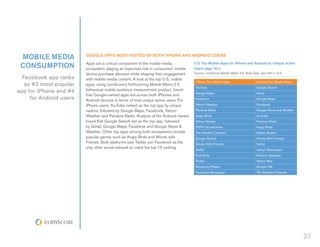
mobile media            Google Apps Most-Visited by both iphone and Android Users

 consumption             Apps are a critical component of the mobile media
                         ecosystem, playing an important role in consumers’ mobile
                                                                                      U.S. Top Mobile Apps for iPhone and Android by Unique Active
                                                                                      Users (Age 18+)
                         device purchase decision while shaping their engagement      Source: comScore Mobile Metrix 2.0, Beta Data, Dec-2011, U.S.
  Facebook app ranks     with mobile media content. A look at the top U.S. mobile
                                                                                       iPhone Top Mobile Apps                    Android Top Mobile Apps
   as #3 most popular    apps, using comScore’s forthcoming Mobile Metrix 2.0
                                                                                       YouTube                                   Google Search
app for iPhone and #4    behavioral mobile audience measurement product, found
                                                                                       Google Maps                               Gmail
                         that Google-owned apps led across both iPhones and
     for Android users   Android devices in terms of total unique active users. For    Facebook                                  Google Maps

                         iPhone users, YouTube ranked as the top app by unique         Yahoo! Weather                            Facebook
                         visitors, followed by Google Maps, Facebook, Yahoo!           Pandora Radio                             Google News and Weather
                         Weather and Pandora Radio. Analysis of the Android market     Angry Birds                               YouTube
                         found that Google Search led as the top app, followed         Yahoo! Stocks                             Pandora Radio
                         by Gmail, Google Maps, Facebook and Google News &             ESPN ScoreCenter                          Angry Birds
                         Weather. Other top apps among both ecosystems include         The Weather Channel                       Adobe Reader
                         popular games such as Angry Birds and Words with              Google Search                             Words With Friends
                         Friends. Both platforms saw Twitter join Facebook as the      Words With Friends                        Twitter
                         only other social network to crack the top 15 ranking.
                                                                                       Netflix                                   Yahoo! Messenger
                                                                                       Fruit Ninja                               Amazon Appstore
                                                                                       Twitter                                   Yahoo! Mail
                                                                                       Movies by Flixster                        Google Talk
                                                                                       Facebook Messenger                        The Weather Channel


                                                                                                                                                           27
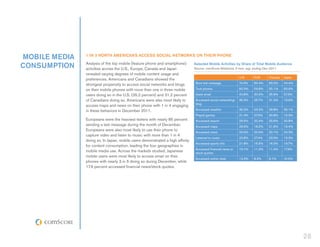
mobile media   1 in 3 North Americans Access Social Networks on their Phone

consumption    Analysis of the top mobile (feature phone and smartphone)
               activities across the U.S., Europe, Canada and Japan
                                                                               Selected Mobile Activities by Share of Total Mobile Audience
                                                                               Source: comScore MobiLens, 3 mon. avg. ending Dec-2011
               revealed varying degrees of mobile content usage and
                                                                                                              U.S.    EU5       Canada   Japan
               preferences. Americans and Canadians showed the
                                                                                Sent text message             74.3%   84.4%     69.2%    44.4%
               strongest propensity to access social networks and blogs
               on their mobile phones with more than one in three mobile        Took photos                   60.3%   59.8%     55.1%    63.9%

               users doing so in the U.S. (35.2 percent) and 31.2 percent       Used email                    40.8%   30.0%     35.9%    57.3%
               of Canadians doing so. Americans were also most likely to        Accessed social networking/   35.3%   25.7%     31.2%    19.6%
                                                                                blog
               access maps and news on their phone with 1 in 4 engaging
               in these behaviors in December 2011.                             Accessed weather              35.2%   23.2%     29.8%    35.1%
                                                                                Played games                  31.4%   27.5%     30.8%    15.3%
               Europeans were the heaviest texters with nearly 85 percent       Accessed search               29.5%   20.4%     25.6%    30.8%
               sending a text message during the month of December.             Accessed maps                 26.5%   18.2%     21.6%    19.4%
               Europeans were also most likely to use their phone to
                                                                                Accessed news                 25.5%   20.0%     20.1%    24.3%
               capture video and listen to music with more than 1 in 4
                                                                                Listened to music             23.8%   27.4%     23.0%    13.3%
               doing so. In Japan, mobile users demonstrated a high affinity
                                                                                Accessed sports info          21.8%   16.5%     16.0%    19.7%
               for content consumption, leading the four geographies in
                                                                                Accessed financial news or    15.1%   11.3%     11.4%    17.9%
               mobile media use. Across the markets studied, Japanese           stock quotes
               mobile users were most likely to access email on their
                                                                                Accessed online retail        12.2%   8.2%      6.1%     10.0%
               phones with nearly 3 in 5 doing so during December, while
               17.9 percent accessed financial news/stock quotes.


                                                                                                                                                 28
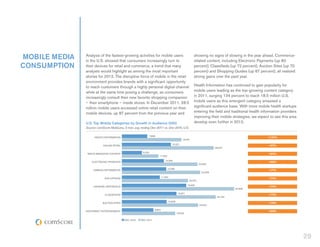
mobile media   Analysis of the fastest-growing activities for mobile users
               in the U.S. showed that consumers increasingly turn to
                                                                                                       showing no signs of slowing in the year ahead. Commerce-
                                                                                                       related content, including Electronic Payments (up 80
consumption    their devices for retail and commerce, a trend that many                                percent), Classifieds (up 72 percent), Auction Sites (up 70
               analysts would highlight as among the most important                                    percent) and Shopping Guides (up 67 percent), all realized
               stories for 2012. The disruptive force of mobile in the retail                          strong gains over the past year.
               environment provides brands with a significant opportunity
               to reach customers through a highly personal digital channel                            Health Information has continued to gain popularity for
               while at the same time posing a challenge, as consumers                                 mobile users leading as the top-growing content category
               increasingly consult their new favorite shopping companion                              in 2011, surging 134 percent to reach 18.5 million U.S.
               – their smartphone – inside stores. In December 2011, 28.5                              mobile users as this emergent category amassed a
               million mobile users accessed online retail content on their                            significant audience base. With more mobile health startups
               mobile devices, up 87 percent from the previous year and                                entering the field and traditional health information providers
                                                                                                       improving their mobile strategies, we expect to see this area
               U.S. Top Mobile Categories by Growth in Audience (000)                                  develop even further in 2012.
               Source: comScore MobiLens, 3 mon. avg. ending Dec-2011 vs. Dec-2010, U.S.

                                                               7,895
                     Health Information                                                                                                             +134%
                                                                                             18,491
                                                                                    15,221
                           Online Retail                                                                                                            +87%
                                                                                                                       28,537
                                                       6,250
                Men’s Magazine Content                                                                                                              +82%
                                                                       11,356
                                                                              13,056
                   Electronic Payments                                                                                                              +80%
                                                                                                            23,480
                                                                                13,789
                    Gaming Information                                                                                                              +77%
                                                                                                              24,358
                                                                           11,794
                            Job Listings                                                                                                            +74%
                                                                                                   20,570
                                                                                                  19,992
                    General Reference                                                                                                               +74%
                                                                                                                                 34,859
                                                                                         16,971
                            Classifieds                                                                                                             +72%
                                                                                                                        29,164
                                                                                13,908
                          Auction Sites                                                                                                             +70%
                                                                                                            23,675
                                                                   9,803
               Kids/Family Entertainment                                                                                                            +69%
                                                                                         16,593

                                           DEC-2010   DEC-2011


                                                                                                                                                                         29
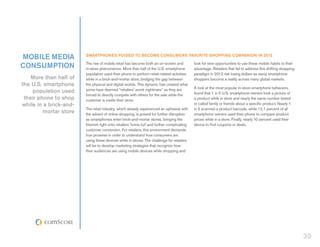
mobile media            Smartphones Poised to Become Consumers’ Favorite Shopping Companion in 2012

consumption             The rise of mobile retail has become both an on-screen and
                        in-store phenomenon. More than half of the U.S. smartphone
                                                                                            look for new opportunities to use these mobile habits to their
                                                                                            advantage. Retailers that fail to address this shifting shopping
                        population used their phone to perform retail-related activities    paradigm in 2012 risk losing dollars as savvy smartphone
    More than half of   while in a brick-and-mortar store, bridging the gap between         shoppers become a reality across many global markets.
the U.S. smartphone     the physical and digital worlds. This dynamic has created what
                        some have deemed “retailers’ worst nightmare” as they are           A look at the most popular in-store smartphone behaviors,
    population used                                                                         found that 1 in 5 U.S. smartphone owners took a picture of
                        forced to directly compete with others for the sale while the
 their phone to shop    customer is inside their store.                                     a product while in store and nearly the same number texted
while in a brick-and-                                                                       or called family or friends about a specific product. Nearly 1
                        The retail industry, which already experienced an upheaval with     in 5 scanned a product barcode, while 12.1 percent of all
         mortar store   the advent of online shopping, is poised for further disruption     smartphone owners used their phone to compare product
                        as smartphones enter brick-and-mortar stores, bringing the          prices while in a store. Finally, nearly 10 percent used their
                        Internet right onto retailers’ home turf and further complicating   device to find coupons or deals.
                        customer conversion. For retailers, this environment demands
                        true prowess in order to understand how consumers are
                        using these devices while in stores. The challenge for retailers
                        will be to develop marketing strategies that recognize how
                        their audiences are using mobile devices while shopping and


                                                                                                                                                               30
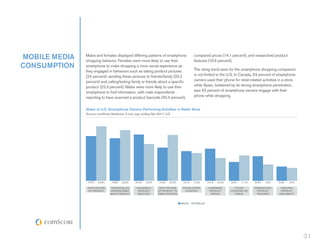
mobile media   Males and females displayed differing patterns of smartphone
               shopping behavior. Females were more likely to use their
                                                                                           compared prices (14.1 percent), and researched product
                                                                                           features (10.9 percent).
consumption    smartphone to make shopping a more social experience as
                                                                                           The rising trend seen for the smartphone shopping companion
               they engaged in behaviors such as taking product pictures
               (24 percent), sending these pictures to friends/family (20.2                is not limited to the U.S. In Canada, 53 percent of smartphone
               percent) and calling/texting family or friends about a specific             owners used their phone for retail-related activities in a store,
               product (22.3 percent). Males were more likely to use their                 while Spain, bolstered by its strong smartphone penetration,
               smartphone to find information, with male respondents                       saw 52 percent of smartphone owners engage with their
               reporting to have scanned a product barcode (20.4 percent),                 phone while shopping.


               Share of U.S. Smartphone Owners Performing Activities in Retail Store
               Source: comScore MobiLens, 3 mon. avg. ending Dec-2011, U.S.


                19.7%   24.0%    18.8%   22.3%   20.4%   16.2%    14.6%   20.2%    13.1%   12.3%     14.1%   10.0%   8.3%   11.1%   10.9%   7.2%   6.3%    5.7%

                took picture     texted/called     scanned a      sent picture     found store        compared         found        researched      checked
                 of product     friends/family      product      of product to       location          product       coupons or      product        product
                                about product       barcode      family/friends                         prices          deals        features      availability


                                                                                  males    females


                                                                                                                                                                  31
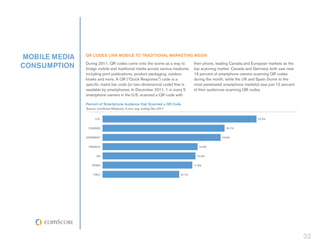
mobile media   QR Codes Link Mobile to Traditional Marketing Media

consumption    During 2011, QR codes came onto the scene as a way to
               bridge mobile and traditional media across various mediums
                                                                                their phone, leading Canada and European markets as the
                                                                                top scanning market. Canada and Germany both saw near
               including print publications, product packaging, outdoor         16 percent of smartphone owners scanning QR codes
               kiosks and more. A QR (“Quick Response”) code is a               during the month, while the UK and Spain (home to the
               specific matrix bar code (or two-dimensional code) that is       most penetrated smartphone markets) saw just 12 percent
               readable by smartphones. In December 2011, 1 in every 5          of their audiences scanning QR codes.
               smartphone owners in the U.S. scanned a QR code with

               Percent of Smartphone Audience that Scanned a QR Code
               Source: comScore MobiLens, 3 mon. avg. ending Dec-2011


                     u.s.                                                                                         20.3%


                canada                                                                           16.1%


               germany                                                                         15.6%


                 france                                                            12.6%


                      uk                                                         12.3%


                   spain                                                        11.9%


                    italy                                               10.1%


                                                                                                                                          32
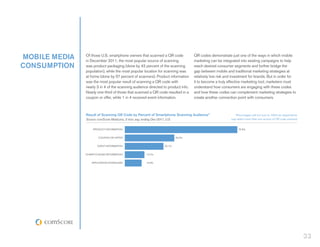
mobile media   Of those U.S. smartphone owners that scanned a QR code
               in December 2011, the most popular source of scanning
                                                                                      QR codes demonstrate just one of the ways in which mobile
                                                                                      marketing can be integrated into existing campaigns to help
consumption    was product packaging (done by 42 percent of the scanning              reach desired consumer segments and further bridge the
               population), while the most popular location for scanning was          gap between mobile and traditional marketing strategies at
               at home (done by 57 percent of scanners). Product information          relatively low risk and investment for brands. But in order for
               was the most popular result of scanning a QR code with                 it to become a truly effective marketing tool, marketers must
               nearly 3 in 4 of the scanning audience directed to product info.       understand how consumers are engaging with these codes
               Nearly one-third of those that scanned a QR code resulted in a         and how these codes can complement marketing strategies to
               coupon or offer, while 1 in 4 received event information.              create another connection point with consumers.


               Result of Scanning QR Code by Percent of Smartphone Scanning Audience*                         *Percentages will not sum to 100% as respondents
               Source: comScore MobiLens, 3 mon. avg. ending Dec-2011, U.S.                                 may select more than one source of QR code scanned


                    product information                                                                          73.3%


                       coupon or offer                                        32.2%


                       event information                              25.1%


               charity/cause information                 12.7%


                   application download                  10.9%


                                                                                                                                                                 33
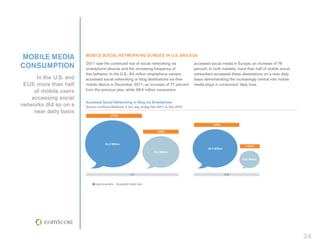
mobile media            Mobile Social Networking Surges in U.S. and EU5

consumption             2011 saw the continued rise of social networking via
                        smartphone devices and the increasing frequency of
                                                                                              accessed social media in Europe, an increase of 76
                                                                                              percent. In both markets, more than half of mobile social
                        this behavior. In the U.S., 64 million smartphone owners              networkers accessed these destinations on a near daily
      In the U.S. and   accessed social networking or blog destinations via their             basis demonstrating the increasingly central role mobile
 EU5, more than half    mobile device in December 2011, an increase of 77 percent             media plays in consumers’ daily lives.
     of mobile users    from the previous year, while 48.4 million consumers

    accessing social
                        Accessed Social Networking or Blog via Smartphone
networks did so on a    Source: comScore MobiLens, 3 mon. avg. ending Dec-2011 vs. Dec-2010
     near daily basis
                                         +77%


                                                                                                          +76%

                                                                         +88%


                                     64.2 Million
                                                                                                                             +102%
                                                                                                      48.4 Million
                                                                       38.2 Million

                                                                                                                           25.5 Million


                                                       U.S.                                                          EU5


                              ever in month     almost every day


                                                                                                                                                          34
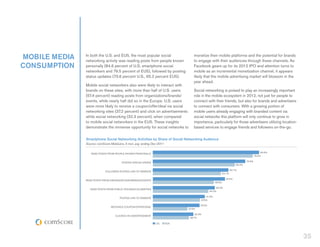
mobile media   In both the U.S. and EU5, the most popular social
               networking activity was reading posts from people known
                                                                                  monetize their mobile platforms and the potential for brands
                                                                                  to engage with their audiences through these channels. As
consumption    personally (84.6 percent of U.S. smartphone social                 Facebook gears up for its 2012 IPO and attention turns to
               networkers and 79.5 percent of EU5), followed by posting           mobile as an incremental monetization channel, it appears
               status updates (73.6 percent U.S., 65.2 percent EU5).              likely that the mobile advertising market will blossom in the
                                                                                  year ahead.
               Mobile social networkers also were likely to interact with
               brands on these sites, with more than half of U.S. users           Social networking is poised to play an increasingly important
               (57.4 percent) reading posts from organizations/brands/            role in the mobile ecosystem in 2012, not just for people to
               events, while nearly half did so in the Europe. U.S. users         connect with their friends, but also for brands and advertisers
               were more likely to receive a coupon/offer/deal via social         to connect with consumers. With a growing portion of
               networking sites (37.2 percent) and click on advertisements        mobile users already engaging with branded content via
               while social networking (32.3 percent), when compared              social networks this platform will only continue to grow in
               to mobile social networkers in the EU5. These insights             importance, particularly for those advertisers utilizing location-
               demonstrate the immense opportunity for social networks to         based services to engage friends and followers on-the-go.

               Smartphone Social Networking Activities by Share of Social Networking Audience
               Source: comScore MobiLens, 3 mon. avg. ending Dec-2011

                                                                                                                                            84.6%
                  read posts from people known personally
                                                                                                                                       79.5%

                                                                                                                               73.6%
                                       posted status update
                                                                                                                       65.2%

                                                                                                                   60.1%
                            followed posted link to website
                                                                                                           54.1%

                                                                                                             57.4%
               read posts from organizations/brands/events
                                                                                                   48.5%

                                                                                                    49.3%
                  read posts from public figures/celebrities
                                                                                               44.2%

                                                                                           41.3%
                                      posted link to website
                                                                                       37.5%

                                                                                       37.2%
                                received coupon/offer/deal
                                                                              27.4%

                                                                                   32.3%
                                   clicked on advertisement
                                                                               28.7%

                                                               u.s.     eu5


                                                                                                                                                       35
Tablets and Multi-Platform Consumption
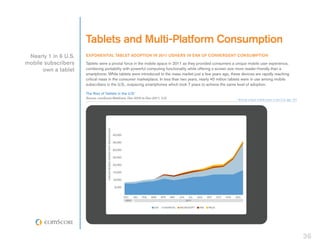
 Nearly 1 in 6 U.S.   Exponential Tablet Adoption in 2011 Ushers in Era of Convergent Consumption
mobile subscribers    Tablets were a pivotal force in the mobile space in 2011 as they provided consumers a unique mobile user experience,
      own a tablet    combining portability with powerful computing functionality while offering a screen size more reader-friendly than a
                      smartphone. While tablets were introduced to the mass market just a few years ago, these devices are rapidly reaching
                      critical mass in the consumer marketplace. In less than two years, nearly 40 million tablets were in use among mobile
                      subscribers in the U.S., outpacing smartphones which took 7 years to achieve the same level of adoption.

                      The Rise of Tablets in the U.S.*
                      Source: comScore MobiLens, Dec-2010 to Dec-2011, U.S.                                                                                         * Among unique mobile users in the U.S. age 13+


                                    unique mobile users with tablets (000)


                                                                             40,000

                                                                             35,000

                                                                             30,000

                                                                             25,000

                                                                             20,000

                                                                             15,000

                                                                             10,000

                                                                              5,000

                                                                                  -
                                                                                      DEC   JAN   FEB   MAR    APR   MAY   JUN     JUL   AUG    SEP     OCT   NOV   DEC
                                                                                       2010                                      2011

                                                                                                         ios    android    microsoft      rim    palm


                                                                                                                                                                                                                      36
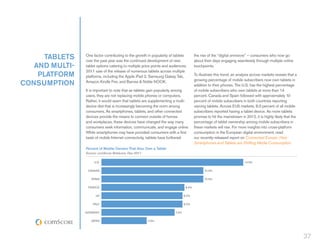
tablets    One factor contributing to the growth in popularity of tablets
                over the past year was the continued development of new
                                                                                       the rise of the “digital omnivore” – consumers who now go
                                                                                       about their days engaging seamlessly through multiple online
   and multi-   tablet options catering to multiple price points and audiences.        touchpoints.
                2011 saw of the release of numerous tablets across multiple
    platform    platforms, including the Apple iPad 2, Samsung Galaxy Tab,             To illustrate this trend, an analysis across markets reveals that a
                                                                                       growing percentage of mobile subscribers now own tablets in
consumption     Amazon Kindle Fire, and Barnes & Noble NOOK.
                                                                                       addition to their phones. The U.S. has the highest percentage
                It is important to note that as tablets gain popularity among          of mobile subscribers who own tablets at more than 14
                users, they are not replacing mobile phones or computers.              percent. Canada and Spain followed with approximately 10
                Rather, it would seem that tablets are supplementing a multi-          percent of mobile subscribers in both countries reporting
                device diet that is increasingly becoming the norm among               owning tablets. Across EU5 markets, 8.3 percent of all mobile
                consumers. As smartphones, tablets, and other connected                subscribers reported having a tablet device. As more tablets
                devices provide the means to connect outside of homes                  promise to hit the mainstream in 2012, it is highly likely that the
                and workplaces, these devices have changed the way many                percentage of tablet ownership among mobile subscribers in
                consumers seek information, communicate, and engage online.            these markets will rise. For more insights into cross-platform
                While smartphones may have provided consumers with a first             consumption in the European digital environment, read
                taste of mobile Internet connectivity, tablets have furthered          our recently-released report on Connected Europe: How
                                                                                       Smartphones and Tablets are Shifting Media Consumption.
                Percent of Mobile Owners That Also Own a Tablet
                Source: comScore MobiLens, Dec-2011

                     u.s.                                                                                              14.3%

                 canada                                                                      10.3%

                   spain                                                                     10.3%

                 france                                                         8.4%

                      uk                                                       8.2%

                    italy                                                      8.2%

                germany                                                 7.4%

                   japan                              4.6%


                                                                                                                                                             37
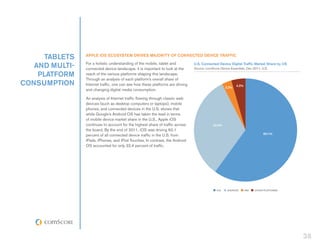
tablets    Apple iOS Ecosystem Drives Majority of Connected Device Traffic

   and multi-   For a holistic understanding of the mobile, tablet and
                connected device landscape, it is important to look at the
                                                                                U.S. Connected Device Digital Traffic Market Share by OS
                                                                                Source: comScore Device Essentials, Dec-2011, U.S.

    platform    reach of the various platforms shaping this landscape.
                Through an analysis of each platform’s overall share of
consumption     Internet traffic, one can see how these platforms are driving
                                                                                                     3.2%
                                                                                                            4.2%
                and changing digital media consumption.

                An analysis of Internet traffic flowing through classic web
                devices (such as desktop computers or laptops), mobile
                phones, and connected devices in the U.S. shows that
                while Google’s Android OS has taken the lead in terms
                of mobile device market share in the U.S., Apple iOS
                continues to account for the highest share of traffic across                 32.4%
                the board. By the end of 2011, iOS was driving 60.1
                percent of all connected device traffic in the U.S. from                                                       60.1%

                iPads, iPhones, and iPod Touches. In contrast, the Android
                OS accounted for only 32.4 percent of traffic.


                                                                                               ios    android      rim   other platforms


                                                                                                                                           38
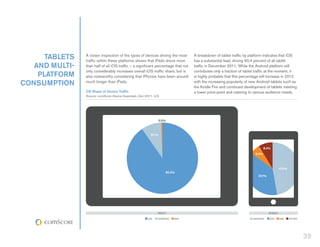
tablets    A closer inspection of the types of devices driving the most
                traffic within these platforms shows that iPads drove more
                                                                                   A breakdown of tablet traffic by platform indicates that iOS
                                                                                   has a substantial lead, driving 90.4 percent of all tablet
   and multi-   than half of all iOS traffic – a significant percentage that not   traffic in December 2011. While the Android platform still
                only considerably increases overall iOS traffic share, but is      contributes only a fraction of tablet traffic at the moment, it
    platform    also noteworthy considering that iPhones have been around          is highly probable that this percentage will increase in 2012
consumption     much longer than iPads.                                            with the increasing popularity of new Android tablets such as
                                                                                   the Kindle Fire and continued development of tablets meeting
                OS Share of Device Traffic                                         a lower price point and catering to various audience needs.
                Source: comScore Device Essentials, Dec-2011, U.S.


                                                                   0.5%


                                                            9.1%


                                                                                                                               8.4%
                                                                                                                        6.5%


                                                                                                                                           47.4%
                                                                      90.4%
                                                                                                                          37.7%


                                                                tablet                                                            mobile

                                                          ios   android   rim                                          android    ios      rim     other


                                                                                                                                                           39
tablets             Connectivity On-the-Go Flourishes with Increased WiFi Availability

   and multi-            One key trend that has been pivotal in shaping the
                         mobile and connected device landscape is the growth in
                                                                                               Connection Type by Device in the U.S.
                                                                                               Source: comScore Device Essentials, Dec-2011, U.S.

    platform             connectivity options available to consumers away from
                                                                                                                          59.7%                            40.3%
                         home and work locations. In recent years, WiFi connections            mobile

consumption              have become more commonplace not just at home, but
                                                                                               tablet    7.7%                              92.3%
                         also in public spaces such as libraries, coffee shops, and
    WiFi connections     airports. In December 2011, WiFi connections drove 40.3                          mobile access     wifi access

drove 40% of mobile      percent of mobile Internet connections and 92.3 percent of
                         tablet Internet connections in the U.S. In this illustration, it is
Internet connections     interesting to note that despite the availability of data plans       There are some notable differences in connection types
    and 92% percent      providing Internet access to mobile users, a significant              driving traffic by operating systems. 75.2 percent of all
                                                                                               Internet traffic coming from iOS devices comes through a
    of tablet Internet   portion of traffic from mobile devices still come through
                                                                                               WiFi connection, while 71.4 percent of Android traffic come
                         WiFi connections. This could be due to multiple factors,
         connections     such as consumer desires to save on data plan fees or                 through mobile broadband access – virtual mirror images
           in the U.S.   needs for higher data transmission capacities met by WiFi             of one another. Until recently, iOS devices – particularly
                         connections. Regardless of the reason, with 40 percent                the iPad – led the market in offering a better browsing
                         of all mobile Internet traffic coming over this channel, WiFi         and entertainment experience, leading to heavier content
                         remains a key connectivity channel for mobile users.                  consumption that can account for a significant share of
                                                                                               traffic coming through WiFi on the iOS platform. But with
                         Tablets tell a somewhat different story. As tablets provide           more innovative Android tablets on the rise in 2012 and
                         a convenient means for users to connect and engage                    tablet data plans becoming more popular across the board,
                         frequently in online activities such as social networking,            it is possible that these connection dynamics will look very
                         online gaming and the like, mobile broadband plans have               different in the coming months.
                         emerged as popular options catering to heavy tablet users.
                         However, only 8 percent of tablet traffic currently comes
                                                                                               Connection Type by OS in the U.S.
                         via mobile broadband. As tablets continue on their upward
                                                                                               Source: comScore Device Essentials, Dec-2011, U.S.
                         climb in 2012 and mobile broadband plans become
                         more accessible, it is highly likely that the share of mobile         android                        71.4%                           28.6%
                         broadband traffic seen over tablets will rapidly increase
                         and may eventually reach levels consummate with mobile                    ios          24.8%                              75.2%
                         phones.
                                                                                                           mobile access     wifi access


                                                                                                                                                                      40
tablets    Connected Devices Encourage Cross-Platform Media Consumption

   and multi-   An analysis of Internet traffic to properties within the
                Newspaper category throughout the course of a day offers
                                                                                                      Different patterns of relative consumption appear
                                                                                                      across the three main device categories driving traffic
    platform    a glimpse into how tablets and other connected devices                                to Newspaper sites, showing that consumers are likely
                are changing the way consumers access and engage with                                 to turn to different devices for news at various points in
consumption     online information. Since the advent of the Internet, the                             a day. On a given weekday, mobile phones and tablets
                newspaper industry has had to adapt to changing demands                               drive less traffic to Newspaper sites in the middle of the
                from consumers now able to turn to the Internet for quick                             workday relative to the total traffic these devices drive to
                and convenient access to real-time news updates from                                  these sites in a day. In contrast, computers display higher
                a variety of sources. As audiences now increase their                                 relative consumption of Newspaper traffic in this period, as
                consumption of information across multiple platforms,                                 most people spend the majority of this time on weekdays
                it becomes more important than ever for newspaper                                     interacting with their computers.
                companies and those in similar industries to understand
                the dynamics of such varied media consumption.

                Share of U.S. Device Page Traffic for the Newspaper Category Over a Day (Weekday)
                Source: comScore Custom Analytics, January 24, 2012 (Tuesday), U.S.

                                                            10%
                Share of Daily Device Traffic to Category


                                                            9%
                                                            8%
                                                            7%
                                                            6%
                                                            5%
                                                            4%
                                                            3%
                                                            2%
                                                            1%
                                                            0%
                                                                  12:00 AM                  6:00 AM      12:00 pM                      6:00 pM


                                                                     tablet   mobile   computer


                                                                                                                                                                     41
tablets    The trend for Newspaper site consumption on tablets
                shows highest relative use in the evening, just before
                                                                                                       consumption throughout the day, compared to tablets and
                                                                                                       mobile devices. Tablet use saw significantly higher relative
   and multi-   midnight. This indicates that tablet owners are most likely                            use in the morning, as tablet owners were more likely to
                to turn to their tablets for news late in the evening after                            browse news leisurely through these devices on a weekend
    platform    unplugging from their computer screens and before getting                              morning.
consumption     ready to turn in for the night. Mobile devices, on the other
                hand, display a moderately steady trend for relative news                              These differing trends highlight how consumers depend on a
                consumption through the day, suggesting that people turn                               variety of devices to consume information depending on their
                to their phones for news in small, regular doses as they                               needs at the moment – broadly illustrating an overall shift
                move from location to location throughout the day.                                     toward cross-platform digital media consumption through
                                                                                                       multiple device touchpoints. In 2012, it will be interesting to
                The relative traffic trends for weekend news consumption                               see how such digital media consumption habits continue to
                paint a different picture. Computers drove less relative news                          be shaped by tablets and connected devices to be released.

                Share of U.S. Device Page Traffic for the Newspaper Category Over a Day (Weekend)
                Source: comScore Custom Analytics, January 28, 2012 (Saturday), U.S.


                                                             10%
                 Share of Daily Device Traffic to Category


                                                             9%

                                                             8%

                                                             7%

                                                             6%

                                                             5%

                                                             4%

                                                             3%

                                                             2%

                                                             1%

                                                             0%

                                                                   12:00 AM                  6:00 AM           12:00 pM                        6:00 pM


                                                                      tablet   mobile   computer


                                                                                                                                                                         42
2012: Putting the Future in Focus
Conclusion   MOBILE ECOSYSTEM BATTLE BECOMING A WAR
             The competition between operating systems is poised to           rejuvenate their OS in the minds of consumers. RIM, which
             intensify in 2012 as brands compete for the tens of millions     led the smartphone market from 2008 to the end of 2010,
             of consumers that will adopt smartphones during the year.        appointed a new CEO as it attempts to halt attrition and
             In 2012, expect smartphone penetration to cross the 50           regain its leadership position in consumers’ consideration
             percent threshold in the U.S., Canada and EU5, with the UK       set. Microsoft, which started off 2012 with the release
             and Spain already reaching this milestone during 2011. In        of the highly publicized Nokia Lumia 900, could emerge
             both the U.S. and Europe, operating systems already play a       as a strong contender with its new Metro user interface
             critical role in device purchase decisions, ranking just under   promising to unify Windows-based phones, tablets, and
             network quality in importance. With smartphone ecosystems        computers and a partnership with Nokia to serve as the
             constantly growing in sophistication and offerings, expect       primary hardware partner for its smartphones.
             consumers to put increasing weight in this factor when
             making their purchase decision.                                  In 2012, platform wars will also extend beyond the
                                                                              smartphone screen, as tablet adoption continues to surge
             Operating systems are not only competing for first-time          while driving a growing share of digital media consumption
             smartphone owners, but also for the loyalty of their current     across the globe. Apple has largely dominated the
             audience base, as attractive offers from carriers and            narrative in the tablet market, but the status quo is set to
             improving features from competitors are constantly putting       be challenged as devices such as the lower-cost Android
             market share at risk. As seen with RIM, which shed half of       tablets offer consumers a more affordable alternative to the
             its U.S. market share in the last 12 months, competition         iPad.
             is fierce and market position can drastically change in a
             very short period of time in this rapidly evolving mobile        With brands waging battle to raise awareness and capture
             landscape.                                                       loyalty, the true winner in this war will be the consumer,
                                                                              benefitting from the innovative technology and price cuts
             Android and iOS are set to define the smartphone                 wrought by this competitive landscape.
             landscape in 2012 as both delivered solid performances
             across North America, Europe and Japan during the past
             year, teeing up what some envision as a two-horse race
             in 2012. Fighting an uphill battle, the year will be critical
             for both RIM and Microsoft, as both brands attempt to


                                                                                                                                             43
Conclusion           TABLETS – THE FOURTH SCREEN IS GOING MAINSTREAM
                     Tablets are taking their place as the fourth screen in           Although facing growing competition, the iPad still reigns
 2012: Putting the   consumers’ lives, joining TV, PCs and smartphones as the         as the leader in the tablet space and will look to solidify its
                     gateway to digital media consumption. Tablet adoption            position with the much anticipated release of a new version
  Future in Focus
                     rapidly ascended in the past year, fueled by a growing           of the iPad in 2012. Although the iPad’s higher price point
                     number of devices coming to market, which created a wide         keeps it out of the consideration set for some consumers,
                     variety of options available for today’s tablet consumer.        Apple’s loyal following of ‘fanboys’ and its highly-publicized
                     Among the most important trends that defined tablet              product launches will no doubt make the new iPad among
                     adoption at the end of 2011 and will be critical in shaping      the most talked about product releases of 2012.
                     2012 is the rise in affordable tablet devices that cater to
                     various price point considerations. The U.S. release of the
                     Kindle Fire and NOOK Tablet was a critical turning point in
                     the mass adoption of tablet devices, bringing to market the
                     first tablets that combined an affordable price point with
                     competitive specs anchored by a strong brand, already
                     established distribution channels and major marketing
                     dollars. This lower price point is critical in bringing tablet
                     devices to the mass market and will be integral to this
                     competitive landscape in 2012.


                                                                                                                                                        44
Conclusion           MIND THE DIGITAL OMNIVORE
                     The surging global adoption of smartphones and tablets is         are disrupted and may not be adequately replaced by
 2012: Putting the   changing the how, when and where consumers connect to             the emerging channel. In 2011 we observed the marked
                     digital content, creating the most dramatic shift in digital      decline of such categories as webmail, weather, maps
  Future in Focus
                     media consumption since the advent of the personal                and others on the classic web, as audiences have turned
                     computer. Understanding today’s multi-device consumer,            with increasing frequency to their mobile devices for these
                     aka the ‘Digital Omnivore,’ will be increasingly important for    activities. Digital commerce continues to take share from
                     advertisers and publishers in 2012 with an eye on the two         traditional retail channels, a trend that will only accelerate
                     critical factors to building effective digital strategies: the    with smartphones entering retail stores and tablets
                     incremental effect and platform cannibalization.                  becoming a preferred source of late-night surfing. We will
                                                                                       also see the continued transition from physical products
                     The incremental effect of smartphones and connected               such as CDs and books to digital content.
                     devices on reach and engagement is often substantial,
                     especially for those categories such as news and                  The incremental effect and potential for cannibalization
                     entertainment that lend themselves particularly well to           point to the rising importance of understanding
                     the mobile and tablet environments. For publishers, this          complementary device usage in the coming year. Devices
                     means the potential to reach incremental audience and             influence the way people consume content and it is
                     deliver more advertising. For advertisers, understanding          important to remember that they do not exist in isolation of
                     unduplicated audiences across these various platforms will        one another, but rather have a complementary relationship
                     be critical to optimizing campaigns. For both publishers and      in consumers’ lives. Understanding how consumers behave
                     advertisers, understanding how these devices are shifting         across multiple environments is the key for businesses to
                     content engagement will provide a more complete picture of        stay ahead of the curve and ensure their digital businesses
                     today’s digital consumer and further inform the allocation of     minimize the effects of disruption and maximize the
                     digital dollars and resources.                                    incremental opportunities.

                     But while these incremental opportunities abound with
                     emerging platforms, they will likely serve as disruptive forces
                     to current paradigms. As consumers develop preferences
                     for using new devices in instances where they once
                     relied on other platforms, existing monetization streams


                                                                                                                                                        45
Conclusion           MOBILE DISRUPTING THE TRADITIONAL RETAIL SALES FUNNEL
                     Smartphones have become consumers’ most-valued                 Not only are smartphones influencing the physical shopping
 2012: Putting the   shopping companion, a trend that is poised to continue         world, these devices, along with tablets, are disrupting
                     in 2012 as smartphone adoption surges past 50 percent          the traditional sales funnel. It is not uncommon for a
  Future in Focus
                     in many markets. What has been referred to by some as          consumer to call upon multiple devices before completing a
                     retailers’ worst nightmare, smartphones are bringing the       purchase. They may browse products on their smartphone
                     power of the Internet right into brick-and-mortar stores,      on the commute to work, research prices on their tablet
                     arming consumers with the pricing power that was once          while curled up in bed for the night, and finally complete
                     reserved for the confines of their home or work online         the purchase on their PC at work the next day. This new
                     shopping experience. With just a few swipes on their           paradigm means that for traditional retailers’ to successfully
                     touchscreen, consumers are now able to compare prices,         navigate this changing landscape in 2012 they must build
                     locate a store that offers a better deal, read reviews, send   strategies that address audiences across these devices
                     product photos and more, all while standing within arms’       throughout their shopping and purchasing process, or risk
                     reach of a product on the shelf and within feet of the         losing that customer’s sale to the savvy retailer who looks
                     checkout, defying the old adage that getting shoppers in the   for the interception by being in front of the consumer at
                     store is half the battle in making a sale.                     every step of the sales funnel.


                                                                                                                                                     46
Conclusion           CONSUMERS READY TO HIT PLAY ON MOBILE VIDEO
                     Fueled by 4G adoption, device advancements and app            Beyond content videos, the emergence of video
 2012: Putting the   proliferation, mobile video is poised to be an increasingly   communication is changing not only how people
                     prominent activity for mobile users in 2012. In the U.S.,     communicate with their phone, but also how OEMs
  Future in Focus
                     4G subscribers are 33 percent more likely to watch            themselves are evolving to address shifting consumer
                     mobile video on their smartphone than an average user,        behaviors. With video chat on the rise, more handsets
                     demonstrating the critical role 4G networks will play         are integrating front-facing cameras into their devices
                     in bringing video to the small screen for mass mobile         to support this communication activity as mobile phones
                     consumption. Similarly WiFi hot spots continue to spring      evolve from much more than their original voice-
                     up offering mobile consumers an increasing number of          to-voice purpose.
                     opportunities to engage with mobile video on-the-go and
                     in turn engage with mobile ads, which will be a growing
                     component of the mobile video landscape and
                     its monetization.


                                                                                                                                             47
Methodology and Definitions
This report utilizes data from the comScore suite of products, including comScore MobiLens, comScore Device Essentials,
GSMA MMM and comScore Mobile Metrix 2.0.


comScore MobiLens
comScore MobiLens provides market-wide insight into mobile digital media consumption, brand-level audience metrics,
and details of device ownership and technology penetration. Using proprietary data collection methods, we survey
nationally representative samples of mobile subscribers age13+ in the U.S., UK, France, Germany, Spain, Italy, Canada,
and Japan. The MobiLens sample is substantial enough to provide projected data for sub-segments as small as 1 percent
of mobile subscribers. The MobiLens’ sampling and survey methods undergo extensive analysis and market validation
including comparisons to known network operator market shares, leading handset model shares, downloading activity, and
other usage metrics.

For 2011, the following represent the estimated monthly survey completes by market utilized for this report:

•	 U.S.: 10,000 mobile phone owners
•	 UK and Germany: 5,000 mobile phone owners
•	 France, Spain and Italy: 4,000 mobile phone owners
•	 Canada (reported quarterly): 5,000 mobile phone owners

For more information, please visit:
www.comscore.com/Products_Services/Product_Index/MobiLens


COMSCORE DEVICE ESSENTIALS
comScore Device Essentials provides insight into digital traffic share across all devices worldwide, offering detail into
device characteristics, connection type, and category consumption. The product is based on the comScore Unified
Digital Measurement (UDM) approach, measuring browser-based page views coming from computers, mobile, and other
connected devices to more than one million domains tagging with comScore. Device Essentials also utilizes the comScore
Client Focus Dictionary to segment connected device usage into content categories.

For more information, please visit:
www.comscore.com/Products_Services/Product_Index/Device_Essentials


                                                                                                                            48
Methodology                    GSMA Mobile Media Metrics (MMM)

         and                   GSMA Mobile Media Metrics (MMM) is a partnership between the GSM Association (GSMA), comScore, and the UK’s 4
                               mobile operators: O2, Vodafone, EverythingEverywhere and 3UK. MMM provides a census-level solution for mobile media
  definitions                  reporting, taking irreversibly anonymised mobile internet usage data from 3 of the 4 UK mobile operators. The census data
                               collected from the operators is ascribed with demographic data collected from a permission-based sample of mobile users.
                               MMM delivers key market-level mobile web visitation and engagement metrics, as well as usage figures for connected apps.

                               For more information, please visit:
                               www.comscore.com/Products_Services/Product_Index/GSMA_Mobile_Media_Metrics_MMM


                               comscore Mobile Metrix 2.0
                               comScore Mobile Metrix 2.0 provides direct and continuous monitoring of actual U.S. consumer behavior on smartphones
                               across the Android, iOS and RIM platforms for mobile users age 18 and older. Utilizing comScore’s Unified Digital
                               Measurement approach, Mobile Metrix 2.0 combines panel and census measurement to provide a comprehensive picture of
                               mobile activity across browser and application usage including metrics such as unique visitors, reach, frequency and duration
                               as well as demographic insights in order to best understand today’s smartphone audience. The product is currently available
                               in beta.

  FOR FURTHER INFORMATION,     For more information, please visit:
           PLEASE CONTACT:     http://www.comscore.com/Products_Services/Product_Index/Mobile_Metrix

           Sarah Radwanick
              comScore, Inc.
           +1 206 268 6310
       press@comscore.com

            Carmela Aquino
             comScore, Inc.
          +1 703 438 2024
       press@comscore.com


                               © 2012 comScore, Inc.

2012 mobile future in focus

  • 1.
    Key Insights from2011 and What They Mean for the Coming Year February 2012
  • 2.
    Introduction 201 was a pivotal year for the mobile industry, marked by the 1 dramatic rise of smartphones in the mainstream, the burgeoning of tablets and other web-enabled connected devices, and a cultural shift toward cross-platform digital media consumption. With mobile becoming an increasing part of comprehensive digital marketing strategies, it becomes more important than ever to understand how the current trends are shaping the mobile environment, with an eye to what lies ahead for 2012. This report examines the mobile and connected device landscape across the mobile markets measured by comScore – primarily the United States, United Kingdom, France, Germany, Italy, Spain, Japan, and Canada – through an exploration of dominant themes in smartphone adoption growth, mobile media use in areas such as FOR FURTHER INFORMATION, social networking and retail, platform ecosystem dynamics, and shifts PLEASE CONTACT: in multi-device digital media consumption. Sarah Radwanick comScore, Inc. +1 206 268 6310 press@comscore.com Carmela Aquino comScore, Inc. +1 703 438 2024 press@comscore.com Stay Connected Follow @comscore 2
  • 3.
    Contents Data Note This report is based on a combination 4 Executive Summary of sources in the comScore mobile suite of products, including behavioral 6 Mobile and Connected Device Landscape data from comScore Device Essentials, comScore Mobile Metrix 2.0 and GSMA 10 Mobile Handsets 16 Mobile Media Metrics (MMM). The majority of this report utilizes data from Smartphone Adoption comScore MobiLens, which is based on a nationally-representative survey of mobile subscribers age 13+ in the U.S., 25 Mobile Media Consumption UK, France, Germany, Italy, Spain, Japan, and Canada. All monthly data from 36 Tablets and Multi-Platform Consumption comScore MobiLens are averaged over three months on a rolling basis, except 43 Conclusion 48 for Canada which is currently measured on a monthly basis, and unless otherwise Methodology and Definitions mentioned. Smartphones are defined throughout the report as mobile phones that use the Google Android, Apple iOS, RIM Blackberry, Microsoft, and other similar platforms. For more information on comScore products, please visit www.comscore.com/Products_Services.
  • 4.
    Executive Summary Smartphones GainTraction Among ‘Early Surge in Mobile App Usage Shapes a Dual Mobile Majority’ Driving Mobile Media Consumption Browsing Experience, Fueling Category Growth Smartphones gained rapid adoption among mainstream Along with the growth in smartphone adoption, investment consumer segments across markets. Nearly 42 percent of all in mobile applications by publishers has fueled increasing U.S. mobile subscribers now use smartphones, along with app usage among total mobile users. In 2011, both the U.S. 44 percent of mobile users across the EU5 (comprised of and EU5 saw strong growth in the usage of apps, reaching France, Germany, Italy, Spain, and the UK). Mobile media parity with the mobile browser audience by year’s end. Health usage – defined as browsing the mobile web, accessing ranked as the fastest-growing mobile media category in the applications, or downloading content – saw a surge in activity U.S. in 2011, followed by Retail and other commerce-related and surpassed 50 percent penetration in many markets, categories such as Electronic Payments and Auction Sites. supported by the proliferation of high-speed networks and increased public WiFi availability. ‘Smart Shoppers’ Disrupt Traditional Retail as Smartphones Enter Brick-and-Mortar Stores Smartphone Platform Wars Intensify As More than half of the U.S. smartphone population used Android and Apple Take the Lead in Most their phone to perform retail research while inside a store Markets in 2011, illustrating the emergence of savvy smartphone The Google Android and Apple iOS smartphone platforms shoppers who bring online shopping behaviors in-store. At emerged as the leaders of the U.S. smartphone market in the end of 2011, nearly 1 in 5 smartphone users scanned 2011, with Android capturing just shy of half the smartphone product barcodes and nearly 1 in 8 compared prices on their market and iOS accounting for nearly 30 percent of the phone while in a store. Male and female smartphone users market, ousting other platforms in the process. Android’s exhibited mobile retail behaviors to differing degrees, as rapid rise is notable given its relatively recent emergence females were more likely to use their devices to share their on the scene. In the EU5, Android saw similarly significant shopping experience socially while males were more likely gains, unseating market leader Symbian in 3 out of the 5 to do product research. As mobile retail usage grows not European markets measured. But the platform race is far just in the U.S. but also across other markets, retailers face from over as other players fight to reclaim market share. the challenge of understanding how audiences interact with Under new leadership, RIM held on to the leading position in their mobile devices while shopping to take advantage of any Canada’s smartphone market, albeit followed closely by iOS. opportunities to increase customer conversion. Microsoft took steps to rebuild its platform share with a Nokia partnership in the works and the launch of its Metro user interface across multiple devices. 4
  • 5.
    executive Mobile Devices Fuel Social Networking On-The- Go, Driving Real-Time Online Interaction Mobile Connectivity and Connected Devices Encourage Cross-Platform Digital Media summary With the means to connect on-the-go, mobile users have not Consumption among ‘Digital Omnivores’ only adopted real-time social networking on their devices at a Tablets quickly rose in popularity in 2011, taking less than growing rate but they are doing so with increasing frequency. two years to reach nearly 40 million tablets in use among the 64.2 million U.S. smartphone users and 48.4 million EU5 U.S. mobile population, significantly outpacing smartphones smartphone users accessed social networking sites or blogs which took 7 years to reach similar levels of adoption. By the on their mobile devices at least once in December 2011, end of 2011, nearly 15 percent of U.S. mobile users also with more than half of these mobile social networking users had tablets – a trend seen across other markets as well. accessing social media almost every day. While mobile social Combining portability with powerful computing functionality in networking users showed the highest propensity to read a sleek, user-friendly package, tablets have emerged as the posts from people they knew personally, more than half of fourth screen, heralding a shift to an increasingly multi-device those in the U.S. and nearly half in the EU5 also reported lifestyle that is becoming the norm for many consumers we reading posts from brands, organizations, and events. call “digital omnivores” who engage seamlessly with multiple With people increasingly using social networking sites not online touchpoints throughout a day. Even when accessing just to interact with their friends but also with brands and the same content, each device has very different peak usage organizations, this platform will only grow in importance for times throughout a typical day, highlighting their varying use those advertisers seeking to engage their social networking cases and value propositions to the digitally-connected audiences through mobile with location-based services. consumer.
  • 6.
    Mobile and ConnectedDevice Landscape Mobile media Mobile Media Use Soars in 2011 usage in the U.S. 2011 saw mobile media use accelerate across markets, Among the eight markets analyzed, Japan had the highest and UK surpassed fueled by the popularity of smartphones, the growing penetration of mobile media usage at 76.2 percent in availability of WiFi paired with the proliferation of 3G and 4G December 2011. The UK followed with more than 56 percent 50% in 2011 wireless networks, and continuing shifts towards a constantly of its mobile population using mobile media, having crossed connected consumer lifestyle. A significant percentage of the 50-percent threshold halfway through the year. Mobile mobile users reported engaging with mobile media – which is media usage in the U.S. showed similar penetration of 55.2 defined as browsing the mobile web, accessing applications percent, with more than half of mobile subscribers using or downloading content – with penetration of this behavior mobile media at the beginning of Q3 2011. The strong rise in increasing 9.2 percentage points across the EU5 (France, penetration of mobile media usage and continued adoption Germany, Italy, Spain, United Kingdom) and 11.6 points in of different means of accessing digital content indicate the United States. significant opportunity for content creators, publishers and app developers as this behavior becomes even more ubiquitous. Share of Mobile Media Users Across Markets Source: comScore MobiLens, 3 mon. avg. ending Dec-2011 76.2% 56.6% 55.2% 49.9% 49.7% 43.9% 43.6% 40.0% JAPAN UK U.S. CANADA SPAIN FRANCE ITALY GERMANY 6
  • 7.
    mobile and Rise of Smartphones Drives Surge in Mobile Media Consumption connected The significant increase in mobile media usage can be attributed to the widespread adoption of smartphones Smartphone Installed Audience (000) Source: comScore MobiLens, 3 mon. avg. ending Dec-2011 device throughout 2011. The smartphone audience in the EU5 UK 25,386 achieved a significant 44-percent increase to 104 million landscape subscribers, representing 44.0 percent of all mobile users. Spain 17,855 Canada 9,103 The U.S. saw an even stronger increase of 55 percent to 98 million smartphone subscribers, representing nearly 42 Italy 21,067 percent of all U.S. mobile users. US 97,865 France 18,788 In July 2011, smartphones surpassed feature phones in Germany 21,300 the U.S. in terms of new mobile acquisitions for the first Japan 16,902 time, buoyed by the continued development of smartphone models and rollout of more affordable device options – particularly on the Android platform – across all carriers. By the end of the year, nearly 60 percent of all recently acquired mobile devices in the U.S. were smartphones, illustrating how pervasive these devices have become among the mobile audience. In comparison, less than 20 percent of new devices acquired were smartphones at the end of Q1 2009. Share of Smartphone Users Across Markets Source: comScore MobiLens, 3 mon. avg. ending Dec-2011 UK 51.3% SPAIN 51.0% CANADA 45.3% ITALY 43.9% U.S. 41.8% FRANCE 40.0% GERMANY 37.0% JAPAN 16.6% 7
  • 8.
    mobile and Mobile and Connected Devices Generate Increasing Share of Internet Traffic connected In 2011, tablets, e-readers and other web-enabled handheld devices – collectively known as “connected Share of Connected Device Traffic in the U.S. Source: comScore Device Essentials, Dec-2011, U.S. device devices” – grew in popularity alongside smartphones as they provided consumers with new ways to connect landscape digitally. The rapid adoption of smartphones coupled with 0.5% the growth of connected device usage ushered a period of 8% of total U.S. expansion for Internet use on-the-go, introducing shifts in 2.5% Internet traffic comes online visitation away from “classic web” use on desktop and laptop computers to mobile platforms. from mobile and 91.8% 8.2% connected devices By December, mobile and connected devices were driving approximately 8 percent of observed Internet traffic* in the 5.2% United States. Mobile phones drove the majority of the traffic at 5.2 percent, while tablets delivered 2.5 percent of all digital traffic in the market. Other mature technology markets show similar trends in share of Internet traffic coming from mobile and connected devices, illustrating the impact of such devices on Internet use. 2012 will see Computer OTHER TABLET MOBILE device manufacturers continue to develop more affordable and innovative connected device offerings, as wireless carriers continue to make significant investments in 4G networks and WiFi hotspots. As the availability of devices and network improvements fuel mobile and connected device usage, we expect to see Internet traffic from these devices secure a growing share of total digital traffic in the year to come – an important trend that will affect the entire ecosystem, including advertisers, publishers, app developers, among others. *Internet traffic is measured here and throughout the paper as census-level page view data collected from more than a million domains tagging with comScore. 8
  • 9.
    Around the world,similar trends can be seen in varying degrees as mobile phones and tablets increasingly become a gateway to the web. In an analysis of 10 selected worldwide markets, Singapore led in driving the highest share of non- computer Internet traffic at more than 11 percent at the end of the year. The UK followed, with nearly 10 percent of traffic coming from mobile phones, tablets and other connected devices. These two markets also drove the highest percentage of mobile Internet traffic among the markets studied. Japan ranked third in driving mobile Internet traffic at nearly 6 percent. This shift in global device consumption is not only of paramount importance to local brands and digital ecosystems, but also for multinational brands seeking to understand their audiences across borders and across screens. Non-Computer Traffic for Selected Markets Source: comScore Device Essentials, Dec-2011 SINGAPORE 11.5% UK 9.5% U.S. 8.2% AUSTRALIA 7.7% JAPAN 7.1% CANADA 6.5% SPAIN 5.2% INDIA 5.1% FRANCE 2.8% BRAZIL 1.5% MOBILE TABLET OTHER 9
  • 10.
    Mobile Handsets Apple iPhone 4 Smartphones Shape the Global Device Landscape ranked as top 2011 saw consumers face an ever-growing number of device options to consider when making a mobile phone purchase, acquired phone in particularly when shopping for a smartphone. In the U.S. alone, there were more than 400 smartphone devices on the market at the end of 2011, supplying consumers with a plethora of options when making a purchase. In several markets, the U.S. and smartphones surpassed feature phones to account for the majority of new device purchases for the first time during 2011. EU5 in 2011 During the year, Germany, France, Italy, Canada and the U.S. all achieved this milestone, joining the UK and Spain which passed this threshold in 2010. The UK and Spain, which both see smartphone ownership account for more than half of their total mobile populations, foreshadow the trend that will occur in other markets as smartphone devices make their way into the majority of mobile users’ hands during 2012. Smartphones Surpass Feature Phones as the Top Acquired Device Type Source: comScore MobiLens May 2010 September 2010 January 2011 June 2011 UK Spain Germany Italy and Canada February 2011 July 2011 France U.S. 10
  • 11.
    mobile Looking at the past year’s most acquired devices further demonstrates this device shift, as all five of the most Top Acquired Phones in the U.S. Source: comScore MobiLens, Jan-2011 to Dec-2011 handsets acquired devices in the U.S. and EU5 were smartphones. 1 Apple iPhone 4 Apple displayed its strength by ranking in the top three 2 Apple iPhone 3GS spots in the U.S. and 3 of the 5 slots in the EU5, with the iPhone 4 ranking #1 in both markets. Although not released 3 Apple iPhone 4S until October, the iPhone 4S rapidly gained transaction to 4 RIM - BlackBerry Curve 8530 secure the #4 ranking in the U.S. and the #5 ranking in 5 HTC - EVO 4G the EU5 as Apple once again delivered a device instantly popular with consumers. Top Acquired Phones in the EU5 In the U.S., the BlackBerry Curve 8530 took the #4 Source: comScore MobiLens, Jan-2011 to Dec-2011 spot despite RIM shedding a significant portion of its smartphone share throughout 2011. The HTC – EVO 4G 1 Apple iPhone 4 secured the #5 slot and was the only device in the top 5 2 Apple iPhone 3GS running the Android operating system, demonstrating that 3 Samsung - Galaxy Ace S5830 even though Android leads in smartphone platform share, 4 Samsung - Galaxy S II its fragmentation across devices keeps OEMs in a constant 5 Apple iPhone 4S competition over platform users. In the EU5, Samsung secured the #3 and #4 spots with the Galaxy Ace S5830 and the Galaxy S II, as Samsung increased its market share in each of the five European markets. 11
  • 12.
    mobile U.S. and EU Smartphone Buyers Rate OS Brand as Very Important in Their Purchase Decision handsets In this rapidly developing and increasingly competitive market, it is critical for OEMs, operating systems and demonstrating the importance of the ecosystem experience, smartphone owners rated selection of apps and music/video carriers to understand what is driving consumers’ mobile capabilities as significantly more important than the total purchase decisions. Among both the total U.S. mobile mobile market. Meanwhile social networking features were audience and smartphone purchasers exclusively, both less important, falling outside of the top purchase factors segments ranked network quality as the most important for smartphone buyers, despite the overall popularity in factor in purchasing a new device. accessing social networking sites on mobile devices. For U.S. smartphone purchasers, phone operating system Both the total mobile market and smartphone-specific immediately followed with a rating of 8.1 on a 10-point scale, purchasers rated cost, including overall cost of monthly demonstrating the importance of OS brand awareness in service and price of phone, at nearly the same importance purchase decisions. OS was more important for purchasers level, demonstrating that price still reigns as a central factor than handset brand, as consumers placed a higher degree of in nearly all consumers’ purchase decisions and will be an value on the mobile ecosystem than the phone itself. Further important selling point in 2012 and beyond. U.S. Top Purchase Consideration Factors for Smartphone Purchasers vs. Total Mobile (1-10 scale, 10=most important) Source: comScore MobiLens, 3 mon. avg. ending Dec-2011, U.S. 8.2 NETWORK QUALITY OF MOBILE SERVICE PROVIDER 8.0 8.1 PHONE OPERATING SYSTEM 7.3 7.9 SELECTION OF APPS 7.1 7.8 OVERALL COST OF MONTHLY SERVICE 7.9 7.8 COST OF DATA PLAN 7.6 7.6 MUSIC AND VIDEO CAPABILITIES 6.8 7.5 BRAND NAME OF MOBILE SERVICE PROVIDER 7.2 PRICE OF PHONE (after rebates/incentives) 7.4 7.5 SMARTPHONE TOTAL MOBILE 12
  • 13.
    mobile When looking at the EU5, network quality of mobile service provider also ranked as the most important factor when making a purchase decision for both the smartphone and the total mobile market. Compared to the U.S., Europeans ranked cost as handsets relatively more important compared with other factors in their purchase decision, while operating system and selection of apps remained highly important to smartphone purchasers on both sides of the Atlantic. EU5 Top Purchase Consideration Factors for Smartphone Purchasers vs. Total Mobile (1-10 scale, 10=most important) Source: comScore MobiLens, 3 mon. avg. ending Dec-2011, EU5 7.8 NETWORK QUALITY OF MOBILE SERVICE PROVIDER 7.6 7.7 OVERALL COST OF MONTHLY SERVICE 7.5 7.6 PHONE OPERATING SYSTEM 7.0 7.5 SELECTION OF APPS 6.9 7.4 PRICE OF PHONE (after rebates/incentives) 7.3 7.3 COST OF DATA PLAN 7.0 7.2 MUSIC AND VIDEO CAPABILITIES 6.8 7.0 BRAND NAME OF PHONE 6.7 SMARTPHONE TOTAL MOBILE 13
  • 14.
    mobile Top OEMs – Smartphones Shake Up the Handset Market handsets Across markets, the battle between OEMs continues to intensify, especially among smartphone device makers as Top OEMs by Share of Total Mobile Market and Smartphone Market Source: comScore MobiLens, 3 mon. avg. ending Dec-2011 partnerships with operating systems and carriers become Samsung and ever-more strategically important in today’s ecosystem. Total Mobile Smartphone Nokia handsets Nokia 24.4% Apple 26.4% Analysis across European markets revealed that Nokia Samsung 19.9% HTC 18.5% account for largest accounted for the largest share of total mobile handsets (feature Apple 13.6% RIM 18.3% share of device phone and smartphones combined) across four of the five EU5 Samsung 37.9% Samsung 27.3% Nokia 18.5% Apple 25.2% market in North markets in December 2011, including the UK (24.4 percent), Apple 10.1% Nokia 15.8% Germany (29.1 percent), Italy (43.8 percent) and Spain (40.7 America and Europe percent), while coming in second to Samsung in France with Nokia 29.1% Nokia 25.1% Samsung 24.3% Apple 22.2% 18.5 percent share. Samsung secured more than one-third of Sony Eric. 13.5% Samsung 20.3% the total mobile market in France at 37.9 percent and led in the Nokia 43.8% Nokia 51.7% U.S. (25.3 percent) and Canada (24.3 percent). Apple, which Samsung 24.2% Apple 15.8% was absent from the top 3 OEM rankings last year, made its LG 7.2% Samsung 14.1% way to the #3 position in the UK (13.6 percent) and France Nokia 40.7% Nokia 37.2% (10.1 percent) driven by continued smartphone adoption and the Samsung 20.4% Samsung 17.9% recent introduction of iPhone 4S. Sony Eric. 8.4% Apple 11.5% Sharp 24.4% Apple 33.6% Japan’s ranking of top OEM providers did not overlap at Panasonic 13.6% Sharp 27.7% all with any of the markets in Europe, Canada or the U.S., Fujitsu 11.5% Sony Eric. 12.8% highlighting the uniqueness of this market. Sharp led as the top Samsung 24.3% RIM 32.6% LG 18.8% Apple 31.2% OEM in Japan, securing 24.4 percent of the market, followed RIM 14.8% Samsung 11.0% by Panasonic (13.6 percent) and Fujitsu (11.5 percent). None Samsung 25.3% Apple 29.6% of these brands had significant penetration elsewhere. LG 20.0% RIM 16.0% Motorola 13.3% HTC 14.6% When looking exclusively at smartphone manufacturers, Apple secured the top ranking in the U.S. (29.6 percent), UK (26.4 percent of the market. With smartphones surpassing feature percent) and Japan (33.6 percent), Nokia led in Germany, Italy phones as the most acquired device type in the majority of these and Spain’s smartphone markets, and Samsung commanded markets in 2011, this already heated landscape will only see the top position in France. RIM, which was the top smartphone competition intensify among OEMs and operating systems as operating system in Canada, was also the top handset with 32.6 they vie to win consumers’ investment and their loyalty. 14
  • 15.
    mobile Smartphone Carrier Networks See Increased Competition handsets Analysis of the network operator landscape in the U.S. found that the four largest mobile network providers – An exclusive look at the smartphone market reveals a different story, with AT&T accounting for the largest share Verizon, AT&T, Sprint and T-Mobile – combined to account at 33.5 percent, followed closely by Verizon at 30.4 percent for nearly 78 percent of the total U.S. mobile subscriber share. Verizon grew its share 3.7 percentage points from the market in December 2011. Verizon led the U.S. mobile previous year, bolstered by its growing menu of smartphone market as the carrier for 31.6 percent of mobile subscribers. options, including the introduction of a Verizon iPhone in AT&T, which ended its bid to buy T-Mobile USA in early 2011, which marked the end of AT&T’s arrangement December, ranked second at 26.3 percent, followed by with Apple as the exclusive carrier of the iPhone. Sprint, Sprint (10.5 percent) and T-Mobile (9.5 percent). which also saw the iPhone debut on its network near the end of 2011, reached 13.7 percent of smartphone subscribers, while T-Mobile accounted for 11.3 percent U.S. Network Operator Share of Total Mobile Market of the market. Source: comScore MobiLens, 3 mon. avg. ending Dec-2011, U.S. verizon, 31.6% at&T, 26.3% sprint, 10.5% t-mobile, 9.5% Verizon (31.6%) tracfone, 7.1% sprint prepaid, 5.1% T-Mobile (9.5%) metropcs, 3.2% other, 2.8% us cellular, 2.1% Sprint (10.5%) cricket, 1.9% AT&T (26.3%) 15
  • 16.
    Smartphone Adoption Smartphone Smartphone Adoption Gains Across Markets adoption surpasses 2011 saw smartphone adoption experience strong gains Some key factors accelerating smartphone adoption across 50% penetration across much of the developed world. In the U.S. and these markets are the proliferation of 3G and 4G networks, EU5 markets, smartphone penetration grew at least 8 innovations in device functionality and applications, and milestone in the UK percentage points and in many cases, significantly more aggressive pricing. While the newest models of many and Spain than that. Both the UK and Spain saw smartphone adoption high-demand smartphones continue to have higher price surpass 50 percent penetration, representing an important points, earlier models are increasingly being offered to milestone in the evolution of this market. Meanwhile, the consumers at very low costs – or in some cases, for free U.S., France, and Italy all saw smartphone penetration – with the purchase of a wireless service contract. In the surpass 40 percent of the market. U.S. for instance, Apple currently offers a free 8GB iPhone 3GS with the purchase of a two-year service contract. As smartphones become more accessible for an increasing segment of the market, we should expect adoption to accelerate even faster throughout 2012. Smartphone Share of Total Mobile Audience Source: comScore MobiLens, 3 mon. avg. ending Dec-2011 vs. Dec-2010 51.3% 51.0% 44.0% 43.9% 41.8% 40.0% 37.6% 37.0% 34.2% 35.2% 31.0% 27.0% 25.8% 25.0% u.s. eu5 Uk SPAIN italy FRANCE GERMANY dec-10 dec-11 16
  • 17.
    smartphone Smartphones Most Popular Among 25-34 Year Olds adoption Smartphone adoption, while quickly breaking into mainstream consumer segments, continues to be more users (55.7 percent). In both the U.S. and Europe, 25-34 year olds comprise the largest proportion of the respective popular among certain segments of the market. While in the markets, followed by 35-44 year olds. Europe has a slightly U.S., smartphone users are fairly evenly split among males higher profile of smartphone users age 55 and older, while and females, EU5 markets have a higher incidence of male the U.S. has a higher percentage of 18-24 year old users. Percent Composition of Smartphone Users by Age Source: comScore MobiLens, 3 mon. avg. Dec-2011, U.S. and EU5 51.3% male 55.7% 48.7% female 44.3% 6.3% age 13-17 7.6% 17.2% age 18-24 14.4% 25.6% age 25-34 22.0% 20.7% age 35-44 21.1% 15.6% age 45-54 16.0% age 55+ 14.6% 18.9% U.S. EU5 17
  • 18.
    smartphone Fastest-Growing Segments of Smartphone Adopters Suggest Affordability Driving Growth adoption The current age and gender dynamics indicate that the smartphone market has not yet fully matured with many U.S. Fastest Growing Demographic Segments Among Smartphone Users Source: comScore Mobilens, 3 mon avg. ending Dec-2011 vs. Dec-2010, U.S. demographic segments remaining partially penetrated. While smartphone adoption grew across nearly every demographic segment in the past year, certain segments HH size: 6 persons 99% achieved significantly faster growth than their peers. An analysis of the fastest-growing U.S. demographic segments hh income: under $25K 98% within age, gender, household income, household size, education and census region paints a vivid portrait of how the market dynamics are changing. The most significant employment: retired 92% growth (99 percent) occurred among 6-person households, a segment that is typically very cost-conscious due to the household size, which suggests that the proliferation education: assoc degree 80% of low-cost smartphones subsidized by carriers with the purchase of a new wireless contract or additional family plan age: 55-64 79% subscriber lines may be driving adoption. This hypothesis is supported by other fast-growing demographic segments, including those making less than $25,000, retirees, and gender: female 70% people age 55-64, all of whom tend to be more cost- conscious segments. In addition, women and people living in the Midwest are adopting smartphones at a much faster region: midwest 62% than average rate. This profile of fast-growing smartphone adopters in 2011 suggests that traditional late adopter segments are the ones climbing aboard the smartphone bandwagon with the most vigor. Although these segments are in many cases still small relative to other segments, their rapid growth trajectory suggests the smartphone market is quickly going mainstream. The increasing affordability of smartphones continues to be an important growth driver, with many Americans now feeling like they are a part of a club that once seemed exclusive. 18
  • 19.
    smartphone Android Captures Nearly Half of U.S. Smartphone Market adoption The U.S. smartphone market has seen significant shifts in market share in the past couple of years with Android and iOS devices U.S. Smartphone Market Share by OS Source: comScore MobiLens, 3 mon. avg. ending Jun-2010 to Dec-2011, U.S. gaining share at the expense of everyone else. Android, in Android and particular, has quickly captured a significant percentage of the 100% 90% iOS account market and now reigns as the leading smartphone platform at 80% for 3 in 4 47.3 percent. Where are all these new Android owners coming 70% from? Data suggest that many RIM users are actually shifting to 60% smartphones Android when they purchase a new smartphone. Specifically, 50% in the U.S. of RIM users who purchased a new smartphone in 2011, 31 40% 30% percent purchased Android phones while 43 percent stuck 20% with a RIM device. Despite being a longtime market leader in 10% the U.S., RIM faced challenges in reacting to rapidly-changing 0% Jun-10 oct-10 feb-11 jun-11 oct-11 consumer preferences for a better browsing experience, sleeker touch interface, and an expanded app marketplace. microsoft symbian palm rim ios android The iOS smartphone share gains were somewhat more deliberate in nature throughout much of the year, never gaining more than 0.6 percentage points in a month until the end of the year. However, 1.5 percentage points of its 4.6 point gain for the year came in the final two months of 2011 on the heels of the iPhone 4S launch in October. RIM, currently the third leading platform in U.S. market share, has seen the greatest attrition with its market share halving in the past year to 16.0 percent. 19
  • 20.
    smartphone 2012 will be a significant year in the U.S. smartphone market as adoption soars past 100 million owners and more U.S. Smartphone Market Share by OS Expanded Trend Source: comScore MobiLens, 3 mon. avg. ending Dec-2005 to Dec-2011, U.S. adoption than half of the market use smartphones as their primary 100% 8% 4% 4% 3% mobile devices. iOS and Android will continue to maintain a 90% 10% 16% 23% stronghold on the platform market with the most advanced 80% 32% 5% ecosystems of apps and complementary products. RIM 70% 28% 31% 40% 41% continues to face a significant challenge in regaining market 26% 4% 30% 60% 8% share, as it promises to address product weaknesses under 16% 6% 50% 12% new leadership. Finally, Microsoft could emerge as a strong 28% 40% 18% 25% contender with its new Metro user interface promising to 35% 30% 26% unify Windows-based phones, tablets, and computers and 36% 47% 20% a partnership with Nokia to serve as the primary platform for 34% 25% 29% its smartphones. 10% 17% 9% 17% 0% If it looks like Android and Apple are positioned to lock Dec-2005 Dec-2006 Dec-2005 Dec-2006 Dec-2007 Dec-2008 Dec-2009 Dec-2007 Dec-2008 Dec-2009 Dec-2010 Dec-2010 Dec-2011 Dec-2011 up the smartphone market, one would be well-advised to symbian RIM palm microsoft ios android recall the history of this market and how quickly leadership positions can change. If we travel back in time to 2005, Palm was the smartphone market leader at 35 percent, What does the future of the U.S. smartphone market followed by RIM and Symbian, each with more than look like? One could argue that the emergence of apps 20 percent of the U.S. market. By 2006, Microsoft had and more well-developed ecosystems around particular grabbed the lead, only to be overtaken by RIM in 2008, platforms might create a higher degree of customer lock- which would emerge as a strong leader for the next few in and help the leaders maintain and even extend their years. In 2011, Android vaulted into the lead while Apple positions. While Microsoft overhauls its platform and user solidified a strong #2 position. While the lead has switched interface and aligns with Nokia, and as RIM aims to reboot hands numerous times over the course of the entire history under a new CEO, the only thing we know is that we just of the U.S. smartphone market, Apple has never claimed can’t be sure how this rapidly changing market will play out. that mantle. 20
  • 21.
    smartphone Android Grabs Top Position in EU5 Smartphone Market adoption The European smartphone market has seen significant shifts in market share in the past couple of years with Android EU5 Smartphone Market Share by OS Source: comScore MobiLens, 3 mon. avg. ending Dec-2011, EU5 and iOS gaining share at the expense of other platforms. In recent months, Android captured the top position 0.2% from Symbian in the EU5 and has seen substantial share gains across each of the markets in the past year. Overall, 3.4% Android’s EU5 market share jumped from 12.0 percent 5.2% in December 2010 to 31.2 percent in December 2011. Symbian, meanwhile, has seen its market share erode in each of these markets but is still maintaining the leading 9.4% position in Italy and Spain. iOS has mostly maintained or 31.2% slightly extended its market share across Europe. Despite accounting for a smaller percentage of the smartphone market, RIM actually expanded its market share in Europe in the past year, despite losing significant share in the U.S. 20.7% 29.9% android symbian iOS rim microsoft other smartphone palm 21
  • 22.
    smartphone The European market may prove to be especially competitive in the coming year given the migration of Nokia triumvirate promises the emergence of three robust app ecosystems that will benefit consumers but might force adoption phones to the Microsoft platform. If Nokia can maintain a difficult choices among app developers. RIM also should similar market share in the OEM market, then Microsoft will not be discounted, particularly in the UK. Such competition establish itself as a very strong third platform in Europe to is likely to propel even greater operating system and app contend against the likes of iOS and Android. This platform innovation. EU5 Smartphone Market Share by OS Source: comScore MobiLens, 3 mon. avg. ending Dec-2011 to Dec-2010 100% 2.5% 4.3% 4.9% 10.0% 7.0% 9.6% 7.9% 9.3% 90% 4.4% 12.5% 4.9% 9.7% 18.3% 3.3% 5.2% 6.8% 17.1% 8.1% 9.2% 4.8% 80% 12.9% 15.8% 11.5% 10.1% 22.2% 70% 20.7% 30.0% 25.2% 27.4% 26.4% 60% 40.4% 50% 28.4% 14.5% 17.0% 52.8% 40% 67.1% 64.7% 30.2% 46.4% 29.6% 30% 20% 36.6% 35.4% 33.6% 32.1% 10% 19.3% 18.6% 17.9% 11.6% 4.1% 7.2% 0% Dec-2010 Dec-2011 Dec-2010 Dec-2011 Dec-2010 Dec-2011 Dec-2010 Dec-2011 Dec-2010 Dec-2011 UK france germany italy spain other microsoft RIM ios symbian android 22
  • 23.
    smartphone Smartphone Markets in Japan and Canada Have Different Complexion adoption comScore introduced measurement of the mobile market in Canada during 2011 and in Japan during 2010, highlighting Japan Smartphone Market Share by OS Source: comScore MobiLens, 3 mon. avg. ending Dec-2011, Japan these two markets’ unique industry dynamics in smartphone 0.3% 0.2% usage. The market in Japan is particularly interesting in that smartphones currently represent just 17 percent of the market – far below what is seen for the North American 5.4% and European markets reported by comScore. However, the Japanese market is unique in that consumers have long had access to advanced phone capabilities through feature phone offerings exclusive to the Japanese market, presenting an initial barrier to entry for smartphones. Today, Japan’s smartphone market is heavily dominated by the Android and iOS platforms, with the two combining for 33.6% 94.1 percent of the smartphone market. Microsoft was the 60.5% only other platform with any notable slice of the market at 5.4 percent. While smartphone penetration still remains low in this market, we should expect to see the numbers climb substantially in the next year given continuing innovations made to smartphone functionality and the wide availability of these devices at more affordable price points. android ios microsoft symbian RIM 23
  • 24.
    smartphone Meanwhile, Canada also shows a very different complexion than most other markets due to the strength of the RIM/ Canada Smartphone Market Share by OS Source: comScore MobiLens, Dec-2011, Canada adoption Blackberry platform. In fact, with 32.6 percent of the market, 0.4% Canada was the only smartphone market reported by 0.6% Canada was the only comScore in which RIM still maintained the leading position. 2.9% Also notable is that the iOS platform (31.2 percent market 4.5% smartphone market share) held a slight advantage over Android (27.8 percent). reported by comScore Symbian (4.5 percent) and Microsoft (2.9 percent) rounded in which RIM still out the top five platforms. maintained the lead While RIM currently maintains the top position in Canada, the 27.8% market dynamics are shifting and its hold is tenuous at best. Apple looks poised to assume the top position during the 32.6% first few months of the year, though Android could surprise and get there first. Over the past six months, RIM has lost 6 percentage points of market share with most of it going to Android. It should be noted, however, that RIM’s January appointment of a new CEO likely signals some upcoming strategic changes that may result in more innovative product 31.2% offerings. Should this change in leadership and enhancement in product offerings prove successful, RIM’s home market Canada represents perhaps the best opportunity to stem the tide and regain lost market share. microsoft symbian palm rim ios android other 24
  • 25.
    Mobile Media Consumption In the U.S. App and Browser Audiences Reach Parity as Dual Access Methods Shape Users’ Experience and EU5, mobile At the conclusion of 2011, more than 127.6 million mobile surge in app users. In December 2011, 47.6 percent of the app audience users in the U.S. and 108 million users in Europe consumed total mobile audience in the U.S. used apps, an increase mobile media through their mobile browser or applications, of 13.3 percentage points, while 47.5 percent used mobile growth exceeded with both geographies seeing nearly 30 percent increases browsers, up 11.1 points. In Europe, 38.2 of the total that of mobile in these audiences. In 2011 both geographies saw mobile mobile audience accessed mobile media via application, browser growth app audience growth exceed that of mobile browser growth, up 10.1 percentage points, while 38.1 percent used their as smartphone adoption and growing app options fueled a browser (up 9.2 points). Percent Share of Browser and App Users Among Total Mobile Audience Source: comScore MobiLens, 3 mon. avg. ending Dec-2011 vs. Dec-2010 38.2% +10.1 pts used application 47.6% +13.3 pts 38.1% +9.2 pts used browser 47.5% +11.1 pts EU5 U.S. 25
  • 26.
    mobile media Apps and mobile browsers offer brands distinct ways to engage with their audiences. Analysis of two news brands UK Mobile Access Method by Share of Total Visitors to BBC Sites and Sky Sites consumption in the UK, BBC Sites and Sky Sites, found mobile access Source: comScore GSMA MMM, Dec-2011, UK methods vary significantly between the two. Three of four 75.5% visitors reached BBC Sites via their mobile browser, while more than two in five (42.2 percent) accessed content via 63.4% mobile apps. In comparison, Sky Sites, which launched its mobile app nearly a year prior to the BBC, witnessed 63.4 percent of its visitors access content via mobile apps 48.0% 42.2% and just 48 percent of the Sky Sites mobile audience accessing via mobile browser, demonstrating how app adoption influences the relationships between these two access methods. 17.0% For both brands, a substantial percentage of their 11.0% respective mobile audiences accessed content via both app and mobile browser, highlighting the importance of both channels for mobile media consumption. In December, BBC Sites sky Sites 17 percent of mobile visitors reached BBC Sites through browser access app access browser and app access a combination of app and browser usage compared to 11 percent of Sky Sites visitors. 26
  • 27.
    mobile media Google Apps Most-Visited by both iphone and Android Users consumption Apps are a critical component of the mobile media ecosystem, playing an important role in consumers’ mobile U.S. Top Mobile Apps for iPhone and Android by Unique Active Users (Age 18+) device purchase decision while shaping their engagement Source: comScore Mobile Metrix 2.0, Beta Data, Dec-2011, U.S. Facebook app ranks with mobile media content. A look at the top U.S. mobile iPhone Top Mobile Apps Android Top Mobile Apps as #3 most popular apps, using comScore’s forthcoming Mobile Metrix 2.0 YouTube Google Search app for iPhone and #4 behavioral mobile audience measurement product, found Google Maps Gmail that Google-owned apps led across both iPhones and for Android users Android devices in terms of total unique active users. For Facebook Google Maps iPhone users, YouTube ranked as the top app by unique Yahoo! Weather Facebook visitors, followed by Google Maps, Facebook, Yahoo! Pandora Radio Google News and Weather Weather and Pandora Radio. Analysis of the Android market Angry Birds YouTube found that Google Search led as the top app, followed Yahoo! Stocks Pandora Radio by Gmail, Google Maps, Facebook and Google News & ESPN ScoreCenter Angry Birds Weather. Other top apps among both ecosystems include The Weather Channel Adobe Reader popular games such as Angry Birds and Words with Google Search Words With Friends Friends. Both platforms saw Twitter join Facebook as the Words With Friends Twitter only other social network to crack the top 15 ranking. Netflix Yahoo! Messenger Fruit Ninja Amazon Appstore Twitter Yahoo! Mail Movies by Flixster Google Talk Facebook Messenger The Weather Channel 27
  • 28.
    mobile media 1 in 3 North Americans Access Social Networks on their Phone consumption Analysis of the top mobile (feature phone and smartphone) activities across the U.S., Europe, Canada and Japan Selected Mobile Activities by Share of Total Mobile Audience Source: comScore MobiLens, 3 mon. avg. ending Dec-2011 revealed varying degrees of mobile content usage and U.S. EU5 Canada Japan preferences. Americans and Canadians showed the Sent text message 74.3% 84.4% 69.2% 44.4% strongest propensity to access social networks and blogs on their mobile phones with more than one in three mobile Took photos 60.3% 59.8% 55.1% 63.9% users doing so in the U.S. (35.2 percent) and 31.2 percent Used email 40.8% 30.0% 35.9% 57.3% of Canadians doing so. Americans were also most likely to Accessed social networking/ 35.3% 25.7% 31.2% 19.6% blog access maps and news on their phone with 1 in 4 engaging in these behaviors in December 2011. Accessed weather 35.2% 23.2% 29.8% 35.1% Played games 31.4% 27.5% 30.8% 15.3% Europeans were the heaviest texters with nearly 85 percent Accessed search 29.5% 20.4% 25.6% 30.8% sending a text message during the month of December. Accessed maps 26.5% 18.2% 21.6% 19.4% Europeans were also most likely to use their phone to Accessed news 25.5% 20.0% 20.1% 24.3% capture video and listen to music with more than 1 in 4 Listened to music 23.8% 27.4% 23.0% 13.3% doing so. In Japan, mobile users demonstrated a high affinity Accessed sports info 21.8% 16.5% 16.0% 19.7% for content consumption, leading the four geographies in Accessed financial news or 15.1% 11.3% 11.4% 17.9% mobile media use. Across the markets studied, Japanese stock quotes mobile users were most likely to access email on their Accessed online retail 12.2% 8.2% 6.1% 10.0% phones with nearly 3 in 5 doing so during December, while 17.9 percent accessed financial news/stock quotes. 28
  • 29.
    mobile media Analysis of the fastest-growing activities for mobile users in the U.S. showed that consumers increasingly turn to showing no signs of slowing in the year ahead. Commerce- related content, including Electronic Payments (up 80 consumption their devices for retail and commerce, a trend that many percent), Classifieds (up 72 percent), Auction Sites (up 70 analysts would highlight as among the most important percent) and Shopping Guides (up 67 percent), all realized stories for 2012. The disruptive force of mobile in the retail strong gains over the past year. environment provides brands with a significant opportunity to reach customers through a highly personal digital channel Health Information has continued to gain popularity for while at the same time posing a challenge, as consumers mobile users leading as the top-growing content category increasingly consult their new favorite shopping companion in 2011, surging 134 percent to reach 18.5 million U.S. – their smartphone – inside stores. In December 2011, 28.5 mobile users as this emergent category amassed a million mobile users accessed online retail content on their significant audience base. With more mobile health startups mobile devices, up 87 percent from the previous year and entering the field and traditional health information providers improving their mobile strategies, we expect to see this area U.S. Top Mobile Categories by Growth in Audience (000) develop even further in 2012. Source: comScore MobiLens, 3 mon. avg. ending Dec-2011 vs. Dec-2010, U.S. 7,895 Health Information +134% 18,491 15,221 Online Retail +87% 28,537 6,250 Men’s Magazine Content +82% 11,356 13,056 Electronic Payments +80% 23,480 13,789 Gaming Information +77% 24,358 11,794 Job Listings +74% 20,570 19,992 General Reference +74% 34,859 16,971 Classifieds +72% 29,164 13,908 Auction Sites +70% 23,675 9,803 Kids/Family Entertainment +69% 16,593 DEC-2010 DEC-2011 29
  • 30.
    mobile media Smartphones Poised to Become Consumers’ Favorite Shopping Companion in 2012 consumption The rise of mobile retail has become both an on-screen and in-store phenomenon. More than half of the U.S. smartphone look for new opportunities to use these mobile habits to their advantage. Retailers that fail to address this shifting shopping population used their phone to perform retail-related activities paradigm in 2012 risk losing dollars as savvy smartphone More than half of while in a brick-and-mortar store, bridging the gap between shoppers become a reality across many global markets. the U.S. smartphone the physical and digital worlds. This dynamic has created what some have deemed “retailers’ worst nightmare” as they are A look at the most popular in-store smartphone behaviors, population used found that 1 in 5 U.S. smartphone owners took a picture of forced to directly compete with others for the sale while the their phone to shop customer is inside their store. a product while in store and nearly the same number texted while in a brick-and- or called family or friends about a specific product. Nearly 1 The retail industry, which already experienced an upheaval with in 5 scanned a product barcode, while 12.1 percent of all mortar store the advent of online shopping, is poised for further disruption smartphone owners used their phone to compare product as smartphones enter brick-and-mortar stores, bringing the prices while in a store. Finally, nearly 10 percent used their Internet right onto retailers’ home turf and further complicating device to find coupons or deals. customer conversion. For retailers, this environment demands true prowess in order to understand how consumers are using these devices while in stores. The challenge for retailers will be to develop marketing strategies that recognize how their audiences are using mobile devices while shopping and 30
  • 31.
    mobile media Males and females displayed differing patterns of smartphone shopping behavior. Females were more likely to use their compared prices (14.1 percent), and researched product features (10.9 percent). consumption smartphone to make shopping a more social experience as The rising trend seen for the smartphone shopping companion they engaged in behaviors such as taking product pictures (24 percent), sending these pictures to friends/family (20.2 is not limited to the U.S. In Canada, 53 percent of smartphone percent) and calling/texting family or friends about a specific owners used their phone for retail-related activities in a store, product (22.3 percent). Males were more likely to use their while Spain, bolstered by its strong smartphone penetration, smartphone to find information, with male respondents saw 52 percent of smartphone owners engage with their reporting to have scanned a product barcode (20.4 percent), phone while shopping. Share of U.S. Smartphone Owners Performing Activities in Retail Store Source: comScore MobiLens, 3 mon. avg. ending Dec-2011, U.S. 19.7% 24.0% 18.8% 22.3% 20.4% 16.2% 14.6% 20.2% 13.1% 12.3% 14.1% 10.0% 8.3% 11.1% 10.9% 7.2% 6.3% 5.7% took picture texted/called scanned a sent picture found store compared found researched checked of product friends/family product of product to location product coupons or product product about product barcode family/friends prices deals features availability males females 31
  • 32.
    mobile media QR Codes Link Mobile to Traditional Marketing Media consumption During 2011, QR codes came onto the scene as a way to bridge mobile and traditional media across various mediums their phone, leading Canada and European markets as the top scanning market. Canada and Germany both saw near including print publications, product packaging, outdoor 16 percent of smartphone owners scanning QR codes kiosks and more. A QR (“Quick Response”) code is a during the month, while the UK and Spain (home to the specific matrix bar code (or two-dimensional code) that is most penetrated smartphone markets) saw just 12 percent readable by smartphones. In December 2011, 1 in every 5 of their audiences scanning QR codes. smartphone owners in the U.S. scanned a QR code with Percent of Smartphone Audience that Scanned a QR Code Source: comScore MobiLens, 3 mon. avg. ending Dec-2011 u.s. 20.3% canada 16.1% germany 15.6% france 12.6% uk 12.3% spain 11.9% italy 10.1% 32
  • 33.
    mobile media Of those U.S. smartphone owners that scanned a QR code in December 2011, the most popular source of scanning QR codes demonstrate just one of the ways in which mobile marketing can be integrated into existing campaigns to help consumption was product packaging (done by 42 percent of the scanning reach desired consumer segments and further bridge the population), while the most popular location for scanning was gap between mobile and traditional marketing strategies at at home (done by 57 percent of scanners). Product information relatively low risk and investment for brands. But in order for was the most popular result of scanning a QR code with it to become a truly effective marketing tool, marketers must nearly 3 in 4 of the scanning audience directed to product info. understand how consumers are engaging with these codes Nearly one-third of those that scanned a QR code resulted in a and how these codes can complement marketing strategies to coupon or offer, while 1 in 4 received event information. create another connection point with consumers. Result of Scanning QR Code by Percent of Smartphone Scanning Audience* *Percentages will not sum to 100% as respondents Source: comScore MobiLens, 3 mon. avg. ending Dec-2011, U.S. may select more than one source of QR code scanned product information 73.3% coupon or offer 32.2% event information 25.1% charity/cause information 12.7% application download 10.9% 33
  • 34.
    mobile media Mobile Social Networking Surges in U.S. and EU5 consumption 2011 saw the continued rise of social networking via smartphone devices and the increasing frequency of accessed social media in Europe, an increase of 76 percent. In both markets, more than half of mobile social this behavior. In the U.S., 64 million smartphone owners networkers accessed these destinations on a near daily In the U.S. and accessed social networking or blog destinations via their basis demonstrating the increasingly central role mobile EU5, more than half mobile device in December 2011, an increase of 77 percent media plays in consumers’ daily lives. of mobile users from the previous year, while 48.4 million consumers accessing social Accessed Social Networking or Blog via Smartphone networks did so on a Source: comScore MobiLens, 3 mon. avg. ending Dec-2011 vs. Dec-2010 near daily basis +77% +76% +88% 64.2 Million +102% 48.4 Million 38.2 Million 25.5 Million U.S. EU5 ever in month almost every day 34
  • 35.
    mobile media In both the U.S. and EU5, the most popular social networking activity was reading posts from people known monetize their mobile platforms and the potential for brands to engage with their audiences through these channels. As consumption personally (84.6 percent of U.S. smartphone social Facebook gears up for its 2012 IPO and attention turns to networkers and 79.5 percent of EU5), followed by posting mobile as an incremental monetization channel, it appears status updates (73.6 percent U.S., 65.2 percent EU5). likely that the mobile advertising market will blossom in the year ahead. Mobile social networkers also were likely to interact with brands on these sites, with more than half of U.S. users Social networking is poised to play an increasingly important (57.4 percent) reading posts from organizations/brands/ role in the mobile ecosystem in 2012, not just for people to events, while nearly half did so in the Europe. U.S. users connect with their friends, but also for brands and advertisers were more likely to receive a coupon/offer/deal via social to connect with consumers. With a growing portion of networking sites (37.2 percent) and click on advertisements mobile users already engaging with branded content via while social networking (32.3 percent), when compared social networks this platform will only continue to grow in to mobile social networkers in the EU5. These insights importance, particularly for those advertisers utilizing location- demonstrate the immense opportunity for social networks to based services to engage friends and followers on-the-go. Smartphone Social Networking Activities by Share of Social Networking Audience Source: comScore MobiLens, 3 mon. avg. ending Dec-2011 84.6% read posts from people known personally 79.5% 73.6% posted status update 65.2% 60.1% followed posted link to website 54.1% 57.4% read posts from organizations/brands/events 48.5% 49.3% read posts from public figures/celebrities 44.2% 41.3% posted link to website 37.5% 37.2% received coupon/offer/deal 27.4% 32.3% clicked on advertisement 28.7% u.s. eu5 35
  • 36.
    Tablets and Multi-PlatformConsumption Nearly 1 in 6 U.S. Exponential Tablet Adoption in 2011 Ushers in Era of Convergent Consumption mobile subscribers Tablets were a pivotal force in the mobile space in 2011 as they provided consumers a unique mobile user experience, own a tablet combining portability with powerful computing functionality while offering a screen size more reader-friendly than a smartphone. While tablets were introduced to the mass market just a few years ago, these devices are rapidly reaching critical mass in the consumer marketplace. In less than two years, nearly 40 million tablets were in use among mobile subscribers in the U.S., outpacing smartphones which took 7 years to achieve the same level of adoption. The Rise of Tablets in the U.S.* Source: comScore MobiLens, Dec-2010 to Dec-2011, U.S. * Among unique mobile users in the U.S. age 13+ unique mobile users with tablets (000) 40,000 35,000 30,000 25,000 20,000 15,000 10,000 5,000 - DEC JAN FEB MAR APR MAY JUN JUL AUG SEP OCT NOV DEC 2010 2011 ios android microsoft rim palm 36
  • 37.
    tablets One factor contributing to the growth in popularity of tablets over the past year was the continued development of new the rise of the “digital omnivore” – consumers who now go about their days engaging seamlessly through multiple online and multi- tablet options catering to multiple price points and audiences. touchpoints. 2011 saw of the release of numerous tablets across multiple platform platforms, including the Apple iPad 2, Samsung Galaxy Tab, To illustrate this trend, an analysis across markets reveals that a growing percentage of mobile subscribers now own tablets in consumption Amazon Kindle Fire, and Barnes & Noble NOOK. addition to their phones. The U.S. has the highest percentage It is important to note that as tablets gain popularity among of mobile subscribers who own tablets at more than 14 users, they are not replacing mobile phones or computers. percent. Canada and Spain followed with approximately 10 Rather, it would seem that tablets are supplementing a multi- percent of mobile subscribers in both countries reporting device diet that is increasingly becoming the norm among owning tablets. Across EU5 markets, 8.3 percent of all mobile consumers. As smartphones, tablets, and other connected subscribers reported having a tablet device. As more tablets devices provide the means to connect outside of homes promise to hit the mainstream in 2012, it is highly likely that the and workplaces, these devices have changed the way many percentage of tablet ownership among mobile subscribers in consumers seek information, communicate, and engage online. these markets will rise. For more insights into cross-platform While smartphones may have provided consumers with a first consumption in the European digital environment, read taste of mobile Internet connectivity, tablets have furthered our recently-released report on Connected Europe: How Smartphones and Tablets are Shifting Media Consumption. Percent of Mobile Owners That Also Own a Tablet Source: comScore MobiLens, Dec-2011 u.s. 14.3% canada 10.3% spain 10.3% france 8.4% uk 8.2% italy 8.2% germany 7.4% japan 4.6% 37
  • 38.
    tablets Apple iOS Ecosystem Drives Majority of Connected Device Traffic and multi- For a holistic understanding of the mobile, tablet and connected device landscape, it is important to look at the U.S. Connected Device Digital Traffic Market Share by OS Source: comScore Device Essentials, Dec-2011, U.S. platform reach of the various platforms shaping this landscape. Through an analysis of each platform’s overall share of consumption Internet traffic, one can see how these platforms are driving 3.2% 4.2% and changing digital media consumption. An analysis of Internet traffic flowing through classic web devices (such as desktop computers or laptops), mobile phones, and connected devices in the U.S. shows that while Google’s Android OS has taken the lead in terms of mobile device market share in the U.S., Apple iOS continues to account for the highest share of traffic across 32.4% the board. By the end of 2011, iOS was driving 60.1 percent of all connected device traffic in the U.S. from 60.1% iPads, iPhones, and iPod Touches. In contrast, the Android OS accounted for only 32.4 percent of traffic. ios android rim other platforms 38
  • 39.
    tablets A closer inspection of the types of devices driving the most traffic within these platforms shows that iPads drove more A breakdown of tablet traffic by platform indicates that iOS has a substantial lead, driving 90.4 percent of all tablet and multi- than half of all iOS traffic – a significant percentage that not traffic in December 2011. While the Android platform still only considerably increases overall iOS traffic share, but is contributes only a fraction of tablet traffic at the moment, it platform also noteworthy considering that iPhones have been around is highly probable that this percentage will increase in 2012 consumption much longer than iPads. with the increasing popularity of new Android tablets such as the Kindle Fire and continued development of tablets meeting OS Share of Device Traffic a lower price point and catering to various audience needs. Source: comScore Device Essentials, Dec-2011, U.S. 0.5% 9.1% 8.4% 6.5% 47.4% 90.4% 37.7% tablet mobile ios android rim android ios rim other 39
  • 40.
    tablets Connectivity On-the-Go Flourishes with Increased WiFi Availability and multi- One key trend that has been pivotal in shaping the mobile and connected device landscape is the growth in Connection Type by Device in the U.S. Source: comScore Device Essentials, Dec-2011, U.S. platform connectivity options available to consumers away from 59.7% 40.3% home and work locations. In recent years, WiFi connections mobile consumption have become more commonplace not just at home, but tablet 7.7% 92.3% also in public spaces such as libraries, coffee shops, and WiFi connections airports. In December 2011, WiFi connections drove 40.3 mobile access wifi access drove 40% of mobile percent of mobile Internet connections and 92.3 percent of tablet Internet connections in the U.S. In this illustration, it is Internet connections interesting to note that despite the availability of data plans There are some notable differences in connection types and 92% percent providing Internet access to mobile users, a significant driving traffic by operating systems. 75.2 percent of all Internet traffic coming from iOS devices comes through a of tablet Internet portion of traffic from mobile devices still come through WiFi connection, while 71.4 percent of Android traffic come WiFi connections. This could be due to multiple factors, connections such as consumer desires to save on data plan fees or through mobile broadband access – virtual mirror images in the U.S. needs for higher data transmission capacities met by WiFi of one another. Until recently, iOS devices – particularly connections. Regardless of the reason, with 40 percent the iPad – led the market in offering a better browsing of all mobile Internet traffic coming over this channel, WiFi and entertainment experience, leading to heavier content remains a key connectivity channel for mobile users. consumption that can account for a significant share of traffic coming through WiFi on the iOS platform. But with Tablets tell a somewhat different story. As tablets provide more innovative Android tablets on the rise in 2012 and a convenient means for users to connect and engage tablet data plans becoming more popular across the board, frequently in online activities such as social networking, it is possible that these connection dynamics will look very online gaming and the like, mobile broadband plans have different in the coming months. emerged as popular options catering to heavy tablet users. However, only 8 percent of tablet traffic currently comes Connection Type by OS in the U.S. via mobile broadband. As tablets continue on their upward Source: comScore Device Essentials, Dec-2011, U.S. climb in 2012 and mobile broadband plans become more accessible, it is highly likely that the share of mobile android 71.4% 28.6% broadband traffic seen over tablets will rapidly increase and may eventually reach levels consummate with mobile ios 24.8% 75.2% phones. mobile access wifi access 40
  • 41.
    tablets Connected Devices Encourage Cross-Platform Media Consumption and multi- An analysis of Internet traffic to properties within the Newspaper category throughout the course of a day offers Different patterns of relative consumption appear across the three main device categories driving traffic platform a glimpse into how tablets and other connected devices to Newspaper sites, showing that consumers are likely are changing the way consumers access and engage with to turn to different devices for news at various points in consumption online information. Since the advent of the Internet, the a day. On a given weekday, mobile phones and tablets newspaper industry has had to adapt to changing demands drive less traffic to Newspaper sites in the middle of the from consumers now able to turn to the Internet for quick workday relative to the total traffic these devices drive to and convenient access to real-time news updates from these sites in a day. In contrast, computers display higher a variety of sources. As audiences now increase their relative consumption of Newspaper traffic in this period, as consumption of information across multiple platforms, most people spend the majority of this time on weekdays it becomes more important than ever for newspaper interacting with their computers. companies and those in similar industries to understand the dynamics of such varied media consumption. Share of U.S. Device Page Traffic for the Newspaper Category Over a Day (Weekday) Source: comScore Custom Analytics, January 24, 2012 (Tuesday), U.S. 10% Share of Daily Device Traffic to Category 9% 8% 7% 6% 5% 4% 3% 2% 1% 0% 12:00 AM 6:00 AM 12:00 pM 6:00 pM tablet mobile computer 41
  • 42.
    tablets The trend for Newspaper site consumption on tablets shows highest relative use in the evening, just before consumption throughout the day, compared to tablets and mobile devices. Tablet use saw significantly higher relative and multi- midnight. This indicates that tablet owners are most likely use in the morning, as tablet owners were more likely to to turn to their tablets for news late in the evening after browse news leisurely through these devices on a weekend platform unplugging from their computer screens and before getting morning. consumption ready to turn in for the night. Mobile devices, on the other hand, display a moderately steady trend for relative news These differing trends highlight how consumers depend on a consumption through the day, suggesting that people turn variety of devices to consume information depending on their to their phones for news in small, regular doses as they needs at the moment – broadly illustrating an overall shift move from location to location throughout the day. toward cross-platform digital media consumption through multiple device touchpoints. In 2012, it will be interesting to The relative traffic trends for weekend news consumption see how such digital media consumption habits continue to paint a different picture. Computers drove less relative news be shaped by tablets and connected devices to be released. Share of U.S. Device Page Traffic for the Newspaper Category Over a Day (Weekend) Source: comScore Custom Analytics, January 28, 2012 (Saturday), U.S. 10% Share of Daily Device Traffic to Category 9% 8% 7% 6% 5% 4% 3% 2% 1% 0% 12:00 AM 6:00 AM 12:00 pM 6:00 pM tablet mobile computer 42
  • 43.
    2012: Putting theFuture in Focus Conclusion MOBILE ECOSYSTEM BATTLE BECOMING A WAR The competition between operating systems is poised to rejuvenate their OS in the minds of consumers. RIM, which intensify in 2012 as brands compete for the tens of millions led the smartphone market from 2008 to the end of 2010, of consumers that will adopt smartphones during the year. appointed a new CEO as it attempts to halt attrition and In 2012, expect smartphone penetration to cross the 50 regain its leadership position in consumers’ consideration percent threshold in the U.S., Canada and EU5, with the UK set. Microsoft, which started off 2012 with the release and Spain already reaching this milestone during 2011. In of the highly publicized Nokia Lumia 900, could emerge both the U.S. and Europe, operating systems already play a as a strong contender with its new Metro user interface critical role in device purchase decisions, ranking just under promising to unify Windows-based phones, tablets, and network quality in importance. With smartphone ecosystems computers and a partnership with Nokia to serve as the constantly growing in sophistication and offerings, expect primary hardware partner for its smartphones. consumers to put increasing weight in this factor when making their purchase decision. In 2012, platform wars will also extend beyond the smartphone screen, as tablet adoption continues to surge Operating systems are not only competing for first-time while driving a growing share of digital media consumption smartphone owners, but also for the loyalty of their current across the globe. Apple has largely dominated the audience base, as attractive offers from carriers and narrative in the tablet market, but the status quo is set to improving features from competitors are constantly putting be challenged as devices such as the lower-cost Android market share at risk. As seen with RIM, which shed half of tablets offer consumers a more affordable alternative to the its U.S. market share in the last 12 months, competition iPad. is fierce and market position can drastically change in a very short period of time in this rapidly evolving mobile With brands waging battle to raise awareness and capture landscape. loyalty, the true winner in this war will be the consumer, benefitting from the innovative technology and price cuts Android and iOS are set to define the smartphone wrought by this competitive landscape. landscape in 2012 as both delivered solid performances across North America, Europe and Japan during the past year, teeing up what some envision as a two-horse race in 2012. Fighting an uphill battle, the year will be critical for both RIM and Microsoft, as both brands attempt to 43
  • 44.
    Conclusion TABLETS – THE FOURTH SCREEN IS GOING MAINSTREAM Tablets are taking their place as the fourth screen in Although facing growing competition, the iPad still reigns 2012: Putting the consumers’ lives, joining TV, PCs and smartphones as the as the leader in the tablet space and will look to solidify its gateway to digital media consumption. Tablet adoption position with the much anticipated release of a new version Future in Focus rapidly ascended in the past year, fueled by a growing of the iPad in 2012. Although the iPad’s higher price point number of devices coming to market, which created a wide keeps it out of the consideration set for some consumers, variety of options available for today’s tablet consumer. Apple’s loyal following of ‘fanboys’ and its highly-publicized Among the most important trends that defined tablet product launches will no doubt make the new iPad among adoption at the end of 2011 and will be critical in shaping the most talked about product releases of 2012. 2012 is the rise in affordable tablet devices that cater to various price point considerations. The U.S. release of the Kindle Fire and NOOK Tablet was a critical turning point in the mass adoption of tablet devices, bringing to market the first tablets that combined an affordable price point with competitive specs anchored by a strong brand, already established distribution channels and major marketing dollars. This lower price point is critical in bringing tablet devices to the mass market and will be integral to this competitive landscape in 2012. 44
  • 45.
    Conclusion MIND THE DIGITAL OMNIVORE The surging global adoption of smartphones and tablets is are disrupted and may not be adequately replaced by 2012: Putting the changing the how, when and where consumers connect to the emerging channel. In 2011 we observed the marked digital content, creating the most dramatic shift in digital decline of such categories as webmail, weather, maps Future in Focus media consumption since the advent of the personal and others on the classic web, as audiences have turned computer. Understanding today’s multi-device consumer, with increasing frequency to their mobile devices for these aka the ‘Digital Omnivore,’ will be increasingly important for activities. Digital commerce continues to take share from advertisers and publishers in 2012 with an eye on the two traditional retail channels, a trend that will only accelerate critical factors to building effective digital strategies: the with smartphones entering retail stores and tablets incremental effect and platform cannibalization. becoming a preferred source of late-night surfing. We will also see the continued transition from physical products The incremental effect of smartphones and connected such as CDs and books to digital content. devices on reach and engagement is often substantial, especially for those categories such as news and The incremental effect and potential for cannibalization entertainment that lend themselves particularly well to point to the rising importance of understanding the mobile and tablet environments. For publishers, this complementary device usage in the coming year. Devices means the potential to reach incremental audience and influence the way people consume content and it is deliver more advertising. For advertisers, understanding important to remember that they do not exist in isolation of unduplicated audiences across these various platforms will one another, but rather have a complementary relationship be critical to optimizing campaigns. For both publishers and in consumers’ lives. Understanding how consumers behave advertisers, understanding how these devices are shifting across multiple environments is the key for businesses to content engagement will provide a more complete picture of stay ahead of the curve and ensure their digital businesses today’s digital consumer and further inform the allocation of minimize the effects of disruption and maximize the digital dollars and resources. incremental opportunities. But while these incremental opportunities abound with emerging platforms, they will likely serve as disruptive forces to current paradigms. As consumers develop preferences for using new devices in instances where they once relied on other platforms, existing monetization streams 45
  • 46.
    Conclusion MOBILE DISRUPTING THE TRADITIONAL RETAIL SALES FUNNEL Smartphones have become consumers’ most-valued Not only are smartphones influencing the physical shopping 2012: Putting the shopping companion, a trend that is poised to continue world, these devices, along with tablets, are disrupting in 2012 as smartphone adoption surges past 50 percent the traditional sales funnel. It is not uncommon for a Future in Focus in many markets. What has been referred to by some as consumer to call upon multiple devices before completing a retailers’ worst nightmare, smartphones are bringing the purchase. They may browse products on their smartphone power of the Internet right into brick-and-mortar stores, on the commute to work, research prices on their tablet arming consumers with the pricing power that was once while curled up in bed for the night, and finally complete reserved for the confines of their home or work online the purchase on their PC at work the next day. This new shopping experience. With just a few swipes on their paradigm means that for traditional retailers’ to successfully touchscreen, consumers are now able to compare prices, navigate this changing landscape in 2012 they must build locate a store that offers a better deal, read reviews, send strategies that address audiences across these devices product photos and more, all while standing within arms’ throughout their shopping and purchasing process, or risk reach of a product on the shelf and within feet of the losing that customer’s sale to the savvy retailer who looks checkout, defying the old adage that getting shoppers in the for the interception by being in front of the consumer at store is half the battle in making a sale. every step of the sales funnel. 46
  • 47.
    Conclusion CONSUMERS READY TO HIT PLAY ON MOBILE VIDEO Fueled by 4G adoption, device advancements and app Beyond content videos, the emergence of video 2012: Putting the proliferation, mobile video is poised to be an increasingly communication is changing not only how people prominent activity for mobile users in 2012. In the U.S., communicate with their phone, but also how OEMs Future in Focus 4G subscribers are 33 percent more likely to watch themselves are evolving to address shifting consumer mobile video on their smartphone than an average user, behaviors. With video chat on the rise, more handsets demonstrating the critical role 4G networks will play are integrating front-facing cameras into their devices in bringing video to the small screen for mass mobile to support this communication activity as mobile phones consumption. Similarly WiFi hot spots continue to spring evolve from much more than their original voice- up offering mobile consumers an increasing number of to-voice purpose. opportunities to engage with mobile video on-the-go and in turn engage with mobile ads, which will be a growing component of the mobile video landscape and its monetization. 47
  • 48.
    Methodology and Definitions Thisreport utilizes data from the comScore suite of products, including comScore MobiLens, comScore Device Essentials, GSMA MMM and comScore Mobile Metrix 2.0. comScore MobiLens comScore MobiLens provides market-wide insight into mobile digital media consumption, brand-level audience metrics, and details of device ownership and technology penetration. Using proprietary data collection methods, we survey nationally representative samples of mobile subscribers age13+ in the U.S., UK, France, Germany, Spain, Italy, Canada, and Japan. The MobiLens sample is substantial enough to provide projected data for sub-segments as small as 1 percent of mobile subscribers. The MobiLens’ sampling and survey methods undergo extensive analysis and market validation including comparisons to known network operator market shares, leading handset model shares, downloading activity, and other usage metrics. For 2011, the following represent the estimated monthly survey completes by market utilized for this report: • U.S.: 10,000 mobile phone owners • UK and Germany: 5,000 mobile phone owners • France, Spain and Italy: 4,000 mobile phone owners • Canada (reported quarterly): 5,000 mobile phone owners For more information, please visit: www.comscore.com/Products_Services/Product_Index/MobiLens COMSCORE DEVICE ESSENTIALS comScore Device Essentials provides insight into digital traffic share across all devices worldwide, offering detail into device characteristics, connection type, and category consumption. The product is based on the comScore Unified Digital Measurement (UDM) approach, measuring browser-based page views coming from computers, mobile, and other connected devices to more than one million domains tagging with comScore. Device Essentials also utilizes the comScore Client Focus Dictionary to segment connected device usage into content categories. For more information, please visit: www.comscore.com/Products_Services/Product_Index/Device_Essentials 48
  • 49.
    Methodology GSMA Mobile Media Metrics (MMM) and GSMA Mobile Media Metrics (MMM) is a partnership between the GSM Association (GSMA), comScore, and the UK’s 4 mobile operators: O2, Vodafone, EverythingEverywhere and 3UK. MMM provides a census-level solution for mobile media definitions reporting, taking irreversibly anonymised mobile internet usage data from 3 of the 4 UK mobile operators. The census data collected from the operators is ascribed with demographic data collected from a permission-based sample of mobile users. MMM delivers key market-level mobile web visitation and engagement metrics, as well as usage figures for connected apps. For more information, please visit: www.comscore.com/Products_Services/Product_Index/GSMA_Mobile_Media_Metrics_MMM comscore Mobile Metrix 2.0 comScore Mobile Metrix 2.0 provides direct and continuous monitoring of actual U.S. consumer behavior on smartphones across the Android, iOS and RIM platforms for mobile users age 18 and older. Utilizing comScore’s Unified Digital Measurement approach, Mobile Metrix 2.0 combines panel and census measurement to provide a comprehensive picture of mobile activity across browser and application usage including metrics such as unique visitors, reach, frequency and duration as well as demographic insights in order to best understand today’s smartphone audience. The product is currently available in beta. FOR FURTHER INFORMATION, For more information, please visit: PLEASE CONTACT: http://www.comscore.com/Products_Services/Product_Index/Mobile_Metrix Sarah Radwanick comScore, Inc. +1 206 268 6310 press@comscore.com Carmela Aquino comScore, Inc. +1 703 438 2024 press@comscore.com © 2012 comScore, Inc.