Kenneth Geisshirt
kg@realm.io
Realm Inc.
@realm
http://github.com/Realm/
http://realm.io/
Is the database
a solved
problem?
Disclaimer
I work for Realm
Realm is a database vendor
I am a little biased
Agenda
• What is a database?
• The history of databases
• Relational databases, the NoSQL revolution
• Mobile platforms
• Mobile database solutions
What is a database?
• According to Wikipedia: A database is an
organized collection of data.
• Common components
• data definition (create the structure/schema)
• insert, update, delete data
• query/retrieve data
• Databases are often ACID compliant
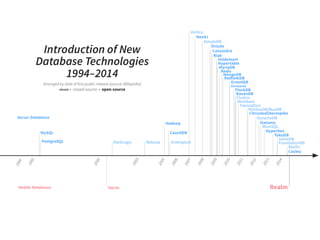
The history
• First commercial database: IDS (1964) - a network
database
• Relational databases were developed in 1970s
• DB2, Oracle, Ingress
• Moving to the desktops in 1980s: dBASE were popular
• DotCom era - or the MySQL era (1995)
• ca. 2009: NoSQL movement
The Victory of
The Relational Database
• Relational database model dominates the world
• DB2 is heavily used by banks
• Oracle is found in large enterprises
• MySQL powers almost every web sites
• SQLite is an embedded database: initial release in
2000
SQL
• Structured Query Language is by all relational
databases
• Components
• Data definition (creating tables, …)
• Data manipulation (inserting rows, …)
• Querying
INSERT INTO Person VALUES('Kenneth', 46)
SELECT * FROM Person WHERE name = 'Kenneth'
Object-Relation Mappers
• Relational modelling
requires normalisation
• Object modelling is often a
more direct
• ORMs try to bridge the gap
Invoice
Item Number Price
CPU 1 2000
RAM 4 4000
Disk 2 6000
Z Corporation
64 Hard Drive
1024 Machineville
Line
Invoice
InvoiceID
LineID
Line
Relationalmodel
Objectmodel
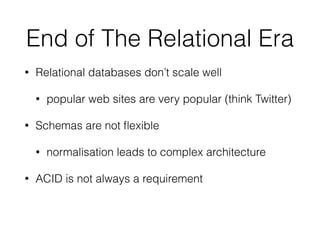
End of The Relational Era
• Relational databases don’t scale well
• popular web sites are very popular (think Twitter)
• Schemas are not flexible
• normalisation leads to complex architecture
• ACID is not always a requirement
Mobile platforms
• Nokia N95 (2007)
• dual-core @ 322 MHz, 160 MB ram
• OnePlus One (2014)
• quad-core @ 2.5 GHz, 3 GB ram, 64 GB storage
• iOS and Android dominate the market
• UNIX like kernels + libraries
• Java (version 6 + some version 7), Objective C, and Swift
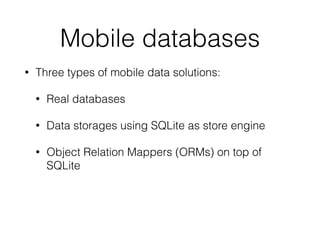
Mobile databases
• Three types of mobile data solutions:
• Real databases
• Data storages using SQLite as store engine
• Object Relation Mappers (ORMs) on top of
SQLite
• Library providing a SQL interface to data
• Most of SQL-92, simplified type system
• Preinstalled on iOS, Android, Windows Phone 8,
Blackberry 10
• 1.8+ billion active devices1
• Liberal license: public domain
1http://www.engadget.com/2014/06/25/google-io-2014-by-the-numbers/
SQLite on Mobile
iOS
• Rarely used directly
• Popular ORMs: Core
Data, Magical Record,
FMDB
Android
• The Java community is
highly object oriented
• Can be used directly
• Popular ORMs:
ORMLite, GreenDAO,
SugarORM, DBFlow
Core Data
• Apple’s object graph and persistent framework
• Supported under iOS and OS X
• Many storage formats: XML, binary files, SQLite
• Highly integrated into Xcode
• Part of the iOS/Cocoa SDKs
Magical Record
• Inspired by Fowler’s active record pattern and
Ruby on Rails’ Active Record
• Build on-top of Core Data
• Managed Object
• https://github.com/magicalpanda/MagicalRecord
FMDB
• Objective C wrapper around SQLite
• Major classes
• FMDatabase - “connection” to SQLite database
• FMDatabaseQueue - queue of queries and operations
• FMResultSet - results from a query
• License: MIT
• http://ccgus.github.io/fmdb/
FMDB - query
FMDatabase *db = [FMDatabase databaseWithPath:@“/tmp/tmp.db”];
[db open];
FMResultSet *s =
[db executeQuery:@"SELECT * FROM myTable”];
while ([s next]) {
// …
}
[db close];
YAP
• Key/value store
• Supports iOS (and OS X)
• SQLite is used as storage engine
• License: BSD
• https://github.com/yapstudios/YapDatabase
LevelDB
• Embedded key/value store (in C++)
• License: BSD
• https://github.com/google/leveldb
• iOS: https://github.com/matehat/Objective-LevelDB
• Android: SnappyDB uses LevelDB + additional
compression
Realm
• Realm is an object store
• Data model = classes (inheriting from a Realm
object)
• Supports iOS, Android and OS X
• Core is written in C++ and highly portable
• Custom bindings to give “native touch”
• License: Apache 2.0 (binding) + closed (core)
Realm - iOS - store
RLMRealm *realm = [RLMRealm defaultRealm];
[realm beginWriteTransaction];
Person *person = [[Person alloc] init];
person.name = @"Kenneth";
person.age = 46;
[realm addObject:person];
[realm commitWriteTransaction];
Realm - iOS - query
RLMResults *persons =
[Person objectsWhere:@"name = ‘Kenneth'"];
for (Person *person in persons) {
NSLog(@"Age:", person.age);
}
Realm - Android - store
Realm realm = Realm.getInstance(context);
realm.beginTransaction();
Person person =
realm.createObject(Person.class);
person.setName(“Kenneth”);
person.setAge(46);
realm.commitTransaction();
Realm - Android - query
RealmResults<Person> persons =
realm.where(Person.class)
.equalTo("name", “Kenneth").findAll();
for (Person person : persons) {
Log.d("REALM", "Age: " + person.getAge());
}
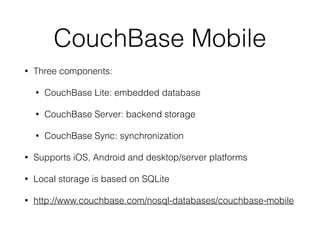
CouchBase Mobile
• Three components:
• CouchBase Lite: embedded database
• CouchBase Server: backend storage
• CouchBase Sync: synchronization
• Supports iOS, Android and desktop/server platforms
• Local storage is based on SQLite
• http://www.couchbase.com/nosql-databases/couchbase-mobile
CouchBase - iOS
CBLManager *manager = CBLManager sharedInstance];
CBLDatabase *database = [manager databaseNamed: dbname
error: &error];
NSDictiorary *person = @{
@"name": @"Kenneth",
@"age": @46
};
CBLDocument* doc = [database createDocument];
NSString *docID = doc.documentID;
CBLRevision *newRevision = [doc putProperties:
myDictionary error: &error];
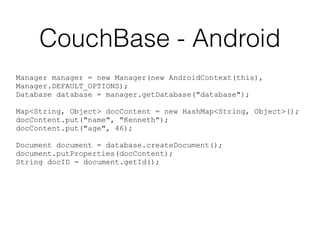
CouchBase - Android
Manager manager = new Manager(new AndroidContext(this),
Manager.DEFAULT_OPTIONS);
Database database = manager.getDatabase("database");
Map<String, Object> docContent = new HashMap<String, Object>();
docContent.put("name", "Kenneth");
docContent.put("age", 46);
Document document = database.createDocument();
document.putProperties(docContent);
String docID = document.getId();
Parse
• Cloud database (and local storage)
• Supports iOS, Android, and Windows Phone (and
desktop/server platforms)
• Store and retrieve objects in the background
• Payment = requests per second
• https://www.parse.com
Parse - iOS - store
PFObject *person = [PFObject
objectWithClassName:@“Person”];
[person setObject:@“Kenneth”
forKey:@“name”];
[person setObject:@“46” forKey:@“age”];
[person saveInBackground];
Parse - iOS - query
PFQuery *query = [PFQuery
queryWithClassName:@“Person”];
[query whereKey:@“name” equalTo:@“Kenneth”];
[query findObjectsInBackgroundWithBlock:^(NSArray
*objects, NSError *error) {
for (PFObject *object in objects) {
NSLog(@“%@“, object[@“age”]);
}
];
Parse - Android - store
ParseObject person = new
ParseObject(“Person”);
person.put(“name”, “Kenneth”);
person.put(“age”, 46);
person.saveInBackground();
Parse - Android - query
ParseQuery<ParseObject> query = ParseQuery.getQuery(“Person”);
query.whereEqualTo(“name”, “Kenneth”);
query.findInBackground(new FindCallback<ParseObject>() {
public void done(List<ParseObject> list, ParseException e) {
for (int i=0; i<list.size(); i++) {
Log.d(“age”, “Age: “ + list.get(i).getInt(“age”));
}
}
});
Hot topics
• Synchronisation between devices and back-end
• Often ReST services are used (with JSON)
• Parse and CouchBase Lite try to solve it
• Reactive programming
• RxJava (for Android)
• ReactiveCocoa (iOS)
The
database
is not a
solved
problemDan Strange, http://bit.ly/1QqQfEe

Is the database a solved problem?

  • 1.
  • 2.
    Disclaimer I work forRealm Realm is a database vendor I am a little biased
  • 3.
    Agenda • What isa database? • The history of databases • Relational databases, the NoSQL revolution • Mobile platforms • Mobile database solutions
  • 4.
    What is adatabase? • According to Wikipedia: A database is an organized collection of data. • Common components • data definition (create the structure/schema) • insert, update, delete data • query/retrieve data • Databases are often ACID compliant
  • 5.
    The history • Firstcommercial database: IDS (1964) - a network database • Relational databases were developed in 1970s • DB2, Oracle, Ingress • Moving to the desktops in 1980s: dBASE were popular • DotCom era - or the MySQL era (1995) • ca. 2009: NoSQL movement
  • 6.
    The Victory of TheRelational Database • Relational database model dominates the world • DB2 is heavily used by banks • Oracle is found in large enterprises • MySQL powers almost every web sites • SQLite is an embedded database: initial release in 2000
  • 7.
    SQL • Structured QueryLanguage is by all relational databases • Components • Data definition (creating tables, …) • Data manipulation (inserting rows, …) • Querying INSERT INTO Person VALUES('Kenneth', 46) SELECT * FROM Person WHERE name = 'Kenneth'
  • 8.
    Object-Relation Mappers • Relationalmodelling requires normalisation • Object modelling is often a more direct • ORMs try to bridge the gap Invoice Item Number Price CPU 1 2000 RAM 4 4000 Disk 2 6000 Z Corporation 64 Hard Drive 1024 Machineville Line Invoice InvoiceID LineID Line Relationalmodel Objectmodel
  • 9.
    End of TheRelational Era • Relational databases don’t scale well • popular web sites are very popular (think Twitter) • Schemas are not flexible • normalisation leads to complex architecture • ACID is not always a requirement
  • 11.
    Mobile platforms • NokiaN95 (2007) • dual-core @ 322 MHz, 160 MB ram • OnePlus One (2014) • quad-core @ 2.5 GHz, 3 GB ram, 64 GB storage • iOS and Android dominate the market • UNIX like kernels + libraries • Java (version 6 + some version 7), Objective C, and Swift
  • 12.
    Mobile databases • Threetypes of mobile data solutions: • Real databases • Data storages using SQLite as store engine • Object Relation Mappers (ORMs) on top of SQLite
  • 13.
    • Library providinga SQL interface to data • Most of SQL-92, simplified type system • Preinstalled on iOS, Android, Windows Phone 8, Blackberry 10 • 1.8+ billion active devices1 • Liberal license: public domain 1http://www.engadget.com/2014/06/25/google-io-2014-by-the-numbers/
  • 14.
    SQLite on Mobile iOS •Rarely used directly • Popular ORMs: Core Data, Magical Record, FMDB Android • The Java community is highly object oriented • Can be used directly • Popular ORMs: ORMLite, GreenDAO, SugarORM, DBFlow
  • 15.
    Core Data • Apple’sobject graph and persistent framework • Supported under iOS and OS X • Many storage formats: XML, binary files, SQLite • Highly integrated into Xcode • Part of the iOS/Cocoa SDKs
  • 16.
    Magical Record • Inspiredby Fowler’s active record pattern and Ruby on Rails’ Active Record • Build on-top of Core Data • Managed Object • https://github.com/magicalpanda/MagicalRecord
  • 17.
    FMDB • Objective Cwrapper around SQLite • Major classes • FMDatabase - “connection” to SQLite database • FMDatabaseQueue - queue of queries and operations • FMResultSet - results from a query • License: MIT • http://ccgus.github.io/fmdb/
  • 18.
    FMDB - query FMDatabase*db = [FMDatabase databaseWithPath:@“/tmp/tmp.db”]; [db open]; FMResultSet *s = [db executeQuery:@"SELECT * FROM myTable”]; while ([s next]) { // … } [db close];
  • 19.
    YAP • Key/value store •Supports iOS (and OS X) • SQLite is used as storage engine • License: BSD • https://github.com/yapstudios/YapDatabase
  • 20.
    LevelDB • Embedded key/valuestore (in C++) • License: BSD • https://github.com/google/leveldb • iOS: https://github.com/matehat/Objective-LevelDB • Android: SnappyDB uses LevelDB + additional compression
  • 21.
    Realm • Realm isan object store • Data model = classes (inheriting from a Realm object) • Supports iOS, Android and OS X • Core is written in C++ and highly portable • Custom bindings to give “native touch” • License: Apache 2.0 (binding) + closed (core)
  • 22.
    Realm - iOS- store RLMRealm *realm = [RLMRealm defaultRealm]; [realm beginWriteTransaction]; Person *person = [[Person alloc] init]; person.name = @"Kenneth"; person.age = 46; [realm addObject:person]; [realm commitWriteTransaction];
  • 23.
    Realm - iOS- query RLMResults *persons = [Person objectsWhere:@"name = ‘Kenneth'"]; for (Person *person in persons) { NSLog(@"Age:", person.age); }
  • 24.
    Realm - Android- store Realm realm = Realm.getInstance(context); realm.beginTransaction(); Person person = realm.createObject(Person.class); person.setName(“Kenneth”); person.setAge(46); realm.commitTransaction();
  • 25.
    Realm - Android- query RealmResults<Person> persons = realm.where(Person.class) .equalTo("name", “Kenneth").findAll(); for (Person person : persons) { Log.d("REALM", "Age: " + person.getAge()); }
  • 26.
    CouchBase Mobile • Threecomponents: • CouchBase Lite: embedded database • CouchBase Server: backend storage • CouchBase Sync: synchronization • Supports iOS, Android and desktop/server platforms • Local storage is based on SQLite • http://www.couchbase.com/nosql-databases/couchbase-mobile
  • 27.
    CouchBase - iOS CBLManager*manager = CBLManager sharedInstance]; CBLDatabase *database = [manager databaseNamed: dbname error: &error]; NSDictiorary *person = @{ @"name": @"Kenneth", @"age": @46 }; CBLDocument* doc = [database createDocument]; NSString *docID = doc.documentID; CBLRevision *newRevision = [doc putProperties: myDictionary error: &error];
  • 28.
    CouchBase - Android Managermanager = new Manager(new AndroidContext(this), Manager.DEFAULT_OPTIONS); Database database = manager.getDatabase("database"); Map<String, Object> docContent = new HashMap<String, Object>(); docContent.put("name", "Kenneth"); docContent.put("age", 46); Document document = database.createDocument(); document.putProperties(docContent); String docID = document.getId();
  • 29.
    Parse • Cloud database(and local storage) • Supports iOS, Android, and Windows Phone (and desktop/server platforms) • Store and retrieve objects in the background • Payment = requests per second • https://www.parse.com
  • 30.
    Parse - iOS- store PFObject *person = [PFObject objectWithClassName:@“Person”]; [person setObject:@“Kenneth” forKey:@“name”]; [person setObject:@“46” forKey:@“age”]; [person saveInBackground];
  • 31.
    Parse - iOS- query PFQuery *query = [PFQuery queryWithClassName:@“Person”]; [query whereKey:@“name” equalTo:@“Kenneth”]; [query findObjectsInBackgroundWithBlock:^(NSArray *objects, NSError *error) { for (PFObject *object in objects) { NSLog(@“%@“, object[@“age”]); } ];
  • 32.
    Parse - Android- store ParseObject person = new ParseObject(“Person”); person.put(“name”, “Kenneth”); person.put(“age”, 46); person.saveInBackground();
  • 33.
    Parse - Android- query ParseQuery<ParseObject> query = ParseQuery.getQuery(“Person”); query.whereEqualTo(“name”, “Kenneth”); query.findInBackground(new FindCallback<ParseObject>() { public void done(List<ParseObject> list, ParseException e) { for (int i=0; i<list.size(); i++) { Log.d(“age”, “Age: “ + list.get(i).getInt(“age”)); } } });
  • 34.
    Hot topics • Synchronisationbetween devices and back-end • Often ReST services are used (with JSON) • Parse and CouchBase Lite try to solve it • Reactive programming • RxJava (for Android) • ReactiveCocoa (iOS)
  • 35.
    The database is not a solved problemDanStrange, http://bit.ly/1QqQfEe