Mobile
Application
development
Hello!
I am Nihit Agrawal
I am your Instructor for the course.
You can find me at nihit.agrawal@mit.asia
2
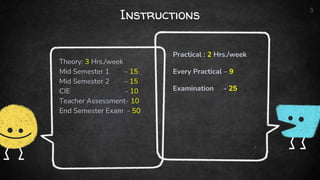
Instructions
Practical : 2 Hrs./week
Every Practical – 9
Examination - 25
Theory: 3 Hrs./week
Mid Semester 1 – 15
Mid Semester 2 – 15
CIE - 10
Teacher Assessment- 10
End Semester Exam - 50
3
Why ??
Is Programming a
Skill or Talent
5 Skills
1. Problem Solving
2. Sharp Memory
3. Efficient Lazyness
4. Self Motivation and
Independence
5. Perseverance
6
Course Outcomes
➜ CO1 – Explain Android Ecosystem and
features of Android Operating System
➜ CO2 – Configure Android Environment
and Development tools
➜ CO3 – Use different layouts and control
flow for designing use interface
7
Course Outcomes
➜ CO4 – Design user interface using
different UI components of Android
➜ CO5 – Demonstrate different lifecycles in
Android
➜ CO6 – Illustrate process of publishing an
Android App on Google Play Store
8
“
Mobile Application
Development is a process
by which applications are
developed for small low
power handheld devices
9
Types of Mobile
Operating system
* Mobiles
* Tablets
* TV
* Android Auto
* Watch
What is required to
learn and master
12
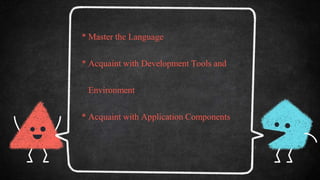
* Master the Language
* Acquaint with Development Tools and
Environment
* Acquaint with Application Components
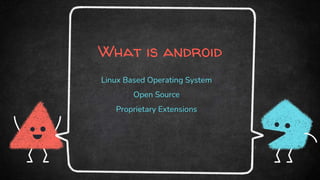
What is android
Linux Based Operating System
Open Source
Proprietary Extensions
Timeline
15
N
M
L
K
J
I
H
G
F
E
D
C
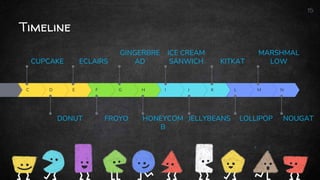
CUPCAKE ECLAIRS
GINGERBRE
AD
ICE CREAM
SANWICH KITKAT
MARSHMAL
LOW
DONUT FROYO HONEYCOM
B
JELLYBEANS LOLLIPOP NOUGAT
Timeline
16
N
M
L
K
J
I
H
G
F
E
D
C
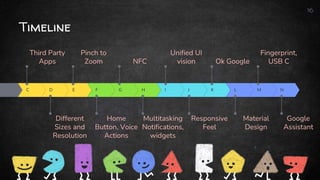
Third Party
Apps
Pinch to
Zoom NFC
Unified UI
vision Ok Google
Fingerprint,
USB C
Different
Sizes and
Resolution
Home
Button, Voice
Actions
Multitasking
Notifications,
widgets
Responsive
Feel
Material
Design
Google
Assistant
Introduction to Android operating
system
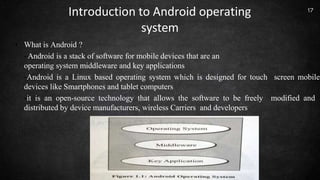
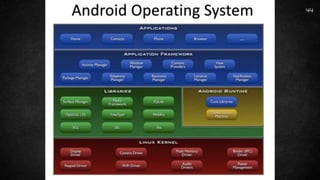
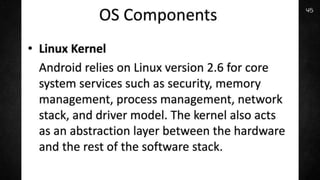
• What is Android ?
-Android is a stack of software for mobile devices that are an
operating system middleware and key applications
-Android is a Linux based operating system which is designed for touch screen mobile
devices like Smartphones and tablet computers
-it is an open-source technology that allows the software to be freely modified and
distributed by device manufacturers, wireless Carriers and developers
17
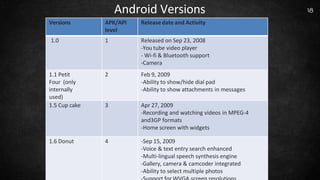
Android Versions
Versions APK/API
level
Releasedate and Activity
1.0 1 Released on Sep 23, 2008
-You tube video player
- Wi-fi & Bluetooth support
-Camera
1.1 Petit
Four (only
internally
used)
2 Feb 9, 2009
-Ability to show/hide dial pad
-Ability to show attachments in messages
1.5 Cup cake 3 Apr 27, 2009
-Recording and watching videos in MPEG-4
and3GP formats
-Home screen with widgets
1.6 Donut 4 -Sep 15, 2009
-Voice & text entry search enhanced
-Multi-lingual speech synthesis engine
-Gallery, camera & camcoder integrated
-Ability to select multiple photos
18
Versions APK/API
level
Release date and Activity
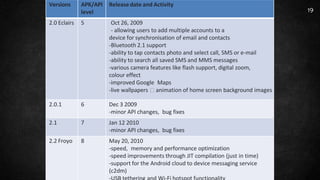
2.0 Eclairs 5 Oct 26, 2009
- allowing users to add multiple accounts to a
device for synchronisation of email and contacts
-Bluetooth 2.1 support
-ability to tap contacts photo and select call, SMS or e-mail
-ability to search all saved SMS and MMS messages
-various camera features like flash support, digital zoom,
colour effect
-improved Google Maps
-live wallpapers animation of home screen background images
2.0.1 6 Dec 3 2009
-minor API changes, bug fixes
2.1 7 Jan 12 2010
-minor API changes, bug fixes
2.2 Froyo 8 May 20, 2010
-speed, memory and performance optimization
-speed improvements through JIT compilation (just in time)
-support for the Android cloud to device messaging service
(c2dm)
19
Versions APK/API
level
Releasedate and Activity
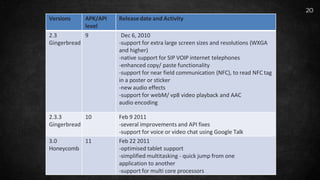
2.3
Gingerbread
9 Dec 6, 2010
-support for extra large screen sizes and resolutions (WXGA
and higher)
-native support for SIP VOIP internet telephones
-enhanced copy/ paste functionality
-support for near field communication (NFC), to read NFC tag
in a poster or sticker
-new audio effects
-support for webM/ vp8 video playback and AAC
audio encoding
2.3.3
Gingerbread
10 Feb 9 2011
-several improvements and API fixes
-support for voice or video chat using Google Talk
3.0
Honeycomb
11 Feb 22 2011
-optimised tablet support
-simplified multitasking - quick jump from one
application to another
-support for multi core processors
20
Versions APK/API level Releasedate and Activity
3.1
Honeycomb
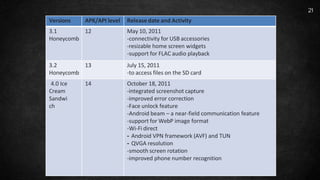
12 May 10, 2011
-connectivity for USB accessories
-resizable home screen widgets
-support for FLAC audio playback
3.2
Honeycomb
13 July 15, 2011
-to access files on the SD card
4.0 Ice
Cream
Sandwi
ch
14 October 18, 2011
-integrated screenshot capture
-improved error correction
-Face unlock feature
-Android beam – a near-field communication feature
-support for WebP image format
-Wi-Fi direct
- Android VPN framework (AVF) and TUN
- QVGA resolution
-smooth screen rotation
-improved phone number recognition
21
Versions APK/API
level
Releasedate and Activity
4.1
Jelly
Bean
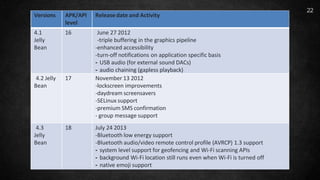
16 June 27 2012
-triple buffering in the graphics pipeline
-enhanced accessibility
-turn-off notifications on application specific basis
- USB audio (for external sound DACs)
- audio chaining (gapless playback)
4.2 Jelly
Bean
17 November 13 2012
-lockscreen improvements
-daydream screensavers
-SELinux support
-premium SMS confirmation
- group message support
4.3
Jelly
Bean
18 July 24 2013
-Bluetooth low energy support
-Bluetooth audio/video remote control profile (AVRCP) 1.3 support
- system level support for geofencing and Wi-Fi scanning APIs
- background Wi-Fi location still runs even when Wi-Fi is turned off
- native emoji support
22
Versions APK
/API
leve l
Releasedate and Activity
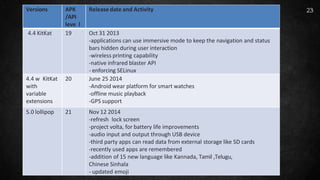
4.4 KitKat 19 Oct 31 2013
-applications can use immersive mode to keep the navigation and status
bars hidden during user interaction
-wireless printing capability
-native infrared blaster API
- enforcing SELinux
4.4 w KitKat
with
variable
extensions
20 June 25 2014
-Android wear platform for smart watches
-offline music playback
-GPS support
5.0 lollipop 21 Nov 12 2014
-refresh lock screen
-project volta, for battery life improvements
-audio input and output through USB device
-third party apps can read data from external storage like SD cards
-recently used apps are remembered
-addition of 15 new language like Kannada, Tamil ,Telugu,
Chinese Sinhala
- updated emoji
23
Versions APK/API
level
Releasedate and Activity
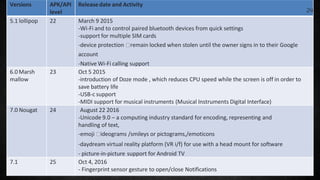
5.1 lollipop 22 March 9 2015
-Wi-Fi and to control paired bluetooth devices from quick settings
-support for multiple SIM cards
-device protection remain locked when stolen until the owner signs in to their Google
account
-Native Wi-Fi calling support
6.0 Marsh
mallow
23 Oct 5 2015
-introduction of Doze mode , which reduces CPU speed while the screen is off in order to
save battery life
-USB-c support
-MIDI support for musical instruments (Musical Instruments Digital Interface)
7.0 Nougat 24 August 22 2016
-Unicode 9.0 – a computing industry standard for encoding, representing and
handling of text,
-emoji ideograms /smileys or pictograms,/emoticons
-daydream virtual reality platform (VR i/f) for use with a head mount for software
- picture-in-picture support for Android TV
7.1 25 Oct 4, 2016
- Fingerprint sensor gesture to open/close Notifications
24
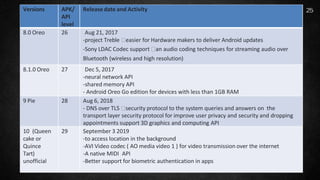
Versions APK/
API
level
Release date and Activity
8.0 Oreo 26 Aug 21, 2017
-project Treble easier for Hardware makers to deliver Android updates
-Sony LDAC Codec support an audio coding techniques for streaming audio over
Bluetooth (wireless and high resolution)
8.1.0 Oreo 27 Dec 5, 2017
-neural network API
-shared memory API
- Android Oreo Go edition for devices with less than 1GB RAM
9 Pie 28 Aug 6, 2018
- DNS over TLS security protocol to the system queries and answers on the
transport layer security protocol for improve user privacy and security and dropping
appointments support 3D graphics and computing API
10 (Queen
cake or
Quince
Tart)
unofficial
29 September 3 2019
-to access location in the background
-AVI Video codec ( AO media video 1 ) for video transmission over the internet
-A native MIDI API
-Better support for biometric authentication in apps
25
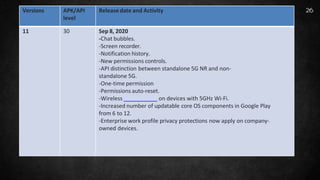
Versions APK/API
level
Releasedate and Activity
11 30 Sep 8, 2020
-Chat bubbles.
-Screen recorder.
-Notification history.
-New permissions controls.
-API distinction between standalone 5G NR and non-
standalone 5G.
-One-time permission
-Permissions auto-reset.
-Wireless Android Auto on devices with 5GHz Wi-Fi.
-Increased number of updatable core OS components in Google Play
from 6 to 12.
-Enterprise work profile privacy protections now apply on company-
owned devices.
26
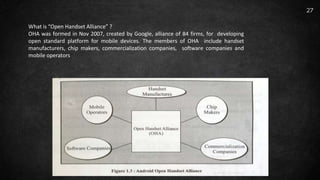
What is “Open Handset Alliance” ?
OHA was formed in Nov 2007, created by Google, alliance of 84 firms, for developing
open standard platform for mobile devices. The members of OHA include handset
manufacturers, chip makers, commercialization companies, software companies and
mobile operators
27
28
1. Google
2. Consumers / Users
3. App Development Houses and freelancers
4. OEMs/ Hardware Manufactures
Android Ecosystem
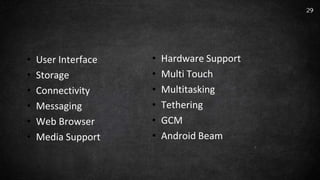
• User Interface
• Storage
• Connectivity
• Messaging
• Web Browser
• Media Support
29
• Hardware Support
• Multi Touch
• Multitasking
• Tethering
• GCM
• Android Beam
• JAVA JDK
• ANDROID IDE
30
Tools Required for Developing an Android APP
• AVD
31
SDK Tools
• ddms
• Debug Android Applications
32
SDK Tools
• emulator
• Test your android application without using a physical
device
33
SDK Tools
• mkscard
• Helps you to create a disk image that you can use with
the emulator
34
SDK Tools
• sqlite3
• Lets you access the SQLite data files created and used by
Android Application
35
SDK Tools
• traceview
• Provides a graphical viewer for execution logs save by
your application
36
SDK Tools
• Progaurd
• Obfuscates code so that the app cannot be reverse
engineered
37
SDK Tools
• Monkey
• Stress tests apps by generating pseudo code-random user
events
38
SDK Tools
• Zipalign
• Optimizes .apk file
39
SDK Tools
• adb
• Android Debug Bridge lets you to communicate with
android instance or connected Android Powered Device
40
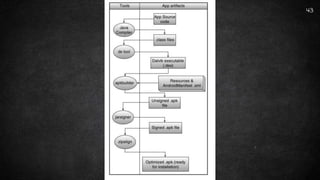
Platform Tools
• aapt
• Compiles app resources and generates R.java file
41
Platform Tools
• dx
• Converts .class file to .dex file
42
Platform Tools
43
44
45
46
47
48
49
50
51
52
53
54
55
56

Mobile Application Development Unit 1.pptx

  • 1.
  • 2.
    Hello! I am NihitAgrawal I am your Instructor for the course. You can find me at nihit.agrawal@mit.asia 2
  • 3.
    Instructions Practical : 2Hrs./week Every Practical – 9 Examination - 25 Theory: 3 Hrs./week Mid Semester 1 – 15 Mid Semester 2 – 15 CIE - 10 Teacher Assessment- 10 End Semester Exam - 50 3
  • 4.
  • 5.
  • 6.
    5 Skills 1. ProblemSolving 2. Sharp Memory 3. Efficient Lazyness 4. Self Motivation and Independence 5. Perseverance 6
  • 7.
    Course Outcomes ➜ CO1– Explain Android Ecosystem and features of Android Operating System ➜ CO2 – Configure Android Environment and Development tools ➜ CO3 – Use different layouts and control flow for designing use interface 7
  • 8.
    Course Outcomes ➜ CO4– Design user interface using different UI components of Android ➜ CO5 – Demonstrate different lifecycles in Android ➜ CO6 – Illustrate process of publishing an Android App on Google Play Store 8
  • 9.
    “ Mobile Application Development isa process by which applications are developed for small low power handheld devices 9
  • 10.
  • 11.
    * Mobiles * Tablets *TV * Android Auto * Watch
  • 12.
    What is requiredto learn and master 12
  • 13.
    * Master theLanguage * Acquaint with Development Tools and Environment * Acquaint with Application Components
  • 14.
    What is android LinuxBased Operating System Open Source Proprietary Extensions
  • 15.
    Timeline 15 N M L K J I H G F E D C CUPCAKE ECLAIRS GINGERBRE AD ICE CREAM SANWICHKITKAT MARSHMAL LOW DONUT FROYO HONEYCOM B JELLYBEANS LOLLIPOP NOUGAT
  • 16.
    Timeline 16 N M L K J I H G F E D C Third Party Apps Pinch to ZoomNFC Unified UI vision Ok Google Fingerprint, USB C Different Sizes and Resolution Home Button, Voice Actions Multitasking Notifications, widgets Responsive Feel Material Design Google Assistant
  • 17.
    Introduction to Androidoperating system • What is Android ? -Android is a stack of software for mobile devices that are an operating system middleware and key applications -Android is a Linux based operating system which is designed for touch screen mobile devices like Smartphones and tablet computers -it is an open-source technology that allows the software to be freely modified and distributed by device manufacturers, wireless Carriers and developers 17
  • 18.
    Android Versions Versions APK/API level Releasedateand Activity 1.0 1 Released on Sep 23, 2008 -You tube video player - Wi-fi & Bluetooth support -Camera 1.1 Petit Four (only internally used) 2 Feb 9, 2009 -Ability to show/hide dial pad -Ability to show attachments in messages 1.5 Cup cake 3 Apr 27, 2009 -Recording and watching videos in MPEG-4 and3GP formats -Home screen with widgets 1.6 Donut 4 -Sep 15, 2009 -Voice & text entry search enhanced -Multi-lingual speech synthesis engine -Gallery, camera & camcoder integrated -Ability to select multiple photos 18
  • 19.
    Versions APK/API level Release dateand Activity 2.0 Eclairs 5 Oct 26, 2009 - allowing users to add multiple accounts to a device for synchronisation of email and contacts -Bluetooth 2.1 support -ability to tap contacts photo and select call, SMS or e-mail -ability to search all saved SMS and MMS messages -various camera features like flash support, digital zoom, colour effect -improved Google Maps -live wallpapers animation of home screen background images 2.0.1 6 Dec 3 2009 -minor API changes, bug fixes 2.1 7 Jan 12 2010 -minor API changes, bug fixes 2.2 Froyo 8 May 20, 2010 -speed, memory and performance optimization -speed improvements through JIT compilation (just in time) -support for the Android cloud to device messaging service (c2dm) 19
  • 20.
    Versions APK/API level Releasedate andActivity 2.3 Gingerbread 9 Dec 6, 2010 -support for extra large screen sizes and resolutions (WXGA and higher) -native support for SIP VOIP internet telephones -enhanced copy/ paste functionality -support for near field communication (NFC), to read NFC tag in a poster or sticker -new audio effects -support for webM/ vp8 video playback and AAC audio encoding 2.3.3 Gingerbread 10 Feb 9 2011 -several improvements and API fixes -support for voice or video chat using Google Talk 3.0 Honeycomb 11 Feb 22 2011 -optimised tablet support -simplified multitasking - quick jump from one application to another -support for multi core processors 20
  • 21.
    Versions APK/API levelReleasedate and Activity 3.1 Honeycomb 12 May 10, 2011 -connectivity for USB accessories -resizable home screen widgets -support for FLAC audio playback 3.2 Honeycomb 13 July 15, 2011 -to access files on the SD card 4.0 Ice Cream Sandwi ch 14 October 18, 2011 -integrated screenshot capture -improved error correction -Face unlock feature -Android beam – a near-field communication feature -support for WebP image format -Wi-Fi direct - Android VPN framework (AVF) and TUN - QVGA resolution -smooth screen rotation -improved phone number recognition 21
  • 22.
    Versions APK/API level Releasedate andActivity 4.1 Jelly Bean 16 June 27 2012 -triple buffering in the graphics pipeline -enhanced accessibility -turn-off notifications on application specific basis - USB audio (for external sound DACs) - audio chaining (gapless playback) 4.2 Jelly Bean 17 November 13 2012 -lockscreen improvements -daydream screensavers -SELinux support -premium SMS confirmation - group message support 4.3 Jelly Bean 18 July 24 2013 -Bluetooth low energy support -Bluetooth audio/video remote control profile (AVRCP) 1.3 support - system level support for geofencing and Wi-Fi scanning APIs - background Wi-Fi location still runs even when Wi-Fi is turned off - native emoji support 22
  • 23.
    Versions APK /API leve l Releasedateand Activity 4.4 KitKat 19 Oct 31 2013 -applications can use immersive mode to keep the navigation and status bars hidden during user interaction -wireless printing capability -native infrared blaster API - enforcing SELinux 4.4 w KitKat with variable extensions 20 June 25 2014 -Android wear platform for smart watches -offline music playback -GPS support 5.0 lollipop 21 Nov 12 2014 -refresh lock screen -project volta, for battery life improvements -audio input and output through USB device -third party apps can read data from external storage like SD cards -recently used apps are remembered -addition of 15 new language like Kannada, Tamil ,Telugu, Chinese Sinhala - updated emoji 23
  • 24.
    Versions APK/API level Releasedate andActivity 5.1 lollipop 22 March 9 2015 -Wi-Fi and to control paired bluetooth devices from quick settings -support for multiple SIM cards -device protection remain locked when stolen until the owner signs in to their Google account -Native Wi-Fi calling support 6.0 Marsh mallow 23 Oct 5 2015 -introduction of Doze mode , which reduces CPU speed while the screen is off in order to save battery life -USB-c support -MIDI support for musical instruments (Musical Instruments Digital Interface) 7.0 Nougat 24 August 22 2016 -Unicode 9.0 – a computing industry standard for encoding, representing and handling of text, -emoji ideograms /smileys or pictograms,/emoticons -daydream virtual reality platform (VR i/f) for use with a head mount for software - picture-in-picture support for Android TV 7.1 25 Oct 4, 2016 - Fingerprint sensor gesture to open/close Notifications 24
  • 25.
    Versions APK/ API level Release dateand Activity 8.0 Oreo 26 Aug 21, 2017 -project Treble easier for Hardware makers to deliver Android updates -Sony LDAC Codec support an audio coding techniques for streaming audio over Bluetooth (wireless and high resolution) 8.1.0 Oreo 27 Dec 5, 2017 -neural network API -shared memory API - Android Oreo Go edition for devices with less than 1GB RAM 9 Pie 28 Aug 6, 2018 - DNS over TLS security protocol to the system queries and answers on the transport layer security protocol for improve user privacy and security and dropping appointments support 3D graphics and computing API 10 (Queen cake or Quince Tart) unofficial 29 September 3 2019 -to access location in the background -AVI Video codec ( AO media video 1 ) for video transmission over the internet -A native MIDI API -Better support for biometric authentication in apps 25
  • 26.
    Versions APK/API level Releasedate andActivity 11 30 Sep 8, 2020 -Chat bubbles. -Screen recorder. -Notification history. -New permissions controls. -API distinction between standalone 5G NR and non- standalone 5G. -One-time permission -Permissions auto-reset. -Wireless Android Auto on devices with 5GHz Wi-Fi. -Increased number of updatable core OS components in Google Play from 6 to 12. -Enterprise work profile privacy protections now apply on company- owned devices. 26
  • 27.
    What is “OpenHandset Alliance” ? OHA was formed in Nov 2007, created by Google, alliance of 84 firms, for developing open standard platform for mobile devices. The members of OHA include handset manufacturers, chip makers, commercialization companies, software companies and mobile operators 27
  • 28.
    28 1. Google 2. Consumers/ Users 3. App Development Houses and freelancers 4. OEMs/ Hardware Manufactures Android Ecosystem
  • 29.
    • User Interface •Storage • Connectivity • Messaging • Web Browser • Media Support 29 • Hardware Support • Multi Touch • Multitasking • Tethering • GCM • Android Beam
  • 30.
    • JAVA JDK •ANDROID IDE 30 Tools Required for Developing an Android APP
  • 31.
  • 32.
    • ddms • DebugAndroid Applications 32 SDK Tools
  • 33.
    • emulator • Testyour android application without using a physical device 33 SDK Tools
  • 34.
    • mkscard • Helpsyou to create a disk image that you can use with the emulator 34 SDK Tools
  • 35.
    • sqlite3 • Letsyou access the SQLite data files created and used by Android Application 35 SDK Tools
  • 36.
    • traceview • Providesa graphical viewer for execution logs save by your application 36 SDK Tools
  • 37.
    • Progaurd • Obfuscatescode so that the app cannot be reverse engineered 37 SDK Tools
  • 38.
    • Monkey • Stresstests apps by generating pseudo code-random user events 38 SDK Tools
  • 39.
    • Zipalign • Optimizes.apk file 39 SDK Tools
  • 40.
    • adb • AndroidDebug Bridge lets you to communicate with android instance or connected Android Powered Device 40 Platform Tools
  • 41.
    • aapt • Compilesapp resources and generates R.java file 41 Platform Tools
  • 42.
    • dx • Converts.class file to .dex file 42 Platform Tools
  • 43.
  • 44.
  • 45.
  • 46.
  • 47.
  • 48.
  • 49.
  • 50.
  • 51.
  • 52.
  • 53.
  • 54.
  • 55.
  • 56.