Android
Programming
Android - Overview
What is Android?
 Android is an open source and Linux-
based Operating System for mobile
devices such as smartphones and tablet
computers.
 Android was developed by the Open
Handset Alliance, led by Google, and
other companies.
What is Android?
 Android offers a unified approach to
application development for mobile
devices which means developers need
only develop for Android, and their
applications should be able to run on
different devices powered by Android.
What is Android?
 The first beta version of the Android
Software Development Kit (SDK) was
released by Google in 2007 where as the
first commercial version, Android 1.0, was
released in September 2008.
What is Android?
 On June 27, 2012, at the Google I/O
conference, Google announced the next
Android version, 4.1 Jelly Bean.
 Jelly Bean is an incremental update, with the
primary aim of improving the user interface,
both in terms of functionality and
performance.
What is Android?
 The source code for Android is available
under free and open source software
licenses.
 Google publishes most of the code under the
Apache License version 2.0 and the rest, Linux
kernel changes, under the GNU General
Public License version 2.
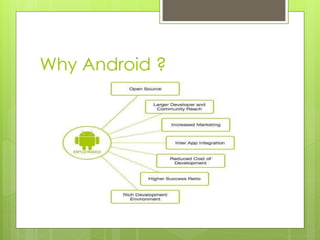
Why Android ?
Features of Android
 Android is a powerful operating system
competing with Apple 4GS and supports
great features.
 Few of them are listed below
 Beautiful UI
 Connectivity
 Storage
 Media support
Features of Android
 Messaging
 Web browser
 Multi-touch
 Multi-tasking
 Resizable widgets
 Multi-Language
 GCM
 Wi-Fi Direct
 Android Beam
Android Applications
 Android applications are usually
developed in the Java/Kotlin language
using the Android Software Development
Kit.
 Once developed, Android applications
can be packaged easily and sold out
either through a store such as Google
Play, SlideME, Opera Mobile
Store, Mobango, F-droid and the Amazon
Appstore.
Android Applications
 Android powers hundreds of millions of
mobile devices in more than 190 countries
around the world.
 It's the largest installed base of any mobile
platform and growing fast.
 Every day more than 1 million new
Android devices are activated worldwide.
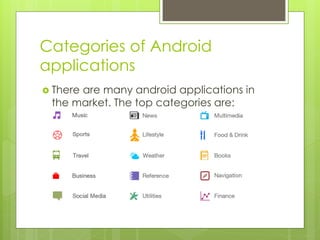
Categories of Android
applications
 There are many android applications in
the market. The top categories are:
History of Android
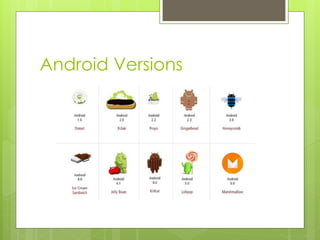
 The code names of android ranges from
A to N currently, such as Aestro, Blender,
Cupcake, Donut, Eclair, Froyo,
Gingerbread, Honeycomb, Ice Cream
Sandwitch, Jelly Bean, KitKat, Lollipop and
Marshmallow.
History of Android
 Over the years, Google has released
several versions of the Android operating
system, each with new features,
improvements, and security
enhancements.
 Here are the major versions of Android
and their key features:
Android Versions
Android Versions
 Android 1.0 (2008): This was the first commercial
version of Android, released in 2008. It featured a
 Simple user interface
 Support for basic features such as phone calls,
text messaging, and email.
Android Versions
 Android 1.5 Cupcake (2009): This version
introduced a number of new features, including
 A virtual keyboard
 Home screen widgets
 Support for video recording.
Android Versions
 Android 1.6 Donut (2009): This version
introduced a number of improvements, including
Support for:
 Larger screen sizes
 Improved search functionality
 Better camera support.
Android Versions
 Android 2.0/2.1 Eclair (2009): This version
introduced a number of new features, including:
 Google maps navigation
 Live wallpapers
 Support for multiple google accounts.
Android Versions
 Android 2.2 Froyo (2010): This version
introduced a number of performance
improvements, including support for:
 Faster web browsing
 Better app management
 The ability to install apps to an SD card.
Android Versions
 Android 2.3 Gingerbread (2010): This version
introduced a number of new features, including
support for
 Near field communication (NFC)
 A redesigned virtual keyboard
 Improved power management
Android Versions
 Android 3.0 Honeycomb (2011): This version
was designed specifically for tablet devices and
introduced a number of new features, including
 A redesigned user interface
 Support for multi-tasking
 A new virtual keyboard
Android Versions
 Android 4.0 Ice Cream Sandwich (2011): This
version introduced a number of new features,
including
 A new virtual assistant (google now)
 A redesigned user interface
 Support for wireless printing
Android Versions
 Android 4.1 Jelly Bean (2012): This version
introduced a number of performance
improvements, including support for
 Google now
 Improved notifications
 The ability to swipe between home screens.
Android Versions
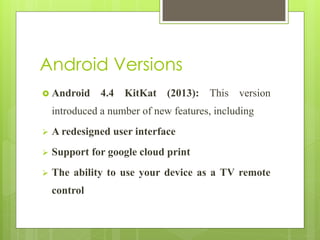
 Android 4.4 KitKat (2013): This version
introduced a number of new features, including
 A redesigned user interface
 Support for google cloud print
 The ability to use your device as a TV remote
control
Android Versions
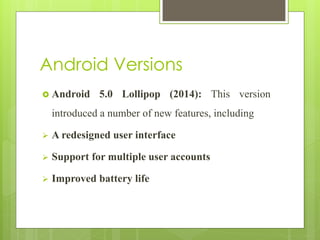
 Android 5.0 Lollipop (2014): This version
introduced a number of new features, including
 A redesigned user interface
 Support for multiple user accounts
 Improved battery life
Android Versions
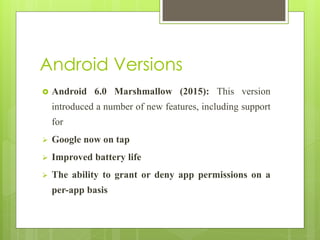
 Android 6.0 Marshmallow (2015): This version
introduced a number of new features, including support
for
 Google now on tap
 Improved battery life
 The ability to grant or deny app permissions on a
per-app basis
Android Versions
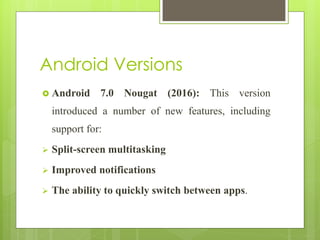
 Android 7.0 Nougat (2016): This version
introduced a number of new features, including
support for:
 Split-screen multitasking
 Improved notifications
 The ability to quickly switch between apps.
Android Versions
 Android 8.0 Oreo (2017): This version introduced
a number of new features, including support for:
 picture-in-picture mode
 Improved battery life
 The ability to snooze notifications
Android Versions
 Android 9.0 Pie (2018): This version introduced a
number of new features, including:
 A new gesture-based navigation system,
 Improved battery life
 The ability to use your phone as a digital
wellbeing tool.
Android Versions
 Android 10 Android Q(2019): This version
introduced a number of new features, including support
for:
 A system-wide dark mode
 Improved privacy controls
 The ability to share your wi-fi network with others
Android Versions
 Android 11 Red velvet Cake(2020): is a version of the
Android operating system released by Google in
September 2020. It was the eleventh major release and
the successor to Android 10. This version introduced a
number of new features, including:
 Built-in screen recording
 Pin conversation to the top of app and screen
Android Versions
 Android 12 Snow Cone (2021): Released Oct. 4,
2021. This version introduced a number of new
features,
 Including improved privacy controls
 A new material design
 The ability to schedule when apps can access your
microphone and camera.
 Android 12L(2022): Released March 7, 2022.The
L stands for larger screens. This update aimed to
improve the user interface and optimize for the
larger screen of a tablet, foldable or Chromebook.
 This update added a dual-panel notification
center for tablets and foldables.
Android Versions
 Android 13 Tiramisu(2022): Released in Aug. 15,
2022. This version introduced a number of new
features, including
 Improved performance
 Enhanced security features
 The ability to easily manage and organize your apps
and notifications.
Android Versions
 Android 14 Upside Down Cake(2023): Released on
Oct. 4, 2023. This version introduced a number of new
features, including
 More customization options for the lock screen and
wallpapers.
 OS efficiency was improved to decrease the strain
on a phone’s battery.
 For accessibility, google added larger scalable fonts
for vision-impaired users

Android Programming lecture 1-2 with full character.pdf

  • 1.
  • 2.
    What is Android? Android is an open source and Linux- based Operating System for mobile devices such as smartphones and tablet computers.  Android was developed by the Open Handset Alliance, led by Google, and other companies.
  • 3.
    What is Android? Android offers a unified approach to application development for mobile devices which means developers need only develop for Android, and their applications should be able to run on different devices powered by Android.
  • 4.
    What is Android? The first beta version of the Android Software Development Kit (SDK) was released by Google in 2007 where as the first commercial version, Android 1.0, was released in September 2008.
  • 5.
    What is Android? On June 27, 2012, at the Google I/O conference, Google announced the next Android version, 4.1 Jelly Bean.  Jelly Bean is an incremental update, with the primary aim of improving the user interface, both in terms of functionality and performance.
  • 6.
    What is Android? The source code for Android is available under free and open source software licenses.  Google publishes most of the code under the Apache License version 2.0 and the rest, Linux kernel changes, under the GNU General Public License version 2.
  • 7.
  • 8.
    Features of Android Android is a powerful operating system competing with Apple 4GS and supports great features.  Few of them are listed below  Beautiful UI  Connectivity  Storage  Media support
  • 9.
    Features of Android Messaging  Web browser  Multi-touch  Multi-tasking  Resizable widgets  Multi-Language  GCM  Wi-Fi Direct  Android Beam
  • 10.
    Android Applications  Androidapplications are usually developed in the Java/Kotlin language using the Android Software Development Kit.  Once developed, Android applications can be packaged easily and sold out either through a store such as Google Play, SlideME, Opera Mobile Store, Mobango, F-droid and the Amazon Appstore.
  • 11.
    Android Applications  Androidpowers hundreds of millions of mobile devices in more than 190 countries around the world.  It's the largest installed base of any mobile platform and growing fast.  Every day more than 1 million new Android devices are activated worldwide.
  • 12.
    Categories of Android applications There are many android applications in the market. The top categories are:
  • 13.
    History of Android The code names of android ranges from A to N currently, such as Aestro, Blender, Cupcake, Donut, Eclair, Froyo, Gingerbread, Honeycomb, Ice Cream Sandwitch, Jelly Bean, KitKat, Lollipop and Marshmallow.
  • 14.
    History of Android Over the years, Google has released several versions of the Android operating system, each with new features, improvements, and security enhancements.  Here are the major versions of Android and their key features:
  • 15.
  • 16.
    Android Versions  Android1.0 (2008): This was the first commercial version of Android, released in 2008. It featured a  Simple user interface  Support for basic features such as phone calls, text messaging, and email.
  • 17.
    Android Versions  Android1.5 Cupcake (2009): This version introduced a number of new features, including  A virtual keyboard  Home screen widgets  Support for video recording.
  • 18.
    Android Versions  Android1.6 Donut (2009): This version introduced a number of improvements, including Support for:  Larger screen sizes  Improved search functionality  Better camera support.
  • 19.
    Android Versions  Android2.0/2.1 Eclair (2009): This version introduced a number of new features, including:  Google maps navigation  Live wallpapers  Support for multiple google accounts.
  • 20.
    Android Versions  Android2.2 Froyo (2010): This version introduced a number of performance improvements, including support for:  Faster web browsing  Better app management  The ability to install apps to an SD card.
  • 21.
    Android Versions  Android2.3 Gingerbread (2010): This version introduced a number of new features, including support for  Near field communication (NFC)  A redesigned virtual keyboard  Improved power management
  • 22.
    Android Versions  Android3.0 Honeycomb (2011): This version was designed specifically for tablet devices and introduced a number of new features, including  A redesigned user interface  Support for multi-tasking  A new virtual keyboard
  • 23.
    Android Versions  Android4.0 Ice Cream Sandwich (2011): This version introduced a number of new features, including  A new virtual assistant (google now)  A redesigned user interface  Support for wireless printing
  • 24.
    Android Versions  Android4.1 Jelly Bean (2012): This version introduced a number of performance improvements, including support for  Google now  Improved notifications  The ability to swipe between home screens.
  • 25.
    Android Versions  Android4.4 KitKat (2013): This version introduced a number of new features, including  A redesigned user interface  Support for google cloud print  The ability to use your device as a TV remote control
  • 26.
    Android Versions  Android5.0 Lollipop (2014): This version introduced a number of new features, including  A redesigned user interface  Support for multiple user accounts  Improved battery life
  • 27.
    Android Versions  Android6.0 Marshmallow (2015): This version introduced a number of new features, including support for  Google now on tap  Improved battery life  The ability to grant or deny app permissions on a per-app basis
  • 28.
    Android Versions  Android7.0 Nougat (2016): This version introduced a number of new features, including support for:  Split-screen multitasking  Improved notifications  The ability to quickly switch between apps.
  • 29.
    Android Versions  Android8.0 Oreo (2017): This version introduced a number of new features, including support for:  picture-in-picture mode  Improved battery life  The ability to snooze notifications
  • 30.
    Android Versions  Android9.0 Pie (2018): This version introduced a number of new features, including:  A new gesture-based navigation system,  Improved battery life  The ability to use your phone as a digital wellbeing tool.
  • 31.
    Android Versions  Android10 Android Q(2019): This version introduced a number of new features, including support for:  A system-wide dark mode  Improved privacy controls  The ability to share your wi-fi network with others
  • 32.
    Android Versions  Android11 Red velvet Cake(2020): is a version of the Android operating system released by Google in September 2020. It was the eleventh major release and the successor to Android 10. This version introduced a number of new features, including:  Built-in screen recording  Pin conversation to the top of app and screen
  • 33.
    Android Versions  Android12 Snow Cone (2021): Released Oct. 4, 2021. This version introduced a number of new features,  Including improved privacy controls  A new material design  The ability to schedule when apps can access your microphone and camera.
  • 34.
     Android 12L(2022):Released March 7, 2022.The L stands for larger screens. This update aimed to improve the user interface and optimize for the larger screen of a tablet, foldable or Chromebook.  This update added a dual-panel notification center for tablets and foldables.
  • 35.
    Android Versions  Android13 Tiramisu(2022): Released in Aug. 15, 2022. This version introduced a number of new features, including  Improved performance  Enhanced security features  The ability to easily manage and organize your apps and notifications.
  • 36.
    Android Versions  Android14 Upside Down Cake(2023): Released on Oct. 4, 2023. This version introduced a number of new features, including  More customization options for the lock screen and wallpapers.  OS efficiency was improved to decrease the strain on a phone’s battery.  For accessibility, google added larger scalable fonts for vision-impaired users