Android	
  Loca+on	
  and	
  Maps	
  

         Jussi	
  Pohjolainen	
  
Loca+on	
  Services	
  and	
  Maps	
  
•  Android	
  provides	
  loca+on	
  framework	
  that	
  
   your	
  app	
  can	
  use	
  to	
  determine	
  	
  
   –  Device’s	
  loca+on	
  
   –  Listening	
  for	
  updates	
  
•  Google	
  maps	
  external	
  library	
  available	
  for	
  
   displaying	
  and	
  managing	
  maps	
  
LOCATION	
  SERVICES	
  
Loca+on	
  Services	
  
•  By	
  using	
  Loca+onManager	
  you	
  are	
  able	
  to	
  
   –  Query	
  for	
  the	
  list	
  of	
  Loca+onProviders	
  for	
  the	
  last	
  
      known	
  loca+on	
  
   –  Register	
  for	
  updates	
  of	
  the	
  user’s	
  current	
  loca+on	
  
   –  Register	
  for	
  given	
  Intent	
  to	
  be	
  fired	
  if	
  the	
  device	
  
      comes	
  within	
  given	
  proximity	
  of	
  given	
  lat/long	
  
Obtaining	
  User	
  Loca+on	
  
•  Loca+on	
  can	
  be	
  determined	
  via	
  GPS	
  and/or	
  
     cell	
  tower	
  +	
  Wi-­‐Fi	
  signals	
  
•  GPS	
  is	
  accurate,	
  but	
  needs	
  outdoors,	
  fix	
  is	
  
     slower	
  and	
  it	
  uses	
  more	
  baQery.	
  	
  
•  To	
  request	
  loca+on,	
  you	
  use	
  Loca+onManager	
  
     -­‐	
  class	


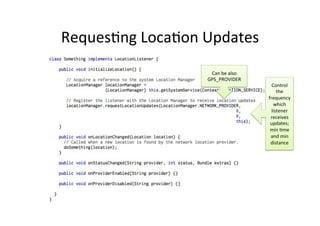
Reques+ng	
  Loca+on	
  Updates	
  
                          Can	
  be	
  also	
  
                         GPS_PROVIDER	
  
                                                    Control	
  
                                                       the	
  
                                                  frequency	
  
                                                     which	
  
                                                    listener	
  
                                                   receives	
  
                                                   updates;	
  
                                                   min	
  +me	
  
                                                   and	
  min	
  
                                                   distance	
  
Reques+ng	
  User	
  Permissions	
  
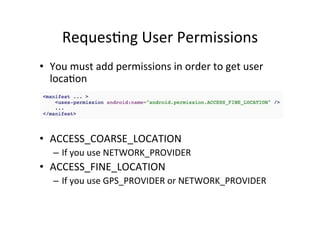
•  You	
  must	
  add	
  permissions	
  in	
  order	
  to	
  get	
  user	
  
   loca+on	


•  ACCESS_COARSE_LOCATION	
  
    –  If	
  you	
  use	
  NETWORK_PROVIDER	
  
•  ACCESS_FINE_LOCATION	
  
    –  If	
  you	
  use	
  GPS_PROVIDER	
  or	
  NETWORK_PROVIDER	
  
Ge]ng	
  Last	
  Known	
  Loca+on	
  
•  First	
  loca+on	
  can	
  take	
  +me.	
  Use	
  cached	
  
   loca+on!	
  
    –  Loca+on	
  lastKnownLoca+on	
  =	
  
       loca+onManager.getLastKnownLoca+on(Loca+onManager
       .NETWORK_PROVIDER);	
  
Mock	
  Loca+on	
  Data	
  
•  If	
  you	
  don’t	
  have	
  Android	
  device,	
  you	
  can	
  use	
  
   emulator	
  for	
  loca+on	
  services	
  by	
  giving	
  mock	
  
   data	
  
•  Mock	
  data	
  works	
  only	
  with	
  GPS_PROVIDER	
  
•  Use	
  	
  
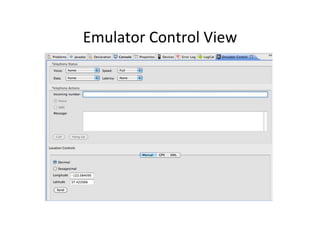
    –  Emulator	
  Control	
  View	
  from	
  Eclipse	
  
    –  DDMS	
  (Dalvik	
  Debug	
  Monitor	
  Server)	
  
    –  Geo	
  command	
  from	
  console	
  
Emulator	
  Control	
  View	
  
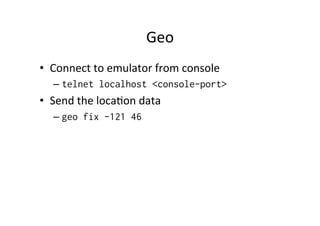
Geo	
  
•  Connect	
  to	
  emulator	
  from	
  console	
  
    –  telnet localhost <console-port>
•  Send	
  the	
  loca+on	
  data	
  
    –  geo fix -121 46
GOOGLE	
  MAPS	
  EXTERNAL	
  
DIRECTORY	
  
Google	
  Maps	
  
•  External	
  API	
  Add-­‐On	
  to	
  Android	
  SDK	
  
•  Install	
  Google	
  APIs	
  Add-­‐On	
  from	
  Android	
  SDK	
  
   and	
  AVD	
  Manager	
  (Google	
  APIs	
  by	
  Google)	
  
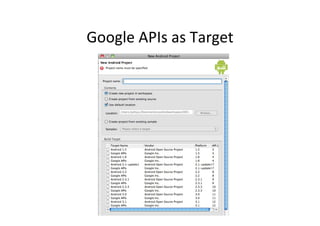
•  When	
  developing,	
  set	
  Google	
  API	
  Add-­‐On	
  as	
  
   target	
  
Google	
  APIs	
  as	
  Target	
  
Overview	
  
1.  Add	
  uses-­‐library	
  and	
  internet	
  permission	
  to	
  
    manifest	
  file	
  
2.  Use	
  the	
  Maps	
  API	
  
3.  Get	
  Maps	
  API	
  key	
  and	
  sign	
  your	
  app	
  
1.	
  Add	
  uses-­‐library	
  element	
  to	
  Manifest	
  file	
  

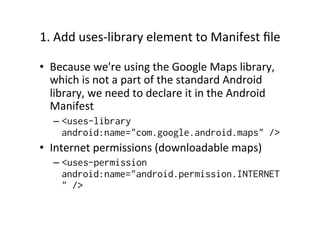
•  Because	
  we're	
  using	
  the	
  Google	
  Maps	
  library,	
  
   which	
  is	
  not	
  a	
  part	
  of	
  the	
  standard	
  Android	
  
   library,	
  we	
  need	
  to	
  declare	
  it	
  in	
  the	
  Android	
  
   Manifest	
  
    –  <uses-library
       android:name="com.google.android.maps" />
•  Internet	
  permissions	
  (downloadable	
  maps)	
  
    –  <uses-permission
         android:name="android.permission.INTERNET
         " />
    	
  
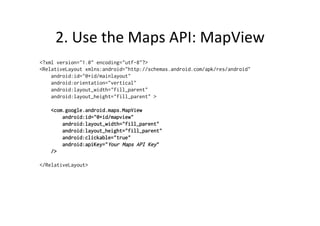
2.	
  Use	
  the	
  Maps	
  API:	
  MapView	
  
<?xml version="1.0" encoding="utf-8"?>
<RelativeLayout xmlns:android="http://schemas.android.com/apk/res/android"
    android:id="@+id/mainlayout"
    android:orientation="vertical"
    android:layout_width="fill_parent"
    android:layout_height="fill_parent" >

        <com.google.android.maps.MapView
            android:id="@+id/mapview"
            android:layout_width="fill_parent"
            android:layout_height="fill_parent"
            android:clickable="true"
            android:apiKey="Your Maps API Key"
        />

</RelativeLayout>
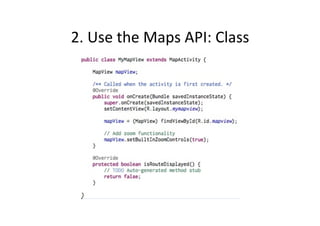
2.	
  Use	
  the	
  Maps	
  API:	
  Class	
  
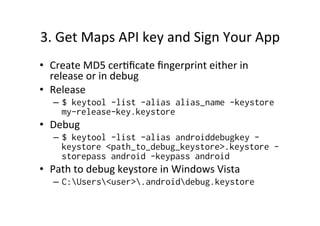
3.	
  Get	
  Maps	
  API	
  key	
  and	
  Sign	
  Your	
  App	
  
•  Create	
  MD5	
  cer+ficate	
  fingerprint	
  either	
  in	
  
   release	
  or	
  in	
  debug	
  
•  Release	
  
    –  $ keytool -list -alias alias_name -keystore
       my-release-key.keystore
•  Debug	
  
    –  $ keytool -list -alias androiddebugkey -
       keystore <path_to_debug_keystore>.keystore -
       storepass android -keypass android
•  Path	
  to	
  debug	
  keystore	
  in	
  Windows	
  Vista	
  
    –  C:Users<user>.androiddebug.keystore
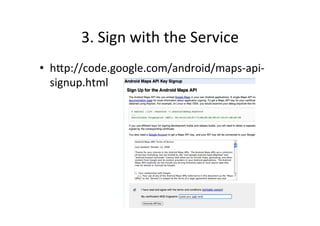
3.	
  Sign	
  with	
  the	
  Service	
  
•  hQp://code.google.com/android/maps-­‐api-­‐
   signup.html	
  
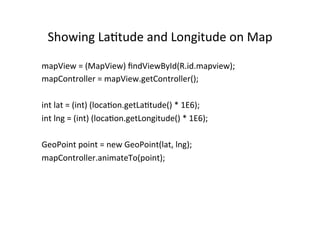
Showing	
  La+tude	
  and	
  Longitude	
  on	
  Map	


  mapView	
  =	
  (MapView)	
  findViewById(R.id.mapview);	
  
	
  mapController	
  =	
  mapView.getController();	


  int	
  lat	
  =	
  (int)	
  (loca+on.getLa+tude()	
  *	
  1E6);	
  
	
  int	
  lng	
  =	
  (int)	
  (loca+on.getLongitude()	
  *	
  1E6);	


  GeoPoint	
  point	
  =	
  new	
  GeoPoint(lat,	
  lng);	
  
	
  mapController.animateTo(point);	


DISPLAYING	
  GRAPHICS	
  ON	
  MAPS	
  
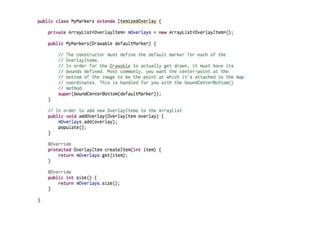
Custom	
  Markers	
  
•  Overlay	
  –	
  Individual	
  item	
  on	
  map	
  
•  Create	
  custom	
  class	
  that	
  inherites	
  
   ItemizedOverlay	
  class	
  
•  ItemizedOverlay	
  class	
  is	
  a	
  base	
  class	
  for	
  an	
  
   Overlay	
  which	
  consists	
  of	
  a	
  list	
  of	
  
   OverlayItems.	
  
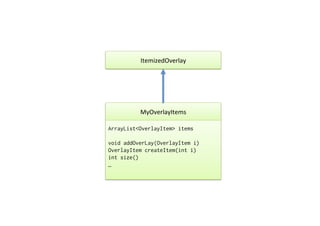
ItemizedOverlay	


          MyOverlayItems	
  

ArrayList<OverlayItem> items

void addOverLay(OverlayItem i)
OverlayItem createItem(int i)
int size()
…
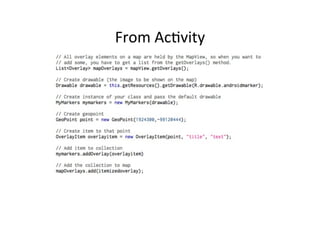
From	
  Ac+vity	
  
Android Location and Maps

Android Location and Maps

  • 1.
    Android  Loca+on  and  Maps   Jussi  Pohjolainen  
  • 2.
    Loca+on  Services  and  Maps   •  Android  provides  loca+on  framework  that   your  app  can  use  to  determine     –  Device’s  loca+on   –  Listening  for  updates   •  Google  maps  external  library  available  for   displaying  and  managing  maps  
  • 3.
  • 4.
    Loca+on  Services   • By  using  Loca+onManager  you  are  able  to   –  Query  for  the  list  of  Loca+onProviders  for  the  last   known  loca+on   –  Register  for  updates  of  the  user’s  current  loca+on   –  Register  for  given  Intent  to  be  fired  if  the  device   comes  within  given  proximity  of  given  lat/long  
  • 5.
    Obtaining  User  Loca+on   •  Loca+on  can  be  determined  via  GPS  and/or   cell  tower  +  Wi-­‐Fi  signals   •  GPS  is  accurate,  but  needs  outdoors,  fix  is   slower  and  it  uses  more  baQery.     •  To  request  loca+on,  you  use  Loca+onManager   -­‐  class    
  • 6.
    Reques+ng  Loca+on  Updates   Can  be  also   GPS_PROVIDER   Control   the   frequency   which   listener   receives   updates;   min  +me   and  min   distance  
  • 7.
    Reques+ng  User  Permissions   •  You  must  add  permissions  in  order  to  get  user   loca+on       •  ACCESS_COARSE_LOCATION   –  If  you  use  NETWORK_PROVIDER   •  ACCESS_FINE_LOCATION   –  If  you  use  GPS_PROVIDER  or  NETWORK_PROVIDER  
  • 8.
    Ge]ng  Last  Known  Loca+on   •  First  loca+on  can  take  +me.  Use  cached   loca+on!   –  Loca+on  lastKnownLoca+on  =   loca+onManager.getLastKnownLoca+on(Loca+onManager .NETWORK_PROVIDER);  
  • 9.
    Mock  Loca+on  Data   •  If  you  don’t  have  Android  device,  you  can  use   emulator  for  loca+on  services  by  giving  mock   data   •  Mock  data  works  only  with  GPS_PROVIDER   •  Use     –  Emulator  Control  View  from  Eclipse   –  DDMS  (Dalvik  Debug  Monitor  Server)   –  Geo  command  from  console  
  • 10.
  • 11.
    Geo   •  Connect  to  emulator  from  console   –  telnet localhost <console-port> •  Send  the  loca+on  data   –  geo fix -121 46
  • 12.
  • 13.
    Google  Maps   • External  API  Add-­‐On  to  Android  SDK   •  Install  Google  APIs  Add-­‐On  from  Android  SDK   and  AVD  Manager  (Google  APIs  by  Google)   •  When  developing,  set  Google  API  Add-­‐On  as   target  
  • 14.
  • 15.
    Overview   1.  Add  uses-­‐library  and  internet  permission  to   manifest  file   2.  Use  the  Maps  API   3.  Get  Maps  API  key  and  sign  your  app  
  • 16.
    1.  Add  uses-­‐library  element  to  Manifest  file   •  Because  we're  using  the  Google  Maps  library,   which  is  not  a  part  of  the  standard  Android   library,  we  need  to  declare  it  in  the  Android   Manifest   –  <uses-library android:name="com.google.android.maps" /> •  Internet  permissions  (downloadable  maps)   –  <uses-permission android:name="android.permission.INTERNET " />  
  • 17.
    2.  Use  the  Maps  API:  MapView   <?xml version="1.0" encoding="utf-8"?> <RelativeLayout xmlns:android="http://schemas.android.com/apk/res/android"     android:id="@+id/mainlayout"     android:orientation="vertical"     android:layout_width="fill_parent"     android:layout_height="fill_parent" >     <com.google.android.maps.MapView         android:id="@+id/mapview"         android:layout_width="fill_parent"         android:layout_height="fill_parent"         android:clickable="true"         android:apiKey="Your Maps API Key"     /> </RelativeLayout>
  • 18.
    2.  Use  the  Maps  API:  Class  
  • 19.
    3.  Get  Maps  API  key  and  Sign  Your  App   •  Create  MD5  cer+ficate  fingerprint  either  in   release  or  in  debug   •  Release   –  $ keytool -list -alias alias_name -keystore my-release-key.keystore •  Debug   –  $ keytool -list -alias androiddebugkey - keystore <path_to_debug_keystore>.keystore - storepass android -keypass android •  Path  to  debug  keystore  in  Windows  Vista   –  C:Users<user>.androiddebug.keystore
  • 20.
    3.  Sign  with  the  Service   •  hQp://code.google.com/android/maps-­‐api-­‐ signup.html  
  • 21.
    Showing  La+tude  and  Longitude  on  Map    mapView  =  (MapView)  findViewById(R.id.mapview);    mapController  =  mapView.getController();          int  lat  =  (int)  (loca+on.getLa+tude()  *  1E6);    int  lng  =  (int)  (loca+on.getLongitude()  *  1E6);        GeoPoint  point  =  new  GeoPoint(lat,  lng);    mapController.animateTo(point);        
  • 22.
  • 23.
    Custom  Markers   • Overlay  –  Individual  item  on  map   •  Create  custom  class  that  inherites   ItemizedOverlay  class   •  ItemizedOverlay  class  is  a  base  class  for  an   Overlay  which  consists  of  a  list  of   OverlayItems.  
  • 24.
    ItemizedOverlay   MyOverlayItems   ArrayList<OverlayItem> items void addOverLay(OverlayItem i) OverlayItem createItem(int i) int size() …
  • 26.