V.S.PRIYA DHARSHINI
I M.SC(CS)
NADAR SARASWATHI COLLEGE OF ARTS&SCIENCE,THENI
DEPARTMENT OF COMPUTER SCIENCE&INFORMATION TECHNOLOGY
MOBILE APP DEVELOPMENT
USING PYTHON
Is Python suitable for mobile applications
 What makes Python so great is its comfort of use and readability and less development time.
This is what makes it ideal in the mobile market, where time to market is critical to gaining and
maintaining a share.
 Fundamentally, iOS and Android do not support interpreter-type languages. It means you can’t
run the Python app natively.This is why it was not common to create mobile apps for Python
earlier.
 However, things are different now with the emergence of several frameworks.There are a
variety of Python GUI frameworks to bridge the gap between making the Python app work
natively on mobile devices.
Why python?
o Faster Programming performance
o Test Driven Development
compatibility
o Variety of Libraries
o Strong Community
Android apps
 VOCs (backronym for “VestigialOutput
Compiler” or “Vexing Obtuse Compiler”) make
this possible.
 It is part of the BeeWare suite and allows you to
access Java native objects like Python,
implement Java interfaces in Python classes, and
subclass Java classes in Python classes. It will
enable you to write Android applications directly
to Android’s nativeAPI.
IOS apps
 The steps to build an application for iOS are a bit
more complicated than Android. Developers can
always use the official Kivy package
documentation for the latest information on iOS
development using Python.
 The process usually involves setting up a Python
environment, encoding your application with
Python/Kivy, and deploying it with Xcode.
Mobile application
that use python
 Instagram
 Pinterest
 Disqus
 Spotify
frameworks for app development
 Kivy
 Beeware
 Python for android
 PYJNius
 PYQt5
 Tkinter
 Falcon
 CherryPy
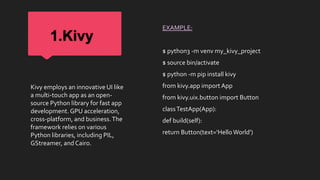
1.Kivy
EXAMPLE:
$ python3 -m venv my_kivy_project
$ source bin/activate
$ python -m pip install kivy
from kivy.app import App
from kivy.uix.button import Button
classTestApp(App):
def build(self):
return Button(text='HelloWorld')
Kivy employs an innovative UI like
a multi-touch app as an open-
source Python library for fast app
development. GPU acceleration,
cross-platform, and business.The
framework relies on various
Python libraries, including PIL,
GStreamer, and Cairo.
2.Beeware
EXAMPLE:
$ python3 -m venv .env
$ pip3 install briefcase
$ briefcase new
Formal Name [Hello World]: Pyython
App Name [Hello]:TestApp
Bundle Identifier [com.example]: com.thepepper.writeHello
Project Name [First Project]:
Author [Developer Name]: <Your Name>
Author's Email: <Your Email>
Application URL:
Select one of the following:
[1] Python
[2] PySide2
[3] NumPy
[4] None
GUI Framework [1]: 1
o BeeWare is used to develop and deploy
native applications in Python. It also
comes withToga, an OS native, Python
native, and cross-platformGUI toolkit.
o In addition, the BeeWare toolkit
contains Rubicon Java which is a library
for working with Java libraries using
Python code.The Briefcase is another
tool for packaging and shipping Python
projects to end-users as deliverables.
3.Python for andriod
 It is a tool for making Python work with Android. Its primary function is to create
a project folder that contains all the tools needed to launch the mobile app.
 This folder consists of various libraries such as Kivy, Pygame, and SDL.This
folder also includes the Java loader, an intermediary between Kivy and OS.You
can then add your scripts or use Android NDK to compile your application.
4.PYJNius
PyJNIus is a framework designed to provide the interaction between
Python and Android API. Practicing this API, developers can obtain
information from various parts of your mobile device, such as
vibration, pause, and restart. PYJNius
5.PYQt5
 The PyQt5 set is organized around the Qt framework, a cross-platform
framework for creating many applications for a variety of platforms.
 The PyQt5 package comprises a complete set of Python wrappers based on v5,
the latest version of the Qt application framework.
 Similar to the Qt5 framework, PyQt5 is fully cross-platform. By holding control
of PyQt5, developers can build applications forWindows, Mac, Linux, iOS,
Android, and other platforms.
6.TKinter
 Tkinter is often referred to as the preferred GUI toolkit by most Python developers.
It was created to provide modern developers with a standardTk GUI toolkit bound
to the Python interface.
 In the world ofTkinter, most of the visual elements we know are called widgets,
and each widget provides varying degrees of customization.
 Tkinter is embedded in the Python installer for all major current operating systems
and provides several common elements that we believe you are familiar with.
7.falcon
 Falcon, a high-performance and secure Python network framework, produces wide
application backends and microservices.The Falcon application runs on anyASGI or
WSGI server and runs on yPy version 3.5+ and CPython version 3.5+.
 Additionally, Falcon has an extensible codebase and is highly optimized. Falcon
provides intuitive routing, including REST-inspired resource classes and URI
templates. It also offers easy access to headers and bodies through request and
response classes.
 Falcon enables rapid unit testing via theWSGI helper. It also handles DRYrequest
processing via middleware components and hooks.
8.cherryPy
 The object-oriented web framework created in Python is CherryPy.You can create a
web app in the same way you make other object-oriented Python programs.This
tool can also run various HTTP servers at once.
 CherryPy is also known for its flexible plug-in system. In addition, tools such as
encoding, caching, authentication, static content, and sessions are built-in.
 CherryPy has built-in support for coverage, profiling, and testing. It works with
Python 2.7+, 3.5+, Android, PyPy, and Jython.
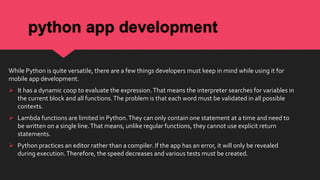
python app development
While Python is quite versatile, there are a few things developers must keep in mind while using it for
mobile app development.
 It has a dynamic coop to evaluate the expression.That means the interpreter searches for variables in
the current block and all functions.The problem is that each word must be validated in all possible
contexts.
 Lambda functions are limited in Python.They can only contain one statement at a time and need to
be written on a single line.That means, unlike regular functions, they cannot use explicit return
statements.
 Python practices an editor rather than a compiler. If the app has an error, it will only be revealed
during execution.Therefore, the speed decreases and various tests must be created.
Thank you!

MOBILE APP DEVELOPMENT USING PYTHON

  • 1.
    V.S.PRIYA DHARSHINI I M.SC(CS) NADARSARASWATHI COLLEGE OF ARTS&SCIENCE,THENI DEPARTMENT OF COMPUTER SCIENCE&INFORMATION TECHNOLOGY
  • 2.
  • 3.
    Is Python suitablefor mobile applications  What makes Python so great is its comfort of use and readability and less development time. This is what makes it ideal in the mobile market, where time to market is critical to gaining and maintaining a share.  Fundamentally, iOS and Android do not support interpreter-type languages. It means you can’t run the Python app natively.This is why it was not common to create mobile apps for Python earlier.  However, things are different now with the emergence of several frameworks.There are a variety of Python GUI frameworks to bridge the gap between making the Python app work natively on mobile devices.
  • 4.
    Why python? o FasterProgramming performance o Test Driven Development compatibility o Variety of Libraries o Strong Community
  • 5.
    Android apps  VOCs(backronym for “VestigialOutput Compiler” or “Vexing Obtuse Compiler”) make this possible.  It is part of the BeeWare suite and allows you to access Java native objects like Python, implement Java interfaces in Python classes, and subclass Java classes in Python classes. It will enable you to write Android applications directly to Android’s nativeAPI. IOS apps  The steps to build an application for iOS are a bit more complicated than Android. Developers can always use the official Kivy package documentation for the latest information on iOS development using Python.  The process usually involves setting up a Python environment, encoding your application with Python/Kivy, and deploying it with Xcode.
  • 7.
    Mobile application that usepython  Instagram  Pinterest  Disqus  Spotify
  • 8.
    frameworks for appdevelopment  Kivy  Beeware  Python for android  PYJNius  PYQt5  Tkinter  Falcon  CherryPy
  • 9.
    1.Kivy EXAMPLE: $ python3 -mvenv my_kivy_project $ source bin/activate $ python -m pip install kivy from kivy.app import App from kivy.uix.button import Button classTestApp(App): def build(self): return Button(text='HelloWorld') Kivy employs an innovative UI like a multi-touch app as an open- source Python library for fast app development. GPU acceleration, cross-platform, and business.The framework relies on various Python libraries, including PIL, GStreamer, and Cairo.
  • 10.
    2.Beeware EXAMPLE: $ python3 -mvenv .env $ pip3 install briefcase $ briefcase new Formal Name [Hello World]: Pyython App Name [Hello]:TestApp Bundle Identifier [com.example]: com.thepepper.writeHello Project Name [First Project]: Author [Developer Name]: <Your Name> Author's Email: <Your Email> Application URL: Select one of the following: [1] Python [2] PySide2 [3] NumPy [4] None GUI Framework [1]: 1 o BeeWare is used to develop and deploy native applications in Python. It also comes withToga, an OS native, Python native, and cross-platformGUI toolkit. o In addition, the BeeWare toolkit contains Rubicon Java which is a library for working with Java libraries using Python code.The Briefcase is another tool for packaging and shipping Python projects to end-users as deliverables.
  • 11.
    3.Python for andriod It is a tool for making Python work with Android. Its primary function is to create a project folder that contains all the tools needed to launch the mobile app.  This folder consists of various libraries such as Kivy, Pygame, and SDL.This folder also includes the Java loader, an intermediary between Kivy and OS.You can then add your scripts or use Android NDK to compile your application.
  • 12.
    4.PYJNius PyJNIus is aframework designed to provide the interaction between Python and Android API. Practicing this API, developers can obtain information from various parts of your mobile device, such as vibration, pause, and restart. PYJNius
  • 13.
    5.PYQt5  The PyQt5set is organized around the Qt framework, a cross-platform framework for creating many applications for a variety of platforms.  The PyQt5 package comprises a complete set of Python wrappers based on v5, the latest version of the Qt application framework.  Similar to the Qt5 framework, PyQt5 is fully cross-platform. By holding control of PyQt5, developers can build applications forWindows, Mac, Linux, iOS, Android, and other platforms.
  • 14.
    6.TKinter  Tkinter isoften referred to as the preferred GUI toolkit by most Python developers. It was created to provide modern developers with a standardTk GUI toolkit bound to the Python interface.  In the world ofTkinter, most of the visual elements we know are called widgets, and each widget provides varying degrees of customization.  Tkinter is embedded in the Python installer for all major current operating systems and provides several common elements that we believe you are familiar with.
  • 15.
    7.falcon  Falcon, ahigh-performance and secure Python network framework, produces wide application backends and microservices.The Falcon application runs on anyASGI or WSGI server and runs on yPy version 3.5+ and CPython version 3.5+.  Additionally, Falcon has an extensible codebase and is highly optimized. Falcon provides intuitive routing, including REST-inspired resource classes and URI templates. It also offers easy access to headers and bodies through request and response classes.  Falcon enables rapid unit testing via theWSGI helper. It also handles DRYrequest processing via middleware components and hooks.
  • 16.
    8.cherryPy  The object-orientedweb framework created in Python is CherryPy.You can create a web app in the same way you make other object-oriented Python programs.This tool can also run various HTTP servers at once.  CherryPy is also known for its flexible plug-in system. In addition, tools such as encoding, caching, authentication, static content, and sessions are built-in.  CherryPy has built-in support for coverage, profiling, and testing. It works with Python 2.7+, 3.5+, Android, PyPy, and Jython.
  • 17.
    python app development WhilePython is quite versatile, there are a few things developers must keep in mind while using it for mobile app development.  It has a dynamic coop to evaluate the expression.That means the interpreter searches for variables in the current block and all functions.The problem is that each word must be validated in all possible contexts.  Lambda functions are limited in Python.They can only contain one statement at a time and need to be written on a single line.That means, unlike regular functions, they cannot use explicit return statements.  Python practices an editor rather than a compiler. If the app has an error, it will only be revealed during execution.Therefore, the speed decreases and various tests must be created.
  • 18.