Mobile IP

Outline
   Intro to mobile IP
   Operation
   Problems with mobility
We’re not quite done with IP
• You’re probably sick and tired of hearing about all
  things IP
   – Forwarding, routing, multicast, etc…
• One last topic we must cover because it’s going to
  be important in the future – mobile networking
   – Examples of mobile networking today?
   – Examples of mobile networking tomorrow?
• Mobile networking should not be confused with
  portable networking
   – Portable networking requires connection to same ISP

                  CS 640                     2
Portable Networking Technology
• Cellular systems
   – Cellular Digital Packet Data (CDPD)
   – 3G
• Bluetooth
   – Low cost, short range radio links between mobile devices
• Wireless Ethernet (802.11)
   – Widely used wireless MAC layer technology


                   CS 640                      3
Mobility and Standard IP Routing
• IP assumes end hosts are in fixed physical locations
   – What happens if we move a host between networks?
• IP addresses enable IP routing algorithms to get packets
  to the correct network
   – Each IP address has network part and host part
      • This keeps host specific information out of routers
   – DHCP is used to get packets to end hosts in networks
      • This still assumes a fixed end host
• What if a user wants to roam between networks?
   – Mobile users don’t want to know that they are moving between
     networks
   – Why can’t mobile users change IP when running an
     application?

                         CS 640                               4
Mobile IP
• Mobile IP was developed as a means for transparently dealing
  with problems of mobile users
   – Enables hosts to stay connected to the Internet regardless of
     their location
   – Enables hosts to be tracked without needing to change their IP
     address
   – Requires no changes to software of non-mobile hosts/routers
   – Requires addition of some infrastructure
   – Has no geographical limitations
   – Requires no modifications to IP addresses or IP address format
   – Supports security
       • Could be even more important than physically connected routing
• IETF standardization process is still underway

                           CS 640                             5
Mobile IP Entities
• Mobile Node (MN)
   – The entity that may change its point of attachment from network to network
     in the Internet
        • Detects it has moved and registers with “best” FA
   – Assigned a permanent IP called its home address to which other hosts send
     packets regardless of MN’s location
        • Since this IP doesn’t change it can be used by long-lived applications as MN’s
          location changes
• Home Agent (HA)
   –   This is router with additional functionality
   –   Located on home network of MN
   –   Does mobility binding of MN’s IP with its COA
   –   Forwards packets to appropriate network when MN is away
        • Does this through encapsulation


                              CS 640                               6
Mobile IP Entities contd.
• Foreign Agent (FA)
   –   Another router with enhanced functionality
   –   If MN is away from HA the it uses an FA to send/receive data to/from HA
   –   Advertises itself periodically
   –   Forward’s MN’s registration request
   –   Decapsulates messages for delivery to MN
• Care-of-address (COA)
   – Address which identifies MN’s current location
   – Sent by FA to HA when MN attaches
   – Usually the IP address of the FA
• Correspondent Node (CN)
   – End host to which MN is corresponding (eg. a web server)

                           CS 640                           7
Mobile IP Support Services
• Agent Discovery
   – HA’s and FA’s broadcast their presence on each network to which they are
     attached
       • Beacon messages via ICMP Router Discovery Protocol (IRDP)
   – MN’s listen for advertisement and then initiate registration
• Registration
   – When MN is away, it registers its COA with its HA
       • Typically through the FA with strongest signal
   – Registration control messages are sent via UDP to well known port
• Encapsulation – just like standard IP only with COA
• Decapsulation – again, just like standard IP

                            CS 640                           8
Mobile IP Operation
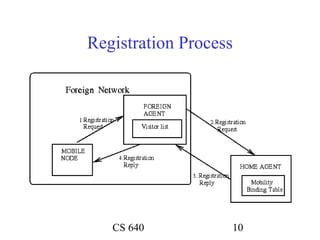
• A MN listens for agent advertisement and then initiates registration
   – If responding agent is the HA, then mobile IP is not necessary
• After receiving the registration request from a MN, the HA
  acknowledges and registration is complete
   – Registration happens as often as MN changes networks
• HA intercepts all packets destined for MN
   – This is simple unless sending application is on or near the same network as
     the MN
   – HA masquerades as MN
   – There is a specific lifetime for service before a MN must re-register
   – There is also a de-registration process with HA if an MN returns home

                           CS 640                           9
Registration Process


   CS 640          10
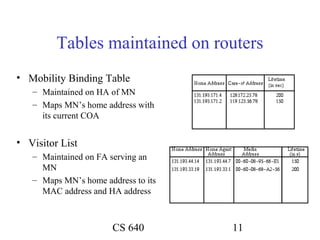
Tables maintained on routers
• Mobility Binding Table
   – Maintained on HA of MN
   – Maps MN’s home address with
     its current COA


• Visitor List
   – Maintained on FA serving an
     MN
   – Maps MN’s home address to its
     MAC address and HA address


                       CS 640        11
Mobile IP Operation contd.
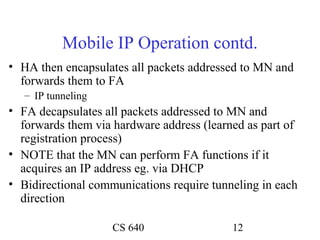
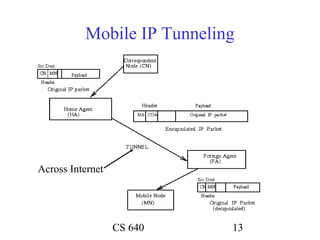
• HA then encapsulates all packets addressed to MN and
  forwards them to FA
   – IP tunneling
• FA decapsulates all packets addressed to MN and
  forwards them via hardware address (learned as part of
  registration process)
• NOTE that the MN can perform FA functions if it
  acquires an IP address eg. via DHCP
• Bidirectional communications require tunneling in each
  direction

                    CS 640                 12
Mobile IP Tunneling


Across Internet


                  CS 640    13
Security in Mobile IP
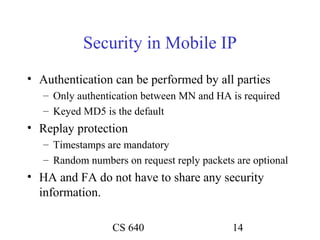
• Authentication can be performed by all parties
   – Only authentication between MN and HA is required
   – Keyed MD5 is the default
• Replay protection
   – Timestamps are mandatory
   – Random numbers on request reply packets are optional
• HA and FA do not have to share any security
  information.

                  CS 640                    14
Problems with Mobile IP
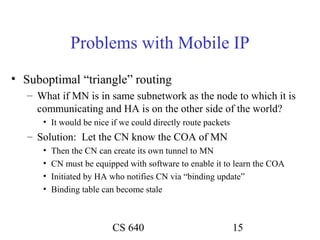
• Suboptimal “triangle” routing
   – What if MN is in same subnetwork as the node to which it is
     communicating and HA is on the other side of the world?
      • It would be nice if we could directly route packets
   – Solution: Let the CN know the COA of MN
      •   Then the CN can create its own tunnel to MN
      •   CN must be equipped with software to enable it to learn the COA
      •   Initiated by HA who notifies CN via “binding update”
      •   Binding table can become stale


                          CS 640                              15
Other Mobile IP Problems
• Single HA model is fragile
   – Possible solution – have multiple HA
• Frequent reports to HA if MN is moving
   – Possible solution – support of FA clustering
• Security
   – Connection hijacking, snooping…
• Many open research questions


                       CS 640                       16
Mobility in IPv6
• Route Optimization is a fundamental part of Mobile
  IPv6
   – Mobile IPv4 it is an optional set of extensions that may not be
     supported by all nodes
• Foreign Agents are not needed in Mobile IPv6
   – MNs can function in any location without the services of any
     special router in that location
• Security
   – Nodes are expected to employ strong authentication and
     encryption
• Other details…

                      CS 640                      17

Mobile

  • 1.
    Mobile IP Outline Intro to mobile IP Operation Problems with mobility
  • 2.
    We’re not quitedone with IP • You’re probably sick and tired of hearing about all things IP – Forwarding, routing, multicast, etc… • One last topic we must cover because it’s going to be important in the future – mobile networking – Examples of mobile networking today? – Examples of mobile networking tomorrow? • Mobile networking should not be confused with portable networking – Portable networking requires connection to same ISP CS 640 2
  • 3.
    Portable Networking Technology •Cellular systems – Cellular Digital Packet Data (CDPD) – 3G • Bluetooth – Low cost, short range radio links between mobile devices • Wireless Ethernet (802.11) – Widely used wireless MAC layer technology CS 640 3
  • 4.
    Mobility and StandardIP Routing • IP assumes end hosts are in fixed physical locations – What happens if we move a host between networks? • IP addresses enable IP routing algorithms to get packets to the correct network – Each IP address has network part and host part • This keeps host specific information out of routers – DHCP is used to get packets to end hosts in networks • This still assumes a fixed end host • What if a user wants to roam between networks? – Mobile users don’t want to know that they are moving between networks – Why can’t mobile users change IP when running an application? CS 640 4
  • 5.
    Mobile IP • MobileIP was developed as a means for transparently dealing with problems of mobile users – Enables hosts to stay connected to the Internet regardless of their location – Enables hosts to be tracked without needing to change their IP address – Requires no changes to software of non-mobile hosts/routers – Requires addition of some infrastructure – Has no geographical limitations – Requires no modifications to IP addresses or IP address format – Supports security • Could be even more important than physically connected routing • IETF standardization process is still underway CS 640 5
  • 6.
    Mobile IP Entities •Mobile Node (MN) – The entity that may change its point of attachment from network to network in the Internet • Detects it has moved and registers with “best” FA – Assigned a permanent IP called its home address to which other hosts send packets regardless of MN’s location • Since this IP doesn’t change it can be used by long-lived applications as MN’s location changes • Home Agent (HA) – This is router with additional functionality – Located on home network of MN – Does mobility binding of MN’s IP with its COA – Forwards packets to appropriate network when MN is away • Does this through encapsulation CS 640 6
  • 7.
    Mobile IP Entitiescontd. • Foreign Agent (FA) – Another router with enhanced functionality – If MN is away from HA the it uses an FA to send/receive data to/from HA – Advertises itself periodically – Forward’s MN’s registration request – Decapsulates messages for delivery to MN • Care-of-address (COA) – Address which identifies MN’s current location – Sent by FA to HA when MN attaches – Usually the IP address of the FA • Correspondent Node (CN) – End host to which MN is corresponding (eg. a web server) CS 640 7
  • 8.
    Mobile IP SupportServices • Agent Discovery – HA’s and FA’s broadcast their presence on each network to which they are attached • Beacon messages via ICMP Router Discovery Protocol (IRDP) – MN’s listen for advertisement and then initiate registration • Registration – When MN is away, it registers its COA with its HA • Typically through the FA with strongest signal – Registration control messages are sent via UDP to well known port • Encapsulation – just like standard IP only with COA • Decapsulation – again, just like standard IP CS 640 8
  • 9.
    Mobile IP Operation •A MN listens for agent advertisement and then initiates registration – If responding agent is the HA, then mobile IP is not necessary • After receiving the registration request from a MN, the HA acknowledges and registration is complete – Registration happens as often as MN changes networks • HA intercepts all packets destined for MN – This is simple unless sending application is on or near the same network as the MN – HA masquerades as MN – There is a specific lifetime for service before a MN must re-register – There is also a de-registration process with HA if an MN returns home CS 640 9
  • 10.
  • 11.
    Tables maintained onrouters • Mobility Binding Table – Maintained on HA of MN – Maps MN’s home address with its current COA • Visitor List – Maintained on FA serving an MN – Maps MN’s home address to its MAC address and HA address CS 640 11
  • 12.
    Mobile IP Operationcontd. • HA then encapsulates all packets addressed to MN and forwards them to FA – IP tunneling • FA decapsulates all packets addressed to MN and forwards them via hardware address (learned as part of registration process) • NOTE that the MN can perform FA functions if it acquires an IP address eg. via DHCP • Bidirectional communications require tunneling in each direction CS 640 12
  • 13.
    Mobile IP Tunneling AcrossInternet CS 640 13
  • 14.
    Security in MobileIP • Authentication can be performed by all parties – Only authentication between MN and HA is required – Keyed MD5 is the default • Replay protection – Timestamps are mandatory – Random numbers on request reply packets are optional • HA and FA do not have to share any security information. CS 640 14
  • 15.
    Problems with MobileIP • Suboptimal “triangle” routing – What if MN is in same subnetwork as the node to which it is communicating and HA is on the other side of the world? • It would be nice if we could directly route packets – Solution: Let the CN know the COA of MN • Then the CN can create its own tunnel to MN • CN must be equipped with software to enable it to learn the COA • Initiated by HA who notifies CN via “binding update” • Binding table can become stale CS 640 15
  • 16.
    Other Mobile IPProblems • Single HA model is fragile – Possible solution – have multiple HA • Frequent reports to HA if MN is moving – Possible solution – support of FA clustering • Security – Connection hijacking, snooping… • Many open research questions CS 640 16
  • 17.
    Mobility in IPv6 •Route Optimization is a fundamental part of Mobile IPv6 – Mobile IPv4 it is an optional set of extensions that may not be supported by all nodes • Foreign Agents are not needed in Mobile IPv6 – MNs can function in any location without the services of any special router in that location • Security – Nodes are expected to employ strong authentication and encryption • Other details… CS 640 17