Mob lynching in India and
Everyday Lives of Women –
Questions of Marginalization
and Representations
Sanjukta Basu, PhD Scholar,
School of Women and Gender Studies
Email:
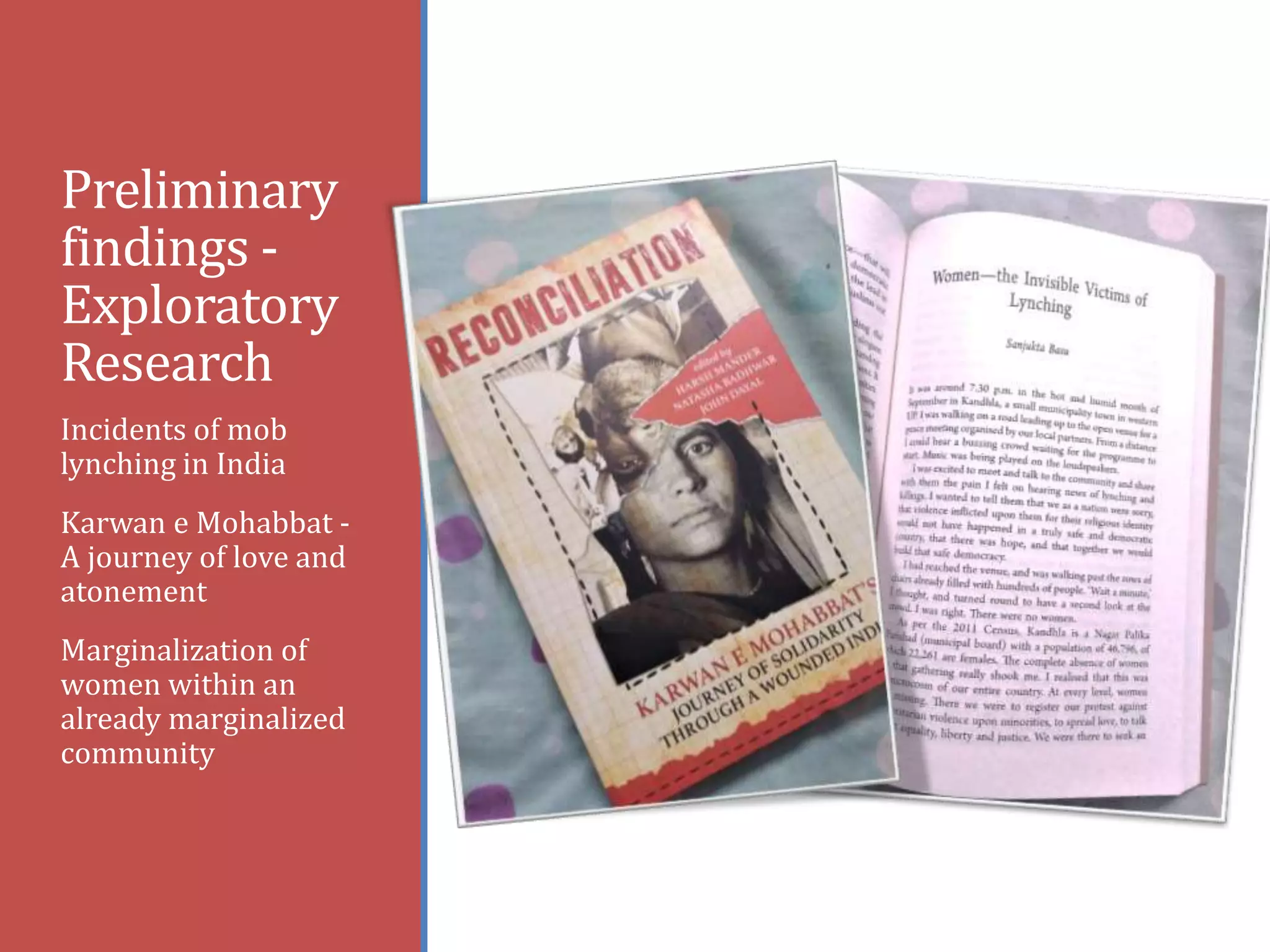
Preliminary
findings -
Exploratory
Research
Incidents of mob
lynching in India
Karwan e Mohabbat -
A journey of love and
atonement
Marginalization of
women within an
already marginalized
community
May 2014 a political
milestone - Mob Lynching
Government does not have official data on mob lynching. According
to India Spend:
Approximately 60 cases of mob lynching by gau rakshaks between
2010 to June 2017 (Currently, this number has crossed 100. Last month, an 80 year
old Muslim man in Bihar was burnt to death by a mob alleged to belong to Hindutva
groups)
25 Indians have lost their life
97% of these cases occurred after May 2014.
84% of the dead are Muslims
IndiaSpend is a non-
profit and a project
of The Spending &
Policy Research
Foundation,
registered as a
Charitable Trust
with the Charity
Commissioner,
Mumbai.
Mohammad Akhlaq, September,
2015, Dadri, Uttar Pradesh
The facts and circumstances
leading up to the attack and
what followed thereafter
were soon to become a
pattern in India. Violence
perpetrated in a systematic
way as a tool of social and
political marginalization and
disenfranchisement of the
Muslims, considered the
original “others/enemy” of
the Hindu nation by
ideologues of Rashtriya
Swayamsevak Sangh (RSS).
 Allegations of beef eating / cow
slaughter / smuggling
 Sudden Mob gathers led by ‘cow
protection groups,’ barge into
somebody’s home or stop a cattle
transferring vehicle.
 Ruthless and incessant beating
sometimes with bare hands, sometimes
using sticks, bricks, or “anything they
could find — iron rods, sticks, knives,
daggers, screw-drivers, even pens” as
weapons.
Video recording - brazen confidence that
you will not be punished for your crime,
and even if you are nabbed, you will be a
hero for the ruling establishment
(Mander, The mob that hates).”
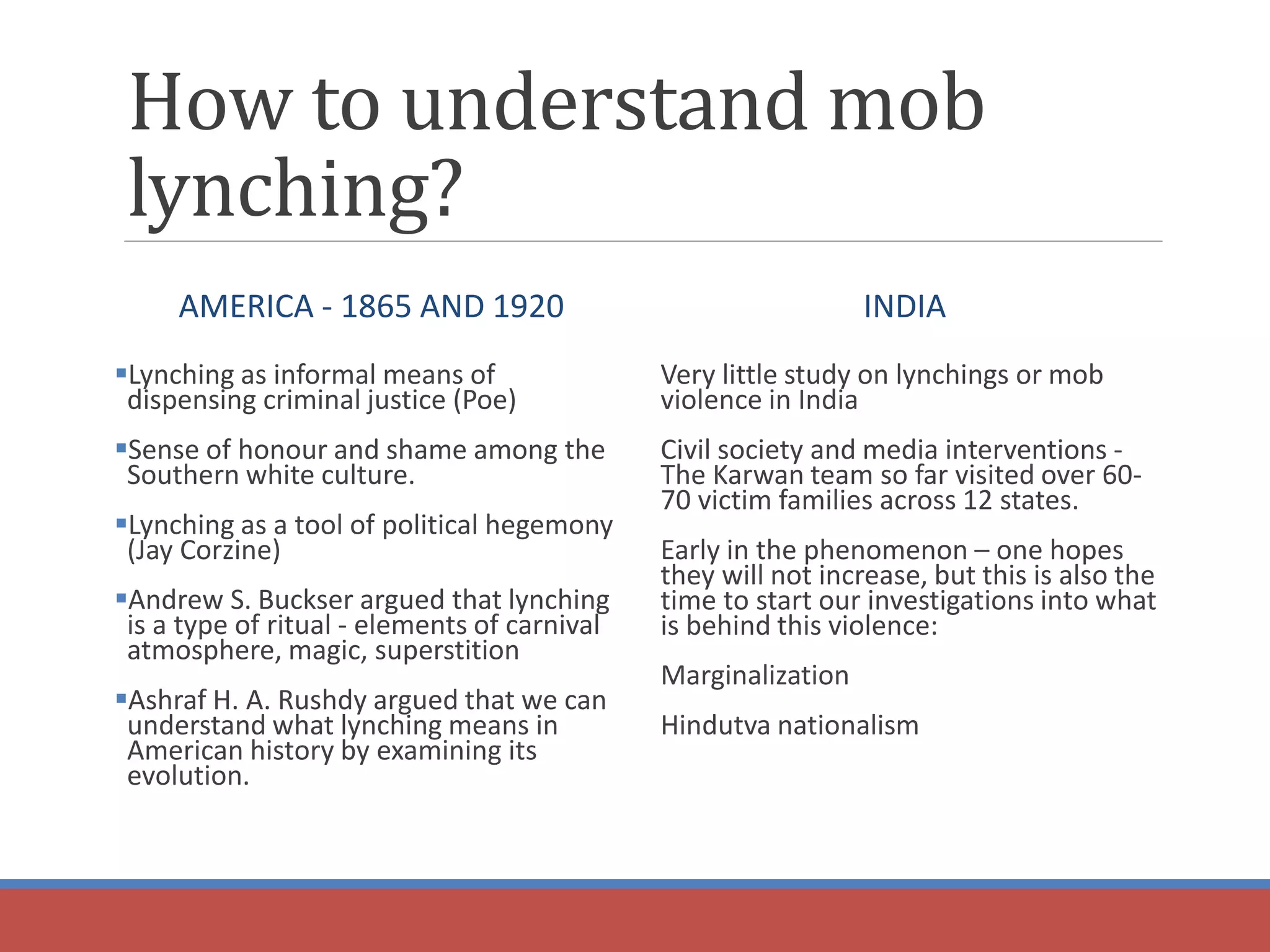
How to understand mob
lynching?
AMERICA - 1865 AND 1920
Lynching as informal means of
dispensing criminal justice (Poe)
Sense of honour and shame among the
Southern white culture.
Lynching as a tool of political hegemony
(Jay Corzine)
Andrew S. Buckser argued that lynching
is a type of ritual - elements of carnival
atmosphere, magic, superstition
Ashraf H. A. Rushdy argued that we can
understand what lynching means in
American history by examining its
evolution.
INDIA
Very little study on lynchings or mob
violence in India
Civil society and media interventions -
The Karwan team so far visited over 60-
70 victim families across 12 states.
Early in the phenomenon – one hopes
they will not increase, but this is also the
time to start our investigations into what
is behind this violence:
Marginalization
Hindutva nationalism
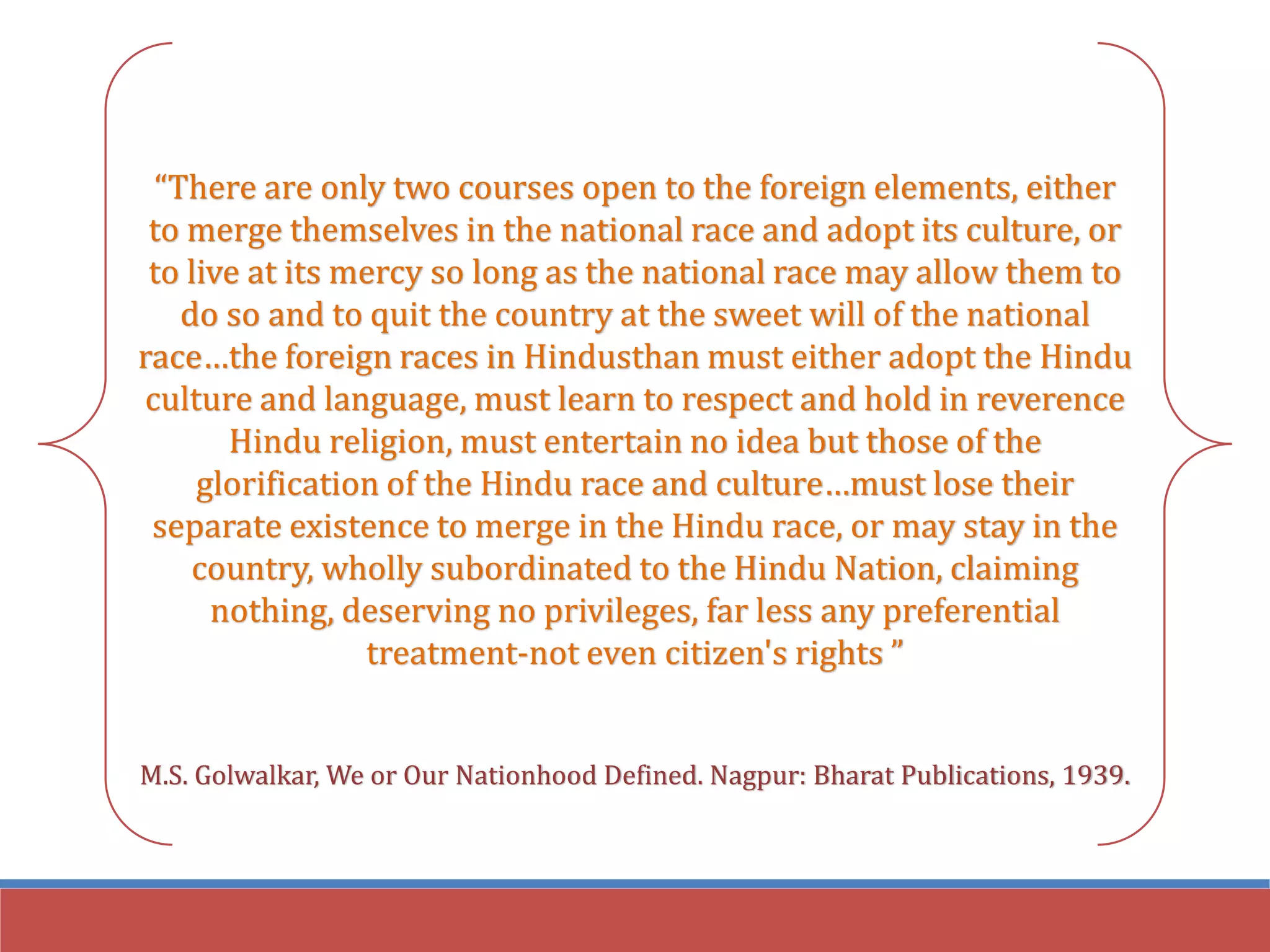
“There are only two courses open to the foreign elements, either
to merge themselves in the national race and adopt its culture, or
to live at its mercy so long as the national race may allow them to
do so and to quit the country at the sweet will of the national
race…the foreign races in Hindusthan must either adopt the Hindu
culture and language, must learn to respect and hold in reverence
Hindu religion, must entertain no idea but those of the
glorification of the Hindu race and culture…must lose their
separate existence to merge in the Hindu race, or may stay in the
country, wholly subordinated to the Hindu Nation, claiming
nothing, deserving no privileges, far less any preferential
treatment-not even citizen's rights ”
M.S. Golwalkar, We or Our Nationhood Defined. Nagpur: Bharat Publications, 1939.
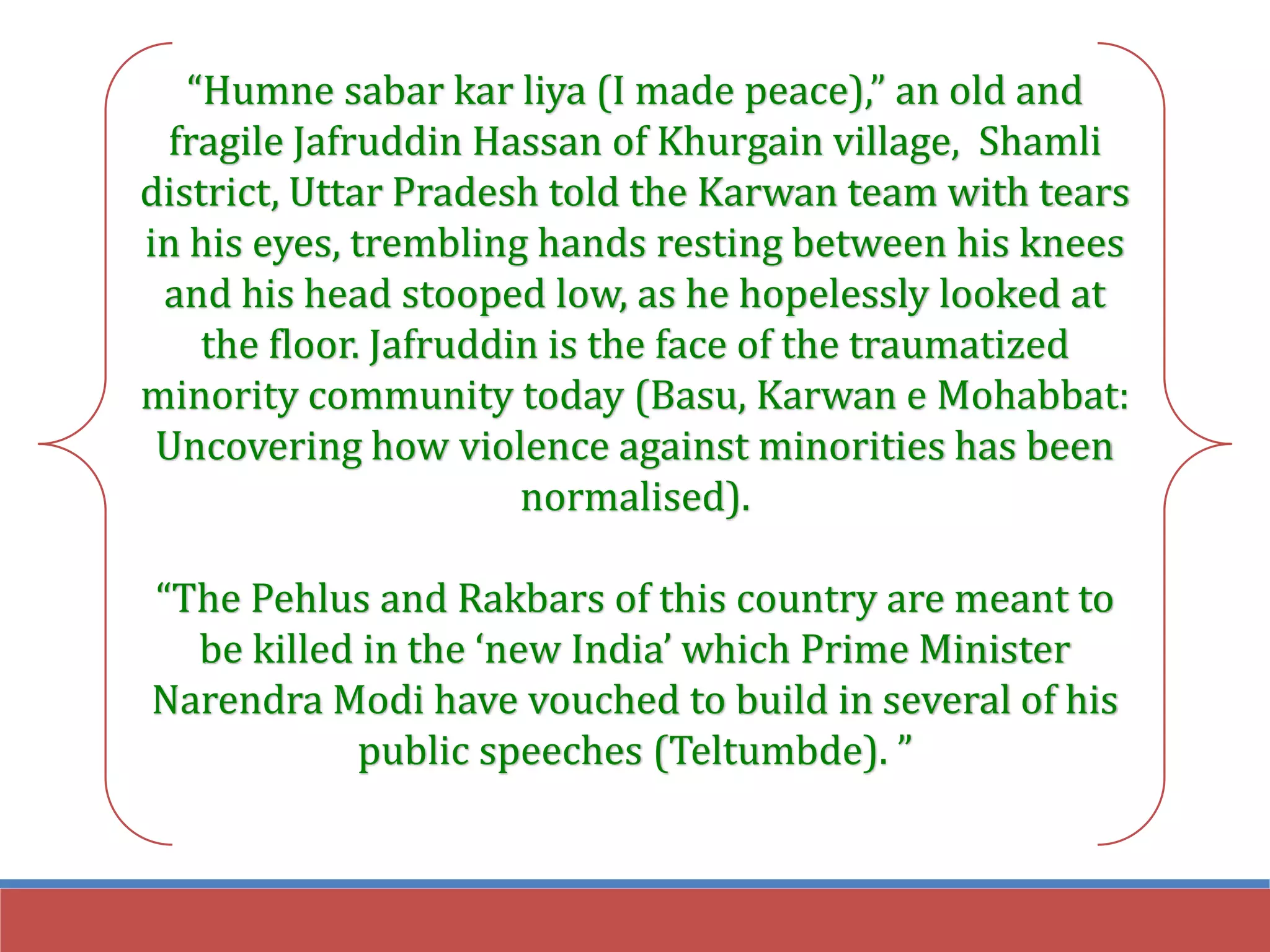
“Humne sabar kar liya (I made peace),” an old and
fragile Jafruddin Hassan of Khurgain village, Shamli
district, Uttar Pradesh told the Karwan team with tears
in his eyes, trembling hands resting between his knees
and his head stooped low, as he hopelessly looked at
the floor. Jafruddin is the face of the traumatized
minority community today (Basu, Karwan e Mohabbat:
Uncovering how violence against minorities has been
normalised).
“The Pehlus and Rakbars of this country are meant to
be killed in the ‘new India’ which Prime Minister
Narendra Modi have vouched to build in several of his
public speeches (Teltumbde). ”
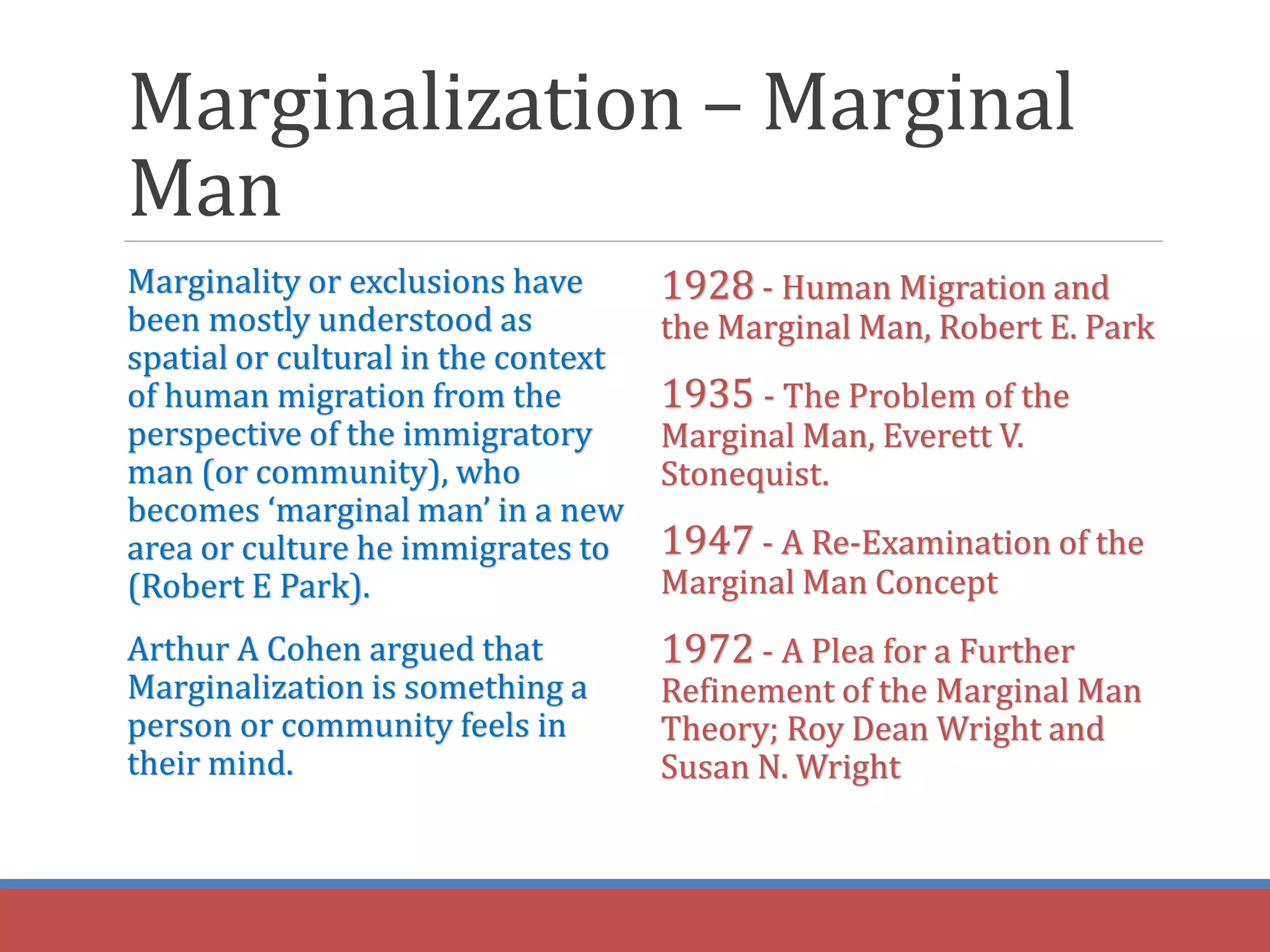
Marginalization – Marginal
Man
Marginality or exclusions have
been mostly understood as
spatial or cultural in the context
of human migration from the
perspective of the immigratory
man (or community), who
becomes ‘marginal man’ in a new
area or culture he immigrates to
(Robert E Park).
Arthur A Cohen argued that
Marginalization is something a
person or community feels in
their mind.
1928 - Human Migration and
the Marginal Man, Robert E. Park
1935 - The Problem of the
Marginal Man, Everett V.
Stonequist.
1947 - A Re-Examination of the
Marginal Man Concept
1972 - A Plea for a Further
Refinement of the Marginal Man
Theory; Roy Dean Wright and
Susan N. Wright
Indian
Context
 Muslims part of Indian landscape for over 500
years.
 History of amalgamation of Hindu-Muslim culture
 Hindu and Muslim animosity traced back to the
period of colonialism by the British, who for the first
time codified the differences (Baber)
 Post 2014, there has been a surge in Hindu
hegemonic ideology often supported by BJP
leaders/allies, which seeks to change the
Constitution (Apoorva) and establish a Hindu
Rashtra. From 2014 to 2015, there has been a range
of attacks on Muslims lives (Gidda), livelihood (Zeba
Siddiqui), food (Mangaldas), faith and culture
(Sharma), madrassa, namaaz, personal laws and so
on. In the ‘new India’ Muslims have been excluded
from the ‘imagined community’ (Anderson) which
constitutes Indian nationalism and are paying a
heavy price (Ashraf) for the Mughal invasions,
colonial rule, and partition – a range of events dating
back to over five hundred years, in which present
generations had no role.
In the Indian context
marginalization of
the Muslim
community have
little relation with
migration anytime in
the near past and
not owed to the
culture difference or
‘hybrids’ as talked
about by Stonequist.
Marginalization
is beyond the
binaries
My argument: Marginalization have to be
understood beyond the binary of the centre and
the periphery. It does not take place just
between two cultures or identities but there are
margins within margins, and layers of identities
placed at hierarchical power positions.
The experiences of the marginal man or
community must be juxtaposed with that felt by
the individual woman and her ‘everyday
realities’
There is an “inner circle” and “everyday world”
(Smith, The Everyday World As Problematic)
within the household that is not penetrated by
the earnest public concern and empathy.
Absence of women from public meetings with
Karwan team made our process of knowing and
understanding mob lynching incomplete – as
argued by Dorothy Smith.
Following media reports of
mob lynching / hate crimes
we as civil society members
reach the doorsteps of
households which have lost
male members of the family
to hate crimes but we stop
there.
Women’s absence from the conversations raised
further questions of representations and identity
politics.
As researchers or civil society members trying to understand a
phenomenon, we go through the dilemma of whether or not it would
be appropriate to insist upon women’s inclusion or ask probing
questions as to why they were absent.
Kimberley Crenshaw explains this problem: Identity politics
“frequently conflates or ignores intra group differences. In the
context of violence against women, this elision of difference is
problematic, fundamentally because the violence that many women
experience is often shaped by other dimensions of their identities,
such as race and class (religion and caste).”
I started Karwan journey with a different purpose but by
talking to the women I learned and unlearned more things.
The issues that emerged cut across academic disciplines,
range and size of studies, geographies and other boundaries.
No single research can possibly accommodate the wide range
of issues I came across in a journey which was about
communal violence. I am now left with the question, whether
it is worth probing into subjects beyond the scope of the
immediate ethnographic study, understanding mob-lynching
or whether we should go into the field without having any
immediate concept as Dorothy Smith suggested and widen
our study to include women’s experiences?

Mob lynching in India - questions of marginalization and representation

  • 1.
    Mob lynching inIndia and Everyday Lives of Women – Questions of Marginalization and Representations Sanjukta Basu, PhD Scholar, School of Women and Gender Studies Email:
  • 2.
    Preliminary findings - Exploratory Research Incidents ofmob lynching in India Karwan e Mohabbat - A journey of love and atonement Marginalization of women within an already marginalized community
  • 3.
    May 2014 apolitical milestone - Mob Lynching Government does not have official data on mob lynching. According to India Spend: Approximately 60 cases of mob lynching by gau rakshaks between 2010 to June 2017 (Currently, this number has crossed 100. Last month, an 80 year old Muslim man in Bihar was burnt to death by a mob alleged to belong to Hindutva groups) 25 Indians have lost their life 97% of these cases occurred after May 2014. 84% of the dead are Muslims IndiaSpend is a non- profit and a project of The Spending & Policy Research Foundation, registered as a Charitable Trust with the Charity Commissioner, Mumbai.
  • 4.
    Mohammad Akhlaq, September, 2015,Dadri, Uttar Pradesh The facts and circumstances leading up to the attack and what followed thereafter were soon to become a pattern in India. Violence perpetrated in a systematic way as a tool of social and political marginalization and disenfranchisement of the Muslims, considered the original “others/enemy” of the Hindu nation by ideologues of Rashtriya Swayamsevak Sangh (RSS).  Allegations of beef eating / cow slaughter / smuggling  Sudden Mob gathers led by ‘cow protection groups,’ barge into somebody’s home or stop a cattle transferring vehicle.  Ruthless and incessant beating sometimes with bare hands, sometimes using sticks, bricks, or “anything they could find — iron rods, sticks, knives, daggers, screw-drivers, even pens” as weapons. Video recording - brazen confidence that you will not be punished for your crime, and even if you are nabbed, you will be a hero for the ruling establishment (Mander, The mob that hates).”
  • 5.
    How to understandmob lynching? AMERICA - 1865 AND 1920 Lynching as informal means of dispensing criminal justice (Poe) Sense of honour and shame among the Southern white culture. Lynching as a tool of political hegemony (Jay Corzine) Andrew S. Buckser argued that lynching is a type of ritual - elements of carnival atmosphere, magic, superstition Ashraf H. A. Rushdy argued that we can understand what lynching means in American history by examining its evolution. INDIA Very little study on lynchings or mob violence in India Civil society and media interventions - The Karwan team so far visited over 60- 70 victim families across 12 states. Early in the phenomenon – one hopes they will not increase, but this is also the time to start our investigations into what is behind this violence: Marginalization Hindutva nationalism
  • 6.
    “There are onlytwo courses open to the foreign elements, either to merge themselves in the national race and adopt its culture, or to live at its mercy so long as the national race may allow them to do so and to quit the country at the sweet will of the national race…the foreign races in Hindusthan must either adopt the Hindu culture and language, must learn to respect and hold in reverence Hindu religion, must entertain no idea but those of the glorification of the Hindu race and culture…must lose their separate existence to merge in the Hindu race, or may stay in the country, wholly subordinated to the Hindu Nation, claiming nothing, deserving no privileges, far less any preferential treatment-not even citizen's rights ” M.S. Golwalkar, We or Our Nationhood Defined. Nagpur: Bharat Publications, 1939.
  • 7.
    “Humne sabar karliya (I made peace),” an old and fragile Jafruddin Hassan of Khurgain village, Shamli district, Uttar Pradesh told the Karwan team with tears in his eyes, trembling hands resting between his knees and his head stooped low, as he hopelessly looked at the floor. Jafruddin is the face of the traumatized minority community today (Basu, Karwan e Mohabbat: Uncovering how violence against minorities has been normalised). “The Pehlus and Rakbars of this country are meant to be killed in the ‘new India’ which Prime Minister Narendra Modi have vouched to build in several of his public speeches (Teltumbde). ”
  • 8.
    Marginalization – Marginal Man Marginalityor exclusions have been mostly understood as spatial or cultural in the context of human migration from the perspective of the immigratory man (or community), who becomes ‘marginal man’ in a new area or culture he immigrates to (Robert E Park). Arthur A Cohen argued that Marginalization is something a person or community feels in their mind. 1928 - Human Migration and the Marginal Man, Robert E. Park 1935 - The Problem of the Marginal Man, Everett V. Stonequist. 1947 - A Re-Examination of the Marginal Man Concept 1972 - A Plea for a Further Refinement of the Marginal Man Theory; Roy Dean Wright and Susan N. Wright
  • 9.
    Indian Context  Muslims partof Indian landscape for over 500 years.  History of amalgamation of Hindu-Muslim culture  Hindu and Muslim animosity traced back to the period of colonialism by the British, who for the first time codified the differences (Baber)  Post 2014, there has been a surge in Hindu hegemonic ideology often supported by BJP leaders/allies, which seeks to change the Constitution (Apoorva) and establish a Hindu Rashtra. From 2014 to 2015, there has been a range of attacks on Muslims lives (Gidda), livelihood (Zeba Siddiqui), food (Mangaldas), faith and culture (Sharma), madrassa, namaaz, personal laws and so on. In the ‘new India’ Muslims have been excluded from the ‘imagined community’ (Anderson) which constitutes Indian nationalism and are paying a heavy price (Ashraf) for the Mughal invasions, colonial rule, and partition – a range of events dating back to over five hundred years, in which present generations had no role. In the Indian context marginalization of the Muslim community have little relation with migration anytime in the near past and not owed to the culture difference or ‘hybrids’ as talked about by Stonequist.
  • 10.
    Marginalization is beyond the binaries Myargument: Marginalization have to be understood beyond the binary of the centre and the periphery. It does not take place just between two cultures or identities but there are margins within margins, and layers of identities placed at hierarchical power positions. The experiences of the marginal man or community must be juxtaposed with that felt by the individual woman and her ‘everyday realities’ There is an “inner circle” and “everyday world” (Smith, The Everyday World As Problematic) within the household that is not penetrated by the earnest public concern and empathy. Absence of women from public meetings with Karwan team made our process of knowing and understanding mob lynching incomplete – as argued by Dorothy Smith. Following media reports of mob lynching / hate crimes we as civil society members reach the doorsteps of households which have lost male members of the family to hate crimes but we stop there.
  • 11.
    Women’s absence fromthe conversations raised further questions of representations and identity politics. As researchers or civil society members trying to understand a phenomenon, we go through the dilemma of whether or not it would be appropriate to insist upon women’s inclusion or ask probing questions as to why they were absent. Kimberley Crenshaw explains this problem: Identity politics “frequently conflates or ignores intra group differences. In the context of violence against women, this elision of difference is problematic, fundamentally because the violence that many women experience is often shaped by other dimensions of their identities, such as race and class (religion and caste).”
  • 12.
    I started Karwanjourney with a different purpose but by talking to the women I learned and unlearned more things. The issues that emerged cut across academic disciplines, range and size of studies, geographies and other boundaries. No single research can possibly accommodate the wide range of issues I came across in a journey which was about communal violence. I am now left with the question, whether it is worth probing into subjects beyond the scope of the immediate ethnographic study, understanding mob-lynching or whether we should go into the field without having any immediate concept as Dorothy Smith suggested and widen our study to include women’s experiences?