Stanford Law Review
Mapping the Margins: Intersectionality, Identity Politics, and
Violence against Women of
Color
Author(s): Kimberle Crenshaw
Source: Stanford Law Review, Vol. 43, No. 6 (Jul., 1991), pp.
1241-1299
Published by: Stanford Law Review
Stable URL: http://www.jstor.org/stable/1229039
Accessed: 11-04-2018 04:08 UTC
REFERENCES
Linked references are available on JSTOR for this article:
http://www.jstor.org/stable/1229039?seq=1&cid=pdf-
reference#references_tab_contents
You may need to log in to JSTOR to access the linked
references.
JSTOR is a not-for-profit service that helps scholars,
researchers, and students discover, use, and build upon a wide
range of content in a trusted digital archive. We use information
technology and tools to increase productivity and
facilitate new forms of scholarship. For more information about
JSTOR, please contact [email protected]
Your use of the JSTOR archive indicates your acceptance of the
Terms & Conditions of Use, available at
http://about.jstor.org/terms
Stanford Law Review is collaborating with JSTOR to digitize,
preserve and extend access to
Stanford Law Review
This content downloaded from 128.114.228.158 on Wed, 11 Apr
2018 04:08:34 UTC
All use subject to http://about.jstor.org/terms
Mapping the Margins: Intersectionality,
Identity Politics, and Violence Against
Women of Color
Kimberle Crenshaw*
INTRODUCTION
Over the last two decades, women have organized against the
almost
routine violence that shapes their lives.1 Drawing from the
strength of
shared experience, women have recognized that the political
demands of mil-
lions speak more powerfully than the pleas of a few isolated
voices. This
politicization in turn has transformed the way we understand
violence
against women. For example, battering and rape, once seen as
private (fam-
ily matters) and aberrational (errant sexual aggression), are
now largely rec-
ognized as part of a broad-scale system of domination that
affects women as
a class.2 This process of recognizing as social and systemic
what was for-
* ? 1993 by Kimberle Crenshaw. Professor of Law, University
of California, Los Angeles.
B.A. Cornell University, 1981; J.D. Harvard Law School, 1984;
LL.M. University of Wisconsin,
1985.
I am indebted to a great many people who have pushed this
project along. For their kind assist-
ance in facilitating my field research for this article, I wish to
thank Maria Blanco, Margaret Cam-
brick, Joan Creer, Estelle Cheung, Nilda Rimonte and Fred
Smith. I benefitted from the comments
of Taunya Banks, Mark Barenberg, Darcy Calkins, Adrienne
Davis, Gina Dent, Brent Edwards,
Paul Gewirtz, Lani Guinier, Neil Gotanda, Joel Handler,
Duncan Kennedy, Henry Monaghan, Eliz-
abeth Schneider and Kendall Thomas. A very special thanks
goes to Gary Peller and Richard Yar-
borough. Jayne Lee, Paula Puryear, Yancy Garrido, Eugenia
Gifford and Leti Volpp provided
valuable research assistance. I gratefully acknowledge the
support of the Academic Senate of
UCLA, Center for Afro-American Studies at UCLA, the Reed
Foundation and Columbia Law
School. Earlier versions of this article were presented to the
Critical Race Theory Workshop and the
Yale Legal Theory Workshop.
This article is dedicated to the memory of Denise Carty-Bennia
and Mary Joe Frug.
1. Feminist academics and activists have played a central role
in forwarding an ideological and
institutional challenge to the practices that condone and
perpetuate violence against women. See
generally SUSAN BROWNMILLER, AGAINST OUR WILL:
MEN, WOMEN AND RAPE (1975);
LORENNE M.G. CLARK & DEBRA J. LEWIS, RAPE: THE
PRICE OF COERCIVE SEXUALITY (1977);
R. EMERSON DOBASH & RUSSELL DOBASH, VIOLENCE
AGAINST WIVES: A CASE AGAINST THE
PATRIARCHY (1979); NANCY GAGER & CATHLEEN
SCHURR, SEXUAL ASSAULT: CONFRONTING
RAPE IN AMERICA (1976); DIANA E.H. RUSSELL, THE
POLITICS OF RAPE: THE VICTIM'S PER-
SPECTIVE (1974); ELIZABETH ANNE STANKO, INTIMATE
INTRUSIONS: WOMEN'S EXPERIENCE OF
MALE VIOLENCE (1985); LENORE E. WALKER,
TERRIFYING LOVE: WHY BATTERED WOMEN
KILL AND HOW SOCIETY RESPONDS (1989); LENORE E.
WALKER, THE BATTERED WOMAN SYN-
DROME (1984); LENORE E. WALKER, THE BATTERED
WOMAN (1979).
2. See, e.g., SUSAN SCHECHTER, WOMEN AND MALE
VIOLENCE: THE VISIONS AND STRUG-
GLES OF THE BATTERED WOMEN'S MOVEMENT (1982)
(arguing that battering is a means of main-
taining women's subordinate position); S. BROWNMILLER,
supra note 1 (arguing that rape is a
1241
This content downloaded from 128.114.228.158 on Wed, 11 Apr
2018 04:08:34 UTC
All use subject to http://about.jstor.org/terms
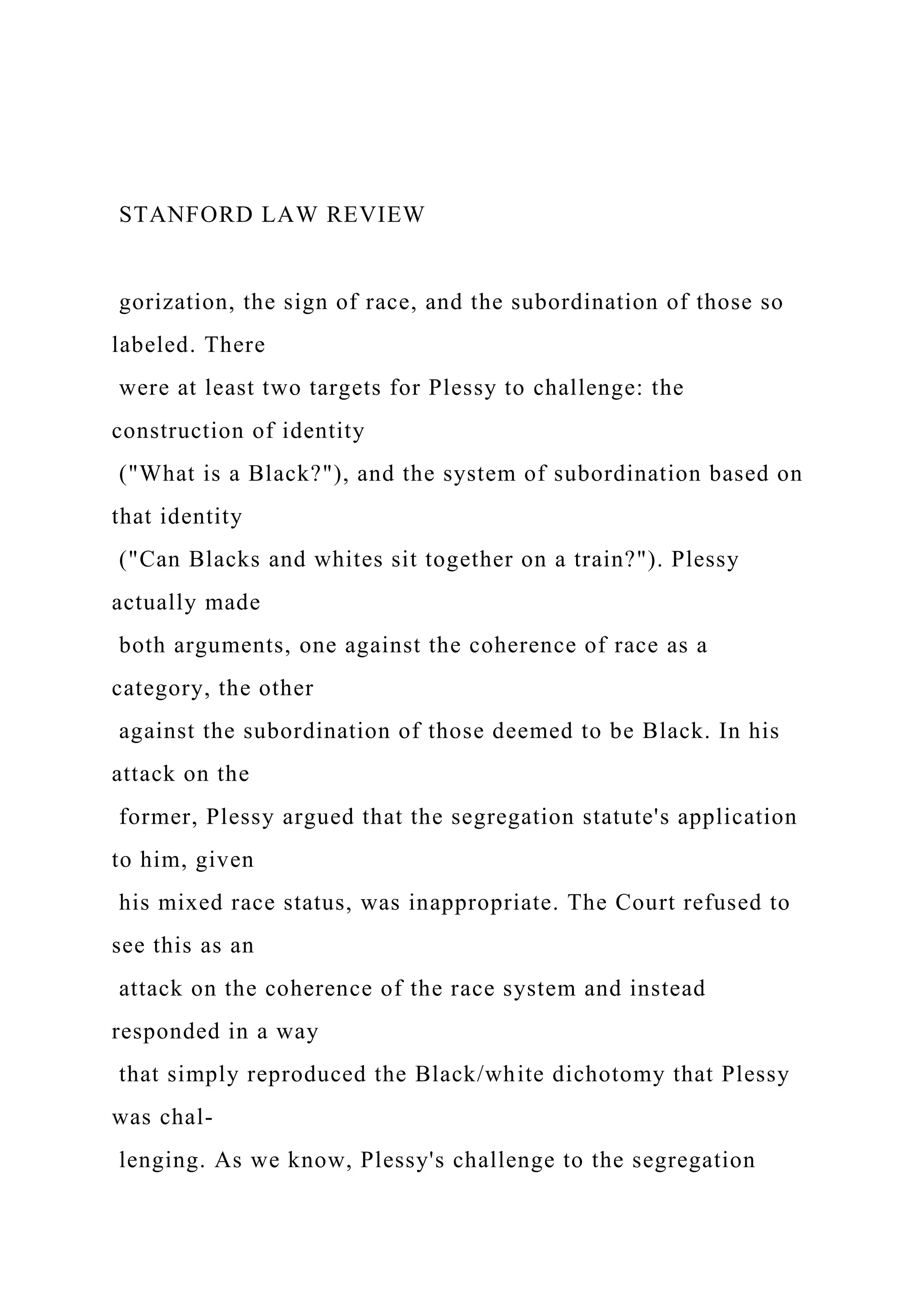
STANFORD LAW REVIEW
merly perceived as isolated and individual has also
characterized the identity
politics of African Americans, other people of color, and gays
and lesbians,
among others. For all these groups, identity-based politics has
been a source
of strength, community, and intellectual development.
The embrace of identity politics, however, has been in tension
with domi-
nant conceptions of social justice. Race, gender, and other
identity catego-
ries are most often treated in mainstream liberal discourse as
vestiges of bias
or domination-that is, as intrinsically negative frameworks in
which social
power works to exclude or marginalize those who are different.
According
to this understanding, our liberatory objective should be to
empty such cate-
gories of any social significance. Yet implicit in certain strands
of feminist
and racial liberation movements, for example is the view that
the social
power in delineating difference need not be the power of
domination; it can
instead be the source of social empowerment and
reconstruction.
The problem with identity politics is not that it fails to
transcend differ-
ence, as some critics charge, but rather the opposite-that it
frequently con-
flates or ignores intragroup differences. In the context of
violence against
women, this elision of difference in identity politics is
problematic, funda-
mentally because the violence that many women experience is
often shaped
by other dimensions of their identities, such as race and class.
Moreover,
ignoring difference within groups contributes to tension among
groups, an-
other problem of identity politics that bears on efforts to
politicize violence
against women. Feminist efforts to politicize experiences of
women and an-
tiracist efforts to politicize experiences of people of color have
frequently
proceeded as though the issues and experiences they each detail
occur on
mutually exclusive terrains. Although racism and sexism
readily intersect in
the lives of real people, they seldom do in feminist and
antiracist practices.
And so, when the practices expound identity as woman or
person of color as
an either/or proposition, they relegate the identity of women of
color to a
location that resists telling.
My objective in this article is to advance the telling of that
location by
exploring the race and gender dimensions of violence against
women of
color.3 Contemporary feminist and antiracist discourses have
failed to con-
patriarchal practice that subordinates women to men);
Elizabeth Schneider, The Violence of Privacy,
23 CONN. L. REV. 973, 974 (1991) (discussing how "concepts
of privacy permit, encourage and
reinforce violence against women"); Susan Estrich, Rape, 95
YALE L.J. 1087 (1986) (analyzing rape
law as one illustration of sexism in criminal law); see also
CATHARINE A. MACKINNON, SEXUAL
HARASSMENT OF WORKING WOMEN: A CASE OF SEX
DISCRIMINATION 143-213 (1979) (arguing
that sexual harassment should be redefined as sexual
discrimination actionable under Title VII,
rather than viewed as misplaced sexuality in the workplace).
3. This article arises out of and is inspired by two emerging
scholarly discourses. The first is
critical race theory. For a cross-section of what is now a
substantial body of literature, see PATRICIA
J. WILLIAMS, THE ALCHEMY OF RACE AND RIGHTS
(1991); Robin D. Barnes, Race Consciousness:
The Thematic Content of Racial Distinctiveness in Critical
Race Scholarship, 103 HARV. L. REV.
1864 (1990); John 0. Calmore, Critical Race Theory, Archie
Shepp, and Fire Music. Securing an
Authentic Intellectual Life in a Multicultural World, 65 S.
CAL. L. REV. 2129 (1992); Anthony E.
Cook, Beyond Critical Legal Studies: The Reconstructive
Theology of Dr. Martin Luther King, 103
HARV. L. REV. 985 (1990); Kimberle Williams Crenshaw,
Race, Reform and Retrenchment: Trans-
formation and Legitimation in Antidiscrimination Law, 101
HARV. L. REV. 1331 (1988); Richard
1242 [Vol. 43:1241
This content downloaded from 128.114.228.158 on Wed, 11 Apr
2018 04:08:34 UTC
All use subject to http://about.jstor.org/terms
July 1991] INTERSECTIONALITY 1243
sider intersectional identities such as women of color.4
Focusing on two
dimensions of male violence against women-battering and rape-
I consider
how the experiences of women of color are frequently the
product of inter-
secting patterns of racism and sexism,5 and how these
experiences tend not
Delgado, When a Story is Just a Story: Does Voice Really
Matter?, 76 VA. L. REV. 95 (1990); Neil
Gotanda, A Critique of "Our Constitution is Colorblind," 44
STAN. L. REV. 1 (1991) Mari J. Mat-
suda, Public Response to Racist Speech: Considering the
Victim's Story, 87 MICH. L. REV. 2320
(1989); Charles R. Lawrence III, The Id, the Ego, and Equal
Protection: Reckoning with Unconscious
Racism, 39 STAN. L. REV. 317 (1987); Gerald Torres, Critical
Race Theory: The Decline of the
Universalist Ideal and the Hope of Plural Justice-Some
Observations and Questions of an Emerging
Phenomenon, 75 MINN. L. REV. 993 (1991). For a useful
overview of critical race theory, see
Calmore, supra, at 2160-2168.
A second, less formally linked body of legal scholarship
investigates the connections between
race and gender. See, e.g., Regina Austin, Sapphire Bound!,
1989 WIS. L. REV. 539; Crenshaw,
supra; Angela P. Harris, Race and Essentialism in Feminist
Legal Theory, 42 STAN. L. REV. 581
(1990); Marlee Kline, Race, Racism and Feminist Legal
Theory, 12 HARV. WOMEN'S L.J. 115
(1989); Dorothy E. Roberts, Punishing Drug Addicts Who Have
Babies: Women of Color, Equality
and the Right of Privacy, 104 HARV. L. REV. 1419 (1991);
Cathy Scarborough, Conceptualizing
Black Women's Employment Experiences, 98 YALE L.J. 1457
(1989) (student author); Peggie R.
Smith, Separate Identities: Black Women, Work and Title VII,
14 HARV. WOMEN'S L.J. 21 (1991);
Judy Scales-Trent, Black Women and the Constitution: Finding
Our Place, Asserting Our Rights, 24
HARV. C.R-C.L. L. REV. 9 (1989); Judith A. Winston, Mirror,
Mirror on the Wall: Title VII, Section
1981, and the Intersection of Race and Gendet 'n the Civil
Rights Act of 1990, 79 CAL. L. REV. 775
(1991). This work in turn has been informed oy a broader
literature examining the interactions of
race and gender in other contexts. See, e.g., PATRICIA HILL
COLLINS, BLACK FEMINIST THOUGHT:
KNOWLEDGE, CONSCIOUSNESS, AND THE POLITICS OF
EMPOWERMENT (1990); ANGELA DAVIS,
WOMEN, RACE AND CLASS (1981); BELL HOOKS, AIN'T I
A WOMAN? BLACK WOMEN AND FEMI-
NISM (1981); ELIZABETH V. SPELMAN, INESSENTIAL
WOMAN: PROBLEMS OF EXCLUSION IN FEMI-
NIST THOUGHT (1988); Frances Beale, Double Jeopardy: To
Be Black and Female, in THE BLACK
WOMAN 90 (Toni Cade ed. 1970); Kink-Kok Cheung, The
Woman Warrior versus The Chinaman
Pacific: Must a Chinese American Critic Choose between
Feminism and Heroism?, in CONFLICTS IN
FEMINISM 234 (Marianne Hirsch & Evelyn Fox Keller eds.
1990); Deborah H. King, Multiple Jeop-
ardy, Multiple Consciousness: The Context of a Black Feminist
Ideology, 14 SIGNS 42 (1988); Diane
K. Lewis, A Response to Inequality: Black Women, Racism and
Sexism, 3 SIGNS 339 (1977);
Deborah E. McDowell, New Directions for Black Feminist
Criticism, in THE NEW FEMINIST CRITI-
CISM: ESSAYS ON WOMEN, LITERATURE AND THEORY
186 (Elaine Showalter ed. 1985); Valerie
Smith, Black Feminist Theory and the Representation of the
"Other" in CHANGING OUR OWN
WORDS: ESSAYS ON CRITICISM, THEORY AND WRITING
BY BLACK WOMEN 38 (Cheryl A. Wall ed.
1989).
4. Although the objective of this article is to describe the
intersectional location of women of
color and their marginalization within dominant resistance
discourses, I do not mean to imply that
the disempowerment of women of color is singularly or even
primarily caused by feminist and an-
tiracist theorists or activists. Indeed, I hope to dispell any such
simplistic interpretations by captur-
ing, at least in part, the way that prevailing structures of
domination shape various discourses of
resistance. As I have noted elsewhere, "People can only
demand change in ways that reflect the
logic of the institutions they are challenging. Demands for
change that do not reflect . . . dominant
ideology . . . will probably be ineffective." Crenshaw, supra
note 3, at 1367. Although there are
significant political and conceptual obstacles to moving against
structures of domination with an
intersectional sensibility, my point is that the effort to do so
should be a central theoretical and
political objective of both antiracism and feminism.
5. Although this article deals with violent assault perpetrated
by men against women, women
are also subject to violent assault by women. Violence among
lesbians is a hidden but significant
problem. One expert reported that in a study of 90 lesbian
couples, roughly 46% of lesbians have
been physically abused by their partners. Jane Garcia, The Cost
of Escaping Domestic Violence: Fear
of Treatment in a Largely Homophobic Society May Keep
Lesbian Abuse Victims from Calling for
Help, L.A. Times, May 6, 1991, at 2; see also NAMING THE
VIOLENCE: SPEAKING OUT ABOUT
LESIBIAN BATTERING (Kerry Lobel ed. 1986); Ruthann
Robson, Lavender Bruises. Intralesbian Vio-
lence, Law and Lesbian Legal Theory, 20 GOLDEN GATE U.L.
REV. 567 (1990). There are clear
parallels between violence against women in the lesbian
community and violence against women in
This content downloaded from 128.114.228.158 on Wed, 11 Apr
2018 04:08:34 UTC
All use subject to http://about.jstor.org/terms
STANFORD LAW REVIEW [Vol. 43:1241
to be represented within the discourses of either feminism or
antiracism. Be-
cause of their intersectional identity as both women and of
color within dis-
courses that are shaped to respond to one or the other, women
of color are
marginalized within both.
In an earlier article, I used the concept of intersectionality to
denote the
various ways in which race and gender interact to shape the
multiple dimen-
sions of Black6 women's employment experiences.7 My
objective there was
to illustrate that many of the experiences Black women face are
not sub-
sumed within the traditional boundaries of race or gender
discrimination as
these boundaries are currently understood, and that the
intersection of ra-
cism and sexism factors into Black women's lives in ways that
cannot be
captured wholly by looking at the race or gender dimensions of
those exper-
iences separately. I build on those observations here by
exploring the vari-
ous ways in which race and gender intersect in shaping
structural, political,
and representational aspects of violence against women of
color.8
I should say at the outset that intersectionality is not being
offered here
as some new, totalizing theory of identity. Nor do I mean to
suggest that
violence against women of color can be explained only through
the specific
frameworks of race and gender considered here.9 Indeed,
factors I address
communities of color. Lesbian violence is often shrouded in
secrecy for similar reasons that have
suppressed the exposure of heterosexual violence in
communities of color-fear of embarassing other
members of the community, which is already stereotyped as
deviant, and fear of being ostracized
from the community. Despite these similarities, there are
nonetheless distinctions between male
abuse of women and female abuse of women that in the context
of patriarchy, racism and
homophobia, warrants more focused analysis than is possible
here.
6. I use "Black" and "African American" interchangeably
throughout this article. I capitalize
"Black" because "Blacks, like Asians, Latinos, and other
'minorities,' constitute a specific cultural
group and, as such, require denotation as a proper noun."
Crenshaw, supra note 3, at 1332 n.2
(citing Catharine MacKinnon, Feminism, Marxism, Method,
and the State: An Agendafor Theory, 7
SIGNS 515, 516 (1982)). By the same token, I do not capitalize
"white," which is not a proper noun,
since whites do not constitute a specific cultural group. For the
same reason I do not capitalize
"women of color."
7. Kimberle Crenshaw, Demarginalizing the Intersection of
Race and Sex, 1989 U. CHI.
LEGAL F. 139.
8. I explicitly adopt a Black feminist stance in this survey of
violence against women of color.
I do this cognizant of several tensions that such a position
entails. The most significant one stems
from the criticism that while feminism purports to speakfor
women of color through its invocation
of the term "woman," the feminist perspective excludes women
of color because it is based upon the
experiences and interests of a certain subset of women. On the
other hand, when white feminists
attempt to include other women, they often add our experiences
into an otherwise unaltered frame-
work. It is important to name the perspective from which one
constructs her analysis; and for me,
that is as a Black feminist. Moreover, it is important to
acknowledge that the materials that I
incorporate in my analysis are drawn heavily from research on
Black women. On the other hand, I
see my own work as part of a broader collective effort among
feminists of color to expand feminism
to include analyses of race and other factors such as class,
sexuality, and age. I have attempted
therefore to offer my sense of the tentative connections
between my analysis of the intersectional
experiences of Black women and the intersectional experiences
of other women of color. I stress that
this analysis is not intended to include falsely nor to exclude
unnecessarily other women of color.
9. I consider intersectionality a provisional concept linking
contemporary politics with
postmodern theory. In mapping the intersections of race and
gender, the concept does engage domi-
nant assumptions that race and gender are essentially separate
categories. By tracing the categories
to their intersections, I hope to suggest a methodology that will
ultimately disrupt the tendencies to
see race and gender as exclusive or separable. While the
primary intersections that I explore here are
1244
This content downloaded from 128.114.228.158 on Wed, 11 Apr
2018 04:08:34 UTC
All use subject to http://about.jstor.org/terms
INTERSECTIONALITY
only in part or not at all, such as class or sexuality, are often as
critical in
shaping the experiences of women of color. My focus on the
intersections of
race and gender only highlights the need to account for
multiple grounds of
identity when considering how the social world is
constructed.'0
I have divided the issues presented in this article into three
categories. In
Part I, I discuss structural intersectionality, the ways in which
the location
of women of color at the intersection of race and gender makes
our actual
experience of domestic violence, rape, and remedial reform
qualitatively dif-
ferent than that of white women. I shift the focus in Part II to
political
intersectionality, where I analyze how both feminist and
antiracist politics
have, paradoxically, often helped to marginalize the issue of
violence against
women of color. Then in Part III, I discuss representational
intersectional-
ity, by which I mean the cultural construction of women of
color. I consider
how controversies over the representation of women of color in
popular cul-
ture can also elide the particular location of women of color,
and thus be-
come yet another source of intersectional disempowerment.
Finally, I
address the implications of the intersectional approach within
the broader
scope of contemporary identity politics.
I. STRUCTURAL INTERSECTIONALITY
A. Structural Intersectionality and Battering
I observed the dynamics of structural intersectionality during a
brief field
study of battered women's shelters located in minority
communities in Los
Angeles." In most cases, the physical assault that leads women
to these
shelters is merely the most immediate manifestation of the
subordination
they experience. Many women who seek protection are
unemployed or un-
deremployed, and a good number of them are poor. Shelters
serving these
women cannot afford to address only the violence inflicted by
the batterer;
they must also confront the other multilayered and routinized
forms of dom-
ination that often converge in these women's lives, hindering
their ability to
create alternatives to the abusive relationships that brought
them to shelters
in the first place. Many women of color, for example, are
burdened by pov-
erty, child care responsibilities, and the lack of job skills.'2
These burdens,
between race and gender, the concept can and should be
expanded by factoring in issues such as
class, sexual orientation, age, and color.
10. Professor Mari Matsuda calls this inquiry "asking the other
question." Mari J. Matsuda,
Beside My Sister, Facing the Enemy: Legal Theory Out of
Coalition, 43 STAN. L. REV. 1183 (1991).
For example, we should look at an issue or condition
traditionally regarded as a gender issue and
ask, "Where's the racism in this?"
11. During my research in Los Angeles, California, I visited
Jenessee Battered Women's Shel-
ter, the only shelter in the Western states primarily serving
Black women, and Everywoman's Shel-
ter, which primarily serves Asian women. I also visited Estelle
Chueng at the Asian Pacific Law
Foundation, and I spoke with a representative of La Casa, a
shelter in the predominantly Latino
community of East L.A.
12. One researcher has noted, in reference to a survey taken of
battered women's shelters, that
"many Caucasian women were probably excluded from the
sample, since they are more likely to
have available resources that enable them to avoid going to a
shelter. Many shelters admit only
women with few or no resources or alternatives." MILDRED
DALEY PAGELOW, WOMAN-BAT-
1245 July 1991]
This content downloaded from 128.114.228.158 on Wed, 11 Apr
2018 04:08:34 UTC
All use subject to http://about.jstor.org/terms
STANFORD LAW REVIEW [Vol. 43:1241
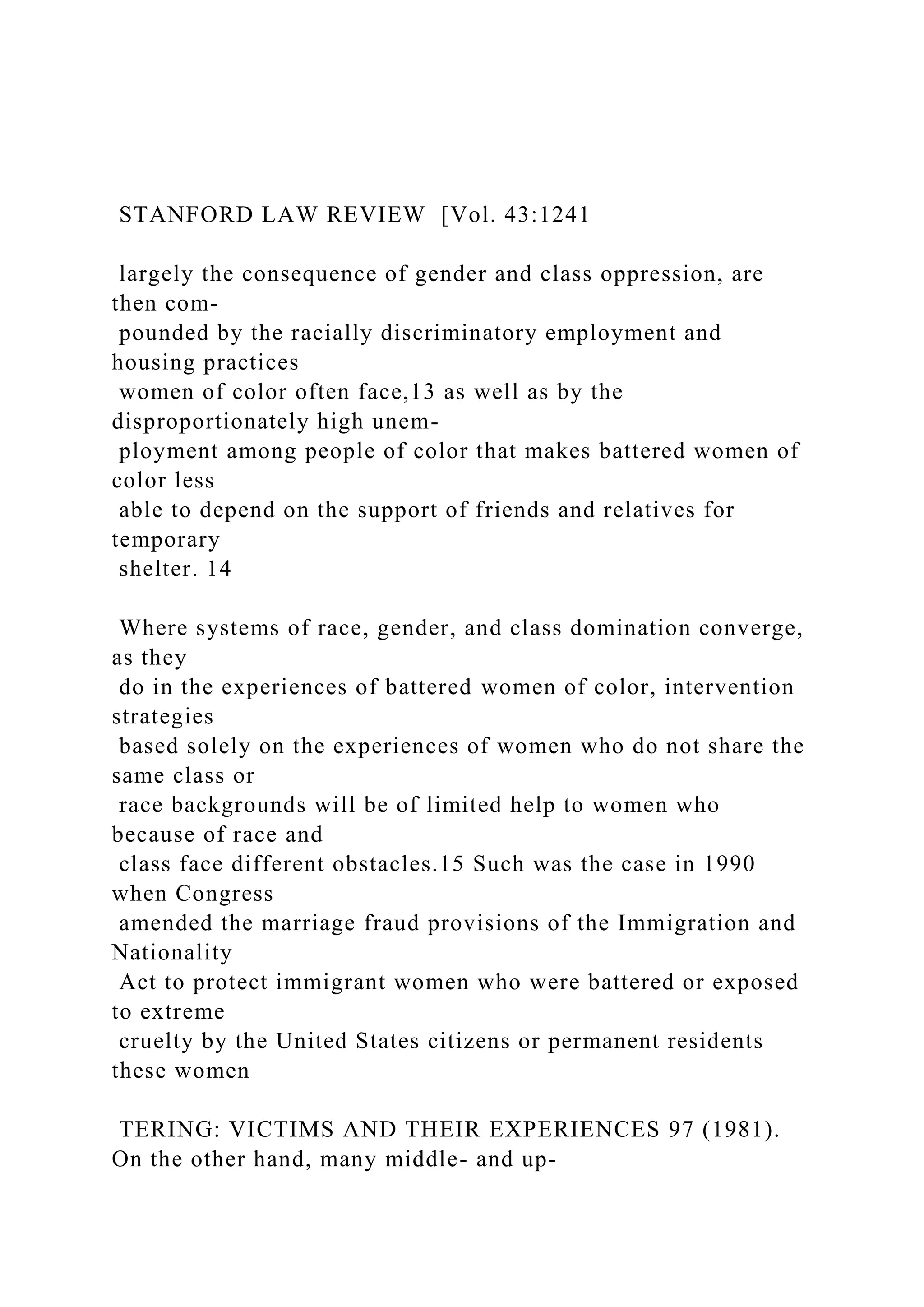
largely the consequence of gender and class oppression, are
then com-
pounded by the racially discriminatory employment and
housing practices
women of color often face,13 as well as by the
disproportionately high unem-
ployment among people of color that makes battered women of
color less
able to depend on the support of friends and relatives for
temporary
shelter. 14
Where systems of race, gender, and class domination converge,
as they
do in the experiences of battered women of color, intervention
strategies
based solely on the experiences of women who do not share the
same class or
race backgrounds will be of limited help to women who
because of race and
class face different obstacles.15 Such was the case in 1990
when Congress
amended the marriage fraud provisions of the Immigration and
Nationality
Act to protect immigrant women who were battered or exposed
to extreme
cruelty by the United States citizens or permanent residents
these women
TERING: VICTIMS AND THEIR EXPERIENCES 97 (1981).
On the other hand, many middle- and up-
per-class women are financially dependent upon their husbands
and thus experience a diminution in
their standard of living when they leave their husbands.
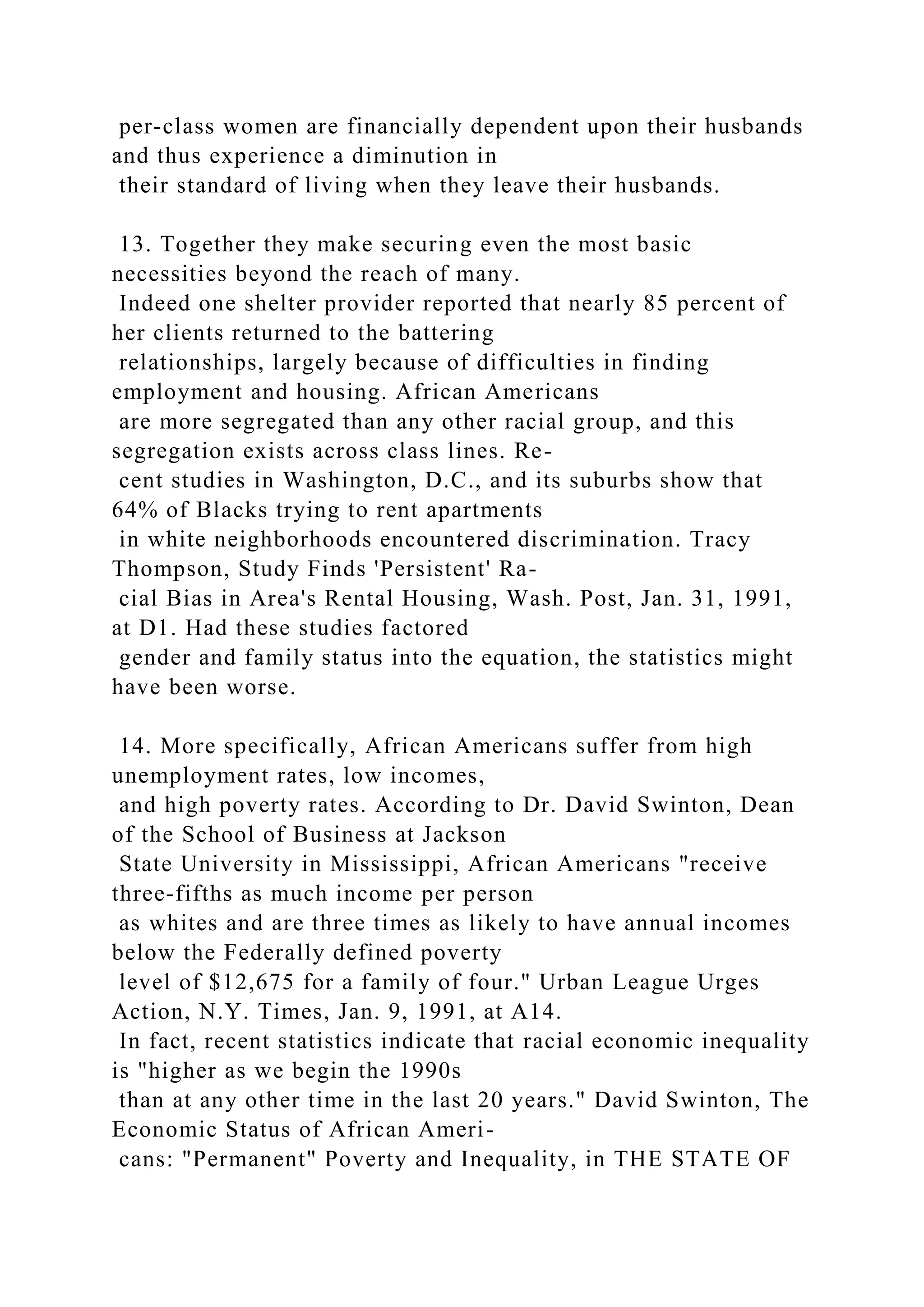
13. Together they make securing even the most basic
necessities beyond the reach of many.
Indeed one shelter provider reported that nearly 85 percent of
her clients returned to the battering
relationships, largely because of difficulties in finding
employment and housing. African Americans
are more segregated than any other racial group, and this
segregation exists across class lines. Re-
cent studies in Washington, D.C., and its suburbs show that
64% of Blacks trying to rent apartments
in white neighborhoods encountered discrimination. Tracy
Thompson, Study Finds 'Persistent' Ra-
cial Bias in Area's Rental Housing, Wash. Post, Jan. 31, 1991,
at D1. Had these studies factored
gender and family status into the equation, the statistics might
have been worse.
14. More specifically, African Americans suffer from high
unemployment rates, low incomes,
and high poverty rates. According to Dr. David Swinton, Dean
of the School of Business at Jackson
State University in Mississippi, African Americans "receive
three-fifths as much income per person
as whites and are three times as likely to have annual incomes
below the Federally defined poverty
level of $12,675 for a family of four." Urban League Urges
Action, N.Y. Times, Jan. 9, 1991, at A14.
In fact, recent statistics indicate that racial economic inequality
is "higher as we begin the 1990s
than at any other time in the last 20 years." David Swinton, The
Economic Status of African Ameri-
cans: "Permanent" Poverty and Inequality, in THE STATE OF
BLACK AMERICA 1991, at 25 (1991).
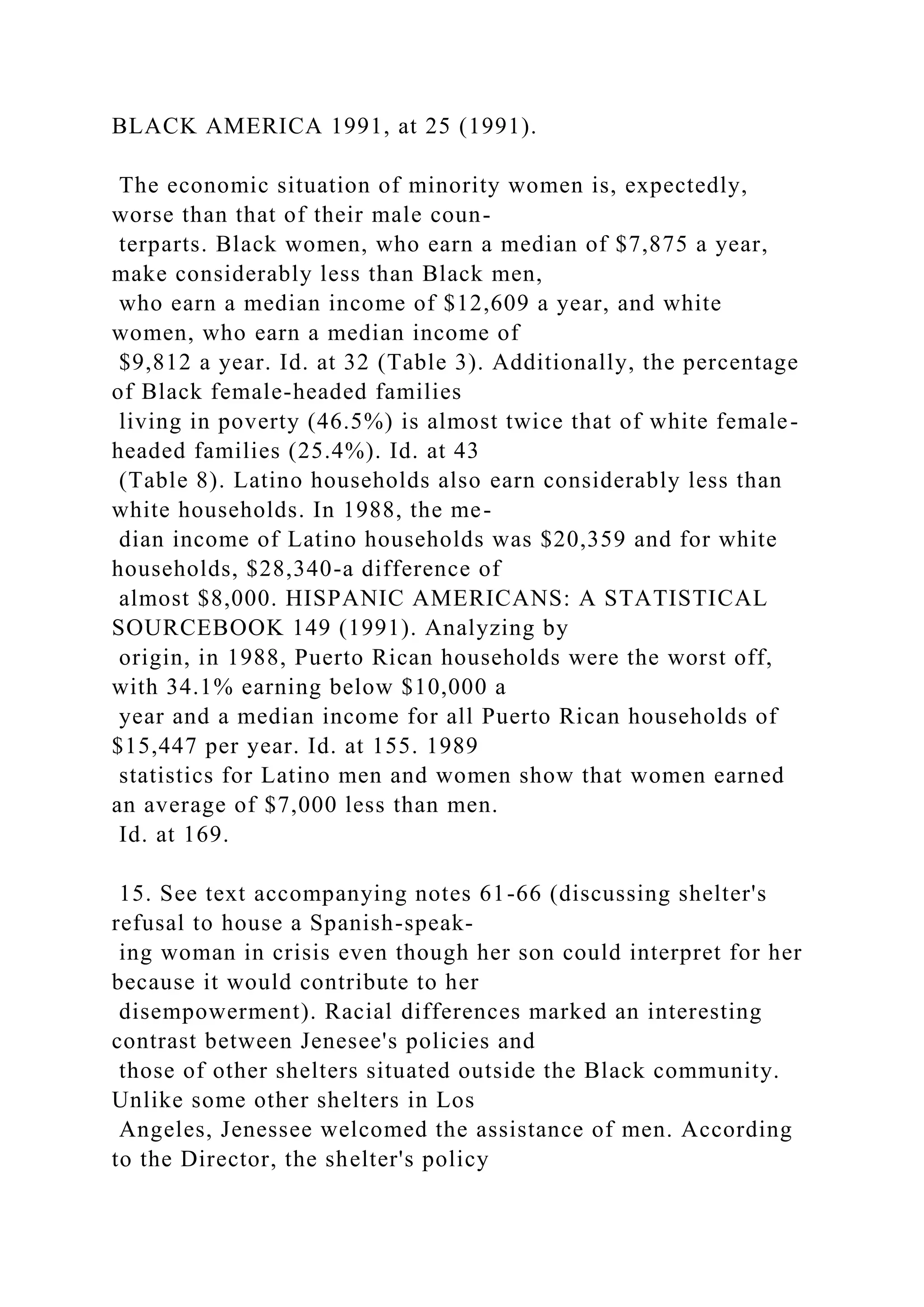
The economic situation of minority women is, expectedly,
worse than that of their male coun-
terparts. Black women, who earn a median of $7,875 a year,
make considerably less than Black men,
who earn a median income of $12,609 a year, and white
women, who earn a median income of
$9,812 a year. Id. at 32 (Table 3). Additionally, the percentage
of Black female-headed families
living in poverty (46.5%) is almost twice that of white female-
headed families (25.4%). Id. at 43
(Table 8). Latino households also earn considerably less than
white households. In 1988, the me-
dian income of Latino households was $20,359 and for white
households, $28,340-a difference of
almost $8,000. HISPANIC AMERICANS: A STATISTICAL
SOURCEBOOK 149 (1991). Analyzing by
origin, in 1988, Puerto Rican households were the worst off,
with 34.1% earning below $10,000 a
year and a median income for all Puerto Rican households of
$15,447 per year. Id. at 155. 1989
statistics for Latino men and women show that women earned
an average of $7,000 less than men.
Id. at 169.
15. See text accompanying notes 61-66 (discussing shelter's
refusal to house a Spanish-speak-
ing woman in crisis even though her son could interpret for her
because it would contribute to her
disempowerment). Racial differences marked an interesting
contrast between Jenesee's policies and
those of other shelters situated outside the Black community.
Unlike some other shelters in Los
Angeles, Jenessee welcomed the assistance of men. According
to the Director, the shelter's policy
was premised on a belief that given African American's need to
maintain healthy relations to pursue
a common struggle against racism, anti-violence programs
within the African American community
cannot afford to be antagonistic to men. For a discussion of the
different needs of Black women who
are battered, see Beth Richie, Battered Black Women: A
Challenge for the Black Community, BLACK
SCHOLAR, Mar./Apr. 1985, at 40.
1246
This content downloaded from 128.114.228.158 on Wed, 11 Apr
2018 04:08:34 UTC
All use subject to http://about.jstor.org/terms
July 1991] INTERSECTIONALITY 1247
immigrated to the United States to marry. Under the marriage
fraud provi-
sions of the Act, a person who immigrated to the United States
to marry a
United States citizen or permanent resident had to remain
"properly" mar-
ried for two years before even applying for permanent resident
status,16 at
which time applications for the immigrant's permanent status
were required
of both spouses.17 Predictably, under these circumstances,
many immigrant
women were reluctant to leave even the most abusive of
partners for fear of
being deported.18 When faced with the choice between
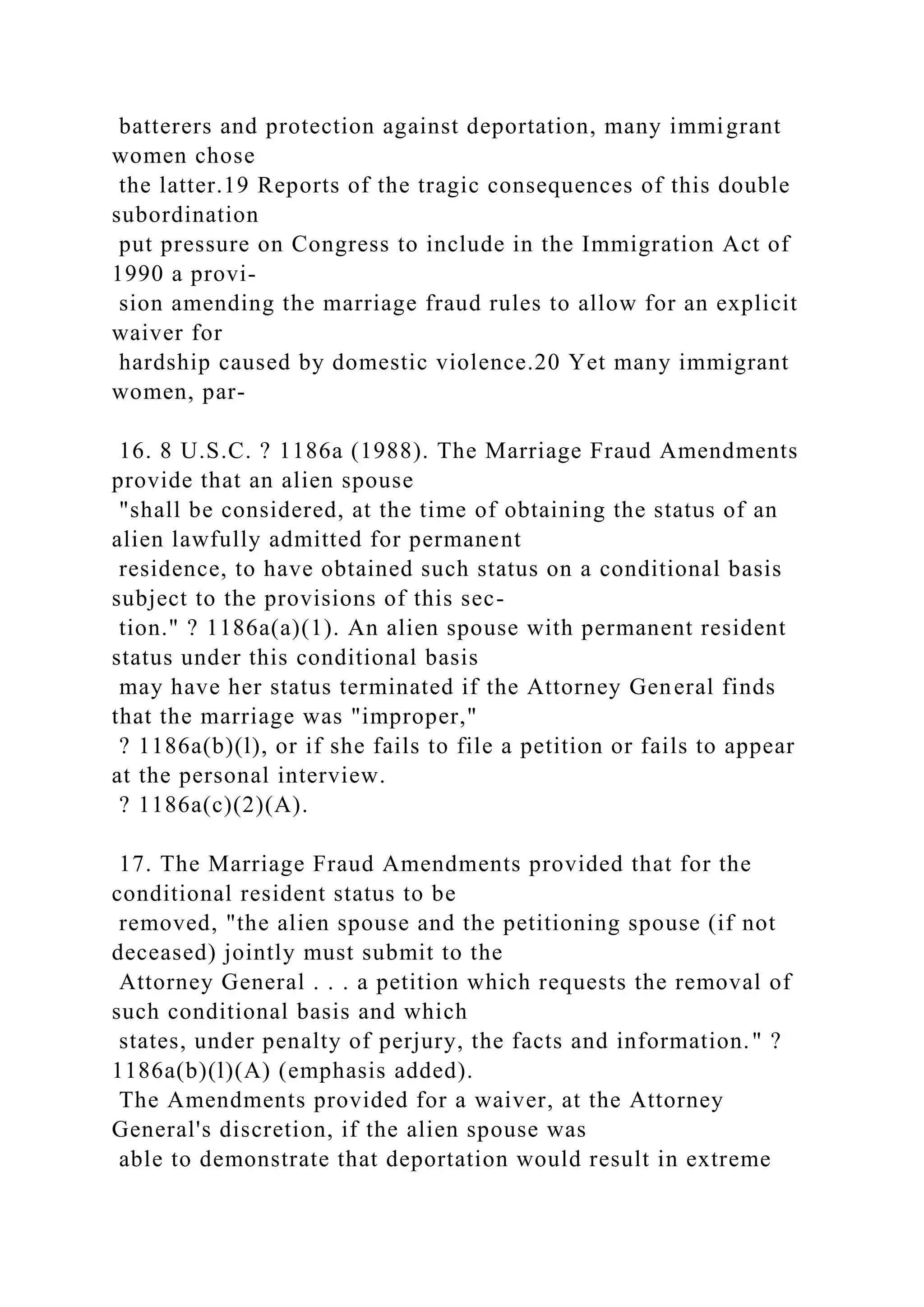
protection from their
batterers and protection against deportation, many immigrant
women chose
the latter.19 Reports of the tragic consequences of this double
subordination
put pressure on Congress to include in the Immigration Act of
1990 a provi-
sion amending the marriage fraud rules to allow for an explicit
waiver for
hardship caused by domestic violence.20 Yet many immigrant
women, par-
16. 8 U.S.C. ? 1186a (1988). The Marriage Fraud Amendments
provide that an alien spouse
"shall be considered, at the time of obtaining the status of an
alien lawfully admitted for permanent
residence, to have obtained such status on a conditional basis
subject to the provisions of this sec-
tion." ? 1186a(a)(1). An alien spouse with permanent resident
status under this conditional basis
may have her status terminated if the Attorney General finds
that the marriage was "improper,"
? 1186a(b)(l), or if she fails to file a petition or fails to appear
at the personal interview.
? 1186a(c)(2)(A).
17. The Marriage Fraud Amendments provided that for the
conditional resident status to be
removed, "the alien spouse and the petitioning spouse (if not
deceased) jointly must submit to the
Attorney General . . . a petition which requests the removal of
such conditional basis and which
states, under penalty of perjury, the facts and information." ?
1186a(b)(l)(A) (emphasis added).
The Amendments provided for a waiver, at the Attorney
General's discretion, if the alien spouse was
able to demonstrate that deportation would result in extreme
hardship, or that the qualifying mar-
riage was terminated for good cause. ? 1186a(c)(4). However,
the terms of this hardship waiver
have not adequately protected battered spouses. For example,
the requirement that the marriage be
terminated for good cause may be difficult to satisfy in states
with no-fault divorces. Eileen P. Lyn-
sky, Immigration Marriage Fraud Amendments of 1986: Till
Congress Do Us Part, 41 U. MIAMI L.
REV. 1087, 1095 n.47 (1987) (student author) (citing Jerome
B. Ingber & R. Leo Prischet, The
Marriage Fraud Amendments, in THE NEW SIMPSON-
RODINO IMMIGRATION LAW OF 1986, at 564-
65 (Stanley Mailman ed. 1986)).
18. Immigration activists have pointed out that "[t]he 1986
Immigration Reform Act and the
Immigration Marriage Fraud Amendment have combined to
give the spouse applying for permanent
residence a powerful tool to control his partner." Jorge
Banales, Abuse Among Immigrants; As Their
Numbers Grow So Does the Need for Services, Wash. Post,
Oct. 16, 1990, at E5. Dean Ito Taylor,
executive director of Nihonmachi Legal Outreach in San
Francisco, explained that the Marriage
Fraud Amendments "bound these immigrant women to their
abusers." Deanna Hodgin, 'Mail-
Order' Brides Marry Pain to Get Green Cards, Wash. Times,
Apr. 16, 1991, at El. In one egregious
instance described by Beckie Masaki, executive director of the
Asian Women's Shelter in San Fran-
cisco, the closer the Chinese bride came to getting her
permanent residency in the United States, the
more harshly her Asian-American husband beat her. Her
husband, kicking her in the neck and face,
warned her that she needed him, and if she did not do as he told
her, he would call immigration
officials. Id.
19. As Alice Fernandez, head of the Victim Services Agency at
the Bronx Criminal Court,
explained, "'Women are being held hostage by their landlords,
their boyfriends, their bosses, their
husbands.... The message is: If you tell anybody what I'm doing
to you, they are going to ship
your ass back home. And for these women, there is nothing
more terrible than that .... Sometimes
their response is: I would rather be dead in this country than go
back home.'" Vivienne Walt,
Immigrant Abuse: Nowhere to Hide; Women Fear Deportation,
Experts Say, Newsday, Dec. 2, 1990,
at 8.
20. Immigration Act of 1990, Pub. L. No. 101-649, 104 Stat.
4978. The Act, introduced by
Representative Louise Slaughter (D-N.Y.), provides that a
battered spouse who has conditional per-
manent resident status can be granted a waiver for failure to
meet the requirements if she can show
that "the marriage was entered into in good faith and that after
the marriage the alien spouse was
This content downloaded from 128.114.228.158 on Wed, 11 Apr
2018 04:08:34 UTC
All use subject to http://about.jstor.org/terms
STANFORD LAW REVIEW [Vol. 43:1241
ticularly immigrant women of color, have remained vulnerable
to battering
because they are unable to meet the conditions established for a
waiver. The
evidence required to support a waiver "can include, but is not
limited to,
reports and affidavits from police, medical personnel,
psychologists, school
officials, and social service agencies."21 For many immigrant
women, lim-
ited access to these resources can make it difficult for them to
obtain the
evidence needed for a waiver. And cultural barriers often
further discourage
immigrant women from reporting or escaping battering
situations. Tina
Shum, a family counselor at a social service agency, points out
that "[t]his
law sounds so easy to apply, but there are cultural
complications in the
Asian community that make even these requirements
difficult.... Just to
find the opportunity and courage to call us is an
accomplishment for
many."22 The typical immigrant spouse, she suggests, may live
"[i]n an ex-
tended family where several generations live together, there
may be no pri-
vacy on the telephone, no opportunity to leave the house and no
understanding of public phones."23 As a consequence, many
immigrant wo-
men are wholly dependent on their husbands as their link to the
world
outside their homes.24
Immigrant women are also vulnerable to spousal violence
because so
many of them depend on their husbands for information
regarding their
legal status.25 Many women who are now permanent residents
continue to
suffer abuse under threats of deportation by their husbands.
Even if the
threats are unfounded, women who have no independent access
to informa-
tion will still be intimidated by such threats.26 And even
though the domes-
battered by or was subjected to extreme mental cruelty by the
U.S. citizen or permanent resident
spouse." H.R. REP. No. 723(I), 101st Cong., 2d Sess. 78
(1990), reprinted in 1990 U.S.C.C.A.N.
6710, 6758; see also 8 C.F.R. ? 216.5(3) (1992) (regulations
for application for waiver based on claim
of having been battered or subjected to extreme mental
cruelty).
21. H.R. REP. No. 723(I), supra note 20, at 79, reprinted in
1990 U.S.C.C.A.N. 6710, 6759.
22. Hodgin, supra note 18.
23. Id.
24. One survey conducted of battered women "hypothesized
that if a person is a member of a
discriminated minority group, the fewer the opportunities for
socioeconomic status above the pov-
erty level and the weaker the English language skills, the
greater the disadvantage." M. PAGELOW,
supra note 12, at 96. The 70 minority women in the study "had
a double disadvantage in this society
that serves to tie them more strongly to their spouses." Id.
25. A citizen or permanent resident spouse can exercise power
over an alien spouse by threat-
ening not to file a petition for permanent residency. If he fails
to file a petition for permanent
residency, the alien spouse continues to be undocumented and
is considered to be in the country
illegally. These constraints often restrict an alien spouse from
leaving. Dean Ito Taylor tells the
story of "one client who has been hospitalized-she's had him
arrested for beating her-but she
keeps coming back to him because he promises he will file for
her .... He holds that green card over
her head." Hodgin, supra note 18. Other stories of domestic
abuse abound. Maria, a 50-year-old
Dominican woman, explains that " 'One time I had eight
stitches in my head and a gash on the other
side of my head, and he broke my ribs .... He would bash my
head against the wall while we had
sex. He kept threatening to kill me if I told the doctor what
happened.' " Maria had a "powerful
reason for staying with Juan through years of abuse: a ticket to
permanent residence in the United
States." Walt, supra note 19.
26. One reporter explained that "Third-world women must deal
with additional fears, how-
ever. In many cases, they are afraid of authority, government
institutions and their abusers' threat
of being turned over to immigration officials to be deported."
Banales, supra note 18.
1248
This content downloaded from 128.114.228.158 on Wed, 11 Apr
2018 04:08:34 UTC
All use subject to http://about.jstor.org/terms
INTERSECTIONALITY
tic violence waiver focuses on immigrant women whose
husbands are United
States citizens or permanent residents, there are countless
women married to
undocumented workers (or who are themselves undocumented)
who suffer
in silence for fear that the security of their entire families will
be jeopardized
should they seek help or otherwise call attention to
themselves.27
Language barriers present another structural problem that often
limits
opportunities of non-English-speaking women to take
advantage of existing
support services.28 Such barriers not only limit access to
information about
shelters, but also limit access to the security shelters provide.
Some shelters
turn non-English-speaking women away for lack of bilingual
personnel and
resources.29
These examples illustrate how patterns of subordination
intersect in wo-
men's experience of domestic violence. Intersectional
subordination need
not be intentionally produced; in fact, it is frequently the
consequence of the
imposition of one burden that interacts with preexisting
vulnerabilities to
create yet another dimension of disempowerment. In the case of
the mar-
riage fraud provisions of the Immigration and Nationality Act,
the imposi-
tion of a policy specifically designed to burden one class-
immigrant spouses
seeking permanent resident status-exacerbated the
disempowerment of
those already subordinated by other structures of domination.
By failing to
take into account the vulnerability of immigrant spouses to
domestic vio-
27. Incidents of sexual abuse of undocumented women abound.
Marta Rivera, director of the
Hostos College Center for Women's and Immigrant's Rights,
tells of how a 19-year-old Dominican
woman had "arrived shaken . . . after her boss raped her in the
women's restroom at work." The
woman told Rivera that "70 to 80 percent of the workers [in a
Brooklyn garment factory] were
undocumented, and they all accepted sex as part of the job ....
She said a 13-year-old girl had been
raped there a short while before her, and the family sent her
back to the Dominican Republic."
Walt, supra note 19. In another example, a "Latin American
woman, whose husband's latest attack
left her with two broken fingers, a swollen face and bruises on
her neck and chest, refused to report
the beating to police." She returned to her home after a short
stay in a shelter. She did not leave the
abusive situation because she was "an undocumented, illiterate
laborer whose children, passport and
money are tightly controlled by her husband." Although she
was informed of her rights, she was not
able to hurdle the structural obstacles in her path. Banales,
supra note 18.
28. For example, in a region with a large number of Third-
World immigrants, "the first hurdle
these [battered women's shelters] must overcome is the
language barrier." Banales, supra note 18.
29.
There can be little question that women unable to communicate
in English are severely
handicapped in seeking independence. Some women thus
excluded were even further dis-
advantaged because they were not U.S. citizens and some were
in this country illegally.
For a few of these, the only assistance shelter staff could
render was to help reunite them
with their families of origin.
M. PAGELOW, supra note 12, at 96-97. Non-English speaking
women are often excluded even from
studies of battered women because of their language and other
difficulties. A researcher qualified the
statistics of one survey by pointing out that "an unknown
number of minority group women were
excluded from this survey sample because of language
difficulties." Id. at 96. To combat this lack of
appropriate services for women of color at many shelters,
special programs have been created specifi-
cally for women from particular communities. A few examples
of such programs include the Victim
Intervention Project in East Harlem for Latina women, Jenesee
Shelter for African American wo-
men in Los Angeles, Apna Gar in Chicago for South Asian
women, and, for Asian women generally,
the Asian Women's Shelter in San Francisco, the New York
Asian Women's Center, and the Center
for the Pacific Asian Family in Los Angeles. Programs with
hotlines include Sakhi for South Asian
Women in New York, and Manavi in Jersey City, also for South
Asian women, as well as programs
for Korean women in Philadelphia and Chicago.
1249 July 1991]
This content downloaded from 128.114.228.158 on Wed, 11 Apr
2018 04:08:34 UTC
All use subject to http://about.jstor.org/terms
STANFORD LAW REVIEW
lence, Congress positioned these women to absorb the
simultaneous impact
of its anti-immigration policy and their spouses' abuse.
The enactment of the domestic violence waiver of the marriage
fraud
provisions similarly illustrates how modest attempts to respond
to certain
problems can be ineffective when the intersectional location of
women of
color is not considered in fashioning the remedy. Cultural
identity and class
affect the likelihood that a battered spouse could take
advantage of the
waiver. Although the waiver is formally available to all
women, the terms of
the waiver make it inaccessible to some. Immigrant women
who are so-
cially, culturally, or economically privileged are more likely to
be able to
marshall the resources needed to satisfy the waiver
requirements. Those im-
migrant women least able to take advantage of the waiver-
women who are
socially or economically the most marginal-are the ones most
likely to be
women of color.
B. Structural Intersectionality and Rape
Women of color are differently situated in the economic,
social, and
political worlds. When reform efforts undertaken on behalf of
women ne-
glect this fact, women of color are less likely to have their
needs met than
women who are racially privileged. For example, counselors
who provide
rape crisis services to women of color report that a significant
proportion of
the resources allocated to them must be spent handling
problems other than
rape itself. Meeting these needs often places these counselors
at odds with
their funding agencies, which allocate funds according to
standards of need
that are largely white and middle-class.30 These uniform
standards of need
ignore the fact that different needs often demand different
priorities in terms
of resource allocation, and consequently, these standards
hinder the ability
of counselors to address the needs of nonwhite and poor
women.31 A case in
point: women of color occupy positions both physically and
culturally
marginalized within dominant society, and so information must
be targeted
directly to them in order to reach them.32 Accordingly, rape
crisis centers
30. For example, the Rosa Parks Shelter and the Compton Rape
Crisis Hotline, two shelters
that serve the African-American community, are in constant
conflict with funding sources over the
ratio of dollars and hours to women served. Interview with
Joan Greer, Executive Director of Rosa
Parks Shelter, in Los Angeles, California (April 1990).
31. One worker explained:
For example, a woman may come in or call in for various
reasons. She has no place to go,
she has no job, she has no support, she has no money, she has
no food, she's been beaten,
and after you finish meeting all those needs, or try to meet all
those needs, then she may
say, by the way, during all this, I was being raped. So that
makes our community different
than other communities. A person wants their basic needs first.
It's a lot easier to discuss
things when you are full.
Nancy Anne Matthews, Stopping Rape or Managing its
Consequences? State Intervention and Fem-
inist Resistance in the Los Angeles Anti-Rape Movement,
1972-1987, at 287 (1989) (Ph.D disserta-
tion, University of California, Los Angeles) (chronicling the
history of the rape crisis movement, and
highlighting the different histories and dilemmas of rape crisis
hotlines run by white feminists and
those situated in the minority communities).
32.
Typically, more time must be spent with a survivor who has
fewer personal resources.
1250 [Vol. 43:1241
This content downloaded from 128.114.228.158 on Wed, 11 Apr
2018 04:08:34 UTC
All use subject to http://about.jstor.org/terms
July 1991] INTERSECTIONALITY 1251
must earmark more resources for basic information
dissemination in com-
munities of color than in white ones.
Increased costs are but one consequence of serving people who
cannot be
reached by mainstream channels of information. As noted
earlier, counsel-
ors in minority communities report spending hours locating
resources and
contacts to meet the housing and other immediate needs of
women who have
been assualted. Yet this work is only considered "information
and referral"
by funding agencies and as such, is typically underfunded,
notwithstanding
the magnitude of need for these services in minority
communities.33 The
problem is compounded by expectations that rape crisis centers
will use a
significant portion of resources allocated to them on counselors
to accom-
pany victims to court,34 even though women of color are less
likely to have
their cases pursued in the criminal justice system.35 The
resources expected
to be set aside for court services are misdirected in these
communities.
The fact that minority women suffer from the effects of
multiple subordi-
nation, coupled with institutional expectations based on
inappropriate
nonintersectional contexts, shapes and ultimately limits the
opportunities for
meaningful intervention on their behalf. Recognizing the
failure to consider
intersectional dynamics may go far toward explaining the high
levels of fail-
ure, frustration, and burn-out experienced by counselors who
attempt to
meet the needs of minority women victims.
II. POLITICAL INTERSECTIONALITY
The concept of political intersectionality highlights the fact
that women
These survivors tend to be ethnic minority women. Often, a
non-assimilated ethnic minor-
ity survivor requires translating and interpreting,
transportation, overnight shelter for her-
self and possibly children, and counseling to significant others
in addition to the usual
counseling and advocacy services. So, if a rape crisis center
serves a predominantly ethnic
minority population, the "average" number of hours of service
provided to each survivor is
much higher than for a center that serves a predominantly white
population.
Id. at 275 (quoting position paper of the Southern California
Rape Hotline Alliance).
33. Id. at 287-88.
34. The Director of Rosa Parks reported that she often runs into
trouble with her funding
sources over the Center's lower than average number of
counselors accompanying victims to court.
Interview with Joan Greer, supra note 30.
35.
Even though current statistics indicate that Black women are
more likely to be victimized
than white women, Black women are less likely to report their
rapes, less likely to have
their cases come to trial, less likely to have their trials result in
convictions, and, most
disturbing, less likely to seek counseling and other support
services.
PATRICIA HILL COLLINS, BLACK FEMINIST THOUGHT:
KNOWLEDGE, CONSCIOUSNESS AND THE
POLITICS OF EMPOWERMENT 178-79 (1990); accord
HUBERT S. FEILD & LEIGH B. BIENEN, JU-
RORS AND RAPE: A STUDY IN PSYCHOLOGY AND LAW
141 (1980) (data obtained from 1,056 citi-
zens serving as jurors in simulated legal rape cases generally
showed that "the assailant of the black
woman was given a more lenient sentence than the white
woman's assailant"). According to Fern
Ferguson, an Illinois sex abuse worker, speaking at a Women
of Color Institute conference in Knox-
ville, Tennessee, 10% of rapes involving white victims end in
conviction, compared with 4.2% for
rapes involving non-white victims (and 2.3% for the less-
inclusive group of Black rape victims).
UPI, July 30, 1985. Ferguson argues that myths about women
of color being promiscuous and
wanting to be raped encourage the criminal justice system and
medical professionals as well to treat
women of color differently than they treat white women after a
rape has occurred. Id.
This content downloaded from 128.114.228.158 on Wed, 11 Apr
2018 04:08:34 UTC
All use subject to http://about.jstor.org/terms
STANFORD LAW REVIEW
of color are situated within at least two subordinated groups
that frequently
pursue conflicting political agendas. The need to split one's
political energies
between two sometimes opposing groups is a dimension of
intersectional dis-
empowerment that men of color and white women seldom
confront. Indeed,
their specific raced and gendered experiences, although
intersectional, often
define as well as confine the interests of the entire group. For
example, ra-
cism as experienced by people of color who are of a particular
gender-
male-tends to determine the parameters of antiracist strategies,
just as sex-
ism as experienced by women who are of a particular race-
white-tends to
ground the women's movement. The problem is not simply that
both dis-
courses fail women of color by not acknowledging the
"additional" issue of
race or of patriarchy but that the discourses are often
inadequate even to the
discrete tasks of articulating the full dimensions of racism and
sexism. Be-
cause women of color experience racism in ways not always the
same as
those experienced by men of color and sexism in ways not
always parallel to
experiences of white women, antiracism and feminism are
limited, even on
their own terms.
Among the most troubling political consequences of the failure
of an-
tiracist and feminist discourses to address the intersections of
race and gen-
der is the fact that, to the extent they can forward the interest
of "people of
color" and "women," respectively, one analysis often implicitly
denies the
validity of the other. The failure of feminism to interrogate
race means that
the resistance strategies of feminism will often replicate and
reinforce the
subordination of people of color, and the failure of antiracism
to interrogate
patriarchy means that antiracism will frequently reproduce the
subordina-
tion of women. These mutual elisions present a particularly
difficult political
dilemma for women of color. Adopting either analysis
constitutes a denial
of a fundamental dimension of our subordination and precludes
the develop-
ment of a political discourse that more fully empowers women
of color.
A. The Politicization of Domestic Violence
That the political interests of women of color are obscured and
some-
times jeopardized by political strategies that ignore or suppress
intersectional
issues is illustrated by my experiences in gathering information
for this arti-
cle. I attempted to review Los Angeles Police Department
statistics reflect-
ing the rate of domestic violence interventions by precinct
because such
statistics can provide a rough picture of arrests by racial group,
given the
degree of racial segregation in Los Angeles.36 L.A.P.D.,
however, would not
release the statistics. A representative explained that one
reason the statis-
tics were not released was that domestic violence activists both
within and
36. Most crime statistics are classified by sex or race but none
are classified by sex and race.
Because we know that most rape victims are women, the racial
breakdown reveals, at best, rape rates
for Black women. Yet, even given this head start, rates for
other non-white women are difficult to
collect. While there are some statistics for Latinas, statistics
for Asian and Native American women
are virtually non-existent. Cf G. Chezia Carraway, Violence
Against Women of Color, 43 STAN. L.
REV. 1301 (1993).
1252 [Vol. 43:1241
This content downloaded from 128.114.228.158 on Wed, 11 Apr
2018 04:08:34 UTC
All use subject to http://about.jstor.org/terms
INTERSECTIONALITY
outside the Department feared that statistics reflecting the
extent of domes-
tic violence in minority communities might be selectively
interpreted and
publicized so as to undermine long-term efforts to force the
Department to
address domestic violence as a serious problem. I was told that
activists
were worried that the statistics might permit opponents to
dismiss domestic
violence as a minoirty problem and, therefore, not deserving of
aggressive
action.
The informant also claimed that representatives from various
minority
communities opposed the release of these statistics. They were
concerned,
apparently, that the data would unfairly represent Black and
Brown commu-
nities as unusually violent, potentially reinforcing stereotypes
that might be
used in attempts to justify oppressive police tactics and other
discriminatory
practices. These misgivings are based on the familiar and not
unfounded
premise that certain minority groups-especially Black men-
have already
been stereotyped as uncontrollably violent. Some worry that
attempts to
make domestic violence an object of political action may only
serve to con-
firm such stereotypes and undermine efforts to combat negative
beliefs about
the Black community.
This account sharply illustrates how women of color can be
erased by the
strategic silences of antiracism and feminism. The political
priorities of both
were defined in ways that suppressed information that could
have facilitated
attempts to confront the problem of domestic violence in
communities of
color.
1. Domestic violence and antiracist politics.
Within communities of color, efforts to stem the politicization
of domes-
tic violence are often grounded in attempts to maintain the
integrity of the
community. The articulation of this perspective takes different
forms. Some
critics allege that feminism has no place within communities of
color, that
the issues are internally divisive, and that they represent the
migration of
white women's concerns into a context in which they are not
only irrelevant
but also harmful. At its most extreme, this rhetoric denies that
gender vio-
lence is a problem in the community and characterizes any
effort to politi-
cize gender subordination as itself a community problem. This
is the
position taken by Shahrazad Ali in her controversial book, The
Blackman's
Guide to Understanding the Blackwoman.37 In this stridently
antifeminist
tract, Ali draws a positive correlation between domestic
violence and the
37. SHAHRAZAD ALI, THE BLACKMAN'S GUIDE TO
UNDERSTANDING THE BLACKWOMAN
(1989). Ali's book sold quite well for an independently
published title, an accomplishment no doubt
due in part to her appearances on the Phil Donahue, Oprah
Winfrey, and Sally Jesse Raphael televi-
sion talk shows. For public and press reaction, see Dorothy
Gilliam, Sick, Distorted Thinking,
Wash. Post, Oct. 11, 1990, at D3; Lena Williams, Black
Woman's Book Starts a Predictable Storm,
N.Y. Times, Oct. 2, 1990, at C11; see also PEARL CLEAGUE,
MAD AT MILES: A BLACK WOMAN'S
GUIDE TO TRUTH (1990). The title clearly styled after Ali's,
Mad at Miles responds not only to
issues raised by Ali's book, but also to Miles Davis's admission
in his autobiography, Miles: The
Autobiography (1989), that he had physically abused, among
other women, his former wife, actress
Cicely Tyson.
1253 July 1991]
This content downloaded from 128.114.228.158 on Wed, 11 Apr
2018 04:08:34 UTC
All use subject to http://about.jstor.org/terms
STANFORD LAW REVIEW [Vol. 43:1241
liberation of African Americans. Ali blames the deteriorating
conditions
within the Black community on the insubordination of Black
women and on
the failure of Black men to control them.38 Ali goes so far as
to advise Black
men to physically chastise Black women when they are
"disrespectful."39
While she cautions that Black men must use moderation in
disciplining
"their" women, she argues that Black men must sometimes
resort to physi-
cal force to reestablish the authority over Black women that
racism has
disrupted.40
Ali's premise is that patriarchy is beneficial for the Black
community,41
and that it must be strengthened through coercive means if
necessary.42 Yet
38. Shahrazad Ali suggests that the "[Blackwoman] certainly
does not believe that her dis-
repect for the Blackman is destructive, nor that her opposition
to him has deteriorated the Black
nation." S. ALI, supra note 37, at viii. Blaming the problems of
the community on the failure of the
Black woman to accept her "real definition," Ali explains that
"[n]o nation can rise when the natural
order of the behavior of the male and the female have been
altered against their wishes by force. No
species can survive if the female of the genus disturbs the
balance of her nature by acting other than
herself." Id. at 76.
39. Ali advises the Blackman to hit the Blackwoman in the
mouth, "[b]ecause it is from that
hole, in the lower part of her face, that all her rebellion
culminates into words. Her unbridled tongue
is a main reason she cannot get along with the Blackman. She
often needs a reminder." Id. at 169.
Ali warns that "if [the Blackwoman] ignores the authority and
superiority of the Blackman, there is
a penalty. When she crosses this line and becomes viciously
insulting it is time for the Blackman to
soundly slap her in the mouth." Id.
40. Ali explains that, "[r]egretfully some Blackwomen want to
be physically controlled by the
Blackman." Id. at 174. "The Blackwoman, deep inside her
heart," Ali reveals, "wants to surrender
but she wants to be coerced." Id. at 72. "[The Blackwoman]
wants [the Blackman] to stand up and
defend himself even if it means he has to knock her out of the
way to do so. This is necessary
whenever the Blackwoman steps out of the protection of
womanly behavior and enters the danger-
ous domain of masculine challenge." Id. at 174.
41. Ali points out that "[t]he Blackman being number 1 and the
Blackwoman being number 2
is another absolute law of nature. The Blackman was created
first, he has seniority. And the
Blackwoman was created 2nd. He is first. She is second. The
Blackman is the beginning and all
others come from him. Everyone on earth knows this except the
Blackwoman." Id. at 67.
42. In this regard, Ali's arguments bear much in common with
those of neoconservatives who
attribute many of the social ills plaguing Black America to the
breakdown of patriarchal family
values. See, e.g., William Raspberry, If We Are to Rescue
American Families, We Have to Save the
Boys, Chicago Trib., July 19, 1989, at C15; George F. Will,
Voting Rights Won't Fix It, Wash. Post,
Jan. 23, 1986, at A23; George F. Will, "White Racism" Doesn't
Make Blacks Mere Victims of Fate,
Milwaukee J., Feb. 21, 1986, at 9. Ali's argument shares
remarkable similarities to the controversial
"Moynihan Report" on the Black family, so called because its
principal author was now-Senator
Daniel P. Moynihan (D-N.Y.). In the infamous chapter entitled
"The Tangle of Pathology," Moy-
nihan argued that
the Negro community has been forced into a matriarchal
structure which, because it is so
out of line with the rest of American society, seriously retards
the progress of the group as
a whole, and imposes a crushing burden on the Negro male and,
in consequence, on a great
many Negro women as well.
OFFICE OF POLICY PLANNING AND RESEARCH, U.S.
DEPARTMENT OF LABOR, THE NEGRO FAM-
ILY: THE CASE FOR NATIONAL ACTION 29 (1965),
reprinted in LEE RAINWATER & WILLIAM L.
YANCEY, THE MOYNIHAN REPORT AND THE POLITICS
OF CONTROVERSY 75 (1967). A storm of
controversy developed over the book, although few
commentators challenged the patriarchy embed-
ded in the analysis. Bill Moyers, then a young minister and
speechwriter for President Johnson,
firmly believed that the criticism directed at Moynihan was
unfair. Some 20 years later, Moyers
resurrected the Moynihan thesis in a special television
program, The Vanishing Family: Crisis in
Black America (CBS television broadcast, Jan. 25, 1986). The
show first aired in January 1986 and
featured several African-American men and women who had
become parents but were unwilling to
marry. Arthur Unger, Hardhitting Special About Black
Families, Christian Sci. Mon., Jan. 23, 1986,
1254
This content downloaded from 128.114.228.158 on Wed, 11 Apr
2018 04:08:34 UTC
All use subject to http://about.jstor.org/terms
July 1991] INTERSECTIONALITY 1255
the violence that accompanies this will to control is
devastating, not only for
the Black women who are victimized, but also for the entire
Black commu-
nity.43 The recourse to violence to resolve conflicts establishes
a dangerous
pattern for children raised in such environments and
contributes to many
other pressing problems.44 It has been estimated that nearly
forty percent of
all homeless women and children have fled violence in the
home,45 and an
estimated sixty-three percent of young men between the ages of
eleven and
twenty who are imprisoned for homicide have killed their
mothers' batter-
ers.46 And yet, while gang violence, homicide, and other forms
of Black-on-
Black crime have increasingly been discussed within African-
American poli-
tics, patriarchal ideas about gender and power preclude the
recognition of
domestic violence as yet another compelling incidence of
Black-on-Black
crime.
Efforts such as Ali's to justify violence against women in the
name of
Black liberation are indeed extreme.47 The more common
problem is that
at 23. Many saw the Moyers show as a vindication of
Moynihan. President Reagan took the oppor-
tunity to introduce an initiative to revamp the welfare system a
week after the program aired.
Michael Barone, Poor Children and Politics, Wash. Post, Feb.
10, 1986, at Al. Said one official, "Bill
Moyers has made it safe for people to talk about this issue, the
disintegrating black family struc-
ture." Robert Pear, President Reported Ready to Propose
Overhaul of Social Welfare System, N.Y.
Times, Feb. 1, 1986, at A12. Critics of the Moynihan/Moyers
thesis have argued that it scapegoats
the Black family generally and Black women in particular. For
a series of responses, see Scapegoat-
ing the Black Family, NATION, July 24, 1989 (special issue,
edited by Jewell Handy Gresham and
Margaret B. Wilkerson, with contributions from Margaret
Burnham, Constance Clayton, Dorothy
Height, Faye Wattleton, and Marian Wright Edelman). For an
analysis of the media's endorsement
of the Moynihan/Moyers thesis, see CARL GINSBURG, RACE
AND MEDIA: THE ENDURING LIFE OF
THE MOYNIHAN REPORT (1989).
43. Domestic violence relates directly to issues that even those
who subscribe to Ali's position
must also be concerned about. The socioeconomic condition of
Black males has been one such
central concern. Recent statistics estimate that 25% of Black
males in their twenties are involved in
the criminal justice systems. See David G. Savage, Young
Black Males in Jail or in Court Control
Study Says, L.A. Times, Feb. 27, 1990, at Al; Newsday, Feb.
27, 1990, at 15; Study Shows Racial
Imbalance in Penal System, N.Y. Times, Feb. 27, 1990, at A
18. One would think that the linkages
between violence in the home and the violence on the streets
would alone persuade those like Ali to
conclude that the African-American community cannot afford
domestic violence and the patriarchal
values that support it.
44. A pressing problem is the way domestic violence
reproduces itself in subsequent genera-
tions. It is estimated that boys who witness violence against
women are ten times more likely to
batter female partners as adults. Women and Violence:
Hearings Before the Senate Comm. on the
Judiciary on Legislation to Reduce the Growing Problem of
Violent Crime Against Women, 101st
Cong., 2d Sess., pt. 2, at 89 (1991) [hereinafter Hearings on
Violent Crime Against Women] (testi-
mony of Charlotte Fedders). Other associated problems for
boys who witness violence against wo-
men include higher rates of suicide, violent assault, sexual
assault, and alcohol and drug use. Id., pt.
2, at 131 (statement of Sarah M. Buel, Assistant District
Attorney, Massachusetts, and Supervisor,
Harvard Law School Battered Women's Advocacy Project).
45. Id. at 142 (statement of Susan Kelly-Dreiss) (discussing
several studies in Pennsylvania
linking homelessness to domestic violence).
46. Id. at 143 (statement of Susan Kelly-Dreiss).
47. Another historical example includes Eldridge Cleaver, who
argued that he raped white
women as an assault upon the white community. Cleaver
"practiced" on Black women first. EL-
DRIDGE CLEAVER, SOUL ON ICE 14-15 (1968). Despite the
appearance of misogyny in both works,
each professes to worship Black women as "queens" of the
Black community. This "queenly subser-
vience" parallels closely the image of the "woman on a
pedestal" against which white feminists have
railed. Because Black women have been denied pedestal status
within dominant society, the image
of the African queen has some appeal to many African-
American women. Although it is not a
This content downloaded from 128.114.228.158 on Wed, 11 Apr
2018 04:08:34 UTC
All use subject to http://about.jstor.org/terms
STANFORD LAW REVIEW
the political or cultural interests of the community are
interpreted in a way
that precludes full public recognition of the problem of
domestic violence.
While it would be misleading to suggest that white Americans
have come to
terms with the degree of violence in their own homes, it is
nonetheless the
case that race adds yet another dimension to why the problem
of domestic
violence is suppressed within nonwhite communities. People of
color often
must weigh their interests in avoiding issues that might
reinforce distorted
public perceptions against the need to acknowledge and address
intracom-
munity problems. Yet the cost of suppression is seldom
recognized in part
because the failure to discuss the issue shapes perceptions of
how serious the
problem is in the first place.
The controversy over Alice Walker's novel The Color Purple
can be un-
derstood as an intracommunity debate about the political costs
of exposing
gender violence within the Black community.48 Some critics
chastised
Walker for portraying Black men as violent brutes.49 One
critic lambasted
Walker's portrayal of Celie, the emotionally and physically
abused protago-
nist who finally triumphs in the end. Walker, the critic
contended, had cre-
ated in Celie a Black woman whom she couldn't imagine
existing in any
Black community she knew or could conceive of.50
The claim that Celie was somehow an unauthentic character
might be
read as a consequence of silencing discussion of
intracommunity violence.
Celie may be unlike any Black woman we know because the
real terror ex-
perienced daily by minority women is routinely concealed in a
misguided
(though perhaps understandable) attempt to forestall racial
stereotyping. Of
course, it is true that representations of Black violence-whether
statistical
or fictional-are often written into a larger script that
consistently portrays
Black and other minority communities as pathologically
violent. The prob-
lem, however, is not so much the portrayal of violence itself as
it is the ab-
sence of other narratives and images portraying a fuller range
of Black
experience. Suppression of some of these issues in the name of
antiracism
imposes real costs. Where information about violence in
minority communi-
feminist position, there are significant ways in which the
promulgation of the image directly counters
the intersectional effects of racism and sexism that have denied
African-American women a perch in
the "gilded cage."
48. ALICE WALKER, THE COLOR PURPLE (1982). The most
severe criticism of Walker devel-
oped after the book was filmed as a movie. Donald Bogle, a
film historian, argued that part of the
criticism of the movie stemmed from the one-dimensional
portrayal of Mister, the abusive man. See
Jacqueline Trescott, Passions Over Purple; Anger and Unease
Over Film's Depiction of Black Men,
Wash. Post, Feb. 5, 1986, at C1. Bogle argues that in the novel,
Walker linked Mister's abusive
conduct to his oppression in the white world-since Mister "can't
be himself, he has to assert himself
with the black woman." The movie failed to make any
connection between Mister's abusive treat-
ment of Black women and racism, and thereby presented Mister
only as an "insensitive, callous
man." Id.
49. See, e.g., Gerald Early, Her Picture in the Papers:
Remembering Some Black Women, AN-
TAEUS, Spring 1988, at 9; Daryl Pinckney, Black Victims,
Black Villains, N.Y. REVIEW OF BOOKS,
Jan. 29, 1987, at 17; Trescott, supra note 48.
50. Trudier Harris, On the Color Purple, Stereotypes, and
Silence, 18 BLACK AM. LIT. F. 155,
155 (1984).
1256 [Vol. 43:1241
This content downloaded from 128.114.228.158 on Wed, 11 Apr
2018 04:08:34 UTC
All use subject to http://about.jstor.org/terms
INTERSECTIONALITY
ties is not available, domestic violence is unlikely to be
addressed as a serious
issue.
The political imperatives of a narrowly focused antiracist
strategy sup-
port other practices that isolate women of color. For example,
activists who
have attempted to provide support services to Asian- and
African-American
women report intense resistance from those communities.51 At
other times,
cultural and social factors contribute to suppression. Nilda
Rimonte, direc-
tor of Everywoman's Shelter in Los Angeles, points out that in
the Asian
community, saving the honor of the family from shame is a
priority.52 Un-
fortunately, this priority tends to be interpreted as obliging
women not to
scream rather than obliging men not to hit.
Race and culture contribute to the suppression of domestic
violence in
other ways as well. Women of color are often reluctant to call
the police, a
hesitancy likely due to a general unwillingness among people
of color to
subject their private lives to the scrutiny and control of a police
force that is
frequently hostile. There is also a more generalized community
ethic against
public intervention, the product of a desire to create a private
world free
from the diverse assaults on the public lives of racially
subordinated people.
The home is not simply a man's castle in the patriarchal sense,
but may also
function as a safe haven from the indignities of life in a racist
society. How-
ever, but for this "safe haven" in many cases, women of color
victimized by
violence might otherwise seek help.
There is also a general tendency within antiracist discourse to
regard the
problem of violence against women of color as just another
manifestation of
racism. In this sense, the relevance of gender domination
within the com-
munity is reconfigured as a consequence of discrimination
against men. Of
51. The source of the resistance reveals an interesting
difference between the Asian-American
and African-American communities. In the African-American
community, the resistance is usually
grounded in efforts to avoid confirming negative stereotypes of
African-Americans as violent; the
concern of members in some Asian-American communities is to
avoid tarnishing the model minority
myth. Interview with Nilda Rimonte, Director of the
Everywoman Shelter, in Los Angeles, Califor-
nia (April 19, 1991).
52. Nilda Rimonte, A Question of Culture: Cultural Approval
of Violence Against Women in
the Pacific-Asian Community and the Cultural Defense, 43
STAN. L. REV. 1311 (1991); see also Nilda
Rimonte, Domestic Violence Against Pacific Asians, in
MAKING WAVES: AN ANTHOLOGY OF WRIT-
INGS BY AND ABOUT ASIAN AMERICAN WOMEN 327,
328 (Asian Women United of California ed.
1989) ("Traditionally Pacific Asians conceal and deny
problems that threaten group pride and may
bring on shame. Because of the strong emphasis on obligations
to the family, a Pacific Asian woman
will often remain silent rather than admit to a problem that
might disgrace her family."). Addition-
ally, the possibility of ending the marriage may inhibit an
immigrant woman from seeking help.
Tina Shum, a family counselor, explains that a "'divorce is a
shame on the whole family.... The
Asian woman who divorces feels tremendous guilt.'" Of course,
one could, in an attempt to be
sensitive to cultural difference, stereotype a culture or defer to
it in ways that abandon women to
abuse. When-or, more importantly, how-to take culture into
account when addressing the needs
of women of color is a complicated issue. Testimony as to the
particularities of Asian "culture" has
increasingly been used in trials to determine the culpability of
both Asian immigrant women and
men who are charged with crimes of interpersonal violence. A
position on the use of the "cultural
defense" in these instances depends on how "culture" is being
defined as well as on whether and to
what extent the "cultural defense" has been used differently for
Asian men and Asian women. See
Leti Volpp, (Mis)Identifying Culture: Asian Women and the
"Cultural Defense," (unpublished man-
uscript) (on file with the Stanford Law Review).
1257 July 1991]
This content downloaded from 128.114.228.158 on Wed, 11 Apr
2018 04:08:34 UTC
All use subject to http://about.jstor.org/terms
STANFORD LAW REVIEW
course, it is probably true that racism contributes to the cycle
of violence,
given the stress that men of color experience in dominant
society. It is there-
fore more than reasonable to explore the links between racism
and domestic
violence. But the chain of violence is more complex and
extends beyond this
single link. Racism is linked to patriarchy to the extent that
racism denies
men of color the power and privilege that dominant men enjoy.
When vio-
lence is understood as an acting-out of being denied male
power in other
spheres, it seems counterproductive to embrace constructs that
implicitly
link the solution to domestic violence to the acquisition of
greater male
power. The more promising political imperative is to challenge
the legiti-
macy of such power expectations by exposing their
dysfunctional and
debilitating effect on families and communities of color.
Moreover, while
understanding links between racism and domestic violence is
an important
component of any effective intervention strategy, it is also
clear that women
of color need not await the ultimate triumph over racism before
they can
expect to live violence-free lives.
2. Race and the domestic violence lobby.
Not only do race-based priorities function to obscure the
problem of vio-
lence suffered by women of color; feminist concerns often
suppress minority
experiences as well. Strategies for increasing awareness of
domestic violence
within the white community tend to begin by citing the
commonly shared
assumption that battering is a minority problem. The strategy
then focuses
on demolishing this strawman, stressing that spousal abuse also
occurs in the
white community. Countless first-person stories begin with a
statement like,
"I was not supposed to be a battered wife." That battering
occurs in families
of all races and all classes seems to be an ever-present theme of
anti-abuse
campaigns.53 First-person anecdotes and studies, for example,
consistently
assert that battering cuts across racial, ethnic, economic,
educational, and
religious lines.54 Such disclaimers seem relevant only in the
presence of an
53. See, e.g., Hearings on Violent Crime Against Women, supra
note 44, pt. 1, at 101 (testimony
of Roni Young, Director of Domestic Violence Unit, Office of
the State's Attorney for Baltimore
City, Baltimore, Maryland) ("The victims do not fit a mold by
any means."); Id. pt. 2, at 89 (testi-
mony of Charlotte Fedders) ("Domestic violence occurs in all
economic, cultural, racial, and reli-
gious groups. There is not a typical woman to be abused."); Id.
pt. 2 at 139 (statement of Susan
Kelly-Dreiss, Executive Director, Pennsylvania Coalition
Against Domestic Violence) ("Victims
come from a wide spectrum of life experiences and
backgrounds. Women can be beaten in any
neighborhood and in any town.").
54. See, e.g., LENORE F. WALKER, TERRIFYING LOVE:
WHY BATTERED WOMEN KILL AND
How SOCIETY RESPONDS 101-02 (1989) ("Battered women
come from all types of economic, cul-
tural, religious, and racial backgrounds.... They are women like
you. Like me. Like those whom
you know and love."); MURRAY A. STRAUS, RICHARD J.
GELLES, SUZANNE K. STEINMETZ, BE-
HIND CLOSED DOORS: VIOLENCE IN THE AMERICAN
FAMILY 31 (1980) ("Wife-beating is found in
every class, at every income level."); Natalie Loder Clark,
Crime Begins At Home: Let's Stop Punish-
ing Victims and Perpetuating Violence, 28 WM. & MARY L.
REV. 263, 282 n.74 (1987) ("The prob-
lem of domestic violence cuts across all social lines and affects
'families regardless of their economic
class, race, national origin, or educational background.'
Commentators have indicated that domestic
violence is prevalent among upper middle-class families.")
(citations omitted); Kathleen Waits, The
Criminal Justice System's Response to Battering.
Understanding the Problem, Forging the
Solution
s,
60 WASH. L. REV. 267, 276 (1985) ("It is important to
emphasize that wife abuse is prevalent
1258 [Vol. 43:1241
This content downloaded from 128.114.228.158 on Wed, 11 Apr
2018 04:08:34 UTC
All use subject to http://about.jstor.org/terms
July 1991] INTERSECTIONALITY 1259
initial, widely held belief that domestic violence occurs
primarily in minority
or poor families. Indeed some authorities explicitly renounce
the "stere-
otypical myths" about battered women.55 A few commentators
have even
transformed the message that battering is not exclusively a
problem of the
poor or minority communities into a claim that it equally
affects all races
and classes.56 Yet these comments seem less concerned with
exploring do-
mestic abuse within "stereotyped" communities than with
removing the ster-
eotype as an obstacle to exposing battering within white
middle- and upper-
class communities.57
Efforts to politicize the issue of violence against women
challenge beliefs
that violence occurs only in homes of "others." While it is
unlikely that
advocates and others who adopt this rhetorical strategy intend
to exclude or
ignore the needs of poor and colored women, the underlying
premise of this
seemingly univeralistic appeal is to keep the sensibilities of
dominant social
throughout our society. Recently collected data merely confirm
what people working with victims
have long known: battering occurs in all social and economic
groups.") (citations omitted); Liza G.
Lerman, Mediation of Wife Abuse Cases: The adverse Impact
of Informal Dispute Resolution on
Women, 7 HARV. WOMEN'S L.J. 57, 63 (1984) ("Battering
occurs in all racial, economic, and reli-
gious groups, in rural, urban, and suburban settings.") (citation
omitted); Steven M. Cook, Domestic
Abuse Legislation in Illinois and Other States: A Survey and
Suggestions for Reform, 1983 U. ILL. L.
REV. 261, 262 (1983) (student author) ("Although domestic
violence is difficult to measure, several
studies suggest that spouse abuse is an extensive problem, one
which strikes families regardless of
their economic class, race, national origin, or educational
background.") (citations omitted).
55. For example, Susan Kelly-Dreiss states:
The public holds many myths about battered women-they are
poor, they are women of
color, they are uneducated, they are on welfare, they deserve to
be beaten and they even
like it. However, contrary to common misperceptions, domestic
violence is not confined to
any one socioeconomic, ethnic, religious, racial or age group.
Hearings on Violent Crime Against Women, supra note 44, pt.
2, at 139 (testimony of Susan Kelly-
Dreiss, Executive Director, Pa. Coalition Against Domestic
Violence). Kathleen Waits offers a pos-
sible explanation for this misperception:
It is true that battered women who are also poor are more likely
to come to the attention of
governmental officials than are their middle- and upper-class
counterparts. However, this
phenomenon is caused more by the lack of alternative resources
and the intrusiveness of
the welfare state than by any significantly higher incidence of
violence among lower-class
families.
Waits, supra note 54, at 276-77 (citations omitted).
56. However, no reliable statistics support such a claim. In
fact, some statistics suggest that
there is a greater frequency of violence among the working
classes and the poor. See M. STRAUS, R.
GELLES, & S. STEINMETZ, supra note 54, at 31. Yet these
statistics are also unreliable because, to
follow Waits's observation, violence in middle- and upper-class
homes remains hidden from the view
of statisticians and governmental officials alike. See note 55
supra. I would suggest that assertions
that the problem is the same across race and class are driven
less by actual knowledge about the
prevalence of domestic violence in different communities than
by advocates' recognition that the
image of domestic violence as an issue involving primarily the
poor and minorities complicates ef-
forts to mobilize against it.
57. On January 14, 1991, Senator Joseph Biden (D-Del.)
introduced Senate Bill 15, the Vio-
lence Against Women Act of 1991, comprehensive legislation
addressing violent crime confronting
women. S. 15, 102d Cong., 1st Sess. (1991). The bill consists
of several measures designed to create
safe streets, safe homes, and safe campuses for women. More
specifically, Title III of the bill creates
a civil rights remedy for crimes of violence motivated by the
victim's gender. Id. ? 301. Among the
findings supporting the bill were "(1) crimes motivated by the
victim's gender constitute bias crimes
in violation of the victim's right to be free from discrimination
on the basis of gender" and "(2) cur-
rent law [does not provide a civil rights remedy] for gender
crimes committed on the street or in the
home." S. REP. No. 197, 102d Cong., 1st Sess. 27 (1991).
This content downloaded from 128.114.228.158 on Wed, 11 Apr
2018 04:08:34 UTC
All use subject to http://about.jstor.org/terms
STANFORD LAW REVIEW
groups focused on the experiences of those groups. Indeed, as
subtly sug-
gested by the opening comments of Senator David Boren (D-
Okla.) in sup-
port of the Violence Against Women Act of 1991, the
displacement of the
"other" as the presumed victim of domestic violence works
primarily as a
political appeal to rally white elites. Boren said,
Violent crimes against women are not limited to the streets of
the inner
cities, but also occur in homes in the urban and rural areas
across the
country.
Violence against women affects not only those who are actually
beaten
and brutalized, but indirectly affects all women. Today, our
wives, mothers,
daughters, sisters, and colleagues are held captive by fear
generated from
these violent crimes-held captive not for what they do or who
they are, but
solely because of gender.58
Rather than focusing on and illuminating how violence is
disregarded when
the home is "othered," the strategy implicit in Senator Boren's
remarks
functions instead to politicize the problem only in the dominant
community.
This strategy permits white women victims to come into focus,
but does little
to disrupt the patterns of neglect that permitted the problem to
continue as
long as it was imagined to be a minority problem. The
experience of vio-
lence by minority women is ignored, except to the extent it
gains white sup-
port for domestic violence programs in the white community.
Senator Boren and his colleagues no doubt believe that they
have pro-
vided legislation and resources that will address the problems
of all women
victimized by domestic violence. Yet despite their
universalizing rhetoric of
"all" women, they were able to empathize with female victims
of domestic
violence only by looking past the plight of "other" women and
by recogniz-
ing the familiar faces of their own. The strength of the appeal
to "protect
our women" must be its race and class specificity. After all, it
has always
been someone's wife, mother, sister, or daughter that has been
abused, even
when the violence was stereotypically Black or Brown, and
poor. The point
here is not that the Violence Against Women Act is
particularistic on its
own terms, but that unless the Senators and other policymakers
ask why
violence remained insignificant as long as it was understood as
a minority
problem, it is unlikely that women of color will share equally
in the distribu-
tion of resources and concern. It is even more unlikely,
however, that those
in power will be forced to confront this issue. As long as
attempts to politi-
cize domestic violence focus on convincing whites that this is
not a "minor-
ity" problem but their problem, any authentic and sensitive
attention to the
58. 137 Cong. Rec. S611 (daily ed. Jan. 14, 1991) (statement of
Sen. Boren). Senator William
Cohen (D-Me.) followed with a similar statement, noting that
rapes and domestic assaults
are not limited to the streets of our inner cities or to those few
highly publicized cases that
we read about in the newspapers or see on the evening news.
Women throughout the
country, in our Nation's urban areas and rural communities, are
being beaten and brutal-
ized in the streets and in their homes. It is our mothers, wives,
daughters, sisters, friends,
neighbors, and coworkers who are being victimized; and in
many cases, they are being
victimized by family members, friends, and acquaintances.
Id. (statement of Sen. Cohen).
1260 [Vol. 43:1241
This content downloaded from 128.114.228.158 on Wed, 11 Apr
2018 04:08:34 UTC
All use subject to http://about.jstor.org/terms
INTERSECTIONALITY
experiences of Black and other minority women probably will
continue to be
regarded as jeopardizing the movement.
While Senator Boren's statement reflects a self-consciously
political pres-
entation of domestic violence, an episode of the CBS news
program 48
Hours59 shows how similar patterns of othering nonwhite
women are appar-
ent in journalistic accounts of domestic violence as well. The
program
presented seven women who were victims of abuse. Six were
interviewed at
some length along with their family members, friends,
supporters, and even
detractors. The viewer got to know something about each of
these women.
These victims were humanized. Yet the seventh woman, the
only nonwhite
one, never came into focus. She was literally unrecognizable
throughout the
segment, first introduced by photographs showing her face
badly beaten and
later shown with her face electronically altered in the videotape
of a hearing
at which she was forced to testify. Other images associated
with this woman
included shots of a bloodstained room and blood-soaked
pillows. Her boy-
friend was pictured handcuffed while the camera zoomed in for
a close-up of
his bloodied sneakers. Of all the presentations in the episode,
hers was the
most graphic and impersonal. The overall point of the segment
"featuring"
this woman was that battering might not escalate into homicide
if battered
women would only cooperate with prosecutors. In focusing on
its own
agenda and failing to explore why this woman refused to
cooperate, the pro-
gram diminished this woman, communicating, however subtly,
that she was
responsible for her own victimization.
Unlike the other women, all of whom, again, were white, this
Black wo-
man had no name, no family, no context. The viewer sees her
only as vic-
timized and uncooperative. She cries when shown pictures. She
pleads not
to be forced to view the bloodstained room and her disfigured
face. The
program does not help the viewer to understand her
predicament. The pos-
sible reasons she did not want to testify-fear, love, or possibly
both-are
never suggested.60 Most unfortunately, she, unlike the other
six, is given no
epilogue. While the fates of the other women are revealed at
the end of the
episode, we discover nothing about the Black woman. She, like
the "others"
she represents, is simply left to herself and soon forgotten.
I offer this description to suggest that "other" women are
silenced as
much by being relegated to the margin of experience as by total
exclusion.
Tokenistic, objectifying, voyeuristic inclusion is at least as
disempowering as
complete exclusion. The effort to politicize violence against
women will do
little to address Black and other minority women if their
images are retained
simply to magnify the problem rather than to humanize their
experiences.
Similarly, the antiracist agenda will not be advanced
significantly by forcibly
suppressing the reality of battering in minority communities.
As the 48
Hours episode makes clear, the images and stereotypes we fear
are readily
59. 48 Hours: Till Death Do Us Part (CBS television broadcast,
Feb. 6, 1991).
60. See Christine A. Littleton, Women's Experience and the
Problem of Transition: Perspectives
on Male Battering of Women, 1989 U. CHI. LEGAL F. 23.
July 1991] 1261
This content downloaded from 128.114.228.158 on Wed, 11 Apr
2018 04:08:34 UTC
All use subject to http://about.jstor.org/terms
STANFORD LAW REVIEW
available and are frequently deployed in ways that do not
generate sensitive
understanding of the nature of domestic violence in minority
communities.
3. Race and domestic violence support services.
Women working in the field of domestic violence have
sometimes repro-
duced the subordination and marginalization of women of color
by adopting
policies, priorities, or strategies of empowerment that either
elide or wholly
disregard the particular intersectional needs of women of color.
While gen-
der, race, and class intersect to create the particular context in
which women
of color experience violence, certain choices made by "allies"
can reproduce
intersectional subordination within the very resistance
strategies designed to
respond to the problem.
This problem is starkly illustrated by the inaccessibility of
domestic vio-
lence support services to many non-English-speaking women.
In a letter
written to the deputy commissioner of the New York State
Department of
Social Services, Diana Campos, Director of Human Services
for Programas
de Ocupaciones y Desarrollo Econ6mico Real, Inc. (PODER),
detailed the
case of a Latina in crisis who was repeatedly denied
accomodation at a shel-
ter because she could not prove that she was English-proficient.
The woman
had fled her home with her teenaged son, believing her
husband's threats to
kill them both. She called the domestic violence hotline
administered by
PODER seeking shelter for herself and her son. Because most
shelters
would not accommodate the woman with her son, they were
forced to live
on the streets for two days. The hotline counselor was finally
able to find an
agency that would take both the mother and the son, but when
the counselor
told the intake coordinator at the shelter that the woman spoke
limited Eng-
lish, the coordinator told her that they could not take anyone
who was not
English-proficient. When the woman in crisis called back and
was told of
the shelter's "rule," she replied that she could understand
English if spoken
to her slowly. As Campos explains, Mildred, the hotline
counselor, told
Wendy, the intake coordinator
that the woman said that she could communicate a little in
English. Wendy
told Mildred that they could not provide services to this woman
because
they have house rules that the woman must agree to follow.
Mildred asked
her, "What if the woman agrees to follow your rules? Will you
still not take
her?" Wendy responded that all of the women at the shelter are
required to
attend [a] support group and they would not be able to have her
in the group
if she could not communicate. Mildred mentioned the severity
of this wo-
man's case. She told Wendy that the woman had been
wandering the streets
at night while her husband is home, and she had been mugged
twice. She
also reiterated the fact that this woman was in danger of being
killed by
either her husband or a mugger. Mildred expressed that the
woman's safety
was a priority at this point, and that once in a safe place,
receiving counsel-
ing in a support group could be dealt with.61
61. Letter of Diana M. Campos, Director of Human Services,
PODER, to Joseph Semidei,
1262 [Vol. 43:1241
This content downloaded from 128.114.228.158 on Wed, 11 Apr
2018 04:08:34 UTC
All use subject to http://about.jstor.org/terms
July 1991] INTERSECTIONALITY 1263
The intake coordinator restated the shelter's policy of taking
only Eng-
lish-speaking women, and stated further that the woman would
have to call
the shelter herself for screening. If the woman could
communicate with
them in English, she might be accepted. When the woman
called the
PODER hotline later that day, she was in such a state of fear
that the hotline
counselor who had been working with her had difficulty
understanding her
in Spanish.62 Campos directly intervened at this point, calling
the executive
director of the shelter. A counselor called back from the
shelter. As Cam-
pos reports,
Marie [the counselor] told me that they did not want to take the
woman in
the shelter because they felt that the woman would feel
isolated. I explained
that the son agreed to translate for his mother during the intake
process.
Furthermore, that we would assist them in locating a Spanish-
speaking bat-
tered women's advocate to assist in counseling her. Marie
stated that utiliz-
ing the son was not an acceptable means of communication for
them, since it
further victimized the victim. In addition, she stated that they
had similar
experiences with women who were non-English-speaking, and
that the wo-
men eventually just left because they were not able to
communicate with
anyone. I expressed my extreme concern for her safety and
reiterated that
we would assist them in providing her with the necessary
services until we
could get her placed someplace where they had bilingual
staff.63
After several more calls, the shelter finally agreed to take the
woman.
The woman called once more during the negotiation; however,
after a plan
was in place, the woman never called back. Said Campos,
"After so many
calls, we are now left to wonder if she is alive and well, and if
she will ever
have enough faith in our ability to help her to call us again the
next time she
is in crisis."64
Despite this woman's desperate need, she was unable to receive
the pro-
tection afforded English-speaking women, due to the shelter's
rigid commit-
ment to exclusionary policies. Perhaps even more troubling
than the
shelter's lack of bilingual resources was its refusal to allow a
friend or rela-
tive to translate for the woman. This story illustrates the
absurdity of a
feminist approach that would make the ability to attend a
support group
without a translator a more significant consideration in the
distribution of
resources than the risk of physical harm on the street. The
point is not that
the shelter's image of empowerment is empty, but rather that it
was imposed
without regard to the disempowering consequences for women
who didn't
match the kind of client the shelter's administrators imagined.
And thus
they failed to accomplish the basic priority of the shelter
movement-to get
the woman out of danger.
Deputy Commissioner, New York State Department of Social
Services (Mar. 26, 1992) [hereinafter
PODER Letter].
62. The woman had been slipping back into her home during
the day when her husband was at
work. She remained in a heightened state of anxiety because he
was returning shortly and she would
be forced to go back out into the streets for yet another night.
63. PODER Letter, supra note 61 (emphasis added).
64. Id.
This content downloaded from 128.114.228.158 on Wed, 11 Apr
2018 04:08:34 UTC
All use subject to http://about.jstor.org/terms
STANFORD LAW REVIEW
Here the woman in crisis was made to bear the burden of the
shelter's
refusal to anticipate and provide for the needs of non-English-
speaking wo-
men. Said Campos, "It is unfair to impose more stress on
victims by placing
them in the position of having to demonstrate their proficiency
in English in
order to receive services that are readily available to other
battered wo-
men."65 The problem is not easily dismissed as one of well-
intentioned igno-
rance. The specific issue of monolingualism and the monistic
view of
women's experience that set the stage for this tragedy were not
new issues in
New York. Indeed, several women of color reported that they
had repeat-
edly struggled with the New York State Coalition Against
Domestic Vio-
lence over language exclusion and other practices that
marginalized the
interests of women of color.66 Yet despite repeated lobbying,
the Coalition
did not act to incorporate the specific needs of nonwhite
women into its
central organizing vision.
Some critics have linked the Coalition's failure to address these
issues to
the narrow vision of coalition that animated its interaction with
women of
color in the first place. The very location of the Coalition's
headquarters in
Woodstock, New York-an area where few people of color live-
seemed to
guarantee that women of color would play a limited role in
formulating pol-
icy. Moreover, efforts to include women of color came, it
seems, as some-
thing of an afterthought. Many were invited to participate only
after the
Coalition was awarded a grant by the state to recruit women of
color. How-
ever, as one "recruit" said, "they were not really prepared to
deal with us or
our issues. They thought that they could simply incorporate us
into their
organization without rethinking any of their beliefs or
priorities and that we
would be happy."67 Even the most formal gestures of inclusion
were not to
be taken for granted. On one occasion when several women of
color at-
tended a meeting to discuss a special task force on women of
color, the
group debated all day over including the issue on the agenda.68
The relationship between the white women and the women of
color on
the Board was a rocky one from beginning to end. Other
conflicts developed
over differing definitions of feminism. For example, the Board
decided to
hire a Latina staffperson to manage outreach programs to the
Latino com-
munity, but the white members of the hiring committee rejected
candidates
favored by Latina committee members who did not have
recognized feminist
65. Id.
66. Roundtable Discussion on Racism and the Domestic
Violence Movement (April 2, 1992)
(transcript on file with the Stanford Law Review). The
participants in the discussion-Diana Cam-
pos, Director, Bilingual Outreach Project of the New York
State Coalition Against Domestic Vio-
lence; Elsa A. Rios, Project Director, Victim Intervention
Project (a community-based project in
East Harlem, New York, serving battered women); and Haydee
Rosario, a social worker with the
East Harlem Council for Human Services and a Victim
Intervention Project volunteer-recounted
conflicts relating to race and culture during their association
with the New York State Coalition
Against Domestic Violence, a state oversight group that
distributed resources to battered women's
shelters throughout the state and generally set policy priorities
for the shelters that were part of the
Coalition.
67. Id.
68. Id.
[Vol. 43:1241 1264
This content downloaded from 128.114.228.158 on Wed, 11 Apr
2018 04:08:34 UTC
All use subject to http://about.jstor.org/terms
INTERSECTIONALITY
credentials. As Campos pointed out, by measuring Latinas
against their
own biographies, the white members of the Board failed to
recognize the
different circumstances under which feminist consciousness
develops and
manifests itself within minority communities. Many of the
women who in-
terviewed for the position were established activists and
leaders within their
own community, a fact in itself suggesting that these women
were probably
familiar with the specific gender dynamics in their
communities and were
accordingly better qualified to handle outreach than other
candidates with
more conventional feminist credentials.69
The Coalition ended a few months later when the women of
color walked
out.70 Many of these women returned to community-based
organizations,
preferring to struggle over women's issues within their
communities rather
than struggle over race and class issues with white middle-class
women. Yet
as illustrated by the case of the Latina who could find no
shelter, the domi-
nance of a particular perspective and set of priorities within the
shelter com-
munity continues to marginalize the needs of women of color.
The struggle over which differences matter and which do not is
neither
an abstract nor an insignificant debate among women. Indeed,
these con-
flicts are about more than difference as such; they raise critical
issues of
power. The problem is not simply that women who dominate
the antivi-
olence movement are different from women of color but that
they frequently
have power to determine, either through material or rhetorical
resources,
whether the intersectional differences of women of color will
be incorporated
at all into the basic formulation of policy. Thus, the struggle
over incorpo-
rating these differences is not a petty or superficial conflict
about who gets to
sit at the head of the table. In the context of violence, it is
sometimes a
deadly serious matter of who will survive-and who will not.71
B. Political Intersectionalities in Rape
In the previous sections, I have used intersectionality to
describe or
frame various relationships between race and gender. I have
used intersec-
tionality as a way to articulate the interaction of racism and
patriarchy gen-
erally. I have also used intersectionality to describe the
location of women
of color both within overlapping systems of subordination and
at the mar-
gins of feminism and antiracism. When race and gender factors
are ex-
amined in the context of rape, intersectionality can be used to
map the ways
in which racism and patriarchy have shaped conceptualizations
of rape, to
describe the unique vulnerability of women of color to these
converging sys-
69. Id.
70. Ironically, the specific dispute that led to the walk-out
concerned the housing of the Span-
ish-language domestic violence hotline. The hotline was
initially housed at the Coalition's headquar-
ters, but languished after a succession of coordinators left the
organization. Latinas on the Coalition
board argued that the hotline should be housed at one of the
community service agencies, while the
board insisted on maintaining control of it. The hotline is now
housed at PODER. Id.
71. Said Campos, "It would be a shame that in New York state
a battered woman's life or
death were dependent upon her English language skills."
PODER Letter, supra note 61.
1265 July 1991]
This content downloaded from 128.114.228.158 on Wed, 11 Apr
2018 04:08:34 UTC
All use subject to http://about.jstor.org/terms
STANFORD LAW REVIEW
tems of domination, and to track the marginalization of women
of color
within antiracist and antirape discourses.72
1. Racism and sexism in dominant conceptualizations of rape.
Generations of critics and activists have criticized dominant
conceptual-
izations of rape as racist and sexist. These efforts have been
important in
revealing the way in which representations of rape both reflect
and
reproduce race and gender hierarchies in American society.73
Black women,
as both women and people of color, are situated within both
groups, each of
which has benefitted from challenges to sexism and racism,
respectively, and
yet the particular dynamics of gender and race relating to the
rape of Black
women have received scant attention. Although antiracist and
antisexist as-
saults on rape have been politically useful to Black women, at
some level, the
monofocal antiracist and feminist critiques have also produced
a political
discourse that disserves Black women.
Historically, the dominant conceptualization of rape as
quintessentially
Black offender/white victim has left Black men subject to legal
and extrale-
gal violence. The use of rape to legitimize efforts to control
and discipline
the Black community is well established, and the casting of all
Black men as
potential threats to the sanctity of white womanhood was a
familiar con-
struct that antiracists confronted and attempted to dispel over a
century ago.
Feminists have attacked other dominant, essentially patriarchal,
concep-
tions of rape, particularly as represented through law. The early
emphasis of
rape law on the property-like aspect of women's chastity
resulted in less so-
licitude for rape victims whose chastity had been in some way
devalued.
Some of the most insidious assumptions were written into the
law, including
the early common-law notion that a woman alleging rape must
be able to
show that she resisted to the utmost in order to prove that she
was raped,
rather than seduced. Women themselves were put on trial, as
judge and jury
scrutinized their lives to determine whether they were innocent
victims or
women who essentially got what they were asking for. Legal
rules thus func-
tioned to legitimize a good woman/bad woman dichotomy in
which women
who lead sexually autonomous lives were usually least likely to
be vindicated
if they were raped.
72. The discussion in following section focuses rather narrowly
on the dynamics of a Black/
white sexual hierarchy. I specify African Americans in part
because given the centrality of sexuality
as a site of racial domination of African Americans, any
generalizations that might be drawn from
this history seem least applicable to other racial groups. To be
sure, the specific dynamics of racial
oppression experienced by other racial groups are likely to
have a sexual componant as well. Indeed,
the repertoire of racist imagery that is commonly associated
with different racial groups each contain
a sexual stereotype as well. These images probably influence
the way that rapes involving other
minority groups are perceived both internally and in society-at-
large, but they are likely to function
in different ways.
73. For example, the use of rape to legitimize efforts to control
and discipline the Black com-
munity is well established in historical literature on rape and
race. See JOYCE E. WILLIAMS &
KAREN A. HOLMES, THE SECOND ASSAULT: RAPE AND
PUBLIC ATTITUDES 26 (1981) ("Rape, or
the threat of rape, is an important tool of social control in a
complex system of racial-sexual
stratification.").
1266 [Vol. 43:1241
This content downloaded from 128.114.228.158 on Wed, 11 Apr
2018 04:08:34 UTC
All use subject to http://about.jstor.org/terms
July 1991] INTERSECTIONALITY 1267
Today, long after the most egregious discriminatory laws have
been erad-
icated, constructions of rape in popular discourse and in
criminal law con-
tinue to manifest vestiges of these racist and sexist themes. As
Valerie Smith
notes, "a variety of cultural narratives that historically have
linked sexual
violence with racial oppression continue to determine the
nature of public
response to [interracial rapes]."74 Smith reviews the well-
publicized case of
a jogger who was raped in New York's Central Park75 to
expose how the
public discourse on the assault "made the story of sexual
victimization insep-
arable from the rhetoric of racism."76 Smith contends that in
dehumanizing
the rapists as "savages," "wolves," and "beasts," the press
"shaped the dis-
course around the event in ways that inflamed pervasive fears
about black
men."77 Given the chilling parallels between the media
representations of
the Central Park rape and the sensationalized coverage of
similar allegations
that in the past frequently culminated in lynchings, one could
hardly be sur-
prised when Donald Trump took out a full page ad in four New
York news-
papers demanding that New York "Bring Back the Death
Penalty, Bring
Back Our Police."78
Other media spectacles suggest that traditional gender-based
stereotypes
that are oppressive to women continue to figure in the popular
construction
of rape. In Florida, for example, a controversy was sparked by
a jury's ac-
quittal of a man accused of a brutal rape because, in the jurors'
view, the
woman's attire suggested that she was asking for sex.79 Even
the press cov-
74. Valerie Smith, Split Affinities: The Case of Interracial
Rape, in CONFLICTS IN FEMINISM
271, 274 (Marianne Hirsch & Evelyn Fox Keller eds. 1990).
75. On April 18, 1989, a young white woman, jogging through
New York's Central Park, was
raped, severely beaten, and left unconscious in an attack by as
many as 12 Black youths. Craig
Wolff, Youths Rape and Beat Central Park Jogger, N.Y. Times,
Apr. 21, 1989, at B1.
76. Smith, supra note 74, at 276-78.
77. Smith cites the use of animal images to characterize the
accused Black rapists, including
descriptions such as: "'a wolfpack of more than a dozen young
teenagers' and '[t]here was a full
moon Wednesday night. A suitable backdrop for the howling of
wolves. A vicious pack ran ram-
pant through Central Park.... This was bestial brutality.' " An
editorial in the New York Times
was entitled "The Jogger and the Wolf Pack." Id. at 277
(citations omitted).
Evidence of the ongoing link between rape and racism in
American culture is by no means
unique to media coverage of the Central Park jogger case. In
December 1990, the George Washing-
ton University student newspaper, The Hatchet, printed a story
in which a white student alleged that
she had been raped at knifepoint by two Black men on or near
the campus. The story caused
considerable racial tension. Shortly after the report appeared,
the woman's attorney informed the
campus police that his client had fabricated the attack. After
the hoax was uncovered, the woman
said that she hoped the story "would highlight the problems of
safety for women." Felicity Banger,
False Rape Report Upsetting Campus, N.Y. Times, Dec. 12,
1990, at A2; see also Les Payne, A Rape
Hoax Stirs Up Hate, Newsday, Dec. 16, 1990, at 6.
78. William C. Troft, Deadly Donald, UPI, Apr. 30 1989.
Donald Trump explained that he
spent $85,000 to take out these ads because "I want to hate
these muggers and murderers. They
should be forced to suffer and, when they kill, they should be
executed for their crimes." Trump
Calls for Death to Muggers, L.A. Times, May 1, 1989, at A2.
But cf. Leaders Fear 'Lynch' Hysteria
in Response to Trump Ads, UPI, May 6, 1989 (community
leaders feared that Trump's ads would fan
"the flames of racial polarization and hatred"); Cynthia Fuchs
Epstein, Cost of Full-Page Ad Could
Help Fight Causes of Urban Violence, N.Y. Times, May 15,
1989, at A18 ("Mr. Trump's proposal
could well lead to further violence.").
79. Ian Ball, Rape Victim to Blame, Says Jury, Daily
Telegraph, Oct. 6, 1989, at 3. Two
months after the acquittal, the same man pled guilty to raping a
Georgia woman to whom he said,
This content downloaded from 128.114.228.158 on Wed, 11 Apr
2018 04:08:34 UTC
All use subject to http://about.jstor.org/terms
STANFORD LAW REVIEW [Vol. 43:1241
erage of William Kennedy Smith's rape trial involved a
considerable degree
of speculation regarding the sexual history of his accuser.80
The racism and sexism written into the social construction of
rape are
merely contemporary manifestations of rape narratives
emanating from a
historical period when race and sex hierarchies were more
explicitly policed.
Yet another is the devaluation of Black women and the
marginalization of
their sexual victimizations. This was dramatically shown in the
special at-
tention given to the rape of the Central Park jogger during a
week in which
twenty-eight other cases of first-degree rape or attempted rape
were reported
in New York.81 Many of these rapes were as horrific as the
rape in Central
Park, yet all were virtually ignored by the media. Some were
gang rapes,82
and in a case that prosecutors described as was "one of the
most brutal in
recent years," a woman was raped, sodomized and thrown fifty
feet off the
top of a four-story building in Brooklyn. Witnesses testified
that the victim
"screamed as she plunged down the air shaft.... She suffered
fractures of
both ankles and legs, her pelvis was shattered and she suffered
extensive
internal injuries."83 This rape survivor, like most of the other
forgotten vic-
tims that week, was a woman of color.
In short, during the period when the Central Park jogger
dominated the
headlines, many equally horrifying rapes occurred. None,
however, elicited
the public expressions of horror and outrage that attended the
Central Park
rape.84 To account for these different responses, Professor
Smith suggests a
"It's your fault. You're wearing a skirt." Roger Simon, Rape:
Clothing is Not the Criminal, L.A.
Times, Feb. 18, 1990, at E2.
80. See Barbara Kantrowitz, Naming Names, NEWSWEEK,
Apr. 29, 1991, at 26 (discussing
the tone of several newspaper investigations into the character
of the woman who alleged that she
was raped by William Kennedy Smith). There were other
dubious assumptions animating the cover-
age. One article described Smith as an "unlikely candidate for
the rapist's role." Boy's Night Out in
Palm Beach, TIME, Apr. 22, 1991, at 82. But see Hillary
Rustin, Letters: The Kennedy Problem,
TIME, May 20, 1991, at 7 (criticizing authors for perpetuating
stereotypical images of the who is or is
not a "likely" rapist). Smith was eventually acquitted.
81. The New York Times pointed out that "[n]early all the
rapes reported during that April
week were of black or Hispanic women. Most went unnoticed
by the public." Don Terry, In Week
of an Infamous Rape, 28 Other Victims Suffer, N.Y. Times,
May 29, 1989, at B25. Nearly all of the
rapes occurred between attackers and victims of the same race:
"Among the victims were 17 blacks,
7 Hispanic women, 3 whites, and 2 Asians." Id.
82. In Glen Ridge, an affluent New Jersey suburb, five white
middle-class teenagers allegedly
gang-raped a retarded white woman with a broom handle and a
miniature baseball bat. See Robert
Hanley, Sexual Assault Splits a New Jersey Town, N.Y. Times,
May 26, 1989, at Bl; Derrick Z.
Jackson, The Seeds of Violence, Boston Globe, June 2, 1989, at
23; Bill Turque, Gang Rape in the
Suburbs, NEWSWEEK, June 5, 1989, at 26.
83. Robert D. McFadden, 2 Men Get 6 to 18 Years for Rape in
Brooklyn, N.Y. Times, Oct. 2,
1990, at B2. The woman "lay, half naked, moaning and crying
for help until a neighbor heard her"
in the air shaft. Community Rallies to Support Victim of Brutal
Brooklyn Rape, N.Y. Daily News,
June 26, 1989, at 6. The victim "suffered such extensive
injuries that she had to learn to walk
again .... She faces years of psychological counseling .. ."
McFadden, supra.
84. This differential response was epitomized by public
reaction to the rape-murder of a young
Black woman in Boston on October 31, 1990. Kimberly Rae
Harbour, raped and stabbed more than
100 times by eight members of a local gang, was an unwed
mother, an occasional prostitute, and a
drug-user. The Central Park victim was a white, upper-class
professional. The Black woman was
raped and murdered intraracially. The white woman was raped
and left for dead interracially. The
Central Park rape became a national rallying cause against
random (read Black male) violence; the
1268
This content downloaded from 128.114.228.158 on Wed, 11 Apr
2018 04:08:34 UTC
All use subject to http://about.jstor.org/terms
July 1991] INTERSECTIONALITY 1269
sexual hierarchy in operation that holds certain female bodies
in higher re-
gard than others.85 Statistics from prosecution of rape cases
suggest that
this hierarchy is at least one significant, albeit often
overlooked factor in
evaluating attitudes toward rape.86 A study of rape
dispositions in Dallas,
for example, showed that the average prison term for a man
convicted of
raping a Black woman was two years,87 as compared to five
years for the
rape of a Latina and ten years for the rape of an Anglo
woman.88 A related
issue is the fact that African-American victims of rape are the
least likely to
be believed.89 The Dallas study and others like it also point to
a more subtle
problem: neither the antirape nor the antiracist political agenda
has focused
on the Black rape victim. This inattention stems from the way
the problem
of rape is conceptualized within antiracist and antirape reform
discourses.
Although the rhetoric of both agendas formally includes Black
women, ra-
cism is generally not problematized in feminism, and sexism,
not problema-
tized in antiracist discourses. Consequently, the plight of Black
women is
relegated to a secondary importance: The primary beneficiaries
of policies
supported by feminists and others concerned about rape tend to
be white
women; the primary beneficiaries of the Black community's
concern over
racism and rape, Black men. Ultimately, the reformist and
rhetorical strate-
gies that have grown out of antiracist and feminist rape reform
movements
have been ineffective in politicizing the treatment of Black
women.
2. Race and the antirape lobby.
Feminist critiques of rape have focused on the way rape law
has reflected
rape of Kimberly Rae Harbour was written into a local script
highlighted by the Boston Police
Department's siege upon Black men in pursuit of the "fictional"
Carol Stuart murderer. See John
Ellement, 8 Teen-agers Charged in Rape, Killing of Dorchester
Woman, Boston Globe, Nov. 20,
1990, at 1; James S. Kunen, Homicide No. 119, PEOPLE, Jan.
14, 1991, at 42. For a comparison of
the Stuart and Harbour murders, see Christopher B. Daly, Scant
Attention Paid Victim as Homicides
Reach Record in Boston, Wash. Post, Dec. 5, 1990, at A3.
85. Smith points out that "[t]he relative invisibility of black
women victims of rape also reflects
the differential value of women's bodies in capitalist societies.
To the extent that rape is constructed
as a crime against the property of privileged white men, crimes
against less valuable women-wo-
men of color, working-class women, and lesbians, for example-
mean less or mean differently than
those against white women from the middle and upper classes."
Smith, supra note 74, at 275-76.
86. "Cases involving black offenders and black victims were
treated the least seriously." GARY
D. LAFREE, RAPE AND CRIMINAL JUSTICE: THE SOCIAL
CONSTRUCTION OF SEXUAL ASSAULT
(1989). LaFree also notes, however, that "the race composition
of the victim-offender dyad" was not
the only predictor of case dispositions. Id. at 219-20.
87. Race Tilts the Scales of Justice. Study: Dallas Punishes
Attacks on Whites More Harshly,
Dallas Times Herald, Aug. 19, 1990, at Al. A study of 1988
cases in Dallas County's criminal
justice system concluded that rapists whose victims were white
were punished more severely than
those whose victims were Black or Hispanic. The Dallas Times
Herald, which had commissioned
the study, reported that "[t]he punishment almost doubled when
the attacker and victim were of
different races. Except for such interracial crime, sentencing
disparities were much less pronounced
...." Id.
88. Id. Two criminal law experts, Iowa law professor David
Baldus and Carnegie-Mellon Uni-
versity professor Alfred Blumstein "said that the racial
inequities might be even worse than the
figures suggest." Id.
89. See G. LAFREE, supra note 86, at 219-20 (quoting jurors
who doubted the credibility of
Black rape survivors); see also H. FEILD & L. BIENEN, supra
note 35, at 117-18.
This content downloaded from 128.114.228.158 on Wed, 11 Apr
2018 04:08:34 UTC
All use subject to http://about.jstor.org/terms
STANFORD LAW REVIEW
dominant rules and expectations that tightly regulate the
sexuality of wo-
men. In the context of the rape trial, the formal definition of
rape as well as
the evidentiary rules applicable in a rape trial discriminate
against women by
measuring the rape victim against a narrow norm of acceptable
sexual con-
duct for women. Deviation from that norm tends to turn women
into illegit-
imate rape victims, leading to rejection of their claims.
Historically, legal rules dictated, for example, that rape victims
had to
have resisted their assailants in order for their claims to be
accepted. Any
abatement of struggle was interpreted as the woman's consent
to the inter-
course under the logic that a real rape victim would protect her
honor virtu-
ally to the death. While utmost resistance is not formally
required anymore,
rape law continues to weigh the credibility of women against
narrow norma-
tive standards of female behavior. A woman's sexual history,
for example, is
frequently explored by defense attorneys as a way of
suggesting that a wo-
man who consented to sex on other occasions was likely to
have consented in
the case at issue. Past sexual conduct as well as the specific
circumstances
leading up to the rape are often used to distinguish the moral
character of
the legitimate rape victim from women who are regarded as
morally debased
or in some other way responsible for their own victimization.
This type of feminist critique of rape law has informed many of
the fun-
damental reform measures enacted in antirape legislation,
including in-
creased penalties for convicted rapists90 and changes in
evidentiary rules to
preclude attacks on the woman's moral character.91 These
reforms limit the
tactics attorneys might use to tarnish the image of the rape
victim, but they
operate within preexisting social constructs that distinguish
victims from
nonvictims on the basis of their sexual character. And so these
reforms,
while beneficial, do not challenge the background cultural
narratives that
undermine the credibility of Black women.
Because Black women face subordination based on both race
and gender,
reforms of rape law and judicial procedures that are premised
on narrow
conceptions of gender subordination may not address the
devaluation of
Black women. Much of the problem results from the way
certain gender
expectations for women intersect with certain sexualized
notions of race, no-
90. For example, Title I of the Violence Against Women Act
creates federal penalties for sex
crimes. See 137 CONG. REC. S597, S599-600 (daily ed. Jan.
14, 1991). Specifically, section 111 of
the Act authorizes the Sentencing Commission to promulgate
guidelines to provide that any person
who commits a violation after a prior conviction can be
punished by a term of imprisonment or fines
up to twice of what is otherwise provided in the guidelines. S.
15, supra note 57, at 8. Additionally
section 112 of the Act authorizes the Sentencing Commission
to amend its sentencing guidelines to
provide that a defendant convicted of rape or aggravated rape,
"shall be assigned a base offense ...
that is at least 4 levels greater than the base offense level
applicable to such offenses." Id. at 5.
91. Title I of the Act also creates new evidentiary rules for the
introduction of sexual history in
criminal and civil cases. Id. Sections 151 and 152 amend Fed.
R. Evid. 412 by prohibiting "reputa-
tion or opinion evidence of the past sexual behavior of an
alleged victim" from being admitted, and
limiting other evidence of past sexual behavior. Id. at 39-44.
Similarly, section 153 amends the rape
shield law. Id. at 44-45. States have also either enacted or
attempted to enact rape shield law
reforms of their own. See Harriet R. Galvin, Shielding Rape
Victims in the State and Federal Courts:
A Proposalfor the Second Decade, 70 MINN. L. REV. 763
(1986); Barbara Fromm, Sexual Battery:
Mixed-Signal Legislation Reveals Need for Further Reform, 18
FLA. ST. U. L. REV. 579 (1991).
1270 [Vol. 43:1241
This content downloaded from 128.114.228.158 on Wed, 11 Apr
2018 04:08:34 UTC
All use subject to http://about.jstor.org/terms
INTERSECTIONALITY
tions that are deeply entrenched in American culture.
Sexualized images of
African Americans go all the way back to Europeans' first
engagement with
Africans. Blacks have long been portrayed as more sexual,
more earthy,
more gratification-oriented. These sexualized images of race
intersect with
norms of women's sexuality, norms that are used to distinguish
good women
from bad, the madonnas from the whores. Thus Black women
are essen-
tially prepackaged as bad women within cultural narratives
about good wo-
men who can be raped and bad women who cannot. The
discrediting of
Black women's claims is the consequence of a complex
intersection of a
gendered sexual system, one that constructs rules appropriate
for good and
bad women, and a race code that provides images defining the
allegedly es-
sential nature of Black women. If these sexual images form
even part of the
cultural imagery of Black women, then the very representation
of a Black
female body at least suggests certain narratives that may make
Black wo-
men's rape either less believable or less important. These
narratives may
explain why rapes of Black women are less likely to result in
convictions and
long prison terms than rapes of white women.92
Rape law reform measures that do not in some way engage and
challenge
the narratives that are read onto Black women's bodies are
unlikely to affect
the way cultural beliefs oppress Black women in rape trials.
While the de-
gree to which legal reform can directly challenge cultural
beliefs that shape
rape trials is limited,93 the very effort to mobilize political
resources toward
addressing the sexual oppression of Black women can be an
important first
step in drawing greater attention to the problem. One obstacle
to such an
effort has been the failure of most antirape activists to analyze
specifically
the consequences of racism in the context of rape. In the
absence of a direct
attempt to address the racial dimensions of rape, Black women
are simply
presumed to be represented in and benefitted by prevailing
feminist critiques.
3. Antiracism and rape.
Antiracist critiques of rape law focus on how the law operates
primarily
to condemn rapes of white women by Black men.94 While the
heightened
92. See note 35 supra.
93. One can imagine certain trial-based interventions that
might assist prosecutors in strug-
gling with these beliefs. For example, one might consider
expanding the scope of voir dire to ex-
amine jurors' attitudes toward Black rape victims. Moreover, as
more is learned about Black
women's response to rape, this information may be deemed
relevant in evaluating Black women's
testimony and thus warrant introduction through expert
testimony. In this regard, it is worth noting
that the battered women's syndrome and the rape trauma
syndrome are both forms of expert testi-
mony that frequently function in the context of a trial to
counter stereotypes and other dominant
narratives that might otherwise produce a negative outcome for
the woman "on trial." These inter-
ventions, probably unimaginable a short while ago, grew out of
efforts to study and somehow quan-
tify women's experience. Similar interventions that address the
particular dimensions of the
experiences of women of color may well be possible. This
knowledge may grow out of efforts to map
how women of color have fared under standard interventions.
For an example of an intersectional
critique of the battered women's syndrome, see Sharon A.
Allard, Rethinking Battered Woman Syn-
drome. A Black Feminist Perspective, 1 U.C.L.A. WOMEN'S
L.J. 191 (1991) (student author).
94. See Smith, supra note 74 (discussing media
sensationalization of the Central Park jogger
case as consistent with historical patterns of focusing almost
exclusively on Black male/white female
1271 July 1991]
This content downloaded from 128.114.228.158 on Wed, 11 Apr
2018 04:08:34 UTC
All use subject to http://about.jstor.org/terms
STANFORD LAW REVIEW [Vol. 43:1241
concern with protecting white women against Black men has
been primarily
criticized as a form of discrimination against Black men,95 it
just as surely
reflects devaluation of Black women.96 This disregard for
Black women re-
sults from an exclusive focus on the consequences of the
problem for Black
men.97 Of course, rape accusations historically have provided
a justification
for white terrorism against the Black community, generating a
legitimating
power of such strength that it created a veil virtually
impenetrable to appeals
based on either humanity or fact.98 Ironically, while the fear of
the Black
rapist was exploited to legitimate the practice of lynching, rape
was not even
alleged in most cases.99 The well-developed fear of Black
sexuality served
primarily to increase white tolerance for racial terrorism as a
prophylactic
measure to keep Blacks under control.'?? Within the African-
American
community, cases involving race-based accusations against
Black men have
stood as hallmarks of racial injustice. The prosecution of the
Scottsboro
boys10l and the Emmett Till'02 tragedy, for example, triggered
African-
dyads.); see also Terry, supra note 81 (discussing the 28 other
rapes that occurred during the same
week, but that were not given the same media coverage).
Although rape is largely an intraracial
crime, this explanation for the disparate coverage given to
nonwhite victims is doubtful, however,
given the findings of at least one study that 48% of those
surveyed believed that most rapes involved
a Black offender and a white victim. See H. FEILD & L.
BIENEN, supra note 35, at 80. Ironically,
Feild and Bienen include in their book-length study of rape two
photographs distributed to the
subjects in their study depicting the alleged victim as white and
the alleged assailant as Black. Given
the authors' acknowledgment that rape was overwhelmingly
intraracial, the appearance of these
photos was particularly striking, especially because they were
the only photos included in the entire
book.
95. See, e.g., G. LAFREE, supra note 86, at 237-39.
96. For a similar argument that race-of-victim discrimination in
the administration of the
death penalty actually represents the devalued status of Black
victims rather than discrimination
against Black offenders, see Randall L. Kennedy, McCleskey v.
Kemp: Race, Capital Punishment,
and the Supreme Court, 101 HARV. L. REV. 1388 (1988).
97. The statistic that 89% of all men executed for rape in this
country were Black is a familiar
one. Furman v. Georgia, 408 U.S. 238, 364 (1972) (Marshall,
J., concurring). Unfortunately, the
dominant analysis of racial discrimination in rape prosecutions
generally does not discuss whether
any of the rape victims in these cases were Black. See Jennifer
Wriggins, Rape, Racism, and the Law,
6 HARV. WOMEN'S L.J. 103, 113 (1983) (student author).
98. Race was frequently sufficient to fill in facts that were
unknown or unknowable. As late as
1953, the Alabama Supreme Court ruled that a jury could take
race into account in determining
whether a Black man was guilty of "an attempt to commit an
assault with an attempt to rape." See
McQuirter v. State, 63 So. 2d. 388, 390 (Ala. 1953). According
to the "victim's" testimony, the man
stared at her and mumbled something unintelligible as they
passed. Id. at 389.
99. Ida Wells, an early Black feminist, investigated every
lynching she could for about a dec-
ade. After researching 728 lynchings, she concluded that
"[o]nly a third of the murdered Blacks
were even accused of rape, much less guilty of it." PAULA
GIDDINGS, WHEN AND WHERE I ENTER:
THE IMPACT OF BLACK WOMEN ON RACE AND SEX IN
AMERICA 28 (1984) (quoting Wells).
100. See Jacquelyn Dowd Hall, "The Mind That Burns in Each
Body": Women, Rape, and
Racial Violence, in POWERS OF DESIRE: THE POLITICS OF
SEXUALITY 328, 334 (Ann Snitow, Chris-
tine Stansell, & Sharon Thompson eds. 1983).
101. Nine Black youths were charged with the rape of two
white women in a railroad freight
car near Scottsboro, Alabama. Their trials occurred in a heated
atmosphere. Each trial was com-
pleted in a single day, and the defendants were all convicted
and sentenced to death. See DAN T.
CARTER, SCOTTSBORO: A TRAGEDY OF THE AMERICAN
SOUTH (1976). The Supreme Court re-
versed the defendants' convictions and death sentences, holding
that they were unconstitutionally
denied the right to counsel. Powell v. Alabama, 287 U.S. 45, 65
(1932). However, the defendants
were retried by an all-white jury after the Supreme Court
reversed their convictions.
102. Emmett Till was a 14-year-old Black boy from Chicago
visiting his relatives near Money,
1272
This content downloaded from 128.114.228.158 on Wed, 11 Apr
2018 04:08:34 UTC
All use subject to http://about.jstor.org/terms
INTERSECTIONALITY
American resistance to the rigid social codes of white
supremacy.'03 To the
extent rape of Black women is thought to dramatize racism, it
is usually cast
as an assault on Black manhood, demonstrating his inability to
protect Black
women. The direct assault on Black womanhood is less
frequently seen as
an assault on the Black community.104
The sexual politics that this limited reading of racism and rape
engenders
continues to play out today, as illustrated by the Mike Tyson
rape trial. The
use of antiracist rhetoric to mobilize support for Tyson
represented an ongo-
ing practice of viewing with considerable suspicion rape
accusations against
Black men and interpreting sexual racism through a male-
centered frame.
The historical experience of Black men has so completely
occupied the dom-
inant conceptions of racism and rape that there is little room to
squeeze in
the experiences of Black women. Consequently, racial
solidarity was contin-
ually raised as a rallying point on behalf of Tyson, but never on
behalf of
Desiree Washington, Tyson's Black accuser. Leaders ranging
from Benja-
min Hooks to Louis Farrakhan expressed their support for
Tyson,105 yet no
established Black leader voiced any concern for Washington.
The fact that
Black men have often been falsely accused of raping white
women underlies
the antiracist defense of Black men accused of rape even when
the accuser
herself is a Black woman.
As a result of this continual emphasis on Black male sexuality
as the core
issue in antiracist critiques of rape, Black women who raise
claims of rape
against Black men are not only disregarded but also sometimes
vilified
within the African-American community. One can only imagine
the aliena-
tion experienced by a Black rape survivor such as Desiree
Washington when
the accused rapist is embraced and defended as a victim of
racism while she
is, at best, disregarded, and at worst, ostracized and ridiculed.
In contrast,
Tyson was the beneficiary of the longstanding practice of using
antiracist
rhetoric to deflect the injury suffered by Black women
victimized by Black
men. Some defended the support given to Tyson on the ground
that all Afri-
Mississippi. On a dare by local boys, he entered a store and
spoke to a white woman. Several days
later, Emmett Till's body was found in the Tallahatchie River.
"The barbed wire holding the cotton-
gin fan around his neck had became snagged on a tangled river
root." After the corpse was discov-
ered, the white woman's husband and his brother-in-law were
charged with Emmett Till's murder.
JUAN WILLIAMS, EYES ON THE PRIZE 39-43 (1987). For a
historical account of the Emmett Till
tragedy, see STEPHEN J. WHITFIELD, A DEATH IN THE
DELTA (1988).
103. Crenshaw, supra note 7, at 159 (discussing how the
generation of Black activists who
created the Black Liberation Movement were contemporaries of
Emmett Till).
104.
Until quite recently, for example, when historians talked of
rape in the slavery experience
they often bemoaned the damage this act did to the Black
male's sense of esteem and
respect. He was powerless to protect his woman from white
rapists. Few scholars probed
the effect that rape, the threat of rape, and domestic violence
had on the psychic develop-
ment of the female victims.
Darlene Clark Hine, Rape and the Inner Lives of Black Women
in the Middle West: Preliminary
Thoughts on the Culture of Dissemblance, in UNEQUAL
SISTERS: A MULTI-CULTURAL READER IN
U.S. WOMEN'S HISTORY (Ellen Carol Dubois & Vicki L.
Ruiz eds. 1990).
105. Michael Madden, No Offensive from Defense, Boston
Globe, Feb. 1, 1992, at 33 (Hooks);
Farrakhan Backs Calls for Freeing Tyson, UPI, July 10, 1992.
1273 July 1991]
This content downloaded from 128.114.228.158 on Wed, 11 Apr
2018 04:08:34 UTC
All use subject to http://about.jstor.org/terms
STANFORD LAW REVIEW
can Americans can readily imagine their sons, fathers, brothers,
or uncles
being wrongly accused of rape. Yet daughters, mothers, sisters,
and aunts
also deserve at least a similar concern, since statistics show
that Black wo-
men are more likely to be raped than Black men are to be
falsely accused of
it. Given the magnitude of Black women's vulnerability to
sexual violence,
it is not unreasonable to expect as much concern for Black
women who are
raped as is expressed for the men who are accused of raping
them.
Black leaders are not alone in their failure to empathize with or
rally
around Black rape victims. Indeed, some Black women were
among Tyson's
staunchest supporters and Washington's harshest critics.106
The media
widely noted the lack of sympathy Black women had for
Washington; Bar-
bara Walters used the observation as a way of challenging
Washington's
credibility, going so far as to press Washington for a
reaction.107 The most
troubling revelation was that many of the women who did not
support
Washington also doubted Tyson's story. These women did not
sympathize
with Washington because they believed that Washington had no
business in
Tyson's hotel room at 2:00 a.m. A typical response was offered
by one
young Black woman who stated, "She asked for it, she got it,
it's not fair to
cry rape."108
Indeed, some of the women who expressed their disdain for
Washington
acknowledged that they encountered the threat of sexual assault
almost
daily.109 Yet it may be precisely this threat-along with the
relative absence
of rhetorical strategies challenging the sexual subordination of
Black wo-
men-that animated their harsh criticism. In this regard, Black
women who
condemned Washington were quite like all other women who
seek to dis-
tance themselves from rape victims as a way of denying their
own vulnerabil-
ity. Prosecutors who handle sexual assault cases acknowledge
that they
often exclude women as potential jurors because women tend to
empathize
the least with the victim.110 To identify too closely with
victimization may
reveal their own vulnerability.111 Consequently, women often
look for evi-
106. See Megan Rosenfeld, After the Verdict, The Doubts:
Black Women Show Little Sympathy
for Tyson's Accuser, Wash. Post, Feb. 13, 1992, at D1; Allan
Johnson, Tyson Rape Case Strikes a
Nerve Among Blacks, Chicago Trib., Mar. 29, 1992, at Cl;
Suzanne P. Kelly, Black Women Wrestle
with Abuse Issue: Many Say Choosing Racial Over Gender
Loyalty Is Too Great a Sacrifice, Star Trib.,
Feb. 18, 1992, at Al.
107. 20/20 (ABC television broadcast, Feb. 21, 1992).
108. Id.
109. According to a study by the Bureau of Justice, Black
women are significantly more likely
to be raped than white women, and women in the 16-24 age
group are 2 to 3 times more likely to be
victims of rape or attempted rape than women in any other age
group. See Ronald J. Ostrow,
Typical Rape Victim Called Poor, Young, L.A. Times, Mar. 25,
1985, at 8.
110. See Peg Tyre, What Experts Say About Rape Jurors,
Newsday, May 19, 1991, at 10 (re-
porting that "researchers had determined that jurors in criminal
trials side with the complainant or
defendant whose ethnic, economic and religious background
most closely resembles their own. The
exception to the rule ... is the way women jurors judge victims
of rape and sexual assault."). Linda
Fairstein, a Manhattan prosecutor, states, "(T)oo often women
tend to be very critical of the conduct
of other women, and they often are not good jurors in
acquaintance-rape cases." Margaret Carlson,
The Trials of Convicting Rapists, TIME, Oct. 14, 1991, at 11.
111. As sex crimes prosecutor Barbara Eganhauser notes, even
young women with contempo-
rary lifestyles often reject a woman's rape accusation out of
fear. "To call another woman the victim
1274 [Vol. 43:1241
This content downloaded from 128.114.228.158 on Wed, 11 Apr
2018 04:08:34 UTC
All use subject to http://about.jstor.org/terms
INTERSECTIONALITY
dence that the victim brought the rape on herself, usually by
breaking social
rules that are generally held applicable only to women. And
when the rules
classify women as dumb, loose, or weak on the one hand, and
smart, dis-
criminating, and strong on the other, it is not surprising that
women who
cannot step outside the rules to critique them attempt to
validate themselves
within them. The position of most Black women on this issue is
particularly
problematic, first, because of the extent to which they are
consistently re-
minded that they are the group most vulnerable to sexual
victimization, and
second, because most Black women share the African-American
commu-
nity's general resistance to explicitly feminist analysis when it
appears to run
up against long-standing narratives that construct Black men as
the primary
victims of sexual racism.
C. Rape and Intersectionality in Social Science
The marginalization of Black women's experiences within the
antiracist
and feminist critiques of rape law are facilitated by social
science studies that
fail to examine the ways in which racism and sexism converge.
Gary
LaFree's Rape and Criminal Justice: The Social Construction of
Sexual As-
sault112 is a classic example. Through a study of rape
prosecutions in Min-
neapolis, LaFree attempts to determine the validity of two
prevailing claims
regarding rape prosecutions. The first claim is that Black
defendants face
significant racial discrimination.113 The second is that rape
laws serve to
regulate the sexual conduct of women by withholding from rape
victims the
ability to invoke sexual assault law when they have engaged in
nontradi-
tional behavior. 14 LaFree's compelling study concludes that
law constructs
rape in ways that continue to manifest both racial and gender
domination.115
Although Black women are positioned as victims of both the
racism and the
sexism that LaFree so persuasively details, his analysis is less
illuminating
than might be expected because Black women fall through the
cracks of his
dichotomized theoretical framework.
1. Racial domination and rape.
LaFree confirms the findings of earlier studies that show that
race is a
significant determinant in the ultimate disposition of rape
cases. He finds
that Black men accused of raping white women were treated
most harshly,
while Black offenders accused of raping Black women were
treated most
leniently.116 These effects held true even after controlling for
other factors
of rape is to acknowledge the vulnerability in yourself. They go
out at night, they date, they go to
bars, and walk alone. To deny it is to say at the trial that
women are not victims." Tyre, supra note
110.
112. G. LAFREE, supra note 86.
113. Id. at 49-50.
114. Id. at 50-51.
115. Id. at 237-40.
116. LaFree concludes that recent studies finding no
discriminatory effect were inconclusive
because they analyzed the effects of the defendant's race
independently of the race of victim. The
differential race effects in sentencing are often concealed by
combining the harsher sentences given to
1275 July 1991]
This content downloaded from 128.114.228.158 on Wed, 11 Apr
2018 04:08:34 UTC
All use subject to http://about.jstor.org/terms
STANFORD LAW REVIEW [Vol. 43:1241
such as injury to the victim and acquaintance between victim
and assailant.
Compared to other defendants, blacks who were suspected of
assaulting
white women received more serious charges, were more likely
to have their
cases filed as felonies, were more likely to receive prison
sentences if con-
victed, were more likely to be incarcerated in the state
penitentiary (as op-
posed to a jail or minimum-security facility), and received
longer sentences
on the average.117
LaFree's conclusions that Black men are differentially punished
depend-
ing on the race of the victim do not, however, contribute much
to under-
standing the plight of Black rape victims. Part of the problem
lies in the
author's use of "sexual stratification" theory, which posits both
that women
are differently valued according to their race and that there are
certain
"rules of sexual access" governing who may have sexual
contact with whom
in this sexually stratified market. 18 According to the theory,
Black men are
discriminated against in that their forced "access" to white
women is more
harshly penalized than their forced "access" to Black women.
19 LaFree's
analysis focuses on the harsh regulation of access by Black
men to white
women, but is silent about the relative subordination of Black
women to
Black men accused of raping white women with the more
lenient treatment of Black men accused of
raping Black women. Id. at 117, 140. Similar results were
found in another study. See Anthony
Walsh, The Sexual Stratification Hypothesis and Sexual
Assault in Light of the Changing Conceptions
of Race, 25 CRIMINOLOGY 153, 170 (1987) ("sentence
severity mean for blacks who assaulted
whites, which was significantly in excess of mean for whites
who assaulted whites, was masked by
the lenient sentence severity mean for blacks who assaulted
blacks").
117. G. LAFREE, supra note 86, at 139-40.
118. Sexual stratification, according to LaFree, refers to the
differential valuation of women
according to their race and to the creation of "rules of sexual
access" governing who may have
contact with whom. Sexual stratification also dictates what the
penalty will be for breaking these
rules: The rape of a white woman by a Black man is seen as a
trespass on the valuable property
rights of white men and is punished most severely. Id. at 48-49.
The fundamental propositions of the sexual stratification thesis
have been summarized as
follows:
(1) Women are viewed as the valued and scarce property of the
men of their own race.
(2) White women, by virtue of membership in the dominant
race, are more valuable
than black women.
(3) The sexual assault of a white by a black threatens both the
white man's "property
rights" and his dominant social position. This dual threat
accounts for the strength of the
taboo attached to interracial sexual assault.
(4) A sexual assault by a male of any race upon members of the
less valued black race
is perceived as nonthreatening to the status quo and therefore
less serious.
(5) White men predominate as agents of social control.
Therefore, they have the
power to sanction differentially according to the perceived
threat to their favored social
position.
Walsh, supra note 116, at 155.
119. I use the term "access" guardedly because it is an inapt
euphemism for rape. On the
other hand, rape is conceptualized differently depending on
whether certain race-specific rules of
sexual access are violated. Although violence is not explicitly
written into the sexual stratification
theory, it does work itself into the rules, in that sexual
intercourse that violates the racial access rules
is presumed to be coercive rather that voluntary. See, e.g.,
Sims v. Balkam, 136 S.E. 2d 766, 769
(Ga. 1964) (describing the rape of a white woman by a Black
man as "a crime more horrible than
death"); Story v. State, 59 So. 480 (Ala. 1912) ("The consensus
of public opinion, unrestricted to
either race, is that a white woman prostitute is yet, though lost
of virtue, above the even greater
sacrifice of the voluntary submission of her person to the
embraces of the other race."); Wriggins,
supra note 97, at 125, 127.
1276
This content downloaded from 128.114.228.158 on Wed, 11 Apr
2018 04:08:34 UTC
All use subject to http://about.jstor.org/terms
INTERSECTIONALITY
white women. The emphasis on differential access to women is
consistent
with analytical perspectives that view racism primarily in terms
of the ine-
quality between men. From this prevailing viewpoint, the
problem of dis-
crimination is that white men can rape Black women with
relative impunity
while Black men cannot do the same with white women.120
Black women
are considered victims of discrimination only to the extent that
white men
can rape them without fear of significant punishment. Rather
than being
viewed as victims of discrimination in their own right, they
become merely
the means by which discrimination against Black men can be
recognized.
The inevitable result of this orientation is that efforts to fight
discrimination
tend to ignore the particularly vulnerable position of Black
women, who
must both confront racial bias and challenge their status as
instruments,
rather than beneficiaries, of the civil rights struggle.
Where racial discrimination is framed by LaFree primarily in
terms of a
contest between Black and white men over women, the racism
experienced
by Black women will only be seen in terms of white male
access to them.
When rape of Black women by white men is eliminated as a
factor in the
analysis, whether for statistical or other reasons, racial
discrimination
against Black women no longer matters, since LaFree's analysis
involves
comparing the "access" of white and Black men to white
women.'21 Yet
Black women are not discriminated against simply because
white men can
rape them with little sanction and be punished less than Black
men who rape
white women, or because white men who rape them are not
punished the
same as white men who rape white women. Black women are
also discrimi-
nated against because intraracial rape of white women is
treated more seri-
ously than intraracial rape of Black women. But the differential
protection
that Black and white women receive against intraracial rape is
not seen as
racist because intraracial rape does not involve a contest
between Black and
white men. In other words, the way the criminal justice system
treats rapes
of Black women by Black men and rapes of white women by
white men is
not seen as raising issues of racism because Black and white
men are not
involved with each other's women.
In sum, Black women who are raped are racially discriminated
against
because their rapists, whether Black or white, are less likely to
be charged
with rape, and when charged and convicted, are less likely to
receive signifi-
cant jail time than the rapists of white women. And while
sexual stratifica-
tion theory does posit that women are stratified sexually by
race, most
applications of the theory focus on the inequality of male
agents of rape
rather than on the inequality of rape victims, thus
marginalizing the racist
120. This traditional approach places Black women in a
position of denying their own victimi-
zation, requiring Black women to argue that it is racist to
punish Black men more harshly for raping
white women than for raping Black women. However, in the
wake of the Mike Tyson trial, it seems
that many Black women are prepared to do just that. See notes
106-109 supra and accompanying
text.
121. In fact, critics and commentators often use the term
"interracial rape" when they are
actually talking only about Black male/white female rape.
1277 July 1991]
This content downloaded from 128.114.228.158 on Wed, 11 Apr
2018 04:08:34 UTC
All use subject to http://about.jstor.org/terms
STANFORD LAW REVIEW
treatment of Black women by consistently portraying racism in
terms of the
relative power of Black and white men.
In order to understand and treat the victimization of Black
women as a
consequence of racism and sexism, it is necessary to shift the
analysis away
from the differential access of men and more toward the
differential protec-
tion of women. Throughout his analysis, LaFree fails to do so.
His sexual
stratification thesis-in particular, its focus on the comparative
power of
male agents of rape-illustrates how the marginalization of
Black women in
antiracist politics is replicated in social science research.
Indeed, the thesis
leaves unproblematized the racist subordination of less
valuable objects
(Black women) to more valuable objects (white women), and it
perpetuates
the sexist treatment of women as property extensions of "their"
men.
2. Rape and gender subordination.
Although LaFree does attempt to address gender-related
concerns of wo-
men in his discussion of rape and the social control of women,
his theory of
sexual stratification fails to focus sufficiently on the effects of
stratification on
women.122 LaFree quite explicitly uses a framework that treats
race and
gender as separate categories, giving no indication that he
understands that
Black women may fall in between or within both. The problem
with
LaFree's analysis lies not in its individual observations, which
can be in-
sightful and accurate, but in his failure to connect them and
develop a
broader, deeper perspective. His two-track framework makes
for a narrow
interpretation of the data because it leaves untouched the
possibility that
these two tracks may intersect. And it is those who reside at the
intersection
of gender and race discrimination-Black women-that suffer
from this fun-
damental oversight.
LaFree attempts to test the feminist hypothesis that "the
application of
law to nonconformist women in rape cases may serve to control
the behavior
of all women."123 This inquiry is important, he explains,
because "if women
who violate traditional sex roles and are raped are unable to
obtain justice
through the legal system, then the law may be interpreted as an
institutional
arrangement for reinforcing women's gender-role
conformity."'24 He finds
that "acquittals were more common and final sentences were
shorter when
nontraditional victim behavior was alleged."125 Thus LaFree
concludes that
the victim's moral character was more important than victim
injury, and
was second only to the defendant's character. Overall, 82.3
percent of the
traditional victim cases resulted in convictions and average
sentences of
122. G. LAFREE, supra note 86, at 148. LaFree's transition
between race and gender suggests
that the shift might not loosen the frame enough to permit
discussion of the combined effects of race
and gender subordination on Black women. LaFree repeatedly
separates race from gender, treating
them as wholly distinguishable issues. See, e.g., id. at 147.
123. Id.
124. Id. at 151. LaFree interprets nontraditional behavior to
include drinking, drug use, extra-
marital sex, illegitimate children, and "having a reputation as a
'partier,' a 'pleasure seeker' or some-
one who stays out late at night." Id. at 201.
125. Id. at 204.
1278 [Vol. 43:1241
This content downloaded from 128.114.228.158 on Wed, 11 Apr
2018 04:08:34 UTC
All use subject to http://about.jstor.org/terms
July 1991] INTERSECTIONALITY 1279
43.38 months.126 Only 50 percent of nontraditional victim
cases led to con-
victions, with an average term of 27.83 months.127 The effects
of traditional
and nontraditional behavior by Black women are difficult to
determine from
the information given and must be inferred from LaFree's
passing com-
ments. For example, LaFree notes that Black victims were
evenly divided
between traditional and nontraditional gender roles. This
observation, to-
gether with the lower rate of conviction for men accused of
raping Blacks,
suggests that gender role behavior was not as significant in
determining case
disposition as it was in cases involving white victims. Indeed,
LaFree explic-
itly notes that "the victim's race was ... an important predictor
of jurors'
case evaluations."128
Jurors were less likely to believe in a defendant's guilt when
the victim was
black. Our interviews with jurors suggested that part of the
explanation for
this effect was that jurors ... were influenced by stereotypes of
black women
as more likely to consent to sex or as more sexually
experienced and hence
less harmed by the assault. In a case involving the rape of a
young black
girl, one juror argued for acquittal on the grounds that a girl
her age from
'that kind of neighborhood' probably wasn't a virgin
anyway.129
126. Id.
127. Id.
128. Id. at 219 (emphasis added). While there is little direct
evidence that prosecutors are
influenced by the race of the victim, it is not unreasonable to
assume that since race is an important
predictor of conviction, prosecutors determined to maintain a
high conviction rate might be less
likely to pursue a case involving a Black victim than a white
one. This calculus is probably rein-
forced when juries fail to convict in strong cases involving
Black victims. For example, the acquittal
of three white St. John's University athletes for the gang rape
of a Jamaican schoolmate was inter-
preted by many as racially influenced. Witnesses testified that
the woman was incapacitated during
much of the ordeal, having ingested a mixture of alcohol given
to her by a classmate who subse-
quently initiated the assault. The jurors insisted that race
played no role in their decision to acquit.
"There was no race, we all agreed to it," said one juror; "They
were trying to make it racial but it
wasn't," said another. Jurors: 'It Wasn't Racial,' Newsday, July
25, 1991, at 4. Yet it is possible that
race did influence on some level their belief that the woman
consented to what by all accounts,
amounted to dehumanizing conduct. See, e.g., Carole Agus,
Whatever Happened to 'The Rules'
Newsday, July 28, 1991, at 11 (citing testimony that at least
two of the assailants hit the victim in the
head with their penises). The jury nonetheless thought, in the
words of its foreman, that the defend-
ants' behavior was "obnoxious" but not criminal. See Sydney H.
Schanberg, Those 'Obnoxious' St.
John's Athletes, Newsday, July 30, 1991, at 79. One can
imagine a different outcome had the races of
the parties only been reversed.
Representative Charles Rangel (D-N.Y.) called the verdict "a
rerun of what used to happen in
the South." James Michael Brodie, The St. John's Rape
Acquittal: Old Wounds That Just Won't Go
Away, BLACK ISSUES IN HIGHER EDUC., Aug. 15, 1991, at
18. Denise Snyder, executive director of
the D.C. Rape Crisis Center, commented:
It's a historical precedent that white men can assault black
women and get away with it.
Woe be to the black man who assaults white women. All the
prejudices that existed a
hundred years ago are dormant and not so dormant, and they
rear their ugly heads in
situations like this. Contrast this with the Central Park jogger
who was an upper-class
white woman.
Judy Mann, New Age, Old Myths, Wash. Post, July 26, 1991, at
C3 (quoting Snyder); see Kristin
Bumiller, Rape as a Legal Symbol: An Essay on Sexual
Violence and Racism, 42 U. MIAMI L. REV.
75, 88 ("The cultural meaning of rape is rooted in a symbiosis
of racism and sexism that has toler-
ated the acting out of male aggression against women and, in
particular, black women.").
129. Id. at 219-20 (citations omitted). Anecdotal evidence
suggests that this attitude exists
among some who are responsible for processing rape cases.
Fran Weinman, a student in my seminar
on race, gender, and the law, conducted a field study at the
Rosa Parks Rape Crisis Center. During
This content downloaded from 128.114.228.158 on Wed, 11 Apr
2018 04:08:34 UTC
All use subject to http://about.jstor.org/terms
STANFORD LAW REVIEW
LaFree also notes that "[o]ther jurors were simply less willing
to believe the
testimony of black complainants."'30 One white juror is quoted
as saying,
"Negroes have a way of not telling the truth. They've a knack
for coloring
the story. So you know you can't believe everything they
say."131
Despite explicit evidence that the race of the victim is
significant in deter-
mining the disposition of rape cases, LaFree concludes that
rape law func-
tions to penalize nontraditional behavior in women.132 LaFree
fails to note
that racial identification may itself serve as a proxy for
nontraditional behav-
ior. Rape law, that is, serves not only to penalize actual
examples of non-
traditional behavior but also to diminish and devalue women
who belong to
groups in which nontraditional behavior is perceived as
common. For the
Black rape victim, the disposition of her case may often turn
less on her
behavior than on her identity. LaFree misses the point that
although white
and Black women have shared interests in resisting the
madonna/whore di-
chotomy altogether, they nevertheless experience its oppressive
power differ-
ently. Black women continue to be judged by who they are, not
by what
they do.
3. Compounding the marginalizations of rape.
LaFree offers clear evidence that the race/sex hierarchy
subordinates
Black women to white women, as well as to men-both Black
and white.
However, the different effects of rape law on Black women are
scarcely men-
tioned in LaFree's conclusions. In a final section, LaFree treats
the devalua-
tion of Black women as an aside-one without apparent
ramifications for
rape law. He concludes: "The more severe treatment of black
offenders who
rape white women (or, for that matter, the milder treatment of
black offend-
ers who rape black women) is probably best explained in terms
of racial dis-
crimination within a broader context of continuing social and
physical
segregation between blacks and whites."133 Implicit
throughout LaFree's
her study, she counseled and accompanied a 12-year-old Black
rape survivor who became pregnant
as a result of the rape. The girl was afraid to tell her parents,
who discovered the rape after she
became depressed and began to slip in school. Police were
initially reluctant to interview the girl.
Only after the girl's father threatened to take matters into his
own hands did the police department
send an investigator to the girl's house. The City prosecutor
indicated that the case wasn't a serious
one, and was reluctant to prosecute the defendant for statutory
rape even though the girl was under-
age. The prosecutor reasoned, "After all, she looks 16." After
many frustrations, the girl's family
ultimately decided not to pressure the prosecutor any further
and the case was dropped. See Fran
Weinman, Racism and the Enforcement of Rape Law, 13-30
(1990) (unpublished manuscript) (on
file with the Stanford Law Review).
130. G. LAFREE, supra note 86, at 220.
131. Id.
132. Id. at 226.
133. Id. at 239 (emphasis added). The lower conviction rates
for those who rape Black women
may be analogous to the low conviction rates for acquaintance
rape. The central issue in many rape
cases is proving that the victim did not consent. The basic
presumption in the absence of explicit
evidence of lack of consent is that consent exists. Certain
evidence is sufficient to disprove that
presumption, and the quantum of evidence necessary to prove
nonconsent increases as the presump-
tions warranting an inference of consent increases. Some
women-based on their character, identity,
or dress-are viewed as more likely to consent than other
women. Perhaps it is the combination of
the sexual stereotypes about Black people along with the
greater degree of familiarity presumed to
[Vol. 43:1241 1280
This content downloaded from 128.114.228.158 on Wed, 11 Apr
2018 04:08:34 UTC
All use subject to http://about.jstor.org/terms
July 1991] INTERSECTIONALITY 1281
study is the assumption that Blacks who are subjected to social
control are
Black men. Moreover, the social control to which he refers is
limited to
securing the boundaries between Black males and white
females. His con-
clusion that race differentials are best understood within the
context of social
segregation as well as his emphasis on the interracial
implications of bound-
ary enforcement overlook the intraracial dynamics of race and
gender subor-
dination. When Black men are leniently punished for raping
Black women,
the problem is not "best explained" in terms of social
segregation but in
terms of both the race- and gender-based devaluation of Black
women. By
failing to examine the sexist roots of such lenient punishment,
LaFree and
other writers sensitive to racism ironically repeat the mistakes
of those who
ignore race as a factor in such cases. Both groups fail to
consider directly
the situation of Black women.
Studies like LaFree's do little to illuminate how the interaction
of race,
class and nontraditional behavior affects the disposition of rape
cases involv-
ing Black women. Such an oversight is especially troubling
given evidence
that many cases involving Black women are dismissed
outright.134 Over 20
percent of rape complaints were recently dismissed as
"unfounded" by the
Oakland Police Department, which did not even interview
many, if not
most, of the women involved.135 Not coincidentally, the vast
majority of the
complainants were Black and poor; many of them were
substance abusers or
prostitutes.136 Explaining their failure to pursue these
complaints, the police
remarked that "those cases were hopelessly tainted by women
who are tran-
sient, uncooperative, untruthful or not credible as witnesses in
court."137
exist between Black men and Black women that leads to the
conceptualization of such rapes as
existing somewhere between acquaintance rape and stranger
rape.
134. See, e.g., Candy J. Cooper, Nowhere to Turn for Rape
Victims: High Proportion of Cases
Tossed Aside by Oakland Police, S.F. Examiner, Sept. 16,
1990, at Al [hereinafter Cooper, Nowhere
to Turn]. The most persuasive evidence that the images and
beliefs that Oakland police officers hold
toward rape victims influence the disposition of their cases is
represented in two follow-up stories.
See Candy J. Cooper, A Rape Victim Vindicated, S.F.
Examiner, Sept. 17, 1990, at Al; Candy J.
Cooper, Victim of Rape, Victim of the System, S.F. Examiner,
Sept. 17, 1990, at A10. These stories
contrasted the experiences of two Black women, both of whom
had been raped by an acquaintance
after smoking crack. In the first case, although there was little
physical evidence and the woman was
initially reluctant to testify, her rapist was prosecuted and
ultimately convicted. In the second case,
the woman was severely beaten by her assailant. Despite ample
physical evidence and corrobora-
tion, and a cooperative victim, her case was not pursued. The
former case was handled by the
Berkeley, California, police department while the latter was
handled by the Oakland police depart-
ment. Perhaps the different approaches producing these
disparate results can best be captured by the
philosophies of the investigators. Officers in Berkeley "take
every woman's case so seriously that not
one [in 1989] was found to be false." See Candy J. Cooper,
Berkeley Unit Takes All Cases as Legiti-
mate, S.F. Examiner, Sept. 16, 1990, at A16. The same year,
24.4% of Oakland's rape cases were
classified as "unfounded." Cooper, Nowhere to Turn, supra.
135. Cooper, Nowhere to Turn, supra note 134, at A10.
136. Id. ("Police, prosecutors, victims and rape crisis workers
agree that most of the dropped
cases were reported by women of color who smoked crack or
were involved in other criminal, high-
risk behavior, such as prostitution.").
137. Id. Advocates point out that because investigators work
from a profile of the kind of case
likely to get a conviction, people left out of that profile are
people of color, prostitutes, drug users
and people raped by acquaintances. This exclusion results in "a
whole class of women . . . systemati-
cally being denied justice. Poor women suffer the most." Id.
This content downloaded from 128.114.228.158 on Wed, 11 Apr
2018 04:08:34 UTC
All use subject to http://about.jstor.org/terms
STANFORD LAW REVIEW
The effort to politicize violence against women will do little to
address
the experiences of Black and other nonwhite women until the
ramifications
of racial stratification among women are acknowledged. At the
same time,
the antiracist agenda will not be furthered by suppressing the
reality of in-
traracial violence against women of color. The effect of both
these marginal-
izations is that women of color have no ready means to link
their experiences
with those of other women. This sense of isolation compounds
efforts to
politicize sexual violence within communities of color and
permits the
deadly silence surrounding these issues.
D. Implications
With respect to the rape of Black women, race and gender
converge in
ways that are only vaguely understood. Unfortunately, the
analytical
frameworks that have traditionally informed both antirape and
antiracist
agendas tend to focus only on single issues. They are thus
incapable of de-
veloping solutions to the compound marginalization of Black
women vic-
tims, who, yet again, fall into the void between concerns about
women's
issues and concerns about racism. This dilemma is complicated
by the role
that cultural images play in the treatment of Black women
victims. That is,
the most critical aspects of these problems may revolve less
around the polit-
ical agendas of separate race- and gender-sensitive groups, and
more around
the social and cultural devaluation of women of color. The
stories our cul-
ture tells about the experience of women of color present
another chal-
lenge-and a further opportunity-to apply and evaluate the
usefulness of
the intersectional critique.
III. REPRESENTATIONAL INTERSECTIONALITY
With respect to the rape of Black women, race and gender
converge so
that the concerns of minority women fall into the void between
concerns
about women's issues and concerns about racism. But when one
discourse
fails to acknowledge the significance of the other, the power
relations that
each attempts to challenge are strengthened. For example, when
feminists
fail to acknowledge the role that race played in the public
response to the
rape of the Central Park jogger, feminism contributes to the
forces that pro-
duce disproportionate punishment for Black men who rape
white women,
and when antiracists represent the case solely in terms of racial
domination,
they belittle the fact that women particularly, and all people
generally,
should be outraged by the gender violence the case represented.
Perhaps the devaluation of women of color implicit here is
linked to how
women of color are represented in cultural imagery. Scholars in
a wide
range of fields are increasingly coming to acknowledge the
centrality of is-
sues of representation in the reproduction of racial and gender
hierarchy in
the United States. Yet current debates over representation
continually elide
the intersection of race and gender in the popular culture's
construction of
images of women of color. Accordingly, an analysis of what
may be termed
1282 [Vol. 43:1241
This content downloaded from 128.114.228.158 on Wed, 11 Apr
2018 04:08:34 UTC
All use subject to http://about.jstor.org/terms
July 1991] INTERSECTIONALITY 1283
"representational intersectionality" would include both the
ways in which
these images are produced through a confluence of prevalent
narratives of
race and gender, as well as a recognition of how contemporary
critiques of
racist and sexist representation marginalize women of color.
In this section I explore the problem of representational
intersectional-
ity-in particular, how the production of images of women of
color and the
contestations over those images tend to ignore the
intersectional interests of
women of color-in the context of the controversy over 2 Live
Crew, the
Black rap group that was the subject of an obscenity
prosecution in Florida
in 1990. I oppose the obscenity prosecution of 2 Live Crew, but
not for the
same reasons as those generally offered in support of 2 Live
Crew, and not
without a sense of sharp internal division, of dissatisfaction
with the idea
that the "real issue" is race or gender, inertly juxtaposed. An
intersectional
analysis offers both an intellectual and political response to
this dilemma.
Aiming to bring together the different aspects of an otherwise
divided sensi-
bility, an intersectional analysis argues that racial and sexual
subordination
are mutually reinforcing, that Black women are commonly
marginalized by
a politics of race alone or gender alone, and that a political
response to each
form of subordination must at the same time be a political
response to both.
A. The 2 Live Crew Controversy
In June 1990, the members of 2 Live Crew were arrested and
charged
under a Florida obscenity statute for their performance in an
adults-only
club in Hollywood, Florida. The arrests came just two days
after a federal
court judge ruled that the sexually explicit lyrics in 2 Live
Crew's album, As
Nasty As They Wanna Be, 38were obscene.'39 Although the
members of 2
Live Crew were eventually acquitted of charges stemming from
the live per-
formance, the federal court determination that Nasty is obscene
still stands.
This obscenity judgment, along with the arrests and subsequent
trial,
prompted an intense public controversy about rap music, a
controversy that
merged with a broader debate about the representation of sex
and violence in
popular music, about cultural diversity, and about the meaning
of freedom
of expression.
Two positions dominated the debate over 2 Live Crew. Writing
in News-
week, political columnist George Will staked out a case for the
prosecu-
138. 2 LIVE CREW, As NASTY AS THEY WANNA BE (Luke
Records 1989).
139. In June 1990, a federal judge ruled that 2 Live Crew's
lyrics referring to sodomy and
sexual intercourse were obscene. Skywalker Records, Inc. v.
Navarro, 739 F. Supp. 578, 596 (S.D.
Fla. 1990). The court held that the recording appealed to the
prurient interest, was patently offen-
sive as defined by state law, and taken as a whole, lacked
serious literary, artistic or political value.
Id. at 591-96. However, the court also held that the sheriffs
office had subjected the recording to
unconstitutional prior restraint and consequently granted 2 Live
Crew permanent injunctive relief.
Id. at 596-604. Two days after the judge declared the recording
obscene, 2 Live Crew members were
charged with giving an obscene performance at a club in
Hollywood, Florida. Experts Defend Live
Crew Lyrics, UPI, Oct. 19, 1990. Deputy sheriffs also arrested
Charles Freeman, a merchant who
was selling copies of the Nasty recording. See Gene Santoro,
How 2 B Nasty, NATION, July 2, 1990,
at 4. The 11th Circuit reversed the conviction, Luke Records,
Inc. v. Navarro, 960 F.2d 134 (11th
Cir. 1992).
This content downloaded from 128.114.228.158 on Wed, 11 Apr
2018 04:08:34 UTC
All use subject to http://about.jstor.org/terms
STANFORD LAW REVIEW [Vol. 43:1241
tion.'40 Will argued that Nasty was misogynistic filth and
characterized 2
Live Crew's performance as a profoundly repugnant
"combination of ex-
treme infantilism and menace" that objectified Black women
and repre-
sented them as suitable targets of sexual violence.141 The most
prominent
defense of 2 Live Crew was advanced by Henry Louis Gates,
Jr., Harvard
professor and expert on African-American literature. In a New
York Times
op-ed piece and in testimony at the criminal trial, Gates
contended that 2
Live Crew's members were important artists operating within
and inven-
tively elaborating upon distinctively African-American forms
of cultural ex-
pression.142 According to Gates, the characteristic
exaggeration featured in
2 Live Crew's lyrics served a political end: to explode popular
racist stereo-
types in a comically extreme form.143 Where Will saw a
misogynistic assault
on Black women by social degenerates, Gates found a form of
"sexual
carnivalesque" with the promise to free us from the pathologies
of racism. 144
Unlike Gates, there are many who do not simply "bust out
laughing"
upon first hearing 2 Live Crew.'45 One does a disservice to the
issue to
describe the images of women in Nasty as simply "sexually
explicit."'46 Lis-
tening to Nasty, we hear about "cunts" being "fucked" until
backbones are
cracked, "asses" being "busted," "dicks" rammed down throats,
and semen
140. See George F. Will, America's Slide into the Sewer,
NEWSWEEK, July 30, 1990, at 64.
141. Id.
142. Henry Louis Gates, 2 Live Crew, Decoded, N.Y. Times,
June 19, 1990, at A23. Professor
Gates, who testified on behalf of 2 Live Crew in the criminal
proceeding stemming from their live
performance, pointed out that the members of 2 Live Crew
were expressing themselves in coded
messages, and were engaging in parody. "For centuries,
African-Americans have been forced to
develop coded ways of communicating to protect them from
danger. Allegories and double mean-
ings, words redefined to mean their opposites . . . have enabled
blacks to share messages only the
initiated understood." Id. Similarly, parody is a component of
"the street tradition called 'signify-
ing' or 'playing the dozens,' which has generally been risque,
and where the best signifier or 'rapper'
is the one who invents the most extravagant images, the biggest
'lies,' as the culture says." Id.
143. Testifying during 2 Live Crew's prosecution for obscenity,
Gates argued that, "[o]ne of
the brilliant things about these four songs is they embrace that
stereotype [of blacks having overly
large sexual organs and being hypersexed individuals]. They
name it and they explode it. You can
have no reaction but to bust out laughing. The fact that they're
being sung by four virile young
black men is inescapable to the audience." Laura Parker, Rap
Lyrics Likened to Literature; Witness
in 2 Live Crew Trial Cites Art, Parody, Precedents, Wash. Post,
Oct. 20, 1990, at D1.
144. Compare Gates, supra note 142 (labeling 2 Live Crew's
braggadocio as "sexual
carnivalesque") with Will, supra note 140 (characterizing 2
Live Crew as "lower animals").
145. See note 143 supra.
146. Although I have elected to print some of the actual
language from Nasty, much of the
debate about this case has proceeded without any specific
discussion of the lyrics. There are reasons
one might avoid repeating such sexually explicit material.
Among the more compelling ones is the
concern that presenting lyrics outside of their fuller musical
context hampers a complex understand-
ing and appreciation of the art form of rap itself. Doing so also
essentializes one dimension of the art
work-its lyrics-to stand for the whole. Finally, focusing on the
production of a single group may
contribute to the impression that that group-here, 2 Live Crew-
fairly represents all rappers.
Recognizing these risks, I believe that it is nonetheless
important to incorporate excerpts from
the Crew's lyrics into this analysis. Not only are the lyrics
legally relevant in any substantive discus-
sion of the obscenity prosecution, but also their inclusion here
serves to reveal the depth of misogyny
many African-American women must grapple with in order to
defend 2 Live Crew. This is particu-
larly true for African-American women who have been sexually
abused by men in their lives. Of
course, it is also the case that many African-American women
who are troubled by the sexual degra-
dation of Black women in some rap music can and do enjoy rap
music generally.
1284
This content downloaded from 128.114.228.158 on Wed, 11 Apr
2018 04:08:34 UTC
All use subject to http://about.jstor.org/terms
INTERSECTIONALITY
splattered across faces. Black women are "cunts," "bitches,"
and all-pur-
pose "hos."147
This is no mere braggadocio. Those who are concerned about
high rates
of gender violence in our communities must be troubled by the
possible con-
nections between these images and the tolerance for violence
against women.
Children and teenagers are listening to this music, and one
cannot but be
concerned that the range of acceptable behavior is being
broadened by the
constant propagation of misogynistic imagery. One must worry
as well
about young Black women who, like young men, are learning
that their
value lies between their legs. But the sexual value of women,
unlike that of
men, is a depletable commodity; boys become men by
expending theirs,
while girls become whores.
Nasty is misogynist, and an intersectional analysis of the case
against 2
Live Crew should not depart from a full acknowledgement of
that misogyny.
But such an analysis must also consider whether an exclusive
focus on issues
of gender risks overlooking aspects of the prosecution of 2
Live Crew that
raise serious questions of racism.
B. The Obscenity Prosecution of 2 Live Crew
An initial problem with the obscenity prosecution of 2 Live
Crew was its
apparent selectivity.148 Even the most superficial comparison
between 2
Live Crew and other mass-marketed sexual representations
suggests the like-
lihood that race played some role in distinguishing 2 Live Crew
as the first
group ever to be prosecuted for obscenity in connection with a
musical re-
cording, and one of a handful of recording artists to be
prosecuted for a live
performance. Recent controversies about sexism, racism, and
violence in
popular culture point to a vast range of expression that might
have provided
targets for censorship, but was left untouched. Madonna has
acted out mas-
turbation, portrayed the seduction of a priest, and insinuated
group sex on
stage,149 but she has never been prosecuted for obscenity.
While 2 Live
Crew was performing in Hollywood, Florida, Andrew Dice
Clay's record-
ings were being sold in stores and he was performing
nationwide on HBO.
147. See generally 2 LIVE CREW, supra note 138; N.W.A.,
STRAIGHT OUTTA COMPTON (Pri-
ority Records, Inc. 1988); N.W.A., N.W.A. & THE POSSE
(Priority Records, Inc. 1989).
148. There is considerable support for the assertion that
prosecution of 2 Live Crew and other
rap groups is a manifestation of selective repression of Black
expression which is no more racist or
sexist than expression by non-Black groups. The most flagrant
example is Geffen Records' decision
not to distribute an album by the rap act, the Geto Boys. Geffen
explained that "the extent to which
the Geto Boys album glamorizes and possibly endorses
violence, racism, and misogyny compels us to
encourage Def American (the group's label) to select a
distributor with a greater affinity for this
musical expression." Greg Ket, No Sale, Citing Explicit Lyrics,
Distributor Backs Away From Geto
Boys Album, Chicago Trib., Sept. 13, 1990, ? 5, at 9. Geffen
apparently has a greater affinity for the
likes of Andrew Dice Clay and Guns 'N Roses, non-Black acts
which have come under fire for racist
and sexist comments. Despite criticism of Guns 'N Roses for
lyrics which include "niggers" and
Clay's "joke" about Native Americans (see note 150 infra),
Geffen continued to distribute their
recordings. Id.
149. See Derrick Z. Jackson, Why Must Only Rappers Take the
Rap?, Boston Globe, June 17,
1990, at A17.
July 1991] 1285
This content downloaded from 128.114.228.158 on Wed, 11 Apr
2018 04:08:34 UTC
All use subject to http://about.jstor.org/terms
STANFORD LAW REVIEW [Vol. 43:1241
Well-known for his racist "humor," Clay is also comparable to
2 Live Crew
in sexual explicitness and misogyny. In his show, for example,
Clay offers,
"Eenie, meenie, minee, mo / Suck my [expletive] and swallow
slow," and
"Lose the bra, bitch."'50 Moreover, graphic sexual images-
many of them
violent-were widely available in Broward County where the
performance
and trial took place. According to the testimony of a Broward
County vice
detective, "nude dance shows and adult bookstores are
scattered throughout
the county where 2 Live Crew performed."'51 Given the
availability of
other forms of sexually explicit "entertainment" in Broward
County, Flor-
ida, one might wonder how 2 Live Crew could have been seen
as uniquely
obscene by the lights of the "community standards" of the
county.'52 After
all, patrons of certain Broward County clubs "can see women
dancing with
at least their breasts exposed," and bookstore patrons can "view
and
purchase films and magazines that depict vaginal, oral and anal
sex, homo-
sexual sex and group sex."153 In arriving at its finding of
obscenity, the
court placed little weight on the available range of films,
magazines, and live
shows as evidence of the community's sensibilities. Instead, the
court appar-
ently accepted the sheriffs testimony that the decision to single
out Nasty
was based on the number of complaints against 2 Live Crew
"communicated
by telephone calls, anonymous messages, or letters to the
police." 54
Evidence of this popular outcry was never substantiated. But
even if it
150. Id. at A20. Not only does Clay exhibit sexism comparable
to, if not greater than, that of 2
Live Crew, he also intensifies the level of hatred by flaunting
racism: " 'Indians, bright people, huh?
They're still livin' in [expletive] tepees. They deserved it.
They're dumb as [expletive].' " Id. (quot-
ing Clay).
One commentator asked, "What separates Andrew Dice Clay
and 2 Live Crew? Answer: Foul-
mouthed Andrew Dice Clay is being chased by the producers of
'Saturday Night Live.' Foul-
mouthed 2 Live Crew are being chased by the police." Id. at
A17. When Clay did appear on
Saturday Night Live, a controversy was sparked because cast
member Nora Dunn and musical guest
Sinead O'Connor refused to appear. Jean Seligmann, Dicey
Problem, NEWSWEEK, May 21, 1990, at
95.
151. Jane Sutton, Untitled, 2 Live Crew, UPI, Oct. 18, 1990.
152. Prosecuting 2 Live Crew but not Clay might be justified
by the argument that there is a
distinction between "obscenity," defined as expressions of
prurient interests, and "pornography" or
"racist speech," defined as expressions of misogyny and race
hatred, respectively. 2 Live Crew's
prurient expressions could be prosecuted as constitutionally
unprotected obscenity while Clay's pro-
tected racist and misogynistic expressions could not. Such a
distinction has been subjected to critical
analysis. See Catharine A. MacKinnon, Not A Moral Issue, 2
YALE L. & POL'Y REV. 321 (1984).
The distinction does not explain why other expressions which
appeal more directly to "prurient
interests" are not prosecuted. Further, 2 Live Crew's prurient
appeal is produced, at least in part,
through the degradation of women. Accordingly, there can be
no compelling distinction between
the appeal Clay makes and that of 2 Live Crew.
153. Sutton, supra note 151.
154. Skywalker Records, Inc. v. Navarro, 739 F. Supp. 578,
589 (S.D. Fla 1990). The court
rejected the defendants' argument that "admission of other
sexually explicit works" is entitled to
great weight in determining community standards and held that
"this type of evidence does not even
have to be considered even if the comparable works have been
found to be nonobscene." Id. (citing
Hamling v. United States, 418 U.S. 82, 126-27 (1974)).
Although the court gave "some weight" to
sexually explicit writings in books and magazines, Eddie
Murphy's audio tape of Raw, and Andrew
Dice Clay's tape recording, it did not explain why these verbal
messages "analogous to the format in
the Nasty recording" were not obscene as well. Id.
1286
This content downloaded from 128.114.228.158 on Wed, 11 Apr
2018 04:08:34 UTC
All use subject to http://about.jstor.org/terms
July 1991] INTERSECTIONALITY 1287
were, the case for selectivity would remain.155 The history of
social repres-
sion of Black male sexuality is long, often violent, and all too
familiar.'56
Negative reactions to the sexual conduct of Black men have
traditionally
had racist overtones, especially where that conduct threatens to
"cross over"
into the mainstream community.157 So even if the decision to
prosecute did
reflect a widespread community perception of the purely
prurient character
of 2 Live Crew's music, that perception itself might reflect an
established
pattern of vigilante attitudes directed toward the sexual
expression of Black
men.158 In short, the appeal to community standards does not
undercut a
155. One report suggested that the complaint came from a
lawyer, Jack Thompson. Thomp-
son has continued his campaign, expanding his net to include
rap artists the Geto Boys and Too
Short. Sara Rimer, Obscenity or Art? Trial on Rap Lyrics
Opens, N.Y. Times, Oct. 17, 1990, at Al.
Despite the appearance of selective enforcement, it is doubtful
that any court would be persuaded
that the requisite racial motivation was proved. Even evidence
of racial disparity in the heaviest of
criminal penalties-the death sentence-is insufficient to warrant
relief absent specific evidence of
discrimination in the defendant's case. See McClesky v. Kemp,
481 U. S. 279 (1987).
156. See notes 101-104 supra and accompanying text.
157. Some critics speculate that the prosecution of 2 Live Crew
has less to do with obscenity
than with the traditional policing of Black males, especially as
it relates to sexuality. Questioning
whether 2 Live Crew is more obscene than Andrew Dice Clay,
Gates states, "Clearly, this rap group
is seen as more threatening than others that are just as sexually
explicit. Can this be completely
unrelated to the specter of the young black male as a figure of
sexual and social disruption, the very
stereotypes that 2 Live Crew seems determined to undermine?"
Gates, supra note 142. Clarence
Page makes a similar point, speculating that "2 Live Crew has
become the scapegoat for widespread
frustration shared by many blacks and whites over a broad
range of social problems that seem to
have gotten out of control." Clarence Page, Culture, Taste and
Standard-Setting, Chicago Trib.,
Oct. 7, 1990, ? 4, at 3. Page implies, however, that this
explanation is something more than or
different from racism. "Could it be (drumroll, please) racism?
Or could it be fear?" Id. (emphasis
added). Page's definition of racism apparently does not include
the possibility that it is racist to
attach one's societal fears and discomforts to a subordinated
and highly stigmatized "other." In
other words, scapegoating, at least in this country, has
traditionally been, and still is, considered
racist, whatever the source of the fear.
158. Even in the current era, this vigilantism is sometimes
tragically expressed. Yusef Haw-
kins became a victim of it in New York on August 23, 1989,
when he was killed by a mob of white
men who believed themselves to be protecting "their" women
from being taken by Black men. UPI,
May 18, 1990. Jesse Jackson called Hawkins's slaying a
"racially and sexually motivated lynching"
and compared it to the 1955 murder of black Mississippi youth
Emmett Till, who was killed by men
who thought he whistled at a white woman. Id. Even those who
denied the racial overtones of
Hawkins's murder produced alternative explanations that were
part of the same historical narrative.
Articles about the Hawkins incident focused on Gina Feliciano
as the cause of the incident, attack-
ing her credibility. See, e.g., Lorrin Anderson, Cracks in the
Mosaic, NAT'L REV., June 25, 1990, at
36. "Gina instigated the trouble .... Gina used drugs and
apparently still does. She dropped out of
a rehabilitation program before testifying for the prosecution at
trial" and was later picked up by the
police and "charged with possession of cocaine-15 vials of
crack fell out of her purse, police said,
and she had a crack pipe in her bra." Id. at 37. At trial, defense
attorney Stephen Murphy claimed
that Feliciano "lied, . . . perjured herself .... She divides,
polarizes eight million people .... It's
despicable what she did, making this a racial incident." Id.
(quoting Murphy). But feminists at-
tacked the "scapegoating" of Feliciano, one stating, "Not only
are women the victims of male vio-
lence, they're blamed for it." Alexis Jetter, Protesters Blast
Scapegoat Tactics, Newsday, Apr. 3,
1990, at 29 (quoting Francoise Jacobsohn, president of the New
York chapter of the National Or-
ganization for Women). According to Merle Hoffman, founder
of the New York Pro-Choice Coali-
tion, "Gina's personal life has nothing to do with the crime, . . .
[b]ut rest assured, they'll go into her
sexual history .... It's all part of the 'she made me do it' idea."
Id. (quoting Hoffman). And New
York columnist Ilene Barth observed that
Gender . . . has a role in New York's race war. Fingers were
pointed in Bensonhurst
last week at a teenage girl . . . [who] never harmed anyone ....
Word of her invitation
offended local studs, sprouting macho-freaks determined to
own local turf and the young
This content downloaded from 128.114.228.158 on Wed, 11 Apr
2018 04:08:34 UTC
All use subject to http://about.jstor.org/terms
STANFORD LAW REVIEW
concern about racism; rather, it underscores that concern.
A second troubling dimension of the case brought against 2
Live Crew
was the court's apparent disregard for the culturally rooted
aspects of 2 Live
Crew's music. Such disregard was essential to a finding of
obscenity given
the third prong of the Miller test requiring that material judged
obscene
must, taken as a whole, lack literary, artistic, or political
value.159 2 Live
Crew argued that this criterion of the Miller test was not met in
the case of
Nasty since the recording exemplified such African-American
cultural
modes as "playing the dozens," "call and response," and
"signifying."160
The court denied each of the group's claims of cultural
specificity,
recharacterizing in more generic terms what 2 Live Crew
contended was
distinctly African American. According to the court, "playing
the dozens"
is "commonly seen in adolescents, especially boys, of all ages";
"boasting"
appears to be "part of the universal human condition"; and the
cultural ori-
gins of "call and response"-featured in a song on Nasty about
fellatio in
which competing groups chanted "less filling" and "tastes
great"-were to
be found in a Miller beer commercial, not in African-American
cultural tra-
dition.161 The possibility that the Miller beer commercial may
have itself
evolved from an African-American cultural tradition was
apparently lost on
the court.
In disregarding the arguments made on behalf of 2 Live Crew,
the court
denied that the form and style of Nasty and, by implication, rap
music in
general had any artistic merit. This disturbing dismissal of the
cultural at-
tributes of rap and the effort to universalize African-American
modes of ex-
pression are a form of colorblindness that presumes to level all
significant
racial and ethnic differences in order to pass judgment on
intergroup con-
flicts. The court's analysis here also manifests a frequently
encountered
strategy of cultural appropriation. African-American
contributions that
have been accepted by the mainstream culture are eventually
absorbed as
females in their ethnic group .... [W]omen have not made the
headlines as part of ma-
rauding bands intent on racial assault. But they number among
their victims."
Ilene Barth, Let the Women of Bensonhurst Lead Us in a
Prayer Vigil, Newsday, Sept. 3, 1989, at 10.
159. The Supreme Court articulated its standard for obscenity
in Miller v. California, 413 U.S.
15 (1973), reh'g denied, 414 U.S. 881 (1973). The Court held
that the basic guidelines for the trier of
fact were (a) "whether the 'average person, applying
contemporary community standards' would
find that the work, taken as a whole, appeals to the prurient
interest"; (b) "whether the work depicts
or describes, in a patently offensive way, sexual conduct
specifically defined by the applicable state
law"; and (c) "whether the work, taken as a whole, lacks
serious literary, artistic, political, or scien-
tific value." Id. at 24 (citations omitted).
160. See Gates, supra note 142.
161. Skywalker Records, Inc., v. Navarro, 739 F. Supp. 578,
595 (S.D. Fla. 1990). The com-
mercial appropriation of rap is readily apparent in pop culture.
Soft drink and fast food commercials
now feature rap even though the style is sometimes presented
without its racial/cultural face. Danc-
ing McDonald's french fries and the Pillsbury Doughboy have
gotten into the rap act. The crossover
of rap is not the problem; instead, it is the tendency,
represented in Skywalker, to reject the cultural
origins of language and practices which are disturbing. This is
part of an overall pattern of cultural
appropriation that predates the rap controversy. Most starkly
illustrated in music and dance, cul-
tural trailblazers like Little Richard and James Brown have
been squeezed out of their place in
popular consciousness to make room for Elvis Presley, Mick
Jagger, and others. The meteoric rise
of white rapper Vanilla Ice is a contemporary example.
1288 [Vol. 43:1241
This content downloaded from 128.114.228.158 on Wed, 11 Apr
2018 04:08:34 UTC
All use subject to http://about.jstor.org/terms
July 1991] INTERSECTIONALITY 1289
simply "American" or found to be "universal." Other modes
associated
with African-American culture that resist absorption remain
distinctive and
are either neglected or dismissed as "deviant."
The court apparently rejected as well the possibility that even
the most
misogynistic rap may have political value as a discourse of
resistance. The
element of resistance found in some rap is in making people
uncomfortable,
thereby challenging received habits of thought and action. Such
challenges
are potentially political, as are more subversive attempts to
contest tradi-
tional rules by becoming what is most feared.162 Against a
historical back-
drop in which the Black male as social outlaw is a prominent
theme,
"gangsta' rap" might be taken as a rejection of a conciliatory
stance aimed at
undermining fear through reassurance, in favor of a more
subversive form of
opposition that attempts to challenge the rules precisely by
becoming the
very social outlaw that society fears and attempts to proscribe.
Rap repre-
sentations celebrating an aggressive Black male sexuality can
be easily con-
strued as discomforting and oppositional. Not only does
reading rap in this
way preclude a finding that Nasty lacks political value, it also
defeats the
court's assumption that the group's intent was to appeal solely
to prurient
interests. To be sure, these considerations carry greater force in
the case of
other rap artists, such as N.W.A., Too Short, Ice Cube, and The
Geto Boys,
all of whose standard fare includes depictions of violent
assault, rape, rape-
murder, and mutilation.163 In fact, had these other groups been
targeted
rather than the comparatively less offensive 2 Live Crew, they
might have
successfully defeated prosecution. The graphic violence in their
representa-
tions militate against a finding of obscenity by suggesting an
intent not to
appeal to prurient interests but instead to more expressly
political ones. So
long as violence is seen as distinct from sexuality, the prurient
interest re-
quirement may provide a shield for the more violent rap artists.
However,
even this somewhat formalistic dichotomy may provide little
solace to such
rap artists given the historical linkages that have been made
between Black
162. Gates argues that 2 Live Crew is undermining the "specter
of the young black male as a
figure of sexual and social disruption." Gates, supra note 142.
Faced with "racist stereotypes about
black sexuality," he explains, "you can do one of two things:
you can disavow them or explode them
with exaggeration." Id. 2 Live Crew, Gates suggests, has
chosen to burst the myth by parodying
exaggerations of the "oversexed black female and male." Id.
163. Other rap acts that have been singled out for their violent
lyrics include Ice Cube, the
Geto Boys, and Too Short. See, e.g., ICE CUBE, KILL AT
WILL (Gangsta Boogie Music (ASCAP)/
UJAMA Music, Inc. 1990); GETO BOYS, THE GETO BOYS
(N-The-Water Music, Inc. (ASCAP)
1989); Too SHORT, SHORT DOG'S IN THE HOUSE (RCA
Records 1990). Not all rap lyrics are
misogynist. Moreover, even misogynist acts also express a
political world view. The differences
among rap groups and the artistic value of the medium is
sometimes overlooked by mainstream
critics. See, e.g., Jerry Adler, The Rap Attitude, NEWSWEEK,
Mar. 19, 1990, at 56, 57 (labeling rap
as a "bombastic, self-aggrandizing" by-product of the growing
"Culture of Attitude"). Adler's treat-
ment of rap set off a storm of responses. See, e.g., Patrick
Goldstein, Pop Eye: Rappers Don't Have
Time For Newsweek's Attitude, L.A. Times, Mar. 25, 1990, at
90 (Magazine). Said Russell Simmons,
chairman of Def-Jam Records, rap's most successful label,
"Surely the moral outrage in [Adler's]
piece would be better applied to contemporary American crises
in health care, education, homeless-
ness .... Blaming the victims-in this case America's black
working class and underclass-is never
a very useful approach to problem-solving." Id. (quoting
Simmons).
This content downloaded from 128.114.228.158 on Wed, 11 Apr
2018 04:08:34 UTC
All use subject to http://about.jstor.org/terms
STANFORD LAW REVIEW
male sexuality and violence. Indeed, it has been the specter of
violence that
surrounds images of Black male sexuality that presented 2 Live
Crew as an
acceptable target of an obscenity prosecution in a field that
included Andrew
Dice Clay and countless others.
The point here is not that the distinction between sex and
violence
should be rigorously maintained in determining what is obscene
or, more
specifically, that rap artists whose standard fare is more violent
ought to be
protected. To the contrary, these more violent groups should be
much more
troubling than 2 Live Crew. My point instead is to suggest that
obscenity
prosecutions of rap artists do nothing to protect the interests of
those most
directly implicated in rap-Black women. On the one hand,
prevailing no-
tions of obscenity separate out sexuality from violence, which
has the effect
of shielding the more violently misogynistic groups from
prosecution; on the
other, historical linkages between images of Black male
sexuality and vio-
lence permit the singling out of "lightweight" rappers for
prosecution among
all other purveyors of explicit sexual imagery.
C. Addressing the Intersectionality
Although Black women's interests were quite obviously
irrelevant in the
2 Live Crew obscenity judgment, their images figured
prominently in the
public case supporting the prosecution. George Will's
Newsweek essay pro-
vides a striking example of how Black women's bodies were
appropriated
and deployed in the broader attack against 2 Live Crew.
Commenting on
"America's Slide into the Sewers," Will laments that
America today is capable of terrific intolerance about smoking,
or toxic
waste that threatens trout. But only a deeply confused society
is more con-
cerned about protecting lungs than minds, trout than black
women. We
legislate against smoking in restaurants; singing "Me So
Horny" is a consti-
tutional right. Secondary smoke is carcinogenic; celebration of
torn vaginas
is "mere words."164
Lest one be misled into thinking that Will has become an ally
of Black
women, Will's real concern is suggested by his repeated
references to the
Central Park jogger assault. Will writes, "Her face was so
disfigured a friend
took 15 minutes to identify her. 'I recognized her ring.' Do you
recognize
the relevance of 2 Live Crew?"165 While the connection
between the threat
of 2 Live Crew and the image of the Black male rapist was
suggested subtly
in the public debate, it is blatant throughout Will's discussion.
Indeed, it
bids to be the central theme of the essay. "Fact: Some members
of a partic-
ular age and societal cohort-the one making 2 Live Crew rich-
stomped
and raped the jogger to the razor edge of death, for the fun of
it."166 Will
directly indicts 2 Live Crew in the Central Park jogger rape
through a fic-
tional dialogue between himself and the defendants.
Responding to one de-
164. See Will, supra note 140.
165. Id.
166. Id.
[Vol. 43:1241 1290
This content downloaded from 128.114.228.158 on Wed, 11 Apr
2018 04:08:34 UTC
All use subject to http://about.jstor.org/terms
INTERSECTIONALITY
fendant's alleged confession that the rape was fun, Will asks,
"Where can
you get the idea that sexual violence against women is fun?
From a music
store, through Walkman earphones, from boom boxes blaring
forth the rap
lyrics of 2 Live Crew."167 Since the rapists were young Black
males and
Nasty presents Black men celebrating sexual violence, 2 Live
Crew was in
Central Park that night, providing the underlying
accompaniment to a vi-
cious assault. Ironically, Will rejected precisely this kind of
argument in the
context of racist speech on the ground that efforts to link racist
speech to
racist violence presume that those who hear racist speech will
mindlessly act
on what they hear.l68 Apparently, the certain "social cohort"
that produces
and consumes racist speech is fundamentally different from the
one that pro-
duces and consumes rap music.
Will invokes Black women-twice-as victims of this music. But
if he
were really concerned with the threat of 2 Live Crew to Black
women, why
does the Central Park jogger figure so prominently in his
argument? Why
not the Black woman in Brooklyn who was gang-raped and then
thrown
down an airshaft? In fact, Will fails even to mention Black
victims of sexual
violence, which suggests that Black women simply function for
Will as
stand-ins for white women. Will's use of the Black female body
to press the
case against 2 Live Crew recalls the strategy of the prosecutor
in Richard
Wright's novel Native Son. Bigger Thomas, Wright's Black
male protago-
nist, is on trial for killing Mary Dalton, a white woman.
Because Bigger
burned her body, it cannot be established whether Bigger had
sexually as-
saulted her, so the prosecutor brings in the body of Bessie, a
Black woman
raped by Bigger and left to die, in order to establish that Bigger
had raped
Mary Dalton.169
These considerations about selectivity, about the denial of
cultural speci-
ficity, and about the manipulation of Black women's bodies
convince me that
race played a significant, if not determining, role in the
shaping of the case
against 2 Live Crew. While using antisexist rhetoric to suggest
a concern for
women, the attack on 2 Live Crew simultaneously endorses
traditional read-
ings of Black male sexuality. The fact that the objects of these
violent sexual
images are Black women becomes irrelevant in the
representation of the
threat in terms of the Black rapist/white victim dyad. The
Black male be-
comes the agent of sexual violence and the white community
becomes his
potential victim. The subtext of the 2 Live Crew prosecution
thus becomes a
re-reading of the sexualized racial politics of the past.
167. Id.
168. See George F. Will, On Campuses, Liberals Would Gag
Free Speech, Newsday, Nov. 6,
1989, at 62.
169. RICHARD WRIGHT, NATIVE SON 305-08 (Perennial
Library ed. 1989) (1940). Wright
wrote,
Though he had killed a black girl and a white girl, he knew that
it would be for the death of
the white girl that he would be punished. The black girl was
merely "evidence." And
under it all he knew that white people did not really care about
Bessie's being killed. White
people never searched for Negroes who killed other Negroes.
Id. at 306-07.
July 1991] 1291
This content downloaded from 128.114.228.158 on Wed, 11 Apr
2018 04:08:34 UTC
All use subject to http://about.jstor.org/terms
STANFORD LAW REVIEW
While concerns about racism fuel my opposition to the
obscenity prose-
cution of 2 Live Crew, the uncritical support for, and indeed
celebration of,
2 Live Crew by other opponents of the prosecution is extremely
troubling as
well. If the rhetoric of antisexism provided an occasion for
racism, so, too,
the rhetoric of antiracism provided an occasion for defending
the misogyny
of 2 Live Crew. That defense took two forms, one political, the
other cul-
tural, both advanced prominently by Henry Louis Gates.
Gates's political
defense argues that 2 Live Crew advances the antiracist agenda
by exagger-
ating stereotypes of Black male sexuality "to show how
ridiculous [they]
are."170 The defense contends that by highlighting to the
extreme the sex-
ism, misogyny, and violence stereotypically associated with
Black male sexu-
ality, 2 Live Crew represents a postmodern effort to "liberate"
us from the
racism that perpetuates these stereotypes.171
Gates is right to contend that the reactions of Will and others
confirm
that the racial stereotypes still exist, but even if 2 Live Crew
intended to
explode these stereotypes, their strategy was misguided.
Certainly, the
group wholly miscalculated the reaction of their white
audience, as Will's
polemic amply illustrates. Rather than exploding stereotypes,
as Gates sug-
gests, 2 Live Crew, it seems most reasonable to argue, was
simply (and un-
successfully) trying to be funny. After all, trading in sexual
stereotypes has
long been a means to a cheap laugh, and Gates's cultural
defense of 2 Live
Crew recognizes as much in arguing the identification of the
group with a
distinctly African-American cultural tradition of the "dozens"
and other
forms of verbal boasting, raunchy jokes, and insinuations of
sexual prowess,
all of which were meant to be laughed at and to gain for the
speaker respect
for his word wizardry, and not to disrupt conventional myths of
Black sexu-
ality.172 Gates's cultural defense of 2 Live Crew, however,
recalls similar
efforts on behalf of racist humor, which has sometimes been
defended as
antiracist-an effort to poke fun at or to show the ridiculousness
of racism.
170. Gates, supra note 142. Gates's defense of 2 Live Crew
portrayed the group as engaging in
postmodern guerrilla warfare against racist stereotypes of
Black sexuality. Says Gates, "2 Live
Crew's music exaggerates stereotypes of black men and women
to show how ridiculous those por-
trayals are. One of the brilliant things about these songs is that
they embrace the stereotypes ....
It's ridiculous. That's why we laugh about them. That is one of
the things I noticed in the audi-
ence's reaction. There is no undertone of violence. There's
laughter, there's joy." Id. Gates repeats
the celebratory theme elsewhere, linking 2 Live Crew to Eddie
Murphy and other Black male per-
formers because
they're saying all the things that we couldn't say even in the
1960's about our own excesses,
things we could only whisper in dark rooms. They're saying
we're going to explode all
these sacred cows. It's fascinating, and it's upsetting
everybody-not just white people but
black people. But it's a liberating moment.
John Pareles, An Album is Judged Obscene; Rap: Slick,
Violent, Nasty and, Maybe Hopeful, N. Y.
Times, June 17, 1990, at 1 (quoting Gates). For a cogent
intersectional analysis of Eddie Murphy's
popular appeal, see Herman Beavers, The Cool Pose:
Intersectionality, Masculinity and Quiescence
in the Comedy and Films of Richard Pryor and Eddie Murphy
(unpublished manuscript) (on file
with the Stanford Law Review).
171. Gates and others who defend 2 Live Crew as postmodern
comic heroes tend to dismiss or
downplay the misogyny represented in their rap. Said Gates,
"Their sexism is so flagrant, however,
that it almost cancels itself out in a hyperbolic war between the
sexes." Gates, supra note 142.
172. See note 142 supra.
1292 [Vol. 43:1241
This content downloaded from 128.114.228.158 on Wed, 11 Apr
2018 04:08:34 UTC
All use subject to http://about.jstor.org/terms
INTERSECTIONALITY
More simply, racist humor has often been excused as "just
joking"-even
racially motivated assaults have been defended as simple
pranks. Thus the
racism of an Andrew Dice Clay could be defended in either
mode as an
attempt to explode racist stereotypes or as simple humor not
meant to be
taken seriously. Implicit in these defenses is the assumption
that racist rep-
resentations are injurious only if they are intended to injure, or
to be taken
literally, or are devoid of some other nonracist objective. It is
highly un-
likely that this rationale would be accepted by Blacks as a
persuasive defense
of Andrew Dice Clay. Indeed, the Black community's historical
and ongo-
ing criticism of such humor suggests widespread rejection of
these
arguments.
The claim that a representation is meant simply as a joke may
be true,
but the joke functions as humor within a specific social context
in which it
frequently reinforces patterns of social power. Though racial
humor may
sometimes be intended to ridicule racism, the close relationship
between the
stereotypes and the prevailing images of marginalized people
complicates
this strategy. And certainly, the humorist's positioning vis-a-
vis a targeted
group colors how the group interprets a potentially derisive
stereotype or
gesture. Although one could argue that Black comedians have
broader li-
cense to market stereotypically racist images, that argument
has no force
here. 2 Live Crew cannot claim an in-group privilege to
perpetuate misogy-
nist humor against Black women: the members of 2 Live Crew
are not
Black women, and more importantly, they enjoy a power
relationship over
them.
Humor in which women are objectified as packages of bodily
parts to
serve whatever male-bonding/male-competition needs men
please subordi-
nates women in much the same way that racist humor
subordinates African
Americans. Claims that incidences of such humor are just jokes
and are not
meant to injure or to be taken literally do little to blunt their
demeaning
quality-nor, for that matter, does the fact that the jokes are told
within an
intragroup cultural tradition.
The notion that sexism can serve antiracist ends has proponents
ranging
from Eldridge Cleaver173 to Shahrazad Ali,174 all of whom
seem to expect
Black women to serve as vehicles for the achievement of a
"liberation" that
functions to perpetuate their own subordination.175 Claims of
cultural speci-
ficity similarly fail to justify toleration of misogyny.176 While
the cultural
173. See note 47 supra.
174. See notes 37-42 supra and accompanying text.
175. Gates occasionally claims that both Black male and Black
female images are exploded by
2 Live Crew. Even if Gates's view holds true for Black male
images, the strategy does not work-
and was not meant to work-for Black women. Black women are
not the actors in 2 Live Crew's
strategy; they are acted upon. To challenge the images of Black
women, Black women themselves
would have to embrace them, not simply permit Black men to
"act out" on them. The only Black
female rap groups that might conceivably claim such a strategy
are Bytches With Problems and
Hoes With Attitudes. Yet, having listened to the music of these
Black female rap groups, I am not
sure that exploding racist images is either their intent or effect.
This is not to say, of course, that all
Black female rap is without its strategies of resistance. See
note 179 infra.
176. It is interesting that whether those judging the 2 Live
Crew case came out for or against,
1293 July 1991]
This content downloaded from 128.114.228.158 on Wed, 11 Apr
2018 04:08:34 UTC
All use subject to http://about.jstor.org/terms
STANFORD LAW REVIEW
defense of 2 Live Crew has the virtue of recognizing merit in a
form of music
common to the Black community, something George Will and
the court that
convicted 2 Live Crew were all too glib in dismissing, it does
not eliminate
the need to question both the sexism within the tradition it
defends and the
objectives to which the tradition has been pressed. The fact that
playing the
dozens, say, is rooted in the Black cultural tradition, or that
themes repre-
sented by mythic folk heroes such as "Stackolee" are African
American does
not settle the question of whether such practices oppress Black
women.177
Whether these practices are a distinctive part of the African-
American cul-
tural tradition is decidedly beside the point. The real question
is how subor-
dinating aspects of these practices play out in the lives of
people in the
community, people who share the benefits as well as the
burdens of a com-
mon culture. With regard to 2 Live Crew, while it may be true
that the
Black community has accepted the cultural forms that have
evolved into
rap, that acceptance should not preclude discussion of whether
the misogyny
within rap is itself acceptable.
With respect to Gates's political and cultural defenses of 2 Live
Crew,
then, little turns on whether the "word play" performed by the
Crew is a
postmodern challenge to racist sexual mythology or simply an
internal
group practice that crossed over into mainstream America. Both
defenses
are problematic because they require Black women to accept
misogyny and
its attendant disrespect and exploitation in the service of some
broader group
objective, whether it be pursuing an antiracist political agenda
or maintain-
ing the cultural integrity of the Black community. Neither
objective obli-
gates Black women to tolerate such misogyny.
Likewise, the superficial efforts of the anti-2 Live Crew
movement to link
all seemed to reject the notion that race has anything to do with
their analysis. See Skywalker
Records, Inc. v. Navarro, 739 F. Supp. 578, 594-96 (S.D. Fla
1990) (rejecting defense contention
that 2 Live Crew's Nasty had artistic value as Black cultural
expression); see also Sara Rimer, Rap
Band Members Found Not Guilty in Obscenity Trial, N.Y.
Times, Oct. 21, 1990, at A30 ("Jurors said
they did not agree with the defense's assertion that the 2 Live
Crew's music had to be understood in
the context of black culture. They said they thought race had
nothing to do with it."). Clarence
Page also rejects the argument that 2 Live Crew's NASTY must
be valued as Black cultural expres-
sion: "I don't think 2 Live Crew can be said to represent black
culture any more than, say, Andrew
Dice Clay can be said to represent white culture. Rather, I
think both represent a lack of culture."
See Page, supra note 157.
177. Gay men are also targets of homophobic humor that might
be defended as culturally
specific. Consider the homophobic humor of such comedians as
Eddie Murphy, Arsenio Hall, and
Damon Wayans and David Alan Grier, the two actors who
currently portray Black gay men on the
television show In Living Color. Critics have linked these
homophobic representations of Black gay
men to patterns of subordination within the Black community.
Black gay filmmaker Marlon Riggs
has argued that such caricatures discredit Black gay men's
claim to Black manhood, presenting them
as "game for play, to be used, joked about, put down, beaten,
slapped, and bashed, not just by
illiterate homophobic thugs in the night, but by black American
culture's best and brightest."
Marlon Riggs, Black Macho Revisited: Reflections of a SNAP!
Queen, in BROTHER TO BROTHER:
NEW WRITINGS BY BLACK GAY MEN 253, 254 (Essex
Hemphill ed. 1991); see also Blair Fell,
Gayface/Blackface: Parallels of Oppression, NYQ, Apr. 5,
1992, at 32 (drawing parallels between
gayface and blackface and arguing that "gayfaced contemporary
comedy . . . serves as a tool to
soothe the guilty consciences and perpetuate the injustices of
gay-bashing America. After all, laugh-
ing at something barely human is easier than dealing with
flying bullets, split skulls, dying bodies
and demands for civil rights.").
1294 [Vol. 43:1241
This content downloaded from 128.114.228.158 on Wed, 11 Apr
2018 04:08:34 UTC
All use subject to http://about.jstor.org/terms
July 1991] INTERSECTIONALITY 1295
the prosecution of the Crew to the victimization of Black
women had little to
do with Black women's lives. Those who deployed Black
women in the ser-
vice of condemning 2 Live Crew's misogynist representations
did not do so
in the interest of empowering Black women; rather, they had
other interests
in mind, the pursuit of which was racially subordinating. The
implication
here is not that Black feminists should stand in solidarity with
the support-
ers of 2 Live Crew. The spirited defense of 2 Live Crew was no
more about
defending the entire Black community than the prosecution was
about de-
fending Black women. After all, Black women whose very
assault is the
subject of the representation can hardly regard the right to be
represented as
bitches and whores as essential to their interest. Instead, the
defense primar-
ily functions to protect 2 Live Crew's prerogative to be as
misogynistic as
they want to be.178
Within the African-American political community, Black
women will
have to make it clear that patriarchy is a critical issue that
negatively affects
the lives not only of Black women, but of Black men as well.
Doing so
would help reshape traditional practices so that evidence of
racism would
not constitute sufficient justification for uncritical rallying
around misogynis-
tic politics and patriarchal values. Although collective
opposition to racist
practice has been and continues to be crucially important in
protecting Black
interests, an empowered Black feminist sensibility would
require that the
terms of unity no longer reflect priorities premised upon the
continued
marginalization of Black women.
178. Although much of the sexism that is voiced in rap
pervades the industry, Black female
rappers have gained a foothold and have undertaken various
strategies of resistance. For some, their
very presence in rap challenges prevailing assumptions that rap
is a Black male tradition. See Tricia
Rose, One Queen, One Tribe, One Destiny, VILLAGE VOICE
ROCK & ROLL QUARTERLY, Spring
1990, at 10 (profiling Queen Latifah, widely regarded as one of
the best female rappers). Although
Latifah has eschewed the head-on approach, her rap and videos
are often women-centered, as exem-
plified by her single, "Ladies First." QUEEN LATIFAH, ALL
HAIL THE QUEEN (Tommy Boy 1989).
The "Ladies First" video featured other female rappers,
"showing a depth of women's solidarity
never seen before." Rose, supra, at 16. Rappers like Yo-Yo,
"hip-hop's first self-proclaimed feminist
activist," take a more confrontational line; for example, Yo-Yo
duels directly with rapper Ice Cube
in "It's a Man's World." Joan Morgan, Throw the 'F' Village
Voice, June 11, 1991, at 75.
Some female rappers, such as Bytches With Problems, have
attempted to subvert the categories
of bitches and whores by taking on the appellations and
infusing them with power. As Joan Morgan
observes,
It's common practice for oppressed peoples to neutralize terms
of disparagement by adopt-
ing and redefining them. Lyndah McCaskill and Tanisha
Michelle Morgan's decision to
define bitch "as a strong woman who doesn't take crap from
anyone, male or female" and
to encourage women to "wear the title as a badge of honor and
keep getting yours" does
not differ significantly from blacks opting to use the word
nigger or gays embracing queer.
Id. However in the case of the Bytches, Joan Morgan ultimately
found the attempt unsuccessful, in
part because the subversion operated merely as an exception
for the few ("Lynda and Tanisha
Michelle are the only B-Y-T-C-H's here; all the other women
they speak about, including the men-
strual accident, the woman whose boyfriend Lyndah screws,
and anyone else who doesn't like their
style, are B-I-T-C-H's in the very male sense of the word") and
because ultimately, their world view
serves to reinscribe male power. Said Morgan, "It's a tired
female rendition of age-old sexist, patri-
archal thinking: the power is in the pistol or the penis." Id.
This content downloaded from 128.114.228.158 on Wed, 11 Apr
2018 04:08:34 UTC
All use subject to http://about.jstor.org/terms
STANFORD LAW REVIEW
CONCLUSION
This article has presented intersectionality as a way of framing
the vari-
ous interactions of race and gender in the context of violence
against women
of color. Yet intersectionality might be more broadly useful as
a way of
mediating the tension between assertions of multiple identity
and the ongo-
ing necessity of group politics. It is helpful in this regard to
distinguish in-
tersectionality from the closely related perspective of
antiessentialism, from
which women of color have critically engaged white feminism
for the ab-
sence of women of color on the one hand, and for speaking for
women of
color on the other. One rendition of this antiessentialist
critique-that femi-
nism essentializes the category woman-owes a great deal to the
postmodernist idea that categories we consider natural or
merely representa-
tional are actually socially constructed in a linguistic economy
of differ-
ence.179 While the descriptive project of postmodernism of
questioning the
ways in which meaning is socially constructed is generally
sound, this cri-
tique sometimes misreads the meaning of social construction
and distorts its
political relevance.
One version of antiessentialism, embodying what might be
called the vul-
garized social construction thesis, is that since all categories
are socially con-
structed, there is no such thing as, say, Blacks or women, and
thus it makes
no sense to continue reproducing those categories by
organizing around
them.180 Even the Supreme Court has gotten into this act. In
Metro Broad-
casting, Inc. v. FCC, 81 the Court conservatives, in rhetoric
that oozes vulgar
constructionist smugness, proclaimed that any set-aside
designed to increase
the voices of minorities on the air waves was itself based on a
racist assump-
tion that skin color is in some way connected to the likely
content of one's
broadcast. 182
But to say that a category such as race or gender is socially
constructed is
not to say that that category has no significance in our world.
On the con-
trary, a large and continuing project for subordinated people-
and indeed,
one of the projects for which postmodern theories have been
very helpful-is
179. I follow the practice of others in linking antiessentialism
to postmodernism. See generally
LINDA NICHOLSON, FEMINISM/POSTMODERNISM (1990).
180. I do not mean to imply that all theorists who have made
antiessentialist critiques have
lasped into vulgar constructionism. Indeed, antiessentialists
avoid making these troubling moves
and would no doubt be receptive to much of the critique set
forth herein. I use the term vulgar
constructionism to distinguish between those antiessentialist
critiques that leave room for identity
politics and those that do not.
181. 110 S. Ct. 2997 (1990).
182.
The FCC's choice to employ a racial criterion embodies the
related notions that a particu-
lar and distinct viewpoint inheres in certain racial groups and
that a particular applicant,
by virtue of race or ethnicity alone, is more valued than other
applicants because the appli-
cant is "likely to provide [that] distinct perspective." The
policies directly equate race with
belief and behavior, for they establish race as a necessary and
sufficient condition of secur-
ing the preference.... The policies impermissibly value
individuals because they presume
that persons think in a manner associated with their race.
Id. at 3037 (O'Connor, J., joined by Rehnquist, C.J., and Scalia
and Kennedy, J.J., dissenting) (inter-
nal citations omitted).
1296 [Vol. 43:1241
This content downloaded from 128.114.228.158 on Wed, 11 Apr
2018 04:08:34 UTC
All use subject to http://about.jstor.org/terms
INTERSECTIONALITY
thinking about the way power has clustered around certain
categories and is
exercised against others. This project attempts to unveil the
processes of
subordination and the various ways those processes are
experienced by peo-
ple who are subordinated and people who are privileged by
them. It is, then,
a project that presumes that categories have meaning and
consequences.
And this project's most pressing problem, in many if not most
cases, is not
the existence of the categories, but rather the particular values
attached to
them and the way those values foster and create social
hierarchies.
This is not to deny that the process of categorization is itself an
exercise
of power, but the story is much more complicated and nuanced
than that.
First, the process of categorizing-or, in identity terms, naming-
is not uni-
lateral. Subordinated people can and do participate, sometimes
even sub-
verting the naming process in empowering ways. One need only
think about
the historical subversion of the category "Black" or the current
transforma-
tion of "queer" to understand that categorization is not a one-
way street.
Clearly, there is unequal power, but there is nonetheless some
degree of
agency that people can and do exert in the politics of naming.
And it is
important to note that identity continues to be a site of
resistance for mem-
bers of different subordinated groups. We all can recognize the
distinction
between the claims "I am Black" and the claim "I am a person
who happens
to be Black." "I am Black" takes the socially imposed identity
and empow-
ers it as an anchor of subjectivity. "I am Black" becomes not
simply a state-
ment of resistance but also a positive discourse of self-
identification,
intimately linked to celebratory statements like the Black
nationalist "Black
is beautiful." "I am a person who happens to be Black," on the
other hand,
achieves self-identification by straining for a certain
universality (in effect, "I
am first a person") and for a concommitant dismissal of the
imposed cate-
gory ("Black") as contingent, circumstantial, nondeterminant.
There is
truth in both characterizations, of course, but they function
quite differently
depending on the political context. At this point in history, a
strong case
can be made that the most critical resistance strategy for
disempowered
groups is to occupy and defend a politics of social location
rather than to
vacate and destroy it.
Vulgar constructionism thus distorts the possibilities for
meaningful
identity politics by conflating at least two separate but closely
linked mani-
festations of power. One is the power exercised simply through
the process
of categorization; the other, the power to cause that
categorization to have
social and material consequences. While the former power
facilitates the
latter, the political implications of challenging one over the
other matter
greatly. We can look at debates over racial subordination
throughout his-
tory and see that in each instance, there was a possibility of
challenging
either the construction of identity or the system of
subordination based on
that identity. Consider, for example, the segregation system in
Plessy v. Fer-
guson.183 At issue were multiple dimensions of domination,
including cate-
183. 163 U.S. 537 (1896).
July 1991] 1297
This content downloaded from 128.114.228.158 on Wed, 11 Apr
2018 04:08:34 UTC
All use subject to http://about.jstor.org/terms
STANFORD LAW REVIEW
gorization, the sign of race, and the subordination of those so
labeled. There
were at least two targets for Plessy to challenge: the
construction of identity
("What is a Black?"), and the system of subordination based on
that identity
("Can Blacks and whites sit together on a train?"). Plessy
actually made
both arguments, one against the coherence of race as a
category, the other
against the subordination of those deemed to be Black. In his
attack on the
former, Plessy argued that the segregation statute's application
to him, given
his mixed race status, was inappropriate. The Court refused to
see this as an
attack on the coherence of the race system and instead
responded in a way
that simply reproduced the Black/white dichotomy that Plessy
was chal-
lenging. As we know, Plessy's challenge to the segregation
system was not
successful either. In evaluating various resistance strategies
today, it is use-
ful to ask which of Plessy's challenges would have been best
for him to have
won-the challenge against the coherence of the racial
categorization system
or the challenge to the practice of segregation?
The same question can be posed for Brown v. Board of
Education.184
Which of two possible arguments was politically more
empowering-that
segregation was unconstitutional because the racial
categorization system on
which it was based was incoherent, or that segregation was
unconstitutional
because it was injurious to Black children and oppressive to
their communi-
ties? While it might strike some as a difficult question, for the
most part, the
dimension of racial domination that has been most vexing to
African Ameri-
cans has not been the social categorization as such, but the
myriad ways in
which those of us so defined have been systematically
subordinated. With
particular regard to problems confronting women of color,
when identity
politics fail us, as they frequently do, it is not primarily
because those politics
take as natural certain categories that are socially constructed
but rather
because the descriptive content of those categories and the
narratives on
which they are based have privileged some experiences and
excluded others.
Along these lines, consider the Clarence Thomas/Anita Hill
controversy.
During the Senate hearings for the confirmation of Clarence
Thomas to the
Supreme Court, Anita Hill, in bringing allegations of sexual
harassment
against Thomas, was rhetorically disempowered in part because
she fell be-
tween the dominant interpretations of feminism and antiracism.
Caught be-
tween the competing narrative tropes of rape (advanced by
feminists) on the
one hand and lynching (advanced by Thomas and his antiracist
supporters)
on the other, the race and gender dimensions of her position
could not be
told. This dilemma could be described as the consequence of
antiracism's
essentializing Blackness and feminism's essentializing
womanhood. But rec-
ognizing as much does not take us far enough, for the problem
is not simply
linguistic or philosophical in nature. It is specifically political:
the narra-
tives of gender are based on the experience of white, middle-
class women,
and the narratives of race are based on the experience of Black
men. The
solution does not merely entail arguing for the multiplicity of
identities or
184. 397 U.S. 483 (1954).
1298 [Vol. 43:1241
This content downloaded from 128.114.228.158 on Wed, 11 Apr
2018 04:08:34 UTC
All use subject to http://about.jstor.org/terms
INTERSECTIONALITY
challenging essentialism generally. Instead, in Hill's case, for
example, it
would have been necessary to assert those crucial aspects of
her location that
were erased, even by many of her advocates-that is, to state
what difference
her difference made.
If, as this analysis asserts, history and context determine the
utility of
identity politics, how then do we understand identity politics
today, espe-
cially in light of our recognition of multiple dimensions of
identity? More
specifically, what does it mean to argue that gender identities
have been ob-
scured in antiracist discourses, just as race identities have been
obscured in
feminist discourses? Does that mean we cannot talk about
identity? Or in-
stead, that any discourse about identity has to acknowledge
how our identi-
ties are constructed through the intersection of multiple
dimensions? A
beginning response to these questions requires that we first
recognize that
the organized identity groups in which we find ourselves in are
in fact coali-
tions, or at least potential coalitions waiting to be formed.
In the context of antiracism, recognizing the ways in which the
intersec-
tional experiences of women of color are marginalized in
prevailing concep-
tions of identity politics does not require that we give up
attempts to
organize as communities of color. Rather, intersectionality
provides a basis
for reconceptualizing race as a coalition between men and
women of color.
For example, in the area of rape, intersectionality provides a
way of explain-
ing why women of color have to abandon the general argument
that the
interests of the community require the suppression of any
confrontation
around intraracial rape. Intersectionality may provide the
means for dealing
with other marginalizations as well. For example, race can also
be a coali-
tion of straight and gay people of color, and thus serve as a
basis for critique
of churches and other cultural institutions that reproduce
heterosexism.
With identity thus reconceptualized, it may be easier to
understand the
need for and to summon the courage to challenge groups that
are after all, in
one sense, "home" to us, in the name of the parts of us that are
not made at
home. This takes a great deal of energy and arouses intense
anxiety. The
most one could expect is that we will dare to speak against
internal exclu-
sions and marginalizations, that we might call attention to how
the identity
of "the group" has been centered on the intersectional identities
of a few.
Recognizing that identity politics takes place at the site where
categories
intersect thus seems more fruitful than challenging the
possibility of talking
about categories at all. Through an awareness of
intersectionality, we can
better acknowledge and ground the differences among us and
negotiate the
means by which these differences will find expression in
constructing group
politics.
July 1991] 1299
This content downloaded from 128.114.228.158 on Wed, 11 Apr
2018 04:08:34 UTC
All use subject to http://about.jstor.org/terms
Contentsimage 1image 2image 3image 4image 5image 6image
7image 8image 9image 10image 11image 12image 13image
14image 15image 16image 17image 18image 19image 20image
21image 22image 23image 24image 25image 26image 27image
28image 29image 30image 31image 32image 33image 34image
35image 36image 37image 38image 39image 40image 41image
42image 43image 44image 45image 46image 47image 48image
49image 50image 51image 52image 53image 54image 55image
56image 57image 58image 59Issue Table of ContentsStanford
Law Review, Vol. 43, No. 6, Jul., 1991Volume Information [pp.
i - xiii]Front MatterPresident's PageIn MemoriamCarl Bernhardt
Spaeth 1907-1991 [pp. 1171 - 1174]Women of Color at the
Center. Selections from the Third National Conference of
Women of Color and the LawKeynote Address [pp. 1175 -
1181]Beside My Sister, Facing the Enemy: Legal Theory out of
Coalition [pp. 1183 - 1192]Understanding Coalition [pp. 1193
- 1196]Coalition-Building between Natives and Non-Natives
[pp. 1197 - 1213]Women of Color and Public Policy: A Case
Study of the Women's Business Ownership Act [pp. 1215 -
1239]Mapping the Margins: Intersectionality, Identity Politics,
and Violence against Women of Color [pp. 1241 -
1299]Violence against Women of Color [pp. 1301 - 1309]A
Question of Culture: Cultural Approval of Violence against
Women in the Pacific-Asian Community and the Cultural
Defense [pp. 1311 - 1326]Reordering Western Civ [pp. 1327 -
1332]Cleaning Up/Kept down: A Historical Perspective on
Racial Inequality in "Women's Work" [pp. 1333 - 1356]Women
of Color and Health: Issues of Gender, Community, and Power
[pp. 1357 - 1368]NotesUnconstitutional Conditions: The
Crossroads of Substantive Rights and Equal Protection [pp.
1369 - 1415]Myth, Empiricism, and America's Competitive
Edge: The Intellectual Property Antitrust Protection Act [pp.
1417 - 1445]
4. Create your Assignment submission and be sure to cite your
sources,
use APA style as required, check your spelling.
Assignment:
Part I:
Complete "Choosing the Board: Charting the Course with
Competing
Priorities (pg #241)" exercise. Rank them from highest to
lowest.
• Explain why you made your rankings.
• List their diversity characteristics and how that impacted your
ranking.
• Regardless of which four nominees are appointed, replacing
one-third
of the Board members all at once will mean a radical change for
this
board. This is a source of concern for the Board members and a
serious concern of the hospital CEO who deals frequently with
the
Board. What might be done to ease the transition for the Board
itself
and for the CEO?
• What patterns emerge in your choices? Were all of your
choices the
same on any dimension(s)? Explain.
• How diversified would you say your choices are? Did you
consciously
or unconsciously make choices on the basis of any particular
dimension of diversity? Explain.
• If all four of your choices were selected for the Board, how
diversified
could your complete Board be?
• This part of the weekly assignment will be at least 1,000
words in
order to address all of the questions
Part II:
Investigate various “wellness program models” used by
organizations.
Write a report describing the costs and benefits of these models
and
identify the features that are important to the success of
wellness programs
regardless of the model used. (500 words)
Starting sources:
• Hanna, L. (2011, August 4). Guidelines for wellness programs.
• Massachusetts Department of Public Health (2013). A model
wellness guide (draft) (Search: A model wellness guide in the
search
box)
• Shemkus, S. (2013, March 3). Wellness programs pay off in
the
workplace. Boston Globe. P.p. G1, 6.
Assignment Expectations:
• Length:
o 1500-1750 words (5-7 pages); answers must thoroughly
address the questions in a clear, concise manner
• Structure:
o Include a title page and reference page in APA style
• References:
o Reference any outside content. Include the appropriate APA
style in-text citations and references for all resources utilized to
answer the questions

Stanford Law Review Mapping the Margins Intersection.docx

  • 1.
    Stanford Law Review Mappingthe Margins: Intersectionality, Identity Politics, and Violence against Women of Color Author(s): Kimberle Crenshaw Source: Stanford Law Review, Vol. 43, No. 6 (Jul., 1991), pp. 1241-1299 Published by: Stanford Law Review Stable URL: http://www.jstor.org/stable/1229039 Accessed: 11-04-2018 04:08 UTC REFERENCES Linked references are available on JSTOR for this article: http://www.jstor.org/stable/1229039?seq=1&cid=pdf- reference#references_tab_contents You may need to log in to JSTOR to access the linked references. JSTOR is a not-for-profit service that helps scholars, researchers, and students discover, use, and build upon a wide range of content in a trusted digital archive. We use information technology and tools to increase productivity and facilitate new forms of scholarship. For more information about JSTOR, please contact [email protected]
  • 2.
    Your use ofthe JSTOR archive indicates your acceptance of the Terms & Conditions of Use, available at http://about.jstor.org/terms Stanford Law Review is collaborating with JSTOR to digitize, preserve and extend access to Stanford Law Review This content downloaded from 128.114.228.158 on Wed, 11 Apr 2018 04:08:34 UTC All use subject to http://about.jstor.org/terms Mapping the Margins: Intersectionality, Identity Politics, and Violence Against Women of Color Kimberle Crenshaw* INTRODUCTION Over the last two decades, women have organized against the almost routine violence that shapes their lives.1 Drawing from the strength of shared experience, women have recognized that the political demands of mil- lions speak more powerfully than the pleas of a few isolated voices. This politicization in turn has transformed the way we understand violence against women. For example, battering and rape, once seen as private (fam-
  • 3.
    ily matters) andaberrational (errant sexual aggression), are now largely rec- ognized as part of a broad-scale system of domination that affects women as a class.2 This process of recognizing as social and systemic what was for- * ? 1993 by Kimberle Crenshaw. Professor of Law, University of California, Los Angeles. B.A. Cornell University, 1981; J.D. Harvard Law School, 1984; LL.M. University of Wisconsin, 1985. I am indebted to a great many people who have pushed this project along. For their kind assist- ance in facilitating my field research for this article, I wish to thank Maria Blanco, Margaret Cam- brick, Joan Creer, Estelle Cheung, Nilda Rimonte and Fred Smith. I benefitted from the comments of Taunya Banks, Mark Barenberg, Darcy Calkins, Adrienne Davis, Gina Dent, Brent Edwards, Paul Gewirtz, Lani Guinier, Neil Gotanda, Joel Handler, Duncan Kennedy, Henry Monaghan, Eliz- abeth Schneider and Kendall Thomas. A very special thanks goes to Gary Peller and Richard Yar- borough. Jayne Lee, Paula Puryear, Yancy Garrido, Eugenia Gifford and Leti Volpp provided valuable research assistance. I gratefully acknowledge the support of the Academic Senate of UCLA, Center for Afro-American Studies at UCLA, the Reed Foundation and Columbia Law School. Earlier versions of this article were presented to the Critical Race Theory Workshop and the Yale Legal Theory Workshop. This article is dedicated to the memory of Denise Carty-Bennia
  • 4.
    and Mary JoeFrug. 1. Feminist academics and activists have played a central role in forwarding an ideological and institutional challenge to the practices that condone and perpetuate violence against women. See generally SUSAN BROWNMILLER, AGAINST OUR WILL: MEN, WOMEN AND RAPE (1975); LORENNE M.G. CLARK & DEBRA J. LEWIS, RAPE: THE PRICE OF COERCIVE SEXUALITY (1977); R. EMERSON DOBASH & RUSSELL DOBASH, VIOLENCE AGAINST WIVES: A CASE AGAINST THE PATRIARCHY (1979); NANCY GAGER & CATHLEEN SCHURR, SEXUAL ASSAULT: CONFRONTING RAPE IN AMERICA (1976); DIANA E.H. RUSSELL, THE POLITICS OF RAPE: THE VICTIM'S PER- SPECTIVE (1974); ELIZABETH ANNE STANKO, INTIMATE INTRUSIONS: WOMEN'S EXPERIENCE OF MALE VIOLENCE (1985); LENORE E. WALKER, TERRIFYING LOVE: WHY BATTERED WOMEN KILL AND HOW SOCIETY RESPONDS (1989); LENORE E. WALKER, THE BATTERED WOMAN SYN- DROME (1984); LENORE E. WALKER, THE BATTERED WOMAN (1979). 2. See, e.g., SUSAN SCHECHTER, WOMEN AND MALE VIOLENCE: THE VISIONS AND STRUG- GLES OF THE BATTERED WOMEN'S MOVEMENT (1982) (arguing that battering is a means of main- taining women's subordinate position); S. BROWNMILLER, supra note 1 (arguing that rape is a 1241 This content downloaded from 128.114.228.158 on Wed, 11 Apr 2018 04:08:34 UTC
  • 5.
    All use subjectto http://about.jstor.org/terms STANFORD LAW REVIEW merly perceived as isolated and individual has also characterized the identity politics of African Americans, other people of color, and gays and lesbians, among others. For all these groups, identity-based politics has been a source of strength, community, and intellectual development. The embrace of identity politics, however, has been in tension with domi- nant conceptions of social justice. Race, gender, and other identity catego- ries are most often treated in mainstream liberal discourse as vestiges of bias or domination-that is, as intrinsically negative frameworks in which social power works to exclude or marginalize those who are different. According to this understanding, our liberatory objective should be to empty such cate- gories of any social significance. Yet implicit in certain strands of feminist and racial liberation movements, for example is the view that the social power in delineating difference need not be the power of domination; it can instead be the source of social empowerment and reconstruction. The problem with identity politics is not that it fails to
  • 6.
    transcend differ- ence, assome critics charge, but rather the opposite-that it frequently con- flates or ignores intragroup differences. In the context of violence against women, this elision of difference in identity politics is problematic, funda- mentally because the violence that many women experience is often shaped by other dimensions of their identities, such as race and class. Moreover, ignoring difference within groups contributes to tension among groups, an- other problem of identity politics that bears on efforts to politicize violence against women. Feminist efforts to politicize experiences of women and an- tiracist efforts to politicize experiences of people of color have frequently proceeded as though the issues and experiences they each detail occur on mutually exclusive terrains. Although racism and sexism readily intersect in the lives of real people, they seldom do in feminist and antiracist practices. And so, when the practices expound identity as woman or person of color as an either/or proposition, they relegate the identity of women of color to a location that resists telling. My objective in this article is to advance the telling of that location by exploring the race and gender dimensions of violence against women of color.3 Contemporary feminist and antiracist discourses have
  • 7.
    failed to con- patriarchalpractice that subordinates women to men); Elizabeth Schneider, The Violence of Privacy, 23 CONN. L. REV. 973, 974 (1991) (discussing how "concepts of privacy permit, encourage and reinforce violence against women"); Susan Estrich, Rape, 95 YALE L.J. 1087 (1986) (analyzing rape law as one illustration of sexism in criminal law); see also CATHARINE A. MACKINNON, SEXUAL HARASSMENT OF WORKING WOMEN: A CASE OF SEX DISCRIMINATION 143-213 (1979) (arguing that sexual harassment should be redefined as sexual discrimination actionable under Title VII, rather than viewed as misplaced sexuality in the workplace). 3. This article arises out of and is inspired by two emerging scholarly discourses. The first is critical race theory. For a cross-section of what is now a substantial body of literature, see PATRICIA J. WILLIAMS, THE ALCHEMY OF RACE AND RIGHTS (1991); Robin D. Barnes, Race Consciousness: The Thematic Content of Racial Distinctiveness in Critical Race Scholarship, 103 HARV. L. REV. 1864 (1990); John 0. Calmore, Critical Race Theory, Archie Shepp, and Fire Music. Securing an Authentic Intellectual Life in a Multicultural World, 65 S. CAL. L. REV. 2129 (1992); Anthony E. Cook, Beyond Critical Legal Studies: The Reconstructive Theology of Dr. Martin Luther King, 103 HARV. L. REV. 985 (1990); Kimberle Williams Crenshaw, Race, Reform and Retrenchment: Trans- formation and Legitimation in Antidiscrimination Law, 101 HARV. L. REV. 1331 (1988); Richard 1242 [Vol. 43:1241
  • 8.
    This content downloadedfrom 128.114.228.158 on Wed, 11 Apr 2018 04:08:34 UTC All use subject to http://about.jstor.org/terms July 1991] INTERSECTIONALITY 1243 sider intersectional identities such as women of color.4 Focusing on two dimensions of male violence against women-battering and rape- I consider how the experiences of women of color are frequently the product of inter- secting patterns of racism and sexism,5 and how these experiences tend not Delgado, When a Story is Just a Story: Does Voice Really Matter?, 76 VA. L. REV. 95 (1990); Neil Gotanda, A Critique of "Our Constitution is Colorblind," 44 STAN. L. REV. 1 (1991) Mari J. Mat- suda, Public Response to Racist Speech: Considering the Victim's Story, 87 MICH. L. REV. 2320 (1989); Charles R. Lawrence III, The Id, the Ego, and Equal Protection: Reckoning with Unconscious Racism, 39 STAN. L. REV. 317 (1987); Gerald Torres, Critical Race Theory: The Decline of the Universalist Ideal and the Hope of Plural Justice-Some Observations and Questions of an Emerging Phenomenon, 75 MINN. L. REV. 993 (1991). For a useful overview of critical race theory, see Calmore, supra, at 2160-2168. A second, less formally linked body of legal scholarship investigates the connections between
  • 9.
    race and gender.See, e.g., Regina Austin, Sapphire Bound!, 1989 WIS. L. REV. 539; Crenshaw, supra; Angela P. Harris, Race and Essentialism in Feminist Legal Theory, 42 STAN. L. REV. 581 (1990); Marlee Kline, Race, Racism and Feminist Legal Theory, 12 HARV. WOMEN'S L.J. 115 (1989); Dorothy E. Roberts, Punishing Drug Addicts Who Have Babies: Women of Color, Equality and the Right of Privacy, 104 HARV. L. REV. 1419 (1991); Cathy Scarborough, Conceptualizing Black Women's Employment Experiences, 98 YALE L.J. 1457 (1989) (student author); Peggie R. Smith, Separate Identities: Black Women, Work and Title VII, 14 HARV. WOMEN'S L.J. 21 (1991); Judy Scales-Trent, Black Women and the Constitution: Finding Our Place, Asserting Our Rights, 24 HARV. C.R-C.L. L. REV. 9 (1989); Judith A. Winston, Mirror, Mirror on the Wall: Title VII, Section 1981, and the Intersection of Race and Gendet 'n the Civil Rights Act of 1990, 79 CAL. L. REV. 775 (1991). This work in turn has been informed oy a broader literature examining the interactions of race and gender in other contexts. See, e.g., PATRICIA HILL COLLINS, BLACK FEMINIST THOUGHT: KNOWLEDGE, CONSCIOUSNESS, AND THE POLITICS OF EMPOWERMENT (1990); ANGELA DAVIS, WOMEN, RACE AND CLASS (1981); BELL HOOKS, AIN'T I A WOMAN? BLACK WOMEN AND FEMI- NISM (1981); ELIZABETH V. SPELMAN, INESSENTIAL WOMAN: PROBLEMS OF EXCLUSION IN FEMI- NIST THOUGHT (1988); Frances Beale, Double Jeopardy: To Be Black and Female, in THE BLACK WOMAN 90 (Toni Cade ed. 1970); Kink-Kok Cheung, The Woman Warrior versus The Chinaman Pacific: Must a Chinese American Critic Choose between Feminism and Heroism?, in CONFLICTS IN
  • 10.
    FEMINISM 234 (MarianneHirsch & Evelyn Fox Keller eds. 1990); Deborah H. King, Multiple Jeop- ardy, Multiple Consciousness: The Context of a Black Feminist Ideology, 14 SIGNS 42 (1988); Diane K. Lewis, A Response to Inequality: Black Women, Racism and Sexism, 3 SIGNS 339 (1977); Deborah E. McDowell, New Directions for Black Feminist Criticism, in THE NEW FEMINIST CRITI- CISM: ESSAYS ON WOMEN, LITERATURE AND THEORY 186 (Elaine Showalter ed. 1985); Valerie Smith, Black Feminist Theory and the Representation of the "Other" in CHANGING OUR OWN WORDS: ESSAYS ON CRITICISM, THEORY AND WRITING BY BLACK WOMEN 38 (Cheryl A. Wall ed. 1989). 4. Although the objective of this article is to describe the intersectional location of women of color and their marginalization within dominant resistance discourses, I do not mean to imply that the disempowerment of women of color is singularly or even primarily caused by feminist and an- tiracist theorists or activists. Indeed, I hope to dispell any such simplistic interpretations by captur- ing, at least in part, the way that prevailing structures of domination shape various discourses of resistance. As I have noted elsewhere, "People can only demand change in ways that reflect the logic of the institutions they are challenging. Demands for change that do not reflect . . . dominant ideology . . . will probably be ineffective." Crenshaw, supra note 3, at 1367. Although there are significant political and conceptual obstacles to moving against structures of domination with an intersectional sensibility, my point is that the effort to do so should be a central theoretical and
  • 11.
    political objective ofboth antiracism and feminism. 5. Although this article deals with violent assault perpetrated by men against women, women are also subject to violent assault by women. Violence among lesbians is a hidden but significant problem. One expert reported that in a study of 90 lesbian couples, roughly 46% of lesbians have been physically abused by their partners. Jane Garcia, The Cost of Escaping Domestic Violence: Fear of Treatment in a Largely Homophobic Society May Keep Lesbian Abuse Victims from Calling for Help, L.A. Times, May 6, 1991, at 2; see also NAMING THE VIOLENCE: SPEAKING OUT ABOUT LESIBIAN BATTERING (Kerry Lobel ed. 1986); Ruthann Robson, Lavender Bruises. Intralesbian Vio- lence, Law and Lesbian Legal Theory, 20 GOLDEN GATE U.L. REV. 567 (1990). There are clear parallels between violence against women in the lesbian community and violence against women in This content downloaded from 128.114.228.158 on Wed, 11 Apr 2018 04:08:34 UTC All use subject to http://about.jstor.org/terms STANFORD LAW REVIEW [Vol. 43:1241 to be represented within the discourses of either feminism or antiracism. Be- cause of their intersectional identity as both women and of color within dis- courses that are shaped to respond to one or the other, women of color are marginalized within both.
  • 12.
    In an earlierarticle, I used the concept of intersectionality to denote the various ways in which race and gender interact to shape the multiple dimen- sions of Black6 women's employment experiences.7 My objective there was to illustrate that many of the experiences Black women face are not sub- sumed within the traditional boundaries of race or gender discrimination as these boundaries are currently understood, and that the intersection of ra- cism and sexism factors into Black women's lives in ways that cannot be captured wholly by looking at the race or gender dimensions of those exper- iences separately. I build on those observations here by exploring the vari- ous ways in which race and gender intersect in shaping structural, political, and representational aspects of violence against women of color.8 I should say at the outset that intersectionality is not being offered here as some new, totalizing theory of identity. Nor do I mean to suggest that violence against women of color can be explained only through the specific frameworks of race and gender considered here.9 Indeed, factors I address communities of color. Lesbian violence is often shrouded in secrecy for similar reasons that have suppressed the exposure of heterosexual violence in
  • 13.
    communities of color-fearof embarassing other members of the community, which is already stereotyped as deviant, and fear of being ostracized from the community. Despite these similarities, there are nonetheless distinctions between male abuse of women and female abuse of women that in the context of patriarchy, racism and homophobia, warrants more focused analysis than is possible here. 6. I use "Black" and "African American" interchangeably throughout this article. I capitalize "Black" because "Blacks, like Asians, Latinos, and other 'minorities,' constitute a specific cultural group and, as such, require denotation as a proper noun." Crenshaw, supra note 3, at 1332 n.2 (citing Catharine MacKinnon, Feminism, Marxism, Method, and the State: An Agendafor Theory, 7 SIGNS 515, 516 (1982)). By the same token, I do not capitalize "white," which is not a proper noun, since whites do not constitute a specific cultural group. For the same reason I do not capitalize "women of color." 7. Kimberle Crenshaw, Demarginalizing the Intersection of Race and Sex, 1989 U. CHI. LEGAL F. 139. 8. I explicitly adopt a Black feminist stance in this survey of violence against women of color. I do this cognizant of several tensions that such a position entails. The most significant one stems from the criticism that while feminism purports to speakfor women of color through its invocation of the term "woman," the feminist perspective excludes women of color because it is based upon the
  • 14.
    experiences and interestsof a certain subset of women. On the other hand, when white feminists attempt to include other women, they often add our experiences into an otherwise unaltered frame- work. It is important to name the perspective from which one constructs her analysis; and for me, that is as a Black feminist. Moreover, it is important to acknowledge that the materials that I incorporate in my analysis are drawn heavily from research on Black women. On the other hand, I see my own work as part of a broader collective effort among feminists of color to expand feminism to include analyses of race and other factors such as class, sexuality, and age. I have attempted therefore to offer my sense of the tentative connections between my analysis of the intersectional experiences of Black women and the intersectional experiences of other women of color. I stress that this analysis is not intended to include falsely nor to exclude unnecessarily other women of color. 9. I consider intersectionality a provisional concept linking contemporary politics with postmodern theory. In mapping the intersections of race and gender, the concept does engage domi- nant assumptions that race and gender are essentially separate categories. By tracing the categories to their intersections, I hope to suggest a methodology that will ultimately disrupt the tendencies to see race and gender as exclusive or separable. While the primary intersections that I explore here are 1244 This content downloaded from 128.114.228.158 on Wed, 11 Apr 2018 04:08:34 UTC
  • 15.
    All use subjectto http://about.jstor.org/terms INTERSECTIONALITY only in part or not at all, such as class or sexuality, are often as critical in shaping the experiences of women of color. My focus on the intersections of race and gender only highlights the need to account for multiple grounds of identity when considering how the social world is constructed.'0 I have divided the issues presented in this article into three categories. In Part I, I discuss structural intersectionality, the ways in which the location of women of color at the intersection of race and gender makes our actual experience of domestic violence, rape, and remedial reform qualitatively dif- ferent than that of white women. I shift the focus in Part II to political intersectionality, where I analyze how both feminist and antiracist politics have, paradoxically, often helped to marginalize the issue of violence against women of color. Then in Part III, I discuss representational intersectional- ity, by which I mean the cultural construction of women of color. I consider how controversies over the representation of women of color in popular cul- ture can also elide the particular location of women of color,
  • 16.
    and thus be- comeyet another source of intersectional disempowerment. Finally, I address the implications of the intersectional approach within the broader scope of contemporary identity politics. I. STRUCTURAL INTERSECTIONALITY A. Structural Intersectionality and Battering I observed the dynamics of structural intersectionality during a brief field study of battered women's shelters located in minority communities in Los Angeles." In most cases, the physical assault that leads women to these shelters is merely the most immediate manifestation of the subordination they experience. Many women who seek protection are unemployed or un- deremployed, and a good number of them are poor. Shelters serving these women cannot afford to address only the violence inflicted by the batterer; they must also confront the other multilayered and routinized forms of dom- ination that often converge in these women's lives, hindering their ability to create alternatives to the abusive relationships that brought them to shelters in the first place. Many women of color, for example, are burdened by pov- erty, child care responsibilities, and the lack of job skills.'2 These burdens,
  • 17.
    between race andgender, the concept can and should be expanded by factoring in issues such as class, sexual orientation, age, and color. 10. Professor Mari Matsuda calls this inquiry "asking the other question." Mari J. Matsuda, Beside My Sister, Facing the Enemy: Legal Theory Out of Coalition, 43 STAN. L. REV. 1183 (1991). For example, we should look at an issue or condition traditionally regarded as a gender issue and ask, "Where's the racism in this?" 11. During my research in Los Angeles, California, I visited Jenessee Battered Women's Shel- ter, the only shelter in the Western states primarily serving Black women, and Everywoman's Shel- ter, which primarily serves Asian women. I also visited Estelle Chueng at the Asian Pacific Law Foundation, and I spoke with a representative of La Casa, a shelter in the predominantly Latino community of East L.A. 12. One researcher has noted, in reference to a survey taken of battered women's shelters, that "many Caucasian women were probably excluded from the sample, since they are more likely to have available resources that enable them to avoid going to a shelter. Many shelters admit only women with few or no resources or alternatives." MILDRED DALEY PAGELOW, WOMAN-BAT- 1245 July 1991] This content downloaded from 128.114.228.158 on Wed, 11 Apr 2018 04:08:34 UTC All use subject to http://about.jstor.org/terms
  • 18.
    STANFORD LAW REVIEW[Vol. 43:1241 largely the consequence of gender and class oppression, are then com- pounded by the racially discriminatory employment and housing practices women of color often face,13 as well as by the disproportionately high unem- ployment among people of color that makes battered women of color less able to depend on the support of friends and relatives for temporary shelter. 14 Where systems of race, gender, and class domination converge, as they do in the experiences of battered women of color, intervention strategies based solely on the experiences of women who do not share the same class or race backgrounds will be of limited help to women who because of race and class face different obstacles.15 Such was the case in 1990 when Congress amended the marriage fraud provisions of the Immigration and Nationality Act to protect immigrant women who were battered or exposed to extreme cruelty by the United States citizens or permanent residents these women TERING: VICTIMS AND THEIR EXPERIENCES 97 (1981). On the other hand, many middle- and up-
  • 19.
    per-class women arefinancially dependent upon their husbands and thus experience a diminution in their standard of living when they leave their husbands. 13. Together they make securing even the most basic necessities beyond the reach of many. Indeed one shelter provider reported that nearly 85 percent of her clients returned to the battering relationships, largely because of difficulties in finding employment and housing. African Americans are more segregated than any other racial group, and this segregation exists across class lines. Re- cent studies in Washington, D.C., and its suburbs show that 64% of Blacks trying to rent apartments in white neighborhoods encountered discrimination. Tracy Thompson, Study Finds 'Persistent' Ra- cial Bias in Area's Rental Housing, Wash. Post, Jan. 31, 1991, at D1. Had these studies factored gender and family status into the equation, the statistics might have been worse. 14. More specifically, African Americans suffer from high unemployment rates, low incomes, and high poverty rates. According to Dr. David Swinton, Dean of the School of Business at Jackson State University in Mississippi, African Americans "receive three-fifths as much income per person as whites and are three times as likely to have annual incomes below the Federally defined poverty level of $12,675 for a family of four." Urban League Urges Action, N.Y. Times, Jan. 9, 1991, at A14. In fact, recent statistics indicate that racial economic inequality is "higher as we begin the 1990s than at any other time in the last 20 years." David Swinton, The Economic Status of African Ameri- cans: "Permanent" Poverty and Inequality, in THE STATE OF
  • 20.
    BLACK AMERICA 1991,at 25 (1991). The economic situation of minority women is, expectedly, worse than that of their male coun- terparts. Black women, who earn a median of $7,875 a year, make considerably less than Black men, who earn a median income of $12,609 a year, and white women, who earn a median income of $9,812 a year. Id. at 32 (Table 3). Additionally, the percentage of Black female-headed families living in poverty (46.5%) is almost twice that of white female- headed families (25.4%). Id. at 43 (Table 8). Latino households also earn considerably less than white households. In 1988, the me- dian income of Latino households was $20,359 and for white households, $28,340-a difference of almost $8,000. HISPANIC AMERICANS: A STATISTICAL SOURCEBOOK 149 (1991). Analyzing by origin, in 1988, Puerto Rican households were the worst off, with 34.1% earning below $10,000 a year and a median income for all Puerto Rican households of $15,447 per year. Id. at 155. 1989 statistics for Latino men and women show that women earned an average of $7,000 less than men. Id. at 169. 15. See text accompanying notes 61-66 (discussing shelter's refusal to house a Spanish-speak- ing woman in crisis even though her son could interpret for her because it would contribute to her disempowerment). Racial differences marked an interesting contrast between Jenesee's policies and those of other shelters situated outside the Black community. Unlike some other shelters in Los Angeles, Jenessee welcomed the assistance of men. According to the Director, the shelter's policy
  • 21.
    was premised ona belief that given African American's need to maintain healthy relations to pursue a common struggle against racism, anti-violence programs within the African American community cannot afford to be antagonistic to men. For a discussion of the different needs of Black women who are battered, see Beth Richie, Battered Black Women: A Challenge for the Black Community, BLACK SCHOLAR, Mar./Apr. 1985, at 40. 1246 This content downloaded from 128.114.228.158 on Wed, 11 Apr 2018 04:08:34 UTC All use subject to http://about.jstor.org/terms July 1991] INTERSECTIONALITY 1247 immigrated to the United States to marry. Under the marriage fraud provi- sions of the Act, a person who immigrated to the United States to marry a United States citizen or permanent resident had to remain "properly" mar- ried for two years before even applying for permanent resident status,16 at which time applications for the immigrant's permanent status were required of both spouses.17 Predictably, under these circumstances, many immigrant women were reluctant to leave even the most abusive of partners for fear of being deported.18 When faced with the choice between protection from their
  • 22.
    batterers and protectionagainst deportation, many immigrant women chose the latter.19 Reports of the tragic consequences of this double subordination put pressure on Congress to include in the Immigration Act of 1990 a provi- sion amending the marriage fraud rules to allow for an explicit waiver for hardship caused by domestic violence.20 Yet many immigrant women, par- 16. 8 U.S.C. ? 1186a (1988). The Marriage Fraud Amendments provide that an alien spouse "shall be considered, at the time of obtaining the status of an alien lawfully admitted for permanent residence, to have obtained such status on a conditional basis subject to the provisions of this sec- tion." ? 1186a(a)(1). An alien spouse with permanent resident status under this conditional basis may have her status terminated if the Attorney General finds that the marriage was "improper," ? 1186a(b)(l), or if she fails to file a petition or fails to appear at the personal interview. ? 1186a(c)(2)(A). 17. The Marriage Fraud Amendments provided that for the conditional resident status to be removed, "the alien spouse and the petitioning spouse (if not deceased) jointly must submit to the Attorney General . . . a petition which requests the removal of such conditional basis and which states, under penalty of perjury, the facts and information." ? 1186a(b)(l)(A) (emphasis added). The Amendments provided for a waiver, at the Attorney General's discretion, if the alien spouse was able to demonstrate that deportation would result in extreme
  • 23.
    hardship, or thatthe qualifying mar- riage was terminated for good cause. ? 1186a(c)(4). However, the terms of this hardship waiver have not adequately protected battered spouses. For example, the requirement that the marriage be terminated for good cause may be difficult to satisfy in states with no-fault divorces. Eileen P. Lyn- sky, Immigration Marriage Fraud Amendments of 1986: Till Congress Do Us Part, 41 U. MIAMI L. REV. 1087, 1095 n.47 (1987) (student author) (citing Jerome B. Ingber & R. Leo Prischet, The Marriage Fraud Amendments, in THE NEW SIMPSON- RODINO IMMIGRATION LAW OF 1986, at 564- 65 (Stanley Mailman ed. 1986)). 18. Immigration activists have pointed out that "[t]he 1986 Immigration Reform Act and the Immigration Marriage Fraud Amendment have combined to give the spouse applying for permanent residence a powerful tool to control his partner." Jorge Banales, Abuse Among Immigrants; As Their Numbers Grow So Does the Need for Services, Wash. Post, Oct. 16, 1990, at E5. Dean Ito Taylor, executive director of Nihonmachi Legal Outreach in San Francisco, explained that the Marriage Fraud Amendments "bound these immigrant women to their abusers." Deanna Hodgin, 'Mail- Order' Brides Marry Pain to Get Green Cards, Wash. Times, Apr. 16, 1991, at El. In one egregious instance described by Beckie Masaki, executive director of the Asian Women's Shelter in San Fran- cisco, the closer the Chinese bride came to getting her permanent residency in the United States, the more harshly her Asian-American husband beat her. Her husband, kicking her in the neck and face, warned her that she needed him, and if she did not do as he told
  • 24.
    her, he wouldcall immigration officials. Id. 19. As Alice Fernandez, head of the Victim Services Agency at the Bronx Criminal Court, explained, "'Women are being held hostage by their landlords, their boyfriends, their bosses, their husbands.... The message is: If you tell anybody what I'm doing to you, they are going to ship your ass back home. And for these women, there is nothing more terrible than that .... Sometimes their response is: I would rather be dead in this country than go back home.'" Vivienne Walt, Immigrant Abuse: Nowhere to Hide; Women Fear Deportation, Experts Say, Newsday, Dec. 2, 1990, at 8. 20. Immigration Act of 1990, Pub. L. No. 101-649, 104 Stat. 4978. The Act, introduced by Representative Louise Slaughter (D-N.Y.), provides that a battered spouse who has conditional per- manent resident status can be granted a waiver for failure to meet the requirements if she can show that "the marriage was entered into in good faith and that after the marriage the alien spouse was This content downloaded from 128.114.228.158 on Wed, 11 Apr 2018 04:08:34 UTC All use subject to http://about.jstor.org/terms STANFORD LAW REVIEW [Vol. 43:1241 ticularly immigrant women of color, have remained vulnerable to battering
  • 25.
    because they areunable to meet the conditions established for a waiver. The evidence required to support a waiver "can include, but is not limited to, reports and affidavits from police, medical personnel, psychologists, school officials, and social service agencies."21 For many immigrant women, lim- ited access to these resources can make it difficult for them to obtain the evidence needed for a waiver. And cultural barriers often further discourage immigrant women from reporting or escaping battering situations. Tina Shum, a family counselor at a social service agency, points out that "[t]his law sounds so easy to apply, but there are cultural complications in the Asian community that make even these requirements difficult.... Just to find the opportunity and courage to call us is an accomplishment for many."22 The typical immigrant spouse, she suggests, may live "[i]n an ex- tended family where several generations live together, there may be no pri- vacy on the telephone, no opportunity to leave the house and no understanding of public phones."23 As a consequence, many immigrant wo- men are wholly dependent on their husbands as their link to the world outside their homes.24 Immigrant women are also vulnerable to spousal violence because so
  • 26.
    many of themdepend on their husbands for information regarding their legal status.25 Many women who are now permanent residents continue to suffer abuse under threats of deportation by their husbands. Even if the threats are unfounded, women who have no independent access to informa- tion will still be intimidated by such threats.26 And even though the domes- battered by or was subjected to extreme mental cruelty by the U.S. citizen or permanent resident spouse." H.R. REP. No. 723(I), 101st Cong., 2d Sess. 78 (1990), reprinted in 1990 U.S.C.C.A.N. 6710, 6758; see also 8 C.F.R. ? 216.5(3) (1992) (regulations for application for waiver based on claim of having been battered or subjected to extreme mental cruelty). 21. H.R. REP. No. 723(I), supra note 20, at 79, reprinted in 1990 U.S.C.C.A.N. 6710, 6759. 22. Hodgin, supra note 18. 23. Id. 24. One survey conducted of battered women "hypothesized that if a person is a member of a discriminated minority group, the fewer the opportunities for socioeconomic status above the pov- erty level and the weaker the English language skills, the greater the disadvantage." M. PAGELOW, supra note 12, at 96. The 70 minority women in the study "had a double disadvantage in this society that serves to tie them more strongly to their spouses." Id. 25. A citizen or permanent resident spouse can exercise power
  • 27.
    over an alienspouse by threat- ening not to file a petition for permanent residency. If he fails to file a petition for permanent residency, the alien spouse continues to be undocumented and is considered to be in the country illegally. These constraints often restrict an alien spouse from leaving. Dean Ito Taylor tells the story of "one client who has been hospitalized-she's had him arrested for beating her-but she keeps coming back to him because he promises he will file for her .... He holds that green card over her head." Hodgin, supra note 18. Other stories of domestic abuse abound. Maria, a 50-year-old Dominican woman, explains that " 'One time I had eight stitches in my head and a gash on the other side of my head, and he broke my ribs .... He would bash my head against the wall while we had sex. He kept threatening to kill me if I told the doctor what happened.' " Maria had a "powerful reason for staying with Juan through years of abuse: a ticket to permanent residence in the United States." Walt, supra note 19. 26. One reporter explained that "Third-world women must deal with additional fears, how- ever. In many cases, they are afraid of authority, government institutions and their abusers' threat of being turned over to immigration officials to be deported." Banales, supra note 18. 1248 This content downloaded from 128.114.228.158 on Wed, 11 Apr 2018 04:08:34 UTC All use subject to http://about.jstor.org/terms
  • 28.
    INTERSECTIONALITY tic violence waiverfocuses on immigrant women whose husbands are United States citizens or permanent residents, there are countless women married to undocumented workers (or who are themselves undocumented) who suffer in silence for fear that the security of their entire families will be jeopardized should they seek help or otherwise call attention to themselves.27 Language barriers present another structural problem that often limits opportunities of non-English-speaking women to take advantage of existing support services.28 Such barriers not only limit access to information about shelters, but also limit access to the security shelters provide. Some shelters turn non-English-speaking women away for lack of bilingual personnel and resources.29 These examples illustrate how patterns of subordination intersect in wo- men's experience of domestic violence. Intersectional subordination need not be intentionally produced; in fact, it is frequently the consequence of the imposition of one burden that interacts with preexisting vulnerabilities to create yet another dimension of disempowerment. In the case of
  • 29.
    the mar- riage fraudprovisions of the Immigration and Nationality Act, the imposi- tion of a policy specifically designed to burden one class- immigrant spouses seeking permanent resident status-exacerbated the disempowerment of those already subordinated by other structures of domination. By failing to take into account the vulnerability of immigrant spouses to domestic vio- 27. Incidents of sexual abuse of undocumented women abound. Marta Rivera, director of the Hostos College Center for Women's and Immigrant's Rights, tells of how a 19-year-old Dominican woman had "arrived shaken . . . after her boss raped her in the women's restroom at work." The woman told Rivera that "70 to 80 percent of the workers [in a Brooklyn garment factory] were undocumented, and they all accepted sex as part of the job .... She said a 13-year-old girl had been raped there a short while before her, and the family sent her back to the Dominican Republic." Walt, supra note 19. In another example, a "Latin American woman, whose husband's latest attack left her with two broken fingers, a swollen face and bruises on her neck and chest, refused to report the beating to police." She returned to her home after a short stay in a shelter. She did not leave the abusive situation because she was "an undocumented, illiterate laborer whose children, passport and money are tightly controlled by her husband." Although she was informed of her rights, she was not able to hurdle the structural obstacles in her path. Banales, supra note 18.
  • 30.
    28. For example,in a region with a large number of Third- World immigrants, "the first hurdle these [battered women's shelters] must overcome is the language barrier." Banales, supra note 18. 29. There can be little question that women unable to communicate in English are severely handicapped in seeking independence. Some women thus excluded were even further dis- advantaged because they were not U.S. citizens and some were in this country illegally. For a few of these, the only assistance shelter staff could render was to help reunite them with their families of origin. M. PAGELOW, supra note 12, at 96-97. Non-English speaking women are often excluded even from studies of battered women because of their language and other difficulties. A researcher qualified the statistics of one survey by pointing out that "an unknown number of minority group women were excluded from this survey sample because of language difficulties." Id. at 96. To combat this lack of appropriate services for women of color at many shelters, special programs have been created specifi- cally for women from particular communities. A few examples of such programs include the Victim Intervention Project in East Harlem for Latina women, Jenesee Shelter for African American wo- men in Los Angeles, Apna Gar in Chicago for South Asian women, and, for Asian women generally, the Asian Women's Shelter in San Francisco, the New York Asian Women's Center, and the Center
  • 31.
    for the PacificAsian Family in Los Angeles. Programs with hotlines include Sakhi for South Asian Women in New York, and Manavi in Jersey City, also for South Asian women, as well as programs for Korean women in Philadelphia and Chicago. 1249 July 1991] This content downloaded from 128.114.228.158 on Wed, 11 Apr 2018 04:08:34 UTC All use subject to http://about.jstor.org/terms STANFORD LAW REVIEW lence, Congress positioned these women to absorb the simultaneous impact of its anti-immigration policy and their spouses' abuse. The enactment of the domestic violence waiver of the marriage fraud provisions similarly illustrates how modest attempts to respond to certain problems can be ineffective when the intersectional location of women of color is not considered in fashioning the remedy. Cultural identity and class affect the likelihood that a battered spouse could take advantage of the waiver. Although the waiver is formally available to all women, the terms of the waiver make it inaccessible to some. Immigrant women who are so- cially, culturally, or economically privileged are more likely to be able to
  • 32.
    marshall the resourcesneeded to satisfy the waiver requirements. Those im- migrant women least able to take advantage of the waiver- women who are socially or economically the most marginal-are the ones most likely to be women of color. B. Structural Intersectionality and Rape Women of color are differently situated in the economic, social, and political worlds. When reform efforts undertaken on behalf of women ne- glect this fact, women of color are less likely to have their needs met than women who are racially privileged. For example, counselors who provide rape crisis services to women of color report that a significant proportion of the resources allocated to them must be spent handling problems other than rape itself. Meeting these needs often places these counselors at odds with their funding agencies, which allocate funds according to standards of need that are largely white and middle-class.30 These uniform standards of need ignore the fact that different needs often demand different priorities in terms of resource allocation, and consequently, these standards hinder the ability of counselors to address the needs of nonwhite and poor women.31 A case in point: women of color occupy positions both physically and culturally
  • 33.
    marginalized within dominantsociety, and so information must be targeted directly to them in order to reach them.32 Accordingly, rape crisis centers 30. For example, the Rosa Parks Shelter and the Compton Rape Crisis Hotline, two shelters that serve the African-American community, are in constant conflict with funding sources over the ratio of dollars and hours to women served. Interview with Joan Greer, Executive Director of Rosa Parks Shelter, in Los Angeles, California (April 1990). 31. One worker explained: For example, a woman may come in or call in for various reasons. She has no place to go, she has no job, she has no support, she has no money, she has no food, she's been beaten, and after you finish meeting all those needs, or try to meet all those needs, then she may say, by the way, during all this, I was being raped. So that makes our community different than other communities. A person wants their basic needs first. It's a lot easier to discuss things when you are full. Nancy Anne Matthews, Stopping Rape or Managing its Consequences? State Intervention and Fem- inist Resistance in the Los Angeles Anti-Rape Movement, 1972-1987, at 287 (1989) (Ph.D disserta- tion, University of California, Los Angeles) (chronicling the history of the rape crisis movement, and highlighting the different histories and dilemmas of rape crisis hotlines run by white feminists and those situated in the minority communities).
  • 34.
    32. Typically, more timemust be spent with a survivor who has fewer personal resources. 1250 [Vol. 43:1241 This content downloaded from 128.114.228.158 on Wed, 11 Apr 2018 04:08:34 UTC All use subject to http://about.jstor.org/terms July 1991] INTERSECTIONALITY 1251 must earmark more resources for basic information dissemination in com- munities of color than in white ones. Increased costs are but one consequence of serving people who cannot be reached by mainstream channels of information. As noted earlier, counsel- ors in minority communities report spending hours locating resources and contacts to meet the housing and other immediate needs of women who have been assualted. Yet this work is only considered "information and referral" by funding agencies and as such, is typically underfunded, notwithstanding the magnitude of need for these services in minority communities.33 The problem is compounded by expectations that rape crisis centers will use a significant portion of resources allocated to them on counselors
  • 35.
    to accom- pany victimsto court,34 even though women of color are less likely to have their cases pursued in the criminal justice system.35 The resources expected to be set aside for court services are misdirected in these communities. The fact that minority women suffer from the effects of multiple subordi- nation, coupled with institutional expectations based on inappropriate nonintersectional contexts, shapes and ultimately limits the opportunities for meaningful intervention on their behalf. Recognizing the failure to consider intersectional dynamics may go far toward explaining the high levels of fail- ure, frustration, and burn-out experienced by counselors who attempt to meet the needs of minority women victims. II. POLITICAL INTERSECTIONALITY The concept of political intersectionality highlights the fact that women These survivors tend to be ethnic minority women. Often, a non-assimilated ethnic minor- ity survivor requires translating and interpreting, transportation, overnight shelter for her- self and possibly children, and counseling to significant others in addition to the usual counseling and advocacy services. So, if a rape crisis center serves a predominantly ethnic minority population, the "average" number of hours of service
  • 36.
    provided to eachsurvivor is much higher than for a center that serves a predominantly white population. Id. at 275 (quoting position paper of the Southern California Rape Hotline Alliance). 33. Id. at 287-88. 34. The Director of Rosa Parks reported that she often runs into trouble with her funding sources over the Center's lower than average number of counselors accompanying victims to court. Interview with Joan Greer, supra note 30. 35. Even though current statistics indicate that Black women are more likely to be victimized than white women, Black women are less likely to report their rapes, less likely to have their cases come to trial, less likely to have their trials result in convictions, and, most disturbing, less likely to seek counseling and other support services. PATRICIA HILL COLLINS, BLACK FEMINIST THOUGHT: KNOWLEDGE, CONSCIOUSNESS AND THE POLITICS OF EMPOWERMENT 178-79 (1990); accord HUBERT S. FEILD & LEIGH B. BIENEN, JU- RORS AND RAPE: A STUDY IN PSYCHOLOGY AND LAW 141 (1980) (data obtained from 1,056 citi- zens serving as jurors in simulated legal rape cases generally showed that "the assailant of the black woman was given a more lenient sentence than the white woman's assailant"). According to Fern Ferguson, an Illinois sex abuse worker, speaking at a Women
  • 37.
    of Color Instituteconference in Knox- ville, Tennessee, 10% of rapes involving white victims end in conviction, compared with 4.2% for rapes involving non-white victims (and 2.3% for the less- inclusive group of Black rape victims). UPI, July 30, 1985. Ferguson argues that myths about women of color being promiscuous and wanting to be raped encourage the criminal justice system and medical professionals as well to treat women of color differently than they treat white women after a rape has occurred. Id. This content downloaded from 128.114.228.158 on Wed, 11 Apr 2018 04:08:34 UTC All use subject to http://about.jstor.org/terms STANFORD LAW REVIEW of color are situated within at least two subordinated groups that frequently pursue conflicting political agendas. The need to split one's political energies between two sometimes opposing groups is a dimension of intersectional dis- empowerment that men of color and white women seldom confront. Indeed, their specific raced and gendered experiences, although intersectional, often define as well as confine the interests of the entire group. For example, ra- cism as experienced by people of color who are of a particular gender- male-tends to determine the parameters of antiracist strategies, just as sex-
  • 38.
    ism as experiencedby women who are of a particular race- white-tends to ground the women's movement. The problem is not simply that both dis- courses fail women of color by not acknowledging the "additional" issue of race or of patriarchy but that the discourses are often inadequate even to the discrete tasks of articulating the full dimensions of racism and sexism. Be- cause women of color experience racism in ways not always the same as those experienced by men of color and sexism in ways not always parallel to experiences of white women, antiracism and feminism are limited, even on their own terms. Among the most troubling political consequences of the failure of an- tiracist and feminist discourses to address the intersections of race and gen- der is the fact that, to the extent they can forward the interest of "people of color" and "women," respectively, one analysis often implicitly denies the validity of the other. The failure of feminism to interrogate race means that the resistance strategies of feminism will often replicate and reinforce the subordination of people of color, and the failure of antiracism to interrogate patriarchy means that antiracism will frequently reproduce the subordina- tion of women. These mutual elisions present a particularly difficult political
  • 39.
    dilemma for womenof color. Adopting either analysis constitutes a denial of a fundamental dimension of our subordination and precludes the develop- ment of a political discourse that more fully empowers women of color. A. The Politicization of Domestic Violence That the political interests of women of color are obscured and some- times jeopardized by political strategies that ignore or suppress intersectional issues is illustrated by my experiences in gathering information for this arti- cle. I attempted to review Los Angeles Police Department statistics reflect- ing the rate of domestic violence interventions by precinct because such statistics can provide a rough picture of arrests by racial group, given the degree of racial segregation in Los Angeles.36 L.A.P.D., however, would not release the statistics. A representative explained that one reason the statis- tics were not released was that domestic violence activists both within and 36. Most crime statistics are classified by sex or race but none are classified by sex and race. Because we know that most rape victims are women, the racial breakdown reveals, at best, rape rates for Black women. Yet, even given this head start, rates for other non-white women are difficult to collect. While there are some statistics for Latinas, statistics for Asian and Native American women
  • 40.
    are virtually non-existent.Cf G. Chezia Carraway, Violence Against Women of Color, 43 STAN. L. REV. 1301 (1993). 1252 [Vol. 43:1241 This content downloaded from 128.114.228.158 on Wed, 11 Apr 2018 04:08:34 UTC All use subject to http://about.jstor.org/terms INTERSECTIONALITY outside the Department feared that statistics reflecting the extent of domes- tic violence in minority communities might be selectively interpreted and publicized so as to undermine long-term efforts to force the Department to address domestic violence as a serious problem. I was told that activists were worried that the statistics might permit opponents to dismiss domestic violence as a minoirty problem and, therefore, not deserving of aggressive action. The informant also claimed that representatives from various minority communities opposed the release of these statistics. They were concerned, apparently, that the data would unfairly represent Black and Brown commu- nities as unusually violent, potentially reinforcing stereotypes that might be
  • 41.
    used in attemptsto justify oppressive police tactics and other discriminatory practices. These misgivings are based on the familiar and not unfounded premise that certain minority groups-especially Black men- have already been stereotyped as uncontrollably violent. Some worry that attempts to make domestic violence an object of political action may only serve to con- firm such stereotypes and undermine efforts to combat negative beliefs about the Black community. This account sharply illustrates how women of color can be erased by the strategic silences of antiracism and feminism. The political priorities of both were defined in ways that suppressed information that could have facilitated attempts to confront the problem of domestic violence in communities of color. 1. Domestic violence and antiracist politics. Within communities of color, efforts to stem the politicization of domes- tic violence are often grounded in attempts to maintain the integrity of the community. The articulation of this perspective takes different forms. Some critics allege that feminism has no place within communities of color, that the issues are internally divisive, and that they represent the migration of
  • 42.
    white women's concernsinto a context in which they are not only irrelevant but also harmful. At its most extreme, this rhetoric denies that gender vio- lence is a problem in the community and characterizes any effort to politi- cize gender subordination as itself a community problem. This is the position taken by Shahrazad Ali in her controversial book, The Blackman's Guide to Understanding the Blackwoman.37 In this stridently antifeminist tract, Ali draws a positive correlation between domestic violence and the 37. SHAHRAZAD ALI, THE BLACKMAN'S GUIDE TO UNDERSTANDING THE BLACKWOMAN (1989). Ali's book sold quite well for an independently published title, an accomplishment no doubt due in part to her appearances on the Phil Donahue, Oprah Winfrey, and Sally Jesse Raphael televi- sion talk shows. For public and press reaction, see Dorothy Gilliam, Sick, Distorted Thinking, Wash. Post, Oct. 11, 1990, at D3; Lena Williams, Black Woman's Book Starts a Predictable Storm, N.Y. Times, Oct. 2, 1990, at C11; see also PEARL CLEAGUE, MAD AT MILES: A BLACK WOMAN'S GUIDE TO TRUTH (1990). The title clearly styled after Ali's, Mad at Miles responds not only to issues raised by Ali's book, but also to Miles Davis's admission in his autobiography, Miles: The Autobiography (1989), that he had physically abused, among other women, his former wife, actress Cicely Tyson. 1253 July 1991]
  • 43.
    This content downloadedfrom 128.114.228.158 on Wed, 11 Apr 2018 04:08:34 UTC All use subject to http://about.jstor.org/terms STANFORD LAW REVIEW [Vol. 43:1241 liberation of African Americans. Ali blames the deteriorating conditions within the Black community on the insubordination of Black women and on the failure of Black men to control them.38 Ali goes so far as to advise Black men to physically chastise Black women when they are "disrespectful."39 While she cautions that Black men must use moderation in disciplining "their" women, she argues that Black men must sometimes resort to physi- cal force to reestablish the authority over Black women that racism has disrupted.40 Ali's premise is that patriarchy is beneficial for the Black community,41 and that it must be strengthened through coercive means if necessary.42 Yet 38. Shahrazad Ali suggests that the "[Blackwoman] certainly does not believe that her dis- repect for the Blackman is destructive, nor that her opposition to him has deteriorated the Black nation." S. ALI, supra note 37, at viii. Blaming the problems of the community on the failure of the
  • 44.
    Black woman toaccept her "real definition," Ali explains that "[n]o nation can rise when the natural order of the behavior of the male and the female have been altered against their wishes by force. No species can survive if the female of the genus disturbs the balance of her nature by acting other than herself." Id. at 76. 39. Ali advises the Blackman to hit the Blackwoman in the mouth, "[b]ecause it is from that hole, in the lower part of her face, that all her rebellion culminates into words. Her unbridled tongue is a main reason she cannot get along with the Blackman. She often needs a reminder." Id. at 169. Ali warns that "if [the Blackwoman] ignores the authority and superiority of the Blackman, there is a penalty. When she crosses this line and becomes viciously insulting it is time for the Blackman to soundly slap her in the mouth." Id. 40. Ali explains that, "[r]egretfully some Blackwomen want to be physically controlled by the Blackman." Id. at 174. "The Blackwoman, deep inside her heart," Ali reveals, "wants to surrender but she wants to be coerced." Id. at 72. "[The Blackwoman] wants [the Blackman] to stand up and defend himself even if it means he has to knock her out of the way to do so. This is necessary whenever the Blackwoman steps out of the protection of womanly behavior and enters the danger- ous domain of masculine challenge." Id. at 174. 41. Ali points out that "[t]he Blackman being number 1 and the Blackwoman being number 2 is another absolute law of nature. The Blackman was created first, he has seniority. And the
  • 45.
    Blackwoman was created2nd. He is first. She is second. The Blackman is the beginning and all others come from him. Everyone on earth knows this except the Blackwoman." Id. at 67. 42. In this regard, Ali's arguments bear much in common with those of neoconservatives who attribute many of the social ills plaguing Black America to the breakdown of patriarchal family values. See, e.g., William Raspberry, If We Are to Rescue American Families, We Have to Save the Boys, Chicago Trib., July 19, 1989, at C15; George F. Will, Voting Rights Won't Fix It, Wash. Post, Jan. 23, 1986, at A23; George F. Will, "White Racism" Doesn't Make Blacks Mere Victims of Fate, Milwaukee J., Feb. 21, 1986, at 9. Ali's argument shares remarkable similarities to the controversial "Moynihan Report" on the Black family, so called because its principal author was now-Senator Daniel P. Moynihan (D-N.Y.). In the infamous chapter entitled "The Tangle of Pathology," Moy- nihan argued that the Negro community has been forced into a matriarchal structure which, because it is so out of line with the rest of American society, seriously retards the progress of the group as a whole, and imposes a crushing burden on the Negro male and, in consequence, on a great many Negro women as well. OFFICE OF POLICY PLANNING AND RESEARCH, U.S. DEPARTMENT OF LABOR, THE NEGRO FAM- ILY: THE CASE FOR NATIONAL ACTION 29 (1965), reprinted in LEE RAINWATER & WILLIAM L. YANCEY, THE MOYNIHAN REPORT AND THE POLITICS
  • 46.
    OF CONTROVERSY 75(1967). A storm of controversy developed over the book, although few commentators challenged the patriarchy embed- ded in the analysis. Bill Moyers, then a young minister and speechwriter for President Johnson, firmly believed that the criticism directed at Moynihan was unfair. Some 20 years later, Moyers resurrected the Moynihan thesis in a special television program, The Vanishing Family: Crisis in Black America (CBS television broadcast, Jan. 25, 1986). The show first aired in January 1986 and featured several African-American men and women who had become parents but were unwilling to marry. Arthur Unger, Hardhitting Special About Black Families, Christian Sci. Mon., Jan. 23, 1986, 1254 This content downloaded from 128.114.228.158 on Wed, 11 Apr 2018 04:08:34 UTC All use subject to http://about.jstor.org/terms July 1991] INTERSECTIONALITY 1255 the violence that accompanies this will to control is devastating, not only for the Black women who are victimized, but also for the entire Black commu- nity.43 The recourse to violence to resolve conflicts establishes a dangerous pattern for children raised in such environments and contributes to many other pressing problems.44 It has been estimated that nearly forty percent of
  • 47.
    all homeless womenand children have fled violence in the home,45 and an estimated sixty-three percent of young men between the ages of eleven and twenty who are imprisoned for homicide have killed their mothers' batter- ers.46 And yet, while gang violence, homicide, and other forms of Black-on- Black crime have increasingly been discussed within African- American poli- tics, patriarchal ideas about gender and power preclude the recognition of domestic violence as yet another compelling incidence of Black-on-Black crime. Efforts such as Ali's to justify violence against women in the name of Black liberation are indeed extreme.47 The more common problem is that at 23. Many saw the Moyers show as a vindication of Moynihan. President Reagan took the oppor- tunity to introduce an initiative to revamp the welfare system a week after the program aired. Michael Barone, Poor Children and Politics, Wash. Post, Feb. 10, 1986, at Al. Said one official, "Bill Moyers has made it safe for people to talk about this issue, the disintegrating black family struc- ture." Robert Pear, President Reported Ready to Propose Overhaul of Social Welfare System, N.Y. Times, Feb. 1, 1986, at A12. Critics of the Moynihan/Moyers thesis have argued that it scapegoats the Black family generally and Black women in particular. For a series of responses, see Scapegoat- ing the Black Family, NATION, July 24, 1989 (special issue,
  • 48.
    edited by JewellHandy Gresham and Margaret B. Wilkerson, with contributions from Margaret Burnham, Constance Clayton, Dorothy Height, Faye Wattleton, and Marian Wright Edelman). For an analysis of the media's endorsement of the Moynihan/Moyers thesis, see CARL GINSBURG, RACE AND MEDIA: THE ENDURING LIFE OF THE MOYNIHAN REPORT (1989). 43. Domestic violence relates directly to issues that even those who subscribe to Ali's position must also be concerned about. The socioeconomic condition of Black males has been one such central concern. Recent statistics estimate that 25% of Black males in their twenties are involved in the criminal justice systems. See David G. Savage, Young Black Males in Jail or in Court Control Study Says, L.A. Times, Feb. 27, 1990, at Al; Newsday, Feb. 27, 1990, at 15; Study Shows Racial Imbalance in Penal System, N.Y. Times, Feb. 27, 1990, at A 18. One would think that the linkages between violence in the home and the violence on the streets would alone persuade those like Ali to conclude that the African-American community cannot afford domestic violence and the patriarchal values that support it. 44. A pressing problem is the way domestic violence reproduces itself in subsequent genera- tions. It is estimated that boys who witness violence against women are ten times more likely to batter female partners as adults. Women and Violence: Hearings Before the Senate Comm. on the Judiciary on Legislation to Reduce the Growing Problem of Violent Crime Against Women, 101st
  • 49.
    Cong., 2d Sess.,pt. 2, at 89 (1991) [hereinafter Hearings on Violent Crime Against Women] (testi- mony of Charlotte Fedders). Other associated problems for boys who witness violence against wo- men include higher rates of suicide, violent assault, sexual assault, and alcohol and drug use. Id., pt. 2, at 131 (statement of Sarah M. Buel, Assistant District Attorney, Massachusetts, and Supervisor, Harvard Law School Battered Women's Advocacy Project). 45. Id. at 142 (statement of Susan Kelly-Dreiss) (discussing several studies in Pennsylvania linking homelessness to domestic violence). 46. Id. at 143 (statement of Susan Kelly-Dreiss). 47. Another historical example includes Eldridge Cleaver, who argued that he raped white women as an assault upon the white community. Cleaver "practiced" on Black women first. EL- DRIDGE CLEAVER, SOUL ON ICE 14-15 (1968). Despite the appearance of misogyny in both works, each professes to worship Black women as "queens" of the Black community. This "queenly subser- vience" parallels closely the image of the "woman on a pedestal" against which white feminists have railed. Because Black women have been denied pedestal status within dominant society, the image of the African queen has some appeal to many African- American women. Although it is not a This content downloaded from 128.114.228.158 on Wed, 11 Apr 2018 04:08:34 UTC All use subject to http://about.jstor.org/terms
  • 50.
    STANFORD LAW REVIEW thepolitical or cultural interests of the community are interpreted in a way that precludes full public recognition of the problem of domestic violence. While it would be misleading to suggest that white Americans have come to terms with the degree of violence in their own homes, it is nonetheless the case that race adds yet another dimension to why the problem of domestic violence is suppressed within nonwhite communities. People of color often must weigh their interests in avoiding issues that might reinforce distorted public perceptions against the need to acknowledge and address intracom- munity problems. Yet the cost of suppression is seldom recognized in part because the failure to discuss the issue shapes perceptions of how serious the problem is in the first place. The controversy over Alice Walker's novel The Color Purple can be un- derstood as an intracommunity debate about the political costs of exposing gender violence within the Black community.48 Some critics chastised Walker for portraying Black men as violent brutes.49 One critic lambasted Walker's portrayal of Celie, the emotionally and physically abused protago- nist who finally triumphs in the end. Walker, the critic
  • 51.
    contended, had cre- atedin Celie a Black woman whom she couldn't imagine existing in any Black community she knew or could conceive of.50 The claim that Celie was somehow an unauthentic character might be read as a consequence of silencing discussion of intracommunity violence. Celie may be unlike any Black woman we know because the real terror ex- perienced daily by minority women is routinely concealed in a misguided (though perhaps understandable) attempt to forestall racial stereotyping. Of course, it is true that representations of Black violence-whether statistical or fictional-are often written into a larger script that consistently portrays Black and other minority communities as pathologically violent. The prob- lem, however, is not so much the portrayal of violence itself as it is the ab- sence of other narratives and images portraying a fuller range of Black experience. Suppression of some of these issues in the name of antiracism imposes real costs. Where information about violence in minority communi- feminist position, there are significant ways in which the promulgation of the image directly counters the intersectional effects of racism and sexism that have denied African-American women a perch in the "gilded cage."
  • 52.
    48. ALICE WALKER,THE COLOR PURPLE (1982). The most severe criticism of Walker devel- oped after the book was filmed as a movie. Donald Bogle, a film historian, argued that part of the criticism of the movie stemmed from the one-dimensional portrayal of Mister, the abusive man. See Jacqueline Trescott, Passions Over Purple; Anger and Unease Over Film's Depiction of Black Men, Wash. Post, Feb. 5, 1986, at C1. Bogle argues that in the novel, Walker linked Mister's abusive conduct to his oppression in the white world-since Mister "can't be himself, he has to assert himself with the black woman." The movie failed to make any connection between Mister's abusive treat- ment of Black women and racism, and thereby presented Mister only as an "insensitive, callous man." Id. 49. See, e.g., Gerald Early, Her Picture in the Papers: Remembering Some Black Women, AN- TAEUS, Spring 1988, at 9; Daryl Pinckney, Black Victims, Black Villains, N.Y. REVIEW OF BOOKS, Jan. 29, 1987, at 17; Trescott, supra note 48. 50. Trudier Harris, On the Color Purple, Stereotypes, and Silence, 18 BLACK AM. LIT. F. 155, 155 (1984). 1256 [Vol. 43:1241 This content downloaded from 128.114.228.158 on Wed, 11 Apr 2018 04:08:34 UTC All use subject to http://about.jstor.org/terms
  • 53.
    INTERSECTIONALITY ties is notavailable, domestic violence is unlikely to be addressed as a serious issue. The political imperatives of a narrowly focused antiracist strategy sup- port other practices that isolate women of color. For example, activists who have attempted to provide support services to Asian- and African-American women report intense resistance from those communities.51 At other times, cultural and social factors contribute to suppression. Nilda Rimonte, direc- tor of Everywoman's Shelter in Los Angeles, points out that in the Asian community, saving the honor of the family from shame is a priority.52 Un- fortunately, this priority tends to be interpreted as obliging women not to scream rather than obliging men not to hit. Race and culture contribute to the suppression of domestic violence in other ways as well. Women of color are often reluctant to call the police, a hesitancy likely due to a general unwillingness among people of color to subject their private lives to the scrutiny and control of a police force that is frequently hostile. There is also a more generalized community ethic against public intervention, the product of a desire to create a private world free
  • 54.
    from the diverseassaults on the public lives of racially subordinated people. The home is not simply a man's castle in the patriarchal sense, but may also function as a safe haven from the indignities of life in a racist society. How- ever, but for this "safe haven" in many cases, women of color victimized by violence might otherwise seek help. There is also a general tendency within antiracist discourse to regard the problem of violence against women of color as just another manifestation of racism. In this sense, the relevance of gender domination within the com- munity is reconfigured as a consequence of discrimination against men. Of 51. The source of the resistance reveals an interesting difference between the Asian-American and African-American communities. In the African-American community, the resistance is usually grounded in efforts to avoid confirming negative stereotypes of African-Americans as violent; the concern of members in some Asian-American communities is to avoid tarnishing the model minority myth. Interview with Nilda Rimonte, Director of the Everywoman Shelter, in Los Angeles, Califor- nia (April 19, 1991). 52. Nilda Rimonte, A Question of Culture: Cultural Approval of Violence Against Women in the Pacific-Asian Community and the Cultural Defense, 43 STAN. L. REV. 1311 (1991); see also Nilda Rimonte, Domestic Violence Against Pacific Asians, in
  • 55.
    MAKING WAVES: ANANTHOLOGY OF WRIT- INGS BY AND ABOUT ASIAN AMERICAN WOMEN 327, 328 (Asian Women United of California ed. 1989) ("Traditionally Pacific Asians conceal and deny problems that threaten group pride and may bring on shame. Because of the strong emphasis on obligations to the family, a Pacific Asian woman will often remain silent rather than admit to a problem that might disgrace her family."). Addition- ally, the possibility of ending the marriage may inhibit an immigrant woman from seeking help. Tina Shum, a family counselor, explains that a "'divorce is a shame on the whole family.... The Asian woman who divorces feels tremendous guilt.'" Of course, one could, in an attempt to be sensitive to cultural difference, stereotype a culture or defer to it in ways that abandon women to abuse. When-or, more importantly, how-to take culture into account when addressing the needs of women of color is a complicated issue. Testimony as to the particularities of Asian "culture" has increasingly been used in trials to determine the culpability of both Asian immigrant women and men who are charged with crimes of interpersonal violence. A position on the use of the "cultural defense" in these instances depends on how "culture" is being defined as well as on whether and to what extent the "cultural defense" has been used differently for Asian men and Asian women. See Leti Volpp, (Mis)Identifying Culture: Asian Women and the "Cultural Defense," (unpublished man- uscript) (on file with the Stanford Law Review). 1257 July 1991] This content downloaded from 128.114.228.158 on Wed, 11 Apr
  • 56.
    2018 04:08:34 UTC Alluse subject to http://about.jstor.org/terms STANFORD LAW REVIEW course, it is probably true that racism contributes to the cycle of violence, given the stress that men of color experience in dominant society. It is there- fore more than reasonable to explore the links between racism and domestic violence. But the chain of violence is more complex and extends beyond this single link. Racism is linked to patriarchy to the extent that racism denies men of color the power and privilege that dominant men enjoy. When vio- lence is understood as an acting-out of being denied male power in other spheres, it seems counterproductive to embrace constructs that implicitly link the solution to domestic violence to the acquisition of greater male power. The more promising political imperative is to challenge the legiti- macy of such power expectations by exposing their dysfunctional and debilitating effect on families and communities of color. Moreover, while understanding links between racism and domestic violence is an important component of any effective intervention strategy, it is also clear that women of color need not await the ultimate triumph over racism before
  • 57.
    they can expect tolive violence-free lives. 2. Race and the domestic violence lobby. Not only do race-based priorities function to obscure the problem of vio- lence suffered by women of color; feminist concerns often suppress minority experiences as well. Strategies for increasing awareness of domestic violence within the white community tend to begin by citing the commonly shared assumption that battering is a minority problem. The strategy then focuses on demolishing this strawman, stressing that spousal abuse also occurs in the white community. Countless first-person stories begin with a statement like, "I was not supposed to be a battered wife." That battering occurs in families of all races and all classes seems to be an ever-present theme of anti-abuse campaigns.53 First-person anecdotes and studies, for example, consistently assert that battering cuts across racial, ethnic, economic, educational, and religious lines.54 Such disclaimers seem relevant only in the presence of an 53. See, e.g., Hearings on Violent Crime Against Women, supra note 44, pt. 1, at 101 (testimony of Roni Young, Director of Domestic Violence Unit, Office of the State's Attorney for Baltimore City, Baltimore, Maryland) ("The victims do not fit a mold by any means."); Id. pt. 2, at 89 (testi-
  • 58.
    mony of CharlotteFedders) ("Domestic violence occurs in all economic, cultural, racial, and reli- gious groups. There is not a typical woman to be abused."); Id. pt. 2 at 139 (statement of Susan Kelly-Dreiss, Executive Director, Pennsylvania Coalition Against Domestic Violence) ("Victims come from a wide spectrum of life experiences and backgrounds. Women can be beaten in any neighborhood and in any town."). 54. See, e.g., LENORE F. WALKER, TERRIFYING LOVE: WHY BATTERED WOMEN KILL AND How SOCIETY RESPONDS 101-02 (1989) ("Battered women come from all types of economic, cul- tural, religious, and racial backgrounds.... They are women like you. Like me. Like those whom you know and love."); MURRAY A. STRAUS, RICHARD J. GELLES, SUZANNE K. STEINMETZ, BE- HIND CLOSED DOORS: VIOLENCE IN THE AMERICAN FAMILY 31 (1980) ("Wife-beating is found in every class, at every income level."); Natalie Loder Clark, Crime Begins At Home: Let's Stop Punish- ing Victims and Perpetuating Violence, 28 WM. & MARY L. REV. 263, 282 n.74 (1987) ("The prob- lem of domestic violence cuts across all social lines and affects 'families regardless of their economic class, race, national origin, or educational background.' Commentators have indicated that domestic violence is prevalent among upper middle-class families.") (citations omitted); Kathleen Waits, The Criminal Justice System's Response to Battering. Understanding the Problem, Forging the
  • 59.
    Solution s, 60 WASH. L.REV. 267, 276 (1985) ("It is important to emphasize that wife abuse is prevalent 1258 [Vol. 43:1241 This content downloaded from 128.114.228.158 on Wed, 11 Apr 2018 04:08:34 UTC All use subject to http://about.jstor.org/terms July 1991] INTERSECTIONALITY 1259 initial, widely held belief that domestic violence occurs primarily in minority or poor families. Indeed some authorities explicitly renounce the "stere- otypical myths" about battered women.55 A few commentators have even transformed the message that battering is not exclusively a
  • 60.
    problem of the pooror minority communities into a claim that it equally affects all races and classes.56 Yet these comments seem less concerned with exploring do- mestic abuse within "stereotyped" communities than with removing the ster- eotype as an obstacle to exposing battering within white middle- and upper- class communities.57 Efforts to politicize the issue of violence against women challenge beliefs that violence occurs only in homes of "others." While it is unlikely that advocates and others who adopt this rhetorical strategy intend to exclude or ignore the needs of poor and colored women, the underlying premise of this seemingly univeralistic appeal is to keep the sensibilities of dominant social throughout our society. Recently collected data merely confirm what people working with victims have long known: battering occurs in all social and economic
  • 61.
    groups.") (citations omitted);Liza G. Lerman, Mediation of Wife Abuse Cases: The adverse Impact of Informal Dispute Resolution on Women, 7 HARV. WOMEN'S L.J. 57, 63 (1984) ("Battering occurs in all racial, economic, and reli- gious groups, in rural, urban, and suburban settings.") (citation omitted); Steven M. Cook, Domestic Abuse Legislation in Illinois and Other States: A Survey and Suggestions for Reform, 1983 U. ILL. L. REV. 261, 262 (1983) (student author) ("Although domestic violence is difficult to measure, several studies suggest that spouse abuse is an extensive problem, one which strikes families regardless of their economic class, race, national origin, or educational background.") (citations omitted). 55. For example, Susan Kelly-Dreiss states: The public holds many myths about battered women-they are poor, they are women of color, they are uneducated, they are on welfare, they deserve to be beaten and they even like it. However, contrary to common misperceptions, domestic violence is not confined to any one socioeconomic, ethnic, religious, racial or age group.
  • 62.
    Hearings on ViolentCrime Against Women, supra note 44, pt. 2, at 139 (testimony of Susan Kelly- Dreiss, Executive Director, Pa. Coalition Against Domestic Violence). Kathleen Waits offers a pos- sible explanation for this misperception: It is true that battered women who are also poor are more likely to come to the attention of governmental officials than are their middle- and upper-class counterparts. However, this phenomenon is caused more by the lack of alternative resources and the intrusiveness of the welfare state than by any significantly higher incidence of violence among lower-class families. Waits, supra note 54, at 276-77 (citations omitted). 56. However, no reliable statistics support such a claim. In fact, some statistics suggest that there is a greater frequency of violence among the working classes and the poor. See M. STRAUS, R. GELLES, & S. STEINMETZ, supra note 54, at 31. Yet these statistics are also unreliable because, to follow Waits's observation, violence in middle- and upper-class
  • 63.
    homes remains hiddenfrom the view of statisticians and governmental officials alike. See note 55 supra. I would suggest that assertions that the problem is the same across race and class are driven less by actual knowledge about the prevalence of domestic violence in different communities than by advocates' recognition that the image of domestic violence as an issue involving primarily the poor and minorities complicates ef- forts to mobilize against it. 57. On January 14, 1991, Senator Joseph Biden (D-Del.) introduced Senate Bill 15, the Vio- lence Against Women Act of 1991, comprehensive legislation addressing violent crime confronting women. S. 15, 102d Cong., 1st Sess. (1991). The bill consists of several measures designed to create safe streets, safe homes, and safe campuses for women. More specifically, Title III of the bill creates a civil rights remedy for crimes of violence motivated by the victim's gender. Id. ? 301. Among the findings supporting the bill were "(1) crimes motivated by the victim's gender constitute bias crimes in violation of the victim's right to be free from discrimination on the basis of gender" and "(2) cur-
  • 64.
    rent law [doesnot provide a civil rights remedy] for gender crimes committed on the street or in the home." S. REP. No. 197, 102d Cong., 1st Sess. 27 (1991). This content downloaded from 128.114.228.158 on Wed, 11 Apr 2018 04:08:34 UTC All use subject to http://about.jstor.org/terms STANFORD LAW REVIEW groups focused on the experiences of those groups. Indeed, as subtly sug- gested by the opening comments of Senator David Boren (D- Okla.) in sup- port of the Violence Against Women Act of 1991, the displacement of the "other" as the presumed victim of domestic violence works primarily as a political appeal to rally white elites. Boren said, Violent crimes against women are not limited to the streets of the inner cities, but also occur in homes in the urban and rural areas
  • 65.
    across the country. Violence againstwomen affects not only those who are actually beaten and brutalized, but indirectly affects all women. Today, our wives, mothers, daughters, sisters, and colleagues are held captive by fear generated from these violent crimes-held captive not for what they do or who they are, but solely because of gender.58 Rather than focusing on and illuminating how violence is disregarded when the home is "othered," the strategy implicit in Senator Boren's remarks functions instead to politicize the problem only in the dominant community. This strategy permits white women victims to come into focus, but does little to disrupt the patterns of neglect that permitted the problem to continue as long as it was imagined to be a minority problem. The experience of vio-
  • 66.
    lence by minoritywomen is ignored, except to the extent it gains white sup- port for domestic violence programs in the white community. Senator Boren and his colleagues no doubt believe that they have pro- vided legislation and resources that will address the problems of all women victimized by domestic violence. Yet despite their universalizing rhetoric of "all" women, they were able to empathize with female victims of domestic violence only by looking past the plight of "other" women and by recogniz- ing the familiar faces of their own. The strength of the appeal to "protect our women" must be its race and class specificity. After all, it has always been someone's wife, mother, sister, or daughter that has been abused, even when the violence was stereotypically Black or Brown, and poor. The point here is not that the Violence Against Women Act is particularistic on its own terms, but that unless the Senators and other policymakers
  • 67.
    ask why violence remainedinsignificant as long as it was understood as a minority problem, it is unlikely that women of color will share equally in the distribu- tion of resources and concern. It is even more unlikely, however, that those in power will be forced to confront this issue. As long as attempts to politi- cize domestic violence focus on convincing whites that this is not a "minor- ity" problem but their problem, any authentic and sensitive attention to the 58. 137 Cong. Rec. S611 (daily ed. Jan. 14, 1991) (statement of Sen. Boren). Senator William Cohen (D-Me.) followed with a similar statement, noting that rapes and domestic assaults are not limited to the streets of our inner cities or to those few highly publicized cases that we read about in the newspapers or see on the evening news. Women throughout the country, in our Nation's urban areas and rural communities, are being beaten and brutal-
  • 68.
    ized in thestreets and in their homes. It is our mothers, wives, daughters, sisters, friends, neighbors, and coworkers who are being victimized; and in many cases, they are being victimized by family members, friends, and acquaintances. Id. (statement of Sen. Cohen). 1260 [Vol. 43:1241 This content downloaded from 128.114.228.158 on Wed, 11 Apr 2018 04:08:34 UTC All use subject to http://about.jstor.org/terms INTERSECTIONALITY experiences of Black and other minority women probably will continue to be regarded as jeopardizing the movement. While Senator Boren's statement reflects a self-consciously political pres- entation of domestic violence, an episode of the CBS news
  • 69.
    program 48 Hours59 showshow similar patterns of othering nonwhite women are appar- ent in journalistic accounts of domestic violence as well. The program presented seven women who were victims of abuse. Six were interviewed at some length along with their family members, friends, supporters, and even detractors. The viewer got to know something about each of these women. These victims were humanized. Yet the seventh woman, the only nonwhite one, never came into focus. She was literally unrecognizable throughout the segment, first introduced by photographs showing her face badly beaten and later shown with her face electronically altered in the videotape of a hearing at which she was forced to testify. Other images associated with this woman included shots of a bloodstained room and blood-soaked pillows. Her boy- friend was pictured handcuffed while the camera zoomed in for a close-up of
  • 70.
    his bloodied sneakers.Of all the presentations in the episode, hers was the most graphic and impersonal. The overall point of the segment "featuring" this woman was that battering might not escalate into homicide if battered women would only cooperate with prosecutors. In focusing on its own agenda and failing to explore why this woman refused to cooperate, the pro- gram diminished this woman, communicating, however subtly, that she was responsible for her own victimization. Unlike the other women, all of whom, again, were white, this Black wo- man had no name, no family, no context. The viewer sees her only as vic- timized and uncooperative. She cries when shown pictures. She pleads not to be forced to view the bloodstained room and her disfigured face. The program does not help the viewer to understand her predicament. The pos- sible reasons she did not want to testify-fear, love, or possibly
  • 71.
    both-are never suggested.60 Mostunfortunately, she, unlike the other six, is given no epilogue. While the fates of the other women are revealed at the end of the episode, we discover nothing about the Black woman. She, like the "others" she represents, is simply left to herself and soon forgotten. I offer this description to suggest that "other" women are silenced as much by being relegated to the margin of experience as by total exclusion. Tokenistic, objectifying, voyeuristic inclusion is at least as disempowering as complete exclusion. The effort to politicize violence against women will do little to address Black and other minority women if their images are retained simply to magnify the problem rather than to humanize their experiences. Similarly, the antiracist agenda will not be advanced significantly by forcibly suppressing the reality of battering in minority communities. As the 48
  • 72.
    Hours episode makesclear, the images and stereotypes we fear are readily 59. 48 Hours: Till Death Do Us Part (CBS television broadcast, Feb. 6, 1991). 60. See Christine A. Littleton, Women's Experience and the Problem of Transition: Perspectives on Male Battering of Women, 1989 U. CHI. LEGAL F. 23. July 1991] 1261 This content downloaded from 128.114.228.158 on Wed, 11 Apr 2018 04:08:34 UTC All use subject to http://about.jstor.org/terms STANFORD LAW REVIEW available and are frequently deployed in ways that do not generate sensitive understanding of the nature of domestic violence in minority communities.
  • 73.
    3. Race anddomestic violence support services. Women working in the field of domestic violence have sometimes repro- duced the subordination and marginalization of women of color by adopting policies, priorities, or strategies of empowerment that either elide or wholly disregard the particular intersectional needs of women of color. While gen- der, race, and class intersect to create the particular context in which women of color experience violence, certain choices made by "allies" can reproduce intersectional subordination within the very resistance strategies designed to respond to the problem. This problem is starkly illustrated by the inaccessibility of domestic vio- lence support services to many non-English-speaking women. In a letter written to the deputy commissioner of the New York State Department of Social Services, Diana Campos, Director of Human Services
  • 74.
    for Programas de Ocupacionesy Desarrollo Econ6mico Real, Inc. (PODER), detailed the case of a Latina in crisis who was repeatedly denied accomodation at a shel- ter because she could not prove that she was English-proficient. The woman had fled her home with her teenaged son, believing her husband's threats to kill them both. She called the domestic violence hotline administered by PODER seeking shelter for herself and her son. Because most shelters would not accommodate the woman with her son, they were forced to live on the streets for two days. The hotline counselor was finally able to find an agency that would take both the mother and the son, but when the counselor told the intake coordinator at the shelter that the woman spoke limited Eng- lish, the coordinator told her that they could not take anyone who was not English-proficient. When the woman in crisis called back and was told of
  • 75.
    the shelter's "rule,"she replied that she could understand English if spoken to her slowly. As Campos explains, Mildred, the hotline counselor, told Wendy, the intake coordinator that the woman said that she could communicate a little in English. Wendy told Mildred that they could not provide services to this woman because they have house rules that the woman must agree to follow. Mildred asked her, "What if the woman agrees to follow your rules? Will you still not take her?" Wendy responded that all of the women at the shelter are required to attend [a] support group and they would not be able to have her in the group if she could not communicate. Mildred mentioned the severity of this wo- man's case. She told Wendy that the woman had been wandering the streets at night while her husband is home, and she had been mugged twice. She also reiterated the fact that this woman was in danger of being
  • 76.
    killed by either herhusband or a mugger. Mildred expressed that the woman's safety was a priority at this point, and that once in a safe place, receiving counsel- ing in a support group could be dealt with.61 61. Letter of Diana M. Campos, Director of Human Services, PODER, to Joseph Semidei, 1262 [Vol. 43:1241 This content downloaded from 128.114.228.158 on Wed, 11 Apr 2018 04:08:34 UTC All use subject to http://about.jstor.org/terms July 1991] INTERSECTIONALITY 1263 The intake coordinator restated the shelter's policy of taking only Eng- lish-speaking women, and stated further that the woman would have to call the shelter herself for screening. If the woman could
  • 77.
    communicate with them inEnglish, she might be accepted. When the woman called the PODER hotline later that day, she was in such a state of fear that the hotline counselor who had been working with her had difficulty understanding her in Spanish.62 Campos directly intervened at this point, calling the executive director of the shelter. A counselor called back from the shelter. As Cam- pos reports, Marie [the counselor] told me that they did not want to take the woman in the shelter because they felt that the woman would feel isolated. I explained that the son agreed to translate for his mother during the intake process. Furthermore, that we would assist them in locating a Spanish- speaking bat- tered women's advocate to assist in counseling her. Marie stated that utiliz- ing the son was not an acceptable means of communication for
  • 78.
    them, since it furthervictimized the victim. In addition, she stated that they had similar experiences with women who were non-English-speaking, and that the wo- men eventually just left because they were not able to communicate with anyone. I expressed my extreme concern for her safety and reiterated that we would assist them in providing her with the necessary services until we could get her placed someplace where they had bilingual staff.63 After several more calls, the shelter finally agreed to take the woman. The woman called once more during the negotiation; however, after a plan was in place, the woman never called back. Said Campos, "After so many calls, we are now left to wonder if she is alive and well, and if she will ever have enough faith in our ability to help her to call us again the next time she is in crisis."64
  • 79.
    Despite this woman'sdesperate need, she was unable to receive the pro- tection afforded English-speaking women, due to the shelter's rigid commit- ment to exclusionary policies. Perhaps even more troubling than the shelter's lack of bilingual resources was its refusal to allow a friend or rela- tive to translate for the woman. This story illustrates the absurdity of a feminist approach that would make the ability to attend a support group without a translator a more significant consideration in the distribution of resources than the risk of physical harm on the street. The point is not that the shelter's image of empowerment is empty, but rather that it was imposed without regard to the disempowering consequences for women who didn't match the kind of client the shelter's administrators imagined. And thus they failed to accomplish the basic priority of the shelter movement-to get
  • 80.
    the woman outof danger. Deputy Commissioner, New York State Department of Social Services (Mar. 26, 1992) [hereinafter PODER Letter]. 62. The woman had been slipping back into her home during the day when her husband was at work. She remained in a heightened state of anxiety because he was returning shortly and she would be forced to go back out into the streets for yet another night. 63. PODER Letter, supra note 61 (emphasis added). 64. Id. This content downloaded from 128.114.228.158 on Wed, 11 Apr 2018 04:08:34 UTC All use subject to http://about.jstor.org/terms STANFORD LAW REVIEW Here the woman in crisis was made to bear the burden of the shelter's
  • 81.
    refusal to anticipateand provide for the needs of non-English- speaking wo- men. Said Campos, "It is unfair to impose more stress on victims by placing them in the position of having to demonstrate their proficiency in English in order to receive services that are readily available to other battered wo- men."65 The problem is not easily dismissed as one of well- intentioned igno- rance. The specific issue of monolingualism and the monistic view of women's experience that set the stage for this tragedy were not new issues in New York. Indeed, several women of color reported that they had repeat- edly struggled with the New York State Coalition Against Domestic Vio- lence over language exclusion and other practices that marginalized the interests of women of color.66 Yet despite repeated lobbying, the Coalition did not act to incorporate the specific needs of nonwhite women into its
  • 82.
    central organizing vision. Somecritics have linked the Coalition's failure to address these issues to the narrow vision of coalition that animated its interaction with women of color in the first place. The very location of the Coalition's headquarters in Woodstock, New York-an area where few people of color live- seemed to guarantee that women of color would play a limited role in formulating pol- icy. Moreover, efforts to include women of color came, it seems, as some- thing of an afterthought. Many were invited to participate only after the Coalition was awarded a grant by the state to recruit women of color. How- ever, as one "recruit" said, "they were not really prepared to deal with us or our issues. They thought that they could simply incorporate us into their organization without rethinking any of their beliefs or priorities and that we
  • 83.
    would be happy."67Even the most formal gestures of inclusion were not to be taken for granted. On one occasion when several women of color at- tended a meeting to discuss a special task force on women of color, the group debated all day over including the issue on the agenda.68 The relationship between the white women and the women of color on the Board was a rocky one from beginning to end. Other conflicts developed over differing definitions of feminism. For example, the Board decided to hire a Latina staffperson to manage outreach programs to the Latino com- munity, but the white members of the hiring committee rejected candidates favored by Latina committee members who did not have recognized feminist 65. Id. 66. Roundtable Discussion on Racism and the Domestic Violence Movement (April 2, 1992)
  • 84.
    (transcript on filewith the Stanford Law Review). The participants in the discussion-Diana Cam- pos, Director, Bilingual Outreach Project of the New York State Coalition Against Domestic Vio- lence; Elsa A. Rios, Project Director, Victim Intervention Project (a community-based project in East Harlem, New York, serving battered women); and Haydee Rosario, a social worker with the East Harlem Council for Human Services and a Victim Intervention Project volunteer-recounted conflicts relating to race and culture during their association with the New York State Coalition Against Domestic Violence, a state oversight group that distributed resources to battered women's shelters throughout the state and generally set policy priorities for the shelters that were part of the Coalition. 67. Id. 68. Id. [Vol. 43:1241 1264 This content downloaded from 128.114.228.158 on Wed, 11 Apr
  • 85.
    2018 04:08:34 UTC Alluse subject to http://about.jstor.org/terms INTERSECTIONALITY credentials. As Campos pointed out, by measuring Latinas against their own biographies, the white members of the Board failed to recognize the different circumstances under which feminist consciousness develops and manifests itself within minority communities. Many of the women who in- terviewed for the position were established activists and leaders within their own community, a fact in itself suggesting that these women were probably familiar with the specific gender dynamics in their communities and were accordingly better qualified to handle outreach than other candidates with more conventional feminist credentials.69
  • 86.
    The Coalition endeda few months later when the women of color walked out.70 Many of these women returned to community-based organizations, preferring to struggle over women's issues within their communities rather than struggle over race and class issues with white middle-class women. Yet as illustrated by the case of the Latina who could find no shelter, the domi- nance of a particular perspective and set of priorities within the shelter com- munity continues to marginalize the needs of women of color. The struggle over which differences matter and which do not is neither an abstract nor an insignificant debate among women. Indeed, these con- flicts are about more than difference as such; they raise critical issues of power. The problem is not simply that women who dominate the antivi- olence movement are different from women of color but that they frequently
  • 87.
    have power todetermine, either through material or rhetorical resources, whether the intersectional differences of women of color will be incorporated at all into the basic formulation of policy. Thus, the struggle over incorpo- rating these differences is not a petty or superficial conflict about who gets to sit at the head of the table. In the context of violence, it is sometimes a deadly serious matter of who will survive-and who will not.71 B. Political Intersectionalities in Rape In the previous sections, I have used intersectionality to describe or frame various relationships between race and gender. I have used intersec- tionality as a way to articulate the interaction of racism and patriarchy gen- erally. I have also used intersectionality to describe the location of women of color both within overlapping systems of subordination and at the mar- gins of feminism and antiracism. When race and gender factors
  • 88.
    are ex- amined inthe context of rape, intersectionality can be used to map the ways in which racism and patriarchy have shaped conceptualizations of rape, to describe the unique vulnerability of women of color to these converging sys- 69. Id. 70. Ironically, the specific dispute that led to the walk-out concerned the housing of the Span- ish-language domestic violence hotline. The hotline was initially housed at the Coalition's headquar- ters, but languished after a succession of coordinators left the organization. Latinas on the Coalition board argued that the hotline should be housed at one of the community service agencies, while the board insisted on maintaining control of it. The hotline is now housed at PODER. Id. 71. Said Campos, "It would be a shame that in New York state a battered woman's life or death were dependent upon her English language skills." PODER Letter, supra note 61.
  • 89.
    1265 July 1991] Thiscontent downloaded from 128.114.228.158 on Wed, 11 Apr 2018 04:08:34 UTC All use subject to http://about.jstor.org/terms STANFORD LAW REVIEW tems of domination, and to track the marginalization of women of color within antiracist and antirape discourses.72 1. Racism and sexism in dominant conceptualizations of rape. Generations of critics and activists have criticized dominant conceptual- izations of rape as racist and sexist. These efforts have been important in revealing the way in which representations of rape both reflect and reproduce race and gender hierarchies in American society.73 Black women,
  • 90.
    as both womenand people of color, are situated within both groups, each of which has benefitted from challenges to sexism and racism, respectively, and yet the particular dynamics of gender and race relating to the rape of Black women have received scant attention. Although antiracist and antisexist as- saults on rape have been politically useful to Black women, at some level, the monofocal antiracist and feminist critiques have also produced a political discourse that disserves Black women. Historically, the dominant conceptualization of rape as quintessentially Black offender/white victim has left Black men subject to legal and extrale- gal violence. The use of rape to legitimize efforts to control and discipline the Black community is well established, and the casting of all Black men as potential threats to the sanctity of white womanhood was a familiar con- struct that antiracists confronted and attempted to dispel over a
  • 91.
    century ago. Feminists haveattacked other dominant, essentially patriarchal, concep- tions of rape, particularly as represented through law. The early emphasis of rape law on the property-like aspect of women's chastity resulted in less so- licitude for rape victims whose chastity had been in some way devalued. Some of the most insidious assumptions were written into the law, including the early common-law notion that a woman alleging rape must be able to show that she resisted to the utmost in order to prove that she was raped, rather than seduced. Women themselves were put on trial, as judge and jury scrutinized their lives to determine whether they were innocent victims or women who essentially got what they were asking for. Legal rules thus func- tioned to legitimize a good woman/bad woman dichotomy in which women who lead sexually autonomous lives were usually least likely to
  • 92.
    be vindicated if theywere raped. 72. The discussion in following section focuses rather narrowly on the dynamics of a Black/ white sexual hierarchy. I specify African Americans in part because given the centrality of sexuality as a site of racial domination of African Americans, any generalizations that might be drawn from this history seem least applicable to other racial groups. To be sure, the specific dynamics of racial oppression experienced by other racial groups are likely to have a sexual componant as well. Indeed, the repertoire of racist imagery that is commonly associated with different racial groups each contain a sexual stereotype as well. These images probably influence the way that rapes involving other minority groups are perceived both internally and in society-at- large, but they are likely to function in different ways. 73. For example, the use of rape to legitimize efforts to control and discipline the Black com- munity is well established in historical literature on rape and race. See JOYCE E. WILLIAMS &
  • 93.
    KAREN A. HOLMES,THE SECOND ASSAULT: RAPE AND PUBLIC ATTITUDES 26 (1981) ("Rape, or the threat of rape, is an important tool of social control in a complex system of racial-sexual stratification."). 1266 [Vol. 43:1241 This content downloaded from 128.114.228.158 on Wed, 11 Apr 2018 04:08:34 UTC All use subject to http://about.jstor.org/terms July 1991] INTERSECTIONALITY 1267 Today, long after the most egregious discriminatory laws have been erad- icated, constructions of rape in popular discourse and in criminal law con- tinue to manifest vestiges of these racist and sexist themes. As Valerie Smith notes, "a variety of cultural narratives that historically have linked sexual violence with racial oppression continue to determine the
  • 94.
    nature of public responseto [interracial rapes]."74 Smith reviews the well- publicized case of a jogger who was raped in New York's Central Park75 to expose how the public discourse on the assault "made the story of sexual victimization insep- arable from the rhetoric of racism."76 Smith contends that in dehumanizing the rapists as "savages," "wolves," and "beasts," the press "shaped the dis- course around the event in ways that inflamed pervasive fears about black men."77 Given the chilling parallels between the media representations of the Central Park rape and the sensationalized coverage of similar allegations that in the past frequently culminated in lynchings, one could hardly be sur- prised when Donald Trump took out a full page ad in four New York news- papers demanding that New York "Bring Back the Death Penalty, Bring Back Our Police."78
  • 95.
    Other media spectaclessuggest that traditional gender-based stereotypes that are oppressive to women continue to figure in the popular construction of rape. In Florida, for example, a controversy was sparked by a jury's ac- quittal of a man accused of a brutal rape because, in the jurors' view, the woman's attire suggested that she was asking for sex.79 Even the press cov- 74. Valerie Smith, Split Affinities: The Case of Interracial Rape, in CONFLICTS IN FEMINISM 271, 274 (Marianne Hirsch & Evelyn Fox Keller eds. 1990). 75. On April 18, 1989, a young white woman, jogging through New York's Central Park, was raped, severely beaten, and left unconscious in an attack by as many as 12 Black youths. Craig Wolff, Youths Rape and Beat Central Park Jogger, N.Y. Times, Apr. 21, 1989, at B1. 76. Smith, supra note 74, at 276-78. 77. Smith cites the use of animal images to characterize the accused Black rapists, including
  • 96.
    descriptions such as:"'a wolfpack of more than a dozen young teenagers' and '[t]here was a full moon Wednesday night. A suitable backdrop for the howling of wolves. A vicious pack ran ram- pant through Central Park.... This was bestial brutality.' " An editorial in the New York Times was entitled "The Jogger and the Wolf Pack." Id. at 277 (citations omitted). Evidence of the ongoing link between rape and racism in American culture is by no means unique to media coverage of the Central Park jogger case. In December 1990, the George Washing- ton University student newspaper, The Hatchet, printed a story in which a white student alleged that she had been raped at knifepoint by two Black men on or near the campus. The story caused considerable racial tension. Shortly after the report appeared, the woman's attorney informed the campus police that his client had fabricated the attack. After the hoax was uncovered, the woman said that she hoped the story "would highlight the problems of safety for women." Felicity Banger, False Rape Report Upsetting Campus, N.Y. Times, Dec. 12,
  • 97.
    1990, at A2;see also Les Payne, A Rape Hoax Stirs Up Hate, Newsday, Dec. 16, 1990, at 6. 78. William C. Troft, Deadly Donald, UPI, Apr. 30 1989. Donald Trump explained that he spent $85,000 to take out these ads because "I want to hate these muggers and murderers. They should be forced to suffer and, when they kill, they should be executed for their crimes." Trump Calls for Death to Muggers, L.A. Times, May 1, 1989, at A2. But cf. Leaders Fear 'Lynch' Hysteria in Response to Trump Ads, UPI, May 6, 1989 (community leaders feared that Trump's ads would fan "the flames of racial polarization and hatred"); Cynthia Fuchs Epstein, Cost of Full-Page Ad Could Help Fight Causes of Urban Violence, N.Y. Times, May 15, 1989, at A18 ("Mr. Trump's proposal could well lead to further violence."). 79. Ian Ball, Rape Victim to Blame, Says Jury, Daily Telegraph, Oct. 6, 1989, at 3. Two months after the acquittal, the same man pled guilty to raping a Georgia woman to whom he said, This content downloaded from 128.114.228.158 on Wed, 11 Apr
  • 98.
    2018 04:08:34 UTC Alluse subject to http://about.jstor.org/terms STANFORD LAW REVIEW [Vol. 43:1241 erage of William Kennedy Smith's rape trial involved a considerable degree of speculation regarding the sexual history of his accuser.80 The racism and sexism written into the social construction of rape are merely contemporary manifestations of rape narratives emanating from a historical period when race and sex hierarchies were more explicitly policed. Yet another is the devaluation of Black women and the marginalization of their sexual victimizations. This was dramatically shown in the special at- tention given to the rape of the Central Park jogger during a week in which twenty-eight other cases of first-degree rape or attempted rape were reported
  • 99.
    in New York.81Many of these rapes were as horrific as the rape in Central Park, yet all were virtually ignored by the media. Some were gang rapes,82 and in a case that prosecutors described as was "one of the most brutal in recent years," a woman was raped, sodomized and thrown fifty feet off the top of a four-story building in Brooklyn. Witnesses testified that the victim "screamed as she plunged down the air shaft.... She suffered fractures of both ankles and legs, her pelvis was shattered and she suffered extensive internal injuries."83 This rape survivor, like most of the other forgotten vic- tims that week, was a woman of color. In short, during the period when the Central Park jogger dominated the headlines, many equally horrifying rapes occurred. None, however, elicited the public expressions of horror and outrage that attended the Central Park rape.84 To account for these different responses, Professor
  • 100.
    Smith suggests a "It'syour fault. You're wearing a skirt." Roger Simon, Rape: Clothing is Not the Criminal, L.A. Times, Feb. 18, 1990, at E2. 80. See Barbara Kantrowitz, Naming Names, NEWSWEEK, Apr. 29, 1991, at 26 (discussing the tone of several newspaper investigations into the character of the woman who alleged that she was raped by William Kennedy Smith). There were other dubious assumptions animating the cover- age. One article described Smith as an "unlikely candidate for the rapist's role." Boy's Night Out in Palm Beach, TIME, Apr. 22, 1991, at 82. But see Hillary Rustin, Letters: The Kennedy Problem, TIME, May 20, 1991, at 7 (criticizing authors for perpetuating stereotypical images of the who is or is not a "likely" rapist). Smith was eventually acquitted. 81. The New York Times pointed out that "[n]early all the rapes reported during that April week were of black or Hispanic women. Most went unnoticed by the public." Don Terry, In Week of an Infamous Rape, 28 Other Victims Suffer, N.Y. Times,
  • 101.
    May 29, 1989,at B25. Nearly all of the rapes occurred between attackers and victims of the same race: "Among the victims were 17 blacks, 7 Hispanic women, 3 whites, and 2 Asians." Id. 82. In Glen Ridge, an affluent New Jersey suburb, five white middle-class teenagers allegedly gang-raped a retarded white woman with a broom handle and a miniature baseball bat. See Robert Hanley, Sexual Assault Splits a New Jersey Town, N.Y. Times, May 26, 1989, at Bl; Derrick Z. Jackson, The Seeds of Violence, Boston Globe, June 2, 1989, at 23; Bill Turque, Gang Rape in the Suburbs, NEWSWEEK, June 5, 1989, at 26. 83. Robert D. McFadden, 2 Men Get 6 to 18 Years for Rape in Brooklyn, N.Y. Times, Oct. 2, 1990, at B2. The woman "lay, half naked, moaning and crying for help until a neighbor heard her" in the air shaft. Community Rallies to Support Victim of Brutal Brooklyn Rape, N.Y. Daily News, June 26, 1989, at 6. The victim "suffered such extensive injuries that she had to learn to walk again .... She faces years of psychological counseling .. ." McFadden, supra.
  • 102.
    84. This differentialresponse was epitomized by public reaction to the rape-murder of a young Black woman in Boston on October 31, 1990. Kimberly Rae Harbour, raped and stabbed more than 100 times by eight members of a local gang, was an unwed mother, an occasional prostitute, and a drug-user. The Central Park victim was a white, upper-class professional. The Black woman was raped and murdered intraracially. The white woman was raped and left for dead interracially. The Central Park rape became a national rallying cause against random (read Black male) violence; the 1268 This content downloaded from 128.114.228.158 on Wed, 11 Apr 2018 04:08:34 UTC All use subject to http://about.jstor.org/terms July 1991] INTERSECTIONALITY 1269 sexual hierarchy in operation that holds certain female bodies
  • 103.
    in higher re- gardthan others.85 Statistics from prosecution of rape cases suggest that this hierarchy is at least one significant, albeit often overlooked factor in evaluating attitudes toward rape.86 A study of rape dispositions in Dallas, for example, showed that the average prison term for a man convicted of raping a Black woman was two years,87 as compared to five years for the rape of a Latina and ten years for the rape of an Anglo woman.88 A related issue is the fact that African-American victims of rape are the least likely to be believed.89 The Dallas study and others like it also point to a more subtle problem: neither the antirape nor the antiracist political agenda has focused on the Black rape victim. This inattention stems from the way the problem of rape is conceptualized within antiracist and antirape reform discourses. Although the rhetoric of both agendas formally includes Black women, ra-
  • 104.
    cism is generallynot problematized in feminism, and sexism, not problema- tized in antiracist discourses. Consequently, the plight of Black women is relegated to a secondary importance: The primary beneficiaries of policies supported by feminists and others concerned about rape tend to be white women; the primary beneficiaries of the Black community's concern over racism and rape, Black men. Ultimately, the reformist and rhetorical strate- gies that have grown out of antiracist and feminist rape reform movements have been ineffective in politicizing the treatment of Black women. 2. Race and the antirape lobby. Feminist critiques of rape have focused on the way rape law has reflected rape of Kimberly Rae Harbour was written into a local script highlighted by the Boston Police Department's siege upon Black men in pursuit of the "fictional"
  • 105.
    Carol Stuart murderer.See John Ellement, 8 Teen-agers Charged in Rape, Killing of Dorchester Woman, Boston Globe, Nov. 20, 1990, at 1; James S. Kunen, Homicide No. 119, PEOPLE, Jan. 14, 1991, at 42. For a comparison of the Stuart and Harbour murders, see Christopher B. Daly, Scant Attention Paid Victim as Homicides Reach Record in Boston, Wash. Post, Dec. 5, 1990, at A3. 85. Smith points out that "[t]he relative invisibility of black women victims of rape also reflects the differential value of women's bodies in capitalist societies. To the extent that rape is constructed as a crime against the property of privileged white men, crimes against less valuable women-wo- men of color, working-class women, and lesbians, for example- mean less or mean differently than those against white women from the middle and upper classes." Smith, supra note 74, at 275-76. 86. "Cases involving black offenders and black victims were treated the least seriously." GARY D. LAFREE, RAPE AND CRIMINAL JUSTICE: THE SOCIAL CONSTRUCTION OF SEXUAL ASSAULT
  • 106.
    (1989). LaFree alsonotes, however, that "the race composition of the victim-offender dyad" was not the only predictor of case dispositions. Id. at 219-20. 87. Race Tilts the Scales of Justice. Study: Dallas Punishes Attacks on Whites More Harshly, Dallas Times Herald, Aug. 19, 1990, at Al. A study of 1988 cases in Dallas County's criminal justice system concluded that rapists whose victims were white were punished more severely than those whose victims were Black or Hispanic. The Dallas Times Herald, which had commissioned the study, reported that "[t]he punishment almost doubled when the attacker and victim were of different races. Except for such interracial crime, sentencing disparities were much less pronounced ...." Id. 88. Id. Two criminal law experts, Iowa law professor David Baldus and Carnegie-Mellon Uni- versity professor Alfred Blumstein "said that the racial inequities might be even worse than the figures suggest." Id. 89. See G. LAFREE, supra note 86, at 219-20 (quoting jurors
  • 107.
    who doubted thecredibility of Black rape survivors); see also H. FEILD & L. BIENEN, supra note 35, at 117-18. This content downloaded from 128.114.228.158 on Wed, 11 Apr 2018 04:08:34 UTC All use subject to http://about.jstor.org/terms STANFORD LAW REVIEW dominant rules and expectations that tightly regulate the sexuality of wo- men. In the context of the rape trial, the formal definition of rape as well as the evidentiary rules applicable in a rape trial discriminate against women by measuring the rape victim against a narrow norm of acceptable sexual con- duct for women. Deviation from that norm tends to turn women into illegit- imate rape victims, leading to rejection of their claims. Historically, legal rules dictated, for example, that rape victims
  • 108.
    had to have resistedtheir assailants in order for their claims to be accepted. Any abatement of struggle was interpreted as the woman's consent to the inter- course under the logic that a real rape victim would protect her honor virtu- ally to the death. While utmost resistance is not formally required anymore, rape law continues to weigh the credibility of women against narrow norma- tive standards of female behavior. A woman's sexual history, for example, is frequently explored by defense attorneys as a way of suggesting that a wo- man who consented to sex on other occasions was likely to have consented in the case at issue. Past sexual conduct as well as the specific circumstances leading up to the rape are often used to distinguish the moral character of the legitimate rape victim from women who are regarded as morally debased or in some other way responsible for their own victimization.
  • 109.
    This type offeminist critique of rape law has informed many of the fun- damental reform measures enacted in antirape legislation, including in- creased penalties for convicted rapists90 and changes in evidentiary rules to preclude attacks on the woman's moral character.91 These reforms limit the tactics attorneys might use to tarnish the image of the rape victim, but they operate within preexisting social constructs that distinguish victims from nonvictims on the basis of their sexual character. And so these reforms, while beneficial, do not challenge the background cultural narratives that undermine the credibility of Black women. Because Black women face subordination based on both race and gender, reforms of rape law and judicial procedures that are premised on narrow conceptions of gender subordination may not address the devaluation of Black women. Much of the problem results from the way
  • 110.
    certain gender expectations forwomen intersect with certain sexualized notions of race, no- 90. For example, Title I of the Violence Against Women Act creates federal penalties for sex crimes. See 137 CONG. REC. S597, S599-600 (daily ed. Jan. 14, 1991). Specifically, section 111 of the Act authorizes the Sentencing Commission to promulgate guidelines to provide that any person who commits a violation after a prior conviction can be punished by a term of imprisonment or fines up to twice of what is otherwise provided in the guidelines. S. 15, supra note 57, at 8. Additionally section 112 of the Act authorizes the Sentencing Commission to amend its sentencing guidelines to provide that a defendant convicted of rape or aggravated rape, "shall be assigned a base offense ... that is at least 4 levels greater than the base offense level applicable to such offenses." Id. at 5. 91. Title I of the Act also creates new evidentiary rules for the introduction of sexual history in criminal and civil cases. Id. Sections 151 and 152 amend Fed. R. Evid. 412 by prohibiting "reputa-
  • 111.
    tion or opinionevidence of the past sexual behavior of an alleged victim" from being admitted, and limiting other evidence of past sexual behavior. Id. at 39-44. Similarly, section 153 amends the rape shield law. Id. at 44-45. States have also either enacted or attempted to enact rape shield law reforms of their own. See Harriet R. Galvin, Shielding Rape Victims in the State and Federal Courts: A Proposalfor the Second Decade, 70 MINN. L. REV. 763 (1986); Barbara Fromm, Sexual Battery: Mixed-Signal Legislation Reveals Need for Further Reform, 18 FLA. ST. U. L. REV. 579 (1991). 1270 [Vol. 43:1241 This content downloaded from 128.114.228.158 on Wed, 11 Apr 2018 04:08:34 UTC All use subject to http://about.jstor.org/terms INTERSECTIONALITY tions that are deeply entrenched in American culture. Sexualized images of
  • 112.
    African Americans goall the way back to Europeans' first engagement with Africans. Blacks have long been portrayed as more sexual, more earthy, more gratification-oriented. These sexualized images of race intersect with norms of women's sexuality, norms that are used to distinguish good women from bad, the madonnas from the whores. Thus Black women are essen- tially prepackaged as bad women within cultural narratives about good wo- men who can be raped and bad women who cannot. The discrediting of Black women's claims is the consequence of a complex intersection of a gendered sexual system, one that constructs rules appropriate for good and bad women, and a race code that provides images defining the allegedly es- sential nature of Black women. If these sexual images form even part of the cultural imagery of Black women, then the very representation of a Black female body at least suggests certain narratives that may make
  • 113.
    Black wo- men's rapeeither less believable or less important. These narratives may explain why rapes of Black women are less likely to result in convictions and long prison terms than rapes of white women.92 Rape law reform measures that do not in some way engage and challenge the narratives that are read onto Black women's bodies are unlikely to affect the way cultural beliefs oppress Black women in rape trials. While the de- gree to which legal reform can directly challenge cultural beliefs that shape rape trials is limited,93 the very effort to mobilize political resources toward addressing the sexual oppression of Black women can be an important first step in drawing greater attention to the problem. One obstacle to such an effort has been the failure of most antirape activists to analyze specifically the consequences of racism in the context of rape. In the absence of a direct
  • 114.
    attempt to addressthe racial dimensions of rape, Black women are simply presumed to be represented in and benefitted by prevailing feminist critiques. 3. Antiracism and rape. Antiracist critiques of rape law focus on how the law operates primarily to condemn rapes of white women by Black men.94 While the heightened 92. See note 35 supra. 93. One can imagine certain trial-based interventions that might assist prosecutors in strug- gling with these beliefs. For example, one might consider expanding the scope of voir dire to ex- amine jurors' attitudes toward Black rape victims. Moreover, as more is learned about Black women's response to rape, this information may be deemed relevant in evaluating Black women's testimony and thus warrant introduction through expert testimony. In this regard, it is worth noting that the battered women's syndrome and the rape trauma
  • 115.
    syndrome are bothforms of expert testi- mony that frequently function in the context of a trial to counter stereotypes and other dominant narratives that might otherwise produce a negative outcome for the woman "on trial." These inter- ventions, probably unimaginable a short while ago, grew out of efforts to study and somehow quan- tify women's experience. Similar interventions that address the particular dimensions of the experiences of women of color may well be possible. This knowledge may grow out of efforts to map how women of color have fared under standard interventions. For an example of an intersectional critique of the battered women's syndrome, see Sharon A. Allard, Rethinking Battered Woman Syn- drome. A Black Feminist Perspective, 1 U.C.L.A. WOMEN'S L.J. 191 (1991) (student author). 94. See Smith, supra note 74 (discussing media sensationalization of the Central Park jogger case as consistent with historical patterns of focusing almost exclusively on Black male/white female 1271 July 1991]
  • 116.
    This content downloadedfrom 128.114.228.158 on Wed, 11 Apr 2018 04:08:34 UTC All use subject to http://about.jstor.org/terms STANFORD LAW REVIEW [Vol. 43:1241 concern with protecting white women against Black men has been primarily criticized as a form of discrimination against Black men,95 it just as surely reflects devaluation of Black women.96 This disregard for Black women re- sults from an exclusive focus on the consequences of the problem for Black men.97 Of course, rape accusations historically have provided a justification for white terrorism against the Black community, generating a legitimating power of such strength that it created a veil virtually impenetrable to appeals based on either humanity or fact.98 Ironically, while the fear of the Black rapist was exploited to legitimate the practice of lynching, rape
  • 117.
    was not even allegedin most cases.99 The well-developed fear of Black sexuality served primarily to increase white tolerance for racial terrorism as a prophylactic measure to keep Blacks under control.'?? Within the African- American community, cases involving race-based accusations against Black men have stood as hallmarks of racial injustice. The prosecution of the Scottsboro boys10l and the Emmett Till'02 tragedy, for example, triggered African- dyads.); see also Terry, supra note 81 (discussing the 28 other rapes that occurred during the same week, but that were not given the same media coverage). Although rape is largely an intraracial crime, this explanation for the disparate coverage given to nonwhite victims is doubtful, however, given the findings of at least one study that 48% of those surveyed believed that most rapes involved a Black offender and a white victim. See H. FEILD & L. BIENEN, supra note 35, at 80. Ironically, Feild and Bienen include in their book-length study of rape two
  • 118.
    photographs distributed tothe subjects in their study depicting the alleged victim as white and the alleged assailant as Black. Given the authors' acknowledgment that rape was overwhelmingly intraracial, the appearance of these photos was particularly striking, especially because they were the only photos included in the entire book. 95. See, e.g., G. LAFREE, supra note 86, at 237-39. 96. For a similar argument that race-of-victim discrimination in the administration of the death penalty actually represents the devalued status of Black victims rather than discrimination against Black offenders, see Randall L. Kennedy, McCleskey v. Kemp: Race, Capital Punishment, and the Supreme Court, 101 HARV. L. REV. 1388 (1988). 97. The statistic that 89% of all men executed for rape in this country were Black is a familiar one. Furman v. Georgia, 408 U.S. 238, 364 (1972) (Marshall, J., concurring). Unfortunately, the dominant analysis of racial discrimination in rape prosecutions generally does not discuss whether
  • 119.
    any of therape victims in these cases were Black. See Jennifer Wriggins, Rape, Racism, and the Law, 6 HARV. WOMEN'S L.J. 103, 113 (1983) (student author). 98. Race was frequently sufficient to fill in facts that were unknown or unknowable. As late as 1953, the Alabama Supreme Court ruled that a jury could take race into account in determining whether a Black man was guilty of "an attempt to commit an assault with an attempt to rape." See McQuirter v. State, 63 So. 2d. 388, 390 (Ala. 1953). According to the "victim's" testimony, the man stared at her and mumbled something unintelligible as they passed. Id. at 389. 99. Ida Wells, an early Black feminist, investigated every lynching she could for about a dec- ade. After researching 728 lynchings, she concluded that "[o]nly a third of the murdered Blacks were even accused of rape, much less guilty of it." PAULA GIDDINGS, WHEN AND WHERE I ENTER: THE IMPACT OF BLACK WOMEN ON RACE AND SEX IN AMERICA 28 (1984) (quoting Wells). 100. See Jacquelyn Dowd Hall, "The Mind That Burns in Each
  • 120.
    Body": Women, Rape,and Racial Violence, in POWERS OF DESIRE: THE POLITICS OF SEXUALITY 328, 334 (Ann Snitow, Chris- tine Stansell, & Sharon Thompson eds. 1983). 101. Nine Black youths were charged with the rape of two white women in a railroad freight car near Scottsboro, Alabama. Their trials occurred in a heated atmosphere. Each trial was com- pleted in a single day, and the defendants were all convicted and sentenced to death. See DAN T. CARTER, SCOTTSBORO: A TRAGEDY OF THE AMERICAN SOUTH (1976). The Supreme Court re- versed the defendants' convictions and death sentences, holding that they were unconstitutionally denied the right to counsel. Powell v. Alabama, 287 U.S. 45, 65 (1932). However, the defendants were retried by an all-white jury after the Supreme Court reversed their convictions. 102. Emmett Till was a 14-year-old Black boy from Chicago visiting his relatives near Money, 1272
  • 121.
    This content downloadedfrom 128.114.228.158 on Wed, 11 Apr 2018 04:08:34 UTC All use subject to http://about.jstor.org/terms INTERSECTIONALITY American resistance to the rigid social codes of white supremacy.'03 To the extent rape of Black women is thought to dramatize racism, it is usually cast as an assault on Black manhood, demonstrating his inability to protect Black women. The direct assault on Black womanhood is less frequently seen as an assault on the Black community.104 The sexual politics that this limited reading of racism and rape engenders continues to play out today, as illustrated by the Mike Tyson rape trial. The use of antiracist rhetoric to mobilize support for Tyson represented an ongo- ing practice of viewing with considerable suspicion rape
  • 122.
    accusations against Black menand interpreting sexual racism through a male- centered frame. The historical experience of Black men has so completely occupied the dom- inant conceptions of racism and rape that there is little room to squeeze in the experiences of Black women. Consequently, racial solidarity was contin- ually raised as a rallying point on behalf of Tyson, but never on behalf of Desiree Washington, Tyson's Black accuser. Leaders ranging from Benja- min Hooks to Louis Farrakhan expressed their support for Tyson,105 yet no established Black leader voiced any concern for Washington. The fact that Black men have often been falsely accused of raping white women underlies the antiracist defense of Black men accused of rape even when the accuser herself is a Black woman. As a result of this continual emphasis on Black male sexuality as the core
  • 123.
    issue in antiracistcritiques of rape, Black women who raise claims of rape against Black men are not only disregarded but also sometimes vilified within the African-American community. One can only imagine the aliena- tion experienced by a Black rape survivor such as Desiree Washington when the accused rapist is embraced and defended as a victim of racism while she is, at best, disregarded, and at worst, ostracized and ridiculed. In contrast, Tyson was the beneficiary of the longstanding practice of using antiracist rhetoric to deflect the injury suffered by Black women victimized by Black men. Some defended the support given to Tyson on the ground that all Afri- Mississippi. On a dare by local boys, he entered a store and spoke to a white woman. Several days later, Emmett Till's body was found in the Tallahatchie River. "The barbed wire holding the cotton- gin fan around his neck had became snagged on a tangled river root." After the corpse was discov-
  • 124.
    ered, the whitewoman's husband and his brother-in-law were charged with Emmett Till's murder. JUAN WILLIAMS, EYES ON THE PRIZE 39-43 (1987). For a historical account of the Emmett Till tragedy, see STEPHEN J. WHITFIELD, A DEATH IN THE DELTA (1988). 103. Crenshaw, supra note 7, at 159 (discussing how the generation of Black activists who created the Black Liberation Movement were contemporaries of Emmett Till). 104. Until quite recently, for example, when historians talked of rape in the slavery experience they often bemoaned the damage this act did to the Black male's sense of esteem and respect. He was powerless to protect his woman from white rapists. Few scholars probed the effect that rape, the threat of rape, and domestic violence had on the psychic develop- ment of the female victims. Darlene Clark Hine, Rape and the Inner Lives of Black Women
  • 125.
    in the MiddleWest: Preliminary Thoughts on the Culture of Dissemblance, in UNEQUAL SISTERS: A MULTI-CULTURAL READER IN U.S. WOMEN'S HISTORY (Ellen Carol Dubois & Vicki L. Ruiz eds. 1990). 105. Michael Madden, No Offensive from Defense, Boston Globe, Feb. 1, 1992, at 33 (Hooks); Farrakhan Backs Calls for Freeing Tyson, UPI, July 10, 1992. 1273 July 1991] This content downloaded from 128.114.228.158 on Wed, 11 Apr 2018 04:08:34 UTC All use subject to http://about.jstor.org/terms STANFORD LAW REVIEW can Americans can readily imagine their sons, fathers, brothers, or uncles being wrongly accused of rape. Yet daughters, mothers, sisters, and aunts also deserve at least a similar concern, since statistics show
  • 126.
    that Black wo- menare more likely to be raped than Black men are to be falsely accused of it. Given the magnitude of Black women's vulnerability to sexual violence, it is not unreasonable to expect as much concern for Black women who are raped as is expressed for the men who are accused of raping them. Black leaders are not alone in their failure to empathize with or rally around Black rape victims. Indeed, some Black women were among Tyson's staunchest supporters and Washington's harshest critics.106 The media widely noted the lack of sympathy Black women had for Washington; Bar- bara Walters used the observation as a way of challenging Washington's credibility, going so far as to press Washington for a reaction.107 The most troubling revelation was that many of the women who did not support Washington also doubted Tyson's story. These women did not
  • 127.
    sympathize with Washington becausethey believed that Washington had no business in Tyson's hotel room at 2:00 a.m. A typical response was offered by one young Black woman who stated, "She asked for it, she got it, it's not fair to cry rape."108 Indeed, some of the women who expressed their disdain for Washington acknowledged that they encountered the threat of sexual assault almost daily.109 Yet it may be precisely this threat-along with the relative absence of rhetorical strategies challenging the sexual subordination of Black wo- men-that animated their harsh criticism. In this regard, Black women who condemned Washington were quite like all other women who seek to dis- tance themselves from rape victims as a way of denying their own vulnerabil- ity. Prosecutors who handle sexual assault cases acknowledge that they
  • 128.
    often exclude womenas potential jurors because women tend to empathize the least with the victim.110 To identify too closely with victimization may reveal their own vulnerability.111 Consequently, women often look for evi- 106. See Megan Rosenfeld, After the Verdict, The Doubts: Black Women Show Little Sympathy for Tyson's Accuser, Wash. Post, Feb. 13, 1992, at D1; Allan Johnson, Tyson Rape Case Strikes a Nerve Among Blacks, Chicago Trib., Mar. 29, 1992, at Cl; Suzanne P. Kelly, Black Women Wrestle with Abuse Issue: Many Say Choosing Racial Over Gender Loyalty Is Too Great a Sacrifice, Star Trib., Feb. 18, 1992, at Al. 107. 20/20 (ABC television broadcast, Feb. 21, 1992). 108. Id. 109. According to a study by the Bureau of Justice, Black women are significantly more likely to be raped than white women, and women in the 16-24 age group are 2 to 3 times more likely to be victims of rape or attempted rape than women in any other age
  • 129.
    group. See RonaldJ. Ostrow, Typical Rape Victim Called Poor, Young, L.A. Times, Mar. 25, 1985, at 8. 110. See Peg Tyre, What Experts Say About Rape Jurors, Newsday, May 19, 1991, at 10 (re- porting that "researchers had determined that jurors in criminal trials side with the complainant or defendant whose ethnic, economic and religious background most closely resembles their own. The exception to the rule ... is the way women jurors judge victims of rape and sexual assault."). Linda Fairstein, a Manhattan prosecutor, states, "(T)oo often women tend to be very critical of the conduct of other women, and they often are not good jurors in acquaintance-rape cases." Margaret Carlson, The Trials of Convicting Rapists, TIME, Oct. 14, 1991, at 11. 111. As sex crimes prosecutor Barbara Eganhauser notes, even young women with contempo- rary lifestyles often reject a woman's rape accusation out of fear. "To call another woman the victim 1274 [Vol. 43:1241
  • 130.
    This content downloadedfrom 128.114.228.158 on Wed, 11 Apr 2018 04:08:34 UTC All use subject to http://about.jstor.org/terms INTERSECTIONALITY dence that the victim brought the rape on herself, usually by breaking social rules that are generally held applicable only to women. And when the rules classify women as dumb, loose, or weak on the one hand, and smart, dis- criminating, and strong on the other, it is not surprising that women who cannot step outside the rules to critique them attempt to validate themselves within them. The position of most Black women on this issue is particularly problematic, first, because of the extent to which they are consistently re- minded that they are the group most vulnerable to sexual victimization, and second, because most Black women share the African-American
  • 131.
    commu- nity's general resistanceto explicitly feminist analysis when it appears to run up against long-standing narratives that construct Black men as the primary victims of sexual racism. C. Rape and Intersectionality in Social Science The marginalization of Black women's experiences within the antiracist and feminist critiques of rape law are facilitated by social science studies that fail to examine the ways in which racism and sexism converge. Gary LaFree's Rape and Criminal Justice: The Social Construction of Sexual As- sault112 is a classic example. Through a study of rape prosecutions in Min- neapolis, LaFree attempts to determine the validity of two prevailing claims regarding rape prosecutions. The first claim is that Black defendants face significant racial discrimination.113 The second is that rape laws serve to
  • 132.
    regulate the sexualconduct of women by withholding from rape victims the ability to invoke sexual assault law when they have engaged in nontradi- tional behavior. 14 LaFree's compelling study concludes that law constructs rape in ways that continue to manifest both racial and gender domination.115 Although Black women are positioned as victims of both the racism and the sexism that LaFree so persuasively details, his analysis is less illuminating than might be expected because Black women fall through the cracks of his dichotomized theoretical framework. 1. Racial domination and rape. LaFree confirms the findings of earlier studies that show that race is a significant determinant in the ultimate disposition of rape cases. He finds that Black men accused of raping white women were treated most harshly, while Black offenders accused of raping Black women were
  • 133.
    treated most leniently.116 Theseeffects held true even after controlling for other factors of rape is to acknowledge the vulnerability in yourself. They go out at night, they date, they go to bars, and walk alone. To deny it is to say at the trial that women are not victims." Tyre, supra note 110. 112. G. LAFREE, supra note 86. 113. Id. at 49-50. 114. Id. at 50-51. 115. Id. at 237-40. 116. LaFree concludes that recent studies finding no discriminatory effect were inconclusive because they analyzed the effects of the defendant's race independently of the race of victim. The differential race effects in sentencing are often concealed by combining the harsher sentences given to 1275 July 1991]
  • 134.
    This content downloadedfrom 128.114.228.158 on Wed, 11 Apr 2018 04:08:34 UTC All use subject to http://about.jstor.org/terms STANFORD LAW REVIEW [Vol. 43:1241 such as injury to the victim and acquaintance between victim and assailant. Compared to other defendants, blacks who were suspected of assaulting white women received more serious charges, were more likely to have their cases filed as felonies, were more likely to receive prison sentences if con- victed, were more likely to be incarcerated in the state penitentiary (as op- posed to a jail or minimum-security facility), and received longer sentences on the average.117 LaFree's conclusions that Black men are differentially punished depend- ing on the race of the victim do not, however, contribute much
  • 135.
    to under- standing theplight of Black rape victims. Part of the problem lies in the author's use of "sexual stratification" theory, which posits both that women are differently valued according to their race and that there are certain "rules of sexual access" governing who may have sexual contact with whom in this sexually stratified market. 18 According to the theory, Black men are discriminated against in that their forced "access" to white women is more harshly penalized than their forced "access" to Black women. 19 LaFree's analysis focuses on the harsh regulation of access by Black men to white women, but is silent about the relative subordination of Black women to Black men accused of raping white women with the more lenient treatment of Black men accused of raping Black women. Id. at 117, 140. Similar results were found in another study. See Anthony Walsh, The Sexual Stratification Hypothesis and Sexual
  • 136.
    Assault in Lightof the Changing Conceptions of Race, 25 CRIMINOLOGY 153, 170 (1987) ("sentence severity mean for blacks who assaulted whites, which was significantly in excess of mean for whites who assaulted whites, was masked by the lenient sentence severity mean for blacks who assaulted blacks"). 117. G. LAFREE, supra note 86, at 139-40. 118. Sexual stratification, according to LaFree, refers to the differential valuation of women according to their race and to the creation of "rules of sexual access" governing who may have contact with whom. Sexual stratification also dictates what the penalty will be for breaking these rules: The rape of a white woman by a Black man is seen as a trespass on the valuable property rights of white men and is punished most severely. Id. at 48-49. The fundamental propositions of the sexual stratification thesis have been summarized as follows: (1) Women are viewed as the valued and scarce property of the
  • 137.
    men of theirown race. (2) White women, by virtue of membership in the dominant race, are more valuable than black women. (3) The sexual assault of a white by a black threatens both the white man's "property rights" and his dominant social position. This dual threat accounts for the strength of the taboo attached to interracial sexual assault. (4) A sexual assault by a male of any race upon members of the less valued black race is perceived as nonthreatening to the status quo and therefore less serious. (5) White men predominate as agents of social control. Therefore, they have the power to sanction differentially according to the perceived threat to their favored social position. Walsh, supra note 116, at 155. 119. I use the term "access" guardedly because it is an inapt
  • 138.
    euphemism for rape.On the other hand, rape is conceptualized differently depending on whether certain race-specific rules of sexual access are violated. Although violence is not explicitly written into the sexual stratification theory, it does work itself into the rules, in that sexual intercourse that violates the racial access rules is presumed to be coercive rather that voluntary. See, e.g., Sims v. Balkam, 136 S.E. 2d 766, 769 (Ga. 1964) (describing the rape of a white woman by a Black man as "a crime more horrible than death"); Story v. State, 59 So. 480 (Ala. 1912) ("The consensus of public opinion, unrestricted to either race, is that a white woman prostitute is yet, though lost of virtue, above the even greater sacrifice of the voluntary submission of her person to the embraces of the other race."); Wriggins, supra note 97, at 125, 127. 1276 This content downloaded from 128.114.228.158 on Wed, 11 Apr 2018 04:08:34 UTC All use subject to http://about.jstor.org/terms
  • 139.
    INTERSECTIONALITY white women. Theemphasis on differential access to women is consistent with analytical perspectives that view racism primarily in terms of the ine- quality between men. From this prevailing viewpoint, the problem of dis- crimination is that white men can rape Black women with relative impunity while Black men cannot do the same with white women.120 Black women are considered victims of discrimination only to the extent that white men can rape them without fear of significant punishment. Rather than being viewed as victims of discrimination in their own right, they become merely the means by which discrimination against Black men can be recognized. The inevitable result of this orientation is that efforts to fight
  • 140.
    discrimination tend to ignorethe particularly vulnerable position of Black women, who must both confront racial bias and challenge their status as instruments, rather than beneficiaries, of the civil rights struggle. Where racial discrimination is framed by LaFree primarily in terms of a contest between Black and white men over women, the racism experienced by Black women will only be seen in terms of white male access to them. When rape of Black women by white men is eliminated as a factor in the analysis, whether for statistical or other reasons, racial discrimination against Black women no longer matters, since LaFree's analysis involves comparing the "access" of white and Black men to white women.'21 Yet Black women are not discriminated against simply because white men can rape them with little sanction and be punished less than Black men who rape
  • 141.
    white women, orbecause white men who rape them are not punished the same as white men who rape white women. Black women are also discrimi- nated against because intraracial rape of white women is treated more seri- ously than intraracial rape of Black women. But the differential protection that Black and white women receive against intraracial rape is not seen as racist because intraracial rape does not involve a contest between Black and white men. In other words, the way the criminal justice system treats rapes of Black women by Black men and rapes of white women by white men is not seen as raising issues of racism because Black and white men are not involved with each other's women. In sum, Black women who are raped are racially discriminated against because their rapists, whether Black or white, are less likely to be charged with rape, and when charged and convicted, are less likely to
  • 142.
    receive signifi- cant jailtime than the rapists of white women. And while sexual stratifica- tion theory does posit that women are stratified sexually by race, most applications of the theory focus on the inequality of male agents of rape rather than on the inequality of rape victims, thus marginalizing the racist 120. This traditional approach places Black women in a position of denying their own victimi- zation, requiring Black women to argue that it is racist to punish Black men more harshly for raping white women than for raping Black women. However, in the wake of the Mike Tyson trial, it seems that many Black women are prepared to do just that. See notes 106-109 supra and accompanying text. 121. In fact, critics and commentators often use the term "interracial rape" when they are actually talking only about Black male/white female rape. 1277 July 1991]
  • 143.
    This content downloadedfrom 128.114.228.158 on Wed, 11 Apr 2018 04:08:34 UTC All use subject to http://about.jstor.org/terms STANFORD LAW REVIEW treatment of Black women by consistently portraying racism in terms of the relative power of Black and white men. In order to understand and treat the victimization of Black women as a consequence of racism and sexism, it is necessary to shift the analysis away from the differential access of men and more toward the differential protec- tion of women. Throughout his analysis, LaFree fails to do so. His sexual stratification thesis-in particular, its focus on the comparative power of male agents of rape-illustrates how the marginalization of
  • 144.
    Black women in antiracistpolitics is replicated in social science research. Indeed, the thesis leaves unproblematized the racist subordination of less valuable objects (Black women) to more valuable objects (white women), and it perpetuates the sexist treatment of women as property extensions of "their" men. 2. Rape and gender subordination. Although LaFree does attempt to address gender-related concerns of wo- men in his discussion of rape and the social control of women, his theory of sexual stratification fails to focus sufficiently on the effects of stratification on women.122 LaFree quite explicitly uses a framework that treats race and gender as separate categories, giving no indication that he understands that Black women may fall in between or within both. The problem with LaFree's analysis lies not in its individual observations, which
  • 145.
    can be in- sightfuland accurate, but in his failure to connect them and develop a broader, deeper perspective. His two-track framework makes for a narrow interpretation of the data because it leaves untouched the possibility that these two tracks may intersect. And it is those who reside at the intersection of gender and race discrimination-Black women-that suffer from this fun- damental oversight. LaFree attempts to test the feminist hypothesis that "the application of law to nonconformist women in rape cases may serve to control the behavior of all women."123 This inquiry is important, he explains, because "if women who violate traditional sex roles and are raped are unable to obtain justice through the legal system, then the law may be interpreted as an institutional arrangement for reinforcing women's gender-role conformity."'24 He finds
  • 146.
    that "acquittals weremore common and final sentences were shorter when nontraditional victim behavior was alleged."125 Thus LaFree concludes that the victim's moral character was more important than victim injury, and was second only to the defendant's character. Overall, 82.3 percent of the traditional victim cases resulted in convictions and average sentences of 122. G. LAFREE, supra note 86, at 148. LaFree's transition between race and gender suggests that the shift might not loosen the frame enough to permit discussion of the combined effects of race and gender subordination on Black women. LaFree repeatedly separates race from gender, treating them as wholly distinguishable issues. See, e.g., id. at 147. 123. Id. 124. Id. at 151. LaFree interprets nontraditional behavior to include drinking, drug use, extra- marital sex, illegitimate children, and "having a reputation as a 'partier,' a 'pleasure seeker' or some-
  • 147.
    one who staysout late at night." Id. at 201. 125. Id. at 204. 1278 [Vol. 43:1241 This content downloaded from 128.114.228.158 on Wed, 11 Apr 2018 04:08:34 UTC All use subject to http://about.jstor.org/terms July 1991] INTERSECTIONALITY 1279 43.38 months.126 Only 50 percent of nontraditional victim cases led to con- victions, with an average term of 27.83 months.127 The effects of traditional and nontraditional behavior by Black women are difficult to determine from the information given and must be inferred from LaFree's passing com- ments. For example, LaFree notes that Black victims were evenly divided between traditional and nontraditional gender roles. This
  • 148.
    observation, to- gether withthe lower rate of conviction for men accused of raping Blacks, suggests that gender role behavior was not as significant in determining case disposition as it was in cases involving white victims. Indeed, LaFree explic- itly notes that "the victim's race was ... an important predictor of jurors' case evaluations."128 Jurors were less likely to believe in a defendant's guilt when the victim was black. Our interviews with jurors suggested that part of the explanation for this effect was that jurors ... were influenced by stereotypes of black women as more likely to consent to sex or as more sexually experienced and hence less harmed by the assault. In a case involving the rape of a young black girl, one juror argued for acquittal on the grounds that a girl her age from 'that kind of neighborhood' probably wasn't a virgin anyway.129
  • 149.
    126. Id. 127. Id. 128.Id. at 219 (emphasis added). While there is little direct evidence that prosecutors are influenced by the race of the victim, it is not unreasonable to assume that since race is an important predictor of conviction, prosecutors determined to maintain a high conviction rate might be less likely to pursue a case involving a Black victim than a white one. This calculus is probably rein- forced when juries fail to convict in strong cases involving Black victims. For example, the acquittal of three white St. John's University athletes for the gang rape of a Jamaican schoolmate was inter- preted by many as racially influenced. Witnesses testified that the woman was incapacitated during much of the ordeal, having ingested a mixture of alcohol given to her by a classmate who subse- quently initiated the assault. The jurors insisted that race played no role in their decision to acquit. "There was no race, we all agreed to it," said one juror; "They were trying to make it racial but it
  • 150.
    wasn't," said another.Jurors: 'It Wasn't Racial,' Newsday, July 25, 1991, at 4. Yet it is possible that race did influence on some level their belief that the woman consented to what by all accounts, amounted to dehumanizing conduct. See, e.g., Carole Agus, Whatever Happened to 'The Rules' Newsday, July 28, 1991, at 11 (citing testimony that at least two of the assailants hit the victim in the head with their penises). The jury nonetheless thought, in the words of its foreman, that the defend- ants' behavior was "obnoxious" but not criminal. See Sydney H. Schanberg, Those 'Obnoxious' St. John's Athletes, Newsday, July 30, 1991, at 79. One can imagine a different outcome had the races of the parties only been reversed. Representative Charles Rangel (D-N.Y.) called the verdict "a rerun of what used to happen in the South." James Michael Brodie, The St. John's Rape Acquittal: Old Wounds That Just Won't Go Away, BLACK ISSUES IN HIGHER EDUC., Aug. 15, 1991, at 18. Denise Snyder, executive director of the D.C. Rape Crisis Center, commented: It's a historical precedent that white men can assault black
  • 151.
    women and getaway with it. Woe be to the black man who assaults white women. All the prejudices that existed a hundred years ago are dormant and not so dormant, and they rear their ugly heads in situations like this. Contrast this with the Central Park jogger who was an upper-class white woman. Judy Mann, New Age, Old Myths, Wash. Post, July 26, 1991, at C3 (quoting Snyder); see Kristin Bumiller, Rape as a Legal Symbol: An Essay on Sexual Violence and Racism, 42 U. MIAMI L. REV. 75, 88 ("The cultural meaning of rape is rooted in a symbiosis of racism and sexism that has toler- ated the acting out of male aggression against women and, in particular, black women."). 129. Id. at 219-20 (citations omitted). Anecdotal evidence suggests that this attitude exists among some who are responsible for processing rape cases. Fran Weinman, a student in my seminar on race, gender, and the law, conducted a field study at the Rosa Parks Rape Crisis Center. During
  • 152.
    This content downloadedfrom 128.114.228.158 on Wed, 11 Apr 2018 04:08:34 UTC All use subject to http://about.jstor.org/terms STANFORD LAW REVIEW LaFree also notes that "[o]ther jurors were simply less willing to believe the testimony of black complainants."'30 One white juror is quoted as saying, "Negroes have a way of not telling the truth. They've a knack for coloring the story. So you know you can't believe everything they say."131 Despite explicit evidence that the race of the victim is significant in deter- mining the disposition of rape cases, LaFree concludes that rape law func- tions to penalize nontraditional behavior in women.132 LaFree fails to note that racial identification may itself serve as a proxy for nontraditional behav-
  • 153.
    ior. Rape law,that is, serves not only to penalize actual examples of non- traditional behavior but also to diminish and devalue women who belong to groups in which nontraditional behavior is perceived as common. For the Black rape victim, the disposition of her case may often turn less on her behavior than on her identity. LaFree misses the point that although white and Black women have shared interests in resisting the madonna/whore di- chotomy altogether, they nevertheless experience its oppressive power differ- ently. Black women continue to be judged by who they are, not by what they do. 3. Compounding the marginalizations of rape. LaFree offers clear evidence that the race/sex hierarchy subordinates Black women to white women, as well as to men-both Black and white. However, the different effects of rape law on Black women are
  • 154.
    scarcely men- tioned inLaFree's conclusions. In a final section, LaFree treats the devalua- tion of Black women as an aside-one without apparent ramifications for rape law. He concludes: "The more severe treatment of black offenders who rape white women (or, for that matter, the milder treatment of black offend- ers who rape black women) is probably best explained in terms of racial dis- crimination within a broader context of continuing social and physical segregation between blacks and whites."133 Implicit throughout LaFree's her study, she counseled and accompanied a 12-year-old Black rape survivor who became pregnant as a result of the rape. The girl was afraid to tell her parents, who discovered the rape after she became depressed and began to slip in school. Police were initially reluctant to interview the girl. Only after the girl's father threatened to take matters into his own hands did the police department send an investigator to the girl's house. The City prosecutor
  • 155.
    indicated that thecase wasn't a serious one, and was reluctant to prosecute the defendant for statutory rape even though the girl was under- age. The prosecutor reasoned, "After all, she looks 16." After many frustrations, the girl's family ultimately decided not to pressure the prosecutor any further and the case was dropped. See Fran Weinman, Racism and the Enforcement of Rape Law, 13-30 (1990) (unpublished manuscript) (on file with the Stanford Law Review). 130. G. LAFREE, supra note 86, at 220. 131. Id. 132. Id. at 226. 133. Id. at 239 (emphasis added). The lower conviction rates for those who rape Black women may be analogous to the low conviction rates for acquaintance rape. The central issue in many rape cases is proving that the victim did not consent. The basic presumption in the absence of explicit evidence of lack of consent is that consent exists. Certain evidence is sufficient to disprove that presumption, and the quantum of evidence necessary to prove
  • 156.
    nonconsent increases asthe presump- tions warranting an inference of consent increases. Some women-based on their character, identity, or dress-are viewed as more likely to consent than other women. Perhaps it is the combination of the sexual stereotypes about Black people along with the greater degree of familiarity presumed to [Vol. 43:1241 1280 This content downloaded from 128.114.228.158 on Wed, 11 Apr 2018 04:08:34 UTC All use subject to http://about.jstor.org/terms July 1991] INTERSECTIONALITY 1281 study is the assumption that Blacks who are subjected to social control are Black men. Moreover, the social control to which he refers is limited to securing the boundaries between Black males and white females. His con- clusion that race differentials are best understood within the
  • 157.
    context of social segregationas well as his emphasis on the interracial implications of bound- ary enforcement overlook the intraracial dynamics of race and gender subor- dination. When Black men are leniently punished for raping Black women, the problem is not "best explained" in terms of social segregation but in terms of both the race- and gender-based devaluation of Black women. By failing to examine the sexist roots of such lenient punishment, LaFree and other writers sensitive to racism ironically repeat the mistakes of those who ignore race as a factor in such cases. Both groups fail to consider directly the situation of Black women. Studies like LaFree's do little to illuminate how the interaction of race, class and nontraditional behavior affects the disposition of rape cases involv- ing Black women. Such an oversight is especially troubling
  • 158.
    given evidence that manycases involving Black women are dismissed outright.134 Over 20 percent of rape complaints were recently dismissed as "unfounded" by the Oakland Police Department, which did not even interview many, if not most, of the women involved.135 Not coincidentally, the vast majority of the complainants were Black and poor; many of them were substance abusers or prostitutes.136 Explaining their failure to pursue these complaints, the police remarked that "those cases were hopelessly tainted by women who are tran- sient, uncooperative, untruthful or not credible as witnesses in court."137 exist between Black men and Black women that leads to the conceptualization of such rapes as existing somewhere between acquaintance rape and stranger rape. 134. See, e.g., Candy J. Cooper, Nowhere to Turn for Rape Victims: High Proportion of Cases
  • 159.
    Tossed Aside byOakland Police, S.F. Examiner, Sept. 16, 1990, at Al [hereinafter Cooper, Nowhere to Turn]. The most persuasive evidence that the images and beliefs that Oakland police officers hold toward rape victims influence the disposition of their cases is represented in two follow-up stories. See Candy J. Cooper, A Rape Victim Vindicated, S.F. Examiner, Sept. 17, 1990, at Al; Candy J. Cooper, Victim of Rape, Victim of the System, S.F. Examiner, Sept. 17, 1990, at A10. These stories contrasted the experiences of two Black women, both of whom had been raped by an acquaintance after smoking crack. In the first case, although there was little physical evidence and the woman was initially reluctant to testify, her rapist was prosecuted and ultimately convicted. In the second case, the woman was severely beaten by her assailant. Despite ample physical evidence and corrobora- tion, and a cooperative victim, her case was not pursued. The former case was handled by the Berkeley, California, police department while the latter was handled by the Oakland police depart- ment. Perhaps the different approaches producing these disparate results can best be captured by the philosophies of the investigators. Officers in Berkeley "take
  • 160.
    every woman's caseso seriously that not one [in 1989] was found to be false." See Candy J. Cooper, Berkeley Unit Takes All Cases as Legiti- mate, S.F. Examiner, Sept. 16, 1990, at A16. The same year, 24.4% of Oakland's rape cases were classified as "unfounded." Cooper, Nowhere to Turn, supra. 135. Cooper, Nowhere to Turn, supra note 134, at A10. 136. Id. ("Police, prosecutors, victims and rape crisis workers agree that most of the dropped cases were reported by women of color who smoked crack or were involved in other criminal, high- risk behavior, such as prostitution."). 137. Id. Advocates point out that because investigators work from a profile of the kind of case likely to get a conviction, people left out of that profile are people of color, prostitutes, drug users and people raped by acquaintances. This exclusion results in "a whole class of women . . . systemati- cally being denied justice. Poor women suffer the most." Id. This content downloaded from 128.114.228.158 on Wed, 11 Apr 2018 04:08:34 UTC
  • 161.
    All use subjectto http://about.jstor.org/terms STANFORD LAW REVIEW The effort to politicize violence against women will do little to address the experiences of Black and other nonwhite women until the ramifications of racial stratification among women are acknowledged. At the same time, the antiracist agenda will not be furthered by suppressing the reality of in- traracial violence against women of color. The effect of both these marginal- izations is that women of color have no ready means to link their experiences with those of other women. This sense of isolation compounds efforts to politicize sexual violence within communities of color and permits the deadly silence surrounding these issues. D. Implications
  • 162.
    With respect tothe rape of Black women, race and gender converge in ways that are only vaguely understood. Unfortunately, the analytical frameworks that have traditionally informed both antirape and antiracist agendas tend to focus only on single issues. They are thus incapable of de- veloping solutions to the compound marginalization of Black women vic- tims, who, yet again, fall into the void between concerns about women's issues and concerns about racism. This dilemma is complicated by the role that cultural images play in the treatment of Black women victims. That is, the most critical aspects of these problems may revolve less around the polit- ical agendas of separate race- and gender-sensitive groups, and more around the social and cultural devaluation of women of color. The stories our cul- ture tells about the experience of women of color present
  • 163.
    another chal- lenge-and afurther opportunity-to apply and evaluate the usefulness of the intersectional critique. III. REPRESENTATIONAL INTERSECTIONALITY With respect to the rape of Black women, race and gender converge so that the concerns of minority women fall into the void between concerns about women's issues and concerns about racism. But when one discourse fails to acknowledge the significance of the other, the power relations that each attempts to challenge are strengthened. For example, when feminists fail to acknowledge the role that race played in the public response to the rape of the Central Park jogger, feminism contributes to the forces that pro- duce disproportionate punishment for Black men who rape white women, and when antiracists represent the case solely in terms of racial
  • 164.
    domination, they belittle thefact that women particularly, and all people generally, should be outraged by the gender violence the case represented. Perhaps the devaluation of women of color implicit here is linked to how women of color are represented in cultural imagery. Scholars in a wide range of fields are increasingly coming to acknowledge the centrality of is- sues of representation in the reproduction of racial and gender hierarchy in the United States. Yet current debates over representation continually elide the intersection of race and gender in the popular culture's construction of images of women of color. Accordingly, an analysis of what may be termed 1282 [Vol. 43:1241 This content downloaded from 128.114.228.158 on Wed, 11 Apr 2018 04:08:34 UTC All use subject to http://about.jstor.org/terms
  • 165.
    July 1991] INTERSECTIONALITY1283 "representational intersectionality" would include both the ways in which these images are produced through a confluence of prevalent narratives of race and gender, as well as a recognition of how contemporary critiques of racist and sexist representation marginalize women of color. In this section I explore the problem of representational intersectional- ity-in particular, how the production of images of women of color and the contestations over those images tend to ignore the intersectional interests of women of color-in the context of the controversy over 2 Live Crew, the Black rap group that was the subject of an obscenity prosecution in Florida in 1990. I oppose the obscenity prosecution of 2 Live Crew, but not for the
  • 166.
    same reasons asthose generally offered in support of 2 Live Crew, and not without a sense of sharp internal division, of dissatisfaction with the idea that the "real issue" is race or gender, inertly juxtaposed. An intersectional analysis offers both an intellectual and political response to this dilemma. Aiming to bring together the different aspects of an otherwise divided sensi- bility, an intersectional analysis argues that racial and sexual subordination are mutually reinforcing, that Black women are commonly marginalized by a politics of race alone or gender alone, and that a political response to each form of subordination must at the same time be a political response to both. A. The 2 Live Crew Controversy In June 1990, the members of 2 Live Crew were arrested and charged under a Florida obscenity statute for their performance in an adults-only
  • 167.
    club in Hollywood,Florida. The arrests came just two days after a federal court judge ruled that the sexually explicit lyrics in 2 Live Crew's album, As Nasty As They Wanna Be, 38were obscene.'39 Although the members of 2 Live Crew were eventually acquitted of charges stemming from the live per- formance, the federal court determination that Nasty is obscene still stands. This obscenity judgment, along with the arrests and subsequent trial, prompted an intense public controversy about rap music, a controversy that merged with a broader debate about the representation of sex and violence in popular music, about cultural diversity, and about the meaning of freedom of expression. Two positions dominated the debate over 2 Live Crew. Writing in News- week, political columnist George Will staked out a case for the prosecu-
  • 168.
    138. 2 LIVECREW, As NASTY AS THEY WANNA BE (Luke Records 1989). 139. In June 1990, a federal judge ruled that 2 Live Crew's lyrics referring to sodomy and sexual intercourse were obscene. Skywalker Records, Inc. v. Navarro, 739 F. Supp. 578, 596 (S.D. Fla. 1990). The court held that the recording appealed to the prurient interest, was patently offen- sive as defined by state law, and taken as a whole, lacked serious literary, artistic or political value. Id. at 591-96. However, the court also held that the sheriffs office had subjected the recording to unconstitutional prior restraint and consequently granted 2 Live Crew permanent injunctive relief. Id. at 596-604. Two days after the judge declared the recording obscene, 2 Live Crew members were charged with giving an obscene performance at a club in Hollywood, Florida. Experts Defend Live Crew Lyrics, UPI, Oct. 19, 1990. Deputy sheriffs also arrested Charles Freeman, a merchant who was selling copies of the Nasty recording. See Gene Santoro, How 2 B Nasty, NATION, July 2, 1990, at 4. The 11th Circuit reversed the conviction, Luke Records, Inc. v. Navarro, 960 F.2d 134 (11th
  • 169.
    Cir. 1992). This contentdownloaded from 128.114.228.158 on Wed, 11 Apr 2018 04:08:34 UTC All use subject to http://about.jstor.org/terms STANFORD LAW REVIEW [Vol. 43:1241 tion.'40 Will argued that Nasty was misogynistic filth and characterized 2 Live Crew's performance as a profoundly repugnant "combination of ex- treme infantilism and menace" that objectified Black women and repre- sented them as suitable targets of sexual violence.141 The most prominent defense of 2 Live Crew was advanced by Henry Louis Gates, Jr., Harvard professor and expert on African-American literature. In a New York Times op-ed piece and in testimony at the criminal trial, Gates contended that 2 Live Crew's members were important artists operating within
  • 170.
    and inven- tively elaboratingupon distinctively African-American forms of cultural ex- pression.142 According to Gates, the characteristic exaggeration featured in 2 Live Crew's lyrics served a political end: to explode popular racist stereo- types in a comically extreme form.143 Where Will saw a misogynistic assault on Black women by social degenerates, Gates found a form of "sexual carnivalesque" with the promise to free us from the pathologies of racism. 144 Unlike Gates, there are many who do not simply "bust out laughing" upon first hearing 2 Live Crew.'45 One does a disservice to the issue to describe the images of women in Nasty as simply "sexually explicit."'46 Lis- tening to Nasty, we hear about "cunts" being "fucked" until backbones are cracked, "asses" being "busted," "dicks" rammed down throats, and semen
  • 171.
    140. See GeorgeF. Will, America's Slide into the Sewer, NEWSWEEK, July 30, 1990, at 64. 141. Id. 142. Henry Louis Gates, 2 Live Crew, Decoded, N.Y. Times, June 19, 1990, at A23. Professor Gates, who testified on behalf of 2 Live Crew in the criminal proceeding stemming from their live performance, pointed out that the members of 2 Live Crew were expressing themselves in coded messages, and were engaging in parody. "For centuries, African-Americans have been forced to develop coded ways of communicating to protect them from danger. Allegories and double mean- ings, words redefined to mean their opposites . . . have enabled blacks to share messages only the initiated understood." Id. Similarly, parody is a component of "the street tradition called 'signify- ing' or 'playing the dozens,' which has generally been risque, and where the best signifier or 'rapper' is the one who invents the most extravagant images, the biggest 'lies,' as the culture says." Id. 143. Testifying during 2 Live Crew's prosecution for obscenity, Gates argued that, "[o]ne of
  • 172.
    the brilliant thingsabout these four songs is they embrace that stereotype [of blacks having overly large sexual organs and being hypersexed individuals]. They name it and they explode it. You can have no reaction but to bust out laughing. The fact that they're being sung by four virile young black men is inescapable to the audience." Laura Parker, Rap Lyrics Likened to Literature; Witness in 2 Live Crew Trial Cites Art, Parody, Precedents, Wash. Post, Oct. 20, 1990, at D1. 144. Compare Gates, supra note 142 (labeling 2 Live Crew's braggadocio as "sexual carnivalesque") with Will, supra note 140 (characterizing 2 Live Crew as "lower animals"). 145. See note 143 supra. 146. Although I have elected to print some of the actual language from Nasty, much of the debate about this case has proceeded without any specific discussion of the lyrics. There are reasons one might avoid repeating such sexually explicit material. Among the more compelling ones is the concern that presenting lyrics outside of their fuller musical
  • 173.
    context hampers acomplex understand- ing and appreciation of the art form of rap itself. Doing so also essentializes one dimension of the art work-its lyrics-to stand for the whole. Finally, focusing on the production of a single group may contribute to the impression that that group-here, 2 Live Crew- fairly represents all rappers. Recognizing these risks, I believe that it is nonetheless important to incorporate excerpts from the Crew's lyrics into this analysis. Not only are the lyrics legally relevant in any substantive discus- sion of the obscenity prosecution, but also their inclusion here serves to reveal the depth of misogyny many African-American women must grapple with in order to defend 2 Live Crew. This is particu- larly true for African-American women who have been sexually abused by men in their lives. Of course, it is also the case that many African-American women who are troubled by the sexual degra- dation of Black women in some rap music can and do enjoy rap music generally. 1284
  • 174.
    This content downloadedfrom 128.114.228.158 on Wed, 11 Apr 2018 04:08:34 UTC All use subject to http://about.jstor.org/terms INTERSECTIONALITY splattered across faces. Black women are "cunts," "bitches," and all-pur- pose "hos."147 This is no mere braggadocio. Those who are concerned about high rates of gender violence in our communities must be troubled by the possible con- nections between these images and the tolerance for violence against women. Children and teenagers are listening to this music, and one cannot but be concerned that the range of acceptable behavior is being broadened by the constant propagation of misogynistic imagery. One must worry as well about young Black women who, like young men, are learning
  • 175.
    that their value liesbetween their legs. But the sexual value of women, unlike that of men, is a depletable commodity; boys become men by expending theirs, while girls become whores. Nasty is misogynist, and an intersectional analysis of the case against 2 Live Crew should not depart from a full acknowledgement of that misogyny. But such an analysis must also consider whether an exclusive focus on issues of gender risks overlooking aspects of the prosecution of 2 Live Crew that raise serious questions of racism. B. The Obscenity Prosecution of 2 Live Crew An initial problem with the obscenity prosecution of 2 Live Crew was its apparent selectivity.148 Even the most superficial comparison between 2 Live Crew and other mass-marketed sexual representations suggests the like-
  • 176.
    lihood that raceplayed some role in distinguishing 2 Live Crew as the first group ever to be prosecuted for obscenity in connection with a musical re- cording, and one of a handful of recording artists to be prosecuted for a live performance. Recent controversies about sexism, racism, and violence in popular culture point to a vast range of expression that might have provided targets for censorship, but was left untouched. Madonna has acted out mas- turbation, portrayed the seduction of a priest, and insinuated group sex on stage,149 but she has never been prosecuted for obscenity. While 2 Live Crew was performing in Hollywood, Florida, Andrew Dice Clay's record- ings were being sold in stores and he was performing nationwide on HBO. 147. See generally 2 LIVE CREW, supra note 138; N.W.A., STRAIGHT OUTTA COMPTON (Pri- ority Records, Inc. 1988); N.W.A., N.W.A. & THE POSSE (Priority Records, Inc. 1989).
  • 177.
    148. There isconsiderable support for the assertion that prosecution of 2 Live Crew and other rap groups is a manifestation of selective repression of Black expression which is no more racist or sexist than expression by non-Black groups. The most flagrant example is Geffen Records' decision not to distribute an album by the rap act, the Geto Boys. Geffen explained that "the extent to which the Geto Boys album glamorizes and possibly endorses violence, racism, and misogyny compels us to encourage Def American (the group's label) to select a distributor with a greater affinity for this musical expression." Greg Ket, No Sale, Citing Explicit Lyrics, Distributor Backs Away From Geto Boys Album, Chicago Trib., Sept. 13, 1990, ? 5, at 9. Geffen apparently has a greater affinity for the likes of Andrew Dice Clay and Guns 'N Roses, non-Black acts which have come under fire for racist and sexist comments. Despite criticism of Guns 'N Roses for lyrics which include "niggers" and Clay's "joke" about Native Americans (see note 150 infra), Geffen continued to distribute their recordings. Id.
  • 178.
    149. See DerrickZ. Jackson, Why Must Only Rappers Take the Rap?, Boston Globe, June 17, 1990, at A17. July 1991] 1285 This content downloaded from 128.114.228.158 on Wed, 11 Apr 2018 04:08:34 UTC All use subject to http://about.jstor.org/terms STANFORD LAW REVIEW [Vol. 43:1241 Well-known for his racist "humor," Clay is also comparable to 2 Live Crew in sexual explicitness and misogyny. In his show, for example, Clay offers, "Eenie, meenie, minee, mo / Suck my [expletive] and swallow slow," and "Lose the bra, bitch."'50 Moreover, graphic sexual images- many of them violent-were widely available in Broward County where the performance and trial took place. According to the testimony of a Broward
  • 179.
    County vice detective, "nudedance shows and adult bookstores are scattered throughout the county where 2 Live Crew performed."'51 Given the availability of other forms of sexually explicit "entertainment" in Broward County, Flor- ida, one might wonder how 2 Live Crew could have been seen as uniquely obscene by the lights of the "community standards" of the county.'52 After all, patrons of certain Broward County clubs "can see women dancing with at least their breasts exposed," and bookstore patrons can "view and purchase films and magazines that depict vaginal, oral and anal sex, homo- sexual sex and group sex."153 In arriving at its finding of obscenity, the court placed little weight on the available range of films, magazines, and live shows as evidence of the community's sensibilities. Instead, the court appar- ently accepted the sheriffs testimony that the decision to single out Nasty
  • 180.
    was based onthe number of complaints against 2 Live Crew "communicated by telephone calls, anonymous messages, or letters to the police." 54 Evidence of this popular outcry was never substantiated. But even if it 150. Id. at A20. Not only does Clay exhibit sexism comparable to, if not greater than, that of 2 Live Crew, he also intensifies the level of hatred by flaunting racism: " 'Indians, bright people, huh? They're still livin' in [expletive] tepees. They deserved it. They're dumb as [expletive].' " Id. (quot- ing Clay). One commentator asked, "What separates Andrew Dice Clay and 2 Live Crew? Answer: Foul- mouthed Andrew Dice Clay is being chased by the producers of 'Saturday Night Live.' Foul- mouthed 2 Live Crew are being chased by the police." Id. at A17. When Clay did appear on Saturday Night Live, a controversy was sparked because cast member Nora Dunn and musical guest Sinead O'Connor refused to appear. Jean Seligmann, Dicey
  • 181.
    Problem, NEWSWEEK, May21, 1990, at 95. 151. Jane Sutton, Untitled, 2 Live Crew, UPI, Oct. 18, 1990. 152. Prosecuting 2 Live Crew but not Clay might be justified by the argument that there is a distinction between "obscenity," defined as expressions of prurient interests, and "pornography" or "racist speech," defined as expressions of misogyny and race hatred, respectively. 2 Live Crew's prurient expressions could be prosecuted as constitutionally unprotected obscenity while Clay's pro- tected racist and misogynistic expressions could not. Such a distinction has been subjected to critical analysis. See Catharine A. MacKinnon, Not A Moral Issue, 2 YALE L. & POL'Y REV. 321 (1984). The distinction does not explain why other expressions which appeal more directly to "prurient interests" are not prosecuted. Further, 2 Live Crew's prurient appeal is produced, at least in part, through the degradation of women. Accordingly, there can be no compelling distinction between the appeal Clay makes and that of 2 Live Crew.
  • 182.
    153. Sutton, supranote 151. 154. Skywalker Records, Inc. v. Navarro, 739 F. Supp. 578, 589 (S.D. Fla 1990). The court rejected the defendants' argument that "admission of other sexually explicit works" is entitled to great weight in determining community standards and held that "this type of evidence does not even have to be considered even if the comparable works have been found to be nonobscene." Id. (citing Hamling v. United States, 418 U.S. 82, 126-27 (1974)). Although the court gave "some weight" to sexually explicit writings in books and magazines, Eddie Murphy's audio tape of Raw, and Andrew Dice Clay's tape recording, it did not explain why these verbal messages "analogous to the format in the Nasty recording" were not obscene as well. Id. 1286 This content downloaded from 128.114.228.158 on Wed, 11 Apr 2018 04:08:34 UTC All use subject to http://about.jstor.org/terms
  • 183.
    July 1991] INTERSECTIONALITY1287 were, the case for selectivity would remain.155 The history of social repres- sion of Black male sexuality is long, often violent, and all too familiar.'56 Negative reactions to the sexual conduct of Black men have traditionally had racist overtones, especially where that conduct threatens to "cross over" into the mainstream community.157 So even if the decision to prosecute did reflect a widespread community perception of the purely prurient character of 2 Live Crew's music, that perception itself might reflect an established pattern of vigilante attitudes directed toward the sexual expression of Black men.158 In short, the appeal to community standards does not undercut a 155. One report suggested that the complaint came from a lawyer, Jack Thompson. Thomp- son has continued his campaign, expanding his net to include
  • 184.
    rap artists theGeto Boys and Too Short. Sara Rimer, Obscenity or Art? Trial on Rap Lyrics Opens, N.Y. Times, Oct. 17, 1990, at Al. Despite the appearance of selective enforcement, it is doubtful that any court would be persuaded that the requisite racial motivation was proved. Even evidence of racial disparity in the heaviest of criminal penalties-the death sentence-is insufficient to warrant relief absent specific evidence of discrimination in the defendant's case. See McClesky v. Kemp, 481 U. S. 279 (1987). 156. See notes 101-104 supra and accompanying text. 157. Some critics speculate that the prosecution of 2 Live Crew has less to do with obscenity than with the traditional policing of Black males, especially as it relates to sexuality. Questioning whether 2 Live Crew is more obscene than Andrew Dice Clay, Gates states, "Clearly, this rap group is seen as more threatening than others that are just as sexually explicit. Can this be completely unrelated to the specter of the young black male as a figure of sexual and social disruption, the very stereotypes that 2 Live Crew seems determined to undermine?"
  • 185.
    Gates, supra note142. Clarence Page makes a similar point, speculating that "2 Live Crew has become the scapegoat for widespread frustration shared by many blacks and whites over a broad range of social problems that seem to have gotten out of control." Clarence Page, Culture, Taste and Standard-Setting, Chicago Trib., Oct. 7, 1990, ? 4, at 3. Page implies, however, that this explanation is something more than or different from racism. "Could it be (drumroll, please) racism? Or could it be fear?" Id. (emphasis added). Page's definition of racism apparently does not include the possibility that it is racist to attach one's societal fears and discomforts to a subordinated and highly stigmatized "other." In other words, scapegoating, at least in this country, has traditionally been, and still is, considered racist, whatever the source of the fear. 158. Even in the current era, this vigilantism is sometimes tragically expressed. Yusef Haw- kins became a victim of it in New York on August 23, 1989, when he was killed by a mob of white men who believed themselves to be protecting "their" women from being taken by Black men. UPI,
  • 186.
    May 18, 1990.Jesse Jackson called Hawkins's slaying a "racially and sexually motivated lynching" and compared it to the 1955 murder of black Mississippi youth Emmett Till, who was killed by men who thought he whistled at a white woman. Id. Even those who denied the racial overtones of Hawkins's murder produced alternative explanations that were part of the same historical narrative. Articles about the Hawkins incident focused on Gina Feliciano as the cause of the incident, attack- ing her credibility. See, e.g., Lorrin Anderson, Cracks in the Mosaic, NAT'L REV., June 25, 1990, at 36. "Gina instigated the trouble .... Gina used drugs and apparently still does. She dropped out of a rehabilitation program before testifying for the prosecution at trial" and was later picked up by the police and "charged with possession of cocaine-15 vials of crack fell out of her purse, police said, and she had a crack pipe in her bra." Id. at 37. At trial, defense attorney Stephen Murphy claimed that Feliciano "lied, . . . perjured herself .... She divides, polarizes eight million people .... It's despicable what she did, making this a racial incident." Id. (quoting Murphy). But feminists at- tacked the "scapegoating" of Feliciano, one stating, "Not only
  • 187.
    are women thevictims of male vio- lence, they're blamed for it." Alexis Jetter, Protesters Blast Scapegoat Tactics, Newsday, Apr. 3, 1990, at 29 (quoting Francoise Jacobsohn, president of the New York chapter of the National Or- ganization for Women). According to Merle Hoffman, founder of the New York Pro-Choice Coali- tion, "Gina's personal life has nothing to do with the crime, . . . [b]ut rest assured, they'll go into her sexual history .... It's all part of the 'she made me do it' idea." Id. (quoting Hoffman). And New York columnist Ilene Barth observed that Gender . . . has a role in New York's race war. Fingers were pointed in Bensonhurst last week at a teenage girl . . . [who] never harmed anyone .... Word of her invitation offended local studs, sprouting macho-freaks determined to own local turf and the young This content downloaded from 128.114.228.158 on Wed, 11 Apr 2018 04:08:34 UTC All use subject to http://about.jstor.org/terms
  • 188.
    STANFORD LAW REVIEW concernabout racism; rather, it underscores that concern. A second troubling dimension of the case brought against 2 Live Crew was the court's apparent disregard for the culturally rooted aspects of 2 Live Crew's music. Such disregard was essential to a finding of obscenity given the third prong of the Miller test requiring that material judged obscene must, taken as a whole, lack literary, artistic, or political value.159 2 Live Crew argued that this criterion of the Miller test was not met in the case of Nasty since the recording exemplified such African-American cultural modes as "playing the dozens," "call and response," and "signifying."160 The court denied each of the group's claims of cultural specificity, recharacterizing in more generic terms what 2 Live Crew contended was
  • 189.
    distinctly African American.According to the court, "playing the dozens" is "commonly seen in adolescents, especially boys, of all ages"; "boasting" appears to be "part of the universal human condition"; and the cultural ori- gins of "call and response"-featured in a song on Nasty about fellatio in which competing groups chanted "less filling" and "tastes great"-were to be found in a Miller beer commercial, not in African-American cultural tra- dition.161 The possibility that the Miller beer commercial may have itself evolved from an African-American cultural tradition was apparently lost on the court. In disregarding the arguments made on behalf of 2 Live Crew, the court denied that the form and style of Nasty and, by implication, rap music in general had any artistic merit. This disturbing dismissal of the cultural at- tributes of rap and the effort to universalize African-American
  • 190.
    modes of ex- pressionare a form of colorblindness that presumes to level all significant racial and ethnic differences in order to pass judgment on intergroup con- flicts. The court's analysis here also manifests a frequently encountered strategy of cultural appropriation. African-American contributions that have been accepted by the mainstream culture are eventually absorbed as females in their ethnic group .... [W]omen have not made the headlines as part of ma- rauding bands intent on racial assault. But they number among their victims." Ilene Barth, Let the Women of Bensonhurst Lead Us in a Prayer Vigil, Newsday, Sept. 3, 1989, at 10. 159. The Supreme Court articulated its standard for obscenity in Miller v. California, 413 U.S. 15 (1973), reh'g denied, 414 U.S. 881 (1973). The Court held that the basic guidelines for the trier of fact were (a) "whether the 'average person, applying
  • 191.
    contemporary community standards'would find that the work, taken as a whole, appeals to the prurient interest"; (b) "whether the work depicts or describes, in a patently offensive way, sexual conduct specifically defined by the applicable state law"; and (c) "whether the work, taken as a whole, lacks serious literary, artistic, political, or scien- tific value." Id. at 24 (citations omitted). 160. See Gates, supra note 142. 161. Skywalker Records, Inc., v. Navarro, 739 F. Supp. 578, 595 (S.D. Fla. 1990). The com- mercial appropriation of rap is readily apparent in pop culture. Soft drink and fast food commercials now feature rap even though the style is sometimes presented without its racial/cultural face. Danc- ing McDonald's french fries and the Pillsbury Doughboy have gotten into the rap act. The crossover of rap is not the problem; instead, it is the tendency, represented in Skywalker, to reject the cultural origins of language and practices which are disturbing. This is part of an overall pattern of cultural appropriation that predates the rap controversy. Most starkly illustrated in music and dance, cul-
  • 192.
    tural trailblazers likeLittle Richard and James Brown have been squeezed out of their place in popular consciousness to make room for Elvis Presley, Mick Jagger, and others. The meteoric rise of white rapper Vanilla Ice is a contemporary example. 1288 [Vol. 43:1241 This content downloaded from 128.114.228.158 on Wed, 11 Apr 2018 04:08:34 UTC All use subject to http://about.jstor.org/terms July 1991] INTERSECTIONALITY 1289 simply "American" or found to be "universal." Other modes associated with African-American culture that resist absorption remain distinctive and are either neglected or dismissed as "deviant." The court apparently rejected as well the possibility that even the most misogynistic rap may have political value as a discourse of
  • 193.
    resistance. The element ofresistance found in some rap is in making people uncomfortable, thereby challenging received habits of thought and action. Such challenges are potentially political, as are more subversive attempts to contest tradi- tional rules by becoming what is most feared.162 Against a historical back- drop in which the Black male as social outlaw is a prominent theme, "gangsta' rap" might be taken as a rejection of a conciliatory stance aimed at undermining fear through reassurance, in favor of a more subversive form of opposition that attempts to challenge the rules precisely by becoming the very social outlaw that society fears and attempts to proscribe. Rap repre- sentations celebrating an aggressive Black male sexuality can be easily con- strued as discomforting and oppositional. Not only does reading rap in this way preclude a finding that Nasty lacks political value, it also defeats the
  • 194.
    court's assumption thatthe group's intent was to appeal solely to prurient interests. To be sure, these considerations carry greater force in the case of other rap artists, such as N.W.A., Too Short, Ice Cube, and The Geto Boys, all of whose standard fare includes depictions of violent assault, rape, rape- murder, and mutilation.163 In fact, had these other groups been targeted rather than the comparatively less offensive 2 Live Crew, they might have successfully defeated prosecution. The graphic violence in their representa- tions militate against a finding of obscenity by suggesting an intent not to appeal to prurient interests but instead to more expressly political ones. So long as violence is seen as distinct from sexuality, the prurient interest re- quirement may provide a shield for the more violent rap artists. However, even this somewhat formalistic dichotomy may provide little solace to such rap artists given the historical linkages that have been made
  • 195.
    between Black 162. Gatesargues that 2 Live Crew is undermining the "specter of the young black male as a figure of sexual and social disruption." Gates, supra note 142. Faced with "racist stereotypes about black sexuality," he explains, "you can do one of two things: you can disavow them or explode them with exaggeration." Id. 2 Live Crew, Gates suggests, has chosen to burst the myth by parodying exaggerations of the "oversexed black female and male." Id. 163. Other rap acts that have been singled out for their violent lyrics include Ice Cube, the Geto Boys, and Too Short. See, e.g., ICE CUBE, KILL AT WILL (Gangsta Boogie Music (ASCAP)/ UJAMA Music, Inc. 1990); GETO BOYS, THE GETO BOYS (N-The-Water Music, Inc. (ASCAP) 1989); Too SHORT, SHORT DOG'S IN THE HOUSE (RCA Records 1990). Not all rap lyrics are misogynist. Moreover, even misogynist acts also express a political world view. The differences among rap groups and the artistic value of the medium is sometimes overlooked by mainstream critics. See, e.g., Jerry Adler, The Rap Attitude, NEWSWEEK,
  • 196.
    Mar. 19, 1990,at 56, 57 (labeling rap as a "bombastic, self-aggrandizing" by-product of the growing "Culture of Attitude"). Adler's treat- ment of rap set off a storm of responses. See, e.g., Patrick Goldstein, Pop Eye: Rappers Don't Have Time For Newsweek's Attitude, L.A. Times, Mar. 25, 1990, at 90 (Magazine). Said Russell Simmons, chairman of Def-Jam Records, rap's most successful label, "Surely the moral outrage in [Adler's] piece would be better applied to contemporary American crises in health care, education, homeless- ness .... Blaming the victims-in this case America's black working class and underclass-is never a very useful approach to problem-solving." Id. (quoting Simmons). This content downloaded from 128.114.228.158 on Wed, 11 Apr 2018 04:08:34 UTC All use subject to http://about.jstor.org/terms STANFORD LAW REVIEW male sexuality and violence. Indeed, it has been the specter of
  • 197.
    violence that surrounds imagesof Black male sexuality that presented 2 Live Crew as an acceptable target of an obscenity prosecution in a field that included Andrew Dice Clay and countless others. The point here is not that the distinction between sex and violence should be rigorously maintained in determining what is obscene or, more specifically, that rap artists whose standard fare is more violent ought to be protected. To the contrary, these more violent groups should be much more troubling than 2 Live Crew. My point instead is to suggest that obscenity prosecutions of rap artists do nothing to protect the interests of those most directly implicated in rap-Black women. On the one hand, prevailing no- tions of obscenity separate out sexuality from violence, which has the effect of shielding the more violently misogynistic groups from prosecution; on the
  • 198.
    other, historical linkagesbetween images of Black male sexuality and vio- lence permit the singling out of "lightweight" rappers for prosecution among all other purveyors of explicit sexual imagery. C. Addressing the Intersectionality Although Black women's interests were quite obviously irrelevant in the 2 Live Crew obscenity judgment, their images figured prominently in the public case supporting the prosecution. George Will's Newsweek essay pro- vides a striking example of how Black women's bodies were appropriated and deployed in the broader attack against 2 Live Crew. Commenting on "America's Slide into the Sewers," Will laments that America today is capable of terrific intolerance about smoking, or toxic waste that threatens trout. But only a deeply confused society is more con- cerned about protecting lungs than minds, trout than black
  • 199.
    women. We legislate againstsmoking in restaurants; singing "Me So Horny" is a consti- tutional right. Secondary smoke is carcinogenic; celebration of torn vaginas is "mere words."164 Lest one be misled into thinking that Will has become an ally of Black women, Will's real concern is suggested by his repeated references to the Central Park jogger assault. Will writes, "Her face was so disfigured a friend took 15 minutes to identify her. 'I recognized her ring.' Do you recognize the relevance of 2 Live Crew?"165 While the connection between the threat of 2 Live Crew and the image of the Black male rapist was suggested subtly in the public debate, it is blatant throughout Will's discussion. Indeed, it bids to be the central theme of the essay. "Fact: Some members of a partic- ular age and societal cohort-the one making 2 Live Crew rich-
  • 200.
    stomped and raped thejogger to the razor edge of death, for the fun of it."166 Will directly indicts 2 Live Crew in the Central Park jogger rape through a fic- tional dialogue between himself and the defendants. Responding to one de- 164. See Will, supra note 140. 165. Id. 166. Id. [Vol. 43:1241 1290 This content downloaded from 128.114.228.158 on Wed, 11 Apr 2018 04:08:34 UTC All use subject to http://about.jstor.org/terms INTERSECTIONALITY fendant's alleged confession that the rape was fun, Will asks, "Where can
  • 201.
    you get theidea that sexual violence against women is fun? From a music store, through Walkman earphones, from boom boxes blaring forth the rap lyrics of 2 Live Crew."167 Since the rapists were young Black males and Nasty presents Black men celebrating sexual violence, 2 Live Crew was in Central Park that night, providing the underlying accompaniment to a vi- cious assault. Ironically, Will rejected precisely this kind of argument in the context of racist speech on the ground that efforts to link racist speech to racist violence presume that those who hear racist speech will mindlessly act on what they hear.l68 Apparently, the certain "social cohort" that produces and consumes racist speech is fundamentally different from the one that pro- duces and consumes rap music. Will invokes Black women-twice-as victims of this music. But if he
  • 202.
    were really concernedwith the threat of 2 Live Crew to Black women, why does the Central Park jogger figure so prominently in his argument? Why not the Black woman in Brooklyn who was gang-raped and then thrown down an airshaft? In fact, Will fails even to mention Black victims of sexual violence, which suggests that Black women simply function for Will as stand-ins for white women. Will's use of the Black female body to press the case against 2 Live Crew recalls the strategy of the prosecutor in Richard Wright's novel Native Son. Bigger Thomas, Wright's Black male protago- nist, is on trial for killing Mary Dalton, a white woman. Because Bigger burned her body, it cannot be established whether Bigger had sexually as- saulted her, so the prosecutor brings in the body of Bessie, a Black woman raped by Bigger and left to die, in order to establish that Bigger had raped Mary Dalton.169
  • 203.
    These considerations aboutselectivity, about the denial of cultural speci- ficity, and about the manipulation of Black women's bodies convince me that race played a significant, if not determining, role in the shaping of the case against 2 Live Crew. While using antisexist rhetoric to suggest a concern for women, the attack on 2 Live Crew simultaneously endorses traditional read- ings of Black male sexuality. The fact that the objects of these violent sexual images are Black women becomes irrelevant in the representation of the threat in terms of the Black rapist/white victim dyad. The Black male be- comes the agent of sexual violence and the white community becomes his potential victim. The subtext of the 2 Live Crew prosecution thus becomes a re-reading of the sexualized racial politics of the past. 167. Id.
  • 204.
    168. See GeorgeF. Will, On Campuses, Liberals Would Gag Free Speech, Newsday, Nov. 6, 1989, at 62. 169. RICHARD WRIGHT, NATIVE SON 305-08 (Perennial Library ed. 1989) (1940). Wright wrote, Though he had killed a black girl and a white girl, he knew that it would be for the death of the white girl that he would be punished. The black girl was merely "evidence." And under it all he knew that white people did not really care about Bessie's being killed. White people never searched for Negroes who killed other Negroes. Id. at 306-07. July 1991] 1291 This content downloaded from 128.114.228.158 on Wed, 11 Apr 2018 04:08:34 UTC All use subject to http://about.jstor.org/terms
  • 205.
    STANFORD LAW REVIEW Whileconcerns about racism fuel my opposition to the obscenity prose- cution of 2 Live Crew, the uncritical support for, and indeed celebration of, 2 Live Crew by other opponents of the prosecution is extremely troubling as well. If the rhetoric of antisexism provided an occasion for racism, so, too, the rhetoric of antiracism provided an occasion for defending the misogyny of 2 Live Crew. That defense took two forms, one political, the other cul- tural, both advanced prominently by Henry Louis Gates. Gates's political defense argues that 2 Live Crew advances the antiracist agenda by exagger- ating stereotypes of Black male sexuality "to show how ridiculous [they] are."170 The defense contends that by highlighting to the extreme the sex- ism, misogyny, and violence stereotypically associated with Black male sexu-
  • 206.
    ality, 2 LiveCrew represents a postmodern effort to "liberate" us from the racism that perpetuates these stereotypes.171 Gates is right to contend that the reactions of Will and others confirm that the racial stereotypes still exist, but even if 2 Live Crew intended to explode these stereotypes, their strategy was misguided. Certainly, the group wholly miscalculated the reaction of their white audience, as Will's polemic amply illustrates. Rather than exploding stereotypes, as Gates sug- gests, 2 Live Crew, it seems most reasonable to argue, was simply (and un- successfully) trying to be funny. After all, trading in sexual stereotypes has long been a means to a cheap laugh, and Gates's cultural defense of 2 Live Crew recognizes as much in arguing the identification of the group with a distinctly African-American cultural tradition of the "dozens" and other forms of verbal boasting, raunchy jokes, and insinuations of
  • 207.
    sexual prowess, all ofwhich were meant to be laughed at and to gain for the speaker respect for his word wizardry, and not to disrupt conventional myths of Black sexu- ality.172 Gates's cultural defense of 2 Live Crew, however, recalls similar efforts on behalf of racist humor, which has sometimes been defended as antiracist-an effort to poke fun at or to show the ridiculousness of racism. 170. Gates, supra note 142. Gates's defense of 2 Live Crew portrayed the group as engaging in postmodern guerrilla warfare against racist stereotypes of Black sexuality. Says Gates, "2 Live Crew's music exaggerates stereotypes of black men and women to show how ridiculous those por- trayals are. One of the brilliant things about these songs is that they embrace the stereotypes .... It's ridiculous. That's why we laugh about them. That is one of the things I noticed in the audi- ence's reaction. There is no undertone of violence. There's laughter, there's joy." Id. Gates repeats the celebratory theme elsewhere, linking 2 Live Crew to Eddie
  • 208.
    Murphy and otherBlack male per- formers because they're saying all the things that we couldn't say even in the 1960's about our own excesses, things we could only whisper in dark rooms. They're saying we're going to explode all these sacred cows. It's fascinating, and it's upsetting everybody-not just white people but black people. But it's a liberating moment. John Pareles, An Album is Judged Obscene; Rap: Slick, Violent, Nasty and, Maybe Hopeful, N. Y. Times, June 17, 1990, at 1 (quoting Gates). For a cogent intersectional analysis of Eddie Murphy's popular appeal, see Herman Beavers, The Cool Pose: Intersectionality, Masculinity and Quiescence in the Comedy and Films of Richard Pryor and Eddie Murphy (unpublished manuscript) (on file with the Stanford Law Review). 171. Gates and others who defend 2 Live Crew as postmodern comic heroes tend to dismiss or downplay the misogyny represented in their rap. Said Gates, "Their sexism is so flagrant, however,
  • 209.
    that it almostcancels itself out in a hyperbolic war between the sexes." Gates, supra note 142. 172. See note 142 supra. 1292 [Vol. 43:1241 This content downloaded from 128.114.228.158 on Wed, 11 Apr 2018 04:08:34 UTC All use subject to http://about.jstor.org/terms INTERSECTIONALITY More simply, racist humor has often been excused as "just joking"-even racially motivated assaults have been defended as simple pranks. Thus the racism of an Andrew Dice Clay could be defended in either mode as an attempt to explode racist stereotypes or as simple humor not meant to be taken seriously. Implicit in these defenses is the assumption that racist rep-
  • 210.
    resentations are injuriousonly if they are intended to injure, or to be taken literally, or are devoid of some other nonracist objective. It is highly un- likely that this rationale would be accepted by Blacks as a persuasive defense of Andrew Dice Clay. Indeed, the Black community's historical and ongo- ing criticism of such humor suggests widespread rejection of these arguments. The claim that a representation is meant simply as a joke may be true, but the joke functions as humor within a specific social context in which it frequently reinforces patterns of social power. Though racial humor may sometimes be intended to ridicule racism, the close relationship between the stereotypes and the prevailing images of marginalized people complicates this strategy. And certainly, the humorist's positioning vis-a- vis a targeted group colors how the group interprets a potentially derisive
  • 211.
    stereotype or gesture. Althoughone could argue that Black comedians have broader li- cense to market stereotypically racist images, that argument has no force here. 2 Live Crew cannot claim an in-group privilege to perpetuate misogy- nist humor against Black women: the members of 2 Live Crew are not Black women, and more importantly, they enjoy a power relationship over them. Humor in which women are objectified as packages of bodily parts to serve whatever male-bonding/male-competition needs men please subordi- nates women in much the same way that racist humor subordinates African Americans. Claims that incidences of such humor are just jokes and are not meant to injure or to be taken literally do little to blunt their demeaning quality-nor, for that matter, does the fact that the jokes are told within an
  • 212.
    intragroup cultural tradition. Thenotion that sexism can serve antiracist ends has proponents ranging from Eldridge Cleaver173 to Shahrazad Ali,174 all of whom seem to expect Black women to serve as vehicles for the achievement of a "liberation" that functions to perpetuate their own subordination.175 Claims of cultural speci- ficity similarly fail to justify toleration of misogyny.176 While the cultural 173. See note 47 supra. 174. See notes 37-42 supra and accompanying text. 175. Gates occasionally claims that both Black male and Black female images are exploded by 2 Live Crew. Even if Gates's view holds true for Black male images, the strategy does not work- and was not meant to work-for Black women. Black women are not the actors in 2 Live Crew's strategy; they are acted upon. To challenge the images of Black women, Black women themselves
  • 213.
    would have toembrace them, not simply permit Black men to "act out" on them. The only Black female rap groups that might conceivably claim such a strategy are Bytches With Problems and Hoes With Attitudes. Yet, having listened to the music of these Black female rap groups, I am not sure that exploding racist images is either their intent or effect. This is not to say, of course, that all Black female rap is without its strategies of resistance. See note 179 infra. 176. It is interesting that whether those judging the 2 Live Crew case came out for or against, 1293 July 1991] This content downloaded from 128.114.228.158 on Wed, 11 Apr 2018 04:08:34 UTC All use subject to http://about.jstor.org/terms STANFORD LAW REVIEW defense of 2 Live Crew has the virtue of recognizing merit in a
  • 214.
    form of music commonto the Black community, something George Will and the court that convicted 2 Live Crew were all too glib in dismissing, it does not eliminate the need to question both the sexism within the tradition it defends and the objectives to which the tradition has been pressed. The fact that playing the dozens, say, is rooted in the Black cultural tradition, or that themes repre- sented by mythic folk heroes such as "Stackolee" are African American does not settle the question of whether such practices oppress Black women.177 Whether these practices are a distinctive part of the African- American cul- tural tradition is decidedly beside the point. The real question is how subor- dinating aspects of these practices play out in the lives of people in the community, people who share the benefits as well as the burdens of a com- mon culture. With regard to 2 Live Crew, while it may be true that the
  • 215.
    Black community hasaccepted the cultural forms that have evolved into rap, that acceptance should not preclude discussion of whether the misogyny within rap is itself acceptable. With respect to Gates's political and cultural defenses of 2 Live Crew, then, little turns on whether the "word play" performed by the Crew is a postmodern challenge to racist sexual mythology or simply an internal group practice that crossed over into mainstream America. Both defenses are problematic because they require Black women to accept misogyny and its attendant disrespect and exploitation in the service of some broader group objective, whether it be pursuing an antiracist political agenda or maintain- ing the cultural integrity of the Black community. Neither objective obli- gates Black women to tolerate such misogyny. Likewise, the superficial efforts of the anti-2 Live Crew
  • 216.
    movement to link allseemed to reject the notion that race has anything to do with their analysis. See Skywalker Records, Inc. v. Navarro, 739 F. Supp. 578, 594-96 (S.D. Fla 1990) (rejecting defense contention that 2 Live Crew's Nasty had artistic value as Black cultural expression); see also Sara Rimer, Rap Band Members Found Not Guilty in Obscenity Trial, N.Y. Times, Oct. 21, 1990, at A30 ("Jurors said they did not agree with the defense's assertion that the 2 Live Crew's music had to be understood in the context of black culture. They said they thought race had nothing to do with it."). Clarence Page also rejects the argument that 2 Live Crew's NASTY must be valued as Black cultural expres- sion: "I don't think 2 Live Crew can be said to represent black culture any more than, say, Andrew Dice Clay can be said to represent white culture. Rather, I think both represent a lack of culture." See Page, supra note 157. 177. Gay men are also targets of homophobic humor that might be defended as culturally specific. Consider the homophobic humor of such comedians as
  • 217.
    Eddie Murphy, ArsenioHall, and Damon Wayans and David Alan Grier, the two actors who currently portray Black gay men on the television show In Living Color. Critics have linked these homophobic representations of Black gay men to patterns of subordination within the Black community. Black gay filmmaker Marlon Riggs has argued that such caricatures discredit Black gay men's claim to Black manhood, presenting them as "game for play, to be used, joked about, put down, beaten, slapped, and bashed, not just by illiterate homophobic thugs in the night, but by black American culture's best and brightest." Marlon Riggs, Black Macho Revisited: Reflections of a SNAP! Queen, in BROTHER TO BROTHER: NEW WRITINGS BY BLACK GAY MEN 253, 254 (Essex Hemphill ed. 1991); see also Blair Fell, Gayface/Blackface: Parallels of Oppression, NYQ, Apr. 5, 1992, at 32 (drawing parallels between gayface and blackface and arguing that "gayfaced contemporary comedy . . . serves as a tool to soothe the guilty consciences and perpetuate the injustices of gay-bashing America. After all, laugh- ing at something barely human is easier than dealing with flying bullets, split skulls, dying bodies
  • 218.
    and demands forcivil rights."). 1294 [Vol. 43:1241 This content downloaded from 128.114.228.158 on Wed, 11 Apr 2018 04:08:34 UTC All use subject to http://about.jstor.org/terms July 1991] INTERSECTIONALITY 1295 the prosecution of the Crew to the victimization of Black women had little to do with Black women's lives. Those who deployed Black women in the ser- vice of condemning 2 Live Crew's misogynist representations did not do so in the interest of empowering Black women; rather, they had other interests in mind, the pursuit of which was racially subordinating. The implication here is not that Black feminists should stand in solidarity with the support- ers of 2 Live Crew. The spirited defense of 2 Live Crew was no
  • 219.
    more about defending theentire Black community than the prosecution was about de- fending Black women. After all, Black women whose very assault is the subject of the representation can hardly regard the right to be represented as bitches and whores as essential to their interest. Instead, the defense primar- ily functions to protect 2 Live Crew's prerogative to be as misogynistic as they want to be.178 Within the African-American political community, Black women will have to make it clear that patriarchy is a critical issue that negatively affects the lives not only of Black women, but of Black men as well. Doing so would help reshape traditional practices so that evidence of racism would not constitute sufficient justification for uncritical rallying around misogynis- tic politics and patriarchal values. Although collective opposition to racist
  • 220.
    practice has beenand continues to be crucially important in protecting Black interests, an empowered Black feminist sensibility would require that the terms of unity no longer reflect priorities premised upon the continued marginalization of Black women. 178. Although much of the sexism that is voiced in rap pervades the industry, Black female rappers have gained a foothold and have undertaken various strategies of resistance. For some, their very presence in rap challenges prevailing assumptions that rap is a Black male tradition. See Tricia Rose, One Queen, One Tribe, One Destiny, VILLAGE VOICE ROCK & ROLL QUARTERLY, Spring 1990, at 10 (profiling Queen Latifah, widely regarded as one of the best female rappers). Although Latifah has eschewed the head-on approach, her rap and videos are often women-centered, as exem- plified by her single, "Ladies First." QUEEN LATIFAH, ALL HAIL THE QUEEN (Tommy Boy 1989). The "Ladies First" video featured other female rappers, "showing a depth of women's solidarity never seen before." Rose, supra, at 16. Rappers like Yo-Yo,
  • 221.
    "hip-hop's first self-proclaimedfeminist activist," take a more confrontational line; for example, Yo-Yo duels directly with rapper Ice Cube in "It's a Man's World." Joan Morgan, Throw the 'F' Village Voice, June 11, 1991, at 75. Some female rappers, such as Bytches With Problems, have attempted to subvert the categories of bitches and whores by taking on the appellations and infusing them with power. As Joan Morgan observes, It's common practice for oppressed peoples to neutralize terms of disparagement by adopt- ing and redefining them. Lyndah McCaskill and Tanisha Michelle Morgan's decision to define bitch "as a strong woman who doesn't take crap from anyone, male or female" and to encourage women to "wear the title as a badge of honor and keep getting yours" does not differ significantly from blacks opting to use the word nigger or gays embracing queer. Id. However in the case of the Bytches, Joan Morgan ultimately found the attempt unsuccessful, in
  • 222.
    part because thesubversion operated merely as an exception for the few ("Lynda and Tanisha Michelle are the only B-Y-T-C-H's here; all the other women they speak about, including the men- strual accident, the woman whose boyfriend Lyndah screws, and anyone else who doesn't like their style, are B-I-T-C-H's in the very male sense of the word") and because ultimately, their world view serves to reinscribe male power. Said Morgan, "It's a tired female rendition of age-old sexist, patri- archal thinking: the power is in the pistol or the penis." Id. This content downloaded from 128.114.228.158 on Wed, 11 Apr 2018 04:08:34 UTC All use subject to http://about.jstor.org/terms STANFORD LAW REVIEW CONCLUSION This article has presented intersectionality as a way of framing the vari- ous interactions of race and gender in the context of violence
  • 223.
    against women of color.Yet intersectionality might be more broadly useful as a way of mediating the tension between assertions of multiple identity and the ongo- ing necessity of group politics. It is helpful in this regard to distinguish in- tersectionality from the closely related perspective of antiessentialism, from which women of color have critically engaged white feminism for the ab- sence of women of color on the one hand, and for speaking for women of color on the other. One rendition of this antiessentialist critique-that femi- nism essentializes the category woman-owes a great deal to the postmodernist idea that categories we consider natural or merely representa- tional are actually socially constructed in a linguistic economy of differ- ence.179 While the descriptive project of postmodernism of questioning the ways in which meaning is socially constructed is generally sound, this cri- tique sometimes misreads the meaning of social construction
  • 224.
    and distorts its politicalrelevance. One version of antiessentialism, embodying what might be called the vul- garized social construction thesis, is that since all categories are socially con- structed, there is no such thing as, say, Blacks or women, and thus it makes no sense to continue reproducing those categories by organizing around them.180 Even the Supreme Court has gotten into this act. In Metro Broad- casting, Inc. v. FCC, 81 the Court conservatives, in rhetoric that oozes vulgar constructionist smugness, proclaimed that any set-aside designed to increase the voices of minorities on the air waves was itself based on a racist assump- tion that skin color is in some way connected to the likely content of one's broadcast. 182 But to say that a category such as race or gender is socially constructed is
  • 225.
    not to saythat that category has no significance in our world. On the con- trary, a large and continuing project for subordinated people- and indeed, one of the projects for which postmodern theories have been very helpful-is 179. I follow the practice of others in linking antiessentialism to postmodernism. See generally LINDA NICHOLSON, FEMINISM/POSTMODERNISM (1990). 180. I do not mean to imply that all theorists who have made antiessentialist critiques have lasped into vulgar constructionism. Indeed, antiessentialists avoid making these troubling moves and would no doubt be receptive to much of the critique set forth herein. I use the term vulgar constructionism to distinguish between those antiessentialist critiques that leave room for identity politics and those that do not. 181. 110 S. Ct. 2997 (1990). 182. The FCC's choice to employ a racial criterion embodies the
  • 226.
    related notions thata particu- lar and distinct viewpoint inheres in certain racial groups and that a particular applicant, by virtue of race or ethnicity alone, is more valued than other applicants because the appli- cant is "likely to provide [that] distinct perspective." The policies directly equate race with belief and behavior, for they establish race as a necessary and sufficient condition of secur- ing the preference.... The policies impermissibly value individuals because they presume that persons think in a manner associated with their race. Id. at 3037 (O'Connor, J., joined by Rehnquist, C.J., and Scalia and Kennedy, J.J., dissenting) (inter- nal citations omitted). 1296 [Vol. 43:1241 This content downloaded from 128.114.228.158 on Wed, 11 Apr 2018 04:08:34 UTC All use subject to http://about.jstor.org/terms
  • 227.
    INTERSECTIONALITY thinking about theway power has clustered around certain categories and is exercised against others. This project attempts to unveil the processes of subordination and the various ways those processes are experienced by peo- ple who are subordinated and people who are privileged by them. It is, then, a project that presumes that categories have meaning and consequences. And this project's most pressing problem, in many if not most cases, is not the existence of the categories, but rather the particular values attached to them and the way those values foster and create social hierarchies. This is not to deny that the process of categorization is itself an exercise of power, but the story is much more complicated and nuanced than that. First, the process of categorizing-or, in identity terms, naming- is not uni-
  • 228.
    lateral. Subordinated peoplecan and do participate, sometimes even sub- verting the naming process in empowering ways. One need only think about the historical subversion of the category "Black" or the current transforma- tion of "queer" to understand that categorization is not a one- way street. Clearly, there is unequal power, but there is nonetheless some degree of agency that people can and do exert in the politics of naming. And it is important to note that identity continues to be a site of resistance for mem- bers of different subordinated groups. We all can recognize the distinction between the claims "I am Black" and the claim "I am a person who happens to be Black." "I am Black" takes the socially imposed identity and empow- ers it as an anchor of subjectivity. "I am Black" becomes not simply a state- ment of resistance but also a positive discourse of self- identification, intimately linked to celebratory statements like the Black
  • 229.
    nationalist "Black is beautiful.""I am a person who happens to be Black," on the other hand, achieves self-identification by straining for a certain universality (in effect, "I am first a person") and for a concommitant dismissal of the imposed cate- gory ("Black") as contingent, circumstantial, nondeterminant. There is truth in both characterizations, of course, but they function quite differently depending on the political context. At this point in history, a strong case can be made that the most critical resistance strategy for disempowered groups is to occupy and defend a politics of social location rather than to vacate and destroy it. Vulgar constructionism thus distorts the possibilities for meaningful identity politics by conflating at least two separate but closely linked mani- festations of power. One is the power exercised simply through the process
  • 230.
    of categorization; theother, the power to cause that categorization to have social and material consequences. While the former power facilitates the latter, the political implications of challenging one over the other matter greatly. We can look at debates over racial subordination throughout his- tory and see that in each instance, there was a possibility of challenging either the construction of identity or the system of subordination based on that identity. Consider, for example, the segregation system in Plessy v. Fer- guson.183 At issue were multiple dimensions of domination, including cate- 183. 163 U.S. 537 (1896). July 1991] 1297 This content downloaded from 128.114.228.158 on Wed, 11 Apr 2018 04:08:34 UTC All use subject to http://about.jstor.org/terms
  • 231.
    STANFORD LAW REVIEW gorization,the sign of race, and the subordination of those so labeled. There were at least two targets for Plessy to challenge: the construction of identity ("What is a Black?"), and the system of subordination based on that identity ("Can Blacks and whites sit together on a train?"). Plessy actually made both arguments, one against the coherence of race as a category, the other against the subordination of those deemed to be Black. In his attack on the former, Plessy argued that the segregation statute's application to him, given his mixed race status, was inappropriate. The Court refused to see this as an attack on the coherence of the race system and instead responded in a way that simply reproduced the Black/white dichotomy that Plessy was chal- lenging. As we know, Plessy's challenge to the segregation
  • 232.
    system was not successfuleither. In evaluating various resistance strategies today, it is use- ful to ask which of Plessy's challenges would have been best for him to have won-the challenge against the coherence of the racial categorization system or the challenge to the practice of segregation? The same question can be posed for Brown v. Board of Education.184 Which of two possible arguments was politically more empowering-that segregation was unconstitutional because the racial categorization system on which it was based was incoherent, or that segregation was unconstitutional because it was injurious to Black children and oppressive to their communi- ties? While it might strike some as a difficult question, for the most part, the dimension of racial domination that has been most vexing to African Ameri- cans has not been the social categorization as such, but the myriad ways in
  • 233.
    which those ofus so defined have been systematically subordinated. With particular regard to problems confronting women of color, when identity politics fail us, as they frequently do, it is not primarily because those politics take as natural certain categories that are socially constructed but rather because the descriptive content of those categories and the narratives on which they are based have privileged some experiences and excluded others. Along these lines, consider the Clarence Thomas/Anita Hill controversy. During the Senate hearings for the confirmation of Clarence Thomas to the Supreme Court, Anita Hill, in bringing allegations of sexual harassment against Thomas, was rhetorically disempowered in part because she fell be- tween the dominant interpretations of feminism and antiracism. Caught be- tween the competing narrative tropes of rape (advanced by feminists) on the
  • 234.
    one hand andlynching (advanced by Thomas and his antiracist supporters) on the other, the race and gender dimensions of her position could not be told. This dilemma could be described as the consequence of antiracism's essentializing Blackness and feminism's essentializing womanhood. But rec- ognizing as much does not take us far enough, for the problem is not simply linguistic or philosophical in nature. It is specifically political: the narra- tives of gender are based on the experience of white, middle- class women, and the narratives of race are based on the experience of Black men. The solution does not merely entail arguing for the multiplicity of identities or 184. 397 U.S. 483 (1954). 1298 [Vol. 43:1241 This content downloaded from 128.114.228.158 on Wed, 11 Apr 2018 04:08:34 UTC
  • 235.
    All use subjectto http://about.jstor.org/terms INTERSECTIONALITY challenging essentialism generally. Instead, in Hill's case, for example, it would have been necessary to assert those crucial aspects of her location that were erased, even by many of her advocates-that is, to state what difference her difference made. If, as this analysis asserts, history and context determine the utility of identity politics, how then do we understand identity politics today, espe- cially in light of our recognition of multiple dimensions of identity? More specifically, what does it mean to argue that gender identities have been ob- scured in antiracist discourses, just as race identities have been obscured in feminist discourses? Does that mean we cannot talk about
  • 236.
    identity? Or in- stead,that any discourse about identity has to acknowledge how our identi- ties are constructed through the intersection of multiple dimensions? A beginning response to these questions requires that we first recognize that the organized identity groups in which we find ourselves in are in fact coali- tions, or at least potential coalitions waiting to be formed. In the context of antiracism, recognizing the ways in which the intersec- tional experiences of women of color are marginalized in prevailing concep- tions of identity politics does not require that we give up attempts to organize as communities of color. Rather, intersectionality provides a basis for reconceptualizing race as a coalition between men and women of color. For example, in the area of rape, intersectionality provides a way of explain- ing why women of color have to abandon the general argument that the
  • 237.
    interests of thecommunity require the suppression of any confrontation around intraracial rape. Intersectionality may provide the means for dealing with other marginalizations as well. For example, race can also be a coali- tion of straight and gay people of color, and thus serve as a basis for critique of churches and other cultural institutions that reproduce heterosexism. With identity thus reconceptualized, it may be easier to understand the need for and to summon the courage to challenge groups that are after all, in one sense, "home" to us, in the name of the parts of us that are not made at home. This takes a great deal of energy and arouses intense anxiety. The most one could expect is that we will dare to speak against internal exclu- sions and marginalizations, that we might call attention to how the identity of "the group" has been centered on the intersectional identities of a few.
  • 238.
    Recognizing that identitypolitics takes place at the site where categories intersect thus seems more fruitful than challenging the possibility of talking about categories at all. Through an awareness of intersectionality, we can better acknowledge and ground the differences among us and negotiate the means by which these differences will find expression in constructing group politics. July 1991] 1299 This content downloaded from 128.114.228.158 on Wed, 11 Apr 2018 04:08:34 UTC All use subject to http://about.jstor.org/terms Contentsimage 1image 2image 3image 4image 5image 6image 7image 8image 9image 10image 11image 12image 13image 14image 15image 16image 17image 18image 19image 20image 21image 22image 23image 24image 25image 26image 27image 28image 29image 30image 31image 32image 33image 34image 35image 36image 37image 38image 39image 40image 41image 42image 43image 44image 45image 46image 47image 48image 49image 50image 51image 52image 53image 54image 55image
  • 239.
    56image 57image 58image59Issue Table of ContentsStanford Law Review, Vol. 43, No. 6, Jul., 1991Volume Information [pp. i - xiii]Front MatterPresident's PageIn MemoriamCarl Bernhardt Spaeth 1907-1991 [pp. 1171 - 1174]Women of Color at the Center. Selections from the Third National Conference of Women of Color and the LawKeynote Address [pp. 1175 - 1181]Beside My Sister, Facing the Enemy: Legal Theory out of Coalition [pp. 1183 - 1192]Understanding Coalition [pp. 1193 - 1196]Coalition-Building between Natives and Non-Natives [pp. 1197 - 1213]Women of Color and Public Policy: A Case Study of the Women's Business Ownership Act [pp. 1215 - 1239]Mapping the Margins: Intersectionality, Identity Politics, and Violence against Women of Color [pp. 1241 - 1299]Violence against Women of Color [pp. 1301 - 1309]A Question of Culture: Cultural Approval of Violence against Women in the Pacific-Asian Community and the Cultural Defense [pp. 1311 - 1326]Reordering Western Civ [pp. 1327 - 1332]Cleaning Up/Kept down: A Historical Perspective on Racial Inequality in "Women's Work" [pp. 1333 - 1356]Women of Color and Health: Issues of Gender, Community, and Power [pp. 1357 - 1368]NotesUnconstitutional Conditions: The Crossroads of Substantive Rights and Equal Protection [pp. 1369 - 1415]Myth, Empiricism, and America's Competitive Edge: The Intellectual Property Antitrust Protection Act [pp. 1417 - 1445]
  • 240.
    4. Create yourAssignment submission and be sure to cite your sources, use APA style as required, check your spelling. Assignment: Part I: Complete "Choosing the Board: Charting the Course with Competing Priorities (pg #241)" exercise. Rank them from highest to lowest. • Explain why you made your rankings. • List their diversity characteristics and how that impacted your ranking. • Regardless of which four nominees are appointed, replacing one-third of the Board members all at once will mean a radical change for this
  • 241.
    board. This isa source of concern for the Board members and a serious concern of the hospital CEO who deals frequently with the Board. What might be done to ease the transition for the Board itself and for the CEO? • What patterns emerge in your choices? Were all of your choices the same on any dimension(s)? Explain. • How diversified would you say your choices are? Did you consciously or unconsciously make choices on the basis of any particular dimension of diversity? Explain. • If all four of your choices were selected for the Board, how diversified could your complete Board be? • This part of the weekly assignment will be at least 1,000 words in order to address all of the questions
  • 242.
    Part II: Investigate various“wellness program models” used by organizations. Write a report describing the costs and benefits of these models and identify the features that are important to the success of wellness programs regardless of the model used. (500 words) Starting sources: • Hanna, L. (2011, August 4). Guidelines for wellness programs. • Massachusetts Department of Public Health (2013). A model wellness guide (draft) (Search: A model wellness guide in the search box) • Shemkus, S. (2013, March 3). Wellness programs pay off in the workplace. Boston Globe. P.p. G1, 6.
  • 243.
    Assignment Expectations: • Length: o1500-1750 words (5-7 pages); answers must thoroughly address the questions in a clear, concise manner • Structure: o Include a title page and reference page in APA style • References: o Reference any outside content. Include the appropriate APA style in-text citations and references for all resources utilized to answer the questions