ASSESSMENT @ COLORADO MOUNTAIN COLLEGE Faculty In-service October 23, 2009 Kathy Kiser-Miller  Professor of Humanities and Speech Communication
1. Define Assessment. 2. Identify Purposes. 3. Share Perceptions, Experiences, Strategies. 4. Planning for Assessment.  What Assessment Means to Us
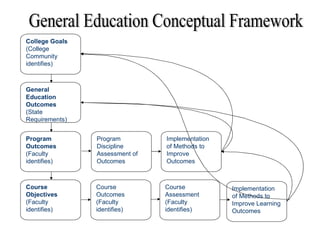
College Goals (College Community identifies) General Education Outcomes   (State Requirements) Course Outcomes (Faculty identifies) Course Objectives  (Faculty identifies) Program Outcomes (Faculty identifies) Course Assessment (Faculty identifies) Implementation of Methods to Improve Learning Outcomes Program Discipline Assessment of Outcomes Implementation of Methods to Improve Outcomes  General Education Conceptual Framework
Higher Learning Commission Criteria for Accreditation Criterion One:  Mission and   Integrity. Criterion Two:  Preparing for   the Future. Criterion Three:  Student   Learning and Effective   Teaching. Criterion Four:  Acquisition,   Discovery, and Application of   Knowledge. Criterion Five:  Engagement   and Service.
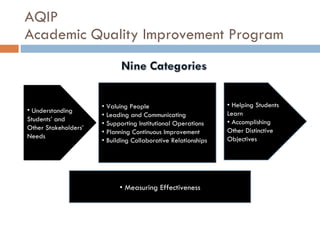
AQIP  Academic Quality Improvement Program  Understanding Students’ and Other Stakeholders’ Needs •  Valuing People •  Leading and Communicating •  Supporting Institutional Operations •  Planning Continuous Improvement •  Building Collaborative Relationships •  Helping Students Learn •  Accomplishing Other Distinctive Objectives •  Measuring Effectiveness
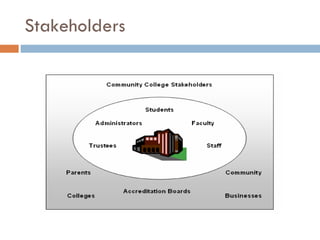
Stakeholders
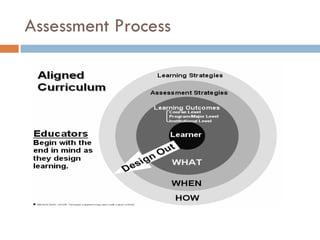
Assessment Process
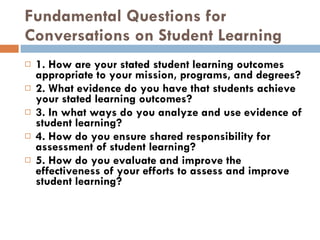
Fundamental Questions for Conversations on Student Learning 1. How are your stated student learning outcomes appropriate to your mission, programs, and degrees? 2. What evidence do you have that students achieve your stated learning outcomes? 3. In what ways do you analyze and use evidence of student learning? 4. How do you ensure shared responsibility for assessment of student learning? 5. How do you evaluate and improve the effectiveness of your efforts to assess and improve student learning?
Assessment Processes The Communications Faculty Discipline Coordinators The Assessment Committee Panel Discussion
Creating a Common Language Created by CMC English and Speech Faculty 2005  Learning Outcomes – essential knowledge or behavior that a student must have at the conclusion of a course, usually demonstrated and evaluated at the conclusion of the course   Competency – Specific ability or set of skills a student must have in order to meet criteria that lead to a demonstration of the student’s achievement of the learning outcome.   Skill – a tool or set of tools that a student must have to demonstrate the competency and that can be practiced or achieved in subunits of a course.   Objective – The goal the instructor has to help a student reach a learning outcome or its associative competencies and skills.
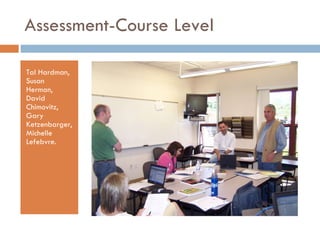
Assessment-Course Level Tal Hardman, Susan Herman, David Chimovitz, Gary Ketzenbarger, Michelle Lefebvre.
The Communications Faculty Team Members Bruce Beckum, David Chimovitz, Tal Hardman, Susan Herman, Gary Ketzenbarger, Michelle Lefebvre.  Kathy Kiser-Miller, Discipline Coordinator Speech Communications Identifying Outcomes, Competencies and Skills Creating Rubrics Creating Assessment Plans COM 115- Public Speaking COM 125- Interpersonal Communications
COM 115-Public Speaking Learning outcomes: 1. Students will clearly compose and appropriately adapt speeches to specific audiences. 2.   Students will clearly and appropriately deliver several types of speeches in front of an audience. 3. Students will critically evaluate and self-evaluate public speeches and messages.
COM 115- Competencies 1A. Prepare and deliver a speech that includes knowledge of these communication concepts: topic selection, preparation, organization, support/research materials, and language. 1B. Students should be able to identify, analyze, and articulate their own values, experiences and perspectives as well as those of others and recognize how these affect opinions, decisions, and behaviors.  2A. Deliver a persuasive speech using effective organization and appropriate supporting materials. 2B. Demonstrate, through delivery and examination, understanding of these essential factors in Public Speaking: speaker, message, delivery, audience, occasion, and purpose, along with the critical thinking processes related to each. 3A. Evaluate selected speeches using the following skills: listening, reasoning, content analysis, and cogent speech criticism. 3B. Demonstrate knowledge of basic communication theory.
Discipline Coordinators Allied Health  Mike Trujillo-Vail/Eagle Arts  Cynthia Zyzda-Alpine Business  Fred Hampel-Alpine Computer Science  Louis Beatty-Dillion CTE-Career & Technical  Michael Martin-Alpine Dev English  Mary Axelson-Spring Valley Dev Math  Roseanne Shepard-Spring Valley English  Rebecca Potter-Alpine                                                                                                       
Discipline Coordinators Humanities  Tom Buesch-Aspen Mathematics  Jason Vargas-Spring Valley Science  Bill Painter-Dillion Speech Communications  Kathy Kiser-Miller-Alpine Social Science  Bob Gumbrecht-Alpine Outdoor Studies  John Saunders-Alpine Statewide Faculty Curriculum Committee  Steve DeLong-Alpine CFI Representative  Margaret Maxwell-Aspen
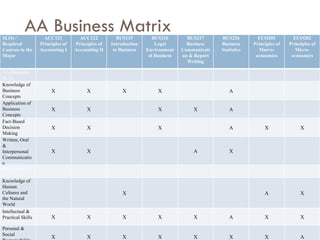
AA Business Matrix SLOs / Required Courses in the Major ACC121 Principles of Accounting I ACC122 Principles of Accounting II BUS115 Introduction to Business BUS216 Legal Environment of Business BUS217 Business Communication & Report Writing BUS226 Business Statistics ECO201 Principles of Macro- economics ECO202 Principles of Micro- economics AA-Business SLOs Knowledge of Business Concepts X X X X A Application of Business Concepts X X X X A Fact-Based Decision Making X X X A X X Written, Oral & Interpersonal Communication X X A X College SLOs Knowledge of Human Cultures and the Natural World X A X Intellectual & Practical Skills X X X X X A X X Personal & Social Responsibility X X X X X X X A Integrative & Applied Learning X X A X X Note:  X = course includes aspects that directly relate to the SLO A = SLO assessed in this course
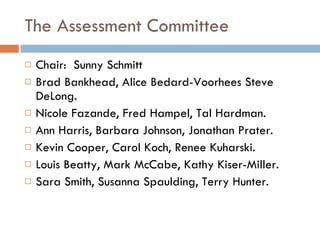
The Assessment Committee Chair:  Sunny Schmitt Brad Bankhead, Alice Bedard-Voorhees Steve DeLong.  Nicole Fazande, Fred Hampel, Tal Hardman.  Ann Harris, Barbara Johnson, Jonathan Prater.  Kevin Cooper, Carol Koch, Renee Kuharski.  Louis Beatty, Mark McCabe, Kathy Kiser-Miller. Sara Smith, Susanna Spaulding, Terry Hunter.
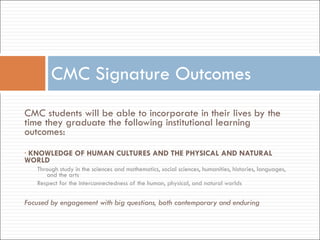
  CMC students will be able to incorporate in their lives by the time they graduate the following institutional learning outcomes:   KNOWLEDGE OF HUMAN CULTURES AND THE PHYSICAL AND NATURAL WORLD Through study in the sciences and mathematics, social sciences, humanities, histories, languages, and the arts Respect for the interconnectedness of the human, physical, and natural worlds   Focused by engagement with big questions, both contemporary and enduring     CMC Signature Outcomes
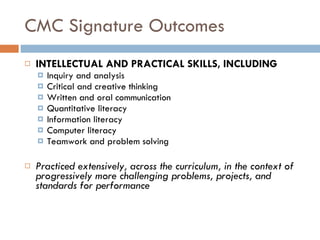
CMC Signature Outcomes INTELLECTUAL AND PRACTICAL SKILLS, INCLUDING Inquiry and analysis Critical and creative thinking Written and oral communication Quantitative literacy Information literacy Computer literacy Teamwork and problem solving   Practiced extensively, across the curriculum, in the context of progressively more challenging problems, projects, and standards for performance
CMC Signature Outcomes PERSONAL AND SOCIAL RESPONSIBILITY, INCLUDING Civic knowledge and engagement – local and global Intercultural knowledge and competence Ethical reasoning and action Foundations and skills for lifelong learning Incorporation of life practices leading to health and wellness The ability to apply ethical and responsible behaviors towards our environment   Anchored through active involvement with diverse communities and real-world challenges
CMC Signature Outcomes INTEGRATIVE AND APPLIED LEARNING, INCLUDING Synthesis and advanced accomplishment across general and specialized studies   Demonstrated through the application of knowledge, skills, and responsibilities to new settings and complex problems   Organizational structure adapted from previous publications of the Association of American Colleges and Universities: Greater Expectations: A New Vision for Learning as a Nation Goes to College (2002), Taking Responsibility for Quality of the Baccalaureate Degree (2004), and Liberal Education Outcomes: A Preliminary Report on Achievement in College (2005) and published most recently in High –Impact Educational Practices: What They Are, Who Has Access to Them, and Why They Matter (2008
http://www.taskstream.com/Main/homeCIP/default.asp   Envisioning The Future
University Planning & Analysis   Internet Resources for Higher Education Outcomes Assessment  http://www2.acs.ncsu.edu/UPA/assmt/resource.htm   Networking & Planning
Academic Quality Improvement Program,  http://www.aqip.org/   An Assessment Framework for the Community College , Measuring Student Learning and Achievement as a Means of Demonstrating Institutional Effectiveness  The League for Innovation in the Community College. (August 2004)  http://www.league.org/ Program and Student Outcomes,  Hillsborough Community College, 2005 The Higher Learning Commission ,  http://www.ncahlc.org/   References

Assessment Presentation for Faculty Panel at CMC

  • 1.
    ASSESSMENT @ COLORADOMOUNTAIN COLLEGE Faculty In-service October 23, 2009 Kathy Kiser-Miller Professor of Humanities and Speech Communication
  • 2.
    1. Define Assessment.2. Identify Purposes. 3. Share Perceptions, Experiences, Strategies. 4. Planning for Assessment. What Assessment Means to Us
  • 3.
    College Goals (CollegeCommunity identifies) General Education Outcomes (State Requirements) Course Outcomes (Faculty identifies) Course Objectives (Faculty identifies) Program Outcomes (Faculty identifies) Course Assessment (Faculty identifies) Implementation of Methods to Improve Learning Outcomes Program Discipline Assessment of Outcomes Implementation of Methods to Improve Outcomes General Education Conceptual Framework
  • 4.
    Higher Learning CommissionCriteria for Accreditation Criterion One: Mission and Integrity. Criterion Two: Preparing for the Future. Criterion Three: Student Learning and Effective Teaching. Criterion Four: Acquisition, Discovery, and Application of Knowledge. Criterion Five: Engagement and Service.
  • 5.
    AQIP AcademicQuality Improvement Program Understanding Students’ and Other Stakeholders’ Needs • Valuing People • Leading and Communicating • Supporting Institutional Operations • Planning Continuous Improvement • Building Collaborative Relationships • Helping Students Learn • Accomplishing Other Distinctive Objectives • Measuring Effectiveness
  • 6.
  • 7.
  • 8.
    Fundamental Questions forConversations on Student Learning 1. How are your stated student learning outcomes appropriate to your mission, programs, and degrees? 2. What evidence do you have that students achieve your stated learning outcomes? 3. In what ways do you analyze and use evidence of student learning? 4. How do you ensure shared responsibility for assessment of student learning? 5. How do you evaluate and improve the effectiveness of your efforts to assess and improve student learning?
  • 9.
    Assessment Processes TheCommunications Faculty Discipline Coordinators The Assessment Committee Panel Discussion
  • 10.
    Creating a CommonLanguage Created by CMC English and Speech Faculty 2005  Learning Outcomes – essential knowledge or behavior that a student must have at the conclusion of a course, usually demonstrated and evaluated at the conclusion of the course   Competency – Specific ability or set of skills a student must have in order to meet criteria that lead to a demonstration of the student’s achievement of the learning outcome.   Skill – a tool or set of tools that a student must have to demonstrate the competency and that can be practiced or achieved in subunits of a course.   Objective – The goal the instructor has to help a student reach a learning outcome or its associative competencies and skills.
  • 11.
    Assessment-Course Level TalHardman, Susan Herman, David Chimovitz, Gary Ketzenbarger, Michelle Lefebvre.
  • 12.
    The Communications FacultyTeam Members Bruce Beckum, David Chimovitz, Tal Hardman, Susan Herman, Gary Ketzenbarger, Michelle Lefebvre. Kathy Kiser-Miller, Discipline Coordinator Speech Communications Identifying Outcomes, Competencies and Skills Creating Rubrics Creating Assessment Plans COM 115- Public Speaking COM 125- Interpersonal Communications
  • 13.
    COM 115-Public SpeakingLearning outcomes: 1. Students will clearly compose and appropriately adapt speeches to specific audiences. 2. Students will clearly and appropriately deliver several types of speeches in front of an audience. 3. Students will critically evaluate and self-evaluate public speeches and messages.
  • 14.
    COM 115- Competencies1A. Prepare and deliver a speech that includes knowledge of these communication concepts: topic selection, preparation, organization, support/research materials, and language. 1B. Students should be able to identify, analyze, and articulate their own values, experiences and perspectives as well as those of others and recognize how these affect opinions, decisions, and behaviors. 2A. Deliver a persuasive speech using effective organization and appropriate supporting materials. 2B. Demonstrate, through delivery and examination, understanding of these essential factors in Public Speaking: speaker, message, delivery, audience, occasion, and purpose, along with the critical thinking processes related to each. 3A. Evaluate selected speeches using the following skills: listening, reasoning, content analysis, and cogent speech criticism. 3B. Demonstrate knowledge of basic communication theory.
  • 15.
    Discipline Coordinators AlliedHealth Mike Trujillo-Vail/Eagle Arts Cynthia Zyzda-Alpine Business Fred Hampel-Alpine Computer Science Louis Beatty-Dillion CTE-Career & Technical Michael Martin-Alpine Dev English Mary Axelson-Spring Valley Dev Math Roseanne Shepard-Spring Valley English Rebecca Potter-Alpine                                                                                                    
  • 16.
    Discipline Coordinators Humanities Tom Buesch-Aspen Mathematics Jason Vargas-Spring Valley Science Bill Painter-Dillion Speech Communications Kathy Kiser-Miller-Alpine Social Science Bob Gumbrecht-Alpine Outdoor Studies John Saunders-Alpine Statewide Faculty Curriculum Committee Steve DeLong-Alpine CFI Representative Margaret Maxwell-Aspen
  • 17.
    AA Business MatrixSLOs / Required Courses in the Major ACC121 Principles of Accounting I ACC122 Principles of Accounting II BUS115 Introduction to Business BUS216 Legal Environment of Business BUS217 Business Communication & Report Writing BUS226 Business Statistics ECO201 Principles of Macro- economics ECO202 Principles of Micro- economics AA-Business SLOs Knowledge of Business Concepts X X X X A Application of Business Concepts X X X X A Fact-Based Decision Making X X X A X X Written, Oral & Interpersonal Communication X X A X College SLOs Knowledge of Human Cultures and the Natural World X A X Intellectual & Practical Skills X X X X X A X X Personal & Social Responsibility X X X X X X X A Integrative & Applied Learning X X A X X Note: X = course includes aspects that directly relate to the SLO A = SLO assessed in this course
  • 18.
    The Assessment CommitteeChair: Sunny Schmitt Brad Bankhead, Alice Bedard-Voorhees Steve DeLong. Nicole Fazande, Fred Hampel, Tal Hardman. Ann Harris, Barbara Johnson, Jonathan Prater. Kevin Cooper, Carol Koch, Renee Kuharski. Louis Beatty, Mark McCabe, Kathy Kiser-Miller. Sara Smith, Susanna Spaulding, Terry Hunter.
  • 19.
      CMC studentswill be able to incorporate in their lives by the time they graduate the following institutional learning outcomes:   KNOWLEDGE OF HUMAN CULTURES AND THE PHYSICAL AND NATURAL WORLD Through study in the sciences and mathematics, social sciences, humanities, histories, languages, and the arts Respect for the interconnectedness of the human, physical, and natural worlds   Focused by engagement with big questions, both contemporary and enduring     CMC Signature Outcomes
  • 20.
    CMC Signature OutcomesINTELLECTUAL AND PRACTICAL SKILLS, INCLUDING Inquiry and analysis Critical and creative thinking Written and oral communication Quantitative literacy Information literacy Computer literacy Teamwork and problem solving   Practiced extensively, across the curriculum, in the context of progressively more challenging problems, projects, and standards for performance
  • 21.
    CMC Signature OutcomesPERSONAL AND SOCIAL RESPONSIBILITY, INCLUDING Civic knowledge and engagement – local and global Intercultural knowledge and competence Ethical reasoning and action Foundations and skills for lifelong learning Incorporation of life practices leading to health and wellness The ability to apply ethical and responsible behaviors towards our environment   Anchored through active involvement with diverse communities and real-world challenges
  • 22.
    CMC Signature OutcomesINTEGRATIVE AND APPLIED LEARNING, INCLUDING Synthesis and advanced accomplishment across general and specialized studies   Demonstrated through the application of knowledge, skills, and responsibilities to new settings and complex problems   Organizational structure adapted from previous publications of the Association of American Colleges and Universities: Greater Expectations: A New Vision for Learning as a Nation Goes to College (2002), Taking Responsibility for Quality of the Baccalaureate Degree (2004), and Liberal Education Outcomes: A Preliminary Report on Achievement in College (2005) and published most recently in High –Impact Educational Practices: What They Are, Who Has Access to Them, and Why They Matter (2008
  • 23.
  • 24.
    University Planning &Analysis Internet Resources for Higher Education Outcomes Assessment http://www2.acs.ncsu.edu/UPA/assmt/resource.htm Networking & Planning
  • 25.
    Academic Quality ImprovementProgram, http://www.aqip.org/ An Assessment Framework for the Community College , Measuring Student Learning and Achievement as a Means of Demonstrating Institutional Effectiveness The League for Innovation in the Community College. (August 2004) http://www.league.org/ Program and Student Outcomes, Hillsborough Community College, 2005 The Higher Learning Commission , http://www.ncahlc.org/ References