
Monitoring & Evaluation
Plan
Mainstreaming Sustainable Land
Management in Agro-Pastoral
Production Systems of Kenya Project
Prepared by Zablon Wagalla, Natural Resources/M&E
Consultant
October/November 2014
Table of Contents
1.0 M&E PLAN ........................................................................................................................................................................ 5
M&E OF PROJECT PERFORMANCE ...............................................................................................................................................5
M&E OF PROJECT IMPACT .............................................................................................................................................................5
1.1 PROJECT OVERVIEW ........................................................................................................................................................6
1.2 SPHERE OF INFLUENCE MAPPING: KEY STAKEHOLDERS, THEIR MANDATES, RESPONSIBILITIES, INTEREST, POTENTIAL
CHALLENGES AND MITIGATION STRATEGIES ................................................................................................................................7
1.3 PROJECT PARTICIPANTS AND PARTNERS AT ALL LEVELS......................................................................................................13
2.0 PURPOSE OF M&E PLAN .............................................................................................................................................15
3.0. M&E OF PROJECT PERFORMANCE .........................................................................................................................17
3.1 PROJECT IMPLEMENTATION APPROACH .................................................................................................................17
3.2 INDICATORS.......................................................................................................................................................................18
3.3 DATA COLLECTION ..........................................................................................................................................................18
4.0 REPORTING ....................................................................................................................................................................20
Diagram 3: Monitoring, Evaluation and Reporting Implementation Arrangements .....................................................23
5.0. M&E OF PROJECT IMPACT.........................................................................................................................................24
5.1 BASELINE DATA AND METHODS ..................................................................................................................................24
5.2 IMPACT ASSESSMENT METHODS ...............................................................................................................................24
5.3 SUSTAINABILITY INDICATORS......................................................................................................................................25
National...................................................................................................................................................................................25
Counties..................................................................................................................................................................................26
Catchment/Communities......................................................................................................................................................26
FFS/PFS.................................................................................................................................................................................26
6.0. CONCLUSION AND RECOMMENDATIONS...............................................................................................................27
ANNEX 1: STRATEGIC RESULTS FRAMEWORK/LOGICAL FRAMEWORK...............................................................28
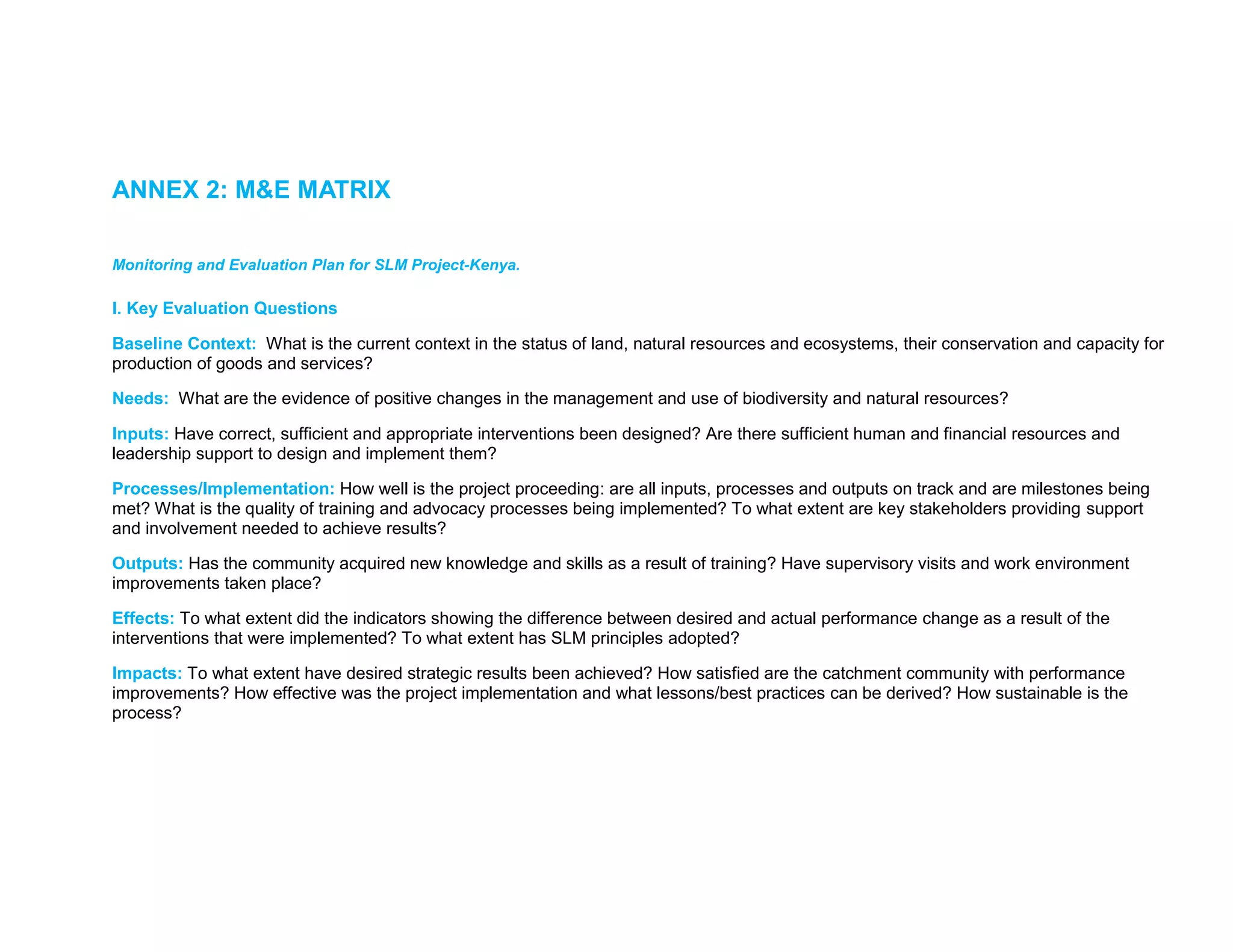
ANNEX 2: M&E MATRIX.......................................................................................................................................................42
MONITORING AND EVALUATION PLAN FOR SLM PROJECT-KENYA............................................................................................42
I. Key Evaluation Questions ................................................................................................................................................42
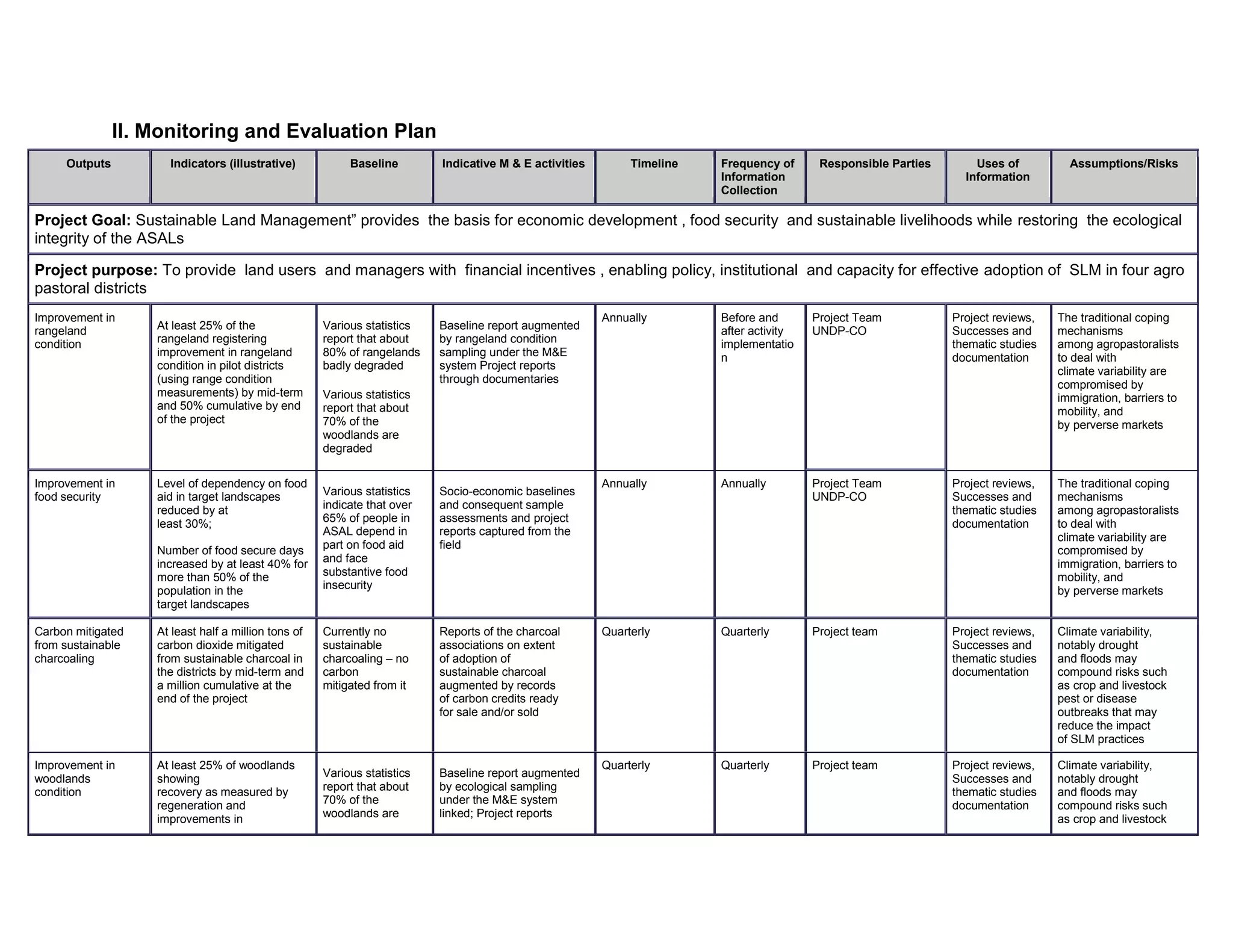
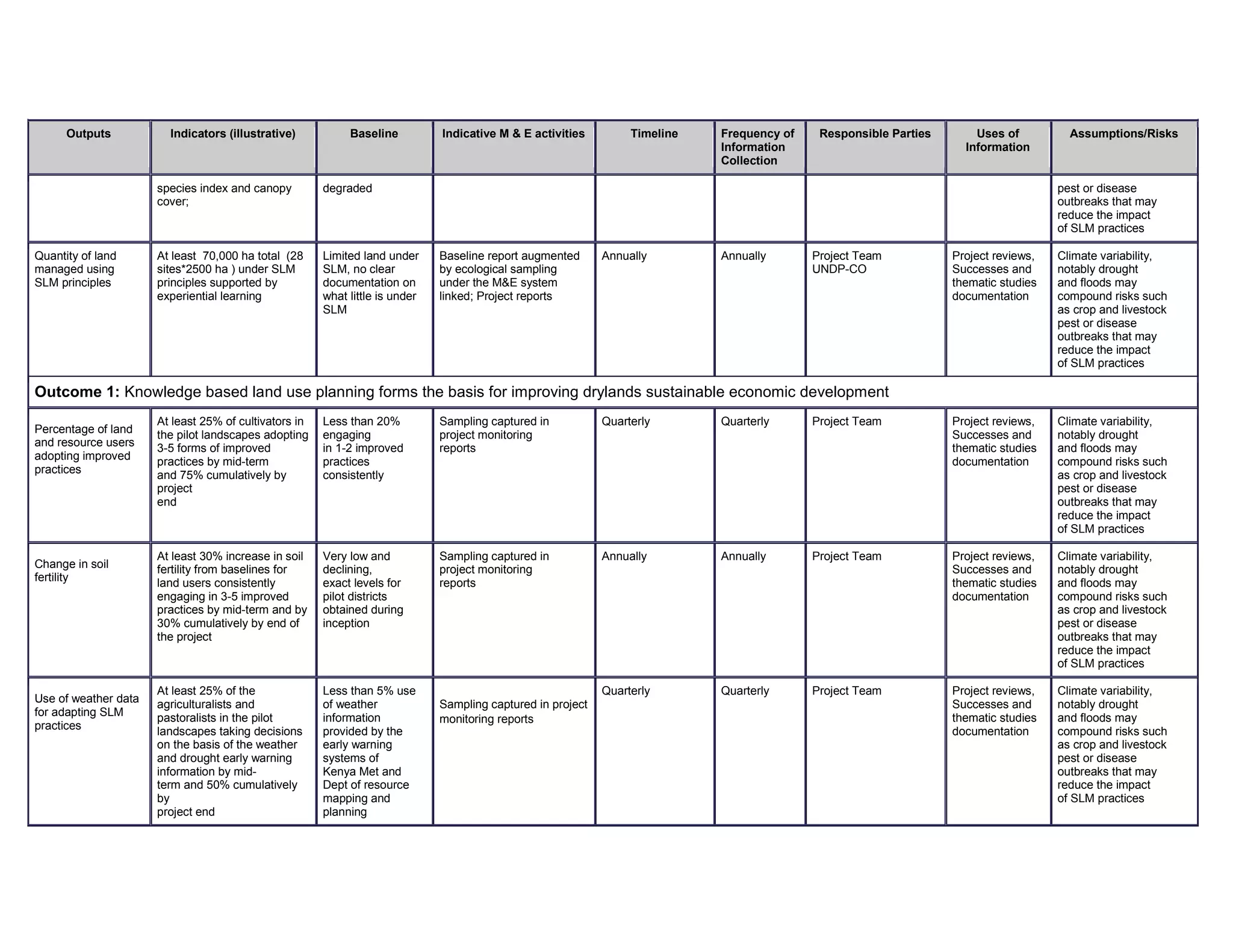
II. Monitoring and Evaluation Plan......................................................................................................................................43
ANNEX 3: IMPACT ASSESSMENTS AND THEMATIC STUDIES...................................................................................50
IMPACT ASSESSMENTS:...............................................................................................................................................................50
THEMATIC STUDIES:.....................................................................................................................................................................51
ANNEX 4: CHARACTERIZATION OF THE LANDSCAPE/COMMUNITY AND SLM ACTION PLAN- REPORT
TEMPLATE.............................................................................................................................................................................52
PART 1: OVERVIEW OF THE TARGET LANDSCAPE 1.1 BASIC INFORMATION- CATCHMENT .......................................................52
1.2 Reasons for selection of the catchment: ..............................................................................................................52
PART 2: CHARACTERIZATION OF THE TARGET CATCHMENT .......................................................................................................52
2.2 Geography, Land and Water Availability and Use.....................................................................................................53
2.3 Land Degradation.....................................................................................................................................................53
2.4 SLM............................................................................................................................................................................53
2.5 Policy and planning ........................................................................................................................................................53
PART 3: CATCHMENT- COMMUNITY SLM ACTION PLAN.............................................................................................................54
3.1 SLM interventions and activities proposed at community/catchment level .....................................................54
3.2 Capacity Building............................................................................................................................................................54
3.3 Collaboration and Co-financing ....................................................................................................................................54
3.3 Upscaling process and sustainability ....................................................................................................................55
ANNEX 5: M&E REPORTING TEMPLATES...................................................................................................................................56
List of Abbreviation and Acronyms
ALRMP Arid Land Resource Management Programme
ASALS Arid and Semi-arid Lands
APR Annual Progress Review
ASDSP Agriculture Sector Development Support Programme
BTOR Back to Office Reports
CDW Country Dialogue Workshop
DLPO District Livestock Production Officer
DLMC District Livestock Management Committee
DMT District Management Team
DRSRS Department of Resource Surveys & Remote Sensing
ERC Evaluation Resource Centre
FAO Food and Agriculture Organisation
FFS Farmer Field Schools
GEF Global Environment Facility
IFAD International Finance for Agricultural Development
KEFRI Kenya Forestry Research Institute
KFS Kenya Forestry Service
LD Land Development
M & E Monitoring & Evaluation
MOA, L & F Ministry of Agriculture, Livestock and Fisheries
NALEP National Agricultural & Extension Programme
NDMA National Drought Management Authority
OFP Operational Focal Point
PFS Pastoral Field Schools
PIR Project Implementation Report
PMED Planning, Monitoring & Evaluation Department
PRA Participatory Rural Appraisal
QPR Quarter Progress Report
RCU Regional Central Unit
SDL State Department of Livestock Development
SIP Strategic Implementation Plan
SLM Sustainable Land Management
SO Strategic Objective
UNCCD United Nations Convention to Combat Desertification
UNDP United Nations Development Programme
UNDP CO United Nations Development Programme Country Office
UNEP United Nations Environment Programme
1.0 M&E PLAN
The M&E plan for the Mainstreaming Sustainable Land Management in Agro-Pastoral Production Systems
of Kenya Project has been developed by the consultant in close collaboration with the Dr. Zeinabu Khalif,
Programme Analyst (UNDP Country Office),all the staff working at the Project Management Unit (PMU-Hill
Plaza) and all the District Management Team, Frontline Extension Officers working at the sub-county levels
of Dadaab, Kyuso, Mbeere North and Narok North using a collaborative and participatory work sessions
with field officers from Garissa, Kyuso, Narok and Embu during October/November 2014. Guidance and
technical comments were provided by the staff working at PMU Office, Leonard Odini, Communications
Officer, Solomon Karuri, Ag. National Project Manager, Barbara Ombasa, Project Assistant, State
Department of Livestock, Planning, Monitoring and Evaluation Division staff.
The M&E plan includes two components addressing the target indicators in the project log-frame:
M&E of Project Performance
Monitoring focuses on the management and supervision of project activities, seeking to improve efficiency
and overall effectiveness of project implementation. It is a continuous process to collect information on
actual implementation of project activities compared to those scheduled in the annual work plans, including
the delivery of quality outputs in a timely manner, to identify problems and constraints (technical,
processes, human resource, and financial), to make clear recommendations for corrective actions, and
identify lessons learned and best practices for scaling up, etc. Performance evaluation will assess the
project’s success in achieving its objectives. The project will be monitored closely by UNDP Energy
Environment and Climate Change Unit and the State Department of Livestock Planning, Monitoring and
Evaluation Division through Monthly statement of expenditure reports, Quarterly progress reports, Annual
progress reports, Annual implementation reviews, Mid-term reviews and Terminal evaluation reports, and
regular technical supervision missions to the project sites as required to enhance success. Participatory
monitoring and evaluation is also encouraged at the grassroot level where beneficiaries are involved
through their respective FFS/PFS in monitoring progress of their activities. The grassroot monitoring
missions are led by county focal point persons for monitoring and evaluations and these feeds into monthly
and quarterly progress reports.
M&E of project impact
Evaluation of the project’s success in achieving its outcomes will be monitored continuously throughout the
project period. The key indicators can be found in the logical framework as indicated in the annex 1. The
indicators have been further reviewed/refined during the development of this M&E Plan, and tools and
methods and indicators for measuring impact have been determined and agreed to ensure that a
standardized framework is shared by the four participating sub-counties while ensuring compliance with
UNDP and government M&E requirements are met.
1.1 PROJECT OVERVIEW
Mainstreaming Sustainable Land Management in Agro-pastoral Production Systems of Kenya Project
(SLM) is a 5 year (2010-2015) Project financed by Global Environmental Facility (GEF), supported by
United Nations Development Programme (UNDP-Kenya) and Government of Kenya (GoK) through State
Department of Livestock, Ministry of Agriculture, Livestock and Fisheries, . The project is financed under
the Land Degradation Focal Area of GEF – hence part of Kenya’s implementation of the UNCCD program
of work and is also part of the regional Strategic Investment Plan of TerrAfrica.
The overall goal of the project is to promote economic development, food security and sustainable land use
practices while restoring ecological integrity of the ASALs. The main objective of the project is to provide
land users and managers with enabling policy and institutional capacity for effective adoption of sustainable
land management (SLM). This will be realized by enhancing the ability of the local communities to mitigate
impacts of climate changes by adopting appropriate technologies that promote socio-economic resilience.
The envisaged outcomes of the project are:
a) Knowledge-based land use planning forms the basis for improving drylands sustainable economic
development
b) Viability of agro-pastoral production system increased through diversification and access to
finances for SLM
c) Mainstreaming SLM policies into cross-sectoral national and local level decision making processes
and support implementation
d) Lessons learnt used to upscale SLM in other ASAL districts.
The project uses two pronged approaches in achieving its goal. At national level, it supports review of
policies related to Sustainable Land Management and mainstreaming of SLM in national planning
processes. It also supports civil societies in mobilization of communities to champion land use policies that
support SLM. At local level, the project activities are implemented in four pilot districts of Mbeere North,
Kyuso, Narok North and Dadaab. The lessons learnt from these pilot districts will be used to upscale in
other ASAL areas.
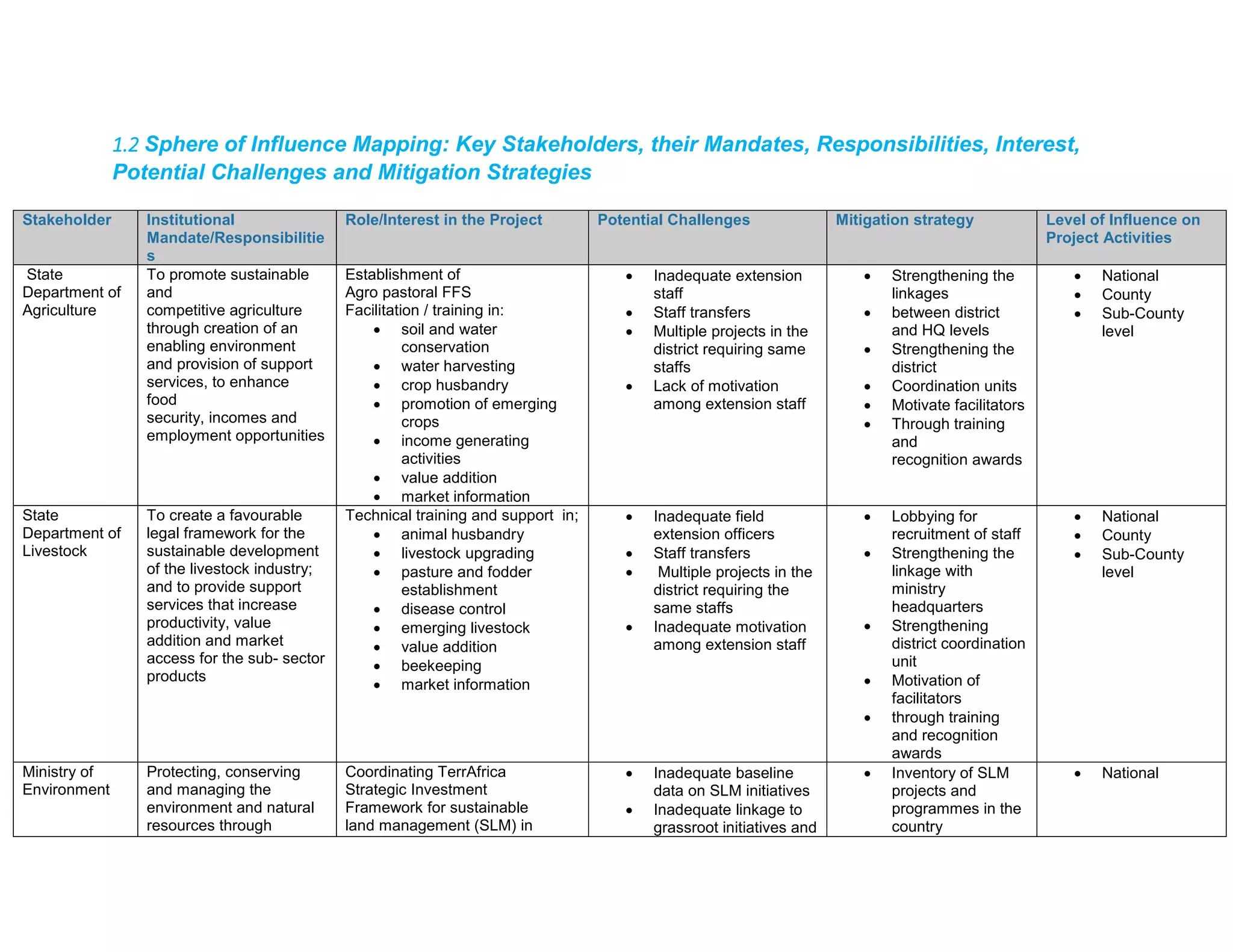
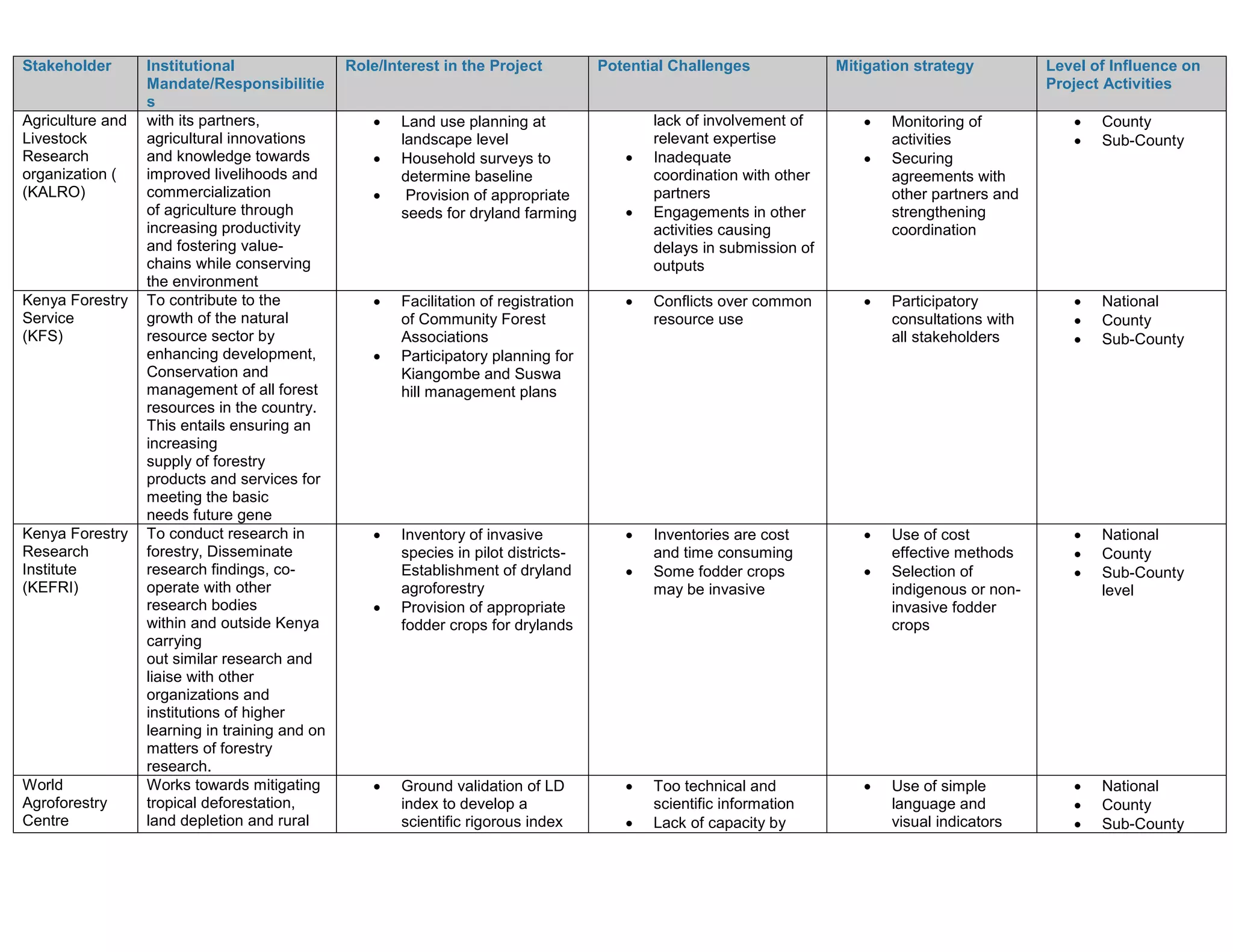
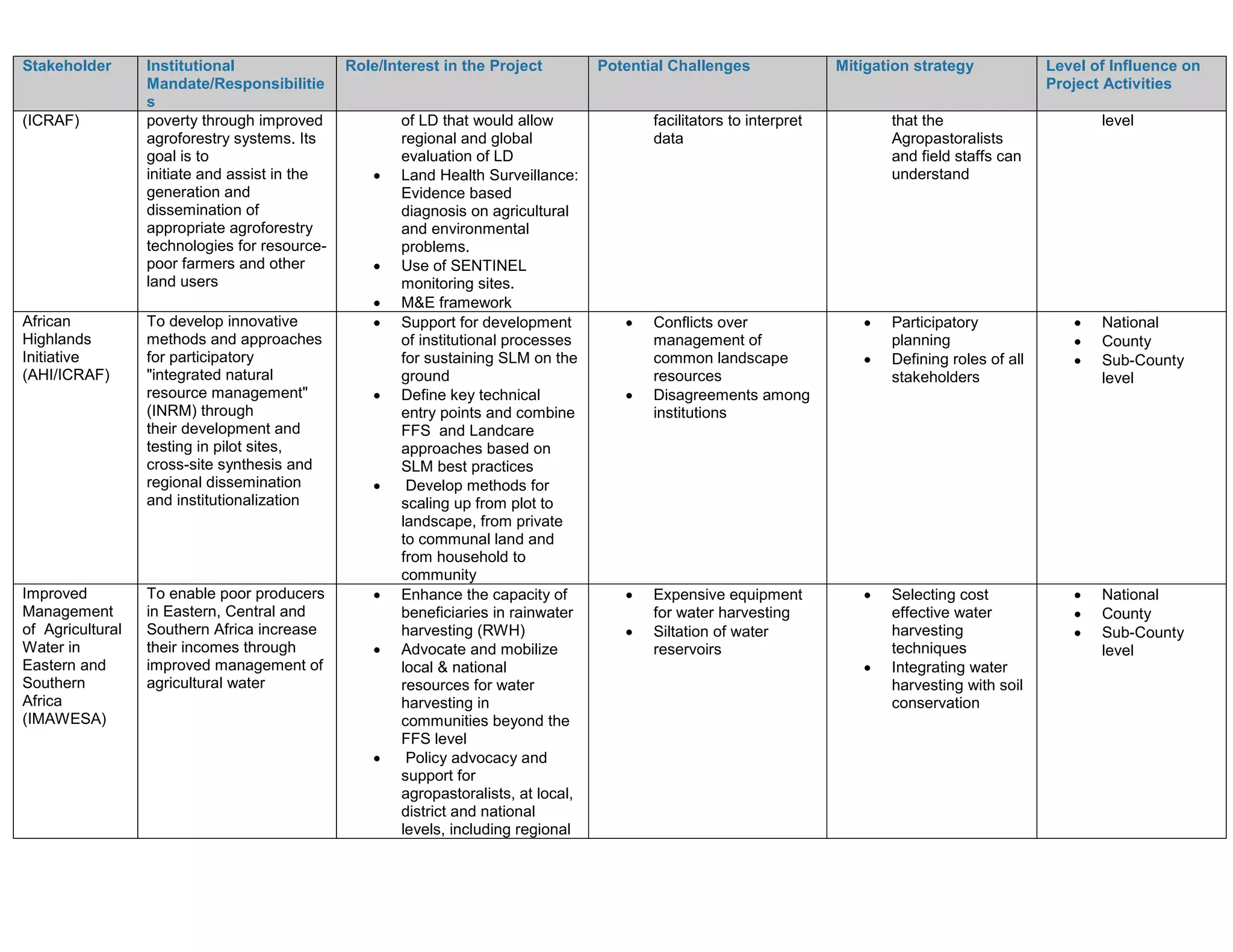
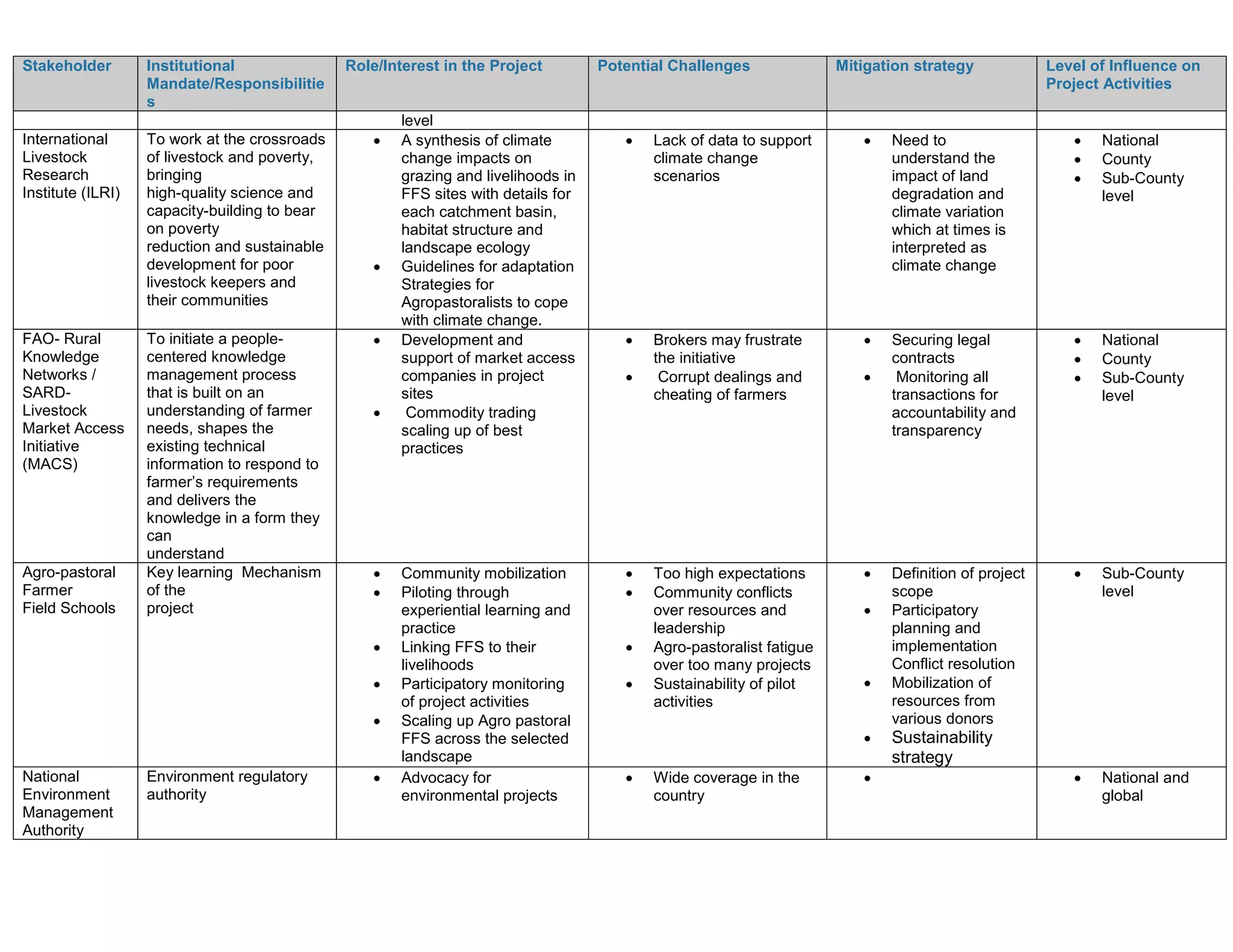
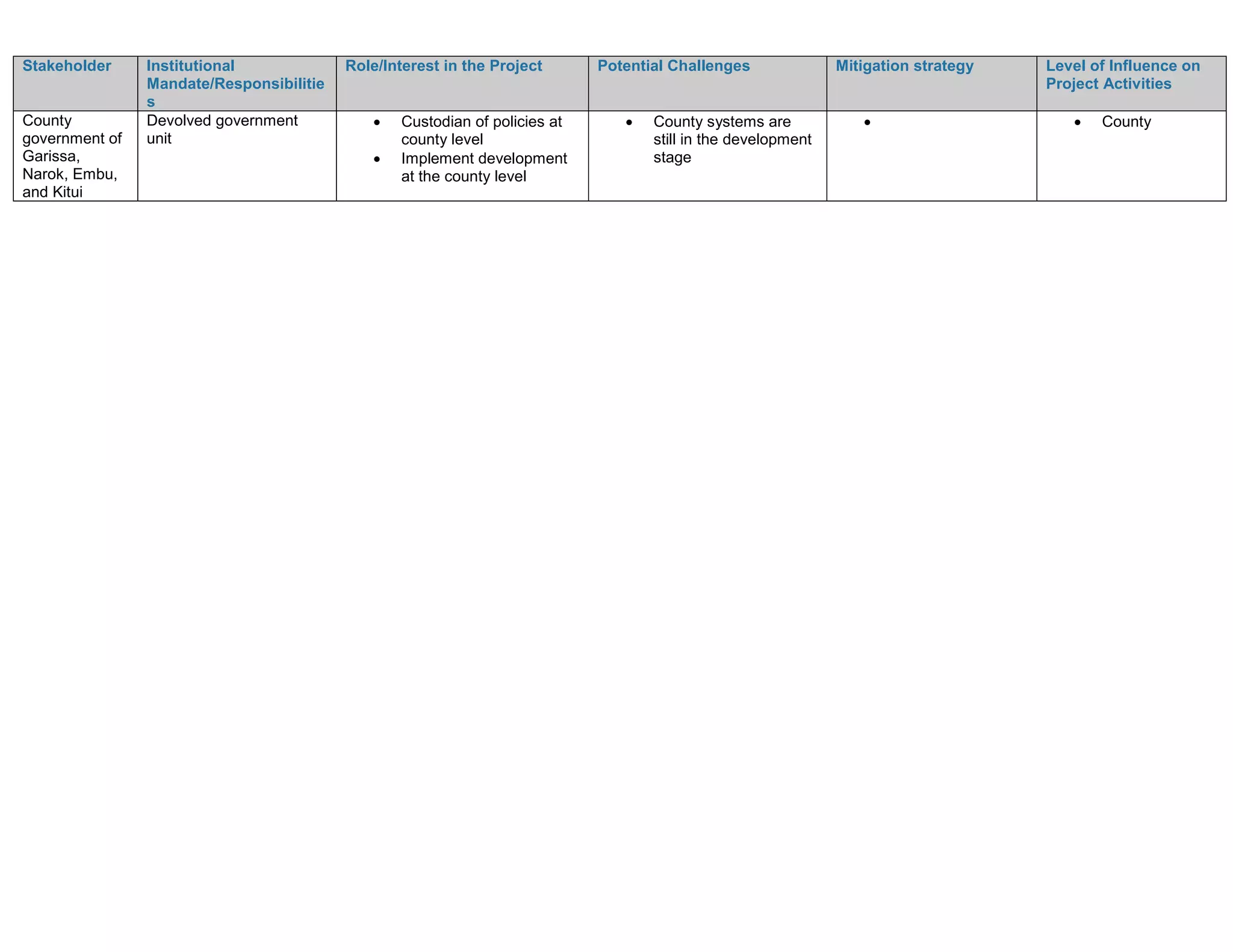
1.2 Sphere of Influence Mapping: Key Stakeholders, their Mandates, Responsibilities, Interest,
Potential Challenges and Mitigation Strategies
Stakeholder Institutional
Mandate/Responsibilitie
s
Role/Interest in the Project Potential Challenges Mitigation strategy Level of Influence on
Project Activities
State
Department of
Agriculture
To promote sustainable
and
competitive agriculture
through creation of an
enabling environment
and provision of support
services, to enhance
food
security, incomes and
employment opportunities
Establishment of
Agro pastoral FFS
Facilitation / training in:
 soil and water
conservation
 water harvesting
 crop husbandry
 promotion of emerging
crops
 income generating
activities
 value addition
 market information
 Inadequate extension
staff
 Staff transfers
 Multiple projects in the
district requiring same
staffs
 Lack of motivation
among extension staff
 Strengthening the
linkages
 between district
and HQ levels
 Strengthening the
district
 Coordination units
 Motivate facilitators
 Through training
and
recognition awards
 National
 County
 Sub-County
level
State
Department of
Livestock
To create a favourable
legal framework for the
sustainable development
of the livestock industry;
and to provide support
services that increase
productivity, value
addition and market
access for the sub- sector
products
Technical training and support in;
 animal husbandry
 livestock upgrading
 pasture and fodder
establishment
 disease control
 emerging livestock
 value addition
 beekeeping
 market information
 Inadequate field
extension officers
 Staff transfers
 Multiple projects in the
district requiring the
same staffs
 Inadequate motivation
among extension staff
 Lobbying for
recruitment of staff
 Strengthening the
linkage with
ministry
headquarters
 Strengthening
district coordination
unit
 Motivation of
facilitators
 through training
and recognition
awards
 National
 County
 Sub-County
level
Ministry of
Environment
Protecting, conserving
and managing the
environment and natural
resources through
Coordinating TerrAfrica
Strategic Investment
Framework for sustainable
land management (SLM) in
 Inadequate baseline
data on SLM initiatives
 Inadequate linkage to
grassroot initiatives and
 Inventory of SLM
projects and
programmes in the
country
 National
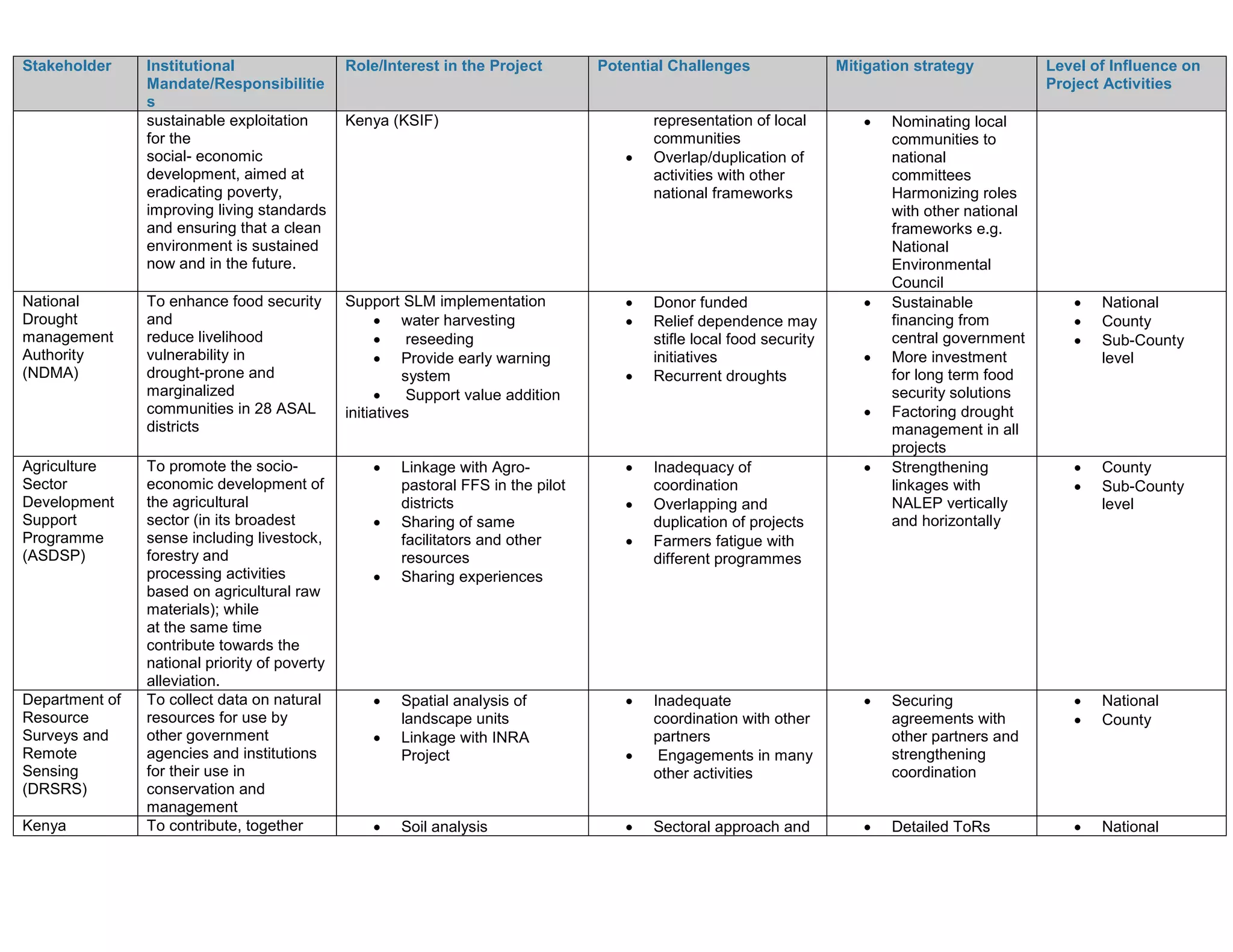
Stakeholder Institutional
Mandate/Responsibilitie
s
Role/Interest in the Project Potential Challenges Mitigation strategy Level of Influence on
Project Activities
sustainable exploitation
for the
social- economic
development, aimed at
eradicating poverty,
improving living standards
and ensuring that a clean
environment is sustained
now and in the future.
Kenya (KSIF) representation of local
communities
 Overlap/duplication of
activities with other
national frameworks
 Nominating local
communities to
national
committees
Harmonizing roles
with other national
frameworks e.g.
National
Environmental
Council
National
Drought
management
Authority
(NDMA)
To enhance food security
and
reduce livelihood
vulnerability in
drought-prone and
marginalized
communities in 28 ASAL
districts
Support SLM implementation
 water harvesting
 reseeding
 Provide early warning
system
 Support value addition
initiatives
 Donor funded
 Relief dependence may
stifle local food security
initiatives
 Recurrent droughts
 Sustainable
financing from
central government
 More investment
for long term food
security solutions
 Factoring drought
management in all
projects
 National
 County
 Sub-County
level
Agriculture
Sector
Development
Support
Programme
(ASDSP)
To promote the socio-
economic development of
the agricultural
sector (in its broadest
sense including livestock,
forestry and
processing activities
based on agricultural raw
materials); while
at the same time
contribute towards the
national priority of poverty
alleviation.
 Linkage with Agro-
pastoral FFS in the pilot
districts
 Sharing of same
facilitators and other
resources
 Sharing experiences
 Inadequacy of
coordination
 Overlapping and
duplication of projects
 Farmers fatigue with
different programmes
 Strengthening
linkages with
NALEP vertically
and horizontally
 County
 Sub-County
level
Department of
Resource
Surveys and
Remote
Sensing
(DRSRS)
To collect data on natural
resources for use by
other government
agencies and institutions
for their use in
conservation and
management
 Spatial analysis of
landscape units
 Linkage with INRA
Project
 Inadequate
coordination with other
partners
 Engagements in many
other activities
 Securing
agreements with
other partners and
strengthening
coordination
 National
 County
Kenya To contribute, together  Soil analysis  Sectoral approach and  Detailed ToRs  National
Stakeholder Institutional
Mandate/Responsibilitie
s
Role/Interest in the Project Potential Challenges Mitigation strategy Level of Influence on
Project Activities
Agriculture and
Livestock
Research
organization (
(KALRO)
with its partners,
agricultural innovations
and knowledge towards
improved livelihoods and
commercialization
of agriculture through
increasing productivity
and fostering value-
chains while conserving
the environment
 Land use planning at
landscape level
 Household surveys to
determine baseline
 Provision of appropriate
seeds for dryland farming
lack of involvement of
relevant expertise
 Inadequate
coordination with other
partners
 Engagements in other
activities causing
delays in submission of
outputs
 Monitoring of
activities
 Securing
agreements with
other partners and
strengthening
coordination
 County
 Sub-County
Kenya Forestry
Service
(KFS)
To contribute to the
growth of the natural
resource sector by
enhancing development,
Conservation and
management of all forest
resources in the country.
This entails ensuring an
increasing
supply of forestry
products and services for
meeting the basic
needs future gene
 Facilitation of registration
of Community Forest
Associations
 Participatory planning for
Kiangombe and Suswa
hill management plans
 Conflicts over common
resource use
 Participatory
consultations with
all stakeholders
 National
 County
 Sub-County
Kenya Forestry
Research
Institute
(KEFRI)
To conduct research in
forestry, Disseminate
research findings, co-
operate with other
research bodies
within and outside Kenya
carrying
out similar research and
liaise with other
organizations and
institutions of higher
learning in training and on
matters of forestry
research.
 Inventory of invasive
species in pilot districts-
Establishment of dryland
agroforestry
 Provision of appropriate
fodder crops for drylands
 Inventories are cost
and time consuming
 Some fodder crops
may be invasive
 Use of cost
effective methods
 Selection of
indigenous or non-
invasive fodder
crops
 National
 County
 Sub-County
level
World
Agroforestry
Centre
Works towards mitigating
tropical deforestation,
land depletion and rural
 Ground validation of LD
index to develop a
scientific rigorous index
 Too technical and
scientific information
 Lack of capacity by
 Use of simple
language and
visual indicators
 National
 County
 Sub-County
Stakeholder Institutional
Mandate/Responsibilitie
s
Role/Interest in the Project Potential Challenges Mitigation strategy Level of Influence on
Project Activities
(ICRAF) poverty through improved
agroforestry systems. Its
goal is to
initiate and assist in the
generation and
dissemination of
appropriate agroforestry
technologies for resource-
poor farmers and other
land users
of LD that would allow
regional and global
evaluation of LD
 Land Health Surveillance:
Evidence based
diagnosis on agricultural
and environmental
problems.
 Use of SENTINEL
monitoring sites.
 M&E framework
facilitators to interpret
data
that the
Agropastoralists
and field staffs can
understand
level
African
Highlands
Initiative
(AHI/ICRAF)
To develop innovative
methods and approaches
for participatory
"integrated natural
resource management"
(INRM) through
their development and
testing in pilot sites,
cross-site synthesis and
regional dissemination
and institutionalization
 Support for development
of institutional processes
for sustaining SLM on the
ground
 Define key technical
entry points and combine
FFS and Landcare
approaches based on
SLM best practices
 Develop methods for
scaling up from plot to
landscape, from private
to communal land and
from household to
community
 Conflicts over
management of
common landscape
resources
 Disagreements among
institutions
 Participatory
planning
 Defining roles of all
stakeholders
 National
 County
 Sub-County
level
Improved
Management
of Agricultural
Water in
Eastern and
Southern
Africa
(IMAWESA)
To enable poor producers
in Eastern, Central and
Southern Africa increase
their incomes through
improved management of
agricultural water
 Enhance the capacity of
beneficiaries in rainwater
harvesting (RWH)
 Advocate and mobilize
local & national
resources for water
harvesting in
communities beyond the
FFS level
 Policy advocacy and
support for
agropastoralists, at local,
district and national
levels, including regional
 Expensive equipment
for water harvesting
 Siltation of water
reservoirs
 Selecting cost
effective water
harvesting
techniques
 Integrating water
harvesting with soil
conservation
 National
 County
 Sub-County
level
Stakeholder Institutional
Mandate/Responsibilitie
s
Role/Interest in the Project Potential Challenges Mitigation strategy Level of Influence on
Project Activities
level
International
Livestock
Research
Institute (ILRI)
To work at the crossroads
of livestock and poverty,
bringing
high-quality science and
capacity-building to bear
on poverty
reduction and sustainable
development for poor
livestock keepers and
their communities
 A synthesis of climate
change impacts on
grazing and livelihoods in
FFS sites with details for
each catchment basin,
habitat structure and
landscape ecology
 Guidelines for adaptation
Strategies for
Agropastoralists to cope
with climate change.
 Lack of data to support
climate change
scenarios
 Need to
understand the
impact of land
degradation and
climate variation
which at times is
interpreted as
climate change
 National
 County
 Sub-County
level
FAO- Rural
Knowledge
Networks /
SARD-
Livestock
Market Access
Initiative
(MACS)
To initiate a people-
centered knowledge
management process
that is built on an
understanding of farmer
needs, shapes the
existing technical
information to respond to
farmer’s requirements
and delivers the
knowledge in a form they
can
understand
 Development and
support of market access
companies in project
sites
 Commodity trading
scaling up of best
practices
 Brokers may frustrate
the initiative
 Corrupt dealings and
cheating of farmers
 Securing legal
contracts
 Monitoring all
transactions for
accountability and
transparency
 National
 County
 Sub-County
level
Agro-pastoral
Farmer
Field Schools
Key learning Mechanism
of the
project
 Community mobilization
 Piloting through
experiential learning and
practice
 Linking FFS to their
livelihoods
 Participatory monitoring
of project activities
 Scaling up Agro pastoral
FFS across the selected
landscape
 Too high expectations
 Community conflicts
over resources and
leadership
 Agro-pastoralist fatigue
over too many projects
 Sustainability of pilot
activities
 Definition of project
scope
 Participatory
planning and
implementation
Conflict resolution
 Mobilization of
resources from
various donors
 Sustainability
strategy
 Sub-County
level
National
Environment
Management
Authority
Environment regulatory
authority
 Advocacy for
environmental projects
 Wide coverage in the
country
  National and
global
Stakeholder Institutional
Mandate/Responsibilitie
s
Role/Interest in the Project Potential Challenges Mitigation strategy Level of Influence on
Project Activities
County
government of
Garissa,
Narok, Embu,
and Kitui
Devolved government
unit
 Custodian of policies at
county level
 Implement development
at the county level
 County systems are
still in the development
stage
  County
1.3 Project participants and partners at all levels
Levels Participants/Partners
Local (Sub-
County and
County Level)
 Farmers Field Schools (FFS) and Pastoral Field Schools(PFS)
 Pastoralists
 Farmers
 Agro-Pastoralist
 Community Owned Financial Institution (COFI)
 Mumoni and Kyuso Organization for Rural Development and
Active Participation (MURKY-ORDAP)
 DLMC
 Mwingi Market Honey Place/ICIPE
 Frontline Extension Officers
 Local level leaders and decision makers
 Sub-County Authorities and County Government leaders
 Civil Society organizations
 Financial Institutions (Kenya Commercial Bank, Equity Bank,
Kenya Women Finance Trust)
National  Ministry of Agriculture, Livestock and Fisheries
 National Research institutions like KEFRI, KARI, and University
of Nairobi and Jomo Kenyatta University of Agriculture and
Technology.
 Private Sector
 UNDP Country Office
 Line ministries
 Civil Society organization
Global  GEF (Global Environmental Facility)
UNDP Country office is directly involved in implementation of the project. The project is being
executed under UNDP National Execution (NEX) procedures. The State Department of
Livestock Development (SDL) has overall responsibility for the project, with close collaboration
with the State Department of Agriculture (MoA) and the National Drought management Authority
(NDMA).The project activities are financed by the Government of Kenya, UNDP and GEF.
The project design is consistent with objectives of the Land Degradation focal area strategy and
Strategic Program for GEF-4; in particular the two main project strategies: 1) Mainstreaming
SLM into the production landscape by addressing both global environmental and sustainable
livelihood values within a holistic development framework 2) Capacity building leading to long-
term sustainability and visible impact for preventing and controlling land degradation. These are
backed up by outreach and networking for horizontal and vertical information flow. Specifically,
the project is contributing to SO-2 by demonstrating and up- scaling successful and innovative
SLM practices for agro-pastoral communities that reduces the extent and severity of
degradation, enhance the productivity and resilience of agro-pastoral management systems
(livestock, pasture and range) and generate socioeconomic/ livelihood benefits for the agro-
pastoralists as well as maintaining environmental services and generating global environmental
benefits. Capacity building is promoted through farmer field school approaches for adaptive
management of SLM practices, and through community planning and integrated ecosystem
approaches in the drylands.
The focus of the programme on restoration of land in different agro-ecosystems through SLM in
agro-pastoral areas provides direct support for GEF Strategic Program 1 (SP-1 element b) for
land degradation. SLM is applied to overcome land degradation through the use of a landscape
approach and integrating ecosystem-based concerns with human land use activities. The
project also addresses the root causes and negative impacts of land degradation on ecosystem
stability, functions and services as they affect local people’s livelihoods and economic well-
being, and to identify and find ways to overcome bottlenecks. Strategic Programme 4 is also
addressed through innovative incentive mechanisms that encourage wide adoption of SLM
practices.
By facilitating inter-sectoral coordination of natural resource management among government
departments and donor projects and by promoting harmonization of the policy and legal
framework guiding communities and districts in SLM the project contributes to Strategic
Objective SO-1. Barriers to SLM are being addressed by building of institutional and human
capacity for land use/ resources planning and incentive/support mechanisms to promote wider
SLM adoption. Capacity building is promoted through the FFS approach for adaptive
management of SLM practices, and through community planning and integrated ecosystem
approaches and thereby the project contributes to Strategic Objective SO-2. The project is
demonstrating and up-scaling successful, innovative and cost-effective SLM practices that
reduces the extent and severity of degradation and deforestation to enhance productivity and
resilience of agricultural systems and generate socioeconomic/livelihood benefits for local land
users as well as global environmental benefits.
The project contributes directly to the SIP indicators by scaling up and out improved land-use
practices including through national policies, coordinated actions and cross-sectoral district
planning and decision making processes (SIP IR 1); contributing to pastoral economies’
knowledge base through practical technologies (tested and proven) in pastoral set ups (SIP IR
4); strengthening the institutional and enabling framework for SLM, building on the coordination
system put in place by the government (SIP IR 2). The project also catalyzes inter-sectoral
partnerships between institutions to overcome barriers to SLM, including enhancement of
institutional and human resource capacity for land use/resources planning.
The project looks forward to filling a strategic gap in the developing portfolio of GEF SLM in
Kenya and the eastern Africa region. This project addresses agro-pastoralism in the semi-arid
lands, an area where resource-use conflict is increasing with immigrant farmers taking over dry-
season grazing reserves and water points. Other GEF projects are addressing arid lands
specifically (e.g. Desert Margins Programme in Marsabit District and Indigenous Vegetation
Programme in Turkana & Marsabit Districts). There are also other projects addressing the
moister end of the ASALs focusing on mountain water towers (WB-GEF Agricultural Productivity
and Sustainable Land Management project with inputs to Taita, Tugen and Cherangani Hills
areas, among others; and UNEP IFAD on Mount Kenya). These interventions have been
discussed at Kenya’s Country Dialogue Workshop (CDW) with staff of the office of the
Operational Focal Point (OFP), to ensure that the project was complementary, not overlapping
or duplicative.
2.0 PURPOSE OF M&E PLAN
The monitoring and evaluation plan for the SLM project will serve two functions: first, periodic
assessment of project implementation progress and performance of activities (M&E of Project
Performance-efficiency of resource application), and second, evaluation of their results in terms
of relevance, effectiveness and impact in promoting the adoption of sustainable land and agro-
ecosystem management (SLM) (M&E of Project Impact). The M&E system of the project will
provide answers on the progress and impact made by UNDP, Government line departments
and their partners in achieving the project’s outputs and outcomes.
Project Performance: Performance evaluation will assess the project’s success in achieving
the outputs with the inputs provided and activities conducted. The project will be monitored
closely by UNDP Energy Environment and Climate Change Unit, Planning, Monitoring and
Evaluation Division of the State Department of Livestock, Ministry of Agriculture, Livestock and
Fisheries, the Project Steering Committee and the Project Technical Committee through
Monthly expenditure reports, Quarterly progress reports, and Annual progress reports.
Moreover, regular technical supervision missions and Back to Office Reports will be provided as
required to enhance success, and serve well as guidance notes and feedbacks on reports.
Project Impact: Evaluation of the project’s success in achieving its outcomes will be monitored
continuously throughout the project. The key indicators found in the logical framework, and in
the revised M&E matrix will guide the evaluation of the project results and impacts. To do so,
reliable baseline data was collected at start of the project activities, and impact data will be
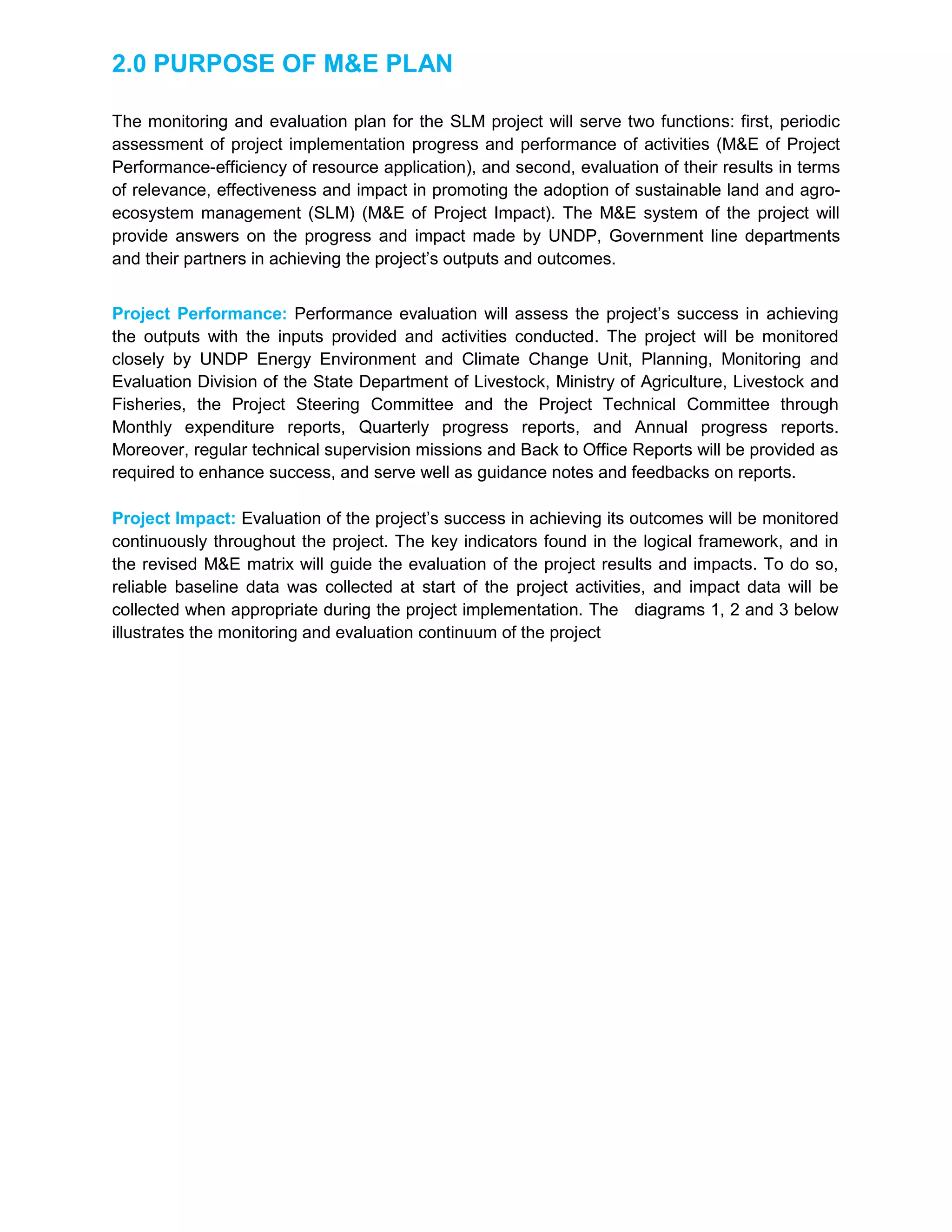
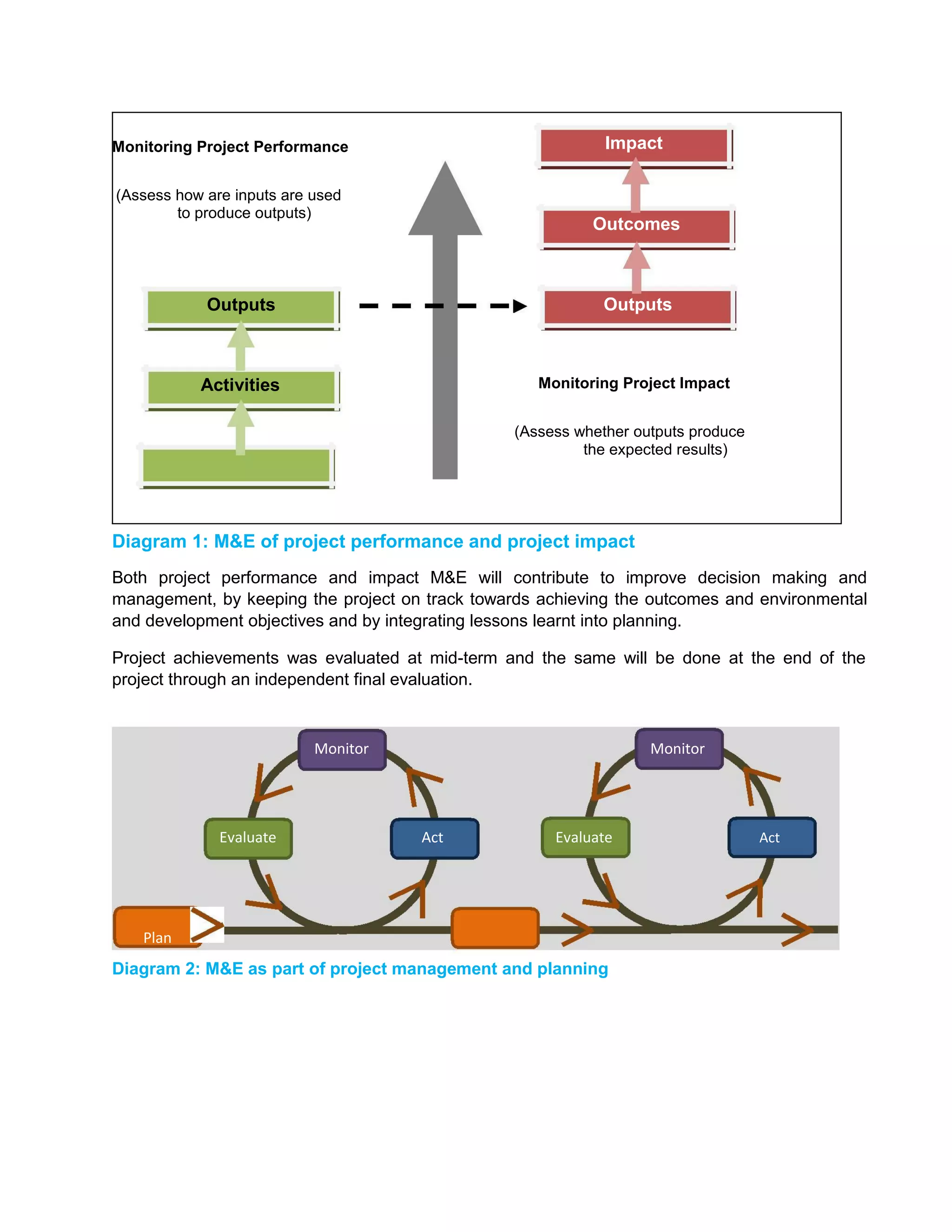
collected when appropriate during the project implementation. The diagrams 1, 2 and 3 below
illustrates the monitoring and evaluation continuum of the project
Monitoring Project Performance
(Assess how are inputs are used
to produce outputs)
Outputs
Activities
Impact
Outcomes
Outputs
Monitoring Project Impact
(Assess whether outputs produce
the expected results)
Diagram 1: M&E of project performance and project impact
Both project performance and impact M&E will contribute to improve decision making and
management, by keeping the project on track towards achieving the outcomes and environmental
and development objectives and by integrating lessons learnt into planning.
Project achievements was evaluated at mid-term and the same will be done at the end of the
project through an independent final evaluation.
Monitor Monitor
Evaluate Act Evaluate Act
Plan
Diagram 2: M&E as part of project management and planning
3.0. M&E OF PROJECT PERFORMANCE
The M&E of project performance focuses on the record of information related to the project
implementation process (inputs), activities and outputs. A minimum data collection is required
to enable the project management and stakeholders:
i. To track at regular time intervals the activities achieved (compare planned/versus
achieved) and assess effects of both external factors and internal project
operations;
ii. To assess results (outputs), lessons learnt, and solutions to keep project on track.
3.1 PROJECT IMPLEMENTATION APPROACH
The challenge in the ASALs in Kenya and the rest of SSA is to develop an innovative approach
to sustainable land management (SLM) at the landscape level where resource conservation
and land rehabilitation can be combined with improved livelihoods and income generation for
local communities and farmers/herders.
Selected districts represent a variety of agropastoral contexts so it is envisaged that many
lessons will be learned for scaling up within Kenya and more widely in agro-pastoral and
pastoral systems for example through the World Initiative for Sustainable Pastoralism. Land
uses historically in Narok and Garissa have mainly been pastoralism and herding, with recent
trends towards privatization of land and increase in crop production, while Mbeere North and
Kyuso are based on mixed agropastoral systems but increasingly inhabited by farming
communities with small numbers of livestock.
The GEF project will implement targeted incremental activities to strengthen SLM and assist in
identifying and removing policy, financial and capacity barriers currently impeding SLM and
sustainable agriculture in ASALs. It will therefore mainstream SLM by strengthening
institutional and community capacities at district and local levels; ensuring policies support
SLM and improving the local level access to alternative income generating activities. Innovative
ideas will be taken up by cross-sectoral District and National Planning and decision-making
processes which will ultimately influence policy change on SLM in agropastoral areas. The
project will operate under significant government co-finance by ongoing programmes, in
particular the Arid Lands Resource Management Project (ALRMP) and National Agriculture
and Livestock Extension Programme (NALEP) while the districts will provide office space and
technical and logistical support for project implementation.
The project will focus on four district: Dadaab (Garissa County); Mbeere North (Embu County)
Kyuso (Kitui County); and Narok North (Narok County); which have been regarded as sites of
land degradation severe enough to cause significant reduction in productivity and
crop/livestock yields. The extent of intervention (expected to exceed over 70,000 ha directly in
the project lifetime) and anticipated improvement in agricultural yields, will lead to sustainable
land management on a scale that reduces poverty and increases food security. This will free
up disaster resources, allowing for replication of interventions.
Lessons learned and experiences from SLM will be captured in different ways. The project will
invest into a large M& E component linked to and co-financed by ICRAF’s partnerships with the
Gates Foundation (Africa Soils Initiative). In this respect, it will develop Sentinel Soil sites at
three landscapes with detailed soil and vegetative cover (biodiversity surrogates) monitoring,
related to changing land uses. This work will be done in partnership with KARI (Kenya
Agricultural Research Institute), which will ensure continuity and upscaling.
3.2 INDICATORS
Indicators provide parameters against which to assess project performance and achievement
in terms of quantity (how many/how much?), time (when?), target group (who?) and quality
(how good?). Indicators can be quantitative, (number of people, number of ha, % of adoption),
semi-quantitative (scale, ranking), or qualitative (perceptions, opinions, categories).
The table of objectively verifiable indicators (OVI) at sub county and country levels is
in Annex 1
3.3 DATA COLLECTION
The established monitoring and evaluation systems for the project are multilayered at different
levels using a variety of tools and funding mechanisms. At pilot project sites a monitoring and
evaluation officer has been designated who collates back to office reports submitted by
executing officers. The FFS and PFS executives committees monitor and evaluate members
and SLM activities and achievements that are subsequently deposited with the DLPOs office.
The PMU monitors the DMTs through quarterly progress reports and field visits. The Project
board monitors the PMU through meetings and reports. The UNDP Country Office monitors
and evaluates the PMU through reports, meetings and undertakes field visits to the project
sites.
The local level M&E focal points who should be in charge of collecting and providing
information on project activities and implementation to the SLM project Coordinator at the sub
county level are the Sub county M & E Officers, sector leads at the sub county levels, local
extension officers, and FFS facilitators at the divisional level. These resource people can use
the proposed project recording forms (in the M&E tools folder) and if necessary can be trained
in data collection and participatory M&E. Furthermore, the PMU shall synthesize the
information for the project area (all selected catchments, communities and sub-counties) and
similarly shall compile it for reporting to the UNDP country office on quarterly and annual basis.
The M&E tools provided with this plan are composed of a set of forms to collect and compile
the information at each level:
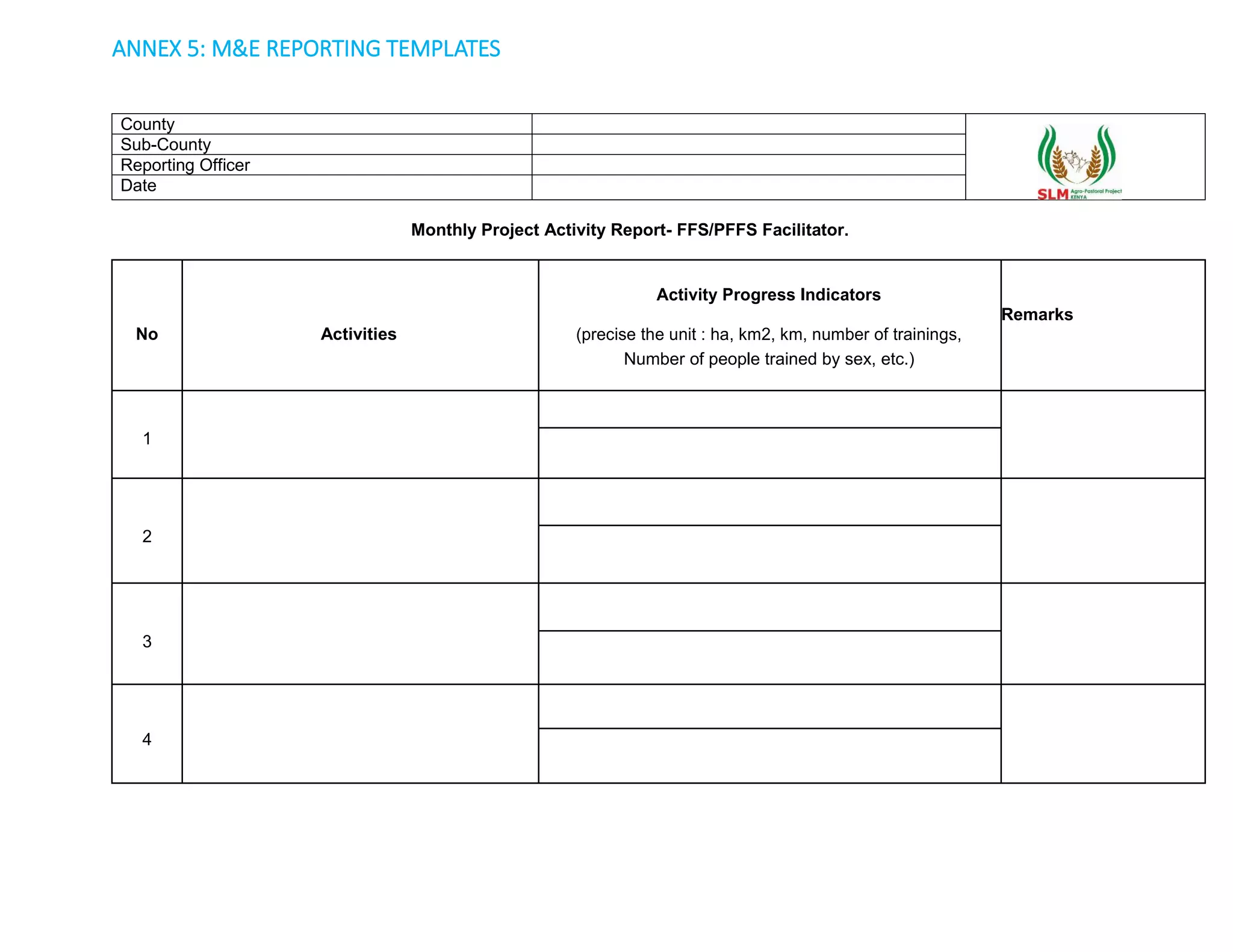
 Community M&E form for the local extension officers and FFS/PFS facilitators
 Sub County level M&E form for the SLM project Coordinators at the Sub counties
 National level M&E form for the PMU, and excel table for quantity data tracking
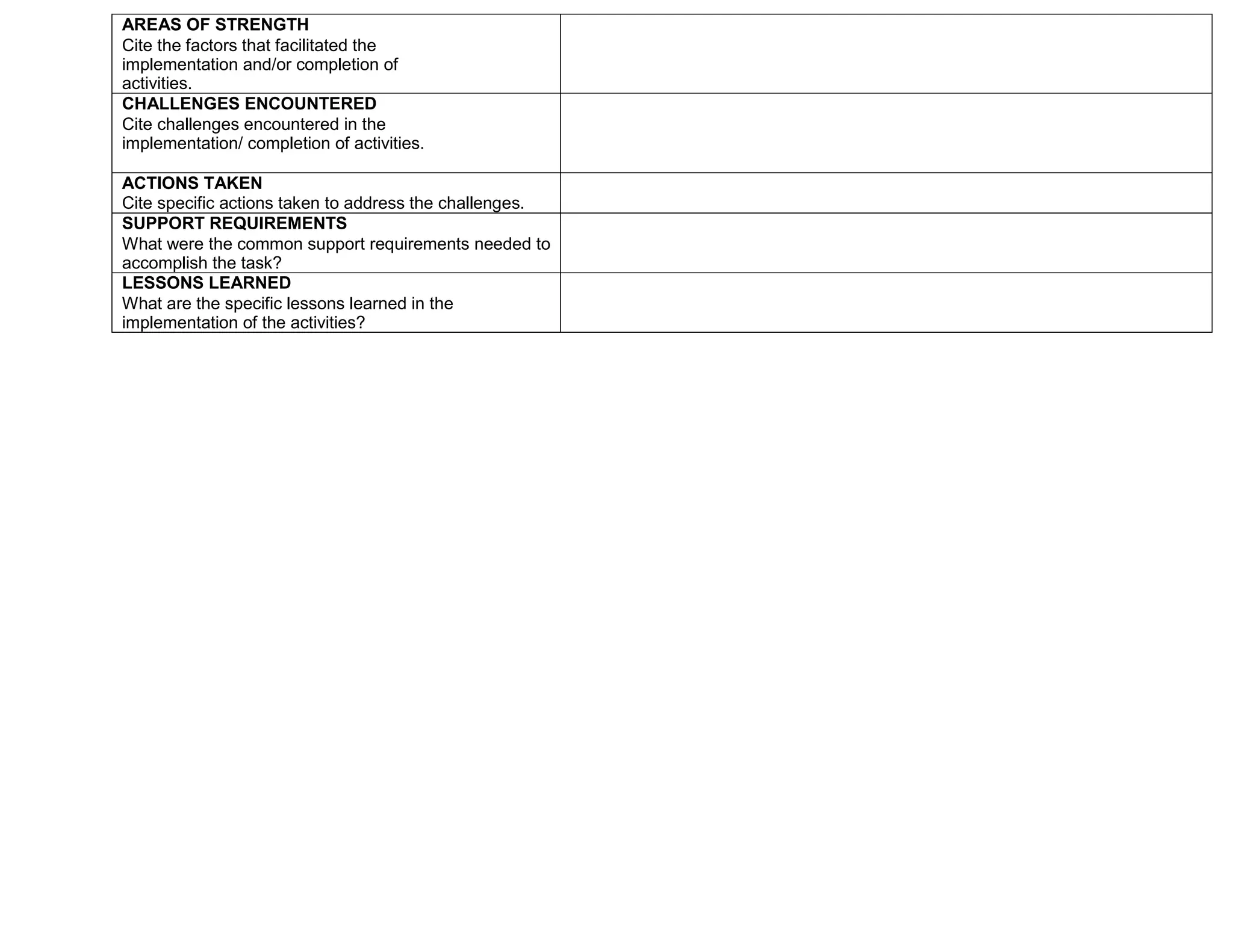
The templates are a way of standardizing the way data is recorded and stored, aggregating
data, and informing project management about progress.
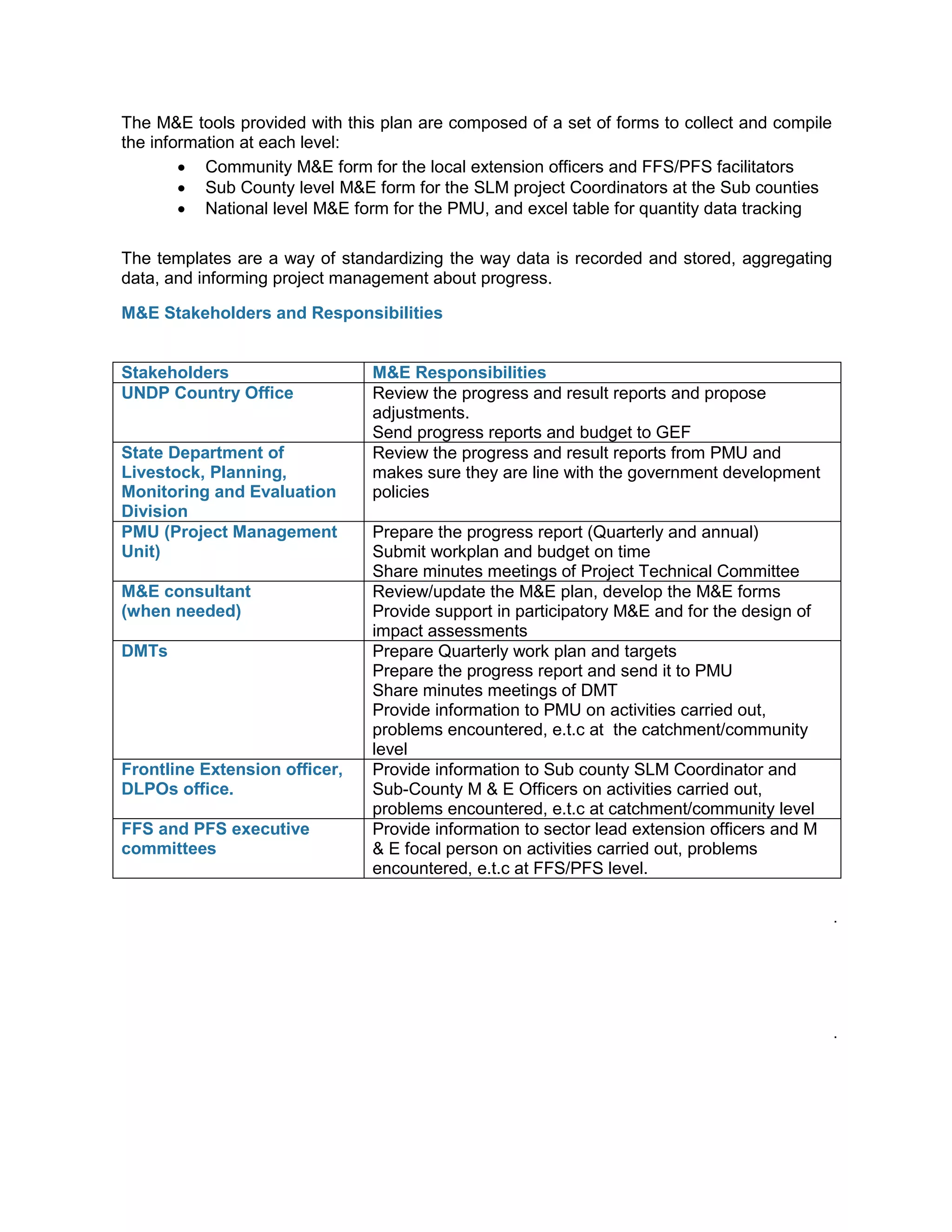
M&E Stakeholders and Responsibilities
Stakeholders M&E Responsibilities
UNDP Country Office Review the progress and result reports and propose
adjustments.
Send progress reports and budget to GEF
State Department of
Livestock, Planning,
Monitoring and Evaluation
Division
Review the progress and result reports from PMU and
makes sure they are line with the government development
policies
PMU (Project Management
Unit)
Prepare the progress report (Quarterly and annual)
Submit workplan and budget on time
Share minutes meetings of Project Technical Committee
M&E consultant
(when needed)
Review/update the M&E plan, develop the M&E forms
Provide support in participatory M&E and for the design of
impact assessments
DMTs Prepare Quarterly work plan and targets
Prepare the progress report and send it to PMU
Share minutes meetings of DMT
Provide information to PMU on activities carried out,
problems encountered, e.t.c at the catchment/community
level
Frontline Extension officer,
DLPOs office.
Provide information to Sub county SLM Coordinator and
Sub-County M & E Officers on activities carried out,
problems encountered, e.t.c at catchment/community level
FFS and PFS executive
committees
Provide information to sector lead extension officers and M
& E focal person on activities carried out, problems
encountered, e.t.c at FFS/PFS level.
4.0 REPORTING
Project monitoring and evaluation will be conducted in accordance with established UNDP and
GEF procedures and will be provided by the project team and the UNDP Country Office (UNDP
CO) with support from UNDP/GEF. The Logical Framework Matrix in Annex 2 provides
indicators for project implementation, cross referenced to the SIP Results Framework as
currently designed, along with their corresponding means of verification. These will form the
basis on which the project's Monitoring and Evaluation system will be built.
Project start: A Project Inception Workshop was held within the first 2 months of project start
with those assigned roles in the project organization structure, UNDP country office and
regional technical policy and programme advisors as well as other stakeholders. The Inception
Workshop was crucial to building ownership for the project results and to planning the first year
annual work plan. It addressed a number of key issues including: assist all partners to fully
understand and take ownership of the project; detail the roles, support services and
complementary responsibilities of UNDP CO and Regional Coordination Unit (RCU) staff vis à
vis the project team; discussed the roles, functions, and responsibilities within the project's
decision-making structures, including reporting and communication lines, and conflict
resolution mechanisms; shared the terms of reference for project staff as needed.
The inception workshop provided a venue for finalizing the first annual work plan as well as
reviewing and agreeing on the indicators, targets and their means of verification, and
rechecking assumptions and risks; it provided a detailed overview of reporting, monitoring and
evaluation (M&E) requirements; it also confirmed the monitoring and evaluation work plan and
budgets and schedules; discussed financial reporting procedures and obligations, and
arrangements for annual audit; planning and scheduling Project Board meetings; clarifying
roles and responsibilities of all project organization structures; and holding the first Project
Board meeting.
Monthly Expenditure reports: Expenditure reports are generated monthly by the respective
SLM coordinators to track expenditure according to planned activities monthly and submitted to
PMU.
Quarterly: Project Progress will be monitored quarterly using the UNDP Enhanced Results
Based Management Platform. The risks identified at project design will be entered into ATLAS
and monitored quarterly. The risks related to markets, micro-finance and conflicts are all rated
critical under the Enhanced Results Based Management Platform on the basis of their
innovative nature (high impact and uncertainty due to no previous experience justifies
classification as critical), and the high incidents of conflicts in the ASALs. These will therefore
be monitored very carefully and information used to adapt project management.
Quarterly Project Progress Reports (PPR) will be generated in the Executive Snapshot,
using the information recorded in Atlas. Other ATLAS logs will be used to monitor issues,
lessons learned etc. The use of these functions is a key indicator in the UNDP Executive
Balanced Scorecard.
Annually: Annual Project Progress will be monitored and captured through the Annual Project
Review/Project Implementation Reports (APR/PIR). This key report comprehensively combines
both UNDP and GEF reporting requirements and includes, but is not limited to, reporting on:
progress made toward project objective and project outcomes - each with indicators, baseline
data and end-of-project targets (cumulative); project outputs delivered per project outcome
(annual); lesson learned/good practice; AWP and other expenditure reports; risk and adaptive
management; and, ATLAS QPR. Portfolio level indicators (i.e. GEF focal area tracking tools)
are used by most focal areas on an annual basis as well.
Periodic Monitoring through site visits: UNDP CO and the UNDP RCU will conduct visits to
project sites based on the agreed schedule in the project's Inception Report/Annual Work Plan
to assess first hand project progress. Other members of the Project Board may also join these
visits. A Field Visit Report/BTOR will be prepared by the CO and UNDP RCU and will be
circulated no less than one month after the visit to the project team and Project Board
members.
Mid-term of project cycle: The project has undergone an independent Mid-Term Evaluation
at the mid-point of project implementation, in August 2014. The Mid-Term Evaluation
determined progress being made towards the achievement of outcomes and identified course
correction that are needed including reviewing of the indicators and having a structured
Monitoring and Evaluation plan for the project. It focused on the effectiveness, efficiency and
timeliness of project implementation; highlighted issues requiring decisions and actions; and
presented initial lessons learned about project design, implementation and management.
Findings of this review will be incorporated as recommendations for enhanced implementation
during the final half of the project’s term.
End of Project: An independent Final Evaluation will take place three months prior to the final
Project Board meeting and will be undertaken in accordance with UNDP and GEF guidance.
The final evaluation will focus on the delivery of the project’s results as initially planned (and as
corrected after the mid-term evaluation, if any such correction took place). The final evaluation
will look at impact and sustainability of results, including the contribution to capacity
development and the achievement of global environmental benefits/goals. The Terms of
Reference for this evaluation will be prepared by the UNDP CO based on guidance from the
Regional Coordinating Unit and UNDP-GEF. The Terminal Evaluation will also provide
recommendations for follow-up activities and will be accompanied by a management response
which will be uploaded to PIMS and to the UNDP Evaluation Office Evaluation Resource
Center (ERC). The relevant GEF Focal Area Tracking Tools will also be completed during the
final evaluation.
During the last three months, the project team will prepare the Project Terminal Report. This
comprehensive report will summarize the results achieved (objectives, outcomes, outputs),
lessons learned, problems met and areas where results may not have been achieved. It will
also lay out recommendations for any further steps that may need to be taken to ensure
sustainability and replicability of the project’s results.
Learning and knowledge sharing: Results from the project will be disseminated within and
beyond the project intervention zone through existing information sharing networks and forums.
The project will therefore identify and participate, as relevant and appropriate, in scientific,
policy-based and/or any other networks, which may be of benefit to project implementation
though lessons learned. The project will also identify, analyze, and share lessons learned that
might be beneficial in the design and implementation of similar future projects. Finally, there
will be a two-way flow of information between this project and other projects of a similar focus.
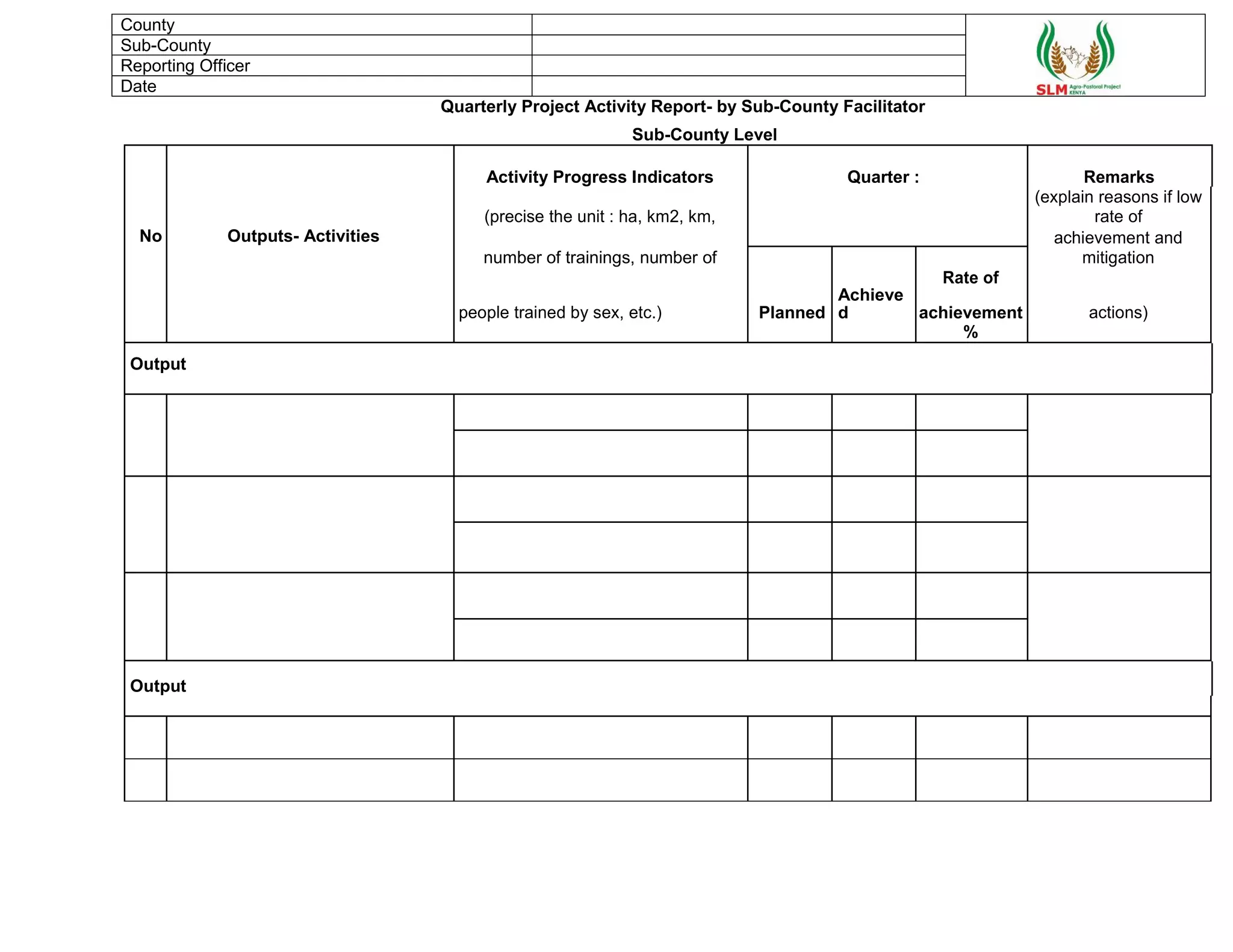
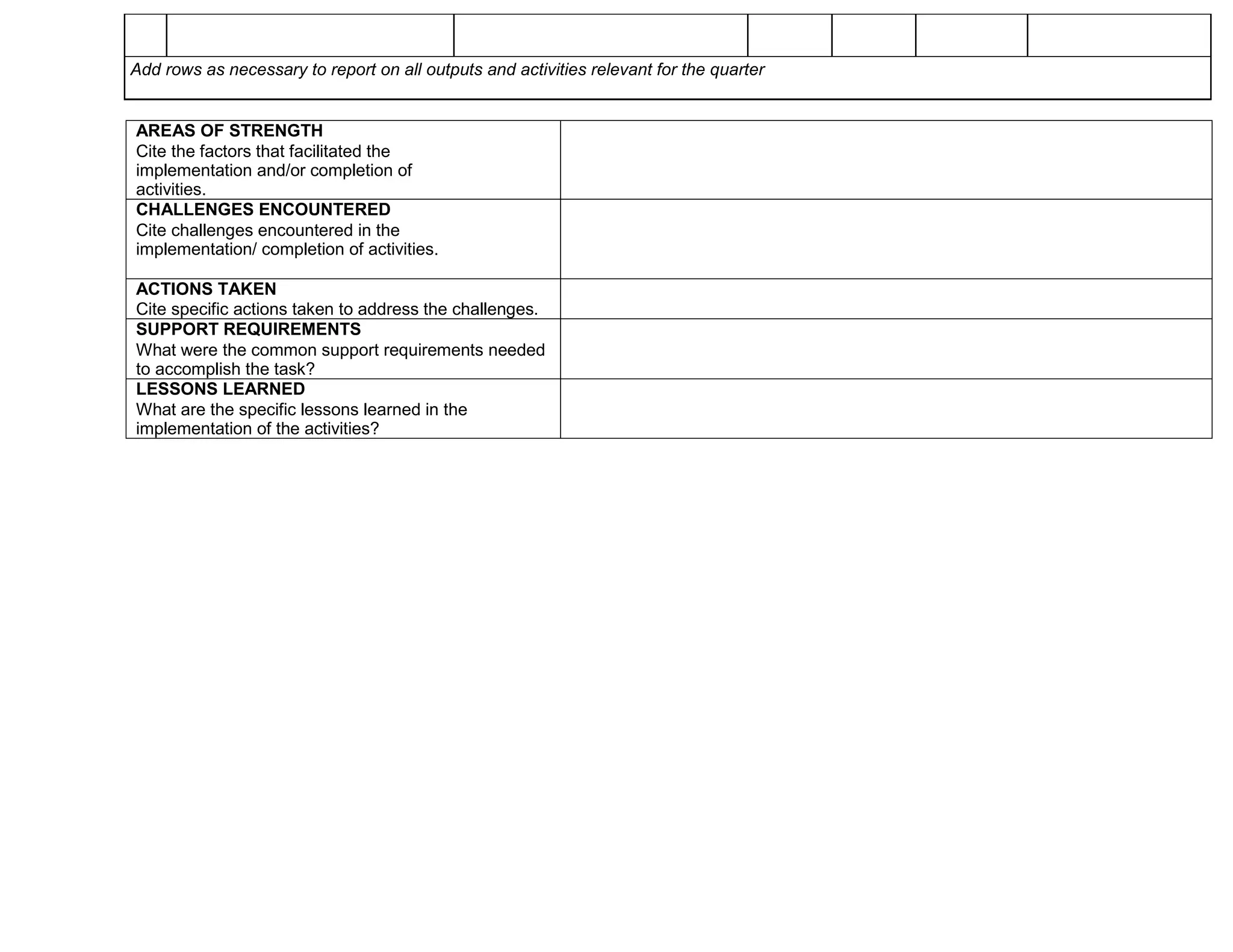
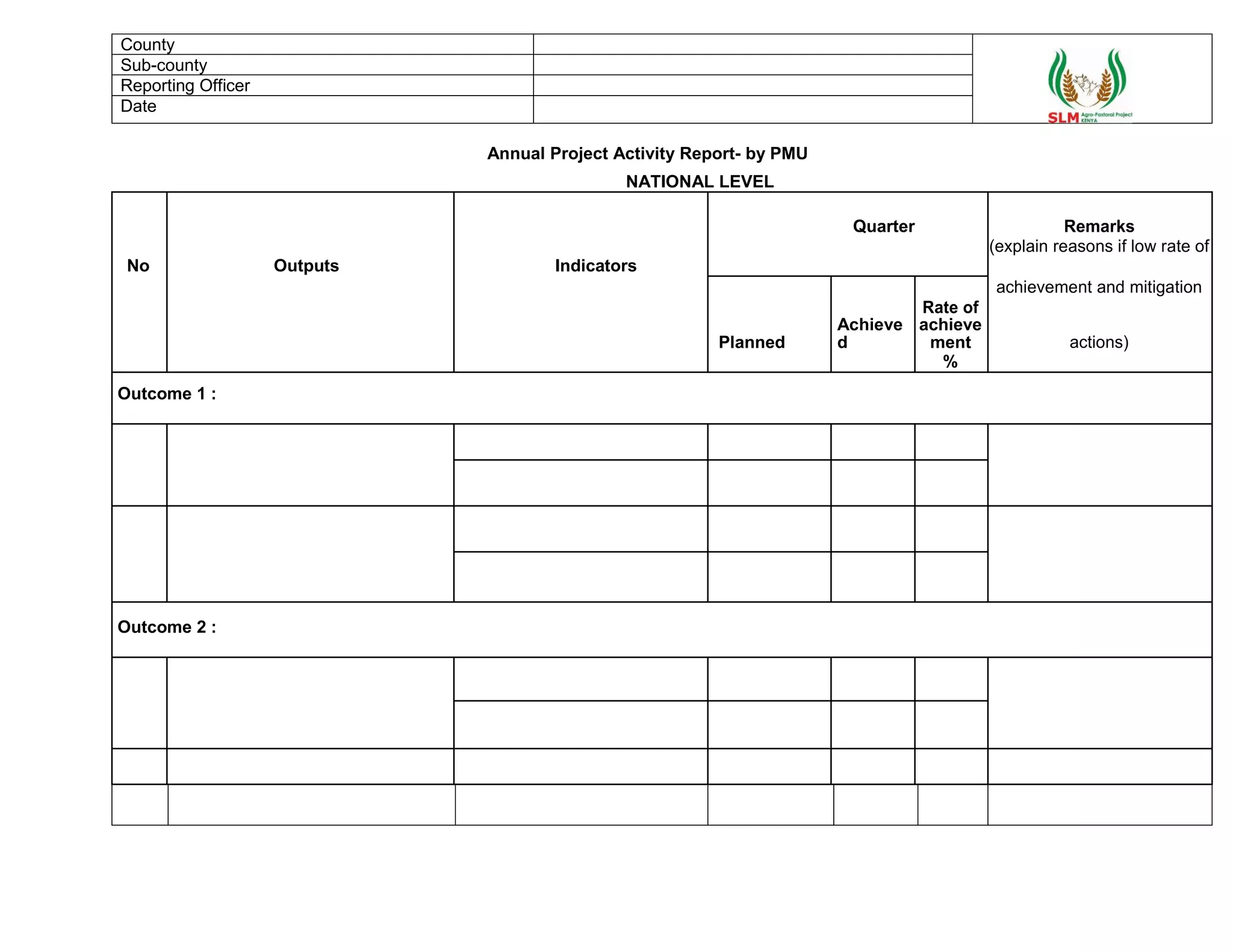
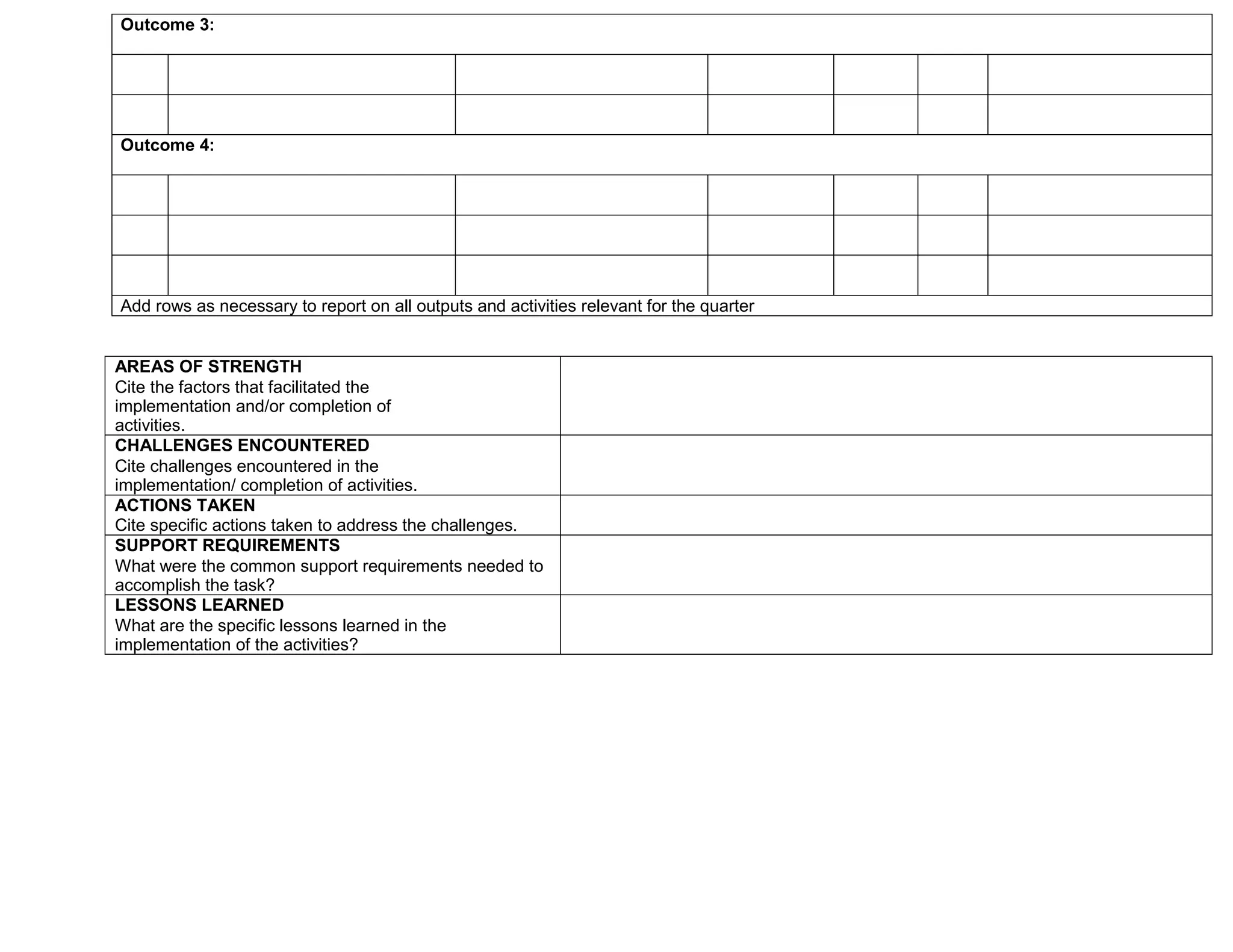
Currently, the project publishes a quarterly newsletter named SLM focus that shares success
stories, and best practices.
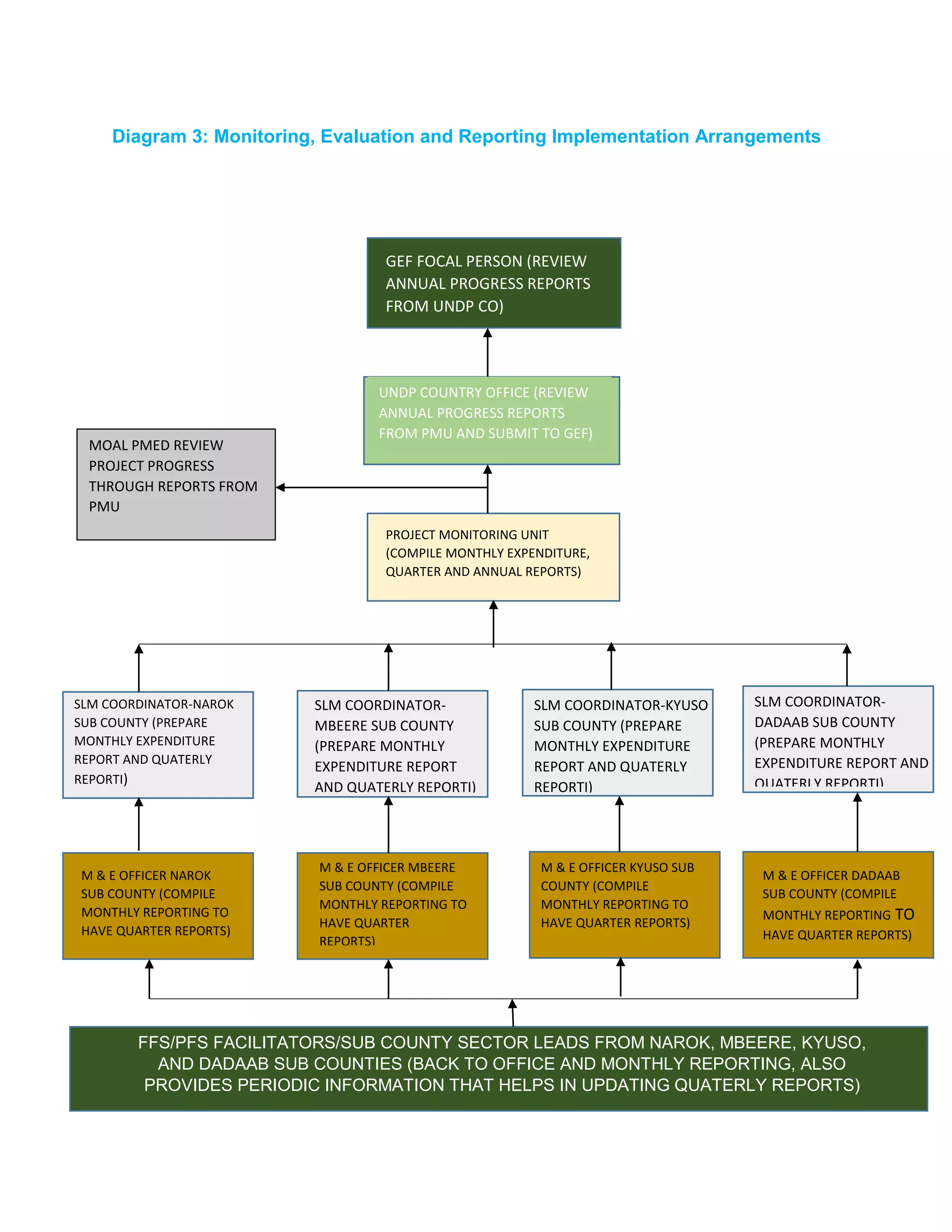
Diagram 3: Monitoring, Evaluation and Reporting Implementation Arrangements
GEF FOCAL PERSON (REVIEW
ANNUAL PROGRESS REPORTS
FROM UNDP CO)
UNDP COUNTRY OFFICE (REVIEW
ANNUAL PROGRESS REPORTS
FROM PMU AND SUBMIT TO GEF)
PROJECT MONITORING UNIT
(COMPILE MONTHLY EXPENDITURE,
QUARTER AND ANNUAL REPORTS)
SLM COORDINATOR-NAROK
SUB COUNTY (PREPARE
MONTHLY EXPENDITURE
REPORT AND QUATERLY
REPORTI)
SLM COORDINATOR-
MBEERE SUB COUNTY
(PREPARE MONTHLY
EXPENDITURE REPORT
AND QUATERLY REPORTI)
SLM COORDINATOR-KYUSO
SUB COUNTY (PREPARE
MONTHLY EXPENDITURE
REPORT AND QUATERLY
REPORTI)
SLM COORDINATOR-
DADAAB SUB COUNTY
(PREPARE MONTHLY
EXPENDITURE REPORT AND
QUATERLY REPORTI)
M & E OFFICER NAROK
SUB COUNTY (COMPILE
MONTHLY REPORTING TO
HAVE QUARTER REPORTS)
M & E OFFICER MBEERE
SUB COUNTY (COMPILE
MONTHLY REPORTING TO
HAVE QUARTER
REPORTS)
M & E OFFICER KYUSO SUB
COUNTY (COMPILE
MONTHLY REPORTING TO
HAVE QUARTER REPORTS)
M & E OFFICER DADAAB
SUB COUNTY (COMPILE
MONTHLY REPORTING TO
HAVE QUARTER REPORTS)
FFS/PFS FACILITATORS/SUB COUNTY SECTOR LEADS FROM NAROK, MBEERE, KYUSO,
AND DADAAB SUB COUNTIES (BACK TO OFFICE AND MONTHLY REPORTING, ALSO
PROVIDES PERIODIC INFORMATION THAT HELPS IN UPDATING QUATERLY REPORTS)
MOAL PMED REVIEW
PROJECT PROGRESS
THROUGH REPORTS FROM
PMU
5.0. M&E OF PROJECT IMPACT
The Project Logical Framework (in the project document) provides performance and impact
indicators for guiding project implementation. Through a process of working with the Project
Management Unit, and project implementers at the sub county levels and these indicators have
been reviewed and revised and their means of verification (assessment methods) specified to
complete the M&E matrix. The resulting M&E matrix is in Annex 2.
5.1 BASELINE DATA AND METHODS
Baseline information such as baseline problem tree/situational analysis, characterization and
evaluation of land management practices and their implication was collected in Narok North,
Kyuso, Mbeere North and Dadaab and PRA processes conducted in a range of agro-ecological
zones and contexts by an interdisciplinary team of experts with community representatives. An
inventory of pertinent studies on soil erosion, extent of burning, soil fertility, productivity, SLM
costs and impacts/benefits, etc. was gathered and reviewed to inform and complement the
baseline for this project.
5.2 IMPACT ASSESSMENT METHODS
Indicators of project impact will be applied at the national, sub county and
catchment/community levels. Major areas identified for impact assessment include:
 Status of land, natural resources and ecosystems, their conservation and capacity for
production of goods and services;
 Evidence of positive changes in the management and use of biodiversity and natural
resources ;
 Improvement in achievement of environmental and livelihood goals – reversing land
degradation, biodiversity conservation, carbon sequestration and enhancing crop and
livestock productivity, reducing poverty, reducing food insecurity and vulnerability;
 Strengthened capacities for integrated sustainable land and agro-ecosystem
management (SLM) at different levels
 Policies reviewed and formulated at the national and sub county level to support SLM
principles and activities
The assessment of project impact will be based on 4 specific and complementary activities
(1) Stakeholder discussion groups and PRA at catchment/community levels around project
components and outputs. These will help to analyse information, identify lessons learnt,
and make recommendations about project implementation, and to assess the changes
brought up by the project;
Example: Case Studies, Focus group discussion with the project participants to assess the
quality of services provided (information, expertise and institutional support) at the field
level.
(2) Household and farm survey with randomly selected FFS members and non-members to
assess livelihoods, agricultural production, resilience and food security;
Example: Survey with farmers in FFS to identify their % of adoption and extent (ha) for
each SLM practice, and benefits of SLM.
(3) Field survey to assess changes in environmental benefits (carbon, biodiversity, tree
density, pasture vegetation cover, water quality and quantity) from SLM interventions;
Example: Field monitoring protocol and land user survey on land degradation/improvement
through LD local indicators, such as : soil properties, soil erosion, soil carbon sampling,
vegetation cover and extent of burning, water resources conditions and availability, habitat
diversity, species/varietal diversity, pest & disease incidence, trends in land/livestock
productivity under different land use types and management practices (controlling for
yearly rainfall difference), livelihoods : income, food security and vulnerability.
(4) Thematic studies undertaken to provide further information on important issues
Examples: SLM technologies and approaches, canopy cover on landscapes before/after
SLM actions, and monitor how SLM practices/approaches contribute to Community action
plans and County development action plans
The different impact assessments shall be done periodically to be included in quarterly reports.
Doing so, the results and recommendations of the impact assessment can feed on to the quarter
and annual reports, use to produce newsletters and bulleting’s on SLM project successes and
documented as knowledge and lessons learnt for project upscaling and dissemination.
5.3 SUSTAINABILITY INDICATORS
Through discussions at the field level, document reviews and discussions with PMU staff, a
simple check list here in developed to help in assessing the project sustainability during
implementation and at the end of the project:
National
 Policies to support SLM principles and activities reviewed
 Best practices and lessons learnt are mainstreamed in development processes, and used
in SLM project upscaling
 SLM information and knowledge generated by the project is available
 SLM practices and approaches are mainstreamed in County agriculture, rangeland and
natural resources action plans
Counties
 SLM action plans are mainstreamed in County Integrated Development Plans, and district
funds are allocated
 Partnership and collaboration continue at County level between different stakeholders
Catchment/Communities
 SLM interventions are maintained by local communities and land owners
 SLM technologies promoted are upscaled by land users and communities
 Charcoal users associations formalized and registered and are using sustainable
charcoal production methods as well as paying levies to county government
FFS/PFS
 FFS/PFS and cooperatives/associations/groups created/supported by the project have
opened bank accounts and are formerly registered
 FFS and cooperatives/associations/groups remain active
 FFS and cooperatives/associations/groups have diversified their activities and are
generating income
6.0. CONCLUSION AND RECOMMENDATIONS
The project M&E is based on the project document and indicators in the log-frame. It has two
main components: project performance, and project impact. Project performance requires the
monitoring of activities and outputs, and his closely related with project execution and planned
activities versus achieved (and budget). Project impact is assessed through the impact and
outcome indicators and through specific and timely assessments, including baseline studies. The
information at the project baseline serves as a basis for monitoring and eventually for impact
assessment at project mid-term and closure.
Some recommendations are as below:
i. M&E focal points established at the sub counties should be strengthened to be effective
in tracking and monitoring activities, especially at field level (catchment/community).
Templates for data collection are provided in annexes, and punctual support for planning
and assessment shall be provided by the PMU and if possible with the help of a
consultant. PMU shall integrate the lessons learnt into their planning, and document
these in their progress reports. Moreover, it is suggested that M&E training on data
collection and participatory impact monitoring shall later be organized to build capacities
of the M&E focal points in regard to M&E for all M & E focal point persons at the sub
county levels. This is suggested to be carried out by the officers from the PMED of State
Department of Livestock.
ii. Considering the project needs partners and co-funding, it would benefit from developing a
clear communication strategy. It is proposed that PMU and Government line ministries
should be proactive in providing information for preparation and dissemination of a
newsletter every three months to update partners on project activities (each newsletter
would have a theme e.g.: selection of the catchments, startup of field activities).
Moreover, the PMU shall be pro-active on proposing specific outputs on which to develop
partnership for SLM implementation and co-funding. It would be important to highlight the
linkages between SLM and climate change adaptation and mitigation, as this can also
generate further funding and partnerships.
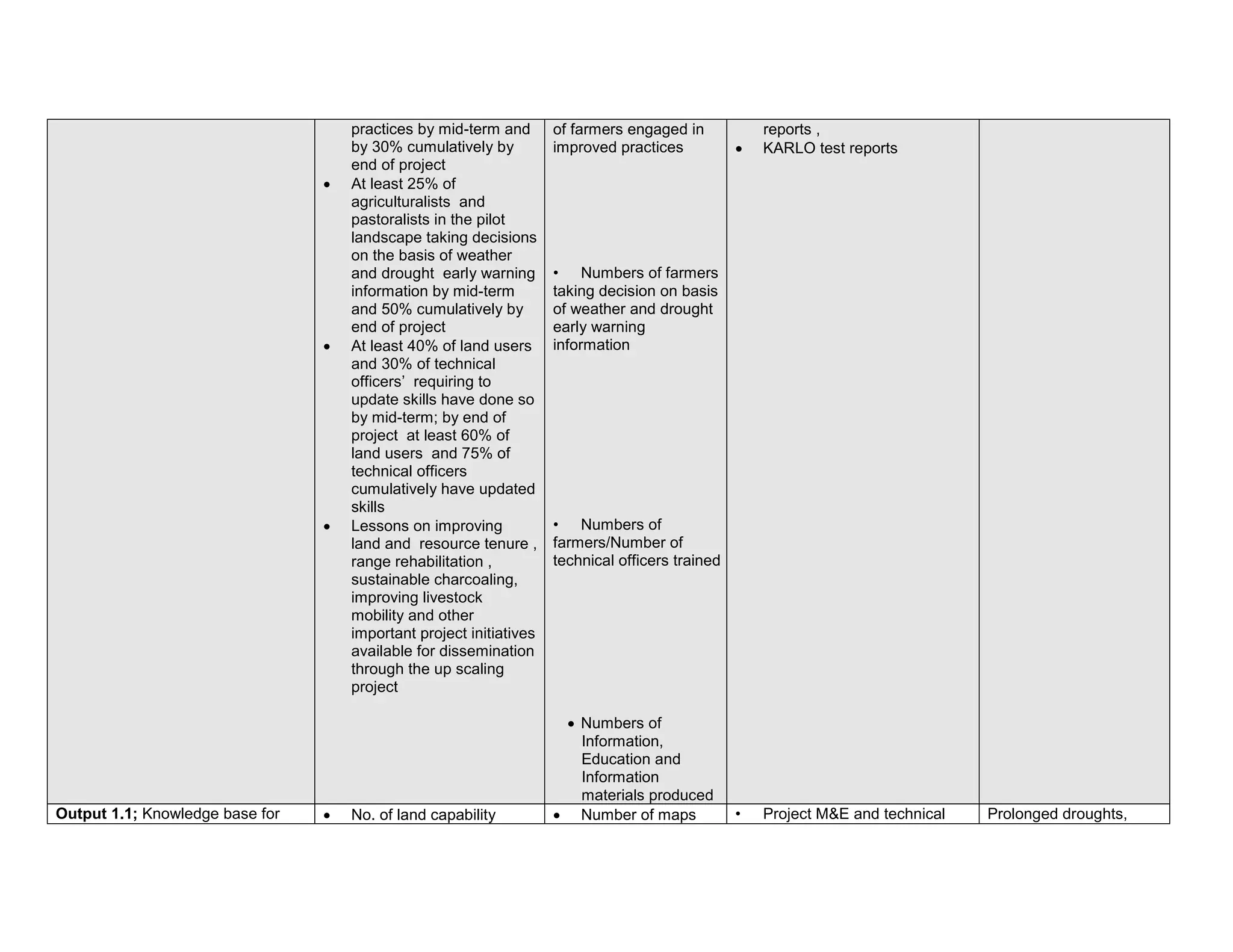
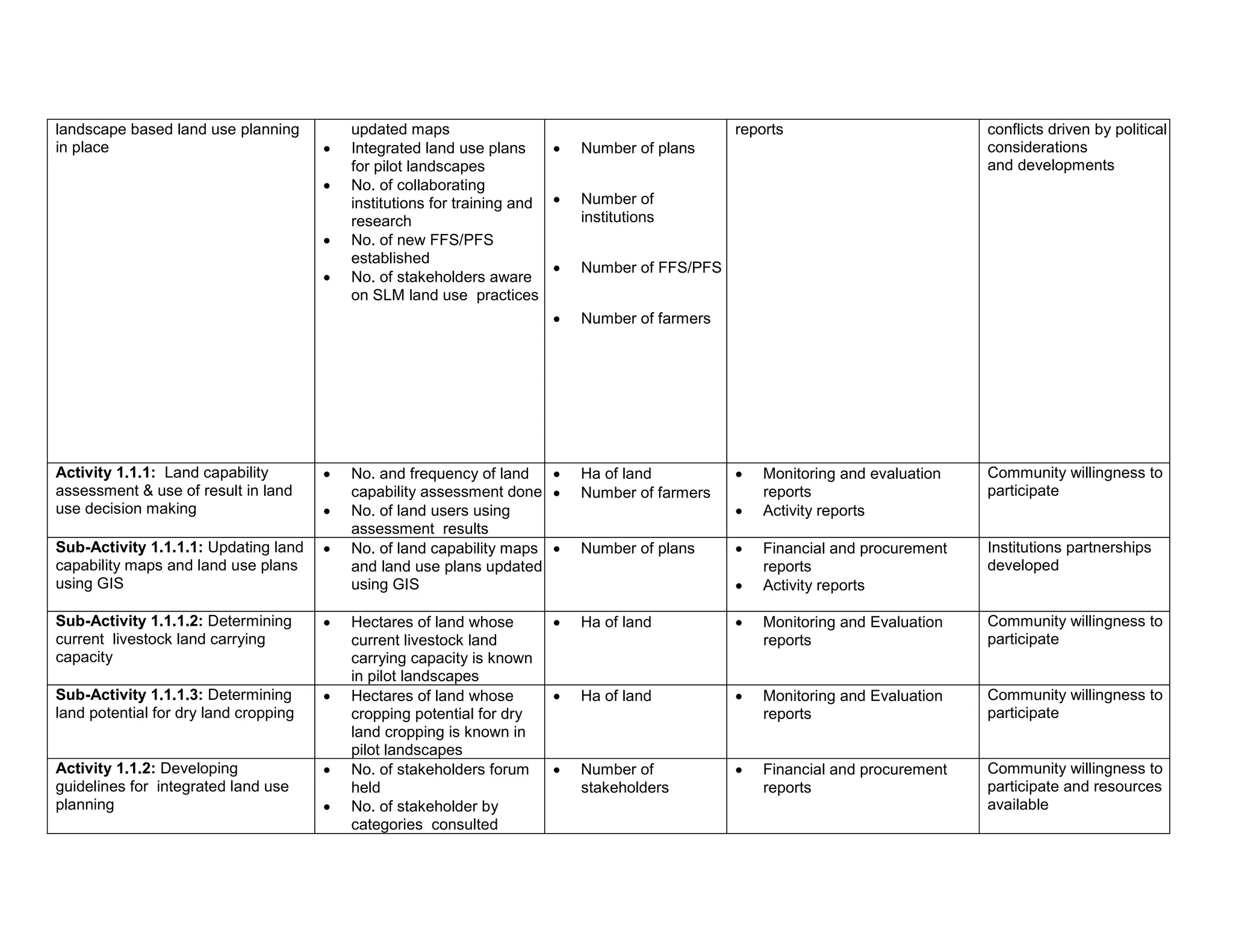
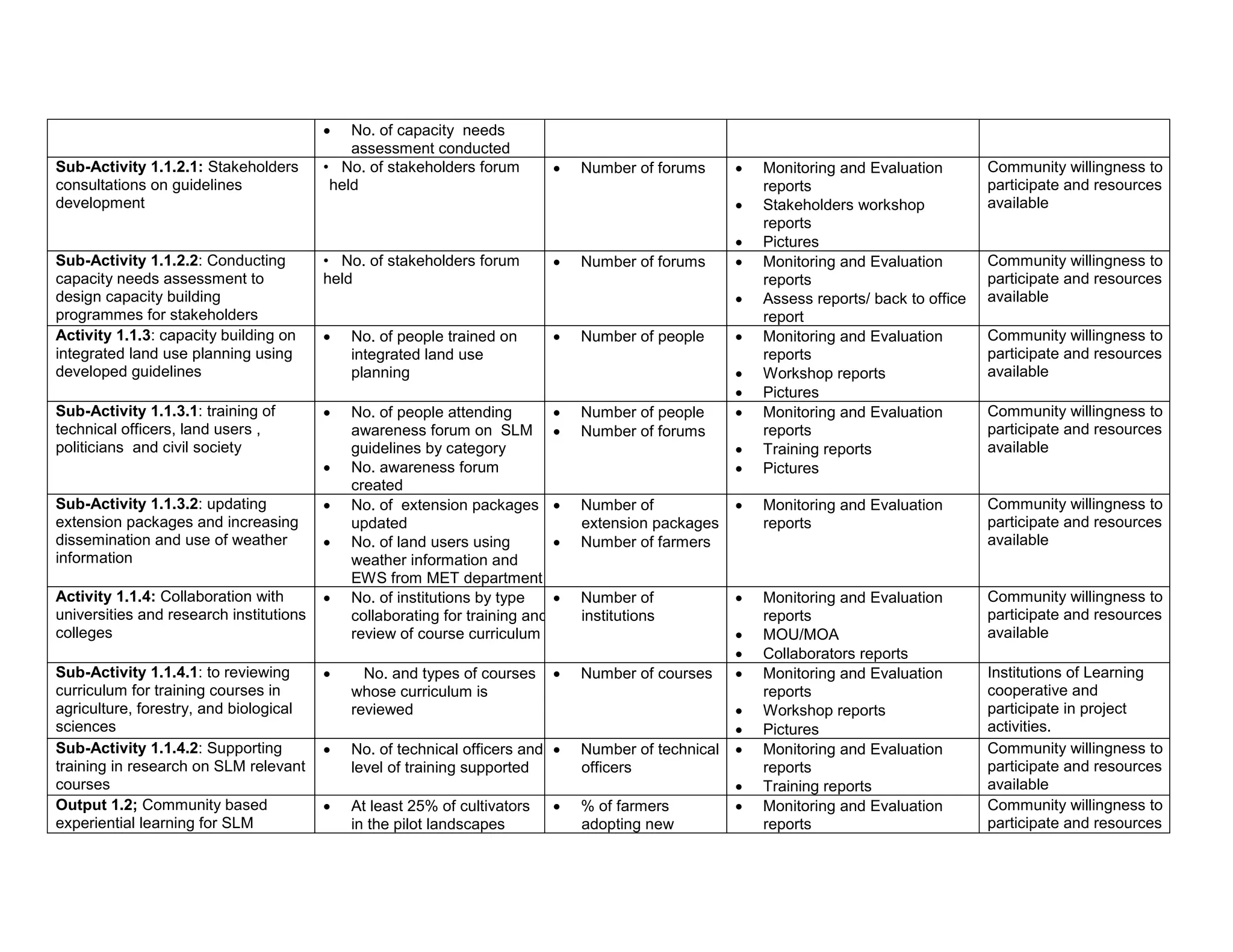
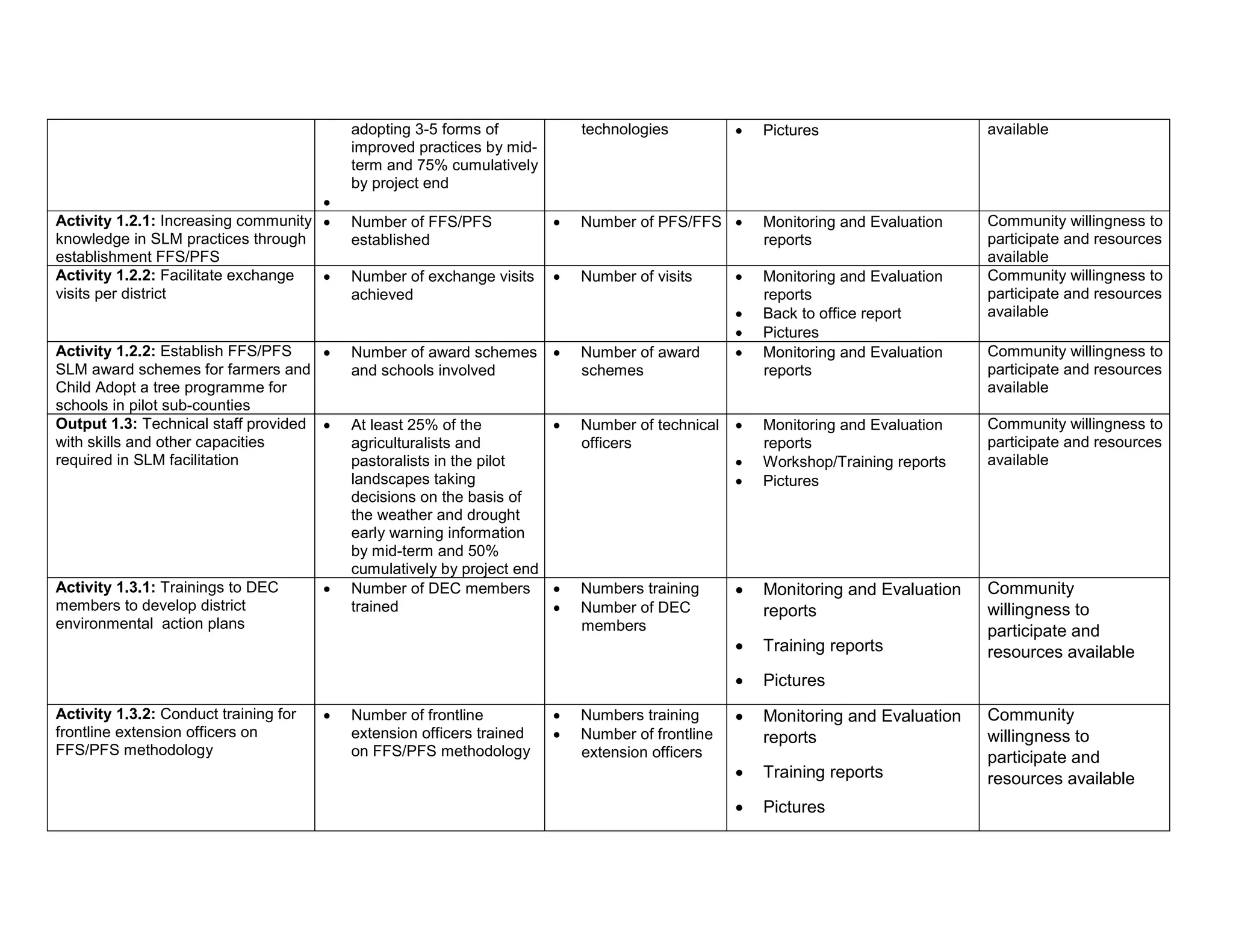
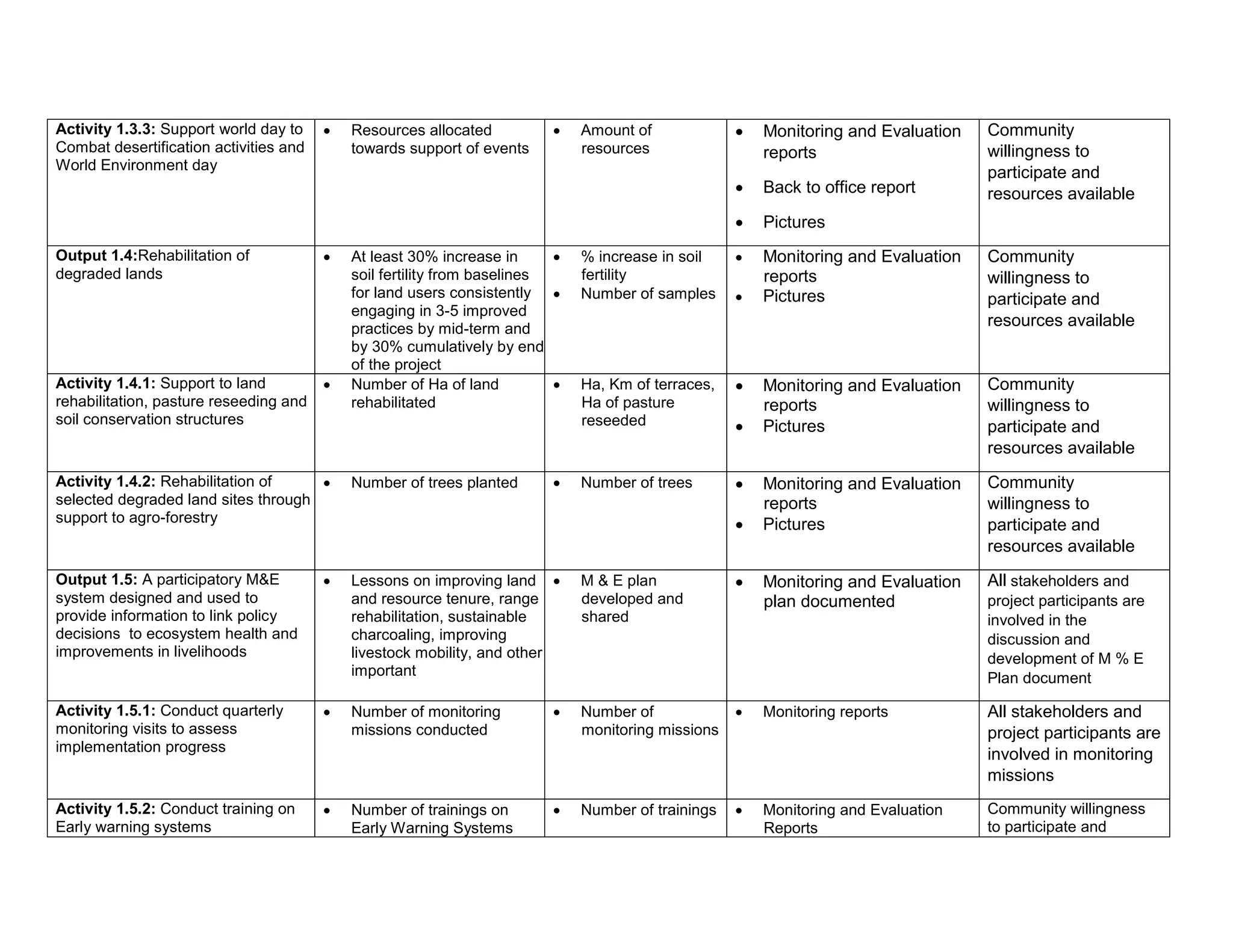
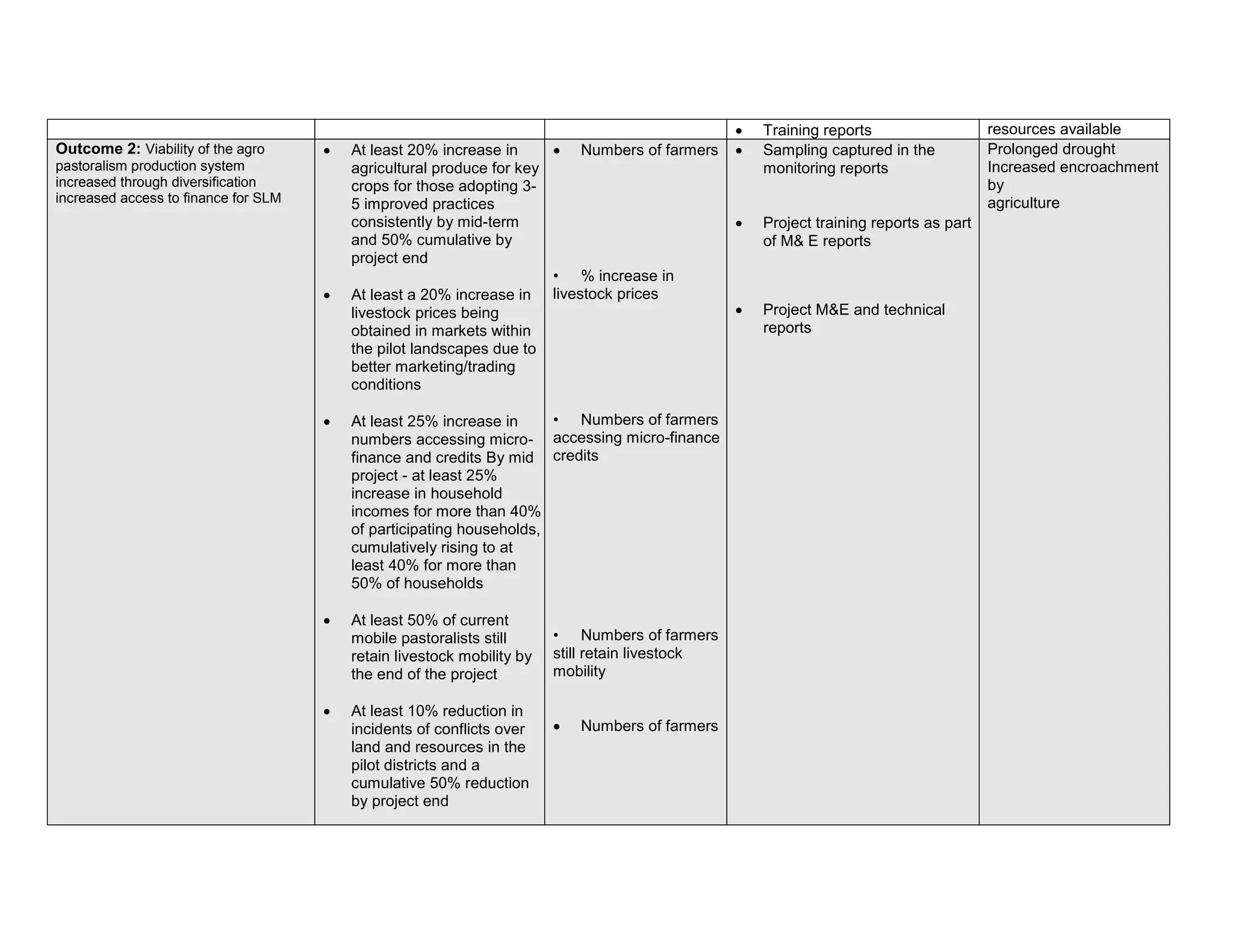
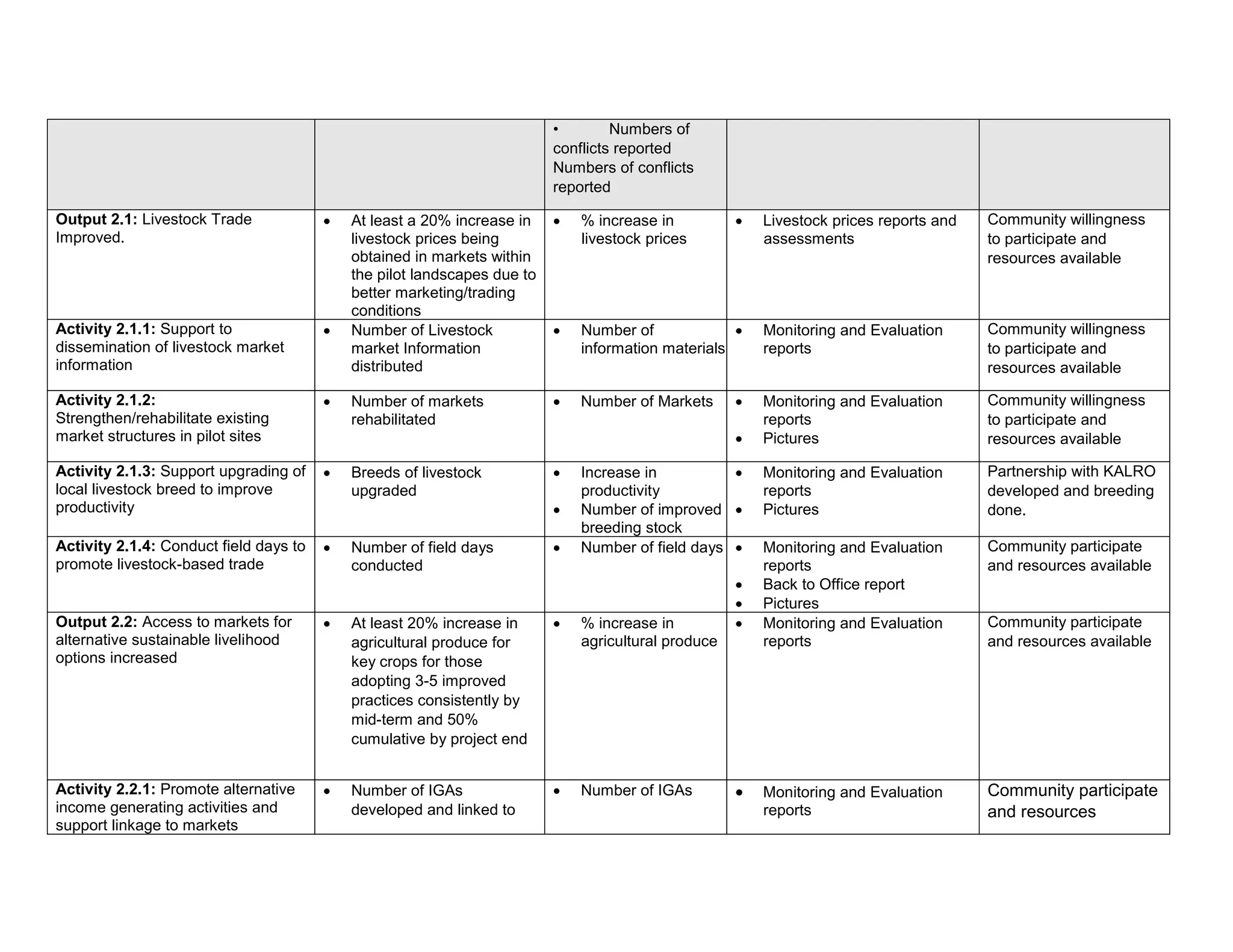
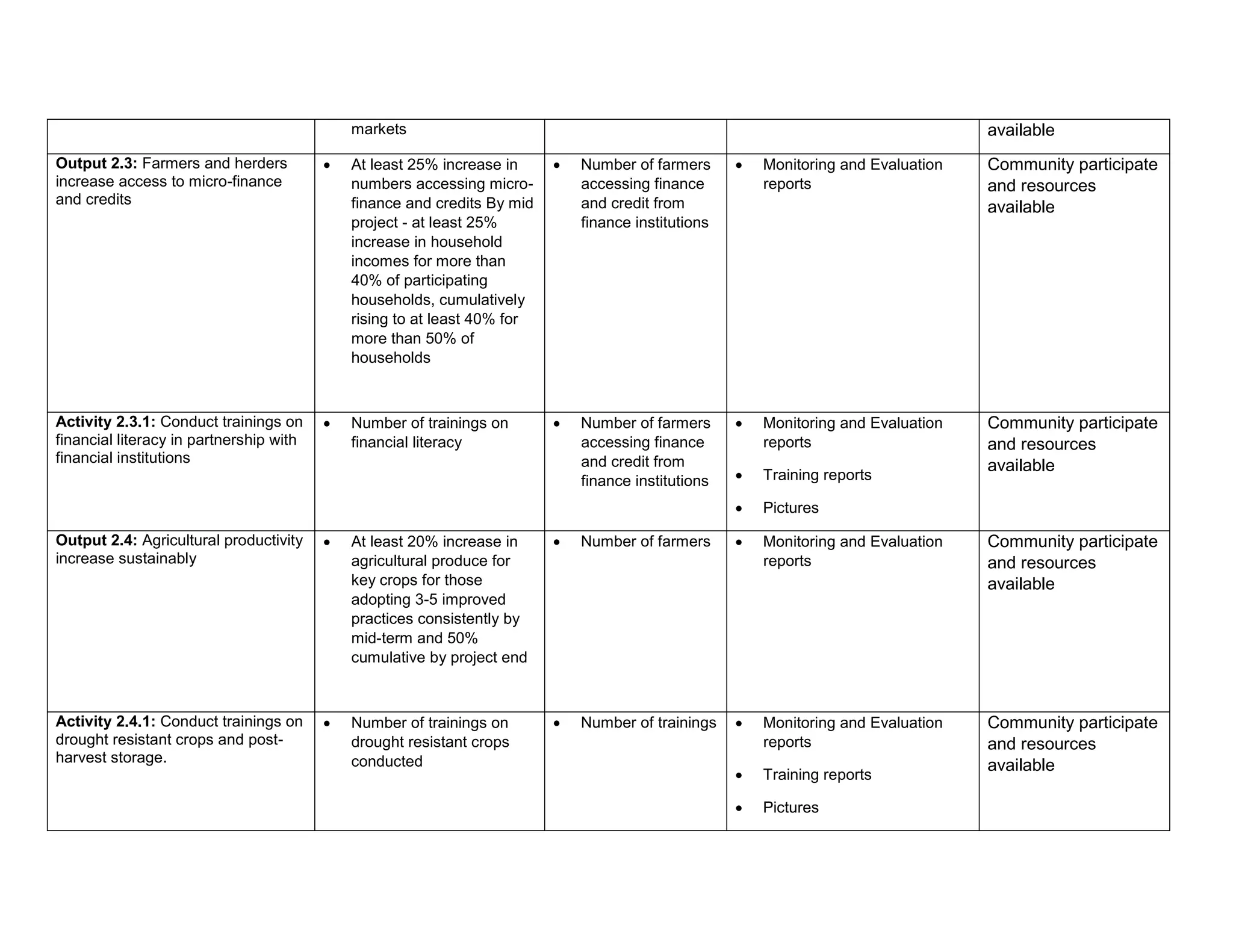
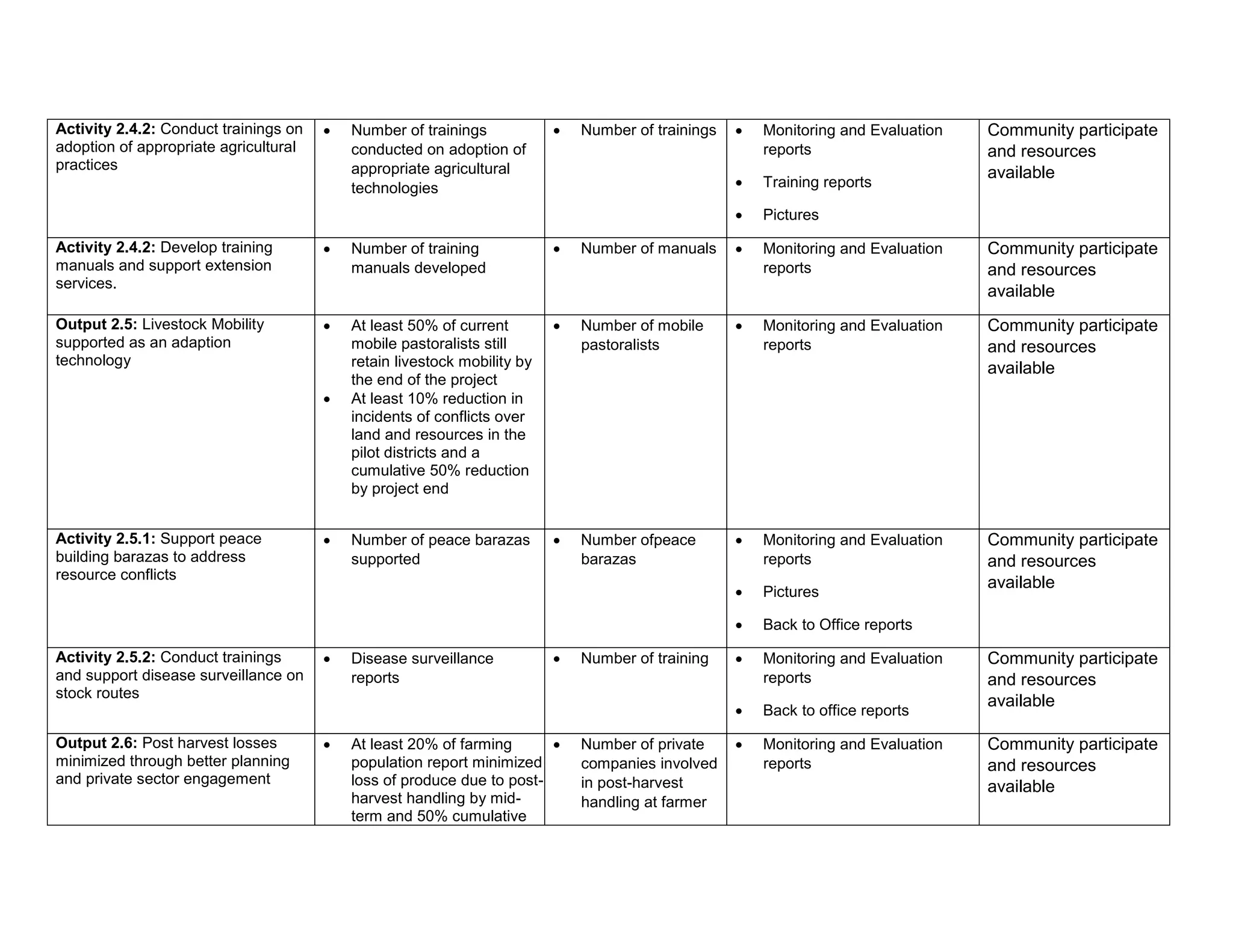
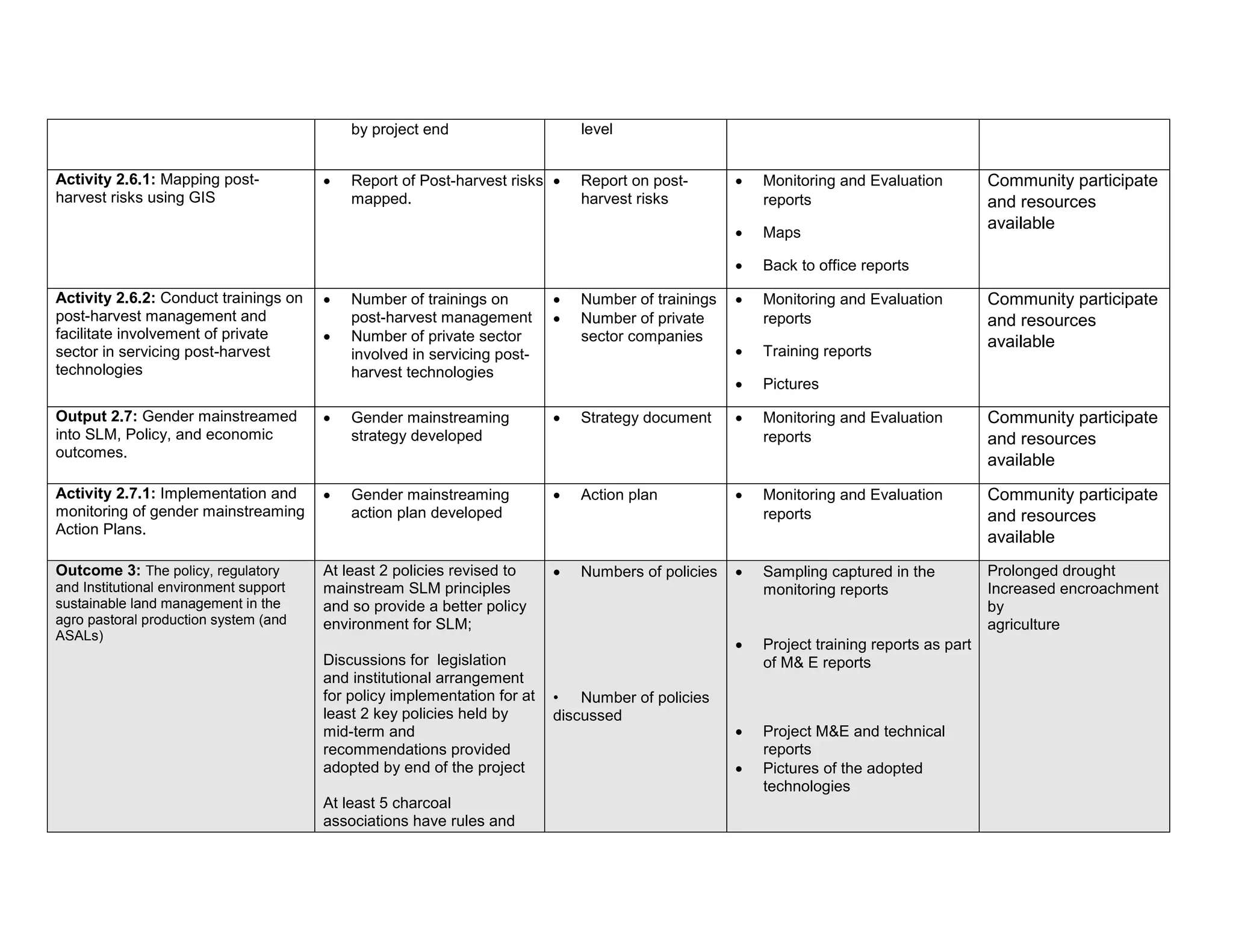
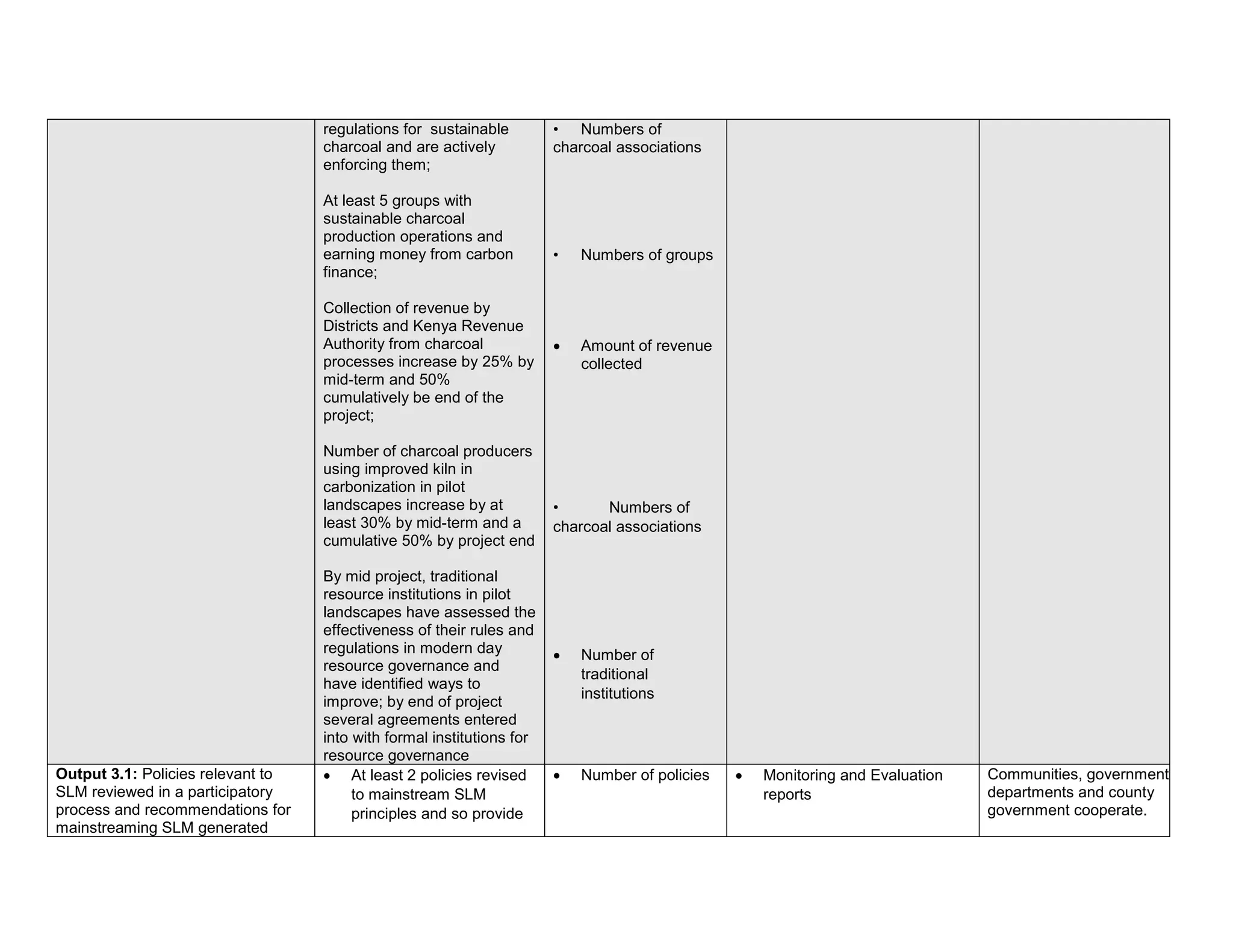
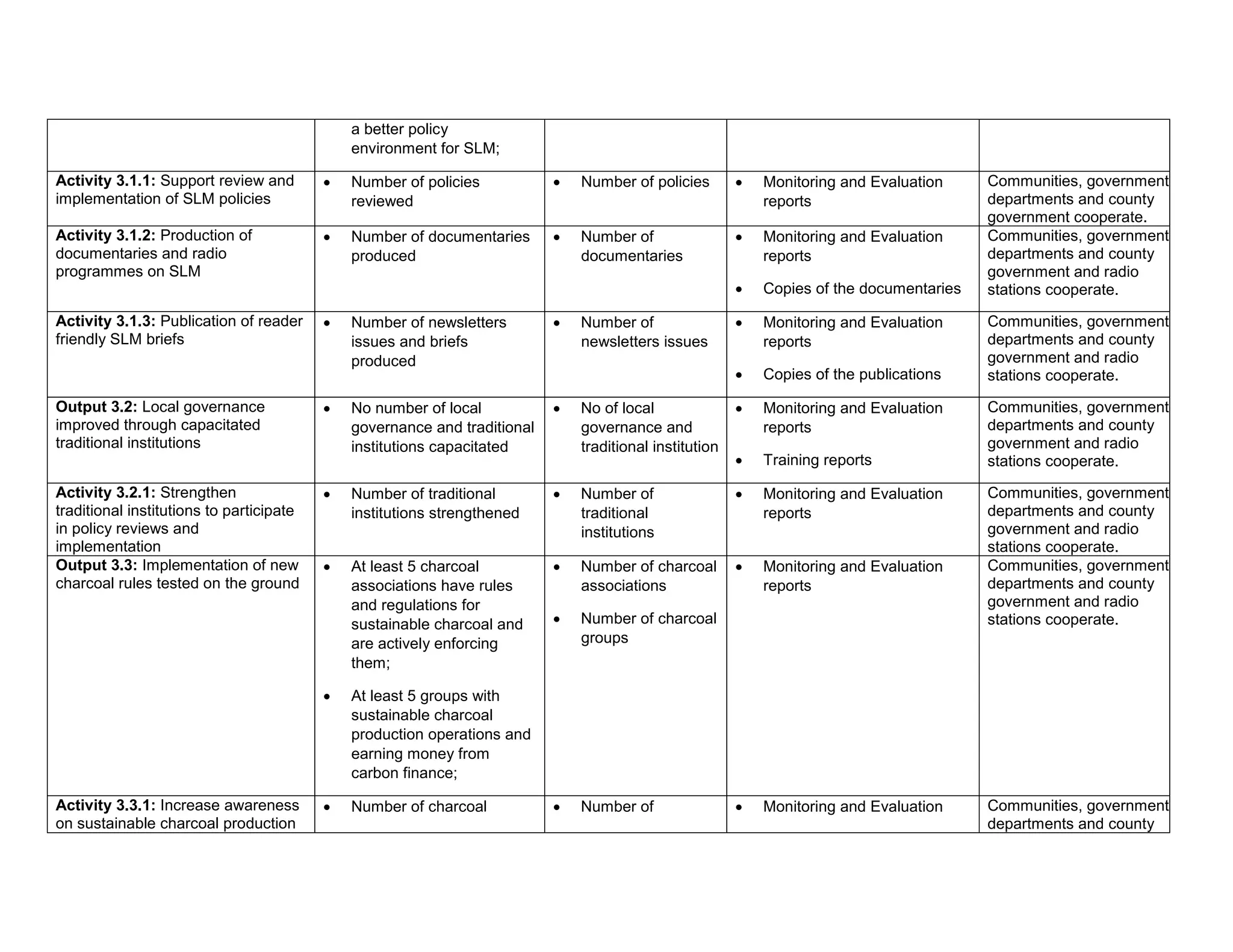
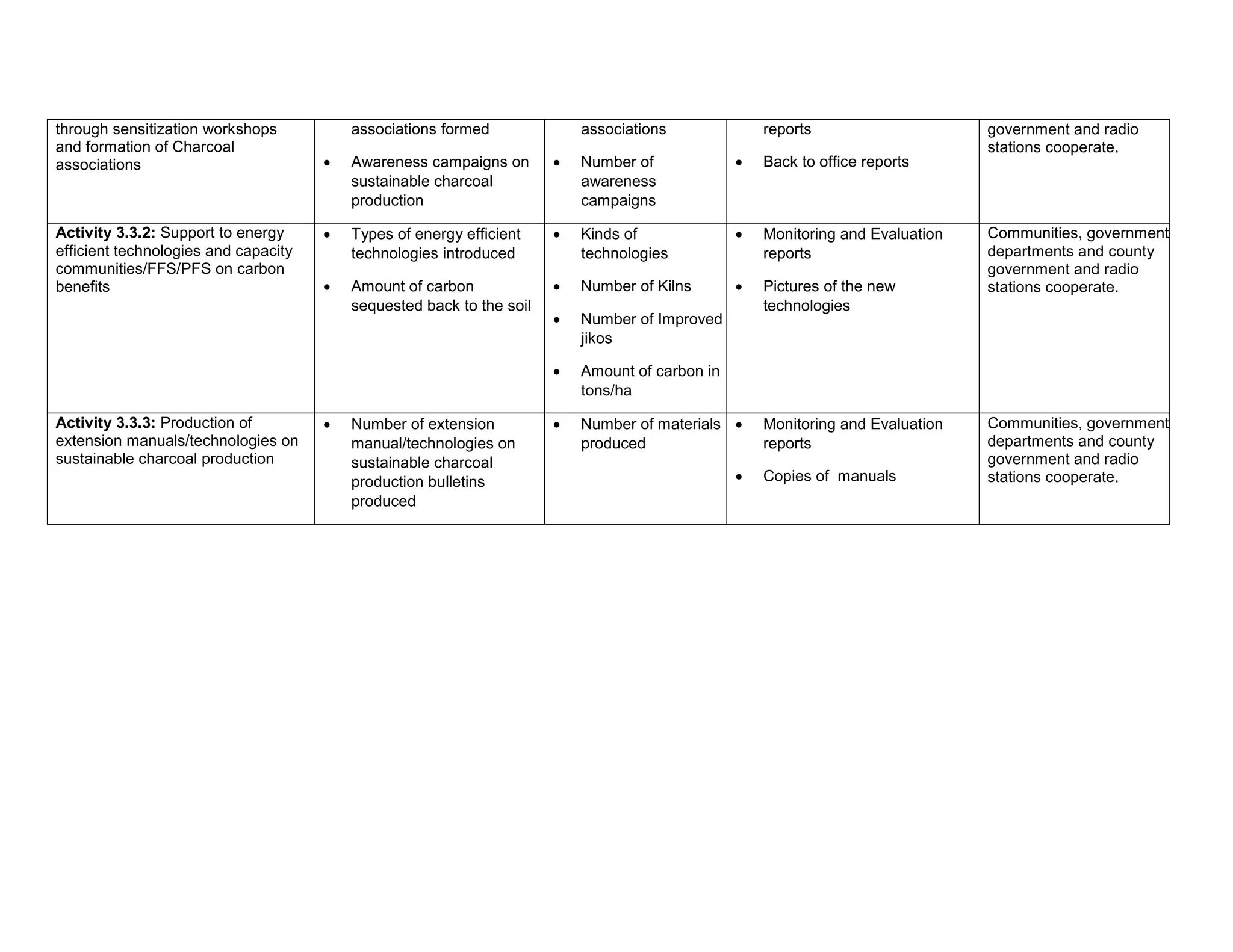
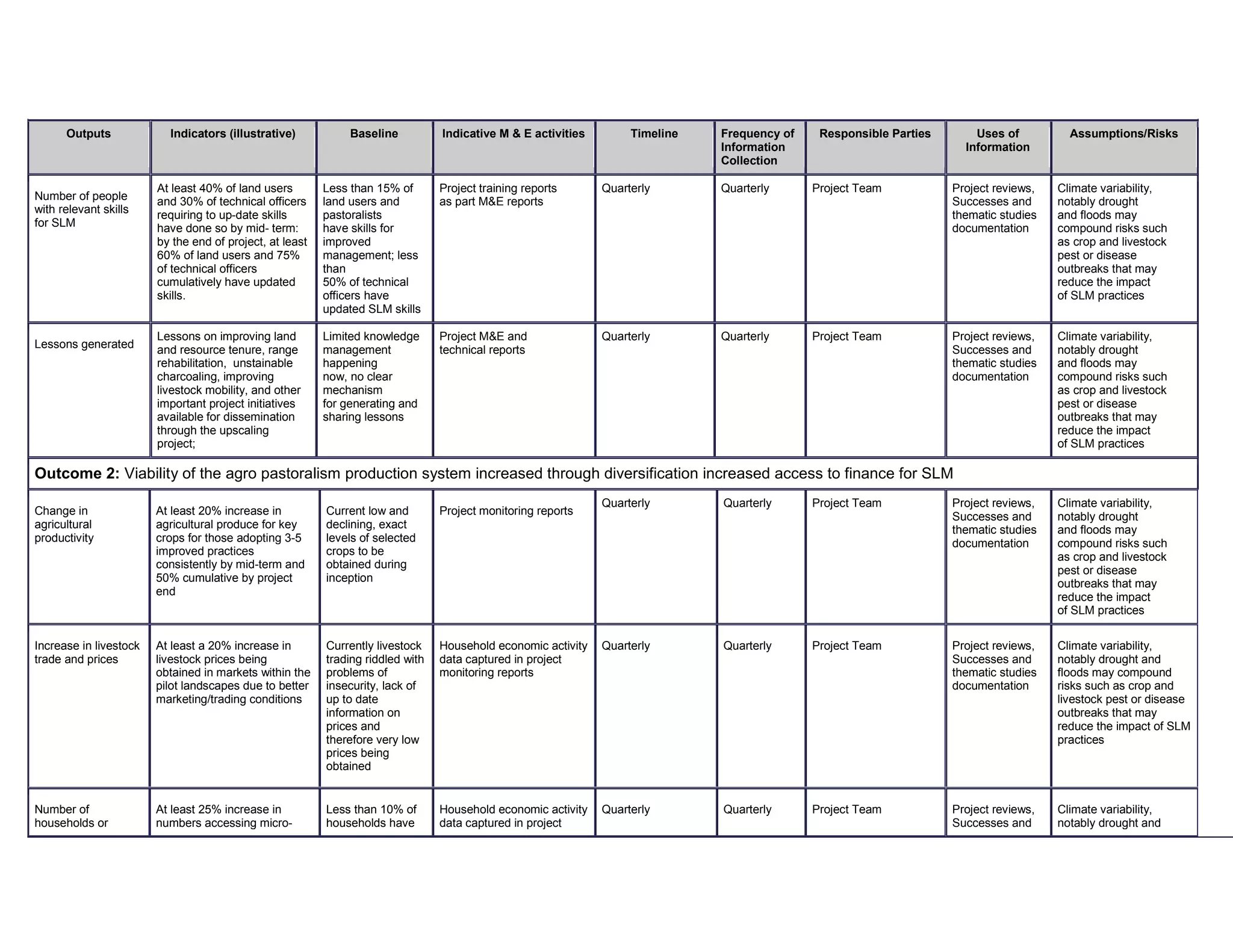
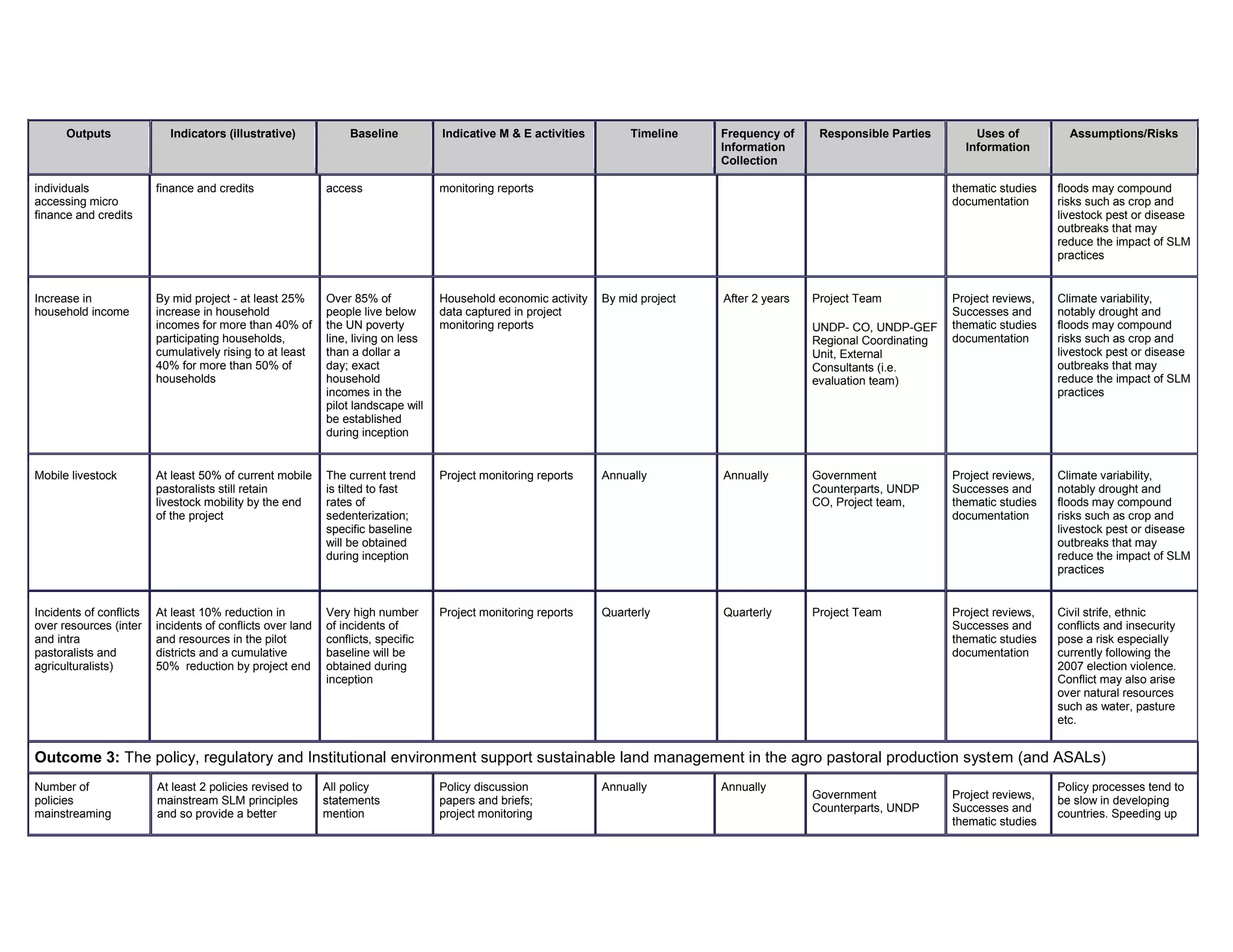
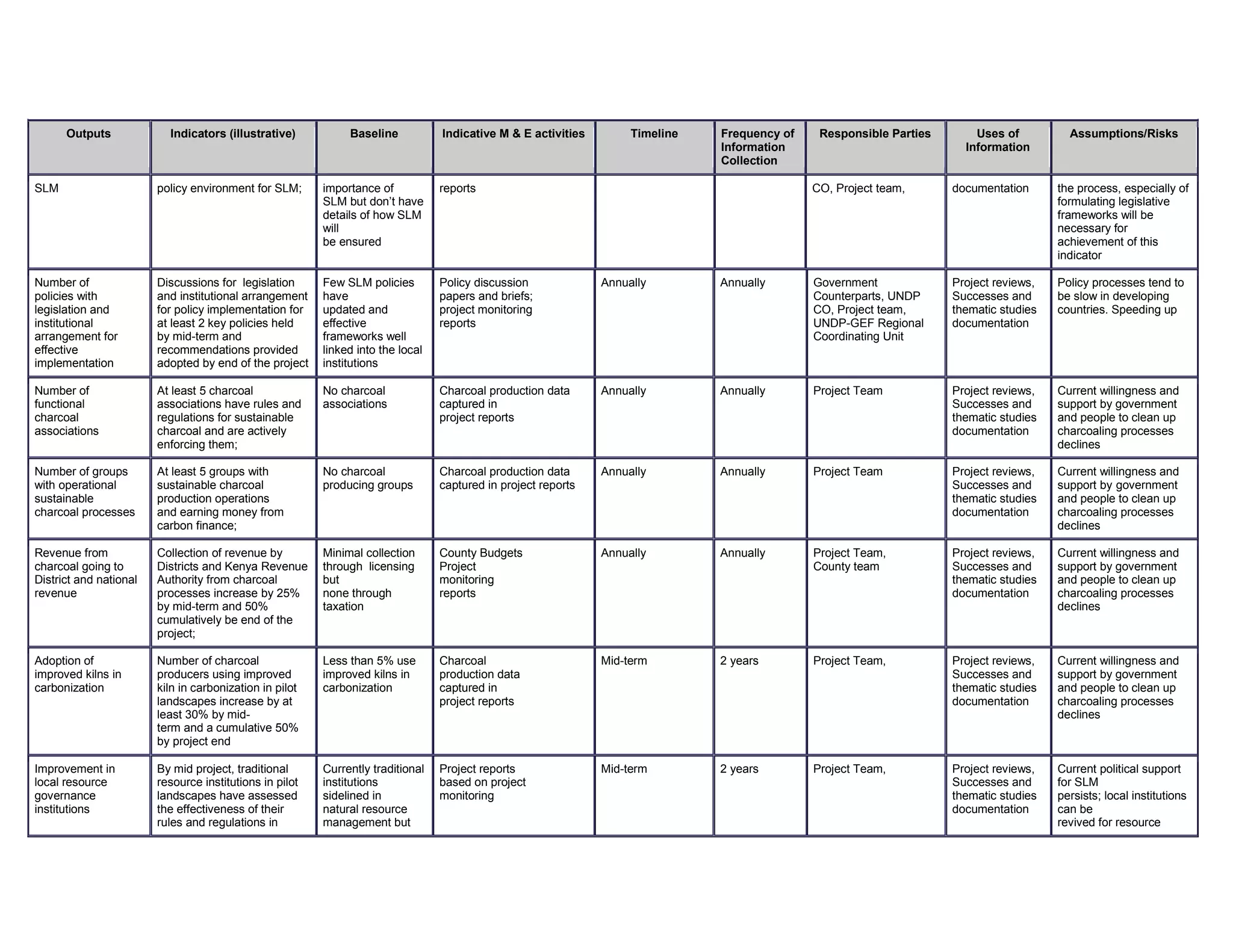
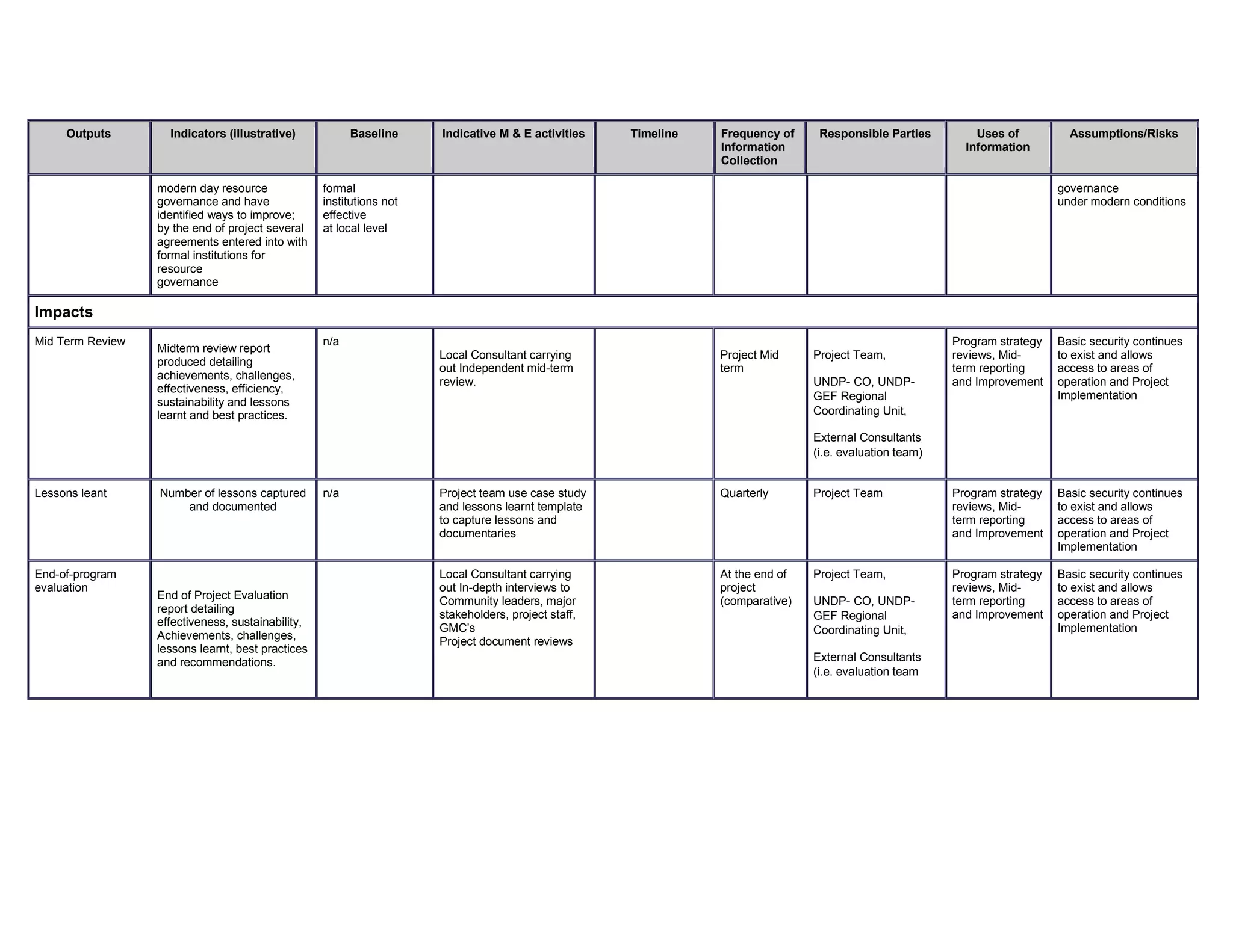
ANNEX 1: STRATEGIC RESULTS FRAMEWORK/LOGICAL FRAMEWORK
The strategic results framework was reviewed and found adequate. Included in the result framework are reviewed indicators and indicator
definition in reference to the Mid-term review, desk research and analysis and discussions by field focal persons.
Results Objectively Verifiable
Indicators (OVIs)
Indicator Definition Means of Verification (MOVs)-
Sources of information/ data -
Sources of information/ data
Risks and Assumptions
Project Goal : “Sustainable Land
Management” provides the basis for
economic development , food
security and sustainable livelihoods
while restoring the ecological
integrity of the ASALs
 Baseline surveys
 Impact studies
 Monitoring and evaluation
reports
 End of project evaluation
report
Prolonged drought
Increased encroachment
by
agriculture
Purpose; To provide land users
and managers with financial
incentives , enabling policy,
institutional and capacity for effective
adoption of SLM in four agro
pastoral districts
 50% of rangeland in the 4
pilot districts register
improvement of range
condition by end of project
 Level of dependency on
food aid in target
landscape reduced by 30%
by the end of project period
 At least 25% of woodlands
showing recovery as
measured by regeneration
and improvement in
species index and canopy
cover
 Ha of Improved
rangeland
 % of households
depending on food
aid
 Number of trees
planted/Types of
species introduced.
 Baseline surveys
 Impact studies
 Monitoring and evaluation
reports
 Mid-term review report
Prolonged drought
Increased encroachment
by
agriculture
Outcome 1: Knowledge based land
use planning forms the basis for
improving drylands sustainable
economic development
 25% of cultivators in pilot
landscapes adopting 3-5
forms of improved
practices by mid-term and
75 cumulatively by project
end
 At least 30% increase in
soil fertility from baselines
for land users consistently
engaging in 3-5 improved
 Numbers of farmers
adopted improved
practices
• Numbers of farmers
 Sampling captured in the
monitoring reports
 Project training reports as part
of M& E reports
 Project M&E and technical
Prolonged drought
Increased encroachment
by
agriculture
practices by mid-term and
by 30% cumulatively by
end of project
 At least 25% of
agriculturalists and
pastoralists in the pilot
landscape taking decisions
on the basis of weather
and drought early warning
information by mid-term
and 50% cumulatively by
end of project
 At least 40% of land users
and 30% of technical
officers’ requiring to
update skills have done so
by mid-term; by end of
project at least 60% of
land users and 75% of
technical officers
cumulatively have updated
skills
 Lessons on improving
land and resource tenure ,
range rehabilitation ,
sustainable charcoaling,
improving livestock
mobility and other
important project initiatives
available for dissemination
through the up scaling
project
of farmers engaged in
improved practices
• Numbers of farmers
taking decision on basis
of weather and drought
early warning
information
• Numbers of
farmers/Number of
technical officers trained
 Numbers of
Information,
Education and
Information
materials produced
reports ,
 KARLO test reports
Output 1.1; Knowledge base for  No. of land capability  Number of maps • Project M&E and technical Prolonged droughts,
landscape based land use planning
in place
updated maps
 Integrated land use plans
for pilot landscapes
 No. of collaborating
institutions for training and
research
 No. of new FFS/PFS
established
 No. of stakeholders aware
on SLM land use practices
 Number of plans
 Number of
institutions
 Number of FFS/PFS
 Number of farmers
reports conflicts driven by political
considerations
and developments
Activity 1.1.1: Land capability
assessment & use of result in land
use decision making
 No. and frequency of land
capability assessment done
 No. of land users using
assessment results
 Ha of land
 Number of farmers
 Monitoring and evaluation
reports
 Activity reports
Community willingness to
participate
Sub-Activity 1.1.1.1: Updating land
capability maps and land use plans
using GIS
 No. of land capability maps
and land use plans updated
using GIS
 Number of plans  Financial and procurement
reports
 Activity reports
Institutions partnerships
developed
Sub-Activity 1.1.1.2: Determining
current livestock land carrying
capacity
 Hectares of land whose
current livestock land
carrying capacity is known
in pilot landscapes
 Ha of land  Monitoring and Evaluation
reports
Community willingness to
participate
Sub-Activity 1.1.1.3: Determining
land potential for dry land cropping
 Hectares of land whose
cropping potential for dry
land cropping is known in
pilot landscapes
 Ha of land  Monitoring and Evaluation
reports
Community willingness to
participate
Activity 1.1.2: Developing
guidelines for integrated land use
planning
 No. of stakeholders forum
held
 No. of stakeholder by
categories consulted
 Number of
stakeholders
 Financial and procurement
reports
Community willingness to
participate and resources
available
 No. of capacity needs
assessment conducted
Sub-Activity 1.1.2.1: Stakeholders
consultations on guidelines
development
• No. of stakeholders forum
held
 Number of forums  Monitoring and Evaluation
reports
 Stakeholders workshop
reports
 Pictures
Community willingness to
participate and resources
available
Sub-Activity 1.1.2.2: Conducting
capacity needs assessment to
design capacity building
programmes for stakeholders
• No. of stakeholders forum
held
 Number of forums  Monitoring and Evaluation
reports
 Assess reports/ back to office
report
Community willingness to
participate and resources
available
Activity 1.1.3: capacity building on
integrated land use planning using
developed guidelines
 No. of people trained on
integrated land use
planning
 Number of people  Monitoring and Evaluation
reports
 Workshop reports
 Pictures
Community willingness to
participate and resources
available
Sub-Activity 1.1.3.1: training of
technical officers, land users ,
politicians and civil society
 No. of people attending
awareness forum on SLM
guidelines by category
 No. awareness forum
created
 Number of people
 Number of forums
 Monitoring and Evaluation
reports
 Training reports
 Pictures
Community willingness to
participate and resources
available
Sub-Activity 1.1.3.2: updating
extension packages and increasing
dissemination and use of weather
information
 No. of extension packages
updated
 No. of land users using
weather information and
EWS from MET department
 Number of
extension packages
 Number of farmers
 Monitoring and Evaluation
reports
Community willingness to
participate and resources
available
Activity 1.1.4: Collaboration with
universities and research institutions
colleges
 No. of institutions by type
collaborating for training and
review of course curriculum
 Number of
institutions
 Monitoring and Evaluation
reports
 MOU/MOA
 Collaborators reports
Community willingness to
participate and resources
available
Sub-Activity 1.1.4.1: to reviewing
curriculum for training courses in
agriculture, forestry, and biological
sciences
 No. and types of courses
whose curriculum is
reviewed
 Number of courses  Monitoring and Evaluation
reports
 Workshop reports
 Pictures
Institutions of Learning
cooperative and
participate in project
activities.
Sub-Activity 1.1.4.2: Supporting
training in research on SLM relevant
courses
 No. of technical officers and
level of training supported
 Number of technical
officers
 Monitoring and Evaluation
reports
 Training reports
Community willingness to
participate and resources
available
Output 1.2; Community based
experiential learning for SLM
 At least 25% of cultivators
in the pilot landscapes
 % of farmers
adopting new
 Monitoring and Evaluation
reports
Community willingness to
participate and resources
adopting 3-5 forms of
improved practices by mid-
term and 75% cumulatively
by project end

technologies  Pictures available
Activity 1.2.1: Increasing community
knowledge in SLM practices through
establishment FFS/PFS
 Number of FFS/PFS
established
 Number of PFS/FFS  Monitoring and Evaluation
reports
Community willingness to
participate and resources
available
Activity 1.2.2: Facilitate exchange
visits per district
 Number of exchange visits
achieved
 Number of visits  Monitoring and Evaluation
reports
 Back to office report
 Pictures
Community willingness to
participate and resources
available
Activity 1.2.2: Establish FFS/PFS
SLM award schemes for farmers and
Child Adopt a tree programme for
schools in pilot sub-counties
 Number of award schemes
and schools involved
 Number of award
schemes
 Monitoring and Evaluation
reports
Community willingness to
participate and resources
available
Output 1.3: Technical staff provided
with skills and other capacities
required in SLM facilitation
 At least 25% of the
agriculturalists and
pastoralists in the pilot
landscapes taking
decisions on the basis of
the weather and drought
early warning information
by mid-term and 50%
cumulatively by project end
 Number of technical
officers
 Monitoring and Evaluation
reports
 Workshop/Training reports
 Pictures
Community willingness to
participate and resources
available
Activity 1.3.1: Trainings to DEC
members to develop district
environmental action plans
 Number of DEC members
trained
 Numbers training
 Number of DEC
members
 Monitoring and Evaluation
reports
 Training reports
 Pictures
Community
willingness to
participate and
resources available
Activity 1.3.2: Conduct training for
frontline extension officers on
FFS/PFS methodology
 Number of frontline
extension officers trained
on FFS/PFS methodology
 Numbers training
 Number of frontline
extension officers
 Monitoring and Evaluation
reports
 Training reports
 Pictures
Community
willingness to
participate and
resources available
Activity 1.3.3: Support world day to
Combat desertification activities and
World Environment day
 Resources allocated
towards support of events
 Amount of
resources
 Monitoring and Evaluation
reports
 Back to office report
 Pictures
Community
willingness to
participate and
resources available
Output 1.4:Rehabilitation of
degraded lands
 At least 30% increase in
soil fertility from baselines
for land users consistently
engaging in 3-5 improved
practices by mid-term and
by 30% cumulatively by end
of the project
 % increase in soil
fertility
 Number of samples
 Monitoring and Evaluation
reports
 Pictures
Community
willingness to
participate and
resources available
Activity 1.4.1: Support to land
rehabilitation, pasture reseeding and
soil conservation structures
 Number of Ha of land
rehabilitated
 Ha, Km of terraces,
Ha of pasture
reseeded
 Monitoring and Evaluation
reports
 Pictures
Community
willingness to
participate and
resources available
Activity 1.4.2: Rehabilitation of
selected degraded land sites through
support to agro-forestry
 Number of trees planted  Number of trees  Monitoring and Evaluation
reports
 Pictures
Community
willingness to
participate and
resources available
Output 1.5: A participatory M&E
system designed and used to
provide information to link policy
decisions to ecosystem health and
improvements in livelihoods
 Lessons on improving land
and resource tenure, range
rehabilitation, sustainable
charcoaling, improving
livestock mobility, and other
important
 M & E plan
developed and
shared
 Monitoring and Evaluation
plan documented
All stakeholders and
project participants are
involved in the
discussion and
development of M % E
Plan document
Activity 1.5.1: Conduct quarterly
monitoring visits to assess
implementation progress
 Number of monitoring
missions conducted
 Number of
monitoring missions
 Monitoring reports All stakeholders and
project participants are
involved in monitoring
missions
Activity 1.5.2: Conduct training on
Early warning systems
 Number of trainings on
Early Warning Systems
 Number of trainings  Monitoring and Evaluation
Reports
Community willingness
to participate and
 Training reports resources available
Outcome 2: Viability of the agro
pastoralism production system
increased through diversification
increased access to finance for SLM
 At least 20% increase in
agricultural produce for key
crops for those adopting 3-
5 improved practices
consistently by mid-term
and 50% cumulative by
project end
 At least a 20% increase in
livestock prices being
obtained in markets within
the pilot landscapes due to
better marketing/trading
conditions
 At least 25% increase in
numbers accessing micro-
finance and credits By mid
project - at least 25%
increase in household
incomes for more than 40%
of participating households,
cumulatively rising to at
least 40% for more than
50% of households
 At least 50% of current
mobile pastoralists still
retain livestock mobility by
the end of the project
 At least 10% reduction in
incidents of conflicts over
land and resources in the
pilot districts and a
cumulative 50% reduction
by project end
 Numbers of farmers
• % increase in
livestock prices
• Numbers of farmers
accessing micro-finance
credits
• Numbers of farmers
still retain livestock
mobility
 Numbers of farmers
 Sampling captured in the
monitoring reports
 Project training reports as part
of M& E reports
 Project M&E and technical
reports
Prolonged drought
Increased encroachment
by
agriculture
• Numbers of
conflicts reported
Numbers of conflicts
reported
Output 2.1: Livestock Trade
Improved.
 At least a 20% increase in
livestock prices being
obtained in markets within
the pilot landscapes due to
better marketing/trading
conditions
 % increase in
livestock prices
 Livestock prices reports and
assessments
Community willingness
to participate and
resources available
Activity 2.1.1: Support to
dissemination of livestock market
information
 Number of Livestock
market Information
distributed
 Number of
information materials
 Monitoring and Evaluation
reports
Community willingness
to participate and
resources available
Activity 2.1.2:
Strengthen/rehabilitate existing
market structures in pilot sites
 Number of markets
rehabilitated
 Number of Markets  Monitoring and Evaluation
reports
 Pictures
Community willingness
to participate and
resources available
Activity 2.1.3: Support upgrading of
local livestock breed to improve
productivity
 Breeds of livestock
upgraded
 Increase in
productivity
 Number of improved
breeding stock
 Monitoring and Evaluation
reports
 Pictures
Partnership with KALRO
developed and breeding
done.
Activity 2.1.4: Conduct field days to
promote livestock-based trade
 Number of field days
conducted
 Number of field days  Monitoring and Evaluation
reports
 Back to Office report
 Pictures
Community participate
and resources available
Output 2.2: Access to markets for
alternative sustainable livelihood
options increased
 At least 20% increase in
agricultural produce for
key crops for those
adopting 3-5 improved
practices consistently by
mid-term and 50%
cumulative by project end
 % increase in
agricultural produce
 Monitoring and Evaluation
reports
Community participate
and resources available
Activity 2.2.1: Promote alternative
income generating activities and
support linkage to markets
 Number of IGAs
developed and linked to
 Number of IGAs  Monitoring and Evaluation
reports
Community participate
and resources
markets available
Output 2.3: Farmers and herders
increase access to micro-finance
and credits
 At least 25% increase in
numbers accessing micro-
finance and credits By mid
project - at least 25%
increase in household
incomes for more than
40% of participating
households, cumulatively
rising to at least 40% for
more than 50% of
households
 Number of farmers
accessing finance
and credit from
finance institutions
 Monitoring and Evaluation
reports
Community participate
and resources
available
Activity 2.3.1: Conduct trainings on
financial literacy in partnership with
financial institutions
 Number of trainings on
financial literacy
 Number of farmers
accessing finance
and credit from
finance institutions
 Monitoring and Evaluation
reports
 Training reports
 Pictures
Community participate
and resources
available
Output 2.4: Agricultural productivity
increase sustainably
 At least 20% increase in
agricultural produce for
key crops for those
adopting 3-5 improved
practices consistently by
mid-term and 50%
cumulative by project end
 Number of farmers  Monitoring and Evaluation
reports
Community participate
and resources
available
Activity 2.4.1: Conduct trainings on
drought resistant crops and post-
harvest storage.
 Number of trainings on
drought resistant crops
conducted
 Number of trainings  Monitoring and Evaluation
reports
 Training reports
 Pictures
Community participate
and resources
available
Activity 2.4.2: Conduct trainings on
adoption of appropriate agricultural
practices
 Number of trainings
conducted on adoption of
appropriate agricultural
technologies
 Number of trainings  Monitoring and Evaluation
reports
 Training reports
 Pictures
Community participate
and resources
available
Activity 2.4.2: Develop training
manuals and support extension
services.
 Number of training
manuals developed
 Number of manuals  Monitoring and Evaluation
reports
Community participate
and resources
available
Output 2.5: Livestock Mobility
supported as an adaption
technology
 At least 50% of current
mobile pastoralists still
retain livestock mobility by
the end of the project
 At least 10% reduction in
incidents of conflicts over
land and resources in the
pilot districts and a
cumulative 50% reduction
by project end
 Number of mobile
pastoralists
 Monitoring and Evaluation
reports
Community participate
and resources
available
Activity 2.5.1: Support peace
building barazas to address
resource conflicts
 Number of peace barazas
supported
 Number ofpeace
barazas
 Monitoring and Evaluation
reports
 Pictures
 Back to Office reports
Community participate
and resources
available
Activity 2.5.2: Conduct trainings
and support disease surveillance on
stock routes
 Disease surveillance
reports
 Number of training  Monitoring and Evaluation
reports
 Back to office reports
Community participate
and resources
available
Output 2.6: Post harvest losses
minimized through better planning
and private sector engagement
 At least 20% of farming
population report minimized
loss of produce due to post-
harvest handling by mid-
term and 50% cumulative
 Number of private
companies involved
in post-harvest
handling at farmer
 Monitoring and Evaluation
reports
Community participate
and resources
available
by project end level
Activity 2.6.1: Mapping post-
harvest risks using GIS
 Report of Post-harvest risks
mapped.
 Report on post-
harvest risks
 Monitoring and Evaluation
reports
 Maps
 Back to office reports
Community participate
and resources
available
Activity 2.6.2: Conduct trainings on
post-harvest management and
facilitate involvement of private
sector in servicing post-harvest
technologies
 Number of trainings on
post-harvest management
 Number of private sector
involved in servicing post-
harvest technologies
 Number of trainings
 Number of private
sector companies
 Monitoring and Evaluation
reports
 Training reports
 Pictures
Community participate
and resources
available
Output 2.7: Gender mainstreamed
into SLM, Policy, and economic
outcomes.
 Gender mainstreaming
strategy developed
 Strategy document  Monitoring and Evaluation
reports
Community participate
and resources
available
Activity 2.7.1: Implementation and
monitoring of gender mainstreaming
Action Plans.
 Gender mainstreaming
action plan developed
 Action plan  Monitoring and Evaluation
reports
Community participate
and resources
available
Outcome 3: The policy, regulatory
and Institutional environment support
sustainable land management in the
agro pastoral production system (and
ASALs)
At least 2 policies revised to
mainstream SLM principles
and so provide a better policy
environment for SLM;
Discussions for legislation
and institutional arrangement
for policy implementation for at
least 2 key policies held by
mid-term and
recommendations provided
adopted by end of the project
At least 5 charcoal
associations have rules and
 Numbers of policies
• Number of policies
discussed
 Sampling captured in the
monitoring reports
 Project training reports as part
of M& E reports
 Project M&E and technical
reports
 Pictures of the adopted
technologies
Prolonged drought
Increased encroachment
by
agriculture
regulations for sustainable
charcoal and are actively
enforcing them;
At least 5 groups with
sustainable charcoal
production operations and
earning money from carbon
finance;
Collection of revenue by
Districts and Kenya Revenue
Authority from charcoal
processes increase by 25% by
mid-term and 50%
cumulatively be end of the
project;
Number of charcoal producers
using improved kiln in
carbonization in pilot
landscapes increase by at
least 30% by mid-term and a
cumulative 50% by project end
By mid project, traditional
resource institutions in pilot
landscapes have assessed the
effectiveness of their rules and
regulations in modern day
resource governance and
have identified ways to
improve; by end of project
several agreements entered
into with formal institutions for
resource governance
• Numbers of
charcoal associations
• Numbers of groups
 Amount of revenue
collected
• Numbers of
charcoal associations
 Number of
traditional
institutions
Output 3.1: Policies relevant to
SLM reviewed in a participatory
process and recommendations for
mainstreaming SLM generated
 At least 2 policies revised
to mainstream SLM
principles and so provide
 Number of policies  Monitoring and Evaluation
reports
Communities, government
departments and county
government cooperate.
a better policy
environment for SLM;
Activity 3.1.1: Support review and
implementation of SLM policies
 Number of policies
reviewed
 Number of policies  Monitoring and Evaluation
reports
Communities, government
departments and county
government cooperate.
Activity 3.1.2: Production of
documentaries and radio
programmes on SLM
 Number of documentaries
produced
 Number of
documentaries
 Monitoring and Evaluation
reports
 Copies of the documentaries
Communities, government
departments and county
government and radio
stations cooperate.
Activity 3.1.3: Publication of reader
friendly SLM briefs
 Number of newsletters
issues and briefs
produced
 Number of
newsletters issues
 Monitoring and Evaluation
reports
 Copies of the publications
Communities, government
departments and county
government and radio
stations cooperate.
Output 3.2: Local governance
improved through capacitated
traditional institutions
 No number of local
governance and traditional
institutions capacitated
 No of local
governance and
traditional institution
 Monitoring and Evaluation
reports
 Training reports
Communities, government
departments and county
government and radio
stations cooperate.
Activity 3.2.1: Strengthen
traditional institutions to participate
in policy reviews and
implementation
 Number of traditional
institutions strengthened
 Number of
traditional
institutions
 Monitoring and Evaluation
reports
Communities, government
departments and county
government and radio
stations cooperate.
Output 3.3: Implementation of new
charcoal rules tested on the ground
 At least 5 charcoal
associations have rules
and regulations for
sustainable charcoal and
are actively enforcing
them;
 At least 5 groups with
sustainable charcoal
production operations and
earning money from
carbon finance;
 Number of charcoal
associations
 Number of charcoal
groups
 Monitoring and Evaluation
reports
Communities, government
departments and county
government and radio
stations cooperate.
Activity 3.3.1: Increase awareness
on sustainable charcoal production
 Number of charcoal  Number of  Monitoring and Evaluation Communities, government
departments and county
through sensitization workshops
and formation of Charcoal
associations
associations formed
 Awareness campaigns on
sustainable charcoal
production
associations
 Number of
awareness
campaigns
reports
 Back to office reports
government and radio
stations cooperate.
Activity 3.3.2: Support to energy
efficient technologies and capacity
communities/FFS/PFS on carbon
benefits
 Types of energy efficient
technologies introduced
 Amount of carbon
sequested back to the soil
 Kinds of
technologies
 Number of Kilns
 Number of Improved
jikos
 Amount of carbon in
tons/ha
 Monitoring and Evaluation
reports
 Pictures of the new
technologies
Communities, government
departments and county
government and radio
stations cooperate.
Activity 3.3.3: Production of
extension manuals/technologies on
sustainable charcoal production
 Number of extension
manual/technologies on
sustainable charcoal
production bulletins
produced
 Number of materials
produced
 Monitoring and Evaluation
reports
 Copies of manuals
Communities, government
departments and county
government and radio
stations cooperate.
ANNEX 2: M&E MATRIX
Monitoring and Evaluation Plan for SLM Project-Kenya.
I. Key Evaluation Questions
Baseline Context: What is the current context in the status of land, natural resources and ecosystems, their conservation and capacity for
production of goods and services?
Needs: What are the evidence of positive changes in the management and use of biodiversity and natural resources?
Inputs: Have correct, sufficient and appropriate interventions been designed? Are there sufficient human and financial resources and
leadership support to design and implement them?
Processes/Implementation: How well is the project proceeding: are all inputs, processes and outputs on track and are milestones being
met? What is the quality of training and advocacy processes being implemented? To what extent are key stakeholders providing support
and involvement needed to achieve results?
Outputs: Has the community acquired new knowledge and skills as a result of training? Have supervisory visits and work environment
improvements taken place?
Effects: To what extent did the indicators showing the difference between desired and actual performance change as a result of the
interventions that were implemented? To what extent has SLM principles adopted?
Impacts: To what extent have desired strategic results been achieved? How satisfied are the catchment community with performance
improvements? How effective was the project implementation and what lessons/best practices can be derived? How sustainable is the
process?
II. Monitoring and Evaluation Plan
Outputs Indicators (illustrative) Baseline Indicative M & E activities Timeline Frequency of
Information
Collection
Responsible Parties Uses of
Information
Assumptions/Risks
Project Goal: Sustainable Land Management” provides the basis for economic development , food security and sustainable livelihoods while restoring the ecological
integrity of the ASALs
Project purpose: To provide land users and managers with financial incentives , enabling policy, institutional and capacity for effective adoption of SLM in four agro
pastoral districts
Improvement in
rangeland
condition
At least 25% of the
rangeland registering
improvement in rangeland
condition in pilot districts
(using range condition
measurements) by mid-term
and 50% cumulative by end
of the project
Various statistics
report that about
80% of rangelands
badly degraded
Various statistics
report that about
70% of the
woodlands are
degraded
Baseline report augmented
by rangeland condition
sampling under the M&E
system Project reports
through documentaries
Annually Before and
after activity
implementatio
n
Project Team
UNDP-CO
Project reviews,
Successes and
thematic studies
documentation
The traditional coping
mechanisms
among agropastoralists
to deal with
climate variability are
compromised by
immigration, barriers to
mobility, and
by perverse markets
Improvement in
food security
Level of dependency on food
aid in target landscapes
reduced by at
least 30%;
Number of food secure days
increased by at least 40% for
more than 50% of the
population in the
target landscapes
Various statistics
indicate that over
65% of people in
ASAL depend in
part on food aid
and face
substantive food
insecurity
Socio-economic baselines
and consequent sample
assessments and project
reports captured from the
field
Annually Annually Project Team
UNDP-CO
Project reviews,
Successes and
thematic studies
documentation
The traditional coping
mechanisms
among agropastoralists
to deal with
climate variability are
compromised by
immigration, barriers to
mobility, and
by perverse markets
Carbon mitigated
from sustainable
charcoaling
At least half a million tons of
carbon dioxide mitigated
from sustainable charcoal in
the districts by mid-term and
a million cumulative at the
end of the project
Currently no
sustainable
charcoaling – no
carbon
mitigated from it
Reports of the charcoal
associations on extent
of adoption of
sustainable charcoal
augmented by records
of carbon credits ready
for sale and/or sold
Quarterly Quarterly Project team Project reviews,
Successes and
thematic studies
documentation
Climate variability,
notably drought
and floods may
compound risks such
as crop and livestock
pest or disease
outbreaks that may
reduce the impact
of SLM practices
Improvement in
woodlands
condition
At least 25% of woodlands
showing
recovery as measured by
regeneration and
improvements in
Various statistics
report that about
70% of the
woodlands are
Baseline report augmented
by ecological sampling
under the M&E system
linked; Project reports
Quarterly Quarterly Project team Project reviews,
Successes and
thematic studies
documentation
Climate variability,
notably drought
and floods may
compound risks such
as crop and livestock
Outputs Indicators (illustrative) Baseline Indicative M & E activities Timeline Frequency of
Information
Collection
Responsible Parties Uses of
Information
Assumptions/Risks
species index and canopy
cover;
degraded pest or disease
outbreaks that may
reduce the impact
of SLM practices
Quantity of land
managed using
SLM principles
At least 70,000 ha total (28
sites*2500 ha ) under SLM
principles supported by
experiential learning
Limited land under
SLM, no clear
documentation on
what little is under
SLM
Baseline report augmented
by ecological sampling
under the M&E system
linked; Project reports
Annually Annually Project Team
UNDP-CO
Project reviews,
Successes and
thematic studies
documentation
Climate variability,
notably drought
and floods may
compound risks such
as crop and livestock
pest or disease
outbreaks that may
reduce the impact
of SLM practices
Outcome 1: Knowledge based land use planning forms the basis for improving drylands sustainable economic development
Percentage of land
and resource users
adopting improved
practices
At least 25% of cultivators in
the pilot landscapes adopting
3-5 forms of improved
practices by mid-term
and 75% cumulatively by
project
end
Less than 20%
engaging
in 1-2 improved
practices
consistently
Sampling captured in
project monitoring
reports
Quarterly Quarterly Project Team Project reviews,
Successes and
thematic studies
documentation
Climate variability,
notably drought
and floods may
compound risks such
as crop and livestock
pest or disease
outbreaks that may
reduce the impact
of SLM practices
Change in soil
fertility
At least 30% increase in soil
fertility from baselines for
land users consistently
engaging in 3-5 improved
practices by mid-term and by
30% cumulatively by end of
the project
Very low and
declining,
exact levels for
pilot districts
obtained during
inception
Sampling captured in
project monitoring
reports
Annually Annually Project Team Project reviews,
Successes and
thematic studies
documentation
Climate variability,
notably drought
and floods may
compound risks such
as crop and livestock
pest or disease
outbreaks that may
reduce the impact
of SLM practices
Use of weather data
for adapting SLM
practices
At least 25% of the
agriculturalists and
pastoralists in the pilot
landscapes taking decisions
on the basis of the weather
and drought early warning
information by mid-
term and 50% cumulatively
by
project end
Less than 5% use
of weather
information
provided by the
early warning
systems of
Kenya Met and
Dept of resource
mapping and
planning
Sampling captured in project
monitoring reports
Quarterly Quarterly Project Team Project reviews,
Successes and
thematic studies
documentation
Climate variability,
notably drought
and floods may
compound risks such
as crop and livestock
pest or disease
outbreaks that may
reduce the impact
of SLM practices
Outputs Indicators (illustrative) Baseline Indicative M & E activities Timeline Frequency of
Information
Collection
Responsible Parties Uses of
Information
Assumptions/Risks
Number of people
with relevant skills
for SLM
At least 40% of land users
and 30% of technical officers
requiring to up-date skills
have done so by mid- term:
by the end of project, at least
60% of land users and 75%
of technical officers
cumulatively have updated
skills.
Less than 15% of
land users and
pastoralists
have skills for
improved
management; less
than
50% of technical
officers have
updated SLM skills
Project training reports
as part M&E reports
Quarterly Quarterly Project Team Project reviews,
Successes and
thematic studies
documentation
Climate variability,
notably drought
and floods may
compound risks such
as crop and livestock
pest or disease
outbreaks that may
reduce the impact
of SLM practices
Lessons generated
Lessons on improving land
and resource tenure, range
rehabilitation, unstainable
charcoaling, improving
livestock mobility, and other
important project initiatives
available for dissemination
through the upscaling
project;
Limited knowledge
management
happening
now, no clear
mechanism
for generating and
sharing lessons
Project M&E and
technical reports
Quarterly Quarterly Project Team Project reviews,
Successes and
thematic studies
documentation
Climate variability,
notably drought
and floods may
compound risks such
as crop and livestock
pest or disease
outbreaks that may
reduce the impact
of SLM practices
Outcome 2: Viability of the agro pastoralism production system increased through diversification increased access to finance for SLM
Change in
agricultural
productivity
At least 20% increase in
agricultural produce for key
crops for those adopting 3-5
improved practices
consistently by mid-term and
50% cumulative by project
end
Current low and
declining, exact
levels of selected
crops to be
obtained during
inception
Project monitoring reports
Quarterly Quarterly Project Team Project reviews,
Successes and
thematic studies
documentation
Climate variability,
notably drought
and floods may
compound risks such
as crop and livestock
pest or disease
outbreaks that may
reduce the impact
of SLM practices
Increase in livestock
trade and prices
At least a 20% increase in
livestock prices being
obtained in markets within the
pilot landscapes due to better
marketing/trading conditions
Currently livestock
trading riddled with
problems of
insecurity, lack of
up to date
information on
prices and
therefore very low
prices being
obtained
Household economic activity
data captured in project
monitoring reports
Quarterly Quarterly Project Team Project reviews,
Successes and
thematic studies
documentation
Climate variability,
notably drought and
floods may compound
risks such as crop and
livestock pest or disease
outbreaks that may
reduce the impact of SLM
practices
Number of
households or
At least 25% increase in
numbers accessing micro-
Less than 10% of
households have
Household economic activity
data captured in project
Quarterly Quarterly Project Team Project reviews,
Successes and
Climate variability,
notably drought and
Outputs Indicators (illustrative) Baseline Indicative M & E activities Timeline Frequency of
Information
Collection
Responsible Parties Uses of
Information
Assumptions/Risks
individuals
accessing micro
finance and credits
finance and credits access monitoring reports thematic studies
documentation
floods may compound
risks such as crop and
livestock pest or disease
outbreaks that may
reduce the impact of SLM
practices
Increase in
household income
By mid project - at least 25%
increase in household
incomes for more than 40% of
participating households,
cumulatively rising to at least
40% for more than 50% of
households
Over 85% of
people live below
the UN poverty
line, living on less
than a dollar a
day; exact
household
incomes in the
pilot landscape will
be established
during inception
Household economic activity
data captured in project
monitoring reports
By mid project After 2 years Project Team
UNDP- CO, UNDP-GEF
Regional Coordinating
Unit, External
Consultants (i.e.
evaluation team)
Project reviews,
Successes and
thematic studies
documentation
Climate variability,
notably drought and
floods may compound
risks such as crop and
livestock pest or disease
outbreaks that may
reduce the impact of SLM
practices
Mobile livestock At least 50% of current mobile
pastoralists still retain
livestock mobility by the end
of the project
The current trend
is tilted to fast
rates of
sedenterization;
specific baseline
will be obtained
during inception
Project monitoring reports Annually Annually Government
Counterparts, UNDP
CO, Project team,
Project reviews,
Successes and
thematic studies
documentation
Climate variability,
notably drought and
floods may compound
risks such as crop and
livestock pest or disease
outbreaks that may
reduce the impact of SLM
practices
Incidents of conflicts
over resources (inter
and intra
pastoralists and
agriculturalists)
At least 10% reduction in
incidents of conflicts over land
and resources in the pilot
districts and a cumulative
50% reduction by project end
Very high number
of incidents of
conflicts, specific
baseline will be
obtained during
inception
Project monitoring reports Quarterly Quarterly Project Team Project reviews,
Successes and
thematic studies
documentation
Civil strife, ethnic
conflicts and insecurity
pose a risk especially
currently following the
2007 election violence.
Conflict may also arise
over natural resources
such as water, pasture
etc.
Outcome 3: The policy, regulatory and Institutional environment support sustainable land management in the agro pastoral production system (and ASALs)
Number of
policies
mainstreaming
At least 2 policies revised to
mainstream SLM principles
and so provide a better
All policy
statements
mention
Policy discussion
papers and briefs;
project monitoring
Annually Annually
Government
Counterparts, UNDP
Project reviews,
Successes and
thematic studies
Policy processes tend to
be slow in developing
countries. Speeding up
Outputs Indicators (illustrative) Baseline Indicative M & E activities Timeline Frequency of
Information
Collection
Responsible Parties Uses of
Information
Assumptions/Risks
SLM policy environment for SLM; importance of
SLM but don’t have
details of how SLM
will
be ensured
reports CO, Project team, documentation the process, especially of
formulating legislative
frameworks will be
necessary for
achievement of this
indicator
Number of
policies with
legislation and
institutional
arrangement for
effective
implementation
Discussions for legislation
and institutional arrangement
for policy implementation for
at least 2 key policies held
by mid-term and
recommendations provided
adopted by end of the project
Few SLM policies
have
updated and
effective
frameworks well
linked into the local
institutions
Policy discussion
papers and briefs;
project monitoring
reports
Annually Annually Government
Counterparts, UNDP
CO, Project team,
UNDP-GEF Regional
Coordinating Unit
Project reviews,
Successes and
thematic studies
documentation
Policy processes tend to
be slow in developing
countries. Speeding up
Number of
functional
charcoal
associations
At least 5 charcoal
associations have rules and
regulations for sustainable
charcoal and are actively
enforcing them;
No charcoal
associations
Charcoal production data
captured in
project reports
Annually Annually Project Team Project reviews,
Successes and
thematic studies
documentation
Current willingness and
support by government
and people to clean up
charcoaling processes
declines
Number of groups
with operational
sustainable
charcoal processes
At least 5 groups with
sustainable charcoal
production operations
and earning money from
carbon finance;
No charcoal
producing groups
Charcoal production data
captured in project reports
Annually Annually Project Team Project reviews,
Successes and
thematic studies
documentation
Current willingness and
support by government
and people to clean up
charcoaling processes
declines
Revenue from
charcoal going to
District and national
revenue
Collection of revenue by
Districts and Kenya Revenue
Authority from charcoal
processes increase by 25%
by mid-term and 50%
cumulatively be end of the
project;
Minimal collection
through licensing
but
none through
taxation
County Budgets
Project
monitoring
reports
Annually Annually Project Team,
County team
Project reviews,
Successes and
thematic studies
documentation
Current willingness and
support by government
and people to clean up
charcoaling processes
declines
Adoption of
improved kilns in
carbonization
Number of charcoal
producers using improved
kiln in carbonization in pilot
landscapes increase by at
least 30% by mid-
term and a cumulative 50%
by project end
Less than 5% use
improved kilns in
carbonization
Charcoal
production data
captured in
project reports
Mid-term 2 years Project Team, Project reviews,
Successes and
thematic studies
documentation
Current willingness and
support by government
and people to clean up
charcoaling processes
declines
Improvement in
local resource
governance
institutions
By mid project, traditional
resource institutions in pilot
landscapes have assessed
the effectiveness of their
rules and regulations in
Currently traditional
institutions
sidelined in
natural resource
management but
Project reports
based on project
monitoring
Mid-term 2 years Project Team, Project reviews,
Successes and
thematic studies
documentation
Current political support
for SLM
persists; local institutions
can be
revived for resource
Outputs Indicators (illustrative) Baseline Indicative M & E activities Timeline Frequency of
Information
Collection
Responsible Parties Uses of
Information
Assumptions/Risks
modern day resource
governance and have
identified ways to improve;
by the end of project several
agreements entered into with
formal institutions for
resource
governance
formal
institutions not
effective
at local level
governance
under modern conditions
Impacts
Mid Term Review
Midterm review report
produced detailing
achievements, challenges,
effectiveness, efficiency,
sustainability and lessons
learnt and best practices.
n/a
Local Consultant carrying
out Independent mid-term
review.
Project Mid
term
Project Team,
UNDP- CO, UNDP-
GEF Regional
Coordinating Unit,
External Consultants
(i.e. evaluation team)
Program strategy
reviews, Mid-
term reporting
and Improvement
Basic security continues
to exist and allows
access to areas of
operation and Project
Implementation
Lessons leant Number of lessons captured
and documented
n/a Project team use case study
and lessons learnt template
to capture lessons and
documentaries
Quarterly Project Team Program strategy
reviews, Mid-
term reporting
and Improvement
Basic security continues
to exist and allows
access to areas of
operation and Project
Implementation
End-of-program
evaluation
End of Project Evaluation
report detailing
effectiveness, sustainability,
Achievements, challenges,
lessons learnt, best practices
and recommendations.
Local Consultant carrying
out In-depth interviews to
Community leaders, major
stakeholders, project staff,
GMC’s
Project document reviews
At the end of
project
(comparative)
Project Team,
UNDP- CO, UNDP-
GEF Regional
Coordinating Unit,
External Consultants
(i.e. evaluation team
Program strategy
reviews, Mid-
term reporting
and Improvement
Basic security continues
to exist and allows
access to areas of
operation and Project
Implementation
ANNEX 3: IMPACT ASSESSMENTS AND THEMATIC STUDIES
Impact Assessments:
1. Assessment of SLM technologies and approaches including case-studies
o inventory
o selection of technologies and approaches to assess
o case studies (book or newsletters on SLM)
2. Assess how SLM practices/ approaches contribute to Community Action plans and County Integrated action plans through a set
of results based indicators
3. Assessment of environmental benefits through a set of project indicators (and capacity building for monitoring
catchment/community SLM action plans and benefits of SLM):
o Effective erosion control
o Diminution of sediment (and nutrient) loads in water supply, improved water quality
o Improved vegetation cover and reduction in fire use and phosphorus emissions
o Increase in soil carbon store (sequestration) (proxy indicators such as increase organic matter, or increase productivity
can be used, or exact measure of labile carbon)
o Increase agro biodiversity: crops and crop species, livestock and livestock breeds, and trees and tree species
o Enhance crop and livestock productivity and livelihoods (income sources and activities)
o Increased awareness, information, expertise and institutional support for SLM
o Resilience: resilience to recent shocks (climatic, market, food prices, etc.)
o Food Security: production and yield of main crops cultivated, and duration of the lean period
Thematic Studies:
1. Best practices to address sustainable land management practices mainstreamed in planning and development processes:
o discuss best practices and constraints (draft reports by consultants and workshop)
o agree on mechanism to mainstream best practices in planning and development processes in counties (final reports by
consultants)
o inform policy makers from different sectors (agriculture, environment, land, water, livestock, etc.) for integration in
development and planning processes
o Solicit co-funding from sub-counties to address issues and develop pilot actions
2. Policy recommendations per county that support national policy decisions and regulatory mechanisms for SLM,
o Review national policies and regulatory mechanisms, and identify the gaps, and draft 5 policy recommendations
o Identify bye-laws and existing barriers at sub-county and community level,
o Workshop to discuss and agree on policy recommendations
ANNEX 4: CHARACTERIZATION OF THE LANDSCAPE/COMMUNITY AND SLM ACTION
PLAN- REPORT TEMPLATE
Part 1: Overview of the Target Landscape 1.1 Basic Information- Catchment
o Sub-county and location within the district (map)
o Number of communities/villages within target landscape
o Catchment population (number of households, average family size and total population male and female)
1.2 Reasons for selection of the catchment: (using the project selection criteria, explain the rational for the selection of each catchment)
o Opportunities to contribute to at least 1 of the 3 project outcomes with impacts on project targets (reducing land degradation,
conservation and sustainable use of agro biodiversity and improved livelihoods- income, nutrition, reduced risk/vulnerability, etc.)
o Presence of other relevant projects and partners for synergy and scaling up
o Degree and type of degradation and causes in specific land use systems and impacts of land degradation on ecosystem services
and livelihoods in accordance with county priorities and plans
o Presence of various SLM measures on the ground with options for improving efficiency and scaling up (local innovations
introduced)
o Probability of success- good relationship with community and local decision makers
o Readily accessible and visible for policy makers and farmers (market, main road)
o In accordance with national plans, strategies and priorities
o Selection agreed upon by a range of stakeholders
Part 2: Characterization of the Target catchment (include pictures)
2.1 More detailed Information
o Service providers operating or planning to operate in the area
o Catchment map/sketch drawing of the micro-catchment)
o Data on targeted land users: main areas of employment; poverty level (proportion of vulnerable/poor people (if data available) and
education level (proportion educated at primary, secondary and tertiary levels)
o Community organizations and CSOs
2.2 Geography, Land and Water Availability and Use
o Maps available (soils, elevation, slope, topographic, etc.)- specify scales,
o Main land use types (proportion of each and significant changes if available),
o Main farming systems and enterprises (crops, livestock, forestry, others) for consumption and market average farm sizes and
degree of fragmentation (hectares; number of parcels/plots) for small, medium, large farms)
o Land tenure arrangement and level of security
o Water sources (distance, supply, management, quality, permanent or seasonal and recent changes if available)
o Conflicts/competition over land and water resources
2.3 Land Degradation (mention and explain the land degradation problems in the catchment)
o Types (by land use types)
o Extent
o Severity
o Causes (hypothesis)
o Impacts (hypothesis)
2.4 SLM (mention and explain the measures and practices seen in the catchment-inventory)
o Technologies/practices (local innovations and introduced)
o Approaches/process (for each Technology)
2.5 Policy and planning
o Application of environmental and agricultural policies
o Existence of district or local action plans and budgets
o Existence of local environmental and agricultural committees
Part 3: Catchment- Community SLM Action Plan
3.1 SLM interventions and activities proposed at community/catchment level

Demonstration sites (for improved pasture/rangelands, protection of wetland/buffer zones, protection of river banks, erosion
control, water management, uncontrolled charcoal production, agro-forestry, tree planting, etc.).

Activities (by whom, where, when, how -inputs and responsibilities)

3.2 Capacity Building
Farmer Field School

Number of PFS/FFS groups and plots in the Target catchment/communities

Number of FFS facilitators (trained by project, trained by others)

Number of farmers in FFS (Male and female and youth (what age?)

Number of poor in FFS (male and female) and access to land and water

Activities (SLM and income generation and other (nutrition, business management e.t.c)
Trainings

Training of trainers, technicians and policy makers

Trainings of land users on income generating activities

Trainings of land users on SLM at catchment/community level
3.3 Collaboration and Co-financing
o Letters of agreement and MOUs (who with, what for and amounts)
o Co-funding amount (in kind; cash) and proportion by Government, private sector, projects, NGOs e.t.c)
o Other areas of collaboration (ongoing; in pipeline)

3.3 Upscaling process and sustainability
(Explain how activities will be upscaled and sustained through partnership, income generating (including PFS and FFS)
ANNEX 5: M&E REPORTING TEMPLATES
County
Sub-County
Reporting Officer
Date
Monthly Project Activity Report- FFS/PFFS Facilitator.
No Activities
Activity Progress Indicators
Remarks
(precise the unit : ha, km2, km, number of trainings,
Number of people trained by sex, etc.)
1
2
3
4
AREAS OF STRENGTH
Cite the factors that facilitated the
implementation and/or completion of
activities.
CHALLENGES ENCOUNTERED
Cite challenges encountered in the
implementation/ completion of activities.
ACTIONS TAKEN
Cite specific actions taken to address the challenges.
SUPPORT REQUIREMENTS
What were the common support requirements needed to
accomplish the task?
LESSONS LEARNED
What are the specific lessons learned in the
implementation of the activities?
County
Sub-County
Reporting Officer
Date
Quarterly Project Activity Report- by Sub-County Facilitator
Sub-County Level
Activity Progress Indicators Quarter : Remarks
No Outputs- Activities
(precise the unit : ha, km2, km,
(explain reasons if low
rate of
number of trainings, number of
achievement and
mitigation
Rate of
people trained by sex, etc.) actions)Planned
Achieve
d achievement
%
Output
Output
Add rows as necessary to report on all outputs and activities relevant for the quarter
AREAS OF STRENGTH
Cite the factors that facilitated the
implementation and/or completion of
activities.
CHALLENGES ENCOUNTERED
Cite challenges encountered in the
implementation/ completion of activities.
ACTIONS TAKEN
Cite specific actions taken to address the challenges.
SUPPORT REQUIREMENTS
What were the common support requirements needed
to accomplish the task?
LESSONS LEARNED
What are the specific lessons learned in the
implementation of the activities?
County
Sub-county
Reporting Officer
Date
Annual Project Activity Report- by PMU
NATIONAL LEVEL
Quarter Remarks
No Outputs Indicators
(explain reasons if low rate of
achievement and mitigation
Rate of
actions)Planned
Achieve
d
achieve
ment
%
Outcome 1 :
Outcome 2 :
Outcome 3:
Outcome 4:
Add rows as necessary to report on all outputs and activities relevant for the quarter
AREAS OF STRENGTH
Cite the factors that facilitated the
implementation and/or completion of
activities.
CHALLENGES ENCOUNTERED
Cite challenges encountered in the
implementation/ completion of activities.
ACTIONS TAKEN
Cite specific actions taken to address the challenges.
SUPPORT REQUIREMENTS
What were the common support requirements needed to
accomplish the task?
LESSONS LEARNED
What are the specific lessons learned in the
implementation of the activities?

MnE_Plan_UNDP-SLM PROJECT FINAL (1)

  • 1.
    Monitoring & Evaluation Plan MainstreamingSustainable Land Management in Agro-Pastoral Production Systems of Kenya Project Prepared by Zablon Wagalla, Natural Resources/M&E Consultant October/November 2014
  • 2.
    Table of Contents 1.0M&E PLAN ........................................................................................................................................................................ 5 M&E OF PROJECT PERFORMANCE ...............................................................................................................................................5 M&E OF PROJECT IMPACT .............................................................................................................................................................5 1.1 PROJECT OVERVIEW ........................................................................................................................................................6 1.2 SPHERE OF INFLUENCE MAPPING: KEY STAKEHOLDERS, THEIR MANDATES, RESPONSIBILITIES, INTEREST, POTENTIAL CHALLENGES AND MITIGATION STRATEGIES ................................................................................................................................7 1.3 PROJECT PARTICIPANTS AND PARTNERS AT ALL LEVELS......................................................................................................13 2.0 PURPOSE OF M&E PLAN .............................................................................................................................................15 3.0. M&E OF PROJECT PERFORMANCE .........................................................................................................................17 3.1 PROJECT IMPLEMENTATION APPROACH .................................................................................................................17 3.2 INDICATORS.......................................................................................................................................................................18 3.3 DATA COLLECTION ..........................................................................................................................................................18 4.0 REPORTING ....................................................................................................................................................................20 Diagram 3: Monitoring, Evaluation and Reporting Implementation Arrangements .....................................................23 5.0. M&E OF PROJECT IMPACT.........................................................................................................................................24 5.1 BASELINE DATA AND METHODS ..................................................................................................................................24 5.2 IMPACT ASSESSMENT METHODS ...............................................................................................................................24 5.3 SUSTAINABILITY INDICATORS......................................................................................................................................25 National...................................................................................................................................................................................25 Counties..................................................................................................................................................................................26 Catchment/Communities......................................................................................................................................................26 FFS/PFS.................................................................................................................................................................................26 6.0. CONCLUSION AND RECOMMENDATIONS...............................................................................................................27 ANNEX 1: STRATEGIC RESULTS FRAMEWORK/LOGICAL FRAMEWORK...............................................................28 ANNEX 2: M&E MATRIX.......................................................................................................................................................42 MONITORING AND EVALUATION PLAN FOR SLM PROJECT-KENYA............................................................................................42 I. Key Evaluation Questions ................................................................................................................................................42 II. Monitoring and Evaluation Plan......................................................................................................................................43 ANNEX 3: IMPACT ASSESSMENTS AND THEMATIC STUDIES...................................................................................50 IMPACT ASSESSMENTS:...............................................................................................................................................................50 THEMATIC STUDIES:.....................................................................................................................................................................51 ANNEX 4: CHARACTERIZATION OF THE LANDSCAPE/COMMUNITY AND SLM ACTION PLAN- REPORT TEMPLATE.............................................................................................................................................................................52 PART 1: OVERVIEW OF THE TARGET LANDSCAPE 1.1 BASIC INFORMATION- CATCHMENT .......................................................52 1.2 Reasons for selection of the catchment: ..............................................................................................................52 PART 2: CHARACTERIZATION OF THE TARGET CATCHMENT .......................................................................................................52 2.2 Geography, Land and Water Availability and Use.....................................................................................................53
  • 3.
    2.3 Land Degradation.....................................................................................................................................................53 2.4SLM............................................................................................................................................................................53 2.5 Policy and planning ........................................................................................................................................................53 PART 3: CATCHMENT- COMMUNITY SLM ACTION PLAN.............................................................................................................54 3.1 SLM interventions and activities proposed at community/catchment level .....................................................54 3.2 Capacity Building............................................................................................................................................................54 3.3 Collaboration and Co-financing ....................................................................................................................................54 3.3 Upscaling process and sustainability ....................................................................................................................55 ANNEX 5: M&E REPORTING TEMPLATES...................................................................................................................................56
  • 4.
    List of Abbreviationand Acronyms ALRMP Arid Land Resource Management Programme ASALS Arid and Semi-arid Lands APR Annual Progress Review ASDSP Agriculture Sector Development Support Programme BTOR Back to Office Reports CDW Country Dialogue Workshop DLPO District Livestock Production Officer DLMC District Livestock Management Committee DMT District Management Team DRSRS Department of Resource Surveys & Remote Sensing ERC Evaluation Resource Centre FAO Food and Agriculture Organisation FFS Farmer Field Schools GEF Global Environment Facility IFAD International Finance for Agricultural Development KEFRI Kenya Forestry Research Institute KFS Kenya Forestry Service LD Land Development M & E Monitoring & Evaluation MOA, L & F Ministry of Agriculture, Livestock and Fisheries NALEP National Agricultural & Extension Programme NDMA National Drought Management Authority OFP Operational Focal Point PFS Pastoral Field Schools PIR Project Implementation Report PMED Planning, Monitoring & Evaluation Department PRA Participatory Rural Appraisal QPR Quarter Progress Report RCU Regional Central Unit SDL State Department of Livestock Development SIP Strategic Implementation Plan SLM Sustainable Land Management SO Strategic Objective UNCCD United Nations Convention to Combat Desertification UNDP United Nations Development Programme UNDP CO United Nations Development Programme Country Office UNEP United Nations Environment Programme
  • 5.
    1.0 M&E PLAN TheM&E plan for the Mainstreaming Sustainable Land Management in Agro-Pastoral Production Systems of Kenya Project has been developed by the consultant in close collaboration with the Dr. Zeinabu Khalif, Programme Analyst (UNDP Country Office),all the staff working at the Project Management Unit (PMU-Hill Plaza) and all the District Management Team, Frontline Extension Officers working at the sub-county levels of Dadaab, Kyuso, Mbeere North and Narok North using a collaborative and participatory work sessions with field officers from Garissa, Kyuso, Narok and Embu during October/November 2014. Guidance and technical comments were provided by the staff working at PMU Office, Leonard Odini, Communications Officer, Solomon Karuri, Ag. National Project Manager, Barbara Ombasa, Project Assistant, State Department of Livestock, Planning, Monitoring and Evaluation Division staff. The M&E plan includes two components addressing the target indicators in the project log-frame: M&E of Project Performance Monitoring focuses on the management and supervision of project activities, seeking to improve efficiency and overall effectiveness of project implementation. It is a continuous process to collect information on actual implementation of project activities compared to those scheduled in the annual work plans, including the delivery of quality outputs in a timely manner, to identify problems and constraints (technical, processes, human resource, and financial), to make clear recommendations for corrective actions, and identify lessons learned and best practices for scaling up, etc. Performance evaluation will assess the project’s success in achieving its objectives. The project will be monitored closely by UNDP Energy Environment and Climate Change Unit and the State Department of Livestock Planning, Monitoring and Evaluation Division through Monthly statement of expenditure reports, Quarterly progress reports, Annual progress reports, Annual implementation reviews, Mid-term reviews and Terminal evaluation reports, and regular technical supervision missions to the project sites as required to enhance success. Participatory monitoring and evaluation is also encouraged at the grassroot level where beneficiaries are involved through their respective FFS/PFS in monitoring progress of their activities. The grassroot monitoring missions are led by county focal point persons for monitoring and evaluations and these feeds into monthly and quarterly progress reports. M&E of project impact Evaluation of the project’s success in achieving its outcomes will be monitored continuously throughout the project period. The key indicators can be found in the logical framework as indicated in the annex 1. The indicators have been further reviewed/refined during the development of this M&E Plan, and tools and methods and indicators for measuring impact have been determined and agreed to ensure that a standardized framework is shared by the four participating sub-counties while ensuring compliance with UNDP and government M&E requirements are met.
  • 6.
    1.1 PROJECT OVERVIEW MainstreamingSustainable Land Management in Agro-pastoral Production Systems of Kenya Project (SLM) is a 5 year (2010-2015) Project financed by Global Environmental Facility (GEF), supported by United Nations Development Programme (UNDP-Kenya) and Government of Kenya (GoK) through State Department of Livestock, Ministry of Agriculture, Livestock and Fisheries, . The project is financed under the Land Degradation Focal Area of GEF – hence part of Kenya’s implementation of the UNCCD program of work and is also part of the regional Strategic Investment Plan of TerrAfrica. The overall goal of the project is to promote economic development, food security and sustainable land use practices while restoring ecological integrity of the ASALs. The main objective of the project is to provide land users and managers with enabling policy and institutional capacity for effective adoption of sustainable land management (SLM). This will be realized by enhancing the ability of the local communities to mitigate impacts of climate changes by adopting appropriate technologies that promote socio-economic resilience. The envisaged outcomes of the project are: a) Knowledge-based land use planning forms the basis for improving drylands sustainable economic development b) Viability of agro-pastoral production system increased through diversification and access to finances for SLM c) Mainstreaming SLM policies into cross-sectoral national and local level decision making processes and support implementation d) Lessons learnt used to upscale SLM in other ASAL districts. The project uses two pronged approaches in achieving its goal. At national level, it supports review of policies related to Sustainable Land Management and mainstreaming of SLM in national planning processes. It also supports civil societies in mobilization of communities to champion land use policies that support SLM. At local level, the project activities are implemented in four pilot districts of Mbeere North, Kyuso, Narok North and Dadaab. The lessons learnt from these pilot districts will be used to upscale in other ASAL areas.
  • 7.
    1.2 Sphere ofInfluence Mapping: Key Stakeholders, their Mandates, Responsibilities, Interest, Potential Challenges and Mitigation Strategies Stakeholder Institutional Mandate/Responsibilitie s Role/Interest in the Project Potential Challenges Mitigation strategy Level of Influence on Project Activities State Department of Agriculture To promote sustainable and competitive agriculture through creation of an enabling environment and provision of support services, to enhance food security, incomes and employment opportunities Establishment of Agro pastoral FFS Facilitation / training in:  soil and water conservation  water harvesting  crop husbandry  promotion of emerging crops  income generating activities  value addition  market information  Inadequate extension staff  Staff transfers  Multiple projects in the district requiring same staffs  Lack of motivation among extension staff  Strengthening the linkages  between district and HQ levels  Strengthening the district  Coordination units  Motivate facilitators  Through training and recognition awards  National  County  Sub-County level State Department of Livestock To create a favourable legal framework for the sustainable development of the livestock industry; and to provide support services that increase productivity, value addition and market access for the sub- sector products Technical training and support in;  animal husbandry  livestock upgrading  pasture and fodder establishment  disease control  emerging livestock  value addition  beekeeping  market information  Inadequate field extension officers  Staff transfers  Multiple projects in the district requiring the same staffs  Inadequate motivation among extension staff  Lobbying for recruitment of staff  Strengthening the linkage with ministry headquarters  Strengthening district coordination unit  Motivation of facilitators  through training and recognition awards  National  County  Sub-County level Ministry of Environment Protecting, conserving and managing the environment and natural resources through Coordinating TerrAfrica Strategic Investment Framework for sustainable land management (SLM) in  Inadequate baseline data on SLM initiatives  Inadequate linkage to grassroot initiatives and  Inventory of SLM projects and programmes in the country  National
  • 8.
    Stakeholder Institutional Mandate/Responsibilitie s Role/Interest inthe Project Potential Challenges Mitigation strategy Level of Influence on Project Activities sustainable exploitation for the social- economic development, aimed at eradicating poverty, improving living standards and ensuring that a clean environment is sustained now and in the future. Kenya (KSIF) representation of local communities  Overlap/duplication of activities with other national frameworks  Nominating local communities to national committees Harmonizing roles with other national frameworks e.g. National Environmental Council National Drought management Authority (NDMA) To enhance food security and reduce livelihood vulnerability in drought-prone and marginalized communities in 28 ASAL districts Support SLM implementation  water harvesting  reseeding  Provide early warning system  Support value addition initiatives  Donor funded  Relief dependence may stifle local food security initiatives  Recurrent droughts  Sustainable financing from central government  More investment for long term food security solutions  Factoring drought management in all projects  National  County  Sub-County level Agriculture Sector Development Support Programme (ASDSP) To promote the socio- economic development of the agricultural sector (in its broadest sense including livestock, forestry and processing activities based on agricultural raw materials); while at the same time contribute towards the national priority of poverty alleviation.  Linkage with Agro- pastoral FFS in the pilot districts  Sharing of same facilitators and other resources  Sharing experiences  Inadequacy of coordination  Overlapping and duplication of projects  Farmers fatigue with different programmes  Strengthening linkages with NALEP vertically and horizontally  County  Sub-County level Department of Resource Surveys and Remote Sensing (DRSRS) To collect data on natural resources for use by other government agencies and institutions for their use in conservation and management  Spatial analysis of landscape units  Linkage with INRA Project  Inadequate coordination with other partners  Engagements in many other activities  Securing agreements with other partners and strengthening coordination  National  County Kenya To contribute, together  Soil analysis  Sectoral approach and  Detailed ToRs  National
  • 9.
    Stakeholder Institutional Mandate/Responsibilitie s Role/Interest inthe Project Potential Challenges Mitigation strategy Level of Influence on Project Activities Agriculture and Livestock Research organization ( (KALRO) with its partners, agricultural innovations and knowledge towards improved livelihoods and commercialization of agriculture through increasing productivity and fostering value- chains while conserving the environment  Land use planning at landscape level  Household surveys to determine baseline  Provision of appropriate seeds for dryland farming lack of involvement of relevant expertise  Inadequate coordination with other partners  Engagements in other activities causing delays in submission of outputs  Monitoring of activities  Securing agreements with other partners and strengthening coordination  County  Sub-County Kenya Forestry Service (KFS) To contribute to the growth of the natural resource sector by enhancing development, Conservation and management of all forest resources in the country. This entails ensuring an increasing supply of forestry products and services for meeting the basic needs future gene  Facilitation of registration of Community Forest Associations  Participatory planning for Kiangombe and Suswa hill management plans  Conflicts over common resource use  Participatory consultations with all stakeholders  National  County  Sub-County Kenya Forestry Research Institute (KEFRI) To conduct research in forestry, Disseminate research findings, co- operate with other research bodies within and outside Kenya carrying out similar research and liaise with other organizations and institutions of higher learning in training and on matters of forestry research.  Inventory of invasive species in pilot districts- Establishment of dryland agroforestry  Provision of appropriate fodder crops for drylands  Inventories are cost and time consuming  Some fodder crops may be invasive  Use of cost effective methods  Selection of indigenous or non- invasive fodder crops  National  County  Sub-County level World Agroforestry Centre Works towards mitigating tropical deforestation, land depletion and rural  Ground validation of LD index to develop a scientific rigorous index  Too technical and scientific information  Lack of capacity by  Use of simple language and visual indicators  National  County  Sub-County
  • 10.
    Stakeholder Institutional Mandate/Responsibilitie s Role/Interest inthe Project Potential Challenges Mitigation strategy Level of Influence on Project Activities (ICRAF) poverty through improved agroforestry systems. Its goal is to initiate and assist in the generation and dissemination of appropriate agroforestry technologies for resource- poor farmers and other land users of LD that would allow regional and global evaluation of LD  Land Health Surveillance: Evidence based diagnosis on agricultural and environmental problems.  Use of SENTINEL monitoring sites.  M&E framework facilitators to interpret data that the Agropastoralists and field staffs can understand level African Highlands Initiative (AHI/ICRAF) To develop innovative methods and approaches for participatory "integrated natural resource management" (INRM) through their development and testing in pilot sites, cross-site synthesis and regional dissemination and institutionalization  Support for development of institutional processes for sustaining SLM on the ground  Define key technical entry points and combine FFS and Landcare approaches based on SLM best practices  Develop methods for scaling up from plot to landscape, from private to communal land and from household to community  Conflicts over management of common landscape resources  Disagreements among institutions  Participatory planning  Defining roles of all stakeholders  National  County  Sub-County level Improved Management of Agricultural Water in Eastern and Southern Africa (IMAWESA) To enable poor producers in Eastern, Central and Southern Africa increase their incomes through improved management of agricultural water  Enhance the capacity of beneficiaries in rainwater harvesting (RWH)  Advocate and mobilize local & national resources for water harvesting in communities beyond the FFS level  Policy advocacy and support for agropastoralists, at local, district and national levels, including regional  Expensive equipment for water harvesting  Siltation of water reservoirs  Selecting cost effective water harvesting techniques  Integrating water harvesting with soil conservation  National  County  Sub-County level
  • 11.
    Stakeholder Institutional Mandate/Responsibilitie s Role/Interest inthe Project Potential Challenges Mitigation strategy Level of Influence on Project Activities level International Livestock Research Institute (ILRI) To work at the crossroads of livestock and poverty, bringing high-quality science and capacity-building to bear on poverty reduction and sustainable development for poor livestock keepers and their communities  A synthesis of climate change impacts on grazing and livelihoods in FFS sites with details for each catchment basin, habitat structure and landscape ecology  Guidelines for adaptation Strategies for Agropastoralists to cope with climate change.  Lack of data to support climate change scenarios  Need to understand the impact of land degradation and climate variation which at times is interpreted as climate change  National  County  Sub-County level FAO- Rural Knowledge Networks / SARD- Livestock Market Access Initiative (MACS) To initiate a people- centered knowledge management process that is built on an understanding of farmer needs, shapes the existing technical information to respond to farmer’s requirements and delivers the knowledge in a form they can understand  Development and support of market access companies in project sites  Commodity trading scaling up of best practices  Brokers may frustrate the initiative  Corrupt dealings and cheating of farmers  Securing legal contracts  Monitoring all transactions for accountability and transparency  National  County  Sub-County level Agro-pastoral Farmer Field Schools Key learning Mechanism of the project  Community mobilization  Piloting through experiential learning and practice  Linking FFS to their livelihoods  Participatory monitoring of project activities  Scaling up Agro pastoral FFS across the selected landscape  Too high expectations  Community conflicts over resources and leadership  Agro-pastoralist fatigue over too many projects  Sustainability of pilot activities  Definition of project scope  Participatory planning and implementation Conflict resolution  Mobilization of resources from various donors  Sustainability strategy  Sub-County level National Environment Management Authority Environment regulatory authority  Advocacy for environmental projects  Wide coverage in the country   National and global
  • 12.
    Stakeholder Institutional Mandate/Responsibilitie s Role/Interest inthe Project Potential Challenges Mitigation strategy Level of Influence on Project Activities County government of Garissa, Narok, Embu, and Kitui Devolved government unit  Custodian of policies at county level  Implement development at the county level  County systems are still in the development stage   County
  • 13.
    1.3 Project participantsand partners at all levels Levels Participants/Partners Local (Sub- County and County Level)  Farmers Field Schools (FFS) and Pastoral Field Schools(PFS)  Pastoralists  Farmers  Agro-Pastoralist  Community Owned Financial Institution (COFI)  Mumoni and Kyuso Organization for Rural Development and Active Participation (MURKY-ORDAP)  DLMC  Mwingi Market Honey Place/ICIPE  Frontline Extension Officers  Local level leaders and decision makers  Sub-County Authorities and County Government leaders  Civil Society organizations  Financial Institutions (Kenya Commercial Bank, Equity Bank, Kenya Women Finance Trust) National  Ministry of Agriculture, Livestock and Fisheries  National Research institutions like KEFRI, KARI, and University of Nairobi and Jomo Kenyatta University of Agriculture and Technology.  Private Sector  UNDP Country Office  Line ministries  Civil Society organization Global  GEF (Global Environmental Facility) UNDP Country office is directly involved in implementation of the project. The project is being executed under UNDP National Execution (NEX) procedures. The State Department of Livestock Development (SDL) has overall responsibility for the project, with close collaboration with the State Department of Agriculture (MoA) and the National Drought management Authority (NDMA).The project activities are financed by the Government of Kenya, UNDP and GEF. The project design is consistent with objectives of the Land Degradation focal area strategy and Strategic Program for GEF-4; in particular the two main project strategies: 1) Mainstreaming SLM into the production landscape by addressing both global environmental and sustainable livelihood values within a holistic development framework 2) Capacity building leading to long- term sustainability and visible impact for preventing and controlling land degradation. These are backed up by outreach and networking for horizontal and vertical information flow. Specifically, the project is contributing to SO-2 by demonstrating and up- scaling successful and innovative SLM practices for agro-pastoral communities that reduces the extent and severity of degradation, enhance the productivity and resilience of agro-pastoral management systems (livestock, pasture and range) and generate socioeconomic/ livelihood benefits for the agro- pastoralists as well as maintaining environmental services and generating global environmental benefits. Capacity building is promoted through farmer field school approaches for adaptive management of SLM practices, and through community planning and integrated ecosystem
  • 14.
    approaches in thedrylands. The focus of the programme on restoration of land in different agro-ecosystems through SLM in agro-pastoral areas provides direct support for GEF Strategic Program 1 (SP-1 element b) for land degradation. SLM is applied to overcome land degradation through the use of a landscape approach and integrating ecosystem-based concerns with human land use activities. The project also addresses the root causes and negative impacts of land degradation on ecosystem stability, functions and services as they affect local people’s livelihoods and economic well- being, and to identify and find ways to overcome bottlenecks. Strategic Programme 4 is also addressed through innovative incentive mechanisms that encourage wide adoption of SLM practices. By facilitating inter-sectoral coordination of natural resource management among government departments and donor projects and by promoting harmonization of the policy and legal framework guiding communities and districts in SLM the project contributes to Strategic Objective SO-1. Barriers to SLM are being addressed by building of institutional and human capacity for land use/ resources planning and incentive/support mechanisms to promote wider SLM adoption. Capacity building is promoted through the FFS approach for adaptive management of SLM practices, and through community planning and integrated ecosystem approaches and thereby the project contributes to Strategic Objective SO-2. The project is demonstrating and up-scaling successful, innovative and cost-effective SLM practices that reduces the extent and severity of degradation and deforestation to enhance productivity and resilience of agricultural systems and generate socioeconomic/livelihood benefits for local land users as well as global environmental benefits. The project contributes directly to the SIP indicators by scaling up and out improved land-use practices including through national policies, coordinated actions and cross-sectoral district planning and decision making processes (SIP IR 1); contributing to pastoral economies’ knowledge base through practical technologies (tested and proven) in pastoral set ups (SIP IR 4); strengthening the institutional and enabling framework for SLM, building on the coordination system put in place by the government (SIP IR 2). The project also catalyzes inter-sectoral partnerships between institutions to overcome barriers to SLM, including enhancement of institutional and human resource capacity for land use/resources planning. The project looks forward to filling a strategic gap in the developing portfolio of GEF SLM in Kenya and the eastern Africa region. This project addresses agro-pastoralism in the semi-arid lands, an area where resource-use conflict is increasing with immigrant farmers taking over dry- season grazing reserves and water points. Other GEF projects are addressing arid lands specifically (e.g. Desert Margins Programme in Marsabit District and Indigenous Vegetation Programme in Turkana & Marsabit Districts). There are also other projects addressing the moister end of the ASALs focusing on mountain water towers (WB-GEF Agricultural Productivity and Sustainable Land Management project with inputs to Taita, Tugen and Cherangani Hills areas, among others; and UNEP IFAD on Mount Kenya). These interventions have been discussed at Kenya’s Country Dialogue Workshop (CDW) with staff of the office of the Operational Focal Point (OFP), to ensure that the project was complementary, not overlapping or duplicative.
  • 15.
    2.0 PURPOSE OFM&E PLAN The monitoring and evaluation plan for the SLM project will serve two functions: first, periodic assessment of project implementation progress and performance of activities (M&E of Project Performance-efficiency of resource application), and second, evaluation of their results in terms of relevance, effectiveness and impact in promoting the adoption of sustainable land and agro- ecosystem management (SLM) (M&E of Project Impact). The M&E system of the project will provide answers on the progress and impact made by UNDP, Government line departments and their partners in achieving the project’s outputs and outcomes. Project Performance: Performance evaluation will assess the project’s success in achieving the outputs with the inputs provided and activities conducted. The project will be monitored closely by UNDP Energy Environment and Climate Change Unit, Planning, Monitoring and Evaluation Division of the State Department of Livestock, Ministry of Agriculture, Livestock and Fisheries, the Project Steering Committee and the Project Technical Committee through Monthly expenditure reports, Quarterly progress reports, and Annual progress reports. Moreover, regular technical supervision missions and Back to Office Reports will be provided as required to enhance success, and serve well as guidance notes and feedbacks on reports. Project Impact: Evaluation of the project’s success in achieving its outcomes will be monitored continuously throughout the project. The key indicators found in the logical framework, and in the revised M&E matrix will guide the evaluation of the project results and impacts. To do so, reliable baseline data was collected at start of the project activities, and impact data will be collected when appropriate during the project implementation. The diagrams 1, 2 and 3 below illustrates the monitoring and evaluation continuum of the project
  • 16.
    Monitoring Project Performance (Assesshow are inputs are used to produce outputs) Outputs Activities Impact Outcomes Outputs Monitoring Project Impact (Assess whether outputs produce the expected results) Diagram 1: M&E of project performance and project impact Both project performance and impact M&E will contribute to improve decision making and management, by keeping the project on track towards achieving the outcomes and environmental and development objectives and by integrating lessons learnt into planning. Project achievements was evaluated at mid-term and the same will be done at the end of the project through an independent final evaluation. Monitor Monitor Evaluate Act Evaluate Act Plan Diagram 2: M&E as part of project management and planning
  • 17.
    3.0. M&E OFPROJECT PERFORMANCE The M&E of project performance focuses on the record of information related to the project implementation process (inputs), activities and outputs. A minimum data collection is required to enable the project management and stakeholders: i. To track at regular time intervals the activities achieved (compare planned/versus achieved) and assess effects of both external factors and internal project operations; ii. To assess results (outputs), lessons learnt, and solutions to keep project on track. 3.1 PROJECT IMPLEMENTATION APPROACH The challenge in the ASALs in Kenya and the rest of SSA is to develop an innovative approach to sustainable land management (SLM) at the landscape level where resource conservation and land rehabilitation can be combined with improved livelihoods and income generation for local communities and farmers/herders. Selected districts represent a variety of agropastoral contexts so it is envisaged that many lessons will be learned for scaling up within Kenya and more widely in agro-pastoral and pastoral systems for example through the World Initiative for Sustainable Pastoralism. Land uses historically in Narok and Garissa have mainly been pastoralism and herding, with recent trends towards privatization of land and increase in crop production, while Mbeere North and Kyuso are based on mixed agropastoral systems but increasingly inhabited by farming communities with small numbers of livestock. The GEF project will implement targeted incremental activities to strengthen SLM and assist in identifying and removing policy, financial and capacity barriers currently impeding SLM and sustainable agriculture in ASALs. It will therefore mainstream SLM by strengthening institutional and community capacities at district and local levels; ensuring policies support SLM and improving the local level access to alternative income generating activities. Innovative ideas will be taken up by cross-sectoral District and National Planning and decision-making processes which will ultimately influence policy change on SLM in agropastoral areas. The project will operate under significant government co-finance by ongoing programmes, in particular the Arid Lands Resource Management Project (ALRMP) and National Agriculture and Livestock Extension Programme (NALEP) while the districts will provide office space and technical and logistical support for project implementation. The project will focus on four district: Dadaab (Garissa County); Mbeere North (Embu County) Kyuso (Kitui County); and Narok North (Narok County); which have been regarded as sites of land degradation severe enough to cause significant reduction in productivity and
  • 18.
    crop/livestock yields. Theextent of intervention (expected to exceed over 70,000 ha directly in the project lifetime) and anticipated improvement in agricultural yields, will lead to sustainable land management on a scale that reduces poverty and increases food security. This will free up disaster resources, allowing for replication of interventions. Lessons learned and experiences from SLM will be captured in different ways. The project will invest into a large M& E component linked to and co-financed by ICRAF’s partnerships with the Gates Foundation (Africa Soils Initiative). In this respect, it will develop Sentinel Soil sites at three landscapes with detailed soil and vegetative cover (biodiversity surrogates) monitoring, related to changing land uses. This work will be done in partnership with KARI (Kenya Agricultural Research Institute), which will ensure continuity and upscaling. 3.2 INDICATORS Indicators provide parameters against which to assess project performance and achievement in terms of quantity (how many/how much?), time (when?), target group (who?) and quality (how good?). Indicators can be quantitative, (number of people, number of ha, % of adoption), semi-quantitative (scale, ranking), or qualitative (perceptions, opinions, categories). The table of objectively verifiable indicators (OVI) at sub county and country levels is in Annex 1 3.3 DATA COLLECTION The established monitoring and evaluation systems for the project are multilayered at different levels using a variety of tools and funding mechanisms. At pilot project sites a monitoring and evaluation officer has been designated who collates back to office reports submitted by executing officers. The FFS and PFS executives committees monitor and evaluate members and SLM activities and achievements that are subsequently deposited with the DLPOs office. The PMU monitors the DMTs through quarterly progress reports and field visits. The Project board monitors the PMU through meetings and reports. The UNDP Country Office monitors and evaluates the PMU through reports, meetings and undertakes field visits to the project sites. The local level M&E focal points who should be in charge of collecting and providing information on project activities and implementation to the SLM project Coordinator at the sub county level are the Sub county M & E Officers, sector leads at the sub county levels, local extension officers, and FFS facilitators at the divisional level. These resource people can use the proposed project recording forms (in the M&E tools folder) and if necessary can be trained in data collection and participatory M&E. Furthermore, the PMU shall synthesize the information for the project area (all selected catchments, communities and sub-counties) and similarly shall compile it for reporting to the UNDP country office on quarterly and annual basis.
  • 19.
    The M&E toolsprovided with this plan are composed of a set of forms to collect and compile the information at each level:  Community M&E form for the local extension officers and FFS/PFS facilitators  Sub County level M&E form for the SLM project Coordinators at the Sub counties  National level M&E form for the PMU, and excel table for quantity data tracking The templates are a way of standardizing the way data is recorded and stored, aggregating data, and informing project management about progress. M&E Stakeholders and Responsibilities Stakeholders M&E Responsibilities UNDP Country Office Review the progress and result reports and propose adjustments. Send progress reports and budget to GEF State Department of Livestock, Planning, Monitoring and Evaluation Division Review the progress and result reports from PMU and makes sure they are line with the government development policies PMU (Project Management Unit) Prepare the progress report (Quarterly and annual) Submit workplan and budget on time Share minutes meetings of Project Technical Committee M&E consultant (when needed) Review/update the M&E plan, develop the M&E forms Provide support in participatory M&E and for the design of impact assessments DMTs Prepare Quarterly work plan and targets Prepare the progress report and send it to PMU Share minutes meetings of DMT Provide information to PMU on activities carried out, problems encountered, e.t.c at the catchment/community level Frontline Extension officer, DLPOs office. Provide information to Sub county SLM Coordinator and Sub-County M & E Officers on activities carried out, problems encountered, e.t.c at catchment/community level FFS and PFS executive committees Provide information to sector lead extension officers and M & E focal person on activities carried out, problems encountered, e.t.c at FFS/PFS level.
  • 20.
    4.0 REPORTING Project monitoringand evaluation will be conducted in accordance with established UNDP and GEF procedures and will be provided by the project team and the UNDP Country Office (UNDP CO) with support from UNDP/GEF. The Logical Framework Matrix in Annex 2 provides indicators for project implementation, cross referenced to the SIP Results Framework as currently designed, along with their corresponding means of verification. These will form the basis on which the project's Monitoring and Evaluation system will be built. Project start: A Project Inception Workshop was held within the first 2 months of project start with those assigned roles in the project organization structure, UNDP country office and regional technical policy and programme advisors as well as other stakeholders. The Inception Workshop was crucial to building ownership for the project results and to planning the first year annual work plan. It addressed a number of key issues including: assist all partners to fully understand and take ownership of the project; detail the roles, support services and complementary responsibilities of UNDP CO and Regional Coordination Unit (RCU) staff vis à vis the project team; discussed the roles, functions, and responsibilities within the project's decision-making structures, including reporting and communication lines, and conflict resolution mechanisms; shared the terms of reference for project staff as needed. The inception workshop provided a venue for finalizing the first annual work plan as well as reviewing and agreeing on the indicators, targets and their means of verification, and rechecking assumptions and risks; it provided a detailed overview of reporting, monitoring and evaluation (M&E) requirements; it also confirmed the monitoring and evaluation work plan and budgets and schedules; discussed financial reporting procedures and obligations, and arrangements for annual audit; planning and scheduling Project Board meetings; clarifying roles and responsibilities of all project organization structures; and holding the first Project Board meeting. Monthly Expenditure reports: Expenditure reports are generated monthly by the respective SLM coordinators to track expenditure according to planned activities monthly and submitted to PMU. Quarterly: Project Progress will be monitored quarterly using the UNDP Enhanced Results Based Management Platform. The risks identified at project design will be entered into ATLAS and monitored quarterly. The risks related to markets, micro-finance and conflicts are all rated critical under the Enhanced Results Based Management Platform on the basis of their innovative nature (high impact and uncertainty due to no previous experience justifies classification as critical), and the high incidents of conflicts in the ASALs. These will therefore be monitored very carefully and information used to adapt project management. Quarterly Project Progress Reports (PPR) will be generated in the Executive Snapshot, using the information recorded in Atlas. Other ATLAS logs will be used to monitor issues, lessons learned etc. The use of these functions is a key indicator in the UNDP Executive Balanced Scorecard.
  • 21.
    Annually: Annual ProjectProgress will be monitored and captured through the Annual Project Review/Project Implementation Reports (APR/PIR). This key report comprehensively combines both UNDP and GEF reporting requirements and includes, but is not limited to, reporting on: progress made toward project objective and project outcomes - each with indicators, baseline data and end-of-project targets (cumulative); project outputs delivered per project outcome (annual); lesson learned/good practice; AWP and other expenditure reports; risk and adaptive management; and, ATLAS QPR. Portfolio level indicators (i.e. GEF focal area tracking tools) are used by most focal areas on an annual basis as well. Periodic Monitoring through site visits: UNDP CO and the UNDP RCU will conduct visits to project sites based on the agreed schedule in the project's Inception Report/Annual Work Plan to assess first hand project progress. Other members of the Project Board may also join these visits. A Field Visit Report/BTOR will be prepared by the CO and UNDP RCU and will be circulated no less than one month after the visit to the project team and Project Board members. Mid-term of project cycle: The project has undergone an independent Mid-Term Evaluation at the mid-point of project implementation, in August 2014. The Mid-Term Evaluation determined progress being made towards the achievement of outcomes and identified course correction that are needed including reviewing of the indicators and having a structured Monitoring and Evaluation plan for the project. It focused on the effectiveness, efficiency and timeliness of project implementation; highlighted issues requiring decisions and actions; and presented initial lessons learned about project design, implementation and management. Findings of this review will be incorporated as recommendations for enhanced implementation during the final half of the project’s term. End of Project: An independent Final Evaluation will take place three months prior to the final Project Board meeting and will be undertaken in accordance with UNDP and GEF guidance. The final evaluation will focus on the delivery of the project’s results as initially planned (and as corrected after the mid-term evaluation, if any such correction took place). The final evaluation will look at impact and sustainability of results, including the contribution to capacity development and the achievement of global environmental benefits/goals. The Terms of Reference for this evaluation will be prepared by the UNDP CO based on guidance from the Regional Coordinating Unit and UNDP-GEF. The Terminal Evaluation will also provide recommendations for follow-up activities and will be accompanied by a management response which will be uploaded to PIMS and to the UNDP Evaluation Office Evaluation Resource Center (ERC). The relevant GEF Focal Area Tracking Tools will also be completed during the final evaluation. During the last three months, the project team will prepare the Project Terminal Report. This comprehensive report will summarize the results achieved (objectives, outcomes, outputs), lessons learned, problems met and areas where results may not have been achieved. It will also lay out recommendations for any further steps that may need to be taken to ensure sustainability and replicability of the project’s results.
  • 22.
    Learning and knowledgesharing: Results from the project will be disseminated within and beyond the project intervention zone through existing information sharing networks and forums. The project will therefore identify and participate, as relevant and appropriate, in scientific, policy-based and/or any other networks, which may be of benefit to project implementation though lessons learned. The project will also identify, analyze, and share lessons learned that might be beneficial in the design and implementation of similar future projects. Finally, there will be a two-way flow of information between this project and other projects of a similar focus. Currently, the project publishes a quarterly newsletter named SLM focus that shares success stories, and best practices.
  • 23.
    Diagram 3: Monitoring,Evaluation and Reporting Implementation Arrangements GEF FOCAL PERSON (REVIEW ANNUAL PROGRESS REPORTS FROM UNDP CO) UNDP COUNTRY OFFICE (REVIEW ANNUAL PROGRESS REPORTS FROM PMU AND SUBMIT TO GEF) PROJECT MONITORING UNIT (COMPILE MONTHLY EXPENDITURE, QUARTER AND ANNUAL REPORTS) SLM COORDINATOR-NAROK SUB COUNTY (PREPARE MONTHLY EXPENDITURE REPORT AND QUATERLY REPORTI) SLM COORDINATOR- MBEERE SUB COUNTY (PREPARE MONTHLY EXPENDITURE REPORT AND QUATERLY REPORTI) SLM COORDINATOR-KYUSO SUB COUNTY (PREPARE MONTHLY EXPENDITURE REPORT AND QUATERLY REPORTI) SLM COORDINATOR- DADAAB SUB COUNTY (PREPARE MONTHLY EXPENDITURE REPORT AND QUATERLY REPORTI) M & E OFFICER NAROK SUB COUNTY (COMPILE MONTHLY REPORTING TO HAVE QUARTER REPORTS) M & E OFFICER MBEERE SUB COUNTY (COMPILE MONTHLY REPORTING TO HAVE QUARTER REPORTS) M & E OFFICER KYUSO SUB COUNTY (COMPILE MONTHLY REPORTING TO HAVE QUARTER REPORTS) M & E OFFICER DADAAB SUB COUNTY (COMPILE MONTHLY REPORTING TO HAVE QUARTER REPORTS) FFS/PFS FACILITATORS/SUB COUNTY SECTOR LEADS FROM NAROK, MBEERE, KYUSO, AND DADAAB SUB COUNTIES (BACK TO OFFICE AND MONTHLY REPORTING, ALSO PROVIDES PERIODIC INFORMATION THAT HELPS IN UPDATING QUATERLY REPORTS) MOAL PMED REVIEW PROJECT PROGRESS THROUGH REPORTS FROM PMU
  • 24.
    5.0. M&E OFPROJECT IMPACT The Project Logical Framework (in the project document) provides performance and impact indicators for guiding project implementation. Through a process of working with the Project Management Unit, and project implementers at the sub county levels and these indicators have been reviewed and revised and their means of verification (assessment methods) specified to complete the M&E matrix. The resulting M&E matrix is in Annex 2. 5.1 BASELINE DATA AND METHODS Baseline information such as baseline problem tree/situational analysis, characterization and evaluation of land management practices and their implication was collected in Narok North, Kyuso, Mbeere North and Dadaab and PRA processes conducted in a range of agro-ecological zones and contexts by an interdisciplinary team of experts with community representatives. An inventory of pertinent studies on soil erosion, extent of burning, soil fertility, productivity, SLM costs and impacts/benefits, etc. was gathered and reviewed to inform and complement the baseline for this project. 5.2 IMPACT ASSESSMENT METHODS Indicators of project impact will be applied at the national, sub county and catchment/community levels. Major areas identified for impact assessment include:  Status of land, natural resources and ecosystems, their conservation and capacity for production of goods and services;  Evidence of positive changes in the management and use of biodiversity and natural resources ;  Improvement in achievement of environmental and livelihood goals – reversing land degradation, biodiversity conservation, carbon sequestration and enhancing crop and livestock productivity, reducing poverty, reducing food insecurity and vulnerability;  Strengthened capacities for integrated sustainable land and agro-ecosystem management (SLM) at different levels  Policies reviewed and formulated at the national and sub county level to support SLM principles and activities The assessment of project impact will be based on 4 specific and complementary activities (1) Stakeholder discussion groups and PRA at catchment/community levels around project components and outputs. These will help to analyse information, identify lessons learnt, and make recommendations about project implementation, and to assess the changes brought up by the project;
  • 25.
    Example: Case Studies,Focus group discussion with the project participants to assess the quality of services provided (information, expertise and institutional support) at the field level. (2) Household and farm survey with randomly selected FFS members and non-members to assess livelihoods, agricultural production, resilience and food security; Example: Survey with farmers in FFS to identify their % of adoption and extent (ha) for each SLM practice, and benefits of SLM. (3) Field survey to assess changes in environmental benefits (carbon, biodiversity, tree density, pasture vegetation cover, water quality and quantity) from SLM interventions; Example: Field monitoring protocol and land user survey on land degradation/improvement through LD local indicators, such as : soil properties, soil erosion, soil carbon sampling, vegetation cover and extent of burning, water resources conditions and availability, habitat diversity, species/varietal diversity, pest & disease incidence, trends in land/livestock productivity under different land use types and management practices (controlling for yearly rainfall difference), livelihoods : income, food security and vulnerability. (4) Thematic studies undertaken to provide further information on important issues Examples: SLM technologies and approaches, canopy cover on landscapes before/after SLM actions, and monitor how SLM practices/approaches contribute to Community action plans and County development action plans The different impact assessments shall be done periodically to be included in quarterly reports. Doing so, the results and recommendations of the impact assessment can feed on to the quarter and annual reports, use to produce newsletters and bulleting’s on SLM project successes and documented as knowledge and lessons learnt for project upscaling and dissemination. 5.3 SUSTAINABILITY INDICATORS Through discussions at the field level, document reviews and discussions with PMU staff, a simple check list here in developed to help in assessing the project sustainability during implementation and at the end of the project: National  Policies to support SLM principles and activities reviewed  Best practices and lessons learnt are mainstreamed in development processes, and used in SLM project upscaling  SLM information and knowledge generated by the project is available  SLM practices and approaches are mainstreamed in County agriculture, rangeland and
  • 26.
    natural resources actionplans Counties  SLM action plans are mainstreamed in County Integrated Development Plans, and district funds are allocated  Partnership and collaboration continue at County level between different stakeholders Catchment/Communities  SLM interventions are maintained by local communities and land owners  SLM technologies promoted are upscaled by land users and communities  Charcoal users associations formalized and registered and are using sustainable charcoal production methods as well as paying levies to county government FFS/PFS  FFS/PFS and cooperatives/associations/groups created/supported by the project have opened bank accounts and are formerly registered  FFS and cooperatives/associations/groups remain active  FFS and cooperatives/associations/groups have diversified their activities and are generating income
  • 27.
    6.0. CONCLUSION ANDRECOMMENDATIONS The project M&E is based on the project document and indicators in the log-frame. It has two main components: project performance, and project impact. Project performance requires the monitoring of activities and outputs, and his closely related with project execution and planned activities versus achieved (and budget). Project impact is assessed through the impact and outcome indicators and through specific and timely assessments, including baseline studies. The information at the project baseline serves as a basis for monitoring and eventually for impact assessment at project mid-term and closure. Some recommendations are as below: i. M&E focal points established at the sub counties should be strengthened to be effective in tracking and monitoring activities, especially at field level (catchment/community). Templates for data collection are provided in annexes, and punctual support for planning and assessment shall be provided by the PMU and if possible with the help of a consultant. PMU shall integrate the lessons learnt into their planning, and document these in their progress reports. Moreover, it is suggested that M&E training on data collection and participatory impact monitoring shall later be organized to build capacities of the M&E focal points in regard to M&E for all M & E focal point persons at the sub county levels. This is suggested to be carried out by the officers from the PMED of State Department of Livestock. ii. Considering the project needs partners and co-funding, it would benefit from developing a clear communication strategy. It is proposed that PMU and Government line ministries should be proactive in providing information for preparation and dissemination of a newsletter every three months to update partners on project activities (each newsletter would have a theme e.g.: selection of the catchments, startup of field activities). Moreover, the PMU shall be pro-active on proposing specific outputs on which to develop partnership for SLM implementation and co-funding. It would be important to highlight the linkages between SLM and climate change adaptation and mitigation, as this can also generate further funding and partnerships.
  • 28.
    ANNEX 1: STRATEGICRESULTS FRAMEWORK/LOGICAL FRAMEWORK The strategic results framework was reviewed and found adequate. Included in the result framework are reviewed indicators and indicator definition in reference to the Mid-term review, desk research and analysis and discussions by field focal persons. Results Objectively Verifiable Indicators (OVIs) Indicator Definition Means of Verification (MOVs)- Sources of information/ data - Sources of information/ data Risks and Assumptions Project Goal : “Sustainable Land Management” provides the basis for economic development , food security and sustainable livelihoods while restoring the ecological integrity of the ASALs  Baseline surveys  Impact studies  Monitoring and evaluation reports  End of project evaluation report Prolonged drought Increased encroachment by agriculture Purpose; To provide land users and managers with financial incentives , enabling policy, institutional and capacity for effective adoption of SLM in four agro pastoral districts  50% of rangeland in the 4 pilot districts register improvement of range condition by end of project  Level of dependency on food aid in target landscape reduced by 30% by the end of project period  At least 25% of woodlands showing recovery as measured by regeneration and improvement in species index and canopy cover  Ha of Improved rangeland  % of households depending on food aid  Number of trees planted/Types of species introduced.  Baseline surveys  Impact studies  Monitoring and evaluation reports  Mid-term review report Prolonged drought Increased encroachment by agriculture Outcome 1: Knowledge based land use planning forms the basis for improving drylands sustainable economic development  25% of cultivators in pilot landscapes adopting 3-5 forms of improved practices by mid-term and 75 cumulatively by project end  At least 30% increase in soil fertility from baselines for land users consistently engaging in 3-5 improved  Numbers of farmers adopted improved practices • Numbers of farmers  Sampling captured in the monitoring reports  Project training reports as part of M& E reports  Project M&E and technical Prolonged drought Increased encroachment by agriculture
  • 29.
    practices by mid-termand by 30% cumulatively by end of project  At least 25% of agriculturalists and pastoralists in the pilot landscape taking decisions on the basis of weather and drought early warning information by mid-term and 50% cumulatively by end of project  At least 40% of land users and 30% of technical officers’ requiring to update skills have done so by mid-term; by end of project at least 60% of land users and 75% of technical officers cumulatively have updated skills  Lessons on improving land and resource tenure , range rehabilitation , sustainable charcoaling, improving livestock mobility and other important project initiatives available for dissemination through the up scaling project of farmers engaged in improved practices • Numbers of farmers taking decision on basis of weather and drought early warning information • Numbers of farmers/Number of technical officers trained  Numbers of Information, Education and Information materials produced reports ,  KARLO test reports Output 1.1; Knowledge base for  No. of land capability  Number of maps • Project M&E and technical Prolonged droughts,
  • 30.
    landscape based landuse planning in place updated maps  Integrated land use plans for pilot landscapes  No. of collaborating institutions for training and research  No. of new FFS/PFS established  No. of stakeholders aware on SLM land use practices  Number of plans  Number of institutions  Number of FFS/PFS  Number of farmers reports conflicts driven by political considerations and developments Activity 1.1.1: Land capability assessment & use of result in land use decision making  No. and frequency of land capability assessment done  No. of land users using assessment results  Ha of land  Number of farmers  Monitoring and evaluation reports  Activity reports Community willingness to participate Sub-Activity 1.1.1.1: Updating land capability maps and land use plans using GIS  No. of land capability maps and land use plans updated using GIS  Number of plans  Financial and procurement reports  Activity reports Institutions partnerships developed Sub-Activity 1.1.1.2: Determining current livestock land carrying capacity  Hectares of land whose current livestock land carrying capacity is known in pilot landscapes  Ha of land  Monitoring and Evaluation reports Community willingness to participate Sub-Activity 1.1.1.3: Determining land potential for dry land cropping  Hectares of land whose cropping potential for dry land cropping is known in pilot landscapes  Ha of land  Monitoring and Evaluation reports Community willingness to participate Activity 1.1.2: Developing guidelines for integrated land use planning  No. of stakeholders forum held  No. of stakeholder by categories consulted  Number of stakeholders  Financial and procurement reports Community willingness to participate and resources available
  • 31.
     No. ofcapacity needs assessment conducted Sub-Activity 1.1.2.1: Stakeholders consultations on guidelines development • No. of stakeholders forum held  Number of forums  Monitoring and Evaluation reports  Stakeholders workshop reports  Pictures Community willingness to participate and resources available Sub-Activity 1.1.2.2: Conducting capacity needs assessment to design capacity building programmes for stakeholders • No. of stakeholders forum held  Number of forums  Monitoring and Evaluation reports  Assess reports/ back to office report Community willingness to participate and resources available Activity 1.1.3: capacity building on integrated land use planning using developed guidelines  No. of people trained on integrated land use planning  Number of people  Monitoring and Evaluation reports  Workshop reports  Pictures Community willingness to participate and resources available Sub-Activity 1.1.3.1: training of technical officers, land users , politicians and civil society  No. of people attending awareness forum on SLM guidelines by category  No. awareness forum created  Number of people  Number of forums  Monitoring and Evaluation reports  Training reports  Pictures Community willingness to participate and resources available Sub-Activity 1.1.3.2: updating extension packages and increasing dissemination and use of weather information  No. of extension packages updated  No. of land users using weather information and EWS from MET department  Number of extension packages  Number of farmers  Monitoring and Evaluation reports Community willingness to participate and resources available Activity 1.1.4: Collaboration with universities and research institutions colleges  No. of institutions by type collaborating for training and review of course curriculum  Number of institutions  Monitoring and Evaluation reports  MOU/MOA  Collaborators reports Community willingness to participate and resources available Sub-Activity 1.1.4.1: to reviewing curriculum for training courses in agriculture, forestry, and biological sciences  No. and types of courses whose curriculum is reviewed  Number of courses  Monitoring and Evaluation reports  Workshop reports  Pictures Institutions of Learning cooperative and participate in project activities. Sub-Activity 1.1.4.2: Supporting training in research on SLM relevant courses  No. of technical officers and level of training supported  Number of technical officers  Monitoring and Evaluation reports  Training reports Community willingness to participate and resources available Output 1.2; Community based experiential learning for SLM  At least 25% of cultivators in the pilot landscapes  % of farmers adopting new  Monitoring and Evaluation reports Community willingness to participate and resources
  • 32.
    adopting 3-5 formsof improved practices by mid- term and 75% cumulatively by project end  technologies  Pictures available Activity 1.2.1: Increasing community knowledge in SLM practices through establishment FFS/PFS  Number of FFS/PFS established  Number of PFS/FFS  Monitoring and Evaluation reports Community willingness to participate and resources available Activity 1.2.2: Facilitate exchange visits per district  Number of exchange visits achieved  Number of visits  Monitoring and Evaluation reports  Back to office report  Pictures Community willingness to participate and resources available Activity 1.2.2: Establish FFS/PFS SLM award schemes for farmers and Child Adopt a tree programme for schools in pilot sub-counties  Number of award schemes and schools involved  Number of award schemes  Monitoring and Evaluation reports Community willingness to participate and resources available Output 1.3: Technical staff provided with skills and other capacities required in SLM facilitation  At least 25% of the agriculturalists and pastoralists in the pilot landscapes taking decisions on the basis of the weather and drought early warning information by mid-term and 50% cumulatively by project end  Number of technical officers  Monitoring and Evaluation reports  Workshop/Training reports  Pictures Community willingness to participate and resources available Activity 1.3.1: Trainings to DEC members to develop district environmental action plans  Number of DEC members trained  Numbers training  Number of DEC members  Monitoring and Evaluation reports  Training reports  Pictures Community willingness to participate and resources available Activity 1.3.2: Conduct training for frontline extension officers on FFS/PFS methodology  Number of frontline extension officers trained on FFS/PFS methodology  Numbers training  Number of frontline extension officers  Monitoring and Evaluation reports  Training reports  Pictures Community willingness to participate and resources available
  • 33.
    Activity 1.3.3: Supportworld day to Combat desertification activities and World Environment day  Resources allocated towards support of events  Amount of resources  Monitoring and Evaluation reports  Back to office report  Pictures Community willingness to participate and resources available Output 1.4:Rehabilitation of degraded lands  At least 30% increase in soil fertility from baselines for land users consistently engaging in 3-5 improved practices by mid-term and by 30% cumulatively by end of the project  % increase in soil fertility  Number of samples  Monitoring and Evaluation reports  Pictures Community willingness to participate and resources available Activity 1.4.1: Support to land rehabilitation, pasture reseeding and soil conservation structures  Number of Ha of land rehabilitated  Ha, Km of terraces, Ha of pasture reseeded  Monitoring and Evaluation reports  Pictures Community willingness to participate and resources available Activity 1.4.2: Rehabilitation of selected degraded land sites through support to agro-forestry  Number of trees planted  Number of trees  Monitoring and Evaluation reports  Pictures Community willingness to participate and resources available Output 1.5: A participatory M&E system designed and used to provide information to link policy decisions to ecosystem health and improvements in livelihoods  Lessons on improving land and resource tenure, range rehabilitation, sustainable charcoaling, improving livestock mobility, and other important  M & E plan developed and shared  Monitoring and Evaluation plan documented All stakeholders and project participants are involved in the discussion and development of M % E Plan document Activity 1.5.1: Conduct quarterly monitoring visits to assess implementation progress  Number of monitoring missions conducted  Number of monitoring missions  Monitoring reports All stakeholders and project participants are involved in monitoring missions Activity 1.5.2: Conduct training on Early warning systems  Number of trainings on Early Warning Systems  Number of trainings  Monitoring and Evaluation Reports Community willingness to participate and
  • 34.
     Training reportsresources available Outcome 2: Viability of the agro pastoralism production system increased through diversification increased access to finance for SLM  At least 20% increase in agricultural produce for key crops for those adopting 3- 5 improved practices consistently by mid-term and 50% cumulative by project end  At least a 20% increase in livestock prices being obtained in markets within the pilot landscapes due to better marketing/trading conditions  At least 25% increase in numbers accessing micro- finance and credits By mid project - at least 25% increase in household incomes for more than 40% of participating households, cumulatively rising to at least 40% for more than 50% of households  At least 50% of current mobile pastoralists still retain livestock mobility by the end of the project  At least 10% reduction in incidents of conflicts over land and resources in the pilot districts and a cumulative 50% reduction by project end  Numbers of farmers • % increase in livestock prices • Numbers of farmers accessing micro-finance credits • Numbers of farmers still retain livestock mobility  Numbers of farmers  Sampling captured in the monitoring reports  Project training reports as part of M& E reports  Project M&E and technical reports Prolonged drought Increased encroachment by agriculture
  • 35.
    • Numbers of conflictsreported Numbers of conflicts reported Output 2.1: Livestock Trade Improved.  At least a 20% increase in livestock prices being obtained in markets within the pilot landscapes due to better marketing/trading conditions  % increase in livestock prices  Livestock prices reports and assessments Community willingness to participate and resources available Activity 2.1.1: Support to dissemination of livestock market information  Number of Livestock market Information distributed  Number of information materials  Monitoring and Evaluation reports Community willingness to participate and resources available Activity 2.1.2: Strengthen/rehabilitate existing market structures in pilot sites  Number of markets rehabilitated  Number of Markets  Monitoring and Evaluation reports  Pictures Community willingness to participate and resources available Activity 2.1.3: Support upgrading of local livestock breed to improve productivity  Breeds of livestock upgraded  Increase in productivity  Number of improved breeding stock  Monitoring and Evaluation reports  Pictures Partnership with KALRO developed and breeding done. Activity 2.1.4: Conduct field days to promote livestock-based trade  Number of field days conducted  Number of field days  Monitoring and Evaluation reports  Back to Office report  Pictures Community participate and resources available Output 2.2: Access to markets for alternative sustainable livelihood options increased  At least 20% increase in agricultural produce for key crops for those adopting 3-5 improved practices consistently by mid-term and 50% cumulative by project end  % increase in agricultural produce  Monitoring and Evaluation reports Community participate and resources available Activity 2.2.1: Promote alternative income generating activities and support linkage to markets  Number of IGAs developed and linked to  Number of IGAs  Monitoring and Evaluation reports Community participate and resources
  • 36.
    markets available Output 2.3:Farmers and herders increase access to micro-finance and credits  At least 25% increase in numbers accessing micro- finance and credits By mid project - at least 25% increase in household incomes for more than 40% of participating households, cumulatively rising to at least 40% for more than 50% of households  Number of farmers accessing finance and credit from finance institutions  Monitoring and Evaluation reports Community participate and resources available Activity 2.3.1: Conduct trainings on financial literacy in partnership with financial institutions  Number of trainings on financial literacy  Number of farmers accessing finance and credit from finance institutions  Monitoring and Evaluation reports  Training reports  Pictures Community participate and resources available Output 2.4: Agricultural productivity increase sustainably  At least 20% increase in agricultural produce for key crops for those adopting 3-5 improved practices consistently by mid-term and 50% cumulative by project end  Number of farmers  Monitoring and Evaluation reports Community participate and resources available Activity 2.4.1: Conduct trainings on drought resistant crops and post- harvest storage.  Number of trainings on drought resistant crops conducted  Number of trainings  Monitoring and Evaluation reports  Training reports  Pictures Community participate and resources available
  • 37.
    Activity 2.4.2: Conducttrainings on adoption of appropriate agricultural practices  Number of trainings conducted on adoption of appropriate agricultural technologies  Number of trainings  Monitoring and Evaluation reports  Training reports  Pictures Community participate and resources available Activity 2.4.2: Develop training manuals and support extension services.  Number of training manuals developed  Number of manuals  Monitoring and Evaluation reports Community participate and resources available Output 2.5: Livestock Mobility supported as an adaption technology  At least 50% of current mobile pastoralists still retain livestock mobility by the end of the project  At least 10% reduction in incidents of conflicts over land and resources in the pilot districts and a cumulative 50% reduction by project end  Number of mobile pastoralists  Monitoring and Evaluation reports Community participate and resources available Activity 2.5.1: Support peace building barazas to address resource conflicts  Number of peace barazas supported  Number ofpeace barazas  Monitoring and Evaluation reports  Pictures  Back to Office reports Community participate and resources available Activity 2.5.2: Conduct trainings and support disease surveillance on stock routes  Disease surveillance reports  Number of training  Monitoring and Evaluation reports  Back to office reports Community participate and resources available Output 2.6: Post harvest losses minimized through better planning and private sector engagement  At least 20% of farming population report minimized loss of produce due to post- harvest handling by mid- term and 50% cumulative  Number of private companies involved in post-harvest handling at farmer  Monitoring and Evaluation reports Community participate and resources available
  • 38.
    by project endlevel Activity 2.6.1: Mapping post- harvest risks using GIS  Report of Post-harvest risks mapped.  Report on post- harvest risks  Monitoring and Evaluation reports  Maps  Back to office reports Community participate and resources available Activity 2.6.2: Conduct trainings on post-harvest management and facilitate involvement of private sector in servicing post-harvest technologies  Number of trainings on post-harvest management  Number of private sector involved in servicing post- harvest technologies  Number of trainings  Number of private sector companies  Monitoring and Evaluation reports  Training reports  Pictures Community participate and resources available Output 2.7: Gender mainstreamed into SLM, Policy, and economic outcomes.  Gender mainstreaming strategy developed  Strategy document  Monitoring and Evaluation reports Community participate and resources available Activity 2.7.1: Implementation and monitoring of gender mainstreaming Action Plans.  Gender mainstreaming action plan developed  Action plan  Monitoring and Evaluation reports Community participate and resources available Outcome 3: The policy, regulatory and Institutional environment support sustainable land management in the agro pastoral production system (and ASALs) At least 2 policies revised to mainstream SLM principles and so provide a better policy environment for SLM; Discussions for legislation and institutional arrangement for policy implementation for at least 2 key policies held by mid-term and recommendations provided adopted by end of the project At least 5 charcoal associations have rules and  Numbers of policies • Number of policies discussed  Sampling captured in the monitoring reports  Project training reports as part of M& E reports  Project M&E and technical reports  Pictures of the adopted technologies Prolonged drought Increased encroachment by agriculture
  • 39.
    regulations for sustainable charcoaland are actively enforcing them; At least 5 groups with sustainable charcoal production operations and earning money from carbon finance; Collection of revenue by Districts and Kenya Revenue Authority from charcoal processes increase by 25% by mid-term and 50% cumulatively be end of the project; Number of charcoal producers using improved kiln in carbonization in pilot landscapes increase by at least 30% by mid-term and a cumulative 50% by project end By mid project, traditional resource institutions in pilot landscapes have assessed the effectiveness of their rules and regulations in modern day resource governance and have identified ways to improve; by end of project several agreements entered into with formal institutions for resource governance • Numbers of charcoal associations • Numbers of groups  Amount of revenue collected • Numbers of charcoal associations  Number of traditional institutions Output 3.1: Policies relevant to SLM reviewed in a participatory process and recommendations for mainstreaming SLM generated  At least 2 policies revised to mainstream SLM principles and so provide  Number of policies  Monitoring and Evaluation reports Communities, government departments and county government cooperate.
  • 40.
    a better policy environmentfor SLM; Activity 3.1.1: Support review and implementation of SLM policies  Number of policies reviewed  Number of policies  Monitoring and Evaluation reports Communities, government departments and county government cooperate. Activity 3.1.2: Production of documentaries and radio programmes on SLM  Number of documentaries produced  Number of documentaries  Monitoring and Evaluation reports  Copies of the documentaries Communities, government departments and county government and radio stations cooperate. Activity 3.1.3: Publication of reader friendly SLM briefs  Number of newsletters issues and briefs produced  Number of newsletters issues  Monitoring and Evaluation reports  Copies of the publications Communities, government departments and county government and radio stations cooperate. Output 3.2: Local governance improved through capacitated traditional institutions  No number of local governance and traditional institutions capacitated  No of local governance and traditional institution  Monitoring and Evaluation reports  Training reports Communities, government departments and county government and radio stations cooperate. Activity 3.2.1: Strengthen traditional institutions to participate in policy reviews and implementation  Number of traditional institutions strengthened  Number of traditional institutions  Monitoring and Evaluation reports Communities, government departments and county government and radio stations cooperate. Output 3.3: Implementation of new charcoal rules tested on the ground  At least 5 charcoal associations have rules and regulations for sustainable charcoal and are actively enforcing them;  At least 5 groups with sustainable charcoal production operations and earning money from carbon finance;  Number of charcoal associations  Number of charcoal groups  Monitoring and Evaluation reports Communities, government departments and county government and radio stations cooperate. Activity 3.3.1: Increase awareness on sustainable charcoal production  Number of charcoal  Number of  Monitoring and Evaluation Communities, government departments and county
  • 41.
    through sensitization workshops andformation of Charcoal associations associations formed  Awareness campaigns on sustainable charcoal production associations  Number of awareness campaigns reports  Back to office reports government and radio stations cooperate. Activity 3.3.2: Support to energy efficient technologies and capacity communities/FFS/PFS on carbon benefits  Types of energy efficient technologies introduced  Amount of carbon sequested back to the soil  Kinds of technologies  Number of Kilns  Number of Improved jikos  Amount of carbon in tons/ha  Monitoring and Evaluation reports  Pictures of the new technologies Communities, government departments and county government and radio stations cooperate. Activity 3.3.3: Production of extension manuals/technologies on sustainable charcoal production  Number of extension manual/technologies on sustainable charcoal production bulletins produced  Number of materials produced  Monitoring and Evaluation reports  Copies of manuals Communities, government departments and county government and radio stations cooperate.
  • 42.
    ANNEX 2: M&EMATRIX Monitoring and Evaluation Plan for SLM Project-Kenya. I. Key Evaluation Questions Baseline Context: What is the current context in the status of land, natural resources and ecosystems, their conservation and capacity for production of goods and services? Needs: What are the evidence of positive changes in the management and use of biodiversity and natural resources? Inputs: Have correct, sufficient and appropriate interventions been designed? Are there sufficient human and financial resources and leadership support to design and implement them? Processes/Implementation: How well is the project proceeding: are all inputs, processes and outputs on track and are milestones being met? What is the quality of training and advocacy processes being implemented? To what extent are key stakeholders providing support and involvement needed to achieve results? Outputs: Has the community acquired new knowledge and skills as a result of training? Have supervisory visits and work environment improvements taken place? Effects: To what extent did the indicators showing the difference between desired and actual performance change as a result of the interventions that were implemented? To what extent has SLM principles adopted? Impacts: To what extent have desired strategic results been achieved? How satisfied are the catchment community with performance improvements? How effective was the project implementation and what lessons/best practices can be derived? How sustainable is the process?
  • 43.
    II. Monitoring andEvaluation Plan Outputs Indicators (illustrative) Baseline Indicative M & E activities Timeline Frequency of Information Collection Responsible Parties Uses of Information Assumptions/Risks Project Goal: Sustainable Land Management” provides the basis for economic development , food security and sustainable livelihoods while restoring the ecological integrity of the ASALs Project purpose: To provide land users and managers with financial incentives , enabling policy, institutional and capacity for effective adoption of SLM in four agro pastoral districts Improvement in rangeland condition At least 25% of the rangeland registering improvement in rangeland condition in pilot districts (using range condition measurements) by mid-term and 50% cumulative by end of the project Various statistics report that about 80% of rangelands badly degraded Various statistics report that about 70% of the woodlands are degraded Baseline report augmented by rangeland condition sampling under the M&E system Project reports through documentaries Annually Before and after activity implementatio n Project Team UNDP-CO Project reviews, Successes and thematic studies documentation The traditional coping mechanisms among agropastoralists to deal with climate variability are compromised by immigration, barriers to mobility, and by perverse markets Improvement in food security Level of dependency on food aid in target landscapes reduced by at least 30%; Number of food secure days increased by at least 40% for more than 50% of the population in the target landscapes Various statistics indicate that over 65% of people in ASAL depend in part on food aid and face substantive food insecurity Socio-economic baselines and consequent sample assessments and project reports captured from the field Annually Annually Project Team UNDP-CO Project reviews, Successes and thematic studies documentation The traditional coping mechanisms among agropastoralists to deal with climate variability are compromised by immigration, barriers to mobility, and by perverse markets Carbon mitigated from sustainable charcoaling At least half a million tons of carbon dioxide mitigated from sustainable charcoal in the districts by mid-term and a million cumulative at the end of the project Currently no sustainable charcoaling – no carbon mitigated from it Reports of the charcoal associations on extent of adoption of sustainable charcoal augmented by records of carbon credits ready for sale and/or sold Quarterly Quarterly Project team Project reviews, Successes and thematic studies documentation Climate variability, notably drought and floods may compound risks such as crop and livestock pest or disease outbreaks that may reduce the impact of SLM practices Improvement in woodlands condition At least 25% of woodlands showing recovery as measured by regeneration and improvements in Various statistics report that about 70% of the woodlands are Baseline report augmented by ecological sampling under the M&E system linked; Project reports Quarterly Quarterly Project team Project reviews, Successes and thematic studies documentation Climate variability, notably drought and floods may compound risks such as crop and livestock
  • 44.
    Outputs Indicators (illustrative)Baseline Indicative M & E activities Timeline Frequency of Information Collection Responsible Parties Uses of Information Assumptions/Risks species index and canopy cover; degraded pest or disease outbreaks that may reduce the impact of SLM practices Quantity of land managed using SLM principles At least 70,000 ha total (28 sites*2500 ha ) under SLM principles supported by experiential learning Limited land under SLM, no clear documentation on what little is under SLM Baseline report augmented by ecological sampling under the M&E system linked; Project reports Annually Annually Project Team UNDP-CO Project reviews, Successes and thematic studies documentation Climate variability, notably drought and floods may compound risks such as crop and livestock pest or disease outbreaks that may reduce the impact of SLM practices Outcome 1: Knowledge based land use planning forms the basis for improving drylands sustainable economic development Percentage of land and resource users adopting improved practices At least 25% of cultivators in the pilot landscapes adopting 3-5 forms of improved practices by mid-term and 75% cumulatively by project end Less than 20% engaging in 1-2 improved practices consistently Sampling captured in project monitoring reports Quarterly Quarterly Project Team Project reviews, Successes and thematic studies documentation Climate variability, notably drought and floods may compound risks such as crop and livestock pest or disease outbreaks that may reduce the impact of SLM practices Change in soil fertility At least 30% increase in soil fertility from baselines for land users consistently engaging in 3-5 improved practices by mid-term and by 30% cumulatively by end of the project Very low and declining, exact levels for pilot districts obtained during inception Sampling captured in project monitoring reports Annually Annually Project Team Project reviews, Successes and thematic studies documentation Climate variability, notably drought and floods may compound risks such as crop and livestock pest or disease outbreaks that may reduce the impact of SLM practices Use of weather data for adapting SLM practices At least 25% of the agriculturalists and pastoralists in the pilot landscapes taking decisions on the basis of the weather and drought early warning information by mid- term and 50% cumulatively by project end Less than 5% use of weather information provided by the early warning systems of Kenya Met and Dept of resource mapping and planning Sampling captured in project monitoring reports Quarterly Quarterly Project Team Project reviews, Successes and thematic studies documentation Climate variability, notably drought and floods may compound risks such as crop and livestock pest or disease outbreaks that may reduce the impact of SLM practices
  • 45.
    Outputs Indicators (illustrative)Baseline Indicative M & E activities Timeline Frequency of Information Collection Responsible Parties Uses of Information Assumptions/Risks Number of people with relevant skills for SLM At least 40% of land users and 30% of technical officers requiring to up-date skills have done so by mid- term: by the end of project, at least 60% of land users and 75% of technical officers cumulatively have updated skills. Less than 15% of land users and pastoralists have skills for improved management; less than 50% of technical officers have updated SLM skills Project training reports as part M&E reports Quarterly Quarterly Project Team Project reviews, Successes and thematic studies documentation Climate variability, notably drought and floods may compound risks such as crop and livestock pest or disease outbreaks that may reduce the impact of SLM practices Lessons generated Lessons on improving land and resource tenure, range rehabilitation, unstainable charcoaling, improving livestock mobility, and other important project initiatives available for dissemination through the upscaling project; Limited knowledge management happening now, no clear mechanism for generating and sharing lessons Project M&E and technical reports Quarterly Quarterly Project Team Project reviews, Successes and thematic studies documentation Climate variability, notably drought and floods may compound risks such as crop and livestock pest or disease outbreaks that may reduce the impact of SLM practices Outcome 2: Viability of the agro pastoralism production system increased through diversification increased access to finance for SLM Change in agricultural productivity At least 20% increase in agricultural produce for key crops for those adopting 3-5 improved practices consistently by mid-term and 50% cumulative by project end Current low and declining, exact levels of selected crops to be obtained during inception Project monitoring reports Quarterly Quarterly Project Team Project reviews, Successes and thematic studies documentation Climate variability, notably drought and floods may compound risks such as crop and livestock pest or disease outbreaks that may reduce the impact of SLM practices Increase in livestock trade and prices At least a 20% increase in livestock prices being obtained in markets within the pilot landscapes due to better marketing/trading conditions Currently livestock trading riddled with problems of insecurity, lack of up to date information on prices and therefore very low prices being obtained Household economic activity data captured in project monitoring reports Quarterly Quarterly Project Team Project reviews, Successes and thematic studies documentation Climate variability, notably drought and floods may compound risks such as crop and livestock pest or disease outbreaks that may reduce the impact of SLM practices Number of households or At least 25% increase in numbers accessing micro- Less than 10% of households have Household economic activity data captured in project Quarterly Quarterly Project Team Project reviews, Successes and Climate variability, notably drought and
  • 46.
    Outputs Indicators (illustrative)Baseline Indicative M & E activities Timeline Frequency of Information Collection Responsible Parties Uses of Information Assumptions/Risks individuals accessing micro finance and credits finance and credits access monitoring reports thematic studies documentation floods may compound risks such as crop and livestock pest or disease outbreaks that may reduce the impact of SLM practices Increase in household income By mid project - at least 25% increase in household incomes for more than 40% of participating households, cumulatively rising to at least 40% for more than 50% of households Over 85% of people live below the UN poverty line, living on less than a dollar a day; exact household incomes in the pilot landscape will be established during inception Household economic activity data captured in project monitoring reports By mid project After 2 years Project Team UNDP- CO, UNDP-GEF Regional Coordinating Unit, External Consultants (i.e. evaluation team) Project reviews, Successes and thematic studies documentation Climate variability, notably drought and floods may compound risks such as crop and livestock pest or disease outbreaks that may reduce the impact of SLM practices Mobile livestock At least 50% of current mobile pastoralists still retain livestock mobility by the end of the project The current trend is tilted to fast rates of sedenterization; specific baseline will be obtained during inception Project monitoring reports Annually Annually Government Counterparts, UNDP CO, Project team, Project reviews, Successes and thematic studies documentation Climate variability, notably drought and floods may compound risks such as crop and livestock pest or disease outbreaks that may reduce the impact of SLM practices Incidents of conflicts over resources (inter and intra pastoralists and agriculturalists) At least 10% reduction in incidents of conflicts over land and resources in the pilot districts and a cumulative 50% reduction by project end Very high number of incidents of conflicts, specific baseline will be obtained during inception Project monitoring reports Quarterly Quarterly Project Team Project reviews, Successes and thematic studies documentation Civil strife, ethnic conflicts and insecurity pose a risk especially currently following the 2007 election violence. Conflict may also arise over natural resources such as water, pasture etc. Outcome 3: The policy, regulatory and Institutional environment support sustainable land management in the agro pastoral production system (and ASALs) Number of policies mainstreaming At least 2 policies revised to mainstream SLM principles and so provide a better All policy statements mention Policy discussion papers and briefs; project monitoring Annually Annually Government Counterparts, UNDP Project reviews, Successes and thematic studies Policy processes tend to be slow in developing countries. Speeding up
  • 47.
    Outputs Indicators (illustrative)Baseline Indicative M & E activities Timeline Frequency of Information Collection Responsible Parties Uses of Information Assumptions/Risks SLM policy environment for SLM; importance of SLM but don’t have details of how SLM will be ensured reports CO, Project team, documentation the process, especially of formulating legislative frameworks will be necessary for achievement of this indicator Number of policies with legislation and institutional arrangement for effective implementation Discussions for legislation and institutional arrangement for policy implementation for at least 2 key policies held by mid-term and recommendations provided adopted by end of the project Few SLM policies have updated and effective frameworks well linked into the local institutions Policy discussion papers and briefs; project monitoring reports Annually Annually Government Counterparts, UNDP CO, Project team, UNDP-GEF Regional Coordinating Unit Project reviews, Successes and thematic studies documentation Policy processes tend to be slow in developing countries. Speeding up Number of functional charcoal associations At least 5 charcoal associations have rules and regulations for sustainable charcoal and are actively enforcing them; No charcoal associations Charcoal production data captured in project reports Annually Annually Project Team Project reviews, Successes and thematic studies documentation Current willingness and support by government and people to clean up charcoaling processes declines Number of groups with operational sustainable charcoal processes At least 5 groups with sustainable charcoal production operations and earning money from carbon finance; No charcoal producing groups Charcoal production data captured in project reports Annually Annually Project Team Project reviews, Successes and thematic studies documentation Current willingness and support by government and people to clean up charcoaling processes declines Revenue from charcoal going to District and national revenue Collection of revenue by Districts and Kenya Revenue Authority from charcoal processes increase by 25% by mid-term and 50% cumulatively be end of the project; Minimal collection through licensing but none through taxation County Budgets Project monitoring reports Annually Annually Project Team, County team Project reviews, Successes and thematic studies documentation Current willingness and support by government and people to clean up charcoaling processes declines Adoption of improved kilns in carbonization Number of charcoal producers using improved kiln in carbonization in pilot landscapes increase by at least 30% by mid- term and a cumulative 50% by project end Less than 5% use improved kilns in carbonization Charcoal production data captured in project reports Mid-term 2 years Project Team, Project reviews, Successes and thematic studies documentation Current willingness and support by government and people to clean up charcoaling processes declines Improvement in local resource governance institutions By mid project, traditional resource institutions in pilot landscapes have assessed the effectiveness of their rules and regulations in Currently traditional institutions sidelined in natural resource management but Project reports based on project monitoring Mid-term 2 years Project Team, Project reviews, Successes and thematic studies documentation Current political support for SLM persists; local institutions can be revived for resource
  • 48.
    Outputs Indicators (illustrative)Baseline Indicative M & E activities Timeline Frequency of Information Collection Responsible Parties Uses of Information Assumptions/Risks modern day resource governance and have identified ways to improve; by the end of project several agreements entered into with formal institutions for resource governance formal institutions not effective at local level governance under modern conditions Impacts Mid Term Review Midterm review report produced detailing achievements, challenges, effectiveness, efficiency, sustainability and lessons learnt and best practices. n/a Local Consultant carrying out Independent mid-term review. Project Mid term Project Team, UNDP- CO, UNDP- GEF Regional Coordinating Unit, External Consultants (i.e. evaluation team) Program strategy reviews, Mid- term reporting and Improvement Basic security continues to exist and allows access to areas of operation and Project Implementation Lessons leant Number of lessons captured and documented n/a Project team use case study and lessons learnt template to capture lessons and documentaries Quarterly Project Team Program strategy reviews, Mid- term reporting and Improvement Basic security continues to exist and allows access to areas of operation and Project Implementation End-of-program evaluation End of Project Evaluation report detailing effectiveness, sustainability, Achievements, challenges, lessons learnt, best practices and recommendations. Local Consultant carrying out In-depth interviews to Community leaders, major stakeholders, project staff, GMC’s Project document reviews At the end of project (comparative) Project Team, UNDP- CO, UNDP- GEF Regional Coordinating Unit, External Consultants (i.e. evaluation team Program strategy reviews, Mid- term reporting and Improvement Basic security continues to exist and allows access to areas of operation and Project Implementation
  • 50.
    ANNEX 3: IMPACTASSESSMENTS AND THEMATIC STUDIES Impact Assessments: 1. Assessment of SLM technologies and approaches including case-studies o inventory o selection of technologies and approaches to assess o case studies (book or newsletters on SLM) 2. Assess how SLM practices/ approaches contribute to Community Action plans and County Integrated action plans through a set of results based indicators 3. Assessment of environmental benefits through a set of project indicators (and capacity building for monitoring catchment/community SLM action plans and benefits of SLM): o Effective erosion control o Diminution of sediment (and nutrient) loads in water supply, improved water quality o Improved vegetation cover and reduction in fire use and phosphorus emissions o Increase in soil carbon store (sequestration) (proxy indicators such as increase organic matter, or increase productivity can be used, or exact measure of labile carbon) o Increase agro biodiversity: crops and crop species, livestock and livestock breeds, and trees and tree species o Enhance crop and livestock productivity and livelihoods (income sources and activities) o Increased awareness, information, expertise and institutional support for SLM
  • 51.
    o Resilience: resilienceto recent shocks (climatic, market, food prices, etc.) o Food Security: production and yield of main crops cultivated, and duration of the lean period Thematic Studies: 1. Best practices to address sustainable land management practices mainstreamed in planning and development processes: o discuss best practices and constraints (draft reports by consultants and workshop) o agree on mechanism to mainstream best practices in planning and development processes in counties (final reports by consultants) o inform policy makers from different sectors (agriculture, environment, land, water, livestock, etc.) for integration in development and planning processes o Solicit co-funding from sub-counties to address issues and develop pilot actions 2. Policy recommendations per county that support national policy decisions and regulatory mechanisms for SLM, o Review national policies and regulatory mechanisms, and identify the gaps, and draft 5 policy recommendations o Identify bye-laws and existing barriers at sub-county and community level, o Workshop to discuss and agree on policy recommendations
  • 52.
    ANNEX 4: CHARACTERIZATIONOF THE LANDSCAPE/COMMUNITY AND SLM ACTION PLAN- REPORT TEMPLATE Part 1: Overview of the Target Landscape 1.1 Basic Information- Catchment o Sub-county and location within the district (map) o Number of communities/villages within target landscape o Catchment population (number of households, average family size and total population male and female) 1.2 Reasons for selection of the catchment: (using the project selection criteria, explain the rational for the selection of each catchment) o Opportunities to contribute to at least 1 of the 3 project outcomes with impacts on project targets (reducing land degradation, conservation and sustainable use of agro biodiversity and improved livelihoods- income, nutrition, reduced risk/vulnerability, etc.) o Presence of other relevant projects and partners for synergy and scaling up o Degree and type of degradation and causes in specific land use systems and impacts of land degradation on ecosystem services and livelihoods in accordance with county priorities and plans o Presence of various SLM measures on the ground with options for improving efficiency and scaling up (local innovations introduced) o Probability of success- good relationship with community and local decision makers o Readily accessible and visible for policy makers and farmers (market, main road) o In accordance with national plans, strategies and priorities o Selection agreed upon by a range of stakeholders Part 2: Characterization of the Target catchment (include pictures) 2.1 More detailed Information o Service providers operating or planning to operate in the area o Catchment map/sketch drawing of the micro-catchment) o Data on targeted land users: main areas of employment; poverty level (proportion of vulnerable/poor people (if data available) and education level (proportion educated at primary, secondary and tertiary levels)
  • 53.
    o Community organizationsand CSOs 2.2 Geography, Land and Water Availability and Use o Maps available (soils, elevation, slope, topographic, etc.)- specify scales, o Main land use types (proportion of each and significant changes if available), o Main farming systems and enterprises (crops, livestock, forestry, others) for consumption and market average farm sizes and degree of fragmentation (hectares; number of parcels/plots) for small, medium, large farms) o Land tenure arrangement and level of security o Water sources (distance, supply, management, quality, permanent or seasonal and recent changes if available) o Conflicts/competition over land and water resources 2.3 Land Degradation (mention and explain the land degradation problems in the catchment) o Types (by land use types) o Extent o Severity o Causes (hypothesis) o Impacts (hypothesis) 2.4 SLM (mention and explain the measures and practices seen in the catchment-inventory) o Technologies/practices (local innovations and introduced) o Approaches/process (for each Technology) 2.5 Policy and planning o Application of environmental and agricultural policies o Existence of district or local action plans and budgets
  • 54.
    o Existence oflocal environmental and agricultural committees Part 3: Catchment- Community SLM Action Plan 3.1 SLM interventions and activities proposed at community/catchment level  Demonstration sites (for improved pasture/rangelands, protection of wetland/buffer zones, protection of river banks, erosion control, water management, uncontrolled charcoal production, agro-forestry, tree planting, etc.).  Activities (by whom, where, when, how -inputs and responsibilities)  3.2 Capacity Building Farmer Field School  Number of PFS/FFS groups and plots in the Target catchment/communities  Number of FFS facilitators (trained by project, trained by others)  Number of farmers in FFS (Male and female and youth (what age?)  Number of poor in FFS (male and female) and access to land and water  Activities (SLM and income generation and other (nutrition, business management e.t.c) Trainings  Training of trainers, technicians and policy makers  Trainings of land users on income generating activities  Trainings of land users on SLM at catchment/community level 3.3 Collaboration and Co-financing o Letters of agreement and MOUs (who with, what for and amounts) o Co-funding amount (in kind; cash) and proportion by Government, private sector, projects, NGOs e.t.c) o Other areas of collaboration (ongoing; in pipeline) 
  • 55.
    3.3 Upscaling processand sustainability (Explain how activities will be upscaled and sustained through partnership, income generating (including PFS and FFS)
  • 56.
    ANNEX 5: M&EREPORTING TEMPLATES County Sub-County Reporting Officer Date Monthly Project Activity Report- FFS/PFFS Facilitator. No Activities Activity Progress Indicators Remarks (precise the unit : ha, km2, km, number of trainings, Number of people trained by sex, etc.) 1 2 3 4
  • 57.
    AREAS OF STRENGTH Citethe factors that facilitated the implementation and/or completion of activities. CHALLENGES ENCOUNTERED Cite challenges encountered in the implementation/ completion of activities. ACTIONS TAKEN Cite specific actions taken to address the challenges. SUPPORT REQUIREMENTS What were the common support requirements needed to accomplish the task? LESSONS LEARNED What are the specific lessons learned in the implementation of the activities?
  • 58.
    County Sub-County Reporting Officer Date Quarterly ProjectActivity Report- by Sub-County Facilitator Sub-County Level Activity Progress Indicators Quarter : Remarks No Outputs- Activities (precise the unit : ha, km2, km, (explain reasons if low rate of number of trainings, number of achievement and mitigation Rate of people trained by sex, etc.) actions)Planned Achieve d achievement % Output Output
  • 59.
    Add rows asnecessary to report on all outputs and activities relevant for the quarter AREAS OF STRENGTH Cite the factors that facilitated the implementation and/or completion of activities. CHALLENGES ENCOUNTERED Cite challenges encountered in the implementation/ completion of activities. ACTIONS TAKEN Cite specific actions taken to address the challenges. SUPPORT REQUIREMENTS What were the common support requirements needed to accomplish the task? LESSONS LEARNED What are the specific lessons learned in the implementation of the activities?
  • 60.
    County Sub-county Reporting Officer Date Annual ProjectActivity Report- by PMU NATIONAL LEVEL Quarter Remarks No Outputs Indicators (explain reasons if low rate of achievement and mitigation Rate of actions)Planned Achieve d achieve ment % Outcome 1 : Outcome 2 :
  • 61.
    Outcome 3: Outcome 4: Addrows as necessary to report on all outputs and activities relevant for the quarter AREAS OF STRENGTH Cite the factors that facilitated the implementation and/or completion of activities. CHALLENGES ENCOUNTERED Cite challenges encountered in the implementation/ completion of activities. ACTIONS TAKEN Cite specific actions taken to address the challenges. SUPPORT REQUIREMENTS What were the common support requirements needed to accomplish the task? LESSONS LEARNED What are the specific lessons learned in the implementation of the activities?