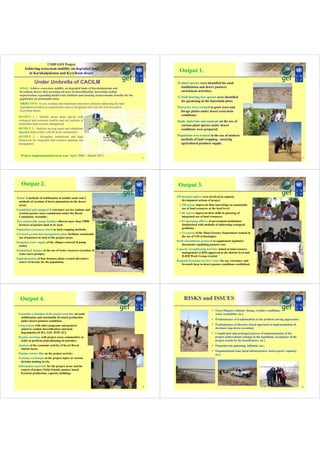
GOAL: Achieve ecosystem stability on degraded lands of Karakalpakstan and 
Kyzylkum desert, thus arresting advance of desertification, increasing carbon 
sequestration, expanding biodiversity habitats and ensuring socioeconomic benefits for the 
population on sustainable basis. 
OBJECTIVE: To test, evaluate and implement innovative solutions addressing the land 
degradation problem at experimental scale in designated sites near the Aral Sea and in 
Kyzylkum desert 
OUTPUT 1 – Identify desert plant species with 
ecological and economic benefits and test methods of 
sustainable land resource management 
OUTPUT 2 – Stabilize moving sands and rehabilitate 
degraded lands jointly with the local communities 
OUTPUT 3 – Strengthen institutional and legal 
framework for integrated land resource planning and 
management 
Project implementation term was: April 2008 – March 2013 
1 
UNDP-GEF Project 
Achieving ecosystem stability on degraded land 
in Karakalpakstan and Kyzylkum desert 
Under Umbrella of CACILM 
Output 1. 
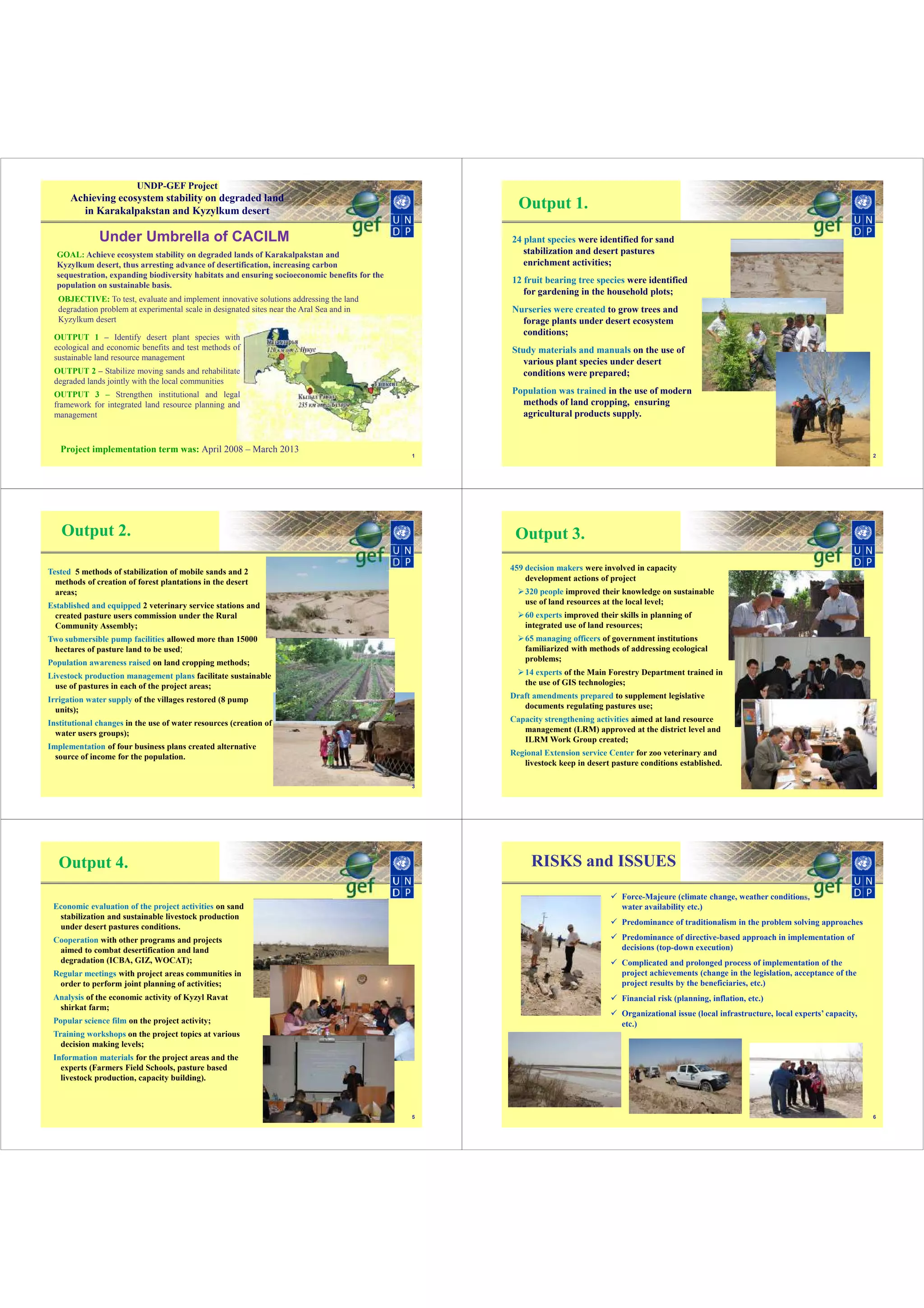
24 plant species were identified for sand 
stabilization and desert pastures 
enrichment activities; 
12 fruit bearing tree species were identified 
for gardening in the household plots; 
Nurseries were created to grow trees and 
forage plants under desert ecosystem 
conditions; 
Study materials and manuals on the use of 
various plant species under desert 
conditions were prepared; 
Population was trained in the use of modern 
methods of land cropping, ensuring 
agricultural products supply. 
2 
Output 2. 
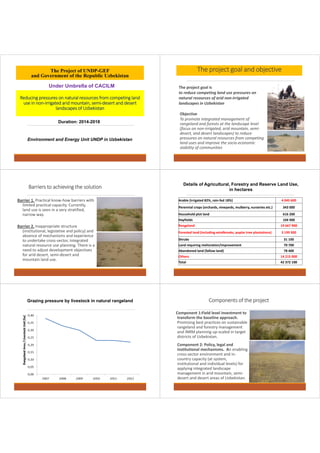
Tested 5 methods of stabilization of mobile sands and 2 
methods of creation of forest plantations in the desert 
areas; 
Established and equipped 2 veterinary service stations and 
created pasture users commission under the Rural 
Community Assembly; 
Two submersible pump facilities allowed more than 15000 
hectares of pasture land to be used; 
Population awareness raised on land cropping methods; 
Livestock production management plans facilitate sustainable 
use of pastures in each of the project areas; 
Irrigation water supply of the villages restored (8 pump 
units); 
Institutional changes in the use of water resources (creation of 
water users groups); 
Implementation of four business plans created alternative 
source of income for the population. 
3 
Output 3. 
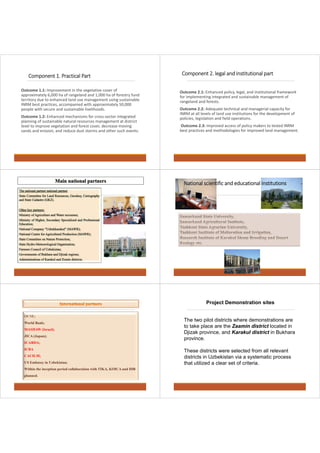
459 decision makers were involved in capacity 
development actions of project 
320 people improved their knowledge on sustainable 
use of land resources at the local level; 
60 experts improved their skills in planning of 
integrated use of land resources; 
65 managing officers of government institutions 
familiarized with methods of addressing ecological 
problems; 
14 experts of the Main Forestry Department trained in 
the use of GIS technologies; 
Draft amendments prepared to supplement legislative 
documents regulating pastures use; 
Capacity strengthening activities aimed at land resource 
management (LRM) approved at the district level and 
ILRM Work Group created; 
Regional Extension service Center for zoo veterinary and 
livestock keep in desert pasture conditions established. 
4 
Output 4. 
Economic evaluation of the project activities on sand 
stabilization and sustainable livestock production 
under desert pastures conditions. 
Cooperation with other programs and projects 
aimed to combat desertification and land 
degradation (ICBA, GIZ, WOCAT); 
Regular meetings with project areas communities in 
order to perform joint planning of activities; 
Analysis of the economic activity of Kyzyl Ravat 
shirkat farm; 
Popular science film on the project activity; 
Training workshops on the project topics at various 
decision making levels; 
Information materials for the project areas and the 
experts (Farmers Field Schools, pasture based 
livestock production, capacity building). 
5 
RISKS and ISSUES 
 Force-Majeure (climate change, weather conditions, 
water availability etc.) 
 Predominance of traditionalism in the problem solving approaches 
 Predominance of directive-based approach in implementation of 
decisions (top-down execution) 
 Complicated and prolonged process of implementation of the 
project achievements (change in the legislation, acceptance of the 
project results by the beneficiaries, etc.) 
 Financial risk (planning, inflation, etc.) 
 Organizational issue (local infrastructure, local experts’ capacity, 
etc.) 
6
The Project of UNDP-GEF 
and Government of the Republic Uzbekistan 
Under Umbrella of CACILM 
Reducing pressures on natural resources from competing land 
use in non-irrigated arid mountain, semi-desert and desert 
landscapes of Uzbekistan 
Duration: 2014-2018 
Environment and Energy Unit UNDP in Uzbekistan 
The project goal and objective 
Objective 
To promote integrated management of 
rangeland and forests at the landscape level 
(focus on non-irrigated, arid mountain, semi-desert, 
and desert landscapes) to reduce 
pressures on natural resources from competing 
land uses and improve the socio-economic 
stability of communities 
Проект SLM-UNDP/GEF 
SGP.UZ 
The project goal is 
to reduce competing land use pressures on 
natural resources of arid non-irrigated 
landscapes in Uzbekistan 
Barriers to achieving the solution 
Barrier 1. Practical know-how barriers with 
limited practical capacity. Currently, 
land use is seen in a very stratified, 
narrow way. 
Barrier 2. Inappropriate structure 
(institutional, legislative and policy) and 
absence of mechanisms and experience 
to undertake cross-sector, integrated 
natural resource use planning. There is a 
need to adjust development objectives 
for arid desert, semi-desert and 
mountain land use. 
Details of Agricultural, Forestry and Reserve Land Use, 
in hectares 
Arable (irrigated 82%, rain-fed 18%) 4 045 600 
Perennial crops (orchards, vineyards, mulberry, nurseries etc.) 343 000 
Household plot land 616 200 
Hayfields 104 900 
Rangeland 19 667 900 
Forested land (including windbreaks, poplar tree plantations) 3 199 300 
Shrubs 31 100 
Land requiring melioration/improvement 70 700 
Abandoned land (fallow land) 78 400 
Others 14 215 000 
Total 42 372 100 
Grazing pressure by livestock in natural rangeland Components of the project 
Component 1:Field level investment to 
transform the baseline approach. 
Promising best practices on sustainable 
rangeland and forestry management 
and INRM planning up-scaled in target 
districts of Uzbekistan. 
Component 2: Policy, legal and 
institutional mechanisms. An enabling 
cross-sector environment and in-country 
capacity (at system, 
institutional and individual levels) for 
applying integrated landscape 
management in arid mountain, semi-desert 
and desert areas of Uzbekistan. 
Фото А. Раббимова
Component 1. Practical Part 
Outcome 1.1: Improvement in the vegetative cover of 
approximately 6,000 ha of rangeland and 1,000 ha of forestry fund 
territory due to enhanced land use management using sustainable 
INRM best practices, accompanied with approximately 50,000 
people with secure and sustainable livelihoods. 
Outcome 1.2: Enhanced mechanisms for cross-sector integrated 
planning of sustainable natural resources management at district 
level to improve vegetation and forest cover, decrease moving 
sands and erosion, and reduce dust storms and other such events. 
Component 2. legal and institutional part 
Outcome 2.1: Enhanced policy, legal, and institutional framework 
for implementing integrated and sustainable management of 
rangeland and forests. 
Outcome 2.2: Adequate technical and managerial capacity for 
INRM at all levels of land use institutions for the development of 
policies, legislation and field operations. 
Outcome 2.3: Improved access of policy makers to tested INRM 
best practices and methodologies for improved land management. 
National scientific and educational iinnssttiittuuttiioonnss 
OCSE; 
World Bank; 
MASHAW (Israel); 
JICA (Japan); 
ICARDA; 
ICBA 
CACILM; 
US Embassy in Uzbekistan; 
Within the inception period collaboration with TIKA, KOICA and IDB 
planned. 
Project Demonstration sites 
The two pilot districts where demonstrations are 
to take place are the Zaamin district located in 
Djizak province, and Karakul district in Bukhara 
province. 
These districts were selected from all relevant 
districts in Uzbekistan via a systematic process 
that utilized a clear set of criteria.
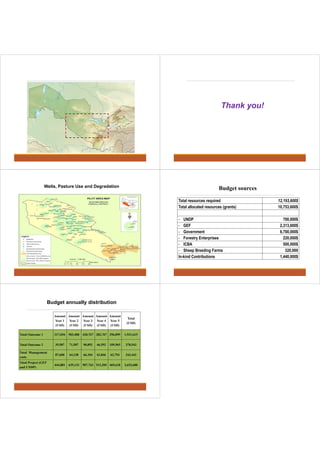
Thank you! 
Wells, Pasture Use and Degradation Budget sources 
Total resources required 12,193,600$ 
Total allocated resources (grants) 10,753,600$ 
- UNDP 700,000$ 
- GEF 2,313,600$ 
- Government 6,700,000$ 
- Forestry Enterprises 220,000$ 
- ICBA 500,000$ 
- Sheep Breeding Farms 320,000 
In-kind Contributions 1,440,000$ 
Budget annually distribution 
Amount 
Year 1 
(USD) 
Amount 
Year 2 
(USD) 
Amount 
Year 3 
(USD) 
Amount 
Year 4 
(USD) 
Amount 
Year 5 
(USD) 
Total 
(USD) 
Total Outcome 1 317,694 503,488 430,767 382,767 296,899 1,931,615 
Total Outcome 2 39,587 71,507 90,892 66,592 109,965 378,543 
Total Management 
costs 
87,600 64,138 66,104 62,846 62,754 343,442 
Total Project (GEF 
and UNDP) 
444,881 639,133 587,763 512,205 469,618 2,653,600

Achieving ecosystem stability on degraded land

  • 1.
    GOAL: Achieve ecosystemstability on degraded lands of Karakalpakstan and Kyzylkum desert, thus arresting advance of desertification, increasing carbon sequestration, expanding biodiversity habitats and ensuring socioeconomic benefits for the population on sustainable basis. OBJECTIVE: To test, evaluate and implement innovative solutions addressing the land degradation problem at experimental scale in designated sites near the Aral Sea and in Kyzylkum desert OUTPUT 1 – Identify desert plant species with ecological and economic benefits and test methods of sustainable land resource management OUTPUT 2 – Stabilize moving sands and rehabilitate degraded lands jointly with the local communities OUTPUT 3 – Strengthen institutional and legal framework for integrated land resource planning and management Project implementation term was: April 2008 – March 2013 1 UNDP-GEF Project Achieving ecosystem stability on degraded land in Karakalpakstan and Kyzylkum desert Under Umbrella of CACILM Output 1. 24 plant species were identified for sand stabilization and desert pastures enrichment activities; 12 fruit bearing tree species were identified for gardening in the household plots; Nurseries were created to grow trees and forage plants under desert ecosystem conditions; Study materials and manuals on the use of various plant species under desert conditions were prepared; Population was trained in the use of modern methods of land cropping, ensuring agricultural products supply. 2 Output 2. Tested 5 methods of stabilization of mobile sands and 2 methods of creation of forest plantations in the desert areas; Established and equipped 2 veterinary service stations and created pasture users commission under the Rural Community Assembly; Two submersible pump facilities allowed more than 15000 hectares of pasture land to be used; Population awareness raised on land cropping methods; Livestock production management plans facilitate sustainable use of pastures in each of the project areas; Irrigation water supply of the villages restored (8 pump units); Institutional changes in the use of water resources (creation of water users groups); Implementation of four business plans created alternative source of income for the population. 3 Output 3. 459 decision makers were involved in capacity development actions of project 320 people improved their knowledge on sustainable use of land resources at the local level; 60 experts improved their skills in planning of integrated use of land resources; 65 managing officers of government institutions familiarized with methods of addressing ecological problems; 14 experts of the Main Forestry Department trained in the use of GIS technologies; Draft amendments prepared to supplement legislative documents regulating pastures use; Capacity strengthening activities aimed at land resource management (LRM) approved at the district level and ILRM Work Group created; Regional Extension service Center for zoo veterinary and livestock keep in desert pasture conditions established. 4 Output 4. Economic evaluation of the project activities on sand stabilization and sustainable livestock production under desert pastures conditions. Cooperation with other programs and projects aimed to combat desertification and land degradation (ICBA, GIZ, WOCAT); Regular meetings with project areas communities in order to perform joint planning of activities; Analysis of the economic activity of Kyzyl Ravat shirkat farm; Popular science film on the project activity; Training workshops on the project topics at various decision making levels; Information materials for the project areas and the experts (Farmers Field Schools, pasture based livestock production, capacity building). 5 RISKS and ISSUES Force-Majeure (climate change, weather conditions, water availability etc.) Predominance of traditionalism in the problem solving approaches Predominance of directive-based approach in implementation of decisions (top-down execution) Complicated and prolonged process of implementation of the project achievements (change in the legislation, acceptance of the project results by the beneficiaries, etc.) Financial risk (planning, inflation, etc.) Organizational issue (local infrastructure, local experts’ capacity, etc.) 6
  • 2.
    The Project ofUNDP-GEF and Government of the Republic Uzbekistan Under Umbrella of CACILM Reducing pressures on natural resources from competing land use in non-irrigated arid mountain, semi-desert and desert landscapes of Uzbekistan Duration: 2014-2018 Environment and Energy Unit UNDP in Uzbekistan The project goal and objective Objective To promote integrated management of rangeland and forests at the landscape level (focus on non-irrigated, arid mountain, semi-desert, and desert landscapes) to reduce pressures on natural resources from competing land uses and improve the socio-economic stability of communities Проект SLM-UNDP/GEF SGP.UZ The project goal is to reduce competing land use pressures on natural resources of arid non-irrigated landscapes in Uzbekistan Barriers to achieving the solution Barrier 1. Practical know-how barriers with limited practical capacity. Currently, land use is seen in a very stratified, narrow way. Barrier 2. Inappropriate structure (institutional, legislative and policy) and absence of mechanisms and experience to undertake cross-sector, integrated natural resource use planning. There is a need to adjust development objectives for arid desert, semi-desert and mountain land use. Details of Agricultural, Forestry and Reserve Land Use, in hectares Arable (irrigated 82%, rain-fed 18%) 4 045 600 Perennial crops (orchards, vineyards, mulberry, nurseries etc.) 343 000 Household plot land 616 200 Hayfields 104 900 Rangeland 19 667 900 Forested land (including windbreaks, poplar tree plantations) 3 199 300 Shrubs 31 100 Land requiring melioration/improvement 70 700 Abandoned land (fallow land) 78 400 Others 14 215 000 Total 42 372 100 Grazing pressure by livestock in natural rangeland Components of the project Component 1:Field level investment to transform the baseline approach. Promising best practices on sustainable rangeland and forestry management and INRM planning up-scaled in target districts of Uzbekistan. Component 2: Policy, legal and institutional mechanisms. An enabling cross-sector environment and in-country capacity (at system, institutional and individual levels) for applying integrated landscape management in arid mountain, semi-desert and desert areas of Uzbekistan. Фото А. Раббимова
  • 3.
    Component 1. PracticalPart Outcome 1.1: Improvement in the vegetative cover of approximately 6,000 ha of rangeland and 1,000 ha of forestry fund territory due to enhanced land use management using sustainable INRM best practices, accompanied with approximately 50,000 people with secure and sustainable livelihoods. Outcome 1.2: Enhanced mechanisms for cross-sector integrated planning of sustainable natural resources management at district level to improve vegetation and forest cover, decrease moving sands and erosion, and reduce dust storms and other such events. Component 2. legal and institutional part Outcome 2.1: Enhanced policy, legal, and institutional framework for implementing integrated and sustainable management of rangeland and forests. Outcome 2.2: Adequate technical and managerial capacity for INRM at all levels of land use institutions for the development of policies, legislation and field operations. Outcome 2.3: Improved access of policy makers to tested INRM best practices and methodologies for improved land management. National scientific and educational iinnssttiittuuttiioonnss OCSE; World Bank; MASHAW (Israel); JICA (Japan); ICARDA; ICBA CACILM; US Embassy in Uzbekistan; Within the inception period collaboration with TIKA, KOICA and IDB planned. Project Demonstration sites The two pilot districts where demonstrations are to take place are the Zaamin district located in Djizak province, and Karakul district in Bukhara province. These districts were selected from all relevant districts in Uzbekistan via a systematic process that utilized a clear set of criteria.
  • 4.
    Thank you! Wells,Pasture Use and Degradation Budget sources Total resources required 12,193,600$ Total allocated resources (grants) 10,753,600$ - UNDP 700,000$ - GEF 2,313,600$ - Government 6,700,000$ - Forestry Enterprises 220,000$ - ICBA 500,000$ - Sheep Breeding Farms 320,000 In-kind Contributions 1,440,000$ Budget annually distribution Amount Year 1 (USD) Amount Year 2 (USD) Amount Year 3 (USD) Amount Year 4 (USD) Amount Year 5 (USD) Total (USD) Total Outcome 1 317,694 503,488 430,767 382,767 296,899 1,931,615 Total Outcome 2 39,587 71,507 90,892 66,592 109,965 378,543 Total Management costs 87,600 64,138 66,104 62,846 62,754 343,442 Total Project (GEF and UNDP) 444,881 639,133 587,763 512,205 469,618 2,653,600