Branding & AdvertisingSouth KoreaEnrique TorresProfessor C. SurisMMC 3602
Brands		Brands are the very thing advertising tries to sell you (the topic of advertising will be covered in more detail in the following slides). It is any given name to a certain product, be it a car, a clothing line, or food. 		In South Korea, there are (obviously) many brands to choose from—all of varying quality and accessibility.
Brands (Continued)		Many of these decide to incorporate a slogan (which is a catchy phrase that somewhat summarizes what the product is about).  		Additionally,  brands are almost always represented by a logo that renders the product immediately recognizable by interpreting the product as an image or something similar.
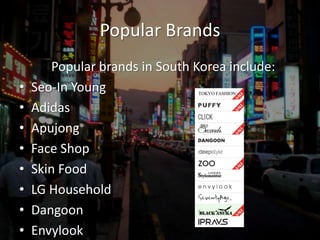
Popular Brands		Popular brands in South Korea include:Seo-In YoungAdidasApujongFace ShopSkin FoodLG HouseholdDangoonEnvylook
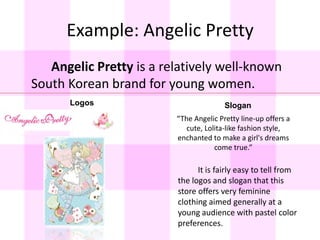
Example: Angelic Pretty		Angelic Pretty is a relatively well-known South Korean brand for young women.LogosSlogan“The Angelic Pretty line-up offers a cute, Lolita-like fashion style, enchanted to make a girl's dreams come true.”		It is fairly easy to tell from the logos and slogan that this store offers very feminine clothing aimed generally at a young audience with pastel color preferences.
Relationship to Advertising		Now that the concepts of brands, slogans and logos are clear, it is necessary to understand that these parts that help sell a product wouldn’t sell were it not for advertising. Without proper advertising, a product can be rendered relatively unpopular to other brands that handle this aspect of properly.
Advertising		In all my research, I found one nearly-perfect definition of this term.		“Advertising is the economic glue that holds 	most media industries together.”		Advertising is helps spread the popularity of a product by placing its logo, slogan, or product in such a way to attract customers. In South Korea, like in many other countries, advertising plays a huge role.
Advertising (Continued)		South Korea has allowed advertising to occur in all aspects of their culture (for instance, television allows ads to run in between shows). Through various methods, South Koreans are much more subject to advertising than they would probably believe—it’s an inescapable force persuading them to purchase products from brands.
Advertisement Agencies		There are many popular advertising agencies in South Korea.  In fact, it is the ninth most prominent industries worldwide (approx. $6.1 billion). Some of the more popular agencies in 2008 are as follows:Samsung Group:  includes a major specialization on electronics and entertainment industries. SK Telecom: focuses on the telecommunications operations.LG Group:  deals with telecommunications, electronics, and chemicals.KTF: recently merges with KT, also dealing with telecommunicationsHyundai Motors:  automakers (one of the biggest worldwide)AIG: focuses on insuranceKT Group: telecommunications
Advertisement Agencies (Continued)		However, these are some of the most important advertisement agencies:Cheil Communications: focuses on communication methods for advertising and public relations.
Oricom Inc.: also has counterpart in Japan—in Korea, it specifically deals with advertising businesses.
McCann Erickson: is a global marketing communications world group.
PublicisWelcomm: a French communication network that works with Dentsu in order to reach Japanese and Korean territories.Where is advertising found?		Advertising can be found through many media in South Korean society. Some of them include:TelevisionNewspapersMagazinesMusic VideosInternet
Types of Ads		Ads seem to take part in many forms. They can occur through product placements, by applying the association principle, running them in between programs in television, or even in print. In the following slides, some of the most effective forms of advertising will be explained.
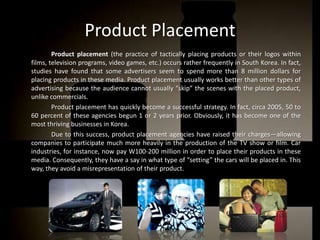
Product Placement		Product placement (the practice of tactically placing products or their logos within films, television programs, video games, etc.) occurs rather frequently in South Korea. In fact, studies have found that some advertisers seem to spend more than 8 million dollars for placing products in these media. Product placement usually works better than other types of advertising because the audience cannot usually “skip” the scenes with the placed product, unlike commercials.		Product placement has quickly become a successful strategy. In fact, circa 2005, 50 to 60 percent of these agencies begun 1 or 2 years prior. Obviously, it has become one of the most thriving businesses in Korea.		Due to this success, product placement agencies have raised their charges—allowing companies to participate much more heavily in the production of the TV show or film. Car industries, for instance, now pay W100-200 million in order to place their products in these media. Consequently, they have a say in what type of “setting” the cars will be placed in. This way, they avoid a misrepresentation of their product.
Internet		The Internet has proven to be the most effective way to reach potential customers. Obviously, many advertising agencies have made a note of this and have been practicing placing advertisements on websites with a large amount of visitors.		 In 2004, online advertising garnered about $480 million—in 2005, it garnered approximately $630 million (an almost 30 percent increase). It is believed by experts that these revenues will keep increasing exponentially for the upcoming years.		Therefore, in Korea, the Internet is frequently viewed as the factor for the slow elimination of other media, such as newspapers, television and magazines. While it is currently not the form of media with the highest amount of shares, its quick growth will make it the most profitable method within a few years.
Television		Television is the second most popular method of advertisement in South Korea (after the Internet). Advertisements in television take place during commercials between television programs (sometimes even extended commercials lasting 1 to 2 minutes). 		An interesting exception South Korea has made in regard to advertisements are for “junk foods.” Since 30% of the ads on television are about unhealthy types of food (such as soft drinks and sweets), the health ministry has decided to put a limit to these commercials. While junk food ads are still allowed to be aired, they have been prohibited from airing at any time between 5PM and 7PM; also, they have been forbidden to air in between any programs aimed at children.		This form of advertisement has been threatened by the efficiency and speed of advertising online (as have other forms of media). While still being an important factor in advertising, its influence and relevance is gradually decreasing.
Television (Video)This is an example of a commercial on South Korean television:
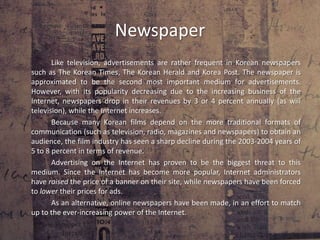
Newspaper		Like television, advertisements are rather frequent in Korean newspapers such as The Korean Times, The Korean Herald and Korea Post. The newspaper is approximated to be the second most important medium for advertisements. However, with its popularity decreasing due to the increasing business of the Internet, newspapers drop in their revenues by 3 or 4 percent annually (as will television), while the Internet increases.		Because many Korean films depend on the more traditional formats of communication (such as television, radio, magazines and newspapers) to obtain an audience, the film industry has seen a sharp decline during the 2003-2004 years of 5 to 8 percent in terms of revenue. 		Advertising on the Internet has proven to be the biggest threat to this medium. Since the Internet has become more popular, Internet administrators have raised the price of a banner on their site, while newspapers have been forced to lower their prices for ads.		As an alternative, online newspapers have been made, in an effort to match up to the ever-increasing power of the Internet.
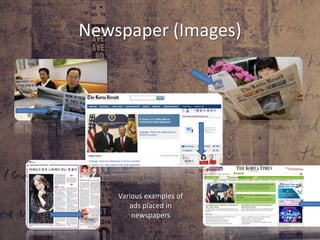
Newspaper (Images)Various examples of ads placed in newspapers
Magazines		South Korean magazines (such as Elle Korea, Esquire, Kid HK and the Korea Economic Report) all play a role in delivering messages that advertising agencies wish to deliver to the South Korean audience. However, much like newspapers and television, the effect that magazines have, in terms of sales, has become relatively meaningless. 		In fact, magazines only have shares of about 4 percent in Korea—a very small amount compared to the television (33.5 percent) and newspapers (26.4 percent).
Music Videos		Nowadays, many artists use product placement (explained previously) in order to make a brand more popular via music fans. Music fans will usually not sacrifice missing out on scenes of the music video in order to avoid seeing products. In fact, seeing one’s favorite celebrity wearing designer clothing, for example, might cause a fan to want to purchase that exact same product to feel as if one has “something in common” with the artist. 		Another popular variation of product placement in music videos are “commercial films,” which will be explained in detail after this example.
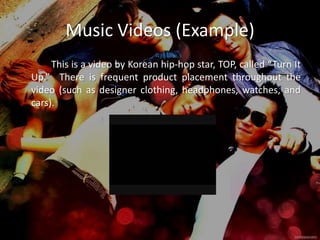
Music Videos (Example)		This is a video by Korean hip-hop star, TOP, called “Turn It Up.”  There is frequent product placement throughout the video (such as designer clothing, headphones, watches, and cars).
Commercial Films		As a variation of product placement in music videos, some advertising agencies take almost full control of what occurs in an artist’s music video—because they sponsor it. In essence, the music video is a commercial playing along to a song (which is more than likely then released as a single) for about 3 or 4 minutes (with some channels making 30 second clips to use as commercials in television).
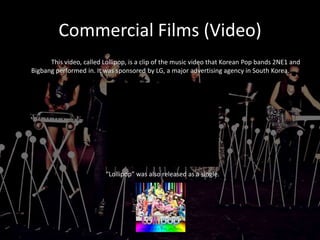
Commercial Films (Video)		This video, called Lollipop, is a clip of the music video that Korean Pop bands 2NE1 and Bigbang performed in. It was sponsored by LG, a major advertising agency in South Korea.“Lollipop” was also released as a single.
How Advertising Affects Women
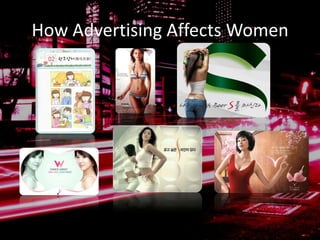
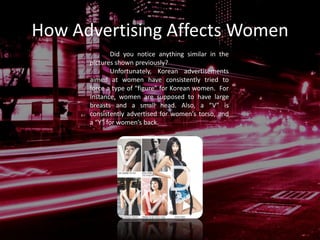
How Advertising Affects Women		Did you notice anything similar in the pictures shown previously? 		Unfortunately, Korean advertisements aimed at women have consistently tried to force a type of “figure” for Korean women.  For instance, women are supposed to have large breasts and a small head. Also, a “V” is consistently advertised for women’s torso, and a “Y” for women’s back.
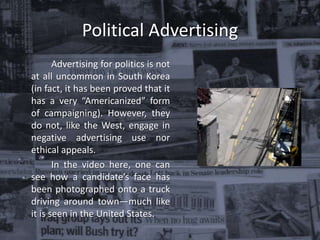
Political Advertising		Advertising for politics is not at all uncommon in South Korea (in fact, it has been proved that it has a very “Americanized” form of campaigning). However, they do not, like the West, engage in negative advertising use nor ethical appeals.		In the video here, one can see how a candidate’s face has been photographed onto a truck driving around town—much like it is seen in the United States.
Thanks for watching!

MMC-3602 South Korea (Presentation)

  • 1.
    Branding & AdvertisingSouthKoreaEnrique TorresProfessor C. SurisMMC 3602
  • 2.
    Brands Brands are thevery thing advertising tries to sell you (the topic of advertising will be covered in more detail in the following slides). It is any given name to a certain product, be it a car, a clothing line, or food. In South Korea, there are (obviously) many brands to choose from—all of varying quality and accessibility.
  • 3.
    Brands (Continued) Many ofthese decide to incorporate a slogan (which is a catchy phrase that somewhat summarizes what the product is about). Additionally, brands are almost always represented by a logo that renders the product immediately recognizable by interpreting the product as an image or something similar.
  • 4.
    Popular Brands Popular brandsin South Korea include:Seo-In YoungAdidasApujongFace ShopSkin FoodLG HouseholdDangoonEnvylook
  • 5.
    Example: Angelic Pretty AngelicPretty is a relatively well-known South Korean brand for young women.LogosSlogan“The Angelic Pretty line-up offers a cute, Lolita-like fashion style, enchanted to make a girl's dreams come true.” It is fairly easy to tell from the logos and slogan that this store offers very feminine clothing aimed generally at a young audience with pastel color preferences.
  • 6.
    Relationship to Advertising Nowthat the concepts of brands, slogans and logos are clear, it is necessary to understand that these parts that help sell a product wouldn’t sell were it not for advertising. Without proper advertising, a product can be rendered relatively unpopular to other brands that handle this aspect of properly.
  • 7.
    Advertising In all myresearch, I found one nearly-perfect definition of this term. “Advertising is the economic glue that holds most media industries together.” Advertising is helps spread the popularity of a product by placing its logo, slogan, or product in such a way to attract customers. In South Korea, like in many other countries, advertising plays a huge role.
  • 8.
    Advertising (Continued) South Koreahas allowed advertising to occur in all aspects of their culture (for instance, television allows ads to run in between shows). Through various methods, South Koreans are much more subject to advertising than they would probably believe—it’s an inescapable force persuading them to purchase products from brands.
  • 9.
    Advertisement Agencies There aremany popular advertising agencies in South Korea. In fact, it is the ninth most prominent industries worldwide (approx. $6.1 billion). Some of the more popular agencies in 2008 are as follows:Samsung Group: includes a major specialization on electronics and entertainment industries. SK Telecom: focuses on the telecommunications operations.LG Group: deals with telecommunications, electronics, and chemicals.KTF: recently merges with KT, also dealing with telecommunicationsHyundai Motors: automakers (one of the biggest worldwide)AIG: focuses on insuranceKT Group: telecommunications
  • 10.
    Advertisement Agencies (Continued) However,these are some of the most important advertisement agencies:Cheil Communications: focuses on communication methods for advertising and public relations.
  • 11.
    Oricom Inc.: alsohas counterpart in Japan—in Korea, it specifically deals with advertising businesses.
  • 12.
    McCann Erickson: isa global marketing communications world group.
  • 13.
    PublicisWelcomm: a Frenchcommunication network that works with Dentsu in order to reach Japanese and Korean territories.Where is advertising found? Advertising can be found through many media in South Korean society. Some of them include:TelevisionNewspapersMagazinesMusic VideosInternet
  • 14.
    Types of Ads Adsseem to take part in many forms. They can occur through product placements, by applying the association principle, running them in between programs in television, or even in print. In the following slides, some of the most effective forms of advertising will be explained.
  • 15.
    Product Placement Product placement(the practice of tactically placing products or their logos within films, television programs, video games, etc.) occurs rather frequently in South Korea. In fact, studies have found that some advertisers seem to spend more than 8 million dollars for placing products in these media. Product placement usually works better than other types of advertising because the audience cannot usually “skip” the scenes with the placed product, unlike commercials. Product placement has quickly become a successful strategy. In fact, circa 2005, 50 to 60 percent of these agencies begun 1 or 2 years prior. Obviously, it has become one of the most thriving businesses in Korea. Due to this success, product placement agencies have raised their charges—allowing companies to participate much more heavily in the production of the TV show or film. Car industries, for instance, now pay W100-200 million in order to place their products in these media. Consequently, they have a say in what type of “setting” the cars will be placed in. This way, they avoid a misrepresentation of their product.
  • 16.
    Internet The Internet hasproven to be the most effective way to reach potential customers. Obviously, many advertising agencies have made a note of this and have been practicing placing advertisements on websites with a large amount of visitors. In 2004, online advertising garnered about $480 million—in 2005, it garnered approximately $630 million (an almost 30 percent increase). It is believed by experts that these revenues will keep increasing exponentially for the upcoming years. Therefore, in Korea, the Internet is frequently viewed as the factor for the slow elimination of other media, such as newspapers, television and magazines. While it is currently not the form of media with the highest amount of shares, its quick growth will make it the most profitable method within a few years.
  • 17.
    Television Television is thesecond most popular method of advertisement in South Korea (after the Internet). Advertisements in television take place during commercials between television programs (sometimes even extended commercials lasting 1 to 2 minutes). An interesting exception South Korea has made in regard to advertisements are for “junk foods.” Since 30% of the ads on television are about unhealthy types of food (such as soft drinks and sweets), the health ministry has decided to put a limit to these commercials. While junk food ads are still allowed to be aired, they have been prohibited from airing at any time between 5PM and 7PM; also, they have been forbidden to air in between any programs aimed at children. This form of advertisement has been threatened by the efficiency and speed of advertising online (as have other forms of media). While still being an important factor in advertising, its influence and relevance is gradually decreasing.
  • 18.
    Television (Video)This isan example of a commercial on South Korean television:
  • 19.
    Newspaper Like television, advertisementsare rather frequent in Korean newspapers such as The Korean Times, The Korean Herald and Korea Post. The newspaper is approximated to be the second most important medium for advertisements. However, with its popularity decreasing due to the increasing business of the Internet, newspapers drop in their revenues by 3 or 4 percent annually (as will television), while the Internet increases. Because many Korean films depend on the more traditional formats of communication (such as television, radio, magazines and newspapers) to obtain an audience, the film industry has seen a sharp decline during the 2003-2004 years of 5 to 8 percent in terms of revenue. Advertising on the Internet has proven to be the biggest threat to this medium. Since the Internet has become more popular, Internet administrators have raised the price of a banner on their site, while newspapers have been forced to lower their prices for ads. As an alternative, online newspapers have been made, in an effort to match up to the ever-increasing power of the Internet.
  • 20.
    Newspaper (Images)Various examplesof ads placed in newspapers
  • 21.
    Magazines South Korean magazines(such as Elle Korea, Esquire, Kid HK and the Korea Economic Report) all play a role in delivering messages that advertising agencies wish to deliver to the South Korean audience. However, much like newspapers and television, the effect that magazines have, in terms of sales, has become relatively meaningless. In fact, magazines only have shares of about 4 percent in Korea—a very small amount compared to the television (33.5 percent) and newspapers (26.4 percent).
  • 22.
    Music Videos Nowadays, manyartists use product placement (explained previously) in order to make a brand more popular via music fans. Music fans will usually not sacrifice missing out on scenes of the music video in order to avoid seeing products. In fact, seeing one’s favorite celebrity wearing designer clothing, for example, might cause a fan to want to purchase that exact same product to feel as if one has “something in common” with the artist. Another popular variation of product placement in music videos are “commercial films,” which will be explained in detail after this example.
  • 23.
    Music Videos (Example) Thisis a video by Korean hip-hop star, TOP, called “Turn It Up.” There is frequent product placement throughout the video (such as designer clothing, headphones, watches, and cars).
  • 24.
    Commercial Films As avariation of product placement in music videos, some advertising agencies take almost full control of what occurs in an artist’s music video—because they sponsor it. In essence, the music video is a commercial playing along to a song (which is more than likely then released as a single) for about 3 or 4 minutes (with some channels making 30 second clips to use as commercials in television).
  • 25.
    Commercial Films (Video) Thisvideo, called Lollipop, is a clip of the music video that Korean Pop bands 2NE1 and Bigbang performed in. It was sponsored by LG, a major advertising agency in South Korea.“Lollipop” was also released as a single.
  • 26.
  • 27.
    How Advertising AffectsWomen Did you notice anything similar in the pictures shown previously? Unfortunately, Korean advertisements aimed at women have consistently tried to force a type of “figure” for Korean women. For instance, women are supposed to have large breasts and a small head. Also, a “V” is consistently advertised for women’s torso, and a “Y” for women’s back.
  • 28.
    Political Advertising Advertising forpolitics is not at all uncommon in South Korea (in fact, it has been proved that it has a very “Americanized” form of campaigning). However, they do not, like the West, engage in negative advertising use nor ethical appeals. In the video here, one can see how a candidate’s face has been photographed onto a truck driving around town—much like it is seen in the United States.
  • 29.